


One might break research questions about gender and politics over time into two basic categories. On the one hand, there are questions that speak to processes unfolding, perhaps rather slowly, over time. In this long-haul category, we might find studies of such things as generational shifts in patterns of attitudes about gendered political roles (Jennings Reference Jennings2006) or of the development of gendered national identities with evolving constitutional interpretations (Ritter Reference Ritter2006). On the other hand, there are inquiries about the dynamics, or instability, of shorter-run patterns. These intellectual pursuits might include seeking to explain short-haul phenomena like changes in partisan gaps between men and women, perhaps even within the duration of a single campaign season (Sapiro and Conover Reference Sapiro and Conover1997). Both categories, of course, are incredibly important realms of inquiry. My argument is for improvements in our studies of shorter-term dynamics and, ultimately, for the integration of studies of both short- and long-run processes, with improved measurement and modeling strategies as the crucial tools we need to get there.
Consider, as a motivating and important example, the revealed dynamics in the various phenomena that have been termed “gender gaps” in the American context: aggregate differences in men's and women's partisanship, policy positions, and voting behavior (e.g., Miller and Shanks Reference Miller and Shanks1996; Welch and Sigelman Reference Welch and Sigelman1989; Wirls Reference Wirls1986). Cumulating the findings of previous, often cross-sectional, analyses of these gender gaps reveals the waxing and waning of aggregate differences between the sexes. Indeed, looking over three decades of General Social Survey data, Virginia Sapiro Reference Sapiro, Sears, Huddy and Jervis(2003) highlights inconsistent patterns of difference in opinion between American men and women on a host of policy issues and draws the conclusion that “the existence and magnitude of gender differences on the same political issues or objects depend on the historical moment” (p. 609). Similarly, when scholars have charted aggregate differences in partisan identification and candidate preference over time, as Karen Kaufmann and John Petrocik Reference Kaufmann and Petrocik(1999) did through more than four decades of National Election Study data, and Janet Box-Steffensmeier, Suzanna DeBoef, and Tse-min Lin Reference Box-Steffensmeier, DeBoef and Lin(2004) did with quarterly news polls reaching back into the 1970s, patterns of growth and recess have complicated the questions we ask about gender differences. Although taking the long view has led us to questions about the causes of fluctuations, long-term processes—like socialization, or slowly cumulating changes in differences in men's and women's education levels or work experiences—cannot explain such short-term dynamics. We need variables that move in the short run, and hence have turned to the idea of context. Perhaps something in particular campaign seasons resonated differently among women than men, or maybe a sudden economic change had differential effects on men and women (Welch and Hibbing Reference Welch and Hibbing1992). For example, many scholars wanted to know the gendered consequences of the “year of the woman,” the 1992 election season that produced a relative bumper crop of female senators, for partisan leanings and voting behavior (e.g., Dolan Reference Dolan1998; Plutzer and Zipp Reference Plutzer and Zipp1996; Sapiro and Conover Reference Sapiro and Conover1997).
The problem, however, is that we are still struggling to account for the micro-foundations of these fluctuating aggregate differences. What makes, to paraphrase Virginia Sapiro and Pamela Conover (Reference Sapiro and Conover1997), the gender basis of elections variable? Without sufficient theory about the mechanisms by which dynamics result, and rigorous analysis thereof, our accounts become episodic. We seem to be explaining exceptions, rather than explaining systematic processes. Consider the difference between asking the questions of “What happened in the year of the woman?” and “How and why are gendered attitudes, identities, and ideologies brought to bear in some political contexts and not others?” Taking the step to the latter, broader question points us in the direction of more useful theoretical work about the unfolding of gendered politics over time. And, I argue, it points specifically to a need for more work that accounts for the interaction of gendered identities and attitudes, social location, and political context. In a way, this is an argument for more self-conscious disaggregation of the concept of “gender,” for us more self-consciously to label gender a metaconcept, to construct meaningfully distinguished concepts within it, and then to model explicitly those concepts and their interactions. The tools I think we need most in order to proceed in this direction are better measurement, particularly of the identity component, and empirical models that explicitly account for the interactions in which we are interested.
What we need in terms of measurement, I think, can be illustrated by turning to the literature on race and politics. This literature has come to a place where its individual-level measurements are more appropriately reflecting the social construction of race. Empirical indicators of race are not just categories checked on a census form or reported to an interviewer, but indicators of the multiple ways in which race is constructed, and the varying degrees to which individuals use race to define themselves. Measures of out-group and in-group stereotyping, or beliefs about typical attributes of racial groups, have a central place (Levine, Carmines, and Sniderman Reference Levine, Carmines and Sniderman1999; Schuman et al. Reference Schuman, Steeh, Bobo and Krysan1997). Race scholars have pushed beyond even stereotypes, however, in pursuit of individuals' internalization of social group boundaries. Thus, there are measures of out-group resentment (Bobo and Smith Reference Bobo, Smith, Katkin, Landsman and Tyree1998; Kinder and Sanders Reference Kinder and Sanders1996; Kinder and Sears Reference Kinder and Sears1981) and perceptions of group-based conflict and competition (Bobo and Hutchings Reference Bobo and Hutchings1996). And there are measures of in-group attachment (Gurin, Miller, and Gurin Reference Gurin, Miller and Gurin1980) and of perceptions of in-group inter-connectedness (Dawson Reference Dawson1994; Sellers et al. 1998). Moreover, race and ethnicity scholars are thinking carefully about what the relevant out-groups and in-groups are. Questions are being forwarded, for instance, about whether Latinos identify as such, or more with their nation-of-origin subgroups (e.g., Jones-Correa and Leal Reference Jones-Correa and Leal1996).
What does the availability of these differentiated measurements of individuals' incorporation of the social construction of race add to explanations of the dynamics of race (and ethnicity) in politics? Quite simply, the measures enable rigorous empirical analysis of nuanced theories about exactly how and why race is brought to bear in political behavior—by whom, in response to what contextual stimuli, and with what effect. There is a growing literature, for example, on how racial cues in communication from political elites introduce racial attitudes into the formulation of public opinion on political figures and policies (Gilens Reference Gilens1996; Kinder and Sanders 1996; Mendelberg Reference Mendelberg2001; Valentino, Hutchings, and White Reference Valentino, Hutchings and White2002). This literature is beginning to tell us what sorts of cues activate particular elements of racial identity, suggesting that the racial content must be implicit for messages to convince white Americans to use their racial out-group attitudes to draw conclusions about the subject (Hurwitz and Peffley Reference Hurwitz and Peffley2005; Mendelberg Reference Mendelberg2001), while explicit race appeals can cause African Americans to form their opinions around their in-group identification (White Reference White2007). With such findings in hand, theoretical arguments can be made about exactly how over-time patterns in public discourse and campaign content push and pull the racial content of public opinion and political behavior—including changes in the “racial divide” between white and black Americans. The key links among identities and attitudes, social location (black versus white in this case), and political contexts can be made.
To say we might benefit from turning to this related literature, however, is not to say that we can simply borrow the approach wholesale. Nor is it to say that gender scholars have not begun to explore the theoretical payoff offered within this more fine-grained realm of measurement. Studies of the political differences that female candidates for office can create, for example, have paid close attention to the influence of gender stereotypes on individuals' candidate evaluations and vote choices. The cumulating results of such studies make an increasingly strong case that gender stereotypes differentiate the evaluations individuals offer of candidates with identical political resumes, but different sexes (Koch Reference Koch2000; Sanbonmatsu Reference Sanbonmatsu2002; Sapiro Reference Sapiro1981). Yet our work on gender identity is still too limited. The studies we do have that employ some measure of gendered group identity generally turn to survey questions that ask how much respondents identify with feminists or how close they feel to women, and these measures do not seem to offer sufficient empirical leverage on questions about differences in men's and women's political behavior (e.g., Conover and Sapiro Reference Conover and Sapiro1993; Cook and Wilcox Reference Cook and Wilcox1991; Sapiro Reference Sapiro, Sears, Huddy and Jervis2003). This suggests, I think, at least two ways in which we need further work that differentiates our approach to measuring gendered identity from the measurement of racial identity, and both involve employing existing gender theory more carefully as we turn to empirical measurement.
First, the measurements for gender identity that we offer must square with our theoretical work on the social construction of gender, much of which points primarily to role differentiation, rather than some other form of group differentiation, such as social segregation. Thus, it would seem that gender identity measures would be more appropriately constructed if they were of identification with roles—where the roles define the social grouping—rather than speaking more closely to physical boundedness of group categories. Second, I think we have not sufficiently thought through in-groups and out-groups in the context of gender identity and its measurement. That is, despite the concept of intersectionality offered to us through feminist (and particularly black feminist) theory (Crenshaw Reference Crenshaw, Cohen, Jones and Tronto[1991] 1997; King Reference King1988; Stewart and McDermott Reference Stewart and McDermott2004), that logic has not been brought to bear in much of our empirical work on how gender affects individual political behavior, including in our measurement strategies. Just as Latino politics scholars are thinking through pan-ethnic identification and national-origin identification, and measuring each of those concepts to test theories about who identifies as what and to what consequence, gender scholars need to think through who identifies with the metacategories of “women” or “men”—and who does not. Moreover, what are the meaningful subcategories within women and men, and how might we assess who identifies with those? And while I may or may not be on the right track with these specific measurement recommendations, resolving this dilemma of developing theoretically meaningful and empirically useful measures of gender identity seems nonetheless key to assessing how and when those identities are brought to bear in politics—and for explaining why specific sets of men and women exhibit different behavior in the short run.
Finally, if our dynamics questions are about placing individual opinion and action in context, then gender scholars ought to be particularly attentive to the resurgent interest in political science in multilevel modeling. Multilevel models place lower-level units in higher-level contexts—perhaps people in time periods—allowing for estimation of the determinants of context, the effects of context on individuals, including the conditioned effect of individual characteristics, as well as other, non-context-specific determinants of individual behavior.Footnote 1 Much of the recent discussion about the utility of multilevel models has been about making cross-national or cross-district comparisons of individual political behavior, asking such questions as how political party position-taking depends on the structure of electoral rules under which the parties operate, or how public support for particular policies might depend on the political regime under which individuals are making their evaluations. We can just as easily think in this framework, however, about modeling how long-run gendered political processes unfold over time at both the macro and micro levels. We could ask, for example, how individuals' issue positions and gender attitudes have structured their preferences for the Republican Party over time, where the time periods have offered contexts with greater or fewer women candidates on the ballot, which might condition the effects of attitudes on partisan preferences. In multilevel model terms, this would give us something like:




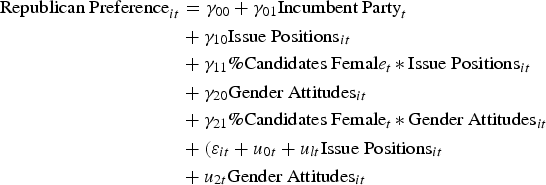
What does this model imply? Equation (1) expresses individual preferences for the Republican Party as a function of issue positions and gender attitudes (each simplified into a single variable for illustration purposes), a constant term, and a stochastic component, ɛ it. Equations (2), (3), and (4) detail how the variables that change only over time (not across individuals) influence preferences for the Republicans. For example, equation (2) implies that the baseline preference for the Republicans in any time period is driven in part by whether or not they are the incumbent party, but also in part by a stochastic process, u 0t. Equation (5) simply rewrites equations (1) through (4) in a single equation. Note that this last equation looks very similar to the standard regression setup, where we might simply interact the context variables with the individual-level variables to capture arguments about how context conditions the relationships between the individual-level variables. The difference from that standard setup is in the last line of equation (5), which highlights that the error term is compound, and, in this case, a function of some of our included variables. Ignoring that difference and proceeding without multilevel modeling techniques at a minimum means we make inefficient use of information. More troubling, it can give us misleading estimates of hypothesized relationships and of our confidence therein (Franzese Reference Franzese2005; Raudenbush and Bryk Reference Raudenbush and Bryk2002).Footnote 2 Although I will not traverse into the details of estimation decisions in this essay, it is worth noting that we have (a growing number of) choices about how to estimate the multilevel models in which we might be interested. And as Robert Franzese Reference Franzese(2005) and Christopher Achen Reference Achen(2005) spell out, care must be taken in making those choices.
Ending with this idea of multilevel modeling, I hope, underscores that even for those interested in questions of individual-level experiences of gendered politics over the short haul, deep understanding of historical context matters. In the most technical sense, it matters because correctly entering it into our empirical models improves their estimation. In the broader theoretical sense, the point is simply that there is much to be gained by distinguishing, but not completely separating, the gendering of politics over the short and long runs.


