Introduction
The good news is that warfare appears to be declining worldwide (see Goldstein Reference Goldstein2011; Pinker Reference Pinker2011). But to those suffering war’s daily ravages and indelible legacies, numbers matter little. Nor is there comfort to be drawn from the uneven global distribution of armed violence and conflict. Africa has witnessed a third of all recorded armed conflicts since 1946, suffered forty-six major and minor conflicts since 1989 (out of 137), and hosted more ongoing and new conflicts in 2011 than any other region in the world (15 out of 37). As with the global trend since World War II, far more armed conflicts have occurred within African states than between them (Themnér & Wallensteen Reference Themnér and Wallensteen2012). In the twentieth century, Africa was one of the most important laboratories of modern war (Reno Reference Reno2011). In the twenty-first century, Africa has become a major laboratory for peace, a landscape of U.N. missions, Millennium Villages, and thousands of other sites, actors, and technologies. Complementing this transnational neoliberal technocracy of peacebuilding is the recent surge in the study of intrastate and substate warfare. Civil conflicts, which peaked in number in the mid-1990s, only began to receive significant scholarly attention following the end of the Cold War. The past two decades have seen an explosion in research on the causes and dynamics of internal wars, much of that research focused on Africa.
The political warrant for most research on civil conflicts is clear enough. First, if the root causes of civil conflicts can be identified, then it might be possible to prevent them. Second, if the dynamics of ongoing conflicts can be understood, then it might be possible to interrupt them before the violence spirals into decades of killing, mass atrocities, or genocide. The search for root causes initially zeroed in on the question of identity. The putative end of ideology and the return to primordial identities after the Cold War, as infamously heralded by Huntington (Reference Huntington1992), initially prompted much interest in the ethnic and religious claims of civil conflict participants. Attacks on this approach quickly appeared (see Bowen 1996; Brubaker & Laitin Reference Brubaker and Laitin1998; Mueller Reference Mueller2000), but the most potent intervention has come from scholars in economics (see Collier et al. Reference Collier, Hoeffler and Rohner2009) and political science (see Fearon & Laitin Reference Fearon and Laitin2003), who use an array of methods and data that appear far more scientific and comprehensive than had previously been deployed to study civil conflicts. The data, methods, and implications of these studies have been criticized (Cramer Reference Cramer2002; Nathan Reference Nathan2005), particularly the problematic nature of their “top-down” interpretation of correlative relations as causative. Such interpretations are only possible via a weak inference based on contested assumptions about the nature of human action (i.e., rational choice game theory) and where etiological agency is vested (i.e., rebels start civil conflicts, states do not). Despite these and other criticisms, Paul Collier (Reference Collier2007, Reference Collier2009), a leading proponent of this approach to the study of civil conflicts, claims boldly that basic root causes of such mass violence have been identified and so it is now possible to make sound policy prescriptions in order to prevent them. That these policies are aimed mostly at Africa—home to the world’s poorest countries and most of its civil conflicts—should come as little surprise given the equation of poverty and violence in these theories. The possibility that these policies are based on unsound science remains subject to debate (see Boston Review 2009; Watts Reference Watts2009; Bensted Reference Bensted2011).
The effort to understand the dynamics of violence in civil warfare is similarly plagued by concepts and theories that exert an overwhelming influence on the collection and interpretation of data. In recent years, it has been suggested that there are problems with the fundamental components of how warfare is understood, including basic distinctions among types of identities (civilian, combatant, paramilitary, criminals, opportunists), types of organizations (government, rebels, opposition, insurgents, militias, gangs, mafias), types of geographies (local, regional, substate, intranational, international, extrasystemic, transnational), types of technologies (civilian, military, mixed), and types of logics of violence (political, economic, criminal, ethnic, religious, environmental, territorial, geopolitical). While some scholars of conflict have questioned these distinctions in order to forge a new understanding of wars and warfare, proponents of more traditional approaches have attacked such revisionism from a variety of perspectives.Footnote 1
What is missing from this latter debate is a clear demonstration of the ways in which traditional approaches to the study of civil warfare problematically create the very reality they claim to find. Previous scholars have shown how discourses—regimes of knowledge and practice—politically mobilize otherwise contingent and contestable assemblages of reality such as terrorism (Zulaika & Douglas Reference Zulaika and Douglas1996), ethnic conflict (Campbell Reference Campbell1998), genocide (Mamdani Reference Mamdani2009), and other forms of organized (Bhatia 2007) and structural (Mitchell Reference Mitchell2005) violence. Likewise, the purpose of this article is to examine a case in which the prevailing understanding of an important political phenomenon—the unimpeded mass slaughter of thousands of civilians—has also been contentiously rendered into a stable object of analysis from an empirical background of conflicting, ambiguous, and indeterminable realities.
The case here is the massacres that took place in Algeria between 1996 and 2002, with a focus on the most intense massacres of 1997 and 1998. Serious inquiry into these massacres has been in stasis for nearly a decade. The reasons for this are mainly political: it is very difficult—and, in fact, it has been illegal since 2005—for Algerians or foreigners to research these topics inside Algeria, even for the purposes of national reconciliation or disinterested scholarship. To be clear, the aim of this article is not to present new research on the massacres; the purpose is to understand the processes by which certain understandings of the massacres were formulated. At the heart of the analysis here is a story about the ways in which conceptual and theoretical assumptions about civil conflicts, warfare, and violence produce and destroy realities. In this sense the aim is first to contribute to the historiography, not necessarily the history, of a frozen research agenda. Second, this article seeks to expand our general understanding of the means by which the contested realties of warfare are transformed into objects for scientific analysis, and thus objects for political management.
The argument will proceed in three parts. First, a brief sketch of the Algerian massacres will be provided, one that underscores the reasons for the lack of new research into them and therefore the rationale for revisiting studies of the massacres that are now more than a decade old. Second, the article will examine the various attempts to explain the massacres and why they fail. Third, the article will provide a thorough analysis of the theoretical and empirical construction of the most rigorous and compelling explanation of the Algerian massacres—Stathis Kalyvas’s “Wanton and Senseless? The Logic of Massacres in Algeria” (1999)—in order to demonstrate the ways in which a series of problematic assumptions, claims, arguments, elisions, and nullifications turn a contested, ambiguous, and indeterminate field into an intelligible and explainable reality. Possible future research should thus examine how these otherwise contestable accounts of the Algerian massacres nonetheless helped enable a global politics of securitization against terrorism while also hampering a global politics of protection against mass atrocities.
The Massacres and Their Explanations
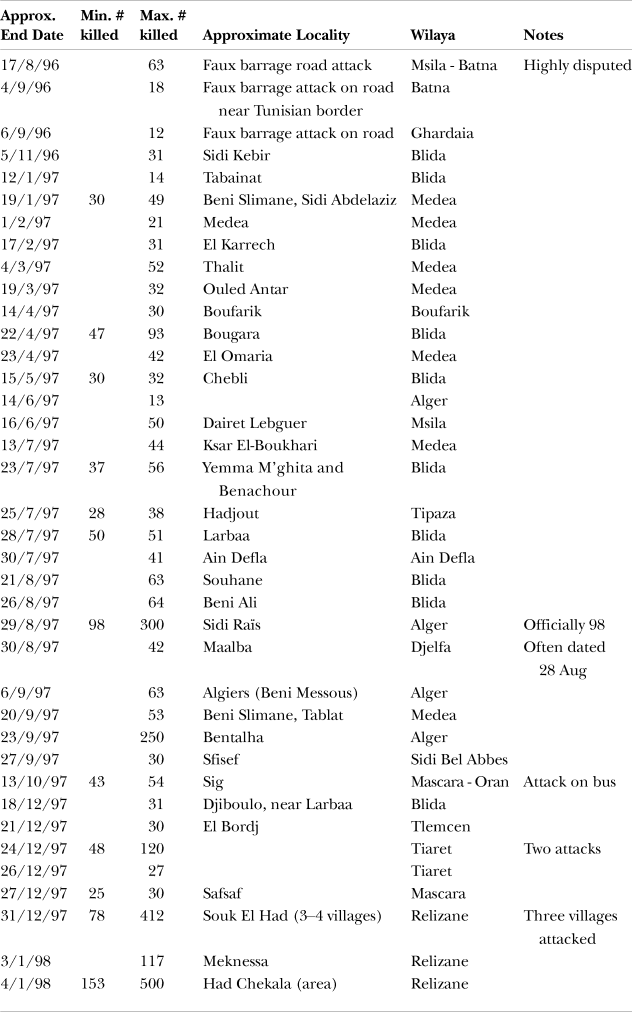
More than a decade has passed since a wave of massacres in Algeria grabbed significant international attention. Between November 1996 and the end of 2002, Algeria witnessed as many as three hundred massacre episodes that claimed upward of sixty-five hundred lives.Footnote 2 Though there had been allegations of massacre activity before 1996 (Harbi et al. Reference Harbi, Dhoquois-Cohen and Ravenel1998:169; Souaïdia Reference Souaïdia2001:149‒51), the most reliable reports suggest that widespread massacre activity did not begin until roughly four years into the armed conflict between the Algerian regime and the various armed Islamist opposition groups (see table 1). Massacres were reported in a wide number of Algerian prefectures, though they were mainly clustered in the central and western north, and largely absent in the east and Saharan south (see map 1). Over 90 percent of the massacres seem to have claimed fifty or fewer lives; the most intense massacres occurred between April 1997 and January 1998, mainly in the Mitidja plain outside Algiers and in the western Ouarsenis mountains of the Relizane, Tiaret, and Tissemsilt prefectures (see map 2). While there is little information on the basic demographics of the victims (age, gender, socioeconomic status), the political geography of the massacres suggested a correlation between massacre activity and voting patterns—that is, a concentration in areas that had, in the 1990 and 1991 elections, supported the Front islamique du salut (FIS), the Islamist political party that was outlawed at the beginning of the civil conflict in 1992. The massacres’ frequency and intensity also dropped to near zero during election periods, suggesting either a government capacity to suppress all violence during voting periods or a strategic logic to the massacres that utilized plebiscites to gauge the effectiveness of mass terror (Aït-Larbi et al. Reference Aït-Larbi, Bedjaoui, Aroua and Aït-Larbi1999:56‒71,121‒25).
Map 1
Massacre Activity in Algeria by Prefecture (August 1996‒May 2002) based on Table 1
Key: #. Prefecture (Number of massacres): 1. Alger (4), 2. Blida (13), 3. Medea (9), 4. Tipaza (1), 5. Aïn Defla (2), 6. Chlef (4), 7. Relizane (4), 8. Batna (2), 9. Msila (2), 10. Djelfa (2), 11. Tiaret (2), 12. Mascara (2), 13. Oran (2), 14. Tlemçen (1), 15. Sidi Bel Abbes (1), 16. El Bayadh (1), 17. Ghardaia (1), 18. Bechar (1).
Note: This map should only be treated as a cartographic representation of Table 1. It is not intended to be a comprehensive or accurate representation of the actual geographical distribution of all suspected or confirmed massacre activity in Algeria since 1992.

Map 2
Approximate Location of the Largest Algerian Massacres, 1997‒98
Note: See Map 1 for an explanation of the prefecture shading.
As with much of the political violence in Algeria since 1988, the identity of the massacre perpetrators and their motives are still subject to intense debate.Footnote 3 This lacuna in our understanding of such massive atrocities is not helped by the Algerian government, which in its 2005 Charte pour la paix et la réconciliation nationale made research into these questions illegal (see Goldstein Reference Goldstein2006). According to a 2006 report issued by Amnesty International, Human Rights Watch, the International Center for Transitional Justice, and the International Federation for Human Rights, Algeria’s national reconciliation policies have been based on amnesty and indemnity rather than truth and accountability. Nor has research into the Algeria massacres been helped by the international environment since September 11, 2001, which has worked to the advantage of the Algerian regime’s claim that Islamists are entirely to blame for the massacres. This narrative has become so sedimented that reputable scholars have since treated it as established fact (see Tilly Reference Tilly2003:105‒6, citing Wiktorowicz Reference Wiktorowicz2001; Gerges Reference Gerges2005:101; Ayoob Reference Ayoob2008:18).
Given the serious yet unresolved allegations that state and private actors might have possibly been involved in the massacres as well, other scholars have recognized the undecided nature of this debate (Cook Reference Cook2005:119‒21; Kepel Reference Kepel and Roberts2006:254‒75). As I will discuss below, the most dedicated observers of Algerian violence have been deeply divided on these questions, though some have attempted to evade the question of the perpetrators’ identities as a hopeless intellectual and political cul-de-sac (see Roberts Reference Roberts1998; Martinez Reference Martinez2001; Lowi Reference Lowi, Collier and Sambanis2005). Bernard-Henri Lévy, the most public and passionate intellectual supporter of the Algerian government at the height of the killing in early 1998, has since admitted that he failed to realize the possibility that the Algerian regime might have had an indirect role in the massacres (Burgat Reference Burgat and Hutchinson2008:175‒76). But recent efforts to examine Algeria’s décennie noire (black decade) of the 1990s unfortunately have nothing to offer in terms of new information; they simply recycle the findings and claims of earlier works, leaving readers with more questions than answers (Evans & Phillips Reference Evans and Phillips2008; Hill Reference Hill2009; Le Sueur 2010).
Serious attempts to identify the agents of the massacres and explain their motivations have tended to suffer from three major problems. Most have simply begged the question, assuming and then explaining why Islamists were the sole perpetrators (Wiktorowicz Reference Wiktorowicz2001; Boukra Reference Boukra2002; Hafez Reference Hafez2000, Reference Hafez and Wiktorowicz2004; Moussaoui Reference Moussaoui2006).Footnote 4 Accounts of the massacres have also asserted that the perpetrators must have been either rebels or government agents, thus omitting alternative agencies and multiple logics of violence that could have been operating simultaneously and interactively rather than exclusively. A third problem is that the massacres’ geographical distribution and the variation in numerical victim classes were rarely taken into account.
The only study that has examined multiple hypotheses to explain the massacres, as well as some of the spatial and demographic aspects of their victimology, is that of Bedjaoui et al. (Reference Bedjaoui, Aroua and Aït-Larbi1999), but this suffers from several troubling deficiencies as well. After observing regularities in the massacre patterns coincident with political events (i.e., consistent troughs in the intensity and frequency of massacres during elections), the authors claim to identify a unifying rationale behind all massacres based on the apparent determination of the perpetrators to allow elections to take place and their assumed capacity to escalate and deescalate the killing. Based on this attributed rationality, the study discounts the thesis of privatized violence—that is, allegedly nonpolitical violence based on interpersonal or intercommunal feuds motivated by factors ranging from the familial to the commercial to the deeply historical. Privately motivated killing, they argue, would be an irrational process that would not produce such regular patterns in the massacres. What this study fails to consider, however, is that the appearance of massacre waves could have resulted just as easily from a coupling of the well-documented dampening effect of increased Algerian state security deployments during elections and an escalating cycle of “irrational” privatized violence. More important, the papers in Bedjaoui et al. discount insurgent responsibility for two very weak and partisan reasons. They claim that, of the two dominant rebel organizations, the Groupes islamiques armées (Armed Islamic Group, hereafter GIA) is essentially a clandestine arm of the state’s security apparatus and so its rival, the armed wing of the FIS, the Armée islamique du salut (Islamic Salvation Army, AIS), was the only legitimate insurgency group operating in the country at the height of the massacres from 1996 through 1998. But since the AIS began observing a truce on October 1, 1997, the insurgency, according to this argument, could not have been the source of the massacres, and therefore the state must have been responsible. However, while many observers suspected that the GIA was controlled, infiltrated, or manipulated by elements of the Algerian state, it remains to be demonstrated convincingly that this was the case for some or all of the GIA units across the country. Given the weakness of these premises, the conclusion is difficult to accept.
The most respected and widely cited analysis of the massacre phenomena in Algeria is undoubtedly Stathis Kalyvas’s award-winning 1999 article “Wanton and Senseless? The Logic of Massacres in Algeria.”Footnote 5 This article constructs and empirically defends a thesis that attempts to explain the strategic rationale leading Islamist rebels to slaughter hundreds of civilians. This article has been enormously influential and has been cited as a foundational study in the burgeoning research on the microdynamics of civil conflict violence. Though “Wanton and Senseless” is careful to frame its findings as a tentative hypothesis, such caveats have not stopped prominent scholars from using its conclusions as a basis for their own work (see Fearon & Laitin Reference Fearon and Laitin2003:80; Weinstein Reference Weinstein2007:316‒17).
There are, however, numerous problems with “Wanton and Senseless,” which appear only upon very close inspection of its argument, the source material it includes, and the source material it excludes. In terms of its theoretical argument, it problematically limits the scope of inquiry a priori. Empirically, “Wanton and Senseless” fails to examine all but the two most conspicuous and famous massacres. It interprets and frames some of its source material to benefit its argument in ways that are both erroneous and questionable, and it selects anecdotal data that fit the thesis from accounts that are in fact contested, ambiguous, and contradictory. Lastly, important confounding information is either ignored or unreasonably dismissed. The rest of this article is devoted to detailing these problems with Kalyvas’s argument.
The Delimiting Effects of Hypothesis Formation
The argument in “Wanton and Senseless” begins with several claims about the alleged interests of the two actors in a civil war—incumbents and insurgents—vis-à-vis civilian populations. The possibility of other political actors with different interests is not even up for consideration. Thus this bifurcated model is incompatible with alternative theses of the Algerian massacres, which appear to be off the table simply because they neither propose military logics nor adhere to the state/rebel dichotomy. To work against the contention that the Algerian massacres were senseless acts of barbarism rooted in Islamist ideology is undoubtedly a worthy cause, but such a warrant evades more difficult arguments.
Another disconcerting feature of this initial hypothesis building is that, according to the model’s logic, government actors have as much, if not more, incentive to engage in massacres as the rebels do. Though “Wanton and Senseless” only examines information to make the case for rebel massacres, its theory also predicts government atrocities. The initial argument is that both sides in a civil war require the “compliance” of civilians; they can use incentives, threats, or a combination of the two to maintain control, though threats are less expensive than incentives. Civilians, whatever their apparent political affinities, prioritize survival, especially when violence is intense. Thus the use of violence against civilians by political actors becomes an effective tool to maintain fidelity, discourage defection, eliminate free riding, or all of the above. In such a context, the side that can produce the most credible threats induces the most civilian support. But such terror, Kalyvas claims, needs to be selective rather than indiscriminate so that the probability of civilian survival does not increase with defection. The resulting hypothesis is that
well-planned, individually targeted, and selective mass killings might thus be an indicator of a strategy initiated by insurgents to maximize civilian compliance (more precisely: to minimize the loss of civilian compliance) by deterring defection; hence, extreme brutality can be instrumental. (1999:251)
From this, three empirically testable claims are drawn: that intensified massacres activity might occur in periods and spaces (1) where rebel hegemony is diminishing; (2) where both sides are able to exert force; and (3) where civilian populations have already been desensitized by lower levels of terror.
Even if one assumes temporarily that each premise holds in this argument (and that is not necessarily the case, given the government’s access to hydrocarbon rents that make it politically independent from civilians), there is a conspicuous omission here: The argument strips incumbents from the picture. But if we follow through on the logic of these claims, it also produces an inverse, though equally valid, hypothesis: that the strategic utility of massacres holds for both sides in a civil war (as, indeed, much research on state terrorism has already suggested).Footnote 6 Though “Wanton and Senseless” later attempts to rule out, a posteriori, the possibility that the massacres were acts of state terrorism, this possibility is also ruled out a priori for no apparent reason.
The Reality Producing, Obfuscating, and Negating Effects of Empirical Testing
Attempts to explain the Algerian massacres have rarely taken into account the various numerical classes of massacres and the information bias in favor of massacres near Algiers. “Wanton and Senseless” claims to be a study of the broader massacre phenomenon (see, e.g., 253,259,256), though it makes the case for focusing on a specific period and geography of massacre activity. In reality, “Wanton and Senseless” is a case study of the two most famous massacres—that is, those that were the most “mediatized” (médiatisé), according to Liess Boukra’s (2002:295) formulation. Equally problematic is Kalyvas’s focus on the period of July 12 to October 12, 1997, which is said to have seen the most deaths (1,690 fatalities) and “the most puzzling” episodes (256). That the massacres during this period were the most “puzzling” is mere assertion. There is a case to be made that the Ouarsenis massacres of December 1997 and January 1998 are more interesting because they took place in a political and geographical context far removed from the well-known Mitidja plain massacres just outside Algiers. The most prominent Mitidja killing sites—Bougara, Larbaa, Raïs, Bentalha, and Sidi Hamed (see table 1 and map 2)—are mere miles from central Algiers and were visited by both foreign journalists and dignitaries. But no foreign journalist appears to have filed any dispatches from any of the Ouarsenis massacres (Reuters 1998a; Khiari Reference Khiari1997c), and some of the western massacre sites even lacked roads or phone lines (Khiari Reference Khiari1998b). As a result, piecing together a coherent picture from the December 1997‒January 1998 western massacres was especially difficult for the press; speculated motives and agents included villagers seeking to dispossess neighbors of their property, feuds between local kinship groups, internecine fighting between the AIS and GIA, rebels taking advantage of the paucity of self-defense militias, or a GIA effort to draw state attention away from the Mitidja sites (BBC Monitoring 1998; Khiari Reference Khiari1998a; Agence France-Presse 1998a; Deutsche Presse-Agentur 1998).
The claim that the period from July 12 to October 12, 1997, saw the most massacre deaths does not hold either. Contemporary press accounts repeatedly noted that the two-month period of December 1997 and January 1998 was by far the bloodiest in the Algerian conflict for civilians. The two most serious efforts to document the massacres subsequently found that the one-month period of mid-December 1997 to mid-January 1998 was the deadliest of the war in terms of massacre activity (Aït-Larbi et al. Reference Aït-Larbi, Bedjaoui, Aroua and Aït-Larbi1999; Sidhoum & Algeria Watch 2003). One of the largest massacre clusters in the Algerian conflict, the Tiaret-Tissemsilt massacres of December 23‒24, 1997, with suspected death tolls reaching more than one hundred, is not even mentioned in “Wanton and Senseless,” though it had been widely reported internationally. And if subsequent government disclosures are to be trusted, the western massacres of New Years’ 1997‒1998 were likely the largest of the conflict (Métaoui Reference Métaoui2006).
“Wanton and Senseless,” in fact, mainly examines the massacres of Raïs and Bentalha, both mentioned roughly twenty times each, while other major massacres, whether in the Mitidja or the Ouarsenis, receive one or two mentions; most are mentioned briefly in the endnotes or in a list of massacres that appears in the form of a table (249‒50). Nevertheless, Raïs and Bentalha account for only 6‒14 percent of deaths recorded in “Wanton and Senseless,” and the Mitidja “triangle of death” incorporates only three of the seventeen prefectures where massacres were recorded (though these were indisputably the most afflicted prefectures). Since Kalyvas underestimates the extent of the massacres in terms of lethality and frequency, we should assign even less explanatory weight to Raïs and Bentalha as representative case studies. The spectacular body counts attributed to Raïs and Bentalha likewise suggest that they are outliers in a field overwhelmingly dominated by much smaller classes of massacres.
The Interpretation and Framing of Source Material
The most egregious aspect of “Wanton and Senseless” is the disturbing number of instances in which the source material has been problematically interpreted and framed.Footnote 7 Indeed, the source material often contradicts the way in which it is presented in the article. For example, Kalyvas claims that a correlation exists between rebel massacres and government counterinsurgency operations and that the Bentalha massacre occurred as the Algerian army was in the midst of a large operation in the area (264). According to the original source, however, we find that this “vast offensive” was actually launched three days after the slaughter at Bentalha (Garçon Reference Garçon1997c). Algerian politicians and other contemporary news sources even noted that this military-media offensive was likely launched in response to the international outcry over the Bentalha massacre (The Economist 1997b; Fisk Reference Fisk1997a).
Close examination reveals other questionable framings and translations, ranging from the inconsequential to the deeply puzzling. For example, Kalyvas refers repeatedly to the village of Haï Bounab (254, 269, 270), a location mentioned in the interviews conducted by the Algerian journalist Baya Gacemi (Reference Gacemi2006) with “Nadia,” a woman who was involved in the Islamist insurgency via her marriage to one of its fighters. However, Haï Bounab is not a real place; it is a pseudonym used by Gacemi (2006:2) to protect the actual location. More important, “Nadia” offers a personal account of one woman’s experience within a semirural guerrilla cell near Algiers. Yet this purely anecdotal evidence is cited in support of important claims about the global behavior of rebels, militias, and government forces, often without corroborating evidence (see 266, 269, 282).
There are even more troubling uses of the source material. In one case Kalyvas claims that the guerrillas described their massacres as “punitive expeditions” (258). In the actual source (Zerrouky Reference Zerrouky1997), it is the journalist, not any insurgent, who describes the massacre as punitive. Inversely, Kalyvas quotes a journalist for Le Monde who “confirmed” that rebels will attack villagers who ask the government for weapons. But the quotation actually comes from an Algerian arriving at the port of Marseille who was speaking to a Le Monde reporter there. Presenting this statement as a journalist’s “confirmation” suggests that it was a fact arrived at through multiple sources, rather than the opinion of a single Algerian safely removed from the fighting. This individual also expresses doubt that the GIA alone, rather than the GIA plus the government, is behind the killings, and the journalist is likewise skeptical (Le Guilledoux 1997). Similarly, a “villager” is quoted (262) as saying that the years between 1992 and 1995 were the worst years of the war, though the person quoted in the original source is identified as Dr. Bachir Ridouh, a professor of psychiatry in Blida, one of Algeria’s largest cities. In the context of “Wanton and Senseless,” it is implied that this “villager” is, like other villagers quoted in the article, living among the suburban and rural Islamist insurgency. In reality, Ridouh is not a villager at all; he is a highly educated elite professional working in a major hospital (see Kaci Reference Kaci1998b).
Data mishandling is not limited to French sources. Citing an article by Scott Peterson (Reference Peterson1997a) in the Christian Science Monitor, Kalyvas quotes an Algerian “villager” as saying that, with respect to the massacres in 1997, there was a “government by day and an [Islamist] government by night.” This comment ostensibly provides evidence of the divided sovereignty mechanism that “Wanton and Senseless” posits at the core of the massacres. In the actual source, however, we find that the statement is not attributed to any specific villager but is described, rather, as an Algerian expression, and the actual context is not 1997 but rather the period of 1994‒95, one to two years before any significant massacres. In the original source, this expression refers to larger claims that the Algerian government might be involved in the massacres, and Peterson also notes concerns of Human Rights Watch (1997) that observers could not distinguish between insurgents and security forces in Algeria because both often disguised themselves as the other.
Kalyvas uses his source material in other problematic ways as well. A dialogue originally quoted in the French newspaper Libération (Aubenas Reference Aubenas1998) between an insurgent and a local youth on the subject of state-sponsored militias (271) supposedly leads the former to warn the latter, “if you take weapons from the government, the first bullet will be for you.” This comment is repeated as part of an explanation of why locals might not accept arms from the government, and it provides perfect anecdotal evidence of such insurgent coercion. The problem here is that “Wanton and Senseless” has the dialogue entirely backwards; in the original, it is a local who in fact threatens to kill the insurgent once the state arms him.Footnote 8 Similarly, to back up the key claim that the massacre perpetrators knew their victims, Kalyvas cites a survivor of the Bougara massacre, who claims that she had been threatened by her former physics professor at a faux barrage (fake checkpoint) incident “well before” the massacre. She later recognized him, Kalyvas claims, as one of the attackers during the massacre (257). In the actual source (Kaci Reference Kaci1998a), the survivor talks about seeing her teacher at the faux barrage incident but says nothing about seeing him during the massacre. On the whole, these errors raise serious questions about how the source material has been handled.
The Taming of Inconsistency and Ambiguity
A major problem facing all attempts to understand the Algerian massacres is the lack of reliable and consistent information. The attitude of “Wanton and Senseless” toward the trustworthiness of its empirical evidence—mainly contemporary accounts carried in foreign press outlets, supplemented with NGO reports—is ambivalent. Though Kalyvas considers such accounts “fragmentary and incomplete” and notes that “the conditions of their investigation were far from ideal,” he argues that his “theoretical lens” will “help make sense of this tragic story” (245‒46). The problem, however, is not simply that the data are “incomplete.” Whether viewed collectively or individually, press accounts from the massacres were just as often contradictory and ambiguous.
A vivid example of the inconsistencies in the source material is the very first massacre listed in the article’s table of massacres, the fourteenth largest massacre on that table. This is an alleged August 17, 1996, massacre near M’sila, which claimed sixty-three lives. The basic facts of the massacre do not support Kalyvas’s model: according to various French and British reports at the time, the selection of the victims was quasi-random (it was reportedly a roadside attack on a bus), the culprits were identified as anti-Islamist militants in some accounts, and the supposed politics of the attack included allegations of “tribal” politics (see Agence France-Press 1996b; BBC Summary of World Broadcasts 1996a, 1996b). More important, it is not clear that this massacre ever took place. Not only did the Algerian government strongly deny that there had been an attack, but it was also suggested that the location had been confused with a roadside bus attack in the Djelfa prefecture on August 15, which was reported in the Algerian press (Africa News 1996; Sud Ouest 1996; Le Monde 1996).
On the other side of the coin, some important episodes are not mentioned at all in “Wanton and Senseless.” Two reports on the slaughter in El Omaria, the day after the Bougara massacre, gave divergent accounts as to the identity of the perpetrators. One suggested that the raid on El Omaria was a possible revenge attack for the Bougara massacre, carried out by “death squads” composed of civilian militia members and elements of the security forces (David Reference David1997). Another, however, claimed that survivors had positively identified the attackers as Islamists (Khiari Reference Khiari1997a). Though widely reported in major press outlets, there is no mention of the El Omaria massacre in “Wanton and Senseless.”
Variation in the way massacre sites were described highlights the problem of ambiguity in the source material. A key claim in “Wanton and Senseless,” for example, is that rebels knew whom they were killing because they attacked specific locales and not entire areas. In one case, Kalyvas underscores the claim that the massacre of Laarba (July 28, 1997) targeted the specific “neighborhood” of Si Zerrouk. In various press accounts, however, Si Zerrouk was also described as a village, a hamlet (gehucht), a district (quartier), or simply a settlement on the outskirts of Larbaa.Footnote 9 If attackers targeted a neighborhood, then it would be reasonable to say that the attack had been geographically selective; but if an entire village, settlement, or hamlet was massacred, then the attack would seem less targeted, more indiscriminate. The result is not that the framework in “Wanton and Senseless” completes an incomplete picture. The framework instead renders a picture from an otherwise inchoate background of highly contested and compromised narratives.
Ignoring the Conditions of Knowledge Production
“Wanton and Senseless” also overlooks the possibility of systemic bias in much of its source material, whether at the level of specific outlets or individual journalists. In the 1990s Algeria was one of the most dangerous places in the world for journalists. By 1998 seventy Algerian journalists and dozens of foreign citizens had been assassinated. At the height of the massacres in 1997, Amnesty International (1997:26‒29) noted that not a single person had been held accountable for the murdered journalists. While Islamists were frequently blamed for attacks on journalists, a 1997 Reporters Without Borders report claimed, “Many professional journalists admit in private that the government is behind certain assassinations, but all say they fear for their lives if they make their knowledge public” (quoted in Marlowe Reference Marlowe1997a; see also Reporters sans frontières et al. 1997). Zineddine Aliou-Salah—one of the four journalists from Liberté murdered during the conflict—was reportedly more afraid of the government than of the Islamists (Black Reference Black1998; see Labter Reference Labter2005:133). The widow of one slain journalist said that, like much of the violence in Algeria, the state was responsible, not the Islamists who were officially blamed (Dalhburg Reference Dalhburg1996). Journalists, particularly those who criticized either side in the conflict, thus worked in an environment of terror and impunity whose effects on the reliability of press accounts must be constantly questioned.
The Algerian government also took overt steps to control domestic reporting on the conflict: individual editions of newspapers were seized, publications were suspended, steep financial burdens were levied, dissenting journalists and editors were fined and imprisoned (Human Rights Watch 1997:26‒33). The government, which owned all the printing presses and paper supplies, positioned state censors (“reading committees”) inside presses in 1996 to vet all editions prior to printing. A Human Rights Watch (1997:29) report noted that Algerian authorities controlled which massacre scenes reporters could cover and prohibited any independent access. Algerian journalists attempting to interview massacre survivors at one site reportedly had to clear the names of potential interviewees with the local police (Aubenas & Garçon Reference Aubenas and Garçon1997). Beyond the systemic bias such conditions might create, there is also the question of ideological bias at the level of individual journalists and outlets. The most cited Algerian journalist in “Wanton and Senseless” is Hassane Zerrouky, who wrote for leftist publications with notoriously anti-Islamist editorial stances. The now defunct Le Matin d’Alger, Zerrouky’s main Algerian outlet, has been accused by another respected Algerian journalist of publishing anti-Islamist propaganda on behalf of the government and fabricating misinformation during the 1990s (Semiane 2005, cited in Le Sueur 2010:222).
Foreign journalists attempting to report on the Algerian massacres also faced daunting challenges. Working in Algeria at that time could only be done with the protection of state security forces, often as many as two dozen assigned to a single journalist (Peterson Reference Peterson1997a; Moore Reference Moore1997). Visiting massacre sites in October 1997, one foreign reported noted, “In no other zone of conflict have I seen people so afraid to speak their minds to a foreigner. This fear is not eased by the constant presence of armed plainclothes ‘minders’ who shadow almost every move of foreign journalists” (Loyd Reference Loyd1997). Another remarked that survivors of a massacre only began to speak critically of their government when “you manage to find privacy from the armed men who seek to listen in to every conversation” (Crawshaw Reference Crawshaw1998). It was also reported that Algerian officials would later interrogate people who had spoken to foreign journalists (Human Rights Watch 1997:30). A 1997 Amnesty International report—one of the most frequently cited sources in “Wanton and Senseless”—concluded that, as a result of the intimidating presence of government officials near foreign journalists, coverage was maximizing rebel violence while minimizing state violence. Some journalists also told Amnesty International that the Algerian government permitted access only on the condition of favorable coverage (Amnesty International 1997:29). While foreign journalists making ad hoc visits to Algiers could—and did—take risks, wire services based in Algiers (e.g., Agence France-Presse, Associated Press, Reuters, Deutsche Presse Agentur) had to take into consideration the possibility of the Algerian government’s retaliating against locally contracted journalists and photographers.Footnote 10 For a period the Algerian government withdrew the credentials of Agence France-Presse following the controversy that erupted over the famous Bentalha “Madonna” photograph, winner of the 1997 World Press Photo award.Footnote 11
The Elimination of Confounding Narratives
As argued above, “Wanton and Senseless” often supports its thesis of the massacres by selectively choosing and framing its data so as to omit any confounding information. Only by doing so can it claim any sort of consensus among witnesses and reporters who in fact provide conflicting information. Journalists who visited Algeria, including several cited in “Wanton and Senseless,” frequently expressed uncertainty about the identity and motive of the attackers or found evidence supporting alternative accounts. Following visits to massacre sites in late 1997 and early 1998, including Raïs, Bentalha, and Sidi Hamed, journalists with Agence France-Presse, the Associated Press, the Guardian, the London Independent, the Irish Times, Le Monde, and the New York Times, as well as Christiane Amanpour of 60 Minutes, refused to reach any conclusion about the perpetrators, even when some survivors blamed the rebels.Footnote 12 The two journalistic sources cited most frequently in “Wanton and Senseless”—Aubenas (1997) and Tuquoi (1997f)—to support the thesis of Islamist responsibility for the massacres have also been citied by critics of the Algerian regime (e.g., Farouk et al. Reference Farouk, Senhadji, Aït-Larbi, Bedjaoui, Aroua and Aït-Larbi1999; Mellah Reference Mellah2004), since they contain survivor testimonies that seem to suggest government complicity. Indeed, massacre survivors often explicitly identified their attackers as state and government-allied agents. As with massacres in Baraki (Abdi Reference Abdi1997) and Raïs (Agence France-Presse 1997c; Tuquoi 1997a), witnesses from the Sidi Youcef massacre said the attackers presented themselves as security forces and so gained the locals’ trust before slaughtering them (Agence France-Presse 1997d). Though some were dressed as Islamists, others reportedly wore jackets of the national police, the Sûreté nationale (Ficatier & Kadi Reference Ficatier and Kadi1997). One survivor of the January 1998 Sidi Hamed massacre claimed that some of the attackers were dressed as paratroopers. Other witnesses said that the killers had been outfitted in the official government uniforms of militias (Reuters 1998b; Ladki Reference Ladki1998), though another report said that some of the killers had worn cachabias (traditional Algerian tunics) (Agence France-Presse 1998c). An Algerian interviewee, in an article cited in “Wanton and Senseless,” suggests that all sides of the conflict dressed as rebels when carrying out killings (Abdi Reference Abdi1997). A survivor of the Raïs massacre told a British journalist that some of the attackers had worn wigs and fake beards (Phillips Reference Phillips1997). One Algerian quoted in “Wanton and Senseless,” albeit in a different context, actually expressed anxiety about whether or not the government was playing a role in the massacres: “That is what is unbearable: the doubt. If we knew that the military was attacking as terrorists, we would be reassured, but they leave us in doubt” (Le Guilledoux 1997). The data are not merely inconsistent; they are often ambiguous, allowing for multiple readings of the same account.
In much of the source material one also finds versions of the privatized violence thesis of the massacres. Following a massacre near the end of September 1997, Libération’s José Garçon (Reference Garçon1997b), a journalist frequently cited by Kalyvas, wondered whether or not, given the selection of victims and the massacre’s proximity to another recent massacre, it had been part of the “terrible cycle of killing/reprisals that has covered the Mitidja in blood.” An Algerian quoted in “Wanton and Senseless” actually expresses the kind of sentiment that might be driving such a cycle of reciprocal massacres: “[The rebels] can kill me, but if they kill one of my relatives I will kill their entire families; this is the only language that terrorists understand . . .” (quoted in Amnesty International 1997:24, ellipses in original; see also Amnesty International 1996:23). Another Algerian expresses a similar theory of the escalating cycles of violence:
The spiral of horror begins when the Islamists kill a member of this tribe. That tribe decides to accept weapons from the security forces, then mounts a revenge against those who have children in the guerrillas [maquis]. In the end, the Islamists return to massacre the tribe in vengeance. But it never ends, because the army has managed to involve people who, since 1992, never wanted to take sides in this war. (Quoted in Abdi Reference Abdi1997)
Interestingly, “Wanton and Senseless” also quotes this comment, but only the first two sentences; thus Kalvyas leaves out the important way in which the speaker also implicates the Algerian regime in the cycles of violence. Kalyvas similarly elides an Algerian’s claim in Garçon (Reference Garçon1997a) that the state is manipulating social tensions for military gain: “One thing is certain,” says the speaker quoted in Libération, “civilians are also the principal victims of the violence exercised by the paramilitary groups.” Yet the rest of the statement, which is omitted from “Wanton and Senseless,” is a vivid example of a hybridized thesis combining both privatized and state-sponsored violence dynamics: “civilians are also the principal victims of the violence exercised by the paramilitary groups linked to different regime clans, violence which is as incontrollable as that of the killers claiming Islam” (emphasis added).
As noted above, a key element of the privatized violence thesis is the growth of civilian militias. In “Wanton and Senseless” Kalyvas spends a great deal of time examining how militias contributed to and participated in the escalation of violence but then stops short of examining serious accusations that progovernment militias were also participating in the massacres. Evidence that state-sponsored militias were already committing significant abuses is not difficult to find. In April 1998, for example, one hundred and twenty-eight cases were registered in the Algerian courts against security and militia officials for fifty-four civilian murders (Fisk Reference Fisk1998).Footnote 13 “Wanton and Senseless” thus manufactures its consensus of journalists and survivors by systematically refusing to weigh conflicting data.
The most difficult yet widely available confounding evidence is similarly dismissed in “Wanton and Senseless”: that is, the statements of former and current members of Algeria’s security, military, and intelligence forces who claim to have either perpetrated mass killings or helped facilitate them, or to possess first-hand knowledge of government complicity in them. Though Kalyvas asserts that survivors’ and journalists’ findings counter and trump such accusations, it is now clear that the accounts of reporters and witnesses were often ambiguous and conflicting. Moreover, Kalyvas downplays the number of whistleblowers who stepped forward, citing only two cases (reported in Sweeney Reference Sweeney1998b and Sergent Reference Sergent1997a, Reference Sergent1997b) in which self-identified members of the Algerian security forces claimed to have either perpetrated massacres or helped other state elements, often disguised as guerrillas, facilitate mass killings.
There were in fact several more who stepped forward. A similar testimony from another Algerian commando appeared in the Irish Times (Marlowe Reference Marlowe1997c, Reference Marlowe1997d) and in a Channel Four documentary in October 1997 (Shah Reference Shah1997). In November 1997 an alleged former officer in Algeria’s military intelligence, who later spoke before the U.K. Parliament (Associated Press 1997a; Landale Reference Landale1998), claimed to have knowledge of the ways in which the government had “infiltrated and manipulated” the GIA as well as special death squads whose tasks included massacres (Sweeney & Doyle Reference Sweeney and Doyle1997). Le Monde’s Jean-Pierre Tuquoi, a journalist praised by Kalyvas, interviewed a serving “senior officer” in Algeria’s military intelligence. He likewise claimed, on the one hand, that the GIA had been manipulated by his employers but was now out of control, and on the other hand, that the government was directly perpetrating some of the massacres (Tuquoi 1997b; see also Sweeney Reference Sweeney1998c). Two former Algerian special police officers spoke out in January 1998, claiming that they too had helped elite units of the military intelligence perpetrate massacres while “wearing the costume of the Islamists: false beards, baggy trousers” (Sweeney Reference Sweeney1998a). Other Algerian officials and politicians also accused the government of direct and indirect complicity in the massacres: former President Ahmed Ben Bella (Agence France-Presse 1997g), former Prime Minister Abdelhamid Brahimi (Duplouich Reference Duplouich1997; Agence France-Presse 1997a), and former diplomat Mohammed Larbi Zitout (Associated Press 1997b).
“Wanton and Senseless” also downplays contradictory evidence by claiming consensus among European governments and academics. Yet this appeal to authority is weak: the citations refer to an indirect reference to the British Foreign Office in The Observer (Sweeney Reference Sweeney1998b) and to one highly skeptical area expert, Lahouari Addi (Reference Addi1998). “European foreign ministries” and “area experts,” like survivors and journalists, tended to reflect and amplify the debate over the massacres, not clarify it. Since the French and U.S. government took the lead in the international politics of the Algerian crisis, their statements are worth considering. From mid- to late 1997, French officials, including Prime Minister Lionel Jospin (The Economist 1997b), raised questions about who was actually carrying out the massacres. After the April 1997 Bougara massacre, a French official said “there is no way to know for sure exactly who is doing what to whom,” citing reports of all sides using disguises (Whitney Reference Whitney1997). In November, Jospin’s Socialist Party called for an international inquiry into the massacres, a proposal already endorsed by Germany’s leading opposition Green Party (Agence France-Presse 1997f, 1997e; Deutsche Presse-Agentur Reference Presse-Agentur1997b; Inter Press Service 1997). This appeal was later echoed by the U.S. State Department, first in January 1998 (U.S. Department of State 1998a) and then in March before the U.N. Commission on Human Rights (M2 Presswire 1998; Haq Reference Haq1998). As a State Department (1998b) spokesperson said on January 6, 1998, following new reports of massacres in western Algeria, “Let’s remember that the facts of many of these massacres are often unclear. The perpetrators are sometimes unclear.”
Just as there is no basis for claiming a consensus among foreign governments, there is no basis for claiming a majority view among area experts. The only expert cited in “Wanton and Senseless” is the Algerian sociologist Lahouari Addi, and, in fact, Addi (1998:44) gave voice to suspicions that the Algerian government might indeed be playing a role in the massacres. Other country and area experts expressed similar concerns. As early as 1995 Luis Martinez, whose monograph is cited a dozen times in “Wanton and Senseless,” claimed that “in the majority of cases, we no longer know who kills who. We have the feeling of an immense settling of scores on a national scale” (Catherine Reference Catherine1995). Before and during the massacres, noted experts like François Burgat (Reference Burgat1995), Ahmed Rouadjia (Ganley Reference Ganley1997a), Bruno Etienne (Mandeville Reference Mandeville1997), Dale Eickelman (Sipress Reference Sipress1998), and Clement Henry (Dennis & Power Reference Dennis and Power1997) either expressed suspicions or accused the Algerian regime of somehow playing a role in the massacres.Footnote 14 While Benjamin Stora helped popularize the notion that the violence in Algeria had become privatized through militias, Gilbert Grandguillaume (Tuquoi 1997b; Ploquin Reference Ploquin1997), Michael Willis (Reference Willis1998), and John Entelis (Sipress Reference Sipress1998) backed versions of this thesis, citing vendettas, land issues, and economic interests. In early 1998 Mary Jane Deeb said all sides in the conflict were to blame, whether the government, rebels, or civilian militias: “It’s not one particular group that is responsible for the massacres” (PBS NewsHour 1998).
Human rights organizations represent another class of expertise one might consider highly relevant to these questions. Though “Wanton and Senseless” relies heavily upon human rights reports, it does not take into account the full extent of their claims. A key Amnesty International report—the most cited source in “Wanton and Senseless”—states unambiguously on the first page that
there is growing concern, from testimonies of survivors and eyewitnesses of the massacres, that death squads working in collusion with, and under the protection of, certain units or factions of the army, security forces, and state-armed militias, may have been responsible for some of the massacres. (Amnesty International 1997:1)
Amnesty says witness accounts “add further weight to reports that armed groups who carried out massacres of civilians in some cases operated in conjunction with, or with the consent of, certain army and security forces units” (1997:9; see also 7‒10). A Human Rights Watch report, also cited in “Wanton and Senseless,” echoes these concerns (1997:13‒14). In January 1998 Patrick Baudouin, president of the Fédération internationale des droits de l’homme, questioned the motivation behind the Algerian government’s failure to stop the massacres despite the proximity of security installations to many of the killing sites (Inter Press Service 1998). Joe Stork of Human Rights Watch, speaking on National Public Radio in the U.S., simply insisted, “The government is involved, definitely. The question is: How is the government involved?” (Edwards Reference Edwards1998).
The only aspect of the Algerian government’s behavior during the massacres that Kalyvas actually finds worthy of consideration is the alleged failure of its security forces to prevent or stop any of the massacres. As was frequently lamented by survivors and noted in press accounts, the massacres often took place within visual or aural range of security installations, which the Algerian government reportedly never denied (Amnesty International 1997:7; Marlowe Reference Marlowe1997b; Moore Reference Moore1997). But reports of the Algerian government’s nonintervention were also inconsistent. In one case, there are conflicting reports as to whether or not security forces halted one of the massacres in Béni Messous (Deutsche Presse-Agentur 1997a; Khiari Reference Khiari1997b; Tuquoi 1997c; see also Amnesty International 1997:8). Witnesses and observers also alleged far more disturbing government and paramilitary behavior than simple nonintervention. Reports from the Bentalha massacre famously included allegations that government tanks and helicopters had been mobilized on the periphery of the massacre site throughout the killing (Aubenas Reference Aubenas1997; Hirst Reference Hirst1997; see also Yous & Mellah Reference Yous and Mellah2000). There were also cases in which security forces reportedly prevented victims from fleeing or prevented other security forces from intervening (Amnesty International 1997:7‒9). A survivor of the Sidi Hamed massacre said that the military had arrived within fifteen minutes of being notified of the attack but did not enter to stop the killing (Crawshaw Reference Crawshaw1998).
Conclusion
Like the study of civil conflict etiology, the study of violence in civil conflicts also contentiously makes what it claims to find. In the case of the Algerian massacres, many observers have commonly rendered the events intelligible simply by adopting the Algerian government’s narrative of blaming the rebels for the atrocities and then providing reasons to make this thesis plausible. Thus the argument has been constructed in terms of the rebels’ discourse and ideology (Hafez Reference Hafez and Wiktorowicz2004; Kepel Reference Kepel and Roberts2006; Moussaoui Reference Moussaoui2006), Algeria’s history (Boukra Reference Boukra2002), or the organizational tendencies of insurgencies in similar contexts (Wiktorowicz Reference Wiktorowicz2001). Other accounts paint an entirely different picture, presenting the massacres as a covert government counterinsurgency program (e.g., Bedjaoui et al. Reference Bedjaoui, Aroua and Aït-Larbi1999), though such accounts have also proved unviable because of several untenable assumptions and claims. The most respected attempt to understand the Algerian massacres, Kalyvas’s “Wanton and Senseless” (1999), which has been intensively scrutinized here, attempts to bring forward a compelling account of why Algeria’s Islamist rebels would commit mass atrocities. Upon closer inspection, however, this attempt proves to be highly problematic. It relies upon a partisan reading of its theoretical framework and then deploys this framework in such a way as to render a coherent yet problematic account of the massacres. This account is drawn from an empirical milieu that is in fact constituted by contested, ambiguous, contradictory, unresolved, and possibly indeterminate realities.
The insights generated in this article apply to the historiography of Algerian violence. Future research into the Algerian massacres, however, has to contend with the fact that a majority of Algerians voted in 1999 and 2005 to support a national reconciliation process based on a forgive-and-forget approach. One of the more controversial provisions in the 2005 Charte lets the Algerian government prohibit any inquiries into the “national tragedy” of the 1990s. Though heavily criticized in the West for not adopting a truth commission model of other African and Latin American states, Algeria adopted an approach to national reconciliation that is not all that different from French policies of amnesty, indemnity, and amnesia following the 1954‒62 war. Indeed, if Algeria’s past is any guide, the ghosts of Algeria’s most recent massacres will continue to haunt that polity and its historiography for years to come.
The fact that these questions remain frozen in Algeria should not prevent the deployment of this article’s findings in other ways. The next step is to analyze the ways in which these representations of the Algerian massacres—representations that account for the massacres entirely within a logic of Islamism or rebellion—have been mobilized in certain politics. Following the events of September 11, 2001, the Algerian government was quick to embrace the U.S. “global war on terror.” It was widely claimed that Algeria had been fighting its own war on terrorism since 1992. Future research should examine how understandings of the Algerian massacres as Islamist atrocities have been utilized in the “war on terror” as a tool of legitimation for those waging the war and as a tool of delegitimation against those who have been subject to it. Since 2003, for example, the Sahara-Sahel region of Africa has been designated a secondary front in the U.S. global antiterrorism efforts. For this reason, among others, the U.S. government has launched a new military command for Africa, AFRICOM. The role of Algerian violence in the recent U.S. securitization of Africa needs to be more thoroughly excavated.
Finally, the international response to the unimaginable slaughters of 1997 and 1998 reveals a need to rethink the global politics of confronting atrocities. The international community’s ability to actuate a “Responsibility to Protect” (R2P) is contingent upon the ability to establish moralized narratives of violence—to demarcate who needs protection from whom. A close reading of R2P documents suggests that no thought has been put into the question of how the international community should have responded to a situation like Algeria, in which the logics and agents of atrocity were, for all intents and purposes, indeterminable. Critics of the R2P doctrine have suggested that it is the West’s desire or predisposition to mount humanitarian interventions in places like Kosovo, Darfur, and Libya that produces such legitimating narratives of violence, not vice versa. The international response to the Algerian massacres suggests that these critics may be right, but for reasons we do not yet understand.