In 1954, Jawaharlal Nehru, Independent India's first prime minister, amazed at the sight of the Bhakra-Nangal Dam, one of the massive projects of post-colonial nation-building in India, remarked in awe, ‘Probably nowhere else in the world is there a dam as high as this . . . As I walked round the site I thought that these days the biggest temple and mosque and gurudwara is the place where man works for the good of mankind.’Footnote 1 In the discourse of Nehruvian modernity, the idea and reality of a temple could easily be substituted with that of a concrete dam. What is striking in Nehru's observation is that even the secular needs to be articulated in the language and metaphor of the religious. Exactly 38 years after Nehru's observation about dams as temples of modern India, there arose a movement, which sought to construct a temple of lord Ram after demolishing the Babri mosque. One of the female Hindutva activists gathered at the site of demolition in 1992 stated, ‘We have come here to shed blood . . . the meaning of temple building is that mullas should be hanged.’Footnote 2 In India, religion as a metaphor and as a reality has been central to the articulation of the political – both the secular and the non-secular. This paper is an attempt to understand the shifts in the practices of religiosity among the Hindus and its relationship to their political choices and preferences in contemporary India. The paper argues that the Hindus in India have moved towards being more religious in terms of taking part in the religious practices in both the public and private realm in the recent past. This participation in the religious activities is significantly linked to the ways in which they make their political choices. These observations are based on the survey data of the National Election Studies conducted during 2004 and 2009 elections (henceforth NES 2004 and NES 2009) to the Indian parliament.
This paper intends to argue through survey data that the so-called modern constituents among the Hindus in India, i.e. the urban, educated, upper-caste, and high class have higher tendencies to practice religiosity in the public as well as in the private realm. Thus being religious in the explicit sense is a phenomenon that is seen more among the strata of the Hindus mentioned above. Thus, the survey data in a way goes against the highly prevalent tendencies of locating the ascriptive identity-based politics amongst the ruralites, lower-castes, lower classes, and uneducated masses among the Hindus in India. In his appraisal of the rise of the BJP and the decline of the Congress, V. B. Singh argues that the support base for the BJP constitutes the urban, educated, and people from high categories in the occupational hierarchy as compared to the Congress.Footnote 3 Meera Nanda, while searching for the reasons for this trend, argues that in the contemporary era of global capitalism, it is the ambivalence over their newfound wealth that seems a plausible explanation for the growing religiosity of the upwardly mobile urban Indians.Footnote 4 Tracing the rise in the following of the modern guru, Nanda argues that these gurus seem to ease the ambivalence of the upwardly mobile urban classes by giving new wealth a divine stamp of approval.Footnote 5 Apart from this, Nanda says that the rising levels of triumphalism and nationalism among the upwardly mobile are also making public expression of religiosity fashionable.Footnote 6 Nanda elaborates on the workings of the state–temple–industrial complex further, ‘the gods become the backdrop, and the traditional puja the medium, for asserting the Hindu-ness of India and the greatness of both. Worship of gods becomes indistinguishable from the worship of Hindu culture and the Indian nation. Devotees come to listen to hymns sung to gods, but end up worshipping a political ideology – and cannot tell the difference’ (italics mine).Footnote 7 C. J. Fuller, while analysing the increasing popularity of the Vinayaka festival in the south Indian state of Tamil Nadu, argues that it is another example of the Sangh parivar's successful appropriation of localized, traditional Hindu rituals to create a wider ‘Hindu unity’.Footnote 8 He further states, ‘All this matters a lot to the urban middle classes, especially in Chennai and to some extent in other cities, for their lives are increasingly influenced by national and transnational networks, rather than by their ascribed status in Tamil society and its caste system.’Footnote 9 In another article, Fuller argues that the Hindu revivalism in Tamil Nadu in the 1990s included among its beneficiaries the Brahman priests in the Minakshi temple.Footnote 10 He further says that Sanskritic, Brahmanical, ritual Hinduism has been given a renewed lease of life in Tamil Nadu during the last decade and the temple policy of Jayalalitha's government, whereby temple-based ritual Hinduism was promoted by the state government, is as much a product as a cause.Footnote 11
From the results of the last few elections, one can testify that Indian politics has seen the rise of the BJP both in national politics as well as in state politics. From only two Lok Sabha seats, which the party won during the 1984 Lok Sabha elections, the BJP increased its number of seats to 121 in 1991 and 182 seats during both the 1998 and 1999 Lok Sabha elections. In terms of the number of Lok Sabha seats won, the BJP emerged as the single largest political party both during the 1998 and 1999 Lok Sabha elections. The popular support of the BJP also increased enormously during this period. From 7.4% of the votes, which the party polled in 1984, its vote share went up to 23.7% during the 1999 Lok Sabha elections. The BJP lost the 2004 Lok Sabha elections and the Congress led UPA government came to power, but even during those elections, the BJP polled 22.2% of the votes. The real setback for the BJP was during the 2009 Lok Saba elections when the party won only 116 seats and polled 18.8% votes.
The results of the elections clearly indicate that there was a rise in the political strength of the BJP. The increasing vote share for the BJP indicates that the support base for the party must have increased amongst different sections of society. While the election results indicate the rise in the political strength of the BJP, there is nothing to suggest that this was mainly due to more religious Hindus voting more in favour of the BJP. The results from the election commission help us analyse the political strength of BJP, but the survey data collected through the National Election Study 2004 during the 2004 Lok Sabha (Lower House of Indian Parliament) and National Election Study 2009, during the 2009 Lok Sabha elections, help us analyse the support base for different political parties and voting patterns.Footnote 12
One of the slogans of the Hindudtva brigade was Garv se kaho hum Hindu hain (Declare with pride-we are Hindus).Footnote 13 The term Hindu has been differently articulated through time and space in India and outside. This essay, however, takes the category of Hindu in a broader sense, thereby encompassing all those who consider themselves as belonging to the Hindu religion. The focus of this article is primarily on Hindus since it is widely believed that the rise of the BJP in Indian politics over the last decade is largely credited to the mobilization of Hindu voters by the BJP, mainly on religious issues. In this paper, an attempt has been made to explore if, over the years, there has been any change in the patterns of engagement in religious activities among the Hindus. Are Hindus more religious now compared to the past? Do Hindus now pray more regularly compared to recent past years? What has been the change in pattern regarding participation in religious activities, which are of public nature? Is the change in engagement in religious activities, if any, even among all Hindus, or is there any pattern to this changing attitude towards engagement in religious activities? It may also be useful to explore if the level of engagement in religious activities has any influence on the political behaviour of the Hindus.
1. Participation in private religion among Indian Hindus is reasonably high
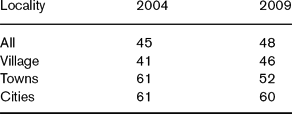
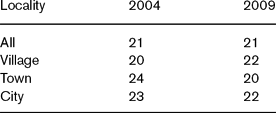
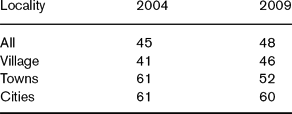
There are various indicators for measuring the intensity of engagement in religious activities. One of the common indicators of measuring if people are religious or not is by knowing how frequently they pray. The majority of the Hindus pray every day. By this standard, it may not be incorrect to say that the majority of Hindus are religious. During the last five years, there has been an increase in the proportion of Hindus who offer puja (prayer, usually accompanied by certain rituals) every day. We can safely assume that, over the last five years, Hindus have become slightly more religious compared to the past.
Hindus who offer Puja daily (%)
Note: Sample size 21,512 (2004) and 28,674 (2009).
Source: NES (2004, 2009).
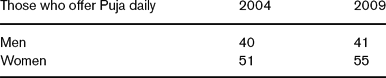
Hindu women offer Puja more regularly compared to Hindu men (%)
Note: Sample size 21,512 (2004) and 28,674 (2009).
Source: NES (2004, 2009).
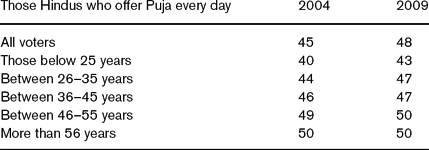
Older Hindus offer Puja more regularly compared to the young Hindu (%)
Note: Sample size 21,512 (2004) and 28,674 (2009).
Source: NES (2004, 2009).
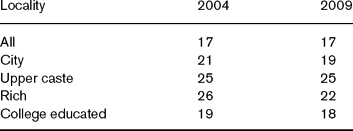
This trend is more visible in urban areas compared to the villages. The level of urbanity is linked to the regularity of worship in the private sphere. According to the National Election Study 2004, Hindus living in towns offer Puja much more regularly compared to those living in villages. Similarly, those living in big cities seem to be offering puja much more regularly compared to those living in towns. One finds a decline in the Hindus offering Puja over the years in towns and cities. This trend is striking if we see this in relation to the decline of the support base for the BJP over the period of the study. One might argue that the rise of the BJP was coterminous with a heightened tendency for engagement in private religious activities, especially among Hindus living in towns and cities. However, it is pertinent to mention here that further research is needed to substantiate this premise. There is a slight decline in engagement in private religious activity, i.e. offering puja, among the urban Hindus over last five years, but still the urban Hindus seemed to be more religious compared to their rural counterparts. One might argue that the urban milieu has led to greater engagement in this private religious activity, i.e. offering Puja. Meera Nanda points towards this trend when she says, ‘Not only are rituals getting more elaborate but many village and working-class gods and goddesses are being adopted by the middle classes, business elites and non-resident Indians – a process of Sanskritisation that has been called a “gentrification of gods”.’ Worship of local gods and goddesses, which, until recently, were associated with the poor, illiterate, and lower castes, is finding a new home in the posh new suburbs, with malls and multiplexes. The enormous growth in the popularity of the goddess called Mariamman or Amma in the south and Devi or Mata in the rest of the country is a case in point.Footnote 14
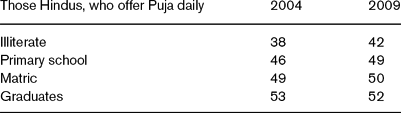
Educated Hindus offer Puja more regularly compared to others (%)
Note: Sample size 21,512 (2004) and 28,674 (2009).
Source: NES (2004, 2009).
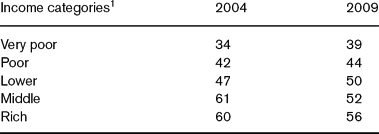
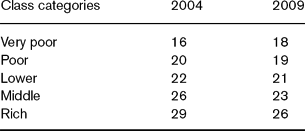
Rich Hindus offer Puja more regularly compared to the poor (%)
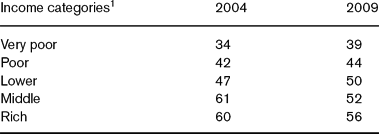
Notes: Sample size 21,512 (2004) and 28,674 (2009).
1 The five-fold classification of the respondents is based on information about the respondent's monthly family income, and respondent's or household's possession of various material goods. The family's household income was already pre-coded into eight broad categories: income below 1,000; 1,001–2,000; 2,001–3,000; 3,001–4,000; 4,001–5,000; 5,001–10,000; 10,001–20,000; and those with a family income of more than 20,001. Based on income and assets, all the respondents were classified into five economic categories, from rich to very poor.
Amongst the rich were those who, or the family, owned either a car or a tractor or a family monthly income of more than Rs. 10,000.
The middle class included those families that owned any three of the following assets: colour TV, scooter, motorcycle, telephone, mobile phone, pumping set, refrigerator, or a family monthly income of Rs. 4,001–10,000.
The lower class included those where the family owned any three of the following items: black and white TV, fan, cooler, cycle, radio, or a family monthly income of Rs. 2,001–4,000.
The poor included those where the family owned any two of the following items: fan, cooler, cycle, radio, or a family monthly income of Rs. 1,000–2,000.
The very poor included those where the family had no material possessions and the monthly income of the family was less than Rs. 1,000.
Source: NES (2004, 2009).
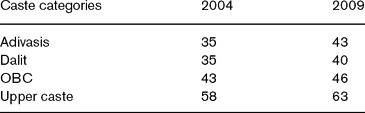
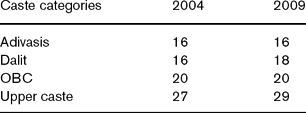
Upper caste Hindus offer Puja more regularly compared to others (%)
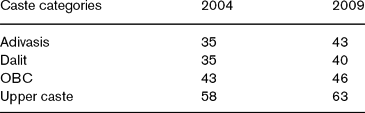
Note: Sample size 21,512 (2004) and 28,674 (2009).
Source: NES (2004, 2009).
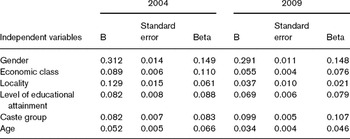
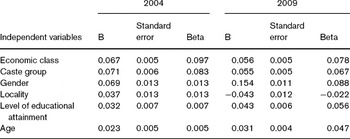
Gender is strongly correlated with regularity of offering Puja

Notes: Regression of Dependent variable, ‘How regularly do you pray?’ With independent variables, gender, locality, economic class, education, caste group and age.
Sample size 21,512 (2004) and 28,674 (2009).
1 For regression, the values of all the independent variables have been arranged unidirectionally from lower to higher.
Gender: 1 = men, 2 = women
Locality: 1 = village, 2 = town, 3 = city
Educational attainment: 1 = illiterate, 2 = primary pass, 3 = high school pass, 4 = college educated
Class: 1 = very poor, 2 = poor, 3 = lower, 4 = middle, 5 = high
Age: 1, less than 25 years, 2 = 26–35 years, 3 = 36–45 years, 4 = 46–55 years, 5 = more than 56 years.
Caste: 1, Dalits, 2, Adivasis, 3 = OBC, 4 = upper castes.
Similarly, the answer categories have been arranged from lower to higher
1 = never, 2 = occasionally, 3 = regularly, 4 = frequently or daily
Source: NES (2004, 2009).
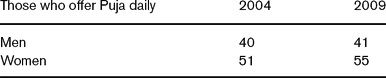
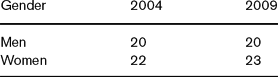
It is not surprising to see that Hindu women are more religious compared to Hindu men. Over the last five years, while the practise of offering Puja every day has increased among both Hindu men and women, this increase is witnessed more among Hindu women compared to Hindu men. The majority of Hindu women now offer Puja every day, which is not the case among Hindu men.
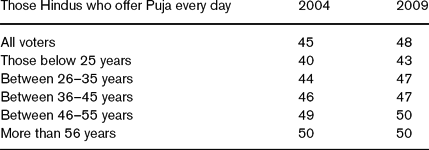
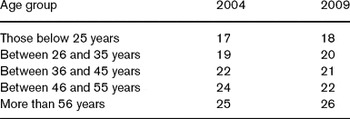
Findings of the survey also suggest that age does matter when it comes to people's engagement in different kinds of religious activities. Among Hindus, people across all age ranges offer Puja quite regularly, but it is more prevalent among the older generation of Hindus compared to the younger ones. Over the last five years, there has been a slight increase in the engagement of younger Hindus in offering Puja daily, which is not seen amongst the older generation, but it is still those Hindus who are above the age of 45 who are more religious compared to the younger generation of Hindus.
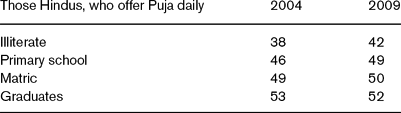
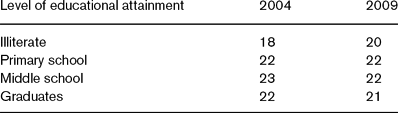
Education seems to suggest a direct correlation with the level of peoples’ engagement with the act of offering Puja. The educated Hindus pray more regularly compared to the illiterate Hindus. Except those who are illiterate, nearly half of all other Hindus, irrespective of level of educational attainment, offer puja every day. It is interesting to note that, among the educated Hindus, the more educated pray more regularly compared to the less educated. Over last five years, there has been an increase in the proportion of Hindus offering puja daily, irrespective of their level of educational attainment.
Similar to the level of educational attainment, the level of economic attainment also has a direct relationship with people's engagement in offering every day Puja. The well-to-do Hindus offer Puja more regularly compared to those who are low on the economic ladder. Among the poor and the very poor, less than half of Hindus offer Puja every day, but among the rich Hindus, 65% offer Puja daily. The proportions of those offering Puja every day, is also high among those who belong to the lower class. However, over the last five years, one finds a decline in the proportion of those who offer Puja every day amongst the middle class and the Rich Hindus. It is important to note that the BJP also draws political support amongst the middle and the rich class voters.
The practise of offering Puja every day is more prevalent among upper caste Hindus compared to lower caste Hindus. Among the Hindus Dalits, the proportion of those who offer Puja every day is the least, followed by the Adivais, and the Hindu OBC caste. The practise of offering Puja more regularly has increased over the last five years among Hindus belonging to all castes, but still among the Dalits, Adviasis, and the OBC less than half of them offer Puja every day. In contrast, among the upper caste Hindus, 63% offer Puja every day.
Engagement in religious practices is generally associated with those who appear low on both social and economic indicators. If that is correct, people living in villages, those with lower levels of educational attainment, or those who are low on the economic ladder would have been offering prayer more frequently compared to those who appear at higher levels on all indicators. But the findings of the survey go against this commonsense view about engagement with the practice of offering Puja. Hindus who live in cities and towns, those who are rich and educated, offer Puja more regularly compared to others. It is not surprising to note that women and also upper caste Hindus offer Puja more regularly compared to others. The probability of women offering Puja quite frequently is very high. The probability of a woman offering Puja every day is 0.312 times higher compared to men. Similarly, the probability of offering Puja every day among those living in cities is higher than both those who live in towns as well as villages. The economic class of the person is also a strong determinant for the probability of offering Puja every day. While economic class is less important compared to gender or locality, it is more important than other factors such as level of educational attainment or age. While caste does influence the pattern of offering Puja, the higher the caste the greater is the frequency of offering Puja, but it is not that strong a determinant as one might feel.
2. Engagement in public religious activities among Indian Hindus is also high − sizeable numbers of Hindus visit temples regularly and participate in Katha, Sattasang, and Bhajan-Kirtan
Any discussion about engagement in religion cannot be considered complete if we only look at patterns of those who offer Puja more regularly compared to others. While offering Puja gives us an idea about the personal aspects of religion among the Hindus, there is also a public aspect of religion, which also needs to be examined. This entails people's engagement in those religious activities generally held collectively and takes place outside the personal home. It is important to mention here that public religious activities were aggressively promoted by the Hindu right wing during their campaign for the Ram temple at Ayodhya in the 1990s. Basu, while mentioning about the proliferation of the Hindu religious symbols in the public sphere states, ‘The successful elaboration of the self-referential network of usable and portable messages is dependent on the deployment of a limited range of basic symbols: Ram (as a baby, and as armed adult), the temple, om, the saffron flag.’Footnote 15 Similarly, Meera Nanda also echoes this argument about the new form of public religiosity among the upper class, urban, and educated Indians when she states, ‘The new elites are shedding their earlier reticence about openly participating in religious rituals in temples and in public ceremonies like kathas and yagnas. If anything, the ritual dimension is becoming more public and more ostentatious.’Footnote 16 The invocation of Hindu religious symbols by the Hindu right wing with the assistance of the state apparatus to further their political ends might have encouraged the proliferation of religious activities in the public sphere. It had its own political repercussions for the support base for the right-wing parties such as the BJP. This section of the paper deals with engagement of Hindus in public religious activities.
It is important to clarify the nature of public religious activities among Hindus as covered by the NES surveys. In order to analyse the level of engagement of Hindus in public religious activities, various forms of public religious activities were taken into consideration. Katha and Satsang are forms of religious discourses where the priest or the religious godhead recites the holy verses from sacred scriptures or narrates stories from Hindu mythology and explains their meaning or context to a religious congregation. Bhajan-Kirtan refers to singing or chanting of religious/sacred verses in a religious congregation. Large numbers of Hindus participate in some form of public religious activity.Footnote 17 Based on the regularity that Hindus participate in these various religious activities, they have been divided into four broad categories: those with a high level of participation, medium level of participation, low level of participation, and, finally, those who do not participate at all in public religious activities.
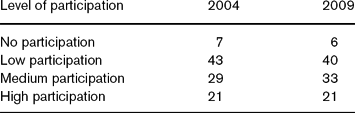
On this broad classification, very few (less than 10%) of Hindus would fall into the category of those showing no participation in public religious activities. The survey suggests that only 7% of Hindus did not participate in any public religious activity. Also, over the last five years, there is a marginal decline in the number of Hindus who do not participate in any public religious activity. At the other extreme are those who show high levels of participation in public religious activities. Amongst Hindus, nearly one-fifth regularly participate in public religious activities and can be classified as those showing a high level of participation. Over the last five years, there is hardly any change in the proportion of Hindus who regularly participate in public religious activities. Large numbers of Hindus (43%) show a low level of participation in public religious activity, and, during last five years, there is also some decline in the proportion of Hindus who show a low level of engagement. At the same time, during the same time period, there is some increase in the proportion of Hindus who show moderate participation in public religious activities. Nearly one-third of Hindus show moderate engagement in public religious activities. Over last five years, their numbers have increased from 29% to 33%.
Participation in public religion is more prevalent among the urban Hindus compared to those who live in villages. Over the last few years, there is a slight increase in the number of Hindus from the villages participating in the public religious activities; however, there is a slight decrease in the number of their counterparts in the cities. The towns have also witnessed fewer Hindus participating in public religious activities as compared to earlier. One finds that earlier, the Hindus living in the towns and cities participated more in public religious activities as compared to the Hindus in villages. One might argue that the towns and the cities witnessed a sustained increase in public religious activities organized by the Hindu right-wing organizations in the 1990s and the early years of this decade, but, in contrast, the decline of the right-wing Hindutva forces has also accompanied a decline in public religious activities among the urban Hindus in India.
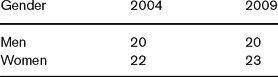
Participation in public religious activities is greater among women compared to men. Among Hindu women, who actively or regularly participate in public religious activities, the proportion is not only higher compared to men, but, over the years, there is also a slight increase in the proportion of women who regularly attend Kathas, Bhajan-Kirtan, and other public religious activities. Among Hindu men, there is hardly any change in proportions among those who regularly participate in public religious activities.
Older Hindus participating more regularly in public religious activities is of no surprise to anyone. There is a slight increase in younger Hindus participating in public religious activities, while one finds a decrease in participation in public religious activities by those who fall in the age group of mid-30s to mid-50s. Those who are above the age of 56 years have started participating more in public religious activities
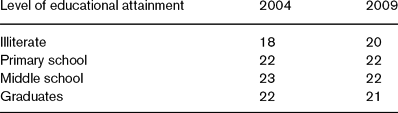
One might tend to believe that the illiterate and the poor may be participating more in public religious activities, such as participating in Bhajan-Kirtan, Satsang etc. But the findings of the survey suggest it is the other way round. The regular participation in public religious activities is more among the educated Hindus compared to the illiterates. The higher the level of educational attainment, the greater is participation in public religious activities, though the graph seems to go down a bit among those who have completed their college education. Regular participation in public religious activities is most prevalent among those who are either studying in school or have completed school education, and it is the least among those who are illiterate. However, the former categories of educated Hindus have witnessed consistency and a decline in participation in public religious activities, respectively.
Among Hindus, participation in public religious activities has also increased (%)
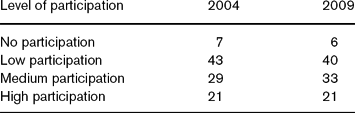
Note: Sample size 21,512 (2004) and 28,674 (2009).
Source: NES (2004, 2009).
Urban Hindus participate more in public religious activities (%)
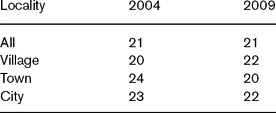
Notes: Figures reported for those who fall in the category of high participation.
Sample size 21,512 (2004) and 28,674 (2009).
Source: NES (2004, 2009).
Hindu women participate more in public religious activities (%)
Notes: Figures reported for those who fall in the category of high participation.
Sample size 21,512 (2004) and 28,674 (2009).
Source: NES (2004, 2009).
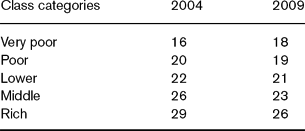
The trends for participation in religious gatherings, Kathas, Satsang, Bhajan-Kirtan, among people belonging to different economic classes correspond with what we find among people with different levels of educational attainment. Participation in public religious activities is the least among the very poor and the highest among the rich. As one moves higher up the economic ladder, the level of engagement in public religious activities also increases. The findings of the survey indicate that over the last five years, engagement in public religious activities has slightly decreased among those belonging to the higher economic group, but there is a slight increase in the proportion of those who belong to the lower strata in terms of their economic class.
Older Hindus participate more in public religious activities (%)

Notes: Figures reported for those who fall in the category of high participation.
Sample size 21,512 (2004) and 28,674 (2009).
Source: NES (2004, 2009).
Educated Hindus participate more in public religious activities (%)
Notes: Figures reported for those who fall in the category of high participation.
Sample size 21,512 (2004) and 28,674 (2009).
Source: NES (2004, 2009).
Rich Hindus participate more in public religious activities (%)
Notes: Figures reported for those who fall in the category of high participation.
Sample size 21,512 (2004) and 28,674 (2009).
Source: NES (2004, 2009).
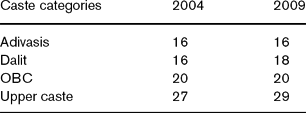
People belonging to the upper castes participate much more than people from lower castes in public religious activities, such as participation in Katha, Satsang, and Bhajan-Kirtan. Interestingly, Dalits and the upper castes have seen an increase in participation in public religious activities over the years, but the Adivasis (tribals) and the OBCs have remained constant as far as their participation in public religion in concerned.
Upper caste Hindus participate more in public religious activities (%)
Notes: Figures reported for those who fall in the category of high participation.
Sample size 21,512 (2004) and 28,674 (2009).
Source: NES (2004, 2009).
Gender, economic class, and caste group are greater determinants for participation in public religious activities

Notes: Regression of dependent variable: How regularly do you participate in public religious activities? With independent variables, gender, locality, economic class, education, caste group, and age.
Sample size 21,512 (2004) and 28,674 (2009).
Source: NES (2004, 2009).
Until a few years ago, caste and gender were the most determining factors regarding participation of Hindus in public religious activities. This was followed by the economic status of the people. The chances of participation of an upper caste Hindu in public religious activities was much higher compared to the OBC or the Dalit Hindus. Compared to men, Hindu women participated more in public religious activities. The probability of participation of upper caste Hindus in public religious activities compared to the OBC or the Dalits is much higher compared to the probability of the participation of Hindu women compared to Hindu men. Though the rich Hindu participate more in public religious activities, compared to the poor, the probability is lower compared to the probability within different caste groups or between men and women.
There does, however, seem to have been changes in recent years. While the rich Hindus still participate more in public religious activities, compared to the poor, the probability of participation of the poor and the rich in public religious activities has increased. Similarly, gender plays a more determining factor among Hindus regarding participation in public religious activities compared to caste. Upper caste Hindus and the poor seem to participate more or less equally in public religious activities. The religious gathering held in cities and towns seems to be having some impact on the daily lives of the people. Even a few years back, urban Hindus participated more in public religious activities compared to those living in villages, but participation of urban Hindus in public religious activities has increased manifold in the cities and towns over last few years. Now urban Hindus are more active in participating in public religious activities compared to the past.
3. The level of religiosity influences political choices
In the previous sections, we tried to look at the changing patterns of engagement in various religious activities, private as well as public. An attempt was made to separate the two spheres of religion – the private and the public – based on the nature of activities in which the Hindus were participating. In this section, an attempt is made to present a comprehensive picture of religious activities in which Indian Hindus engage in day-to-day life. Taking into consideration the level of engagement of Indian Hindus in both private and public religion, they were divided into four broad groups: those with a very low level of religiosity, low level of religiosity, medium level of religiosity, and, finally, those at the top who participate in many such religious activities. Such Hindus have been classified as highly religious.
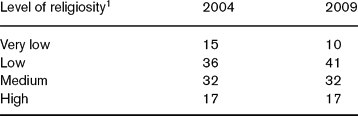
If, at one extreme, 10% of the Hindus belong to the category of very low religiosity, on the other side are those 17% of Hindus who belong to the category of being highly religious. In between are the Hindus who fall into the segment of those having a low level of religiosity, while the rest, 32%, belong to the category of those having a medium level of religiosity. Comparative data for the 2004 and 2009 surveys indicate that there has hardly been any change in the proportion of Hindus who would fit into these four categories of Hindus having different levels of religiosity.
While analysing religiosity among Hindus, one finds that the numbers of those considering themselves as very less religious have decreased over the last five years, but there is some increase in the proportion of Hindus who would fall into the category of those having a low level of religiosity. Their numbers have increased from 36% in 2004 to 41% in 2009. The number of Hindus, who consider themselves as highly or moderately religious have remained constant over the years.
The levels of religiosity among Hindus (%)
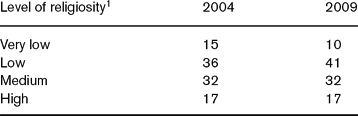
Notes: Sample size 21,512 (2004) and 28,674 (2009).
1The index of religiosity is formed on the basis of respondent's responses to five different questions. The questions were: How regularly do people offer Puja/ Namaz etc.? How regularly do people visit temple/maszid, church etc.? How frequently do people participate in Katha Kirtan, Bhajan etc. How frequently do people give donations for religious activities? How regularly do people keep fast? Responses to all these questions were in four categories, ranging from frequently or daily to never. All the respondents were classified into four broad categories: those who would be considered as very low religious, low religious, medium religious, and last those who would be considered as highly religious. The categorization was based on the standardized scores of responses of all the respondents on all these issues. Those with negative scores were classified into very low or low religiosity, while those with positive scores were classified into medium and highly religious.
Source: NES (2004, 2009).
Socially privileged Hindus are more engaged in religious activities (%)
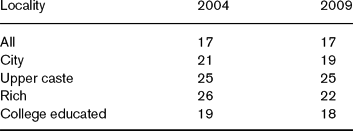
Notes: Figures reported only for those who figured on high religiosity.
Sample size 21,512 (2004) and 28,674 (2009).
Source: NES (2004, 2009).
But one might argue that there is a trend towards somewhat decreased participation of Hindus in religious activities over the years. As mentioned earlier, this trend is linked significantly to the decline of the political fortunes of the BJP, a right-wing political party in India with a significant support base among the upper strata of society in terms of caste and class in urban India. This might help us in answering the big question that still remains, i.e. do the differential levels of engagement in religious activities affect the political choices among Hindus?
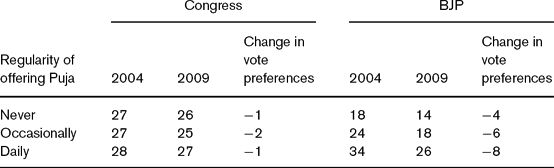
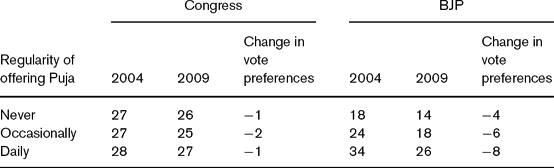
Let us first look at whether political choices are influenced by people's engagement with private religious affairs, i.e. offering Puja. If we look at three different kinds of Hindus, those who offer Puja daily, those who offer Puja occasionally, and those who do not offer Puja at all, we also find differences in their political preferences. Among those Hindus who offer Puja every day, large numbers voted for the BJP in 2004 but this percentage has seen a significant decline in 2009. Of those Hindus who do not offer Puja at all, fewer voted for the BJP in 2004. Between 2004 and 2009, the support base for the BJP declined even amongst Hindus who do not offer puja at all, but the decline in the support for the BJP amongst such voters is much smaller compared to those Hindus who offer puja every day. However, one can say that, despite a drift of the highly religious Hindus away from the BJP, there is a clear trend for higher political preferences for the BJP among those Hindus who pray more regularly as compared to those Hindus who pray occasionally or do not pray at all. The support for the Congress is more or less the same both amongst Hindus offering Puja every day and amongst those who do not offer puja at all. It is also important to note that this support has hardly changed for the Congress, even during the 2009 Lok Sabha elections.
Hindus, who pray daily vote more for BJP, while those who do not pray vote more for the Congress (%)
Note: Sample size 21,512 (2004) and 28,674 (2009).
Source: NES (2004, 2009).
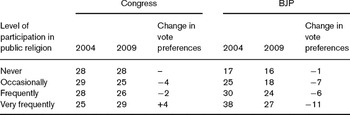
Hindus, who participate more in public religion vote more for the BJP (%)

Note: Sample size 21,512 (2004) and 28,674 (2009).
Source: NES (2004, 2009).
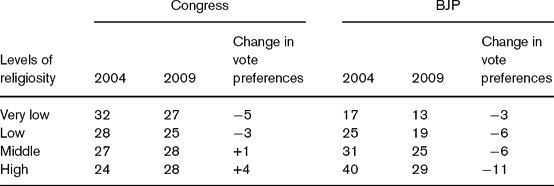
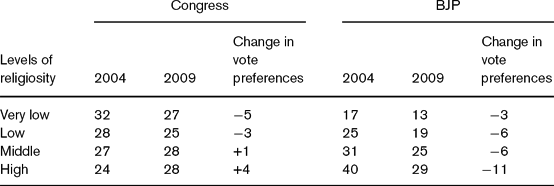
Hindus with higher religiosity voted more for BJP, while those with low religiosity voted more for the Congress (%)
Note: Sample size 21,512 (2004) and 28,674 (2009).
Source: NES (2004, 2009).
Now let us also look at whether there is any pattern of political preferences among those who participate in public religious activities, i.e. those who participate in Katha, Bhajan-Kirtan etc. There seems to be a direct relationship with participation in public religious activities amongst Hindus and political preferences. Hindus who participate in public religious activities very frequently voted more for the BJP during the 2004 Lok Sabah elections, while Hindus who never participate in public religious activities voted in much fewer numbers for the BJP. The findings of the 2004 survey indicate a clear slant in the voting patterns and engagement in public religious activities among the Hindus, the higher the level of engagement in public religious activities, the higher the support for the BJP and vice versa. The 2009 survey indicates that there has been a decline in the support for the BJP amongst all Hindu voters, but the decline is sharpest amongst those Hindus who frequently participate in public religious activities. A comparison between the 2004 and 2009 data suggests that the decline in the support for the BJP amongst those Hindus who never participate in public religious activities is much lower. But, in spite of this sharp decline in the support for the BJP amongst Hindus who participate very regularly in public religious activities, they are still far more polarized in favour of the BJP compared to those Hindus who never participate in public religious activities. The support for the Congress is more or less the same amongst Hindus with different levels of engagement in public religious activities, but, interestingly, during the recently concluded 2009 Lok Saba elections, the support base for the Congress has witnessed some rise amongst Hindus who participate in public religious activities very frequently. The support base for the Congress among the Hindus whose participation in public religious activities is least has remained high and constant over the years.
It is clear that Hindus who participate regularly either in private religious activities or in public religious activities vote more for the BJP, while the Hindus who either do not participate or participate rarely in religious activities vote more for the Congress. At the same time, one finds a trend for the highly religious Hindus in terms of their participation in the private and public religious activities to be drifting away from the BJP over a period of time. It may also be useful to find, putting all things together, if more religious Hindus are more likely to vote for the BJP and the less religious Hindus are more likely to vote for the Congress. Considering participation in various religious activities, the Hindus have been divided into a four-fold classification of those with very low religiosity, those with low religiosity, middle level religiosity, and, finally, those with high-level religiosity. Again, the data indicate a direct relationship between levels of religiosity among Hindus and their political preferences. During the 2004 Lok Sabha elections, Hindus with higher levels of religiosity voted more for the BJP, while Hindus with lower levels of religiosity voted in fewer numbers for the BJP. There is a clear pattern, the higher the level of religiosity, the higher the support for the BJP and vice versa. During the 2009 Lok Sabhe elections, there was a decline in the support base for the BJP amongst all Hindus, but the decline in the support for the BJP is much higher amongst the highly religious Hindus compared to Hindus with very low and low levels of religiosity. But it is important to note that, in spite of this sharp decline, the support for the BJP amongst the highly religious Hindus is still much higher compared to those Hindus who are very low on the religious index. Though the support base for the Congress is more or less uniform amongst all Hindus, between the 2004 and 2009 Lok Sabha elections there was some increase in support for the Congress amongst the highly religious Hindus. The percentage of the highly religious Hindus who voted for the Congress is almost similar to the BJP.
Conclusion
There has not been much change in religious practices among Indian Hindus over the last five years. Although there is some decline in religious engagement among the urban Hindus, even then the urban Hindus still tend to be more religious compared to their rural counterparts.
What seems to have changed is their political preferences. Over the last two elections for which data have been presented, the less religious voted for BJP in fewer numbers compared to the more religious Hindus. This still remains valid for the 2009 elections, as the less religious voted for the BJP in fewer numbers compared to the moderate or highly religious Hindus. But the decline in the preference of voting for the BJP is much sharper amongst the more religious Hindus compared to the less or non-religious Hindus. There are various other reasons that contributed to the decline in support for the BJP during the 2009 elections, but this may be one of the decisive factors for the poor performance of the BJP. Throughout the elections, there was confusion among the BJP leadership about the kind of stand the party should take on issues of Hindutva, i.e. whether to go for a soft line or for a hard line Hindutva. This confusion among the BJP leadership became public when different leaders took different stands on the issue of Varun Gandhi, who delivered a hate speech targeting the Muslims in the country. It seems, besides other reasons that may have also annoyed core voters, that its unclear stand on the issue of Hindutva may have proved costly for the party.
About the author
Sanjay Kumar is a Fellow at the Centre for the Study of Developing Societies (CSDS) and Deputy Director. Lokniti a research program of the CSDS. His area of research has been the electoral system, electoral process, and electoral politics, with special focus on patterns and strategies of electoral mobilization. He is also interested in mapping changing patterns of democracy. While India remains his primary research locale, his research interests extend to other South Asian countries. Sanjay's research draws heavily from the empirical studies, which he pursues as his research tool. He has co-edited (with Christopher Jafferlot) Rise of Plebians? The Changing Face of Indian Legislative Assemblies (Routledge 2009) and co-authored (with Peter R.deSouza and Sandeep Shastri) Indian Youth in a Transforming World: Attitudes and Perceptions (Sage 2009). He has also authored research reports, contributed to several edited volumes, and published in many research journals and national newspapers.