Introduction
A growing body of research has established that there are regional differences in intelligence within countries and that the areas with lower IQs seem to have lower levels of socioeconomic development. This has been found in different regions of the UK (e.g. Lynn, Reference Lynn1979; Carl, Reference Carl2016b), France (Lynn, Reference Lynn1980), Italy (e.g. Lynn, Reference Lynn2010), Spain (Lynn, Reference Lynn2012), Portugal (Almeida et al., Reference Almeida, Lemos and Lynn2011), Germany (Roivainen, Reference Roivainen2012), Finland (Dutton & Lynn, Reference Dutton and Lynn2014), China (Lynn & Cheng, Reference Lynn and Cheng2013), Japan (Kura, Reference Kura2013), the USA (e.g. Pesta et al., Reference Pesta, McDaniel and Betsch2010), Turkey (Lynn et al., Reference Lynn, Sakar and Cheng2015), Brazil (Fuerst & Kirkegaard, Reference Fuerst and Kirkegaard2016), Mexico (Fuerst & Kirkegaard, Reference Fuerst and Kirkegaard2016), Sudan (Bakhiet & Lynn, Reference Bakhiet and Lynn2014a) and Russia (Grigoriev et al., Reference Grigoriev, Lapteva and Lynn2016). Carl (Reference Carl2016a, Reference Carlb) examined data from 400 local authorities in the UK and found that a local authority’s average IQ correlates with a general socioeconomic factor at 0.58. It has been widely demonstrated that IQ is robustly positively associated with socioeconomic status among individuals (e.g. Jensen, Reference Jensen1998) and that average national IQ predicts socioeconomic differences between countries (e.g. Lynn & Vanhanen, Reference Lynn and Vanhanen2012).
There remains debate over the exact direction of causation. Lynn and Vanhanen (Reference Lynn and Vanhanen2012), for example, argue that IQ is in the region of 0.8 heritable among adults, IQ is relatively invariant across the lifespan, ethnic minorities in Western countries reflect the IQ of their host country and that high-IQ groups living in arid conditions maintain a high IQ and flourish economically, such as the Chinese in Singapore. As such, they maintain, IQ is causal in regional and international differences in socioeconomic variables. They also argue that, every generation, by genetic chance, some intelligent people are born into poverty and these people tend to migrate out of it (Jensen, Reference Jensen1998), consistent with the idea that IQ is causal. Others aver that most of the variance is the other way around: poor socioeconomic conditions cause low IQ (e.g. Wicherts et al., Reference Wicherts, Boorsboom and Dolan2010). To some extent cautiously consistent with both interpretations, Bakhiet et al. (Reference Bakhiet, Dutton, Ashaer, Essa, Blahmar, Hakami and Madison2018) conducted a meta-analysis of administrations of Ravens to samples in Arab countries. They showed that at around the age of 5, IQ in Arab countries is roughly 5 points lower than that in Western countries. However, by the age of 18 it is roughly 15 points lower. They suggest a number of explanations, including that the education system in the Arab world does not induce analytic thinking to the same extent as the education system in the West.
The present study contributes to the understanding of regional differences in intelligence by showing, for the first time, that they also exist in North Africa and that their correlates are similar to those in Western countries. This is achieved by comparing two administrations of the Raven’s Coloured Progressive Matrices, one to a representative Egyptian sample and the other to a sample from villages in Menoufia, a province in northern Egypt.
Methods
A secondary analysis was conducted of two previously published studies of IQ in Egypt. The first sample consisted of 1756 Egyptian school children (863 boys and 893 girls) aged 5–11 years attending three village primary schools in the province of Menoufia in the north of Egypt. The children’s IQ was assessed in early 2017 using the Raven’s Coloured Progressive Matrices (CPM), a British non-verbal reasoning test designed for children aged 5–11 years (Raven et al., Reference Raven, Raven and Court1998) and re-standardized in Britain in 2007 (Raven, Reference Raven2008). The children were tested individually and without time limit. These results were presented in English in Ziada et al. (Reference Ziada, Metwaly, Bakhiet, Cheng and Lynn2017).
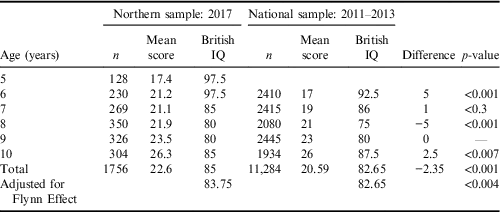
The second sample was drawn from a standardization of the Coloured Progressive Matrices in Egypt, which has been published in Arabic (Ali, Reference Ali2014). The sample consists of 11,284 boys and girls aged 5–10 years. These were drawn from representative primary schools from each province throughout Egypt. The test was administered without time limit between 2011 and 2013. The results were published in English in Bakhiet and Lynn (Reference Bakhiet and Lynn2014b). In order to properly compare these two samples the Flynn Effect needed to be accounted for; a secular rise in IQ of, on average, 2.5 points per decade has been shown to be occurring in certain Arab countries as well as in the West (see Flynn, Reference Flynn2012), so is very likely to be occurring in Egypt. To attain a reasonable estimate of the Flynn Effect, the median year of the national administrations was taken (the year 2012), the annual average Flynn Effect based on the average reported in Flynn (Reference Flynn2012) was calculated, the Flynn Effect between 2012 and 2017 was calculated and then this was subtracted from the difference between the two sets of results. The Flynn Effect was calculated to be around 2.5 points per decade, giving a Flynn Effect of 1.25 points between 2012 and 2017.
Results
It can be seen in Table 1 that the average score on the CPM in rural northern Egypt was statistically significantly higher than the same score in Egypt as a whole. It can also be seen, consistent with the findings of Bakhiet et al. (Reference Bakhiet, Dutton, Ashaer, Essa, Blahmar, Hakami and Madison2018) in the Arab world more broadly, that the Egyptian IQ falls with age in comparison to the Greenwich IQ.
Comparison of Egyptian national score on the CPM with northern Egyptian rural score

Discussion
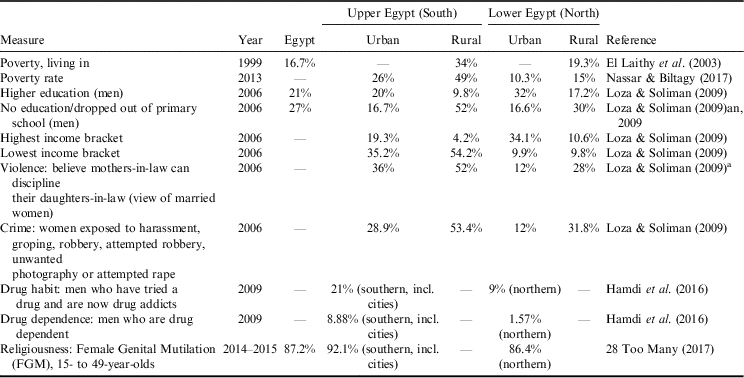
It is possible that the three villages in northern Egypt are anomalously high in IQ and that nothing about northern Egypt can be inferred from them. However, this seems extremely unlikely. Studies of regional differences in IQ have consistently shown that more rural areas tend to have lower average IQs than more urban areas (e.g. Lynn, Reference Lynn1979, Reference Lynn1980; Gintiliene & Girdzijauskiene, Reference Gintiliene and Girdzijauskiene2003; Tine, Reference Tine2013). So, if anything, the IQ for these villages should be lower than the IQ for northern Egypt as a whole. Perhaps confusingly, most of northern Egypt is referred to as Lower Egypt. Most of southern Egypt is referred to as Upper Egypt. To make matters even more confusing, these terms have different meanings when it comes to referring to the governorates of Egypt. In that context, what constitutes ‘Upper Egypt’ excludes huge areas of the south, which are categorized as ‘Frontier Governorate’ and large areas of the north, which come under ‘Urban Governorate’ (the four large cities of Cairo, Alexandria, Port Said and Suez) or ‘Frontier Governorate.’ To be clear, this study uses ‘Lower Egypt’ to mean the north of the country and ‘Upper Egypt’ to mean the south of the country, excluding the four large cities, unless otherwise stated. If Upper Egypt and Lower Egypt are compared there are consistent differences on numerous measures which correlate with intelligence, implying that Lower Egypt has higher intelligence than the Egyptian average and that Lower Egypt has higher average intelligence than Upper Egypt. These are most simply expressed in table format in Table 2. It can be observed from Table 2 that on a variety of correlates of intelligence, Lower Egypt would appear to have higher intelligence than Upper Egypt and, where comparative data are available, Lower Egypt is more intelligent than the Egyptian average. It should be noted that religiousness has been shown to be robustly negatively associated with IQ, at about −0.2 on population samples (Dutton, Reference Dutton2014). Female genital mutilation (FGM) is widely practised in Egypt and practised for specifically religious reasons. It is believed that a woman is not a good Muslim unless she has undergone it (Bursey, Reference Bursey2009, p. 6). There are many measures on which this pattern, of implicitly higher IQ in Lower Egypt, can be observed such as differences in fertility, child mortality and general health (Ministry of Health and Population, 2014).
Correlates of intelligence in Egypt, Upper Egypt and Lower Egypt

a Loza and Soliman (Reference Loza and Soliman2009) pointed out that some of their figures on domestic violence may be have been confounded by a tradition that husbands should not hit their wives, with this tradition being more prevalent in rural areas. However, this does not appear to be a cultural problem when it comes to mothers-in-law.
Of course, this raises the question of why this difference should exist. As already discussed, there are some researchers who maintain that, to a great extent, poverty is causing lower IQ and others who maintain that, in the main, poverty is a reflection of lower IQ. However, in the case of the north–south difference in Egypt a number of pieces of evidence point towards the latter hypothesis. Firstly, it has been demonstrated that consanguineous marriage has a detrimental impact on IQ. Inbreeding leads to a build-up of double doses of mutations that have a small but significant impact on brain functioning (see Woodley, Reference Woodley2009; Brody, Reference Brody2013, p. 157; Fareed & Afzal, Reference Fareed and Afzal2014). Shawky et al. (Reference Shawky, El-Awady, Elsayed and Hamadan2011) have shown that 35% of marriages contracted in Egypt are consanguineous. However, in Sohag, in Upper Egypt, this is 42.2% while in Assuit, in Lower Egypt, it is 21.7%. It could be argued that insomuch as cousin marriage is higher in rural areas of Egypt (59.9%) than urban areas (17%), it is a reflection of poverty in part. For example, it might be argued that the instability caused by poverty may lead to lower levels of trust (see Rushton, Reference Rushton1995). This may mean that males prefer to marry cousins because then even if they have been cuckolded they are still investing in their own genetic kin, following Hamilton’s (Reference Hamilton1996) model of inclusive fitness, which notes that you can pass on your genes both directly and indirectly by aiding your genetic kin. But it can be countered that low levels of trust are also a reflection of low IQ (Jensen, Reference Jensen1998) and also that cousin marriage, whatever its sociological or evolutionary psychological causes, will to some extent negatively impact IQ. Thus, one relatively persuasive cause of these regional differences implies that poverty is partly a reflection of low IQ and not merely a cause of it.
Secondly, it must be stressed that Egypt is not ethnically homogenous. Lynn and Vanhanen’s (Reference Lynn and Vanhanen2012) national IQ data set – though it has been criticized with regard to many individual national datasets – is clear that the average IQ of sub-Saharan Africa is considerable lower than that of the Middle East; a difference of around a standard deviation. It has been shown that the average IQ of the Arab Sudanese, living in the area of Sudan which borders Upper Egypt, is 77.4 (Bakhiet & Lynn, Reference Bakhiet and Lynn2014a). The Arab Sudanese range, in terms of their ethnic heritage, from overwhelmingly Arab to Arab–sub-Saharan African admixture and the level of Arab admixture decreases as one moves southward (Holfelder et al., Reference Holfelder, Schlebusch, Günther, Babiker, Hassan and Jakobsson2017). The theory espoused by Lynn and Vanhanen (Reference Lynn and Vanhanen2012), the Cold Winters Theory, argues that colder environments select more strongly for intelligence and this explains their finding that sub-Saharan Africans have lower intelligence than Europeans, even at a very early age and in Western countries. If this theory is correct, and it must be remembered there is much debate over this, then sub-Saharan admixture would reduce average intelligence. Indeed, Lynn (Reference Lynn2015) has argued that black people in the northern states of the USA have more European admixture than those in the southern states, partly explaining their higher average IQ. Consistent with this, the area of Sudan (not including the new state of South Sudan), Darfur, with the highest level of sub-Saharan admixture, has an average IQ of just 64 (Bakhiet & Lynn, Reference Bakhiet and Lynn2014a). Similarly, there is sub-Saharan admixture in the modern day Egyptian population (Schuenemann et al., Reference Schuenemann, Peltzer, Welter, Van Pelte and Molak2017) and its extent increases the further south one goes (Kings et al., Reference Kings, Salem, Bauer, Geisert and Malek1992). Accordingly, a second possible explanation for apparent high average IQ, even in the rural north of Egypt, compared with the average and compared with the south, is a relative lack of sub-Saharan African admixture. This model would imply that IQ is causal in terms of regional differences in socioeconomic variables within Egypt.
In terms of the alternative hypothesis, Menoufia received a substantial amount of investment in the 1990s, including the repair and modernization of many local schools (Arafat, Reference Arafat2009, p. 75). In addition, there is evidence that school standards tend to be higher in Lower than Upper Egypt and school attendance far more regular. Children in Upper Egypt are more likely to be withdrawn from school in order to work and girls are more likely to be withdrawn from mixed-sex schools for religious reasons, leading to breaks in education (Sayed, Reference Sayed2006). Based on data already presented, children in Lower Egypt are more likely to have parents with a university education and less likely to have parents who are illiterate. This will create a more stimulating home environment and cause them to think in a more analytic way (see Flynn, Reference Flynn2012), elevating their IQ. Consistent with this, it has been shown that the IQ disparity between working-class and middle-class children in Western countries exists at the age of 5 but expands and expands throughout childhood, as middle-class children are subject to greater intellectual stimulation, which inspires more intellectual pursuits, creating a snowball effect of greater and greater cognitive development (Von Strumm & Plomin, Reference Von Strumm and Plomin2015).
Limitations and future research
One limitation to this study is that comparing a study of Egypt as a whole with a local study is obviously not the same as having average IQs from each region. It seems fairly clear that Menoufia has a higher average IQ than Egypt as a whole. This provides very strong inference – especially in light of the IQ correlates that have been examined – that Lower Egypt has a higher average IQ than Upper Egypt. However, it would be useful if future researchers could simply directly test this, by taking representative samples from each region. A second issue is the evidence of a proportion of children simply not being sent to school in rural areas. This raises the question of whether the Menoufia sample – and indeed the sample for Egypt as a whole – is an elite sample, because it draws upon children attending primary school. This is not a problem making the comparison that has been made as school non-attendance is more of a problem in Upper Egypt, meaning that the average IQ of Upper Egypt is likely to be lower than has been found in the dataset drawn upon in this study. However, it may mean that using primary school samples overestimates the average of IQ of Egypt in relation to that of other countries.
Finally, it would be extremely useful if the direction of causation conundrum could be solved in terms of regional differences in intelligence. In this case, it is true that Menoufia may well have above-average schools by Egyptian standards. However, evidence has been provided that seems to indicate that Upper Egypt is likely to have a lower IQ at least partly for genetic reasons, especially related to inbreeding, though it should be appreciated that there is a degree to which this is speculative. Future studies should look into this in greater depth.
Acknowledgment
The authors extend their appreciation to the Deanship of Scientific Research at King Saud University for funding this work through Research Group No. RG-1438-067.
Ethical Approval. The authors assert that all procedures contributing to this work comply with the ethical standards of the relevant national and institutional committees on human experimentation and with the Helsinki Declaration of 1975, as revised in 2008.
Conflicts of Interest. The authors have no conflict of interest to declare.
Funding. The Deanship of Scientific Research at King Saud University funded this work through Research Group No. RG-1438-067.