Introduction
Tinnitus is a widespread auditory disorder affecting approximately 10–15 per cent of the population, often with debilitating consequences.Reference Leaver, Seydell-Greenwald and Rauschecker1 It is a very common complaint in the adult population, with established effects on the lives of patients. Over time, tinnitus often becomes a chronic and disabling condition and represents a real burden for patients and a challenging phenomenon for audiologists and professionals in mental healthcare.Reference Henry, Zaugg and Schechter2
Although tinnitus may be associated with diagnosed dysfunctions of the inner ear and the auditory nerve, it can be present in patients with normal hearing and no detectable otological disorders.Reference McKee and Stephens3 Therefore, it has been suggested that central nervous system dysfunction might be involved in tinnitus generation. There are an ever-growing number of studies that typically utilise neuroimaging in humans and have identified tinnitus-related differences in function and anatomy outside central auditory pathways, particularly in structures considered to be part of the limbic system. Additionally, there is the possibility that maladaptive neuroplasticity and subsequent hyperactivity in an extended neuronal network, including the primary auditory cortex and higher-order association areas, might be involved in tinnitus perception.Reference Plewnia, Reimold, Najib, Brehm, Reischl and Plontke4 Long latency event-related potentials including P300 are often used to evaluate the function of higher cortical areas, and they can be used clinically for the assessment of cognitive function in cases of tinnitus.Reference de Azevedo, Figueiredo and Penido5
However, the possibility of the presence of subtle cochlear dysfunction is still strongly suggested to play an important role in the generation of tinnitus, which emphasises the importance of assessing the peripheral auditory pathway to diagnose such a possibility. Cochlear function can be tested objectively using otoacoustic emissions.Reference Weisz, Müller, Schlee, Dohrmann, Hartmann and Elbert6 Distortion product otoacoustic emission amplitudes were shown to be significantly reduced in most normal-hearing patients with tinnitus compared with normal-hearing controls without tinnitus, which suggests an altered functional state of the outer hair cells in most of the tinnitus ears.Reference Bartnik, Hawley, Rogowski, Raj-Koziak, Fabijanska and Formby7
In this work, we hypothesised that patients with tinnitus and apparently normal hearing might have subtle peripheral or central auditory pathology that could contribute to tinnitus generation. Different types of electrophysiological and behavioural procedures were used to study this issue.
Materials and methods
We examined the hypothesis that different central or peripheral auditory areas are affected in patients with tinnitus with normal hearing. To this end, we recorded distortion product otoacoustic emissions and P300 components of the event-related potentials. We also investigated the possible correlation between both types of measures with patients’ complaints.
In total, 70 participants (age range, 18–50 years) with bilateral normal peripheral hearing participated in this study. They were divided into two groups: a control group comprising 25 participants (20 females and 5 males) without complaint of tinnitus, and a study group of 45 participants (28 females and 17 males) who were suffering from tinnitus.
Inclusion criteria included individuals with bilateral normal peripheral hearing thresholds (less than or equal to 25 dB HL at all frequencies). None of the participants had a history of otological disorders or surgery, a history of noise exposure, systemic diseases or psychological problems.
Exclusion criteria included patients with hearing impairment or previous ear surgery, history of ototoxic medication, cervical spondylosis, a history of head injury or cerebrovascular accident, chronic systemic diseases (e.g. diabetes mellitus or hypertension), psychological disorders, or endocrinal diseases.
Participants were recruited from patients attending the Audiovestibular Unit, Otolaryngology Department, Kafrelsheikh University Hospitals, Egypt. Written consent was obtained from all participants in the study after explanation of the test procedure. The study was approved by the ethics committee of the Faculty of Medicine, Kafrelsheikh University Hospitals (20-180-815).
All participants were submitted to thorough history taking, otoscopic examination, pure tone audiometry throughout the frequency range of 250–8000 Hz and speech audiometry. Both tests were performed using an AD629 audiometer (Interacoustics, Middelfart, Denmark), and tympanometry and acoustic reflexes (ipsilateral and contralateral) were performed using an AT235 (Interacoustics).
Tinnitus matching for pitch and loudness was conducted in the study group. Pitch matching was measured by varying the frequency of a pure tone or a narrow-band noise aiming to match the pitch of the tinnitus by asking the patients to select the sound that best matched his or her tinnitus. Loudness matching was carried out by instructing the patient to raise his or her hand whenever the stimulus was equal in loudness to the tinnitus. Loudness was expressed in decibels.
The Arabic version of the Tinnitus Handicap InventoryReference Newman, Jacobson and Spitzer8 was used to assess the psychological impact of tinnitus. The questionnaire included 10 questions, with response options of ‘always’ (score = 10), ‘sometimes’ (5) or ‘no’ (0). The psychological impact of tinnitus was calculated from the total score of the 10 questions.
Tests for distortion product otoacoustic emissions (DPOAEs) comprised two pairs of primary pure tones (f1 and f2), presented at f2/f1 frequency ratio equal to 1.22 at two levels (level 1 and level 2) where level 2 is greater than level 1 by 10 dB. The two f1 to f2 DPOAEs gram was measured at various f2 frequencies throughout the frequency range of 1000–6000 Hz with fixed stimulus intensities (level 1 = 65 dB SPL; level 2 = 55 dB SPL). Distortion product otoacoustic emissions were considered present if the distortion product signal-to-noise ratio exceeded the noise floor by more than 3 dB. Distortion product otoacoustic emissions were recorded using an Interacoustics Eclipse-EP25 (Middelfart, Denmark).
P300 was recorded using the oddball paradigm in which two-tone burst stimuli of different frequencies are presented in a random order. One of the two stimuli, the standard stimulus (1000 Hz), was presented more than the deviant stimulus (1050 Hz). Stimuli were presented at 40 dB SL (in relation to speech recognition threshold). Participants were allowed to recline on a comfortable sofa and asked to avoid moving. They were then instructed to count the deviant stimulus that was presented with 15 per cent probability. Four electrodes were used for P300 recording, placed at Fz (positive electrode), Fpz (ground electrode) and M1 and M2 (mastoids) as reference electrodes according to the stimulated side. The total number of stimuli was 200. Filters were set at 1–30 Hz, and the time window was 0–500 mseconds. Both latencies and amplitudes were calculated for participants in both groups.
The collected data were statistically analysed using the SPSS® statistical software (version 19). Qualitative data are presented as number and percentage. Quantitative data are described using means (minimum and maximum) and standard deviations. The level of significance was adopted at p < 0.05. The chi-square test was used for categorical variables to compare between the two groups, Student t-test was used for normally distributed quantitative variables to compare between the two groups, and the Mann–Whitney test was used for abnormally distributed quantitative variables to compare between the two groups. The Spearman coefficient was used to evaluate correlations between two normally distributed quantitative variables.
Results
This study was conducted between January and July 2020 and included 70 participants: the control group (n = 25; mean age, 34.1 ± 1.2 years) and the study group (n = 45; mean age, 38 years). There was no significant difference between the two groups (p > 0.05) in terms of age or sex. Tinnitus laterality in the study group was found to be bilateral in 54 per cent of cases, left-sided in 36 per cent of cases and right-sided in 10 per cent of cases. The duration of tinnitus was 3.1 ± 1.26 years, and the tinnitus course was intermittent in 66.6 per cent of cases and continuous in 33.4 per cent of cases.
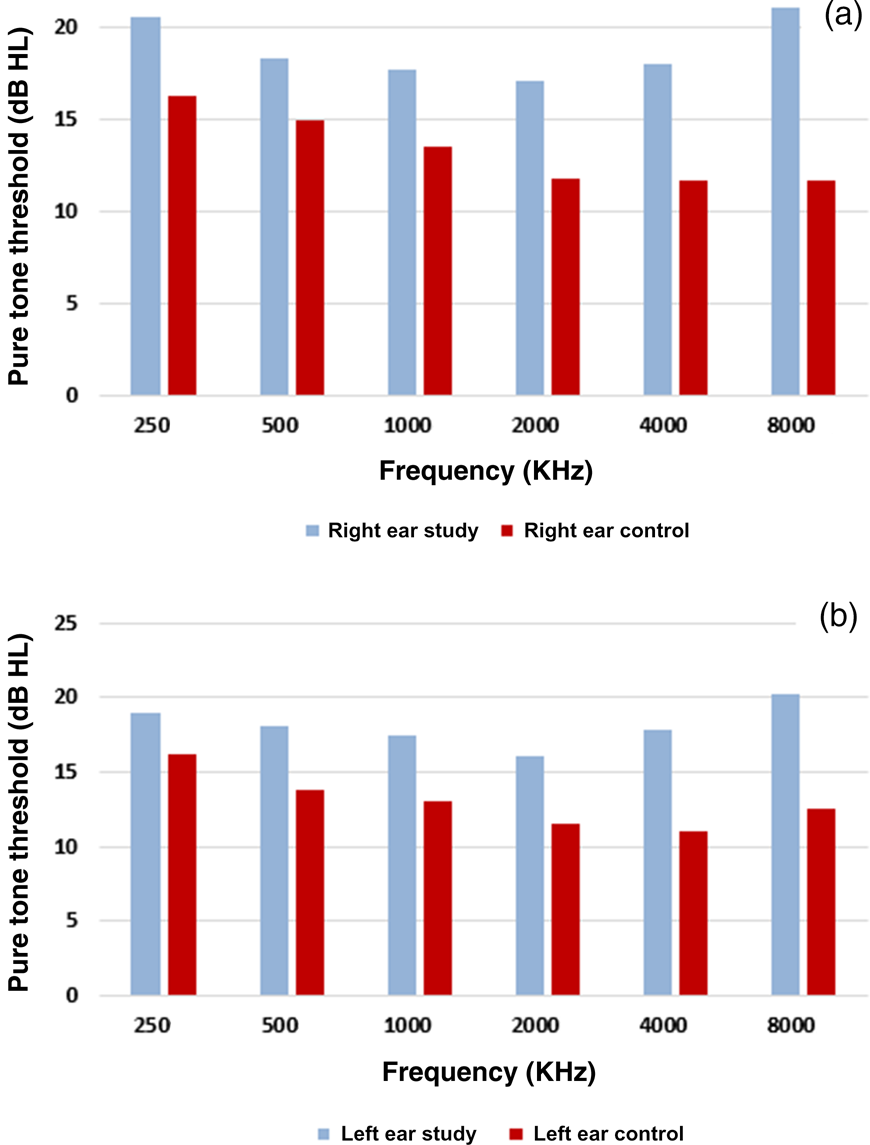
Basic audiological evaluation showed within-normal hearing sensitivity, although with significantly higher hearing thresholds in the study group at all frequencies, especially at frequencies more than 2000 Hz. Speech discrimination scores were excellent in all tinnitus cases (98.67 ± 1.89 per cent). The results of immittancemetry showed normal middle-ear functions and normal ipsilateral and contralateral acoustic reflex thresholds in both ears in both groups (Figure 1).
Comparison of hearing thresholds between both groups in the (a) right and (b) left ears.

The results of tinnitus matching for frequency showed high frequency tinnitus (more than or equal to 4000 Hz) in 16 ears, mid-frequency tinnitus (1000–3000 Hz) in 18 ears and low-frequency tinnitus (less than 1000 Hz) in 12 ears, in addition to noise-like tinnitus in 44 ears. Tinnitus matching for intensity was less than 40 dB in 45 ears, 40–60 dB in 38 ears and more than 60 dB in 7 ears.
The Arabic version of the Tinnitus Handicap Inventory was conducted to assess the possible existence of disability caused by tinnitus in the study group. Results showed mean scores of 39.1 ± 14.8; 28 cases (62.2 per cent) had mild impairment, 14 (31.1 per cent) had moderate impairment and 3 (6.7 per cent) had severe impairment.
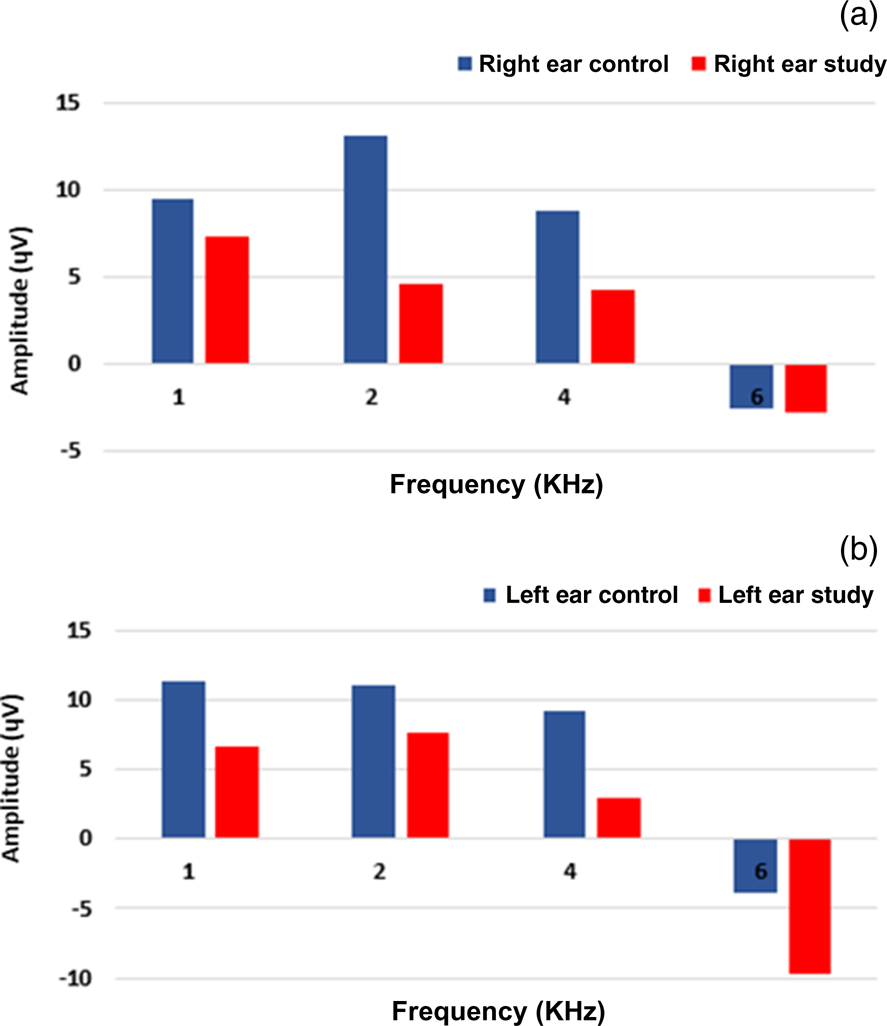
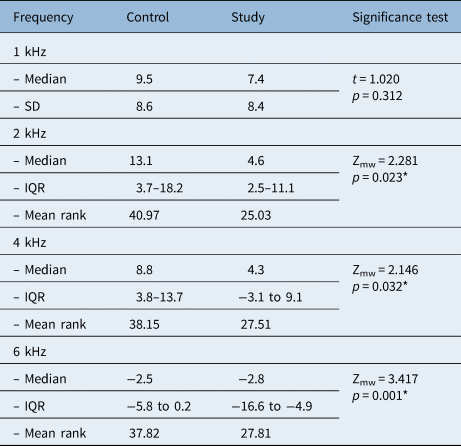
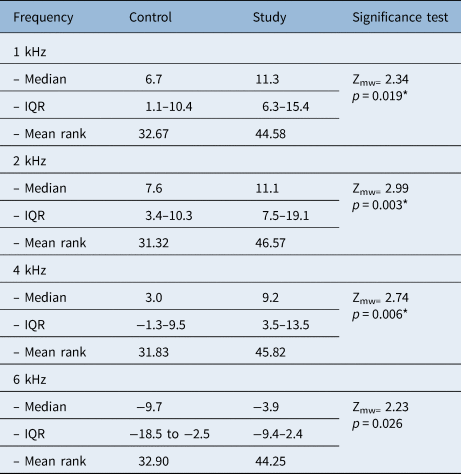
The distortion product otoacoustic emissions gram throughout the frequency range of 1000–6000 Hz showed significantly higher amplitudes in both right and left ears in the control group compared with the study group (Figure 2 and Table 1 and 2).
Comparison of distortion product otoacoustic emission amplitudes between both groups in the (a) right and (b) left ears.

Comparison of distortion product otoacoustic emission amplitudes between the control and study group in the right ear at different frequencies

*Significant at p < 0.05. t is independent t-test. Zmw is Mann–Whitney U test. SD = standard deviation; IQR = interquartile range
Comparison of distortion product otoacoustic emission amplitudes between control and study group in left ear at different frequencies

*Significant at p < 0.05. t is independent t-test. Zmw is Mann–Whitney U test. IQR = interquartile range
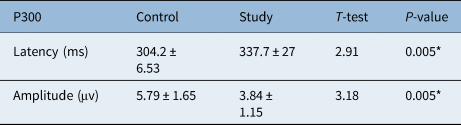
P300 was measured in both groups. Because no significant difference was found between right and left ears in each group, we compared ears between the two groups. The mean latency of P300 showed significant delayed latencies in the study group compared with the control group (study group, 337.7 ± 27.2 ms; control group, 304.2 ± 6.53 ms). Regarding P300 amplitudes, they were significantly lower in the study group with a mean of 5.79 ± 1.65 μv in the control group and 3.84 ± 1.15 μv in the study group (Table 3).
Comparison of P300 latency and amplitude between control and study groups

*Significant at p < 0.05. t is independent t-test
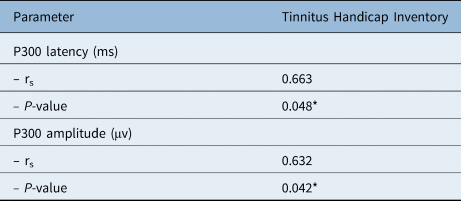
We then studied the possible correlation between the Arabic version of Tinnitus Handicap Inventory and tinnitus frequency, tinnitus intensity and distortion product otoacoustic emissions gram amplitudes throughout different frequencies (1000–6000 Hz). The results showed no correlation between any of these parameters (p > 0.05). For P300 latency, there was a significantly positive correlation with the Arabic version of the Tinnitus Handicap Inventory, meaning that the higher the Tinnitus Handicap Inventory score, the more delayed was P300 latency. Moreover, P300 amplitude showed a significantly negative correlation with Tinnitus Handicap Inventory score indicating that the higher the Tinnitus Handicap Inventory score, the lower the amplitude of P300 (Table 4).
Spearman's rank-order correlation between Tinnitus Handicap Inventory scores and P300 latency and amplitude

*Significant at p < 0.05. rs = correlation coefficient
Discussion
Tinnitus is a phantom auditory perception that is poorly understood. It represents one of the most common and distressing otological problems causing various somatic and psychological disorders that interfere with quality of life.Reference Yetiser, Tosun, Satar, Arslanhan, Akcam and Ozkaptan9 Based on a neurophysiological model, tinnitus may originate from an auditory or non-auditory system including the limbic system. Studies suggest that various networks are involved in perception and generation of tinnitus, such as the frontal cortex and the limbic system, which may be responsible for distress and attention disorders in patients with tinnitus, thereby contributing to a range of problems in their daily life.Reference Jastreboff, Gray and Gold10–Reference Mohamad, Hoare and Hall12
In this study, 70 individuals were recruited, with 25 participants in the control group and 45 participants with normal hearing and tinnitus in the study group. There was no significant difference between both groups with regard to age and sex (p > 0.05). Tinnitus was bilateral in 54 per cent of cases, left-sided in 36 per cent of cases and right-sided in 10 per cent of cases.
Pure tone audiometry showed normal hearing thresholds in both groups; however, the hearing thresholds of patients with tinnitus were significantly higher compared with the control group, which suggests the possibility of subtle pathology at the cochlear level. Recent findings in a variety of rodent models have suggested that substantial damage to the auditory periphery can occur without affecting cochlear thresholds. Indeed, there was extensive loss of synapses between cochlear inner hair cells and auditory nerve fibres despite inner and outer hair cells being left macroscopically intact. This finding was termed ‘cochlear synaptopathy’. This pathology has been observed in noise-exposure or as a result of aging in guinea pigs.Reference Lin, Furman, Kujawa and Liberman13,Reference Sergeyenko, Lall, Liberman and Kujawa14 Crucially, the pathology does not compromise sensitivity to low-level sounds as there is a preferential loss of auditory nerve fibres with low spontaneous firing rates and high thresholds. Consistent with this finding is the evident abnormal auditory processing at higher sound levels in patients with tinnitus who demonstrated hyperacusis in many situations.Reference Kujawa and Liberman15,Reference Furman, Kujawa and Liberman16 Thus, tinnitus may be a primary symptom of diseases that are only diagnosed after the occurrence of hearing loss.Reference Ishak, Zhao, Rajenderkumar and Arif17
In this study, the possibility of the presence of cochlear pathology was examined using distortion product otoacoustic emission (DPOAEs). The DPOAE grams were recorded in both groups throughout the frequency range of 1000–6000 Hz, with significantly higher DPOAE amplitudes in the control group at all frequencies in both ears compared with the group of patients with tinnitus. These findings suggest the possibility of the presence of subtle damage to the outer hair cells in patients with tinnitus, and DPOAEs can be used effectively for cochlear pathology detection even before it becomes evident in audiometric thresholds.Reference McKee and Stephens3,Reference Ami, Abdullah, Awang, Liyab and Saim18
Although it is generally agreed that tinnitus is induced or triggered by abnormal events in the cochlea, the perception of tinnitus might not solely be related to cochlear mechanisms.Reference Fabijańska, Smurzyński, Hatzopoulos, Kochanek, Bartnik and Raj-Koziak19 The discordant damage theory of Jastreboff and HazellReference Jastreboff and Hazell20 provides one of several possible explanations for the existence of tinnitus in patients with normal hearing. According to this theory, the presence of a limited area of outer hair cell damage (which may not be detected in a conventional audiogram) with intact inner hair cells can result in unbalanced neural activity between type I and type II auditory nerve fibres. Consequently, this unbalanced activity, after being further enhanced at different stages of the auditory pathway, is perceived as tinnitus.Reference Jastreboff, Vernon and Møller21
Clark et al.,Reference Clark, Kim, Zurek and Bohne22 reported that outer hair cell damage of about 20 per cent might not be detected in the behavioural threshold measures. Moreover, the possibility of loss of normally high-threshold spiral ganglion cells might also be involved in the generation of tinnitus.Reference Fabijańska, Smurzyński, Hatzopoulos, Kochanek, Bartnik and Raj-Koziak19 Numerous studies support the role of the efferent system in the generation of tinnitusReference Chéry-croze, Collet and Morgon23,Reference Fernandes and dos Santos24 and report that most patients with tinnitus had an efferent system that lacked effectiveness. The medial olivocochlear system mediates peripheral suppression on the outer hair cell activity followed by reduction in cochlear activity and inhibits cochlear nerve output to the brain with a homeostatic increase in evoked firing in certain neurons of the ventral cochlear nucleus.Reference Riga, Papadas, Werner and Dalchow25
In this work, we used the P300 component of the event-related potentials as a non-invasive method of measuring brain activity during cognitive processing. P300 is dependent primarily on the cognitive evaluation of the stimuli. Its latency and amplitude can be used as a measure of the relative timing and magnitude of this evaluation process.Reference Coles, Smid, Scheffers, Otten, Coles and Rugg26 In this work, patients with tinnitus showed reduced P300 amplitudes and prolonged latency suggesting that they have impaired cognitive performance. Jastreboff et al.Reference Jastreboff, Gray and Gold10 argued that the limbic system is responsible for the impairment felt by the patients with tinnitus in which the impaired limbic system affects the patient's attention, memory, detection and the processing of auditory stimuli involved in the generation and modulation of the P300 wave.Reference Hallam, McKenna and Shurlock27 Moreover, P300 recording requires the patients’ attention to the deviant stimuli. Because attention is affected in patients with tinnitus,Reference Jacobson, Calder, Newman, Peterson, Wharton and Ahmad28 the findings of abnormal P300 results in those patients might be expected. The dorsolateral prefrontal cortex has an important role in auditory attention and has a direct connection with the primary auditory cortex and could be involved as a cause for the reduction of amplitude in the tinnitus group.Reference De Ridder, Song and Vanneste29
In this study, the results of the Arabic version of Tinnitus Handicap Inventory showed that all the patients with tinnitus suffered to some degree psychologically and most of them showed mild-to-moderate impairment. However, results of this Tinnitus Handicap Inventory were not correlated with tinnitus frequency or intensity or distortion product otoacoustic emission gram amplitudes (p > 0.05).
• Tinnitus is an ambiguous complaint that affects a wide variety of patients
• This work emphasises the possibility of auditory pathway affection at different levels in such patients
• Distortion product otoacoustic emissions provide evidence of subclinical affection of the cochlear function despite apparent normal hearing
• P300 provided evidence of cognitive function affection in patients with tinnitus that should be considered during the rehabilitation
Regarding P300 latency and amplitude, there was a significantly positive correlation with the Arabic version of the Tinnitus Handicap Inventory, meaning that the higher the Tinnitus Handicap Inventory score, the more delayed the P300 latency and the lower the amplitude (p < 0.05). This finding agrees with McKenna et al. Reference McKenna, Hallam, Shurlock, Reich and Vernon30 and Gabr et al.,Reference Gabr, Abd El-Hay and Badawy31 who reported poor performance in cases with tinnitus compared with a control group, which may stem from depressive and anxiety symptoms or be because of a central mechanism. The presence of such minor cognitive disturbance could also be another factor that contributes to impaired P300 response. The efferent system also plays a role where deficits in the efferent nerve fibre through cortical connection may create impairment in central inhibition which produces abnormally high loudness in patients with tinnitus. Moreover, a patient's cognitive and attention resources may be disrupted or depleted because of negative thoughts, continuous orienting to tinnitus as well as to increased self-focused attention with the subsequent impact on a patient's mental condition.Reference De Ridder, Song and Vanneste29,Reference Newman, Wharton and Jacobson32
Competing interests
None declared