Introduction
Harmful drinking and alcohol use disorders (AUDs) represent leading causes of global preventable mortality, contributing to 3 million deaths annually (WHO, 2018) and recent research suggesting an alarming increase in the prevalence of problem drinking in some demographic groups (Grant et al., Reference Grant, Chou, Saha, Pickering, Kerridge, Ruan and Hasin2017). Extant treatments for AUD enjoy limited long-term efficacy, with under 20% completing treatment free of dependence and fewer still maintaining abstinence long-term (Public Health England, 2018). Treatment approaches targeting the fundamental processes underlying the development and maintenance of harmful drinking are required to address this global health priority.
AUDs arise via repeated environmental exposures to alcohol amid multivariate risk factors (Sher, Grekin, & Williams, Reference Sher, Grekin and Williams2005). Harmful alcohol consumption may therefore be conceptualised partly as a learned pattern of maladaptive behaviours (Drummond, Cooper, & Glautier, Reference Drummond, Cooper and Glautier1990; Hyman, Reference Hyman2005). Alcohol, similar to other addictive drugs, induces plasticity in mesocorticolimbic motivational circuitry (Pierce & Kumaresan, Reference Pierce and Kumaresan2006). This system supports reward learning, adapting behaviour to seek and maximise rewards when environmental cues signal their availability. Alcohol can therefore support behavioural adaptation towards hyper-motivated alcohol seeking and consumption in the presence of environmental ‘trigger’ cues. Practically, this manifests as arousal and a strong desire to drink (craving) in response to certain alcohol-predictive contexts and stimuli (e.g. the sight or smell of beer) (Self, Reference Self1998; Sinha & Li, Reference Sinha and Li2007).
Memories that support a harmful level of alcohol use, by linking environmental cues to alcohol reward can be considered to be ‘maladaptive reward memories’ (MRMs). Once formed through repeated naturalistic exposures to alcohol with accruing drinking episodes (Robbins, Ersche, & Everitt, Reference Robbins, Ersche and Everitt2008), these MRMs are highly robust and display remarkable persistence (Hyman & Malenka, Reference Hyman and Malenka2001) even after extended periods of abstinence. They are therefore believed to be a core substrate underlying persistent relapse susceptibility.
Their central pathogenic role suggests MRMs should be a primary target in the treatment of AUDs (Tronson & Taylor, Reference Tronson and Taylor2013). A novel approach for directly and perhaps permanently ameliorating the negative influence of MRMs on behaviour is to leverage the process of memory reconsolidation (Milton & Everitt, Reference Milton and Everitt2012; Torregrossa & Taylor, Reference Torregrossa and Taylor2013). This is a retrieval-dependent memory maintenance process that serves to strengthen and/or update consolidated memory traces when new memory-relevant information is presented at retrieval. Such updating necessitates the temporary destabilisation of memory traces, such that new information can be incorporated and the relevant adjustments to the dendritic and synaptic architecture encoding the memory trace made (Clem & Huganir, Reference Clem and Huganir2010; Merlo, Bekinschtein, Jonkman, & Medina, Reference Merlo, Bekinschtein, Jonkman and Medina2015). If adaptive learning (e.g. extinction) is timed correctly following retrieval/destabilisation, such that it occurs in the critical (~2 h) ‘reconsolidation window’ when memories are active and unstable, it is theoretically possible to rewrite maladaptive memory content to a benign form (Germeroth et al., Reference Germeroth, Carpenter, Baker, Froeliger, LaRowe and Saladin2017; Monfils & Holmes, Reference Monfils and Holmes2018). By re-formatting MRMs such that trigger cues do not provoke alcohol seeking, it may be possible to reduce alcohol consumption and prophylactically guard against relapse over the long-term.
Although a nascent field, there are highly promising early demonstrations of the potential of this approach (Walsh, Das, Saladin, & Kamboj, Reference Walsh, Das, Saladin and Kamboj2018). Extinction (i.e. exposure therapy) following retrieval of MRMs has been shown to produce long-lasting reductions in drug-cue-induced craving and physiological arousal (Xue et al., Reference Xue, Luo, Wu, Shi, Xue, Chen and Lu2012), and reduce smoking in cigarette smokers (Germeroth et al., Reference Germeroth, Carpenter, Baker, Froeliger, LaRowe and Saladin2017). However, there have also been notable failures to replicate reconsolidation-interference effects, particularly using the retrieval-extinction paradigm (Baker, McNally, & Richardson, Reference Baker, McNally and Richardson2013; Luyten & Beckers, Reference Luyten and Beckers2017; Soeter & Kindt, Reference Soeter and Kindt2011). There are several potential reasons for such discrepant results.
Firstly, extinction itself may represent a sub-optimal ‘corrective’ learning modality. Since it is a largely passive procedure, involving no response from participants, unobserved inter-individual variability in engagement and responsiveness to extinction (Shumake, Jones, Auchter, & Monfils, Reference Shumake, Jones, Auchter and Monfils2018) may mask effects. A promising alternative – counterconditioning – re-pairs cues reward cues (e.g. pictures of beer) with negatively-valenced outcomes (e.g. disgust-inducing bitter liquids and images). Disgust- counterconditioning may provide a more potent corrective learning experience than extinction (Tunstall, Verendeev, & Kearns, Reference Tunstall, Verendeev and Kearns2012) since it (1) leverages a potent oral-rejection mechanism (Rozin & Fallon, Reference Rozin and Fallon1987) (2) the ‘disgust’ response to certain images and bitter liquids are powerful and throught to be universal (Schienle, Arendasy, & Schwab, Reference Schienle, Arendasy and Schwab2015) and (3) it is an ‘active’ procedure, meaning participants cannot simply disengage from the task, as may occur during extinction. We have shown broad short-term abolition of attentional biases and reactivity to alcohol cues when counterconditioning was conducted after MRM retrieval in hazardous drinkers (Das, Lawn, & Kamboj, Reference Das, Lawn and Kamboj2015) a finding that has been further demonstrated in experimental animals (Goltseker, Bolotin, & Barak, Reference Goltseker, Bolotin and Barak2017), however this has never been shown to affect long-term drinking outcomes.
Secondly, memory retrieval and destabilisation are not synonymous. Indeed, memory destabilisation is highly dependent upon various ‘boundary conditions’ (Elsey & Kindt, Reference Elsey and Kindt2017; Walker & Stickgold, Reference Walker and Stickgold2016). Primary amongst these are the length of retrieval (N cues presented), with retrievals that are either too short or too long failing to spark destabilisation (Merlo, Milton, & Everitt, Reference Merlo, Milton and Everitt2018; Merlo, Milton, Goozee, Theobald, & Everitt, Reference Merlo, Milton, Goozee, Theobald and Everitt2014; Suzuki et al., Reference Suzuki, Josselyn, Frankland, Masushige, Silva and Kida2004) and the presence of an appropriate ‘mismatch’ learning signal – prediction error (PE) (Schultz, Dayan, & Montague, Reference Schultz, Dayan and Montague1997; Waelti, Dickinson, & Schultz, Reference Waelti, Dickinson and Schultz2001) – at retrieval (Das et al., Reference Das, Lawn and Kamboj2015; Krawczyk, Fernández, Pedreira, & Boccia, Reference Krawczyk, Fernández, Pedreira and Boccia2017; Sevenster, Beckers, & Kindt, Reference Sevenster, Beckers and Kindt2013). Specifically, some level of mismatch between predicted and actual outcomes is required for destabilisation (Agustina López et al., Reference Agustina López, Jimena Santos, Cortasa, Fernández, Carbó Tano and Pedreira2016; Pedreira, Pérez-Cuesta, & Maldonado, Reference Pedreira, Pérez-Cuesta and Maldonado2004).
These key parameters have not been systematically manipulated in clinically-focused reconsolidation interference studies (Walsh et al., Reference Walsh, Das, Saladin and Kamboj2018). It is unsurprising, then, that findings are inconsistent. In order to properly assess whether rewriting of alcohol MRMs can be reliably achieved through purely behavioural reconsolidation manipulations, systematic investigation of the role of MRM retrieval and PE prior to corrective learning is required.
In the current study, we addressed this issue by systematically manipulating MRM retrieval and the presence of PE at retrieval prior to a counterconditioning intervention in heavy drinkers. We assess whether the effects of counterconditioning on cue reactivity and drinking levels are potentiated in a retrieval and PE-dependent manner, consistent with reconsolidation-based memory rewriting.
Methods
Participants and design
A total of 120 hazardous, beer-preferring drinkers were randomised in a 2 (MRM retrieval/no retrieval) × 2 (prediction error/no prediction error) factorial design. All participants completed three sessions, corresponding to baseline (on Day 1), retrieval/counterconditioning manipulation (Days 3–5) and post-manipulation (Days 10–13). Primary inclusion criteria were: Aged 18–60, scoring >8 on the Alcohol Use Disorders Identification Test (AUDIT) (Saunders et al., Reference Saunders, Aasland, Babor, Delafuente, Grant, De La Fuente and Grant1993); consuming >40 (men) or >30 (women) UK units/week (1 unit = 8 g ethanol), drinking ⩾4 days each week, primarily drinking beer and having non-treatment seeking status. Exclusion criteria were: pregnancy/breastfeeding, diagnosis of AUDs/SUDs, current diagnosed psychiatric disorder, AUD as defined by the SCID; use of psychoactive medications and use of illicit drugs >2×/month.
Measures
Questionnaire assessments
The comprehensive effects of alcohol questionnaire (CEOA; Fromme, Stroot, and Kaplan, Reference Fromme, Stroot and Kaplan1993) retrospectively assessed responses to alcohol, the AUDIT, obsessive-compulsive drinking scale (OCDS; Anton, Moak, and Latham, Reference Anton, Moak and Latham1995) and alcohol craving questionnaire (ACQ-NOW; Singleton, Henningfield, and Tiffany, Reference Singleton, Henningfield and Tiffany1994) measured maladaptive drinking patterns. Motivation to reduce drinking was measured by the stages of change readiness and treatment eagerness scale (SOCRATES; Miller and Tonigan, Reference Miller and Tonigan1996). Distress tolerance and sensitivity to disgust were assessed by the Distress Tolerance Scale (DTS; Simons and Gaher, Reference Simons and Gaher2005) and Disgust Propensity and Sensitivity Scale (DPSS-R; Olatunji, Cisler, Deacon, Connolly, and Lohr, Reference Olatunji, Cisler, Deacon, Connolly and Lohr2007), respectively. Changes in anxiety and affect due to the counterconditioning procedure were assessed using the state version of the Spielberger State-Trait Anxiety Inventory (STAI-S; Spielberger et al., Reference Spielberger, Gorusch, Lushene, Vagg and Jacbos1983) and positive and negative affect scale (PANAS; Watson, Clark, and Tellegen, Reference Watson, Clark and Tellegen1988), respectively. Drinking was quantified using the Timeline Follow-Back diary procedure (Sobell & Sobell, Reference Sobell and Sobell1992). Depressive symptomatology was assessed with the Beck Depression Inventory (BDI) (Beck, Steer, & Carbin, Reference Beck, Steer and Carbin1988).
Cue reactivity assessment
As in our previous study (Das et al., Reference Das, Gale, Walsh, Hennessy, Iskandar, Mordecai and Kamboj2019), participants were presented with a 150 ml glass of beer and told they would consume this after rating a series of images. They then rated their urge to drink and liking of four ‘orange juice cue’ images and four ‘beer cue’ images. These were subsequently used as retrieval cues in the ‘no retrieval’ (‘No RET’) and retrieval (‘RET’) procedures respectively on the manipulation day. Three wine and two soft drink (neutral) images (not used as retrieval cues) were also rated. Participants then rated their urge to drink the glass of beer and predicted enjoyment of the beer. These were all rated on an 11-point (0–10) scale. Participants then consumed the beer according to timed on-screen prompts and rated their post-consumption actual enjoyment of the beer and urge to drink more beer. These scales thus assessed the acute hedonic and motivational properties of alcohol. These baseline (Day 1) procedures both allowed assessment of changes in cue reactivity and reinforcing properties of alcohol, and set the expectation of beer consumption to maximise PE on the manipulation day when the drink was unexpectedly withheld in PE groups during the appropriate retrieval procedure.
MRM retrieval/PE procedure
This procedure was the one we have previously used to reactivate alcohol MRMs and is described fully elsewhere (Das et al., Reference Das, Lawn and Kamboj2015; Das Gale Hennessy, Reference Das, Gale, Hennessy and Kamboj2018; Das et al., Reference Das, Gale, Walsh, Hennessy, Iskandar, Mordecai and Kamboj2019). Participants' MRMs were retrieved by viewing/rating beer cues (RET). Control memories were retrieved by viewing/rating orange juice cues (No RET). This was identical to the cue reactivity task except that (1) the in vivo beer was replaced with orange juice in the No RET groups and (2) only four condition-appropriate cue images were rated. To manipulate PE, the drink given to participants (orange juice or beer) was unexpectedly withheld by an on-screen prompt reading ‘Stop, do not drink!’ in PE groups: (RET + PE and No RET + PE) generating negative PE. In the ‘No PE’ conditions (RET No PE and No RET No PE), the drink was consumed as on Day 1, as expected.
Counterconditioning
All four groups underwent counterconditioning after the retrieval/PE manipulations as previously described (Das, Gale, Hennessy, & Kamboj, Reference Das, Gale, Hennessy and Kamboj2018a). Briefly, after a 5-min interval during which participants completed high working memory load distractor tasks (digit span and prose recall), they were shown four beer images and two neutral drink images (coffee and cola) four times each in a pseudo-randomised, fixed order. Two of the beer images (nominated ‘Beer-Bit CSs’) were paired with consumption of 15 ml of a highly bitter solution (0.067% aqueous denatonium benzoate/Bitrex). The other two beer images (nominated ‘Beer-Pic CSs’) were followed by one of four images taken from the IAPS database highly rated highly for induction of disgust. The coffee and cola images (nominated ‘Neut-Neut CSs’) were followed by neutral-rated images from the IAPS database. All pairings occurred on a 100% reinforcement ratio. Counterconditioning was indexed as change in liking ratings of cues. Full information is given in the online Supplementary Materials.
Procedure
Participants responding to study advertisements were screened for eligibility by telephone. On Day 1 (baseline), participants attended UCL and completed informed consent before being breathalysed (Lion 500 Alcometer) to ensure abstinence from alcohol. They then completed demographic information (gender, age, education and smoking status) and questionnaire measures (AUDIT, Timeline Follow-back, OCDS, CEOA, SOCRATES, DTS and BDI). Participants then completed the cue reactivity and acute beer rating, as described above and in the online Supplementary Materials.
On Day 2 (manipulation: Day 1 + 48–72 h), breath-verified alcohol abstinence was confirmed prior to completion of the DPSS-R, ACQ-NOW, PANAS and STAI. Participants then underwent group-appropriate retrieval/no-retrieval and PE/No PE manipulation followed by counterconditioning. After completion of counterconditioning, participants re-completed the PANAS. On Day 3 (post-manipulation: 7 ± 2 days after Day 2) participants attended the test centre for the final time and recompleted all baseline questionnaires and cue reactivity/acute beer challenge before debriefing.
Remote follow-up assessments of perceived drinking changes, TLFB, ACQ-NOW and SOCRATES measures were completed at 2 weeks, 3, 6 and 9 months following Day 3. Participants were reimbursed at the standard university hourly rate (£10) for in-lab testing sessions and incentivised with an extra £5 for each completed remote follow-up.
Sample size was calculated using G*Power 3.1.9.2 for 1 − β = 0.95 to detect a minimum effect size of n p2 = 0.05 at α = 0.05 for the interaction in a mixed analysis of variance (ANOVA), assuming ρ of 0.5. This yielded a total required sample size of N = 104 (26 per group). Anticipating minimal attrition, we randomised N = 30/group.
Statistical approach
See online Supplementary Materials for full data-handling. Changes in short-term outcomes (measured in-lab) were assessed with 2 [Day: pre-manipulation v. post-manipulation) × 2 [Retrieval: RET v. No RET] × 2 [PE: PE v. No PE] mixed ANOVA. For analysis of the cue reactivity, a factor of Cue Type (Beer-Bit CS/Beer-Pic CS/Neut-Neut CS/Orange Juice/Neutral) was also modelled. For counterconditioning in addition to RET and PE factors, factors of Cue Type (Beer-Bit CS/Beer-Pic CS/Neut-Neut CS) and Trial (1st, 2nd, 3rd and final) were included. Where sphericity was violated in repeated measures, the Greenhouse Geisser or multivariate ANOVAs were used, depending on ɛ values and according to published recommendations (Stevens, Reference Stevens2012). This is reflected in multivariate/non-integer DFs.
Long-term drinking data were analysed using linear mixed models with fixed factors of Retrieval and PE across Time (6: Baseline, Post-manipulation, 2 weeks, 3 months, 6 months, 9 months), modelling per-participant intercepts as baseline values. Time slopes were initially modelled as fixed then as random, assessing improvement in model fit according to reduction >2 in Bayesian information criterion (BIC). Due to the presence of highly outlying mean daily unit alcohol consumption values at 2 weeks (~60 units/day, >450/week), an upper-trim on values was performed on means with the trim at 30 units/day. This removed the two outlying data points (males) from the 2-week data, but did not affect other data. Rating data were lost for one participant due to technical error. Alpha for all a priori tests was set at 0.05, with p values Sidak-corrected for post-hoc tests. For tests of baseline trait, drinking and demographics variables, the false-discovery rate (FDR) correction was applied. Data were analysed blind to condition.
Results
Participants were largely equivalent at baseline on key variables (see Table 1). Due to technical error, post-screening baseline AUDIT data were only available for No RET No PE N = 22, No RET + PE N = 20, RET No PE N = 22 and RET + PE N = 20. There were no differences between groups in the number of days between study sessions and this was unrelated to outcomes.
Baseline demographic drinking and questionnaire measures

Groups did not differ at FDR-corrected alpha for any variables at baseline. Degrees of freedom for one-way ANOVA are all 3, 116, with the exception of AUDIT data where DFs were 3, 80 due to data loss.
Counterconditioning: Those in the two MRM retrieval groups gave statistically similar liking and urge to drink ratings in response to the beer cues and glass of beer used to retrieve MRMs prior to counterconditioning [all Fs(1,58) ⩽ 2.05, ps ⩾ 0.158]. Inferential statistics for counterconditioning data are given in Table 2 for clarity. A Trial × Cue Type interactiona emerged, indicating significant reductions in liking of Bitrex-paired beer CSsb and disgust picture-paired beer CSsc across trials, with no significant reduction in unreinforced neutral picturesd. Counterconditioning thus successfully reduced mean-level Beer CS liking. Although successful counterconditioning was evident in both Retrieval groups, a marginal Cue Type × Trial × Retrieval interactione indicated greater liking of Beer-Bit CSs f and Neut-Neut CSs g in the RET groups v. No RET groups on Trial 1 of counterconditioning (see Fig. 1). In the RET groups, all Cue Types were liked equally on Trial 1 h, whereas in the No RET groups liking of Beer-Pic CSs was greater than Neut-Neut CSs i. On Trial 4 of counterconditioning, Neut-Neut Css were liked more than both Beer CSs in the No RET groups (ps ⩽ 0.014) but not in the RET groups (ps = 0.072–0.956). Unreinforced pre-exposure to CSs during MRM retrieval may have thus affected the speed and level at which these were differentiated and subsequently counterconditioned as discriminative stimuli. Importantly, however, on Trial 4, there were no differences across RET conditions in ratings of cuesj; indicating that absolute responses to counterconditioned cues were similar across groups.
Liking ratings for the conditioned stimuli (CSs) across the counterconditioning task. Significant reductions in liking of the Bitrex-paired beer CS (Beer-Bit CS) and disgusting image-paired beer CS (Beer-Pic CS) were seen in reactivated and non-reactivated groups. However, only in No RET did the liking of CSs differ on Trial 1. * = Beer-Pic > Neut-Neut, ¥ = Beer-Pic > Beer-Bit, † = Neut-Neut > Beer-Bit, # = Neut-Neut > Beer-Pic.

Key inferential statistics for cue liking data during the counterconditioning task

Higher-order effects are given in bold, with the simple-effects analyses used to unpick interactions beneath. Beer-Bit CSs, beer cues paired with Bitrex; Beer-Pic CSs, beer cues paired with disgust images; Neut-Neut CSs, neutral images paired with neutral images (control). Superscript letters refer to the terms discussed in the text.
Counterconditioning response heterogeneity: There was substantial inter-individual variation in ratings of disgust UCSs and CSs across counterconditioning. Descriptive statistics for these ratings are given in online Supplementary Table S2. Since memory rewriting here is predicated upon the level of ‘corrective learning’ (i.e. effective counterconditioning of beer cues), a measure of ‘counterconditioning responsiveness’ was computed as change in liking of CSs across counterconditioning (Trial 4–Trial 1). Greatest variability was seen in ratings of Beer Pic CSs. Responsiveness was therefore calculated as Trial 4–Trial 1 (Δ in Beer-PIC CS liking) to be assessed as a predictor in mixed modelling of drinking outcomes and as a covariate where it was correlated with the dependent variable in general linear models (reinforcing effects of beer), including an interaction term with Group to assess the difference in the covariate slope across groups. Correlations with key post-manipulation outcomes and exploratory analyses of trait predictors of counterconditioning responsiveness are given in online Supplementary Materials (Table S3).
Prediction error generation
Analysis of rated ‘surprise’ levels following the retrieval and PE/No PE procedures showed a main effect of PE, indicating greater surprise in PE groups than No PE groups (F (1,116) = 309.79, p < 0.001, η p2 = 0.728). This did not interact with the Retrieval group. The PE generation procedure was thus highly successful and equally effective in RET and No RET groups. Full statistics on manipulation checks for MRM retrieval are given in the online Supplementary Materials.
Primary outcomes
Cue reactivity: reinforcing effects of alcohol
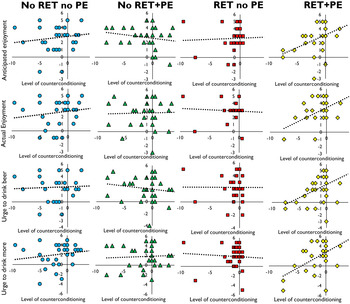
All analyses of reinforcing effects of in vivo beer were analysed with Day (baseline v. post-manipulation) × Retrieval (RET v. No RET) × PE (PE v. No PE) RMANCOVAs, including counterconditioning Responsiveness as a covariate that could interact with RET × PE. Four-way interactions were found for pre-consumption anticipated enjoyment and urge to drink beer and post-consumption (primed) urge to drink more beer. Commensurate with the bivariate correlations, the four-way interactions were driven Day × Responsiveness interactions in RET + PE only, indicating that the degree of achieved counterconditioning predicted post-manipulation reactivity to in-vivo beer only in the ‘active’ RET + PE group. For actual enjoyment of beer (post consumption), counterconditioning responsiveness again predicted post-manipulation enjoyment only in RET+ PE. However, the four-way interaction did not reach significance. These interaction terms and simple slopes are given in Table 3. Scatterplots of bivariate associations are given in Fig. 2. Analysis of ratings of pictorial cues used in the cue reactivity task are given in the online Supplementary Materials.
Associations between ‘strength’ of counterconditioning (change in liking of counterconditioned beer cues) anticipated enjoyment, urge to drink, actual enjoyment and urge to drink more beer on the Day 3 beer reactivity test. The correlations were significant only in RET + PE (rightmost column). Dashed lines are ordinary least-squares linear best fit lines.

Reactivity to in-vivo beer: highest-order (four-way) interaction terms in Day × Retrieval × Responsiveness × PE mixed ANOVAs on anticipated and actual enjoyment of sampled beer and pre and post-drink urge to drink beer

Significant effects are highlighted in bold. Degrees of freedom (DFs) = 29 for all t tests.
Drinking levels
Beer
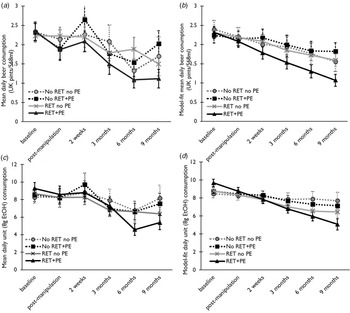
The random intercepts-only effects mixed model revealed a significant main effect of Time (F (1, 522.74) = 39.027, p < 0.001) and a marginally significant RET × PE × Time interaction (F (1, 522.74) = 3.965, p = 0.047). The Time effect represented a reduction in beer consumption across the follow-up period, with a mean reduction of 0.23 UK pints/day at each time point (b = −0.232, t (521.5) = 2.04, p < 0.0005). The three-way interaction represented a greater reduction in drinking across Time in RET + PE than No RET + PE (b = 0.146, t = 2.06, p = 0.0397), with no differences between the other groups. Model-predicted and true values for this effect are shown in Fig. 3, panels a and b. Modelling random slopes for Time did not improve model fit (BIC 2128.485→2128.919) and yielded non-significant variance in slopes (Z = 1.138, p = 0.255). Responsiveness to counterconditioning was not a significant predictor (F (1, 119.495) = 0.72, p = 0.679) and was detrimental to parsimonious model fit (BIC 2128.485→2134.752).
Panel a (top left): Changes in mean daily beer consumption (in UK pints) across the study time points in each group. Panel b (top right): Mixed model fit values for beer consumption data. A marginally significant Time × RET × PE interaction indicated a steeper reduction across Time in RET + PE than No RET + PE (p = 0.037). Panel c: Changes in mean daily unit alcohol consumption across the study time points in each group. Panel d: Model fit values for overall alcohol consumption (total UK unit) data. A significant RET × Time interaction indicated significant reductions across time in RET groups but not No RET groups. Panels a and c: error bars represent s.d. Panels b and d: error bars represent model s.e.m.

Total units
The random intercepts-only model for total unit consumption data (BIC = 3748.009) yielded a significant effect of Time (F (1, 533.775) = 25.487, p < 0.001) and RET × Time interaction (F (1, 533.775) = 4.937, p = 0.027). Simple contrasts on the Time main effect against baseline drinking levels showed no overall change in drinking from baseline to post-manipulation (b = −0.69, t (511.97) = 0.706, p = 0.48) or 2 weeks (b = −1.196, t (516.53) = 0.1.194, p = 0.233), with a marginal reduction by 3 months (b = −1.97, t (519.482) = 1.925, p = 0.055) and significant reductions by 6 months (b = −4.66, t (519.48) = 4.549, p < 0.001) and 9 months (b = −3.65, t (521.05) = 3.431, p = 0.001). Parameter estimates for the RET × Time interaction showed a greater reduction in drinking across Time in RET than No RET groups (b = 0.575, t (531.58) = 2.192, p = 0.029). Within-groups, the slope for the reduction in drinking across time was highly significant in the RET groups (b = −0.923, t (51.26) = −5.008, p < 0.0005) but non-significant in the No RET groups (b = −0.3, t (53.958) = −1.177, p = 0.245).
Significant variance in slopes (Z = 2.781, p = 0.005) and improved model fit (Δ-2LL χ2(2) = −18.004, p < 0.001, BIC 3748.09→3743.262) when allowing slopes for Time to vary indicated that a random slopes effect model was appropriate. This reduced the RET × Time effect to only a marginally significant level (b = 0.623, t (107.023) = 1.999, p = 0.049). Including counterconditioning Responsiveness as a covariate yielded a borderline-significant predictive impact in drinking (F (1, 119.518) = 3.916, p = 0.05), but was detrimental to parsimonious model fit (3743.262→3749.194), so was not included in the final model. Actual and mean model-predicted values for the RET × Time effect in the final model are shown in Fig. 3, panels c and d.
Discussion
We examined the potential for putative memory reconsolidation mechanisms to catalyse the efficacy and longevity of an experimental learning-based intervention in ameliorating maladaptive drinking patterns. We found mixed evidence that supported the long-term utility of a reconsolidation-focused approach, whereas highlighting large response variability and potential limitations of a homogenous learning manipulation.
We observed a greater reduction in over the 9 month follow-up period when counterconditioning followed the putatively ‘active’ retrieval (RET) with prediction error (PE) manipulation. Greater reductions in non-specific, total alcohol consumption were seen in both MRM retrieval groups, although this was not PE-dependent. These results are broadly consistent with counterconditioning updating MRMs via reconsolidation mechanisms, producing lasting beneficial changes in drinking behaviour. That lasting effects on drinking levels are observed after a one-off, purely behavioural manipulation is encouraging and extends our previous work on ketamine, suggesting reconsolidation-focused therapies may have a bright future in the treatment of SUDs.
The current results extend our previous findings with counterconditioning during the reconsolidation window (Das et al., Reference Das, Lawn and Kamboj2015) and pharmacological blockade of alcohol MRM reconsolidation by ketamine (Das et al., Reference Das, Gale, Walsh, Hennessy, Iskandar, Mordecai and Kamboj2019). Although we previously demonstrated RET and PE-dependent beneficial effects of counterconditioning on computerised in-lab markers of MRMs, changes in responses to actual alcohol and long-term reductions in drinking following have not, until now, been shown using a purely behavioural reconsolidation-update manipulation.
Unexpectedly, the beneficial effects observed here were primarily evident only in the longer-term drinking outcomes but not acute in-lab measures of cue reactivity. The reason for this discrepancy is uncertain. One possibility is lack of sensitivity or limited ecological validity of an in-lab acute assessment of the reinforcing effects of alcohol, since anticipated enjoyment and urge to drink have no impact on whether beer is consumed or not during this test. An emergent and more compelling interpretation is that memory rewriting manipulations display their true utility when participants are exposed to naturalistic ‘high-risk’ relapse scenarios following manipulation. Indeed, previous research has also observed lagged improvements in phobic symptomatology (Soeter & Kindt, Reference Soeter and Kindt2015) and craving reductions and CO levels in smokers (Germeroth et al., Reference Germeroth, Carpenter, Baker, Froeliger, LaRowe and Saladin2017) following a reconsolidation intervention. This is in line with protection against renewal, reinstatement and spontaneous recovery conferred by reconsolidation interference in the experimental literature. The follow-up period used here is the longest of which we are aware in the reconsolidation literature and the potential for these lagged effects highlights the importance of assessing the longevity of effects over extended follow-up.
Short-term improvements are typically seen following learning-based interventions such as cue-exposure therapy, but these are not maintained across time and contexts. Indeed, in the current study, all groups largely displayed improvements in maladaptive drinking behaviours from pre-to-post-manipulation. Incorporating prior retrieval/destabilisation of MRMs offers a potential means to make these interventions ‘stick’, vastly enhancing their long-term efficacy and protecting against relapse. The ‘single-shot’ nature of reconsolidation-interference means it could readily be included as part of a comprehensive psychological treatment programme with minimal addition to therapist/patient burden. It may potentially act synergistically with other treatment components that target the biological, cognitive and social causes of AUD by addressing a core, low-level relapsogenic mechanism.
The discrepancy between retrieval and prediction-error-dependent effects on beer v. all alcohol consumption was unexpected. We and others (Agustina López et al., Reference Agustina López, Jimena Santos, Cortasa, Fernández, Carbó Tano and Pedreira2016; Das et al., Reference Das, Lawn and Kamboj2015; Exton-McGuinness, Lee, & Reichelt, Reference Exton-McGuinness, Lee and Reichelt2015; Krawczyk et al., Reference Krawczyk, Fernández, Pedreira and Boccia2017; Sevenster, Beckers, & Kindt, Reference Sevenster, Beckers and Kindt2014) have previously forwarded PE or ‘surprise’ at retrieval as a necessary condition for destabilisation of consolidated memories. Hypothetically, PE signals insufficient or inaccurate prediction of outcomes currently stored by the memory trace and necessitates memory destabilisation to allow the memory to update and stay ‘relevant’. These findings may seem to suggest that PE is of secondary importance in sparking memory destabilisation and reconsolidation. Indeed, most previous experimental (Milton, Lee, Butler, Gardner, & Everitt, Reference Milton, Lee, Butler, Gardner and Everitt2008; Monfils & Holmes, Reference Monfils and Holmes2018; Saitoh, Akagi, Oka, & Yamada, Reference Saitoh, Akagi, Oka and Yamada2017) and clinically applied (Germeroth et al., Reference Germeroth, Carpenter, Baker, Froeliger, LaRowe and Saladin2017; Xue et al., Reference Xue, Luo, Wu, Shi, Xue, Chen and Lu2012, Reference Xue, Deng, Chen, Zhang, Wu, Huang and Lu2017) reconsolidation studies reporting positive findings have not explicitly manipulated PE. There are several key points that should be borne in mind which caution against such an interpretation, however.
It is typical in reconsolidation studies to omit the primary reinforcer during cue-driven retrieval. This will generate a variable level of PE to the extent that reinforcement is expected, despite not explicitly aiming to manipulate PE. In clinical populations, where craving/desire to use is likely to be high to response to drug cues, we may reasonably expect greater PE when drug is not consumed. This is supported by the association between anticipated liking and urge to drink observed and subsequent PE seen in the current study (see online Supplementary Materials). This may well account for variability in previous findings. In the current study, although not statistically significant, the RET + PE group also showed the steepest overall absolute decrease in overall drinking, meaning unintended PE generation in the RET No PE group may have limited power to observe PE-dependent effects. Indeed, peri-retrieval ‘surprise’ ratings demonstrated some variability in surprise in the RET No PE and RET + PE groups, indicating that some level of unintended PE was occurring in the former group and some expectancy of deception in the latter. For clinical translation, there is minimal extra burden involved in explicitly generating and assessing PE during MRM retrieval. Indeed, in treatment scenarios (e.g. in detoxified drug-abusing patients) it would be ethically unacceptable to reinforce patients with abused drugs. Moreover, there are no demonstrations of inferiority of PE v. No PE at retrieval in memory destabilisation, thus the most prudent course of action would be to include PE-generation procedures in experimental and translational retrieval protocols going forward and at the very least assess these explicitly. As a minimum criterion, ‘reactivation’ cues should evoke an urge/desire to consume and anticipatory enjoyment of drug reward. These measures may be predictive of outcome variability where PE is not assessed.
Limitations
We have previously assumed a relatively homogenous response to the counterconditioning intervention, given that is leverages very basic learning and aversion mechanisms. The large observed variability in the level of achieved counterconditioning or ‘responsiveness’ demonstrate that this assumption is not tenable. Some participants displayed reductions in liking of negatively reinforced beer stimuli over half the scale range whereas others showed little or no change and some even displayed increased liking over the course of the task. Equally, some participants did not rate the UCSs as particularly aversive, with some even rating them as mildly pleasant. Having extensively piloted the doses of Bitrex used here ourselves, this is puzzling to us, although genetic polymorphisms moderating bitterness perception may play a key role (Duffy & Bartoshuk, Reference Duffy and Bartoshuk2000). We further found that disgust propensity, sensitivity and distress tolerance predicted counterconditioning responsiveness, yielding potentially useful trait markers of likely treatment response. However, such individual variability to counterconditioning likely obscured potential group-level differences in responses to the acute alcohol challenge. Interestingly, the ‘degree’ of counterconditioning was predictive of proximal markers of responding to alcohol, but not long-term drinking outcomes. We believe this is a largely statistical phenomenon, due to greater variance in drinking levels v. in-lab measures of cue reactivity. However, it is possible that with passing time since reconsolidation–intervention and possible ‘schematisation’ of updated associations, the degree of acute ‘responsiveness’ to counterconditioning becomes less critical to outcomes. This would need to be validated empirically, but further highlights a potential disparity between proximal and enduring measures of intervention response and underscores the importance of long-term follow-up.
One could reasonably anticipate equal (or greater) response variability when using retrieval-extinction (Shumake et al., Reference Shumake, Jones, Auchter and Monfils2018); a paradigm that has dominated behavioural memory rewriting research. This may partially explain the inconsistencies and difficulties in replicating findings with retrieval-extinction interventions (Baker et al., Reference Baker, McNally and Richardson2013; Chen et al., Reference Chen, Cai, Pearce, Sun, Roberts and Glanzman2014; Luyten & Beckers, Reference Luyten and Beckers2017; Soeter & Kindt, Reference Soeter and Kindt2011), since a failure to extinguish would preclude any potentiating effect of prior memory retrieval. These observations highlight the importance assessing level of corrective learning, conducting learning to a criterion level or identifying potential low-responders within reconsolidation-updating paradigms.
Variability in learning is perhaps a reason to recommend pharmacological memory-weakening over purely behavioural memory updating approaches in certain populations. Drugs' pharmacodynamic profiles are generally not subject to influence by individual cognitive variables such as learning rates, boredom and punishment insensitivity and may be a key option where behavioural approaches fail.
There is no way of assessing whether the RET + PE truly destabilised alcohol MRMs and engaged reconsolidation mechanisms (or did so to an equal degree) in all individuals in the current study, since memory destabilisation is a behaviourally silent process. This remains the primary impediment to translational/clinical developments within the reconsolidation field, which is in desperate need of validated biomarkers of memory destabilisation. The lack of triangulation between short-term lab measures and longer-term drinking outcomes compounds this issue in the current study. We have, however, now demonstrated group-level sufficiency of the RET + PE procedure used improving clinically-relevant outcomes in five studies (Das et al., Reference Das, Lawn and Kamboj2015, Reference Das, Gale, Hennessy and Kamboj2018a, Reference Das, Walsh, Hannaford, Lazzarino and Kamboj2018b, Reference Das, Gale, Walsh, Hennessy, Iskandar, Mordecai and Kamboj2019; Hon, Das, & Kamboj, Reference Hon, Das and Kamboj2016). Along with the apparently durable effects on drinking observed here, this lends support to the notion that reconsolidation mechanisms were engaged in the current study. Although non-reconsolidation mechanisms may explain shorter-term effects on outcome, the emergence of divergent effects longer-term observed here are in line with reconsolidation-update.
The current study highlights fundamental questions regarding the parameters that conspire retrieval conspire to determine the fate of memories at retrieval. The future of memory-rewriting interventions will rely upon better understanding of these parameters and individual optimisation of memory destabilisation procedures based therein. Nevertheless, the results obtained here are should energise future research in the field, particularly to assess whether similar effects can be replicated in clinically diagnosed samples where comorbidities and cognitive impairment from chronic alcohol abuse may further complicate implementation.
Supplementary material
The supplementary material for this article can be found at https://doi.org/10.1017/S0033291720001531.
Financial support
This work was funded by a Medical Research Council grant awarded to Sunjeev Kamboj (grant number: MR/M007006/1).
Conflict of interest
None.
Ethical standards
The authors assert that all procedures contributing to this work comply with the ethical standards of the relevant national and institutional committees on human experimentation and with the Helsinki Declaration of 1975, as revised in 2013.