


1. Lk 15.11–32 und 16.19–31 als Schwestergeschichten
Wer das Lukasevangelium als zusammenhängenden Text, der ‘in guter Ordnung’ (καθϵξῆς, 1.3) gestaltet ist—und nicht als nur lose verbundene ‘Perikopenliteratur’—wahrnimmt, hat die beeindruckende Parabel vom verlorenen Sohn (Lk 15.11–32) noch lebendig vor Augen, wenn er die Erzählung vom reichen Mann und armen Lazarus (Lk 16.19–31) liest oder hört. Die Erinnerung an die Parabel vom verlorenen Sohn wird bei der Lektüre der Beispielerzählung vom reichen Mann und armen Lazarus zusätzlich dadurch wach gehalten, dass Lk 15.11–32 und 16.19–31 Parallelen aufweisen. Die Geschichten lassen sich aufgrund dieser Parallelen auch gegeneinander profilieren.Footnote 1 Die räumliche Nähe sowie die strukturellen und motivischen Parallelen legen den Schluss nahe: Lk 16.19–31 will im Lichte von Lk 15.11–32 gelesen werden.Footnote 2
Die Strukturparallelität zwischen Lk 15.11–32 und Lk 16.19–31 lässt sich in folgender Tabelle zusammenfassen:
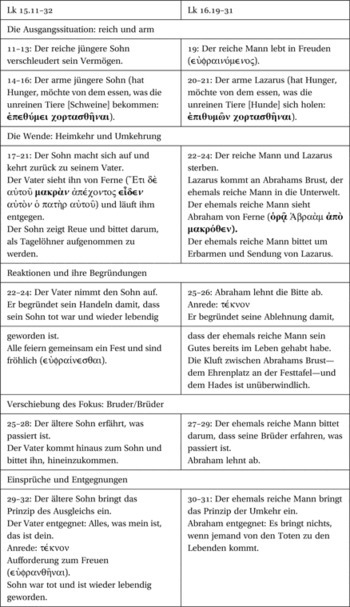
Beide Erzählungen kontrastieren zu Beginn arm und reich, Freude und Bedrückung. Während der reiche Mann sich wie ein König kleidet und ‘jeden Tag in Freuden lebt’ (ϵὐϕραινόμϵνος καθ’ ἡμ ραν λαμπρῶς), liegt Lazarus hungrig und mit Geschwüren bedeckt draußen vor der Tür des Reichen. Diesen Kontrast zwischen reich und arm durchlebt der ‘verlorene Sohn’: Er lebt zuerst ‘drinnen’, bei Vater und Bruder, hat dort zu Essen und ein gutes Auskommen.Footnote 3 Dann geht er nach ‘draußen’, verlässt den väterlichen Hof, verschleudert seinen Besitz und wird arm. Er fängt an zu hungern und endet in der sozialen Beziehungslosigkeit, in der allein die unreinen Schweine ihm noch Gesellschaft leisten. Insofern vereinigt der Sohn das Schicksal des reichen Mannes und des armen Lazarus in sich. Dabei fällt zweierlei auf: (1) Die Lebensweise des (noch) reichen Sohnes wird moralisch abwertend beschrieben,Footnote 4 er ‘verschleudert’ sein Geld (καὶ
 κϵῖ διϵσκόρπισϵν τὴν οὐσίαν αὐτοῦ ζῶν ἀσώτως; 15.13). Die Lebensweise des reichen Mannes (16.19) hingegen wird mit demselben Verb bezeichnet, das in 15.24, 32 zur Beschreibung der Freude des Vaters über den heimgekehrten Sohn dient (ϵὐϕραίνω). Insofern ist hier keine moralische Abwertung erkennbar. (2) Das Schicksal des Lazarus wird in motivischer und wörtlicher Anlehnung an das Schicksal des ‘verlorenen’ Sohnes geschildert: Beide möchten etwas essen (πϵθύμϵι χορτασθῆναι/πιθυμῶν χορτασθῆναι), was letztlich die unreinen Tiere (Schweine bzw. Hunde) bekommen. In beiden Erzählungen stellt diese Passage einen narrativen Knotenpunkt dar. Der ‘verlorene’ Sohn gerät ins Nachdenken, er fasst einen Plan und wird aktiv (15.17–20). Bei der Erzählung vom reichen Mann und armen Lazarus erwarten die Leser/innen an dieser Stelle, dass etwas passiert, damit die krasse Ungleichheit ein Ende hat: ‘Dass der Arme danach verlangt, sich mit dem zu sättigen, “was vom Tisch des Reichen fällt” (V 21), stellt die beiden in die Beziehung einer Konfiguration, d.h.: Sie stehen sich nicht einfach beziehungslos gegenüber, sondern der Arme liegt “vor der Tür” des Reichen (V 20), der eine ist drinnen, der andere draußen und die Lesererwartung richtet sich so nicht auf zwei lediglich oppositionelle oder parallele Geschehensabläufe, die jeden der beiden für sich beträfen, sondern erwartet, dass einer der beiden durch “die Türe” zum anderen gelangt’.Footnote 5 Aber im Gegensatz zum Gleichnis vom verlorenen Sohn wird die Lesererwartung enttäuscht: In der ersten Szene geschieht buchstäblich nichts, ‘während gleichzeitig alles darauf angelegt ist, dass etwas geschehen müsste’.Footnote 6
Nun kommt es in beiden Erzählungen zur entscheidenden Wende: Der Sohn macht sich auf und kehrt zurück zu seinem Vater (15.20). Der reiche Mann und der arme Lazarus hingegen sterben (16.22). Während der Sohn aktiv handelt, geschieht etwas mit dem reichen Mann und Lazarus. Sie kommen—quasi ‘automatisch’—in den Hades bzw. an Abrahams Brust.Footnote 7 Mit dem Liegen an Abrahams Brust ist bildlich der Ehrenplatz beim himmlischen Mahl umschrieben.Footnote 8 Das Bild unterstreicht damit die Umkehrung der Verhältnisse: Im Diesseits hungerte Lazarus und der reiche Mann schwelgte im Überfluss und ließ Speisereste vom Tisch fallen.Footnote 9 Ein göttliches Gericht oder Ähnliches wird gar nicht erwähnt. ‘Wie das Gericht Gottes stattfindet, wird nicht erzählt. Sein Ergebnis ist Realität, unmittelbar nach dem Tod der Menschen’.Footnote 10 Die Situationen zu Lebzeiten werden dabei ‘automatisch’ in ihr Gegenteil umgekehrt. Im Folgenden wird der Kontrast zwischen dem Schicksal des ‘verlorenen’ Sohnes, der sich zu seinem Vater aufgemacht hat, und demjenigen des ehemals reichen Mannes scharf profiliert: Der Vater sieht den Sohn von Ferne (Ἔτι δ αὐτοῦ μακρὰν ἀπχοντος ϵἶδϵν αὐτὸν ὁ πατὴρ αὐτοῦ) und läuft ihm entgegen, er fällt ihm um den Hals und küsst ihn (15.20). Die große Distanz zwischen Vater und Sohn wird also einerseits durch die Rückkehr des Sohnes, andererseits durch das Entgegenkommen des Vaters überwunden. Ganz anders in Lk 16: Der ehemals reiche Mann sieht Abraham von Ferne (ὁρᾷ Ἀβραὰμ ἀπὸ μακρόθϵν), aber er weiß sofort, dass er diese Distanz nicht überwinden kann. Seine Bitte fällt dementsprechend viel bescheidener aus: Lazarus soll kommen und ihm die Zunge kühlen. Auch der ‘verlorene’ Sohn geht davon aus, dass das alte Verhältnis zwischen seinem Vater und ihm nicht wieder hergestellt werden kann: Er bekennt—anders als der ehemals reiche Mann—seine Sünden und will den Vater darum bitten, als Tagelöhner zu arbeiten (15.19, 21).
Die Reaktionen auf die jeweiligen Bitten unterstreichen wiederum den Kontrast zwischen beiden Erzählungen: Der ‘verlorene’ Sohn kommt nicht einmal dazu, seine Bitte auszusprechen. Der Vater nimmt ihn spontan nicht als Tagelöhner, sondern als Sohn an (15.22–23).Footnote 11 Die Distanz ist vollständig überwunden. Abraham hingegen lehnt die Bitte des ehemals reichen Mannes ab. Sowohl der Vater als auch Abraham begründen ihre jeweiligen Reaktionen. Der Vater verweist darauf, dass sein Sohn tot war und nun wieder lebendig ist (15.24). Abraham liefert zwei Argumente: Zunächst argumentiert er mit dem Prinzip des Ausgleichs (16.25): Der reiche Mann hat ‘sein Gutes’ (τὰ ἀγαθά) bereits zu Lebzeiten empfangen, Lazarus hingegen nur Schlechtes (τὰ κακά). Dieser Zustand wird jetzt kompensiert. Als zweites Argument führt Abraham an, dass es ohnehin unmöglich ist, Lazarus hinunterzuschicken, da zwischen ihnen eine tiefe Kluft sei (16.26). Die Trennung, die damit festgeschrieben wird,Footnote 12 kontrastiert mit dem fröhlichen Feiern, in das der verlorene, wiedergekehrte Sohn selbstverständlich einbezogen ist (15.24).
Mit dem fröhlichen Fest bzw. dem Hinweis auf die tiefe Kluft finden beide Erzählungen einen vorläufigen Abschluss. Es kommt nun zu einer Verschiebung des Fokus. Der Bruder des ‘verlorenen’ Sohnes bzw. die Brüder des ehemals reichen Mannes betreten die Bühne. Zunächst erfährt der ältere Sohn durch einen der Knechte, was passiert ist (15.25–27). Genau darum bittet der ehemals reiche Mann Abraham: Er möge Lazarus zu seinen Brüdern schicken, damit—so ist wohl zu ergänzen—sie erfahren, was mit ihm geschehen ist, und sie gewarnt sind (16.27–28). Doch Abraham lehnt ab: Das sei unnötig, denn die Brüder hätten Mose und die Propheten (16.29). Deshalb wird auch weiter nur indirekt über die Brüder geredet. Der Vater hingegen unterhält sich nun direkt mit seinem älteren Sohn. Er kommt auch ihm entgegen und bittet ihn hinein (15.28). Der Vater tut damit das, was die Leser/innen in 16.19–21 vom reichen Mann und armen Lazarus erwarten, was dort aber gerade nicht geschieht: Der Vater geht durch die Tür, die beim reichen Mann verschlossen bleibt. Er tritt aktiv in Kontakt mit seinem älteren Sohn und fordert ihn auf, wieder in die Gemeinschaft mit ihm und seinem Bruder einzutreten, also hereinzukommen und mit ihnen zu feiern. ‘Die Struktur der Parabel verdeutlicht deren Intention: Im Zentrum steht der Vater und die bei ihm gegenwärtige Freude… Wer außerhalb der Freude beim Vater ist, ist tot und verloren. Wer daran teilnimmt, ist wieder lebendig und gefunden… Es geht nicht um das, was war oder darum, ob der eine gegenüber dem anderen einen Vorteil hatte, sondern um die jetzt gegenwärtige Freude—dabei sein ist alles’.Footnote 13
Im letzten Gesprächsgang kritisiert der ältere Sohn das Verhalten des Vaters (15.29–30): Er stellt seinen vorbildlichen Lebenswandel heraus und beschwert sich darüber, dass der Vater ihm niemals einen Ziegenbock gegeben habe. Für den jüngeren Sohn hingegen habe er das Mastkalb geschlachtet, obwohl er sein Vermögen mit Dirnen durchgebracht habe. Der ältere Sohn kontrastiert also zum einen seine eigene Lebensweise mit derjenigen seines jüngeren Bruders, zum anderen die Art und Weise, wie der Vater sie beide behandelt. Von 16.25 her legt sich ein besonderer Fokus auf diese Darstellung: Der jüngere Sohn—so könnte man den Vorwurf an den Vater unter dem Eindruck der Äußerung Abrahams reformulieren—hat ‘sein Gutes’ bereits gehabt (vgl. 16.25) und verschleudert, insofern ist es nicht gerecht, wenn er nun noch mehr (ein Mastkalb zum Feiern und die Wiedereinsetzung als Sohn) bekommt. Der Vater nimmt diesen Aspekt des Ausgleichs insofern auf, als er den älteren Sohn darauf hinweist, dass er (materiell) keineswegs zu kurz gekommen ist. ‘Alles, was mir gehört, gehört auch dir’ (15.31b). Die Anrede τκνον, die der Vater hier gegenüber seinem älteren Sohn benutzt, findet sich bezeichnenderweise auch im Gespräch zwischen Abraham und dem ehemals reichen Mann, und zwar eben in 16.25. Während der Vater in 15.31a die bleibende Gemeinschaft mit dem älteren Sohn herausstellt (‘Kind, du bist immer bei mir’),Footnote 14 betont Abraham in diesem Zusammenhang die endgültige Trennung zwischen sich und dem ehemals reichen Mann (16.25–26). Während der ältere Sohn gegen das Verhalten des Vaters aufbegehrt, stellt der ehemals reiche Mann das in Lk 16 dominierende Prinzip des Ausgleichs und damit der Umkehrung der Situation nicht grundsätzlich in Frage. Das radikale Prinzip des Ausgleichs wird also nicht außer Kraft gesetzt oder auch nur kritisch angefragt. Der ehemals reiche Mann lässt sich vielmehr darauf ein und bittet im letzten Gesprächsgang darum, dass Abraham einen von den Toten (z.B. Lazarus) zu seinen Brüdern schickt, denn dann würden sie umkehren (μϵτανοήσουσιν 16.30). Das Schicksal des ehemals reichen Mannes ist—auch in seiner eigenen Wahrnehmung—besiegelt. Offen bleibt, ob seine Brüder die Chance zur Umkehr nutzen werden. Der Kontrast tot/lebendig nimmt die Metaphorik aus 15.24, 32 auf: Was dort im übertragenden Sinn auf die Frage der Trennung von (=tot) bzw. Gemeinschaft mit (=lebendig) Gott abzielte, bezieht sich hier auf das physische Leben bzw. den physischen Tod. Mit dem Tod sind die Würfel gefallen. Abraham lehnt daher auch diese letzte Bitte ab. Dabei stellt er die Möglichkeit, dass Tote auferstehen, nicht grundsätzlich in Frage. Er bezweifelt aber, dass eine solche Sendung irgendetwas verändern würde und verweist wiederum auf Mose und die Propheten. Das heißt: Der ehemals reiche Mann unterstellt, dass sein eschatologisches Schicksal anders ausgesehen hätte, wenn er zu Lebzeiten umgekehrt wäre. Diese Annahme wird von Abraham indirekt bestätigt, zumindest widerspricht er ihr nicht. Damit wirft die Beispielerzählung die Frage nach dem Verhältnis von Umkehr und Ausgleich auf—und zwar im ‘Schatten’ von Lk 15.
2. Konsequenzen für die Auslegung von Lk 16.19–31
Welche weiteren Konsequenzen ergeben sich für die Auslegung von Lk 16.19–31, wenn wir die Parabel vom verlorenen Sohn und die Beispielerzählung vom reichen Mann und armen Lazarus als Schwestergeschichten lesen?
2.1. Ausgleich als nicht moralisch geprägtes Prinzip
Abraham begründet das jeweilige eschatologische Schicksal des ehemals reichen Mannes und des armen Lazarus mit dem Hinweis darauf, was jene zu Lebzeiten empfangen haben (16.25). Argumentiert wird hier mit dem Prinzip des gerechten Ausgleichs. Die Vorstellung ist offenbar die, dass jeder Mensch den gleichen Anteil an Gutem und Schlechtem ‘zugeteilt’ bekommt. Wer bereits im Diesseits sein Gutes bekommt, dem steht im Jenseits nur noch das Schlechte zu. Wer umgekehrt im Diesseits nur Schlechtes zugeteilt bekommt, darf im Jenseits das Gute genießen. Hierin liegt die Gerechtigkeit des Prinzips der Umkehrung der diesseitigen Situation im Jenseits.Footnote 15 In der Forschung ist umstritten, ob bei dieser Begründung für die Umkehrung der Schicksale implizit auch die Frage der Gottesbeziehung bzw. des (un)moralischen Handelns eine Rolle spielt. Dabei wird einerseits mit dem Namen Lazarus, andererseits mit (angeblichen) griechisch-römischen Motivparallelen zum biblischen Text argumentiert.
Der hebräische Name Lazarus bedeutet ‘Gott hilft’. Der Name impliziere, dass Lazarus wegen seiner Frömmigkeit an Abrahams Brust gelangt, während der reiche Mann aufgrund seiner Gottlosigkeit im Hades endet.Footnote 16 Allerdings ist fraglich, ob Lukas damit rechnen durfte, dass seine (heidenchristlichen) Leser/innen diese Anspielung, die dann eine zentrale Bedeutung hätte, verstehen.
Andere ExegetenFootnote 17 versuchen, durch griechisch-römische Parallelen einen moralischen Unterton in Lk 16.25 zu begründen. Hock führt die Dialoge Cataplus und Gallus von Lukian von Samosata als Motivparallelen an, um zu zeigen, dass Lukas—wie Lukian—Reichtum mit Unmoral und Armut mit Moral koppelt.Footnote 18 Hock unterstellt dem reichen Mann aufgrund dieser Parallele einen hedonistischen Lebensstil. R. Bauckham hat m.E. zu Recht darauf hingewiesen, dass sich die Beispielerzählung vom reichen Mann und armen Lazarus von diesen griechisch-römischen Parallelen gerade dadurch unterscheidet, dass sie nicht moralisiert: Lucian ‘does not preserve, as the parable does, the stark simplicity of the motif in its basic form: that it is the inequality of rich and poor as such which is unjust and must be remedied… The parable does not condemn the rich man because his lavish feasts are self-indulgent and associated with sexual immorality, but because he is living in luxury while Lazarus is destitute. The juxtaposition of the rich man's luxury and Lazarus’ painful poverty expresses the parable's point of view without any moralizing between the lines’.Footnote 19
Die These von Bauckham wird durch die Beachtung der Parallelität zwischen Lk 15.11–32 und Lk 16.19–31 gestützt. Denn der Lebensstil des reichen Mannes wird in 16.19 mit demselben Verb (ϵὐϕραίνω) bezeichnet wie die Freude des Vaters über die Rückkehr seines Sohnes (15.24, 32)—und diese zweimalige, pointierte Aussage dürften die Hörer/innen von 16.19–31 durchaus noch im Ohr haben. Lukas verwendet das Verb also ohne moralische Wertung. Essen und Trinken gehören zur Freude, jedoch wiederum ohne moralisch-anklagenden Unterton.Footnote 20
Die These, dass es sich bei dem Prinzip des Ausgleichs, das zu einer radikalen Umkehrung der Situation von Armen und Reichen im Jenseits führt, um ein Konzept handelt, das nicht moralisch geprägt ist, wird durch die Seligpreisungen und Wehe-Rufe unterstrichen. ‘Selig, ihr Armen, denn euch gehört das Reich Gottes. Selig, die ihr jetzt hungert, denn ihr werdet satt werden’ (6.21–22). Und dagegen: ‘Weh euch Reichen! Denn ihr habt euren Trost schon gehabt’ (6.24).Footnote 21 Lk 16.19–31 liest sich geradezu wie eine narrative Entfaltung dieser Seligpreisungen und Wehe-Rufe. Tragendes Strukturprinzip ist auch hier die eschatologische Umkehrung der diesseitigen Situation in ihr Gegenteil. Wiederum ist nicht davon die Rede, dass die Armen moralisch besser wären als die Reichen.Footnote 22
Das Prinzip des Ausgleichs zeichnet sich also durch folgende Merkmale aus: Im Jenseits werden die diesseitigen Verhältnisse radikal und endgültig umgekehrt. Diese Umkehrung erscheint wie ein ‘Automatismus’. Von einem Gericht, gar einem Gericht nach den Werken, ist keine Rede. Es geht nicht darum, dass die Reichen schlecht gehandelt hätten, moralische Begriffe wie ‘Sünde’ fehlen in diesem Zusammenhang. Es geht vielmehr um einen Ausgleich zwischen dem Guten und dem Schlechten, das jemand empfängt (ἀπλαβϵς τὰ ἀγαθά σου; nicht: das er tut!) (V 25). ‘In the parable…there is no reference to the good deeds of Lazarus or the evil deeds of the rich man. The reason for the reversal of fortune is clearly stated but different. It is simply that the rich man has received “good things” during his life, whereas Lazarus has received “evil things” (Luke 16.25)’.Footnote 23
Die Implikationen dieser unterschiedlichen Interpretationen bringt L. Schottroff auf den Punkt: ‘Für die eschatologische Deutung ist entscheidend, was im Sinne des Textes der Fehler des Reichen ist. Ist er moralisch unverantwortlich mit seinem Reichtum umgegangen, oder ist sein Reichtum als solcher in Gottes Augen eine unvergebbare Schuld? In dieser Frage ist eine sozialgeschichtliche Dimension enthalten: Beruht im Sinne des Textes Reichtum als solcher auf dem Unrecht von Ausbeutung anderer Menschen? Ist dieses Unrecht vermeidbar und wie kann es vermieden werden?’Footnote 24 Lk 16.19–26 bezieht seine Radikalität gerade aus der fehlenden moralischen Codierung des Geschehens: Reichtum ist angesichts von existentieller Armut in sich eine ‘Macht’, die Menschen im Diesseits korrumpiert und in der Tatenlosigkeit und Beziehungslosigkeit verharren lässt.
2.2. Konkretisierung der Umkehr in 16.30 durch Lk 15
Angesichts der Kompromisslosigkeit, mit der Lukas das Prinzip der Umkehrung der diesseitigen Verhältnisse propagiert, ist erstaunlich, dass ein reicher Mann offenbar dennoch ins Reich Gottes kommen kann, wenn er umkehrt. Von dieser Möglichkeit gehen jedenfalls sowohl der ehemals reiche Mann als auch Abraham aus (16.27–31). Die Frage, was genau der ehemals reiche Mann im Rahmen seiner Umkehr hätte tun sollen—und was seine Brüder noch immer tun könnten, bleibt in 16.30 offen. ‘Aus V. 30 geht zwar hervor, dass es allein das “Umkehren” (μϵτανοω) ist, das die Brüder des reichen Mannes vor demselben Unheilsgeschick bewahren kann, doch ist damit immer noch nicht gesagt, durch welche Handlungen es zum Ausdruck gebracht werden soll’.Footnote 25 Die dargestellten Strukturparallelen zwischen 15.11–32 und 16.19–31 legen m.E. zwingend nahe, die Umkehr in 16.30 auch im Lichte von 15.11–32 zu sehen. Denn die Parabel vom verlorenen Sohn schließt eine Gleichnistrilogie ab, die pointiert von der Umkehr handelt. Dabei fällt allerdings auf, dass die Begriffe μϵτανοω bzw. μϵτάνοια in Lk 15.11–32 nicht auftauchen. Der Kontext des Gleichnisses zeigt m.E. aber deutlich, dass der ‘verlorene Sohn’ im lukanischen Sinne umkehrt.
Unstrittig gehören die drei Gleichnisse in Lk 15 thematisch eng zusammen. Sie handeln von der Suche nach dem Verlorenen. Die Gleichnisse vom verlorenen Schaf und von der verlorenen Drachme schließen beide mit einer weitgehend parallel formulierten Anwendung, die die Erzählungen auf die himmlische Freude über einen umgekehrten Sünder hin deutet (15.7, 10). Diese Anwendungen passen nur bedingt auf die Gleichnisse, denn ein Schaf und schon gar eine Drachme können nicht ‘umkehren’. Hier findet also zwischen Erzählung und Anwendung eine Akzentverschiebung statt: Während die Erzählungen Schaf und Drachme eine passive Rolle zuschreiben, bringen die Anwendungen das ‘Schicksal’ von Schaf und Drachme mit der aktiven Umkehr des Sünders in Verbindung. Genau genommen passen die Anwendungen am besten auf das dritte Gleichnis, da es die inneren Beweggründe des Sünders, die ihn zur Umkehr bewegen, genauer beleuchtet. Aber gerade hier findet sich keine Anwendung.Footnote 26 Diese Auffälligkeit legt den Schluss nahe: ‘V. 10 hat…im Gesamtkontext von Lk 15 klar die Funktion der Hinführung und Überleitung zur Parabel vom verlorenen Sohn…’Footnote 27 Damit aber wird der verlorene Sohn zum paradigmatischen Sünder, der umkehrt.Footnote 28
Was also zeichnet die Umkehr nach Lk 15 aus? Zur Umkehr gehört, dass der Mensch seine Sünden, also sein moralisches Fehlverhalten,Footnote 29 erkennt, bekennt und Gott dafür um Verzeihung bittet. Der ‘verlorene’ Sohn hat sich falsch verhalten, indem er das Geld verprasst hat (15.13). Er erkennt sein Fehlverhalten und will seinen Vater um Verzeihung bitten (15.18–19, 21). In der Umkehr entspricht der Bewegung des reuigen Sünders zu Gott die Bewegung des (suchenden) Gottes zum Sünder hin. In Lk 15 wird diese Bewegung Gottes bzw. Jesu Christi zu den Menschen als Suche nach dem Verlorenen narrativ entfaltet. Hier zeigt sich auch: Die Initiative Gottes bzw. Christi steht an erster Stelle. Das verdeutlicht die Reihenfolge der drei Gleichnisse, bei denen Schaf (vgl. 15.1–7) und Drachme (vgl. 15.8–10) keine ‘aktive Umkehr’ versinnbildlichen können. Hier steht das—z.T. unverschuldete—‘Verlorengehen’ im Vordergrund, das damit rechnen kann, von Gott bzw. Christus gesucht zu werden.Footnote 30 Das dritte Gleichnis fokussiert dann ‘die innerpsychischen Vorgänge des Bekehrungsprozesses’.Footnote 31 Umkehr zeichnet sich also durch ein sich Aufeinander-zu-Bewegen von Gott und Mensch aus: Der Mensch kehrt um und Gott bzw. Christus suchen ihn und laufen ihm entgegen.Footnote 32 Die Umkehr polarisiert Sünder und Gerechte (15.7; 5.32) und thematisiert Gottes Zuwendung zum reuigen Sünder.
2.3. Spannung zwischen Ausgleich und Umkehr
Umkehr und Ausgleich unterscheiden sich damit in drei wesentlichen Punkten: (1) Umkehr hat—anders als das Prinzip des eschatologischen Ausgleichs der materiellen Situation—mit ‘Sünden’ und deren Vergebung zu tun. Umkehr ist also moralisch konnotiert. (2) Bei der Umkehr geht es (auch) um ein aktives Sich-Aufmachen des Sünders, nicht um einen Automatismus, bei dem etwas mit den Menschen geschieht. (3) Die Vergangenheit erhält einen unterschiedlichen Stellenwert: Beim Prinzip des Ausgleichs wird das Gute im Jenseits gegen das Schlechte, das jemand empfangen hat, aufgewogen—und umgekehrt. Das, was war, entscheidet also darüber, was wird. Anders bei der Umkehr: Die Vergebung zieht einen Schlussstrich unter das, was war. Die Vergangenheit hat damit gerade keine Auswirkungen mehr auf das, was ist und kommt.
Das Prinzip der Umkehr nach Lk 15—das in 16.30 nachklingt—und das Prinzip des Ausgleichs, wie es in 16.25 formuliert wird, treten damit in eine gewisse Spannung zueinander. Im Licht von 16.19–31 erscheint der verlorene Sohn nachträglich als jemand, der ‘sein Gutes’ bereits gehabt hat. In diese Richtung argumentiert ja auch der ältere Sohn (15.29–30). Und trotzdem eilt der Vater dem jüngeren Sohn entgegen und verteidigt diese Entscheidung gegenüber dem Einwand des älteren (15.31–32). Von Lk 15.11–32 her wird damit deutlich, wie groß die Chance ist, die der ehemals reiche Mann verpasst hat, die seinen Brüdern und v.a. uns als Leser/innen der Beispielerzählung aber noch offen steht. Auch wer seinen Reichtum im Diesseits bereits verantwortungslos verschleudert hat, hat noch die Chance umzukehren. ‘Es gibt ein “Zu spät!”’,Footnote 33 aber dieses ‘Zu spät!’ definiert sich einzig über den Zeitpunkt des physischen Todes, nicht über die Frage, ob ich mein anvertrautes ‘Gutes’ unter Umständen schon—egoistisch—aufgebraucht habe, wie 16.30 nahe legen könnte, wenn ich es allein von Lk 16.25 her verstehe.
Das heißt: Wer die μϵτάνοια in 16.30 auch von Lk 15 her versteht—und das ist m.E. durch die räumliche Nähe beider Texte und ihre strukturelle Parallelität gefordert—gerät durch die eigene, aktive Mitarbeit beim Lesen in einen gewissen Widerspruch zu dem in 16.25 kompromisslos formulierten Prinzip der Umkehrung und des Ausgleichs. Es bleibt zwar die Forderung, die materiellen Verhältnisse im Diesseits auszugleichen (vgl. Lk 3). Wo diese Chance aber bereits vertan ist, bleibt auch für jemanden, der sein Gutes bereits gehabt hat, die Möglichkeit der Umkehr (vgl. Lk 15). Es ist beachtlich, wie diese Relativierung eingebracht wird. Durch die Vorschaltung der Geschwistererzählung vom ‘verlorenen’ Sohn gewinnt die implizite Annahme, dass der ehemals reiche Mann sein eschatologisches Schicksal hätte verändern können, wenn er umgekehrt wäre (16.30), subversives Potenzial. Denn die Umkehr des ‘verlorenen’ Sohnes hebelt das Prinzip des Ausgleichs, mit dem Abraham in 16.25 argumentiert, in letzter Konsequenz aus.
Der Text überlässt hier viel der Eigentätigkeit der Lesenden. An keiner Stelle im Lukasevangelium wird das Prinzip der Umkehrung und des Ausgleichs direkt von einer Figur im Text in Frage gestellt—wie es etwa der ältere Sohn mit Blick auf das Verhalten des Vaters gegenüber dem heimgekehrten Sohn tut. Der ehemals reiche Mann akzeptiert die Argumente Abrahams aus 16.25–26. Beide sind sich aber auch darin einig, dass dem ehemals reichen Mann sein jenseitiges Schicksal erspart geblieben wäre, wenn er umgekehrt wäre. Wer diese Umkehr von Lk 15 her versteht, geht implizit zum Prinzip des Ausgleichs auf Distanz. Diese Distanzierung geschieht durch die Tätigkeit der Lesenden. Sie müssen den Einspruch gegen das Prinzip des Ausgleichs gleichsam selbst vorbringen und gegen die Chance der Umkehr abwägen.
Die Spannung zwischen den Konzepten der Umkehr und des Ausgleichs darf m.E. nicht nivelliert werden, wenn man der Theologie des Lukasevangeliums gerecht werden will. Denn beide Konzepte beinhalten Kernaussagen, die dem Evangelisten offensichtlich wichtig waren. Für Lk 15 ist das unbestritten: Die Umkehr, der auf der Seite Gottes bzw. Christi die Suche nach dem Verlorenen entspricht, bildet ein Kernstück lukanischer Theologie. Deshalb findet sich die Gleichnistrilogie vom Verlorenen im Zentrum des Lukasevangeliums.Footnote 34 Hier geht es um die Polarität von Gerechten und Sündern (15.7, 10; vgl. 5.32). Ich meine jedoch, dass auch das Kapitel 16 zum theologischen Zentrum des Lukasevangeliums zu rechnen ist. Lk 16 arbeitet mit der Polarität von arm und reich. Es geht dem Evangelium dabei nicht nur darum, dass einige Menschen mit ihrem Besitz nicht ‘richtig’ umgehen, sondern es geht ihm um eine radikale und kompromisslose Verurteilung struktureller sozialer Ungerechtigkeit.Footnote 35 Eine zu starke Moralisierung der lukanischen Reichtumskritik liefe Gefahr, das Problem der sozialen Ungerechtigkeit unangemessen zu individualisieren und damit letztlich zu relativieren. Für die Armen stellt die Aussicht auf radikale Umkehrung der diesseitigen Verhältnisse im Jenseits einen nicht zu unterschätzenden Trost dar.Footnote 36 Während es also bei der Umkehr um das eschatologische Schicksal der Gerechten und der Sünder geht,Footnote 37 geht es bei der Umkehrung der sozialen Verhältnisse um das eschatologische Schicksal der Armen und der Reichen. Lukas betont: Die Armen sollen bekommen, was ihnen (an Gutem) noch zusteht, die Sünder hingegen, die umkehren, werden gerade davor bewahrt, was ihnen (an Strafen für ihre Sünden) eigentlich zustünde. Beide Aussagen setzt Lukas radikal in Kraft. Dort, wo ehemals Reiche als Sünder umkehren, gerät die Spannung zwischen Umkehr und Ausgleich in den Blick. Dies ist in 16.30 potenziell der Fall.
3. Forschungsgeschichtliche Einordnung
Wie lässt sich die ausgeführte These in der Forschungsdiskussion verorten? Ich sehe hier v.a. zwei Fragen tangiert. Zum einen die Frage, wie die ‘Leerstelle’ in 16.30 zu füllen ist, zum anderen die Frage nach der Einheitlichkeit von Lk 16.19–31.
3.1. Zum Verständnis der Umkehr in 16.30
Die Frage, was genau unter der μϵτάνοια in 16.30 zu verstehen ist, wird in der Forschung nicht durchgängig thematisiert. Auslegungen, die auf diese Frage eingehen, zeichnen sich dadurch aus, dass sie 16.30 in ein weitgehend spannungsfreies Verhältnis zu 16.25 setzen.
Leonhardt-Balzer beantwortet die Frage unter Rückgriff auf die Wendung ‘Mose und die Propheten’ (16.29, 31): ‘Es stellt sich die Frage: wie kann ein Reicher in den Himmel kommen?… Somit stellen sich für die Reichen zwei Möglichkeiten dar: entweder sie geben ihren Reichtum ab oder sie verwenden ihn, der Mahnung von Tora und Propheten entsprechend, sozial verantwortlich’.Footnote 38 Wolters Vorschlag geht in eine ähnliche Richtung, verfolgt aber genauer spezifische intratextuelle Verweise. Er sieht eine Verkettung, die beginnend bei dem Ausdruck ‘Mose und die Propheten’ (16.29, 31) über 16.16a (‘Die Tora und die Propheten sind bis zu Johannes in Geltung’.) und 7.29–30 (Taufe durch Johannes) auf die Predigt von Johannes dem Täufer in 3.7–17. verweist. Hier haben die Lesenden erfahren, was es heißt umzukehren: ‘Damit können aber auch die Leser die pragmatische Leerstelle auffüllen. Wenn die fünf reichen Brüder “umkehren” (V. 30) und als “Früchte der Umkehr” (3.8) denjenigen Kleidung und Nahrung geben, die nichts haben (3.11), werden sie dem Unheilsgeschick entgehen, das ihren Bruder getroffen hat’.Footnote 39
Was ergibt sich, wenn wir die Leerstelle in 16.30, von der Wolter spricht, mit der Predigt von Johannes dem Täufer füllen? Worin unterscheidet sich die ‘Umkehr’ in der Täuferpredigt von der ‘Umkehr’ in Lk 15? Johannes der Täufer predigt die ‘Taufe der Umkehr zur Vergebung der Sünden’ (βάπτισμα μϵτανοίας ϵἰς ἄϕϵσιν ἁμαρτιῶν, 3.3). Hier bestätigt sich: Umkehr hat—anders als das Prinzip der eschatologischen Umkehrung der materiellen Situation—mit ‘Sünden’ und deren Vergebung zu tun (etwa in der Taufe). So weit stimmen die Vorstellungen von ‘Umkehr’ in Lk 3 und Lk 15 überein. Auch in einem weiteren Aspekt liegen Lk 3 und Lk 15 eng beieinander: In der Umkehr entspricht der Bewegung des reuigen Sünders zu Gott die Bewegung des (suchenden) Gottes zum Sünder hin. In Lk 3 wird dies durch das Jesaja-Zitat deutlich: ‘Bereitet dem Herrn den Weg! Ebnet ihm die Straßen!… Und alles Fleisch wird das Heil Gottes schauen’ (Lk 3.4, 6; vgl. Jes 40.3–5). Gott kommt zu den Menschen, daher gilt es, ihm den Weg zu bereiten. In der Gleichnistrilogie Lk 15 wird diese Bewegung Gottes bzw. Jesu Christi zu den Menschen als Suche nach dem Verlorenen narrativ entfaltet.
In einem dritten und für unseren Zusammenhang wesentlichen Punkt unterscheiden sich jedoch die Konkretionen der ‘Umkehr’ in Lk 3 und Lk 15: Während Johannes der Täufer stark auf die ‘Früchte der Umkehr’ (3.8) abhebt, hören wir davon in Lk 15 nichts. Johannes führt zu den ‘Früchten der Umkehr’ aus: ‘Wer zwei Untergewänder hat, soll dem abgeben, der keins hat, und wer zu essen hat, soll dasselbe tun’ (3.11). Der narrative Duktus in Lk 15.11–32 lässt aber gar nicht mehr zu, dass der zurückgekehrte Sohn im Sinne der Täuferpredigt handelt: Er kann den Armen schlicht deshalb nichts mehr geben, weil er bereits alles verschwendet hat. Nach Lk 15 ist ‘Umkehr’—und die damit verbundene Annahme durch Gott—also auch dann möglich, wenn die ‘Früchte der Umkehr’ im Sinne von Lk 3 nicht mehr erbracht werden können. Genau dadurch gerät Lk 15.11–32 in Spannung zu dem in 16.25 formulierten Prinzip des Ausgleichs von Gutem und Schlechtem.
Ich halte die ‘Füllung’ der von Wolter ausgewiesenen Leerstelle in 16.30 durch die Täuferpredigt für möglich, bin aber der Meinung, dass sie nur eine von mindestens zweien ist, die der Text des Lukasevangeliums nahe legt.Footnote 40 Denn während den Lesenden und v.a. der Zuhörerschaft bei Wolters Auslegung einiges abverlangt wird—sie sollen eine Motivverkettung nachvollziehen, die sie beinahe bis an den Anfang des Evangeliums zurückführt—geht die hier entfaltete These von der Beobachtung aus, dass in unmittelbarer Nähe zu Lk 16.30 das Thema der Umkehr in anderer Weise breit entfaltet wird. Die enge Parallelität zwischen der Parabel vom verlorenen Sohn und der Beispielerzählung vom reichen Mann und armen Lazarus zwingt m.E. dazu, 16.30 auch im Lichte von 15.11–32 zu verstehen.
Die Auslegungen von Leonhardt-Balzer und Wolter bringen die Prinzipien des Ausgleichs und der Umkehr in ein weitgehend spannungsfreies Verhältnis.Footnote 41 Wenn die materiellen Verhältnisse bereits im Diesseits ausgeglichen werden, indem der Reiche dem Armen die Hälfte seines Besitzes abgibt (vgl. in diesem Sinne auch Lk 19.1–10), können sie auch im Jenseits ausgeglichen bleiben. Eine Verbannung in den Hades ‘entfällt’. Lk 15 untergräbt diese ‘glatte’ Auslegung. Die Gleichnistrilogie entlässt die Leser/innen mit einer Vorstellung von ‘Umkehr’ ins 16. Kapitel, die mit 16.25 nicht vollständig in Einklang zu bringen ist, so dass zwischen 16.25 und 16.30 eine latente Spannung entsteht.
3.2. Zur Frage der Einheitlichkeit von Lk 16.19–31
Bereits A. Jülicher hat die These vertreten, dass es sich bei der Beispielerzählung vom reichen Mann und armen Lazarus nicht um ein einheitliches Gleichnis handele.Footnote 42 Drei Argumente dienen—in unterschiedlicher Gewichtung—zur Untermauerung dieser These. (1) Der Fokus der Erzählung verschiebt sich ab V27: Standen zunächst der reiche Mann und Lazarus im Mittelpunkt, so betreten nun die fünf Brüder des reichen Mannes die Bühne. Von Lazarus ist nicht mehr die Rede, stattdessen führt der ehemals reiche Mann einen längeren Dialog mit Abraham. (2) Die Verse 19–26 bilden als ‘Erzählung von der Umkehrung der diesseitigen Verhältnisse im Jenseits’ eine eigenständige Einheit.Footnote 43 (3) Die Verse 19–26 und 27–31 verarbeiten unterschiedliche Traditionen. Ägyptische und jüdische Parallelen finden sich nur zum ersten Teil.Footnote 44
Die hier vertretene These berührt nicht die diachrone Frage der Entstehungsgeschichte von Lk 16.19–31. Sie hat aber auf synchroner Ebene Auswirkungen auf die Frage nach der Einheitlichkeit des Textes. Wir haben bereits gesehen, dass es auch in der Parabel vom ‘verlorenen’ Sohn zu einer Verschiebung des Fokus kommt. Der Auftritt des älteren Sohnes wird hier bereits in V. 1 durch die Nennung der zwei Söhne vorbereitet. Das ist im Blick auf die Brüder des ehemals reichen Mannes in 16.19–31 nicht der Fall. Ich sehe in 16.27–31 eine Strukturparallele zu 15.25–32, die kompositionskritisch als solche zu würdigen ist. Die Erzählung vom reichen Mann und armen Lazarus thematisiert—so die hier vertretene These—in ihrem ersten Teil das Prinzip des eschatologischen Ausgleichs und der Umkehrung der diesseitigen Situation. Sie thematisiert in ihrem zweiten Teil das Prinzip der Umkehr. Die gegenseitige Profilierung beider Prinzipien bis hin zur Konstatierung von Spannungen scheint zunächst die These zu stützen, nach der es sich bei der Beispielerzählung auch auf synchroner Ebene nicht um einen einheitlichen Text handelt. Das ist insofern richtig, als eine Spannung bleibt. Die ‘Rolle’ des reichen Mannes ändert sich im Laufe der Erzählung: Er tritt zunächst als Mensch auf, der sein Gutes zu Lebzeiten erhält, und wird dann zum Sünder, der hätte umkehren können, diese Chance jedoch verpasst hat.Footnote 45 Im Unterschied zu diachronen Textzugängen geht es der hier vorgetragenen Auslegung jedoch nicht darum, das eine Prinzip (als ‘traditionell’) gegenüber dem anderen (‘redaktionellen’) abzuschatten. Das Lukasevangelium vertritt beide Prinzipien kompromisslos. Im Zentrum des Evangeliums treffen sie aufeinander.
4. Kompositionskritischer Ertrag
Die Kapitel 15 und 16 stellen eine spannungsvolle Einheit dar und sind gemeinsam als theologisches Zentrum des Lukasevangeliums anzusehen. Dagegen steht die Überzeugung u.a. von Wolter: ‘Gelegentliche Versuche, einen Zusammenhang [von Kapitel 16] mit Kap. 15 zu konstruieren…, sind gescheitert…’Footnote 46 Zu unterschiedlich seien die jeweiligen Themen: einerseits die Suche nach dem Verlorenen (Lk 15), andererseits der Umgang mit Geld und Besitz (Lk 16). Andere Exegeten sehen einen engen Zusammenhang zwischen 15.11–32 und 16.1–8.Footnote 47 Die hier vertretene These hingegen besagt, dass sich das spannungsvolle In- und Gegeneinander von Lk 15 und 16 nicht in erster Linie in einer direkten Verbindung zwischen 15.11–32 und 16.1–8 ausdrückt, sondern in der Anlage der Kapitel 15 und 16 insgesamt. 15.11–32 und 16.19–31 sind ‘Schwestererzählungen’. Gleichzeitig schließt Lk 16.19–31 die Klammer, die Lk 15.1–10 eröffnet. Die beiden ersten Gleichnisse in Kapitel 15 erhalten—wie bereits gesehen—jeweils eine Anwendung, die das Thema ‘Umkehr’ explizit thematisiert (15.7, 10). Eine solche Anwendung fehlt beim Gleichnis vom verlorenen Sohn. Die Erwartungshaltung der Leser/innen, die durch die parallelen Anwendungen in 15.7, 10 aufgebaut worden ist, wird also zunächst enttäuscht. Erst in 16,30 taucht das Wort μϵτανοω wieder auf. Hier begegnen uns auch die Engel (16.22), von denen schon in 15.10 die Rede war. Sie freuen sich über die Umkehr des Sünders und tragen den Armen in Abrahams Schoß.
Lk 15 und 16 sind ihrerseits in einen gemeinsamen Erzählzusammenhang eingespannt, der Lk 14–17 umfasst.Footnote 48 Der Komplex wird begrenzt durch die Verortung und Situationsangabe in 14,1–7. und 17,11–12. Braun hat darauf hingewiesen, dass die sieben Gleichnisse in Lk 14–17 eine gemeinsame Motivstruktur aufweisen.
Es geht um Mahlzeiten in einem Haus (vgl. 14,1), Statusfragen solche Mahlzeiten betreffend (vgl. 14,7ff.) und hierbei besonders um die Einladung von Menschen, die für gewöhnlich nicht in diesen Häusern an festlichen Mahlzeiten teilnehmen (vgl. 14,13). Diese Struktur findet sich dann durchgehend in den nun folgenden Gleichnissen wieder: Wird von dem Schicksal einer dort erzählten Figur positiv berichtet, dann wird dies mittels des Motivs ausgedrückt, dass sich diese Figur in einem Haus befindet. Wird aber von einem dramatischen Schicksal berichtet, dann befindet sich diese Figur außerhalb eines Hauses (oder einer äquivalenten Größe). Dieses Motiv wird dazu näher spezifiziert, denn im Haus zu sein bedeutet positiv, Nahrung im Überfluss zu haben. Außerhalb des Hauses zu sein bedeutet dagegen, von diesem Nahrungsüberfluss ausgeschlossen zu sein, ja zu hungern.Footnote 49
Dabei fällt auf, dass die Gleichnisse in Lk 14 und 17 explizit von (Fest-)Mählern handeln, während die Gleichnisse in Lk 15 und 16 dieses Motiv nur anklingen lassen und—im Falle der Parabeln vom verlorenen Sohn, vom ungerechten Haushalter und vom reichen Mann und armen Lazarus—stärker mit der Dichotomie von drinnen und draußen arbeiten.Footnote 50 Lk 14 und 17 bilden insofern nochmals eine Klammer um Lk 15 und 16. Das heißt umgekehrt: Lk 15 und Lk 16 bilden das Zentrum eines Erzählzusammenhangs, der sich durch eine gemeinsame Motivstruktur auszeichnet.
Diese kompositionskritischen Beobachtungen stützen die These, dass die Umkehr, von der in Lk 16.30 die Rede ist, nicht allein im Lichte der Täuferpredigt in Lk 3 gelesen werden darf, sondern stark unter dem Eindruck von Lk 15.11–32 steht. An diesem Punkt kann die Auslegung noch einen Schritt weiter gehen. Braun hat festgestellt, dass das Gleichnis vom unnützen Knecht (17.7–10) die Erwartungen voraussetzt und durchbricht, die in den voran gehenden sechs Gleichnissen lexikalisiert worden sind:
Am Abschluss des Erzählabschnittes 14,1–17,10 steht nun das Gleichnis vom Sklavenlohn und muss vor diesem Hintergrund befremdend wirken. Denn in das Lexikon der Leserinnen und Leser ist zum einen mittels der Rahmenhandlung zu Beginn des Abschnittes, zum anderen mittels der darauf folgenden sechs Gleichnisse die genannte Motivstruktur fest eingetragen worden und damit zum gewöhnlichen Motivgebrauch geworden: Im Haus zu sein bedeutet, Anteil an Nahrung, ja sogar an einem festlichen Mahl zu haben. Diese lexikalisierte Erwartungshaltung wird nun aber durch das Gleichnis irritiert und gleichzeitig vorausgesetzt, denn es setzt die Bedeutungsregeln jenes Lexikons voraus, um sie in Frage zu stellen.Footnote 51
Eine ganz ähnliche Kompositionstechnik ergibt sich für Lk 15 und 16. Das Spiel mit den Erwartungshaltungen der Zuhörer ist auch hier zu beobachten. In Lk 15 erfährt die Leserin, dass Umkehr auch dann möglich ist, wenn der Reichtum verschleudert wurde, so dass keine ‘Früchte der Umkehr’ im Sinne der Täuferpredigt erbracht werden können. Diese lexikalisierte Erwartung wird dann in 16.25 durchbrochen oder doch zumindest in Frage gestellt: Das von Abraham angewandte Prinzip des Ausgleichs von Gutem und Bösem, das jemand empfängt, erfährt keinen Widerspruch durch den ehemals reichen Mann. Hätte der Vater des ‘verlorenen’ Sohnes nach diesem Prinzip gehandelt, hätte er ihn kaum wieder aufnehmen dürfen. Dieses Prinzip des Ausgleichs ist den Hörer/innen aus den Seligpreisungen und Weherufen bereits bekannt. In 16.30 findet eine weitere Brechung statt: Der ehemals reiche Mann—so die Implikation—hätte sein eschatologisches Schicksal positiv beeinflussen können, wenn er umgekehrt wäre. Von ‘Früchten der Umkehr’ ist hier explizit keine Rede. Insofern haben seine Brüder wohl—wie der ‘verlorene’ Sohn—die Chance auf eine Umkehr auch ohne Früchte.
Bovon sagt im Blick auf Lk 16.19–31, dass uns Lukas hier die ‘Schlüssel zum Paradies’ an die Hand gebe.Footnote 52Genau genommen wird man sagen müssen, dass uns das Lukasevangelium zwei unterschiedliche ‘Schlüssel zum Paradies’ an die Hand gibt: den ‘Schlüssel’ der Umkehr und den ‘Schlüssel’ des Ausgleichs der materiellen Verhältnisse. Beide ‘Schlüssel’ fordern besitzethisch die Abgabe von Reichtum an Ärmere.Footnote 53 In der jeweiligen radikalen Zuspitzung ergibt sich jedoch eine Spannung, die nicht harmonisiert werden darf. Für Lukas gilt beides ohne Abstriche: Reichtum ist nicht (nur) das Zeichen individueller moralischer Verfehlungen, sondern Ausdruck einer strukturellen Ungerechtigkeit, die Gott im Eschaton zugunsten der Armen ausgleicht. Die Chance auf Umkehr haben aber auch diejenigen nicht verwirkt, die ihren Reichtum im Diesseits selbstsüchtig verschleudern. Insofern scheint es weder angemessen, nur einen der beiden ‘Schlüssel’ als genuin lukanisch zu bewerten, noch beide Prinzipien in dem Sinne zu harmonisieren, als handele es sich letztlich um ein und denselben ‘Schlüssel’. Im Zentrum des Lukasevangeliums werden beide ‘Schlüssel’ insbesondere anhand der ‘Schwestererzählungen’ Lk 15.11–32 und 16.19–31 in ein potenziell spannungsvolles Verhältnis gesetzt.



