Introduction
Allergic rhinitis is a worldwide health problem, with a prevalence of up to 30 per cent in adults and 40 per cent in children.Reference Meltzer and Bukstein 1 It is estimated to affect the lives of more than 500 million people worldwide.Reference Bousquet, Khaltaev, Cruz, Denburg, Fokkens and Togias 2 In our previous study, allergic rhinitis had a prevalence of 15.8–19.4 per cent in children, and had a significant impact on sleep, emotions and memory.Reference Song, Wang, Xie, Li, Zhang and Wang 3 Co-morbid conditions associated with allergic rhinitis, including asthma and otitis media, can be problematic in children if left untreated.Reference Stewart 4
In contrast to pharmacotherapy, subcutaneous immunotherapy has been demonstrated to regulate the immunological process during the development of allergic rhinitis rather than simply alleviating symptoms.Reference Jacobsen, Niggemann, Dreborg, Ferdousi, Halken and Høst 5 However, the long-term efficacy of subcutaneous immunotherapy in paediatric patients with persistent allergic rhinitis who are sensitised to multiple allergens, including house dust mites, has been less convincing.
The present study aimed to evaluate the long-term clinical efficacy of subcutaneous immunotherapy compared with pharmacotherapy alone in children with monosensitised and polysensitised rhinitis who were sensitised to house dust mites.
Materials and methods
Patient selection
A total of 236 children, aged 5–14 years, with a clinical history of persistent allergic rhinitis, who presented at the ENT Department of the Third Xiangya Hospital and the Hunan Children's Hospital, Changsha, China, were enrolled in the present study between January 2007 and August 2009. Allergic rhinitis was diagnosed according to Allergic Rhinitis and its Impact on Asthma guidelines,2 and all skin prick test results showed a positive response to house dust mite allergens (Dermatophagoides pteronyssinus and/or Dermatophagoides farinae) with or without other allergens. The study was performed with the approval of the local ethics committee and with the parents’ written informed consent.
Case grouping
Two treatment strategies, subcutaneous immunotherapy and pharmacotherapy, were introduced to the patients and their parents, who selected the strategy they preferred. Two groups were formed: a subcutaneous immunotherapy group (120 patients) and a pharmacotherapy group (116 patients). As of August 2012, 111 patients in the subcutaneous immunotherapy group and 99 patients in the pharmacotherapy group had completed the selected treatment. After the initial treatment was completed, the patients were followed up at six months, one year, three years and five years.
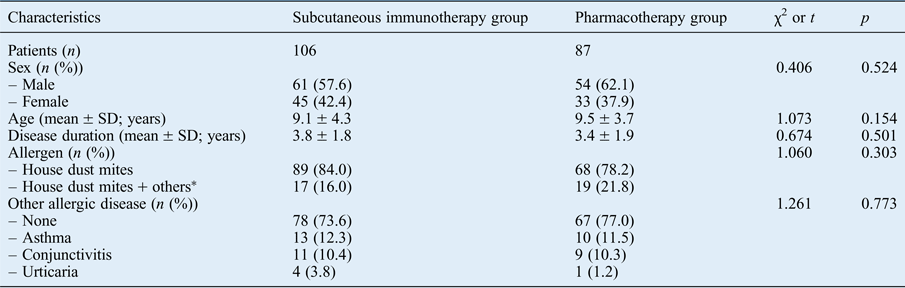
In September 2015, complete clinical data were available for 106 patients in the subcutaneous immunotherapy group, with an average follow-up duration of 4.2 ± 1.5 years. Complete clinical data were available for 87 patients in the pharmacotherapy group, with an average follow-up duration of 4.6 ± 1.3 years. The follow-up duration of 19 patients in the subcutaneous immunotherapy group and 21 patients in the pharmacotherapy group was more than 5 years. Thirty-nine patients (16.5 per cent) in the two groups dropped out during the maintenance phase. Forty-three patients were lost during the follow-up period. The basic information for the patients in the two groups is summarised in Table I.
Basic characteristics of paediatric allergic rhinitis patients in the two therapy groups

*Subcutaneous immunotherapy group: pollens (2 patients), fungi (2 patients), cockroaches (12 patients), cat hair (1 patient). Pharmacotherapy group: fungi (1 patient), mugwort (1 patient), cockroaches (15 patients), cat hair (1 patient), cockroaches and cat hair (1 patient). SD = standard deviation
Subcutaneous immunotherapy
The standardised specific subcutaneous immunotherapy was administered at the clinic. The patients received Alutard SQ subcutaneous immunotherapy (Dermatophagoides pteronyssinus; ALK-Abelló, Hørsholm, Denmark).Reference Dong, Huang, Li, Hu, Wang and Wang 6 The product was well characterised by the manufacturer (1 ml of 100 000 SQ-U containing 4.5 µg Der p 1).Reference Tabar, Arroabarren, Echechipía, García, Martin and Alvarez-Puebla 7 There were four different vials (numbers 1–4) of standardised allergen extracts, in which the allergen concentration increased 10-fold, from 100 to 100 000 SQ-U/ml. The build-up phase followed the conventional schedule recommended by the manufacturer, which comprised weekly injections with volumes of 0.2, 0.4 and 0.8 ml from vial numbers 1–3, and 0.1, 0.2, 0.4, 0.8 and 1.0 ml from vial number 4, to achieve a maintenance dose of 100 000 SQ-U. The maintenance dose was then administered every 6 weeks, according to the manufacturer's instructions, for 36 months. The patients were observed at the clinic for at least 30 minutes after each injection for possible adverse effects.
During the treatment and follow-up periods, the patients were permitted to use rescue medications (see the ‘Medication scores’ section), depending on the persistence and severity of the allergic rhinitis symptoms.
Pharmacotherapy
The patients in the pharmacotherapy group received intranasal corticosteroids (budesonide) and oral antihistamines (loratadine), according to the manufacturer's instructions, for one month. After the initial treatment was completed, the patients received budesonide and loratadine treatment again, depending on the persistence and severity of the allergic rhinitis symptoms. Patients who underwent another treatment strategy, such as subcutaneous immunotherapy or surgery, during the treatment and/or follow-up period were excluded.
Symptoms and quality of life evaluation
Before treatment and at every follow-up session, the severity of allergic rhinitis symptoms (rhinorrhoea, sneezing, itching and nasal blockage) was evaluated using a visual analogue scale (VAS), consisting of a 10 cm line ranging from no symptoms (0 cm) to the highest level of symptoms (10 cm). Quality of life was evaluated using the Rhinoconjunctivitis Quality of Life Questionnaire. The entire follow-up process was completed by the children and their parents together.
Medication scores
When necessary, the patients were permitted to use rescue medications, which were scored as follows: oral antihistamine tablet, 1 point; inhaled corticosteroids, 1 point; β−2 agonists, 1 point; intranasal corticosteroids, 0.75 points; intranasal antihistamines, 0.25 points; and inhaled corticosteroids plus β−2 agonists, 2 points. The patients and/or their parents were instructed to keep a diary during the follow-up period so that their medication scores could be evaluated. The mean monthly scores were recorded at every study visit (six months, one year, three years and five years). The mean medication scores for the month prior to treatment were used as the baseline medication scores.
Safety assessment
Safety was assessed by monitoring adverse events, laboratory parameters, physical examination findings and vital signs. Adverse events were classified according to the grading of systemic reactions to immunotherapy, as reported by the European Academy of Allergy and Clinical Immunology: grade 1, reaction of a single-organ system, such as the cutaneous, conjunctival or upper respiratory system; grade 2, reaction of either the gastrointestinal or cardiovascular system; grade 3, more than two single-organ system reactions or asthma; grade 4, conventional clinical indicators of a severe reaction, such as loss of consciousness, hypotension and respiratory failure; and grade 5, death.Reference Canonica, Cox, Pawankar, Baena-Cagnani, Blaiss and Bonini 8
Statistical analysis
SPSS version 16.0 software (SPSS, Chicago, Illinois, USA) was used for statistical analysis. Differences between groups were compared using a dependent-sample t-test. Differences within groups were compared using a paired-sample t-test. A p-value of less than 0.05 was considered to indicate statistical significance.
Results
Patients
A total of 193 patients (106 in the subcutaneous immunotherapy group and 87 in the pharmacotherapy group) completed the 3-year treatment schedule and had full data available for all variables of interest for the 5-year follow-up period. No significant differences were observed in the basic characteristics of the enrolled patients (Table I).
Clinical efficacy
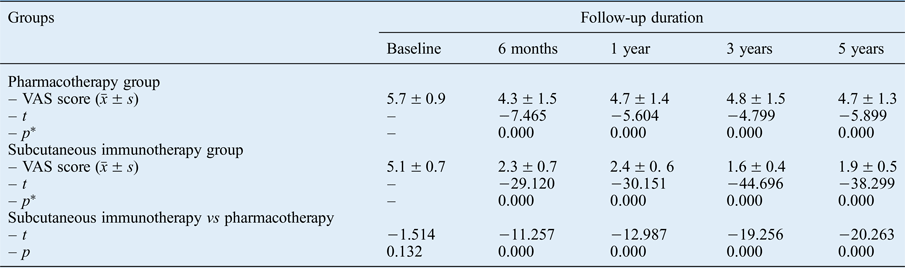
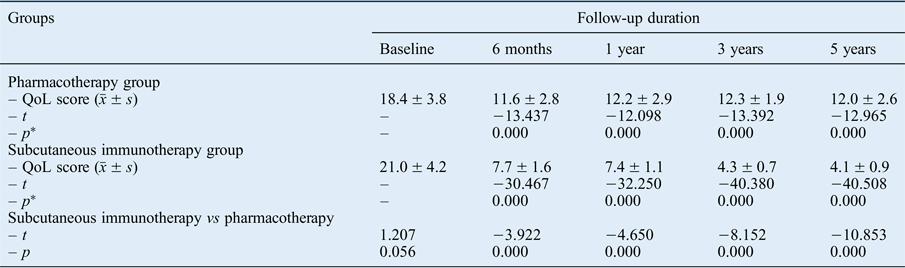
The main clinical efficacy endpoints for patients undergoing the three-year treatment and for whom full data were available are summarised in Tables II and III. Both subcutaneous immunotherapy and pharmacotherapy significantly reduced the VAS and Rhinoconjunctivitis Quality of Life Questionnaire scores at six months, one year, three years and five years, compared with baseline (p < 0.05). However, the reduction in the VAS and Rhinoconjunctivitis Quality of Life Questionnaire scores was significantly greater in the subcutaneous immunotherapy group compared with the pharmacotherapy group (p < 0.001). These results indicate that subcutaneous immunotherapy had better long-term efficacy (for as long as five years after treatment discontinuation) compared with pharmacotherapy.
VAS scores of paediatric allergic rhinitis patients before and after treatment

*Compared with baseline. VAS = visual analogue scale
Rhinoconjunctivitis quality of life questionnaire scores of paediatric allergic rhinitis patients before and after treatment

*Compared with baseline. QoL = quality of life
Medication scores
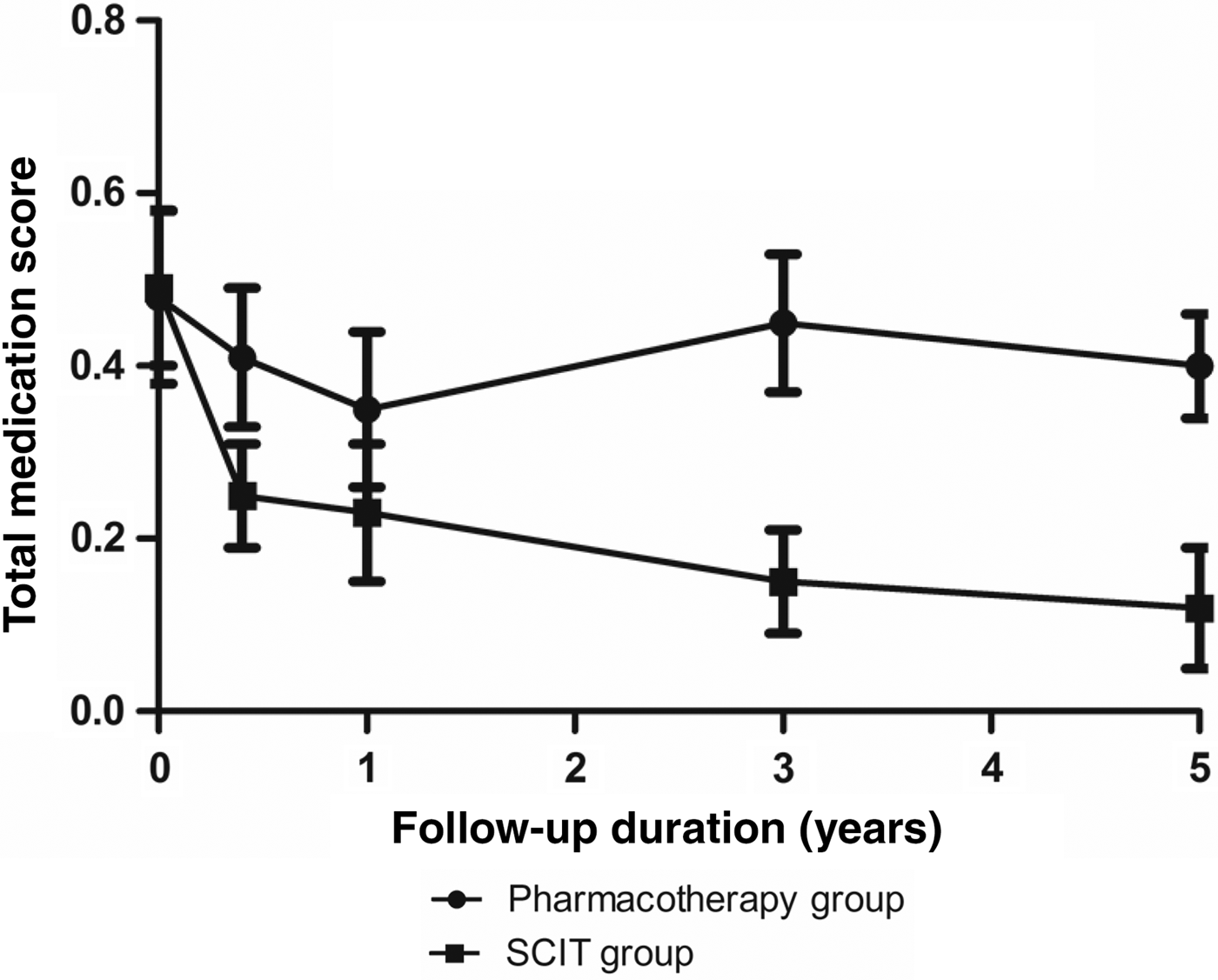
The baseline medication scores did not differ significantly between the subcutaneous immunotherapy and pharmacotherapy groups (p > 0.05). In the pharmacotherapy group, the medication scores showed no significant differences at six months, one year, three years and five years, compared with baseline (p > 0.05). In the subcutaneous immunotherapy group, the medication scores were 0.25 ± 0.06 at six months, 0.23 ± 0.08 at one year, 0.15 ± 0.06 at three years and 0.12 ± 0.07 at five years, which were significantly reduced compared with 0.49 ± 0.09 at baseline (p < 0.05; Figure 1).
Total medication scores of the paediatric allergic rhinitis patients in the pharmacotherapy and subcutaneous immunotherapy (SCIT) groups, at baseline, six months, one year, three years and five years (
 $\bar x \pm s$
).

Monosensitised and polysensitised patients
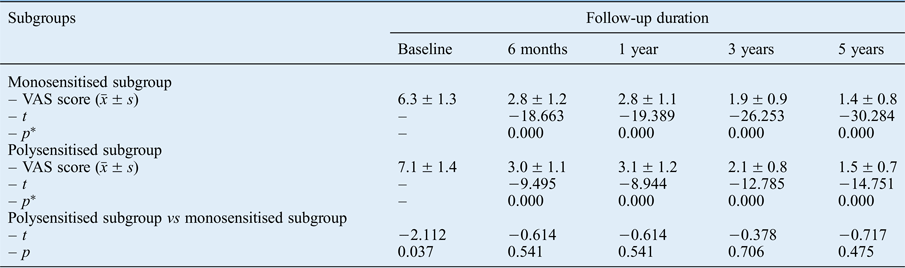
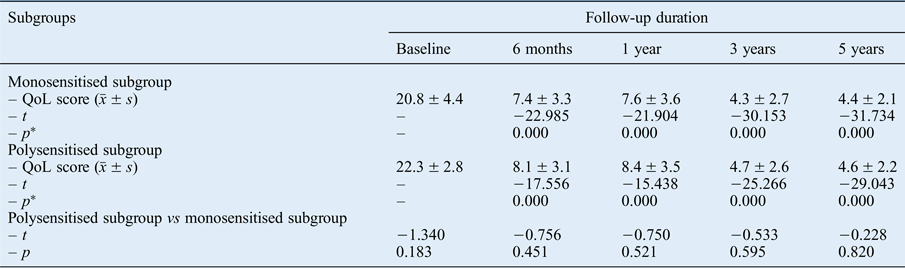
Seventeen allergic rhinitis patients who received subcutaneous immunotherapy were sensitised to multiple allergens, including house dust mites. In these patients, the VAS and Rhinoconjunctivitis Quality of Life Questionnaire scores at six months, one year, three years and five years were significantly reduced compared with baseline (p < 0.05). There was no significant difference in the Rhinoconjunctivitis Quality of Life Questionnaire scores between the 17 polysensitised patients and the 89 monosensitised patients who received subcutaneous immunotherapy (p > 0.05). The VAS scores of the polysensitised patients were significantly higher than those of the monosensitised patients at baseline (p < 0.05), but there was no significant difference between the polysensitised patients and the monosensitised patients at six months, one year, three years and five years (p > 0.05). Together, these results indicate that for polysensitised patients, subcutaneous immunotherapy showed satisfactory efficacy, similar to its efficacy for monosensitised patients (Tables IV and V).
VAS scores of monosensitised and polysensitised patients who received subcutaneous immunotherapy

*Compared with baseline. VAS = visual analogue scale
Rhinoconjunctivitis quality of life questionnaire scores of monosensitised and polysensitised patients who received subcutaneous immunotherapy

*Compared with baseline. QoL = quality of life
Safety assessment
The 106 patients received a total of 5406 injections. There were 253 (4.6 per cent) grade 1 adverse events, including erythema and subcutaneous induration; these adverse events were temporary and subsided with medications. There were 11 (0.2 per cent) grade 3 adverse events, including asthma attacks and airway hyper-responsiveness, which were well controlled by intravenous injection of dexamethasone (10 mg); none of the patients needed to be hospitalised for observation. No fatality related to subcutaneous immunotherapy was observed in our study.
Discussion
Leonard Noon began to study subcutaneous immunotherapy for the treatment of allergic rhinitis in 1911.Reference Noon 9 At present, allergen-specific immunotherapy is the only available treatment to modify the natural progression of allergic rhinitis. During the 5-year period of our study, 236 children with persistent allergic rhinitis were enrolled and received subcutaneous immunotherapy. The results demonstrated the long-term efficacy and safety of subcutaneous immunotherapy.
In the paediatric population of Europe, the major allergen implicated in allergic rhinitis is pollen, which mainly results in seasonal allergic rhinitis. In this population, subcutaneous immunotherapy significantly alleviates symptoms, prevents the development of asthma and reduces skin prick test wheal diameters compared with controls, demonstrating definite efficacy for paediatric seasonal allergic rhinitis.Reference Jacobsen, Niggemann, Dreborg, Ferdousi, Halken and Høst 5 , Reference Durham, Walker, Varga, Jacobson, O'Brien and Noble 10 , Reference Möller, Dreborg, Ferdousi, Halken, Høst and Jacobsen 11 However, there are few studies on the long-term efficacy of subcutaneous immunotherapy in paediatric patients with persistent allergic rhinitis caused by house dust mites. The house dust mite allergen is the most common inhaled allergen that can induce allergic rhinitis in China, especially in the southern region, which includes Changsha city, Hunan province. As we previously reported, the positive rate of house dust mite sensitisation in children with allergic rhinitis in Changsha city is 97 per cent.3 Standardised mite allergen immunotherapy is appropriate for treating allergic rhinitis in the local area. Our present study indicates that subcutaneous immunotherapy has long-term efficacy (as long as five years after treatment discontinuation), which merits further study and attention.
-
• Subcutaneous immunotherapy showed better long-term efficacy than pharmacotherapy for paediatric perennial allergic rhinitis
-
• Medication scores were significantly reduced in the subcutaneous immunotherapy group compared with baseline
-
• Single-allergen immunotherapy showed satisfactory efficacy in polysensitised patients
-
• No serious adverse events occurred with subcutaneous immunotherapy
The appropriate use of immunotherapy for polysensitised allergic rhinitis patients remains unclear.Reference Calderón, Cox, Casale, Moingeon and Demoly 12 , Reference Bahceciler, Galip and Cobanoglu 13 Regarding house dust mite subcutaneous immunotherapy for polysensitised allergic rhinitis, Soyyigit et al.Reference Soyyigit, Guloglu, Ikinciogullari, Secil, Oztuna and Mungan 14 and Kim et al.Reference Kim, Shin, Lee, Kim and Cho 15 reported that monosensitised and polysensitised adult patients showed equal improvement in symptom scores, VAS scores and quality of life after subcutaneous immunotherapy. To the best of our knowledge, no study in the literature has compared the clinical efficacy of subcutaneous immunotherapy in monosensitised and polysensitised paediatric patients with persistent allergic rhinitis. In the present study, 17 children (16 per cent) were sensitised to house dust mite allergen in addition to pollens, fungi, mugwort and others; in these children, allergic rhinitis symptoms and quality of life showed improvements similar to those of children monosensitised to house dust mite allergen, and there were no significant differences between the two subgroups. Our data suggest that single-allergen subcutaneous immunotherapy is also appropriate for allergic rhinitis caused by multiple allergens, including house dust mites, in the paediatric population. A possible explanation is that house dust mite allergen plays a critical role in the development of allergic symptoms; however, the specific mechanisms are unclear.
The safety problems associated with subcutaneous immunotherapy for allergic rhinitis are of significant concern to otolaryngologists. Local and systemic reactions vary considerably according to the allergen extract, induction schedule, preparation and dose. The incidence of systemic reactions to subcutaneous immunotherapy varies between 0.06 and 1.01 per cent among those receiving injections.Reference Bernstein, Epstein, Murphy-Berendts and Liss 16 Of the 5406 injections administered in our clinics, there were 253 (4.6 per cent) grade 1 adverse events and 11 (0.2 per cent) grade 3 adverse events, which were well controlled with no need to hospitalise the patients for observation. No fatality related to subcutaneous immunotherapy was observed in our study. The present data indicate that specific subcutaneous immunotherapy with standardised house dust mite extract is safe and reliable for treating paediatric allergic rhinitis.
Conclusion
Standardised specific subcutaneous immunotherapy has long-term efficacy for children with persistent allergic rhinitis. Single-allergen subcutaneous immunotherapy was also appropriate for allergic rhinitis caused by multiple allergens, including house dust mites, in the paediatric population.
Acknowledgement
This study was supported by the New Xiangya Talent Projects of the Third Xiangya Hospital of Central South University (JY201617).