INTRODUCTION
The chronology of the pre-colonial indigenous occupation of Cuba is one of the most misunderstood aspects of Caribbean archaeology, making inferences about population dynamics, identities and interactions in the island extremely difficult. This is primarily due to the fact that less than 200 calibrated radiocarbon (14C) dates with secure contextual information are available for Cuba (Pino Reference Pino1995; Cooper et al. Reference Cooper, Valcárcel and Cruz Ramírez2006; Cooper Reference Cooper, Fitzpatrick and Ross2010; Cooper and Thomas Reference Cooper and Thomas2011; Roksandic et al. Reference Roksandic, Buhay, Chinique de Armas, Rodríguez Suárez, Peros, Roksandic, Armstrong, Viera Sanfiel, Arredondo and Martínez Fuentes2015); even though it represents nearly half of the land surface (110,860 km2) of all the Caribbean islands (238,464 km2), and has an history of indigenous occupation spanning for over 4500 years before the arrival of the Spanish colonizers (Cooper Reference Cooper, Fitzpatrick and Ross2010; Roksandic et al. Reference Roksandic, Buhay, Chinique de Armas, Rodríguez Suárez, Peros, Roksandic, Armstrong, Viera Sanfiel, Arredondo and Martínez Fuentes2015). In the absence of sufficient 14C dates, the precolonial occupation was constructed in the framework of relative chronologies based on typological aspects of the material culture centered on the presence/absence of diagnostic artifacts such as unretouched macroblades, lithic daggers, stone balls, gouges, microlithic artifacts, griddles vessels, and ceramics typology (Tabío and Rey Reference Tabío and Rey1979). The most commonly used classification system in Cuba recognizes three categories: Preagroalfarero (preagroceramicist), Protoagrícola (protoagriculturalist) and Agroalfarero (agroceramicist) (Tabío Reference Tabío1984). The Preagroalfareros group was defined by the lack of ceramics. This includes the so-called hunters (Kozlowski Reference Kozlowski1975, Reference Kozlowski1980; Febles and Rives Reference Febles and Rives1991; Rives and Baena Reference Rives and Baena1993; Izquierdo and Sampedro Reference Izquierdo and Sampedro2008), and the groups associated with the “Archaic” Age in the Antilles (traditionally considered to be fisher-gatherers) whose material assemblages are tied to the shell industry of the “Manicuaroid tradition” (Cruxent and Rouse Reference Cruxent and Rouse1961; Rivero de La Calle Reference Rivero de La Calle1966; Alonso Reference Alonso1995; Keegan and Hofman Reference Keegan and Hofman2017) and the stone industry of the “Banwaroid tradition” (Cruxent and Rouse Reference Cruxent and Rouse1961; Boomert Reference Boomert2000; Keegan and Hofman Reference Keegan and Hofman2017). Although some authors have understood these two industries as different cultural manifestations (Cruxent and Rouse Reference Cruxent and Rouse1961; Tabío and Rey Reference Tabío and Rey1979), these traditions are mixed within the archaeological record of the island (Godo Reference Godo1994), likely as a result of a complex process of interactions and the issues associated with the use of technotypological classifications.
The Protoagricola classification (or incipient agriculturalists) was reserved for those sites where early ceramics were found in association with a microlithic blade industry and typical Archaic Age assemblages (Kozlowski Reference Kozlowski1974; Tabío Reference Tabío1984; Ulloa and Valcárcel Reference Ulloa and Valcárcel2002). The Agroalfareros classification is used to refer to Arawak groups that occupied the island from at least cal AD 820–830 (2 σ) (Cooper Reference Cooper, Fitzpatrick and Ross2010), carrying the “Chicoid” ceramics (restricted to eastern Cuba), and the “Meillacoid” manifestations that have been identified across the majority of the island, but with local variations (Ulloa and Valcárcel Reference Ulloa, Valcárcel, Keegan, Hofman and Rodríguez Ramos2013). Guarch et al. (Reference Guarch, Rey and Febles1995) systematised the existing dates and archaeological evidence, assigning chronological ranges for hunters (BC 6000–2500), fisher-gatherers (BC 2500–AD 1500), incipient agriculturalists (BC 400–AD 1500) and agriculturalists (AD 600–1500). These broad categories were the consequence of the paucity of absolute dates making it particularly challenging to understand the timing of the early peopling of the islands (ca. BC 4000–AD 500) and the complex web of interactions that took place among the populations that predated the expansion of the late ceramic Arawak agriculturalist groups in Cuba.
Part of the problem in understanding the variability and interactions among individuals grouped under the term Preagroalfareros (“Archaic” Age groups) stems from assumptions that are still in place in Caribbean archaeology. In general terms, they have been collectively understood as groups with small population densities, high mobility and a lack of systematic agriculture or ceramic production (Rodríguez Ramos et al. Reference Rodríguez Ramos, Keegan, Hofman and Rodríguez Ramos2013). This stands in contrast to more recent findings that demonstrated that some Archaic Age groups regularly used cultigens as part of their diet (Pagán Jimenez et al. Reference Pagán Jiménez, Rodríguez, Chanlatte Baik and Narganes Storde2005, Reference Pagán Jiménez, Rodríguez Ramos, Reid, van der Bel and Hofman2015; Mickleburgh and Pagán Jimenez Reference Mickleburgh and Pagán Jiménez2012; Chinique de Armas et al. Reference Chinique de Armas, Rodríguez Suárez, Buhay, Armstrong, Smith and Roksandic2015, Reference Chinique de Armas, Rodríguez Suárez, Buhay, Roksandic, Hofman and Antczak2019; González Herrera et al. Reference González Herrera, Rodríguez Suárez, Reyes Serrano, Yero Masdeu, Chinique de Armas and Roksandic2019). In addition, there is a growing evidence of substantial/persistent differences in dietary practices (Chinique de Armas et al. Reference Chinique de Armas, Roksandic, Rodríguez Suárez, Smith, Buhay and Roksandic2016), settlement patterns, burial practices (González Herrera et al. Reference González Herrera, Chinique de Armas, Yero Masdeu and Roksandicforthcoming) and material culture (Guarch Reference Guarch1990) among these diverse communities of practice (Rodríguez Ramos Reference Rodríguez Ramos, Fitzpatrick and Ross2010). This suggests that the Caribbean precolonial history requires a more critical and detailed revision of its archaeological contexts along with new frames of reference; a process that needs to be supported by more absolute chronologies. In this sense, 14C dates of human remains provide a strong framework to examine biocultural differences among groups and their interactions through time, since cemeteries are repositories of both biological and cultural identities of a given group (Larsen Reference Larsen2002; Sofaer Reference Sofaer2006).
While recent studies have reported 14C dates of skeletal remains from sites associated with “Archaic Age” populations in western Cuba (Roksandic et al. Reference Roksandic, Buhay, Chinique de Armas, Rodríguez Suárez, Peros, Roksandic, Armstrong, Viera Sanfiel, Arredondo and Martínez Fuentes2015), no 14C dates of human remains are currently available for groups traditionally understood as holders of the “Banwaroid tradition” (Ciboney Cayo Redondo type sensu Osgood Reference Osgood1942). The Cayo Redondo tool assemblage was characterized by a diverse stone tool set that included lithic daggers and stone balls (Osgood Reference Osgood1942). Analogies can be drawn with the material culture of the northeast coast of South America and the Lesser Antilles at sites such as Banwari Trace [cal BC 5230–600 (1 σ)] (Harris Reference Harris1971), Saint John [cal BC 5030–3130, (1 σ)] (Pagán Jiménez et al. Reference Pagán Jiménez, Rodríguez Ramos, Reid, van der Bel and Hofman2015) and Ortoire [cal BC 1750–1050 (1 σ)] (Rouse Reference Rouse1992) in Trinidad. In this paper, we provide the first insights into the chronology of the archaeological site of Playa del Mango (Rio Cauto, eastern Cuba), traditionally associated with the Banwaroid stone tool tradition. This information will be useful in understanding the chrono-spatial occupation of the Rio Cauto Basin and more generally, for building a chronological framework for understanding interactions among different groups in Cuba and the Caribbean.
The Archaeological Site of Playa del Mango
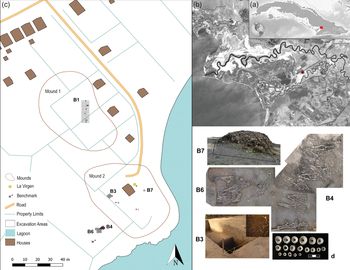
The archaeological site of Playa del Mango is located in the Rio Cauto Basin in the province of Granma in eastern Cuba (20°33′14.38″N, 76°59′08.97″W) (Figure 1a). The site is adjacent to the “Laguna del Mango,” approximately 3.5 km east of the lagoon system of Las Playas and 14 km inland (north) from the Gulf of Guacanayabo (Figure 1b). The site covers approximately 60,000 m2 and includes three mounds. The two largest mounds, mound 1 (M1) and mound 2 (M2) are approximately 60 and 40 m in diameter and 7 and 3 m in height, respectively (Figure 1c). According to the traditional Cuban classification systems, the site occupants were either Ciboney Cayo Redondo (Rouse Reference Rouse1942; Tabío and Rey Reference Tabío and Rey1979), Preagroalfareros (Tabío Reference Tabío1984) or “Fisher-Gatherers”: Cultural variant Guacanayabo (Guarch Reference Guarch1990). The material culture found at the site is consistent with the archaeological assemblage of the “Banwaroid tradition” (Cruxent and Rouse Reference Cruxent and Rouse1961; Boomert Reference Boomert2000; Keegan and Hofman Reference Keegan and Hofman2017).
Geographic location of Playa del Mango, Cauto River, Granma province, Cuba.

Playa del Mango was first excavated in 1941 by doctor Bernardo Utset Masía who uncovered approximately 40 skeletons at a depth of ~21 cm below the surface of M1 (Utset Reference Utset Masía1941). The skeletons were in anatomical position, laying on their backs (dorsal decubitus) in primary burials. Some burials had beads made of fish and shark vertebrae around their necks, wrists and ankles. Unfortunately, the osteological remains are no longer available and only limited contextual information regarding these burials was recorded in Utset (Reference Utset Masía1941).
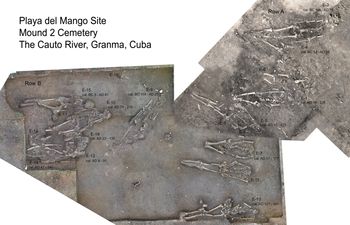
Between 1980 and 1986 a team of the Academy of Sciences of Cuba excavated two new areas in M1 and M2, recovering additional faunal remains (Córdova and Arredondo Reference Córdova and Arredondo1990) and artifacts (Febles and Godo Reference Febles Dueñas and Godo1990). Between 2014 and 2018, a joint project by the Cuban Institute of Anthropology and The University of Winnipeg resumed excavations at the site. As a result of the first surveys in 2014 and 2015, some isolated human bones and beads made of fish/shark vertebrae were found in M1 (Figure 1c, B1 and B2). In 2016 and 2018, Bloque 3 (B3) and 7 (B7) located on the mound, and Bloque 4 (B4) and 6 (B6) in the marginal area of the mound (Figure 1c) were excavated under the direction of Dr. Ulises Gonzalez Herrera (Cuban Institute of Anthropology) and Dr. Yadira Chinique de Armas (University of Winnipeg). Archaeological evidence of domestic activity (food, charcoals, and artifacts) from Mound 2 suggested that the area was a habitational space. In the marginal area of M2, 20 skeletons in anatomical position were found (funerary space), some of which were partially or completely altered due to modern agricultural practices (Figure 2).
General Scheme of the Burials at the Playa del Mango site, Granma, Cuba.

MATERIALS AND METHODS
Sample Selection
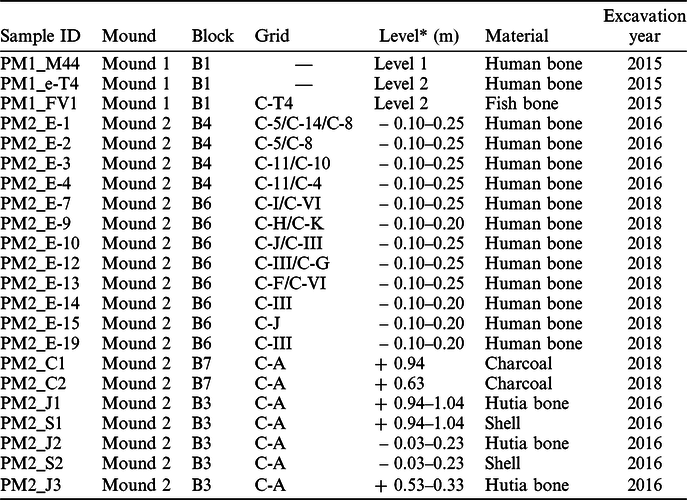
A total of 22 samples from the archaeological site of Playa del Mango were submitted for 14C dating at the André E. Lalonde AMS Laboratory, University of Ottawa, Canada (Table 1). The sample set includes two human bone samples and an associated shark vertebra (ornament) from M1; five animal remains [fragments of two shells (Codakia orbicularis) and three hutia bones (Geocapromys sp.; terrestrial rodent) from B3], two charcoal samples from M2 (B7) and 12 human samples from the peripheral area of M2 (B4 and B6). The newly excavated Playa del Mango human remains are now housed in the Cuban Institute of Anthropology in Havana, Cuba. Authorization to study the archaeological material in Canada was granted to Dr. Ulises M. Gonzalez Herrera by the ‘Comisión Nacional de Monumentos’ in Cuba.
Samples of Playa del Mango (Granma, Cuba) sent to the Lalonde Lab (Ottawa, Canada) for 14C dating.

* Level is relative to the bench (geodesic point in the peripheral area of M2: 3.55 m above sea level).
14C Analysis and Calibration
The sample pretreatment techniques used are described in Crann et al. (Reference Crann, Murseli, St-Jean, Zhao, Clark and Kieser2017). 14C analysis was performed on a 3MV tandem accelerator mass spectrometer built by High Voltage Engineering (HVE). The 12,13,14C+3 ions were measured at 2.5 MV terminal voltage with Ar stripping. The fraction modern carbon, F14C, was calculated according to Reimer et al. (Reference Reimer, Bard, Bayliss, Beck, Blackwell, Bronk Ramsey, Buck, Cheng, Edwards and Friedrich2004) as the ratio of the sample 14C/12C ratio to the standard 14C/12C ratio (Ox-II) measured in the same data block. Both 14C/12C ratios were background-corrected and the result corrected for spectrometer and preparation fractionation using the AMS measured 13C/12C ratio, then normalized to δ13C (VPDB). 14C ages were calculated as –8033 ln (F14C) and reported in 14C yr BP (BP = AD 1950) as described by Stuiver and Polach (Reference Stuiver and Polach1977). The errors on 14C ages (1 σ) are based on counting statistics and 14C/12C and 13C/12C variation between data blocks.
The two coincident bivalve shell (Codakia orbicularis) and hutia samples (Geocapromys sp.) from M2 (pairs PM2_J1/PM2_S1 and PM2_J2/PM2_S2, Table 2) were used to establish the site-specific ΔR; a correction factor for local variance in the marine reservoir correction (see Reimer and Reimer Reference Reimer and Reimer2017). Samples used to calculate ΔR were found close together at the same grid and level. The bivalve shell samples were homogenized to avoid 14C dating errors related to growth and potential overgrowth in homogeneities, as well as short-term fluctuations in local marine 14C reservoir offsets (changes in ΔR during the life of the organism) which can be magnified through the random sampling of short growth periods (Culleton et al. Reference Culleton, Kennett, Ingram, Erlandson and Southon2006). We selected shells whose lip was intact to reduce the risk of reuse (Cooper and Thomas Reference Cooper and Thomas2011). The ΔR with lower uncertainties was used to describe, and graphically represent, the results.
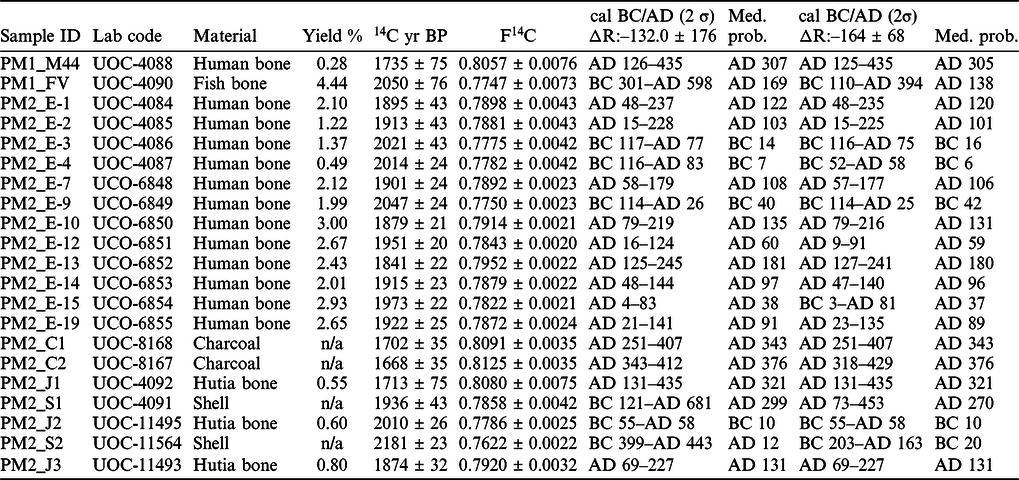
AMS 14C dates of the archaeological site of Playa del Mango, Rio Cauto, Granma, Cuba. 14C ages were calibrated using the two calculated ΔR for Playa del Mango (–132.0 ± 176 and –164 ± 68). A 5% estimated marine diet factor was used to calibrate the human bone samples.*

* Yield: collagen yield % by mass; yr: years; F14C: fraction modern carbon; Med. prob.: Median probability; BP: Before present; BC: Before Christ; AD: Anno domini. PM1_e-T4 failed to produce collagen.
The AMS dates obtained on the charcoal and hutia samples were calibrated to cal BC/AD using the Calib 7.0.2 Intcal13 curve (Reimer et al. Reference Reimer, Bard, Bayliss, Beck, Blackwell, Bronk Ramsey, Buck, Cheng, Edwards and Friedrich2013). The AMS dates for the shells was calibrated to cal BC/AD using the MARINE13 age calibration curve (100% marine contribution). The AMS dates for the human samples were calibrated using the marine & atmosphere NH curve (Marine13 and IntCal13) (Reimer et al. Reference Reimer, Bard, Bayliss, Beck, Blackwell, Bronk Ramsey, Buck, Cheng, Edwards and Friedrich2013). Notably, a 5% estimated marine diet factor was used in the age calibrations for the human bone samples, according to the δ13C and δ15N stable isotopes results of Chinique de Armas et al. (Reference Chinique de Armas, Buhay, Reyes, González Herrera, Skelton, Rodríguez Suarez, Filyk, Roksandic and Laffoonforthcoming). This low percentage of marine contribution largely mitigate the uncertainties associated with the marine reservoir effect and the calculated ΔR values. Interpretation of these results are based on 2 σ, which represent with 95% of confidence that the calendar dates of the death of the organisms fall within that range.
Statistics
The set of human bone dates is normally distributed (W = 0.93467, p-value = 0.3917), we used a student t-test to compare samples whose median probabilities (MP) were years BC with the ones whose MP were years AD. Statistical significance was set at α = 0.05.
RESULTS
Twenty-one of the 22 samples submitted yielded reliable dates: two from M1 (a human sample and a shark vertebra bead associated with isolated human remains) and 19 samples from M2 including the two charcoal samples, two shells, three hutia bones and 12 human remains from the periphery of M2 (Table 1). The ΔR calculated for Playa del Mango site was –132.0 ± 176 (samples PM2_J1/PM2_S1) and –164.0 ± 68 (samples PM2_J2/PM2_S2) (Reimer and Reimer, Reference Reimer and Reimer2017). Calibrated 14C dates do not differ significantly for humans (5% marine contribution) when using the two different calculated ΔR values (Table 2). However, it is possible to obtain narrower ranges for the fish bone and shell samples (100% marine contribution) when using the ΔR with lower variation (–164.0 ± 68) (Table 2).
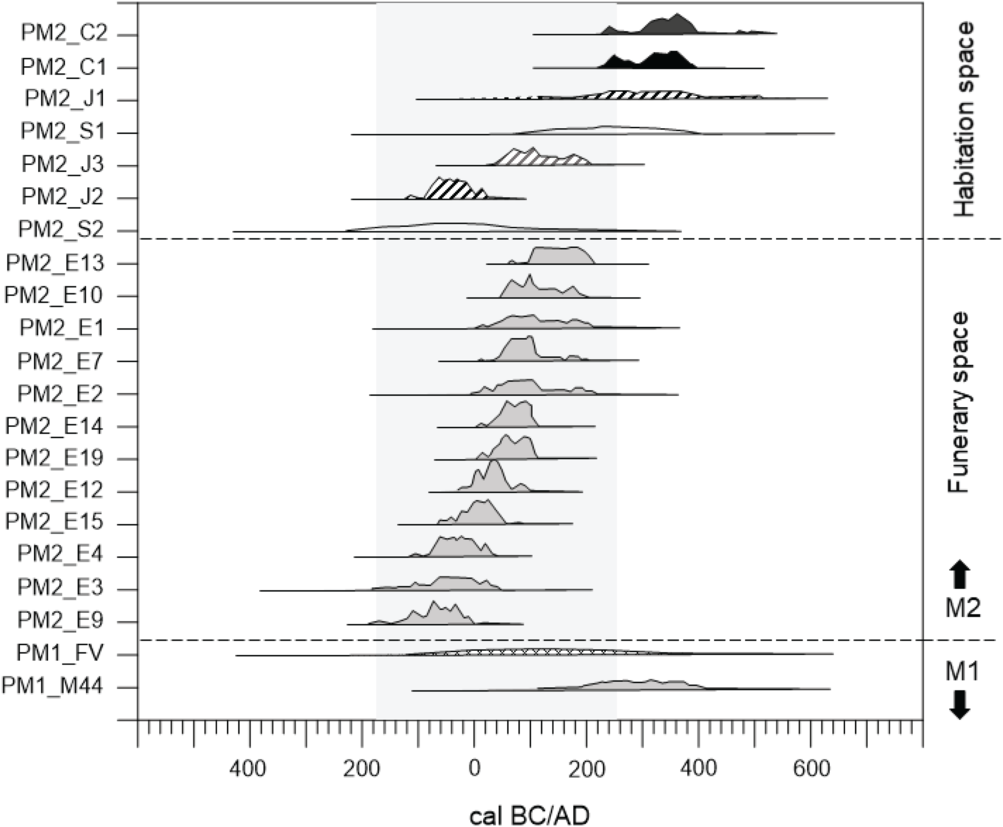
The single human sample from M1 (PM_M44) indicates that the mound was in use as a cemetery at some point between cal AD 125–435 (2 σ) (Median probability: cal AD 305). The shark vertebra used as an ornament and associated with the isolated human remain that failed to produce collagen (PM1_eT4), yielded a wider date range [cal BC 110–AD 394 (2 σ)] with a median probability of cal AD 138 (Table 1, Figure 3). The range is even wider when using the most variable ΔR (Table 2).
Posterior probability distribution of AMS 14C dates (2 σ) of the archaeological site of Playa del Mango, Rio Cauto, Granma province, Cuba. 14C ages were calibrated using a delta R of –164 ± 68. A 5% estimated marine diet factor was used to calibrate the human bone samples. Note that the gray shading corresponds to AMS 14C dates on human bone collagen; the plain white shading to the shell dates; the angled lined symbols to the hutia bone collagen dates; the “V” symbols to the fish bone collagen date; and the black shading to the charcoal dates.

The calibrated dates suggest that the domestic space of M2 was in use between cal BC 203–AD 453 (2 σ) (median probabilities between BC 20 and AD 376, Table 2) while the periphery of M2 was in use as a funerary space from at least cal BC 116 to AD 241 (2 σ). The median probabilities indicated two statistically significant separate burial clusters (t = 5.52, df = 10.99, p-value = 0.00); with an older age range represented by samples PM_E-9, PM_E-3 and PM_E-4 (between cal BC 42–6) and a younger age range represented by samples PM_E-15, PM_E-12, PM_E-19, PM_E-14, PM_E-2, PM_E-7, PM_E-1, PM_E-10 and PM_E-13 (between cal AD 37–180). They are statistically significantly different even before delta R adjustments (t = 5.04, df= 3.83, p-value = 0.00).
DISCUSSION
The chronology of burials from the Playa del Mango site suggests that the peripheral area of M2 was continuously used as a cemetery from at least cal BC 116–AD 241 (2 σ). The median probabilities showed that some of the burials included in this study (PM2_E-3, PM2_E-4 and PM2_E-9) were earlier than the others. However, since the total sample size (12 skeletons) is relatively small, and the range of the AMS 14C ages (2 σ) for these three skeletons slightly overlaps with some of the others (Figure 3), we are not entirely confident that those three skeletons represent a separate period of occupation of the site but rather may indicate the continual use of the site for over three hundred years.
As Utset (Reference Utset Masía1941) described for the skeletons excavated in M1, most individuals of the funerary area of M2 were placed in rows (Figure 2: Rows A and B), in extended position and in dorsal decubitus. Only two individuals excavated so far do not conform to the orientation in the rows: PM2_E-9, the earliest burial recorded at the site and the burial of an infant (PM2_E-8) associated with the PM2_E9. However, other aspects of the burial position are consistent with the rest of the burials. Two more individuals PM2_E-3 and PM2_E-4, seem to have been buried simultaneously, as demonstrated by the superposition of the bones, and the 14C dates (Table 2).
Most skeletons excavated in M2 (PM2_E-12, PM2_E-19, PM2_E-14, PM2_E-2, PM2_E-7, PM2_E-1, PM2_E-10) were buried in a relatively short period of time (between AD 9–216) since the AMS 14C dates at 2 σ significantly overlap (Figure 3). Notably, most skeletons in row A (Figure 2) were undisturbed by subsequent burial practices, with the exception of burial PM2_E-2, where there is intermixing of human remains of a previous, undated burial (PM2_E-5), which was disturbed by PM2_E-2. This use of the space with minimal secondary disturbance of the skeletons suggest the possible use of burial markers. Ancient DNA results suggest the use of the same spaces for burying related individuals (Nagele et al. personal communication), which could explain why PM2_E-5 was altered when PM2_E-2 was inhumed. In contrast, row B shows several skeletons buried very closely together and, in some cases, superimposed (Figure 2).
The youngest skeleton encountered, PM2_E-13, had beads made of vertebral shark on the thorax and pelvis which is consistent with the earlier description of the ornaments found by Bernardo Utset in some M1 burials (Utset Reference Utset Masía1941). According to Rivero de La Calle (Reference Rivero de La Calle1966: 33–34), the skeletons buried in the east of M1 had ornaments, in contrast with the ones uncovered in the west of M1; which may be indicative of differential social status. However, since the only individuals from the M1 dated in this study [PM1_M44: cal AD 126–435 (2 σ)] postdates all of the individuals excavated in M2, the presence of ornaments in Playa del Mango burials may be a practice associated with chronologically younger skeletons.
The 14C age for the shark vertebra (ornament) associated with PM1_e-T4 (the sample that failed to produce results) overlaps the Hallstatt Plateau in the calibration curve (Jacobsson et al. Reference Jacobsson, Hamilton, Cook, Crone, Dunbar, Kinch, Naysmith, Tripney and Sheng2017). The resulting wide age range [from cal BC 110–AD 394 (2 σ)] overlaps the 14C age for the PM1_M44, supporting that it was a PM1_e-T4 burial inclusion. It also suggests that the use of ornaments by populations at the site was in place at the time that PM1_M44 was buried. Unfortunately, this sample is an isolated human remain whose archaeological context is not clear. More excavations and bioarchaeological studies are needed before we can explain the differential presence of ornaments in Playa del Mango burials, but a pattern related to chronology may be in place. It is also important to understand the relationship between the funerary spaces of M1 and M2. Future excavations will examine if there is a continuous funerary space from the marginal areas of M2 to M1, or there are two disconnected funerary spaces at Playa del Mango (Figure 1).
In M2, the 14C dates from the two charcoal samples from B7 and the hutia bones from B3 suggested that the shell midden on the site was in formation at least between cal BC 55–AD 435 (2 σ) (median probabilities between cal BC 10 and AD 376). The shells from B3 yielded a wider chronological range between cal BC 203–AD 453 (2 σ), although the median probability is consistent with the mound being in use likely between BC 20–AD 270. The dates obtained on two the charcoal samples collected from the profile of B7, and the animal bones from B3, are consistent with their stratigraphic position, confirming our direct observation that the anthropogenic layers were not disturbed by modern taphonomic processes.
As indicated above, two associated pairs of shell of C. orbicularis and a hutia bone (Geocapromys sp.) were recovered at two different levels at B3 and consequently, used to calculate the ΔR for Playa del Mango. The two ΔR values calculated for Playa del Mango are similar between them (with overlap), but different from the ones calculated for other areas of Cuba (Reimer and Reimer Reference Reimer and Reimer2001, Diaz et al. Reference Díaz, Macario, Gomes, Álvarez-Lajonchere, Aguilera and Alves2017). This supports the importance of using site specific ΔR values to calibrate 14C dates of archaeological samples. The extended calendar age range (95% confidence intervals) for the M1 shark vertebrae (PM1_FV) and M2 shells (PM2_S1, PM2_S2; C. orbicularis) in figure 3 (> ± 300 years for both) are a result of the myriad of uncertainties related to the marine 14C reservoir offsets for each of the samples (Reimer and Reimer Reference Reimer and Reimer2017). Dissolved inorganic carbon (DIC) is the primary carbon source for marine organisms and local offsets from the marine DI14C reservoir is a function of multiple environmental factors such as the variation in ocean circulation, upwelling, freshwater input and coastal geology (Hadden et al. Reference Hadden, Cherkinsky, Smith, Ollivier and Pan2017). Corrections for these local offsets, like the ΔR employed in this study, are used to calibrate 14C dates of marine origin materials (Reimer and Reimer Reference Reimer and Reimer2017) but further uncertainties regarding isotopic equilibrium between DI14C (McConnaughey and Gillikin Reference McConnaughey and Gillikin2008), contamination of young carbon from calcite overgrowths and recrystallization during diagenesis (Busschers et al. Reference Busschers, Wesselingh, Kars, Versluijs-Helder, Wallinga, Bosch, Timmner, Nierop, Meijer, Bunnik and De Wolf2014), as well as assumptions of minimal vital isotope effects related to metabolism (Gillikin et al. Reference Gillikin, Lorrain, Meng and Dehairs2007), may further complicate 14C dating of marine materials. With these complications in mind, and the understanding of our current limitations in addressing the dating uncertainties recognized, the marine shells (PM2_S1, PM2_S2) and fish vertebrae (PM1_FV) samples in this study were homogenized (see above). It should also be noted that C. orbicularis is a filter feeder as opposed to a grazer which alleviates some of the potential complications related to the varied feeding practices of marine grazers; however, more uncertainty remains for the carnivorous fish vertebrae sample (PM1_FV) (Petchey et al. Reference Petchey, Ulm, David, McNiven, Asmussen, Tomkins, Dolby, Aplin, Richards and Rowe2013). The larger variation observed in the calibrated values of the shell samples is partially driven by the uncertainties of the calculated ΔR, since the samples have a 100% marine contribution. This variation does not significantly affect the calibration of the human samples since the estimated marine contribution to the diet is relatively low (Chinique de Armas et al. Reference Chinique de Armas, Buhay, Reyes, González Herrera, Skelton, Rodríguez Suarez, Filyk, Roksandic and Laffoonforthcoming).
The habitational space of M2 was used at minimum between cal BC 20–AD 376 (2 σ). Since only a small part of the site has been excavated, we cannot ascertain the beginning and the end date for the mound formation. The chronological range of the habitational place at M2 encompasses the use of the peripheral areas of the mound for burial practices, supporting the premise that the domestic activities and burial practices were chronologically associated (Figure 3). The M2 is also contemporaneous with later burials, such as the one found in M1 (PM1_M44, see Figure 1). More samples from the shell matrix site are needed before we can understand the dynamic of M1 and M2 formation and to elucidate the observed relationship between the formation of the mounds and the use of M1 for burial practices.
The material culture found at Playa del Mango mounds resembles that of the Banwari Trace [dated to cal BC 5230-600 (1 σ)] (Harris Reference Harris1971, Tankersley et al. Reference Tankersley, Dunning, Owen and Sparks2018), Saint John [dated to cal BC 5030–3130 (1 σ)] (Pagán Jiménez et al. Reference Pagán Jiménez, Rodríguez Ramos, Reid, van der Bel and Hofman2015) and Ortoire [cal BC 1750–1050 (1 σ)] (Rouse Reference Rouse1992) in Trinidad, the first island in the Caribbean with evidence of human occupation (Siegel et al. Reference Siegel, Jones, Pearsall, Dunning, Farrell, Duncan, Curtis, Hofman and Antczak2019). The populations at these sites had an artifact assemblage characterized by a diverse set of flaked and ground stone tools (including grooved axes, mortars and side edge grinders) with the exploitation of terrestrial and aquatic (marine, freshwater) ecosystems (Boomert Reference Boomert2000). The Banwari Trace complex was assigned to the “Ortoiroid series” by Rouse (Reference Rouse1992), together with the related traditions of the El Conchero complex of the east coast of Venezuela (Cruxent and Rouse Reference Cruxent and Rouse1982) and the Alaka complex on the northwest coast of Guyana [cal BC 6200 (1 σ)] (Evans and Meggers Reference Evans and Meggers1960, Boomert Reference Boomert2000, Reference Boomert, Hofman and Antczak2019). Most of these sites in Trinidad and Tobago are also recognized as Banwarian Ortoiroid (Boomert Reference Boomert2000).
Between cal. BC 3500–3000 (1 σ), the Ortoiroid-related groups started the process of colonizing the Lesser Antilles (Boomert Reference Boomert, Hofman and Antczak2019). Although the edge-ground cobble/milling stone assemblages used to characterize the “Banwarian tradition” are rare in the Windward Islands (Boomert Reference Boomert, Hofman and Antczak2019), similar types of evidence have been recorded on islands such as St. Vincent, Boutbois in Martinica, Jolly Beach [BC 2466–1971 (2 σ)] (David Reference David2000) in Antigua, sites in Saba and St. Kitts and Krum Bay, Virgin Islands (Rouse Reference Rouse1992). Burial positions at Playa del Mango site are consistently extended, in contrast with the strong flexed position of the Banwari Trace individual, and other burials of the El Conchero and Alaska complexes (Boomert Reference Boomert, Hofman and Antczak2019). It is not possible to explain at this point the origin of this apparent cultural discontinuity in burial practices, but by cal BC 114–AD 25 (2 σ), populations that settled the Playa del Mango site systematically buried their dead in extended position, with the backs on the ground, as they continued to do until at least cal. AD 180.
By BC 2863, populations with similar material cultures had reached the Greater Antilles with evidence at sites such as Couri I and II [cal BC 1519–AD 849 (2 σ)] in Haiti (Moore and Tremmel Reference Moore and Tremmel1997) and Cueva de Berna [cal BC 2833–1261 (2 σ)] (Veloz Maggiolo et al. Reference Veloz Maggiolo, Ortega, Nadal, Luna Calderón and Rimoli1977, Tavárez Reference Tavárez2007), Hoyo del Toro [late horizon at cal BC 819–411 (2 σ)] (Morbán Laucer Reference Morbán Laucer1979) and El Porvenir [cal BC 2863–936(2 σ)] (Veloz Maggiolo and Ortega Reference Veloz Maggiolo and Ortega1973; Rouse and Allaire Reference Rouse, Allaire, Meighan and Taylor1978) in the Dominican Republic. Cultural evidence is also available at Coroso in Puerto Rico (Rouse Reference Rouse1992). Most of the dates were obtained before 1977 when 14C dates did not account for isotopic fractionation (Stuiver and Polach Reference Stuiver and Polach1977) that can lead to large errors when dating charcoal samples (Taylor Reference Taylor1987). In addition, a critical revision of the archaeological evidence associated with these dates is important for multi-component sites in which more than one “complex” or “tradition” is present. However, it seems likely that starting at around BC 3000 a dynamic and multi-vectorial movement of groups of the “Ortoiroid Banwarian tradition” took place in the Antilles.
Different sites in Cuba are consistent with the archaeological indicators traditionally used to identify the “Banwaroid tradition,” with the highest concentration in the Cauto basin and the caneyes of south Camagüey in southeast Cuba (Guarch Reference Guarch1990, González Herrera, Reference González Herrera, Chinique de Armas, Yero Masdeu and Roksandicforthcoming). The site of Victoria I in south Camagüey, the largest shell-matrix site identified in Cuba, was in use between cal BC 388–AD 678 (2 σ) (Cooper Reference Cooper, Fitzpatrick and Ross2010). The lower range of these dates is older than the Playa del Mango dates, but the total range encompass the dates of the shell-middens and the burials of Playa del Mango, which indicate that populations with a similar material culture and way of life where exploiting the ecosystems of Guacanayabo Gulf and the south coast of Camagüey concurrently, at least since BC 42, and possibly earlier. A charcoal sample taken at level 2 of Victoria I shell-matrix site places these groups well into cal AD 989–1208 (2 σ) (Cooper Reference Cooper, Fitzpatrick and Ross2010), which supports the idea that these groups survived in the Antilles at least until the end of the first millennium of the Common Era.
Typical artifacts of the “Banwarian Ortoiroid tradition” are present in Cuban sites from the very east to the far west of the island (Godo Reference Godo1994). Examples of sites includes El Carnero (Yara, Granma), Loma del Indio (Rio Cauto, Granma), Caney del Castillo (Vertientes, Camagüey), Caney en la Finca Santanica and Caney del Gato (Florida, Camagüey), Caney del Pedernal (Morón, Ciego de Ávila), La Luisa and Cueva del Purial (Sancti Spíritus, Sancti Spíritus) [cal BC 1694–830 (2 σ)] (Pino Reference Pino1995; Cooper Reference Cooper, Fitzpatrick and Ross2010), Cueva Funeraria de Los Niños (Yaguajay, Sancti Spíritus) and Cayo Redondo in Pinar del Río. The systematic study (including 14C dates) of other sites in the Rio Cauto basin (González Herrera et al. Reference González Herrera, Chinique de Armas, Yero Masdeu and Roksandicforthcoming), and south of Camagüey into the Guacanayabo Gulf, and other Cuban sites linked to this tradition, will allow us to better understand the chrono-spacial distribution of these populations in the archipelago.
The archaeological evidence indicates that other “Lithic/Archaic” Age groups were present in Cuba before cal BC 1694–830 (2 σ), including Levisa 1 [cal BC 4338–1417 (2 σ)], Levisa 8 [cal BC 908–673 (2 σ)], Abra del Cacoyuguin [cal BC 2917–AD 976 (2 σ)] and Damajayabo [cal BC1750–1310 (2 σ)] (Cooper Reference Cooper, Fitzpatrick and Ross2010) in the east of the island. The oldest site in central Cuba was recorded in Jorajuría Cay [cal BC 2877–2034 (2 σ)] (Cooper Reference Cooper, Fitzpatrick and Ross2010). Toward the west of the island, evidence of early human occupation has been recorded at Canimar Abajo [cal BC 3251–AD 829 (2 σ)] (Roksandic et al. Reference Roksandic, Buhay, Chinique de Armas, Rodríguez Suárez, Peros, Roksandic, Armstrong, Viera Sanfiel, Arredondo and Martínez Fuentes2015), Cueva de la Lechuza [cal BC 1950–AD 60 (2 σ)], Cueva de la Pintura [cal BC 1391–46 (2 σ)] and Cueva Funche [cal BC 2904–AD 248 (2 σ)] (Cooper Reference Cooper, Fitzpatrick and Ross2010). In the Canimar Valley, for instance, “Archaic” Age-related populations were well established in the area by cal BC 1380–AD 1090 (2 σ) (Roksandic et al. Reference Roksandic, Buhay, Chinique de Armas, Rodríguez Suárez, Peros, Roksandic, Armstrong, Viera Sanfiel, Arredondo and Martínez Fuentes2015). Many other “Archaic” Age sites predate Playa del Mango burials (see Cooper Reference Cooper, Fitzpatrick and Ross2010). Some of them have material culture associated to the Manicuaroid shell industry tradition (Alonso Reference Alonso1995), although elements of both industries are mixed in the archaeological record of the Cuban archipelago (Godo Reference Godo1994). This is likely the result of persistent cultural connections between different groups in the region and their interactions within Cuba. Different lines of evidence combining bioarchaeological studies (stable isotopes for tracing migrations, dietary practices, ancient DNA, skeletal morphology), 14C dates and the critical study of the archaeological culture will shed more light on the colonization process and the spheres of interaction of Banwaroid related groups with other populations within the Cuban archipelago.
By the beginning of the Common Era, the systematic burial activities at the Playa del Mango site indicate some sense of territoriality, since well-established funerary areas are typically associated with increased forms of residential stability (Parker Pearson Reference Parker Pearson1999). The abundance of sites of this archaeological tradition in the Cauto region support this notion. In contrast with other areas of eastern Cuba, the occupation of the Rio Cauto basin by late ceramic groups is scarce and marginal, which may suggest that these populations had a strong hold on the territories that prevented the movement of incoming groups.
FINAL REMARKS
The archaeological site of Playa del Mango was occupied by groups similar to the “Banwarian Ortoiroid archaeological tradition” since at least cal BC 116 to possibly AD 453 (2 σ)]. The peripheral area of the M2 was in use as a funerary space at least from cal BC 42–AD 180 (2 σ), which encompasses the chronological period of the M2 formation (in use minimally between cal. BC 10–AD 376, 2 σ), confirming that the domestic activities and burial practices were chronologically associated. It is possible that the M2 funerary space is connected with the area of M1 where approximately 40 human remains were excavated in 1941. An isolated human remain from M1 dated at cal AD 125–435 (2 σ) suggest that this area may have been used later and in association with the formation of younger layers of M2. Of particular note is the differential use of ornaments among individuals buried at the site. This practice was already in place between cal 127–241 AD (2 σ). Future bioarchaeological studies will allow us to understand the reasons for this differential use of the ornaments.
Based on their material culture and chronology, the origin of Playa del Mango populations may be linked to the groups that settled Trinidad and the northeast coast of South America since at least BC 5000. Biological or cultural descendants of these populations may have moved into the Antilles starting at around 3500–3000 BC, reaching the Greater Antilles, including Cuba, by (at least) the first millennium BC. By BC 388, the south coast of Camagüey was settled by these types of groups, which seem to have also been present at the archaeological site of Playa del Mango at around the first century BC. Our data strongly support that these groups survived in the archipelago at least until AD 453–989, indicating that the “Archaic” Age populations lived in the Greater Antilles longer than generally acknowledged. The archaeological assemblages of these groups have a wide geographic distribution within Cuba, making it possible to infer a complex web of interactions within the Cuban archipelago and the Caribbean region in precolonial times. Future studies, in association with new dates and a critical analysis of the artefactual assemblages found in Cuban archaeological sites will shed light into the dynamics of human occupation of the archipelago and the sociocultural processes that shaped the archaeological contexts we observe today.
ACKNOWLEDGMENTS
The authors would like to thank Dr. Silvia T. Hernandez Godoy, for her support preparing the samples sent to the Lalonde Lab for dating. We would like to extend our special gratitude to Dr. Pedro Pablo Godo Torres (Cuban Institute of Anthropology, CITMA) for sharing his deep knowledge of the area, and his help in the 2015 field work season. This research was funded by the Social Sciences and Humanities Research Council of Canada (Standard Research Grant SSHRC - 410-2011-1179) and the University of Winnipeg internal Major Grant.