Introduction
The focus of this paper is on Maya calendrics and astronomy, and specifically the analysis of 20 periods of the 819-day count as an extension of the established four-part, color- directional sequence. An attempt is made to look at the reasons for developing such a complex calendric mechanism and to consider why and when it was developed. The historical and cultural context is necessary to appreciate the role of the 819-day count in Maya astronomy.
Several terms will be used that deal with the cycles and astronomical positions for the visible planets. The first is “synodic period,” which refers to the time it takes for a planet and the Earth to return to the same positions relative to the Sun. It can be measured from any point in the Earth's orbit, but convenient points for the outer orbit planets are at “opposition” (when the Earth is between a planet and the Sun), and “conjunction” (when the Earth is on the other side of the Sun from a planet). The synodic period is a key element in Maya astronomy as it provides the mechanism by which one can calculate planetary positions for dates in the future or the past. The planets Venus and Mercury exhibit slightly different “conjunctions” due to their interior orbits. For them, superior conjunction occurs when Venus or Mercury are on the other side of the Sun, and inferior conjunction when they are between the Earth and the Sun.
Other terms such as “retrograde” and “1st stationary point” and “2nd stationary point” will be used in discussing the apparent retrograde motion of the visible outer planets. “Retrograde” refers to the apparent backward motion of a planet from the visual perspective of an observer on the Earth. All three of the visible outer planets (Saturn, Jupiter, and Mars) exhibit an apparent retrograde in which the eastward motion of the planets reverses direction and moves westward against the background of the stars, and then resumes its eastward motion. The retrograde period begins at the 1st stationary point and ends with the 2nd stationary point. This apparent retrograde motion for the Earth-based observer is the result of Earth's interior orbit and its faster orbital period. As the Earth catches up with each of the outer planets, they appear to slow at the 1st stationary point, begin retrograde through opposition, and then end retrograde at the 2nd stationary point, when the Earth continues its interior orbit.
The two main objectives for this paper are to demonstrate how a larger group of 20 periods of 819 days would have been used by the Late Classic Maya, and to note the occurrence of an even larger period of 1,195,740 days (Lounsbury's Palenque Interval) on the murals at Xultun.
Rediscovery and early research
As the name indicates, the glyphs and dates of the 819-day count are associated with multiples of 819 days. After its original creation by Maya astronomers, the 819-day count was rediscovered by the modern scholar Thompson (Reference Thompson1943:140, Reference Thompson1960:212). He demonstrated that each of the Calendar Round dates, which are reached by subtracting the associated distance number (DN) from the Initial Series date, were separated by multiples of 819 days. Subsequent work by Berlin and Kelley (Reference Berlin and Kelley1961:12) showed that each of these 819-day count phrases had associated color and directional glyphs. There were four colors (red, white, black, and yellow) with four directions (east, north, west, and south). East always had the glyph for red, north the glyph for white, west the glyph for black, and south the glyph for yellow. These four colors and directions repeated in a sequence of four such that each 819-date count inscription with the same color and direction was separated by a multiple of 4 × 819 days. In a study of the cardinal directions and the mural painted in Tomb 12 at Rio Azul, Bricker (Reference Bricker1983:350, Reference Bricker1988:394) showed that what has been interpreted as the direction north, actually refers to zenith, and as the direction south, refers to nadir. This interpretation agrees with observational astronomy, where objects rise in the east, move to a zenith, set in the west, and return through the underworld or nadir to rise again in the east.
There are approximately twenty inscriptions known to date that contain the 819-day count, and they first appeared in the Maya inscriptions during the Late Classic period. The majority of them are from Palenque and Yaxchilan, with a few examples from other sites, such as Copan and Quirigua. The Appendix at the end of this paper lists the 819-day count inscriptions with secure dates, and it can be seen that the majority of them are at Palenque and Yaxchilan. The best structural analysis for these 819-day count inscriptions is still the one presented by Kelley (Reference Kelley1976: 56–57, Figure 17), which showed the position of each glyph in the 819-day count phrase. An additional list of 819-day count inscriptions with planetary ecliptic longitude positions is presented by Anderson (Reference Anderson2015).
Figure 1 from the Temple of the Sun at Palenque provides a good example of a Maya inscription that contains an 819-day count phrase. It begins with an Initial Series inscription and is then followed by a Supplementary Series Inscription that has the 819-day count phrase at the end. The Initial Series Introductory Glyph (ISIG) begins the inscription at A1–B2, and the patron deity of the Haab’ calendar position (Keh) is infixed within the ISIG. The Long Count date of 1.18.5.3.6 (birth of GIII) is shown at A3–B7 with head variants for the numbers. The Tzolk'in calendar position of 13 Kimi is shown next at A8–B8. The Supplementary Series begins at A9 with the Glyphs G3 and F, followed at B9 with the Haab’ calendar position of 19 Keh.
Glyphs at the beginning of the hieroglyphic text on the Temple of the Sun at Palenque, including an 819-day count phrase at A14-B14-A15. Drawing by Linda Schele © David Schele, courtesy of Ancient Americas of Los Angeles County Museum of Art (www.ancientamericas.org) after Stuart (Reference Stuart2006:162).

The Lunar Series begins next with the Moon age count of 26 days at A10–B10, and the Moon number of four in the skull trimester of 18 months is at A11 with the X4 name glyph shown at B11. Glyph B follows at A12, and the Lunar Series ends with Glyph A at B12 representing the lunar month length of 30 days. A DN of 411 days (1.2.11) follows at A13–B13, and the 819-day phrase is shown at A14–B14–A15. The 819-day count station date is represented at B15–A16 with the Tzolk'in date (1 Ik’ 10 Sek). The final glyph at B16 in Figure 1 is not part of the 819-day count phrase, but is a transition to the next portion of the inscription that describes the birth of the Palenque Triad God GIII.
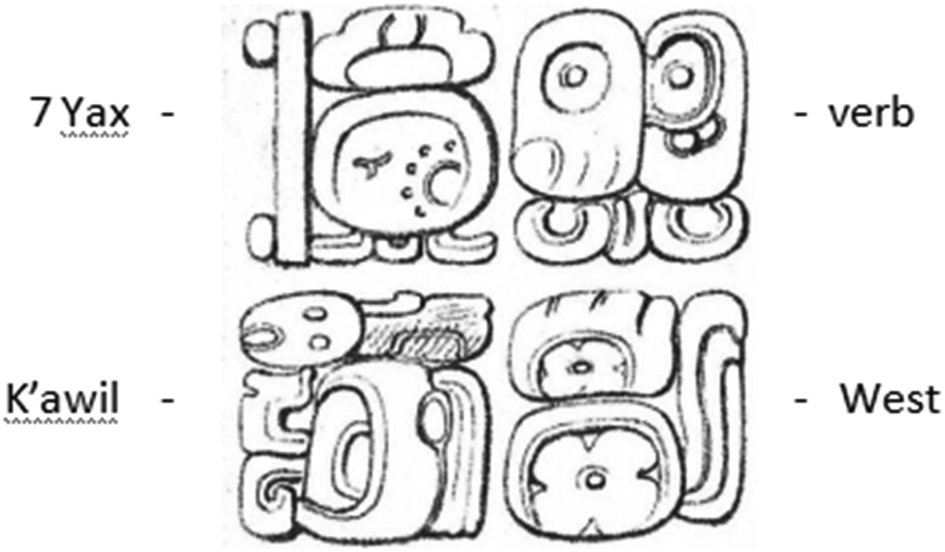
Other examples of 819-day count inscriptions are presented below and will be discussed in a review of Lounsbury's (Reference Lounsbury and Robertson1976:215) analysis of the Cross Group inscriptions at Palenque. In the first example in Figure 1, the core components for an 819-day count phrase are shown. It begins with the verb at A14, then K'awil at B14, and the direction Zenith at A15. The recorded 819-day count station follows with the Calendar Round date, 1 Ik’ at B15, and 10 Sek at A16.
Another example of an 819-day count phrase that contains a minimal number of glyphs is shown in Figure 2. The verb follows the Haab’ month position of 7 Yax, and the name glyph for K'awil continues, with the direction west ending the phrase.
Palenque Temple of the Foliated Cross, A14–B15. Drawing by Annie Hunter after Maudslay (Reference Maudslay, Godman and Salvin1889-1902:vol. IV, Plate 82).

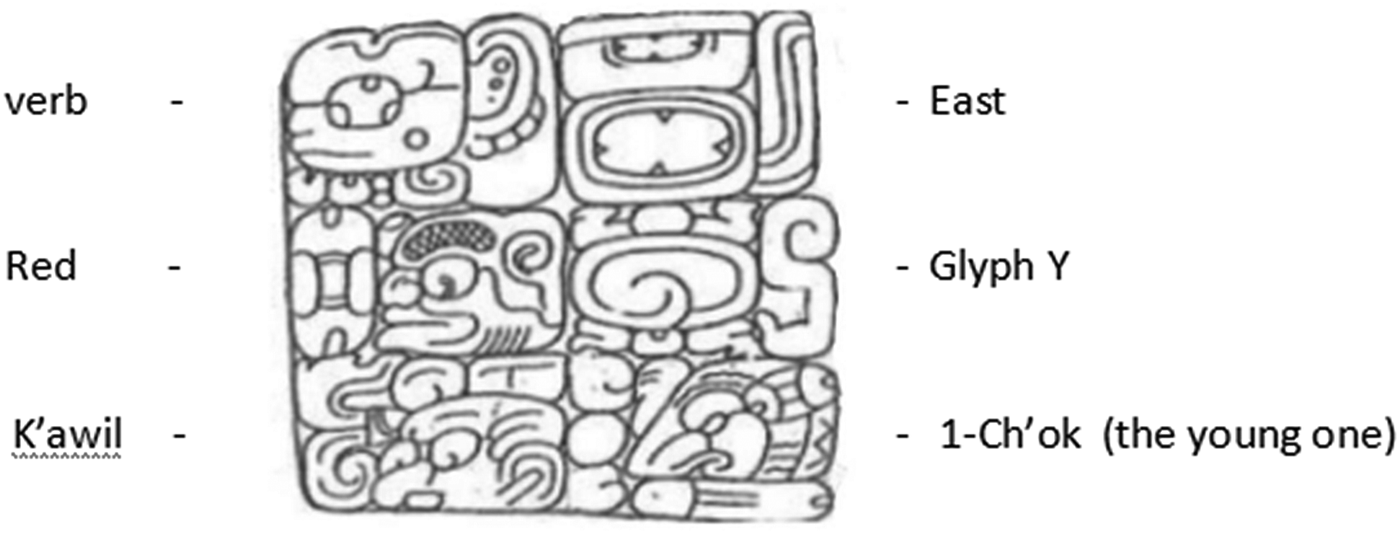
Although the core glyphs of the 819-day count can be described as the verb and the direction (often with the associated color), additional glyphs can be present, including Glyph Y, the god K'awil name glyph, and a 1-Ch'ok title. These additional glyphs in the 819-day count phrase are most probably names and titles and remain largely uninterpreted in terms of their specific astronomical significance.
One of the best examples of an 819-day count inscription that shows the glyphs for Glyph Y, the god K'awil and the 1-Ch'ok title is recorded on Yaxchilan Lintel 30, shown in Figure 3. Here the direction (east) directly follows the verb with the color red next. Glyph Y precedes the name glyph for the god K'awil, and the title, 1-Ch'ok, ends the phrase.
Yaxchilan Lintel 30, E3–F5 (Graham Reference Graham1979). Drawing by Ian Graham © President and Fellows of Harvard College. Peabody Museum of Archaeology and Ethnology, 2004.15.6.6.2.

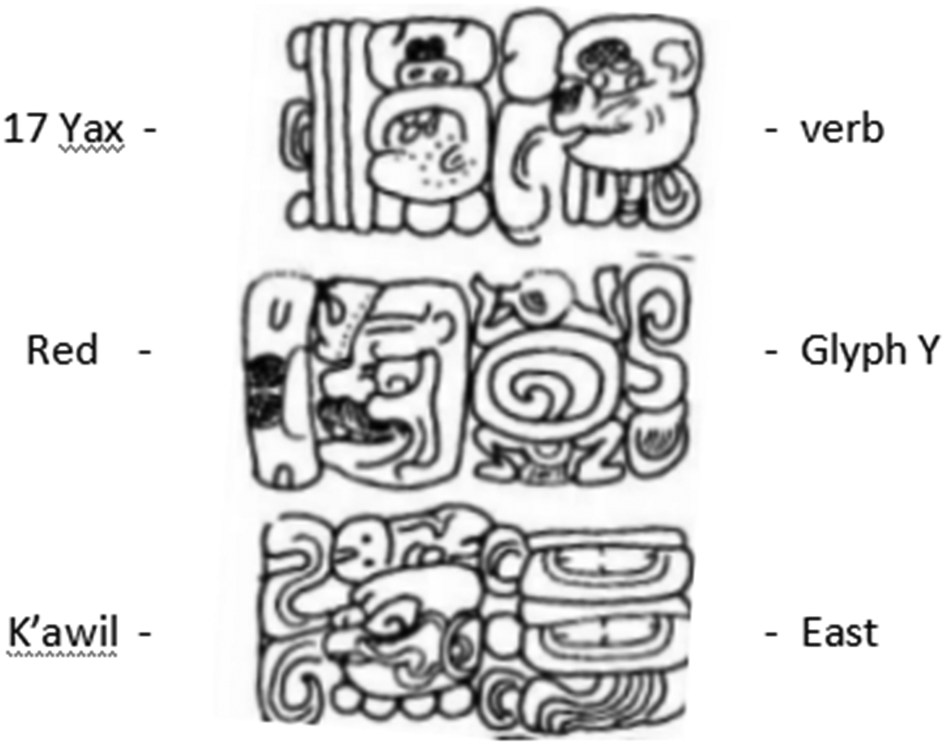
Figure 4 shows another example of the additional 819-day count glyphs that can accompany the core group of verb-direction. In this example, the verb is followed by the associated color red, then by Glyph Y and name glyph for K'awil, with the direction east at the end of the phrase.
Palenque East Tableau of Group XVI. Drawing by Bernal Romero (Reference Bernal Romero, Sanz, Connaughton, Gisbert, Mata and Tejada2016:114).

Basic 819-day mechanics
The early numerological analysis of the 819-day count was made by Thompson (Reference Thompson1943:140), Berlin and Kelley (Reference Berlin and Kelley1961:11), Kelley (Reference Kelley1976:57), Lounsbury (Reference Lounsbury and Robertson1976:215, Reference Lounsbury and Coulston-Gillispie1980:808), and Justeson (Reference Justeson and Aveni1989:103). These works are well worth reading for their insight into Maya calendrics. Some dedication and patience are required for any review of the 819-day count numerology.
At its most basic level, the 819-day count is composed of three modules: 819 = 9 × 7 × 13. Thompson (Reference Thompson1943:140) rediscovered the cycle of nine days and linked them to the Nine Lords of the Night. Yasugi and Saito (Reference Yasugi and Saito1991:4–5) made a convincing analysis for Glyph Y that showed a cycle of seven days when numeral coefficients are prefixed. The number 13 is an integral part of the Tzolkin (13 numbers running concurrently with the 20 day names = 260 days). Thompson (Reference Thompson1943:140, Reference Thompson1960:215) noted in his rediscovery of the 819-day count that the multiples of 9 × 13 = 117 were within one day of the synodic period of Mercury.
Bricker and Bricker (Reference Bricker and Bricker2020:95) have looked at these cycles of nine days, seven days, and 13 days as calendric “weeks,” which follow the Initial Series and precede the Lunar Series. They note that three iterations of Glyph G's nine-day cycle (3 × 9 = 27 days) is close to the sidereal lunar month (the time it takes the Moon to return to the same star as viewed from Earth) of 27.32166 days. Additionally they cite Grofe (Reference Grofe and Barnhart2014:138) that these three cycles of nine days may equally well refer to the draconic month of 27.21222 days. The draconic month refers to the time it takes for the Moon to cross the plane of the ecliptic in its orbit around the Earth and then return to cross it again after one full orbit. The crossing points at the ecliptic are called nodes and are important in determining whether lunar or solar eclipses are possible.
Regarding the seven-day cycle, Aveni (Reference Aveni1980:100) has noted that 4 × 7 = 28 days, approximates the length of the lunar synodic month of 29.53059 days. The utility in thinking of the numerical factors of the 819-day count (9 × 7 × 13) as “weeks” fits well with their location and sequence in the inscriptions, as the position of the 819-day count immediately follows the Lunar Series and is counted backwards from the Initial Series date by a connecting DN. The cycle of 20 day names can be thought of as a 20-day “week” that cycles concurrently with the 13-day “week” to create the Tzolk'in (260 days). This provides an important link to the 819-day count, as will be discussed later regarding the 20-period cycle for 819 days.
The 819-day count at Palenque: A scribal “error,” a puzzle, and the planet Jupiter
The first examples of the 819-day count were inscribed at Palenque in the Late Classic period, and these Palenque records also constitute the majority of the 819-day inscriptions. It is almost certain that the 819-day count was developed at Palenque during the reigns of Pakal I, Kan Bahlam II and K'an Joy Chitam II. These kings and their astronomers created the 819-day count as part of an effort to provide a link to their mythical ancestors and establish a new dynastic line (Aldana Reference Aldana2007:73, Lounsbury Reference Lounsbury and Robertson1976:218).
Temple of the Cross
Lounsbury (Reference Lounsbury and Robertson1976:215) showed that the Temple of the Cross Initial Series date, which recorded the birth of the Palenque Triad progenitor, was a “like in kind” event linked to the birth of Pakal on 8 Ajaw. The Long Count date of the Initial Series is 12.19.13.14.0 8 Ajaw 18 Sek, which equals 2,440 days (6.14.0) before the Era Event of 13.0.0.0.0 4 Ajaw 8 Kumk'u. In summary:
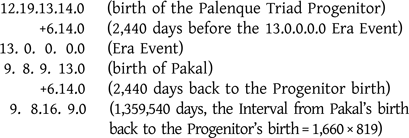
This interval of 9.8.16.9.0 or 1,359,540 days is 1,660 multiples of the 819-day count and, as Lounsbury (Reference Lounsbury and Robertson1976:215) noted, is also 415 repetitions of the 4 × 819-day cycle. The main use of the count cycle here was to establish a link between the birth of Pakal on 8 Ajaw and the birth of the mythical Progenitor of the Palenque Triad on 8 Ajaw. Lounsbury (Reference Lounsbury and Robertson1976:218) linked the 8 Ajaw birth of Pakal with the “like in kind” birth of the Palenque Triad Progenitor using multiples of the 819-day count.
Temple of the Sun
Lounsbury (Reference Lounsbury and Aveni1989:247) demonstrated that the 399-day synodic period of Jupiter was linked to the 819-day count, as well as to historical events in the life of the king, Kan Bahlam II. His analysis of the important I Ik’ 10 Sek 819-day station recorded on the tablet in the Temple of the Sun (Figure 1) dealt with an “error” that was really an intentional puzzle created by the Maya astronomers at Palenque. The recorded DN of 411 days (1.2.11) that follows the Initial Series and Supplementary Series in the Temple of the Sun does not lead back to the immediately prior 819-day station (as is the normal convention), but instead is used to adjust the interval between the birth of GIII and an earlier Long Count date shown by the Calendar Round glyphs for 1 Ik’ 10 Sek. Long considered a scribal error, Lounsbury (Reference Lounsbury and Aveni1989:247–248) showed that the recorded 1 Ik’ 10 Sek date actually references a 101st prior 819-day count station that marks the Long Count date 1.6.14.11.2. The difference between this 819-day count station of 1 Ik’ 10 Sek and the Initial Series date of 1.18.5.3.6 13 Kimi 19 Keh (birth of GIII of the Palenque Triad) is 83,004 days (11.10.10.4). Subtracting the recorded DN of 411 days from 11.10.10.4 yields the interval 11.9.7.13 or 82,593 days, and this number is exactly 207 multiples of the 399-day synodic period of Jupiter.
In summary:
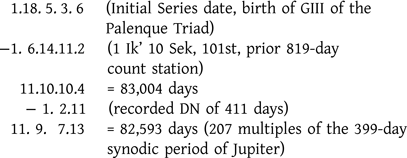
This 819-day count station of 1 Ik’ 10 Sek on 1.6.14.11.2 was key to establishing the 399-day synodic period of Jupiter. Mathews (Reference Mathews1980:6) later demonstrated with his reconstruction of the 9.12.16.2.2 I Ik’ 10 Sek date from the Temple of Inscriptions Medallion Series that a second 1 Ik’ 10 Sek 819-day count station is also linked with the important 2 Kib’ 14 Mol “rites for the gods” of Kan Bahlam II. This second 1 Ik’ 10 Sek date on 9.12.16.2.2 is the 819-day count station that directly preceded the 2 Kib’ 14 Mol “rites for the gods,” when Kan Bahlam II celebrated the triple conjunctions of Mars, Jupiter, and Saturn.
Focusing on these two 1 Ik’ 10 Sek 819-day stations, Lounsbury (Reference Lounsbury and Aveni1989:248) noted that the interval between them was 63 Calendar Rounds or 1,195,740 days. This interval between the two 1 Ik’ 10 Sek 819-day stations is important and will be discussed below in connection with its occurrence on the murals at Xultun.
Lounsbury (Reference Lounsbury and Aveni1989:250) went on to show that other historic dates during the life of Kan Bahlam II (K'inich Kan Bahlam II) coincided with the 2nd stationary point of Jupiter's retrograde period. Powell (Reference Powell1997:17) also gave a summary of these historic dates in the life of Kan Bahlam II, representing them as Jupiter stationary points and listing multiples of 399 days between them. Justeson (Reference Justeson and Aveni1989:103) further noted a high frequency of Jupiter and Saturn events associated with the 819-day counts. In effect, multiples of the 819-day count were used at Palenque to establish an integral average of 399 days for the synodic period of Jupiter, and Kan Bahlam II then linked them to the 2nd stationary point of Jupiter's retrograde in scheduling important ritual events.
K'awil and the 819-day count
The literature on the Classic-period Maya god K'awil is extensive, ranging from a personification of the royal dynastic line and symbol for the right to rule, to associations with Jupiter and Saturn. At Palenque, K'awil has been linked to GII of the Palenque Triad, and probably represented the ruling dynastic line (Aldana Reference Aldana2007:175).
Milbrath (Reference Milbrath1999:233) added to Floyd Lounsbury's work on Jupiter, including Saturn in her analysis of the Classic-period K'awil and the Post Classic God K. She suggested that the Classic-period god, K'awil with smoke and fire emanating from its forehead (Figures 1–4) is a representation of either Jupiter or Saturn or both, and may refer specifically to their retrograde periods. Milbrath (Reference Milbrath1999:244, Reference Milbrath2004:83–84) also presented a thorough review of the Maya Inscriptions dealing with Jupiter and Saturn, looking at the Katun ending inscriptions and their occurrences during planetary retrograde for Jupiter and Saturn. As she noted, a Katun ending (7,200 days) is close to a commensuration of the Jupiter and Saturn synodic periods. (7,200-18 days = 7,182 days = 18 × 399 = 19 × 378). Katun endings were of high importance to the Classic-period Maya, and the close proximity of Jupiter and Saturn synodic periods to the Katun endings would have been noted by them.
Given the proposed associations of K'awil with Jupiter and Saturn, it is also interesting to note that GII (K'awil), the youngest of the Palenque Triad, was born 18 days after the birth of GI, and that the key commensuration of the Jupiter and Saturn synodic periods (7,182 days) is 18 days short of a Katun (7,200 days). Milbrath (Reference Milbrath1999:206–305) provides an extensive chronological summary of important Classic-period Maya dates and their astronomical associations. Bricker and Bricker (Reference Bricker and Bricker2011:851) discuss Jupiter and Saturn and support an association with K'awil for Jupiter in the Classic period, but do not necessarily agree with linking the Post Classic God K to Jupiter. It is interesting to imagine that an effigy of K'awil was set up every 819 days to mark the current position in a cycle of 4 × 819 days, with an alternating sequence of red K'awil of the east, white K'awil of the zenith, black K'awil of the west, and yellow K'awil of the nadir.
Glyph Y occasionally occurs in the 819-day inscriptions directly before the name glyph for K'awil (Figures 3–4). Grofe (Reference Grofe, Looper and Macri2006:3), in his analysis of Glyph Y and GII, notes that the highest incidence of Glyph Y inscriptions with coefficients are at Yaxchilan, and that both Palenque and Yaxchilan record 819-day count inscriptions. Since Palenque and Yaxchilan are in close geographic proximity, this proximity coupled with the large number of 819-day count inscriptions at each site represents a shared tradition. This last point of Grofe's has interesting possibilities for demonstrating political affiliations between the Maya polities based upon their shared calendric traditions and astronomical references.
Establishing a new dynasty at Palenque
The over-riding question as to why the 819-day count was created is best answered by Aldana (Reference Aldana2007:32, 193), who describes the need for the rulers of Palenque to reestablish their dynasty as the legitimate rulers. After the devastating defeats in a.d. 599 and 611 by the “Snake Kingdom” (Dzibanche, Calakmul), Pakal strove to establish a new line of kings at Palenque. This return of Palenque's regional power was founded by Pakal and consolidated by his sons Kan Bahlam II and K'an Joy Chitam II (Martin and Grube Reference Martin and Grube2008:162). Aldana (Reference Aldana2007:190) further maintains that the 819-day puzzles and “errors” of the Cross Group inscriptions were created as a secret knowledge linking the new dynasty to their mythical ancestors and to legitimize their right to rule. He likens this secret knowledge to the Post Classic Zuyuathan language in the Yucatan peninsula that restricted the right to rule to those who knew the answers to a secret code (Aldana Reference Aldana2007:181).
Overall, it has been well-established that the Palenque inscriptions used the 819-day count to establish a dynastic link to their mythological ancestors, and create a working average of 399 days for the synodic period of Jupiter. Kan Bahlam II used the 2nd stationary point of Jupiter's retrograde to mark important events in his life, and probably set the latest 1 Ik’ 10 Sek 819-day station (9.12.16.2.2) as a new starting point for future 819-day count calculations (Powell Reference Powell1997:16).
The role of Saturn in the 819-day count
The research discussed above supports the conclusion that the 819-day count at Palenque is closely associated with Jupiter's synodic period. The Maya also recorded the synodic period of Saturn (Fox and Justeson, Reference Fox and Justeson1978:56), and there is some evidence that multiples of Saturn's synodic period also fit several key dates at Palenque. As noted by Powell (Reference Powell1997:18):
“…the interval between the proposed zero base (9.12.16.2.2) and the 819 station of the 12 year anniversary of Chan Bahlum's rites to the Gods is the least common multiple of Saturn and the 819-day stations (819 × 6 = 378 × 13). Three half multiples of Saturn are found between the proposed zero date and the heir designation, between the stated distance number and 819 station of the Birth of God 2, and between the proposed zero date and the 819 station of the birth of God two [sic].”
Powell correctly observes that 13 synodic periods of Saturn equals six cycles of the 819-day count. This basic correspondence between multiples of the 819-day count and Saturn's synodic period would provide a convenient method for near term calculations of Saturn's synodic period. It has been established (Bernal Romero Reference Bernal Romero, Sanz, Connaughton, Gisbert, Mata and Tejada2016:8, Justeson Reference Justeson and Aveni1989:103, Lounsbury Reference Lounsbury and Robertson1976:217, Powell Reference Powell1997:13) that 63 days is a key factor in 819-day numerology, being the product of the important Maya cycles of 9 days and 7 days.
In an important article on Maya calendrics, Bernal Romero (Reference Bernal Romero, Sanz, Connaughton, Gisbert, Mata and Tejada2016:13) has demonstrated the existence of a 63-day cycle Fire Drilling ritual in the Classic Maya inscriptions. Comparing the number of days between dates associated with several Initial Series inscriptions, Bernal Romero convincingly shows that these Fire Drilling rituals are separated by multiples of 63 days, and that these 63-day intervals can also be associated with the synodic period of Saturn (there are six 63-day divisions in the 378-day synodic period of Saturn). A key part of Bernal Romero's (Reference Bernal Romero, Sanz, Connaughton, Gisbert, Mata and Tejada2016:13) work is that he demonstrates the 63-day period makes sense on its own as the calendric cycle for a Fire Drilling ritual.
Milbrath continued Lounsbury's research, linking important Classic-period dates with the retrograde positions of Jupiter and possibly Saturn. Her work (Milbrath Reference Milbrath1999:236) showed a correlation between the dates of several Yaxchilan monuments with God K iconographic references and the retrograde positions of Jupiter. She maintained the cycles of Jupiter and Saturn were linked through the 819-day count (Milbrath Reference Milbrath1999:241).
In addition, Anderson (Reference Anderson2015) also concluded that the 819-day count was linked to the retrograde periods of Jupiter and possibly Saturn. His study focuses on the occurrences of 819-day count inscriptions that include Glyph Y, and he maintains that the majority of these dates occur when Jupiter is in the first part of its synodic period, when it has just emerged from conjunction with the Sun up to or shortly after the 1st stationary point. Anderson's conclusion is that the primary association for the 819-day count inscriptions, which include Glyph Y, is with Jupiter. He also notes that this same data can support an association with Saturn. One area that needs further definition in Anderson's analysis is a study of the 819-day count inscriptions where Glyph Y is present, but Jupiter (and Saturn) are at other positions in their synodic cycles.
Venus and Mercury and the 819-day count
Thompson (Reference Thompson1943:143, Reference Thompson1960:215) in his original discussions of the 819-count noted that 117 days (9 × 13) provides a close approximation for the synodic period of Mercury, but he thought this association was secondary to the more important numerology of the 819-day count, where 9 × 13 × 7 = 819. Later, Thompson (Reference Thompson1972:102, D30c–D33c), in his Commentary on the Dresden Codex described Almanac 65,as an almanac that was expanded “nine times the normal 260 days” of the Tzolk'in. The length of the almanac was (9 × 260 = 2,340 days). The internal structure had intervals of 13 days for each of the nine divisions (9 × 13 = 117 days), which are repeated 20 times for total of 2,340 (20 × 117 = 2,340).
More recent work by Bricker and Bricker (Reference Bricker and Bricker2011:235) defined this almanac as a Venus-Mercury Almanac, based upon the 117-day structure of the almanac, which is a close approximation of Mercury's synodic period, and the almanac's total length of 2,340 days, which also provides a close approximation for the synodic period of Venus (585 × 4 = 2,340). It should be pointed out that the average synodic period of Mercury is closer to 116 days (115.88 days), and that the average synodic period of Venus is closer to 584 days (583.92 days), the latter being used in the Venus Tables of the Dresden Codex (Thompson Reference Thompson1972:D24, D46-D50). That being said, the structure and length of the Venus-Mercury Almanac provide a good working commensuration for the inner orbits of Venus and Mercury, where: 117 days (Mercury) × 20 = 2,340 days = 585 days (Venus) × 4. The utility of this almanac in providing a close approximation for the commensuration of the Venus and Mercury synodic periods will be further discussed in the context of 20 periods of the 819-day count.
Xultun Table of Multiples on the north wall of Structure 10K-2
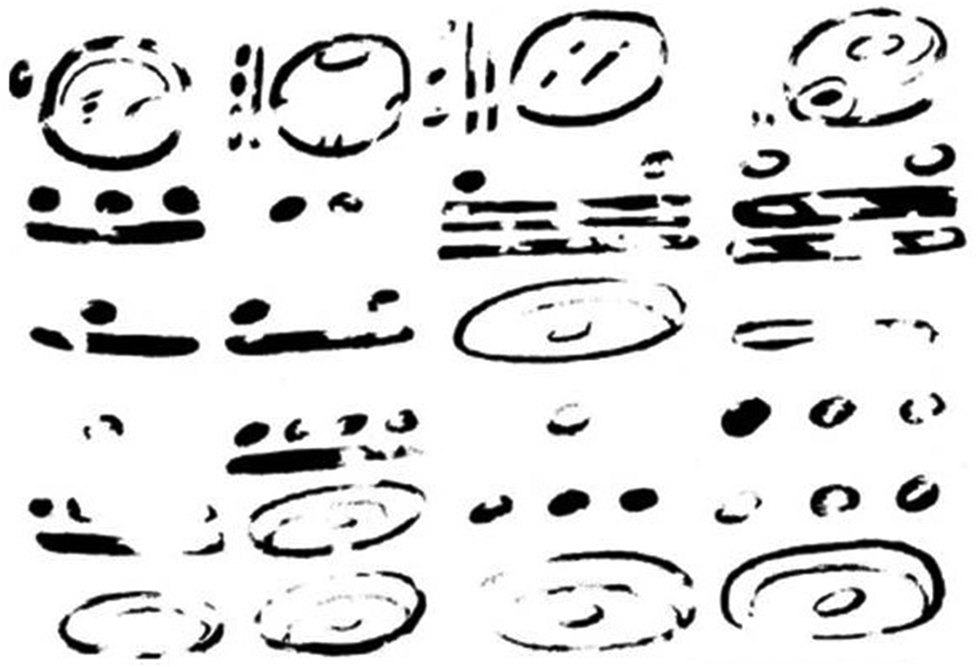
One of the most exciting discoveries in Maya archaeology was made in 2012 by Saturno and his team at Xultun in Guatemala. In a residential compound called Structure 10K-2 they discovered a room with astronomical notations and numerical tables drawn on the walls. MacLeod and Kinsman (Reference MacLeod and Kinsman2012) noted that the number in column A in the Table of Multiples that is written on the north wall in Structure 10K-2 is an even multiple of 819 days. Also, that this number is the smallest multiple that will commensurate the 819-day count and the Calendar Round (260 × 365 days = 18,980 days; see Figure 5 on the far left)
Xultun structure 10K-2, Table of Multiples. Drawing by David Stuart, adapted from MacLeod and Kinsman (Reference MacLeod and Kinsman2012).
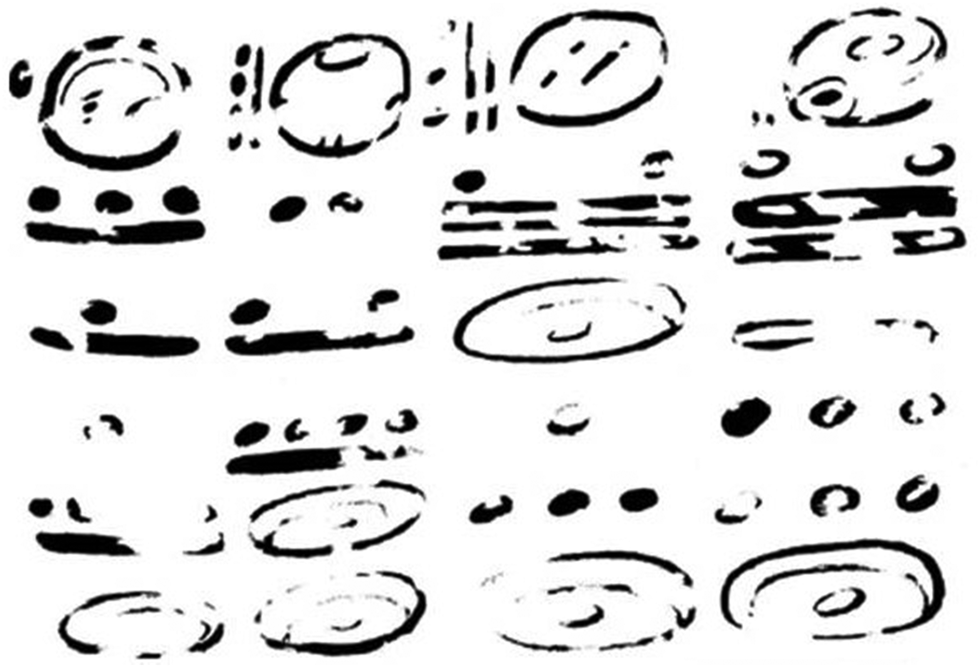
Bricker et al. (Reference Bricker, Aveni and Bricker2014:167) studied the paintings and notations on each area of the 10K-2 walls, analyzing the lunar calendar in area A, and finding a probable Mars conjunction with Orion near an eclipse date in area B. (Victoria Bricker, personal communication 2021) has pointed out that two of the notations that introduce the inscriptions on many stone monuments (Lunar Series and 819-day count) are also recorded on the walls of Structure 10K-2 at Xultun. One of these is the lunar table showing an expansion of the Lunar Series with nine repetitions of the 18-month trimester calendar, and the other is the 819-day count referenced in the number in column A of the Table of Multiples. In addition, they expanded on the study of the table of four multiples on the north wall, and observed that each of these four multiples—A, B, C, and D—was also a multiple of 780 days (the average number of days for the synodic period of Mars). For the number in column A, they noted: 8.6.1.9.0 = 1,195,740 = 21 × 3 × 18,980 = 1,533 × 780.
There is another important observation to be made about the number in column A of the Table of Multiples at Xultun 10K-2. It is exactly the difference between the two key 1 Ik’ 10 Sek dates at Palenque for the 819-day count:
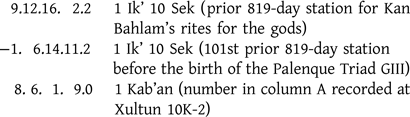
As Lounsbury (Reference Lounsbury and Aveni1989:246–247) noted:
“An 819-day station can occur on the same calendar-round day only once every 63 calendar rounds (3,276 years, omitting leap-year days). Or, to put it another way, an appropriate calendar-round day —such as 1 Ik 10 Tzec—can recur again as an 819-day station only after a lapse of 63 × 52 Maya years. That is the interval between the 1 Ik 10 Tzec of the 819-day station of the Temple of the Sun (necessarily 1.6.14.11.2) and the 1 Ik 10 Tzec of the 819-day station of the Medallion Series (9.12.16.2.2).” Note: Tzec refers to the month Sek.
The recording of the 8.6.1.9.0 number in Structure 10K-2 shows that the Late Classic Maya at Xultun were using this same multiple of 819-day cycles to commensurate with the Calendar Round, exactly as Lounsbury (Reference Lounsbury and Aveni1989:246–247) described for the 1 Ik’ 10 Sek dates at Palenque.
20 periods of 819 days
As discussed above, the combination of the three important calendric cycles (9 × 7 × 13 = 819 days) may have been sufficient motivation for the Late Classic Maya to create the 819-day count. Its location in the inscriptions (following the Lunar Series) and its focus on the three important calendric cycles (9, 7, and 13 days) could have been reason enough to record a ritual calendar with multiples of 819 days.
Additionally, there may also have been an astronomical use for keeping track of the multiples of 819 days, and this deals with calculating the positions of the visible planets. Thompson (Reference Thompson1943:143, Reference Thompson1960:215), first noted that the synodic period of Mercury (117 days) agrees with each multiple of 819 days (117 × 7 = 819). Mercury is the only visible planet that provides integral multiples of its synodic cycle within a single 819-day period. The synodic periods of all the other visible planets have decimal remainders for a single 819-day period, but commensurate with certain multiples of 819 days within a twenty period 819-day calendar.
If we look at each iteration of 819 days, a decimal remainder is left after subtracting multiples of the synodic periods for each of the visible planets
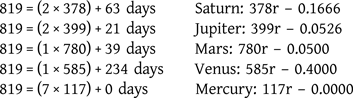
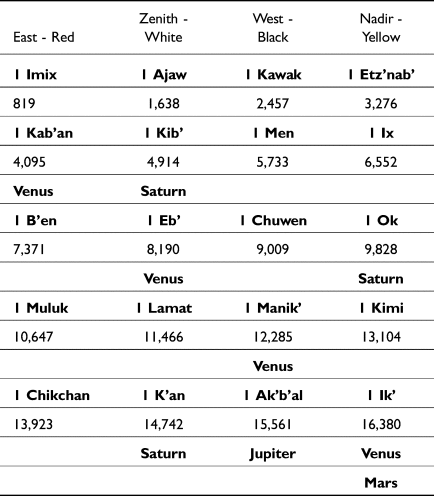
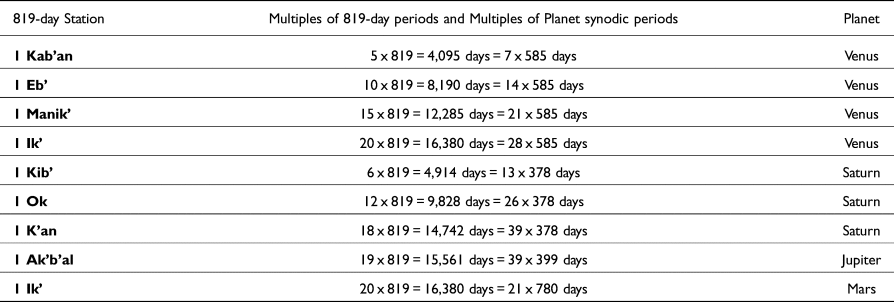
Thus, after six, 819-day periods, the remainder increases to an even multiple of Saturn's synodic period of 378 days. For Jupiter this increase for every 819 days does not reach an integral multiple of the synodic period until 19 periods of 819-days. And for Mars, not until 20 periods of 819-days have passed. Using 585 days for the synodic period of Venus, a commensuration is achieved after five multiples of 819 (5 × 819 = 4,095 days = 7 × 585). Twenty-one days is a key factor in looking at the synodic periods of Jupiter and Saturn. Jupiter's average synodic period of 399 days is 21 days longer than Saturn's synodic period of 378 days, and both Jupiter's and Saturn's average synodic periods are evenly divisible by 21 days.
In Maya calendrics and astronomy, only whole numbers or integers were used. The average synodic period of Jupiter is 398.88 days. Since the ancient Maya did not use fractional numbers, the way they would have approximated this number was by averaging a large number of days. In the case of Jupiter, Lounsbury (Reference Lounsbury and Aveni1989:247) showed the Maya at Palenque used 82,593 days to approximate 207 synodic periods, which equaled 399 days for the Jupiter synodic period. There are certain limits in using synodic periods to define variable positions such as the retrograde stationary points for the outer planets. This has to do with two phenomena: the inherent variability in the synodic period of each planet, which varies slightly from year to year, and the fact that the apparent retrograde stationary points occur over a number of days as the planet slows approaching and then leaving the stationary point. Over larger intervals of time this variability in the synodic period averages out so that an integral value can be used.
Tedlock (Reference Tedlock and Aveni1992:257) noticed this factor of 21 days, and suggested dividing Jupiter's synodic period into 21-day periods, with the period of disappearance at conjunction the final 21 days. Powell (Reference Powell1997:13) also noted the 21-day difference between the synodic period of Jupiter and Saturn, and that 63-day multiples evenly divide the synodic period of Saturn. This last observation has also been made by Bernal Romero (Reference Bernal Romero, Sanz, Connaughton, Gisbert, Mata and Tejada2016:3) in his study of the 63-day period associated with the Fire Drilling ceremony. In his analysis of the highest common multiple needed for establishing the 12.19.13.14.0 birth date of the Triad progenitor, Lounsbury (Reference Lounsbury and Robertson1976:217) arrived at the number 2.5.9.0 in Maya notation, or 16,380 days. This number of 16,380 days includes integral multiples of 117, 780, nine, seven, and, most interestingly, 20 × 819. Continuing Lounsbury's work on a 16,380 day (2.5.9.0) multiple for the 819-day count, Powell (Reference Powell1997:13) wrote:
“To use this 819-day cycle the Maya would have required a table of multiples of 819 up to the twentieth (16,380 days), which is the least common multiple of 819 and the 260-day Tzolkin, and continuing into higher multiples of 16,380 days.”
The grouping of 20 periods of 819 days has several uses for calculating the synodic periods of the visible planets, beyond what is possible with a single cycle of 4 × 819 days.
By arranging the 4 × 819 cycle into five repeating cycles of 3,270 days, one creates a larger cycle of 20 periods of 819 days that allows the 20 day names of the Tzolk'in to recycle. Because 819 is evenly divisible by 13, each 819 station date will begin with the number 1.
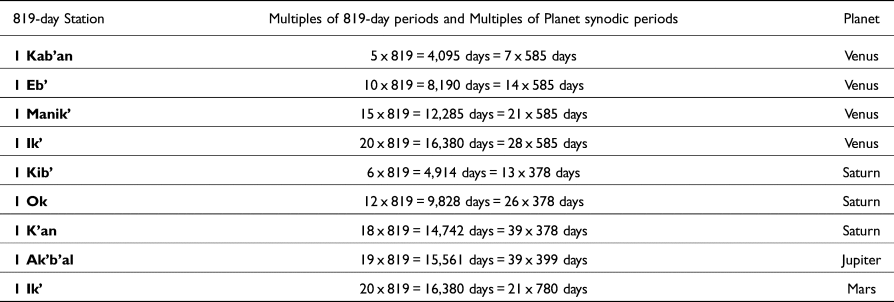
With this larger cycle of 20 periods of 819 days, one ensures that some multiples of the 819-day period will commensurate with the synodic periods of all the visible planets (Table 1). If the base date or starting point of this cycle of 20 periods of 819 days is set at the same important 9.12.16.2.2 1 Ik’ 10 Sek date that was noted by Powell (Reference Powell1997:17), 20 multiples of the 819-day period could be used to calculate future synodic cycles. The use of this table of 20 multiples of the 819-day period would provide a convenient way to predict multiples of the synodic periods for all the visible outer planet in the Tzolk'in.
Twenty periods of the 819-day count and the day totals.

Note: Planets names are shown below the 819-day station that commensurates with their synodic period. Mercury's synodic period commensurates with every 819-day station.
Overall, the mechanics of the 819-day cycle seem most suitable for Saturn and Venus in that every six iterations of the 819-day cycle produces an integral multiple of 13, 378-day Saturn synodic periods; and, for Venus, every five iterations of the 819-day cycle produces an integral multiple of seven, 585-day Venus synodic periods. For Jupiter and Mars, 19 and 20 iterations, respectively, are needed to produce integral multiples for their synodic periods; and this happens for them only once in a cycle of 20 periods of 819 days. Each cycle of this larger 20-period grouping of 819-day count would return Mars to an integral synodic multiple.
Robert Daniel Purrington, an astronomy professor in the Department of Physics at Tulane, has pointed out that 819 days approximates the length of intervals between successive conjunctions of Mars and Jupiter (Victoria Bricker, personal communication 2021). The mean length of such intervals is 816.85 days.
For Saturn, each iteration of the larger 20 periods of 819 days would regress or “work backward” two, 819-day periods such that, after three iterations, the table would return to a cycle of synodic periods on 1 Kib’, 1 Ok, and 1 K'an. For Jupiter, a full 20 iterations of the larger 20 periods of 819 days cycle would be needed to regress to the nineteenth 819-day period on 1 Ak'b’al.
For the synodic period of Mars, there are two other interesting points to consider with regard to the 819-day count (Table 2). Dividing two iterations of 819 days (1,638 days) by the average synodic period of Mars (780 days) leaves a remainder of 78 days (1,636 / 780 = 2.1), which is the length of the retrograde period of Mars that was used in the Dresden Codex. In addition, the same six iterations of 819 days (4,914 days) mentioned above for the 13 synodic periods of Saturn also produces seven multiples of 702 days, the Long Emperic Sidereal Interval (LESI) for Mars.
Twenty periods of the 819-day count and multiples of the synodic periods for the visible planets.
LESIs contain retrograde periods, requiring a minimum of 707 days for Mars to return to the same star where the planet began its journey. Short Empiric Sidereal Intervals can be completed in 540 days because their circuits do not include a retrograde period before returning to the star where they began. The values for these Martian sidereal periods employed by the pre-Columbian Maya were based on modules of 54 days: 10 modules for a short sidereal period without retrograde (= 540 days) and 13 modules for a long sidereal period with retrograde (702 days). The formula that would have worked with these modules was: 7L + S + 7L + S + 8L + S (Bricker and Bricker Reference Bricker and Bricker2011:422–424).
The sequence of LESI periods and a Short Empiric Sidereal Interval (SESI) period provided a mechanism to reset the Mars sidereal cycle with the tropical year (Bricker and Bricker Reference Bricker, Bricker and Boone2005:10, Bricker et al. Reference Bricker, Aveni and Bricker2001:2). In this way, the period of six, 819-day cycles not only provides an integral multiple for 13 synodic cycles of Saturn, but also marks the cycle of seven LESI periods (7 × 702 days) before a SESI of 540 days is required.
There is an axiom to the effect that the larger the interval, the greater the number of kinds of smaller intervals that can be accommodated. This must be kept in mind with any consideration of larger multiples of the 819-day period. As the numbers grow larger, there is an increasing chance that commensurations may be the result of coincidence. We do not believe that this is the case for the larger group of 20 periods of 819 days, based on the number of planets which show average synodic periods in the larger multiples of 819-days, Also this larger 20-period group of 819 days provides an important calendric mechanism for reestablishing the Tzolk'in count at the beginning of each 20 periods of 819 days.
Conclusion
The first 819-day count inscriptions occur at Palenque in the Late Classic period, and there can be little doubt that this new calendric cycle was developed there. The development of the 819-day count at Palenque was most probably used to legitimize Pakal's dynasty, and reestablish a link to their mythical ancestors.
After its development at Palenque, other Maya cities began to include the 819-day count in their inscriptions, and placed it after the Initial and Lunar Series to present the most complete calendar positions for the date recorded. Second to Palenque, the next highest number of 819-day count inscriptions are at Yaxchilan, and this use at Yaxchilan demonstrates a shared tradition with Palenque (Grofe Reference Grofe, Looper and Macri2006:3).
The discovery of the astronomical notations recorded on the walls of Xultun 10K-2 (Saturno et. al Reference Saturno, Stuart, Aveni and Rossi2012:714) has provided a key insight into Classic-period Maya astronomy. The Xultun Multiple number of 8.6.1.9.0 in column A of Figure 5 is the exact number that separates the important 1 Ik’ 10 Sek dates at Palenque, as described by Lounsbury (Reference Lounsbury and Aveni1989:247–248). The second 1 Ik’ 10 Sek date (9.12.16.2.2) is the 819-day station just prior to Kan Bahlam II's “rites for gods,” a three-day observance of triple near conjunctions for all three of the visible outer planets (Mars, Jupiter, and Saturn). The fact that the number 8.6.1.9.0 was used at both Palenque and Xultun shows that the astronomers at each city were keeping track of multiples of the 819-day count, its commensuration with the Calendar Round, and most probably the synodic periods of the visible planets.
Lounsbury's (Reference Lounsbury and Aveni1989:247–248) work demonstrated the importance of Jupiter's synodic period for the 819-day count at Palenque. Powell (Reference Powell1997:13), Milbrath (Reference Milbrath2004:83–84), Anderson (Reference Anderson2015), as well as Bernal Romero (Reference Bernal Romero, Sanz, Connaughton, Gisbert, Mata and Tejada2016:8), have demonstrated a probable association with Saturn.
Bricker et al. (Reference Bricker, Aveni and Bricker2014:167) have pointed out the association of Mars’ synodic period with the multiple number A at Xultun. The Venus-Mercury Almanac in the Dresden Codex as studied by Bricker and Bricker (Reference Bricker and Bricker2011:163) provided good evidence that the Maya were watching the commensurations of Venus and Mercury, and the structure of that almanac agrees with the basic numerology of the 819-day count.
The use of 20 periods of 819 days shown in Table 1 makes it possible to demonstrate an association between the 819-day count and the synodic periods of all the visible planets. While one period of 819-days is sufficient to exceed the synodic period for each of the visible planets, it only provides an integral multiple for the average synodic period of Mercury (approximately 117 days). All the other visible planets (Venus, Mars, Jupiter, and Saturn) require larger multiples of the 819-day period to produce integral multiples of their synodic periods, and the established four-part, color-direction sequence of the 819- day count does not provide commensurations at the 819-day stations for the synodic periods of these planets.
An expansion of the standard 4 × 819-day cycle to 20 periods of 819 days does provide a larger calendar system with commensurations at its stations for the synodic periods of all the visible planets. Most importantly this larger calendar system of 20 periods of 819 days provides a mechanism for reestablishing the day number and day name of the Tzolk'in each time the cycle of 20 periods of 819 days begins. Although earlier scholars have noted that the 16,380-day period would have been familiar to the Maya (Lounsbury Reference Lounsbury and Robertson1976:217), and that a grouping of 20 periods of 819 days would have been used by the Maya (Powell Reference Powell1997:13), the data in Table 1 presents a new model of how such a larger grouping of 20 periods of 819 days would have worked.
Rather than limit their focus to any one planet, the Maya astronomers who created the 819-day count envisioned it as a larger calendar system that could be used for predictions of all the visible planet's synodic periods, as well as commensuration points with their cycles in the Tzolk'in and Calendar Round.
Supplementary material
The supplementary material for this article can be found at https://doi.org/10.1017/S0956536122000323