Decreasing levels of electoral turnout and party membership as well as more severe criticism directed towards politicians and parties have caused intense scholarly activity throughout the last decades (Dalton Reference Dalton2004; Norris Reference Norris1999). A large part of this research has been oriented towards various mechanisms by which the people can be brought back into politics. Political theorists have called for more participatory forms of democracy and scholars as well as policymakers have pursued an array of projects that engage citizens in participatory and deliberative participation (Michels and de Graaf Reference Michels and de Graaf2010; Scarrow Reference Scarrow2001, Reference Scarrow2004; Setälä Reference Setälä2009).
While research on democratic processes has flourished from many perspectives, citizens’ preferences concerning procedures for political decision-making were left untouched for a long time. Some recent attempts to expand knowledge on this topic have been made, however, and they indicate that the preferences held by citizens are far from uniform (Bengtsson Reference Bengtsson2012; Font and Alarcon Reference Font and Alarcón2011; Hibbing and Theiss-Morse Reference Hibbing and Theiss-Morse2001; Neblo et al. Reference Neblo, Esterling, Kennedy, Lazer and Sokhey2010). Perhaps unsurprisingly, it seems that citizens have different conceptions of how a democracy ought to work. While some favour high levels of citizen involvement in the political sphere, others are more inclined to leave political decisions in the hands of those thought to be more capable. What is less clear is whether these different views also have repercussions for the behaviour of citizens. Do they act in accordance with their beliefs or are they largely irrelevant for predicting behaviour? Recent research by, for example, Webb (Reference Webb2013) and Neblo et al. (Reference Neblo, Esterling, Kennedy, Lazer and Sokhey2010) indicate that certain attitudes concerning political processes affect how citizens engage in politics. Nevertheless, despite the valuable input provided by these studies, it is still not clear whether citizens consistently act in accordance with their ideal conception of democracy.
For this reason, the aim of this article is to study whether and how citizens’ conceptions of democracy are related to the way they engage in politics. The data analysed are from the Finnish National Election Study 2011 (Borg and Grönlund Reference Borg and Grönlund2011), a post-election study that includes a rich selection of survey items on political processes with specific focus on the actors involved in political decision-making. We examine the link between three conceptions of democracy (representation, participation, expertise) and the propensity to participate in electoral, institutionalized and non-institutionalized politics. The results demonstrate a clear association between citizens’ democratic ideals and their political actions.
The article is structured as follows. The first section provides an introduction to different concepts of democracy and their bases in theoretical as well as empirical literature, and to the current state of research on citizens’ preferences for political decision-making. In the next section the hypotheses are outlined, alongside a more general presentation of the research design applied. This is followed by the empirical analyses and a concluding discussion of the results and their implications.
Conceptions Of Democracy And Political Participation
The study of citizens’ preferences for political decision-making procedures was for a long time not very prominent in political science. From a theoretical perspective, there has been a prevailing assumption that processes are subordinate to outcomes and that citizens would tolerate most procedures as long as they produce favourable results (Fiorina Reference Fiorina1981; Popkin Reference Popkin1991).Footnote 1 Hence, the bulk of research on public opinion has studied preferences for policy output rather than the processes by which this outcome is obtained (Hibbing and Theiss-Morse Reference Hibbing and Theiss-Morse2001). From a methodological perspective, there has been an implicit assumption at least that most people lack the ability to form opinions on complex issues such as procedures for political decision-making (see Carman Reference Carman2007)Footnote 2 and that these complex issues are difficult to translate into crude survey questions (Bengtsson Reference Bengtsson2012). Finally, from a more pragmatic perspective, the issue has not been considered topical, since it has been hard to envisage drastic changes to the model of representative democracy found in most countries – with the main exception of Switzerland, where direct democratic procedures have long been the norm.
However, these views have been challenged in recent years; there has been an increasing interest in what citizens prefer when it comes to alternative processes for political decision-making (see Bengtsson and Mattila Reference Bengtsson and Mattila2009; Esaiasson et al. Reference Esaiasson, Gilljam and Persson2012; Hibbing and Theiss-Morse Reference Hibbing and Theiss-Morse2001, Reference Hibbing and Theiss-Morse2002; Webb Reference Webb2013). For the most established line of literature concerning citizens’ attitudes towards the use of direct democratic procedures, it is by now well-established that citizens generally have a positive perception of the use of referendums (Anderson and Goodyear-Grant Reference Anderson and Goodyear-Grant2010; Bowler et al. Reference Bowler, Donovan and Karp2007; Dalton et al. Reference Dalton, Bürklin and Drummond2001; Donovan and Karp Reference Donovan and Karp2006). Other studies suggest that the willingness to use public deliberation to reach decisions is relatively widespread (Neblo et al. Reference Neblo, Esterling, Kennedy, Lazer and Sokhey2010). Although this line of research has been criticized for not providing a balanced picture of the public’s preferences (Hibbing and Theiss-Morse Reference Hibbing and Theiss-Morse2002), it clearly indicates that citizens are able to express their preferences for political processes, not just the outputs.
Moreover, a recent study by Bengtsson (Reference Bengtsson2012) based on Finnish data demonstrates that it is possible to detect coherent dimensions in the way people respond to questions on political processes. We here refer to the three dimensions found in the Finnish study – representation, expertise and participation – as conceptions of democracy, since they correspond well with established ideas in political theory and the overall impression from previous empirical studies.
The first dimension we refer to as representation since this concept is focused on representative democratic procedures, where elections are used to select representatives with a mandate to govern on behalf of the citizenry, and democracy is above all considered to be a method for leadership selection (Dahl Reference Dahl1956; Riker Reference Riker1982; Sartori Reference Sartori1987; Schumpeter Reference Schumpeter1942). The second dimension we refer to as expertise, since this idea accentuates the role of experts rather than elected representatives. This is related to the stealth democracy-ideal identified by Hibbing and Theiss-Morse (Reference Hibbing and Theiss-Morse2002) in the US. Historically, the role of experts and neutral bureaucrats has been emphasized by a number of scholars (Keane Reference Keane2009: 571–2; see also Rosanvallon Reference Rosanvallon2011: 43–50). The third dimension we refer to as participation, since it involves a participatory conception of democracy which has been prevalent in the academic debate over the last decades. According to this ideal, participation by citizens is a vital element of democracy (Barber Reference Barber1984; Pateman Reference Pateman1970).
In this study, we use these three conceptions of democracy as our point of departure and explore how they relate to patterns of political participation, which are important in helping us understand the consequences they have for society. Presenting logical connections between ideals and actual behaviour also supports the usefulness of examining preferences in the complicated political processes. As Citrin (Reference Citrin1974: 978–9) reminds us, the validity of attitudinal constructs depends in part on their ability to predict differences in behaviour adequately.
The assumption that attitudes towards the political system and its actors should influence patterns of participation is not new. In a relatively recent article by Paul Webb (Reference Webb2013), the willingness and actual participation of dissatisfied and ‘stealth’ democrats is compared, showing that the latter are less willing to participate than the former.Footnote 3 Similarly, Neblo and colleagues (2010) demonstrate that different attitudes towards democratic practices – which they present as ‘stealth’ and ‘sunshine’ democracy – increase willingness to participate in deliberative sessions.Footnote 4 However, both of these studies differ from the current study in terms of their scope and the applied methodological approach. Here we aim to provide a more complete picture, by means of both alternative conceptions of democracy and forms of participation included in the study.
Apart from previous empirical indications, there are also valid theoretical reasons to expect citizens’ conceptions of democracy to have implications for their political behaviour since there are distinct beliefs about how the ideal citizen ought to behave embedded in different models of democracy. Based on social psychology theory, we know that many people have a pronounced need for structure and closure in life (Cohen et al. Reference Cohen, Stotland and Wolfe1955; Leone et al. Reference Leone, Wallace and Modglin1999), which can be expected to lead to coherency between expressed ideals and actual behaviour.
We examine the link between conceptions of democracy and the propensity to become politically active to settle the link between ideals and actions when it comes to political decision-making. In doing this, it is necessary to consider the variety of political activities citizens have at their disposal. Voting is a central form of involvement in representative democracies, but this is complemented by citizen involvement between elections, varying from traditional or institutionalized activities orchestrated on the premises of the political system to more bottom-up and elite-challenging forms of non-institutionalized political activities (Esaiasson and Narud Reference Esaiasson and Narud2013; Kaase Reference Kaase1999; Marien et al. Reference Marien, Hooghe and Quintelier2010). Institutionalized activities occur in conjunction with the formal political system and function according to principles defined by the political system, whereas non-institutionalized activities are not formally connected to the political system and operate according to principles defined by the participants (Christensen Reference Christensen2013: 104).
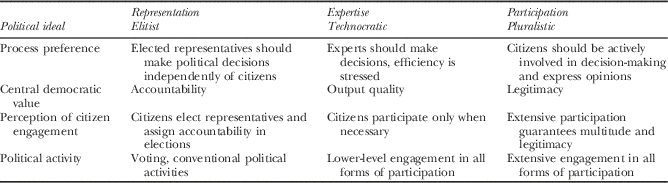
The involvement of citizens in these activities is likely to differ, depending on their conceptions of democracy outlined above. Representation emphasizes the role of elected representatives. We anticipate that citizens who support representation are particularly active in elections, since this is envisaged as the central channel for citizen involvement. Between elections, the political engagement of these respondents is expected to be limited, especially when it comes to non-institutionalized forms of political participation since involvement in such activities reflects responsibility-taking on behalf of citizens (Micheletti and McFarland Reference Micheletti and McFarland2011), which contradicts the elitist foundations of this ideal. However, some involvement in institutionalized activities can be expected, since this includes activities in connection with election campaigns that may be considered an extension of electoral participation beyond the act of voting, since they support the functioning of the representative system (Dalton Reference Dalton2006: 43; Verba et al. Reference Verba, Schlozman and Brady1995). Even if it is likely that fewer people are routinely involved in these activities since they are more demanding than casting a vote, we may nonetheless expect the adherents of representation to be more active than the general population.
The second dimension, called expertise, stresses that the role of expertise is connected to a technocratic view of politics, where citizens prefer to let experts decide. As in the representative view, this ideal involves a belief that citizens are not capable of contributing to political decision-making, as well as questioning whether citizens want to be involved in political matters except under extraordinary circumstances. This involves an engineer-view of politics which is focused on finding optimal solutions rather than representing diverse interests. This ideal also entails scepticism towards political representation, since the representatives are considered inapt guardians of the interest of the general public and more inclined to cater to special interests. This style of decision-making is today often associated with the European Union and in particular the European Commission (see Majone Reference Majone2002; Wallace and Smith Reference Wallace and Smith1995). As a consequence of these considerations, we expect citizens who share the expertise conception of democracy to be less likely to engage in political activities, regardless of the form of participation.
Participation is the third conception, which provides a distinct alternative to the previous two, where the proponents emphasize popular involvement as the optimal way to structure political decision-making. This pluralist ideal of democracy advocates greater involvement of citizens, since giving everyone affected by the decisions a say in decision-making benefits the political legitimacy of the final results and promotes essential civic attributes such as knowledge and efficacy (Pateman Reference Pateman1970). For this reason, we expect those who support this ideal to see political participation as an inherent part of being a democratic citizen. They are likely to vote, since this is a central act of participation which also expresses a belief in the functioning of the political system (Dalton Reference Dalton2006: 38–42; Verba et al. Reference Verba, Schlozman and Brady1995). However, the involvement is not confined to voting, since this would be considered an inadequate form of involvement (Inglehart Reference Inglehart1997; Norris Reference Norris1999). We therefore expect those who share the participatory conception of democracy to engage in a wide range of political activities between elections, both institutionalized participation and non-institutionalized participation.
In Table 1 we compile the arguments concerning the differences between the three conceptions of democracy and the expected relationships with political activity.
Three Conceptions of Democracy

RESEARCH DESIGN
Based on the theoretical review, we expect the following patterns to exist for the behaviour of citizens:
Hypothesis 1: Adhering to a representative conception of democracy leads to higher engagement in voting and institutionalized political participation.
Hypothesis 2: Adhering to a conception of democracy in which expertise is emphasized leads to lower engagement in voting, institutionalized and non-institutionalized participation.
Hypothesis 3: Adhering to a participatory conception of democracy leads to higher engagement in voting, institutionalized and non-institutionalized participation.
To test these three hypotheses we use the most recent round of the Finnish National Electoral Study from 2011, a cross-sectional post-election survey performed in two stages, including face-to-face interviews and a self-administered questionnaire (Borg and Grönlund Reference Borg and Grönlund2011).Footnote 5 This Finnish Election Study offers a rare opportunity to examine these questions since it contains a wide set of indicators of various procedures of political decision-making and political participation as well as appropriate indicators on well-established control variables. The survey forms part of the Comparative Study of Electoral Systems (CSES) and includes 1,298 respondents. However, since most of the questions on political processes were asked in a self-administered questionnaire filled in by 806 participants, this study is restricted to these respondents.
Restricting the study to the Finnish context means that the generalizability of any findings is limited. However, Finland may be considered a crucial ‘most-likely case’ (Eckstein Reference Eckstein1975) – that is, a case where we would expect to find the relationships under scrutiny.Footnote 6 Finland has traditionally been a predominantly representative democracy with limited use of referendums, which suggests that there would be strong support for the representative view. There are also reasons to expect that a significant share of the population will emphasize the role of expertise in politics, in particular Finland’s geopolitical position, including the historically sensitive foreign relations with the Soviet Union (and later Russia) and the tradition of oversized coalition governments, contributing to a consensus-striving political culture with low transparency. At the same time, there is also a relatively strong tradition of political participation, which indicates that participatory decision-making also has support in Finland. Although Finland has experienced a drop in turnout since the 1980s (Wass Reference Wass2007), the level is not among the lowest in Europe. Moreover, Finns are relatively active in different forms of political participation, in particular more traditional forms, but new forms such as internet activities have also become common (Christensen and Bengtsson Reference Christensen and Bengtsson2011). These different observations suggest that Finns have diverging perceptions as well as patterns of participation, which ought to be considered favourable conditions for studying the relationships between these factors.
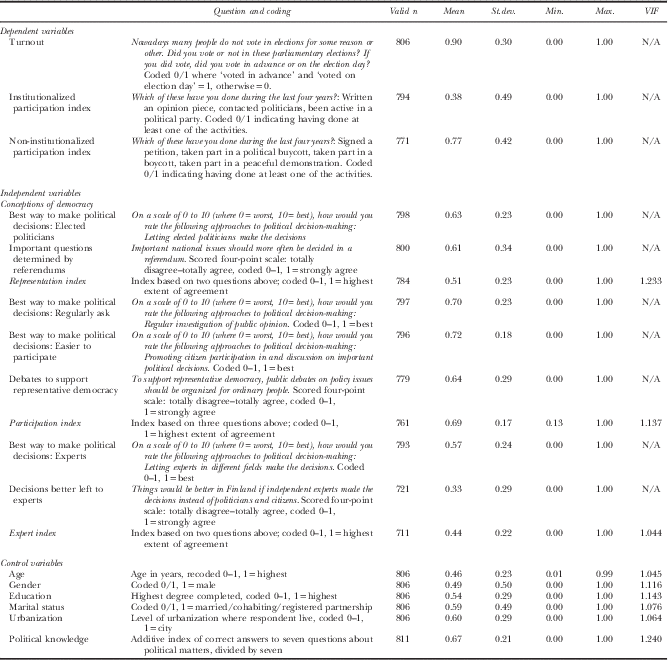
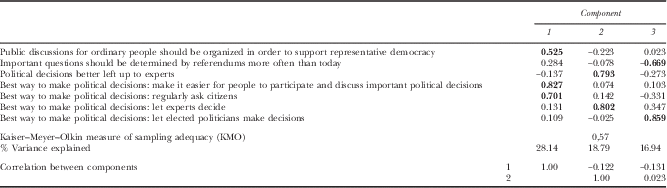
The central independent variables of the study are the views on political processes, and by using the same data we here build on the previous work of Bengtsson (Reference Bengtsson2012). The data include seven questions that probe concepts of democracy by examining what the respondents feel is the best way to make political decisions and what actors should be involved. The first three questions are statements with ‘agree/disagree’ response alternatives to the involvement of citizens, representatives and experts in political decision-making. The four other questions are alternative answers to a combined question concerning the best way to make political decisions: (1) Make it easier for people to participate and discuss important political decisions; (2) Regularly ask citizens; (3) Let experts decide; and (4) Let elected politicians make decisions. The four alternatives are ranked on an 11-point continuum, where 0 represents the worst and 10 the best way to make political decisions (later recoded to 0–1). For more details, see the Appendix.
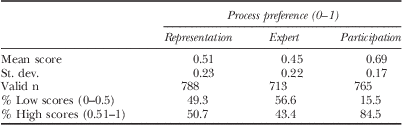
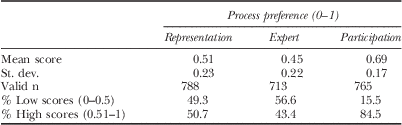
To construct indexes based on the answers to these questions, we examined the dimensionality with exploratory factor analysis, applying oblimin rotation which allows for correlation between components (results are presented in the Appendix). In line with the study by Bengtsson (Reference Bengtsson2012), three underlying and largely independentFootnote 7 dimensions are found, all of which emphasize different actors within decision-making: participation, expertise and representation.Footnote 8 Based on these results, we construct three sum indexes using the variables that load strongly onto each dimension and recode them to vary between 0 and 1, with 1 indicating the highest extent of agreement with the process view in question.Footnote 9Table 2 displays descriptive information on these three indexes.
Descriptive Information on Indexes of Conceptions of Democracy
Note: The conceptions of democracy are indexes measuring the extent to which the respondent agrees with the process view in question. Consult the Appendix for more on the coding.
Participation has strong support (mean 0.69) and only 15.5 per cent are below the absolute mean of 0.5, and also has the lowest standard deviation, which demonstrates that preferences are less dispersed than for the other two dimensions. There is also a fair amount of support for representation (mean 0.51), which is fairly evenly distributed. Expertise is the least popular (mean 0.45), but it is by no means without supporters since 43.4 per cent are above the absolute mean. The lower response rate for these items does, however, indicate that they are more difficult for respondents to relate to.
These indexes form the main independent variables in the analyses of the extent to which citizens’ conceptions of democracy influence their actual patterns of political participation. The dependent variables analysed are three modes of political participation. The Finnish National Election Study includes items on a wide range of political activities. In addition to whether or not they voted in the last election, respondents were asked to indicate whether they performed a number of political actions between the elections during the last four years. Based on their answers, measures for three forms of political participation are formed:Footnote 10 voting, institutionalized participation, and non-institutionalized participation. All three indexes are coded to be dichotomous to indicate whether the respondents participated or not.
The three modes of political activities are analysed using logistic regression analysis and the use of two different models for each mode; the first model including only the focal independent variables of the study – that is, process perceptions – and a second model including a number of control variables to ascertain the validity of the findings.Footnote 11 The controls are restricted to central socio-demographic characteristics known to affect both political attitudes and the propensity to be politically active (Marien et al. Reference Marien, Hooghe and Quintelier2010; Verba et al. Reference Verba, Schlozman and Brady1995). We also control for objective political knowledge, since this has a close relationship with political participation and may act as a proxy for the civic competence of the respondents (Christensen and Bengtsson Reference Christensen and Bengtsson2011). We do not include controls for political attitudes such as political interest. There are good reasons to expect a close relationship between such political attitudes and conceptions of democracy, since respondents who take a more activist view are likely to be more interested in political matters. This relationship is, however, more aptly considered formative rather than causal and it is therefore inappropriate to control for these factors (see Burns et al. Reference Burns, Schlozman and Verba2001: 46–8).Footnote 12
EMPIRICAL ANALYSES
We start the empirical analyses by showing differences in how many performed each political activity to see whether there are systematic differences between the three conceptions of democracy. In this section we use an arithmetic divide of the indexes (below and above 0.5). It should be noted that the share of respondents in each group deviates from one index to another (see Table 3).
Conceptions of Democracy and Percentages of Performed Political Activities

Note: The conceptions of democracy are indexes measuring the extent to which the respondent agrees with the process view in question. Consult the Appendix for more on the coding.
An average of 90.1 per cent indicated they had voted in the last election, which clearly exaggerates the true level of electoral participation, since the official turnout was 70.5 per cent in the 2011 elections. This is most likely due to social pressures or forgetfulness.Footnote 13 Even if the reported levels should only be considered indicative of the actual extent of participation, the differences between groups are nonetheless relevant. The two other forms of participation are less popular on average, since 37.6 per cent indicate they were involved in institutionalized participation while 47.8 have performed at least one act of non-institutionalized participation during the last four years.
When comparing levels of participation among groups of different conceptions of democracy, we find interesting variations which on many accounts are in line with our outlined hypotheses. The tendency to vote is, for example, close to 12 percentage points higher among those who score high on the representation index (96.5 compared with 84.6 per cent). However, contrary to what we expected, this initial analysis also indicates that proponents of representative decision-making procedures are more inclined to participate in non-institutionalized activities, while no such effect is found for institutionalized forms of political engagement. As expected, we find that those who support the value of expertise are less active in all forms of participation, with the strongest variation found for participation in institutionalized forms. Among supporters of processes based on active citizen participation, we find higher rates of involvement for two of the three activities, the exception being voting, where the percentage of voters is slightly lower among the strong supporters.
Although the differences between the high- and low-scoring individuals are generally in line with expectations, this is not necessarily the case when considering the differences compared to the population means. For example, there are 49.2 per cent active in non-institutionalized activities among the strong supporters, compared with a population percentage of 47.8. This seems to contradict our expectations. However, the level of activity is affected by a host of factors such as age, gender and education (Marien et al. Reference Marien, Hooghe and Quintelier2010), which are likely to affect the views on political processes as well. In order to ascertain how the views on processes are related to the political behaviour, we need to control for these factors.
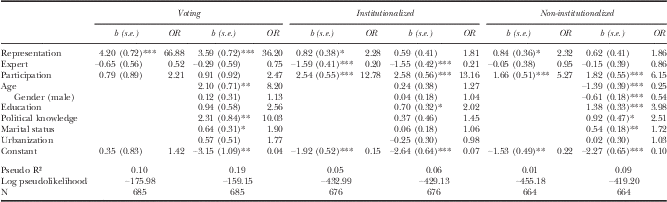
To this end, we performed a series of logistic regression analyses. For each type of participation we first run a model which only includes the three indexes measuring conceptions of democracy, followed by a model where we include the control variables. The results are presented in Table 4.
The Effect of Conceptions of Democracy on Political Participation (logistic regression)
Note: Entries are estimates from logistic regressions with standard errors in parentheses. All variables coded to vary between 0 and 1. ***p<0.001, **p<0.01, *p<0.05.
For voting, representation has the expected strong positive effect, even after controlling for confounding factors. Although the coefficient of 3.59 and the odds ratio of 36.2 suggest a very strong effect, it seems likely that those who favour this form of decision-making would be more likely to answer in the positive even when they did not vote. Hence, the exact impact should be taken with some caution, but there is little doubt that those who adhere to a representative conception of democracy are more likely to vote in elections. The coefficients have the expected directions for expertise and participation, but the estimates are not significant.
For institutionalized participation, the coefficients for all three views on representation have the expected directions in both models. However, representation loses significance when controlling for other factors. The instability in the effect of a representational ideal on institutionalized participation is not surprising, given the intellectual roots of this perspective being in the elitist model of democracy and its strong emphasis on elections. In this analysis we also find that the somewhat confusing finding in Table 3, where those scoring high on the expertise ideal stood out as more active in institutionalized participation, transforms into the expected pattern when taking into account the full variation and controlling for other factors.
For non-institutionalized participation, the coefficients again have the expected directions, but only the estimate for participation reaches significance in both models. The effect is relatively strong and in line with the ideals put forward by the participatory model of democracy, which underlines the importance and positive effects of citizens engaging in a wide range of political and social activities.
To facilitate the interpretation of the results found in Table 4, Figures 1–4 show the developments in the predicted probabilities of participation concerning the significant relationships. The predicted probabilities are derived from the extended model and hold all other factors included in the analyses constant at their mean values.
Representative Conception of Democracy and Voting (estimated probabilities with 95% CIs)
Expertise Conception of Democracy and Institutionalized Participation (estimated probabilities with 95% CIs)
Participatory Conception of Democracy and Institutionalized Participation (estimated probabilities with 95% CIs)
Participatory Conception of Democracy and Non-institutionalized Participation (estimated probabilities with 95% CIs)
Figure 1 displays the effect of representation on voting, and the graph clearly shows that while the likelihood of voting is relatively low at 0.8 (compared with the population average of 0.9) for those at the lower end of the representation index, voting is virtually a given at the high end. It should also be noted that the 95 per cent confidence intervals suggest that the effect is more certain as representation is valued more highly, indicating that the propensity to vote is supported by a high belief in representation as the best way to make decisions.
Figure 2 presents the negative effect of the expertise ideal on the propensity to become active in institutionalized activities. The predicted probability of engaging in these types of activities decreases from 0.6 to 0.2 as the belief in this sort of decision-making increases from its minimum to its maximum value.
Figure 3 also presents the variation in the predicted probability for engaging in institutionalized participation, but for the belief in participation as a decision-making method. Here the positive effect indicates that those with the lowest belief only have a likelihood of participation of 0.1 while those with the highest belief have a predicted probability of participation of 0.6, thus showing that belief in participation has important repercussions for this form of involvement.
Figure 4 visualizes the impact of belief in participation on non-institutionalized participation, and the positive effect here indicates that those with the lowest belief in participation have a likelihood of participation of 0.2 compared with 0.6 for those with the highest belief. It is also worth noting that the confidence intervals decrease with higher values, which shows that the credibility of the estimates are stronger when the respondents are strong supporters of participation as a decision-making ideal.
CONCLUSIONS
In this study we have demonstrated that citizens have different conceptions of democracy. While some citizens support a system with vivid public engagement, others prefer purely representative procedures or even a greater role for experts. More importantly, these different conceptions of democracy are not just ideals without substantial consequences. On the contrary, they have systematic effects on the way and extent in which people choose to engage in political activities.
In support of our first hypothesis, we find that those who believe that political decisions ought to be made by elected representatives in line with a representative ideal-model were more likely to vote in elections and participate in institutionalized activities in close vicinity to the formal political system, while there was no discernible effect on non-institutionalized participation. Clearly, the formal representative structures still have many supporters who are satisfied with choosing their leaders on election day (Schumpeter Reference Schumpeter1942).
The second hypothesis held that those adhering to a conception of democracy in which experts should have a prominent role should be less likely to be active in all kinds of participation. The hypothesis received some support. Citizens with high values on this index overall reported lower levels of participation. Furthermore, a negative estimate was found for all three forms of participation in the regression analyses, albeit only significant for the institutionalized activities. Hence, although we cannot establish the impact of this belief with great certainty, the results indicate that some citizens are satisfied to leave the decision-making to experts and have little desire to get involved in politics on a more permanent basis (see Hibbing and Theiss-Morse Reference Hibbing and Theiss-Morse2002).
Nevertheless, this is clearly only part of the truth, since the last finding suggests that many citizens in Finland have a participatory conception of democracy and are also actively involved in political activities, which was in line with our third hypothesis. Findings confirmed a positive effect on participation in institutionalized and non-institutionalized activities, while the effect on voting was not significant. The latter result can be seen as being in line with the relatively low levels of enthusiasm for voting among proponents of participatory democracy, since these citizens prefer more direct forms of involvement (see Pateman Reference Pateman1970). It may, however, also be related to systematic differences in over-reporting when it comes to voting. Those who believe that citizens should be active in other activities may feel less pressure to report that they voted, even if they did not, meaning that the differences are evened out in the survey material.
Yet another interesting finding is that the three conceptions had the most consistent impact on the institutionalized activities between elections. While this may to some extent be due to the inherent problems with measuring the two other modes of participation adequately, it could also suggest that these activities at the centre of the democratic process are more closely affected by how citizens perceive the system ought to function (Dalton Reference Dalton2006: 43). In this sense, these activities may still play a very central role in creating a viable democratic system in the future, although concerns have been raised over the lack of popularity of these activities (Mair Reference Mair2006).
At a more general level, the findings presented here clearly demonstrate why it has become a challenge to construct a system of democratic decision-making that can satisfy large parts of the population. The great diversity in citizens’ conceptions of democracy and the concurrent views on which actors should be involved in the decision-making puts democratic decision-making under great pressure. In this sense, the results support the idea that it is changes in citizens’ demands, rather than the democratic performance, that cause the perceived lack of political support in many democratic societies (Norris Reference Norris2011). In this sense, the results cast doubt on the potential for reviving democracy through institutional engineering (see Zittel and Fuchs Reference Zittel and Fuchs2007). Since there is no uniform preference among citizens for how the political decisions ought to be made, it is virtually impossible to come up with an institutional solution that can accommodate these varied demands.
Some of these results should be taken with caution. Due to the limited variation in some of the central variables and problems with measurement, it was not possible to establish all connections with great certainty. It should also be recalled that Finland can be considered a ‘most likely case’ for finding the expected patterns. Research from other contexts is therefore necessary to establish how well the conclusions drawn here apply to other settings. Nevertheless, this study certainly suggests that citizens do act in accordance with their ideals in political matters, which as such can be taken as a general confirmation of the fruitfulness of trying to comprehend citizens’ conceptions of democracy with the use of survey research.
APPENDIX
Coding of Variables and Descriptive Statistics
Exploratory Factor Analyses of Manifest Indicators of Conceptions of Democracy