


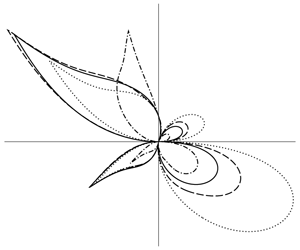
1 Introduction
Coherent structures (CS), which exhibit a high degree of spatial and temporal order, are present in both free and wall-bounded turbulent shear flows (Cantwell Reference Cantwell1981; Hussain Reference Hussain1983; Robinson Reference Robinson1991). They play an important role in sustaining turbulence (Hussain & Zaman Reference Hussain and Zaman1985; Antonia et al. Reference Antonia, Chambers, Britz and Browne1986), mixing or entrainment of fluids (Dimotakis & Brown Reference Dimotakis and Brown1976; Meyer, Dutton & Lucht Reference Meyer, Dutton and Lucht2006) and production of drag and noise (Crow & Champagne Reference Crow and Champagne1971; Liu Reference Liu1974), and as such, have been a subject of extensive investigation for decades. Experimental studies have gathered a great deal of data concerning the kinematic and dynamic properties of CS, which were often extracted from the instantaneous field by suitable statistical means such as the phase average. Several theoretical approaches have been proposed, of which the relatively recent ones are the resolvent analysis and dynamical-system approach. In the former, the instantaneous flow is decomposed into a (locally parallel) mean field and a fluctuating part, and the full Navier–Stokes (N–S) equations are arranged into a ‘linearised’ form with the nonlinear terms of the fluctuations being treated as forcing (McKeon & Sharma Reference McKeon and Sharma2010; McKeon Reference McKeon2017). CS are deemed to correspond to the largest possible response, which is calculated by performing singular value decomposition. Obviously, this approach is restricted to stable profiles because otherwise the response would be infinite. The dynamical-system approach seeks exact solutions to the N–S equations, which are of simple equilibrium type, consisting of travelling waves, streamwise vortices and streaks. These solutions are unstable in the full phase space, but form part of the boundary separating the attracting basins of the laminar and turbulent states. They are thought to be visited by, and moreover organise, the trajectories of fully time-dependent motions (Kerswell Reference Kerswell2005; Kawahara, Uhlmann & Van Veen Reference Kawahara, Uhlmann and Van Veen2012). These exact solutions are mostly obtained numerically, but at high Reynolds numbers asymptotic theory can be constructed, providing crucial insight into the physical mechanisms, spatial structures as well as scaling properties (Hall & Sherwin Reference Hall and Sherwin2010). The mean flow is generated by nonlinear interactions of the wave motion and computed as part of the solution, unlike the resolvent analysis, where the dynamics is primarily linear and the mean flow is prescribed as an input.
Another approach, which appeared much earlier, is based upon ‘triple decomposition’, namely, splitting the instantaneous flow into three constituents: a time-averaged mean field, a coherent part and small-scale fluctuations (Reynolds & Hussain Reference Reynolds and Hussain1972), and the idea is that CS can be treated as instability modes supported by the mean flow. This approach seems applicable to flows whose mean velocity profiles are inviscidly unstable, such as mixing layers, wakes and jets. CS in these flows were studied by a great number of experimentalists, and the major findings have been reviewed, e.g. by Hussain (Reference Hussain1983) and Wygnanski & Petersen (Reference Wygnanski and Petersen1987), and a fairly detailed summary was given by Wu & Zhuang (Reference Wu and Zhuang2016). In particular, Gaster, Kit & Wygnanski (Reference Gaster, Kit and Wygnanski1985) found that the spatial and temporal characteristics (wavelength, propagation speed and transverse distribution) of CS in a mixing layer were fairly well predicted by linear instability analysis for the mean flow, suggesting that CS may be treated as wavepackets of instability modes. The same conclusion was found to hold for CS in plane wakes (Marasli, Champagne & Wygnanski Reference Marasli, Champagne and Wygnanski1989, Reference Marasli, Champagne and Wygnanski1991) and jets (Hussain & Thompson Reference Hussain and Thompson1980). The presence of CS in turbulent axisymmetric jets was established by the pioneering study of Crow & Champagne (Reference Crow and Champagne1971), which preceded those on planar free shear layers. The propagation velocity of CS was found to be consistent with the temporal rather than spatial stability analysis of the mean flow modelled simplistically as a vortex sheet. Further hot-wire measurements and flow visualisations were carried out by Hussain & Zaman (Reference Hussain and Zaman1981), Zaman & Hussain (Reference Zaman and Hussain1980) and Hussain & Clark (Reference Hussain and Clark1981), but the findings were not interpreted from the perspective of instability modes. The more recent experiments (Suzuki & Colonius Reference Suzuki and Colonius2006; Gudmundsson & Colonius Reference Gudmundsson and Colonius2011; Cavalieri et al. Reference Cavalieri, Rodriguez, Jordan, Colonius and Gervais2013) as well as the validated data from large-eddy simulations (Sasaki et al. Reference Sasaki, Cavalieri, Jordan, Schmidt, Colonius and Brès2017) provided overwhelming evidence supporting the notion of CS as instability modes on the background mean flows.
Once they have acquired a significant amplitude, CS exhibit nonlinear features, the most remarkable of which is the formation of concentrated spanwise vortices or roller structures (Brown & Roshko Reference Brown and Roshko1974). It has been found that nonlinear effects come into play near the neutral position (Gudmundsson & Colonius Reference Gudmundsson and Colonius2011; Cavalieri et al. Reference Cavalieri, Rodriguez, Jordan, Colonius and Gervais2013; Tissot et al. Reference Tissot, Zhang, Lajús, Cavalieri and Jordan2016; Jordan et al. Reference Jordan, Zhang, Lehnasch and Cavalieri2017), similar to instability modes in laminar flows. Nonlinear interactions of CS generate a mean-flow distortion and harmonics. The former effect was accounted for either by employing the energy equation together with a shape assumption for the transverse distribution of the disturbance (Liu Reference Liu1989), or by calculating iteratively at each streamwise location the correction to the mean flow and linear instability of the modified mean flow (Cohen, Marasli & Levinski Reference Cohen, Marasli and Levinski1994). With the approximations being made on an empirical rather than systematic asymptotic basis, these approaches are of a heuristic nature, but captured some of the observations, including nonlinear saturation of CS and the spreading of the shear-layer thickness. However, none of them can predict vortex roll-up. Wu & Zhuang (Reference Wu and Zhuang2016) noted that an asymptotic theory describing the nonlinear dynamics of CS may be developed from the nonlinear non-equilibrium critical-layer theory for spatially evolving laminar shear flows. The latter describes the continued nonlinear evolution of instability modes when their linear growth becomes diminished, and as a high-Reynolds-number approach is adopted in order to take into account systematically the effects of competing physical factors (nonlinearity, non-equilibrium, viscosity and non-parallelism), a critical layer arises near the transverse position where the mean-flow velocity equals the phase speed of the mode, and nonlinearity as well as viscous and non-equilibrium effects may all become important; a review of the subject was recently given by Wu (Reference Wu2019). For a planar mode in an incompressible mixing layer, Goldstein & Hultgren (Reference Goldstein and Hultgren1988) and Goldstein & Leib (Reference Goldstein and Leib1989) showed that the dynamics in the critical layer is of a strongly nonlinear nature, due to which all higher-order harmonics are excited simultaneously causing the vorticity field to roll up. This strongly nonlinear critical-layer theory was extended by Sparks & Wu (Reference Sparks and Wu2008) first to the weakly, and then fully, compressible regimes. It successfully predicts the nonlinear amplitude evolution (Hultgren Reference Hultgren1992), and moreover captures roll-up of the vorticity, and in the compressible case, of the temperature field as well. By accounting for both the effects of fine-scale turbulence and strong non-parallelism of the mean flow, Wu & Zhuang (Reference Wu and Zhuang2016) adapted this strongly nonlinear framework to incompressible turbulent free shear layers. The resulting theory reproduces the formation of Brown–Roshko rollers, and the predicted oscillatory saturation of CS is in qualitative, and sometimes quantitative, agreement with experimental measurements.
Experiments indicate that CS exist as well in compressible mixing layers (Papamoschou & Roshko Reference Papamoschou and Roshko1988; Clemens et al. Reference Clemens, Mungal, Berger and Vandsburger1990; Elliott & Samimy Reference Elliott and Samimy1990; Clemens & Mungal Reference Clemens and Mungal1992), wakes (Scarano & Van Oudheusden Reference Scarano and Van Oudheusden2003) and axisymmetric jets (Thurow, Samimy & Lempert Reference Thurow, Samimy and Lempert2003). In the case of mixing layers, compressibility can be characterised by a so-called convective Mach number,  $M_{c}$. For
 $M_{c}<0.6$, the dynamics appears to be similar to the incompressible case, with the spanwise rollers remaining as the dominant structures (Samimy, Reeder & Elliott Reference Samimy, Reeder and Elliott1992; Elliott, Samimy & Arnette Reference Elliott, Samimy and Arnette1995), but dominant structures become three-dimensional when
 $M_{c}>0.62$. The convection velocity of CS and the change over to three-dimensional character correlate well with the linear stability of the mean flow (Jackson & Grosch Reference Jackson and Grosch1989; Ragab & Wu Reference Ragab and Wu1989; Sandham & Reynolds Reference Sandham and Reynolds1991). CS structures continue to play a key role in entrainment and mixing (Clemens & Mungal Reference Clemens and Mungal1995). Experimental studies found that manipulation of CS through controlled excitation led to significant changes to the acoustic far field (Bechert & Pfizenmaier Reference Bechert and Pfizenmaier1975, Reference Bechert and Pfizenmaier1977; Moore Reference Moore1977), and that the near- and far-field pressure fluctuations were composed of just several low-order azimuthal modes (Fuchs & Michel Reference Fuchs and Michel1978). All these indicate that CS might be the major source of noise. Since CS are more amenable to theoretical modelling and experimental probing than random fluctuations, it might be possible to predict and control noise through CS (Hussain & Hasan Reference Hussain and Hasan1985; Zaman Reference Zaman1985; Samimy et al. Reference Samimy, Kim, Kearney-Fischer and Sinha2010). This attractive prospect has prompted considerable sustained interest and research activities, which resurged recently (Jordan & Colonius Reference Jordan and Colonius2013).
In order to account for the weak non-parallelism of the mean flow, the approach of linear parabolised stability equations (PSE) has been adopted to describe the development of CS (Gudmundsson & Colonius Reference Gudmundsson and Colonius2011; Cavalieri et al. Reference Cavalieri, Rodriguez, Jordan, Colonius and Gervais2013). Alternatively, linear (bi-)global stability analyses, which include non-parallelism at leading order, have been performed by Nicholas & Lele (Reference Nicholas and Lele2011) and Schmidt et al. (Reference Schmidt, Towne, Colonius, Cavalieri, Jordan and Brès2017) for supersonic and high-subsonic jets, respectively. This approach treats the streamwise and transverse variations of the mean flow on the same footing, and thus requires both the upstream and downstream boundary conditions of the computation domain. It is however quite difficult to specify the ones that fully respect the true flow conditions and ensure independency of the solution from the domain size. Only temporally damped global modes have been found. While how such modes represent (or reconcile with) the sustained nature of CS and noise radiation remains to be understood, it is interesting that their spatial structures closely mimic those of the usual Kelvin–Helmholtz (K–H) type of shear instability as well as upstream propagating acoustic modes, and in the supersonic case feature an acoustic field at large radial distances (Schmidt et al. Reference Schmidt, Towne, Colonius, Cavalieri, Jordan and Brès2017). The signatures of K–H and acoustic modes contained in the global modes are of primary physical relevance, but it is unclear presently how the nonlinear nature of K–H modes, which is important for their acoustic radiation, could be taken into account within the global stability approach.
The resolvent analysis approach, developed primarily for CS in exact parallel flows (McKeon & Sharma Reference McKeon and Sharma2010; Sharma & McKeon Reference Sharma and McKeon2013), has recently been extended to spatially developing shear flows. Including the non-parallelism at leading order, as in the global stability analysis, Garnaud et al. (Reference Garnaud, Lesshafft, Schmid and Huerre2013) formulated a global resolvent analysis for an incompressible jet, and this framework was further extended to subsonic jets by Towne et al. (Reference Towne, Colonius, Jordan, Cavalieri and Brès2015) and Jeun, Nichols & Jovanović (Reference Jeun, Nichols and Jovanović2016) among others; see the recent review by Cavalieri, Jordan & Lesshafft (Reference Cavalieri, Jordan and Lesshafft2019). The nonlinear terms were treated as a time-harmonic external forcing, and so a linear inhomogeneous boundary-value problem arises. Under the assumption that CS correspond to an ‘optimal’ response, the problem is converted to one of finding the input, the forcing or initial condition, such that the gain (i.e. output–input ratio) is the largest. The optimal response and maximum gain, referred to as the resolvent mode and singular value respectively, are determined by the property of the linear operators, one of which appears in the linearised N–S equations and the other describes the observable output. The resolvent mode contains significant signature of local instability modes. The connection between these two entities was discussed by Beneddine et al. (Reference Beneddine, Sipp, Arnault, Dandois and Lesshafft2016), who noted that if the dominant singular value is much greater than others while the forcing does not contain preferentially the subdominant one, then the local instability mode is proportional to the dominant resolvent mode of the same frequency. Tissot et al. (Reference Tissot, Zhang, Lajús, Cavalieri and Jordan2016) presented a local data-driven resolvent formulation, in which the weak non-parallelism is accounted for by using the linear PSE idea, while the forcing is chosen such that the output ‘best approximates’ the observation.
The physical mechanisms of noise generation by CS continue to be the focus of current investigations. In supersonic shear layers, there exist CS propagating supersonically relative to the ambient flow, and they may radiate Mach waves (Tam Reference Tam1991). The mechanism is now well understood, and the far-field acoustic wave can be found in terms of the amplitude of the wavepacket representing CS (Tam & Burton Reference Tam and Burton1984; Wu Reference Wu2005), or via extrapolating the near-field pressure to the far field using the Kirchhoff acoustic surface propagation technique (Sinha et al. Reference Sinha, Rodríguez, Brès and Colonius2014).
Generation of sound waves in the subsonic regime is however rather different and subtle. Insights into the relations between CS and noise emission were provided by recent studies. Cavalieri et al. (Reference Cavalieri, Jordan, Colonius and Gervais2012) found in their experiment that the acoustic field at low polar angles (with respect to the downstream axial direction) is predominantly axisymmetric, and exhibits the so-called superdirectivity. Employing a simplified form of acoustic analogy and modelling the source term by a wavepacket, they calculated the sound, and the prediction was found to be in agreement with the measurements. Instead of examining how CS might radiate sound waves, Kerhervé et al. (Reference Kerhervé, Jordan, Cavalieri, Delville, Bogey and Juvé2012) proposed a statistical estimation methodology and used it to educe, from the measured acoustic field as well as the turbulent flow, the structures primarily responsible for the low-angle sound radiation. These structures turned out to agree rather well with the linear instability modes supported by the mean-flow profile. Fu et al. (Reference Fu, Agarwal, Cavalieri, Jordan and Brès2017) showed that if CS are removed from the source in Lighthill’s acoustic analogy, the resulting noise is substantially reduced.
There has been much effort to characterise the statistical properties of the near-field fluctuations, in terms of which the far-field noise may be expressed. However, statistical analysis in the frequency–wavenumber domain tends to mask noise-emitting events local in time and space. Quite a few investigators therefore turned their attention to temporal-spatial behaviours of the near-field flow and far-field noise with a view of seeking causal relations between the two. Close examinations of experimental and DNS (direct numerical simulation) or LES (large eddy simulation) data reveal that the emission is associated with intermittent events (Juvé, Sunyach & Comte-Bellot Reference Juvé, Sunyach and Comte-Bellot1980; Hileman et al. Reference Hileman, Thurow, Caraballo and Samimy2005; Cavalieri et al. Reference Cavalieri, Jordan, Gervais, Wei and Freund2010; Kearney-Fischer, Sinha & Samimy Reference Kearney-Fischer, Sinha and Samimy2013). The intermittency may manifest itself as jittering, or spatial-temporal modulation, which is controlled by nonlinear effects. The role of jittering has been assessed mainly in the framework of the acoustic analogy. When jittering was introduced, on a phenomenological basis, to the phase speed or envelope of the wavepack modelling the source, the radiated sound increased (Ffowcs Williams & Kempton Reference Ffowcs Williams and Kempton1978; Cavalieri et al. Reference Cavalieri, Jordan, Agarwal and Gervais2011). The same effect occurs when coherence decay, which is a statistical measure of jittering, is introduced to the source model in the spectral domain (Goldstein Reference Goldstein1984; Cavalieri & Agarwal Reference Cavalieri and Agarwal2014; Baqui et al. Reference Baqui, Agarwal, Cavalieri and Sinayoko2015). Among important flow events, vortex pairing had long been considered as one that radiates substantial noise (e.g. Kibens Reference Kibens1980). However, subsequent studies found that this was the case only at low Reynolds numbers, and in practical situations breakdown of CS (axisymmetric ring vortices in circular jets, or Brown–Roshko rollers in mixing layers) appears to be the dominant source (Bridges & Hussain Reference Bridges and Hussain1987, Reference Bridges and Hussain1992; Samimy et al. Reference Samimy, Kim, Kearney-Fischer and Sinha2010; Crawley et al. Reference Crawley, Gefen, Kuo, Samimy and Camussi2018). Despite the ever expanding literature, the causal relations between CS and the emitted sound remain elusive.
The aim of the present paper is, first of all, to investigate the nonlinear evolution of CS in a subsonic turbulent mixing layer. We shall pursue this goal in the simple framework of local stability, the reason being that even though global and resolvent modes can be computed (at higher costs), it is primarily the signatures of local convective unstable modes that are of direct relevance for physical understanding. These local modes are more amiable to theoretical and computational treatments, and equally importantly they possess the key attribute observed of CS being directly related to external disturbances (such as acoustic noise or turbulence in the oncoming flow), and the link between them could be understood in terms of receptivity mechanisms near the nozzle or the trailing edge of the splitter plate. The present theoretical development will be based on the previous work on nonlinear instability of a compressible laminar shear layer (Sparks & Wu Reference Sparks and Wu2008), and on CS in an incompressible turbulent mixing layer (Wu & Zhuang Reference Wu and Zhuang2016). The ensuing analysis amounts to extending either the former to the CS in a turbulent shear flow, or the latter to the compressible regime. Moreover, the CS are taken to be a spatially and temporally modulated wavetrain, which is a more realistic representation of the actual disturbances, and more importantly would radiate low-frequency sound waves.
The second aim of the present paper is to investigate acoustic radiation of the CS. Several previous studies employed acoustic analogy with the corresponding sources being modelled in terms of wavepackets to calculate the sound field. Sandham, Morfey & Hu (Reference Sandham, Morfey and Hu2006) and Sandham & Salgado (Reference Sandham and Salgado2008) used the Lilley–Goldstein analogy, in which the sources are ‘nonlinear’, being the products of the fluctuations. With the fluctuations being represented by linearly evolving instability waves, the resulting source component with difference wavenumber or frequency was found to generate the dominant sound wave. Cheung & Lele (Reference Cheung and Lele2009) showed that when the fluctuation is represented by nonlinearly developing instability modes, acoustic radiation becomes much stronger. Cavalieri et al. (Reference Cavalieri, Jordan, Agarwal and Gervais2011) and Cavalieri & Agarwal (Reference Cavalieri and Agarwal2014) opted for Lighthill’s analogy, in which linear and nonlinear sources appear in general. They focussed on the linear source only while neglecting the nonlinear ones. The predictions based on acoustic analogy captured some key features of acoustic fields. However, this methodology does not probe the true physical process of sound emission, the precise mechanism of which remains unexplained. Our goal is to describe, on the basis of first principles, why and how the CS emit sound waves, using the asymptotic approach to aeroacoustics, which was first introduced by Crow (Reference Crow1970) for low-Mach-number flows. In this approach, sound radiation is treated as a singular perturbation problem with the acoustic field being determined by analysing the far-field asymptotic behaviour of the hydrodynamic fluctuations. Unlike the acoustic analogy, there is no need to pre-designate the ‘sound field’ and its ‘source’ since they identify themselves unequivocally in the course of the analysis. As further developments and applications, the mechanism and mathematical theory of the noise generated by linear unstable supersonic modes were proposed by Tam & Burton (Reference Tam and Burton1984), and the radiations by nonlinear unstable modes in supersonic and subsonic jets were presented by Wu (Reference Wu2005) and Wu & Huerre (Reference Wu and Huerre2009) respectively. The approach has also been applied to acoustic radiation from instability waves in boundary layers by Wu & Hogg (Reference Wu and Hogg2006) and Wu (Reference Wu2011).
The acoustic radiations mentioned above take place in laminar flows. In this paper, a theory for the acoustic radiation by subsonic CS in a turbulent mixing layer will be developed. A wave propagating subsonically relative to the ambient mean flow is completely quiescent if it undergoes no spatial modulation. When modulated in space, it does radiate sound waves of the same frequency directly through a linear mechanism, as has been shown by Crighton & Huerre (Reference Crighton and Huerre1990) for a model problem and by Tam & Morris (Reference Tam and Morris1980) for a mixing layer; see also Cavalieri et al. (Reference Cavalieri, Jordan, Colonius and Gervais2012). The sound waves emitted are rather weak, and concentrate in the small angles to the streamwise direction. A nonlinear and stronger radiation occurs if the wave undergoes simultaneous spatial and temporal modulation. The nonlinear interactions of the waves (or rather wavepackets) then generate components with difference wavenumbers/frequencies, which may radiate effectively (Sandham & Salgado Reference Sandham and Salgado2008; Suponitsky, Sandham & Morfey Reference Suponitsky, Sandham and Morfey2010). More generally, these components can be considered as part of the nonlinearly induced mean-flow distortion, which varies slowly in both time and space, radiating low-frequency noise to the far field. Such a mechanism has been demonstrated for a pair of subsonic helical modes on a laminar circular jet (Wu & Huerre Reference Wu and Huerre2009). A broadly similar mechanism operates with the two-dimensional CS in a turbulent mixing layer, but significant differences arise in the characters of both the nonlinear dynamics and radiation.
The rest of the paper is organised as follows. In § 2, CS are separated from the instantaneous flow field through triple decomposition. Their governing equations are obtained with the aid of a closure model for the coherent Reynolds stresses of small-scale fluctuations. In § 3, on the assumption that a CS can be represented by a wavepacket, we consider its nonlinear dynamics in the streamwise region where the linear growth rate is vanishingly small. Suitable scales are introduced, and the asymptotic analysis is performed for the main shear layer and the critical layer to derive a strongly nonlinear evolution system. In § 4, this evolution system is summarised, and appropriate initial and boundary conditions are deduced for the cases where the wavepacket consists of discrete and continuous sidebands. By examining the far-field behaviour of CS, we show in § 5 how CS emit sound waves. The actual sound emitter is found to be the nonlinearly generated unsteady mean-flow distortion, which radiates low-frequency sound waves. Calculations are carried out for a typical mean-flow velocity profile in § 6, and numerical calculations are presented in three parts: (a) CS with a single frequency; (b) CS consisting of discrete sidebands; (c) the sound waves radiated by modulated CS with discrete and continuous sidebands. Finally, a summary and discussion are given in § 7.
2 Formulation
2.1 Governing equations and flow decomposition
To fix the idea, we consider a typical compressible mixing layer, which is formed due to two streams merging downstream of a splitter plate. The velocity and temperature in the fast stream are denoted by  $U_{1}^{\ast }$ and
 $T_{1}^{\ast }$, and those in the slow stream by
 $U_{2}^{\ast }$ and
 $T_{2}^{\ast }$, respectively. We introduce the Cartesian coordinates
 $(x^{\ast },y^{\ast })$, where
 $x^{\ast }$ and
 $y^{\ast }$ denote the distances in the streamwise and transverse directions respectively. The coordinates
 $(x^{\ast },y^{\ast })$ and time
 $t^{\ast }$ are non-dimensionalised by a reference length
 $\unicode[STIX]{x1D6FF}_{0}^{\ast }$ and time
 $\unicode[STIX]{x1D6FF}_{0}^{\ast }/U_{0}^{\ast }$, where the superscript
 $^{\ast }$ signifies a dimensional quantity,
 $\unicode[STIX]{x1D6FF}_{0}^{\ast }$ denotes the thickness of the shear layer at a typical position and
 $U_{0}^{\ast }$ is a reference velocity. The velocity
 $U^{\ast }$, density
 $\unicode[STIX]{x1D70C}^{\ast }$, temperature
 $T^{\ast }$ and viscosity
 $\unicode[STIX]{x1D707}^{\ast }$ are normalised respectively by
 $$\begin{eqnarray}U_{0}^{\ast }=(U_{1}^{\ast }-U_{2}^{\ast })/2,\quad \unicode[STIX]{x1D70C}_{0}^{\ast }=\unicode[STIX]{x1D70C}_{1}^{\ast },\quad T_{0}^{\ast }=T_{1}^{\ast },\quad \unicode[STIX]{x1D707}_{0}^{\ast }=\unicode[STIX]{x1D707}_{1}^{\ast },\end{eqnarray}$$
while the non-dimensional pressure  $p$ is introduced by writing
 $p^{\ast }=p_{0}^{\ast }+\unicode[STIX]{x1D70C}_{0}^{\ast }U_{0}^{\ast 2}p$.
The resulting dimensionless parameters, including the Mach number  $Ma$, the Reynolds number
 $Re$ and the Prandtl number
 $Pr$, are defined as
 $$\begin{eqnarray}Ma=U_{0}^{\ast }/\sqrt{\unicode[STIX]{x1D6FE}R_{g}^{\ast }T_{0}^{\ast }},\quad Re=\unicode[STIX]{x1D70C}_{0}^{\ast }U_{0}^{\ast }\unicode[STIX]{x1D6FF}_{0}^{\ast }/\unicode[STIX]{x1D707}_{0}^{\ast },\quad Pr=\unicode[STIX]{x1D707}_{0}^{\ast }C_{p}^{\ast }/k_{0}^{\ast },\end{eqnarray}$$
where  $R_{g}^{\ast }$ is the universal gas constant,
 $k_{0}^{\ast }$ its thermal conductivity and
 $\unicode[STIX]{x1D6FE}=C_{p}/C_{v}$ is the ratio of the constant-pressure and constant-volume specific heat capacities,
 $C_{p}$ and
 $C_{v}$. The non-dimensional compressible Navier–Stokes (N–S) equations for a perfect gas can be written as (in the tensor form),
 $$\begin{eqnarray}\displaystyle & \displaystyle \frac{\unicode[STIX]{x2202}\unicode[STIX]{x1D70C}}{\unicode[STIX]{x2202}t}+\frac{\unicode[STIX]{x2202}\unicode[STIX]{x1D70C}u_{i}}{\unicode[STIX]{x2202}x_{i}}=0, & \displaystyle\end{eqnarray}$$
 $$\begin{eqnarray}\displaystyle & \displaystyle \unicode[STIX]{x1D70C}\frac{\unicode[STIX]{x2202}u_{i}}{\unicode[STIX]{x2202}t}+\unicode[STIX]{x1D70C}u_{j}\frac{\unicode[STIX]{x2202}u_{i}}{\unicode[STIX]{x2202}x_{j}}=-\frac{\unicode[STIX]{x2202}p}{\unicode[STIX]{x2202}x_{i}}+\frac{1}{Re}\frac{\unicode[STIX]{x2202}}{\unicode[STIX]{x2202}x_{j}}\left[\unicode[STIX]{x1D707}\left(\frac{\unicode[STIX]{x2202}u_{i}}{\unicode[STIX]{x2202}x_{j}}+\frac{\unicode[STIX]{x2202}u_{j}}{\unicode[STIX]{x2202}x_{i}}\right)-\frac{2}{3}\unicode[STIX]{x1D707}\frac{\unicode[STIX]{x2202}u_{k}}{\unicode[STIX]{x2202}x_{k}}\unicode[STIX]{x1D6FF}_{ij}\right], & \displaystyle\end{eqnarray}$$
 $$\begin{eqnarray}\displaystyle & \displaystyle \unicode[STIX]{x1D70C}\frac{\unicode[STIX]{x2202}T}{\unicode[STIX]{x2202}t}+\unicode[STIX]{x1D70C}u_{i}\frac{\unicode[STIX]{x2202}T}{\unicode[STIX]{x2202}x_{i}}=(\unicode[STIX]{x1D6FE}-1)Ma^{2}\left(\frac{\unicode[STIX]{x2202}p}{\unicode[STIX]{x2202}t}+u_{i}\frac{\unicode[STIX]{x2202}p}{\unicode[STIX]{x2202}x_{i}}\right)+\frac{1}{PrRe}\frac{\unicode[STIX]{x2202}}{\unicode[STIX]{x2202}x_{i}}\unicode[STIX]{x1D707}\frac{\unicode[STIX]{x2202}T}{\unicode[STIX]{x2202}x_{i}}+\frac{(\unicode[STIX]{x1D6FE}-1)Ma^{2}}{Re}\unicode[STIX]{x1D6F7},\qquad & \displaystyle\end{eqnarray}$$
 $$\begin{eqnarray}\displaystyle & \displaystyle \unicode[STIX]{x1D70C}T=1+\unicode[STIX]{x1D6FE}Ma^{2}p, & \displaystyle\end{eqnarray}$$
where the dissipation function  $\unicode[STIX]{x1D6F7}$ is
 $$\begin{eqnarray}\unicode[STIX]{x1D6F7}=\frac{\unicode[STIX]{x1D707}}{2}\left(\frac{\unicode[STIX]{x2202}u_{i}}{\unicode[STIX]{x2202}x_{j}}+\frac{\unicode[STIX]{x2202}u_{j}}{\unicode[STIX]{x2202}x_{i}}\right)\left(\frac{\unicode[STIX]{x2202}u_{i}}{\unicode[STIX]{x2202}x_{j}}+\frac{\unicode[STIX]{x2202}u_{j}}{\unicode[STIX]{x2202}x_{i}}\right)-\frac{2\unicode[STIX]{x1D707}}{3}\left(\frac{\unicode[STIX]{x2202}u_{i}}{\unicode[STIX]{x2202}x_{i}}\right)^{2}.\end{eqnarray}$$
As a first step towards a mathematical formulation for the nonlinear evolution of CS in a mixing layer, the instantaneous field  $(\boldsymbol{u},T,p,\unicode[STIX]{x1D70C},\unicode[STIX]{x1D707})$ is decomposed into the mean flow
 $(\bar{\boldsymbol{U}},\bar{T},\bar{P},\bar{\unicode[STIX]{x1D70C}},\bar{\unicode[STIX]{x1D707}})$, the quasi-periodic coherent motion
 $(\tilde{\boldsymbol{u}},\tilde{T},\tilde{p},\tilde{\unicode[STIX]{x1D70C}},\tilde{\unicode[STIX]{x1D707}})$ and the remaining fluctuations
 $(\boldsymbol{u}^{\prime },T^{\prime },p^{\prime },\unicode[STIX]{x1D70C}^{\prime },\unicode[STIX]{x1D707}^{\prime })$, which are predominately small scale (so that energy cascade takes place among components in this part) (Hussain & Reynolds Reference Hussain and Reynolds1972; Wu & Zhuang Reference Wu and Zhuang2016),
 $$\begin{eqnarray}(\boldsymbol{u},T,p,\unicode[STIX]{x1D70C},\unicode[STIX]{x1D707})=(\bar{\boldsymbol{U}},\bar{T},\bar{P},\bar{\unicode[STIX]{x1D70C}},\bar{\unicode[STIX]{x1D707}})+(\tilde{\boldsymbol{u}},\tilde{T},\tilde{p},\tilde{\unicode[STIX]{x1D70C}},\tilde{\unicode[STIX]{x1D707}})+(\boldsymbol{u}^{\prime },T^{\prime },p^{\prime },\unicode[STIX]{x1D70C}^{\prime },\unicode[STIX]{x1D707}^{\prime }),\end{eqnarray}$$
where an overbar over  $p$,
 $\unicode[STIX]{x1D70C}$ and
 $\unicode[STIX]{x1D707}$ denotes a time-averaged quantity
 $$\begin{eqnarray}\overline{f}(\boldsymbol{x},t)\equiv \lim _{\unicode[STIX]{x1D70F}\rightarrow \infty }\frac{1}{\unicode[STIX]{x1D70F}}\int _{t}^{t+\unicode[STIX]{x1D70F}}f(\boldsymbol{x},t^{\star })\,\text{d}t^{\star },\end{eqnarray}$$
whereas the velocity  $\bar{\boldsymbol{U}}$ and temperature
 $\bar{T}$ denote the Favre time average,
 $$\begin{eqnarray}\overline{f}(\boldsymbol{x},t)\equiv \frac{1}{\overline{\unicode[STIX]{x1D70C}}}\lim _{\unicode[STIX]{x1D70F}\rightarrow \infty }\frac{1}{\unicode[STIX]{x1D70F}}\int _{t}^{t+\unicode[STIX]{x1D70F}}\unicode[STIX]{x1D70C}f(\boldsymbol{x},t^{\star })\,\text{d}t^{\star },\end{eqnarray}$$
which is necessary for compressible turbulent flows; for statistically stationary flows,  $\overline{f}$ is independent of
 $t$. Owing to their quasi-cyclic property, CS may be extracted by the phase average (Hussain & Reynolds Reference Hussain and Reynolds1970)
 $$\begin{eqnarray}\langle f\rangle (\boldsymbol{x},t)\equiv \lim _{N\rightarrow \infty }\frac{1}{N}\mathop{\sum }_{i=1}^{N}f(\boldsymbol{x},t+\unicode[STIX]{x1D70F}_{i}),\end{eqnarray}$$
for  $\tilde{p}$,
 $\tilde{\unicode[STIX]{x1D70C}}$ and
 $\tilde{\unicode[STIX]{x1D707}}$, whereas for
 $\tilde{\boldsymbol{u}}$ and
 $\tilde{T}$ the Favre phase average is defined as
 $$\begin{eqnarray}\langle f\rangle (\boldsymbol{x},t)\equiv \frac{1}{\langle \unicode[STIX]{x1D70C}\rangle }\lim _{N\rightarrow \infty }\frac{1}{N}\mathop{\sum }_{i=1}^{N}\unicode[STIX]{x1D70C}f(\boldsymbol{x},t+\unicode[STIX]{x1D70F}_{i}),\end{eqnarray}$$
where  $\unicode[STIX]{x1D70F}_{i}$ denotes the time lapse between the instants at which the structure is considered to have the same phase as at time
 $t$ (Hussain & Reynolds Reference Hussain and Reynolds1970; Hussain Reference Hussain1983). The decomposition is primarily targeted at flows which exhibit a discernible period
 $\unicode[STIX]{x1D70F}_{0}$, or are excited by harmonic forcing, in which case
 $\unicode[STIX]{x1D70F}_{i}=i\unicode[STIX]{x1D70F}_{0}$. The signature of CS,
 $\tilde{f}$, is then obtained by
 $\tilde{f}\equiv \langle f\rangle -\bar{f}$. The large- and small-scale fluctuations are assumed to be uncorrelated, i.e.
 $\overline{\tilde{f}g^{\prime }}=0$.
2.2 Mean-flow equations
The time-averaged mean flow is driven by the Reynolds stresses contributed by both the coherent and small-scale fluctuations. Unlike the conventional treatment, here we regard  $\bar{U}$,
 $\bar{V}$,
 $\bar{T}$,
 $\bar{P}$,
 $\bar{\unicode[STIX]{x1D70C}}$ and
 $\bar{\unicode[STIX]{x1D707}}$ as being driven only by the Reynolds stresses from small-scale eddies. This is realised by treating the mean-flow distortion caused by CS as a part of CS themselves (cf. Wu & Zhuang Reference Wu and Zhuang2016).
It is generally accepted that direct effects of density fluctuations on turbulence are small at free-stream Mach numbers less than approximately  $5$ (Bradshaw Reference Bradshaw1977). For subsonic cases, we can omit the correlations about
 $\unicode[STIX]{x1D70C}^{\prime }$. After taking the time average, or Favre time average, of (2.3)–(2.6), the mean flow field in two dimensions is found to satisfy the Reynolds-averaged equations (Schlichting Reference Schlichting1979),
 $$\begin{eqnarray}\frac{\unicode[STIX]{x2202}\bar{\unicode[STIX]{x1D70C}}}{\unicode[STIX]{x2202}t}+\frac{\unicode[STIX]{x2202}\bar{\unicode[STIX]{x1D70C}}\bar{U}}{\unicode[STIX]{x2202}x}+\frac{\unicode[STIX]{x2202}\bar{\unicode[STIX]{x1D70C}}\bar{V}}{\unicode[STIX]{x2202}y}=0,\end{eqnarray}$$
 $$\begin{eqnarray}\displaystyle & & \displaystyle \bar{\unicode[STIX]{x1D70C}}\frac{\unicode[STIX]{x2202}\bar{U}}{\unicode[STIX]{x2202}t}+\bar{\unicode[STIX]{x1D70C}}\bar{U}\frac{\unicode[STIX]{x2202}\bar{U}}{\unicode[STIX]{x2202}x}+\bar{\unicode[STIX]{x1D70C}}\bar{V}\frac{\unicode[STIX]{x2202}\bar{U}}{\unicode[STIX]{x2202}y}-\frac{2}{3Re}\frac{\unicode[STIX]{x2202}}{\unicode[STIX]{x2202}x}\bar{\unicode[STIX]{x1D707}}\left(2\frac{\unicode[STIX]{x2202}\bar{U}}{\unicode[STIX]{x2202}x}-\frac{\unicode[STIX]{x2202}\bar{V}}{\unicode[STIX]{x2202}y}\right)-\frac{1}{Re}\frac{\unicode[STIX]{x2202}}{\unicode[STIX]{x2202}y}\bar{\unicode[STIX]{x1D707}}\left(\frac{\unicode[STIX]{x2202}\bar{U}}{\unicode[STIX]{x2202}y}+\frac{\unicode[STIX]{x2202}\bar{V}}{\unicode[STIX]{x2202}x}\right)\nonumber\\ \displaystyle & & \displaystyle \quad =-\frac{\unicode[STIX]{x2202}\bar{P}}{\unicode[STIX]{x2202}x}+\frac{\unicode[STIX]{x2202}\bar{\unicode[STIX]{x1D70F}}_{11}^{\dagger }}{\unicode[STIX]{x2202}x}+\frac{\unicode[STIX]{x2202}\bar{\unicode[STIX]{x1D70F}}_{12}^{\dagger }}{\unicode[STIX]{x2202}y}+\text{H.O.T.},\end{eqnarray}$$
 $$\begin{eqnarray}\displaystyle & & \displaystyle \bar{\unicode[STIX]{x1D70C}}\frac{\unicode[STIX]{x2202}\bar{V}}{\unicode[STIX]{x2202}t}+\bar{\unicode[STIX]{x1D70C}}\bar{U}\frac{\unicode[STIX]{x2202}\bar{V}}{\unicode[STIX]{x2202}x}+\bar{\unicode[STIX]{x1D70C}}\bar{V}\frac{\unicode[STIX]{x2202}\bar{V}}{\unicode[STIX]{x2202}y}-\frac{2}{3Re}\frac{\unicode[STIX]{x2202}}{\unicode[STIX]{x2202}y}\bar{\unicode[STIX]{x1D707}}\left(2\frac{\unicode[STIX]{x2202}\bar{V}}{\unicode[STIX]{x2202}y}-\frac{\unicode[STIX]{x2202}\bar{U}}{\unicode[STIX]{x2202}x}\right)-\frac{1}{Re}\frac{\unicode[STIX]{x2202}}{\unicode[STIX]{x2202}x}\bar{\unicode[STIX]{x1D707}}\left(\frac{\unicode[STIX]{x2202}\bar{U}}{\unicode[STIX]{x2202}y}+\frac{\unicode[STIX]{x2202}\bar{V}}{\unicode[STIX]{x2202}x}\right)\nonumber\\ \displaystyle & & \displaystyle \quad =-\frac{\unicode[STIX]{x2202}\bar{P}}{\unicode[STIX]{x2202}y}+\frac{\unicode[STIX]{x2202}\bar{\unicode[STIX]{x1D70F}}_{21}^{\dagger }}{\unicode[STIX]{x2202}x}+\frac{\unicode[STIX]{x2202}\bar{\unicode[STIX]{x1D70F}}_{22}^{\dagger }}{\unicode[STIX]{x2202}y}+\text{H.O.T.},\end{eqnarray}$$
 $$\begin{eqnarray}\displaystyle & & \displaystyle \bar{\unicode[STIX]{x1D70C}}\frac{\unicode[STIX]{x2202}\bar{T}}{\unicode[STIX]{x2202}t}+\bar{\unicode[STIX]{x1D70C}}\bar{U}\frac{\unicode[STIX]{x2202}\bar{T}}{\unicode[STIX]{x2202}x}+\bar{\unicode[STIX]{x1D70C}}\bar{V}\frac{\unicode[STIX]{x2202}\bar{T}}{\unicode[STIX]{x2202}y}-\frac{1}{PrRe}\left(\frac{\unicode[STIX]{x2202}}{\unicode[STIX]{x2202}x}\bar{\unicode[STIX]{x1D707}}\frac{\unicode[STIX]{x2202}\bar{T}}{\unicode[STIX]{x2202}x}+\frac{\unicode[STIX]{x2202}}{\unicode[STIX]{x2202}y}\bar{\unicode[STIX]{x1D707}}\frac{\unicode[STIX]{x2202}\bar{T}}{\unicode[STIX]{x2202}y}\right)\nonumber\\ \displaystyle & & \displaystyle \quad =(\unicode[STIX]{x1D6FE}-1)Ma^{2}\left(\frac{\unicode[STIX]{x2202}\bar{P}}{\unicode[STIX]{x2202}t}+\bar{U}\frac{\unicode[STIX]{x2202}\bar{P}}{\unicode[STIX]{x2202}x}+\bar{V}\frac{\unicode[STIX]{x2202}\bar{P}}{\unicode[STIX]{x2202}y}\right)+(\unicode[STIX]{x1D6FE}-1)Ma^{2}\left[\,\overline{u^{\prime }\frac{\unicode[STIX]{x2202}p^{\prime }}{\unicode[STIX]{x2202}x}}+\overline{v^{\prime }\frac{\unicode[STIX]{x2202}p^{\prime }}{\unicode[STIX]{x2202}y}}\,\right]\nonumber\\ \displaystyle & & \displaystyle \qquad +\,\frac{\unicode[STIX]{x2202}\bar{\unicode[STIX]{x1D70F}}_{T1}^{\dagger }}{\unicode[STIX]{x2202}x}+\frac{\unicode[STIX]{x2202}\bar{\unicode[STIX]{x1D70F}}_{T2}^{\dagger }}{\unicode[STIX]{x2202}y}+\frac{(\unicode[STIX]{x1D6FE}-1)Ma^{2}}{Re}(\bar{\unicode[STIX]{x1D6F7}}+\bar{\unicode[STIX]{x1D6F7}}^{\prime })+\text{H.O.T.},\end{eqnarray}$$
 $$\begin{eqnarray}\bar{\unicode[STIX]{x1D70C}}\bar{T}=1+\unicode[STIX]{x1D6FE}Ma^{2}\bar{P},\end{eqnarray}$$
where  $\bar{\unicode[STIX]{x1D70F}}_{ij}^{\dagger }$ and
 $\bar{\unicode[STIX]{x1D70F}}_{Ti}^{\dagger }$ denote the Reynolds stress and energy flux, respectively, and
 $$\begin{eqnarray}\left.\begin{array}{@{}c@{}}\displaystyle \bar{\unicode[STIX]{x1D6F7}}=\frac{4}{3}\bar{\unicode[STIX]{x1D707}}\left[\frac{\unicode[STIX]{x2202}\bar{U}}{\unicode[STIX]{x2202}x}\frac{\unicode[STIX]{x2202}\bar{U}}{\unicode[STIX]{x2202}x}+\frac{\unicode[STIX]{x2202}\bar{V}}{\unicode[STIX]{x2202}y}\frac{\unicode[STIX]{x2202}\bar{V}}{\unicode[STIX]{x2202}y}-\frac{\unicode[STIX]{x2202}\bar{U}}{\unicode[STIX]{x2202}x}\frac{\unicode[STIX]{x2202}\bar{V}}{\unicode[STIX]{x2202}y}\right]+\bar{\unicode[STIX]{x1D707}}\left[\frac{\unicode[STIX]{x2202}\bar{U}}{\unicode[STIX]{x2202}y}\frac{\unicode[STIX]{x2202}\bar{U}}{\unicode[STIX]{x2202}y}+\frac{\unicode[STIX]{x2202}\bar{V}}{\unicode[STIX]{x2202}x}\frac{\unicode[STIX]{x2202}\bar{V}}{\unicode[STIX]{x2202}x}-\frac{\unicode[STIX]{x2202}\bar{U}}{\unicode[STIX]{x2202}y}\frac{\unicode[STIX]{x2202}\bar{V}}{\unicode[STIX]{x2202}x}\right],\\ \displaystyle \bar{\unicode[STIX]{x1D6F7}}^{\prime }=\frac{4}{3}\bar{\unicode[STIX]{x1D707}}\left[\;\overline{\frac{\unicode[STIX]{x2202}u^{\prime }}{\unicode[STIX]{x2202}x}\frac{\unicode[STIX]{x2202}u^{\prime }}{\unicode[STIX]{x2202}x}}+\overline{\frac{\unicode[STIX]{x2202}v^{\prime }}{\unicode[STIX]{x2202}y}\frac{\unicode[STIX]{x2202}v^{\prime }}{\unicode[STIX]{x2202}y}}-\overline{\frac{\unicode[STIX]{x2202}u^{\prime }}{\unicode[STIX]{x2202}x}\frac{\unicode[STIX]{x2202}v^{\prime }}{\unicode[STIX]{x2202}y}}\;\right]+\bar{\unicode[STIX]{x1D707}}\left[\;\overline{\frac{\unicode[STIX]{x2202}u^{\prime }}{\unicode[STIX]{x2202}y}\frac{\unicode[STIX]{x2202}u^{\prime }}{\unicode[STIX]{x2202}y}}+\overline{\frac{\unicode[STIX]{x2202}v^{\prime }}{\unicode[STIX]{x2202}x}\frac{\unicode[STIX]{x2202}v^{\prime }}{\unicode[STIX]{x2202}x}}-\overline{\frac{\unicode[STIX]{x2202}u^{\prime }}{\unicode[STIX]{x2202}y}\frac{\unicode[STIX]{x2202}v^{\prime }}{\unicode[STIX]{x2202}x}}\;\right].\end{array}\right\}\end{eqnarray}$$
The fact that large-scale CS are influenced by the upstream and boundary conditions means that their Reynolds stresses cannot be well characterised by the local mean-flow strain rate with an eddy viscosity coefficient. Now with CS and their Reynolds stresses being treated separately and explicitly, a closure model needs to be introduced for the (Favre-) time-averaged Reynolds stresses of small-scale fluctuations, which depend primarily on local conditions and thus may be less troublesome to model. A simple gradient type of model may be adopted here, which is written (in the tensor form with the Kronecker delta  $\unicode[STIX]{x1D6FF}_{ij}$) as
 $$\begin{eqnarray}\displaystyle & \displaystyle \bar{\unicode[STIX]{x1D70F}}_{Ti}^{\dagger }=-\overline{\unicode[STIX]{x1D70C}u_{i}^{\prime }T^{\prime }}=\frac{\unicode[STIX]{x1D707}_{t}}{Pr_{T}R_{T}}\frac{\unicode[STIX]{x2202}\bar{T}}{\unicode[STIX]{x2202}x_{i}}, & \displaystyle\end{eqnarray}$$
 $$\begin{eqnarray}\displaystyle & \displaystyle \bar{\unicode[STIX]{x1D70F}}_{ij}^{\dagger }=-\overline{\unicode[STIX]{x1D70C}u_{i}^{\prime }u_{j}^{\prime }}=-\frac{1}{3}\overline{\unicode[STIX]{x1D70C}u_{k}^{\prime }u_{k}^{\prime }}\unicode[STIX]{x1D6FF}_{ij}+\frac{\unicode[STIX]{x1D707}_{t}}{R_{T}}\left(\frac{\unicode[STIX]{x2202}\bar{U}_{i}}{\unicode[STIX]{x2202}x_{j}}+\frac{\unicode[STIX]{x2202}\bar{U}_{j}}{\unicode[STIX]{x2202}x_{i}}-\frac{2}{3}\frac{\unicode[STIX]{x2202}\bar{U}_{k}}{\unicode[STIX]{x2202}x_{k}}\unicode[STIX]{x1D6FF}_{ij}\right), & \displaystyle\end{eqnarray}$$
where  $\unicode[STIX]{x1D707}_{t}$ is the mean eddy viscosity normalised by its reference value
 $\unicode[STIX]{x1D707}_{t,0}^{\ast }$. The turbulent Reynolds number
 $R_{T}$ and Prandtl number
 $Pr_{T}$ are defined as
 $$\begin{eqnarray}R_{T}=\unicode[STIX]{x1D70C}_{0}^{\ast }U_{0}^{\ast }\unicode[STIX]{x1D6FF}_{0}^{\ast }/\unicode[STIX]{x1D707}_{t,0}^{\ast },\quad Pr_{T}=C_{p}^{\ast }\unicode[STIX]{x1D707}_{t,0}^{\ast }/k_{t,0}^{\ast },\end{eqnarray}$$
with  $k_{t,0}^{\ast }$ being the dimensional mean eddy conductivity. The term
 $\overline{u_{i}^{\prime }\unicode[STIX]{x2202}_{x_{i}}p^{\prime }}$ in (2.16) is modelled by following Van Driest (Reference Van Driest1951). After using the momentum equations for
 $u_{i}^{\prime }$ to eliminate the pressure gradient, and making the same approximations as that in Van Driest (Reference Van Driest1951), we have the model
 $$\begin{eqnarray}\overline{u_{i}^{\prime }\frac{\unicode[STIX]{x2202}p^{\prime }}{\unicode[STIX]{x2202}x_{i}}}=-\overline{\unicode[STIX]{x1D70C}u_{i}^{\prime }u_{j}^{\prime }}\frac{\unicode[STIX]{x2202}\bar{U}_{i}}{\unicode[STIX]{x2202}x_{j}}=\bar{\unicode[STIX]{x1D70F}}_{ij}^{\dagger }\frac{\unicode[STIX]{x2202}\bar{U}_{i}}{\unicode[STIX]{x2202}x_{j}}.\end{eqnarray}$$
The molecular viscosity  $\unicode[STIX]{x1D707}$ is usually a function of temperature, i.e.
 $\unicode[STIX]{x1D707}=\unicode[STIX]{x1D707}(T)$, and thus the temperature fluctuation causes a molecular viscosity fluctuation
 $\unicode[STIX]{x1D707}^{\prime }$. The time-averaged Reynolds stresses due to
 $\unicode[STIX]{x1D707}^{\prime }$ are relegated into higher-order terms represented by H.O.T. in (2.14)–(2.16), since they are small (Bradshaw Reference Bradshaw1977), here of
 $O[(R_{T}Re)^{-1}]$ (which is
 $O(\unicode[STIX]{x1D716}^{5/2})$ with the scalings to be introduced in § 3.1), and likewise the resulting phase-averaged (coherent) Reynolds stresses are much smaller than those caused by velocity fluctuations, and so will be relegated into the higher-order terms represented by h.o.t. in (2.24)–(2.26).
2.3 Equations for coherent structures
Substituting (2.8) into (2.3)–(2.6), and performing the phase average or the Favre-phase average, followed by subtracting out (2.13)–(2.17) respectively, we obtain the equations governing CS,
 $$\begin{eqnarray}\frac{\unicode[STIX]{x2202}\tilde{\unicode[STIX]{x1D70C}}}{\unicode[STIX]{x2202}t}+\frac{\unicode[STIX]{x2202}\tilde{\unicode[STIX]{x1D70C}}\bar{U}}{\unicode[STIX]{x2202}x}+\frac{\unicode[STIX]{x2202}\tilde{\unicode[STIX]{x1D70C}}\bar{V}}{\unicode[STIX]{x2202}y}+\frac{\unicode[STIX]{x2202}\unicode[STIX]{x1D70C}u}{\unicode[STIX]{x2202}x}+\frac{\unicode[STIX]{x2202}\unicode[STIX]{x1D70C}v}{\unicode[STIX]{x2202}y}=0,\end{eqnarray}$$
 $$\begin{eqnarray}\displaystyle & & \displaystyle \unicode[STIX]{x1D70C}\frac{\unicode[STIX]{x2202}u}{\unicode[STIX]{x2202}t}+\unicode[STIX]{x1D70C}\bar{U}\frac{\unicode[STIX]{x2202}u}{\unicode[STIX]{x2202}x}+\unicode[STIX]{x1D70C}\bar{V}\frac{\unicode[STIX]{x2202}u}{\unicode[STIX]{x2202}y}+\unicode[STIX]{x1D70C}u\frac{\unicode[STIX]{x2202}\bar{U}}{\unicode[STIX]{x2202}x}+\unicode[STIX]{x1D70C}v\frac{\unicode[STIX]{x2202}\bar{U}}{\unicode[STIX]{x2202}y}+\unicode[STIX]{x1D70C}u\frac{\unicode[STIX]{x2202}u}{\unicode[STIX]{x2202}x}+\unicode[STIX]{x1D70C}v\frac{\unicode[STIX]{x2202}u}{\unicode[STIX]{x2202}y}+\tilde{\unicode[STIX]{x1D70C}}\bar{U}\frac{\unicode[STIX]{x2202}\bar{U}}{\unicode[STIX]{x2202}x}+\tilde{\unicode[STIX]{x1D70C}}\bar{V}\frac{\unicode[STIX]{x2202}\bar{U}}{\unicode[STIX]{x2202}y}\nonumber\\ \displaystyle & & \displaystyle \quad =-\frac{\unicode[STIX]{x2202}p}{\unicode[STIX]{x2202}x}+\frac{\unicode[STIX]{x2202}\tilde{\unicode[STIX]{x1D70F}}_{11}^{\dagger }}{\unicode[STIX]{x2202}x}+\frac{\unicode[STIX]{x2202}\tilde{\unicode[STIX]{x1D70F}}_{12}^{\dagger }}{\unicode[STIX]{x2202}y}+\frac{2}{3Re}\frac{\unicode[STIX]{x2202}}{\unicode[STIX]{x2202}x}\unicode[STIX]{x1D707}\left(2\frac{\unicode[STIX]{x2202}u}{\unicode[STIX]{x2202}x}-\frac{\unicode[STIX]{x2202}v}{\unicode[STIX]{x2202}y}\right)+\frac{1}{Re}\frac{\unicode[STIX]{x2202}}{\unicode[STIX]{x2202}y}\unicode[STIX]{x1D707}\left(\frac{\unicode[STIX]{x2202}u}{\unicode[STIX]{x2202}y}+\frac{\unicode[STIX]{x2202}v}{\unicode[STIX]{x2202}x}\right)\nonumber\\ \displaystyle & & \displaystyle \qquad +\,\frac{2}{3Re}\frac{\unicode[STIX]{x2202}}{\unicode[STIX]{x2202}x}\tilde{\unicode[STIX]{x1D707}}\left(2\frac{\unicode[STIX]{x2202}\bar{U}}{\unicode[STIX]{x2202}x}-\frac{\unicode[STIX]{x2202}\bar{V}}{\unicode[STIX]{x2202}y}\right)+\frac{1}{Re}\frac{\unicode[STIX]{x2202}}{\unicode[STIX]{x2202}y}\tilde{\unicode[STIX]{x1D707}}\left(\frac{\unicode[STIX]{x2202}\bar{U}}{\unicode[STIX]{x2202}y}+\frac{\unicode[STIX]{x2202}\bar{V}}{\unicode[STIX]{x2202}x}\right)+\text{h.o.t.},\end{eqnarray}$$
 $$\begin{eqnarray}\displaystyle & & \displaystyle \unicode[STIX]{x1D70C}\frac{\unicode[STIX]{x2202}v}{\unicode[STIX]{x2202}t}+\unicode[STIX]{x1D70C}\bar{U}\frac{\unicode[STIX]{x2202}v}{\unicode[STIX]{x2202}x}+\unicode[STIX]{x1D70C}\bar{V}\frac{\unicode[STIX]{x2202}v}{\unicode[STIX]{x2202}y}+\unicode[STIX]{x1D70C}u\frac{\unicode[STIX]{x2202}\bar{V}}{\unicode[STIX]{x2202}x}+\unicode[STIX]{x1D70C}v\frac{\unicode[STIX]{x2202}\bar{V}}{\unicode[STIX]{x2202}y}+\unicode[STIX]{x1D70C}u\frac{\unicode[STIX]{x2202}v}{\unicode[STIX]{x2202}x}+\unicode[STIX]{x1D70C}v\frac{\unicode[STIX]{x2202}v}{\unicode[STIX]{x2202}y}+\tilde{\unicode[STIX]{x1D70C}}\bar{U}\frac{\unicode[STIX]{x2202}\bar{V}}{\unicode[STIX]{x2202}x}+\tilde{\unicode[STIX]{x1D70C}}\bar{V}\frac{\unicode[STIX]{x2202}\bar{V}}{\unicode[STIX]{x2202}y}\nonumber\\ \displaystyle & & \displaystyle \quad =-\frac{\unicode[STIX]{x2202}p}{\unicode[STIX]{x2202}y}+\frac{\unicode[STIX]{x2202}\tilde{\unicode[STIX]{x1D70F}}_{21}^{\dagger }}{\unicode[STIX]{x2202}x}+\frac{\unicode[STIX]{x2202}\tilde{\unicode[STIX]{x1D70F}}_{22}^{\dagger }}{\unicode[STIX]{x2202}y}+\frac{2}{3Re}\frac{\unicode[STIX]{x2202}}{\unicode[STIX]{x2202}y}\unicode[STIX]{x1D707}\left(2\frac{\unicode[STIX]{x2202}v}{\unicode[STIX]{x2202}y}-\frac{\unicode[STIX]{x2202}u}{\unicode[STIX]{x2202}x}\right)+\frac{1}{Re}\frac{\unicode[STIX]{x2202}}{\unicode[STIX]{x2202}x}\unicode[STIX]{x1D707}\left(\frac{\unicode[STIX]{x2202}u}{\unicode[STIX]{x2202}y}+\frac{\unicode[STIX]{x2202}v}{\unicode[STIX]{x2202}x}\right)\nonumber\\ \displaystyle & & \displaystyle \qquad +\,\frac{2}{3Re}\frac{\unicode[STIX]{x2202}}{\unicode[STIX]{x2202}y}\tilde{\unicode[STIX]{x1D707}}\left(2\frac{\unicode[STIX]{x2202}\bar{V}}{\unicode[STIX]{x2202}y}-\frac{\unicode[STIX]{x2202}\bar{U}}{\unicode[STIX]{x2202}x}\right)+\frac{1}{Re}\frac{\unicode[STIX]{x2202}}{\unicode[STIX]{x2202}x}\tilde{\unicode[STIX]{x1D707}}\left(\frac{\unicode[STIX]{x2202}\bar{U}}{\unicode[STIX]{x2202}y}+\frac{\unicode[STIX]{x2202}\bar{V}}{\unicode[STIX]{x2202}x}\right)+\text{h.o.t.},\end{eqnarray}$$
 $$\begin{eqnarray}\displaystyle & & \displaystyle \unicode[STIX]{x1D70C}\frac{\unicode[STIX]{x2202}T}{\unicode[STIX]{x2202}t}+\unicode[STIX]{x1D70C}\bar{U}\frac{\unicode[STIX]{x2202}T}{\unicode[STIX]{x2202}x}+\unicode[STIX]{x1D70C}\bar{V}\frac{\unicode[STIX]{x2202}T}{\unicode[STIX]{x2202}y}+\unicode[STIX]{x1D70C}u\frac{\unicode[STIX]{x2202}\bar{T}}{\unicode[STIX]{x2202}x}+\unicode[STIX]{x1D70C}v\frac{\unicode[STIX]{x2202}\bar{T}}{\unicode[STIX]{x2202}y}+\unicode[STIX]{x1D70C}u\frac{\unicode[STIX]{x2202}T}{\unicode[STIX]{x2202}x}+\unicode[STIX]{x1D70C}v\frac{\unicode[STIX]{x2202}T}{\unicode[STIX]{x2202}y}+\tilde{\unicode[STIX]{x1D70C}}\bar{U}\frac{\unicode[STIX]{x2202}\bar{T}}{\unicode[STIX]{x2202}x}+\tilde{\unicode[STIX]{x1D70C}}\bar{V}\frac{\unicode[STIX]{x2202}\bar{T}}{\unicode[STIX]{x2202}y}\nonumber\\ \displaystyle & & \displaystyle \quad =(\unicode[STIX]{x1D6FE}-1)Ma^{2}\left(\frac{\unicode[STIX]{x2202}p}{\unicode[STIX]{x2202}t}+\bar{U}\frac{\unicode[STIX]{x2202}p}{\unicode[STIX]{x2202}x}+\bar{V}\frac{\unicode[STIX]{x2202}p}{\unicode[STIX]{x2202}y}+u\frac{\unicode[STIX]{x2202}\bar{P}}{\unicode[STIX]{x2202}x}+v\frac{\unicode[STIX]{x2202}\bar{P}}{\unicode[STIX]{x2202}y}+u\frac{\unicode[STIX]{x2202}p}{\unicode[STIX]{x2202}x}+v\frac{\unicode[STIX]{x2202}p}{\unicode[STIX]{x2202}y}\right)\nonumber\\ \displaystyle & & \displaystyle \qquad +\,\frac{1}{PrRe}\left(\frac{\unicode[STIX]{x2202}}{\unicode[STIX]{x2202}x}\unicode[STIX]{x1D707}\frac{\unicode[STIX]{x2202}T}{\unicode[STIX]{x2202}x}+\frac{\unicode[STIX]{x2202}}{\unicode[STIX]{x2202}y}\unicode[STIX]{x1D707}\frac{\unicode[STIX]{x2202}T}{\unicode[STIX]{x2202}y}\right)+\frac{1}{PrRe}\left(\frac{\unicode[STIX]{x2202}}{\unicode[STIX]{x2202}x}\tilde{\unicode[STIX]{x1D707}}\frac{\unicode[STIX]{x2202}\bar{T}}{\unicode[STIX]{x2202}x}+\frac{\unicode[STIX]{x2202}}{\unicode[STIX]{x2202}y}\tilde{\unicode[STIX]{x1D707}}\frac{\unicode[STIX]{x2202}\bar{T}}{\unicode[STIX]{x2202}y}\right)+\frac{\unicode[STIX]{x2202}\tilde{\unicode[STIX]{x1D70F}}_{T1}^{\dagger }}{\unicode[STIX]{x2202}x}+\frac{\unicode[STIX]{x2202}\tilde{\unicode[STIX]{x1D70F}}_{T2}^{\dagger }}{\unicode[STIX]{x2202}y}\nonumber\\ \displaystyle & & \displaystyle \qquad +\,(\unicode[STIX]{x1D6FE}-1)Ma^{2}\bowtie \left[u^{\prime }\frac{\unicode[STIX]{x2202}p^{\prime }}{\unicode[STIX]{x2202}x}+v^{\prime }\frac{\unicode[STIX]{x2202}p^{\prime }}{\unicode[STIX]{x2202}y}\right]+\frac{(\unicode[STIX]{x1D6FE}-1)Ma^{2}}{Re}(\tilde{\unicode[STIX]{x1D6F7}}+\tilde{\unicode[STIX]{x1D6F7}}^{\prime })+\text{h.o.t.},\end{eqnarray}$$
 $$\begin{eqnarray}\unicode[STIX]{x1D70C}T+\tilde{\unicode[STIX]{x1D70C}}\bar{T}=\unicode[STIX]{x1D6FE}Ma^{2}p,\end{eqnarray}$$
where  $\tilde{\unicode[STIX]{x1D70F}}_{ij}^{\dagger }=\bowtie [\unicode[STIX]{x1D70C}u_{i}^{\prime }u_{j}^{\prime }]$ and
 $\tilde{\unicode[STIX]{x1D70F}}_{Ti}^{\dagger }=\bowtie [\unicode[STIX]{x1D70C}u_{i}^{\prime }T^{\prime }]$ represent the phase-averaged Reynolds stresses of small-scale velocity and temperature fluctuations with the operator ‘
 $\bowtie$’ being defined as
 $$\begin{eqnarray}\bowtie [f(t)]\equiv -[\langle f(t)\rangle -\overline{f(t)}];\end{eqnarray}$$
in (2.26),  $\tilde{\unicode[STIX]{x1D6F7}}$ and
 $\tilde{\unicode[STIX]{x1D6F7}}^{\prime }$ denote the dissipation functions associated with CS and small-scale motions respectively,
 $$\begin{eqnarray}\left.\begin{array}{@{}c@{}}\displaystyle \begin{array}{@{}rcl@{}}\displaystyle \tilde{\unicode[STIX]{x1D6F7}}\; & =\; & \displaystyle \unicode[STIX]{x1D707}\left\{\frac{4}{3}\left[\frac{\unicode[STIX]{x2202}u}{\unicode[STIX]{x2202}x}\frac{\unicode[STIX]{x2202}u}{\unicode[STIX]{x2202}x}+\frac{\unicode[STIX]{x2202}v}{\unicode[STIX]{x2202}y}\frac{\unicode[STIX]{x2202}v}{\unicode[STIX]{x2202}y}+2\frac{\unicode[STIX]{x2202}\bar{U}}{\unicode[STIX]{x2202}x}\frac{\unicode[STIX]{x2202}u}{\unicode[STIX]{x2202}x}+2\frac{\unicode[STIX]{x2202}\bar{V}}{\unicode[STIX]{x2202}y}\frac{\unicode[STIX]{x2202}v}{\unicode[STIX]{x2202}y}-\frac{\unicode[STIX]{x2202}\bar{U}}{\unicode[STIX]{x2202}x}\frac{\unicode[STIX]{x2202}v}{\unicode[STIX]{x2202}y}\right.\right.\\ \; & \; & \displaystyle -\left.\frac{\unicode[STIX]{x2202}\bar{V}}{\unicode[STIX]{x2202}y}\frac{\unicode[STIX]{x2202}u}{\unicode[STIX]{x2202}x}-\frac{\unicode[STIX]{x2202}u}{\unicode[STIX]{x2202}x}\frac{\unicode[STIX]{x2202}v}{\unicode[STIX]{x2202}y}\right]\\ \; & \; & +\,\displaystyle \left[\frac{\unicode[STIX]{x2202}v}{\unicode[STIX]{x2202}x}\frac{\unicode[STIX]{x2202}v}{\unicode[STIX]{x2202}x}+\frac{\unicode[STIX]{x2202}u}{\unicode[STIX]{x2202}y}\frac{\unicode[STIX]{x2202}u}{\unicode[STIX]{x2202}y}+2\frac{\unicode[STIX]{x2202}\bar{V}}{\unicode[STIX]{x2202}x}\frac{\unicode[STIX]{x2202}v}{\unicode[STIX]{x2202}x}+2\frac{\unicode[STIX]{x2202}\bar{V}}{\unicode[STIX]{x2202}x}\frac{\unicode[STIX]{x2202}u}{\unicode[STIX]{x2202}y}+2\frac{\unicode[STIX]{x2202}\bar{U}}{\unicode[STIX]{x2202}y}\frac{\unicode[STIX]{x2202}v}{\unicode[STIX]{x2202}x}\right.\\ \; & \; & \displaystyle +\left.\left.2\frac{\unicode[STIX]{x2202}\bar{U}}{\unicode[STIX]{x2202}y}\frac{\unicode[STIX]{x2202}u}{\unicode[STIX]{x2202}y}+2\frac{\unicode[STIX]{x2202}v}{\unicode[STIX]{x2202}x}\frac{\unicode[STIX]{x2202}u}{\unicode[STIX]{x2202}y}\right]\right\},\end{array}\\ \displaystyle \tilde{\unicode[STIX]{x1D6F7}}^{\prime }=\unicode[STIX]{x1D707}\bowtie \left[\frac{4}{3}\frac{\unicode[STIX]{x2202}u^{\prime }}{\unicode[STIX]{x2202}x}\frac{\unicode[STIX]{x2202}u^{\prime }}{\unicode[STIX]{x2202}x}+\frac{4}{3}\frac{\unicode[STIX]{x2202}v^{\prime }}{\unicode[STIX]{x2202}y}\frac{\unicode[STIX]{x2202}v^{\prime }}{\unicode[STIX]{x2202}y}+\frac{\unicode[STIX]{x2202}v^{\prime }}{\unicode[STIX]{x2202}x}\frac{\unicode[STIX]{x2202}v^{\prime }}{\unicode[STIX]{x2202}x}+\frac{\unicode[STIX]{x2202}u^{\prime }}{\unicode[STIX]{x2202}y}\frac{\unicode[STIX]{x2202}u^{\prime }}{\unicode[STIX]{x2202}y}+\frac{4}{3}\frac{\unicode[STIX]{x2202}u^{\prime }}{\unicode[STIX]{x2202}x}\frac{\unicode[STIX]{x2202}v^{\prime }}{\unicode[STIX]{x2202}y}+\frac{8}{3}\frac{\unicode[STIX]{x2202}v^{\prime }}{\unicode[STIX]{x2202}x}\frac{\unicode[STIX]{x2202}u^{\prime }}{\unicode[STIX]{x2202}y}\right].\end{array}\right\}\end{eqnarray}$$
For brevity, we have omitted the  $\tilde{\text{ }}$ over
 $u$,
 $v$,
 $T$ and
 $p$, the quantities representing CS. However,
 $\unicode[STIX]{x1D70C}$ and
 $\unicode[STIX]{x1D707}$ will denote the sums of the time-averaged density and molecular viscosity and the coherent density and viscosity fluctuations, i.e.
 $\unicode[STIX]{x1D70C}=\bar{\unicode[STIX]{x1D70C}}+\tilde{\unicode[STIX]{x1D70C}}$ and
 $\unicode[STIX]{x1D707}=\bar{\unicode[STIX]{x1D707}}+\tilde{\unicode[STIX]{x1D707}}$.
The system (2.23)–(2.27) needs to be closed by introducing a suitable model for  $\tilde{\unicode[STIX]{x1D70F}}_{ij}^{\dagger }$ and
 $\tilde{\unicode[STIX]{x1D70F}}_{Ti}^{\dagger }$, the coherent (phase-averaged) Reynolds stresses of small-scale turbulence. They are related to the strain rate of CS by a gradient type of model with a time delay, i.e.
 $$\begin{eqnarray}\tilde{\unicode[STIX]{x1D70F}}_{Ti}^{\dagger }=\frac{\tilde{\unicode[STIX]{x1D707}}_{t}}{\tilde{Pr}_{T}\tilde{R}_{T}}\frac{\unicode[STIX]{x2202}T}{\unicode[STIX]{x2202}x_{i}}(t-\hat{\unicode[STIX]{x1D70F}}_{1},\boldsymbol{x}),\quad \tilde{\unicode[STIX]{x1D70F}}_{ij}^{\dagger }=\frac{\tilde{\unicode[STIX]{x1D707}}_{t}}{\tilde{R}_{T}}\left(\frac{\unicode[STIX]{x2202}u_{i}}{\unicode[STIX]{x2202}x_{j}}+\frac{\unicode[STIX]{x2202}u_{j}}{\unicode[STIX]{x2202}x_{i}}-\frac{2}{3}\frac{\unicode[STIX]{x2202}u_{k}}{\unicode[STIX]{x2202}x_{k}}\unicode[STIX]{x1D6FF}_{ij}\right)(t-\hat{\unicode[STIX]{x1D70F}}_{2},\boldsymbol{x}),\end{eqnarray}$$
where  $\tilde{\unicode[STIX]{x1D707}}_{t}$, normalised by its reference value
 $\tilde{\unicode[STIX]{x1D707}}_{t,0}^{\ast }$, is the coherent eddy viscosity, accounting for the impact of fine-scale turbulence on CS, and the dimensionless parameters,
 $\tilde{R}_{T}$ and
 $\tilde{Pr}_{T}$, are defined as
 $$\begin{eqnarray}\tilde{R}_{T}=\unicode[STIX]{x1D70C}_{0}^{\ast }U_{0}^{\ast }\unicode[STIX]{x1D6FF}_{0}^{\ast }/\tilde{\unicode[STIX]{x1D707}}_{t,0}^{\ast },\quad \tilde{Pr}_{T}=C_{p}^{\ast }\tilde{\unicode[STIX]{x1D707}}_{t,0}^{\ast }/\tilde{k}_{t,0}^{\ast },\end{eqnarray}$$
with  $\tilde{k}_{t,0}^{\ast }$ being the dimensional coherent eddy conductivity. A model of this type was introduced by Wu & Zhou (Reference Wu and Zhou1989) for CS in incompressible boundary layers. Here, we generalise it to a compressible mixing layer, and allow for two time delays,
 $\hat{\unicode[STIX]{x1D70F}}_{1}$ and
 $\hat{\unicode[STIX]{x1D70F}}_{2}$. The concept of eddy viscosity was introduced by drawing analogy between ‘random eddy motions’ and molecular collisions, which give rise to molecular viscosity. However, small-scale fluctuations have a much longer time scale than that of molecular collisions, and so do not adjust instantaneously to the local conditions of the large-scale CS (Wu & Zhou Reference Wu and Zhou1989). It appears reasonable to expect that the momentum and energy fluxes carried by small-scale turbulence lag behind the strain rate and temperature gradient of the CS, respectively. As it will transpire in § 4.3, when the governing equations are transformed to spectral space, complex eddy conductivity and viscosity coefficients will appear. Following Van Driest (Reference Van Driest1951), we obtain the model for the phase-averaged quantity,
 $$\begin{eqnarray}\left\langle u_{i}^{\prime }\frac{\unicode[STIX]{x2202}p^{\prime }}{\unicode[STIX]{x2202}x_{i}}\right\rangle =-\langle \unicode[STIX]{x1D70C}u_{i}^{\prime }u_{j}^{\prime }\rangle \left(\frac{\unicode[STIX]{x2202}\bar{U}_{i}}{\unicode[STIX]{x2202}x_{j}}+\frac{\unicode[STIX]{x2202}u_{i}}{\unicode[STIX]{x2202}x_{j}}\right).\end{eqnarray}$$
It follows from (2.22) and (2.32) that
 $$\begin{eqnarray}\bowtie \left[u_{i}^{\prime }\frac{\unicode[STIX]{x2202}p^{\prime }}{\unicode[STIX]{x2202}x_{i}}\right]=\bar{\unicode[STIX]{x1D70F}}_{ij}^{\dagger }\frac{\unicode[STIX]{x2202}u_{i}}{\unicode[STIX]{x2202}x_{j}}+\tilde{\unicode[STIX]{x1D70F}}_{ij}^{\dagger }\frac{\unicode[STIX]{x2202}\bar{U}_{i}}{\unicode[STIX]{x2202}x_{j}}+\tilde{\unicode[STIX]{x1D70F}}_{ij}^{\dagger }\frac{\unicode[STIX]{x2202}u_{i}}{\unicode[STIX]{x2202}x_{j}}.\end{eqnarray}$$
The effect of the above term turns out to be negligible for the problem considered in the present paper.
3 Asymptotic theory for strongly nonlinear critical layers
3.1 Asymptotic scalings
The equations governing CS are now applied to a compressible free shear layer. As a first step, we specify the appropriate scalings both in the streamwise and normal directions (figure 1). A CS is represented by a modulated wavepacket of an instability mode. Our focus is on the region where the mode is nearly neutral and thus prone to nonlinear effects. In the main part of the flow, the CS can be written as
 $$\begin{eqnarray}\unicode[STIX]{x1D716}A^{\dagger }(\unicode[STIX]{x1D70F},\bar{x})\hat{q}(y)\text{e}^{\text{i}\unicode[STIX]{x1D6FC}\unicode[STIX]{x1D701}}+\text{c.c.}\quad \text{with }\unicode[STIX]{x1D701}=x-ct,\end{eqnarray}$$
where  $\unicode[STIX]{x1D6FC},c=O(1)$ are the wavenumber and phase speed of the locally neutral mode respectively,
 $\unicode[STIX]{x1D716}\ll 1$ is a measure of its magnitude,
 $\hat{q}(y)$ characterises its transverse distribution and
 $A^{\dagger }$ is its amplitude with the slow spatial and time variables,
 $\bar{x}$ and
 $\unicode[STIX]{x1D70F}$, to be defined below.
Asymptotic structures and scalings in both the streamwise and transverse directions.

The mode representing the CS has a critical layer located at a generalised inflection point. As in Sparks & Wu (Reference Sparks and Wu2008) and Wu & Zhuang (Reference Wu and Zhuang2016), our interest is in its dynamics in the strongly nonlinear and non-equilibrium regime. Suppose that the critical-layer thickness is of  $O(l_{\unicode[STIX]{x1D707}})$ with
 $l_{\unicode[STIX]{x1D707}}\ll 1$ to be fixed. The nonlinear effect, mainly from
 $v\unicode[STIX]{x2202}/(\unicode[STIX]{x2202}y)=O(\unicode[STIX]{x1D716}/l_{\unicode[STIX]{x1D707}})$, is required to balance the
 $O(l_{\unicode[STIX]{x1D707}})$ non-equilibrium effect, leading to
 $$\begin{eqnarray}l_{\unicode[STIX]{x1D707}}=\unicode[STIX]{x1D716}^{1/2}.\end{eqnarray}$$
The disturbance undergoes temporal and spatially modulation, which is described by the slow time and streamwise variables (cf. Wu & Tian Reference Wu and Tian2012),
 $$\begin{eqnarray}\unicode[STIX]{x1D70F}=l_{\unicode[STIX]{x1D707}}t,\quad \bar{x}=l_{\unicode[STIX]{x1D707}}x/c.\end{eqnarray}$$
The introduction of temporal modulation means that the CS consists of discrete, or a continuum of, sideband spectra adjacent to the main carrier-wave component. Such spectral content arises because naturally present disturbances exciting the CS are unlikely to be purely monochromatic. When nonlinear effects come into play, the resulting energy transfer among different spectral components causes significant intermittency or jittering (Wu & Tian Reference Wu and Tian2012), which is known to be important in the radiation of sound waves.
For  $\bar{x}=O(1)$, the nonlinear effect as well as the effects of conductivities and viscosities all appear at leading order in the critical layer, if we choose the scalings as,
 $$\begin{eqnarray}Re^{-1}=\bar{\unicode[STIX]{x1D706}}l_{\unicode[STIX]{x1D707}}^{3}=\bar{\unicode[STIX]{x1D706}}\unicode[STIX]{x1D716}^{3/2},\quad \tilde{R}_{T}^{-1}=\tilde{\unicode[STIX]{x1D706}}l_{\unicode[STIX]{x1D707}}^{3}=\tilde{\unicode[STIX]{x1D706}}\unicode[STIX]{x1D716}^{3/2},\end{eqnarray}$$
where  $\bar{\unicode[STIX]{x1D706}},\tilde{\unicode[STIX]{x1D706}}=O(1)$ are the Haberman (Reference Haberman1972) parameters. Furthermore, the non-parallelism is to appear at leading order, if we set
 $R_{T}\sim Re^{2/3}$ (cf. Wu & Zhuang Reference Wu and Zhuang2016), which can be expressed as
 $$\begin{eqnarray}\unicode[STIX]{x1D70E}R_{T}=Re^{2/3}\quad \text{with }\unicode[STIX]{x1D70E}=O(1).\end{eqnarray}$$
Note that  $Re\gg R_{T}\gg 1$, which is reasonable since the eddy viscosity is much greater than the molecular viscosity. We re-scale the vertical velocity as
 $R_{T}^{-1}\bar{V}$, so that the mean flow field can be written as (
 $\bar{U}$,
 $R_{T}^{-1}\bar{V}$,
 $\bar{T}$,
 $\bar{P}$,
 $\bar{\unicode[STIX]{x1D70C}}$,
 $\bar{\unicode[STIX]{x1D707}}$), and it develops in the streamwise direction on the slow streamwise variable
 $$\begin{eqnarray}\tilde{x}=x/R_{T}.\end{eqnarray}$$
Clearly,  $\tilde{x}$ and
 $\bar{x}$ have the relationship
 $\tilde{x}=\unicode[STIX]{x1D716}^{1/2}\unicode[STIX]{x1D70E}\bar{\unicode[STIX]{x1D706}}^{2/3}c\bar{x}$.
With the aid of the closure model (2.19)–(2.20) and (2.22), equations (2.13)–(2.14) and (2.16) reduce to (cf. Van Driest Reference Van Driest1951)
 $$\begin{eqnarray}\displaystyle & \displaystyle \frac{\unicode[STIX]{x2202}\bar{\unicode[STIX]{x1D70C}}\bar{U}}{\unicode[STIX]{x2202}\tilde{x}}+\frac{\unicode[STIX]{x2202}\bar{\unicode[STIX]{x1D70C}}\bar{V}}{\unicode[STIX]{x2202}y}=0, & \displaystyle\end{eqnarray}$$
 $$\begin{eqnarray}\displaystyle & \displaystyle \bar{\unicode[STIX]{x1D70C}}\bar{U}\frac{\unicode[STIX]{x2202}\bar{U}}{\unicode[STIX]{x2202}\tilde{x}}+\bar{\unicode[STIX]{x1D70C}}\bar{V}\frac{\unicode[STIX]{x2202}\bar{U}}{\unicode[STIX]{x2202}y}=\frac{\unicode[STIX]{x2202}}{\unicode[STIX]{x2202}y}\unicode[STIX]{x1D707}_{t}\frac{\unicode[STIX]{x2202}\bar{U}}{\unicode[STIX]{x2202}y}, & \displaystyle\end{eqnarray}$$
 $$\begin{eqnarray}\displaystyle & \displaystyle \bar{\unicode[STIX]{x1D70C}}\bar{U}\frac{\unicode[STIX]{x2202}\bar{T}}{\unicode[STIX]{x2202}\tilde{x}}+\bar{\unicode[STIX]{x1D70C}}\bar{V}\frac{\unicode[STIX]{x2202}\bar{T}}{\unicode[STIX]{x2202}y}=\frac{1}{Pr_{T}}\frac{\unicode[STIX]{x2202}}{\unicode[STIX]{x2202}y}\unicode[STIX]{x1D707}_{t}\frac{\unicode[STIX]{x2202}\bar{T}}{\unicode[STIX]{x2202}y}+(\unicode[STIX]{x1D6FE}-1)Ma^{2}\unicode[STIX]{x1D707}_{t}\frac{\unicode[STIX]{x2202}\bar{U}}{\unicode[STIX]{x2202}y}\frac{\unicode[STIX]{x2202}\bar{U}}{\unicode[STIX]{x2202}y}. & \displaystyle\end{eqnarray}$$
The velocity and temperature profiles of the mean flow near  $\tilde{x}=0$ (the neutral point) can be Taylor expanded as,
 $$\begin{eqnarray}\left[\begin{array}{@{}c@{}}\bar{U}(\tilde{x},y)\\ \bar{T}(\tilde{x},y)\end{array}\right]=\left[\begin{array}{@{}c@{}}\bar{U}(0,y)\\ \bar{T}(0,y)\end{array}\right]+\unicode[STIX]{x1D716}^{1/2}\left[\begin{array}{@{}c@{}}\bar{U}_{1}(y)\\ \bar{T}_{1}(y)\end{array}\right]\bar{x}+\frac{1}{2}\unicode[STIX]{x1D716}\left[\begin{array}{@{}c@{}}\bar{U}_{2}(y)\\ \bar{T}_{2}(y)\end{array}\right]\bar{x}^{2}+\cdots \,,\end{eqnarray}$$
where
 $$\begin{eqnarray}(\bar{U}_{n},\bar{T}_{n})=(\unicode[STIX]{x1D70E}\bar{\unicode[STIX]{x1D706}}^{2/3}c)^{n}\left.\left(\frac{\unicode[STIX]{x2202}^{n}\bar{U}}{\unicode[STIX]{x2202}\tilde{x}^{n}},\frac{\unicode[STIX]{x2202}^{n}\bar{T}}{\unicode[STIX]{x2202}\tilde{x}^{n}}\right)\right|_{\tilde{x}=0}.\end{eqnarray}$$
When analysing the critical layer, a thin layer at the generalised inflection point  $y_{c}$, it is necessary to introduce a local transverse (inner) variable,
 $$\begin{eqnarray}Y=(y-y_{c})/l_{\unicode[STIX]{x1D707}}=(y-y_{c})/\unicode[STIX]{x1D716}^{1/2}.\end{eqnarray}$$
In the critical layer, the mean-flow profiles can be further expanded about  $y_{c}$ as,
 $$\begin{eqnarray}\displaystyle \left[\begin{array}{@{}c@{}}\bar{U}(\bar{x},Y)\\ \bar{T}(\bar{x},Y)\end{array}\right] & = & \displaystyle \left(\begin{array}{@{}c@{}}\bar{U}_{c}\\ \bar{T}_{c}\end{array}\right)+\unicode[STIX]{x1D716}^{1/2}\left[\left(\begin{array}{@{}c@{}}\bar{U}_{1,c}\\ \bar{T}_{1,c}\end{array}\right)\bar{x}+\left(\begin{array}{@{}c@{}}\bar{U}_{c}^{\prime }\\ \bar{T}_{c}^{\prime }\end{array}\right)Y\right]\nonumber\\ \displaystyle & & \displaystyle +\,\frac{1}{2}\unicode[STIX]{x1D716}\left[\left(\begin{array}{@{}c@{}}\bar{U}_{2,c}\\ \bar{T}_{2,c}\end{array}\right)\bar{x}^{2}+2\left(\begin{array}{@{}c@{}}\bar{U}_{1,c}^{\prime }\\ \bar{T}_{1,c}^{\prime }\end{array}\right)\bar{x}Y+\left(\begin{array}{@{}c@{}}\bar{U}_{c}^{\prime \prime }\\ \bar{T}_{c}^{\prime \prime }\end{array}\right)Y^{2}\right]+\cdots \,.\qquad\end{eqnarray}$$
Moreover, in order to describe acoustic radiation and non-parallelism, a sound-field variable  $\bar{y}$ and a far-field variable
 ${\tilde{y}}$,
 $$\begin{eqnarray}\bar{y}=l_{\unicode[STIX]{x1D707}}y/c=\unicode[STIX]{x1D716}^{1/2}y/c,\quad {\tilde{y}}=y/R_{T}\end{eqnarray}$$
have to be introduced, as will be explained in § 5.3 and § 6.1, respectively. The asymptotic structure of the flow is shown in figure 1. In the streamwise direction, the mean flow develops over the  $O(R_{T})$ distances, while the perturbation evolves nonlinearly over an
 $O(\unicode[STIX]{x1D716}^{-1/2})$ length. In the transverse direction, there exist four regions: the main layer with
 $y=O(1)$, the critical layer where
 $Y=O(1)$, the acoustic region where
 $\bar{y}=O(1)$ and the inviscid region of the mean flow where
 ${\tilde{y}}=O(1)$. An analysis will be performed for each of them, of which the most important is the critical layer, where nonlinearity, viscosity, non-equilibrium and non-parallelism all play leading roles. The asymptotic matching is between
 $Y\rightarrow \pm \infty$ and
 $y\rightarrow 0^{\pm }$,
 $y\rightarrow \pm \infty$ and
 $\bar{y}\rightarrow 0^{\pm }$ for the perturbation as well as between
 $y\rightarrow \pm \infty$ and
 ${\tilde{y}}\rightarrow 0^{\pm }$ for the mean flow.
3.2 Outer expansions in the main shear layer
In the main part of the shear layer, the perturbation is a travelling wave, modulated in both time and space. The carrier wave is described by the fast variable  $\unicode[STIX]{x1D701}=x-ct$, representing the coordinate moving at the phase speed of the wave. The temporal-spatial modulation is described by the amplitude function
 $A^{\dagger }(\unicode[STIX]{x1D70F},\bar{x})$. The molecular viscosity
 $\unicode[STIX]{x1D707}$ has no contribution in this region up to
 $O(\unicode[STIX]{x1D716}^{5/2})$, namely the main layer is inviscid in our analysis. Let
 $\tilde{q}$ represent any of
 $u$,
 $v$,
 $T$,
 $p$,
 $\tilde{\unicode[STIX]{x1D70C}}$ or
 $\tilde{\unicode[STIX]{x1D707}}$. The solution can be expressed as an asymptotic series,
 $$\begin{eqnarray}\displaystyle \tilde{q} & = & \displaystyle \unicode[STIX]{x1D716}A^{\dagger }(\unicode[STIX]{x1D70F},\bar{x})\hat{q}_{0}(y)\text{e}^{\text{i}\unicode[STIX]{x1D6FC}\unicode[STIX]{x1D701}}+\unicode[STIX]{x1D716}^{3/2}\mathop{\sum }_{m=1}^{\infty }\hat{q}_{1}^{\langle m\rangle }(\unicode[STIX]{x1D70F},\bar{x},y)\text{e}^{\text{i}m\unicode[STIX]{x1D6FC}\unicode[STIX]{x1D701}}\nonumber\\ \displaystyle & & \displaystyle +\,\unicode[STIX]{x1D716}^{2}\mathop{\sum }_{m=0}^{\infty }\hat{q}_{2}^{\langle m\rangle }(\unicode[STIX]{x1D70F},\bar{x},y)\text{e}^{\text{i}m\unicode[STIX]{x1D6FC}\unicode[STIX]{x1D701}}+\text{c.c.}+\cdots \,.\end{eqnarray}$$
Inserting (3.15) into (2.23)–(2.27), at  $O(\unicode[STIX]{x1D716})$ we obtain,
 $$\begin{eqnarray}\displaystyle & \displaystyle \text{i}\unicode[STIX]{x1D6FC}\hat{u} _{0}+\hat{v}_{0}^{\prime }+\text{i}\unicode[STIX]{x1D6FC}Ma^{2}(\bar{U}-c)\hat{p}_{0}=0, & \displaystyle\end{eqnarray}$$
 $$\begin{eqnarray}\displaystyle & \displaystyle \text{i}\unicode[STIX]{x1D6FC}(\bar{U}-c)\hat{u} _{0}+\bar{U}^{\prime }\hat{v}_{0}+\text{i}\unicode[STIX]{x1D6FC}\bar{T}\hat{p}_{0}=0, & \displaystyle\end{eqnarray}$$
 $$\begin{eqnarray}\displaystyle & \displaystyle \text{i}\unicode[STIX]{x1D6FC}(\bar{U}-c)\hat{v}_{0}+\bar{T}\hat{p}_{0}^{\prime }=0, & \displaystyle\end{eqnarray}$$
 $$\begin{eqnarray}\displaystyle & \displaystyle \text{i}\unicode[STIX]{x1D6FC}(\bar{U}-c)\hat{T}_{0}+\bar{T}^{\prime }\hat{v}_{0}-\text{i}\unicode[STIX]{x1D6FC}(\unicode[STIX]{x1D6FE}-1)Ma^{2}\bar{T}(\bar{U}-c)\hat{p}_{0}=0, & \displaystyle\end{eqnarray}$$
 $$\begin{eqnarray}\displaystyle & \displaystyle \hat{T}_{0}+\bar{T}^{2}\hat{\unicode[STIX]{x1D70C}}_{0}-\unicode[STIX]{x1D6FE}Ma^{2}\bar{T}\hat{p}_{0}=0, & \displaystyle\end{eqnarray}$$
where the prime represents the differentiation with respect to  $y$. Elimination of
 $\hat{u} _{0}$ and
 $\hat{v}_{0}$ from (3.16)–(3.20) leads to the compressible Rayleigh equation with the boundary conditions,
 $$\begin{eqnarray}{\mathcal{L}}\hat{p}_{0}=0;\quad \hat{p}_{0}\rightarrow 0\quad \text{as }y\rightarrow \pm \infty ,\end{eqnarray}$$
where  ${\mathcal{L}}$ is the Rayleigh operator, defined as
 $$\begin{eqnarray}{\mathcal{L}}\equiv \frac{\text{d}^{2}}{\text{d}y^{2}}+\left[\frac{\bar{T}^{\prime }}{\bar{T}}-\frac{2\bar{U}^{\prime }}{\bar{U}-c}\right]\frac{\text{d}}{\text{d}y}+\unicode[STIX]{x1D6FC}^{2}\left[\frac{Ma^{2}(\bar{U}-c)^{2}}{\bar{T}}-1\right].\end{eqnarray}$$
The eigenvalue problem (3.21) determines unstable modes with  $O(1)$ growth rates, but the critical layer has to be considered for nearly neutral modes. The solution for the velocities
 $\hat{u} _{0}$ and
 $\hat{v}_{0}$, the density
 $\hat{\unicode[STIX]{x1D70C}}_{0}$ and temperature
 $\hat{T}_{0}$ can be expressed in terms of
 $\hat{p}_{0}$; see appendix A.
The Rayleigh equation is singular at the critical level  $y=y_{c}$, where
 $\bar{U}(y_{c})=c$. Near
 $y_{c}$, an asymptotic solution can be found for
 $\hat{p}_{0}$ (cf. Goldstein & Leib Reference Goldstein and Leib1989; Leib Reference Leib1991),
 $$\begin{eqnarray}\hat{p}_{0}=\frac{\bar{U}_{c}^{\prime }}{\bar{T}_{c}}\left[\unicode[STIX]{x03C0}_{1}(\unicode[STIX]{x1D6FC};{\hat{y}})+\frac{1}{3}\unicode[STIX]{x1D6FC}^{2}\left(b_{1}+\frac{\bar{U}_{c}^{\prime \prime }}{2\bar{U}_{c}^{\prime }}\right)\unicode[STIX]{x03C0}_{2}(\unicode[STIX]{x1D6FC};{\hat{y}})\right],\end{eqnarray}$$
where  ${\hat{y}}\equiv y-y_{c}\rightarrow 0$,
 $$\begin{eqnarray}\left.\begin{array}{@{}c@{}}\displaystyle \unicode[STIX]{x03C0}_{1}(\unicode[STIX]{x1D6FC};{\hat{y}})=1-{\textstyle \frac{1}{2}}\unicode[STIX]{x1D6FC}^{2}{\hat{y}}^{2}+a_{4}{\hat{y}}^{4}+O({\hat{y}}^{6}),\quad \unicode[STIX]{x03C0}_{2}(\unicode[STIX]{x1D6FC};{\hat{y}})={\hat{y}}^{3}+O({\hat{y}}^{5}),\\ \displaystyle a_{4}=\frac{1}{4}\unicode[STIX]{x1D6FC}^{2}\left[\frac{\bar{T}_{c}^{\prime \prime }}{\bar{T}_{c}}-\frac{2\bar{U}_{c}^{\prime \prime \prime }}{3\bar{U}_{c}^{\prime }}-\frac{\bar{T}_{c}^{\prime 2}}{2\bar{T}_{c}^{2}}-\frac{1}{2}\unicode[STIX]{x1D6FC}^{2}-\frac{Ma^{2}\bar{U}_{c}^{\prime 2}}{\bar{T}_{c}}\right],\end{array}\right\}\end{eqnarray}$$
and  $b_{1}$ is a constant to be determined by solving (3.21) globally. Inserting (3.23) into (3.17)–(3.19), we obtain,
 $$\begin{eqnarray}\displaystyle & \displaystyle \hat{u} _{0}=-b_{1}-e_{1}{\hat{y}}+O({\hat{y}}^{2}), & \displaystyle\end{eqnarray}$$
 $$\begin{eqnarray}\displaystyle & \displaystyle \hat{v}_{0}=-\text{i}\unicode[STIX]{x1D6FC}[1-b_{1}{\hat{y}}-{\textstyle \frac{1}{2}}(e_{1}-Ma^{2}\bar{U}_{c}^{\prime 2}/\bar{T}_{c}){\hat{y}}^{2}]+O({\hat{y}}^{3}), & \displaystyle\end{eqnarray}$$
 $$\begin{eqnarray}\displaystyle & \displaystyle \hat{T}_{0}=\frac{\bar{T}_{c}^{\prime }}{\bar{U}_{c}^{\prime }}\frac{1}{{\hat{y}}}+\frac{1}{\bar{U}_{c}^{\prime }}\left[\bar{T}_{c}^{\prime \prime }-\bar{T}_{c}^{\prime }b_{1}-\frac{\bar{T}_{c}^{\prime 2}}{2\bar{T}_{c}}+(\unicode[STIX]{x1D6FE}-1)Ma^{2}\bar{U}_{c}^{\prime 2}\right]+O({\hat{y}}), & \displaystyle\end{eqnarray}$$
with
 $$\begin{eqnarray}e_{1}=\frac{\bar{T}_{c}^{\prime \prime }}{\bar{T}_{c}}+b_{1}\frac{\bar{T}_{c}^{\prime }}{\bar{T}_{c}}-\frac{\bar{U}_{c}^{\prime \prime \prime }}{\bar{U}_{c}^{\prime }}-\unicode[STIX]{x1D6FC}^{2}-\frac{Ma^{2}\bar{U}_{c}^{\prime 2}}{\bar{T}_{c}}.\end{eqnarray}$$
At  $O(\unicode[STIX]{x1D716}^{3/2})$, we obtain,
 $$\begin{eqnarray}\text{i}\unicode[STIX]{x1D6FC}\hat{u} _{1}^{\langle 1\rangle }+\hat{v}_{1}^{\langle 1\rangle \prime }+Ma^{2}\text{i}\unicode[STIX]{x1D6FC}(\bar{U}-c)\hat{p}_{1}^{\langle 1\rangle }=-Ma^{2}\hat{p}_{0}({\mathcal{D}}_{1}A^{\dagger }+\text{i}\unicode[STIX]{x1D6FC}\bar{U}_{1}\bar{x}A^{\dagger })-c^{-1}\hat{u} _{0}\frac{\unicode[STIX]{x2202}A^{\dagger }}{\unicode[STIX]{x2202}\bar{x}},\end{eqnarray}$$
 $$\begin{eqnarray}\displaystyle & & \displaystyle \text{i}\unicode[STIX]{x1D6FC}(\bar{U}-c)\hat{u} _{1}^{\langle 1\rangle }+\bar{U}^{\prime }\hat{v}_{1}^{\langle 1\rangle }+\text{i}\unicode[STIX]{x1D6FC}\bar{T}\hat{p}_{1}^{\langle 1\rangle }\nonumber\\ \displaystyle & & \displaystyle \quad =-\hat{u} _{0}({\mathcal{D}}_{1}A^{\dagger }+\text{i}\unicode[STIX]{x1D6FC}\bar{U}_{1}\bar{x}A^{\dagger })-\bar{U}_{1}^{\prime }\hat{v}_{0}\bar{x}A^{\dagger }-c^{-1}\bar{T}\hat{p}_{0}\frac{\unicode[STIX]{x2202}A^{\dagger }}{\unicode[STIX]{x2202}\bar{x}}-\text{i}\unicode[STIX]{x1D6FC}\bar{T}_{1}\hat{p}_{0}\bar{x}A^{\dagger },\end{eqnarray}$$
 $$\begin{eqnarray}\text{i}\unicode[STIX]{x1D6FC}(\bar{U}-c)\hat{v}_{1}^{\langle 1\rangle }+\bar{T}\hat{p}_{1}^{\langle 1\rangle \prime }=-\hat{v}_{0}({\mathcal{D}}_{1}A^{\dagger }+\text{i}\unicode[STIX]{x1D6FC}\bar{U}_{1}\bar{x}A^{\dagger })-\bar{T}_{1}\hat{p}_{0}^{\prime }\bar{x}A^{\dagger },\end{eqnarray}$$
 $$\begin{eqnarray}\displaystyle & & \displaystyle \text{i}\unicode[STIX]{x1D6FC}(\bar{U}-c)\hat{T}_{1}^{\langle 1\rangle }+\bar{T}^{\prime }\hat{v}_{1}^{\langle 1\rangle }-\text{i}\unicode[STIX]{x1D6FC}(\unicode[STIX]{x1D6FE}-1)Ma^{2}\bar{T}(\bar{U}-c)\hat{p}_{1}^{\langle 1\rangle }\nonumber\\ \displaystyle & & \displaystyle \quad =-\hat{T}_{0}({\mathcal{D}}_{1}A^{\dagger }+\text{i}\unicode[STIX]{x1D6FC}\bar{U}_{1}\bar{x}A^{\dagger })-\bar{T}_{1}^{\prime }\hat{v}_{0}\bar{x}A^{\dagger }\nonumber\\ \displaystyle & & \displaystyle \qquad +\,(\unicode[STIX]{x1D6FE}-1)Ma^{2}(\bar{T}\hat{p}_{0}{\mathcal{D}}_{1}A^{\dagger }+\text{i}\unicode[STIX]{x1D6FC}\bar{T}_{1}\hat{p}_{0}^{\prime }\bar{x}A^{\dagger }),\end{eqnarray}$$
 $$\begin{eqnarray}\hat{T}_{1}^{\langle 1\rangle }+\bar{T}^{2}\hat{\unicode[STIX]{x1D70C}}_{1}^{\langle 1\rangle }-\unicode[STIX]{x1D6FE}Ma^{2}\bar{T}\hat{p}_{1}^{\langle 1\rangle }=(\hat{T}_{0}-\bar{T}^{2}\hat{\unicode[STIX]{x1D70C}}_{0})\bar{T}^{-1}\bar{T}_{1}\bar{x}A^{\dagger },\end{eqnarray}$$
where the operator  ${\mathcal{D}}_{1}$ is defined as
 $$\begin{eqnarray}{\mathcal{D}}_{1}(y)\equiv \frac{\unicode[STIX]{x2202}}{\unicode[STIX]{x2202}\unicode[STIX]{x1D70F}}+\frac{\bar{U}(y)}{c}\frac{\unicode[STIX]{x2202}}{\unicode[STIX]{x2202}\bar{x}}.\end{eqnarray}$$
Eliminating  $\hat{u} _{1}^{\langle 1\rangle }$,
 $\hat{v}_{1}^{\langle 1\rangle }$ and
 $\hat{T}_{1}^{\langle 1\rangle }$ from (3.29)–(3.33), we obtain the inhomogeneous Rayleigh equation for
 $\hat{p}_{1}^{\langle 1\rangle }$ (cf. Wu Reference Wu2005),
 $$\begin{eqnarray}{\mathcal{L}}\hat{p}_{1}^{\langle 1\rangle }=-\frac{2\text{i}}{\unicode[STIX]{x1D6FC}c}({\mathcal{G}}_{11}\hat{p}_{0}^{\prime }+\unicode[STIX]{x1D6FC}^{2}{\mathcal{G}}_{12}\hat{p}_{0})\frac{\unicode[STIX]{x2202}A^{\dagger }}{\unicode[STIX]{x2202}\bar{x}}+\frac{2\text{i}}{\unicode[STIX]{x1D6FC}}({\mathcal{G}}_{21}\hat{p}_{0}^{\prime }+\unicode[STIX]{x1D6FC}^{2}{\mathcal{G}}_{22}\hat{p}_{0}){\mathcal{D}}_{0}A^{\dagger }-({\mathcal{G}}_{01}\hat{p}_{0}^{\prime }+\unicode[STIX]{x1D6FC}^{2}{\mathcal{G}}_{02}\hat{p}_{0})\bar{x}A^{\dagger },\end{eqnarray}$$
with its boundary conditions that  $\hat{p}_{1}^{\langle 1\rangle }\rightarrow 0$ as
 $y\rightarrow \pm \infty$, where
 $$\begin{eqnarray}\left.\begin{array}{@{}c@{}}\displaystyle {\mathcal{D}}_{0}\equiv {\mathcal{D}}_{1}(y_{c})=\frac{\unicode[STIX]{x2202}}{\unicode[STIX]{x2202}\unicode[STIX]{x1D70F}}+\frac{\unicode[STIX]{x2202}}{\unicode[STIX]{x2202}\bar{x}};\\ \displaystyle {\mathcal{G}}_{11}=0,\quad {\mathcal{G}}_{12}=1-\frac{Ma^{2}(\bar{U}-c)^{2}}{\bar{T}};\quad {\mathcal{G}}_{21}=\frac{\bar{U}^{\prime }}{(\bar{U}-c)^{2}},\quad {\mathcal{G}}_{22}=\frac{Ma^{2}(\bar{U}-c)}{\bar{T}};\\ \displaystyle {\mathcal{G}}_{01}=\frac{2[\bar{U}_{1}\bar{U}^{\prime }-(\bar{U}-c)\bar{U}_{1}^{\prime }]}{(\bar{U}-c)^{2}}-\frac{\bar{T}^{\prime }\bar{T}_{1}-\bar{T}\bar{T}_{1}^{\prime }}{\bar{T}^{2}},\\ \displaystyle {\mathcal{G}}_{02}=\frac{Ma^{2}(\bar{U}-c)}{\bar{T}^{2}}[2\bar{U}_{1}\bar{T}-(\bar{U}-c)\bar{T}_{1}].\end{array}\right\}\end{eqnarray}$$
By the method of variation of parameter, the solution for  $\hat{p}_{1}^{\langle 1\rangle }$ can be found, in terms of
 $\hat{p}_{0}$, as
 $$\begin{eqnarray}\hat{p}_{1}^{\langle 1\rangle }=C_{1}^{\langle 1\rangle }(\unicode[STIX]{x1D70F},\bar{x})\hat{p}_{0}+C_{2}^{\langle 1\rangle \pm }(\unicode[STIX]{x1D70F},\bar{x})\hat{p}_{00}-\frac{2\text{i}}{\unicode[STIX]{x1D6FC}c}\frac{\unicode[STIX]{x2202}A^{\dagger }}{\unicode[STIX]{x2202}\bar{x}}K_{1}+\frac{2\text{i}}{\unicode[STIX]{x1D6FC}}{\mathcal{D}}_{0}A^{\dagger }K_{2}-\bar{x}A^{\dagger }K_{0},\end{eqnarray}$$
where the ‘ $\pm$’ signs refer to
 $y>y_{c}$ and
 $y<y_{c}$ respectively, and
 $$\begin{eqnarray}\hat{p}_{00}({\hat{y}})=\hat{p}_{0}\int _{0}^{{\hat{y}}}\frac{(\bar{U}-c)^{2}}{\bar{T}\hat{p}_{0}^{2}}\,\text{d}{\hat{y}}^{\star },\quad K_{j}({\hat{y}})=\hat{p}_{0}\int _{0}^{{\hat{y}}}\frac{(\bar{U}-c)^{2}}{\bar{T}\hat{p}_{0}^{2}}\tilde{J}_{j}({\hat{y}}^{\star })\,\text{d}{\hat{y}}^{\star },\end{eqnarray}$$
with
 $$\begin{eqnarray}\tilde{J}_{j}({\hat{y}})=\unicode[STIX]{x2A0D}_{-\infty }^{{\hat{y}}}\frac{\bar{T}}{(\bar{U}-c)^{2}}({\mathcal{G}}_{j1}\hat{p}_{0}^{\prime }\hat{p}_{0}+\unicode[STIX]{x1D6FC}^{2}{\mathcal{G}}_{j2}\hat{p}_{0}^{2})\,\text{d}{\hat{y}}^{\star }\quad (j=0,1,2),\end{eqnarray}$$
whereas  $C_{1}^{\langle 1\rangle }$ and
 $C_{2}^{\langle 1\rangle \pm }$ are arbitrary. Obviously,
 $\tilde{J}_{j}$ may be hyper-singular integrals when the integral interval contains
 $y=y_{c}$, and must be defined in the sense of Hadamard finite part; see § 6.2 for the details of their calculation.
In order for  $\hat{p}_{1}^{\langle 1\rangle }$ to satisfy the boundary conditions, it is necessary to set
 $$\begin{eqnarray}C_{2}^{\langle 1\rangle -}=0,\quad C_{2}^{\langle 1\rangle +}=\frac{2\text{i}}{\unicode[STIX]{x1D6FC}c}J_{1}\frac{\unicode[STIX]{x2202}A^{\dagger }}{\unicode[STIX]{x2202}\bar{x}}-\frac{2\text{i}}{\unicode[STIX]{x1D6FC}}J_{2}{\mathcal{D}}_{0}A^{\dagger }+J_{0}\bar{x}A^{\dagger },\end{eqnarray}$$
where we have put
 $$\begin{eqnarray}J_{j}=\tilde{J}_{j}(\infty )=\unicode[STIX]{x2A0D}_{-\infty }^{\infty }\frac{\bar{T}}{(\bar{U}-c)^{2}}({\mathcal{G}}_{j1}\hat{p}_{0}^{\prime }\hat{p}_{0}+\unicode[STIX]{x1D6FC}^{2}{\mathcal{G}}_{j2}\hat{p}_{0}^{2})\,\text{d}{\hat{y}}\quad (j=0,1,2).\end{eqnarray}$$
On the other hand, near  $y_{c}$ (i.e.
 ${\hat{y}}\rightarrow 0$), we have the asymptotic solution to (3.35),
 $$\begin{eqnarray}\displaystyle \hat{p}_{1}^{\langle 1\rangle } & \rightarrow & \displaystyle d_{1}^{\langle 1\rangle }(\unicode[STIX]{x1D70F},\bar{x})\unicode[STIX]{x03C0}_{1}(\unicode[STIX]{x1D6FC};{\hat{y}})+d_{2}^{\langle 1\rangle \pm }(\unicode[STIX]{x1D70F},\bar{x})\unicode[STIX]{x03C0}_{2}(\unicode[STIX]{x1D6FC};{\hat{y}})\nonumber\\ \displaystyle & & \displaystyle +\,\left(\frac{\text{i}\unicode[STIX]{x1D6FC}}{\bar{T}_{c}}{\mathcal{D}}_{0}A^{\dagger }-\frac{\unicode[STIX]{x1D6FC}^{2}\bar{U}_{1,c}}{\bar{T}_{c}}\bar{x}A^{\dagger }\right)\left[{\hat{y}}-\left(b_{1}+\frac{\bar{U}_{c}^{\prime \prime }}{2\bar{U}_{c}^{\prime }}\right){\hat{y}}^{2}+\frac{1}{3}j{\hat{y}}^{3}\ln |{\hat{y}}|\right]\nonumber\\ \displaystyle & & \displaystyle +\,\frac{\text{i}\unicode[STIX]{x1D6FC}\bar{U}_{c}^{\prime }}{c\bar{T}_{c}}\frac{\unicode[STIX]{x2202}A^{\dagger }}{\unicode[STIX]{x2202}\bar{x}}{\hat{y}}^{2}+\frac{\unicode[STIX]{x1D6FC}^{2}\bar{U}_{c}^{\prime }}{3\bar{T}_{c}}j_{1}\bar{x}A^{\dagger }{\hat{y}}^{3}\ln |{\hat{y}}|+O({\hat{y}}^{4}\ln |{\hat{y}}|)\quad \text{as }{\hat{y}}\rightarrow 0,\end{eqnarray}$$
in which
 $$\begin{eqnarray}\displaystyle j=\left(\frac{\bar{T}_{c}^{\prime \prime }}{\bar{T}_{c}}-\frac{\bar{T}_{c}^{\prime 2}}{\bar{T}_{c}^{2}}\right)-\left(\frac{\bar{U}_{c}^{\prime \prime \prime }}{\bar{U}_{c}^{\prime }}-\frac{\bar{U}_{c}^{\prime \prime 2}}{\bar{U}_{c}^{\prime 2}}\right),\quad j_{1}=\frac{\bar{T}_{c}^{\prime }}{\bar{T}_{c}}\left(\frac{\bar{T}_{1,c}^{\prime }}{\bar{T}_{c}^{\prime }}-\frac{\bar{T}_{1,c}}{\bar{T}_{c}}\right)-\frac{\bar{U}_{c}^{\prime \prime }}{\bar{U}_{c}^{\prime }}\left(\frac{\bar{U}_{1,c}^{\prime \prime }}{\bar{U}_{c}^{\prime \prime }}-\frac{\bar{U}_{1,c}^{\prime }}{\bar{U}_{c}^{\prime }}\right). & & \displaystyle \nonumber\\ \displaystyle & & \displaystyle\end{eqnarray}$$
In the limit  ${\hat{y}}\rightarrow 0$, the general solution (3.37) must have the same behaviour as (3.42). Taking the limit
 ${\hat{y}}\rightarrow 0$ of (3.37) and using the asymptotic behaviour of
 $\hat{p}_{0}$, we have,
 $$\begin{eqnarray}d_{1}^{\langle 1\rangle }=(\bar{U}_{c}^{\prime }/\bar{T}_{c})C_{1}^{\langle 1\rangle },\end{eqnarray}$$
 $$\begin{eqnarray}\displaystyle d_{2}^{\langle 1\rangle \pm } & = & \displaystyle \frac{\bar{U}_{c}^{\prime }}{3}\left[\frac{\unicode[STIX]{x1D6FC}^{2}}{\bar{T}_{c}}\left(b_{1}+\frac{\bar{U}_{c}^{\prime \prime }}{2\bar{U}_{c}^{\prime }}\right)C_{1}^{\langle 1\rangle }+C_{2}^{\langle 1\rangle \pm }\right.\nonumber\\ \displaystyle & & \displaystyle -\left.\tilde{J}_{1}(0)\frac{2\text{i}}{\unicode[STIX]{x1D6FC}c}\frac{\unicode[STIX]{x2202}A^{\dagger }}{\unicode[STIX]{x2202}\bar{x}}+\tilde{J}_{2}(0)\frac{2\text{i}}{\unicode[STIX]{x1D6FC}}{\mathcal{D}}_{0}A^{\dagger }-\tilde{J}_{0}(0)\bar{x}A^{\dagger }\right].\end{eqnarray}$$
Obviously,  $C_{1}^{\langle 1\rangle }(\unicode[STIX]{x1D70F},\bar{x})$ remains undetermined, but we could treat
 $(A^{\dagger }+\unicode[STIX]{x1D716}^{1/2}C_{1}^{\langle 1\rangle })$ as one entity, which is equivalent to re-defining the amplitude function
 $A^{\dagger }$.
For the boundary-value problem (3.35) to have a solution, a solvable condition must be satisfied, which follows from multiplying (3.35) by  $\bar{T}\hat{p}_{0}/(\bar{U}-c)^{2}$ and performing integration by parts on the left-hand side. After these steps, we obtain
 $$\begin{eqnarray}-\frac{3}{\bar{U}_{c}^{\prime }}(d_{2}^{\langle 1\rangle +}-d_{2}^{\langle 1\rangle -})=\frac{2\text{i}}{\unicode[STIX]{x1D6FC}}J_{2}\frac{\unicode[STIX]{x2202}A^{\dagger }}{\unicode[STIX]{x2202}\unicode[STIX]{x1D70F}}-\frac{2\text{i}}{\unicode[STIX]{x1D6FC}}\left(\frac{J_{1}}{c}-J_{2}\right)\frac{\unicode[STIX]{x2202}A^{\dagger }}{\unicode[STIX]{x2202}\bar{x}}-J_{0}\bar{x}A^{\dagger }.\end{eqnarray}$$
The solution for the velocities  $\hat{u} _{1}$ and
 $\hat{v}_{1}$, the density
 $\hat{\unicode[STIX]{x1D70C}}_{1}$ and temperature
 $\hat{T}_{1}$ can be expressed in terms of
 $\hat{p}_{0}$ and
 $\hat{p}_{1}$ as shown in appendix A. In order to find the relation between the jump
 $(d_{2}^{\langle 1\rangle +}-d_{2}^{\langle 1\rangle -})$ and the jump in the relevant flow quantity, the asymptotic solutions for
 $\hat{u} _{1}^{\langle 1\rangle }$,
 $\hat{v}_{1}^{\langle 1\rangle }$ and
 $\hat{T}_{1}^{\langle 1\rangle }$ near
 ${\hat{y}}=0$ are worked out as follows,
 $$\begin{eqnarray}\displaystyle \hat{u} _{1}^{\langle 1\rangle } & \rightarrow & \displaystyle \left[-\frac{\text{i}}{\unicode[STIX]{x1D6FC}\bar{U}_{c}^{\prime }}j{\mathcal{D}}_{0}-\left(j_{1}-\frac{\bar{U}_{1,c}}{\bar{U}_{c}^{\prime }}j\right)\bar{x}\right]A^{\dagger }\ln |{\hat{y}}|\nonumber\\ \displaystyle & & \displaystyle +\,\left(e_{2}{\mathcal{D}}_{0}A^{\dagger }+e_{3}\bar{x}A^{\dagger }-\frac{3\bar{T}_{c}}{\unicode[STIX]{x1D6FC}^{2}\bar{U}_{c}^{\prime }}d_{2}^{\langle 1\rangle \pm }\right)+O({\hat{y}}\ln |{\hat{y}}|),\end{eqnarray}$$
 $$\begin{eqnarray}\displaystyle \hat{v}_{1}^{\langle 1\rangle } & \rightarrow & \displaystyle \left[\left(\frac{b_{1}}{\bar{U}_{c}^{\prime }}+\frac{\bar{U}_{c}^{\prime \prime }}{2\bar{U}_{c}^{\prime 2}}\right)({\mathcal{D}}_{0}+\text{i}\unicode[STIX]{x1D6FC}\bar{U}_{1,c}\bar{x})A^{\dagger }-\frac{\unicode[STIX]{x2202}A^{\dagger }}{c\unicode[STIX]{x2202}\bar{x}}+\frac{\text{i}\unicode[STIX]{x1D6FC}\bar{U}_{1,c}^{\prime }}{\bar{U}_{c}^{\prime }}\bar{x}A^{\dagger }-\frac{\text{i}\unicode[STIX]{x1D6FC}\bar{T}_{c}}{\bar{U}_{c}^{\prime }}d_{1}^{\langle 1\rangle }\right]\nonumber\\ \displaystyle & & \displaystyle +\,\left[-\frac{1}{\bar{U}_{c}^{\prime }}j({\mathcal{D}}_{0}+\text{i}\unicode[STIX]{x1D6FC}\bar{U}_{1,c}\bar{x})+\text{i}\unicode[STIX]{x1D6FC}j_{1}\bar{x}\right]A^{\dagger }{\hat{y}}\ln |{\hat{y}}|+O({\hat{y}}),\end{eqnarray}$$
 $$\begin{eqnarray}\displaystyle \hat{T}_{1}^{\langle 1\rangle } & \rightarrow & \displaystyle \frac{\text{i}\bar{T}_{c}^{\prime }}{\unicode[STIX]{x1D6FC}\bar{U}_{c}^{\prime 2}{\hat{y}}^{2}}({\mathcal{D}}_{0}+\text{i}\unicode[STIX]{x1D6FC}\bar{U}_{1,c}\bar{x})A^{\dagger }-\frac{1}{\text{i}\unicode[STIX]{x1D6FC}\bar{U}_{c}^{\prime 2}{\hat{y}}}[\bar{T}_{c}^{\prime \prime }{\mathcal{D}}_{0}+\text{i}\unicode[STIX]{x1D6FC}(\bar{U}_{1,c}\bar{T}_{c}^{\prime \prime }-\bar{U}_{c}^{\prime }\bar{T}_{1,c}^{\prime })\bar{x}]A^{\dagger }\nonumber\\ \displaystyle & & \displaystyle +\,\frac{\bar{T}_{c}^{\prime }}{\bar{U}_{c}^{\prime 2}\bar{T}_{c}{\hat{y}}}\left[\unicode[STIX]{x1D6FC}^{2}\bar{T}_{c}^{2}d_{1}^{\langle 1\rangle }-\frac{\text{i}\bar{T}_{c}^{\prime }}{\unicode[STIX]{x1D6FC}}{\mathcal{D}}_{0}A^{\dagger }+(\bar{U}_{c}^{\prime }\bar{T}_{1,c}-\bar{T}_{c}^{\prime }\bar{U}_{1,c}-2\bar{T}_{c}\bar{U}_{1,c}^{\prime })\bar{x}A^{\dagger }\right]\nonumber\\ \displaystyle & & \displaystyle +\,O(\ln |{\hat{y}}|),\end{eqnarray}$$
where  $e_{2}$ and
 $e_{3}$ are coefficients, each having the same value above and below the critical layer. It follows from (3.47) that the difference
 $(d_{2}^{\langle 1\rangle +}-d_{2}^{\langle 1\rangle -})$ is related to the jump of the streamwise velocity
 $\hat{u} _{1}^{\langle 1\rangle }$ across the critical layer,
 $$\begin{eqnarray}-\frac{3\bar{T}_{c}}{\unicode[STIX]{x1D6FC}^{2}\bar{U}_{c}^{\prime }}(d_{2}^{\langle 1\rangle +}-d_{2}^{\langle 1\rangle -})=\hat{u} _{1}^{\langle 1\rangle }({\hat{y}}=0^{+})-\hat{u} _{1}^{\langle 1\rangle }({\hat{y}}=0^{-}).\end{eqnarray}$$
The right-hand side of the above equation is to be found by considering the inner solution in the critical layer. The issuing analysis in § 3.3 is rather complex, but the principal outcome consists of (a) the jump, which is used in (3.46) to give the amplitude equation (3.67), and (b) the evolution equations (3.61) and (3.66), which govern the temperature and vorticity of the CS in the critical layer. The reader who is primarily interested in the results may skip much of the algebra in § 3.3 and go to § 4, where the outcome is summarised.
3.3 Inner expansions in the critical layer
Due to the algebraic singularity of  $\hat{T}$ (see (3.27) and (3.49)) and the logarithmic singularity of
 $\hat{u}$ (see (3.47)) in the outer expansions, we need to find the corresponding inner solution in the critical layer. As indicated by (3.27) and (3.49), the strength of the pole singularity in the temperature is controlled by
 $\bar{T}_{c}^{\prime }$. When
 $\bar{T}_{c}^{\prime }=O(1)$, the critical layer is weakly nonlinear (Goldstein & Leib Reference Goldstein and Leib1989; Leib Reference Leib1991), but is strongly nonlinear when
 $\bar{T}_{c}^{\prime }=O(\unicode[STIX]{x1D716}^{1/2})$, which is the case if
 $Ma=O(\unicode[STIX]{x1D716}^{1/4})$ as was noted by Sparks & Wu (Reference Sparks and Wu2008). It turns out that
 $\bar{T}_{c}^{\prime }$ is rather small even for
 $Ma=O(1)$, implying that a strongly nonlinear critical layer is more appropriate. Following Sparks & Wu (Reference Sparks and Wu2008), we treat
 $\bar{T}_{c}^{\prime }$ as an independent parameter with
 $\bar{T}_{c}^{\prime }=O(\unicode[STIX]{x1D716}^{1/2})$. Given that the critical layer is located at the generalised inflection point, where
 $\bar{T}_{c}^{\prime }/\bar{T}_{c}=\bar{U}_{c}^{\prime \prime }/\bar{U}_{c}^{\prime }$, we scale the parameters as
 $$\begin{eqnarray}\bar{T}_{c}^{\prime }=\bar{T}_{cM}^{\prime }\unicode[STIX]{x1D716}^{1/2},\quad \bar{U}_{c}^{\prime \prime }=\bar{U}_{cM}^{\prime \prime }\unicode[STIX]{x1D716}^{1/2},\end{eqnarray}$$
where  $\bar{T}_{cM}^{\prime }$,
 $\bar{U}_{cM}^{\prime \prime }=O(1)$ and
 $$\begin{eqnarray}\bar{T}_{cM}^{\prime }/\bar{T}_{c}=\bar{U}_{cM}^{\prime \prime }/\bar{U}_{c}^{\prime }.\end{eqnarray}$$
The solution in the critical layer is described by the inner variable  $Y$ defined by (3.12) and can be expanded as (Sparks & Wu Reference Sparks and Wu2008; Wu & Zhuang Reference Wu and Zhuang2016)
 $$\begin{eqnarray}\tilde{q}=\unicode[STIX]{x1D716}\tilde{q}_{0}(\unicode[STIX]{x1D70F},\bar{x},Y,\unicode[STIX]{x1D701})+\unicode[STIX]{x1D716}^{3/2}\ln \unicode[STIX]{x1D716}\tilde{q}_{1L}(\unicode[STIX]{x1D70F},\bar{x},Y,\unicode[STIX]{x1D701})+\unicode[STIX]{x1D716}^{3/2}\tilde{q}_{1}(\unicode[STIX]{x1D70F},\bar{x},Y,\unicode[STIX]{x1D701})+\cdots \,,\end{eqnarray}$$
where  $\tilde{q}$ stands for the quantities
 $u$,
 $v$,
 $T$,
 $p$,
 $\tilde{\unicode[STIX]{x1D70C}}$ and
 $\tilde{\unicode[STIX]{x1D707}}$. Here, the molecular viscosity fluctuation
 $\tilde{\unicode[STIX]{x1D707}}$ arises due to its dependence on
 $\tilde{T}$, and the leading-order term in the critical layer can be expressed as

Substituting expansions (3.53) and (3.13) together with the scaling (3.51) into (2.23)–(2.27), we obtain the equations at leading order. The inner solutions for  $\tilde{v}_{0}$ and
 $\tilde{p}_{0}$, which match with the corresponding outer expansions, are found as,
 $$\begin{eqnarray}\tilde{v}_{0}=-\text{i}\unicode[STIX]{x1D6FC}A^{\dagger }\text{e}^{\text{i}\unicode[STIX]{x1D6FC}\unicode[STIX]{x1D701}}+\text{c.c.},\quad \tilde{p}_{0}=\frac{\bar{U}_{c}^{\prime }}{\bar{T}_{c}}A^{\dagger }\text{e}^{\text{i}\unicode[STIX]{x1D6FC}\unicode[STIX]{x1D701}}+\text{c.c.},\end{eqnarray}$$
which are simply trivial continuations of the outer solutions. The expansion of the continuity and momentum equations to the second order shows that the solution for  $\tilde{u} _{0}$ matching with the outer solution (3.25) is
 $$\begin{eqnarray}\tilde{u} _{0}=-b_{1}A^{\dagger }\text{e}^{\text{i}\unicode[STIX]{x1D6FC}\unicode[STIX]{x1D701}}+\text{c.c.},\end{eqnarray}$$
and that the solution for  $\tilde{v}_{1}$ that matches with (3.26) and (3.48) is
 $$\begin{eqnarray}\tilde{v}_{1}=\left[\text{i}\unicode[STIX]{x1D6FC}b_{1}Y+\frac{b_{1}}{\bar{U}_{c}^{\prime }}({\mathcal{D}}_{0}+\text{i}\unicode[STIX]{x1D6FC}\bar{U}_{1,c}\bar{x})-\frac{\unicode[STIX]{x2202}}{c\unicode[STIX]{x2202}\bar{x}}+\frac{\text{i}\unicode[STIX]{x1D6FC}\bar{U}_{1,c}^{\prime }}{\bar{U}_{c}^{\prime }}\bar{x}\right]A^{\dagger }\text{e}^{\text{i}\unicode[STIX]{x1D6FC}\unicode[STIX]{x1D701}}+\text{c.c.}\end{eqnarray}$$
The leading-order temperature satisfies the equation,
 $$\begin{eqnarray}\displaystyle & & \displaystyle {\mathcal{L}}_{N}^{\dagger }\tilde{T}_{0}-\frac{\bar{\unicode[STIX]{x1D706}}\bar{T}_{c}\unicode[STIX]{x1D707}_{c}}{Pr}\frac{\unicode[STIX]{x2202}^{2}}{\unicode[STIX]{x2202}Y^{2}}\tilde{T}_{0}-\frac{\tilde{\unicode[STIX]{x1D706}}\bar{T}_{c}\tilde{\unicode[STIX]{x1D707}}_{t,c}}{\tilde{Pr}_{T}}\frac{\unicode[STIX]{x2202}^{2}}{\unicode[STIX]{x2202}Y^{2}}\tilde{T}_{0}(t-\hat{\unicode[STIX]{x1D70F}}_{1})\nonumber\\ \displaystyle & & \displaystyle \quad =(\unicode[STIX]{x1D6FE}-1)Ma^{2}\bar{T}_{c}\left[{\mathcal{D}}_{0}\tilde{p}_{0}+(\bar{U}_{c}^{\prime }Y+\bar{U}_{1,c}\bar{x})\frac{\unicode[STIX]{x2202}\tilde{p}_{0}}{\unicode[STIX]{x2202}\unicode[STIX]{x1D701}}\right]-(\bar{T}_{c}^{\prime \prime }Y+\bar{T}_{1,c}^{\prime }\bar{x}+\bar{T}_{cM}^{\prime })\tilde{v}_{0},\qquad\end{eqnarray}$$
where  ${\mathcal{L}}_{N}^{\dagger }$ denotes the nonlinear operator
 $$\begin{eqnarray}{\mathcal{L}}_{N}^{\dagger }\equiv \frac{\unicode[STIX]{x2202}}{\unicode[STIX]{x2202}\unicode[STIX]{x1D70F}}+\frac{\unicode[STIX]{x2202}}{\unicode[STIX]{x2202}\bar{x}}+(\bar{U}_{c}^{\prime }Y+\bar{U}_{1,c}\bar{x})\frac{\unicode[STIX]{x2202}}{\unicode[STIX]{x2202}\unicode[STIX]{x1D701}}-(\text{i}\unicode[STIX]{x1D6FC}A^{\dagger }\text{e}^{\text{i}\unicode[STIX]{x1D6FC}\unicode[STIX]{x1D701}}+\text{c.c.}-\unicode[STIX]{x1D70E}\bar{\unicode[STIX]{x1D706}}^{2/3}\bar{V}_{c})\frac{\unicode[STIX]{x2202}}{\unicode[STIX]{x2202}Y},\end{eqnarray}$$
in which  $\bar{V}_{c}$ is the re-scaled mean-flow vertical velocity at the critical level.
In order to aid the matching with the outer solution, we make the substitution
 $$\begin{eqnarray}T^{\dagger }=\tilde{T}_{0}-\left[\frac{\bar{T}_{c}^{\prime \prime }}{\bar{U}_{c}^{\prime }}+(\unicode[STIX]{x1D6FE}-1)Ma^{2}\bar{U}_{c}^{\prime }\right](A^{\dagger }\text{e}^{\text{i}\unicode[STIX]{x1D6FC}\unicode[STIX]{x1D701}}+\text{c.c.}).\end{eqnarray}$$
Substitution of (3.55) and (3.60) into (3.58) reduces the latter to
 $$\begin{eqnarray}\displaystyle & & \displaystyle {\mathcal{L}}_{N}^{\dagger }T^{\dagger }-\frac{\bar{\unicode[STIX]{x1D706}}\bar{T}_{c}\unicode[STIX]{x1D707}_{c}}{Pr}\frac{\unicode[STIX]{x2202}^{2}}{\unicode[STIX]{x2202}Y^{2}}T^{\dagger }-\frac{\tilde{\unicode[STIX]{x1D706}}\bar{T}_{c}\tilde{\unicode[STIX]{x1D707}}_{t,c}}{\tilde{Pr}_{T}}\frac{\unicode[STIX]{x2202}^{2}}{\unicode[STIX]{x2202}Y^{2}}T^{\dagger }(t-\hat{\unicode[STIX]{x1D70F}}_{1})\nonumber\\ \displaystyle & & \displaystyle \quad =\left(\text{i}\unicode[STIX]{x1D6FC}\bar{T}_{cM}^{\prime }-\frac{\bar{T}_{c}^{\prime \prime }}{\bar{U}_{c}^{\prime }}{\mathcal{D}}_{0}+\text{i}\unicode[STIX]{x1D6FC}\frac{\bar{U}_{c}^{\prime }\bar{T}_{1,c}^{\prime }-\bar{U}_{1,c}\bar{T}_{c}^{\prime \prime }}{\bar{U}_{c}^{\prime }}\bar{x}\right)A^{\dagger }\text{e}^{\text{i}\unicode[STIX]{x1D6FC}\unicode[STIX]{x1D701}}+\text{c.c.}\end{eqnarray}$$
As  $Y\rightarrow \pm \infty$,
 $\tilde{T}_{0}$ matches with the
 $O(\unicode[STIX]{x1D716})$ terms in the outer expansion (3.27) and (3.49) when the latter is written in terms of
 $Y={\hat{y}}/\unicode[STIX]{x1D716}^{1/2}$ and
 $\bar{T}_{c}^{\prime }$ is relegated to a higher order.
Substitution of the expansions (3.53) and (3.13) into the equations (2.23)–(2.25) gives, at the next (third) order, the equations
 $$\begin{eqnarray}\displaystyle & & \displaystyle {\mathcal{L}}_{N}^{\dagger }\tilde{T}_{0}+(\bar{T}_{c}^{\prime \prime }Y+\bar{T}_{1,c}^{\prime }\bar{x}+\bar{T}_{cM}^{\prime })\tilde{v}_{0}-\unicode[STIX]{x1D6FE}Ma^{2}\bar{T}_{c}\left[{\mathcal{D}}_{0}\tilde{p}_{0}+(\bar{U}_{c}^{\prime }Y+\bar{U}_{1,c}\bar{x})\frac{\unicode[STIX]{x2202}\tilde{p}_{0}}{\unicode[STIX]{x2202}\unicode[STIX]{x1D701}}\right]\nonumber\\ \displaystyle & & \displaystyle \quad =\bar{T}_{c}\left(\frac{\unicode[STIX]{x2202}\tilde{u} _{1}}{\unicode[STIX]{x2202}\unicode[STIX]{x1D701}}+\frac{\unicode[STIX]{x2202}\tilde{v}_{2}}{\unicode[STIX]{x2202}Y}+\frac{\unicode[STIX]{x2202}\tilde{u} _{0}}{c\unicode[STIX]{x2202}\bar{x}}\right)+\bar{T}_{1,c}\bar{x}\left(\frac{\unicode[STIX]{x2202}\tilde{u} _{0}}{\unicode[STIX]{x2202}\unicode[STIX]{x1D701}}+\frac{\unicode[STIX]{x2202}\tilde{v}_{1}}{\unicode[STIX]{x2202}Y}\right),\end{eqnarray}$$
 $$\begin{eqnarray}\displaystyle & & \displaystyle {\mathcal{L}}_{N}^{\dagger }\tilde{u} _{1}-\bar{\unicode[STIX]{x1D706}}\bar{T}_{c}\unicode[STIX]{x1D707}_{c}\frac{\unicode[STIX]{x2202}^{2}}{\unicode[STIX]{x2202}Y^{2}}\tilde{u} _{1}-\tilde{\unicode[STIX]{x1D706}}\bar{T}_{c}\tilde{\unicode[STIX]{x1D707}}_{t,c}\frac{\unicode[STIX]{x2202}^{2}}{\unicode[STIX]{x2202}Y^{2}}\tilde{u} _{1}(t-\hat{\unicode[STIX]{x1D70F}}_{2})\nonumber\\ \displaystyle & & \displaystyle \quad =\bar{\unicode[STIX]{x1D706}}\bar{T}_{c}\bar{U}_{c}^{\prime }\unicode[STIX]{x1D707}_{c}^{\prime }\frac{\unicode[STIX]{x2202}\tilde{T}_{0}}{\unicode[STIX]{x2202}Y}-\left(\frac{1}{2}\bar{T}_{c}^{\prime \prime }Y^{2}+\bar{T}_{1,c}^{\prime }\bar{x}Y+\bar{T}_{cM}^{\prime }Y\right)\frac{\unicode[STIX]{x2202}\tilde{p}_{0}}{\unicode[STIX]{x2202}\unicode[STIX]{x1D701}}-\tilde{T}_{0}\frac{\unicode[STIX]{x2202}\tilde{p}_{0}}{\unicode[STIX]{x2202}\unicode[STIX]{x1D701}}-\bar{T}_{1,c}\bar{x}\left(\frac{\unicode[STIX]{x2202}\tilde{p}_{1}}{\unicode[STIX]{x2202}\unicode[STIX]{x1D701}}+\frac{\unicode[STIX]{x2202}\tilde{p}_{0}}{c\unicode[STIX]{x2202}\bar{x}}\right)\nonumber\\ \displaystyle & & \displaystyle \qquad -\,\bar{T}_{c}\left(\frac{\unicode[STIX]{x2202}\tilde{p}_{2}}{\unicode[STIX]{x2202}\unicode[STIX]{x1D701}}+\frac{\unicode[STIX]{x2202}\tilde{p}_{1}}{c\unicode[STIX]{x2202}\bar{x}}\right)-\tilde{u} _{0}\frac{\unicode[STIX]{x2202}\tilde{u} _{0}}{\unicode[STIX]{x2202}\unicode[STIX]{x1D701}}-\left(\bar{U}_{1,c}^{\prime }\bar{x}Y+\frac{1}{2}\bar{U}_{2,c}\bar{x}^{2}\right)\frac{\unicode[STIX]{x2202}\tilde{u} _{0}}{\unicode[STIX]{x2202}\unicode[STIX]{x1D701}}-(\bar{U}_{c}^{\prime }Y+\bar{U}_{1,c}\bar{x})\frac{\unicode[STIX]{x2202}\tilde{u} _{0}}{c\unicode[STIX]{x2202}\bar{x}}\nonumber\\ \displaystyle & & \displaystyle \qquad -\,\bar{U}_{1,c}\tilde{u} _{0}-\bar{U}_{c}^{\prime }\tilde{v}_{2}-\bar{U}_{1,c}^{\prime }\bar{x}\tilde{v}_{1}-\left(\frac{1}{2}\bar{U}_{c}^{\prime \prime \prime }Y^{2}+\bar{U}_{1,c}^{\prime \prime }\bar{x}Y+\frac{1}{2}\bar{U}_{2}^{\prime }\bar{x}^{2}+\bar{U}_{cM}^{\prime \prime }Y\right)\tilde{v}_{0}\nonumber\\ \displaystyle & & \displaystyle \qquad -\,(\unicode[STIX]{x1D6FE}Ma^{2}\tilde{p}_{0}-\tilde{T}_{0}/\bar{T}_{c})(\bar{U}_{1,c}+\unicode[STIX]{x1D70E}\bar{\unicode[STIX]{x1D706}}^{2/3}\bar{U}_{c}^{\prime }\bar{V}_{c}),\end{eqnarray}$$
 $$\begin{eqnarray}\frac{\unicode[STIX]{x2202}\tilde{v}_{0}}{\unicode[STIX]{x2202}\unicode[STIX]{x1D70F}}+\frac{\unicode[STIX]{x2202}\tilde{v}_{0}}{\unicode[STIX]{x2202}\bar{x}}+(\bar{U}_{c}^{\prime }Y+\bar{U}_{1,c}\bar{x})\frac{\unicode[STIX]{x2202}\tilde{v}_{0}}{\unicode[STIX]{x2202}\unicode[STIX]{x1D701}}=-\bar{T}_{c}\frac{\unicode[STIX]{x2202}\tilde{p}_{2}}{\unicode[STIX]{x2202}Y}.\end{eqnarray}$$
The first term on the right-hand side of (3.63) is associated with  $\tilde{\unicode[STIX]{x1D707}}_{0}$, given by (3.54).
Differentiating (3.63) with respect to  $Y$, and making use of the results (3.56), (3.57) and (3.64) as well as (3.62) and (3.58), followed by the introduction of the new dependent variable,
 $$\begin{eqnarray}Q^{\dagger }=\tilde{u} _{1Y}-\left[\left(\unicode[STIX]{x1D6FC}^{2}+\frac{\bar{U}_{c}^{\prime \prime \prime }}{\bar{U}_{c}^{\prime }}-\frac{\bar{T}_{c}^{\prime \prime }}{\bar{T}_{c}}+\frac{Ma^{2}\bar{U}_{c}^{\prime 2}}{\bar{T}_{c}}\right)A^{\dagger }\text{e}^{\text{i}\unicode[STIX]{x1D6FC}\unicode[STIX]{x1D701}}+\text{c.c.}\right],\end{eqnarray}$$
we obtain the equation for  $Q^{\dagger }$,
 $$\begin{eqnarray}\displaystyle & & \displaystyle {\mathcal{L}}_{N}^{\dagger }Q^{\dagger }-\bar{\unicode[STIX]{x1D706}}\bar{T}_{c}\unicode[STIX]{x1D707}_{c}\frac{\unicode[STIX]{x2202}^{2}}{\unicode[STIX]{x2202}Y^{2}}Q^{\dagger }-\tilde{\unicode[STIX]{x1D706}}\bar{T}_{c}\tilde{\unicode[STIX]{x1D707}}_{t,c}\frac{\unicode[STIX]{x2202}^{2}}{\unicode[STIX]{x2202}Y^{2}}Q^{\dagger }(t-\hat{\unicode[STIX]{x1D70F}}_{2})\nonumber\\ \displaystyle & & \displaystyle \quad =-\bar{\unicode[STIX]{x1D706}}\bar{U}_{c}^{\prime }\left(\frac{\unicode[STIX]{x1D707}_{c}}{Pr}-\bar{T}_{c}\unicode[STIX]{x1D707}_{c}^{\prime }\right)\frac{\unicode[STIX]{x2202}^{2}T^{\dagger }}{\unicode[STIX]{x2202}Y^{2}}-\frac{\tilde{\unicode[STIX]{x1D706}}\bar{U}_{c}^{\prime }\tilde{\unicode[STIX]{x1D707}}_{t,c}}{\tilde{Pr}_{T}}\frac{\unicode[STIX]{x2202}^{2}T^{\dagger }(t-\hat{\unicode[STIX]{x1D70F}}_{1})}{\unicode[STIX]{x2202}Y^{2}}\nonumber\\ \displaystyle & & \displaystyle \qquad -\,\frac{\bar{U}_{c}^{\prime }}{\bar{T}_{c}}\left(\text{i}\unicode[STIX]{x1D6FC}A^{\dagger }\text{e}^{\text{i}\unicode[STIX]{x1D6FC}\unicode[STIX]{x1D701}}+\text{c.c.}-\frac{\bar{U}_{1,c}}{\bar{U}_{c}^{\prime }}-\unicode[STIX]{x1D70E}\bar{\unicode[STIX]{x1D706}}^{2/3}\bar{V}_{c}\right)\frac{\unicode[STIX]{x2202}T^{\dagger }}{\unicode[STIX]{x2202}Y}-\left(\frac{\bar{U}_{c}^{\prime \prime \prime }}{\bar{U}_{c}^{\prime }}-\frac{\bar{T}_{c}^{\prime \prime }}{\bar{T}_{c}}\right){\mathcal{D}}_{0}(A^{\dagger }\text{e}^{\text{i}\unicode[STIX]{x1D6FC}\unicode[STIX]{x1D701}}+\text{c.c.})\nonumber\\ \displaystyle & & \displaystyle \qquad +\,\left[\bar{U}_{c}^{\prime }\left(\frac{\bar{U}_{1,c}^{\prime \prime }}{\bar{U}_{c}^{\prime }}-\frac{\bar{T}_{1,c}^{\prime }}{\bar{T}_{c}}\right)-\left(\frac{\bar{U}_{c}^{\prime \prime \prime }}{\bar{U}_{c}^{\prime }}-\frac{\bar{T}_{c}^{\prime \prime }}{\bar{T}_{c}}\right)\bar{U}_{1,c}\right]\bar{x}(\text{i}\unicode[STIX]{x1D6FC}A^{\dagger }\text{e}^{\text{i}\unicode[STIX]{x1D6FC}\unicode[STIX]{x1D701}}+\text{c.c.}).\end{eqnarray}$$
As  $Y\rightarrow \pm \infty$,
 $Q^{\dagger }$ matches with (
 $\hat{u} _{1}^{\langle 1\rangle }\text{e}^{\text{i}\unicode[STIX]{x1D6FC}\unicode[STIX]{x1D701}}+\text{c.c.}$) in (3.47) differentiated with respect to
 ${\hat{y}}$ with
 $\bar{T}_{c}^{\prime }$ and
 $\bar{U}_{c}^{\prime \prime }$ being relegated to higher orders.
Equation (3.66) allows us to determine the jump  $(d_{2}^{\langle 1\rangle +}-d_{2}^{\langle 1\rangle -})$ as follows. Selecting the
 $n=1$ component of
 $Q^{\dagger }$ and integrating it with respect to
 $Y$ gives
 $\tilde{u} _{1}^{\langle 1\rangle }(\infty )-\tilde{u} _{1}^{\langle 1\rangle }(-\infty )$. Matching between the outer solution
 $\unicode[STIX]{x1D716}^{3/2}\hat{u} _{1}^{\langle 1\rangle }$ and the inner solution
 $\unicode[STIX]{x1D716}^{3/2}\tilde{u} _{1}$ means that
 $\hat{u} _{1}(y=y_{c}^{+})-\hat{u} _{1}(y=y_{c}^{-})=\tilde{u} _{1}^{\langle 1\rangle }(\infty )-\tilde{u} _{1}^{\langle 1\rangle }(-\infty )$. Combining this with (3.46) and (3.50), we obtain the amplitude equation for
 $A^{\dagger }$,
 $$\begin{eqnarray}\frac{\unicode[STIX]{x1D6FC}}{2\unicode[STIX]{x03C0}}\int _{-\infty }^{\infty }\int _{0}^{2\unicode[STIX]{x03C0}/\unicode[STIX]{x1D6FC}}Q^{\dagger }\text{e}^{-\text{i}\unicode[STIX]{x1D6FC}\unicode[STIX]{x1D701}}\,\text{d}\unicode[STIX]{x1D701}\,\text{d}Y=\frac{\bar{T}_{c}}{\unicode[STIX]{x1D6FC}^{2}}\left[\frac{2\text{i}}{\unicode[STIX]{x1D6FC}}J_{2}\frac{\unicode[STIX]{x2202}A^{\dagger }}{\unicode[STIX]{x2202}\unicode[STIX]{x1D70F}}-\frac{2\text{i}}{\unicode[STIX]{x1D6FC}}\left(\frac{J_{1}}{c}-J_{2}\right)\frac{\unicode[STIX]{x2202}A^{\dagger }}{\unicode[STIX]{x2202}\bar{x}}-J_{0}\bar{x}A^{\dagger }\right].\end{eqnarray}$$
The evolution system governing the nonlinear dynamics of CS consists of the amplitude equation (3.67), the temperature equation and vorticity equations, (3.61) and (3.66), subject to appropriate upstream and boundary conditions, which will be derived in § 4.2 and § 4.3 respectively. Several features of this system are worth noting. In the incompressible limit,  $Ma=0$,
 $\bar{T}_{c}^{\prime }=\bar{T}_{c}^{\prime \prime }=0$ and the temperature fluctuation is absent, i.e.
 $T^{\dagger }\equiv 0$, and hence the system reduces to (3.37) and (3.44) in Wu & Zhuang (Reference Wu and Zhuang2016) as expected. For the laminar case with a parallel-flow assumption, we have
 $\tilde{\unicode[STIX]{x1D706}}=0$,
 $\bar{V}\equiv 0$ and
 $\bar{U}_{1}=\bar{U}_{1}^{\prime }=\bar{U}_{1}^{\prime \prime }=\bar{T}_{1}=\bar{T}_{1}^{\prime }=0$, and the system with
 $Pr=1$ reduces to (4.12)–(4.14) in Sparks & Wu (Reference Sparks and Wu2008), which further reduce to the incompressible limit (Goldstein & Hultgren Reference Goldstein and Hultgren1988). On the other hand, in the limit
 $\bar{T}_{cM}^{\prime }\gg 1$, the system can be simplified to a sole amplitude equation for
 $A^{\dagger }$ as derived in Sparks & Wu (Reference Sparks and Wu2008).
4 Evolution system of coherent structures
4.1 Coupled equations
A main remaining task of this paper is to solve the evolution system ((3.67) coupled with (3.61) and (3.66)) subject to appropriate initial and boundary conditions. In order to reduce the number of parameters, it is convenient to introduce the renormalised variables,

as well as the renormalised streamwise and local transverse coordinates,
 $$\begin{eqnarray}\bar{\unicode[STIX]{x1D701}}=\unicode[STIX]{x1D6FC}\unicode[STIX]{x1D701},\quad \bar{\unicode[STIX]{x1D702}}=\unicode[STIX]{x1D6FC}(\bar{U}_{c}^{\prime }Y+\bar{U}_{1,c}\bar{x}).\end{eqnarray}$$
The coupled equations (3.61), (3.66) and (3.67) then become,
 $$\begin{eqnarray}\displaystyle & & \displaystyle \frac{1}{2\unicode[STIX]{x03C0}}\int _{-\infty }^{\infty }\int _{0}^{2\unicode[STIX]{x03C0}}\widetilde{Q}\text{e}^{-\text{i}\bar{\unicode[STIX]{x1D701}}}\,\text{d}\bar{\unicode[STIX]{x1D701}}\,\text{d}\bar{\unicode[STIX]{x1D702}}=\unicode[STIX]{x1D6EC}_{1}\frac{\unicode[STIX]{x2202}\widetilde{A}}{\unicode[STIX]{x2202}\unicode[STIX]{x1D70F}}+\unicode[STIX]{x1D6EC}_{2}\frac{\unicode[STIX]{x2202}\widetilde{A}}{\unicode[STIX]{x2202}\bar{x}}+\unicode[STIX]{x1D6EC}_{0}\bar{x}\widetilde{A},\end{eqnarray}$$
 $$\begin{eqnarray}\displaystyle & & \displaystyle {\mathcal{L}}_{N}\widetilde{T}-\bar{\unicode[STIX]{x1D706}}_{1}\frac{\unicode[STIX]{x2202}^{2}}{\unicode[STIX]{x2202}\bar{\unicode[STIX]{x1D702}}^{2}}\widetilde{T}-\tilde{\unicode[STIX]{x1D706}}_{1}\frac{\unicode[STIX]{x2202}^{2}}{\unicode[STIX]{x2202}\bar{\unicode[STIX]{x1D702}}^{2}}\widetilde{T}(t-\hat{\unicode[STIX]{x1D70F}}_{1})\nonumber\\ \displaystyle & & \displaystyle \quad =-\left[\left(p_{1}\frac{\unicode[STIX]{x2202}}{\unicode[STIX]{x2202}\unicode[STIX]{x1D70F}}+p_{1}\frac{\unicode[STIX]{x2202}}{\unicode[STIX]{x2202}\bar{x}}-\text{i}p_{2}-\text{i}\unicode[STIX]{x1D712}_{1}\bar{x}\right)\widetilde{A}\text{e}^{\text{i}\bar{\unicode[STIX]{x1D701}}}+\text{c.c.}\right],\end{eqnarray}$$
 $$\begin{eqnarray}\displaystyle & & \displaystyle {\mathcal{L}}_{N}\widetilde{Q}-\bar{\unicode[STIX]{x1D706}}_{2}\frac{\unicode[STIX]{x2202}^{2}}{\unicode[STIX]{x2202}\bar{\unicode[STIX]{x1D702}}^{2}}\widetilde{Q}-\tilde{\unicode[STIX]{x1D706}}_{2}\frac{\unicode[STIX]{x2202}^{2}}{\unicode[STIX]{x2202}\bar{\unicode[STIX]{x1D702}}^{2}}\widetilde{Q}(t-\hat{\unicode[STIX]{x1D70F}}_{2})\nonumber\\ \displaystyle & & \displaystyle \quad =-\bar{\unicode[STIX]{x1D706}}_{3}\frac{\unicode[STIX]{x2202}^{2}\widetilde{T}}{\unicode[STIX]{x2202}\bar{\unicode[STIX]{x1D702}}^{2}}-\tilde{\unicode[STIX]{x1D706}}_{3}\frac{\unicode[STIX]{x2202}^{2}\widetilde{T}(t-\hat{\unicode[STIX]{x1D70F}}_{1})}{\unicode[STIX]{x2202}\bar{\unicode[STIX]{x1D702}}^{2}}+p_{3}(\text{i}\widetilde{A}\text{e}^{\text{i}\bar{\unicode[STIX]{x1D701}}}+\text{c.c.}-\unicode[STIX]{x1D712})\frac{\unicode[STIX]{x2202}\widetilde{T}}{\unicode[STIX]{x2202}\bar{\unicode[STIX]{x1D702}}}\nonumber\\ \displaystyle & & \displaystyle \qquad -\,\left[\left(\frac{\unicode[STIX]{x2202}}{\unicode[STIX]{x2202}\unicode[STIX]{x1D70F}}+\frac{\unicode[STIX]{x2202}}{\unicode[STIX]{x2202}\bar{x}}-\text{i}\unicode[STIX]{x1D712}_{2}\bar{x}\right)\widetilde{A}\text{e}^{\text{i}\bar{\unicode[STIX]{x1D701}}}+\text{c.c.}\right],\end{eqnarray}$$
 $$\begin{eqnarray}{\mathcal{L}}_{N}\equiv \frac{\unicode[STIX]{x2202}}{\unicode[STIX]{x2202}\unicode[STIX]{x1D70F}}+\frac{\unicode[STIX]{x2202}}{\unicode[STIX]{x2202}\bar{x}}+\bar{\unicode[STIX]{x1D702}}\frac{\unicode[STIX]{x2202}}{\unicode[STIX]{x2202}\bar{\unicode[STIX]{x1D701}}}-(\text{i}\widetilde{A}\text{e}^{\text{i}\bar{\unicode[STIX]{x1D701}}}+\text{c.c.}-\unicode[STIX]{x1D712})\frac{\unicode[STIX]{x2202}}{\unicode[STIX]{x2202}\bar{\unicode[STIX]{x1D702}}},\end{eqnarray}$$
and the parameters in the system are,
 $$\begin{eqnarray}\left.\begin{array}{@{}c@{}}\displaystyle \unicode[STIX]{x1D712}=\unicode[STIX]{x1D6FC}(\bar{U}_{1,c}+\unicode[STIX]{x1D70E}\bar{\unicode[STIX]{x1D706}}^{2/3}\bar{U}_{c}^{\prime }\bar{V}_{c}),\quad \unicode[STIX]{x1D712}_{1}=(\bar{U}_{c}^{\prime }\bar{T}_{1,c}^{\prime }-\bar{U}_{1,c}\bar{T}_{c}^{\prime \prime })/(\unicode[STIX]{x1D6FC}\bar{U}_{c}^{\prime 2}),\\ \displaystyle \unicode[STIX]{x1D712}_{2}=[\bar{U}_{c}^{\prime }(\bar{U}_{1,c}^{\prime \prime }/\bar{U}_{c}^{\prime }-\bar{T}_{1,c}^{\prime }/\bar{T}_{c})-(\bar{U}_{c}^{\prime \prime \prime }/\bar{U}_{c}^{\prime }-\bar{T}_{c}^{\prime \prime }/\bar{T}_{c})\bar{U}_{1,c}]/(\unicode[STIX]{x1D6FC}\bar{U}_{c}^{\prime }p_{Q});\\ \displaystyle p_{1}=\bar{T}_{c}^{\prime \prime }/(\unicode[STIX]{x1D6FC}\bar{U}_{c}^{\prime 2}),\quad p_{2}=\bar{T}_{cM}^{\prime }/(\unicode[STIX]{x1D6FC}\bar{U}_{c}^{\prime }),\quad p_{3}=\bar{U}_{c}^{\prime }/(\bar{T}_{c}p_{Q});\\ \displaystyle \unicode[STIX]{x1D6EC}_{1}=2\text{i}\bar{T}_{c}J_{2}/(\unicode[STIX]{x1D6FC}^{4}p_{Q}),\quad \unicode[STIX]{x1D6EC}_{2}=-2\text{i}\bar{T}_{c}(J_{1}/c-J_{2})/(\unicode[STIX]{x1D6FC}^{4}p_{Q}),\quad \unicode[STIX]{x1D6EC}_{0}=-\bar{T}_{c}J_{0}/(\unicode[STIX]{x1D6FC}^{3}p_{Q});\\ \displaystyle \bar{\unicode[STIX]{x1D706}}_{1}=\bar{\unicode[STIX]{x1D706}}\bar{T}_{c}\unicode[STIX]{x1D707}_{c}(\unicode[STIX]{x1D6FC}\bar{U}_{c}^{\prime })^{2}/Pr,\quad \bar{\unicode[STIX]{x1D706}}_{2}=\bar{\unicode[STIX]{x1D706}}\bar{T}_{c}\unicode[STIX]{x1D707}_{c}(\unicode[STIX]{x1D6FC}\bar{U}_{c}^{\prime })^{2},\quad \bar{\unicode[STIX]{x1D706}}_{3}=\bar{\unicode[STIX]{x1D706}}(\unicode[STIX]{x1D707}_{c}/Pr-\unicode[STIX]{x1D707}_{c}^{\prime }\bar{T}_{c})\unicode[STIX]{x1D6FC}^{2}\bar{U}_{c}^{\prime 3}/p_{Q};\\ \displaystyle \tilde{\unicode[STIX]{x1D706}}_{1}=\tilde{\unicode[STIX]{x1D706}}\bar{T}_{c}\tilde{\unicode[STIX]{x1D707}}_{t,c}(\unicode[STIX]{x1D6FC}\bar{U}_{c}^{\prime })^{2}/\tilde{Pr}_{T},\quad \tilde{\unicode[STIX]{x1D706}}_{2}=\tilde{\unicode[STIX]{x1D706}}\bar{T}_{c}\tilde{\unicode[STIX]{x1D707}}_{t,c}(\unicode[STIX]{x1D6FC}\bar{U}_{c}^{\prime })^{2},\quad \tilde{\unicode[STIX]{x1D706}}_{3}=\tilde{\unicode[STIX]{x1D706}}\tilde{\unicode[STIX]{x1D707}}_{t,c}\unicode[STIX]{x1D6FC}^{2}\bar{U}_{c}^{\prime 3}/(p_{Q}\tilde{Pr}_{T}).\end{array}\right\}\end{eqnarray}$$
Since the unknown amplitude function  $\widetilde{A}$ appears in the coefficients in both the temperature and vorticity equations, the evolution system (4.3) for CS is strongly nonlinear.
A turbulent flow differs from its laminar counterpart owing to the influences of small-scale fluctuations and the strong non-parallelism. The former is characterised by the eddy conductivity and viscosity,  $\tilde{\unicode[STIX]{x1D706}}_{1}$ and
 $\tilde{\unicode[STIX]{x1D706}}_{2}$, as well as the time delays,
 $\hat{\unicode[STIX]{x1D70F}}_{1}$ and
 $\hat{\unicode[STIX]{x1D70F}}_{2}$. The non-parallelism is characterised by parameters
 $\unicode[STIX]{x1D712}$,
 $\unicode[STIX]{x1D712}_{1}$,
 $\unicode[STIX]{x1D712}_{2}$ and
 $\unicode[STIX]{x1D6EC}_{0}$, of which
 $\unicode[STIX]{x1D712}$ indicates a translating critical-layer effect associated with motion of the critical level, similar to that in certain time-dependent flows (cf. Cowley Reference Cowley1985; Haynes & Cowley Reference Haynes and Cowley1986).
4.2 Upstream conditions
The upstream condition can be derived by observing that as  $\bar{x}\rightarrow -\infty$, the disturbance is of small amplitude so that the nonlinear terms in both the temperature and vorticity equations can be neglected. The system linearises, and only the fundamental component is present in the flow field. Solving the linear equations gives the upstream conditions for
 $\widetilde{T}(\unicode[STIX]{x1D70F},\bar{x},\bar{\unicode[STIX]{x1D702}},\bar{\unicode[STIX]{x1D701}})$ and
 $\widetilde{Q}(\unicode[STIX]{x1D70F},\bar{x},\bar{\unicode[STIX]{x1D702}},\bar{\unicode[STIX]{x1D701}})$ as
 $$\begin{eqnarray}\displaystyle & \displaystyle \widetilde{T}\rightarrow \left[-\int _{0}^{\infty }\mathscr{T}_{A}(\unicode[STIX]{x1D709};\unicode[STIX]{x1D70F},\bar{x})\text{e}^{-\unicode[STIX]{x1D706}_{11}\unicode[STIX]{x1D709}^{3}/3+\text{i}\unicode[STIX]{x1D712}\unicode[STIX]{x1D709}^{2}/2-\text{i}\bar{\unicode[STIX]{x1D702}}\unicode[STIX]{x1D709}}\,\text{d}\unicode[STIX]{x1D709}\right]\text{e}^{\text{i}\bar{\unicode[STIX]{x1D701}}}+\text{c.c.}, & \displaystyle\end{eqnarray}$$
 $$\begin{eqnarray}\displaystyle & \displaystyle \widetilde{Q}\rightarrow \left[-\int _{0}^{\infty }\mathscr{Q}_{A}(\unicode[STIX]{x1D709};\unicode[STIX]{x1D70F},\bar{x})\text{e}^{-\unicode[STIX]{x1D706}_{21}\unicode[STIX]{x1D709}^{3}/3+\text{i}\unicode[STIX]{x1D712}\unicode[STIX]{x1D709}^{2}/2-\text{i}\bar{\unicode[STIX]{x1D702}}\unicode[STIX]{x1D709}}\,\text{d}\unicode[STIX]{x1D709}\right]\text{e}^{\text{i}\bar{\unicode[STIX]{x1D701}}}+\text{c.c.}, & \displaystyle\end{eqnarray}$$
with
 $$\begin{eqnarray}\left.\begin{array}{@{}c@{}}\displaystyle \mathscr{T}_{A}(\unicode[STIX]{x1D709};\unicode[STIX]{x1D70F},\bar{x})=\left[p_{1}\left(\frac{\unicode[STIX]{x2202}}{\unicode[STIX]{x2202}\unicode[STIX]{x1D70F}}+\frac{\unicode[STIX]{x2202}}{\unicode[STIX]{x2202}\bar{x}}\right)-\text{i}p_{2}-\text{i}\unicode[STIX]{x1D712}_{1}(\bar{x}-\unicode[STIX]{x1D709})\right]\widetilde{A}(\unicode[STIX]{x1D70F}-\unicode[STIX]{x1D709},\bar{x}-\unicode[STIX]{x1D709}),\\ \displaystyle \begin{array}{@{}rcl@{}}\displaystyle \mathscr{Q}_{A}(\unicode[STIX]{x1D709};\unicode[STIX]{x1D70F},\bar{x})\; & =\; & \displaystyle \int _{0}^{\unicode[STIX]{x1D709}}(\unicode[STIX]{x1D706}_{31}{\unicode[STIX]{x1D709}^{\dagger }}^{2}+\text{i}p_{3}\unicode[STIX]{x1D712}\unicode[STIX]{x1D709}^{\dagger })\mathscr{T}_{A}(\unicode[STIX]{x1D709}^{\dagger };\unicode[STIX]{x1D70F},\bar{x})\text{e}^{-(\unicode[STIX]{x1D706}_{11}-\unicode[STIX]{x1D706}_{21}){\unicode[STIX]{x1D709}^{\dagger }}^{3}/3}\,\text{d}\unicode[STIX]{x1D709}^{\dagger }\\ \; & \; & \displaystyle +\,\left[\frac{\unicode[STIX]{x2202}}{\unicode[STIX]{x2202}\unicode[STIX]{x1D70F}}+\frac{\unicode[STIX]{x2202}}{\unicode[STIX]{x2202}\bar{x}}-\text{i}\unicode[STIX]{x1D712}_{2}(\bar{x}-\unicode[STIX]{x1D709})\right]\widetilde{A}(\unicode[STIX]{x1D70F}-\unicode[STIX]{x1D709},\bar{x}-\unicode[STIX]{x1D709}),\end{array}\end{array}\right\}\end{eqnarray}$$
and  $\unicode[STIX]{x1D706}_{i1}$ (
 $i=1,2,3$) being the normalised complex eddy conductivities and viscosities, which will be defined in (4.17).
Integrating (4.7) with respect to  $\bar{\unicode[STIX]{x1D702}}$, we have
 $$\begin{eqnarray}\int _{-\infty }^{\infty }\widetilde{Q}\,\text{d}\bar{\unicode[STIX]{x1D702}}=-\unicode[STIX]{x03C0}({\mathcal{D}}_{0}-\text{i}\unicode[STIX]{x1D712}_{2}\bar{x})\widetilde{A}\text{e}^{\text{i}\bar{\unicode[STIX]{x1D701}}}+\text{c.c.}\end{eqnarray}$$
This result is inserted into (4.3a) to give
 $$\begin{eqnarray}\frac{\unicode[STIX]{x2202}\widetilde{A}}{\unicode[STIX]{x2202}\bar{x}}+\frac{1}{c_{g}}\frac{\unicode[STIX]{x2202}\widetilde{A}}{\unicode[STIX]{x2202}\unicode[STIX]{x1D70F}}=\unicode[STIX]{x1D70E}_{s}\bar{x}\widetilde{A},\end{eqnarray}$$
where  $c_{g}$ is the group velocity,
 $$\begin{eqnarray}c_{g}=(\unicode[STIX]{x1D6EC}_{2}+\unicode[STIX]{x03C0})/(\unicode[STIX]{x1D6EC}_{1}+\unicode[STIX]{x03C0}),\end{eqnarray}$$
and
 $$\begin{eqnarray}\unicode[STIX]{x1D70E}_{s}=(\text{i}\unicode[STIX]{x03C0}\unicode[STIX]{x1D712}_{2}-\unicode[STIX]{x1D6EC}_{0})/(\unicode[STIX]{x03C0}+\unicode[STIX]{x1D6EC}_{2})\end{eqnarray}$$
is a quantity characterising non-parallelism. It can be deduced from (4.10) that
 $$\begin{eqnarray}\widetilde{A}\rightarrow \text{e}^{\unicode[STIX]{x1D70E}_{s}\bar{x}^{2}/2+\unicode[STIX]{x1D705}_{l}\bar{x}-\text{i}S_{0}\unicode[STIX]{x1D70F}}\quad \text{as }\bar{x}\rightarrow -\infty ,\end{eqnarray}$$
where  $\unicode[STIX]{x1D705}_{l}=\text{i}S_{0}/c_{g}$ with
 $S_{0}$ measuring the deviation of the disturbance frequency from that of the neutral mode
 $(\unicode[STIX]{x1D714}=\unicode[STIX]{x1D6FC}c+\unicode[STIX]{x1D716}^{1/2}S_{0})$, and the real part of
 $\unicode[STIX]{x1D705}_{l}$ represents the scaled linear growth rate of
 $\widetilde{A}$. Since the group velocity
 $c_{g}$ is a complex number, it is impossible to introduce the coordinate moving at the group velocity. This modulation equation is a first-order partial differential equation unlike the case of a real group velocity, where a modulation equation containing a second-order derivative with respect to the moving coordinate can be derived.
4.3 Fourier decompositions and boundary conditions
The solutions for  $\widetilde{A}$,
 $\widetilde{T}$ and
 $\widetilde{Q}$ can be written as Fourier series (cf. Goldstein & Leib Reference Goldstein and Leib1988; Wu & Tian Reference Wu and Tian2012),
 $$\begin{eqnarray}\displaystyle & \displaystyle \widetilde{A}=A(\unicode[STIX]{x1D70F},\bar{x})\text{e}^{-\text{i}S_{0}\unicode[STIX]{x1D70F}}, & \displaystyle\end{eqnarray}$$
 $$\begin{eqnarray}\displaystyle & \displaystyle [\widetilde{T},\widetilde{Q}]=\mathop{\sum }_{n=-\infty }^{\infty }[T_{n}(\unicode[STIX]{x1D70F},\bar{x},\unicode[STIX]{x1D702}),Q_{n}(\unicode[STIX]{x1D70F},\bar{x},\unicode[STIX]{x1D702})]\text{e}^{\text{i}n(\bar{\unicode[STIX]{x1D701}}-S_{0}\unicode[STIX]{x1D70F})}, & \displaystyle\end{eqnarray}$$
where  $\unicode[STIX]{x1D702}=\bar{\unicode[STIX]{x1D702}}-S_{0}$,
 $T_{-n}=T_{n}^{\ast }$ and
 $Q_{-n}=Q_{n}^{\ast }$ (
 $n\in \mathbb{N}^{+}$) with the superscript
 $^{\ast }$ denoting the complex conjugate. It is worth mentioning that
 $T_{0}$ and
 $Q_{0}$ represent the mean-flow distortion generated by the nonlinear self-interaction of CS. Inserting (4.14)–(4.15) into (4.3), we have
 $$\begin{eqnarray}\int _{-\infty }^{\infty }Q_{1}\,\text{d}\unicode[STIX]{x1D702}=-\text{i}S_{0}\unicode[STIX]{x1D6EC}_{1}A+\unicode[STIX]{x1D6EC}_{1}\frac{\unicode[STIX]{x2202}A}{\unicode[STIX]{x2202}\unicode[STIX]{x1D70F}}+\unicode[STIX]{x1D6EC}_{2}\frac{\unicode[STIX]{x2202}A}{\unicode[STIX]{x2202}\bar{x}}+\unicode[STIX]{x1D6EC}_{0}\bar{x}A,\end{eqnarray}$$
 $$\begin{eqnarray}\displaystyle & & \displaystyle \left({\mathcal{D}}_{0}+\text{i}n\unicode[STIX]{x1D702}+\unicode[STIX]{x1D712}\frac{\unicode[STIX]{x2202}}{\unicode[STIX]{x2202}\unicode[STIX]{x1D702}}-\unicode[STIX]{x1D706}_{1n}\frac{\unicode[STIX]{x2202}^{2}}{\unicode[STIX]{x2202}\unicode[STIX]{x1D702}^{2}}\right)T_{n}+\text{i}\frac{\unicode[STIX]{x2202}}{\unicode[STIX]{x2202}\unicode[STIX]{x1D702}}(A^{\ast }T_{n+1}-AT_{n-1})\nonumber\\ \displaystyle & & \displaystyle \quad =-\unicode[STIX]{x1D6FF}_{n1}(p_{1}{\mathcal{D}}_{0}-\text{i}p_{1}S_{0}-\text{i}p_{2}-\text{i}\unicode[STIX]{x1D712}_{1}\bar{x})A,\end{eqnarray}$$
 $$\begin{eqnarray}\displaystyle & & \displaystyle \left({\mathcal{D}}_{0}+\text{i}n\unicode[STIX]{x1D702}+\unicode[STIX]{x1D712}\frac{\unicode[STIX]{x2202}}{\unicode[STIX]{x2202}\unicode[STIX]{x1D702}}-\unicode[STIX]{x1D706}_{2n}\frac{\unicode[STIX]{x2202}^{2}}{\unicode[STIX]{x2202}\unicode[STIX]{x1D702}^{2}}\right)Q_{n}+\text{i}\frac{\unicode[STIX]{x2202}}{\unicode[STIX]{x2202}\unicode[STIX]{x1D702}}(A^{\ast }Q_{n+1}-AQ_{n-1})\nonumber\\ \displaystyle & & \displaystyle \quad =-\unicode[STIX]{x1D6FF}_{n1}({\mathcal{D}}_{0}-\text{i}S_{0}-\text{i}\unicode[STIX]{x1D712}_{2}\bar{x})A+\text{i}p_{3}\frac{\unicode[STIX]{x2202}}{\unicode[STIX]{x2202}\unicode[STIX]{x1D702}}(AT_{n-1}-A^{\ast }T_{n+1})\nonumber\\ \displaystyle & & \displaystyle \qquad -\,p_{3}\unicode[STIX]{x1D712}\frac{\unicode[STIX]{x2202}T_{n}}{\unicode[STIX]{x2202}\unicode[STIX]{x1D702}}-\unicode[STIX]{x1D706}_{3n}\frac{\unicode[STIX]{x2202}^{2}T_{n}}{\unicode[STIX]{x2202}\unicode[STIX]{x1D702}^{2}},\end{eqnarray}$$
 $\unicode[STIX]{x1D6FF}_{n1}$ denotes the Kronecker delta, and
 $\unicode[STIX]{x1D706}_{1n}$,
 $\unicode[STIX]{x1D706}_{2n}$ and
 $\unicode[STIX]{x1D706}_{3n}$ are complex quantities to characterise the molecular and coherent eddy conductivities and viscosities,
 $$\begin{eqnarray}\unicode[STIX]{x1D706}_{1n}=\bar{\unicode[STIX]{x1D706}}_{1}+\tilde{\unicode[STIX]{x1D706}}_{1}\text{e}^{\text{i}n\unicode[STIX]{x1D714}\hat{\unicode[STIX]{x1D70F}}_{1}},\quad \unicode[STIX]{x1D706}_{2n}=\bar{\unicode[STIX]{x1D706}}_{2}+\tilde{\unicode[STIX]{x1D706}}_{2}\text{e}^{\text{i}n\unicode[STIX]{x1D714}\hat{\unicode[STIX]{x1D70F}}_{2}},\quad \unicode[STIX]{x1D706}_{3n}=\bar{\unicode[STIX]{x1D706}}_{3}+\tilde{\unicode[STIX]{x1D706}}_{3}\text{e}^{\text{i}n\unicode[STIX]{x1D714}\hat{\unicode[STIX]{x1D70F}}_{1}}.\end{eqnarray}$$
For the mathematical problem (4.16) to be well posed, the effective conductivity and diffusivity must be positive for  $\hat{\unicode[STIX]{x1D70F}}_{i}\not =0$ (
 $i=1,2$), and it is thus necessary to restrict
 $\tilde{\unicode[STIX]{x1D706}}_{i}\leqslant \bar{\unicode[STIX]{x1D706}}_{i}$ (
 $i=1,2$).
The boundary conditions of  $T_{n}$ and
 $Q_{n}$ follow from the dominant balances in (4.16b)–(4.16c) as
 $\unicode[STIX]{x1D702}\rightarrow \pm \infty$. After ignoring the
 $O(\unicode[STIX]{x1D702}^{-4})$ terms, they are written as,
 $$\begin{eqnarray}T_{1}\rightarrow \left(\frac{\text{i}}{\unicode[STIX]{x1D702}}-\frac{{\mathcal{D}}_{0}}{\unicode[STIX]{x1D702}^{2}}-\frac{\text{i}{\mathcal{D}}_{0}^{2}}{\unicode[STIX]{x1D702}^{3}}+\frac{\unicode[STIX]{x1D712}}{\unicode[STIX]{x1D702}^{3}}\right)(p_{1}{\mathcal{D}}_{0}-\text{i}p_{1}S_{0}-\text{i}p_{2}-\text{i}\unicode[STIX]{x1D712}_{1}\bar{x})A+O(\unicode[STIX]{x1D702}^{-4}),\end{eqnarray}$$
 $$\begin{eqnarray}\displaystyle T_{0} & \rightarrow & \displaystyle -\frac{p_{1}|A|^{2}}{\unicode[STIX]{x1D702}^{2}}+\frac{2}{\unicode[STIX]{x1D702}^{3}} [\!\text{i}p_{1}(A{\mathcal{D}}_{0}A^{\ast }-A^{\ast }{\mathcal{D}}_{0}A+\text{i}S_{0}|A|^{2})\nonumber\\ \displaystyle & & \displaystyle -\,(p_{2}+\unicode[STIX]{x1D712}_{1}\bar{x})|A|^{2}-(\unicode[STIX]{x1D712}_{1}+p_{1}\unicode[STIX]{x1D712}){\mathcal{B}}_{1}\! ]+O(\unicode[STIX]{x1D702}^{-4}),\end{eqnarray}$$
 $$\begin{eqnarray}T_{2}\rightarrow -\frac{\text{i}}{2\unicode[STIX]{x1D702}^{3}}A(p_{1}{\mathcal{D}}_{0}-\text{i}p_{1}S_{0}-\text{i}p_{2}-\text{i}\unicode[STIX]{x1D712}_{1}\bar{x})A+O(\unicode[STIX]{x1D702}^{-4}),\end{eqnarray}$$
 $$\begin{eqnarray}\displaystyle Q_{1} & \rightarrow & \displaystyle \left(\frac{\text{i}}{\unicode[STIX]{x1D702}}-\frac{{\mathcal{D}}_{0}}{\unicode[STIX]{x1D702}^{2}}-\frac{\text{i}{\mathcal{D}}_{0}^{2}}{\unicode[STIX]{x1D702}^{3}}+\frac{\unicode[STIX]{x1D712}}{\unicode[STIX]{x1D702}^{3}}\right)({\mathcal{D}}_{0}-\text{i}S_{0}-\text{i}\unicode[STIX]{x1D712}_{2}\bar{x})A\nonumber\\ \displaystyle & & \displaystyle +\,p_{3}\unicode[STIX]{x1D712}\left(\frac{\text{i}}{\unicode[STIX]{x1D702}^{2}}-\frac{2{\mathcal{D}}_{0}}{\unicode[STIX]{x1D702}^{3}}\right)(p_{1}{\mathcal{D}}_{0}-\text{i}p_{1}S_{0}-\text{i}p_{2}-\text{i}\unicode[STIX]{x1D712}_{1}\bar{x})A+O(\unicode[STIX]{x1D702}^{-4}),\end{eqnarray}$$
 $$\begin{eqnarray}\displaystyle Q_{0} & \rightarrow & \displaystyle -\frac{(p_{1}p_{3}+1)|A|^{2}}{\unicode[STIX]{x1D702}^{2}}+\frac{2}{\unicode[STIX]{x1D702}^{3}}\{\!\text{i}(p_{1}p_{3}+1)(A{\mathcal{D}}_{0}A^{\ast }-A^{\ast }{\mathcal{D}}_{0}A)\nonumber\\ \displaystyle & & \displaystyle -\,[S_{0}+p_{3}(p_{1}S_{0}+p_{2}+p_{1}\unicode[STIX]{x1D712})+(\unicode[STIX]{x1D712}_{2}+p_{3}\unicode[STIX]{x1D712}_{1})\bar{x}]|A|^{2}\nonumber\\ \displaystyle & & \displaystyle -\,[\unicode[STIX]{x1D712}_{2}+p_{3}\unicode[STIX]{x1D712}_{1}+\unicode[STIX]{x1D712}(p_{1}p_{3}+1)]{\mathcal{B}}_{1}\!\}\,+\,O(\unicode[STIX]{x1D702}^{-4}),\end{eqnarray}$$
 $$\begin{eqnarray}Q_{2}\rightarrow -\frac{\text{i}A}{2\unicode[STIX]{x1D702}^{3}}\{p_{3}(p_{1}{\mathcal{D}}_{0}-\text{i}p_{1}S_{0}-\text{i}p_{2}-\text{i}\unicode[STIX]{x1D712}_{1}\bar{x})+{\mathcal{D}}_{0}-\text{i}S_{0}-\text{i}\unicode[STIX]{x1D712}_{2}\bar{x}\}A+O\,(\unicode[STIX]{x1D702}^{-4}),\end{eqnarray}$$
 $$\begin{eqnarray}{\mathcal{B}}_{1}(\unicode[STIX]{x1D70F},\bar{x})=\int _{0}^{\infty }|A(\unicode[STIX]{x1D70F}-\unicode[STIX]{x1D709},\bar{x}-\unicode[STIX]{x1D709})|^{2}\,\text{d}\unicode[STIX]{x1D709}.\end{eqnarray}$$
In order to solve the evolution system, the infinite domain in the  $\unicode[STIX]{x1D702}$-direction is truncated to a large but finite interval
 $-\tilde{H}\leqslant \unicode[STIX]{x1D702}\leqslant \tilde{H}$. Then equation (4.16a) becomes a second-order partial differential equation,
 $$\begin{eqnarray}\displaystyle & & \displaystyle \unicode[STIX]{x1D6EC}_{1}\frac{\unicode[STIX]{x2202}A}{\unicode[STIX]{x2202}\unicode[STIX]{x1D70F}}+\unicode[STIX]{x1D6EC}_{2}\frac{\unicode[STIX]{x2202}A}{\unicode[STIX]{x2202}\bar{x}}+\left[\left(\unicode[STIX]{x1D6EC}_{0}-\frac{2}{\tilde{H}}p_{3}\unicode[STIX]{x1D712}\unicode[STIX]{x1D712}_{1}\right)\bar{x}-\text{i}S_{0}\unicode[STIX]{x1D6EC}_{1}-\frac{2}{\tilde{H}}p_{3}\unicode[STIX]{x1D712}(S_{0}p_{1}+p_{2})\right]A\nonumber\\ \displaystyle & & \displaystyle \quad =I_{10}-\frac{2}{\tilde{H}}{\mathcal{D}}_{0}[{\mathcal{D}}_{0}-\text{i}(S_{0}+p_{1}p_{3}\unicode[STIX]{x1D712})-\text{i}\unicode[STIX]{x1D712}_{2}\bar{x}]A+O(\tilde{H}^{-3}),\end{eqnarray}$$
where we have defined
 $$\begin{eqnarray}I_{nk}=\int _{-\tilde{H}}^{\tilde{H}}\unicode[STIX]{x1D702}^{k}Q_{n}\,\text{d}\unicode[STIX]{x1D702}.\end{eqnarray}$$
Equation (4.21) is similar to that in Wu & Zhuang (Reference Wu and Zhuang2016), and it can, according to (3.43) and (3.44) in that paper, be written into a first-order form with respect to  $\bar{x}$,
 $$\begin{eqnarray}\displaystyle & & \displaystyle \tilde{\unicode[STIX]{x1D6EC}}_{1}\frac{\unicode[STIX]{x2202}A}{\unicode[STIX]{x2202}\unicode[STIX]{x1D70F}}+\tilde{\unicode[STIX]{x1D6EC}}_{2}\frac{\unicode[STIX]{x2202}A}{\unicode[STIX]{x2202}\bar{x}}-\tilde{\unicode[STIX]{x1D6EC}}_{d,1}\frac{\unicode[STIX]{x2202}^{2}A}{\unicode[STIX]{x2202}\unicode[STIX]{x1D70F}^{2}}-\tilde{\unicode[STIX]{x1D6EC}}_{d,2}\frac{\unicode[STIX]{x2202}^{2}A}{\unicode[STIX]{x2202}\unicode[STIX]{x1D70F}\unicode[STIX]{x2202}\bar{x}}+\tilde{\unicode[STIX]{x1D6EC}}_{0}A\nonumber\\ \displaystyle & & \displaystyle \quad =\left(q_{1}-q_{2}\bar{x}-\frac{2\unicode[STIX]{x1D6EC}_{d}}{\tilde{H}\unicode[STIX]{x1D6EC}_{2}}\frac{\unicode[STIX]{x2202}}{\unicode[STIX]{x2202}\unicode[STIX]{x1D70F}}\right)I_{10}+\frac{2\text{i}}{\tilde{H}}I_{11}-\frac{4}{\tilde{H}^{2}\unicode[STIX]{x1D6EC}_{2}}(I_{12}+\text{i}\unicode[STIX]{x1D712}I_{10}-A^{\ast }I_{20}),\end{eqnarray}$$
the coefficients of which are given in appendix B.
4.4 Strongly nonlinear sideband instability
Now we show that a modulated wavepacket of the form (3.1) may represent a disturbance consisting of two or more instability waves with different frequencies, e.g.  $\unicode[STIX]{x1D714}_{0}$ and
 $\unicode[STIX]{x1D714}_{1}$, which differ by
 $O(\unicode[STIX]{x1D716}^{1/2})$, i.e.
 $|\unicode[STIX]{x1D714}_{0}-\unicode[STIX]{x1D714}_{1}|=O(\unicode[STIX]{x1D716}^{1/2})$; the two waves are in the ‘sideband’ of each other. The corresponding wavenumbers differ by
 $O(\unicode[STIX]{x1D716}^{1/2})$ also, i.e.
 $|\unicode[STIX]{x1D6FC}_{0}-\unicode[STIX]{x1D6FC}_{1}|=O(\unicode[STIX]{x1D716}^{1/2})$. Supposing that the wave with
 $\unicode[STIX]{x1D714}_{0}$ is stronger than the one with
 $\unicode[STIX]{x1D714}_{1}$, we regard
 $\unicode[STIX]{x1D714}_{0}$ as the ‘central frequency’, while
 $\unicode[STIX]{x1D714}_{1}$ is its sideband frequency. The disturbance in the main layer is represented by
 $\unicode[STIX]{x1D716}\hat{q}_{0}(y)[A_{0}^{\dagger }\text{e}^{\text{i}(\unicode[STIX]{x1D6FC}_{0}x-\unicode[STIX]{x1D714}_{0}t)}+A_{1}^{\dagger }\text{e}^{\text{i}(\unicode[STIX]{x1D6FC}_{1}x-\unicode[STIX]{x1D714}_{1}t)}]+\text{c.c.}$, or
 $$\begin{eqnarray}\unicode[STIX]{x1D716}\hat{q}_{0}(y)[A_{0}^{\dagger }+A_{1}^{\dagger }\text{e}^{\text{i}(\unicode[STIX]{x1D6FC}_{1}-\unicode[STIX]{x1D6FC}_{0})x-\text{i}(\unicode[STIX]{x1D714}_{1}-\unicode[STIX]{x1D714}_{0})t}]\text{e}^{\text{i}\unicode[STIX]{x1D6FC}_{0}\unicode[STIX]{x1D701}}+\text{c.c.},\end{eqnarray}$$
which is of the form (3.1) since  $|\unicode[STIX]{x1D6FC}_{0}-\unicode[STIX]{x1D6FC}_{1}|\sim |\unicode[STIX]{x1D714}_{0}-\unicode[STIX]{x1D714}_{1}|=O(\unicode[STIX]{x1D716}^{1/2})$. More generally, a modulated wavetrain may consist of discrete or a continuum of sideband modes. The focus of this section is on how this form of disturbance evolves, how the spectral components are excited and what role they would play in the nonlinear dynamics.
4.4.1 Discrete-sideband disturbance
For the case of a discrete sideband, the amplitude  $\widetilde{A}$ is expressed as a Fourier series,
 $$\begin{eqnarray}\widetilde{A}=A(\unicode[STIX]{x1D70F},\bar{x})\text{e}^{-\text{i}S_{0}\unicode[STIX]{x1D70F}}=\mathop{\sum }_{m=-\infty }^{\infty }A^{(m)}(\bar{x})\text{e}^{-\text{i}m\unicode[STIX]{x0394}\unicode[STIX]{x1D70F}}\text{e}^{-\text{i}S_{0}\unicode[STIX]{x1D70F}},\end{eqnarray}$$
while a double Fourier decomposition is necessary for temperature  $\widetilde{T}$ and vorticity
 $\widetilde{Q}$,
 $$\begin{eqnarray}\displaystyle [\widetilde{T},\widetilde{Q}] & = & \displaystyle \mathop{\sum }_{n=-\infty }^{\infty }[T_{n}(\unicode[STIX]{x1D70F},\bar{x},\unicode[STIX]{x1D702}),Q_{n}(\unicode[STIX]{x1D70F},\bar{x},\unicode[STIX]{x1D702})]\text{e}^{\text{i}n(\bar{\unicode[STIX]{x1D701}}-S_{0}\unicode[STIX]{x1D70F})}\nonumber\\ \displaystyle & = & \displaystyle \mathop{\sum }_{n=-\infty }^{\infty }\mathop{\sum }_{m=-\infty }^{\infty }[T_{n}^{(m)}(\bar{x},\unicode[STIX]{x1D702}),Q_{n}^{(m)}(\bar{x},\unicode[STIX]{x1D702})]\text{e}^{-\text{i}m\unicode[STIX]{x0394}\unicode[STIX]{x1D70F}}\text{e}^{\text{i}n(\bar{\unicode[STIX]{x1D701}}-S_{0}\unicode[STIX]{x1D70F})},\end{eqnarray}$$
with the reality condition demanding that  $T_{-n}=T_{n}^{\ast }$,
 $T_{-n}^{(m)}=T_{n}^{(-m)\ast }$ and similarly for
 $Q_{n}$ and
 $Q_{n}^{(m)}$. Substituting (4.25)–(4.26) into (4.23) and (4.16b)–(4.16c), we obtain the equations for
 $A^{(m)}$,
 $T_{n}^{(m)}$ and
 $Q_{n}^{(m)}$ as,
 $$\begin{eqnarray}\displaystyle & & \displaystyle (\text{i}m\unicode[STIX]{x0394}\tilde{\unicode[STIX]{x1D6EC}}_{2}+\tilde{\unicode[STIX]{x1D6EC}}_{d,2})\frac{\unicode[STIX]{x2202}A^{(m)}}{\unicode[STIX]{x2202}\bar{x}}+(\tilde{\unicode[STIX]{x1D6EC}}_{0}-\text{i}m\unicode[STIX]{x0394}\tilde{\unicode[STIX]{x1D6EC}}_{1}+m^{2}\unicode[STIX]{x1D6E5}^{2}\tilde{\unicode[STIX]{x1D6EC}}_{d,1})A^{(m)}\nonumber\\ \displaystyle & & \displaystyle \quad =\left(q_{1}-q_{2}\bar{x}+\frac{2\text{i}m\unicode[STIX]{x0394}\unicode[STIX]{x1D6EC}_{d}}{\tilde{H}\unicode[STIX]{x1D6EC}_{2}}\right)I_{10}^{(m)}+\frac{2\text{i}}{\tilde{H}}I_{11}^{(m)}\nonumber\\ \displaystyle & & \displaystyle \qquad -\,\frac{4}{\tilde{H}^{2}\unicode[STIX]{x1D6EC}_{2}}\left[I_{12}^{(m)}+\text{i}\unicode[STIX]{x1D712}I_{10}^{(m)}-\mathop{\sum }_{k=-\infty }^{\infty }A^{(k)\ast }I_{20}^{(m+k)}\right],\end{eqnarray}$$
 $$\begin{eqnarray}\displaystyle & & \displaystyle \left(\frac{\unicode[STIX]{x2202}}{\unicode[STIX]{x2202}\bar{x}}+\text{i}n\unicode[STIX]{x1D702}-\text{i}m\unicode[STIX]{x1D6E5}+\unicode[STIX]{x1D712}\frac{\unicode[STIX]{x2202}}{\unicode[STIX]{x2202}\unicode[STIX]{x1D702}}-\unicode[STIX]{x1D706}_{1n}\frac{\unicode[STIX]{x2202}^{2}}{\unicode[STIX]{x2202}\unicode[STIX]{x1D702}^{2}}\right)T_{n}^{(m)}+\text{i}\frac{\unicode[STIX]{x2202}}{\unicode[STIX]{x2202}\unicode[STIX]{x1D702}}\mathop{\sum }_{k=-\infty }^{\infty }[A^{(k)\ast }T_{n+1}^{(m+k)}-A^{(k)}T_{n-1}^{(m-k)}]\nonumber\\ \displaystyle & & \displaystyle \quad =-\unicode[STIX]{x1D6FF}_{n1}\left(p_{1}\frac{\unicode[STIX]{x2202}}{\unicode[STIX]{x2202}\bar{x}}-\text{i}p_{1}m\unicode[STIX]{x1D6E5}-\text{i}p_{1}S_{0}-\text{i}p_{2}-\text{i}\unicode[STIX]{x1D712}_{1}\bar{x}\right)A^{(m)},\end{eqnarray}$$
 $$\begin{eqnarray}\displaystyle & & \displaystyle \left(\frac{\unicode[STIX]{x2202}}{\unicode[STIX]{x2202}\bar{x}}+\text{i}n\unicode[STIX]{x1D702}-\text{i}m\unicode[STIX]{x1D6E5}+\unicode[STIX]{x1D712}\frac{\unicode[STIX]{x2202}}{\unicode[STIX]{x2202}\unicode[STIX]{x1D702}}-\unicode[STIX]{x1D706}_{2n}\frac{\unicode[STIX]{x2202}^{2}}{\unicode[STIX]{x2202}\unicode[STIX]{x1D702}^{2}}\right)Q_{n}^{(m)}+\text{i}\frac{\unicode[STIX]{x2202}}{\unicode[STIX]{x2202}\unicode[STIX]{x1D702}}\mathop{\sum }_{k=-\infty }^{\infty }[A^{(k)\ast }Q_{n+1}^{(m+k)}-A^{(k)}Q_{n-1}^{(m-k)}]\nonumber\\ \displaystyle & & \displaystyle \quad =-\text{i}p_{3}\frac{\unicode[STIX]{x2202}}{\unicode[STIX]{x2202}\unicode[STIX]{x1D702}}\mathop{\sum }_{k=-\infty }^{\infty }[A^{(k)\ast }T_{n+1}^{(m+k)}-A^{(k)}T_{n-1}^{(m-k)}]-p_{3}\unicode[STIX]{x1D712}\frac{\unicode[STIX]{x2202}T_{n}^{(m)}}{\unicode[STIX]{x2202}\unicode[STIX]{x1D702}}\nonumber\\ \displaystyle & & \displaystyle \qquad -\,\unicode[STIX]{x1D706}_{3n}\frac{\unicode[STIX]{x2202}^{2}T_{n}^{(m)}}{\unicode[STIX]{x2202}\unicode[STIX]{x1D702}^{2}}-\unicode[STIX]{x1D6FF}_{n1}\left(\frac{\unicode[STIX]{x2202}}{\unicode[STIX]{x2202}\bar{x}}-\text{i}m\unicode[STIX]{x1D6E5}-\text{i}S_{0}-\text{i}\unicode[STIX]{x1D712}_{2}\bar{x}\right)A^{(m)},\end{eqnarray}$$
 $$\begin{eqnarray}I_{nk}^{(m)}(\bar{x})=\int _{-\tilde{H}}^{\tilde{H}}Q_{n}^{(m)}(\bar{x},\unicode[STIX]{x1D702})\unicode[STIX]{x1D702}^{k}\,\text{d}\unicode[STIX]{x1D702}.\end{eqnarray}$$
We consider a particular form of disturbance that consists of three modes upstream. The upstream condition for the amplitude (4.14) is then given by
 $$\begin{eqnarray}\widetilde{A}\rightarrow (a_{0}^{-}\text{e}^{\text{i}\unicode[STIX]{x1D711}_{0}^{-}}\text{e}^{\unicode[STIX]{x1D705}_{l}^{-}\bar{x}+\text{i}\unicode[STIX]{x0394}\unicode[STIX]{x1D70F}}+\text{e}^{\unicode[STIX]{x1D705}_{l}\bar{x}}+a_{0}^{+}\text{e}^{\text{i}\unicode[STIX]{x1D711}_{0}^{+}}\text{e}^{\unicode[STIX]{x1D705}_{l}^{+}\bar{x}-\text{i}\unicode[STIX]{x0394}\unicode[STIX]{x1D70F}})\text{e}^{\unicode[STIX]{x1D70E}_{s}\bar{x}^{2}/2-\text{i}S_{0}\unicode[STIX]{x1D70F}}\quad \text{as }\bar{x}\rightarrow -\infty ,\end{eqnarray}$$
where  $\unicode[STIX]{x1D716}^{1/2}\unicode[STIX]{x1D6E5}=\unicode[STIX]{x1D714}_{\unicode[STIX]{x1D708}}$ is the scaled frequency difference,
 $a_{0}^{\pm }$,
 $\unicode[STIX]{x1D711}_{0}^{\pm }$ and
 $\unicode[STIX]{x1D705}_{l}^{\pm }$ represent the initial amplitudes, phases and the linear growth rates of the two sidebands respectively, whose frequencies are
 $\unicode[STIX]{x1D714}^{\pm }=\unicode[STIX]{x1D714}_{0}\pm \unicode[STIX]{x1D714}_{\unicode[STIX]{x1D708}}=\unicode[STIX]{x1D714}_{0}\pm \unicode[STIX]{x1D716}^{1/2}\unicode[STIX]{x1D6E5}=\unicode[STIX]{x1D6FC}_{0}c+\unicode[STIX]{x1D716}^{1/2}(S_{0}\pm \unicode[STIX]{x1D6E5})$. Inserting (4.29) into (4.10), we have
 $\unicode[STIX]{x1D705}_{l}=\text{i}S_{0}/c_{g}$ and
 $\unicode[STIX]{x1D705}_{l}^{\pm }=\text{i}(S_{0}\pm \unicode[STIX]{x1D6E5})/c_{g}$. Then the upstream conditions for
 $\widetilde{T}$ and
 $\widetilde{Q}$ can be found by inserting (4.29) into (4.6) and (4.7) respectively.
The boundary conditions for  $T_{n}^{(m)}$ and
 $Q_{n}^{(m)}$ follow from (4.18a)–(4.19c) provided that the nonlinear terms involving
 $A$ are replaced by the Cauchy products, i.e.
 $$\begin{eqnarray}\left.\begin{array}{@{}c@{}}\displaystyle |A|^{2}\Rightarrow \mathop{\sum }_{k=-\infty }^{\infty }[A^{(k)}A^{(k-m)\ast }],\quad A{\mathcal{D}}_{0}A\Rightarrow \mathop{\sum }_{k=-\infty }^{\infty }\left\{A^{(k)}\left[\frac{\unicode[STIX]{x2202}}{\unicode[STIX]{x2202}\bar{x}}-\text{i}(m-k)\unicode[STIX]{x1D6E5}\right]A^{(m-k)}\right\},\\ \displaystyle A^{\ast }{\mathcal{D}}_{0}A\Rightarrow \mathop{\sum }_{k=-\infty }^{\infty }\left\{A^{(k)\ast }\left[\frac{\unicode[STIX]{x2202}}{\unicode[STIX]{x2202}\bar{x}}-\text{i}(m+k)\unicode[STIX]{x1D6E5}\right]A^{(m+k)}\right\},\quad A{\mathcal{D}}_{0}A^{\ast }\Rightarrow (A^{\ast }{\mathcal{D}}_{0}A)^{\ast },\\ \displaystyle {\mathcal{B}}_{1}\Rightarrow {\mathcal{B}}_{1}^{(m)}(\unicode[STIX]{x1D70F},\bar{x})=\mathop{\sum }_{k=-\infty }^{\infty }\int _{0}^{\infty }[A^{(k)}(\bar{x}-\unicode[STIX]{x1D709})A^{(k-m)\ast }(\bar{x}-\unicode[STIX]{x1D709})]\text{e}^{\text{i}m\unicode[STIX]{x0394}\unicode[STIX]{x1D709}}\,\text{d}\unicode[STIX]{x1D709}.\end{array}\right\}\end{eqnarray}$$
4.4.2 Continuous-sideband disturbance
In the case of a continuous sideband, we perform a Fourier transform of the coupled equations (4.3) with respect to  $\unicode[STIX]{x1D70F}$. The transformed quantities of
 $\widetilde{A}$,
 $\widetilde{T}$ and
 $\widetilde{Q}$ in spectral space are expressed as,
 $$\begin{eqnarray}\mathscr{F}_{\unicode[STIX]{x1D70F}\rightarrow \unicode[STIX]{x1D714}}[\widetilde{A}(\unicode[STIX]{x1D70F},\bar{x})]=\widehat{A}(\unicode[STIX]{x1D714}-S_{0},\bar{x}),\end{eqnarray}$$
 $$\begin{eqnarray}\mathscr{F}_{\unicode[STIX]{x1D70F}\rightarrow \unicode[STIX]{x1D714}}[\widetilde{T}(\unicode[STIX]{x1D70F},\bar{x},\unicode[STIX]{x1D702}),\widetilde{Q}(\unicode[STIX]{x1D70F},\bar{x},\unicode[STIX]{x1D702})]=\mathop{\sum }_{n=-\infty }^{\infty }[\widehat{T}_{n}(\unicode[STIX]{x1D714}-S_{0},\bar{x},\unicode[STIX]{x1D702}),\widehat{Q}_{n}(\unicode[STIX]{x1D714}-S_{0},\bar{x},\unicode[STIX]{x1D702})]\text{e}^{\text{i}n\bar{\unicode[STIX]{x1D701}}}.\end{eqnarray}$$
The equations governing the spectral components are similar to (4.27) for the discrete case, provided that the terms  $A^{(m)}$,
 $T_{n}^{(m)}$,
 $Q_{n}^{(m)}$ and
 $I_{nk}^{(m)}$ are replaced by their respective Fourier transforms
 $\widehat{A}(\unicode[STIX]{x1D714},\bar{x})$,
 $\widehat{T}_{n}(\unicode[STIX]{x1D714},\bar{x},\unicode[STIX]{x1D702})$,
 $\widehat{Q}_{n}(\unicode[STIX]{x1D714},\bar{x},\unicode[STIX]{x1D702})$ and
 $\widehat{I}_{nk}(\unicode[STIX]{x1D714},\bar{x})$ respectively with
 $$\begin{eqnarray}\widehat{I}_{nk}(\unicode[STIX]{x1D714},\bar{x})=\int _{-\tilde{H}}^{\tilde{H}}\widehat{Q}_{n}(\unicode[STIX]{x1D714},\bar{x},\unicode[STIX]{x1D702})\unicode[STIX]{x1D702}^{k}\,\text{d}\unicode[STIX]{x1D702}.\end{eqnarray}$$
Meanwhile the term ( $-\text{i}m\unicode[STIX]{x1D6E5}$), which is produced by the differential operator
 $\unicode[STIX]{x2202}/\unicode[STIX]{x2202}\unicode[STIX]{x1D70F}$, is written as (
 $-\text{i}\unicode[STIX]{x1D714}$), and the terms with the Cauchy products in (4.27) and the boundary conditions (4.18a)–(4.19c) are substituted by the corresponding convolutions such as
 $$\begin{eqnarray}\widehat{|A|^{2}}(\unicode[STIX]{x1D714},\bar{x})=\widehat{A}(\unicode[STIX]{x1D714},\bar{x})\ast \widehat{A^{\ast }}(\unicode[STIX]{x1D714},\bar{x})=\int _{-\infty }^{\infty }\widehat{A}(\unicode[STIX]{x1D714}-s,\bar{x})\widehat{A^{\ast }}(s,\bar{x})\,\text{d}s.\end{eqnarray}$$
The upstream condition for  $\widehat{A}$ is found by Fourier transforming (4.10) as
 $$\begin{eqnarray}\widehat{A}(\unicode[STIX]{x1D714},\bar{x})\rightarrow \widehat{A}_{0}(\unicode[STIX]{x1D714})\exp (\unicode[STIX]{x1D70E}_{s}\bar{x}^{2}/2+\text{i}\unicode[STIX]{x1D714}\bar{x}/c_{g})\quad \text{as }\bar{x}\rightarrow -\infty ,\end{eqnarray}$$
where  $\widehat{A}_{0}(\unicode[STIX]{x1D714})$ is the initial spectrum. In in our calculations, a Gaussian distribution,
 $$\begin{eqnarray}\widehat{A}_{0}(\unicode[STIX]{x1D714})=(d\sqrt{\unicode[STIX]{x03C0}})^{-1}\exp (-\unicode[STIX]{x1D714}^{2}/d^{2}),\end{eqnarray}$$
will be used (cf. Wu & Huerre Reference Wu and Huerre2009), where  $d$ is the scaled spectral bandwidth of the oncoming wavepacket, and
 $\widehat{A}$ is normalised by
 $d$ such that the overall intensity of
 $\widehat{A}$ is (scaled to)
 $1$. The upstream wavepacket envelope in physical space is given by
 $$\begin{eqnarray}\widetilde{A}(\unicode[STIX]{x1D70F},\bar{x})\rightarrow (2\unicode[STIX]{x03C0})^{-1}\exp [\unicode[STIX]{x1D70E}_{s}\bar{x}^{2}/2-(\bar{x}/c_{g}-\unicode[STIX]{x1D70F})^{2}d^{2}/4]\text{e}^{-\text{i}S_{0}\unicode[STIX]{x1D70F}}\quad \text{as }\bar{x}\rightarrow -\infty .\end{eqnarray}$$
A modulated wavepacket of this form can be measured more concisely by its mean square,
 $$\begin{eqnarray}\overline{|\widetilde{A}|^{2}}\rightarrow [d\sqrt{(2\unicode[STIX]{x03C0})^{3}}]^{-1}\exp (-\bar{x}^{2}/\unicode[STIX]{x1D70E}_{e}^{2})\quad \text{as }\bar{x}\rightarrow -\infty ,\end{eqnarray}$$
which is Gaussian since
 $$\begin{eqnarray}\unicode[STIX]{x1D70E}_{e}^{-2}=-(\unicode[STIX]{x1D70E}_{s}+\unicode[STIX]{x1D70E}_{s}^{\ast })/2-(1/c_{g}-1/c_{g}^{\ast })^{2}d^{2}/8\in \mathbb{R}^{+}.\end{eqnarray}$$
Obviously,  $\unicode[STIX]{x1D70E}_{e}>0$ is the scale of the wavepacket analogous to
 $\unicode[STIX]{x1D6E5}^{-1}$ in the discrete-sideband case.
The upstream conditions ( $\bar{x}\rightarrow -\infty$) for
 $\widehat{T}$ and
 $\widehat{Q}$ are derived by Fourier transforming (4.6) and (4.7),
 $$\begin{eqnarray}\displaystyle & \displaystyle \widehat{T}\rightarrow \left[-\int _{0}^{\infty }\widehat{\mathscr{T}}_{A}(\unicode[STIX]{x1D709};\unicode[STIX]{x1D714},\bar{x})\text{e}^{-\unicode[STIX]{x1D706}_{11}\unicode[STIX]{x1D709}^{3}/3+\text{i}\unicode[STIX]{x1D712}\unicode[STIX]{x1D709}^{2}/2-\text{i}\bar{\unicode[STIX]{x1D702}}\unicode[STIX]{x1D709}}\,\text{d}\unicode[STIX]{x1D709}\right]\text{e}^{\text{i}\bar{\unicode[STIX]{x1D701}}}+\text{c.c.}, & \displaystyle\end{eqnarray}$$
 $$\begin{eqnarray}\displaystyle & \displaystyle \widehat{Q}\rightarrow \left[-\int _{0}^{\infty }\widehat{\mathscr{Q}}_{A}(\unicode[STIX]{x1D709};\unicode[STIX]{x1D714},\bar{x})\text{e}^{-\unicode[STIX]{x1D706}_{21}\unicode[STIX]{x1D709}^{3}/3+\text{i}\unicode[STIX]{x1D712}\unicode[STIX]{x1D709}^{2}/2-\text{i}\bar{\unicode[STIX]{x1D702}}\unicode[STIX]{x1D709}}\,\text{d}\unicode[STIX]{x1D709}\right]\text{e}^{\text{i}\bar{\unicode[STIX]{x1D701}}}+\text{c.c.}, & \displaystyle\end{eqnarray}$$
with
 $$\begin{eqnarray}\left.\begin{array}{@{}c@{}}\displaystyle \widehat{\mathscr{T}}_{A}(\unicode[STIX]{x1D709};\unicode[STIX]{x1D714},\bar{x})=\left[p_{1}\frac{\unicode[STIX]{x2202}}{\unicode[STIX]{x2202}\bar{x}}-\text{i}p_{1}\unicode[STIX]{x1D714}-\text{i}p_{2}-\text{i}\unicode[STIX]{x1D712}_{1}(\bar{x}-\unicode[STIX]{x1D709})\right]\widehat{A}(\unicode[STIX]{x1D714},\bar{x}-\unicode[STIX]{x1D709})\text{e}^{\text{i}\unicode[STIX]{x1D714}\unicode[STIX]{x1D709}},\\ \displaystyle \begin{array}{@{}rcl@{}}\displaystyle \widehat{\mathscr{Q}}_{A}(\unicode[STIX]{x1D709};\unicode[STIX]{x1D714},\bar{x})\; & =\; & \displaystyle \int _{0}^{\unicode[STIX]{x1D709}}\left(\unicode[STIX]{x1D706}_{31}{\unicode[STIX]{x1D709}^{\dagger }}^{2}+\text{i}p_{3}\unicode[STIX]{x1D709}^{\dagger }\right)\widehat{\mathscr{T}}_{A}(\unicode[STIX]{x1D709}^{\dagger };\unicode[STIX]{x1D714},\bar{x})\text{e}^{-(\unicode[STIX]{x1D706}_{11}-\unicode[STIX]{x1D706}_{21}){\unicode[STIX]{x1D709}^{\dagger }}^{3}/3}\,\text{d}\unicode[STIX]{x1D709}^{\dagger }\\ \; & \; & \displaystyle +\,\left[\frac{\unicode[STIX]{x2202}}{\unicode[STIX]{x2202}\bar{x}}-\text{i}\unicode[STIX]{x1D714}-\text{i}\unicode[STIX]{x1D712}_{2}(\bar{x}-\unicode[STIX]{x1D709})\right]\widehat{A}(\unicode[STIX]{x1D714},\bar{x}-\unicode[STIX]{x1D709})\text{e}^{\text{i}\unicode[STIX]{x1D714}\unicode[STIX]{x1D709}}.\end{array}\end{array}\!\!\right\}\end{eqnarray}$$
The numerical calculations for sideband modes (either discrete or continuous case) consist of solving the coupled equations (4.27) or their modified forms, subject to the corresponding initial and boundary conditions as described above.
The results on the nonlinear dynamics of the CS are presented in §§ 6.1–6.4, which may be read independently of § 5.
5 Acoustic radiation and its physical source
In this section, we consider how CS can radiate sound waves. Wu & Huerre (Reference Wu and Huerre2009) showed that a pair of subsonic oblique (helical) modes interact to generate a spatially and temporally modulated mean-flow distortion; the latter then emits low-frequency sound waves. There will be a similar radiation mechanism with the two-dimensional CS under consideration. We will analyse the mean-flow distortion caused by modulated CS to find the actual sound source as well as the mechanism of radiation.
5.1 Mean-flow distortion in the main layer
The mean-flow distortion caused by the nonlinear interactions is a part of the CS, corresponding to the modulated components without the fast-varying carrier-wave factor, i.e. the components with  $n=0$ in (3.15) and (4.26). In the main layer, the expansion up to the first two orders takes the form,
 $$\begin{eqnarray}\unicode[STIX]{x1D716}^{2}[(u_{M},\unicode[STIX]{x1D716}^{1/2}v_{M},T_{M},p_{M},\unicode[STIX]{x1D70C}_{M})+\unicode[STIX]{x1D716}^{1/2}(u_{M_{2}},\unicode[STIX]{x1D716}^{1/2}v_{M_{2}},T_{M_{2}},p_{M_{2}},\unicode[STIX]{x1D70C}_{M_{2}})+\cdots \,].\end{eqnarray}$$
The leading-order terms are governed by equations,
 $$\begin{eqnarray}\displaystyle & \displaystyle \frac{1}{c}\frac{\unicode[STIX]{x2202}u_{M}}{\unicode[STIX]{x2202}\bar{x}}+\frac{\unicode[STIX]{x2202}v_{M}}{\unicode[STIX]{x2202}y}+\bar{T}{\mathcal{D}}_{1}\unicode[STIX]{x1D70C}_{M}-\frac{\bar{T}^{\prime }}{\bar{T}}v_{M}=\bar{T}f_{c}, & \displaystyle\end{eqnarray}$$
 $$\begin{eqnarray}\displaystyle & \displaystyle {\mathcal{D}}_{1}u_{M}+\bar{U}^{\prime }v_{M}+\frac{\bar{T}}{c}\frac{\unicode[STIX]{x2202}p_{M}}{\unicode[STIX]{x2202}\bar{x}}=f_{x}, & \displaystyle\end{eqnarray}$$
 $$\begin{eqnarray}\displaystyle & \displaystyle \frac{\unicode[STIX]{x2202}p_{M}}{\unicode[STIX]{x2202}y}=f_{y}, & \displaystyle\end{eqnarray}$$
 $$\begin{eqnarray}\displaystyle & \displaystyle {\mathcal{D}}_{1}T_{M}+\bar{T}^{\prime }v_{M}-(\unicode[STIX]{x1D6FE}-1)Ma^{2}\bar{T}~{\mathcal{D}}_{1}p_{M}=f_{T}, & \displaystyle\end{eqnarray}$$
 $$\begin{eqnarray}\displaystyle & \displaystyle \unicode[STIX]{x1D6FE}Ma^{2}\bar{T}p_{M}=T_{M}+\bar{T}^{2}\unicode[STIX]{x1D70C}_{M}+\bar{T}f_{s}, & \displaystyle\end{eqnarray}$$
 $f_{c}$,
 $f_{x}$,
 $f_{y}$,
 $f_{T}$ and
 $f_{s}$ are the nonlinear forcing terms in the main layer,
 $$\begin{eqnarray}\left.\begin{array}{@{}c@{}}\displaystyle f_{c}=-\hat{\unicode[STIX]{x1D70C}}_{0}\hat{u} _{0}\frac{\unicode[STIX]{x2202}|A^{\dagger }|^{2}}{c\unicode[STIX]{x2202}\bar{x}}-\left[A^{\dagger \ast }\frac{\unicode[STIX]{x2202}}{\unicode[STIX]{x2202}y}(\hat{v}_{1}^{\langle 1\rangle }\hat{\unicode[STIX]{x1D70C}}_{0}-\hat{v}_{0}\hat{\unicode[STIX]{x1D70C}}_{1}^{\langle 1\rangle })+\text{c.c.}\right],\\ \displaystyle f_{x}=-\left\{[\hat{u} _{0}\hat{u} _{0}+(\hat{T}_{0}-\unicode[STIX]{x1D6FE}Ma^{2}\bar{T}\hat{p}_{0})\hat{p}_{0}]\frac{\unicode[STIX]{x2202}|A^{\dagger }|^{2}}{c\unicode[STIX]{x2202}\bar{x}}+[A^{\dagger \ast }(\hat{v}_{1}^{\langle 1\rangle }\hat{u} _{0}^{\prime }-\hat{v}_{0}\hat{u} _{1}^{\langle 1\rangle \prime })+\text{c.c.}]\right\},\\ \displaystyle f_{y}=2|A^{\dagger }|^{2}(\hat{v}_{0}^{2}/\bar{T})^{\prime },\\ \displaystyle \begin{array}{@{}rcl@{}}\displaystyle f_{T}\; & =\; & \displaystyle (\unicode[STIX]{x1D6FE}-1)Ma^{2}(\hat{T}_{0}-\unicode[STIX]{x1D6FE}Ma^{2}\bar{T}\hat{p}_{0})\hat{p}_{0}{\mathcal{D}}_{1}|A^{\dagger }|^{2}\\ \; & \; & -\,\displaystyle [\hat{T}_{0}-(\unicode[STIX]{x1D6FE}-1)Ma^{2}\bar{T}\hat{p}_{0}]\hat{u} _{0}\frac{\unicode[STIX]{x2202}|A^{\dagger }|^{2}}{c\unicode[STIX]{x2202}\bar{x}}+[A^{\dagger \ast }(\text{i}\unicode[STIX]{x1D6FC}\mathscr{Z}_{T,1}+\mathscr{Z}_{T,2})+\text{c.c.}],\end{array}\\ \displaystyle f_{s}=2\hat{\unicode[STIX]{x1D70C}}_{0}\hat{T}_{0}|A^{\dagger }|^{2},\end{array}\right\}\end{eqnarray}$$
with the complex quantities,  $\mathscr{Z}_{T,1}$ and
 $\mathscr{Z}_{T,2}$, being given by
 $$\begin{eqnarray}\left.\begin{array}{@{}c@{}}\displaystyle \begin{array}{@{}rcl@{}}\mathscr{Z}_{T,1}\; & =\; & (\unicode[STIX]{x1D6FE}-1)Ma^{2}[(\bar{U}-c)(\hat{T}_{0}\hat{p}_{1}^{\langle 1\rangle }-\hat{T}_{1}^{\langle 1\rangle }\hat{p}_{0})+\bar{T}(\hat{u} _{0}\hat{p}_{1}^{\langle 1\rangle }-\hat{u} _{1}^{\langle 1\rangle }\hat{p}_{0})]\\ \; & \; & +\,\hat{T}_{0}\hat{u} _{1}^{\langle 1\rangle }-\hat{T}_{1}^{\langle 1\rangle }\hat{u} _{0},\end{array}\\ \displaystyle \mathscr{Z}_{T,2}=\hat{v}_{0}\hat{T}_{1}^{\langle 1\rangle \prime }-\hat{v}_{1}^{\langle 1\rangle }\hat{T}_{0}^{\prime }+(\unicode[STIX]{x1D6FE}-1)Ma^{2}\bar{T}(\hat{v}_{1}^{\langle 1\rangle }\hat{p}_{0}^{\prime }-\hat{v}_{0}\hat{p}_{1}^{\langle 1\rangle \prime }).\end{array}\!\!\right\}\end{eqnarray}$$
It is noted that these volumetric forcing terms in the main layer all vanish as  $y\rightarrow \pm \infty$. Integrating (5.2c), we find
 $p_{M}=2|A^{\dagger }|^{2}\hat{v}_{0}^{2}/\bar{T}+p_{M,\infty }(\unicode[STIX]{x1D70F},\bar{x})$, where we take
 $p_{M,\infty }\equiv 0$ so that
 $p_{M}\rightarrow 0$ as
 $y\rightarrow \pm \infty$, because otherwise in the far field,
 $O(\unicode[STIX]{x1D716}^{2})$ streamwise velocity and temperature would be present according to (5.2b) and (5.2d). That would in turn imply an
 $O(\unicode[STIX]{x1D716}^{2})$ transverse velocity, which is too large to be matched with
 $v_{M}$ at
 $O(\unicode[STIX]{x1D716}^{5/2})$ in the main layer.
Now eliminating  $\unicode[STIX]{x1D70C}_{M}$,
 $u_{M}$ and
 $T_{M}$ among (5.2), we obtain,
 $$\begin{eqnarray}\left(\frac{\unicode[STIX]{x2202}}{\unicode[STIX]{x2202}\unicode[STIX]{x1D70F}}+\frac{\bar{U}}{c}\frac{\unicode[STIX]{x2202}}{\unicode[STIX]{x2202}\bar{x}}\right)\frac{\unicode[STIX]{x2202}v_{M}}{\unicode[STIX]{x2202}y}-\frac{\bar{U}^{\prime }}{c}\frac{\unicode[STIX]{x2202}v_{M}}{\unicode[STIX]{x2202}\bar{x}}=-{\mathcal{S}}(\unicode[STIX]{x1D70F},\bar{x},y),\end{eqnarray}$$
where the forcing  ${\mathcal{S}}$ on the right-hand side is given by
 $$\begin{eqnarray}{\mathcal{S}}=-\frac{\bar{T}}{c^{2}}\frac{\unicode[STIX]{x2202}^{2}p_{M}}{\unicode[STIX]{x2202}\bar{x}^{2}}+\frac{1}{c}\frac{\unicode[STIX]{x2202}f_{x}}{\unicode[STIX]{x2202}\bar{x}}-{\mathcal{D}}_{1}\left(\bar{T}f_{c}+\frac{f_{T}}{\bar{T}}\right)+{\mathcal{D}}_{1}^{2}(Ma^{2}p_{M}-f_{s}).\end{eqnarray}$$
Note that  ${\mathcal{S}}\rightarrow 0$ as
 $y\rightarrow \pm \infty$, and that the
 $O(\unicode[STIX]{x1D716}^{2})$ quantities of the mean-flow distortion, (
 $p_{M}$,
 $u_{M}$,
 $\unicode[STIX]{x1D70C}_{M}$,
 $T_{M}$), are completely trapped within the shear layer. Furthermore, equation (5.5) reduces to the correct incompressible limit (4.9) in Wu & Zhuang (Reference Wu and Zhuang2016). Each of
 $f_{x}$,
 $f_{c}$,
 $f_{T}$ and
 $f_{s}$ can be expressed in terms of the eigenfunction
 $\hat{p}_{0}(y)$ and the mean-flow profiles, as detailed in § C.1. We can evaluate
 ${\mathcal{S}}(\unicode[STIX]{x1D70F},\bar{x},y)$, and after using the relation
 ${\mathcal{D}}_{1}(y)\equiv {\mathcal{D}}_{0}+[\bar{U}(y)/c-1]\unicode[STIX]{x2202}/\unicode[STIX]{x2202}\bar{x}$, the final result is
 $$\begin{eqnarray}\displaystyle {\mathcal{S}}(\unicode[STIX]{x1D70F},\bar{x},y) & = & \displaystyle [2\bar{T}^{\prime }J_{y1}^{\pm }(y)/\unicode[STIX]{x1D6FC}^{2}+\tilde{{\mathcal{S}}}_{1}(y)]\frac{\unicode[STIX]{x2202}^{2}B_{0}^{\dagger }}{c^{2}\unicode[STIX]{x2202}\bar{x}^{2}}+[-2Ma^{2}\bar{U}^{\prime }J_{y2}^{\pm }(y)/\unicode[STIX]{x1D6FC}^{2}+\tilde{{\mathcal{S}}}_{2}(y)]{\mathcal{D}}_{0}^{2}B_{0}^{\dagger }\nonumber\\ \displaystyle & & \displaystyle +\,[2Ma^{2}\bar{U}^{\prime }J_{y1}^{\pm }(y)/\unicode[STIX]{x1D6FC}^{2}-2\bar{T}^{\prime }J_{y2}^{\pm }(y)/\unicode[STIX]{x1D6FC}^{2}+\tilde{{\mathcal{S}}}_{3}(y)]{\mathcal{D}}_{0}\frac{\unicode[STIX]{x2202}B_{0}^{\dagger }}{c\unicode[STIX]{x2202}\bar{x}},\end{eqnarray}$$
where
 $$\begin{eqnarray}B_{0}^{\dagger }(\unicode[STIX]{x1D70F},\bar{x})=|A^{\dagger }(\unicode[STIX]{x1D70F},\bar{x})|^{2},\quad \tilde{{\mathcal{S}}}_{i}(y)=S_{i1}^{\dagger }\hat{p}_{0}^{2}+S_{i2}^{\dagger }\hat{p}_{0}^{\prime 2}+S_{i3}^{\dagger }\hat{p}_{0}^{\prime }\hat{p}_{0},\end{eqnarray}$$
 $$\begin{eqnarray}J_{yj}^{\pm }(y)=\int _{\pm \infty }^{y}\frac{\bar{T}}{(\bar{U}-c)^{2}}({\mathcal{G}}_{j1}\hat{p}_{0}^{\prime }\hat{p}_{0}+\unicode[STIX]{x1D6FC}^{2}{\mathcal{G}}_{j2}\hat{p}_{0}^{2})\,\text{d}y^{\star }\quad (j=0,1,2),\end{eqnarray}$$
with ‘ $\pm$’ referring to
 $y>y_{c}$ and
 $y<y_{c}$ respectively.
For the purpose of determining the radiated sound wave, it is necessary to write the complementary solution to (5.5) in physical space,
 $$\begin{eqnarray}v_{M,c}=\left(\frac{\unicode[STIX]{x2202}}{\unicode[STIX]{x2202}\unicode[STIX]{x1D70F}}+\frac{\bar{U}}{c}\frac{\unicode[STIX]{x2202}}{\unicode[STIX]{x2202}\bar{x}}\right)a_{M}^{\pm }(\unicode[STIX]{x1D70F},\bar{x}),\end{eqnarray}$$
where  $a_{M}^{\pm }(\unicode[STIX]{x1D70F},\bar{x})$ are arbitrary functions and may take different values for
 $y>y_{c}$ and
 $y<y_{c}$. The general solution to (5.5) can be found in Fourier spectral space with respect to both
 $\unicode[STIX]{x1D70F}$ and
 $\bar{x}$, marked by a wide hat over the quantity, as
 $$\begin{eqnarray}\widehat{v_{M}}(\unicode[STIX]{x1D714},\unicode[STIX]{x1D705},y)=\text{i}(\bar{U}\unicode[STIX]{x1D705}/c-\unicode[STIX]{x1D714})\left[\widehat{a_{M}^{\pm }}(\unicode[STIX]{x1D714},\unicode[STIX]{x1D705})+\int _{\pm \infty }^{y}\frac{\widehat{{\mathcal{S}}}(\unicode[STIX]{x1D714},\unicode[STIX]{x1D705},y)}{(\bar{U}\unicode[STIX]{x1D705}/c-\unicode[STIX]{x1D714})^{2}}\,\text{d}y\right].\end{eqnarray}$$
Obviously,  $\widehat{v_{M}}$ has non-zero values when
 $y\rightarrow \pm \infty$ as (5.11) shows, leading to a pressure perturbation in the far field. On the other hand, as
 $y\rightarrow y_{c}^{\pm }$,
 $$\begin{eqnarray}\widehat{v_{M}}(y_{c}^{+})-\widehat{v_{M}}(y_{c}^{-})=\text{i}(\unicode[STIX]{x1D705}-\unicode[STIX]{x1D714})\left[(\widehat{a_{M}^{+}}-\widehat{a_{M}^{-}})-\unicode[STIX]{x2A0D}_{-\infty }^{\infty }\frac{\widehat{{\mathcal{S}}}}{(\bar{U}\unicode[STIX]{x1D705}/c-\unicode[STIX]{x1D714})^{2}}\,\text{d}y\right].\end{eqnarray}$$
The jump across the critical layer,  $[\widehat{v_{M}}(y_{c}^{+})-\widehat{v_{M}}(y_{c}^{-})]$, will be determined in § 5.2. Our aim is to find
 $a_{M}^{\pm }(\unicode[STIX]{x1D70F},\bar{x})$ or
 $\widehat{a_{M}^{\pm }}(\unicode[STIX]{x1D70F},\bar{x})$ and analyse their role in the radiation of sound waves.
It is also necessary to find the  $O(\unicode[STIX]{x1D716}^{5/2})$ pressure
 $p_{M_{2}}(y)$ in (5.1), whose governing equation is
 $\unicode[STIX]{x2202}p_{M_{2}}/\unicode[STIX]{x2202}y=f_{y_{2}}(\unicode[STIX]{x1D70F},\bar{x},y)$, with
 $$\begin{eqnarray}\displaystyle f_{y_{2}} & = & \displaystyle (2\unicode[STIX]{x1D6FE}Ma^{2}\hat{p}_{0}^{\prime }\hat{p}_{0}|A^{\dagger }|^{2}-p_{M}^{\prime })\frac{\bar{T}_{1}\bar{x}}{\bar{T}}-\left\{\frac{A^{\dagger \ast }}{\bar{T}}\left[\text{i}\unicode[STIX]{x1D6FC}(\hat{u} _{0}\hat{v}_{1}^{\langle 1\rangle }+\hat{u} _{1}^{\langle 1\rangle }\hat{v}_{0})-\hat{v}_{0}\hat{v}_{1}^{\langle 1\rangle \prime }-\hat{v}_{1}^{\langle 1\rangle }\hat{v}_{0}^{\prime }\right.\right.\nonumber\\ \displaystyle & & \displaystyle +\left.\left.(\hat{T}_{0}-\unicode[STIX]{x1D6FE}Ma^{2}\bar{T}\hat{p}_{0})\hat{p}_{1}^{\langle 1\rangle \prime }+(\hat{T}_{1}^{\langle 1\rangle }-\unicode[STIX]{x1D6FE}Ma^{2}\bar{T}\hat{p}_{1}^{\langle 1\rangle })\hat{p}_{0}^{\prime }+\hat{u} _{0}\hat{v}_{0}\frac{\unicode[STIX]{x2202}A^{\dagger }}{c\unicode[STIX]{x2202}\bar{x}}\right]+\text{c.c.}\right\}.\end{eqnarray}$$
Integrating it with respect to  $y$, we have

After integration by parts,  ${\mathcal{Y}}$ can be written as,
 $$\begin{eqnarray}{\mathcal{Y}}(\unicode[STIX]{x1D70F},\bar{x})=\text{i}(B_{1}^{\dagger }-B_{1}^{\dagger \ast })\tilde{{\mathcal{Y}}}_{1}+\text{i}(B_{2}^{\dagger }-B_{2}^{\dagger \ast })\tilde{{\mathcal{Y}}}_{2}+\bar{x}B_{0}^{\dagger }\tilde{{\mathcal{Y}}}_{0},\end{eqnarray}$$
where
 $$\begin{eqnarray}\tilde{{\mathcal{Y}}}_{j}=\unicode[STIX]{x2A0D}_{-\infty }^{\infty }(G_{j1}^{\dagger }+G_{j2}^{\dagger }J_{yj}^{\pm }+G_{j3}^{\dagger }K_{yj}^{\pm })\,\text{d}y\quad (j=0,1,2);\end{eqnarray}$$
 $$\begin{eqnarray}B_{1}^{\dagger }(\unicode[STIX]{x1D70F},\bar{x})\equiv c^{-1}A^{\dagger \ast }\frac{\unicode[STIX]{x2202}A^{\dagger }}{\unicode[STIX]{x2202}\bar{x}},\quad B_{2}^{\dagger }(\unicode[STIX]{x1D70F},\bar{x})\equiv A^{\dagger \ast }{\mathcal{D}}_{0}A^{\dagger };\end{eqnarray}$$
 $$\begin{eqnarray}J_{yj}^{\pm }(y)=\int _{\pm \infty }^{y}({\mathcal{G}}_{j1}\hat{p}_{0}^{\prime }\hat{p}_{0}+\unicode[STIX]{x1D6FC}^{2}{\mathcal{G}}_{j2}\hat{p}_{0}^{2})\,\text{d}y^{\star },\quad K_{yj}^{\pm }(y)=\left\{\begin{array}{@{}cc@{}}K_{j}(y), & y<y_{c},\\ K_{j}(y)-J_{j}p_{00}(y), & y>y_{c},\end{array}\right.\end{eqnarray}$$
and the expressions for  $G_{ji}$ in (5.16) are given in § C.2.
5.2 Asymptotic matching with the critical layer
To verify the jump (5.12) of the  $O(\unicode[STIX]{x1D716}^{5/2})$ normal velocity across the critical layer in the mean-flow distortion, we examine the
 $O(\unicode[STIX]{x1D716}^{2})$ expansion of the continuity equation in the critical layer, which, after use is made of the temperature equation, reads
 $$\begin{eqnarray}\displaystyle \left[\frac{\unicode[STIX]{x2202}\tilde{u} _{1}}{c\unicode[STIX]{x2202}\bar{x}}+\frac{\unicode[STIX]{x2202}\tilde{v}_{3}}{\unicode[STIX]{x2202}Y}\right]_{0} & = & \displaystyle \left[\frac{\bar{\unicode[STIX]{x1D706}}\unicode[STIX]{x1D707}_{c}}{Pr}\frac{\unicode[STIX]{x2202}^{2}\tilde{T}_{1}}{\unicode[STIX]{x2202}Y^{2}}+\frac{\bar{\unicode[STIX]{x1D706}}\unicode[STIX]{x1D707}_{c}}{\tilde{Pr}_{T}}\frac{\unicode[STIX]{x2202}^{2}\tilde{T}_{1}(t-\hat{\unicode[STIX]{x1D70F}}_{1})}{\unicode[STIX]{x2202}Y^{2}}-\frac{\bar{T}_{1,c}\bar{x}}{\bar{T}_{c}^{2}}{\mathcal{L}}_{N}^{\dagger }\tilde{T}_{0}\right.\nonumber\\ \displaystyle & & \displaystyle -\left.\frac{\bar{\unicode[STIX]{x1D706}}}{Pr}\left(\unicode[STIX]{x1D707}_{c}^{\prime }+\unicode[STIX]{x1D707}_{c}\frac{\bar{T}_{1,c}\bar{x}}{\bar{T}_{c}}\right)\frac{\unicode[STIX]{x2202}^{2}\tilde{T}_{0}}{\unicode[STIX]{x2202}Y^{2}}-\frac{\tilde{\unicode[STIX]{x1D706}}\bar{T}_{1,c}\bar{x}}{\tilde{Pr}_{T}\bar{T}_{c}}\unicode[STIX]{x1D707}_{c}\frac{\unicode[STIX]{x2202}^{2}\tilde{T}_{0}(t-\hat{\unicode[STIX]{x1D70F}}_{1})}{\unicode[STIX]{x2202}Y^{2}}\right]_{0},\qquad\end{eqnarray}$$
where the subscript  $0$ indicates that the focus is on the mean-flow distortion. Due to the fact that
 $\unicode[STIX]{x2202}\tilde{T}_{1}/\unicode[STIX]{x2202}Y\rightarrow 0$ as
 $Y\rightarrow \pm \infty$, there is no need to derive the equation for
 $\tilde{T}_{1}$. Integrating (5.19) with respect to
 $Y$ and noting that
 $({\mathcal{L}}_{N}^{\dagger }\tilde{T}_{0})|_{0}=0$, we obtain,
 $$\begin{eqnarray}\tilde{v}_{3}|_{0}(Y\rightarrow \infty )-\tilde{v}_{3}|_{0}(Y\rightarrow -\infty )=-\frac{\unicode[STIX]{x2202}}{c\unicode[STIX]{x2202}\bar{x}}\left[\left.\int _{-\infty }^{\infty }\tilde{u} _{1}\right|_{0}(\unicode[STIX]{x1D70F},\bar{x},Y)\,\text{d}Y\right].\end{eqnarray}$$
Taking (3.65) into account, we have,
 $$\begin{eqnarray}\tilde{u} _{1}|_{0}=\int _{-\infty }^{Y}Q^{\dagger }|_{0}\,\text{d}Y=\frac{p_{Q}}{\unicode[STIX]{x1D6FC}\bar{U}_{c}^{\prime }}\int _{-\infty }^{\unicode[STIX]{x1D702}}Q_{0}\,\text{d}\unicode[STIX]{x1D702}.\end{eqnarray}$$
The equation governing  $Q_{0}$ follows from setting
 $n=0$ in (4.16b) and (4.16c),
 $$\begin{eqnarray}\left(\frac{\unicode[STIX]{x2202}}{\unicode[STIX]{x2202}\unicode[STIX]{x1D70F}}+\frac{\unicode[STIX]{x2202}}{\unicode[STIX]{x2202}\bar{x}}+\unicode[STIX]{x1D712}\frac{\unicode[STIX]{x2202}}{\unicode[STIX]{x2202}\unicode[STIX]{x1D702}}-\unicode[STIX]{x1D706}_{10}\frac{\unicode[STIX]{x2202}^{2}}{\unicode[STIX]{x2202}\unicode[STIX]{x1D702}^{2}}\right)T_{0}+\text{i}\frac{\unicode[STIX]{x2202}}{\unicode[STIX]{x2202}\unicode[STIX]{x1D702}}(A^{\ast }T_{1}-AT_{1}^{\ast })=0,\end{eqnarray}$$
 $$\begin{eqnarray}\displaystyle & & \displaystyle \left(\frac{\unicode[STIX]{x2202}}{\unicode[STIX]{x2202}\unicode[STIX]{x1D70F}}+\frac{\unicode[STIX]{x2202}}{\unicode[STIX]{x2202}\bar{x}}+\unicode[STIX]{x1D712}\frac{\unicode[STIX]{x2202}}{\unicode[STIX]{x2202}\unicode[STIX]{x1D702}}-\unicode[STIX]{x1D706}_{20}\frac{\unicode[STIX]{x2202}^{2}}{\unicode[STIX]{x2202}\unicode[STIX]{x1D702}^{2}}\right)Q_{0}+\text{i}\frac{\unicode[STIX]{x2202}}{\unicode[STIX]{x2202}\unicode[STIX]{x1D702}}(A^{\ast }Q_{1}-AQ_{1}^{\ast })\nonumber\\ \displaystyle & & \displaystyle \quad =-\text{i}p_{3}\frac{\unicode[STIX]{x2202}}{\unicode[STIX]{x2202}\unicode[STIX]{x1D702}}(A^{\ast }T_{1}-AT_{1}^{\ast })-p_{3}\unicode[STIX]{x1D712}\frac{\unicode[STIX]{x2202}T_{0}}{\unicode[STIX]{x2202}\unicode[STIX]{x1D702}}-\unicode[STIX]{x1D706}_{30}\frac{\unicode[STIX]{x2202}^{2}T_{0}}{\unicode[STIX]{x2202}\unicode[STIX]{x1D702}^{2}}.\end{eqnarray}$$
 $\unicode[STIX]{x1D702}$ from
 $-\infty$ to
 $(\unicode[STIX]{x1D702}-\bar{U}_{1,c}\bar{x}/\bar{U}_{c}^{\prime })/(\unicode[STIX]{x1D6FC}\bar{U}_{c}^{\prime })$, then integrating with respect to
 $\unicode[STIX]{x1D702}$ from
 $-\infty$ to
 $\infty$ again and noting that
 $\int _{-\infty }^{\infty }T_{0}\,\text{d}\unicode[STIX]{x1D702}=\int _{-\infty }^{\infty }Q_{0}\,\text{d}\unicode[STIX]{x1D702}=0$ as well as (4.16a), we obtain,
 $$\begin{eqnarray}\displaystyle & & \displaystyle {\mathcal{U}}(\unicode[STIX]{x1D70F},\bar{x})\equiv \left(\frac{\unicode[STIX]{x2202}}{\unicode[STIX]{x2202}\unicode[STIX]{x1D70F}}+\frac{\unicode[STIX]{x2202}}{\unicode[STIX]{x2202}\bar{x}}\right)\left.\int _{-\infty }^{\infty }\tilde{u} _{1}\right|_{0}\,\text{d}Y\nonumber\\ \displaystyle & & \displaystyle \quad =\frac{p_{Q}}{\unicode[STIX]{x1D6FC}^{2}\bar{U}_{c}^{\prime 2}}\left[-\text{i}\unicode[STIX]{x1D6EC}_{1}\frac{\unicode[STIX]{x2202}|A|^{2}}{\unicode[STIX]{x2202}\unicode[STIX]{x1D70F}}-\text{i}\unicode[STIX]{x1D6EC}_{2}\frac{\unicode[STIX]{x2202}|A|^{2}}{\unicode[STIX]{x2202}\bar{x}}-p_{3}\left(\frac{\unicode[STIX]{x2202}}{\unicode[STIX]{x2202}\unicode[STIX]{x1D70F}}+\frac{\unicode[STIX]{x2202}}{\unicode[STIX]{x2202}\bar{x}}\right)\unicode[STIX]{x2A0D}_{-\infty }^{\infty }\unicode[STIX]{x1D702}^{\ast }T_{0}(\unicode[STIX]{x1D702}^{\ast })\,\text{d}\unicode[STIX]{x1D702}^{\ast }\right].\qquad\end{eqnarray}$$
Noting that  $v_{M}$ and
 $\tilde{v}_{3}$ are both of
 $O(\unicode[STIX]{x1D716}^{5/2})$, we have, by the principle of asymptotic matching, the relation
 $$\begin{eqnarray}v_{M}(y=y_{c}^{+})-v_{M}(y=y_{c}^{-})=\tilde{v}_{3}|_{0}(Y\rightarrow \infty )-\tilde{v}_{3}|_{0}(Y\rightarrow -\infty ),\end{eqnarray}$$
which is the first condition needed to determine  $a_{M}^{\pm }$. It follows from (5.12) and Fourier transforms of (5.20) and (5.23)–(5.24) that
 $$\begin{eqnarray}\text{i}(\unicode[STIX]{x1D705}-\unicode[STIX]{x1D714})\left[\widehat{a_{M}^{+}}(\unicode[STIX]{x1D714},\unicode[STIX]{x1D705})-\widehat{a_{M}^{-}}(\unicode[STIX]{x1D714},\unicode[STIX]{x1D705})-\unicode[STIX]{x2A0D}_{-\infty }^{\infty }\frac{\widehat{{\mathcal{S}}}(\unicode[STIX]{x1D714},\unicode[STIX]{x1D705},y)}{(\bar{U}\unicode[STIX]{x1D705}/c-\unicode[STIX]{x1D714})^{2}}\,\text{d}y\right]=-\frac{\unicode[STIX]{x1D705}\widehat{{\mathcal{U}}}(\unicode[STIX]{x1D714},\unicode[STIX]{x1D705})}{c(\unicode[STIX]{x1D705}-\unicode[STIX]{x1D714})},\end{eqnarray}$$
where  $\widehat{{\mathcal{U}}}$ denotes the Fourier transform of the right-hand side of (5.23).
5.3 Asymptotic matching with the acoustic field
Since  $v_{M}$ does not vanish as
 $y\rightarrow \pm \infty$, it induces a perturbation in the far field, which acquires the acoustic character when
 $y=O(\unicode[STIX]{x1D716}^{-1/2})$ (see figure 1). The transverse variable
 $\bar{y}$ defined by (3.14a) describes the acoustic field. The perturbation can be written as
 $\unicode[STIX]{x1D716}^{5/2}(\tilde{U} ^{\pm },\tilde{V}^{\pm },\tilde{T}^{\pm },\tilde{P}^{\pm })$, which are all functions of (
 $\unicode[STIX]{x1D70F}$,
 $\bar{x}$,
 $\bar{y}$), and their governing equations follow from expansions of (2.23)–(2.26),
 $$\begin{eqnarray}\displaystyle & \displaystyle \frac{\bar{T}_{\pm }}{c}\left(\frac{\unicode[STIX]{x2202}\tilde{U} ^{\pm }}{\unicode[STIX]{x2202}\bar{x}}+\frac{\unicode[STIX]{x2202}\tilde{V}^{\pm }}{\unicode[STIX]{x2202}\bar{y}}\right)=\left(\frac{\unicode[STIX]{x2202}}{\unicode[STIX]{x2202}\unicode[STIX]{x1D70F}}+\frac{\bar{U}_{\pm }}{c}\frac{\unicode[STIX]{x2202}}{\unicode[STIX]{x2202}\bar{x}}\right)(\tilde{T}^{\pm }-\unicode[STIX]{x1D6FE}Ma^{2}\bar{T}_{\pm }\tilde{P}^{\pm }), & \displaystyle\end{eqnarray}$$
 $$\begin{eqnarray}\displaystyle & \displaystyle \left(\frac{\unicode[STIX]{x2202}}{\unicode[STIX]{x2202}\unicode[STIX]{x1D70F}}+\frac{\bar{U}_{\pm }}{c}\frac{\unicode[STIX]{x2202}}{\unicode[STIX]{x2202}\bar{x}}\right)(\tilde{U} ^{\pm },\tilde{V}^{\pm })=-\frac{\bar{T}_{\pm }}{c}\left(\frac{\unicode[STIX]{x2202}}{\unicode[STIX]{x2202}\bar{x}},\frac{\unicode[STIX]{x2202}}{\unicode[STIX]{x2202}\bar{y}}\right)\tilde{P}^{\pm }, & \displaystyle\end{eqnarray}$$
 $$\begin{eqnarray}\displaystyle & \displaystyle \left(\frac{\unicode[STIX]{x2202}}{\unicode[STIX]{x2202}\unicode[STIX]{x1D70F}}+\frac{\bar{U}_{\pm }}{c}\frac{\unicode[STIX]{x2202}}{\unicode[STIX]{x2202}\bar{x}}\right)\tilde{T}^{\pm }=(\unicode[STIX]{x1D6FE}-1)Ma^{2}\bar{T}_{\pm }\left(\frac{\unicode[STIX]{x2202}}{\unicode[STIX]{x2202}\unicode[STIX]{x1D70F}}+\frac{\bar{U}_{\pm }}{c}\frac{\unicode[STIX]{x2202}}{\unicode[STIX]{x2202}\bar{x}}\right)\tilde{P}^{\pm }, & \displaystyle\end{eqnarray}$$
 $\bar{U}_{\pm }=(U_{1}^{\ast }+U_{2}^{\ast })/(U_{1}^{\ast }-U_{2}^{\ast })\pm 1$,
 $\bar{T}_{+}=1$ and
 $\bar{T}_{-}=\unicode[STIX]{x1D6FD}_{T}$. Eliminating
 $\tilde{U} ^{\pm }$,
 $\tilde{V}^{\pm }$ and
 $\tilde{T}^{\pm }$, we obtain a two-dimensional convected wave equation for
 $\tilde{P}^{\pm }$,
 $$\begin{eqnarray}Ma^{2}\left(\frac{\unicode[STIX]{x2202}}{\unicode[STIX]{x2202}\unicode[STIX]{x1D70F}}+\frac{\bar{U}_{\pm }}{c}\frac{\unicode[STIX]{x2202}}{\unicode[STIX]{x2202}\bar{x}}\right)^{2}\tilde{P}^{\pm }-\frac{\bar{T}_{\pm }}{c^{2}}\left(\frac{\unicode[STIX]{x2202}^{2}}{\unicode[STIX]{x2202}\bar{x}^{2}}+\frac{\unicode[STIX]{x2202}^{2}}{\unicode[STIX]{x2202}\bar{y}^{2}}\right)\tilde{P}^{\pm }=0,\end{eqnarray}$$
subject to the Neumann boundary condition,
 $$\begin{eqnarray}\left.\frac{\unicode[STIX]{x2202}\tilde{P}^{\pm }}{\unicode[STIX]{x2202}\bar{y}}\right|_{\bar{y}=0^{\pm }}=-\frac{c}{\bar{T}_{\pm }}\left(\frac{\unicode[STIX]{x2202}}{\unicode[STIX]{x2202}\unicode[STIX]{x1D70F}}+\frac{\bar{U}_{\pm }}{c}\frac{\unicode[STIX]{x2202}}{\unicode[STIX]{x2202}\bar{x}}\right)^{2}a_{M}^{\pm }(\unicode[STIX]{x1D70F},\bar{x}),\end{eqnarray}$$
which follows from the vertical momentum equation in (5.26b) and matching with the main-layer solution (5.11). The acoustic radiation of CS is thus shown to be analogous to a classical acoustic problem represented by (5.27)–(5.28) with  $a_{M}^{\pm }(\unicode[STIX]{x1D70F},\bar{x})$ playing the role of the equivalent acoustic sources in the acoustic analogy of Lighthill type. However, their values cannot be pre-determined, and rather have to be found along with solving the wave equation. In other words, although the sound may be viewed as being emitted by the equivalent sources, it also produces a back action on the latter. This is a significant difference from what the Lighthill type acoustical analogy envisages.
We can also solve (5.27)–(5.28) by taking double Fourier transform with respect to both  $\unicode[STIX]{x1D70F}$ and
 $\bar{x}$, which converts the system to
 $$\begin{eqnarray}\displaystyle & \displaystyle \left[\frac{\unicode[STIX]{x2202}^{2}}{\unicode[STIX]{x2202}\bar{y}^{2}}+\mathscr{K}_{\pm }^{2}(\unicode[STIX]{x1D714},\unicode[STIX]{x1D705})\right]\widehat{P^{\pm }}(\unicode[STIX]{x1D714},\unicode[STIX]{x1D705},\bar{y})=0, & \displaystyle\end{eqnarray}$$
 $$\begin{eqnarray}\displaystyle & \displaystyle \left.\frac{\unicode[STIX]{x2202}\widehat{P^{\pm }}}{\unicode[STIX]{x2202}\bar{y}}\right|_{\bar{y}=0^{\pm }}=\frac{1}{c\bar{T}_{\pm }}(\bar{U}_{\pm }\unicode[STIX]{x1D705}-c\unicode[STIX]{x1D714})^{2}\widehat{a_{M}^{\pm }}(\unicode[STIX]{x1D714},\unicode[STIX]{x1D705}), & \displaystyle\end{eqnarray}$$
 $$\begin{eqnarray}\mathscr{K}_{\pm }(\unicode[STIX]{x1D714},\unicode[STIX]{x1D705})=\sqrt{Ma^{2}(\bar{U}_{\pm }\unicode[STIX]{x1D705}-c\unicode[STIX]{x1D714})^{2}/\bar{T}_{\pm }-\unicode[STIX]{x1D705}^{2}}.\end{eqnarray}$$
The solution can be written as
 $$\begin{eqnarray}\widehat{P^{\pm }}(\unicode[STIX]{x1D714},\unicode[STIX]{x1D705},\bar{y})=\mp \widehat{{\mathcal{E}}}_{\pm }(\unicode[STIX]{x1D714},\unicode[STIX]{x1D705})\widehat{a_{M}^{\pm }}(\unicode[STIX]{x1D714},\unicode[STIX]{x1D705})\exp [\pm \text{i}\mathscr{K}_{\pm }(\unicode[STIX]{x1D714},\unicode[STIX]{x1D705})\bar{y}],\end{eqnarray}$$
where  $\widehat{{\mathcal{E}}}_{\pm }(\unicode[STIX]{x1D714},\unicode[STIX]{x1D705})$ are determined by the boundary conditions (5.29b) as
 $$\begin{eqnarray}\widehat{{\mathcal{E}}}_{\pm }(\unicode[STIX]{x1D714},\unicode[STIX]{x1D705})=\text{i}(\bar{U}_{\pm }\unicode[STIX]{x1D705}-c\unicode[STIX]{x1D714})^{2}/[c\bar{T}_{\pm }\mathscr{K}_{\pm }(\unicode[STIX]{x1D714},\unicode[STIX]{x1D705})].\end{eqnarray}$$
The solution (5.31) indicates that there is a pressure jump across the main layer at  $O(\unicode[STIX]{x1D716}^{5/2})$,
 $$\begin{eqnarray}\widehat{P^{+}}(\bar{y}=0^{+})-\widehat{P^{-}}(\bar{y}=0^{-})=-[\widehat{{\mathcal{E}}}_{+}(\unicode[STIX]{x1D714},\unicode[STIX]{x1D705})\widehat{a_{M}^{+}}(\unicode[STIX]{x1D714},\unicode[STIX]{x1D705})+\widehat{{\mathcal{E}}}_{-}(\unicode[STIX]{x1D714},\unicode[STIX]{x1D705})\widehat{a_{M}^{-}}(\unicode[STIX]{x1D714},\unicode[STIX]{x1D705})].\end{eqnarray}$$
On the other hand, by matching with the main-layer pressure ( $\unicode[STIX]{x1D716}^{5/2}p_{M_{2}}$), we have
 $$\begin{eqnarray}\tilde{P}^{+}(\bar{y}=0^{+})-\tilde{P}^{-}(\bar{y}=0^{-})=p_{M_{2}}(y\rightarrow \infty )-p_{M_{2}}(y\rightarrow -\infty ),\end{eqnarray}$$
which is the second condition to determine  $a_{M}^{\pm }$. Taking the Fourier transform of (5.34) and (5.14) and making use of (5.33), we obtain
 $$\begin{eqnarray}-[\widehat{{\mathcal{E}}}_{+}(\unicode[STIX]{x1D714},\unicode[STIX]{x1D705})\widehat{a_{M}^{+}}(\unicode[STIX]{x1D714},\unicode[STIX]{x1D705})+\widehat{{\mathcal{E}}}_{-}(\unicode[STIX]{x1D714},\unicode[STIX]{x1D705})\widehat{a_{M}^{-}}(\unicode[STIX]{x1D714},\unicode[STIX]{x1D705})]=\widehat{{\mathcal{Y}}}(\unicode[STIX]{x1D714},\unicode[STIX]{x1D705}).\end{eqnarray}$$
5.4 Acoustic radiation of modulated coherent structures
From (5.25) and (5.35), the Fourier transforms of the equivalent sound sources  $a_{M}^{\pm }(\unicode[STIX]{x1D70F},\bar{x})$ are found as,
 $$\begin{eqnarray}\widehat{a_{M}^{\pm }}(\unicode[STIX]{x1D714},\unicode[STIX]{x1D705})=\frac{\pm \widehat{{\mathcal{E}}}_{\mp }(\unicode[STIX]{x1D714},\unicode[STIX]{x1D705})}{\widehat{{\mathcal{E}}}_{+}+\widehat{{\mathcal{E}}}_{-}}\left[\frac{\text{i}\unicode[STIX]{x1D705}\widehat{{\mathcal{U}}}(\unicode[STIX]{x1D714},\unicode[STIX]{x1D705})}{c(\unicode[STIX]{x1D705}-\unicode[STIX]{x1D714})^{2}}+\unicode[STIX]{x2A0D}_{-\infty }^{\infty }\frac{\widehat{{\mathcal{S}}}(\unicode[STIX]{x1D714},\unicode[STIX]{x1D705},y)}{(\bar{U}\unicode[STIX]{x1D705}/c-\unicode[STIX]{x1D714})^{2}}\,\text{d}y\right]-\frac{\widehat{{\mathcal{Y}}}(\unicode[STIX]{x1D714},\unicode[STIX]{x1D705})}{\widehat{{\mathcal{E}}}_{+}+\widehat{{\mathcal{E}}}_{-}}.\end{eqnarray}$$
The true physical sources correspond to  ${\mathcal{U}}$,
 ${\mathcal{S}}$ and
 ${\mathcal{Y}}$, the first of which is contributed by the interactions in the critical layer, and the others by the interactions in the main layer. Note that the forcing terms generating these sources do not simply act on a (set of) wave-like equation(s) as in acoustic analogy. On the other hand, not all forcing terms lead to emission of sound waves. The equivalent sources are linear combinations of the three physical sources. It should be stressed again that the equivalent sources are determined in the course of calculating the radiated sound, indicating that a back action is present.
The acoustic pressure  $\unicode[STIX]{x1D716}^{5/2}\tilde{P}^{\pm }(\unicode[STIX]{x1D70F},\bar{x},\bar{y})$ in physical space can be found by inverting Fourier transform as,
 $$\begin{eqnarray}\tilde{P}^{\pm }(\unicode[STIX]{x1D70F},\bar{x},\bar{y})=\mp \frac{1}{4\unicode[STIX]{x03C0}^{2}}\int _{-\infty }^{\infty }\text{e}^{-\text{i}\unicode[STIX]{x1D714}\unicode[STIX]{x1D70F}}\,\text{d}\unicode[STIX]{x1D714}\int _{-\infty }^{\infty }\widehat{{\mathcal{E}}}_{\pm }(\unicode[STIX]{x1D714},\unicode[STIX]{x1D705})\widehat{a_{M}^{\pm }}(\unicode[STIX]{x1D714},\unicode[STIX]{x1D705})\text{e}^{\pm \text{i}\mathscr{K}_{\pm }(\unicode[STIX]{x1D714},\unicode[STIX]{x1D705})\bar{y}+\text{i}\unicode[STIX]{x1D705}\bar{x}}\,\text{d}\unicode[STIX]{x1D705}.\end{eqnarray}$$
Of primary interest is the acoustics in the far field, which can be approximated asymptotically using the stationary-phase method. For that purpose, the polar coordinates  $(\bar{R},\bar{\unicode[STIX]{x1D703}})$,
 $\bar{\unicode[STIX]{x1D703}}\in [-\unicode[STIX]{x03C0},\unicode[STIX]{x03C0}]$, are introduced, where
 $$\begin{eqnarray}\bar{R}=\sqrt{\bar{x}^{2}+\bar{y}^{2}}\gg 1,\quad \tan \bar{\unicode[STIX]{x1D703}}=\bar{y}/\bar{x}.\end{eqnarray}$$
In the inner integral of (5.37), the phase functions
 $$\begin{eqnarray}\unicode[STIX]{x1D719}_{\pm }(\unicode[STIX]{x1D714},\unicode[STIX]{x1D705},\bar{\unicode[STIX]{x1D703}})=\pm \mathscr{K}_{\pm }(\unicode[STIX]{x1D714},\unicode[STIX]{x1D705})\sin \bar{\unicode[STIX]{x1D703}}+\unicode[STIX]{x1D705}\cos \bar{\unicode[STIX]{x1D703}}\end{eqnarray}$$
have the stationary points, where  $\unicode[STIX]{x2202}\unicode[STIX]{x1D719}_{\pm }(\unicode[STIX]{x1D714},\unicode[STIX]{x1D705},\bar{\unicode[STIX]{x1D703}})/\unicode[STIX]{x2202}\unicode[STIX]{x1D705}=0$, at
 $$\begin{eqnarray}\unicode[STIX]{x1D705}=\unicode[STIX]{x1D705}_{s}^{\pm }(\unicode[STIX]{x1D714},\bar{\unicode[STIX]{x1D703}})=\left[\frac{\text{sgn}(\unicode[STIX]{x1D714})\bar{T}_{\pm }\cos \bar{\unicode[STIX]{x1D703}}}{\sqrt{\bar{T}_{\pm }-Ma^{2}\bar{U}_{\pm }^{2}\sin ^{2}\bar{\unicode[STIX]{x1D703}}}}-Ma\bar{U}_{\pm }\right]\frac{Mac\unicode[STIX]{x1D714}}{\bar{T}_{\pm }-Ma^{2}\bar{U}_{\pm }^{2}}.\end{eqnarray}$$
It can be readily verified that  $\unicode[STIX]{x1D705}_{s}^{\pm }$ is in the region that leads to a wave form, i.e.
 $$\begin{eqnarray}\displaystyle Ma^{2}(\bar{U}_{\pm }\unicode[STIX]{x1D705}_{s}^{\pm }-c\unicode[STIX]{x1D714})^{2}/\bar{T}_{\pm }-\unicode[STIX]{x1D705}_{s}^{\pm 2}>0. & & \displaystyle\end{eqnarray}$$
The far-field pressure in the region  $\bar{R}\gg 1$ is given by
 $$\begin{eqnarray}\displaystyle \tilde{P}^{\pm }(\unicode[STIX]{x1D70F},\bar{R},\bar{\unicode[STIX]{x1D703}}) & \rightarrow & \displaystyle \mp \frac{\sqrt{2\unicode[STIX]{x03C0}}}{4\unicode[STIX]{x03C0}^{2}\sqrt{\bar{R}}}\int _{-\infty }^{\infty }\frac{\text{e}^{\text{sgn}[\unicode[STIX]{x1D719}_{\pm }^{\prime \prime }(\unicode[STIX]{x1D714},\unicode[STIX]{x1D705}_{s}^{\pm },\bar{\unicode[STIX]{x1D703}})]\text{i}\unicode[STIX]{x03C0}/4}}{\sqrt{|\unicode[STIX]{x1D719}_{\pm }^{\prime \prime }(\unicode[STIX]{x1D714},\unicode[STIX]{x1D705}_{s}^{\pm },\bar{\unicode[STIX]{x1D703}})|}}\nonumber\\ \displaystyle & & \displaystyle \times \,\widehat{{\mathcal{E}}}_{\pm }(\unicode[STIX]{x1D714},\unicode[STIX]{x1D705}_{s}^{\pm })\widehat{a_{M}^{\pm }}(\unicode[STIX]{x1D714},\unicode[STIX]{x1D705}_{s}^{\pm })\text{e}^{\text{i}\unicode[STIX]{x1D719}_{\pm }(\unicode[STIX]{x1D714},\unicode[STIX]{x1D705}_{s}^{\pm },\bar{\unicode[STIX]{x1D703}})\bar{R}-\text{i}\unicode[STIX]{x1D714}\unicode[STIX]{x1D70F}}\,\text{d}\unicode[STIX]{x1D714},\end{eqnarray}$$
where
 $$\begin{eqnarray}\unicode[STIX]{x1D719}_{\pm }^{\prime \prime }(\unicode[STIX]{x1D714},\unicode[STIX]{x1D705}_{s}^{\pm },\bar{\unicode[STIX]{x1D703}})=\frac{\pm (Ma^{2}\bar{U}_{\pm }^{2}-\bar{T}_{\pm })\sin \bar{\unicode[STIX]{x1D703}}}{\sqrt{T_{\pm }Ma^{2}(\bar{U}_{\pm }\unicode[STIX]{x1D705}_{s}^{\pm }-c\unicode[STIX]{x1D714})^{2}-\bar{T}_{\pm }^{2}\unicode[STIX]{x1D705}_{s}^{\pm 2}}}+\frac{Ma^{2}\bar{U}_{\pm }(\bar{U}_{\pm }\unicode[STIX]{x1D705}_{s}^{\pm }-c\unicode[STIX]{x1D714})-\bar{T}_{\pm }\unicode[STIX]{x1D705}_{s}^{\pm }}{Ma^{2}(\bar{U}_{\pm }\unicode[STIX]{x1D705}_{s}^{\pm }-c\unicode[STIX]{x1D714})^{2}-\bar{T}_{\pm }\unicode[STIX]{x1D705}_{s}^{\pm 2}}\cos \bar{\unicode[STIX]{x1D703}}.\end{eqnarray}$$
Obviously,  $(\text{i}\unicode[STIX]{x1D705}_{s}^{\pm })^{-1}\widehat{{\mathcal{E}}}_{\pm }(\unicode[STIX]{x1D714},\unicode[STIX]{x1D705}_{s}^{\pm })$ and
 $\unicode[STIX]{x1D705}_{s}^{\pm }\unicode[STIX]{x1D719}_{\pm }^{\prime \prime }(\unicode[STIX]{x1D714},\unicode[STIX]{x1D705}_{s}^{\pm },\bar{\unicode[STIX]{x1D703}})$ are functions only of the radiation angle
 $\bar{\unicode[STIX]{x1D703}}$, and so we could introduce two ‘auxiliary functions’
 $\unicode[STIX]{x1D6E9}_{\pm }(\bar{\unicode[STIX]{x1D703}})$ and
 $\mathscr{S}_{\pm }(\unicode[STIX]{x1D714},\bar{\unicode[STIX]{x1D703}})$ as
 $$\begin{eqnarray}\displaystyle & \displaystyle \unicode[STIX]{x1D6E9}_{\pm }(\bar{\unicode[STIX]{x1D703}})=\frac{(\text{i}\unicode[STIX]{x1D705}_{s}^{\pm })^{-1}\widehat{{\mathcal{E}}}_{+}(\unicode[STIX]{x1D714},\unicode[STIX]{x1D705}_{s}^{\pm })\widehat{{\mathcal{E}}}_{-}(\unicode[STIX]{x1D714},\unicode[STIX]{x1D705}_{s}^{\pm })}{\widehat{{\mathcal{E}}}_{+}(\unicode[STIX]{x1D714},\unicode[STIX]{x1D705}_{s}^{\pm })+\widehat{{\mathcal{E}}}_{-}(\unicode[STIX]{x1D714},\unicode[STIX]{x1D705}_{s}^{\pm })}{|\unicode[STIX]{x1D705}_{s}^{\pm }\unicode[STIX]{x1D719}_{\pm }^{\prime \prime }(\unicode[STIX]{x1D714},\unicode[STIX]{x1D705}_{s}^{\pm },\bar{\unicode[STIX]{x1D703}})|}^{-1/2}, & \displaystyle\end{eqnarray}$$
 $$\begin{eqnarray}\displaystyle & \displaystyle \mathscr{S}_{\pm }(\unicode[STIX]{x1D714},\bar{\unicode[STIX]{x1D703}})=\text{i}\unicode[STIX]{x1D705}_{s}^{\pm }\sqrt{|\unicode[STIX]{x1D705}_{s}^{\pm }|}\left[\frac{\text{i}\unicode[STIX]{x1D705}\widehat{{\mathcal{U}}}(\unicode[STIX]{x1D714},\unicode[STIX]{x1D705})}{c(\unicode[STIX]{x1D705}_{s}^{\pm }-\unicode[STIX]{x1D714})^{2}}+\unicode[STIX]{x2A0D}_{-\infty }^{\infty }\frac{\widehat{{\mathcal{S}}}(\unicode[STIX]{x1D714},\unicode[STIX]{x1D705}_{s}^{\pm },y)}{(\bar{U}\unicode[STIX]{x1D705}_{s}^{\pm }/c-\unicode[STIX]{x1D714})^{2}}\,\text{d}y\mp \frac{\widehat{{\mathcal{Y}}}(\unicode[STIX]{x1D714},\unicode[STIX]{x1D705}_{s}^{\pm })}{\widehat{{\mathcal{E}}}_{\mp }(\unicode[STIX]{x1D714},\unicode[STIX]{x1D705}_{s}^{\pm })}\right].\qquad & \displaystyle\end{eqnarray}$$
In terms of  $\unicode[STIX]{x1D6E9}_{\pm }$ and
 $\mathscr{S}_{\pm }$, the acoustic pressure (5.42) in the far field is expressed as
 $$\begin{eqnarray}\tilde{P}^{\pm }\rightarrow -\frac{\unicode[STIX]{x1D6E9}_{\pm }(\bar{\unicode[STIX]{x1D703}})}{(2\unicode[STIX]{x03C0})^{3/2}\sqrt{\bar{R}}}\int _{-\infty }^{\infty }\text{e}^{\text{sgn}[\unicode[STIX]{x1D719}_{\pm }^{\prime \prime }(\unicode[STIX]{x1D714},\unicode[STIX]{x1D705}_{s}^{\pm },\bar{\unicode[STIX]{x1D703}})]\text{i}\unicode[STIX]{x03C0}/4}\mathscr{S}_{\pm }(\unicode[STIX]{x1D714},\bar{\unicode[STIX]{x1D703}})\text{e}^{\text{i}\unicode[STIX]{x1D719}_{\pm }(\unicode[STIX]{x1D714},\unicode[STIX]{x1D705}_{s}^{\pm },\bar{\unicode[STIX]{x1D703}})\bar{R}-\text{i}\unicode[STIX]{x1D714}\unicode[STIX]{x1D70F}}\,\text{d}\unicode[STIX]{x1D714}.\end{eqnarray}$$
The overall intensity of the acoustic pressure is measured by the root-mean-square value of  $\tilde{P}^{\pm }$, which is, according to Parseval’s theorem, given by
 $$\begin{eqnarray}\tilde{P}_{rms}^{\pm }(\bar{R},\bar{\unicode[STIX]{x1D703}})\rightarrow \sqrt{\overline{|\tilde{P}^{\pm }|^{2}}}=\frac{1}{(2\unicode[STIX]{x03C0})^{5/2}}\frac{\mathscr{D}_{\pm }(\bar{\unicode[STIX]{x1D703}})}{\sqrt{\bar{R}}};\end{eqnarray}$$
here  $\mathscr{D}_{\pm }(\bar{\unicode[STIX]{x1D703}})$ is the directivity function,
 $$\begin{eqnarray}\mathscr{D}_{\pm }(\bar{\unicode[STIX]{x1D703}})=|\unicode[STIX]{x1D6E9}_{\pm }(\bar{\unicode[STIX]{x1D703}})|\sqrt{\int _{-\infty }^{\infty }|\mathscr{S}_{\pm }(\unicode[STIX]{x1D714},\bar{\unicode[STIX]{x1D703}})|^{2}\,\text{d}\unicode[STIX]{x1D714}},\end{eqnarray}$$
which indicates that  $\mathscr{D}_{\pm }(\bar{\unicode[STIX]{x1D703}})$ is a superimposition of the corresponding spectrum function
 $|\mathscr{S}_{\pm }(\unicode[STIX]{x1D714},\bar{\unicode[STIX]{x1D703}})|$ at a radiation direction
 $\bar{\unicode[STIX]{x1D703}}$.
6 Numerical solutions
6.1 Non-parallel mean-flow profiles
The theory is applied to a compressible mixing layer, which is formed by two streams with velocities  $U_{1}^{\ast }$ and
 $U_{2}^{\ast }<U_{1}^{\ast }$. The mean streamwise-velocity profile is chosen to be
 $$\begin{eqnarray}\bar{U}[\unicode[STIX]{x1D702}^{\dagger }(y,\tilde{x})]=\bar{U}_{R}+f(\unicode[STIX]{x1D702}^{\dagger }),\end{eqnarray}$$
with
 $$\begin{eqnarray}\bar{U}_{R}=\frac{U_{1}^{\ast }+U_{2}^{\ast }}{U_{1}^{\ast }-U_{2}^{\ast }},\quad \unicode[STIX]{x1D702}^{\dagger }=\unicode[STIX]{x1D702}_{c,0}^{\dagger }+\frac{y-y_{0}(\tilde{x})}{\unicode[STIX]{x1D6FF}(\tilde{x})},\end{eqnarray}$$
where  $f(\unicode[STIX]{x1D702}^{\dagger })$ is a function satisfying
 $f(\pm \infty )=\pm 1$,
 $y_{0}$ and
 $\unicode[STIX]{x1D6FF}$ represent the centre and thickness of the mixing layer respectively, and they are both functions of
 $\tilde{x}$ defined by (3.6). The parameter
 $\unicode[STIX]{x1D702}_{c,0}^{\dagger }$ is assigned to ensure that the critical level (the generalised inflection point) is located at
 $y=y_{0}(0)=0$ at the neutral position
 $\tilde{x}=0$. Equation (6.1) indicates that the mean-flow profile remains self-similar in the streamwise direction, and the phase speed of the neutral mode
 $c$ is given by
 $$\begin{eqnarray}c=\bar{U}_{c}=\bar{U}[\unicode[STIX]{x1D702}^{\dagger }(y_{0}(\tilde{x}),\tilde{x})]=\bar{U}_{R}+f(\unicode[STIX]{x1D702}_{c,0}^{\dagger }).\end{eqnarray}$$
The dimensional momentum thickness  $\unicode[STIX]{x1D703}^{\ast }$, which is often measured in experiments, is given by
 $$\begin{eqnarray}\unicode[STIX]{x1D703}^{\ast }=\mathscr{C}_{1}\unicode[STIX]{x1D6FF}\unicode[STIX]{x1D6FF}_{0}^{\ast },\end{eqnarray}$$
where the constant  $\mathscr{C}_{1}$ is found as
 $$\begin{eqnarray}\mathscr{C}_{1}=\left(\frac{\bar{U}_{+}^{2}}{\bar{T}_{+}}-\frac{\bar{U}_{+}\bar{U}_{-}}{\bar{T}_{+}}-\frac{\bar{U}_{+}\bar{U}_{-}}{\bar{T}_{-}}+\frac{\bar{U}_{-}^{2}}{\bar{T}_{-}}\right)^{-1}\int _{-\infty }^{\infty }\frac{[\bar{U}_{+}-\bar{U}(\unicode[STIX]{x1D702}^{\dagger })][\bar{U}(\unicode[STIX]{x1D702}^{\dagger })-\bar{U}_{-}]}{\bar{T}(\unicode[STIX]{x1D702}^{\dagger })}\,\text{d}\unicode[STIX]{x1D702}^{\dagger }.\end{eqnarray}$$
Differentiation (6.4) with respect to the dimensional streamwise length  $x^{\ast }$ gives
 $$\begin{eqnarray}\frac{\text{d}\unicode[STIX]{x1D703}^{\ast }/\text{d}x^{\ast }}{\unicode[STIX]{x1D716}\mathscr{C}_{1}}=\unicode[STIX]{x1D70E}\bar{\unicode[STIX]{x1D706}}^{2/3}\dot{\unicode[STIX]{x1D6FF}},\end{eqnarray}$$
where the dot over a quantity represents the differentiation with respect to  $\tilde{x}$. The quantities characterising non-parallelism are all proportional to
 $\hat{\unicode[STIX]{x1D6FF}}\equiv \unicode[STIX]{x1D70E}\bar{\unicode[STIX]{x1D706}}^{2/3}\dot{\unicode[STIX]{x1D6FF}}$.
As previously stated, the normal velocity of the mean flow appears at leading order in the evolution system (4.3), which can be determined by the profiles of  $\bar{U}$ and
 $\bar{T}$ as follows. The mean-flow quantities,
 $\bar{U}$,
 $\bar{V}$,
 $\bar{T}$, etc., depend on
 $\tilde{x}$ (defined in (3.6)) and
 $y$. The streamwise momentum equation of the mean flow (3.8) can be rewritten by subtracting out
 $\bar{U}_{\pm }$ for
 $y>0$ and
 $y<0$ respectively as
 $$\begin{eqnarray}\bar{\unicode[STIX]{x1D70C}}\bar{U}\frac{\unicode[STIX]{x2202}(\bar{U}-\bar{U}_{\pm })}{\unicode[STIX]{x2202}\tilde{x}}+\bar{\unicode[STIX]{x1D70C}}\bar{V}\frac{\unicode[STIX]{x2202}(\bar{U}-\bar{U}_{\pm })}{\unicode[STIX]{x2202}y}=\frac{\unicode[STIX]{x2202}}{\unicode[STIX]{x2202}y}\unicode[STIX]{x1D707}_{t}\frac{\unicode[STIX]{x2202}\bar{U}}{\unicode[STIX]{x2202}y},\end{eqnarray}$$
which can, by using (3.7), be converted to
 $$\begin{eqnarray}\frac{\unicode[STIX]{x2202}\bar{\unicode[STIX]{x1D70C}}\bar{U}(\bar{U}-\bar{U}_{\pm })}{\unicode[STIX]{x2202}\tilde{x}}+\frac{\unicode[STIX]{x2202}\bar{\unicode[STIX]{x1D70C}}\bar{V}(\bar{U}-\bar{U}_{\pm })}{\unicode[STIX]{x2202}y}=\frac{\unicode[STIX]{x2202}}{\unicode[STIX]{x2202}y}\unicode[STIX]{x1D707}_{t}\frac{\unicode[STIX]{x2202}\bar{U}}{\unicode[STIX]{x2202}y}.\end{eqnarray}$$
Integrating (6.8) first with respect to  $y$ from
 $-\infty$ to
 $\infty$ and then with respect to
 $\tilde{x}$, we obtain
 $$\begin{eqnarray}\int _{-\infty }^{0}\bar{\unicode[STIX]{x1D70C}}\bar{U}(\bar{U}-\bar{U}_{-})\,\text{d}y+\int _{0}^{\infty }\bar{\unicode[STIX]{x1D70C}}\bar{U}(\bar{U}-\bar{U}_{+})\,\text{d}y=\mathscr{C}_{0}+\int _{0}^{\tilde{x}}\mathscr{C}_{V}(\unicode[STIX]{x1D709})\,\text{d}\unicode[STIX]{x1D709},\end{eqnarray}$$
where  $\mathscr{C}_{0}$ is a constant and
 $$\begin{eqnarray}\mathscr{C}_{V}(\tilde{x})=-(\bar{U}_{+}-\bar{U}_{-})\bar{V}_{c,0}(\tilde{x})/\bar{T}_{c,0}(\tilde{x}).\end{eqnarray}$$
After changing to the variable (6.2b), equation (6.9) becomes,
 $$\begin{eqnarray}\int _{-\infty }^{\unicode[STIX]{x1D702}_{c,0}^{\dagger }-y_{0}/\unicode[STIX]{x1D6FF}}\bar{\unicode[STIX]{x1D70C}}\bar{U}(\bar{U}-\bar{U}_{-})\,\text{d}\unicode[STIX]{x1D702}^{\dagger }+\int _{\unicode[STIX]{x1D702}_{c,0}^{\dagger }-y_{0}/\unicode[STIX]{x1D6FF}}^{\infty }\bar{\unicode[STIX]{x1D70C}}\bar{U}(\bar{U}-\bar{U}_{+})\,\text{d}\unicode[STIX]{x1D702}^{\dagger }=\frac{\mathscr{C}_{0}}{\unicode[STIX]{x1D6FF}}+\frac{1}{\unicode[STIX]{x1D6FF}}\int _{0}^{\tilde{x}}\mathscr{C}_{V}(\unicode[STIX]{x1D709})\,\text{d}\unicode[STIX]{x1D709}.\end{eqnarray}$$
On differentiating this equation with respect to  $\tilde{x}$, we have,
 $$\begin{eqnarray}\bar{\unicode[STIX]{x1D70C}}_{c,0}\bar{U}_{c,0}(\bar{U}_{+}-\bar{U}_{-})(-{\dot{y}}_{0}\unicode[STIX]{x1D6FF}+y_{0}\dot{\unicode[STIX]{x1D6FF}})=-\dot{\unicode[STIX]{x1D6FF}}\mathscr{C}_{0}+\unicode[STIX]{x1D6FF}\mathscr{C}_{V}-\dot{\unicode[STIX]{x1D6FF}}\int _{0}^{\tilde{x}}\mathscr{C}_{V}(\unicode[STIX]{x1D709})\,\text{d}\unicode[STIX]{x1D709},\end{eqnarray}$$
where the subscript  $(c,0)$ denotes the quantities evaluated
 $\unicode[STIX]{x1D702}^{\dagger }=\unicode[STIX]{x1D702}_{c,0}^{\dagger }-y_{0}(\tilde{x})/\unicode[STIX]{x1D6FF}(\tilde{x})$.
The normal velocity  $\bar{V}$ can be derived from the continuity equation (3.7) by defining the streamfunction
 $\unicode[STIX]{x1D6F9}_{B}(\tilde{x},y)$ or
 $\unicode[STIX]{x1D6F9}[\tilde{x},\unicode[STIX]{x1D702}^{\dagger }(\tilde{x},y)]$, which satisfies the relations,
 $$\begin{eqnarray}\bar{\unicode[STIX]{x1D70C}}\bar{U}=\frac{\unicode[STIX]{x2202}\unicode[STIX]{x1D6F9}_{B}}{\unicode[STIX]{x2202}y}=\frac{1}{\unicode[STIX]{x1D6FF}}\frac{\unicode[STIX]{x2202}\unicode[STIX]{x1D6F9}}{\unicode[STIX]{x2202}\unicode[STIX]{x1D702}^{\dagger }},\quad \bar{\unicode[STIX]{x1D70C}}\bar{V}=-\frac{\unicode[STIX]{x2202}\unicode[STIX]{x1D6F9}_{B}}{\unicode[STIX]{x2202}\tilde{x}}=\frac{{\dot{y}}_{0}+(\unicode[STIX]{x1D702}^{\dagger }-\unicode[STIX]{x1D702}_{c,0}^{\dagger })\dot{\unicode[STIX]{x1D6FF}}}{\unicode[STIX]{x1D6FF}}\frac{\unicode[STIX]{x2202}\unicode[STIX]{x1D6F9}}{\unicode[STIX]{x2202}\unicode[STIX]{x1D702}^{\dagger }}-\frac{\unicode[STIX]{x2202}\unicode[STIX]{x1D6F9}}{\unicode[STIX]{x2202}\tilde{x}}.\end{eqnarray}$$
Noting that  $\bar{\unicode[STIX]{x1D70C}}=1/\bar{T}$ and integrating (6.13a), we have
 $$\begin{eqnarray}\unicode[STIX]{x1D6F9}=\unicode[STIX]{x1D6FF}\int _{-\infty }^{\unicode[STIX]{x1D702}^{\dagger }}\left[\frac{\bar{U}(\unicode[STIX]{x1D702}^{\star })}{\bar{T}(\unicode[STIX]{x1D702}^{\star })}-\frac{\bar{U}_{-}}{\bar{T}_{-}}\right]\,\text{d}\unicode[STIX]{x1D702}^{\star }+\frac{\bar{U}_{-}}{\bar{T}_{-}}(\unicode[STIX]{x1D702}^{\dagger }-\unicode[STIX]{x1D702}_{c,0}^{\dagger })\unicode[STIX]{x1D6FF}+d_{0}(\tilde{x}),\end{eqnarray}$$
where  $d_{0}(\tilde{x})$ is an arbitrary function of
 $\tilde{x}$. The vertical velocity
 $\bar{V}$ follows from differentiating (6.14) with respect to
 $\tilde{x}$,
 $$\begin{eqnarray}\displaystyle \bar{V}(\unicode[STIX]{x1D702}^{\dagger },\tilde{x}) & = & \displaystyle \bar{U}[{\dot{y}}_{0}+(\unicode[STIX]{x1D702}^{\dagger }-\unicode[STIX]{x1D702}_{c,0}^{\dagger })\dot{\unicode[STIX]{x1D6FF}}]-\bar{T}\dot{\unicode[STIX]{x1D6FF}}\int _{-\infty }^{\unicode[STIX]{x1D702}^{\dagger }}[\bar{U}(\unicode[STIX]{x1D702}^{\star })/\bar{T}(\unicode[STIX]{x1D702}^{\star })-\bar{U}_{-}/\bar{T}_{-}]\,\text{d}\unicode[STIX]{x1D702}^{\star }\nonumber\\ \displaystyle & & \displaystyle -\,(\bar{U}_{-}/\bar{T}_{-})\bar{T}(\unicode[STIX]{x1D702}^{\dagger }-\unicode[STIX]{x1D702}_{c,0}^{\dagger })\dot{\unicode[STIX]{x1D6FF}}-\bar{T}{\dot{d}}_{0}.\end{eqnarray}$$
In order to determine  $d_{0}(\tilde{x})$, it is necessary to analyse the impact of the shear layer on the inviscid mean flow in the far field. First, we take the limit
 $\unicode[STIX]{x1D702}^{\dagger }\rightarrow \pm \infty$ to show that
 $$\begin{eqnarray}\bar{V}\rightarrow \bar{V}_{\pm }=\bar{U}_{\pm }{\dot{y}}_{0}(\tilde{x})-\bar{T}_{\pm }[{\dot{d}}_{0}(\tilde{x})+\mathscr{C}_{T}^{\pm }\dot{\unicode[STIX]{x1D6FF}}]\quad \text{as }\unicode[STIX]{x1D702}^{\dagger }\rightarrow \pm \infty ,\end{eqnarray}$$
where  $\mathscr{C}_{T}^{\pm }$ are constants,
 $$\begin{eqnarray}\mathscr{C}_{T}^{-}=0,\quad \mathscr{C}_{T}^{+}=\int _{-\infty }^{\unicode[STIX]{x1D702}_{c,0}^{\dagger }}(\bar{U}/\bar{T}-\bar{U}_{-}/\bar{T}_{-})\,\text{d}\unicode[STIX]{x1D702}+\int _{\unicode[STIX]{x1D702}_{c,0}^{\dagger }}^{\infty }(\bar{U}/\bar{T}-\bar{U}_{+}/\bar{T}_{+})\,\text{d}\unicode[STIX]{x1D702},\end{eqnarray}$$
and  $\bar{V}_{\pm }$ are the so-called transpiration velocities induced by the viscous motion in the shear layer. Through
 $\bar{V}_{\pm }$, an
 $O(R_{T}^{-1})$ perturbation
 $R_{T}^{-1}(\hat{u} ^{\pm },\hat{v}^{\pm },\hat{T}^{\pm },\hat{p}^{\pm })$ is induced in the far field, where
 $\tilde{x},{\tilde{y}}=O(1)$ (see (3.14b) and figure 1). The perturbation satisfies the equations,
 $$\begin{eqnarray}\displaystyle & \displaystyle \bar{T}_{\pm }\left(\frac{\unicode[STIX]{x2202}\hat{u} ^{\pm }}{\unicode[STIX]{x2202}\tilde{x}}+\frac{\unicode[STIX]{x2202}\hat{v}^{\pm }}{\unicode[STIX]{x2202}{\tilde{y}}}\right)=\bar{U}_{\pm }\frac{\unicode[STIX]{x2202}\hat{T}^{\pm }}{\unicode[STIX]{x2202}\tilde{x}}-\unicode[STIX]{x1D6FE}Ma^{2}\bar{T}_{\pm }\bar{U}_{\pm }\frac{\unicode[STIX]{x2202}\hat{p}^{\pm }}{\unicode[STIX]{x2202}\tilde{x}}, & \displaystyle\end{eqnarray}$$
 $$\begin{eqnarray}\displaystyle & \displaystyle \bar{U}_{\pm }\frac{\unicode[STIX]{x2202}}{\unicode[STIX]{x2202}\tilde{x}}(\hat{u} ^{\pm },\hat{v}^{\pm })=-\bar{T}_{\pm }\left(\frac{\unicode[STIX]{x2202}}{\unicode[STIX]{x2202}\tilde{x}},\frac{\unicode[STIX]{x2202}}{\unicode[STIX]{x2202}{\tilde{y}}}\right)\hat{p}^{\pm }, & \displaystyle\end{eqnarray}$$
 $$\begin{eqnarray}\displaystyle & \displaystyle \frac{\unicode[STIX]{x2202}\hat{T}^{\pm }}{\unicode[STIX]{x2202}\tilde{x}}=(\unicode[STIX]{x1D6FE}-1)Ma^{2}\bar{T}_{\pm }\frac{\unicode[STIX]{x2202}\hat{p}^{\pm }}{\unicode[STIX]{x2202}\tilde{x}}, & \displaystyle\end{eqnarray}$$
 $\hat{p}^{\pm }$ and its boundary condition,
 $$\begin{eqnarray}\left(1-\frac{\bar{U}_{\pm }^{2}Ma^{2}}{\bar{T}_{\pm }}\right)\frac{\unicode[STIX]{x2202}^{2}\hat{p}^{\pm }}{\unicode[STIX]{x2202}\tilde{x}^{2}}+\frac{\unicode[STIX]{x2202}^{2}\hat{p}^{\pm }}{\unicode[STIX]{x2202}{\tilde{y}}^{2}}=0,\quad \left.\frac{\unicode[STIX]{x2202}\hat{p}^{\pm }}{\unicode[STIX]{x2202}{\tilde{y}}}\right|_{{\tilde{y}}=0^{\pm }}=-\frac{\bar{U}_{\pm }}{\bar{T}_{\pm }}\frac{\unicode[STIX]{x2202}\bar{V}_{\pm }}{\unicode[STIX]{x2202}\tilde{x}},\end{eqnarray}$$
where  $\bar{U}_{\pm }Ma/\sqrt{\bar{T}_{\pm }}<1$ holds for the subsonic regime, and the boundary condition follows from the vertical momentum equation in (6.18b) and matching
 $\hat{v}_{\pm }$ with the transpiration velocities
 $\bar{V}_{\pm }$.
Introducing the re-scaled variable  $\mathscr{Y}=\mathscr{P}_{\pm }{\tilde{y}}=\sqrt{1-\bar{U}_{\pm }^{2}Ma^{2}/\bar{T}_{\pm }}\,{\tilde{y}}$, we rewrite (6.19) into the standard Laplace equation and the corresponding boundary condition as,
 $$\begin{eqnarray}\unicode[STIX]{x1D6FB}^{2}\hat{p}^{\pm }=0,\quad \left.\frac{\unicode[STIX]{x2202}\hat{p}^{\pm }}{\unicode[STIX]{x2202}\mathscr{Y}}\right|_{\mathscr{Y}=0^{\pm }}=-\frac{\bar{U}_{\pm }}{\mathscr{P}_{\pm }\bar{T}_{\pm }}\frac{\unicode[STIX]{x2202}\bar{V}_{\pm }}{\unicode[STIX]{x2202}\tilde{x}}.\end{eqnarray}$$
Additionally, the mixing layer is too thin to withstand any difference of the pressure, that is,  $\hat{p}^{+}=\hat{p}^{-}$ at
 ${\tilde{y}}=0$, which requires that
 $\bar{U}_{+}\bar{V}_{+}/(\mathscr{P}_{+}\bar{T}_{+})=-\bar{U}_{-}\bar{V}_{-}/(\mathscr{P}_{-}\bar{T}_{-})$. Combining this with (6.16), we find that
 $$\begin{eqnarray}{\dot{d}}_{0}=\frac{\bar{U}_{+}^{2}\bar{T}_{-}\mathscr{P}_{-}+\bar{U}_{-}^{2}\bar{T}_{+}\mathscr{P}_{+}}{\bar{T}_{+}\bar{T}_{-}(\bar{U}_{+}\mathscr{P}_{-}+\bar{U}_{-}\mathscr{P}_{+})}{\dot{y}}_{0}-\frac{\bar{U}_{+}\mathscr{C}_{T}^{+}\mathscr{P}_{-}+\bar{U}_{-}\mathscr{C}_{T}^{-}\mathscr{P}_{+}}{\bar{U}_{+}\mathscr{P}_{-}+\bar{U}_{-}\mathscr{P}_{+}}\dot{\unicode[STIX]{x1D6FF}}.\end{eqnarray}$$
Specifically, at the neutral position  $\tilde{x}=0$, we have
 $\unicode[STIX]{x1D6FF}(0)=1$ and
 $y_{0}(0)=0$, use of which in (6.11) and (6.12) gives
 $$\begin{eqnarray}\displaystyle & \displaystyle \int _{-\infty }^{\unicode[STIX]{x1D702}_{c,0}^{\dagger }}\bar{U}(\bar{U}-\bar{U}_{-})/\bar{T}\,\text{d}\unicode[STIX]{x1D702}^{\dagger }+\int _{\unicode[STIX]{x1D702}_{c,0}^{\dagger }}^{\infty }\bar{U}(\bar{U}-\bar{U}_{+})/\bar{T}\,\text{d}\unicode[STIX]{x1D702}^{\dagger }=\mathscr{C}_{0}, & \displaystyle\end{eqnarray}$$
 $$\begin{eqnarray}\displaystyle & \displaystyle -\bar{U}_{c}(\bar{U}_{+}-\bar{U}_{-}){\dot{y}}_{0}=-\bar{T}_{c}\mathscr{C}_{0}\dot{\unicode[STIX]{x1D6FF}}-(\bar{U}_{+}-\bar{U}_{-})\bar{V}_{c}(0). & \displaystyle\end{eqnarray}$$
The required value  $\bar{V}_{c}(0)$ is found from (6.15) by setting
 $\unicode[STIX]{x1D702}^{\dagger }=\unicode[STIX]{x1D702}_{c,0}^{\dagger }$ and
 $\tilde{x}=0$ as,
 $$\begin{eqnarray}\bar{V}_{c}(0)=\bar{U}_{c}{\dot{y}}_{0}-\bar{T}_{c}({\dot{d}}_{0}+\mathscr{C}_{h}\dot{\unicode[STIX]{x1D6FF}})\quad \text{with }\mathscr{C}_{h}=\int _{-\infty }^{\unicode[STIX]{x1D702}_{c,0}^{\dagger }}(\bar{U}/\bar{T}-\bar{U}_{-}/\bar{T}_{-})\,\text{d}\unicode[STIX]{x1D702}^{\dagger }.\end{eqnarray}$$
From (6.21) and (6.23)–(6.24), we find that  ${\dot{d}}_{0}$,
 ${\dot{y}}_{0}$ and hence
 $\bar{V}_{c}$ are all proportional to
 $\dot{\unicode[STIX]{x1D6FF}}$,
 $$\begin{eqnarray}\displaystyle & \displaystyle {\dot{d}}_{0}=\left(\frac{\mathscr{C}_{0}}{\bar{U}_{+}-\bar{U}_{-}}-\mathscr{C}_{h}\right)\dot{\unicode[STIX]{x1D6FF}}, & \displaystyle\end{eqnarray}$$
 $$\begin{eqnarray}\displaystyle & \displaystyle {\dot{y}}_{0}=\frac{\bar{T}_{+}\bar{T}_{-}(\bar{U}_{+}\mathscr{P}_{-}+\bar{U}_{-}\mathscr{P}_{+})}{\bar{U}_{+}^{2}\bar{T}_{-}\mathscr{P}_{-}+\bar{U}_{-}^{2}\bar{T}_{+}\mathscr{P}_{+}}\left(\frac{\mathscr{C}_{0}}{\bar{U}_{+}-\bar{U}_{-}}-\mathscr{C}_{h}+\frac{\bar{U}_{+}\mathscr{C}_{T}^{+}\mathscr{P}_{-}}{\bar{U}_{+}\mathscr{P}_{-}+\bar{U}_{-}\mathscr{P}_{+}}\right)\dot{\unicode[STIX]{x1D6FF}}, & \displaystyle\end{eqnarray}$$
 $$\begin{eqnarray}\displaystyle \bar{V}_{c}(0) & = & \displaystyle \frac{\bar{U}_{c}\bar{T}_{+}\bar{T}_{-}(\bar{U}_{+}\mathscr{P}_{-}+\bar{U}_{-}\mathscr{P}_{+})}{\bar{U}_{+}^{2}\bar{T}_{-}\mathscr{P}_{-}+\bar{U}_{-}^{2}\bar{T}_{+}\mathscr{P}_{+}}\left(\frac{\mathscr{C}_{0}}{\bar{U}_{+}-\bar{U}_{-}}-\mathscr{C}_{h}+\frac{\bar{U}_{+}\mathscr{C}_{T}^{+}\mathscr{P}_{-}}{\bar{U}_{+}\mathscr{P}_{-}+\bar{U}_{-}\mathscr{P}_{+}}\right)\dot{\unicode[STIX]{x1D6FF}}\nonumber\\ \displaystyle & & \displaystyle -\,\frac{\bar{T}_{c}\mathscr{C}_{0}}{\bar{U}_{+}-\bar{U}_{-}}\dot{\unicode[STIX]{x1D6FF}}.\end{eqnarray}$$
The choice of the mean-temperature profile is now discussed. When a unit turbulent Prandtl number  $Pr_{T}$ is assumed,
 $\bar{T}$ is related to
 $\bar{U}$ via usual Crocco–Busemann relation similar to the laminar case. If
 $Pr_{T}\not =1$ but still a constant, there is an empirical formula,
 $$\begin{eqnarray}\bar{T}(\unicode[STIX]{x1D702}^{\dagger })=-r\frac{(\unicode[STIX]{x1D6FE}-1)Ma^{2}}{2}(\bar{U}-\bar{U}_{-})(\bar{U}-\bar{U}_{+})+\frac{1-\unicode[STIX]{x1D6FD}_{T}}{2}(\bar{U}-\bar{U}_{-})+\unicode[STIX]{x1D6FD}_{T},\end{eqnarray}$$
where  $r$ is referred to as the recovery factor, and in the turbulent case
 $r={Pr_{T}}^{1/3}$ was proposed (Persh & Lee Reference Persh and Lee1956), but
 $r=Pr^{1/2}$ was taken for the laminar case (Schlichting Reference Schlichting1979, pp. 334–335, pp. 713–714); for either choice the formula reduces to the usual Crocco–Busemann relation when
 $Pr_{T}=1$ or
 $Pr=1$. Alternatively,
 $\bar{T}$ may be obtained from the energy equation (3.9) together with the momentum equation (3.8). Substituting (6.2b), (6.15) and (6.25) into (3.8)–(3.9), we have the coupled equations for
 $\bar{T}(\unicode[STIX]{x1D702}^{\dagger })$ with the eddy viscosity
 $\unicode[STIX]{x1D707}_{t}(\unicode[STIX]{x1D702}^{\dagger })$ and an auxiliary function
 $\bar{G}(\unicode[STIX]{x1D702}^{\dagger })$ as,
 $$\begin{eqnarray}\displaystyle & \displaystyle \frac{1}{Pr_{T}}\frac{\text{d}}{\text{d}\unicode[STIX]{x1D702}^{\dagger }}\unicode[STIX]{x1D707}_{t}\frac{\text{d}\bar{T}}{\text{d}\unicode[STIX]{x1D702}^{\dagger }}+\bar{G}\frac{\text{d}\bar{T}}{\text{d}\unicode[STIX]{x1D702}^{\dagger }}+(\unicode[STIX]{x1D6FE}-1)Ma^{2}\unicode[STIX]{x1D707}_{t}\frac{\text{d}\bar{U}}{\text{d}\unicode[STIX]{x1D702}^{\dagger }}\frac{\text{d}\bar{U}}{\text{d}\unicode[STIX]{x1D702}^{\dagger }}=0, & \displaystyle\end{eqnarray}$$
 $$\begin{eqnarray}\displaystyle & \displaystyle \frac{\text{d}}{\text{d}\unicode[STIX]{x1D702}^{\dagger }}\unicode[STIX]{x1D707}_{t}\frac{\text{d}\bar{U}}{\text{d}\unicode[STIX]{x1D702}^{\dagger }}+\bar{G}\frac{\text{d}\bar{U}}{\text{d}\unicode[STIX]{x1D702}^{\dagger }}=0, & \displaystyle\end{eqnarray}$$
 $$\begin{eqnarray}\displaystyle & \displaystyle \frac{\text{d}\bar{G}}{\text{d}\unicode[STIX]{x1D702}^{\dagger }}=\frac{\bar{U}}{\bar{T}}\dot{\unicode[STIX]{x1D6FF}}, & \displaystyle\end{eqnarray}$$
 $$\begin{eqnarray}\bar{T}\rightarrow \bar{T}_{\pm }\quad \text{as }\unicode[STIX]{x1D702}^{\dagger }\rightarrow \pm \infty ;\quad (\unicode[STIX]{x1D707}_{t},\bar{G})\rightarrow (1,\bar{G}_{+}(\unicode[STIX]{x1D702}^{\dagger })\dot{\unicode[STIX]{x1D6FF}})\quad \text{as }\unicode[STIX]{x1D702}^{\dagger }\rightarrow \infty ,\end{eqnarray}$$
with
 $$\begin{eqnarray}\bar{G}_{+}(\unicode[STIX]{x1D702}^{\dagger })=(\bar{U}_{+}/\bar{T}_{+})(\unicode[STIX]{x1D702}^{\dagger }-\unicode[STIX]{x1D702}_{c,0}^{\dagger })+\mathscr{C}_{T}^{+}+\mathscr{C}_{0}/(\bar{U}_{+}-\bar{U}_{-})-\mathscr{C}_{h}.\end{eqnarray}$$
Here, we select a velocity profile  $f(\unicode[STIX]{x1D702}^{\dagger })$ as
 $$\begin{eqnarray}f(\unicode[STIX]{x1D702}^{\dagger })=(1+q_{c}\text{sech}^{2}\unicode[STIX]{x1D702}^{\dagger })\tanh \unicode[STIX]{x1D702}^{\dagger },\end{eqnarray}$$
where the parameter  $q_{c}$ characterising the shape of the mean-flow profile is assigned a value to fit experimental data (Wu & Zhuang Reference Wu and Zhuang2016).
For a given similarity profile  $F$, which may represent
 $\bar{U}$,
 $\bar{T}$,
 $\bar{U}^{\prime \prime }$ and so on, its streamwise derivative is found as
 $$\begin{eqnarray}F_{1}=\unicode[STIX]{x1D70E}\bar{\unicode[STIX]{x1D706}}^{2/3}c\left.\frac{\unicode[STIX]{x2202}F}{\unicode[STIX]{x2202}\tilde{x}}\right|_{\tilde{x}=0}=\unicode[STIX]{x1D70E}\bar{\unicode[STIX]{x1D706}}^{2/3}c\frac{\text{d}F}{\text{d}\unicode[STIX]{x1D702}^{\dagger }}\left.\frac{\unicode[STIX]{x2202}\unicode[STIX]{x1D702}^{\dagger }}{\unicode[STIX]{x2202}\tilde{x}}\right|_{\tilde{x}=0}=-\unicode[STIX]{x1D70E}\bar{\unicode[STIX]{x1D706}}^{2/3}c[{\dot{y}}_{0}+(\unicode[STIX]{x1D702}^{\dagger }-\unicode[STIX]{x1D702}_{c,0}^{\dagger })\dot{\unicode[STIX]{x1D6FF}}]F^{\prime }.\end{eqnarray}$$
Inserting them into (3.41) shows that  $J_{0}$ can be written as
 $J_{0}={\hat{J}}_{0}\dot{\unicode[STIX]{x1D6FF}}$, where
 $$\begin{eqnarray}{\hat{J}}_{0}=-\unicode[STIX]{x1D70E}\bar{\unicode[STIX]{x1D706}}^{2/3}c\unicode[STIX]{x2A0D}_{-\infty }^{\infty }\frac{\bar{T}}{(\bar{U}-c)^{2}}(\hat{{\mathcal{G}}}_{01}\hat{p}_{0}^{\prime }\hat{p}_{0}+\unicode[STIX]{x1D6FC}^{2}\hat{{\mathcal{G}}}_{02}\hat{p}_{0}^{2})\left(\unicode[STIX]{x1D702}^{\dagger }-\unicode[STIX]{x1D702}_{c,0}^{\dagger }+\frac{{\dot{y}}_{0}}{\dot{\unicode[STIX]{x1D6FF}}}\right)\,\text{d}\unicode[STIX]{x1D702}^{\dagger },\end{eqnarray}$$
with
 $$\begin{eqnarray}\hat{{\mathcal{G}}}_{01}=\frac{2[\bar{U}^{\prime }\bar{U}^{\prime }-(\bar{U}-c)\bar{U}^{\prime \prime }]}{(\bar{U}-c)^{2}}-\frac{\bar{T}^{\prime }\bar{T}^{\prime }-\bar{T}\bar{T}^{\prime \prime }}{\bar{T}^{2}},\quad \hat{{\mathcal{G}}}_{02}=\frac{Ma^{2}(\bar{U}-c)}{\bar{T}^{2}}[2\bar{U}^{\prime }\bar{T}-(\bar{U}-c)\bar{T}^{\prime }].\end{eqnarray}$$
Thus, the parameters characterising the non-parallelism are all proportional to  $\dot{\unicode[STIX]{x1D6FF}}$ or
 $\hat{\unicode[STIX]{x1D6FF}}$, which is related to the physical quantity
 $\text{d}\unicode[STIX]{x1D703}^{\ast }/\text{d}x^{\ast }$ as (6.6) shows.
6.2 Numerical methods
The core numerical work is to solve the evolution system (4.3), which consists of the amplitude equation (4.27a) for  $A^{(m)}$, the temperature equation (4.27b) for
 $T_{n}^{(m)}$ and the vorticity equation (4.27c) for
 $Q_{n}^{(m)}$, subject to the initial conditions (4.6), (4.7) and (4.13) as well as the boundary conditions (4.18)–(4.19). The system is truncated in the region
 $-10\leqslant \bar{x}\leqslant 20$ and
 $-80\leqslant \unicode[STIX]{x1D702}\leqslant 80$, with the step sizes
 $\unicode[STIX]{x0394}x=0.001$ and
 $\unicode[STIX]{x0394}\unicode[STIX]{x1D702}=0.005$. The Fourier series for
 $T_{n}$ and
 $Q_{n}$ consist of
 $20$ harmonics, i.e.
 $-20\leqslant n\leqslant 20$. The calculations for sidebands are carried out for
 $8$ modes on each side (
 $-8\leqslant m\leqslant 8$) in the discrete case, and for
 $64$ sample points within a spectrum (
 $-32\leqslant m\leqslant 32$) in the continuous case for each harmonic. The equations for
 $T_{n}^{(m)}$ and
 $Q_{n}^{(m)}$ are discretised by the Crank–Nicolson scheme. The amplitude equation is marched downstream using a predictor–corrector scheme consisting of a three-step Adams explicit and two-step implicit schemes for the predictor and the corrector respectively.
For given mean velocity and temperature profiles (with the latter being obtained by using (6.28) for  $Pr_{T}=1$), the compressible Rayleigh equation is solved numerically first to find the wavenumber
 $\unicode[STIX]{x1D6FC}$ and eigenfunction of the neutral mode, and then the parameters such as
 $\mathscr{C}_{0}$,
 $\mathscr{C}_{1}$,
 $\mathscr{C}_{T}$,
 $J_{1}$,
 $J_{2}$ and
 ${\hat{J}}_{0}$ are evaluated. Among these, the integrands of
 $J_{1}$,
 $J_{2}$ and
 ${\hat{J}}_{0}$ consist of a singularity in the form of fourth-order pole
 $(\unicode[STIX]{x1D702}^{\dagger }-\unicode[STIX]{x1D702}_{c}^{\dagger })^{-4}$, and these integrals must be interpreted as the Hadamard finite parts, which are defined according to the asymptotic behaviour of the integrand as follows. Let
 $f(t)$ be differentiable up to order
 $(n-1)$ at
 $t=s$. Then, one may define the finite part integral that
 $$\begin{eqnarray}\unicode[STIX]{x2A0D}_{a}^{b}\frac{f(t)}{(t-s)^{n+1}}\,\text{d}t=\lim _{\unicode[STIX]{x1D700}\rightarrow 0}\left[\left(\int _{a}^{s-\unicode[STIX]{x1D700}}+\int _{s+\unicode[STIX]{x1D700}}^{b}\right)\frac{f(t)}{(t-s)^{n+1}}\,\text{d}t-R_{n}(s,\unicode[STIX]{x1D700})\right],\end{eqnarray}$$
where  $R_{n}$ are the divergent parts
 $$\begin{eqnarray}R_{0}(s,\unicode[STIX]{x1D700})=0,\quad R_{n}(s,\unicode[STIX]{x1D700})=\mathop{\sum }_{k=0}^{n-1}\frac{f^{(k)}(s)}{k!}\left[\frac{1-(-1)^{n-k}}{(n-k)\unicode[STIX]{x1D700}^{n-k}}\right]\quad \text{for }n>0.\end{eqnarray}$$
6.3 Numerical results for single-frequency coherent structures
The evolution system contains several parameters, which influence the dynamics of CS. These include the dimensionless velocity  $\bar{U}_{R}$, the spreading rate of shear-layer thickness
 $\text{d}\unicode[STIX]{x1D703}^{\ast }/\text{d}x^{\ast }$ (represented by
 $\hat{\unicode[STIX]{x1D6FF}}$), the Mach number
 $Ma$, the Reynolds number
 $Re$ (represented by
 $\bar{\unicode[STIX]{x1D706}}$), the mean temperature ratio
 $\unicode[STIX]{x1D6FD}_{T}$,
 $q_{c}$ controlling the velocity profile shape, Prandtl number
 $Pr$ and the time delays
 $\hat{\unicode[STIX]{x1D70F}}_{1}$ and
 $\hat{\unicode[STIX]{x1D70F}}_{2}$. For the present closure model, it is necessary to restrict
 $\tilde{\unicode[STIX]{x1D706}}_{i}\leqslant \bar{\unicode[STIX]{x1D706}}_{i}\;(i=1,2)$ if
 $\hat{\unicode[STIX]{x1D70F}}_{i}\not =0\;(i=1,2)$. We choose the limit condition
 $\tilde{\unicode[STIX]{x1D706}}_{i}=\bar{\unicode[STIX]{x1D706}}_{i}\;(i=1,2)$ to allow for maximum effects of small-scale fluctuations (cf. Wu & Zhuang Reference Wu and Zhuang2016). The Mach number
 $Ma$ is related to the Mach number of the fast upstream,
 $Ma_{1}$, via
 $Ma=Ma_{1}/(\bar{U}_{R}+1)$. Other physical parameters are simply taken to be
 $\unicode[STIX]{x1D6FE}=1.4$,
 $Pr=0.7$ and
 $Pr_{T}=1$, as their values do not vary or affect the dynamics significantly. The remaining coefficients are assigned reasonable values, for example
 $\unicode[STIX]{x1D70E}=1$,
 $S_{0}=[\text{Re}(\text{i}/c_{g})]^{-1}$, which amounts to rescaling the linear growth rate to unity for different cases, and
 $\unicode[STIX]{x1D716}=0.09$.
6.3.1 The development of the coherent structure amplitude
Unless stated otherwise, the parameters in the following cases take the values in the baseline marked ‘ ${\mathcal{F}}$’, including the dimensionless velocity
 $\bar{U}_{R}=7/3$, the Mach number
 $Ma_{1}=0.3$, the temperature ratio
 $\unicode[STIX]{x1D6FD}_{T}=7/8$, the viscosity coefficient
 $\bar{\unicode[STIX]{x1D706}}=0.005$, the phase lags, which are transformed from the time delays,
 $\hat{\unicode[STIX]{x1D703}}_{1}=\hat{\unicode[STIX]{x1D703}}_{2}=\unicode[STIX]{x03C0}/5$ (
 $\hat{\unicode[STIX]{x1D703}}_{i}=\unicode[STIX]{x1D6FC}c\hat{\unicode[STIX]{x1D70F}}_{i}$), the spreading rate of the shear-layer thickness
 $\hat{\unicode[STIX]{x1D6FF}}=0.06$ and the shape parameter
 $q_{c}=0.67$.
As mentioned above, the non-parallelism is associated with  $\hat{\unicode[STIX]{x1D6FF}}$: the greater its value is, the stronger is the non-parallelism. In order to study its effect, calculations were carried out for
 $\hat{\unicode[STIX]{x1D6FF}}=0$,
 $0.03$,
 $0.06$ and
 $0.12$. The amplitude evolution and the instantaneous growth rate are shown in figure 2. With the parallel-flow assumption (
 $\hat{\unicode[STIX]{x1D6FF}}=0$), the amplitude undergoes oscillatory saturation. The combined effect of nonlinearity and non-parallelism leads to its oscillatory decay. Non-parallelism suppresses the amplitude, causing it to attenuate below the value attained in the parallel case. The oscillatory character of the amplitude and the repeated change of the sign of the instantaneous growth rate indicate significant jittering, which is important for acoustic radiation.
Nonlinear dynamics of CS for different spreading rates of the shear-layer momentum thickness  $\hat{\unicode[STIX]{x1D6FF}}=0$,
 $0.03$,
 $0.06$ and
 $0.12$. (a) The evolution of the amplitude
 $A$; (b) the instantaneous growth rate
 $\text{Re}(A^{\prime }/A)$.

The compressibility is measured by  $Ma$. The amplitude development for different
 $Ma_{1}\,<\,1$ is displayed in figure 3(a) for two spreading rates of the shear layer. Compressibility exerts little influence in the linear stage, but enhances appreciably the amplitude of CS in the nonlinear regime. Compressibility causes a greater degree of undulation if non-parallelism is suppressed, but does not if the latter is included.
The evolution of the amplitude  $A$ for different parameter values: (a) Mach numbers of the fast upstream
 $Ma_{1}=0$,
 $0.3$,
 $0.6$ and
 $0.9$; (b) viscosity parameter
 $\bar{\unicode[STIX]{x1D706}}=0$,
 $0.003$,
 $0.005$ and
 $0.01$; (c) temperature ratios
 $\unicode[STIX]{x1D6FD}_{T}=2/3$,
 $7/8$,
 $1$ and
 $3/2$; (d) turbulent intensities
 $q_{c}=0$,
 $0.5$,
 $0.8$ and
 $1$. In (a,b), the upper four curves represent the results for
 $\hat{\unicode[STIX]{x1D6FF}}=0$ (parallel-flow assumption), and the lower four curved represent the results for
 $\hat{\unicode[STIX]{x1D6FF}}=0.06$ (non-parallelism included).

Viscous effects are characterised by  $Re$ or equivalently
 $\bar{\unicode[STIX]{x1D706}}$ (see (3.4)). As shown in figure 3(b), with non-parallelism being accounted for, increase of
 $\bar{\unicode[STIX]{x1D706}}$ (i.e. viscosity) has the effect of decreasing the amplitude and suppressing its oscillations, namely, viscosity plays a stabilising role. However, if non-parallelism is ignored, i.e.
 $\hat{\unicode[STIX]{x1D6FF}}=0$, viscosity plays a destabilising role, as it does in the incompressible regime (Goldstein & Hultgren Reference Goldstein and Hultgren1988; Wu & Zhuang Reference Wu and Zhuang2016).
The temperature ratio  $\unicode[STIX]{x1D6FD}_{T}$ is an important parameter characterising the mean flow. Figure 3(c) shows that deviation of
 $\unicode[STIX]{x1D6FD}_{T}$ away from
 $1$, i.e. the difference of the free-stream temperatures, enhances the oscillation of the amplitude.
The parameter  $q_{c}$ characterises the turbulence intensity, which influences the velocity profile. The amplitude evolution for different
 $q_{c}$ is displayed in figure 3(d). The qualitative behaviours remain similar, but appreciable quantitative differences exist. For higher
 $q_{c}$, the amplitude is smaller.
Calculations were also performed for different phase lags  $\hat{\unicode[STIX]{x1D703}}_{1}$ and
 $\hat{\unicode[STIX]{x1D703}}_{2}$. Neither is found to have any significant influence, and so the results are not presented.
6.3.2 Vorticity and temperature roll-up, and development of harmonics
The nonlinear dynamics of CS can be illustrated by the temperature and vorticity fields in the critical layer. The total temperature in the critical layer is
 $$\begin{eqnarray}T_{total,c}=T_{\langle 0\rangle }+\unicode[STIX]{x1D716}^{1/2}T_{\langle 1/2\rangle }+\unicode[STIX]{x1D716}T_{\langle 1\rangle }+\cdots \,.\end{eqnarray}$$
Recalling (3.13) and (3.60), we have  $T_{\langle 0\rangle }=\bar{T}_{c}$,
 $T_{\langle 1/2\rangle }=\bar{T}_{1,c}\bar{x}$ and
 $$\begin{eqnarray}\displaystyle T_{\langle 1\rangle } & = & \displaystyle \frac{1}{2}\bar{T}_{c}^{\prime \prime }Y^{2}+\bar{T}_{1,c}^{\prime }\bar{x}Y+\frac{1}{2}\bar{T}_{2,c}\bar{x}^{2}+\bar{T}_{cM}^{\prime }Y\nonumber\\ \displaystyle & & \displaystyle +\,T^{\dagger }+\left[\frac{\bar{T}_{c}^{\prime \prime }}{\bar{U}_{c}^{\prime }}+(\unicode[STIX]{x1D6FE}-1)Ma^{2}\bar{U}_{c}^{\prime }\right]A^{\dagger }\text{e}^{\text{i}\unicode[STIX]{x1D6FC}\unicode[STIX]{x1D701}}+\text{c.c.}\end{eqnarray}$$
Similarly, the total vorticity in the critical layer is
 $$\begin{eqnarray}\unicode[STIX]{x1D6FA}_{total,c}=\frac{\unicode[STIX]{x2202}V_{total,c}}{\unicode[STIX]{x2202}x}-\frac{\unicode[STIX]{x2202}U_{total,c}}{\unicode[STIX]{x2202}y}=-\unicode[STIX]{x1D6FA}_{\langle 0\rangle }-\unicode[STIX]{x1D716}^{1/2}\unicode[STIX]{x1D6FA}_{\langle 1/2\rangle }-\unicode[STIX]{x1D716}\unicode[STIX]{x1D6FA}_{\langle 1\rangle }-\cdots \,,\end{eqnarray}$$
with  $V_{total,c}=\unicode[STIX]{x1D716}\bar{V}_{c}+\unicode[STIX]{x1D716}\tilde{v}_{0}+\unicode[STIX]{x1D716}^{3/2}\tilde{v}_{1}$ and
 $$\begin{eqnarray}\displaystyle U_{total,c} & = & \displaystyle \bar{U}_{c}+\unicode[STIX]{x1D716}^{1/2}(\bar{U}_{c}^{\prime }Y+\bar{U}_{1,c}\bar{x})+\unicode[STIX]{x1D716}\left(\bar{U}_{1,c}^{\prime }\bar{x}Y+\frac{\bar{U}_{2,c}}{2}\bar{x}^{2}+\tilde{u} _{0}\right)\nonumber\\ \displaystyle & & \displaystyle +\,\unicode[STIX]{x1D716}^{3/2}\left(\frac{\bar{U}_{c}^{\prime \prime \prime }}{6}Y^{3}+\frac{\bar{U}_{1,c}^{\prime \prime }}{2}\bar{x}Y^{2}+\frac{\bar{U}_{2,c}^{\prime }}{2}\bar{x}^{2}Y+\frac{\bar{U}_{3,c}}{6}\bar{x}^{3}+\frac{\bar{U}_{cM}^{\prime \prime }}{2}Y^{2}+\tilde{u} _{1}\right).\qquad\end{eqnarray}$$
Making use of (3.55a), (3.56) and (3.65), we have  $\unicode[STIX]{x1D6FA}_{\langle 0\rangle }=\bar{U}_{c}^{\prime }$,
 $\unicode[STIX]{x1D6FA}_{\langle 1/2\rangle }=\bar{U}_{1,c}^{\prime }\bar{x}$ and
 $$\begin{eqnarray}\displaystyle \unicode[STIX]{x1D6FA}_{\langle 1\rangle } & = & \displaystyle \frac{\bar{U}_{c}^{\prime \prime \prime }}{2}Y^{2}+\bar{U}_{1,c}^{\prime \prime }\bar{x}Y+\frac{\bar{U}_{2,c}^{\prime }}{2}\bar{x}^{2}+\bar{U}_{cM}^{\prime \prime }Y\nonumber\\ \displaystyle & & \displaystyle +\,Q^{\dagger }+\left(\frac{\bar{U}_{c}^{\prime \prime \prime }}{\bar{U}_{c}^{\prime }}-\frac{\bar{T}_{c}^{\prime \prime }}{\bar{T}_{c}}+\frac{Ma^{2}\bar{U}_{c}^{\prime 2}}{\bar{T}_{c}}\right)A^{\dagger }\text{e}^{\text{i}\unicode[STIX]{x1D6FC}\unicode[STIX]{x1D701}}+\text{c.c.}\end{eqnarray}$$
Noting the re-scaling (4.1) and expansions (4.15), we can write the (renormalised) total temperature and vorticity in the critical layer as  $(\bar{T}_{c}+\unicode[STIX]{x1D716}^{1/2}\bar{T}_{1,c}\bar{x}+\unicode[STIX]{x1D716}\bar{T}_{\unicode[STIX]{x1D712}}+\unicode[STIX]{x1D716}T_{c})$ and
 $(-\bar{U}_{c}^{\prime }-\unicode[STIX]{x1D716}^{1/2}\bar{U}_{1,c}^{\prime }\bar{x}-\unicode[STIX]{x1D716}\bar{U}_{\unicode[STIX]{x1D712}}-\unicode[STIX]{x1D716}p_{Q}\unicode[STIX]{x1D6FA}_{c})$ respectively, where
 $\bar{T}_{\unicode[STIX]{x1D712}}$ and
 $\bar{U}_{\unicode[STIX]{x1D712}}$ denote the terms independent of
 $\unicode[STIX]{x1D702}$. The temperature and vorticity variations are represented by
 $T_{c}$ and
 $\unicode[STIX]{x1D6FA}_{c}$,
 $$\begin{eqnarray}\displaystyle T_{c}(\unicode[STIX]{x1D70F},\bar{x},\unicode[STIX]{x1D702},\bar{\unicode[STIX]{x1D701}}) & = & \displaystyle \frac{\bar{T}_{c}^{\prime \prime }}{2\unicode[STIX]{x1D6FC}^{2}\bar{U}_{c}^{\prime 2}}(\unicode[STIX]{x1D702}+S_{0})^{2}+\left(\frac{\bar{T}_{cM}^{\prime }}{\unicode[STIX]{x1D6FC}\bar{U}_{c}^{\prime }}+\unicode[STIX]{x1D712}_{1}\bar{x}\right)(\unicode[STIX]{x1D702}+S_{0})+\mathop{\sum }_{n=-\infty }^{\infty }T_{n}(\unicode[STIX]{x1D70F},\bar{x},\unicode[STIX]{x1D702})\text{e}^{\text{i}n(\bar{\unicode[STIX]{x1D701}}-S_{0}\unicode[STIX]{x1D70F})}\nonumber\\ \displaystyle & & \displaystyle +\,\left\{\left[\frac{\bar{T}_{c}^{\prime \prime }}{\bar{U}_{c}^{\prime }}+(\unicode[STIX]{x1D6FE}-1)Ma^{2}\bar{U}_{c}^{\prime }\right]\frac{A(\bar{x})}{\unicode[STIX]{x1D6FC}^{2}\bar{U}_{c}^{\prime }}\text{e}^{\text{i}(\bar{\unicode[STIX]{x1D701}}-S_{0}\unicode[STIX]{x1D70F})}+\text{c.c.}\right\},\end{eqnarray}$$
 $$\begin{eqnarray}\displaystyle \unicode[STIX]{x1D6FA}_{c}(\unicode[STIX]{x1D70F},\bar{x},\unicode[STIX]{x1D702},\bar{\unicode[STIX]{x1D701}}) & = & \displaystyle \frac{\bar{U}_{c}^{\prime \prime \prime }}{2\unicode[STIX]{x1D6FC}^{2}\bar{U}_{c}^{\prime 2}p_{Q}}(\unicode[STIX]{x1D702}+S_{0})^{2}+\left(\frac{\bar{U}_{cM}^{\prime \prime }}{\unicode[STIX]{x1D6FC}\bar{U}_{c}^{\prime }p_{Q}}+\frac{\bar{U}_{c}^{\prime }\bar{U}_{1,c}^{\prime \prime }-\bar{U}_{1,c}\bar{U}_{c}^{\prime \prime \prime }}{\unicode[STIX]{x1D6FC}\bar{U}_{c}^{\prime 2}p_{Q}}\bar{x}\right)(\unicode[STIX]{x1D702}+S_{0})\nonumber\\ \displaystyle & & \displaystyle +\,\mathop{\sum }_{n=-\infty }^{\infty }Q_{n}(\unicode[STIX]{x1D70F},\bar{x},\unicode[STIX]{x1D702})\text{e}^{\text{i}n(\bar{\unicode[STIX]{x1D701}}-S_{0}\unicode[STIX]{x1D70F})}\nonumber\\ \displaystyle & & \displaystyle +\,\left[\left(\frac{\bar{U}_{c}^{\prime \prime \prime }}{\bar{U}_{c}^{\prime }}-\frac{\bar{T}_{c}^{\prime \prime }}{\bar{T}_{c}}+\frac{Ma^{2}\bar{U}_{c}^{\prime 2}}{\bar{T}_{c}}\right)\frac{A(\bar{x})}{\unicode[STIX]{x1D6FC}^{2}\bar{U}_{c}^{\prime }p_{Q}}\text{e}^{\text{i}(\bar{\unicode[STIX]{x1D701}}-S_{0}\unicode[STIX]{x1D70F})}+\text{c.c.}\right].\end{eqnarray}$$
These quantities will be plotted.
Physically, roll-up is associated with the simultaneous appearance of high harmonics, which are generated by nonlinear interactions. The harmonics in the main shear layer arise due to the forcing through the streamwise velocity jumps  $(\hat{u} _{1}^{\langle n\rangle +}-\hat{u} _{1}^{\langle n\rangle -})$. According to the asymptotic analysis,
 $$\begin{eqnarray}\hat{u} _{1}^{\langle n\rangle +}-\hat{u} _{1}^{\langle n\rangle -}=\frac{n\unicode[STIX]{x1D6FC}}{2\unicode[STIX]{x03C0}}\int _{-\infty }^{\infty }\int _{0}^{2\unicode[STIX]{x03C0}/n\unicode[STIX]{x1D6FC}}Q^{\dagger }\text{e}^{-\text{i}n\unicode[STIX]{x1D6FC}\unicode[STIX]{x1D701}}\,\text{d}\unicode[STIX]{x1D701}\,\text{d}Y,\end{eqnarray}$$
and hence we take
 $$\begin{eqnarray}H_{n}=\int _{-\infty }^{\infty }Q_{n}\,\text{d}\unicode[STIX]{x1D702}\end{eqnarray}$$
as a measure of harmonics.
Figure 4 shows the renormalised critical-layer temperature and vorticity contours at four different streamwise locations  $\bar{x}=0,1,2$ and
 $6$, as well as the profiles of the mean-flow distortion (
 $Q_{0}$), the fundamental component (
 $Q_{1}$) and the first harmonic (
 $Q_{2}$). At
 $\bar{x}=0$, the temperature and vorticity contours exhibit rather simple patterns. The fundamental component
 $Q_{1}$ has the largest magnitude. As
 $\bar{x}$ increases,
 $Q_{0}$ and
 $Q_{2}$ are excited and amplify gradually, and the first harmonic
 $Q_{2}$ is smaller than the mean-flow distortion
 $Q_{0}$. At
 $\bar{x}=1$,
 $Q_{0}$ becomes almost comparable with
 $Q_{1}$, and the contours start to roll up with a roller structure taking its shape. After this point, the mean-flow distortion, the fundamental component and the first harmonic continue to grow, and they have all reached nearly the same level at
 $\bar{x}=2$, where the contours of the temperature and vorticity have fully rolled up, and a complete CS appears. At this position, the peak of
 $Q_{0}$ is greater than that of
 $Q_{1}$, whilst
 $Q_{2}$ also increases to a considerable level here. Between
 $\bar{x}=2$ and
 $6$, the CS maintains its overall appearance and some fine-scale features emerge: rapid variations occur near the top and bottom of the roller. At
 $\bar{x}=6$, the rollers become tilted towards the streamwise direction, the braid region between the neighbouring eddies becomes diffused. Here, the mean-flow distortion maintains both its magnitude and distribution characteristics at the previous positions, but the fundamental component and the first harmonic decay gradually.
The (a) temperature and (b) vorticity contours of CS, and (c) the profiles of the harmonics at different streamwise positions:  $\bar{x}=0$ (the first row), 1 (the second row), 2 (the third row) and 6 (the fourth row) in case
 ${\mathcal{F}}$.

Figure 5 shows the streamwise development of the first five harmonics which are measured by  $H_{n}(n=2\sim 6)$ as defined by (6.46). The harmonics are excited simultaneously after the neutral position. For
 $\bar{x}\geqslant 2$, the first five harmonics have more or less the same magnitude. They are responsible for the roll-up and other nonlinear phenomena of CS.
The development of the higher-order harmonics ( $n=2,3,4,5,6$).

Further numerical results indicate that roll-up of CS is a robust phenomenon, exhibiting similar characteristics in various conditions. This is illustrated for four cases. Besides the case  ${\mathcal{F}}$,
 ${\mathcal{F}}-\bar{\unicode[STIX]{x1D706}}$,
 ${\mathcal{F}}-\hat{\unicode[STIX]{x1D6FF}}$ and
 ${\mathcal{F}}-Ma$ represent the cases of high viscosity (
 $\bar{\unicode[STIX]{x1D706}}=0.01$), strong non-parallelism (
 $\hat{\unicode[STIX]{x1D6FF}}=0.12$), and moderate compressibility (
 $Ma_{1}=0.6$) respectively. In order to make a clear comparison, the same coordinate scale for the harmonic distributions and the same contour levels are selected in all cases. The (renormalised) critical-layer temperature and vorticity contours as well as the harmonic distributions at
 $\bar{x}=3$ are displayed in figure 6. The structures appear broadly similar. The high viscosity (the second row) and stronger non-parallelism (the third row) cases show less small-scale oscillations of the harmonics, and the contours look smooth, which is expected since viscosity and non-parallelism tend to play a stabilising and smoothing role. The moderately increased compressibility (the fourth row) does not change the temperature and vorticity fields appreciably. At this location
 $\bar{x}=3$, the temperature and vorticity fluctuations persist, and the roll-up intensifies, exhibiting more prominent small-scale features than at upstream locations.
The (a) temperature and (b) vorticity contours of CS, and (c) the profiles of the harmonics in different cases:  ${\mathcal{F}}$ (the first row),
 ${\mathcal{F}}-\bar{\unicode[STIX]{x1D706}}$ (the second row),
 ${\mathcal{F}}-\hat{\unicode[STIX]{x1D6FF}}$ (the third row) and
 ${\mathcal{F}}-Ma$ (the fourth row) at the streamwise position
 $\bar{x}=3$.

6.4 Numerical results for coherent structures with discrete-sideband modes
A CS may be better represented by a wavetrain consisting of multi-frequencies. A simple case is a wavetrain comprised of a central mode with frequency  $\unicode[STIX]{x1D714}_{0}$ and one or two sideband modes
 $\unicode[STIX]{x1D714}_{0}\pm \unicode[STIX]{x1D714}_{\unicode[STIX]{x1D708}}$ with
 $\unicode[STIX]{x1D714}_{\unicode[STIX]{x1D708}}\ll 1$. The nonlinear evolution of such a wavetrain is now investigated. The phenomena of the excitation and interaction of higher-order sidebands will be described.
In order to analyse the spectrum of the flow field, it is convenient to introduce the double-Fourier components  $\widetilde{u}_{n}^{(m)}(\bar{x},\unicode[STIX]{x1D702})$ with respect to both
 $\bar{\unicode[STIX]{x1D701}}$ and
 $\unicode[STIX]{x1D70F}$ of the inner solution for velocity
 $\tilde{u}$,
 $$\begin{eqnarray}\tilde{u} (\unicode[STIX]{x1D70F},\bar{x},\unicode[STIX]{x1D702},\bar{\unicode[STIX]{x1D701}})=\mathop{\sum }_{n=-\infty }^{\infty }\mathop{\sum }_{m=-\infty }^{\infty }\widetilde{u}_{n}^{(m)}(\bar{x},\unicode[STIX]{x1D702})\text{e}^{\text{i}n(\bar{\unicode[STIX]{x1D701}}-S_{0}\unicode[STIX]{x1D70F})-\text{i}m\unicode[STIX]{x0394}\unicode[STIX]{x1D70F}}+\text{c.c.},\end{eqnarray}$$
whose exponent could be also written as  $[\text{i}n\unicode[STIX]{x1D6FC}x-\text{i}(n\unicode[STIX]{x1D6FC}c+\unicode[STIX]{x1D716}^{1/2}nS_{0}+\unicode[STIX]{x1D716}^{1/2}m\unicode[STIX]{x1D6E5})t]$. Obviously,
 $\widetilde{u}_{n}^{(m)}(\bar{x},\unicode[STIX]{x1D702})$ represents the strength of the component with frequency
 $[n\unicode[STIX]{x1D714}_{0}+m\unicode[STIX]{x1D714}_{\unicode[STIX]{x1D708}}]$.
Using the outer and inner solutions, (3.15) and (3.53), as well as the relationship between  $\tilde{u}$ and
 $Q$, (3.65), we can construct a composite solution for
 $\tilde{u} _{n}^{(m)}$ accurate up to and including
 $O(\unicode[STIX]{x1D716}^{3/2})$. The nonlinearly generated mean-flow distortion (
 $n=0$) and harmonics are found as
 $$\begin{eqnarray}\displaystyle & \displaystyle \widetilde{u}_{0}^{(m)}(\bar{x},\unicode[STIX]{x1D702})=\unicode[STIX]{x1D716}^{3/2}\frac{p_{Q}}{\unicode[STIX]{x1D6FC}\bar{U}_{c}^{\prime }}\int _{-\infty }^{\unicode[STIX]{x1D702}}Q_{0}^{(m)}(\bar{x},\unicode[STIX]{x1D702}^{\star })\,\text{d}\unicode[STIX]{x1D702}^{\star }, & \displaystyle\end{eqnarray}$$
 $$\begin{eqnarray}\displaystyle & \displaystyle \widetilde{u}_{n}^{(m)}(\bar{x},\unicode[STIX]{x1D702})=\unicode[STIX]{x1D716}^{3/2}\left[\frac{p_{Q}}{\unicode[STIX]{x1D6FC}\bar{U}_{c}^{\prime }}\left.\int _{-\infty }^{\unicode[STIX]{x1D702}}Q_{n}^{(m)}\,\text{d}\unicode[STIX]{x1D702}^{\star }+\hat{u} _{1}^{\langle n\rangle -}\right|^{(m)}\right]\quad (n=2,3,\ldots ), & \displaystyle\end{eqnarray}$$
where the superscript  $(m)$ for
 $\hat{u} _{1}^{\langle n\rangle -}$ indicates the
 $m$th-order sideband of the
 $(n-1)$th harmonic in the outer solution (3.15). The fundamental component (
 $n=1$) is derived from (3.56) and (3.65). Considering the integration domain
 $(-\tilde{H},\tilde{H})$ defined previously, we have
 $$\begin{eqnarray}\displaystyle \widetilde{u}_{1}^{(m)}(\bar{x},\unicode[STIX]{x1D702}) & = & \displaystyle -\frac{\unicode[STIX]{x1D716}b_{1}}{\unicode[STIX]{x1D6FC}^{2}\bar{U}_{c}^{\prime }}A^{(m)}+\unicode[STIX]{x1D716}^{3/2}\frac{p_{Q}}{\unicode[STIX]{x1D6FC}\bar{U}_{c}^{\prime }}\left[\left(\text{i}\frac{\unicode[STIX]{x2202}}{\unicode[STIX]{x2202}\bar{x}}+m\unicode[STIX]{x1D6E5}+S_{0}+\unicode[STIX]{x1D712}_{2}\bar{x}\right)A^{(m)}\ln \frac{\unicode[STIX]{x1D716}^{1/2}}{\unicode[STIX]{x1D6FC}\bar{U}_{c}^{\prime }}\right]\nonumber\\ \displaystyle & & \displaystyle +\,\unicode[STIX]{x1D716}^{3/2}\frac{p_{Q}}{\unicode[STIX]{x1D6FC}\bar{U}_{c}^{\prime }}\lim _{\tilde{H}\rightarrow \infty }\left[\left(\text{i}\frac{\unicode[STIX]{x2202}}{\unicode[STIX]{x2202}\bar{x}}+m\unicode[STIX]{x1D6E5}+S_{0}+\unicode[STIX]{x1D712}_{2}\bar{x}\right)A^{(m)}\ln |\tilde{H}|+\int _{-\tilde{H}}^{\unicode[STIX]{x1D702}}Q_{1}^{(m)}\,\text{d}\unicode[STIX]{x1D702}^{\star }\right]\nonumber\\ \displaystyle & & \displaystyle +\,\unicode[STIX]{x1D716}^{3/2}\left[\left.\left(\unicode[STIX]{x1D6FC}^{2}+\frac{\bar{U}_{c}^{\prime \prime \prime }}{\bar{U}_{c}^{\prime }}-\frac{\bar{T}_{c}^{\prime \prime }}{\bar{T}_{c}}+\frac{Ma^{2}\bar{U}_{c}^{\prime 2}}{\bar{T}_{c}}\right)\frac{(\unicode[STIX]{x1D702}+S_{0})}{\unicode[STIX]{x1D6FC}^{2}\bar{U}_{c}^{\prime }}A^{(m)}+\hat{u} _{1}^{\langle 1\rangle -}\right|^{(m)}\right].\end{eqnarray}$$
Furthermore, in order to show the temporal modulation, we will monitor the central velocity  $\tilde{u} _{c}(t,\bar{x})=\tilde{u} (\unicode[STIX]{x1D70F},\bar{x},0,\bar{\unicode[STIX]{x1D701}})$, as well as the modulus function
 $a(t,\bar{x})$ and phase function
 $\unicode[STIX]{x1D713}(t,\bar{x})$ of the complex amplitude function,

6.4.1 The amplitude evolution of sideband perturbations
As an example, calculations are performed for case  ${\mathcal{H}}$’, which is the case
 ${\mathcal{F}}$ with the added sideband components with phases
 $\unicode[STIX]{x1D711}_{0}^{-}=-\unicode[STIX]{x03C0}/3$ and
 $\unicode[STIX]{x1D711}_{0}^{+}=\unicode[STIX]{x03C0}/6$; see (4.29). We take
 $\unicode[STIX]{x1D6E5}=|S_{0}|/2$ with
 $S_{0}$ being substituted by
 $\unicode[STIX]{x1D716}^{-1/2}\unicode[STIX]{x1D6FC}c/6$. The amplitudes of the central, upper- and lower-sideband modes will be represented by
 $A_{0}$,
 $A_{+}$ and
 $A_{-}$, which correspond to
 $A^{(0)}$,
 $A^{(+1)}$ and
 $A^{(-1)}$ in the expansion (4.25), respectively.
The evolution of CS consisting of sideband components. (a) Cases where only the lower sideband is seeded ( $a_{0}^{+}=0$, triangles) or the upper sideband is seeded (
 $a_{0}^{-}=0$, circles). (b) Effects of the initial amplitude ratio
 $a_{0}^{+}/a_{0}^{-}=0.3$ (diamonds),
 $1.0$ (triangles) and
 $3.0$ (circles).

In order to investigate excitation of discrete-sideband modes, calculations were preformed first for the extreme cases where the initial amplitude of one of the two sideband components was set to zero. As figure 7(a) shows, the development of the dominate central mode is not significantly influenced by the sideband modes. The unseeded sideband mode in either case is soon excited and reaches a comparable level. In the early stage of the development, the growth rate of one sideband exceeds its linear growth rate due to the nonlinear interactions. Furthermore, after the excitation and transient adjustment, the upper and lower sidebands both undergo similar nonlinear attenuation, as the central mode does. The lower sideband amplitude is higher than those of the central and upper modes, i.e. the lower-frequency component eventually becomes dominant. Figure 7(b) shows the development of sideband modes for three representative ratios  $a_{0}^{+}/a_{0}^{-}=0.3$,
 $1$ and
 $3$. The initial ratio of the sideband amplitudes causes significant differences in the early and intermediate stages. The overall feature of the later stage for these conventional ratios is the similar to the extreme cases: after the rapid excitation, the amplitude of the lower sideband is always higher than those of the upper sideband and the central mode. The emergence and development of the lower sideband is a phenomenon of energy back scattering. Although not shown here, the same occurs in various cases with different initial phases
 $\unicode[STIX]{x1D711}_{0}^{\pm }$,
 $\bar{\unicode[STIX]{x1D706}}$,
 $\hat{\unicode[STIX]{x1D6FF}}$ and so on.
6.4.2 Spectral evolution and broadening
Figure 8 shows the evolution of the fundamental and its sideband components. The first-order upper and lower sidebands ( $m=\pm 1$) interact the central mode to suppress/enhance the upper/lower sideband. The amplitude of the latter exceeds eventually that of the central mode and becomes the dominant part of the disturbance. At the same time, the second- and higher-order sideband components
 $(m=\pm 2,\pm 3,\ldots )$ are excited. At each order, the upper sidebands are initially stronger than the lower ones, but the latter have higher growth rates and hence rise rapidly to reach considerable magnitudes, which is also a manifestation of energy back scattering. As a result, the spectrum of the perturbation broadens gradually around
 $\unicode[STIX]{x1D714}_{0}$.
The development of  $A^{(m)}$, the amplitudes of the harmonics with frequencies
 $\unicode[STIX]{x1D714}_{0}\pm m\unicode[STIX]{x1D714}_{\unicode[STIX]{x1D708}}$ (
 $m=0,1,\ldots ,5$) in case
 ${\mathcal{H}}$.

As with the evolution of CS with a single frequency, higher harmonics here are simultaneously excited due to the strong nonlinearity, and grow in turn. Figure 9 shows the evolution of the first harmonic ( $n=2$) together with its sideband components. The evolution feature is similar to that of the fundamental frequency component (see figure 8): the central mode has a relatively large amplitude in the initial stage, and then attenuates to lose its dominant status as the sidebands develop, with the lower sidebands increasing more rapidly from lower initial amplitudes. Higher harmonics, as well as their sidebands, develop similarly and the spectrum broadens around them.
The development of the maximum streamwise velocity of the first-order harmonic as well as its sideband components ( $\widetilde{u}_{2}^{(m)}$,
 $m=0,\pm 1,\pm 2,\pm 3$) in case
 ${\mathcal{H}}$.

The development of the maximum streamwise velocity  $\widetilde{u}_{0}^{(m)}$, representing the mean-flow distortion and its sidebands (at the frequencies
 $m\unicode[STIX]{x1D714}_{\unicode[STIX]{x1D708}}$,
 $m=0,1,2,3$), in case
 ${\mathcal{H}}$.

Moreover, the mean-flow distortion ( $\unicode[STIX]{x1D714}=0$) and near-zero-frequency components are generated as is shown in figure 10. Unlike harmonics, these components have larger amplitudes and attenuate very slowly. This theoretical conclusion is consistent with experimental observations (cf. Miksad Reference Miksad1973). As will be shown in § 5, it is these components that emit sound. Note that their amplification and attenuation are not monotonic, but display a series of jitterings, a feature that may enhance acoustic radiation. The spectrum of the perturbation at three streamwise positions
 $\bar{x}=0,2,5$ is shown in figure 11. As stated before, the component
 $\widetilde{u}_{0}^{(0)}$ attenuates slowly, and is thus used to re-scale the amplitudes of the others. In order to display the results clearly, the spectrum curves at
 $\bar{x}=2$ and
 $5$ are moved four and eight units down in the vertical direction respectively. Several features are worth emphasising: due to the strong nonlinearity, all harmonics
 $(n\unicode[STIX]{x1D714}_{0},n=2,3,\ldots )$ are excited at the same order and the energy is transferred to the higher-frequency components; the mean-flow distortion and the main difference frequency mode
 $\unicode[STIX]{x1D714}_{\unicode[STIX]{x1D708}}$ may attain amplitudes larger than those of the seeded modes; the sidebands (
 $n\unicode[STIX]{x1D714}_{0}\pm m\unicode[STIX]{x1D714}_{\unicode[STIX]{x1D708}}$) between harmonics are gradually filled up, leading to spectral broadening.
The spectrum of the streamwise velocity at positions  $\bar{x}=0,2,5$ in case
 ${\mathcal{H}}$ with curves moved four (for
 $\bar{x}=2$) and eight (for
 $\bar{x}=5$) units down.

6.4.3 Amplitude-phase modulation in case  ${\mathcal{H}}$

A wavetrain consisting of two harmonic components with frequencies  $\unicode[STIX]{x1D714}_{1}$ and
 $\unicode[STIX]{x1D714}_{2}$, which differ by a small amount (
 $|\unicode[STIX]{x1D714}_{0}-\unicode[STIX]{x1D714}_{1}|\ll 1$), exhibits the behaviour known as ‘amplitude-phase modulation’: the time trace varies rapidly with a high frequency
 $(\unicode[STIX]{x1D714}_{0}+\unicode[STIX]{x1D714}_{1})/2\approx \unicode[STIX]{x1D714}_{0}$ but its amplitude and phase change slowly on the longer time scale
 $2\unicode[STIX]{x03C0}/\unicode[STIX]{x1D714}_{\unicode[STIX]{x1D708}}$, where
 $\unicode[STIX]{x1D714}_{\unicode[STIX]{x1D708}}=|\unicode[STIX]{x1D714}_{0}-\unicode[STIX]{x1D714}_{1}|$. It is the components with frequencies
 $m\unicode[STIX]{x1D714}_{\unicode[STIX]{x1D708}}\;(m=1,2,\ldots )$ that constitute the unsteady mean flow and play the role of sound source as we will show later. Here, we focus on the slow temporal modulation.
Figure 12 shows the time trace of  $\tilde{u} _{c}$, the velocity at the critical level, which features a sequence of wavetrains or wavepackets at
 $\bar{x}=0$ and
 $2$. The envelope modulates the slow time scale of
 $2\unicode[STIX]{x03C0}/\unicode[STIX]{x1D714}_{\unicode[STIX]{x1D708}}$, and as do the modulus
 $a$ and phase
 $\unicode[STIX]{x1D713}$ of the complex amplitude
 $\tilde{A}(\unicode[STIX]{x1D70F},\bar{x})$. This is a typical amplitude-phase modulation phenomenon. Downstream of
 $\bar{x}=2$,
 $\tilde{u} _{c}$ is still modulated on the slow time variable, while the modulus and phase of the wavepacket envelope become less regular and exhibit a relaxation type of oscillation. At
 $\bar{x}=5$, the wavepacket envelope jitters rather violently, and both
 $a$ and
 $\unicode[STIX]{x1D713}$ oscillate rapidly. As a result, the time series appears more irregular.
The amplitude-phase modulation at three streamwise positions (a)  $\bar{x}=0$, (b)
 $\bar{x}=2$ and (c)
 $\bar{x}=5$ in case
 ${\mathcal{H}}$.

Figure 13 displays the profiles of the first harmonic  $\widetilde{u}_{2}^{(0)}$ and its sidebands
 $\widetilde{u}_{2}^{(m)}$ (
 $m=\pm 1$,
 $\pm 2$,
 $\pm 3$), as well as the profiles of the mean-flow distortion
 $\widetilde{u}_{0}^{(0)}$ and the low-frequency sidebands
 $\widetilde{u}_{0}^{(m)}\;(m=1,2,3)$. The lower sideband
 $\widetilde{u}_{2}^{(-1)}$ is always stronger than the upper one
 $\widetilde{u}_{2}^{(1)}$. At
 $\bar{x}=0$, the sidebands are all weaker than their own central components. At
 $\bar{x}=2$, the harmonics and their sidebands increase rapidly. The component
 $\widetilde{u}_{0}^{(1)}$ rises to a considerable level, which distorts the envelop as figure 12 shows. At
 $\bar{x}=5$, the harmonics and their sidebands have attenuated considerably, but the mean-flow distortion and its sidebands
 $\widetilde{u}_{0}^{(m)}$ retain significant magnitudes. These behaviours are consistent with those shown in figure 10.
The profiles of the first harmonic  $\widetilde{u}_{2}^{(0)}$ and its sidebands
 $\widetilde{u}_{2}^{(m)}\;(m=\pm 1,\pm 2,\pm 3)$ as well as the mean-flow distortion
 $\widetilde{u}_{0}^{(0)}$ and the low-frequency sidebands
 $\widetilde{u}_{0}^{(m)}\;(m=1,2,3)$ at three streamwise positions (a)
 $\bar{x}=0$, (b)
 $\bar{x}=2$ and
 $(c)$
 $\bar{x}=5$ in case
 ${\mathcal{H}}$.

The critical-layer temperature and vorticity of a CS are modulated periodically over the long period  $T=2\unicode[STIX]{x03C0}/\unicode[STIX]{x1D714}_{\unicode[STIX]{x1D708}}$. This is illustrated in figure 14, which displays the temperature and vorticity contours at
 $\bar{x}=3$ and at instants
 $\unicode[STIX]{x1D70F}=T/6$,
 $T/2$ and
 $5T/6$. A CS at a fixed location changes its shape and intensity appreciably with time.
Temporal modulation of the temperature (the first row) and vorticity (the second row) of the CS consisting of sidebands at  $\bar{x}=3$: contours at different instants (a)
 $\unicode[STIX]{x1D70F}=T/6$, (b)
 $\unicode[STIX]{x1D70F}=T/2$ and (c)
 $\unicode[STIX]{x1D70F}=5T/6$ in a period in case
 ${\mathcal{H}}$.

It is interesting to note that, due to the combined effects of temporal modulation and nonlinearity, the signature of CS is rather intermittent (figure 12). The fundamental and sideband components in a wavepacket contain supersonic Fourier components, whose amplitudes are exponentially small with respect to the ratio of the modulation length scale to the acoustic wavelength (Tam & Morris Reference Tam and Morris1980; Crighton & Huerre Reference Crighton and Huerre1990). Such components, each radiating a sound wave, are rather weak for a mildly modulated wavepacket, which is the case if nonlinearity is neglected. However, owing to the oscillatory nonlinear attenuation as shown in figure 8, their magnitudes could be considerable in practice, and accordingly the radiated low-angle sound waves may be significant (cf. Cavalieri et al. Reference Cavalieri, Jordan, Agarwal and Gervais2011; Cavalieri & Agarwal Reference Cavalieri and Agarwal2014). It would be of interest to assess this linear radiation mechanism for the developing wavepackets with the predicted jittering. However, our focus in this paper is on the nonlinear radiation mechanism associated with the sidebands close to zero frequency, the oscillatory attenuation of which, shown in figure 10, implies strong radiation of low-frequency sound waves.
6.5 Numerical results of acoustic radiation by CS
As was shown in § 5, a CS in the form of a wavepacket interacts nonlinearly to provide a mean-flow distortion that varies slowly in time and space. The modulated mean-flow distortion would lead an  $O(\unicode[STIX]{x1D716}^{5/2})$ pressure and vertical velocity perturbation at the outer edges of the main shear layer, and thus emits low-frequency sound to the far fields. Here we examine the directivity and spectrum of the sound field.
In our calculations, we first find the Fourier transforms of the physical sources  ${\mathcal{S}}(\unicode[STIX]{x1D70F},\bar{x},y)$,
 ${\mathcal{U}}(\unicode[STIX]{x1D70F},\bar{x})$ and
 ${\mathcal{Y}}(\unicode[STIX]{x1D70F},\bar{x})$
 $$\begin{eqnarray}\displaystyle \widehat{{\mathcal{S}}}(\unicode[STIX]{x1D714},\unicode[STIX]{x1D705},y) & = & \displaystyle \frac{\widehat{\widehat{B_{0}}}}{\unicode[STIX]{x1D6FC}^{4}\bar{U}_{c}^{\prime 2}}\left[\frac{\unicode[STIX]{x1D705}^{2}}{c^{2}}\left(\frac{2\bar{T}^{\prime }}{\unicode[STIX]{x1D6FC}^{2}}J_{y1}^{\pm }+\tilde{{\mathcal{S}}}_{1}\right)-(\unicode[STIX]{x1D714}-\unicode[STIX]{x1D705})^{2}\left(-\frac{2Ma^{2}\bar{U}^{\prime }}{\unicode[STIX]{x1D6FC}^{2}}J_{y2}^{\pm }+\tilde{{\mathcal{S}}}_{2}\right)\right.\nonumber\\ \displaystyle & & \displaystyle \left.+\,\frac{(\unicode[STIX]{x1D714}-\unicode[STIX]{x1D705})\unicode[STIX]{x1D705}}{c}\left(\frac{2Ma^{2}\bar{U}^{\prime }}{\unicode[STIX]{x1D6FC}^{2}}J_{y1}^{\pm }-\frac{2\bar{T}^{\prime }}{\unicode[STIX]{x1D6FC}^{2}}J_{y2}^{\pm }+\tilde{{\mathcal{S}}}_{3}\right)\right],\end{eqnarray}$$
 $$\begin{eqnarray}\displaystyle & \displaystyle \widehat{{\mathcal{U}}}(\unicode[STIX]{x1D714},\unicode[STIX]{x1D705})=\frac{p_{Q}}{\unicode[STIX]{x1D6FC}^{2}\bar{U}_{c}^{\prime 2}}\left[\text{i}p_{3}(\unicode[STIX]{x1D714}-\unicode[STIX]{x1D705})\unicode[STIX]{x2A0D}_{-\infty }^{\infty }\unicode[STIX]{x1D702}\widehat{\widehat{T_{0}}}\,\text{d}\unicode[STIX]{x1D702}-(\unicode[STIX]{x1D6EC}_{1}\unicode[STIX]{x1D714}-\unicode[STIX]{x1D6EC}_{2}\unicode[STIX]{x1D705})\widehat{\widehat{B_{0}}}\right], & \displaystyle\end{eqnarray}$$
 $$\begin{eqnarray}\displaystyle & \displaystyle \widehat{{\mathcal{Y}}}(\unicode[STIX]{x1D714},\unicode[STIX]{x1D705})=\frac{\text{i}}{\unicode[STIX]{x1D6FC}^{4}\bar{U}_{c}^{\prime 2}}\left[(\widehat{\widehat{B_{1}}}-\widehat{\widehat{B_{1}^{\ast }}})\tilde{{\mathcal{Y}}}_{1}+(\widehat{\widehat{B_{2}}}-\widehat{\widehat{B_{2}^{\ast }}})\tilde{{\mathcal{Y}}}_{2}+\frac{\unicode[STIX]{x2202}\widehat{\widehat{B_{0}}}}{\unicode[STIX]{x2202}\unicode[STIX]{x1D705}}\tilde{{\mathcal{Y}}}_{0}\right], & \displaystyle\end{eqnarray}$$
where  $\widehat{\widehat{B_{j}}}$ denotes the Fourier transform of
 $B_{j}\equiv \unicode[STIX]{x1D6FC}^{4}\bar{U}_{c}^{\prime 2}B_{j}^{\dagger }$ and
 $\widehat{\widehat{B_{j}^{\ast }}}(\unicode[STIX]{x1D714},\unicode[STIX]{x1D705})=\widehat{\widehat{B_{j}}}^{\ast }(-\unicode[STIX]{x1D714},-\unicode[STIX]{x1D705})$ (
 $j=0,1,2$) with
 $B_{j}^{\dagger }$ being defined in (5.8a) and (5.17).
In the discrete-sideband case,  $B_{j}$ can be written as a Fourier series,
 $$\begin{eqnarray}B_{j}(\unicode[STIX]{x1D70F},\bar{x})=\mathop{\sum }_{m=-\infty }^{\infty }B_{j}^{(m)}(\bar{x})\text{e}^{-\text{i}m\unicode[STIX]{x0394}\unicode[STIX]{x1D70F}},\end{eqnarray}$$
where
 $$\begin{eqnarray}\left.\begin{array}{@{}c@{}}\displaystyle B_{0}^{(m)}(\bar{x})=\mathop{\sum }_{k=-\infty }^{\infty }A^{(k)\ast }(\bar{x})A^{(m+k)}(\bar{x}),\quad B_{1}^{(m)}(\bar{x})=c^{-1}\mathop{\sum }_{k=-\infty }^{\infty }A^{(k)\ast }(\bar{x})\frac{\unicode[STIX]{x2202}A^{(m+k)}(\bar{x})}{\unicode[STIX]{x2202}\bar{x}},\\ \displaystyle B_{2}^{(m)}(\bar{x})=\mathop{\sum }_{k=-\infty }^{\infty }A^{(k)\ast }(\bar{x})\left[\frac{\unicode[STIX]{x2202}}{\unicode[STIX]{x2202}\bar{x}}-\text{i}(m+k)\unicode[STIX]{x1D6E5}\right]A^{(m+k)}(\bar{x}).\end{array}\right\}\end{eqnarray}$$
It follows that the Fourier transform of  $B_{j}$ is
 $$\begin{eqnarray}\widehat{\widehat{B_{j}}}(\unicode[STIX]{x1D714},\unicode[STIX]{x1D705})=2\unicode[STIX]{x03C0}\unicode[STIX]{x1D6FF}(m\unicode[STIX]{x1D714}_{\unicode[STIX]{x1D708}}-\unicode[STIX]{x1D714})\mathscr{F}_{\bar{x}\rightarrow \unicode[STIX]{x1D705}}[B_{j}^{(m)}(\bar{x})]\quad (j=0,1,2).\end{eqnarray}$$
Similarly, the Fourier transform of  $T_{0}$ is
 $$\begin{eqnarray}\widehat{\widehat{T_{0}}}(\unicode[STIX]{x1D714},\unicode[STIX]{x1D705},\unicode[STIX]{x1D702})=2\unicode[STIX]{x03C0}\unicode[STIX]{x1D6FF}(m\unicode[STIX]{x1D714}_{\unicode[STIX]{x1D708}}-\unicode[STIX]{x1D714})\mathscr{F}_{\bar{x}\rightarrow \unicode[STIX]{x1D705}}[T_{0}^{(m)}(\bar{x},\unicode[STIX]{x1D702})].\end{eqnarray}$$
It is possible and informative to express  $\mathscr{S}_{\pm }$ and
 $\mathscr{D}_{\pm }$ in terms of
 $\mathscr{S}_{\pm }^{(m)}(\bar{\unicode[STIX]{x1D703}})$ and
 $\mathscr{D}_{\pm }^{(m)}(\bar{\unicode[STIX]{x1D703}})$, which are defined for each frequency
 $\unicode[STIX]{x1D714}_{m}=m\unicode[STIX]{x1D714}_{\unicode[STIX]{x1D708}}$. Obviously,
 $\mathscr{S}_{\pm }$ are functions of
 ${\mathcal{U}}$,
 ${\mathcal{S}}$ and
 ${\mathcal{Y}}$, which are all functions of
 $B_{j}(\unicode[STIX]{x1D70F},\bar{x})$. When
 $B_{j}$ is written as a Fourier series (6.55), so are
 ${\mathcal{U}}$,
 ${\mathcal{S}}$ and
 ${\mathcal{Y}}$. Correspondingly, the Fourier integral (5.46) becomes a Fourier series as well with
 $\mathscr{S}_{\pm }$ taking discrete values
 $\mathscr{S}_{\pm }^{(m)}(\bar{\unicode[STIX]{x1D703}})$, selected by the Dirac function
 $\unicode[STIX]{x1D6FF}(m\unicode[STIX]{x1D6E5}-\unicode[STIX]{x1D714})$ (
 $m=0,\pm 1,\pm 2,\ldots$). It follows that
 $\mathscr{D}_{\pm }$ (see (5.48)) can be written as
 $$\begin{eqnarray}\mathscr{D}_{\pm }(\bar{\unicode[STIX]{x1D703}})=\sqrt{\mathop{\sum }_{m=-\infty }^{\infty }[\mathscr{D}_{\pm }^{(m)}(\bar{\unicode[STIX]{x1D703}})]^{2}},\quad \mathscr{D}_{\pm }^{(m)}(\bar{\unicode[STIX]{x1D703}})=|\unicode[STIX]{x1D6E9}(\bar{\unicode[STIX]{x1D703}})||\mathscr{S}_{\pm }^{(m)}(\bar{\unicode[STIX]{x1D703}})|\unicode[STIX]{x1D714}_{\unicode[STIX]{x1D708}}.\end{eqnarray}$$
In the case of a continuous sideband, solving the evolution system by Fourier transform with respect to  $\unicode[STIX]{x1D70F}$, we have
 $\widehat{A}(\unicode[STIX]{x1D714},\bar{x})$,
 $\unicode[STIX]{x2202}\widehat{A}(\unicode[STIX]{x1D714},\bar{x})/\unicode[STIX]{x2202}\bar{x}$ and
 $\widehat{T}(\unicode[STIX]{x1D714},\bar{x})$. Then performing convolution, we evaluate
 $\widehat{B_{j}}(\unicode[STIX]{x1D714},\bar{x})$:
 $$\begin{eqnarray}\left.\begin{array}{@{}c@{}}\displaystyle \widehat{B_{0}}(\unicode[STIX]{x1D714},\bar{x})=\widehat{A^{\ast }}(\unicode[STIX]{x1D714},\bar{x})\ast \widehat{A}(\unicode[STIX]{x1D714},\bar{x}),\quad \widehat{B_{1}}(\unicode[STIX]{x1D714},\bar{x})=c^{-1}\widehat{A^{\ast }}(\unicode[STIX]{x1D714},\bar{x})\ast \frac{\unicode[STIX]{x2202}\widehat{A}(\unicode[STIX]{x1D714},\bar{x})}{\unicode[STIX]{x2202}\bar{x}},\\ \displaystyle \widehat{B_{2}}(\unicode[STIX]{x1D714},\bar{x})=\widehat{A^{\ast }}(\unicode[STIX]{x1D714},\bar{x})\ast \left[\left(\frac{\unicode[STIX]{x2202}}{\unicode[STIX]{x2202}\bar{x}}-\text{i}\unicode[STIX]{x1D714}\right)\widehat{A}(\unicode[STIX]{x1D714},\bar{x})\right].\end{array}\right\}\end{eqnarray}$$
Further Fourier transforms of  $\widehat{B_{j}}$ and
 $\widehat{T_{0}}$ with respect to
 $\bar{x}$ give
 $$\begin{eqnarray}\widehat{\widehat{B_{j}}}(\unicode[STIX]{x1D714},\unicode[STIX]{x1D705})=\mathscr{F}_{\bar{x}\rightarrow \unicode[STIX]{x1D705}}[\widehat{B_{j}}(\unicode[STIX]{x1D714},\bar{x})]\quad (j=0,1,2),\quad \widehat{\widehat{T_{0}}}(\unicode[STIX]{x1D714},\unicode[STIX]{x1D705})=\mathscr{F}_{\bar{x}\rightarrow \unicode[STIX]{x1D705}}[\widehat{T_{0}}(\unicode[STIX]{x1D714},\bar{x})],\end{eqnarray}$$
which are then used in (6.52)–(6.54) to calculate the physical sources of sound.
The acoustic field radiated from a modulated CS with discrete sidebands in case  ${\mathcal{H}}$. (a) Directivity of the sound wave emitted by each low-frequency sideband with
 $\unicode[STIX]{x1D714}_{m}=m\unicode[STIX]{x1D714}_{\unicode[STIX]{x1D708}}$ (
 $m=1,2,3,4$). The overall directivity of the acoustic field is also shown. (b) Spectrum at different radiation directions
 $\bar{\unicode[STIX]{x1D703}}=\bar{\unicode[STIX]{x1D703}}_{p}^{\pm }$,
 $\bar{\unicode[STIX]{x1D703}}_{m}^{\pm }$ (the directions of maximal
 $\mathscr{D}_{\pm }$) and
 $\pm \unicode[STIX]{x03C0}/2$.

Figure 15(a) shows the directivity of the sound waves with different frequencies  $\unicode[STIX]{x1D714}_{m}=m\unicode[STIX]{x1D714}_{\unicode[STIX]{x1D708}}\;(m=1,2,3,4)$ in case
 ${\mathcal{H}}$. The acoustic field features broadly a four-lobed directivity pattern, characteristic of quadrupole radiation that the acoustic analogy theory would predict, and indeed such four- or multi-lobed patterns were predicted for sound waves generated by vortex pairing (Colonius, Lele & Moin Reference Colonius, Lele and Moin1997; Cheung & Lele Reference Cheung and Lele2009). However, the connection of the present theoretical result with a quadrupole is somewhat fortuitous, because the source, the slowly modulated mean flow, is non-compact, for which a multipolar interpretation of radiation is not attainable in general. The two downstream beaming lobes in the first and fourth quadrants are smooth. Interestingly, the two upstream beaming lobes in the second and third quadrants each display a cusp. This is caused by the acoustic interactions between
 $\bar{y}>0$ and
 $\bar{y}<0$ regions. When the radiation direction
 $\bar{\unicode[STIX]{x1D703}}\in (143.50^{\circ },180.00^{\circ })$ in the upper half-plane,
 $\widehat{{\mathcal{E}}}_{+}$ remains an imaginary number, but
 $\widehat{{\mathcal{E}}}_{-}$ becomes a real number. Physically, when
 $\bar{\unicode[STIX]{x1D703}}$ crosses the angle
 $\bar{\unicode[STIX]{x1D703}}_{c}^{+}\approx 143.50^{\circ }$, the corresponding
 $\widehat{P^{-}}$ is no longer a travelling wave at this wavenumber
 $\unicode[STIX]{x1D705}_{s}^{+}$ and instead decays exponentially in the normal direction, so that the directivity is distorted. The cusp in the lower half-plane appears for a similar reason. Basically, whenever
 $[Ma^{2}(\bar{U}_{\pm }/c-\unicode[STIX]{x1D714}/\unicode[STIX]{x1D705}_{s}^{\mp })^{2}-\bar{T}_{\pm }/c^{2}]$ change their signs, a cusp appears in the other half-plane. Obviously, the angles of the cusps are only determined by the property of the main shear layer. Contrary to one’s intuition, the acoustic radiations to the upper and lower far fields are not passive or independent, but interfere with each other. This is possible because they both act to influence the equivalent sources. The directivity of different low-frequency components appears familiar. The radiated sound waves concentrate in a beam with an angle of
 $\bar{\unicode[STIX]{x1D703}}_{p}^{+}\approx 27.3^{\circ }$ in
 $\bar{y}>0$ region and of
 $\bar{\unicode[STIX]{x1D703}}_{p}^{-}\approx -30.0^{\circ }$ in
 $\bar{y}<0$ region respectively. The directivity of the overall acoustic fields is also shown in figure 15(a).
Furthermore, the spectrum of the sound at different angles could be also found. We select the radiating angles  $\bar{\unicode[STIX]{x1D703}}_{p}^{\pm }$ and
 $\bar{\unicode[STIX]{x1D703}}_{m}^{\pm }$, the directions of the beams, as well as
 $\pm \unicode[STIX]{x03C0}/2$ in the following presentations. Figure 15(b) shows the spectrum at these angles. Because of the significant strength difference at different angles, the spectrum is normalised by
 $\mathscr{D}_{\pm }$. The first three components have strong magnitudes, of which
 $\unicode[STIX]{x1D714}_{1}=\unicode[STIX]{x1D714}_{\unicode[STIX]{x1D708}}$ is the strongest.
The overall acoustic field radiated by modulated CS with discrete sidebands in different cases: case  ${\mathcal{H}}$, case – [
 $\bar{\unicode[STIX]{x1D706}}=0.0005$], case – [
 $\hat{\unicode[STIX]{x1D6FF}}=0.03$], case – [
 $Ma_{1}=0.5$]. (a) Directivity. (b) The spectrum at the radiating angles
 $\bar{\unicode[STIX]{x1D703}}=-\unicode[STIX]{x03C0}/2$ (left) and
 $\bar{\unicode[STIX]{x1D703}}=\bar{\unicode[STIX]{x1D703}}_{p}^{+}$ (right) in different cases.

Beam angles  $\bar{\unicode[STIX]{x1D703}}_{p}^{\pm }$ and
 $\bar{\unicode[STIX]{x1D703}}_{m}^{\pm }$ and the maximum sound pressure level at the distance
 $\bar{R}=10\unicode[STIX]{x1D6FF}$ of the acoustic field radiated by modulated CS with discrete sidebands in different cases.

It is of interest to examine how the flow parameters affect the radiation qualitatively. The effects of  $Ma$,
 $\hat{\unicode[STIX]{x1D6FF}}$ and
 $\bar{\unicode[STIX]{x1D706}}$ are shown in figure 16(a). As the sound strength (
 $\tilde{P}_{rms}^{\pm }$) varies by several orders of magnitude from case to case, we present the directivity normalised by
 $\mathscr{D}_{\pm }(\unicode[STIX]{x03C0}/2)$ in each case. Table 1 lists the main characteristics of the acoustic fields for the four cases considered. Obviously, the Mach number,
 $Ma_{1}$ or
 $Ma$, has a greater effect than the other two parameters. Figure 16(b) shows the normalised spectrum in the four different cases at radiating angles
 $\bar{\unicode[STIX]{x1D703}}=-\unicode[STIX]{x03C0}/2$ and
 $\bar{\unicode[STIX]{x1D703}}=\bar{\unicode[STIX]{x1D703}}_{p}^{+}$. The peak radiation occurs at
 $\unicode[STIX]{x1D714}_{\unicode[STIX]{x1D708}}$ for
 $\bar{\unicode[STIX]{x1D706}}=0.0005$ and
 $\hat{\unicode[STIX]{x1D6FF}}=0.03$ cases, but shifts to a higher frequency
 $4\unicode[STIX]{x1D714}_{\unicode[STIX]{x1D708}}$ for
 $Ma_{1}=0.5$.
The acoustic field generated by a CS with a continuum of sidebands is also calculated. As the calculation becomes much more costly, only one set of results is given to show the qualitative characteristics here. As indicated by (4.36), a continuous-sideband CS is characterised by  $d$, the rescaled bandwidth of the initial spectrum, and the unscaled bandwidth is
 $\unicode[STIX]{x1D716}^{1/2}d$. Here we take
 $6d=0.125\unicode[STIX]{x1D714}_{0}$,
 $0.25\unicode[STIX]{x1D714}_{0}$,
 $0.5\unicode[STIX]{x1D714}_{0}$ and
 $0.75\unicode[STIX]{x1D714}_{0}$, where
 $6d$ is given by the ‘
 $3\unicode[STIX]{x1D70E}$ law’ in the Gaussian distribution (4.36), and
 $\unicode[STIX]{x1D714}_{0}$ is the frequency of the fundamental disturbance.
The acoustic field radiated by a modulated CS with continuous sidebands for different initial bandwidths  $6d=0.125\unicode[STIX]{x1D714}_{0}$,
 $0.25\unicode[STIX]{x1D714}_{0}$,
 $0.5\unicode[STIX]{x1D714}_{0}$ and
 $0.75\unicode[STIX]{x1D714}_{0}$. (a) Directivity. (b) The spectrum at radiating angles
 $\bar{\unicode[STIX]{x1D703}}=-\unicode[STIX]{x03C0}/2$ (left) and
 $\bar{\unicode[STIX]{x1D703}}=\bar{\unicode[STIX]{x1D703}}_{p}^{+}$ (right).

Beam angles  $\bar{\unicode[STIX]{x1D703}}_{p}^{\pm }$ and the maximum sound pressure level at the distance
 $\bar{R}=10\unicode[STIX]{x1D6FF}$ of the acoustic field radiated by the modulated CS with continous sidebands for different initial bandwidths.

The directivity for each of these initial-spectrum bandwidths is displayed in figure 17(a). Clearly, the bandwidth has little influence on the beam angles. The main features of the acoustic field are summarised in table 2. The overall initial intensity remains  $1$ as
 $d$ varies, but the radiated strength increases with the bandwidth. The latter may be explained by the fact that for a broader sideband, more components would interact nonlinearly with each other, causing more severe jittering of the wavepacket. In the opposite limit of
 $d\rightarrow 0$, the CS tends to be a single-frequency perturbation, which does not radiate any sound wave.
The rescaled spectra are displayed in figure 17(b). Instead of  $\unicode[STIX]{x1D714}$, here we introduce the Strouhal number,
 $$\begin{eqnarray}St(\unicode[STIX]{x1D714})=\unicode[STIX]{x1D716}^{1/2}L_{0}^{\ast }f^{\ast }/U_{0}^{\ast }=\unicode[STIX]{x1D716}^{1/2}\unicode[STIX]{x1D714}/(2\unicode[STIX]{x03C0}),\end{eqnarray}$$
with  $\unicode[STIX]{x1D716}^{1/2}f^{\ast }$ being the physical frequency of the radiated sound waves in Hertz (
 $\text{Hz}$). The radiating frequency band covers
 $St\approx 0\sim 0.05$, whereas the carrier wave of the wavepacket has the Strouhal number
 $\unicode[STIX]{x1D716}^{-1/2}St_{0}=\unicode[STIX]{x1D714}_{0}/(2\unicode[STIX]{x03C0})\approx 0.46$ in all the cases displayed. In the directions
 $\bar{\unicode[STIX]{x1D703}}=-\unicode[STIX]{x03C0}/2$ and
 $\bar{\unicode[STIX]{x1D703}}_{p}^{+}$, the radiation shifts to higher frequencies with the increase of the bandwidth. As expected, in the case of a very narrow initial bandwidth
 $6d=0.125\unicode[STIX]{x1D714}_{0}$, radiation is restricted to a small band of very low frequencies.
7 Conclusions and discussion
7.1 Summary and conclusions
In this paper, a mathematical theory was developed to describe the nonlinear dynamics of CS in a subsonic turbulent free shear layer, by adopting the semi-empirical model that CS can be treated as instability waves, or wavepackets, as a first approximation. The strongly nonlinear–non-equilibrium critical-layer theory for laminar flows was applied to turbulent mixing layers to derive an evolution system, which consists of the amplitude equation, the temperature and vorticity equations supplemented by appropriate initial and boundary conditions. The present work was an extension of the incompressible coherent-structure theory (Wu & Zhuang Reference Wu and Zhuang2016) to the compressible case. It is also an extension of the unified theory for subsonic instability modes (Sparks & Wu Reference Sparks and Wu2008) to turbulent flows. Furthermore, the acoustic radiation process is analysed, leading to identification of the real acoustic sources, and a theory was developed to predict the directivity and spectrum of the radiated acoustic field.
Concerning the dynamics of CS, the theoretical development took several steps. First, through the Favre phase average the flow field is decomposed into three parts: the mean flow, the CS and small-scale fluctuations. Second, the effect of small-scale fluctuations on CS is accounted for by using a generalised gradient closure model, which allows for possible time-delay effects. Third, the nonlinear development of the CS is analysed based on the large-Reynolds-number assumption. The asymptotic scalings were chosen such that non-equilibrium, viscous and nonlinear effects all appear at leading order in the critical layer. Most significantly, particular attention is paid to the fact that turbulent shear flows develop in the streamwise direction rather rapidly, and so the associated non-parallelism is retained at leading order in the governing system. Specifically, as part of the non-parallel-flow effects, the transverse velocity of the mean flow is found to play a leading-order role, and its profile was deduced from the continuity and momentum equations by matching the main mixing layer with the far field. The Fourier-component forms of the governing equations for the amplitude, temperature and vorticity were deduced, and so were the appropriate initial and boundary conditions. A suitable velocity profile was chosen to mimic the mean flow in practice. The required parameters such as neutral wavenumber and frequency were obtained by solving the compressible Rayleigh equation.
Numerical solutions of the evolution system for a single-frequency wave showed that the theory captured the most important features in the development of CS: roll-up and attenuation of large-scale vortices. We studied the influence of key parameters on the evolution of CS, including the non-parallelism (which also causes a transverse drift of the critical level), viscosity, compressibility, temperature ratio and turbulence intensity (represented by  $q_{c}$). Among these, non-parallelism, viscosity and incompressibility were found to inhibit CS.
A study was also made of more general and realistic CS consisting of sidebands, with particular attention to their spectral evolution and amplitude-phase modulation. Numerical results showed that if only one sideband was seeded upstream, the other one would soon be excited, and the interactions of sidebands in the early stage of the evolution lead to the enhancement of one sideband. The amplitude of the lower-frequency sideband of the fundamental mode exceeded those of the central mode causing its upper sideband to become the dominant component. The excitation and evolution of high harmonics and their sidebands were also monitored. The upper sideband of each harmonic is stronger than the lower one at the beginning, but its growth rate is lower than that of the latter, which rises rapidly, overtaking the central harmonics and upper sidebands. In this process, a mean-flow distortion and low-frequency components are generated, and they acquire fairly large magnitudes before attenuating rather slowly. The development of these components leads to the broadening of the coherent-structure spectrum. The nonlinear dynamics involves a forward energy transfer from the fundamental to harmonics, a local inverse cascade from each harmonic to its lower sidebands and a global back scatting from the fundamental, harmonics and their sidebands to the mean flow and low-frequency fluctuations. The nonlinear behaviour may also be characterised by the amplitude and phase of the complex amplitude of CS being modulated over the time scale  $2\unicode[STIX]{x03C0}/\unicode[STIX]{x1D714}_{\unicode[STIX]{x1D708}}$. The modulation is rather gradual and regular upstream but becomes increasingly abrupt and irregular as the disturbance propagates downstream. The roller structures of the CS, as represented by the critical-layer temperature and vorticity, undergo periodic breathing, and change their appearance appreciably.
By analysing the far-field asymptotic behaviour of the perturbation, we elucidated how CS radiate sound waves. The fast-varying unsteady components such as the fundamental and its harmonics as well as their sidebands all remain trapped within the shear layer without generating any sound waves. The slowly varying mean-flow distortion, driven by the nonlinear interaction of the wavepacket, emits low-frequency sound waves. The physical source was found to consist of these parts: the transverse velocity jump across the critical layer, induced by the nonlinear interactions in the critical layer, the transverse velocity and pressure jumps across the main shear layer, both induced by the wavepacket interactions in the main layer. Our asymptotic analysis shows that the transverse velocities at the outer edges of the shear layer appear in the Neumann boundary condition on the acoustic wave equation, and thus may be interpreted as the equivalent sources in the context of Lighthill type acoustic analogy. However, contrary to the premise of the classical acoustics analogy, the equivalent sound sources cannot be pre-determined before solving the acoustic equation, and have to be determined along with the radiated sound. This may be interpreted as the latter acting back on the sources. As a result, the radiation processes to the upper and lower far fields are inter-dependent, which leads to a cusp appearing on each of the two upstream beams. Numerical results are presented to show the directivity and spectrum of the sound radiated by modulated CS. The acoustic fields feature a four-lobed directivity pattern that is characteristic of quadrupole radiation despite the fact that the sources are not compact, for which the concept of acoustic multipoles is not, strictly speaking, applicable.
The present paper focuses on the low-frequency sound waves emitted by the nonlinear interactions of wavepackets. In general, the acoustic field consists of also the directly radiated sound waves, whose frequencies are comparable with that of the carries wave (Tam & Morris Reference Tam and Morris1980; Cavalieri et al. Reference Cavalieri, Jordan, Colonius and Gervais2012). The effectiveness of both radiation mechanisms is influenced by jittering, which is in turn controlled by nonlinear effects. With increased jittering the spectrum of the low-frequency sound waves extends towards higher frequencies while the direct radiation becomes stronger.
7.2 Reflection and prospect
The theory presented in this paper is fairly general, valid for any shear flow that is inviscidly unstable, in the incompressible or compressible regime. With the eddy conductivity and viscosity being set to zero, it is applicable to laminar flows. After substituting the parameters of the mean flow and making minor modifications to the governing equations, the theory can be applied to planar jets and wakes, and indeed to wall-bounded shear flows as well, laminar or turbulent. Turbulent circular jets arise in various applications, and the CS play a significant role in fluid mixing and noise generation. Extension to that case is in progress.
However, several assumptions made in the paper may be improved. For the phase-averaged Reynolds stresses of small-scale fluctuations, we employed the gradient models with the eddy conductivity and viscosity, which included the effects of time relaxations. A better closure model needs to be developed by treating the shear stresses as independent variables and coupling them with the flow quantities. The spreading rate of the shear-layer momentum thickness, which measures non-parallelism, is not always a constant in practice, but is influenced by the CS as well. Future research would consider coupling it with the evolution of the CS. The present theory was based on the high-Reynolds-number assumption and made extensive use of matched asymptotic expansion and multiple scale methods. The theory has, on the one hand, the advantage that it probes into the radiation process and identifies the true physical sources of sound, thereby predicting the sound emission on that basis. It has revealed several features different from what the existing acoustic analogy approach envisages, the implication of which requires further investigation. On the other hand, for engineering applications it would be of interest to develop a simpler approach which captures the features and effects revealed here, but does not involve all of the complicated asymptotic analysis. One possibility is to use the nonlinear PSE approach to predict the nonlinear evolution of the CS, but retain the formalism for the acoustic radiation including the expressions for the physical sources. The data from the PSE calculations could be used to evaluate these sources directly whereby predicting the acoustic far field.
Acknowledgements
This investigation was supported by the Natural Science Foundation of China (NSFC grant no. 11472190). We would like to thank the reviewers for their comments and suggestions, which helped us improve the manuscript.
Appendix A. Outer solution for the velocities, temperature and density in terms of $\hat{p}_{0}$

The leading-order solution for the velocity, temperature and density is found from (3.16)–(3.20) as,
 $$\begin{eqnarray}\hat{v}_{0}=\frac{\text{i}\bar{T}}{\unicode[STIX]{x1D6FC}(\bar{U}-c)}\hat{p}_{0}^{\prime },\quad \hat{u} _{0}=-\frac{\bar{T}}{\bar{U}-c}\hat{p}_{0}-\frac{\bar{T}\bar{U}^{\prime }}{\unicode[STIX]{x1D6FC}^{2}(\bar{U}-c)^{2}}\hat{p}_{0}^{\prime },\end{eqnarray}$$
 $$\begin{eqnarray}\displaystyle & \displaystyle \hat{T}_{0}=-\frac{\bar{T}\bar{T}^{\prime }}{\unicode[STIX]{x1D6FC}^{2}(\bar{U}-c)^{2}}\hat{p}_{0}^{\prime }+(\unicode[STIX]{x1D6FE}-1)Ma^{2}\bar{T}\hat{p}_{0}, & \displaystyle\end{eqnarray}$$
 $$\begin{eqnarray}\displaystyle & \displaystyle \hat{\unicode[STIX]{x1D70C}}_{0}=\frac{\bar{T}^{\prime }}{\unicode[STIX]{x1D6FC}^{2}(\bar{U}-c)^{2}\bar{T}}\hat{p}_{0}^{\prime }+\frac{Ma^{2}}{\bar{T}}\hat{p}_{0}. & \displaystyle\end{eqnarray}$$
The second-order solution for  $\hat{q}_{1}^{\langle 1\rangle }$ in (3.15) is found from (3.29)–(3.33) as,
 $$\begin{eqnarray}\hat{v}_{1}^{\langle 1\rangle }=\frac{\text{i}\bar{T}}{\unicode[STIX]{x1D6FC}(\bar{U}-c)}\hat{p}_{1}^{\langle 1\rangle \prime }-\frac{\bar{T}\hat{p}_{0}^{\prime }}{\unicode[STIX]{x1D6FC}^{2}(\bar{U}-c)^{2}}{\mathcal{D}}_{1}A^{\dagger }-\frac{\text{i}\bar{T}\hat{p}_{0}^{\prime }}{\unicode[STIX]{x1D6FC}(\bar{U}-c)}\left(\frac{\bar{U}_{1}}{\bar{U}-c}-\frac{\bar{T}_{1}}{\bar{T}}\right)\bar{x}A^{\dagger },\end{eqnarray}$$
 $$\begin{eqnarray}\displaystyle \hat{u} _{1}^{\langle 1\rangle } & = & \displaystyle -\frac{\bar{T}}{\bar{U}-c}\hat{p}_{1}^{\langle 1\rangle }-\frac{\bar{T}\bar{U}^{\prime }}{\unicode[STIX]{x1D6FC}^{2}(\bar{U}-c)^{2}}\hat{p}_{1}^{\langle 1\rangle \prime }\nonumber\\ \displaystyle & & \displaystyle -\,\left[\frac{\text{i}\bar{T}\hat{p}_{0}}{\unicode[STIX]{x1D6FC}(\bar{U}-c)^{2}}+\frac{2\text{i}\bar{T}\bar{U}^{\prime }\hat{p}_{0}^{\prime }}{\unicode[STIX]{x1D6FC}^{3}(\bar{U}-c)^{3}}\right]{\mathcal{D}}_{1}A^{\dagger }+\frac{\text{i}\bar{T}\hat{p}_{0}}{\unicode[STIX]{x1D6FC}c(\bar{U}-c)}\frac{\unicode[STIX]{x2202}A^{\dagger }}{\unicode[STIX]{x2202}\bar{x}}\nonumber\\ \displaystyle & & \displaystyle +\,\left[\left(\frac{\bar{U}_{1}\bar{T}}{\bar{U}-c}-\bar{T}_{1}\right)\frac{\hat{p}_{0}}{\bar{U}-c}+\left(\frac{2\bar{U}_{1}}{\bar{U}-c}-\frac{\bar{U}_{1}^{\prime }}{\bar{U}^{\prime }}-\frac{\bar{T}_{1}}{\bar{T}}\right)\frac{\bar{T}\bar{U}^{\prime }\hat{p}_{0}^{\prime }}{\unicode[STIX]{x1D6FC}^{2}(\bar{U}-c)^{2}}\right]\bar{x}A^{\dagger },\qquad\end{eqnarray}$$
 $$\begin{eqnarray}\displaystyle \hat{T}_{1}^{\langle 1\rangle } & = & \displaystyle -\frac{\bar{T}\bar{T}^{\prime }}{\unicode[STIX]{x1D6FC}^{2}(\bar{U}-c)^{2}}\hat{p}_{1}^{\langle 1\rangle \prime }+(\unicode[STIX]{x1D6FE}-1)Ma^{2}\bar{T}\hat{p}_{1}^{\langle 1\rangle }-\frac{2\text{i}\bar{T}^{\prime }\bar{T}\hat{p}_{0}^{\prime }}{\unicode[STIX]{x1D6FC}^{3}(\bar{U}-c)^{3}}{\mathcal{D}}_{1}A^{\dagger }\nonumber\\ \displaystyle & & \displaystyle +\,\left[(\unicode[STIX]{x1D6FE}-1)Ma^{2}\bar{T}_{1}\hat{p}_{0}+\left(\frac{2\bar{U}_{1}\bar{T}^{\prime }}{\bar{U}-c}-\frac{\bar{T}_{1}\bar{T}^{\prime }+\bar{T}_{1}^{\prime }\bar{T}}{\bar{T}}\right)\frac{\bar{T}\hat{p}_{0}^{\prime }}{\unicode[STIX]{x1D6FC}^{2}(\bar{U}-c)^{2}}\right]\bar{x}A^{\dagger },\end{eqnarray}$$
 $$\begin{eqnarray}\displaystyle \hat{\unicode[STIX]{x1D70C}}_{1}^{\langle 1\rangle } & = & \displaystyle \frac{\bar{T}^{\prime }}{\unicode[STIX]{x1D6FC}^{2}(\bar{U}-c)^{2}\bar{T}}\hat{p}_{1}^{\langle 1\rangle \prime }+\frac{Ma^{2}}{\bar{T}}\hat{p}_{1}^{\langle 1\rangle }+\frac{2\text{i}\bar{T}^{\prime }\hat{p}_{0}^{\prime }}{\unicode[STIX]{x1D6FC}^{3}(\bar{U}-c)^{3}\bar{T}}{\mathcal{D}}_{1}A^{\dagger }\nonumber\\ \displaystyle & & \displaystyle -\,\frac{1}{\bar{T}^{2}}\left[\unicode[STIX]{x1D6FE}Ma^{2}\bar{T}_{1}\hat{p}_{0}+\left(\frac{2\bar{U}_{1}\bar{T}^{\prime }}{\bar{U}-c}-\frac{\bar{T}_{1}}{\bar{T}}\right)\frac{\bar{T}\hat{p}_{0}^{\prime }}{\unicode[STIX]{x1D6FC}^{2}(\bar{U}-c)^{2}}\right]\bar{x}A^{\dagger }.\end{eqnarray}$$
Note that  $\hat{p}_{1}^{\langle 1\rangle }$, the inhomogeneous solution to (3.35), can be expressed in terms of
 $\hat{p}_{0}$, as (3.37) indicates.
Appendix B. Coefficients in (4.23)
The coefficients in the truncated amplitude equation (4.23) are as follows:
 $$\begin{eqnarray}\left.\begin{array}{@{}c@{}}\displaystyle \begin{array}{@{}rcl@{}}\displaystyle \tilde{\unicode[STIX]{x1D6EC}}_{1}\; & =\; & \displaystyle (q_{1}-q_{2}\bar{x})[\unicode[STIX]{x1D6EC}_{1}-2\text{i}(S_{0}+p_{1}p_{3}\unicode[STIX]{x1D712}+\unicode[STIX]{x1D712}_{2}\bar{x})/\tilde{H}]\\ \; & \; & +\,\displaystyle \frac{2}{\tilde{H}}\left\{l_{1}+l_{2}\bar{x}-\frac{\unicode[STIX]{x1D6EC}_{d}}{\unicode[STIX]{x1D6EC}_{2}}\left[(\unicode[STIX]{x1D6EC}_{0}-2p_{3}\unicode[STIX]{x1D712}_{1}\unicode[STIX]{x1D712}/\tilde{H})\bar{x}-S_{1}\right]+\frac{2\text{i}\unicode[STIX]{x1D712}_{2}\unicode[STIX]{x1D6EC}_{d}}{\tilde{H}\unicode[STIX]{x1D6EC}_{2}}\right\},\end{array}\\ \displaystyle \tilde{\unicode[STIX]{x1D6EC}}_{2}=(q_{1}-q_{2}\bar{x})[\unicode[STIX]{x1D6EC}_{2}-2\text{i}(S_{0}+p_{1}p_{3}\unicode[STIX]{x1D712}+\unicode[STIX]{x1D712}_{2}\bar{x})/\tilde{H}]+2(l_{1}+l_{2}\bar{x})/\tilde{H},\\ \displaystyle \tilde{\unicode[STIX]{x1D6EC}}_{d,j}=\frac{2\unicode[STIX]{x1D6EC}_{d}}{\tilde{H}\unicode[STIX]{x1D6EC}_{2}}[\unicode[STIX]{x1D6EC}_{2}-2\text{i}(S_{0}+p_{1}p_{3}\unicode[STIX]{x1D712}+\unicode[STIX]{x1D712}_{2}\bar{x})/\tilde{H}+\unicode[STIX]{x1D6EC}_{j}]\quad (j=1,2),\\ \displaystyle \tilde{\unicode[STIX]{x1D6EC}}_{0}=(q_{1}-q_{2}\bar{x})[(\unicode[STIX]{x1D6EC}_{0}-2p_{3}\unicode[STIX]{x1D712}_{1}\unicode[STIX]{x1D712}/\tilde{H})\bar{x}-S_{1}-2\text{i}\unicode[STIX]{x1D712}_{2}/\tilde{H}]+2(r_{1}+r_{2}\bar{x})/\tilde{H},\end{array}\right\}\end{eqnarray}$$
with
 $$\begin{eqnarray}\left.\begin{array}{@{}c@{}}\displaystyle S_{1}=2(\text{i}S_{0}\unicode[STIX]{x1D6EC}_{1}+S_{0}p_{1}p_{3}\unicode[STIX]{x1D712}+p_{2}p_{3}\unicode[STIX]{x1D712})/\tilde{H},\\ \displaystyle q_{1}=\unicode[STIX]{x1D6EC}_{2}-\frac{2\text{i}}{\tilde{H}}(S_{0}+p_{1}p_{3}\unicode[STIX]{x1D712})-\frac{4}{\unicode[STIX]{x1D6EC}_{2}}+\frac{2S_{1}}{\tilde{H}\unicode[STIX]{x1D6EC}_{2}},\quad q_{2}=\frac{2\text{i}\unicode[STIX]{x1D712}_{2}}{\tilde{H}}+\frac{2}{\tilde{H}\unicode[STIX]{x1D6EC}_{2}}\left(\unicode[STIX]{x1D6EC}_{0}-\frac{2p_{3}\unicode[STIX]{x1D712}_{1}\unicode[STIX]{x1D712}}{\tilde{H}}\right),\\ \displaystyle l_{1}=-2\tilde{H}+S_{1}-\frac{4\text{i}}{\unicode[STIX]{x1D6EC}_{2}}(S_{0}+p_{1}p_{3}\unicode[STIX]{x1D712})+\frac{4}{\tilde{H}\unicode[STIX]{x1D6EC}_{2}}\left(\unicode[STIX]{x1D6EC}_{0}-\frac{2p_{3}\unicode[STIX]{x1D712}_{1}\unicode[STIX]{x1D712}}{\tilde{H}}\right)+\frac{4\text{i}\unicode[STIX]{x1D712}_{2}}{\tilde{H}},\\ \displaystyle l_{2}=-(\unicode[STIX]{x1D6EC}_{0}-2p_{3}\unicode[STIX]{x1D712}_{1}\unicode[STIX]{x1D712}/\tilde{H})-4\text{i}\unicode[STIX]{x1D712}_{2}/\unicode[STIX]{x1D6EC}_{2},\\ \displaystyle r_{1}=2\text{i}(S_{0}+p_{1}p_{3}\unicode[STIX]{x1D712})\tilde{H}-(\unicode[STIX]{x1D6EC}_{0}-2p_{3}\unicode[STIX]{x1D712}_{1}\unicode[STIX]{x1D712}/\tilde{H})-4\text{i}\unicode[STIX]{x1D712}_{2}/\unicode[STIX]{x1D6EC}_{2},\quad r_{2}=2\text{i}\unicode[STIX]{x1D712}_{2}\tilde{H}.\end{array}\right\}\end{eqnarray}$$
Appendix C. Expressions for the functions in ${\mathcal{S}}$ and ${\mathcal{Y}}$


In the analysis of acoustic radiation, the physical acoustic sources,  $\widehat{{\mathcal{S}}}$ (see (5.7)) and
 $\widehat{{\mathcal{Y}}}$ (see (5.15)) involve functions
 $S_{ik}^{\dagger }(y)$ and
 $G_{jk}^{\dagger }(y)$ (
 $i,k=1,2,3$;
 $j=0,1,2$). They are expressed in terms of the mean-flow profiles (
 $\bar{U}$,
 $\bar{T}$), the eigenvalue
 $\unicode[STIX]{x1D6FC}$ and the associated eigenfunction
 $\hat{p}_{0}(y)$ as follows.
C.1 Expressions for the functions in ${\mathcal{S}}$

Inserting (A 1)–(A 7) and  $\hat{p}_{1}^{\langle 1\rangle }(y)$ into (5.6), we have the functions
 $S_{ik}^{\dagger }(y)$ in (5.7),
 $$\begin{eqnarray}\left.\begin{array}{@{}c@{}}\displaystyle S_{11}^{\dagger }(y)=(\unicode[STIX]{x1D6FE}+1)Ma^{2}\bar{T}-\frac{\bar{T}^{2}}{(\bar{U}-c)^{2}}-(2\unicode[STIX]{x1D6FE}+1)Ma^{4}(\bar{U}-c)^{2},\\ \displaystyle S_{12}^{\dagger }(y)=\frac{\bar{U}^{\prime \prime }\bar{T}^{2}}{\unicode[STIX]{x1D6FC}^{4}(\bar{U}-c)^{3}}+\frac{\bar{T}^{2}}{\unicode[STIX]{x1D6FC}^{2}(\bar{U}-c)^{2}}-\frac{\bar{U}^{\prime 2}\bar{T}^{2}}{\unicode[STIX]{x1D6FC}^{4}(\bar{U}-c)^{4}}+\frac{2\bar{U}^{\prime }\bar{T}^{\prime }\bar{T}}{\unicode[STIX]{x1D6FC}^{2}(\bar{U}-c)^{3}}-\frac{3Ma^{2}\bar{T}}{\unicode[STIX]{x1D6FC}^{2}},\\ \displaystyle S_{13}^{\dagger }(y)=\frac{5\bar{T}^{\prime }\bar{T}}{\unicode[STIX]{x1D6FC}^{2}(\bar{U}-c)^{2}}-\frac{2\bar{U}^{\prime }\bar{T}^{2}}{\unicode[STIX]{x1D6FC}^{2}(\bar{U}-c)^{3}}-\frac{2\bar{U}^{\prime }\bar{T}Ma^{2}}{\unicode[STIX]{x1D6FC}^{2}(\bar{U}-c)}-\frac{(\unicode[STIX]{x1D6FE}+3)Ma^{2}\bar{T}^{\prime }}{\unicode[STIX]{x1D6FC}^{2}};\\ \displaystyle S_{21}^{\dagger }(y)=-\frac{Ma^{2}\bar{T}}{(\bar{U}-c)^{2}}-(\unicode[STIX]{x1D6FE}-2)Ma^{4},\quad S_{22}^{\dagger }(y)=\frac{\bar{T}^{\prime 2}}{\unicode[STIX]{x1D6FC}^{4}(\bar{U}-c)^{4}}-\frac{3Ma^{2}\bar{T}}{\unicode[STIX]{x1D6FC}^{2}(\bar{U}-c)^{2}},\\ \displaystyle S_{23}^{\dagger }(y)=\frac{4\bar{T}^{\prime }\bar{T}}{\unicode[STIX]{x1D6FC}^{2}(\bar{U}-c)^{4}}-\frac{2(\unicode[STIX]{x1D6FE}+1)Ma^{2}\bar{U}^{\prime }\bar{T}}{\unicode[STIX]{x1D6FC}^{2}(\bar{U}-c)^{3}}-\frac{6Ma^{4}\bar{T}^{\prime }}{\unicode[STIX]{x1D6FC}^{2}(\bar{U}-c)^{2}};\\ \displaystyle S_{31}^{\dagger }(y)=-(3\unicode[STIX]{x1D6FE}-1)Ma^{4}(\bar{U}-c)-\frac{(\unicode[STIX]{x1D6FE}-1)\bar{T}Ma^{2}}{\bar{U}-c},\\ \displaystyle S_{32}^{\dagger }(y)=\frac{\bar{U}^{\prime \prime }\bar{T}^{2}}{\unicode[STIX]{x1D6FC}^{4}(\bar{U}-c)^{4}}-\frac{6Ma^{2}\bar{T}}{\unicode[STIX]{x1D6FC}^{2}(\bar{U}-c)}+\frac{\bar{T}^{\prime 2}}{\unicode[STIX]{x1D6FC}^{4}(\bar{U}-c)^{3}}+\frac{2\bar{T}^{\prime }\bar{U}^{\prime }\bar{T}}{\unicode[STIX]{x1D6FC}^{2}(\bar{U}-c)^{4}},\\ \displaystyle S_{33}^{\dagger }(y)=\frac{8\bar{T}^{\prime }\bar{T}}{\unicode[STIX]{x1D6FC}^{2}(\bar{U}-c)^{3}}+\frac{(\unicode[STIX]{x1D6FE}-9)Ma^{2}\bar{T}^{\prime }}{\unicode[STIX]{x1D6FC}^{2}(\bar{U}-c)}-\frac{2(\unicode[STIX]{x1D6FE}+2)Ma^{2}\bar{U}^{\prime }\bar{T}}{\unicode[STIX]{x1D6FC}^{2}(\bar{U}-c)^{2}}.\end{array}\right\}\end{eqnarray}$$
C.2 Expressions for the functions in ${\mathcal{Y}}$

Following the similar procedure for (5.13), we obtain the functions  $G_{jk}^{\dagger }(y)$ in (5.16),
 $$\begin{eqnarray}\left.\begin{array}{@{}c@{}}\displaystyle G_{11}^{\dagger }(y)=\frac{\bar{T}\hat{p}_{0}^{\prime 2}}{\unicode[STIX]{x1D6FC}^{3}(\bar{U}-c)^{2}}\left(\frac{\bar{T}^{\prime }}{\bar{T}}-\frac{2\bar{U}^{\prime }}{\bar{U}-c}\right),\\ \displaystyle G_{12}^{\dagger }(y)=\frac{2}{\unicode[STIX]{x1D6FC}}\left[1-\frac{Ma^{2}(\bar{U}-c)^{2}}{\bar{T}}\right]-\frac{2\hat{p}_{0}^{\prime }}{\unicode[STIX]{x1D6FC}^{3}\hat{p}_{0}}\left(\frac{\bar{T}^{\prime }}{\bar{T}}-\frac{2\bar{U}^{\prime }}{\bar{U}-c}\right),\\ \displaystyle G_{13}^{\dagger }(y)=\frac{4\hat{p}_{0}^{\prime }}{\unicode[STIX]{x1D6FC}}\left[\frac{\bar{T}}{(\bar{U}-c)^{2}}-Ma^{2}\right]-\frac{2\bar{T}\hat{p}_{0}^{\prime 2}}{\unicode[STIX]{x1D6FC}^{3}(\bar{U}-c)^{2}\hat{p}_{0}}\left(\frac{\bar{T}^{\prime }}{\bar{T}}-\frac{2\bar{U}^{\prime }}{\bar{U}-c}\right);\\ \displaystyle G_{21}^{\dagger }(y)=\frac{\bar{T}\hat{p}_{0}^{\prime 2}}{\unicode[STIX]{x1D6FC}^{3}(\bar{U}-c)^{3}}\left(\frac{\bar{T}^{\prime }}{\bar{T}}-\frac{3\bar{U}^{\prime }}{\bar{U}-c}\right)-\frac{2\bar{T}\hat{p}_{0}\hat{p}_{0}^{\prime }}{\unicode[STIX]{x1D6FC}(\bar{U}-c)^{3}},\\ \displaystyle G_{22}^{\dagger }(y)=\frac{2}{\unicode[STIX]{x1D6FC}}\left[\frac{Ma^{2}(\bar{U}-c)^{2}}{\bar{T}}-1\right]+\frac{2\hat{p}_{0}^{\prime }}{\unicode[STIX]{x1D6FC}^{3}\hat{p}_{0}}\left(2-\frac{\bar{T}^{\prime }}{\bar{T}}-\frac{2\bar{U}^{\prime }}{\bar{U}-c}\right),\\ \displaystyle G_{23}^{\dagger }(y)=\frac{4\hat{p}_{0}^{\prime }}{\unicode[STIX]{x1D6FC}}\left[Ma^{2}-\frac{\bar{T}}{(\bar{U}-c)^{2}}\right]+\frac{2\bar{T}\hat{p}_{0}^{\prime 2}}{\unicode[STIX]{x1D6FC}^{3}(\bar{U}-c)^{2}\hat{p}_{0}}\left(2-\frac{\bar{T}^{\prime }}{\bar{T}}-\frac{2\bar{U}^{\prime }}{\bar{U}-c}\right);\\ \displaystyle \begin{array}{@{}rcl@{}}\displaystyle G_{01}^{\dagger }(y)\; & =\; & \displaystyle \frac{\bar{T}\hat{p}_{0}^{\prime 2}}{\unicode[STIX]{x1D6FC}^{2}(\bar{U}-c)^{2}}\left[\frac{3\bar{U}^{\prime }\bar{U}_{1}}{(\bar{U}-c)^{2}}-\frac{\bar{T}^{\prime }\bar{U}_{1}}{(\bar{U}-c)\bar{T}}-\frac{2\bar{T}^{\prime }\bar{T}_{1}}{\bar{T}}-\frac{\bar{U}_{1}^{\prime }}{\bar{U}-c}+\frac{\bar{T}_{1}^{\prime }}{\bar{T}}\right]\\ \; & \; & \displaystyle +\,\hat{p}_{0}^{\prime }\hat{p}_{0}\left[\frac{2\bar{U}_{1}\bar{T}}{(\bar{U}-c)^{3}}+(\unicode[STIX]{x1D6FE}+1)\frac{Ma^{2}\bar{T}_{1}}{\bar{T}}\right],\end{array}\\ \displaystyle G_{02}^{\dagger }(y)=1-\frac{Ma^{2}(\bar{U}-c)^{2}}{\bar{T}}+\frac{\hat{p}_{0}^{\prime }}{\unicode[STIX]{x1D6FC}^{2}\hat{p}_{0}}\left(\frac{2\bar{U}^{\prime }}{\bar{U}-c}+\frac{\bar{T}^{\prime }}{\bar{T}}-2\right),\\ \displaystyle G_{03}^{\dagger }(y)=2\hat{p}_{0}^{\prime }\left[\frac{\bar{T}}{(\bar{U}-c)^{2}}-Ma^{2}\right]+\frac{\bar{T}\hat{p}_{0}^{\prime 2}}{\unicode[STIX]{x1D6FC}^{2}(\bar{U}-c)^{2}\hat{p}_{0}}\left(\frac{2\bar{U}^{\prime }}{\bar{U}-c}+\frac{\bar{T}^{\prime }}{\bar{T}}-2\right).\end{array}\right\}\end{eqnarray}$$



