

INTRODUCTION
The Return of Hephaistos to Olympus was a popular scene in Attic vase-painting from the beginning of the sixth century through the end of the fifth century bce, and it is found occasionally on other pottery fabrics as well (LIMC IV.1, 1988, 627–54, s.v. Hephaistos [A. Hermary and A. Jacquemin]; Brommer Reference Brommer1978);Footnote 1 for a catalogue of vases illustrating the scenes, see Appendix 1. According to myth, Hephaistos was lame, and this disability is sometimes depicted on painted pottery, almost always in scenes of his Return. The best-known example is the François Vase, which is often the only Athenian vase cited when discussing instances of Hephaistos's lameness (Brommer Reference Brommer1978; Carpenter Reference Carpenter1991, 15; Fineburg Reference Fineburg2009, 298; Shapiro Reference Shapiro1995, 8). Although three other vases showing this disability are occasionally cited as doing so (see Appendix 1, Cat. 2, 7, 9), one of which does not show his Return, but instead the Birth of Athena (Cat. 2), there are actually quite a number more Attic vases that show his lameness than have previously been recognised. In this paper I will present seven new Attic examples (Cat. 3, 4, 5, 6, 7, 9, 10) that clearly display his lameness, and consider the different ways in which his disability is rendered.Footnote 2
LITERARY SOURCES
Hephaistos, unlike many of his Olympian companions, is mentioned infrequently in literature. Because of this, along with the conflicting versions of the myths connected with him, his story is often confusing and difficult to follow (Hedreen Reference Hedreen2004, 39). The texts that describe him span centuries, from Homer's eighth-century bce epics, to Apollodorus's second-century ce work, to Nonnus's fifth-century ce epic The Dionysiaca. Interestingly, two ancient authors, Apollodorus and Herodotus, also mention sons of Hephaistos who inherited his lameness (Apollodorus, The Library 3.16; Herodotus 3.37.2)
The god is perhaps best known for the fact that he was thrown off Mount Olympus. There are differing versions of this story and reasons as to why he was hurled from the mountaintop. One of the most common versions is that Hephaistos was born lame, and Hera was so displeased by his disability that she decided to rid herself of him. In the Homeric Hymn to Pythian Apollo, Hera expresses this sentiment: ‘… my son Hephaistos, whom I bore, was a weakling among all the gods and had withered feet, and so I picked him up and hurled him into the great sea’ (Homeric Hymns 3 2.316–18; see West Reference West2003, 95).
The other tradition states that Zeus threw him off because the two gods had engaged in an altercation. Apollodorus relays the myth in this way, saying:
Him Zeus cast out of heaven, because he came to the rescue of Hera in her bonds. For when Hercules had taken Troy and was at sea, Hera sent a storm after him; so Zeus hung her from Olympus. Hephaestus fell on Lemnos and was lamed of his legs, but Thetis saved him. (Apollodorus, The Library 1.3.5; translated by Frazer Reference Frazer1921, 23)
The reason why Hephaistos was born with a disability is greatly debated. One theory mentioned by some modern authors, such as Cheryl De Ciantis (Reference De Ciantis2005, 7–8) and Eva Keuls (Reference Keuls1993, 43–4), was that Hera grew jealous when she saw Zeus giving birth to Athena, feeling as though her role as a child-bearing woman had been usurped by her husband – and with great success as well, given how favoured Athena became. In attempted retaliation Hera tried to give birth to a child of her own, without Zeus's help. As a result of her bitterness and jealousy, and also perhaps as a commentary on the necessity and even primary importance of the male in the reproductive process, Hephaistos was born disabled (De Ciantis Reference De Ciantis2005, 185). This theory has roots in literary sources. In one scene in the Iliad Hephaistos expresses resentment towards his mother for her actions. He greets Thetis, saying:
Then ‘tis a goddess I respect and honour that is within! She saved me when I was in pain by reason of my fearful fall, thanks to my shameless mother, and she offered to hide me in my lameness. (Homer, Iliad 18.394–96; translated by Marris Reference Marris1934, 423)
Thetis, and other nymphs, saved Hephaistos from the sea when he fell into it, and nursed him back to health. It was in the nymphs' cave that he began to learn his craft as a smith.Footnote 3
Furthermore, Nonnus's epic says:
No fatherless Hephaistos could rival Semele's child, none unbegotten of a father whom Hera brought forth by her own begetting – and how he limps about on an ill-matched pair of feeble legs to hide his mother's bungling skill in childbirth! (Nonnus, Dionysiaca 9.228–231; translated by Rouse Reference Rouse1940, 319–20)
The ancient literary sources use a variety of epithets and phrases to describe Hephaistos's handicap. For the full breadth and context of these terms, see Appendix 2 (detailing the vocabulary used to discuss the disability, and where it occurs in the texts).Footnote 4 It is important to keep these in mind when delving into the visual depictions of Hephaistos's disability for, as we shall see, there is a relationship between the two.
DISCUSSION OF VASES
While the literary sources about Hephaistos often refer to his disability, the artistic depictions are not so reliable. Because of this, let us briefly define the standard iconography for the Return on black-figure vases before dealing with the inconsistencies and ambiguity that it often presents. The Return contains a donkey rider,Footnote 5 originally in a processional context, though as the scene became more and more common it was often broken up onto two sides of the vase, and eventually only the rider was shown, separate from the original procession. For instance, there is a group of vases that depict Hephaistos on one side, and Herakles battling a sea monster on the reverse (Ahlberg-Cornell Reference Ahlberg-Cornell1984, 138; Gorbunova Reference Gorbunova1983, 122–3).
Hephaistos is sometimes shown with an attribute, such as an axe, though not always. Dionysos is usually shown walking and riding along with the procession, or seated, waiting for Hephaistos to arrive.Footnote 6 Typical Dionysian elements make up the rest of the scene. Satyrs are the usual companions on the Attic vases, generally engaged in merriment and debauchery, and there are sometimes nymphs, though not always. Ithyphallic imagery is almost always present, in either the donkey, the satyrs, or both.
The fullest and most identifiable representation of the Return of Hephaistos to Olympus is pictured on the François Vase, where Hephaistos's feet are cleverly drawn so that his right foot, on the far side of the donkey, is turned backwards, thereby indicating his lameness (Cat. 1; Fig. 1).
Black-figure volute krater; Greek, Attic, Kletias and Ergotimos, c.570–560. Florence, Museo Archeologico Nazionale: 4209.

Because of its considerable detail, and also because it is the earliest Attic depiction of this scene, the François Vase is typically used as the definitive example when discussing the Return of Hephaistos and the god's lameness. Indeed, some scholars including Thomas Carpenter (Reference Carpenter1991, 15), Stephen Fineburg (Reference Fineburg2009, 298), Frank Brommer (Reference Brommer1937, 204) and Alan Shapiro (Reference Shapiro1995, 8) go so far as to consider the Return on the François Vase to be essentially the only Attic example showing Hephaistos's disability, while others claim, perhaps with the François Vase in mind, that the primary iconographic feature of the Return is Hephaistos's lame foot (Smith, Reference Smith2009, 86).Footnote 7
Neither of these assumptions is correct, because they both rely mainly on one single vase, as opposed to considering the hundreds of Attic vases that depict the Return for evidence of Hephaistos's disability. Two other Attic vases showing the Return are occasionally cited as depicting a lame Hephaistos, but at other times they are not considered to be definitive representations of his deformity (Hedreen Reference Hedreen1992, 25).Footnote 8
One of the other ways that Hephaistos's disability is rendered, as I have discovered, is to show one or both of his feet drawn with a zigzag line for the bottom of the foot. In these cases the god's feet are markedly different from those belonging to the other figures present in the scene.Footnote 9 A psykter in Paris, c.520, whose drawing is related to the Antimenes Painter (Cat. 9; Fig. 2), shows this and has the most angular treatment of all of the vases that represent Hephaistos's lameness in this manner. The incision for the right foot against the donkey's two front legs is precise and clearly different from the feet of any of the dancing satyrs and maenads.
Black-figure psykter; Greek, Attic, related to Antimenes Painter. Paris, Musée du Louvre: F321.

Another example of this treatment is on a late black-figure amphora, c.520–510, from the Three-Line Group in Munich (Cat. 10), on which Hephaistos rides the donkey side-saddle. In the CVA entry for this vase Erika Kunze-Götte notes that his feet are deformed (CVA, Munich Museum Antiker Kleinkunst 8 [37], 29–31). Although the feet are not done with as much angular precision as on the Paris psykter, they clearly have three distinct curves, including one in the middle between the heel and toe that is not indicative of a naturally rendered foot.Footnote 10 Interestingly, there are traces near the feet that appear to be the donkey's phallus, which would have intersected with Hephaistos's feet. However, the painter wiped the gloss for it off and redrew the phallus at a lower angle so as not to obstruct the feet. Perhaps the artist did not want to obscure the god's disability.
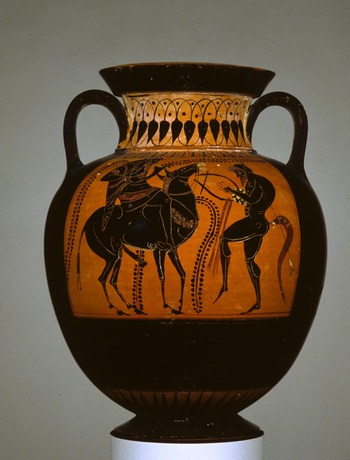
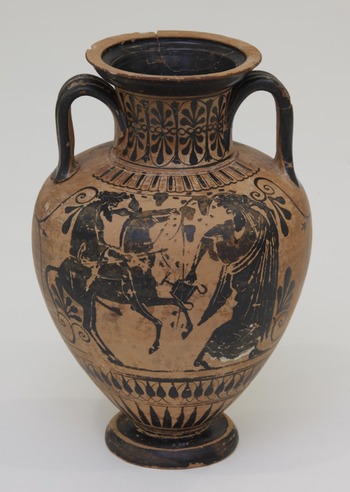
A third example of a vase depicting Hephaistos with deformed feet in this same manner is an amphora in Tampa (Cat. 6; Fig. 3) by the Euphiletos Painter from the second half of the sixth century. Both sides of the vase show a single draped male figure on an ithyphallic donkey, accompanied by a lyre-playing satyr. The rider in both scenes was originally identified as Dionysos (Beazley Reference Rouse1956, 323.21). However, I would argue that this vase in fact depicts Hephaistos, not Dionysos.
Black-figure neck amphora; Greek, Attic, attributed to the Euphiletos Painter [Beazley], c.520 bce. Ceramic, H. 12 5/8 in. Tampa Museum of Art, Joseph Veach Noble Collection 1986.027.

On one side Hephaistos's foot is clearly rendered in a manner similar to the Paris and Munich vases (Cat. 9 and 10). Instead of the smooth lines that characterise the bottoms of the satyr's feet, with the space between the heel and toe free of any disfiguration, the rider's foot has clear and apparently intended curves that create a scalloped effect on the bottom of his foot. The incision appears as tight and controlled as it does on the rest of the vase, with the details of the musculature skilfully done on both the satyr and the donkey, which would indicate that the appearance of the foot is intentional.Footnote 11
The last example of a vase depicting Hephaistos's disability in this manner is an amphora in Rome (Cat. 7). Like the previous vase, the rider was formerly identified as Dionysos. However, on the reverse of the vessel Dionysos is pictured with maenads, so the composition of the vase as a whole makes more sense when one considers it to be the Return, with Hephaistos as the rider on one side and Dionysos participating in the procession on the other side.Footnote 12 The kantharos that the rider holds in his left hand does not necessarily indicate that the figure is Dionysos. In the Return, Hephaistos is depicted in the context of Dionysian elements. He frequently holds a drinking horn, which, during the beginning to middle of the sixth century was an attribute of Dionysos (Carpenter 1968, 16), similar to the kantharos. Typical Dionysian elements cannot be used to unequivocally favour an identification of Dionysos over Hephaistos, as the attributes blend and are taken on by Hephaistos in the scene.Footnote 13
The definitive factor that proves the rider is Hephaistos is the manner in which the foot is represented. His foot is rendered in a zigzag fashion on this vase, and it is placed against the donkey's side, making the treatment clear and unobstructed. The incision appears to have been done painstakingly, and with a certain amount of control that does not suggest a slip of the hand when fashioning the bottom of Hephaistos's foot. Therefore, the curves are indicative of a decision to display the god's deformity in the same manner as on the three other vases that we have already discussed.
Of interest here is the fact that a common epithet for Hephaistos used by Homer is the term ἀμφιγυήεις, which refers to the god's feet being crooked.Footnote 14 This could be a synonym of the popular epithet for clubfoot, κυλλοποδίον, which is also used to describe Hephaistos.Footnote 15 It could also be used specifically to describe the crooked, zigzag feet on the previous four vases described (Cat. 6, 7, 9, 10), adding support to the idea that Hephaistos is rendered as lame on these vases.
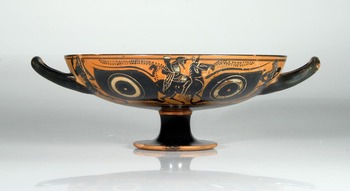
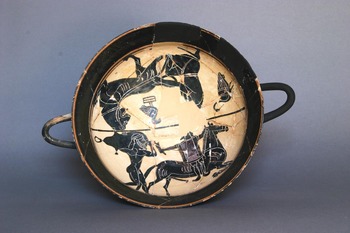
Two nearly identical cups by a painter in the Essen Group depict the disability in the same way on both vases. The first, a cup from Göteborg, dated between 530 and 520, does not even depict Hephaistos with a foot (Cat. 4; Fig. 4). The god's lower calf is rendered in an almost rectangular fashion, in sharp contrast to the thick curvature of the thigh and upper calf. Instead of the calf culminating with a foot, a sharp incised line terminates the calf without a foot. The lines of the calf even continue past the final line. The donkey rider on this vase was previously identified as Dionysos, like the riders on two vases previously mentioned (Cat. 6 and 7). However, his disability indicates that he is in fact Hephaistos.
Black-figure Type A cup; Greek, Attic, attributed to the Painter of the Essen Group, c.530–520. Göteborg, Rohsska Museum: 70.58. Photograph by Mikael Lammgård.

The second kylix is in Munich (Cat. 5), and the lameness is rendered in the exact same fashion. The two parallel lines cut off by an abrupt stroke at the bottom create a jagged, rectangular lower leg, instead of the curved calf and foot that one would expect. The fact that this technique was used more than once proves that the disability was not the result of a single slip of the hand when incising the leg; rather it is a deliberate decision to display Hephaistos's deformity. Detienne and Vernant (Reference Detienne, Vernant and Lloyd1978, 271) mention that the word χωλός can imply connotations of being truncated. In Plato's Laws the word is used to describe an individual with only one arm (Plato, Laws 794e). Perhaps these two vases, with legs chopped deliberately off above the foot, can be interpreted as representing this truncated connotation of χωλός.
The remaining Attic vases (Cat. 3, 8, 11) are each unique in their treatment of the disability. While there does not appear to be any connection between them in the way in which the disability is shown, they each represent fully realised examples of feet that are intended to be viewed as lame. A black-figure cup by the Durand Painter from the second half of the sixth century is reflective of another epithet used for Hephaistos, ῥικνὸς πόδας,Footnote 16 or shrivelled feet (Cat. 3). Hephaistos's thigh and calf appear normal, yet the foot is thin and withered, with the heel barely articulated from the leg. In comparison to the feet of the other figures on the vase, Hephaistos's is rendered very differently. Although it is a discernible foot, it appears unnatural and deformed.
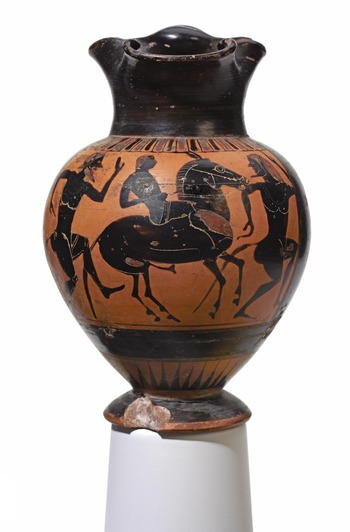
Yet another example of a vase portraying a lame Hephaistos is an oinochoe in San Simeon, c.530–520 (Cat. 8; Fig. 5). It is one of the vases that was previously cited by Hedreen (Reference Hedreen1992, 25) as potentially depicting a disability.Footnote 17
Black-figure oinochoe; Greek, Attic, Class of London B 534, c.530–520. San Simeon, Hearst Corporation: 9911. Photograph by Victoria Garagliano. © Hearst Castle ® CA State Parks.

Hephaistos's foot is incised very lightly, and in some places the lines are difficult to discern. It is a broad, triangular shape, making an almost hourglass form when combined with the calf. The foot splays out, and the two lines that should join together to create the toes never appear to meet, but flare out slightly just past the donkey's chest. While the feet of the other figures on the vase are not incised, they are recognisably and unmistakably feet. In comparison to the other figures, Hephaistos's splayed and cumbersome foot is almost unrecognisable as such.
The final Attic example depicting Hephaistos's disability is a black-figure amphora in Frankfürt dated to the last decade of the sixth century (Cat. 11; Fig. 6). It has been attributed to the Manner of the Kleophrades Painter. On it, Hephaistos's foot is drawn in an almost bestial fashion, similar in shape to the hind leg of a hare. The thigh and calf are both depicted with lifelike curves and musculature, but the foot is thin and elongated, and the toes are articulated in a paw-like fashion. The foot is placed against the donkey's front right leg, and the incision at the bottom of the foot lines up with the edge of the leg. Although this placement is not ideal for the depiction of his foot, it is clear that when viewed in conjunction with the feet of the other figures on the vase, Hephaistos's foot stands out as malformed.
Black-figure neck amphora; Greek, Attic, Manner of Kleophrades Painter, c.510–500. Frankfürt, Museum für Vor- und Frühgeschichte: B286.

In addition to the unmistakable depictions of Hephaistos's disability, there are other Attic examples that may possibly show him as lame, although they lack the certainty of those that I have already mentioned.Footnote 18 On one such example,Footnote 19 a calyx krater by the Antimenes Painter in the Louvre dating between 520 and 510, the god's foot is similar in style to the zigzag feet that I discussed above. Here the arch of Hephaistos's foot is drawn at a severe right angle, as opposed to the delicate curves with which the other feet on this vase are articulated.
In ancient literary sources, another way that Hephaistos is described is with the epithet κνῆμαι ἀραιαί, or slender legs.Footnote 20 There are many vases that could be interpreted as displaying Hephaistos with a slender leg.Footnote 21 On these vases the girth of Hephaistos's thigh is normal, if not exaggerated, and his calf is much more slender than one would expect. Though a definitive disability cannot be assigned to these examples, it is important to note that it was a relatively common artistic decision to depict the donkey-riding god with lower legs that are relatively thin, and seemingly weak. This draws directly from the aforementioned literary evidence for Hephaistos being thought of as having slender legs. There are also many other vases on which the rider has been previously identified as Dionysos that display a markedly slender lower leg as well.Footnote 22
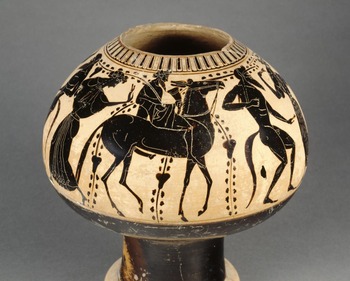
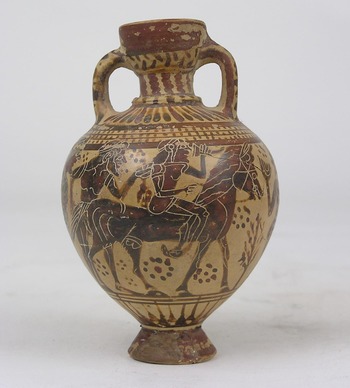
Besides the Attic examples, there are also several notable non-Athenian vases that depict Hephaistos as lame. They are for the most part contemporary with the Attic examples, all dating to the sixth century. Indeed, the oldest representations of the Return of Hephaistos can be found on Corinthian vases (Carpenter Reference Carpenter1986, 15). The earliest example of the Return and the first instance of his disability is found on a Middle Corinthian amphoriskos in the National Museum in Athens (Cat. 12; Fig. 7).
Black-figure amphoriskos; Greek, Corinthian, c.590–570. Athens, National Museum: 664. Photograph by Irini Miari. Copyright © Hellenic Ministry of Culture and Sports Archaeological Receipts Fund.

This vase dates from between 590 and 570, making it earlier than the François Vase. It displays a procession around its miniature belly in which Hephaistos rides side-saddle to the right, with his left foot heavily contorted into a clubfoot. A cloaked man walking behind him is commonly thought to be Dionysos, although others contest this identification (Isler-Kerényi Reference Isler-Kerényi2007, 24–7). There are several other differences in the iconography of this vase in comparison to its Attic counterparts showing the Return. The mount appears to be more like a horse than the donkey that is always displayed on Attic vases. The thick and flowing mane is very different from the short bristles seen on donkeys. The ears are smaller and more delicate than the large comical ears of a donkey. The bearded processional companions on this vase are not satyrs, but are generally considered to be padded dancers (Seeberg Reference Seeberg1965, 105). Interestingly, komast dancers are rarely depicted as ithyphallic, yet this vase is an exception (Smith Reference Smith, Csapo and Miller2007, 51).Footnote 23 While the identification of the scene on this vase as the Return of Hephaistos is contested (Carpenter Reference Carpenter1986, 16; Isler-Kerényi Reference Isler-Kerényi2007, 24–7), the iconography appears very strongly to be that of the Return.Footnote 24 If the rider is taken to be Hephaistos, it represents the earliest depiction of both the Return and his disability.
The second example, an earlier vase dating to the very beginning of the sixth century, is a Corinthian krater in the British Museum (Cat. 13). Some scholars have considered Hephaistos to be disabled on this vase (Seeberg Reference Seeberg1965, 103). However, on close examination, his feet do not appear to be deformed. This observation has already been made by Carpenter (Reference Carpenter1986, 17). There is a strong tradition of clubfoot komasts on Corinthian vases that in many ways has impacted the scholarship on the Return because of the shared lameness (Smith Reference Smith2009, 70; Ziskowski Reference Ziskowski2012, 211). This can be seen in the use of the term ‘clubfoot’ when describing the disability, as well as the comparisons that are drawn between lame komast dancers and Hephaistos (Smith Reference Smith2009, 75).
A Laconian cup in Rhodes, contemporary with the François Vase, also depicts Hephaistos's disability (Cat. 14; Fig. 8). The interior of the vase is divided in half. The god rides an ithyphallic donkey side-saddle, with his clubfeet contorted in opposite directions. He extends his right hand, holding a drinking horn, out to a naked man who follows on the left, with a wineskin slung over his left shoulder. This vase displays Hephaistos's lameness perhaps the most blatantly of all the vases, with both feet clearly and heavily disabled.
Black-figure kylix; Greek, Laconian, c.570. Rhodes, Archaeological Museum: 10.711. Copyright © Hellenic Ministry of Culture and Sports Archaeological Receipts Fund.

The last two non-Attic vases are both from the last third of the sixth century. A Caeretan hydria by the Eagle Painter (Cat. 15) shows Hephaistos riding a donkey to the left, with his feet curled into balls like clenched fists, while a Campana dinos in Würzburg (Cat. 16) depicts Hephaistos with thin legs that end in a small point. Both of these vases are commonly referenced when discussing the Return of Hephaistos, as they depict the scene in its entirety, and both obviously show his lameness.
Thus, the non-Attic examples that depict Hephaistos as lame during the Return have several similarities with their Attic counterparts. They all fall within the sixth century, are done in black figure, and for the most part are articulated in a unique manner on each vase. A clubfoot, however, is shown more accurately on these vases than on the Attic vases, which is a significant difference. It may also perhaps be the source of the aforementioned preference shown by modern scholars for the clubfoot epithet κυλλοποδίον when discussing Hephaistos, at the expense or neglect of other, more common ones, such as ἀμφιγυήεις, which refers to his feet being crooked.
CONCLUSION
Although there is uncertainty regarding exactly how many vases do indeed depict the Return, and how many show the god's lameness, I have shown that there are a significantly greater number of Attic vases that represent Hephaistos's disability than have been previously identified: seven in toto. I have also shown that there are several different ways that the disability was rendered, and that there was no standard iconography for depicting the disability.Footnote 25 The zigzag technique, as I have observed, was used by several painters on at least four different vases in the last quarter of the sixth century, a manner of indicating his lameness that was only previously recognised by Erika Kunze-Götte on the Munich vase (Cat. 10). This technique, as well as some of the others we have seen, relates very clearly back to the epithets used in literature for his disability, such as ἀμφιγυήεις (with both feet crooked), ῥικνὸς πόδας (shrivelled feet), κνῆμαι ἀραιαί (slender legs) and χωλός (lame, with associations of truncation). Thus, the seven new examples of a lame Hephaistos that I have discussed in this paper change our previous conception of the iconography of the Return. Not only are there more examples of his disability than have been previously recognised, but also we have discovered that there are multiple vases on which a figure who has been identified as Dionysos depicts in fact Hephaistos,Footnote 26 some of which show the god disabled (Cat. 4, 5, 6, 7).
ACKNOWLEDGEMENTS
The Department of Classical Studies at The College of William and Mary has been incredibly supportive of my research, and helped facilitate my stay in Oxford during the summer of 2013. I would like to thank Dr Peter Stewart, Director of the Classical Art Research Centre in Oxford for his gracious hospitality during my time researching in the Beazley Archives. I would also like to thank Dr Thomas Mannack and Dr Alastair Harden for their encouragement and advice during the formative stages of my research. Peter Liddel, Kathy Stanford and the entire editorial team at Cambridge University Press have been a source of continued guidance and advice during the revision process. Finally, I am enormously grateful to my mentor, Professor John Oakley. Without his counsel, wisdom and seemingly infinite patience this paper certainly would not exist.
APPENDIX 1: CATALOGUE OF VASES
-
1. Florence, Museo Archeologico Nazionale: 4209
François Vase
Attic black-figure volute krater c.570–560
Kletias and Ergotimos
BAPD 300000
The Return is depicted on a band of decoration beneath the main frieze. Hephaistos, who is inscribed, is bearded, astride an ithyphallic donkey facing and moving left towards Dionysos, who also is identified by an inscription. Hephaistos's feet are turned in two different directions; his left foot is normal, but his right foot, on the far side of the donkey, is turned around backwards.
Ithyphallic figures marked ΣΙΛΕΝΟΙ follow closely behind. The first one carries a wineskin, and the next plays the aulos. A third silen has grabbed a nymph and is dipping her in his arms, and at the rear of the scene, after the interruption of a missing fragment, two more nymphs follow; the last one holds a tympanum.
References: Beazley Reference Rouse1956, 76.1, 682; Beazley Reference Beazley1971, 29; Boardman Reference Boardman1974, fig. 46.7; Brommer Reference Brommer1978, 11 fig. 1, pl. 1.1–2; Beazley Reference Beazley1986, pl. 25.4; Carpenter Reference Carpenter1986, 19–21 pl. 4a; LIMC IV.2, 1988, s.v. Hephaistos, pl. 202 fig. 186; Carpenter, Mannack, and Mendonca Reference Carpenter, Mannack and Mendonca1989, 21; Carpenter Reference Carpenter1991, figs. 1–2, 20, 75, 86, 248, 284; Hedreen Reference Hedreen1992, 14–15, pl. 1a,b; Boardman Reference Boardman1993, 71 fig. 66; Boardman Reference Boardman1996, 102–3, figs. 89–90; Carpenter Reference Carpenter1997, pls. 5a, 12a,b, 38a; Sutton Reference Sutton and Cohen2000, 50 fig. 2.2; Boardman Reference Boardman2001, 52–3, 182, figs. 62–4, 202; Isler-Kerényi Reference Isler-Kerényi2007, 91, fig. 42; Hirayama Reference Hirayama2010, foldout, pls. I–III, 3–14, fig. 21b,c,e,g; Shapiro, Iozzo, and Lezzi Reference Shapiro, Iozzo and Lezzi2013, vol. 2 pl. 3, 36–7.
-
2. Berlin, Antikensammlung: 1704
Attic black-figure neck amphora c.570–560
Kyllenios Painter in Tyrrhenian Group
BAPD 310014
The upper register shows the Birth of Athena. To the left of Zeus stands a triad of figures, Hermes, Hephaistos and Dionysos, who are all labelled. On the right stands Hermes, facing left and holding his kerykeion. On the left Dionysos stands facing right, holding his kantharos in his right hand and gesturing with his left. In the middle, striding between the two is Hephaistos. He moves left, but his head is turned back to the right, facing Hermes. He holds his attribute, the double axe, in his left hand, and his right foot is placed forward and curved into a clubfoot.
References: Beazley Reference Beazley1956, 96.14, 683; Beazley Reference Beazley1971, 36; CVA, Berlin, Antikenmuseum 5 (45) 23–5, pls. 12.1–2, 14.1–2, 16.1–3; Heilmeyer et al. Reference Heilmeyer, Goemann, Giulianai, Platz and Zimmer1988, 66, no. 1; LIMC V.2, 1990, s.v. Hermes, pl. 255, fig. 681; Schefold Reference Schefold and Griffiths1992, fig. 1; Bilde, Nielsen and Nielsen Reference Bilde, Nielsen and Nielsen1993, 300, fig. 11; Boardman Reference Boardman1996, 104, fig. 91; Knittlmayer and Heilmeyer Reference Knittlmayer and Heilmeyer1998, 43, no. 16; Boardman Reference Boardman2001, 50 fig. 59; Deacy and Villing Reference Deacy and Villing2001, pl. 5b; Angiolillo and Giuman Reference Angiolillo and Giuman2007, 219, fig. 7; Isler-Kerényi Reference Isler-Kerényi2007, 153, fig. 94; Schlesier and Schwarzmaier Reference Schlesier and Schwarzmaier2008, 75, fig. 6a–b; Backe-Dahmen et al. Reference Backe-Dahmen, Kästner, Schwarzmaier, Laurentius and Geske2010, 12–13, no. 3; Hirayama Reference Hirayama2010, fig. 24d; Schwarzmaier et al. Reference Schwarzmaier, Scholl, Geske, Laurentius and Maischberger2012, 71, no. 30.
-
3. Luzern, Market, Ars Antiqua
Athenian black-figure Type A cup c.550–520
Durand Painter
BAPD 340234
This cup depicts a Return scene punctuated by eyes on each side. Outside of the eyes are a pair of dogs as well as maenads, one of whom frolics with one krotyle, another with an aulos, and the others simply dance. Between the eyes on one side stands Dionysos and another draped, bearded male figure, surrounded by vines.
Between the eyes on the other side of the cup is Hephaistos. He rides a braying donkey. Behind the animal walks an almost completely concealed satyr accompanying Hephaistos. The god's thigh and calf are drawn with thickly defined musculature, yet his foot is drawn as a rather withered stump, with the heel barely articulated from the rest of his leg. This is a strangely drawn foot, when compared with the other feet pictured on the vase, and it can be interpreted as a depiction of his disability.
The tondo of the cup contains a Gorgoneion.
Reference: Beazley Reference Beazley1971, 98.2 bis.
-
4. Göteborg, Rohsska Museum: 70.58
Athenian black-figure Type A cup c.530–520
Painter of the Essen Group
Perhaps workshop of Nikosthenes
BAPD 14662
On both sides of the cup, between the eyes a single figure identified as Dionysos rides a donkey, holding a comically large drinking horn. Satyrs dance outside of the eyes, and beneath both handles are jumping dolphins.
The rider's leg terminates without a foot; instead a straight incised line cuts the leg off abruptly. All of the satyrs have perfectly normal feet, whereas the rider's leg seems to be intentionally botched. While the thigh and upper part of the calf are drawn using curvature more reflective of the human form, the lower part of the calf is done in an almost rectangular manner, which is strange. This indicates that the rider is disabled, which would mean that the former identification of the figure as Dionysos is incorrect. The rider is Hephaistos, and this vase depicts the Return of Hephaistos to Olympus.
Reference: CVA, Göteborg, Public Collections (3) 75 pl. 32.1–3.
-
5. Munich, Antikensammlungen: 2090
Athenian black-figure Type A Cup c.530–520
Painter of the Essen Group
Perhaps workshop of Nikosthenes
BAPD 331764
This cup is a twin of the kylix in Göteborg (Cat. 4). The rider's disability is rendered in exactly the same manner; his lower calf lacks any curvature, and is formed by just two straight lines that at the bottom are met by another straight-line cutting perpendicularly across, thereby rendering the leg as a rectangular stump, rather than a foot.
References: Beazley Reference Beazley1956, 631.4; CVA, Munich, Antikensammlungen 13 (77), 102–3, fig. 1, pl. 66.1–8.
-
6. Tampa (FL), Museum of Art: 86.27
Athenian black-figure neck amphora c.530–520
Euphiletos Painter
BAPD 301707
Both sides of this vase display a rider on a donkey partnered with a satyr. The riders have been incorrectly identified as Dionysos, when in fact they are Hephaistos. On the first side of the vase, the god rides an ithyphallic donkey whose head is thrown back as if the animal is braying. On the right, a satyr playing the lyre steps towards Hephaistos. The god holds a drinking horn in his right hand, and his foot is drawn with a zigzag line that indicates his disability.
The reverse of this vase has another rider, seemingly without any identifiable attributes. The rider is almost identical to the one on the other side of the vase, although he holds a strand of ivy. The satyr in this case is also on the right, playing the lyre, but he moves to the right with his back to Hephaistos. While he plays the strings with his left hand, he grasps a branch of ivy with his right.
The rider's foot on this side looks to be deformed also, although not quite as striking as the foot on the other side: the zigzag is much less pronounced than on side A, although it is still different from the satyrs’.
References: Beazley Reference Beazley1956, 323.21; Beazley Reference Beazley1971, 142; Hyatt Reference Hyatt1981, fig.1, second from left; Carpenter, Mannack and Mendonca Reference Carpenter, Mannack and Mendonca1989, 88.
-
7. Rome, Mus. Naz. Etrusco di Villa Giulia: 74944
Attic black-figure neck amphora c.530–520
BAPD 5400
On the left a maenad and a satyr both move rapidly to the left, although their heads are turned back to the right. The satyr appears to be carrying a wineskin, which is visible below the donkey's belly. On the right another satyr stands facing right, playing the barbiton.
In the middle, a bearded figure rides an ithyphallic donkey to the right. In his right hand he grasps the reins, with his elbow jutting back, and in his left he holds a large kantharos. The bottom of the rider's foot is incised in a zigzag outline that indicates his disability. Although the rider on this vase was previously identified as Dionysos, he is in fact Hephaistos on the donkey.
The reverse depicts Dionysos, holding a drinking horn, and flanked by maenads.
References: Moretti Reference Moretti1975, pl. 61, no. 14; Battaglia, Pallottino and Proietti Reference Battaglia, Pallottino and Proietti1980, 221, fig. 294.
-
8. San Simeon (CA), Hearst Corporation: 9911
Athenian black-figure oinochoe c.530–520
Class of London B 524
BAPD 351290
An unbearded Hephaistos with closely cropped hair appears in the centre of the scene, riding an ithyphallic donkey. On either side of him, naked, ithyphallic satyrs dance, gesturing with their arms and moving their feet. The one to Hephaistos's right turns back around to the left in order to make eye contact with him.
Hephaistos's foot is depicted as a broad triangle, which is strange in comparison to the naturally depicted feet of both satyrs. The foot splays out in an ungainly manner, and the calf and the foot together create an almost hourglass shape. This strange depiction represents his congenital disability. Beazley Reference Beazley1971, 179.3
Reference: Hedreen Reference Hedreen1992, 184.
-
9. Paris, Musée du Louvre: F321
Attic black-figure psykter c.520
Related to Antimenes Painter
BAPD 320242
Hephaistos sits astride an ithyphallic donkey moving to the right. Bearded, he holds a drinking horn in his left hand. His right foot is articulated by incision against the body of the donkey. It is drawn with a zigzag that sets it apart from the other feet depicted on the vase. This is indicative of Hephaistos's disability.
On the left is a dancing maenad, and a satyr leads on the right. The procession, consisting of satyrs and maenads, moves right around the psykter to Dionysos, who is seated on a diphros on the opposite side of the vase.
References: CVA, Paris, Musée du Louvre 8 (12) 505–6, pls. 73.4–6, 74.2–3; Beazley Reference Beazley1956, 282.22; Drougou Reference Drougou1975, 14, 47, pl. 14.1; Carpenter, Mannack and Mendonca Reference Carpenter, Mannack and Mendonca1989, 73.
-
10. Munich, Antikensammlungen: J1271
Athenian black-figure amphora c.520–510
Three-line Group
BAPD 1159
A bearded Hephaistos is pictured in the middle of the scene riding a braying, ithyphallic donkey side-saddle. On each side a satyr flanks him, and all of the figures are moving to the right. The satyr on the left tugs on Hephaistos's garment, and Hephaistos turns his head back to look at him.
Hephaistos's feet are drawn with a mangled, zigzag quality that indicates his disability. Faint traces around the feet appear to be a phallus that was wiped off and redrawn at a lower angle so as to not obstruct the feet.
The reverse of the vase depicts Herakles battling a sea monster.
References: CVA, Munich, Museum Antiker Kleinkunst 8 (37) 29–31, pls. 373.4, 377.1–2, 378.4; LIMC III.2, 1986, s.v. Dionysos, pl. 343, fig. 397; Vierneisel and Kaeser Reference Vierneisel and Kaeser1990, 379, fig. 67.11.
-
11. Frankfürt, Museum für Vor- und Frühgeschichte: B286
Athenian black-figure amphora c.510–500
Manner of Kleophrades Painter
BAPD 351279
Hephaistos and Dionysos are pictured amidst vines, both moving to the right. Dionysos is on the right, turning back to face Hephaistos. He holds a kantharos in his right hand and grasps an ivy vine in his left. On the left Hephaistos rides a rearing, ithyphallic donkey and holds a goad. His left foot is not pictured, but his right foot extends downwards and is depicted with an almost bestial quality. The toes are articulated by incision, and in comparison with Dionysos’ feet, Hephaistos is clearly depicted as disabled.
On the reverse is a scene of satyrs along with dancing maenads.
References: CVA, Frankfurt am Main 1 (25) 29 pls. 30.1–2, 33.6; Beazley Reference Beazley1971, 176; Kunze-Götte Reference Kunze-Götte1992, pls. 53.4, 56.2–3, 67.4.
-
12. Athens, National Museum: 664
Middle Corinthian amphoriskos 590–570
In the centre of the vessel Hephaistos rides a donkey side-saddle to the right. Although it is difficult to make out his feet, both of his calves are visible against the donkey's side. The foot that can clearly be seen is contorted into a twisted clubfoot, indicating Hephaistos's disability. In his left hand he holds a drinking horn up to his lips, and he grasps the reins of the animal in the other. The procession moves around the vase to the right. It is composed primarily of komasts, some of whom are ithyphallic, and one of them holds a drinking vessel.
A cloaked figure who may be identified as Dionysos stands two figures behind Hephaistos in the procession.
In front of the animal is a plant, and the rest of the empty space is filled with dot rosettes.
References: Seeberg Reference Seeberg1965, 85 pl. XXXIV; Hedreen Reference Hedreen1992, 131; Dasen Reference Dasen1993, 199; Garland Reference Garland1995, pl. 18; Isler-Kerényi Reference Isler-Kerényi2007, 24, fig. 13; Ziskowski Reference Ziskowski2012, 107 fig. 2.
-
13. London, British Museum: 1867,0508.860
Corinthian black-figure krater c.600–575
Apparently by the Ophelandros Painter
On the left there are two komasts, the second one carrying a wineskin over his left shoulder and a vessel in his right hand. Next, Dionysos faces right, holding a drinking horn in his left hand. In the centre Hephaistos rides a mule to the right. He holds a drinking horn in his right hand, which he turns around and extends towards Dionysos. In front of Hephaistos a komast lunges forward with his left foot. He holds a branch with his left hand and looks back, seemingly making eye contact with the donkey. Two komasts on the right complete the scene. One stands to the right holding a drinking horn, while the other faces left, gesturing with both hands by his hips.
Although some scholars believe that Hephaistos is lame on this vase, this is not the case as his feet are sound.
In the lower band of decoration is an animal frieze. A combat scene is shown on the reverse.
References: Forsdyke, Smith and Walters Reference Forsdyke, Smith and Walters1893, 13; Carpenter Reference Carpenter1986, 17, pl. 4b; Hedreen Reference Hedreen1992, 25; Walsh Reference Walsh2009, 109 fig. 23; Ziskowski Reference Ziskowski2012, 217–18 fig. 3; Oakley Reference Oakley2013, 53–4 fig. 13.
-
14. Rhodes, Archaeological Museum: 10.711
Laconian black-figure kylix c.570
A line divides the tondo of the cup into two equal parts. In one zone a bearded man kneels and guides a lion from the rear with reins. The beast turns his head back to look at him. An owl is perched above, and an aquatic bird stands on the far left.
On the other half of the interior Hephaistos, identified by his two clubfeet, rides an ithyphallic donkey side-saddle. With his left hand he grasps between the ears of the donkey, while holding a drinking horn in his right hand. He stretches his right arm out to the right towards the naked man who follows the beast on the left, a wineskin slung over his shoulder. This scene depicts an abbreviated version of the Return of Hephaistos to Olympus.
References: CVA, Rhodes, Archaeological Museum 1 (9) III D pl. 4; Pipili Reference Pipili1987, 54, fig. 80; Hedreen Reference Hedreen1992, 146; Garland Reference Garland1995, pl. 19; Bazopoulou-Kyrkanidou Reference Bazopoulou-Kyrkanidou1997, 150 fig. 5.
-
15. Vienna, Kunsthistorisches Museum: 3577
Caeretan black-figure hydria c.530–520
Eagle Painter
On the left Dionysos stands facing right holding a kantharos in his left hand. An unbearded Hephaistos, atop a donkey, rides left towards Dionysos. A maenad runs behind Hephaistos holding a snake in both hands.
Hephaistos's feet are curled back into clenched balls, with the toes articulated to further emphasise the disability. His left foot is clearly seen, but his right clubfoot is only slightly visible beneath the donkey's belly; just enough is shown to indicate that both feet, not just one, are disabled.
References: Boardman Reference Boardman1998, fig. 491; Boardman Reference Boardman2001, fig. 107; Walsh Reference Walsh2009, 110 fig. 42.
-
16. Würzburg, Martin von Wagner Museum: H5332
Campana black-figure dinos c.530–520
In the centre a naked Hephaistos rides a donkey to the left towards a standing figure, who is usually identified as Dionysos, gesturing with both hands in the donkey's face. Behind Hephaistos, on the right, a satyr follows and grasps the donkey's tail with his left hand while holding a drinking horn up in his right hand. Slung over on his back is a full wineskin. Several satyrs follow in the procession.
Beneath a thick muscular thigh, Hephaistos's calf is incredibly slender. Instead of a naturally articulated foot, the leg culminates in a withered point. This clearly indicates Hephaistos's disability.
References: Brommer Reference Brommer1978, fig. 11.3; Boardman Reference Boardman2001, fig. 106.
-
17. *AddendumFootnote 27
Beaulieu-sur-Mer, Villa Kerylos
Chalcidian neck amphora c.560–510
On the left of the scene stands Dionysos, whose left hand is shown reaching out towards the middle figure. Hephaistos is pictured in the centre of the field reclining across the back of a donkey, holding a phiale out towards Dionysos in his right hand. To the right of the downward-looking donkey prances a satyr, depicted with hooves as opposed to human feet. The satyr looks back towards the donkey, while gesturing up with his left hand, and down with the right. Above the central scene, on the curve of the shoulder, two sphinxes are depicted facing each other, each stretching a paw out towards their companion.
On the reverse of the vase a lion and a stag are shown in the upper band of decoration, and in the central field two pairs of figures face each other. In each pair a man stands on the left, with a woman to his right.
Hephaistos's feet are rendered by incision overlapping on the black gloss used for Dionysos’ garment. Both feet have an incised U-curve indicating the ankle-bone. The right foot is rendered with toes splayed outwards, while the left (and lower) foot has the toes curled in on themselves; a stark contrast to its companion. In his discussion of this vase, Dietrich von Bothmer notes the disability displayed here.
References: Rumpf Reference Rumpf1927, 52, 106–7, 179; Von Bothmer Reference Von Bothmer1998, 532–40.
APPENDIX 2: VOCABULARY USED TO DESCRIBE HEPHAISTOS'S DISABILITY
-
ἀμφιγυήεις: with both feet crooked
Iliad 1.607, 14.239, 18.383, 18.393, 18.462, 18.587, 18.590, 18.614; Odyssey 8.300, 8.349, 8.357; Hesiod, Theogony 945
-
κυλλοποδίον: clubfoot
Iliad 18.371, 20.270, 21.331
-
ῥικνὸς πόδας: shrivelled feet
Homeric Hymn to Pythian Apollo 317
-
κνῆμαι ἀραιαί: slender legs
Iliad 18.411, 20.38
-
ἔρρων: limping
Iliad 18.421
-
ἠπεδανός: halting
Odyssey 8.311; Homeric Hymn to Pythian Apollo 31
-
πηρωθέντα: maimed, mutilated, (in this case) lamed (referring to his feet)
Apollodorus 1.3.5
-
πυγμαίου ἀνδρὸς μίμησις ἐστί: it is the likeness of a dwarf (referring to a cult statue of Hephaistos)
Herodotus 3.37.2
-
οὔτε τοὺς πόδας ἐρρωμένος: not strong of his feet
Pausanias 5.19.8
-
βαρύγουνος: heavyknee
Nonnus 5.140
-
σκάζοντα: limping
Nonnus 5.141
-
λεπταλέων σκάζοντα ποδῶν ἑτεραλχέι ταρσῶ: limping on poorly matched delicate feet
Nonnus 9.230
-
Various forms of the verb χωλεύω: lame
-
χωλὸν ἐόντα
Iliad 18.397; Odyssey 8.308
-
χωλεύων
Iliad 18.417, 20.38
-
χωλὸς ἐών
Odyssey 8.332
-
χωλός
Apollodorus 3.14.6
It seems as though there was a trend in the older sources, particularly Homer, to describe Hephaistos's lameness specifically in regard to how the disability physically manifested itself, whereas later literary sources tend to focus on the manner in which Hephaistos moved.