INTRODUCTION
Dogs have several roles in modern human society including serving as companions to people, guides for the blind, guards and hunting dogs. Dogs may carry parasites transmissible to humans and pose a health risk (Shaw et al. Reference Shaw, Day, Birtles and Breitschwerdt2001). The brown dog tick, Rhipicephalus sanguineus sensu lato is a main tick species distributed in tropical and subtropical regions worldwide (Latrofa et al. Reference Latrofa, Dantas-Torres, Giannelli and Otranto2014; Ereqat et al. Reference Ereqat, Nasereddin, Al-Jawabreh, Azmi, Harrus, Mumcuoglu, Apanaskevich and Abdeen2016). The protozoal pathogens associated with R. sanguineus s.l, which cause canine vector borne diseases include Hepatozoon canis and Babesia vogeli (Criado-Fornelio et al. Reference Criado-Fornelio, Rey-Valeiron, Buling, Barba-Carretero, Jefferies and Irwin2007). Hepatozoon canis is present in many countries in Asia, Africa, Europe and America (Karagenc et al. Reference Karagenc, Pasa, Kirli, Hosgor, Bilgic, Ozon, Atasoy and Eren2006). This parasite is transmitted to dogs by the ingestion of infected ticks. In infected dogs, gamonts are present within peripheral blood leukocytes. Hepatozoon canis infections range from asymptomatic to life threatening in which clinical findings such as fever, anaemia, emaciation and lethargy are found. Coexisting infections with pathogens such as Babesia vogeli and Ehrlichia spp. may worsen the clinical condition of dogs infected with H. canis. Hepatozoon felis causing feline hepatozoonosis, has a wide geographic distribution. Its mode of transmission is currently unknown and it could be transmitted by some ectoparasite vector such as fleas, mites or tick species, or transplacentally (Baneth et al. Reference Baneth, Sheiner, Eyal, Hahn, Beaufils, Anug and Talmi-Frank2013). Hepatozoon felis or closely related species are responsible for infection of the myocardium and skeletal muscles in domestic cats and other carnivores (Kubo et al. Reference Kubo, Miyoshi and Yasuda2006, Reference Kubo, Jeong, Kim, Kim, Lee, Kimura, Agatsuma, Sakai and Yanai2010; East et al. Reference East, Wibbelt, Lieckfeldt, Ludwig, Goller, Wilhelm, Schares, Thierer and Hofer2008; Giannitti et al. Reference Giannitti, Diab, Uzal, Fresneda, Rossi, Talmi-Frank and Baneth2012).
Babesiosis is a disease of veterinary and human importance with a great economic impact in livestock. A major research effort has been devoted to understanding its mechanisms of pathogenicity, treatment and prevention by vaccines (Schnittger et al. Reference Schnittger, Rodriguez, Florin-Christensen and Morrison2012). Several babesial species are known to cause canine babesiosis (Andersson et al. Reference Andersson, Bergvall, Chirico, Christensson, Lindgren, Nordstrom and Kjellander2016; Karlsson and Andersson, Reference Karlsson and Andersson2016; Solano-Gallego et al. Reference Solano-Gallego, Sainz, Roura, Estrada-Pena and Miro2016). These species typically have specific tick vectors, antigenic properties and geographic distribution (Lobetti, Reference Lobetti1998; Boozer and Macintire, Reference Boozer and Macintire2003; Uilenberg, Reference Uilenberg2006). Babesia vogeli transmitted by R. sanguineus s.l in tropical and subtropical regions around the world (Passos et al. Reference Passos, Geiger, Ribeiro, Pfister and Zahler-Rinder2005) infects canine erythrocytes causing anaemia. It may cause severe illness in young puppies, in immune-suppressed dogs or in dogs co-infected with other pathogens. Other babesial species cause diseases with variable levels of severity ranging from sub-clinical infection to fatal disease.
No reports have been made to date of tick borne pathogen infections in dogs from Palestine. It is important to study the presence of these pathogens in order to know what disease can be expected. Molecular methods play an important role in the diagnosis of canine diseases and research into their distribution and prevalence. In this study, PCR was used to evaluate tick borne protozoal pathogens in blood samples and ticks of domestic dogs in an area where the tick R. sanguineus s.l is present.
METHODS
Study area and blood collection
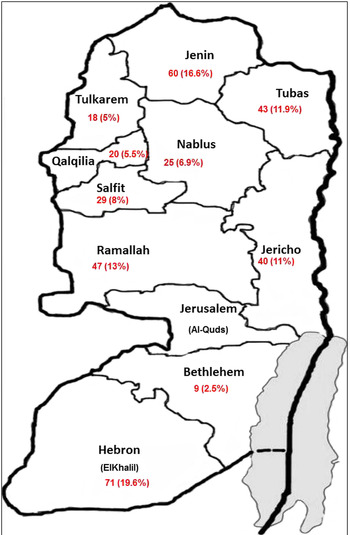
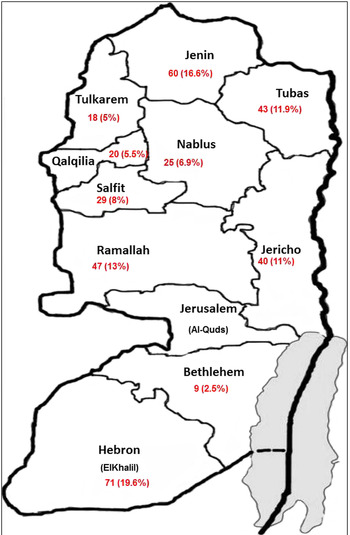
This study was carried out on blood samples collected during 2010, 2014 and 2015. In total, 362 blood samples of apparently healthy dogs were collected from ten rural districts of Palestine (Fig. 1 Map, Table 1). The dogs never travelled outside of Palestine, and permission was received from the owners for blood collection and its use in the study. Five mL of blood were collected from the cephalic vein into anticoagulant (EDTA) tubes and stored at −20 °C until DNA was extracted as described below.
Map of the districts of Palestine indicating the localities from which samples were collected and the number of dogs collected in each district. The overall infection rates with tick-borne pathogens identified are in brackets.
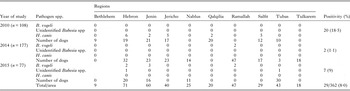
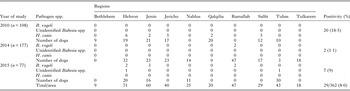
Positivity and yearly distribution of Babesia and Hepatozoon spp. infections in dogs in different sampling site of Palestine
Tick collection and identification
Ticks were collected from dogs from four rural districts of Palestine (Hebron, Jenin, Nablus and Tubas) in 2015. The ticks, one to five hard ticks per dog, were taken off from the skin of 77 dogs. All ticks found on each animal were immediately introduced into 70% ethanol, identified using standard taxonomic keys (Feldman-Muhsam, Reference Feldman-Muhsam1951, Reference Feldman-Muhsam1954) and stored at −20 °C until DNA extraction.
DNA extraction and PCR amplification
DNA from the blood of dogs was extracted using a commercial kit (Master Pure™ DNA purification kit for blood version II, Epicenter, Madison, WI, USA) according to the manufacturer's instructions and adjusted to a volume of 100 µL of blood. The eluted DNA was kept at −20 °C before PCR amplification. DNA was extracted from each tick using a DNA extraction kit (QIAGEN GmbH, 40724 Hilden, Germany) following the manufacturer's instructions. Each tick was crushed individually with a disposable sterile scalpel in a microtube. After digestion with proteinase K (20 µg mL−1), samples were applied to columns for absorption and washing of DNA. DNA was eluted in 100 µL of buffer and stored at 4 °C until used as template for PCR amplification. PCR was performed as described previously (Casati et al. Reference Casati, Sager, Gern and Piffaretti2006) with the following modification: the PCR reactions were performed in a total volume of 25 µL using PCR-Ready Supreme™ mix (Syntezza Bioscience, Jerusalem, Israel) including the primers at 1 µ m final concentration. The PCR amplification program performed by a thermocycler (Mastercycler Personal, Eppendorf) included an initial denaturation step of 5 min at 94 °C, followed by 35 cycles of denaturation at 94 °C for 45 s, annealing at 55 °C for 30 s, and elongation at 72 °C for 45 s and final extension 72 °C for 5 m.
DNA samples of H. canis and B. vogeli, from a previous study on ticks (Azmi et al. Reference Azmi, Ereqat, Nasereddin, Al-Jawabreh, Baneth and Abdeen2016), were run in parallel and used as a positive controls in each reaction. Negative control samples consisting of PCR mixture containing distilled water were included in each reaction. Five microlitres of the PCR products were analysed on 2% Tris-acetate-EDTA buffer (TAE 1X) agarose gels and visualized under UV transillumination.
Sequence analysis and Phylogenetic analysis
Sequencing was performed by an ABI 3730xl DNA Analyzer (Hylab Co., sequencing service, Israel). The products were sequenced in both directions with the same primers as for the PCR. The BioEdit software was used to assemble the forward and reverse sequences obtained.
Sequences of PCR products obtained with the BN2/BJ1 primer set were analysed using BLASTn to confirm their identities. They were then compared with the 18S rRNA of Babesia and Hepatozoon sequences from GenBank by means of multiple alignments using the ClustalW algorithm http://www.genome.jp/tools/clustalw/. In order to investigate the occurrence of different genotypes, we compared the sequences obtained from dogs with those available in GenBank from other different geographical regions. Sequences belonging to a certain species were identified based on being the first and closest match in GenBank and having an identity of >97 with 100% coverage. Phylogenetic trees were inferred using the neighbour-joining analysis, by means of the MEGA6 software with a bootstrap of 1000 replications. The 18S rDNA gene sequence of Isospora belli (GenBank accession DQ060666·2) was used as an outgroup.
Statistical analysis
Statistical analysis of the epidemiological data was carried out using the SPSS V.17.0 program and the Chi square test was used in the analysis. A P value < 0·05 was considered statistically significant.
RESULTS
Dog survey and pathogen detection and identification
A total of 362 blood samples were collected from dogs in ten districts of Palestine. Collection from dogs included: 60 (16·6%) from Jenin, 71 (19·6%) from Hebron, 47 (13%) from Ramallah, 43 (11·9%) from Tubas, 40 (11%) from Jericho, 29 (8%) from Salfit, 25 (6·9%) from Nablus, 20 (5·5%) from Qalqilia, 18 (4%) from Tulkarem and 9 (2·5%) from the Bethlehem district (Fig. 1 map). The number of blood samples collected in different years from different districts varied with 108 in 2010, 177 in 2014 and 77 in 2015 (Fig. 1, Table 1).
In total 73 of the dogs sampled were females (20·2%) of which 7 (9·5%) were PCR-positive, of which 1/73 (1·4%) were positive for Babesia spp and 6/73 (8·2%) for Hepatozoon spp. Two hundred and eighty nine ticks were males (79·8%) of which 22 (7·6%) were PCR-positive, 14/289 (4·8%) for Hepatozoon and 8/289 (2·8%) for Babesia spp. None of these positive dogs carried ticks infected by the studied pathogens. Sex was found to be significantly associated (P = 0·02) with positivity for Babesia infection and not significantly associated with Hepatozoon infection. The dog's age was known only for 324 dogs with a range of 4 months–12 years, 53·9%; 4 months–2 years, 26·2%; 3–5 years, 6·4%; 6–8 years, 3·0%; >8 years, while no information on age was available for 38 (10·5%) dogs. In total 13 of the 29 (44·8%) dogs (0–2 years old) were infected with Hepatozoon and Babesia Spp., seven (24%) dogs in the group aged 3–5 years, four (14%) were in the group aged above 6 years and five (17%) was not available. The animals carrying the infected ticks were apparently healthy and did not show any manifestations of disease.
DNA fragments of approximately 540 or 490 bp, corresponding to Hepatozoon or Babesia spp., respectively, were detected from 8·0% (29/362) of the dog blood DNA samples. Twenty samples were positive in 2010, two in 2014 and seven in 2015. Nine were PCR positive for Babesia species, seven of which were infected with B. vogeli (1·9%) and two were infected with an unidentified Babesia sp (0·6%). All the 20 additional positive dogs (5·5%) were infected with H. canis (Table 1).
Tick survey and pathogen detection and identification
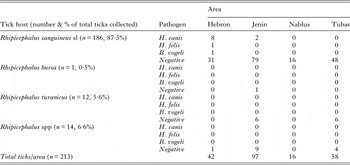
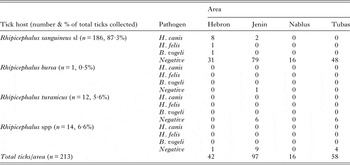
A total of 213 partially fed hard ticks were collected from 77 dogs in four districts. Collection included: 97 ticks (45·5%) from Jenin, 58 (27·2%) from Tubas, 42 (19·7%) from Hebron and 16 (7·5%) from Nablus (Table 2). The most abundant tick species was R. sanguineus s.l. (186/213, 87·3%), 5·6% were Rhipicephalus turanicus, 6·6% were Rhipicephalus spp. and 0·5% was Rhipicephalus bursa (Table 2). The majority of collected ticks were adult females: 135 (63·3%), 55 (25·8%) were adult males and 23 (10·7%) were nymphs. Overall, a total of 12 ticks, which comprised 5·6% of the ticks collected, were positive for Babesia or Hepatozoon and these pathogens were detected only in R. sanguineus s.l ticks. One tick was infected with B. vogeli (0·5%), one with H. felis (0·5%) and with H. canis (4·7%). None of the studied pathogens were found in R. bursa or R. turanicus. All positive ticks were collected from male dogs. The presence of pathogen DNA was not significantly different in female (6/12, 50%) than in male (2/12, 16·7%) or nymphal ticks (4/12, 33·3%) (P = 0·27).
Infection rates of detected pathogens from ticks in four study sites in Palestine evaluated by PCR and DNA sequencing
Phylogenetic analysis
Phylogenetic trees for Hepatozoon and Babesia were constructed from 18S rRNA gene sequences generated in this study with comparison of the DNA 490 or 540 bp amplified DNA fragments to selected sequences available in GenBank using the Mega6 software and sequences from a previous study (Azmi et al. Reference Azmi, Ereqat, Nasereddin, Al-Jawabreh, Baneth and Abdeen2016).
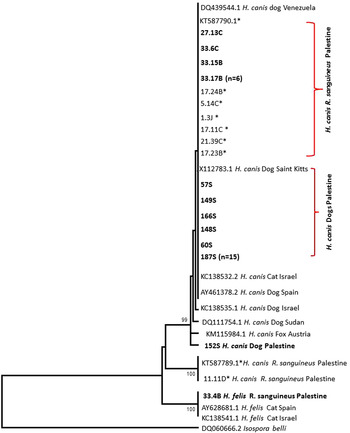
The Hepatozoon phylogram (Fig. 2) revealed two main clusters representing all the sequences of H. canis and H. felis generated in this study from DNA detected in ticks and dogs (n = 31). One cluster represents H. canis (n = 30). In this cluster, two clades were formed, which included most of the study sequences. These clades included the sequences from Palestine and sequences from other countries such as Venezuela, Saint Kitts in the Caribbean, Israel, Spain, Sudan and Austria (Fig. 2).
Phylogenetic analysis of the 420 bp sequences of Hepatozoon spp. detected in this study and compared with GenBank accessions. The phylogram was constructed by the UPGMA method with bootstrap of 1000 replications using the Mega 6 program. The GenBank accession numbers, species of infected animals and country of origin from which the sequences were derived are included for each sequence. GenBank accessions for sequences derived from the previous study are marked by star (*). The number of identical sequences is in brackets. Selected reference H. canis sequences from GenBank are also shown. Isospora belli was used as out-group. UPGMA, unweighted pair group method with arithmetic mean.
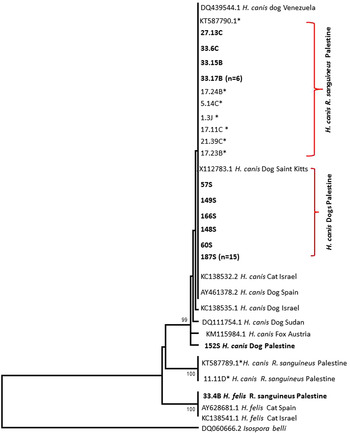
Based on the phylogenetic analysis, it was demonstrated that the 30 H. canis sequences clustered separately from two H. canis sequences (KT587789·1, and 11·11D) derived from ticks collected in Palestine during a previous study (Azmi et al. Reference Azmi, Ereqat, Nasereddin, Al-Jawabreh, Baneth and Abdeen2016). Concerning H. felis, the phylogram showed that the Palestinian 18S rRNA sequence of H. felis clustered together with those from Spain (AY628681·1) and Israel (KC138541·1).
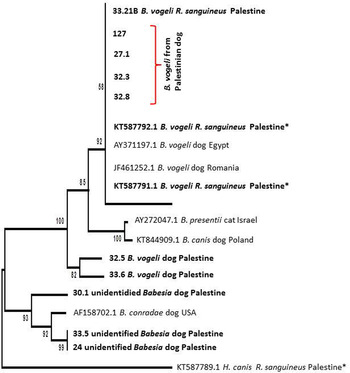
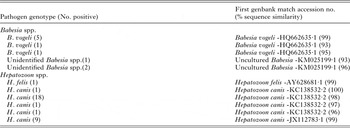
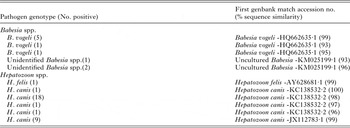
The second phylogram included all Babesia sequences generated in this study (Fig. 3), which are represented in two main clusters. One cluster represents the large-from Babesia species. In this cluster, the 18S rRNA gene sequences of B. vogeli (n = 7) described herein formed well supported clades of five sequences that were identical to each other with 99% nucleotide identity (Fig. 3, Table 3) and identical to B. vogeli respective reference sequences from Romania (accession nos. HQ662635·1; JF461252·1) and Egypt (AY371197·1), (Passos et al. Reference Passos, Geiger, Ribeiro, Pfister and Zahler-Rinder2005; Ionita et al. Reference Ionita, Mitrea, Pfister, Hamel, Buzatu and Silaghi2012), with the exception of two sequences (325 and 326) that differed with a high bootstrap support (100%) and shared only 93–95% identity with B. vogeli (accession no: HQ662635·1). The second cluster represents sequences of previously unidentified Babesia sp. that clustered close but distinctly from Babesia conarade sequences from California (USA).
Phylogenetic analysis of 421 bp sequences of Babesia spp. detected in this study and compared with GenBank accessions. The phylogram was constructed by the UPGMA method with bootstrap of 1000 replications using the Mega 6 program. The GenBank accession numbers, species of infected animals and country of origin from which the sequences were derived are included for each sequence. GenBank accessions for sequences derived from the previous study are marked by star (*). The number of identical sequences is in brackets. Selected reference Babesia sequences from GenBank are also shown. Hepatozoon canis (KT587789·1) was used as out-group. UPGMA, unweighted pair group method with arithmetic mean.

Comparison of DNA sequence similarities between pathogens detected in dogs and ticks in this study and GenBank deposited sequences
DISCUSSION
To date there have only been a few studies on vector borne agents in Palestinian dogs but our study has confirmed that H. canis and B. vogeli occur in Palestine. Molecular methods used to detect Hepatozoon spp and Babesia spp. are sensitive and specific for protozoal pathogens in peripheral blood and also in arthropod vectors (Criado-Fornelio et al. Reference Criado-Fornelio, Martinez-Marcos, Buling-Sarana and Barba-Carretero2003; Azmi et al. Reference Azmi, Ereqat, Nasereddin, Al-Jawabreh, Baneth and Abdeen2016). Moreover, PCR followed by sequence analysis can be used for phylogenetic characterization of Hepatozoon and Babesia isolates. This methodology did not allow us to detect co-infection because we used primers that detect only one pathogen (the most abundant probably) and not specific primers.
Based on sequence analysis of a partial fragment of the 18S rRNA gene of the 30 Hepatozoon spp. sequences obtained in this study, we found that these sequences shared identity with H. canis strains from the GenBank database from different geographical regions. The phylogenetic tree of the 18S rRNA Hepatozoon sequences amplified from Palestinian domestic dogs and ticks are indistinguishable from those reported from Israel, Spain and Saint Kitts in the Caribbean, and different from other sequences reported from a Sudanese dog and from an Austrian fox. The occurrence of H. canis and B. vogeli has been previously confirmed in ticks from Palestine by means of molecular techniques. A previous epidemiological survey reported that 5·3% of ticks were infected with Babesia sp. or H. canis (Azmi et al. Reference Azmi, Ereqat, Nasereddin, Al-Jawabreh, Baneth and Abdeen2016). Our results may serve as a baseline for the prevalence and geographical distribution of these two pathogens in domestic dogs in Palestine. The 18S rRNA sequences of H. canis from ticks clustered together with the sequences obtained from the DNA of infected dogs. High sequence similarities (99–100%) were found between the pathogens detected from the dog and those detected in ticks removed from other dogs (Table 3).
While dogs samples collected in 2010 were positive for Hepatozoon spp, dog samples from 2015 were positive for Babesia but negative for Hepatozoon spp. unfortunately, no ticks were collected in the year 2010. The ticks that were removed from PCR negative dogs collected in 2015 were found positive for H. canis. A question that still needs to be explained is why H. canis was not detected in the collections done in 2014 and 2015. Furthermore, why Babesia spp. was not detected in dog samples collected in 2010.
The vector tick could become infected with H. canis or Babesia spp. in the larval or nymph stages by acquiring the infection from another intermediate host before feeding or being on these dogs. This may explain why dogs carrying infected ticks were not positive themselves. In fact, salivary transfer of Hepatozoon spp. from the final hematophageous vector host to the vertebrate intermediate host during the blood meal has not been demonstrated (Smith, Reference Smith1996; Baneth et al. Reference Baneth, Samish and Shkap2007; Baneth, Reference Baneth2011).
Dogs from neonatal to adult age can be infected with H. canis (Otranto et al. Reference Otranto, Dantas-Torres, Weigl, Latrofa, Stanneck, Decaprariis, Capelli and Baneth2011). There was no correlation between the incidence of H. canis and the age of the dogs. Most of infections were in dogs aged between 4 months and 2 years old. Hepatozoon canis has been shown to spread rapidly in a young dog population (Otranto et al. Reference Otranto, Dantas-Torres, Weigl, Latrofa, Stanneck, Decaprariis, Capelli and Baneth2011). Little information is available in the literature on the incidence of H. canis infection in young dogs and thus data presented in our study where infection was abundant in young dogs are of interest in indicating that this infection could spread quickly among young dogs and be present in the majority of the exposed population.
Babesia vogeli is able to cause infection in dogs in a large part of the world (Passos et al. Reference Passos, Geiger, Ribeiro, Pfister and Zahler-Rinder2005; Schetters, Reference Schetters2005a , Reference Schetters b ). The dog sequences of B. vogeli found in this study clustered in the phylogenetic analysis with the sequences from the two R. sanguineus s.l. ticks (KT587792·1 and KT587791·1) from Palestine submitted to GenBank in our previous study (Azmi et al. Reference Azmi, Ereqat, Nasereddin, Al-Jawabreh, Baneth and Abdeen2016). They were also indistinguishable from those reported from dogs from Romania and Egypt (Passos et al. Reference Passos, Geiger, Ribeiro, Pfister and Zahler-Rinder2005; Ionita et al. Reference Ionita, Mitrea, Pfister, Hamel, Buzatu and Silaghi2012). Two sequences (32·5 and 33·6) were separated in clade that differed from the other sequences of B. vogeli and B. canis with 100% bootstrap support and had only 95% identity with B. vogeli (HQ662635·1) from a Romanian dog. This could be a new species of different strain.
Furthermore, based on sequence analysis of a partial fragment of the 18S rRNA gene; previously unidentified Babesia spp. sequences were characterized from three dogs, which were distinct from B. vogeli, and had 93% homology with Babesia conradae (AF158702·1) from the USA. Babesia conradae causes haemolytic anaemia in dogs in California (Kjemtrup and Conrad, Reference Kjemtrup and Conrad2006; Kjemtrup et al. Reference Kjemtrup, Wainwright, Miller, Penzhorn and Carreno2006). It is possible that other Babesia spp. perhaps transmitted by other tick species may be circulating among dogs in Palestine. However, further research is needed in order to evaluate a larger number of samples that could promote a more accurate screening in dog populations. In this study, only a single tick was found to be infected with B. vogeli, while the dog it was taken from, was free from this pathogen. This might be due to infection of the tick by feeding on an infected host at an earlier stage of its life cycle.
Genetic analysis indicated that Palestinian H. felis sequence from R. sanguineus s.l. tick is indistinguishable from those reported from Spanish and Israeli sequences. Hepatozoon felis is expected to be transmitted by a hematophagous vector and is the predominant species of Hepatozoon that infects domestic cats (Baneth et al. Reference Baneth, Sheiner, Eyal, Hahn, Beaufils, Anug and Talmi-Frank2013). So far, no domestic dog has been reported to be infected with H. felis, however, the opposite has been reported with H. canis infection in cats (Baneth et al. Reference Baneth, Sheiner, Eyal, Hahn, Beaufils, Anug and Talmi-Frank2013). The possibility of its presence in ticks collected from dogs suggests that ticks that have fed on cats or other hosts infected with H. felis in a previous life cycle, have fed on dogs from which they were collected at a later life stage.
To the best of our knowledge, the present study is the first epidemiological survey of Hepatozoon and Babesia spp. in dogs from Palestine. The results obtained from this study and our previous study on ticks indicate that these two genera are common causes of infection in dogs in this area of the world and may be cause widespread sub-clinical infection.
Concluding remarks
This study describes the molecular detection of H. canis, B. vogeli and an unidentified Babesia spp. in dogs from Palestine. These pathogens should be included in the differential diagnosis of dogs with compatible clinical signs and hematological abnormalities suggestive of tick-borne diseases in this region.
FINANCIAL SUPPORT
This study was supported financially by grant 2014·52146 funded by the Netherlands Ministry of Foreign Affairs, The Hague, Netherlands and USAID grant MERC TA-MOU-12-M32-038.
AUTHORS’ CONTRIBUTIONS
K.A. conceived and designed the study, analysed the data and wrote the manuscript; K.A., A.J., T.Z., A.Q. helped in extraction of DNA; A.N. and S.E., revised the paper; G.B., revised the manuscript; Z.A., contributed reagents and materials and revised the paper. ‘All authors read and approved the final version of the manuscript’.
COMPETING INTERESTS
The authors declare that they have no competing interests.