Similar to those of a number of post-colonial nations in the mid-twentieth century, post-independence Indian artists aimed to construct a new theatre, free from the legacy of colonialism and reflecting key aspects of a new national identity. In doing so, they followed modernity's project of the opportune amalgamation of traditional and folk forms with the sensibilities of the modern, inspired by the West but also experimenting with local creative idioms.
The newly independent state took the initiative in this context. As Partha Chatterjee puts it, ‘to provide the official stamp of national modernity on various branches of cultural production, the postcolonial state created institutions such as Sangeet Natak Akademi and the National School of Drama to extend financial, infrastructural and pedagogical support to the theatre’.Footnote 1 The new institutional spaces were concentrated around the capital, Delhi, which had not experienced an earlier regional or colonial theatre culture. As a result, the first directors deliberately engaged in a pedagogical process to create a new generation of citizen–artists who would play an active role in civil society. An active theatrical public sphere would be an important democratic institution, while these ideal citizen–artists would reflect the vision of the benevolent state.
An early example of this is theatre director E. Alkazi (born 1925), who worked in Bombay, and who in 1962 was invited to develop guidelines for a fully fledged curriculum for the new drama school and to take over as the director of the institution, where he would remain until 1977. In this essay, however, my focus is on the theatre created by women directors in this space, whose interventions provided visibility to the women's experience of showcasing performances in this context. Starting in the late 1980s, several women directors, who had occupied an ambivalent status both inside and outside amateur Delhi theatre practice, took up permanent teaching posts at the National School of Drama (NSD). For the next two decades, Anuradha Kapur, Kirti Jain, Maya Rao and Anamika Haksar designed and implemented new actor-training experiments at the NSD and influenced the theatre scene in Delhi in various ways.
In her writings, Anuradha Kapur has mapped how these women changed the aesthetics of performance through innovative use of the female body onstage, new dramatic structures that stressed cooperative working processes, circular plots, non-linear narratives, undoing dialogic communication, destabilizing gender norms and upsetting gender hierarchies.Footnote 2 In order to demonstrate how this feminist emphasis was worked out in practical terms, I will first outline these artists’ interrogation of conventional theatrical structures. Thereafter, I will discuss the innovative processes they discovered while creating their productions, which can also be seen as formulating a new pedagogical vocabulary. Anamika Haksar, a faculty member at the NSD from 1990 to 1998, is regarded, as Kapur points out, as being the most radical feminist director representing this group.Footnote 3 In order to illustrate my broader argument, I will concentrate on Haksar's pedagogical practice, and on her monumental production of the play Antar Yatra, based on Silappatikaram, a Tamil epic dating from the beginning of the Common Era, and attributed to Jain poet Prince Ilango Adigal.
Interrogating conventional dramatic structures
At the first all-India Drama Seminar in 1956, convened by the National Academy for the Performing Arts (Sangeet Natak Akademi), Alkazi presented a landmark paper that is often cited as a blueprint for theatre pedagogy in post-independence India.Footnote 4 I read the proposed plan as the core of a theatre school curriculum but also as a directive on how to become an ideal citizen–actor of the theatrical public sphere of the new democratic nation and its civil society. The Alkazi paper bore some similarities to the drama curriculum of British drama schools of the time, demonstrating in particular the influence of the Royal Academy of Dramatic Arts, London, where Alkazi had trained. It combined this with recognition of the need for an in-depth interest in traditional and indigenous methods associated with Indian cultural practices, which were seen as having being marginalized in the colonial years. Alkazi's focus, for example, on the ‘realist portrayal of life’, ‘formalized gestures’, ‘clarity of expression’, ‘authentic character creation’ and ‘minute and objective observation of reality’ underscored some of the ideological values through which he was endeavouring to evolve an identity that might reflect an Indian modernity to be written into the acting curriculum.Footnote 5
Alkazi's productions became spectacular theatrical events in the new post-independence modern theatre of Delhi. His syllabus resulted in productions where the star male actors, carefully selected and nurtured through drama school rigour, appeared as larger-than-life individuals onstage, performing the roles of kings, emperors and noblemen within a new Indian drama repertoire. Photographs, memoirs and reviews all emphasize these aspects as characteristics of his work.Footnote 6 The two productions presented as exemplars of Alkazi's legacy, Andha Yug (1963) and Tughlaq (1972), were performed at the Purana Quila and Ferozshah Kotla, two precolonial edifices located at the centre of the capital. Andha Yug was a major national theatrical event. Watched by then prime minister Jawaharlal Nehru, the performance became a key point of reference for the inauguration of postcolonial modern Indian theatre.Footnote 7
The curriculum based on Alkazi's paper remained in place at the NSD until 1988, when Kirti Jain was appointed the school's first woman director. Under her leadership, a new syllabus was designed by the new faculty members who were predominantly women, and who brought with them, as I see it, a distinctively gendered sensibility.Footnote 8 Among these faculty members was Anamika Haksar, who joined the school in 1990.
Unlike her colleagues, Haksar had not been a student of the NSD, so had not imbibed what has come to be nostalgically canonized as the Alkazi training. Haksar had studied at the Soviet Institute of Theatre Arts in Moscow (1982–8) as her father, a senior bureaucrat in the Indian government, played an important role in India's alignment with the USSR as part of the nation's post-independence foreign-policy orientation. At the NSD, Haksar built on her Stanislavskian training, prioritizing the actors’ exploration of interiority over externalization of the character set in the narrative. Her method marked a sharp shift from the actor-training methods of the past. In Antar Yatra and other productions, she attempted to create a performance text based on a long improvisation process which included character-role switching during rehearsals, numerous workshops for the students to collectively devise the production, abundant use of the body, ‘consciousness raising’ and innovative use of space.Footnote 9 Her training in the USSR was seen as promoting ‘progressive interpretation’ in terms of its socialist dramaturgy and the vision it promoted of the collective expressed through the dramaturgy's aesthetic idioms. Her intervention came with a focus on ‘knowing yourself’, something subsequently stressed by many of her students, and this displaced, I argue, a monolithic vision of tradition as envisaged by her predecessors dominating these institutional spaces.Footnote 10 In her writings on modern Indian theatre, Vasudha Dalmia discusses how Haksar took up the many strands that had evolved through the post-independence decades, such as the folk, the classical, the Western high bourgeois, the feminist and the cinematic, and wove them together into what can be seen as a self-reflexive modernist idiom.Footnote 11 My description of Haksar's production and rehearsal process for Antar Yatra aims to reveal these complex transitions and departures.
Process translated into pedagogy
The crucial methodological entry point into Haksar's theatrical experiments is to document how she conceptualizes the experience of teaching theatre and incorporates her concept into the process of performance creation. Therefore, together with the performance, details of the rehearsal processes are crucial to understanding the real impact of Haksar's work. This has received limited recognition to date, but the true impression of her work comes in terms of the institution and a newly gendered intervention in pedagogy.
In order to incorporate the experiences of the students as active participants in the training and the subsequent theatrical process of the production of Antar Yatra, I interviewed those involved in the production about the training and rehearsals.Footnote 12 They all spoke of Haksar's collaborative, non-authorial and democratic pedagogy and process.
She made us all sit down in a circle and collectively brainstorm on how we would like to emote a situation in accordance to our individual cultural leanings. We were egged on by her to break free from what was expected of an actor as per the books, rather focus on our idiosyncratic ties.
The focus on the self and thereafter the use of individual experience are among the prime pedagogical tools used by Haksar.Footnote 13 According to her students, Haksar builds a bridge between critical thinking and real-life situations to enable them to see the everyday world instead of a stereotypical perspective on that world. Students were made to learn martial arts; were introduced to regional and oral histories of the context, images, metaphors and proverbs; and then were asked to improvise on them. Expression through speech was forbidden during the majority of these assignments and newer forms of emotive gestures through the body were exacted from them. Haksar's approach to theatre training, honed by extensive work on her productions, made the pedagogic encounter a process of communication through which knowledge was communicated, contested, revised, appropriated and challenged. This enabled the student actors to create their own materials as the basis of the text to be performed, to perform personal narratives and to reimagine their relation to performance and what it might mean in the social world. In Haksar's work, contestation was central, and her focus on improvisation was not exclusively on middle-class life, but on the minutiae of the multiple regional specificities, identities and sense of belonging experienced by the people through the process conditioned by her actors/students. In my view, such process-based work could not have emerged from Haksar's imagination alone, but only through an opportunity to work with young actors through their drama school curriculum and productions, where an amateur theatre free of a commercial ethos enabled experiments of this magnitude. This paradigm, I therefore argue, enables ways of thinking that are non-linear, associative, dialectical and based on a process of layering.
Antar Yatra: an innovative journey
Haksar's ability to stretch the boundaries of creative expression is best seen in her production Antar Yatra (1993). My documentation of this production is drawn from watching the video recording of the performance and rehearsals, as well as from detailed interviews with the director and actors of the play.Footnote 14
Antar Yatra was performed in 1993, when communal tension was at a peak in India. A sixteenth-century mosque, Babri Masjid, was demolished by militant Hindu nationalist groups, and riots between the majority Hindus and minority Muslim communities spread across the nation. Antar Yatra tells a story of an ancient world where various religions coexisted in peace and harmony. The central narrative is the tale of the journey of three characters through physical and metaphorical landscapes. Kannagi and Kovalan are married, but their lives are disrupted by Kovalan's infatuation with Madhavi, a courtesan and an accomplished dancer and singer. He later repents, and starts afresh with his wife, but is mistakenly killed by the king. In her fury, Kannagi confronts the king and curses the kingdom. Subsequently she ascends to the domain of myth and divinity and is worshipped as a goddess.
Today, Kannagi is greatly admired in the Tamil world for her conjugal devotion. Haksar's Kannagi and Madhavi, however, did not fit into the normative traditional moulds of the chaste wife and the courtesan as the other woman, and her interpretation of the two female protagonists is the feminist entry point into her dramaturgical intervention. On the stage, the characters of the two women emerge as mirror images of each other. Kannagi here is no longer a repressive model for female conduct. She tries to disrupt accepted gender roles and dissolve the boundaries between public and private, outer and inner selves. Her body movements are bold and she occupies the centre stage quite often in the play. Many times, she merges with the other women characters (like the ones etching patterns on the floor), bringing in a fluid presence onstage and questioning the trope of the submissive wife. Similarly, Madhavi is shown as kind and a likeable presence, in sharp contrast to the popular stereotype of a conniving, promiscuous courtesan. Unlike her male predecessors, Haksar uses the narrative device of the journey, a growth to selfhood, for her women characters. The play traces Kannagi's journey from silence, to a questioning voice of pain and anger, to her exit in deification. The character of Kannagi or the contrasting one of Madhavi would have been the ideal roles to choose and portray conventional feminine archetypes, but through Haksar's treatment they became a means to deconstruct the feminine.
While depicting the core story of Antar Yatra, Haksar's production was more intent on unfolding its landscape. Actors melded into this large background. In researching the production, Haksar travelled for two years through all the places mentioned in the epic story. These are in south India, which culturally is more diverse than northern India where Haksar was based and had worked for so long.Footnote 15 Her proximity to daily life and the cultural practices of the region entailed a day-to-day reflection on the local and regional that she could incorporate into the performance text. Her meaningful adaptation and deliberate creation of a heterogeneous idiom questioned what had come to be known as a traditional text, as well as its representation of women who had become aligned with the metaphor of the nation as an ideal Indian woman. Drawing from alternative modes of representation such as physical theatre and diverse dance forms (Russian ballet, Rajasthani folk and traditional Tamil forms), Haksar brought in aural–visual motifs that questioned the supremacy of the traditional, text-based representational genealogies put forward by her predecessors.
Haksar's dramaturgy challenged a conventional linear narrative, replacing it with a more disjointed and diffuse one to allow for several viewpoints to come into play. For instance, in the midst of the narrative, an actress would come centre stage and sing Andal's poetry.Footnote 16 The emphasis on unrealistic performance modes, combined with fluid movements, allowed Haksar to explore the female body as female subject. That is, through moving bodies she challenged the objectified inertness of the female body and thereby invested her female subjects with individuality. In the play a Russian ballerina and many other dancers were performing the roles of spirits at the seashore, inhabiting the performance space without any dialogue.
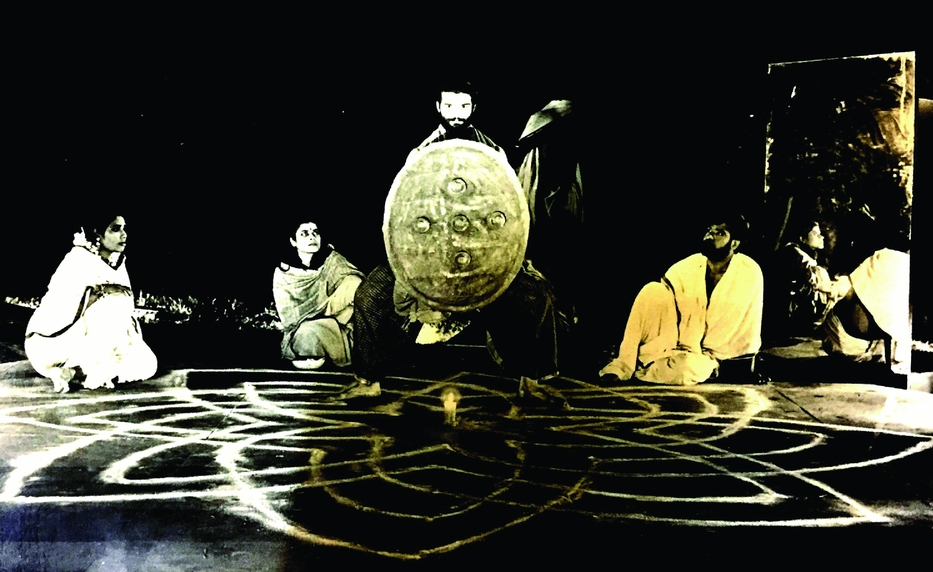
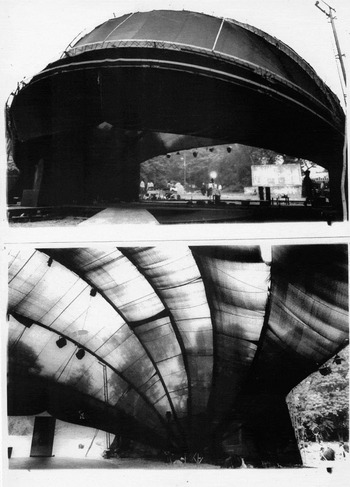
In the elaborately constructed space of fluid women's bodies, the two female protagonists, at centre stage, introduced the audience to a new scenography complementing the dramaturgy. The allocation of stage space for female actors amidst a larger mise en scène has been crucial to most of Haksar's creations. In her production process, there is often the undercurrent of challenging the conventional scenography. This can be seen in the depiction of the city of Madurai in the play as a square, which the actors knock at, talk to and enter respectively. Archana Shastri, who designed the sets for the play, explains the set as ‘an open air space, enclosed on two sides by a moving-dome like structure, opened at the back providing an infinite depth to the viewer’.Footnote 17 The audiences were looking at multiple actions and locations simultaneously. The space, the actors and their actions were interchangeable and fluid. Various performers drawing and etching patterns, kolams, on the floor would break into formations and body movements, replicating the drawings.Footnote 18
A new sensibility of the local and the regional, a focus on inhabiting the individual subject position rather than inflating the self (in contrast to most of Alkazi's productions), and the portrayal of natural postures rather than larger-than-life gestures, are characteristic of Haksar's work. Her directorial inputs allow one to deconstruct iconic female figures envisaged through hegemonic norms. By creating a fluid performance panorama, Haksar fragmented the proscenium stage and the ‘eye’ of the spectator. The performance space extended beyond the circular, canopy-covered stage (see Fig. 1) and into the larger outdoor spaces where the performance was usually staged. The audience was forced to see beyond that which it had become accustomed to watching. The unique arrangement of space, characters, plot, movements, images and music made this production a spectacular and innovative experiment.
Performers drawing patterns on the stage in Antar Yatra. Photo credit: Anamika Haksar.

Antar Yatra. The large dome-shaped stage set. Directed by Anamika Haksar, 1993. Photo credit: Anamika Haksar.

Although in the last few years several women directors have either left the NSD or stopped making new productions, their feminist intervention in the processes of training and theatre-making persists. For instance, traces of the breakthrough are evident in the works of some of their students.Footnote 19 Through my performance analysis, and by interpreting their processes as new theatre training methods, I aim to challenge some common trends in the writing of postcolonial theatre history in India, such as an undue emphasis on the dramatic text and the treatment of directors as authors, where authorship is attributed to a long list of iconic male playwrights and directors and the direct lineage of the women directors is drawn from the male iconic figures.Footnote 20 Anuradha Kapur likewise draws her genealogy from male icons like Alkazi and Karanth. As a result of this, the significance of the innovative experiments of the ‘feminist theatre’ is underplayed, marginalizing its historical mapping in the process. The very reconstruction and analysis of their work can in some ways implicitly take the urban Delhi theatre from the realm of a postcolonial modernity into the contemporary. By documenting Haksar's work both as process and as pedagogy, I hope to facilitate this transition, and to suggest multiple identities for Indian women in performance.