Introduction
The serious problems associated with the use of synthetic pesticides in stored-product systems, such as insecticide resistance, adverse effects on non-target organisms, widespread environmental hazards and mammalian toxicity, calls for the development of effective and environmentally safe alternatives (Elhag, Reference Elhag2000; Talukder and Howse, Reference Talukder and Howse2000). This includes using plant derivatives for the control of important pest species. Plant-derived materials are readily biodegradable, have lower mammalian toxicity, are more selective in action and delay the development of resistance in target pests (Saxena, Reference Saxena1987). Vitex negundo L. (Verbenaceae), a large aromatic shrub with typical five-foliolate leaf pattern, has been claimed to possess many medicinal properties (Tandon, Reference Tandon2005). It is found throughout India, Bangladesh, Afghanistan, The Philippines, tropical Africa, Madagascar and China (Kirtikar and Basu, Reference Kirtikar and Basu1994). It has been extensively studied for its antibacterial (Panda et al., Reference Panda, Thatoi and Dutta2009), anti-inflammatory (Jana et al., Reference Jana, Chattopadhyay and Shaw1999; Tandon and Gupta, Reference Tandon and Gupta2006; Kulkarni et al., Reference Kulkarni, Virkar and D'Mello2008), analgesic (Gupta et al., Reference Gupta, Mazumder and Bhawal1999; Telang et al., Reference Telang, Chatterjee and Varshneya1999) and anticonvulsant activities (Tandon and Gupta, Reference Tandon and Gupta2005).
Phytochemical investigation of this plant revealed several types of compounds, such as volatile oils (Wang et al., Reference Wang, Ren, Yang, Zhu and Lu2004; Khokra et al., Reference Khokra, Prakash, Jain, Aneja and Dhingra2008), lignans (Azhar-ul-Haq et al., Reference Azhar-ul-Haq, Malik, Anis, Khan, Ahmed, Ahmed, Nawaz and Choudhary2004), flavonoids (Banerji et al., Reference Banerji, Das and Chakrabarty1988), iridoids (Chandramu et al., Reference Chandramu, Manohar, Krupadanan and Dashvantha2003; Sharma et al., Reference Sharma, Prabhaka, Dhar and Sachar2009), terpenes (triterpenes, diterpenes, sesquiterpenes) (Chawla et al., Reference Chawla, Sharma, Handa and Dhar1992) and steroids (Maurya et al., Reference Maurya, Shukla and Ashok2007). The most important flavonoid glycosides from ethanolic extracts of V. negundo are 5-hydroxy-3,6,7-trimethoxy-2-(3,4-dimethoxyphenyl)-4H-chromen-4-one and 5,7-dihydroxy-2-(3,4-dihydroxyphenyl)-4H-chromen-4-one (Gautam, Reference Gautam2008). Methanolic extract also contains negundoside, agnuside and vitegnoside (Nadkarni, Reference Nadkarni1994). p-Hydroxybenzoic acid (1) and β-sitosterol (2) were isolated (Meena et al., Reference Meena, Singh U, Yadav, Singh and Rao2010) and identified from the methanol and hexane extracts of V. negundo bark. 6-Hydroxy-4-(4-hydroxy-3-methoxy-phenyl)-3-hydroxy-methyl-7-methoxy-3,4-dihydro-2-naphthaldehyde (1) and vitedoamine A (2) were isolated and identified from V. negundo seeds (Meena et al., Reference Meena, Singh U, Yadav, Singh and Rao2010) and its roots contain lignans (Azhar-ul-Haq et al., Reference Azhar-ul-Haq, Malik, Khan, Anwar-ul-Haq, Khan, Ahmad and Choudhary2006).
The red flour beetle Tribolium castaneum (Herbst) (Coleoptera: Tenebrionidae) is worldwide one of the most serious pests of stored products. The exact origin of T. castaneum is not known, but according to Blair (Reference Blair1930) it was commonly found in rotting wood and in loose bark of trees in India. This insect is now widely distributed all over the world mainly through commerce. It can be found in almost every store containing cereals or cereal products, especially in tropical and subtropical climates (Dobie et al., Reference Dobie, Haines, Hodges, Prevett and Rees1991). The beetles' mouthparts are not adapted to feed on hard whole grains and are thus found in almost any kind of flour and in grains previously attacked by other pests. Grain damage (to the germ and endosperm) is caused by both larvae and adults. Commodities attacked by T. castaneum include whole-wheat flour, bran, rice flour, maize meal and barley flour (Metcalf and Metcalf, Reference Metcalf and Metcalf1992).
Several strains of T. castaneum have developed resistance to commonly used post-harvest insecticides. The FSS II strain is susceptible to organophosphate insecticides like malathion (Lloyd and Ruczkowski, Reference Lloyd and Ruczkowski1980). CTC-12 is a multi-organophosphate polygenic-resistant strain first reported by Champ and Campbell-Brown (Reference Champ and Campbell-Brown1970), whereas the KANO strain is malathion resistant due to a dominant allele at a single autosomal locus (Wool et al., Reference Wool, Noiman, Manheim and Cohen1982).
A diverse range of chemical compounds has been isolated from the leaves of V. negundo. It is an important medicinal plant found throughout India (Meena et al., Reference Meena, Singh U, Yadav, Singh and Rao2010). It is credited with innumerable medicinal properties: analgesic, anti-inflammatory, anticonvulsant, antioxidant, bronchial relaxant, hepatoprotective, etc. (Tandon, Reference Tandon2005). Its leaves and seeds are widely used to treat rheumatism and joint inflammation (Chawla et al., Reference Chawla, Sharma, Handa and Dhar1992; Dharmasiri et al., Reference Dharmasiri, Jayakody, Galhena, Liyanage and Ratnasooriya2003). Internally, the decoction of its leaves is taken as diuretic, expectorant, vermifuge, tonic and febrifuge (Meena et al., Reference Meena, Singh U, Yadav, Singh and Rao2010). It is available in the Indian sub-continent and the plant extract has been frequently used by a number of researchers (Prakash and Mathur, Reference Prakash and Mathur1985). The plant grows in wastelands and is often planted as a hedge-plant in India (Meena et al., Reference Meena, Singh U, Yadav, Singh and Rao2010).
However, the potential of this plant possessing repellent and insecticidal properties against stored grain insects remains to be investigated. Therefore, the present study was carried out to identify the bioactive compound(s) from methanolic extracts of V. negundo leaves for control of T. castaneum.
Materials and methods
Test insects
Three standard strains of T. castaneum (CTC-12, KANO and FSS-II) were obtained from the Department of Agriculture and Environmental Science, University of Newcastle upon Tyne, UK. Insects were reared in a controlled temperature room (30 ± 0.5 °C, 70% relative humidity and 12/12 h photoperiod), in the Integrated Pest Management Laboratory, Institute of Biological Sciences, Rajshahi University, Bangladesh.
Rearing of test insects
Cultures were maintained in plastic pots (2 l) and sub-cultures in beakers (500 ml), with the food medium covered tightly with pieces of muslin cloth with the help of rubber bands to avoid possible escape of the beetles. The cultures were checked at regular intervals and eggs and larvae were separated to synchronize the populations. A standard mixture of sterilized whole-wheat flour with powdered dry yeast in a ratio of 19:1 was used as food medium for all experiments (Park, Reference Park1962; Khalequzzaman et al., Reference Khalequzzaman, Khatun and Talukder1994). Second, third, fourth, fifth and sixth instar larvae were obtained from the larval culture on the 3rd, 6th, 9th, 12th and 16th day from hatching, respectively, while the newly hatched larvae were considered as first instar (Mondal, Reference Mondal1984). After every 3 days the food medium was renewed.
Test plant
Leaves from mature V. negundo plants were collected during October–November 2002 from the rural areas of Rajshahi. The plant was identified by Professor Nadiruzzaman, Department of Botany, University of Rajshahi, Bangladesh and a voucher specimen (RUH no. 14 347) was deposited in the Herbarium of the Department of Botany of Rajshahi University.
Extraction and characterization of compounds
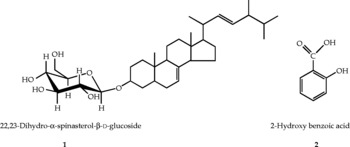
Dried powdered leaves of V. negundo (500 g) were macerated with methanol (3.0 l) for 72 h following the procedure described by Hostettmann et al. (Reference Hostettmann, Marston and Hostettmann1998). The concentrated methanol (25 g) extract was fractionated using petroleum ether, chloroform and ethyl acetate (Merck, Germany) to separate solvent-specific solutes. The solvents were evaporated by rotary evaporator at 40 °C and under reduced pressure to obtain petroleum ether (3.0 g), chloroform (1.2 g) and ethyl acetate (0.5 g) extract as a semisolid mass. The insecticidal activity of the three fractions was evaluated against T. castaneum adults. Of the fractions tested, chloroform soluble fraction was the most active. One gram of chloroform soluble fraction was subjected to column chromatography (2.5 cm diameter × 100 cm length) over silica gel (250 g) eluting with chloroform and methanol (40:60) of increasing polarity, which gave a total of 12 fractions. On the basis of a thin-layer chromatography (TLC) (5 × 20 cm, silica gel 60 F254, Merck, Germany) profile, the fractions were combined together. The compound 22,23-dihydro-α-spinasterol-β-d-glucoside (175 mg) (Fig. 1) was obtained as crystalline powder from fractions after column 3–5 eluted with n-hexane and ethyl acetate (1:1) by preparative TLC (20 × 20 cm, 0.5 mm, G60 Merck 7731, Germany) and was visualized as a pink spot when sprayed with 1% vanillin in concentrated H2SO4. Similarly, 2-hydroxy benzoic acid (125 mg) (Fig. 1) obtained as needle crystal from fractions after column 6–9 eluted with 100% chloroform followed by preparative TLC (mobile phase chloroform:methanol 7:1) and showed light yellow colour with 1% vanillin–H2SO4 and tested positive for phenol. The identification followed the procedure described by Ling et al. (Reference Ling, Wan, Ling, Zhang, Xia, Li and Hou2010).
Structure of isolated compounds

Bioassay
Insecticidal activity
A residual film bioassay (Busvine, Reference Busvine1971) was used to evaluate the toxicity of the two purified compounds 22,23-dihydro-α-spinasterol-β-d-glucoside and 2-hydroxy benzoic acid to adult T. castaneum. Three concentrations (1.99, 0.796 and 0.393 mg/ml) were prepared in methanol and were evenly applied to the bottom of a Petri dish (8 cm diameter). After drying for half an hour, groups of 10 adult beetles (0–24 h old) were individually placed on the bottom of the Petri dishes with three replications each. Subsequently, a control batch was maintained with the methanol. Treated and control (solvent only) batches were held at 30 ± 1 °C and 70% relative humidity. All bioassays were performed three times.
Repellent activity
The repellent activity of methanolic V. negundo leaf extracts was evaluated against the three T. castaneum strains according to McDonald et al. (Reference McDonald, Guy and Speirs1970) with some modifications. Substrates were prepared by cutting filter paper circles (Whatman No. 40; 9 cm in diameter) in half. Briefly, a stock solution (12.5 mg/ml) of the V. negundo extracts was prepared in known amounts of petroleum spirit. The stock solution was serially diluted in methanol and the resulting nine concentrations (393.3 to 1.5 μg/cm2) were used in the repellency tests. From each dose, 1 ml solution was applied uniformly on the half circles of filter papers with a micropipette. A treated half-circle filter paper was air-dried and attached to another untreated half circle of the same dimension by a transparent non-toxic adhesive tape. Then the whole filter paper was placed in a 9-cm Petri dish. The Petri dishes were placed randomly in different directions within a plastic tray to avoid any positional effect. Ten insects were released on the centre of each filter paper circle and the Petri dishes were covered immediately. The experiment was repeated three times. Counts of the insects were made at 1 h intervals up to 5 h and the number of insects present on the treated and untreated portions of the filter papers was recorded.
Data analysis
Insecticidal activity
Mortalities were subjected to Probit analysis (Finney, Reference Finney1947) using GWBASIC software for estimating the LC50, regression equation and the goodness-of-fit χ2 test values (Islam and Mustari, Reference Islam and Mustari2010). Three different exposure periods were chosen (24, 48 and 72 h).
Repellent activity
The averages of counts were converted to express percentage repulsion (PR) using the following formula:

where N c is the number of insects present in the control half. Positive values (+) indicated repellency and negative values ( − ) attraction (McDonald et al., Reference McDonald, Guy and Speirs1970).
Results and Discussion
Characterization of compounds
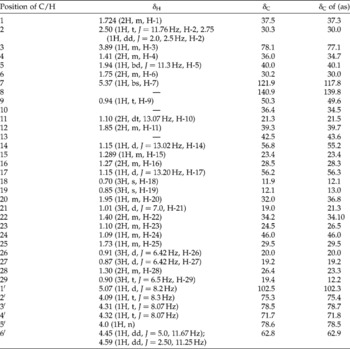
Compound 1 was isolated from the chloroform soluble fraction of the methanolic V. negundo leaf extracts as crystalline powder, mp 282–284 °C (uncorrected) and R f value 0.361 in ethyl acetate and methanol (10:1) system. Infrared (IR) spectrum showed O–H stretching band at 3400 per cm and C = O stretching vibration at 1055 per cm. The C–H and >C = C–H stretching vibrations were observed between 2900 and 2850 per cm. The mass spectrum was recorded on JEOL DX-300 (Jeol Limited, Tokyo, Japan) which showed molecular ion peak [M+H]+ at m/z 501 corresponding to the molecular formula C32H56O7. The NMR spectrum showed the presence of anomeric proton of β-d-glucose at 5.07 with J = 8.2, a multiplet at 3.89 for an oxygenated proton (H-3) and six methyl protons between 0.70 and 1.01. In 13C NMR spectrum, six carbon peaks at δ-102.574(C-1), 75.36(C-2), 78.51(C-3), 71.72(C-4), 78.625(C-5) and 62-87(C-6) are similar to those of Me-β-d-glucose, which confirm the presence of β-d-glucose unit (Kojima et al., Reference Kojima, Sato, Hatano and Ogura1990). In the Heteronuclear Multiple Bond Correlation experiment, H-3 showed a 3J correlation with the (H-1′) of β-d-glucose. In addition, the 1H and 13C NMR data are identical to those of 22,23-dihydro-α-spinasterol-β-d-glucoside (Kojima et al., Reference Kojima, Sato, Hatano and Ogura1990) (Table 1). Therefore, compound 1 was identified as 22,23-dihydro-α-spinasterol-β-d-glucoside and reported for the first time from V. negundo.
1H NMR data of compound 1 and 13C NMR data of compound 1 and the authentic sample of 22,23-dihydro-α-spinasterol-β-d-glucoside (as)

δH = ppm value of proton.
δC = ppm value of carbon.
δC of (as) = carbon value of authentic sample for comparisons.
Compound 2 was obtained from the chloroform soluble fraction of the methanolic V. negundo leaf extracts as white, needle-shaped crystal, mp 156–159 °C (uncorrected) and R f value 0.35 in chloroform and methanol (1:1) system. The mass spectrum showed a molecular ion peak at m/z 138 indicating the molecular formula C7H6O3 including four-unsaturation. In IR spectrum, it exhibited a band at 1625 per cm for C = O and 3510 per cm for OH of COOH group. The 1H and 13C NMR data (Table 2) were very similar with those reported of salicylic acid (Pretsch, Reference Pretsch1983). Thus compound 2 was identified as 2-hydroxy benzoic acid and reported for the first time from V. negundo.
1H NMR and 13C long-range data of compound 2

δH = ppm value of proton.
δC = ppm value of carbon.
2J/3J = long-range co-relation between proton and carbon.
Insecticidal activity
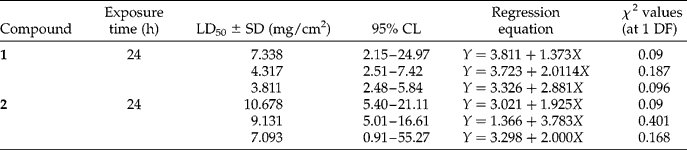
The LC50 values, regression equations (Y) and χ2 values for adult mortality against T. castaneum at different exposure times of the tested compounds are shown in Table 3. Both compounds showed an exposure-dependent mortality. In the present study, two compounds 22,23-dihydro-α-spinasterol-β-d-glucoside (1) and 2-hydroxy benzoic (2) were isolated from the methanolic V. negundo leaf extracts and tested against T. castaneum.
LD50 values, regression equations and χ2 values for adult mortality against Tribolium castaneum at different exposure times of the tested compounds 1 and 2
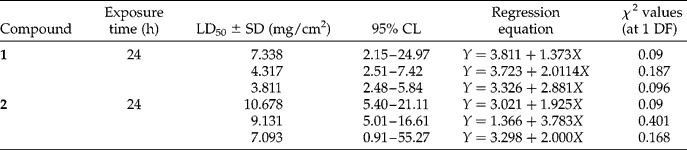
CL, confidence limits; DF, degrees of freedom.
The pesticidal property of V. negundo, especially the leaf extracts, against a number of insect pests, including T. castaneum, has previously been evaluated (Buiyah and Quiniones, Reference Buiyah and Quiniones1990; Rajappan et al., Reference Rajappan, Ushamalini, Subramanian, Narasimhan and Kareem2000; Yun et al., Reference Yun, Xue and Xing2004; Karunamoorthi et al., Reference Karunamoorthi, Ramanujam and Rathinasamy2008; Sahaf et al., Reference Sahaf, Moharramipour and Meshkatalsadat2008). Chowdhury et al. (Reference Chowdhury, Islam and Khalequzzaman2009) showed LC50 of 6.98, 6.23 and 5.99 mg/cm2 methanol extract of V. negundo.
Compound 1 was more potent against T. castaneum than compound 2. This is the first report on the insecticidal activities of the two compounds against T. castaneum. It will be interesting to explore the further use of the two V. negundo compounds for T. castaneum control.
Repellency
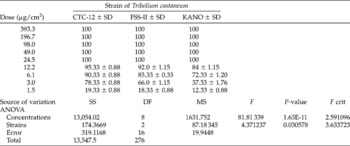
Methanolic leaf extracts had strong repellent effects on all three tested T. castaneum strains with 100% repellency (Class V category, i.e. repellency 80–100%) at doses 393.3, 196.7, 98.0, 49.0 and 24.5 μg/cm2. The degree of repellency response among the three T. castaneum strains was insignificant. Yet, near-class-V-category repellency was observed for CTC-12 at a concentration as low as 3.0 μg/cm2 (Table 4).
Percentage repulsion of adult Tribolium castaneum at different doses of methanol extract of leaves of Vitex negundo

SD, standard deviation; SS, sum of squares; DF, degrees of freedom; MS, mean square; F, variance ratio.
Similar work has been conducted by Liu et al. (Reference Liu, Xu, Wu and Hock2002) through bioassay-guided fractionation of methanol extracts from Dictamnus dasycarpus Turez (Rutaceae) root bark, showing its feeding deterrent activity against adults and larvae of T. castaneum. The feeding deterrent index (FDI) of fraxinellone at 10–300 ppm ranged from 18.6 to 95% for adult T. castaneum and FDI of dictamine at 30–300 ppm ranged from 32.4 to 81.2%. Talukder and Howse (Reference Talukder and Howse1995, Reference Talukder and Howse2000) tested MeOH extract of pithraj (Aphanamixis polystachya) (Wall.) Parker (Meliaceae) on T. castaneum and reported 100% repellency.
Conclusion
The practical use of V. negundo extracts for stored product protection remains to be tested under field conditions, but the present results clearly indicate a potential use.
Acknowledgements
The authors thank the Director, Institute of Biological Sciences, University of Rajshahi, Bangladesh for his early support. We would also like to thank the Department of Pharmacy, Nigata University, Japan for structural elucidation and the identification of chemical components present in the compounds.