Introduction
Pigs are regarded as a useful species for use in biomedical research due to their anatomic and physiologic similarities to humans (Svendsen, Reference Svendsen2006). In particular, miniature pigs are used extensively because of their smaller body size (Wakai et al., Reference Wakai, Sugimura, Yamanaka, Kawahara, Sasada, Tanaka, Ando, Kobayashi and Sato2008), and well defined genetic background (Yao et al., Reference Yao, Zhang, Sun and Liu2006) as compared with that of domestic pigs, such as Landrace, Yorkshire, Duroc, and their hybrids. Even so, domestic pigs still have the advantages of lower cost, higher prolificacy and wide availability (Estrada et al., Reference Estrada, Collins, York, Bischoff, Sommer, Tsai, Petters and Piedrahita2008).
One of the most remarkable research fields using pigs is xenotransplantation. Recently, many kind of transgenic pigs have been produced for this purpose using the somatic cell nuclear transfer (SCNT) technique (Sprangers et al., Reference Sprangers, Waer and Billiau2008). Because their body weight is similar to that of humans (Lee et al., Reference Lee, Lee, Kim, Jeong, Kim, Koo, Park, Hashem, Hossein, Son, Lee, Hwang, Kang and Lee2006), miniature pigs were selected as an appropriate cell donor for SCNT to produce transgenic pigs for xenotransplantation. However, the efficiency at producing cloned piglets using SCNT is still very low. Numerous factors have been shown to affect the efficiency of SCNT in the pig, including SCNT procedure (Miyoshi et al., Reference Miyoshi, Saeki and Sato2000; Du et al., Reference Du, Kragh, Zhang, Li, Schmidt, Bogh, Zhang, Purup, Jorgensen, Pedersen, Villemoes, Yang, Bolund and Vajta2007), artificial activation conditions (Cheong et al., Reference Cheong, Park, Im, Lai, Sun, Day and Prather2002; Zhu et al., Reference Zhu, Telfer, Fletcher, Springbett, Dobrinsky, De Sousa and Wilmut2002; Ziecik et al., Reference Ziecik, Biallowicz, Kaczmarek, Demianowicz, Rioperez, Wasielak and Bogacki2005; Koo et al., Reference Koo, Jang, Kwon, Kang, Kwon, Park, Kang and Lee2008), stages of donor cells (Prather et al., Reference Prather, Boquest and Day1999), and more.
A previous study that used in vivo produced embryos has documented that both the development of placenta and maintenance of pregnancy are influenced by fetal and maternal breed (Biensen et al., Reference Biensen, Wilson and Ford1998). Thus, we hypothesized that breed difference between cell donor and recipient is an important factor that affects success of cloning of miniature pigs, as size of uterus and birth weight had been very different between miniature and domestic pigs in our past observation.
The breeding environment for miniature pigs and domestic pigs is different. Therefore, the selection of the correct breed for use as recipient of cloned embryos is a key decision to be made before establishing experimental or commercial animal facilities. Minimal information is available on the effect of breed difference between cell donors and embryo recipient pigs on producing cloned miniature pigs. For these reasons, the present study was performed to investigate effect of breed of recipient pig on production of cloned miniature pigs using SCNT.
Materials and Methods
Chemicals and care of animals
All chemicals were obtained from Sigma–Aldrich Corp. unless otherwise stated. Gyeonggido Veterinary Service was responsible for breeding of the pigs in compliance with Gyeonggido Veterinary Service Institutional Animal Care and Use Committee, administered by National Veterinary Research & Quarantine Service.
Isolation and culture of donor cells
Ear tissues were obtained from three domestic and three miniature pigs, washed three times in DPBS (Invitrogen) and minced with a surgical blade. The minced tissues were dissociated in Dulbecco's modified Eagle's medium (DMEM; Invitrogen) supplemented with 0.25% (w/v) trypsin/l mM EDTA (Invitrogen) for 1 h at 37 °C. Trypsinized cells were washed once in Ca2+- and Mg2+-free DPBS by centrifugation at 300 g for 2 min, and seeded onto 100 mm plastic culture dishes (Becton Dickinson). Subsequently, cells were cultured for 8 to 10 days in DMEM supplemented with 10% (v/v) FBS (Invitrogen) at 39 °C in a humidified atmosphere of 5% CO2 and 95% air. Cultured cells at passages three to eight were used for SCNT.
In vitro maturation of porcine oocytes
Ovaries (mixed breed of Landrace, Yorkshire, and Duroc) were collected from a local slaughterhouse. Cumulus–oocyte complexes aspirated from 3 to 6 mm diameter of follicles were cultured in tissue culture medium 199 (TCM-199, Invitrogen), supplemented with 10 ng/ml EGF, 4 IU/ml serum gonadotropin (Foligon), 4 IU/ml chorionic gonadotropin (Choluron) and 10% porcine follicular fluid at 39 °C in a humidified atmosphere of 5% CO2. After culturing for 22 h, COCs were washed then cultured in hormone-free medium for another 22 h. At 38 to 42 h of maturation culture, oocytes were freed from cumulus cells by repeated pipetting in 0.1% hyaluronidase.
Somatic cell nuclear transfer
For SCNT, a micromanipulation system (NT-88, Nikon-Narishige) attached to an inverted microscope (TE-2000, Nikon Instrument) was used. A cumulus-free oocyte was held with a holding micropipette and the zona pellucida was partially dissected with a fine glass needle to make a slit near the first polar body. The first polar body and adjacent cytoplasm, presumably containing the metaphase-II chromosomes, were extruded by squeezing with the same needle. Enucleation was confirmed by staining with Hoechst 33342 during manipulation. Single fibroblast cells with a smooth surface were selected under a microscope and transferred into the perivitelline space of enucleated oocytes. These couplets were placed in a pulsing medium for 4 min and transferred to a chamber consisting of two electrodes overlaid with pulsing medium. The pulsing medium was 0.26 M mannitol solution containing 0.5 mM HEPES, 0.1 mM CaCl2 and 0.1 mM MgSO4. Couplets were fused and activated simultaneously with a single 2 kV/cm DC pulse for 30 μs using a BTX Electro-Cell Manipulator 2001 (BTX, Inc.). Fused couplets were used for embryo transfer within 2 h without additional in vitro culture.
Embryo transfer and pregnancy diagnosis
In the laboratory, 120 to 150 of fused SCNT embryos were loaded into a sterilized 0.25 ml straw (Minitüb) and kept in a portable incubator (Minitüb) during transportation to the embryo transfer facility. An estrous-synchronized recipient was anesthetized using ketamine and xylazine for induction and 3% of isoflurane for maintenance. One oviduct was exposed by laparotomy. The straw containing the embryos was put directly into the oviduct of the recipient and embryos were expelled from the straw using one ml syringe (Becton Dickinson). Recipients were checked for pregnancy by transabdominal ultrasound examination on day 30 after embryo transfer. Landrace, and Yorkshire, and Duroc hybrids domestic pigs and miniature pigs were used for embryo recipient.
Microarray analysis and real-time RT PCR
Miniature pig and domestic pig fetuses derived from natural breeding were obtained by cesarean section at day 25 of gestation. For each breed, three fetuses from different litters were used for analysis. Each whole fetus was homogenized and used for RNA extraction. Total RNA was extracted using the Easy-spin Total RNA Extraction Kit (iNtRON Biotechnology) by following supplier's instructions. An equal amount of RNA from three fetuses of each breed was mixed for further analysis to reduce individual effect. Microarray analysis was conducted using the Platinum pig 13K cDNA chip (Genocheck Inc.) according to a protocol described previously (Jung et al., Reference Jung, Park, Hwang, Kang, Lee, Song, Lee, Yeo, Kang, Lee, Jeon, Um, Kim, Oh, Youn, Li, Park and Hwang2004).
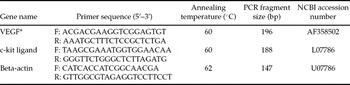
The same RNAs were used for real-time RT-PCR to confirm the microarray result. The 7300 real-time PCR system (Applied Biosystems) was employed and the amplifications were performed with SYBR Premix Ex Taq (Takara). All PCR products were analysed by the 7300 system SDS software version 1.3 (Applied Biosystems). The sequences of the primers used, the annealing temperatures, the size of expected PCR product and the sequence references are summarized in Table 1.
Primers used for real-time RT-PCR.

*Vascular endothelial growth factor.
Statistical analysis
The chi-squared analysis was used to compare pregnancy and delivery rates among experimental groups. Litter size was analysed by Student's t-test using Prism software (GraphPad). A value of p < 0.05 was considered statistically significant. Microarray data were analysed by fold test using Genepix Pro 4.1 software (Axon Instruments Inc.). More than a two-fold of difference was considered statistically significant. Data on gene expression levels data from real-time RT-PCR were normalized to the internal control, beta-actin gene, and analysed by Student's t-test.
Results and Discussion
The present study demonstrated that the miniature pig is a more suitable recipient for producing cloned miniature pigs than the domestic pig. Cloned miniature piglets can be produced using both miniature pig and domestic pig recipients (Table 2). Pregnancy rates after transferring cloned miniature pig embryos into miniature and domestic recipient pigs were similar. However, delivery rates of miniature pig embryos transferred to miniature pig recipient were significantly higher than those transferred to domestic pig recipients. Our finding was similar to that of previous studies performed with Meishan and Yorkshire pigs using in vivo fertilized embryos (Biensen et al., Reference Biensen, Wilson and Ford1998; Wilson et al., Reference Wilson, Biensen, Youngs and Ford1998). According to both previous reports, pregnancy rate was determined by the uterine environment up to day 90 of gestation, regardless of the fetal genotype. However, during late gestation, breed-specific mechanisms become more important due to fetal demand for nutrient uptake and increasing need for rapid waste removal. The significant difference in delivery rate in the present study, in spite of similar pregnancy rates, between two donor breeds may due to similar mechanisms suggested in the previous reports.
In vivo development of cloned porcine embryos derived from fetal fibroblasts of miniature or domestic pigs and transferred to miniature or domestic recipient pigs.

a ,b Different superscripts in same column indicate significantly differences (p < 0.05).
c ,d Significant different between domestic to domestic and miniature to miniature group. Miniature to domestic group was not used for statistically analysis due to restricted replication number.
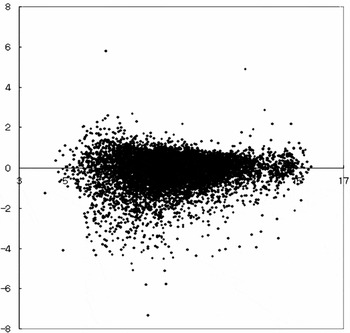
While previous reports used morphology and size of placenta as the criteria to compare placental differences between Meishan and Yorkshire pigs, we used a microarray assay to examine differences between miniature pig and domestic pig fetuses. In total, of 13 297 spots on the microarray chip, 1551 (11.7%) were significantly different between the two breeds (Fig 1). Among these, 252 (16.2%) genes were over-expressed and 1299 (83.8%) genes were down-regulated in miniature pig fetuses (please contact corresponding author for detailed data). Functionally, many genes that were related to transport, integral membrane proteins, protein binding and cell cycle regulation were differentially expressed between the two breeds. Successful implantation and maintenance of pregnancy requires complex processes and are tightly controlled by interplays between maternal and fetal factors (Huppertz, Reference Huppertz2007). Thus, we assume that the low delivery rate after transfer of cloned miniature pig embryos to domestic pig recipients was a reflection of variation in gene expression between miniature pig and domestic pig fetuses.
Differential gene expression levels in miniature pig and domestic pig fetuses. Microarray assay was used to examine differences between miniature pig and domestic pig fetuses.

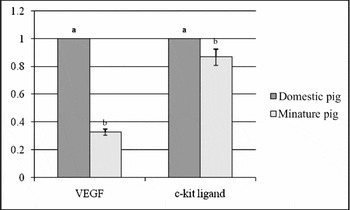
To confirm the microarray results and to further examine the mechanism(s) for the low delivery rate in domestic recipients of miniature pig cloned embryos, two important genes that are related to implantation and gestation were selected for further analysis. In the microarray analysis, vascular endothelial growth factor (VEGF) and c-kit both appeared to be down-regulated in miniature pig fetuses. VEGF is expressed from early to late gestation and is correlated with placental growth and vascular development (Vonnahme & Ford, Reference Vonnahme and Ford2004). c-kit protein is expressed in both the placenta and endometrium and plays important roles in the placental proliferation and differentiation (Horie et al., Reference Horie, Fujita, Takakura, Kanzaki, Kaneko, Iwai, Nakayama and Mori1992). As expected from microarray data, both genes were down-regulated in miniature pig fetuses when analysed by RT-PCR (Fig. 2). These differences in gene expression might be the cause of incompatibility between the two breeds and the result in low delivery rate of miniature pig fetuses transferred to domestic pig recipients.
Expression of vascular endothelial growth factor (VEGF) and c-kit ligand gene in miniature and domestic pig fetuses. Gene expression levels were measured by RT-PCR. Different superscripts within the same gene group indicate statistically different values (p < 0.05).

In a recent report, the domestic pig was recommended as a embryo recipient for production of cloned miniature pigs due to their ability to accommodate more fetuses (Kurome et al., Reference Kurome, Ishikawa, Tomii, Ueno, Shimada, Yazawa and Nagashima2008). However, according to our observations, litter size tends to be influenced more by the cell donor breed than by the embryo recipient breed. Domestic pigs used in the present study were Landrace, and Yorkshire and Duroc hybrids, and their normal litter size varies from eight to 15. Litter size of miniature pigs normally is from four to six. In the present study, mean litter size was significantly lower in miniature pig embryos transferred to miniature pig recipients as compared with that of domestic pig embryos transferred to domestic pigs (3.1 ± 0.2 vs. 7.0 ± 1.0, respectively; mean ± S.E.M.). However, we did not see a specific pattern when litter size was categorized according to recipient breeds groups. In the present study, litter size was even reduced in miniature donor to domestic recipient group, as compared with miniature to miniature group. Therefore, we conclude that litter size was not improved by using domestic pigs as recipients of cloned miniature pig embryos.
A limitation of the present study is that we didn't obtain data from transfer of domestic pig cloned embryos to miniature pig recipients; hence, the effect of breed difference on pig cloning is not explained fully. However, the present study clearly showed that the use of miniature pigs, as recipients, improved delivery rate of cloned miniature piglets.
For successful xenotransplantation, animal facilities built to human-use standards are required. Miniature pigs are easier to maintain in a germ-free or specific pathogen-free state. Their genetic background is more defined and they are more likely to meet the standards necessary to obtain approval for human use. In addition, an estrus synchronization procedure for the miniature pig has already been established (Kurome et al., Reference Kurome, Ishikawa, Tomii, Ueno, Shimada, Yazawa and Nagashima2008), making it feasible to use as a recipient species for cloned embryos. Accordingly, we recommend the miniature pig is a better embryo recipient than domestic pigs to use for producing cloned miniature piglets.
Acknowledgements
This study was financially supported by Korean MEST through KOSEF (grant #M10625030005–07N250300510) and BK21 programme. We thank Sung Sik Lee, Nam Yong Paek, Young Hee Nam, Moon Young Ko, and many others from the Gyeonggido Veterinary Service for valuable contributions in animal husbandry and discussion. We also thank Genocheck Inc. for technical and statistical support for microarray and real-time RT-PCR.