China's response to the recent Syria crisis at the UN Security Council represents a new phase in China's approach to intervention, which is broadly defined as “compromises of sovereignty by other states that are exceptional in some way.”Footnote 1 China actively intervened to ensure that a firm line against non-consensual intervention would be held, and in this case alone, China committed to three diplomatic innovations: casting multiple, successive veto votes; rebranding to delegitimize intervention as “regime change,” and engaging in norm-shaping of the “responsibility to protect” regarding the use of force.Footnote 2 Together, these three innovations highlight China's desire to keep separate the intervention norm from that of foreign-imposed regime change.Footnote 3 Unlike other watershed examples of intervention, the Syria case marks a shift in China's approach in that China attempted to not only control policy outcomes (bringing possible action to a halt via multiple vetoes) but also affect normative discourse and the normative status quo (delegitimizing intervention as “back-door” regime change and projecting China's anti-intervention position as “responsible protection”). Therefore, the Syria episode represents a crucial case through which to understand China's evolving position on intervention,Footnote 4 which the literature largely approaches as increasingly progressive.Footnote 5
The Syria case differs from China's past practice when contending with the expanding and more permissive boundaries for intervention in two ways. First, in other hallmark cases of UN Security Council interventions under “all necessary means” to address massive human rights abuses, China shelved its misgivings about UN Security Council attempts to affect local governance, typically preferring to take a passive stance by pursuing abstention votes – neither supporting nor blocking efforts – or casting “yes” votes, justified by exceptional circumstances.Footnote 6 Cases of intervention in the Rwanda genocide,Footnote 7 ethnic cleansing in Srebrenica and the former YugoslaviaFootnote 8 provide prime examples of this preferred response. Second, when China has seen fit to oppose intervention, it has favoured the use of a single veto in such ongoing cases, not repeated vetoes to halt action by the UN Security Council.Footnote 9 As the state with the lowest absolute number of exercised vetoes among the permanent members, China's departure to cast multiple vetoes in relation to the same crisis is a significant change.
This article proceeds by addressing why China modified its practice on intervention. It establishes China's motives for keeping regime change separate from intervention, paying attention to the elite and public discourse on the regime change context for the Syrian intervention. Then, process-tracing is used against the contours of the Syria case, with an emphasis on highlighting how China committed to keeping the intervention norm separate from regime change, focusing on China's three diplomatic innovations. The article closes by discussing the implications of China's stance regarding intervention in crises against the context of public calls for regime change. The article draws insights from interviews with foreign policy elites in Beijing, New York and New Delhi.
Demarcating Intervention from Regime Change: Explaining Why China Shifted its Stance on Intervention in the Case of Syria
Syria joins a long list of states faced with anti-government protest in South-West Asia and North Africa. In the post-9/11 landscape and long after the “colour revolutions” in the former Soviet Union, regime change has re-emerged as a foreign policy tool, which has been used to target dictators in Egypt, Iraq, Libya and Sudan for example, and also as a domestic policy goal of people-led social movements countering autocracies. The UN Security Council is not immune to considering intervention in such cases, with many appearing on its agenda. While China has gradually shifted towards accepting intervention, it remains reluctant to condone regime change in target states.
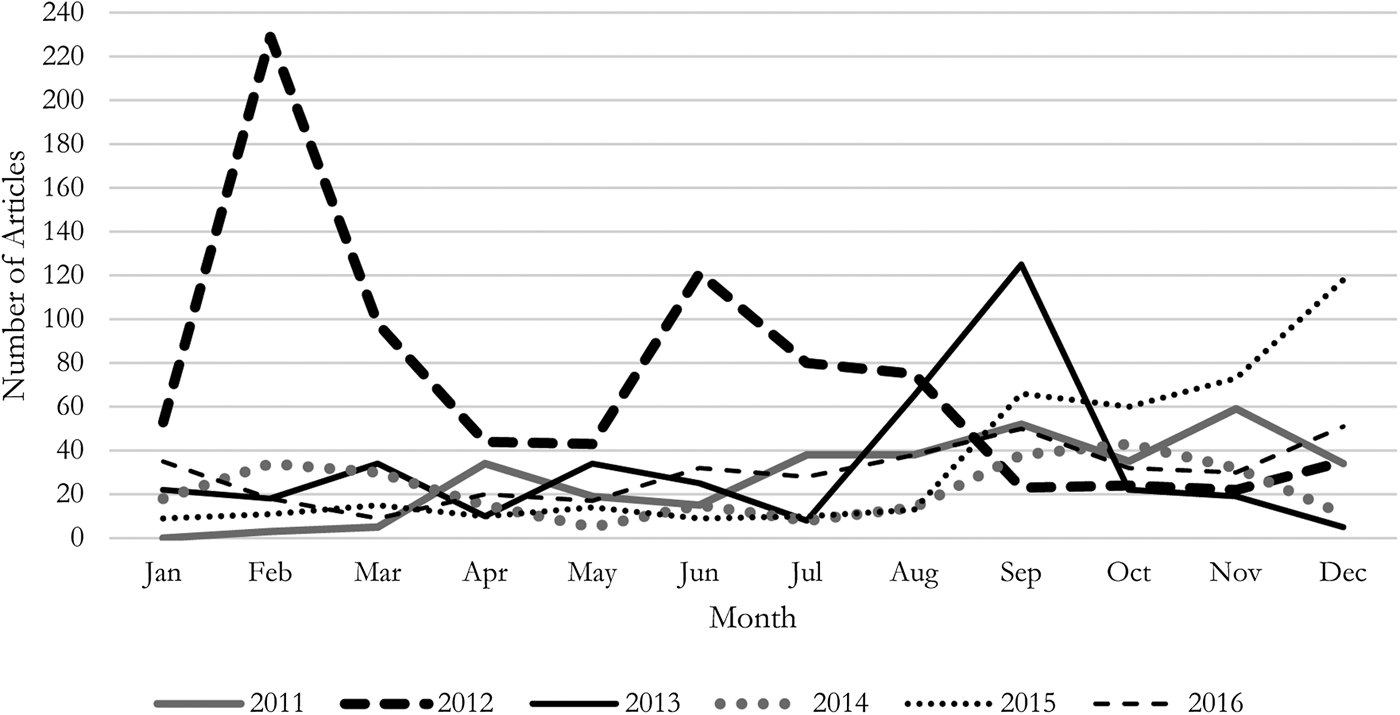
Discussions regarding intervention in Syria took place against a background of calls for regime change, which served to heighten China's concerns that the UN Security Council could be used to instigate such a move. As a crude indicator of the public discourse on Syria and regime change, I ran a word search of news articles, looking for instances where “Syria” and “regime change” are within five words of one another, in the ProQuest database. Figure 1 illustrates that the public discourse on Syria and regime change picked up in 2011 as the crisis first unfolded, and peaked as the UN Security Council began to discuss opportunities to intervene in the crisis.
Search of “Syria” and “Regime Change” in ProQuest News Sources, 2011–2016

Elite discourse from those states with a precedent of leading the charge for intervention at the UN Security Council – France, the United Kingdom and the United StatesFootnote 10 – indicates that there was a desire for Syrian regime change. These three states actively discussed and advocated for Assad's departure within months of the crisis entering the UN Security Council agenda, raising China's concerns that UN Security Council-led intervention could mean regime change in Syria. By May 2011, French president Nicolas Sarkozy came out firmly against Assad, saying “we will not accept that a regime sends the army against peaceful protesters.”Footnote 11 US president Barack Obama called for Assad to “lead [political] transition, or get out of the way.”Footnote 12 By July 2011, the UK prime minister David Cameron joined the calls for Assad's departure.Footnote 13 These three leaders coalesced in increasing pressure on Assad with a coordinated, formal call on 18 August 2011 for President Assad to step aside.Footnote 14 Throughout 2012, these states ratcheted up the pressure on Assad, establishing that “all options” were available to remove Assad from power.Footnote 15
Supporting the elite discourse on Syria and regime change, the think tank and advocacy communities viewed Syrian regime change as an almost inevitable outcome of the US and UK foreign policies. For example, commentators at the Council on Foreign Relations noted that Syria represented “the third Arab country [the Obama] administration has targeted for regime change this year,”Footnote 16 and more coercive policy was expected “now that Obama has committed the United States to regime change in Damascus.”Footnote 17 Analysts at Chatham House pointed out that “[many] governments, especially in developing countries … believe [intervention in Syria] is an excuse for regime change. After all, Britain has called for regime change in Syria before, it funds the Syrian opposition, and has stretched the meaning of previous UN resolutions to justify regime changes in Iraq and Libya.”Footnote 18 Experts argued that it was only a matter of time until regime change would occur,Footnote 19 some even going as far as calling Assad a “dead man walking,”Footnote 20 and discussed the array of tools available to achieve such an outcome.Footnote 21 These data points illustrate that throughout the crisis, decisions at the UN Security Council were being reached against a background of public discourse of Syrian regime change. China therefore remained wary of promoting regime change via UN Security Council initiatives, as it perceived had been the case in Libya.
Beijing's approach to the Syria crisis was underscored by Chinese views that UN Security Council Resolution 1973, which authorized the enforcement of a no-fly zone over Libya, had been abused to unseat Muammar Gaddafi.Footnote 22 When in 2011 the issue of Syria was introduced in an open debate on the protection of civilians in armed conflict, the-then Chinese ambassador to the United Nations Li Baodong 李保东 explicitly referenced Libya: “The original intention of resolutions 1970 (2011) and 1973 (2011) was to put an end to violence … [we] are opposed to any attempt to wilfully interpret the resolutions or to take actions that exceed those mandated.”Footnote 23
China leveraged Russian concerns that intervention was synonymous with regime change.Footnote 24 Scholars noted that China and Russia had “concerns that the ultimate US aim in Syria is coercive regime change.”Footnote 25 Both states were keen to secure their overseas interests, and regime change could potentially lead to the problem of reassigning asset ownership, for example.Footnote 26 China National Petroleum Corporation has shares in Syria's two largest oil firms, and Sinochem, through a subsidiary, has a 50 per cent stake in Syrian oil fields. China rounded out the purchases of Syrian crude oil after the European Union's embargo in 2011. That year, China was Syria's biggest trading partner, with exports of over $2.4 billion shepherded by closer state-to-state coordination through the Syrian–Chinese Business Council.Footnote 27
Having established why China would want to demarcate intervention from regime change, the article now uses process-tracing in the Syria case to illustrate how China did so, focusing on China's three diplomatic innovations.
China's Diplomatic Innovations in the Syria Case
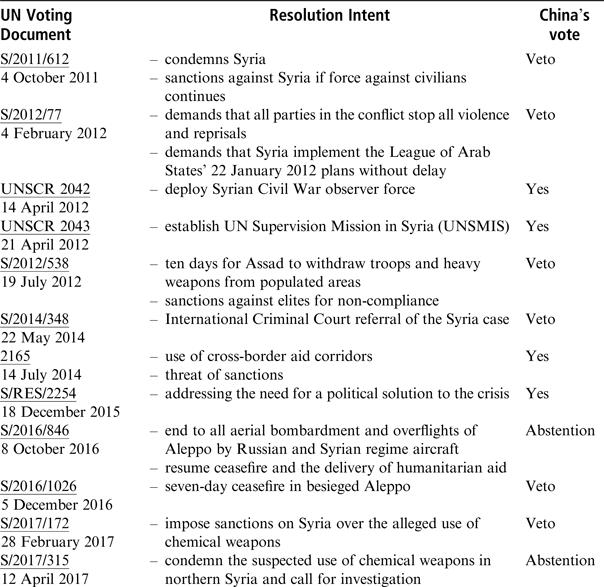
Protesters in Syria demanded the end of Ba'ath Party rule and the resignation of President Bashar al-Assad at the end of January 2011. Although the Assad regime initially offered small concessions,Footnote 28 the government switched to repressive tactics by mid-March 2011. By the time the crisis came to the UN Security Council table, there was already active debate on the parameters of intervention. China consistently opposed any coercive measures by blocking censures, demands for peace plan compliance or ceasefires, the use of sanctions, and an International Criminal Court (ICC) referral of the Syria cases. China did, however, support moves for a negotiated, political settlement of the conflict, paying equal attention to all parties, and emphasizing Syrian consent. Table 1 presents a summary of how China voted in the key Security Council resolutions.
Key UN Security Council Resolutions on the Syria Crisis
At the end of April 2011, the UN Security Council entered into its first public debate on Syria, in which China gave a typically neutral statement, calling for “constructive assistance in line with the UN Charter.”Footnote 29 A first attempt at a UN Security Council resolution in June 2011 ended up in a failed “no” vote, with China, Russia, and rotating members Brazil, South Africa and India all challenging whether the Council should prescribe “how [Syria] should reform itself politically.”Footnote 30 Talks at the end of August 2011 regarding proposed sanctions were simply boycotted by China and Russia, and the proposed draft resolution was tabled without a vote.Footnote 31 Russia countered with its own draft resolution in September 2011, which also ended without a vote since it was dismissed as too weak in its criticism of Damascus.
China exercises veto and introduces regime change rhetoric
Pursuing a veto with Russia in early October 2011 that blocked censures and potential sanctions against Syria was the first signal that China wanted to prevent intervention. China and Russia also successfully persuaded Brazil, India, South Africa, and the sole Middle East player, Lebanon, to abstain. This diplomatic coalition gave credibility to China's framing of the proposed resolution as an expression of Western-led interests. China positioned itself as a member of the international community, emphasizing its interest in pursuing “a positive and constructive role in appropriately resolving the question of Syria.”Footnote 32
China introduced a new response to the crisis as it moved to delegitimize attempts at intervention as “regime change.” China reaffirmed that it continued to “firmly oppose the use of force to resolve the Syrian issues, as well as practices, such as forcibly pushing for regime change, that violate the purposes and principles of the United Nations Charter and the basic norms that govern international relations.”Footnote 33 In using such language, China not only acknowledged the regime change debate over Syria but also clearly signalled its boundaries regarding intervention. Actions that could now lead to regime change were unacceptable to China, and China rebranded Western discourse, which had framed regime change as a positive goal, as the illegitimate activity of a few powerful states against a weaker party. This is remarkable directness for China. Previously, China had obliquely referred to genocide in Rwanda and ethnic cleansing in Srebrenica as “domestic affairs” and had studiously avoided any reference to “regime change” when debating intervention in the Libya crisis. This new response indicated China's confidence in accusing other states of being complicit in efforts to disrupt peaceful dispute resolution.
Chinese officials at the United Nations and official Chinese mouthpieces utilized the term “regime change” in their discussions. For example, in the People's Daily, there was criticism of “some states [which] still do not abandon their intention of changing the Syrian regime by external forces.”Footnote 34 Although Chinese government mouthpieces did not explicitly name certain states as proponents of regime change, they did come very close:
Certain Western countries still have not given up on regime change in Syria, and have provided increasing support to rebel forces. Their open discussion of a no-fly zone, along with other irresponsible words and actions, has undermined the solidarity of the Security Council, causing the international community to be unable to reach consensus.Footnote 35
In February 2012, a Western-backed UN draft resolution, which demanded the cessation of all violence and reprisals by all parties in the conflict and called upon Syria to implement the League of Arab States’ peace plans without delay, was vetoed by both China and Russia.Footnote 36 China explained its position as follows: equal attention should be given to “all parties to stop the violence,” and although Beijing did “support the good-offices efforts of the Arab League” and “respect the request of the Syrian people for reform,” China still felt that the draft resolution was out of sync with China's goals as a UN Security Council member – namely, that the international community “should provide constructive assistance” which still respected “the sovereignty, independence and territorial integrity of Syria.”Footnote 37 As part of “the international community,” China should “play a positive and constructive role in the proper settlement of the Syrian issue.”Footnote 38
Following the second veto, the UN Security Council remained divided. Both China and Russia worked to reduce the number of unarmed military observers dispatched to SyriaFootnote 39 and diminish the scope and authority of the peacekeepers from the United Nations Supervision Mission in Syria (UNSMIS),Footnote 40 who were sent to monitor the cessation of violence and support the implementation of peace initiatives.Footnote 41 Pressure continued to mount against the Assad regime as the International Committee of the Red Cross reported in early May 2012 that killings in Homs and Idlib could qualify Syria as a case of civil war. In response, the UN Security Council could only muster press statements.Footnote 42
The stasis at the UN Security Council led to alternative diplomatic strategies being pursued, including the appointment of former UN secretary-general Kofi Annan as the joint special envoy of the United Nations and the League of Arab States on the Syrian crisis.Footnote 43 Special Envoy Annan worked towards garnering support for his six-point peace plan.Footnote 44 This plan was purposely disassociated from any regime change discourse and pointedly resisted any calls for Assad's resignation,Footnote 45 an issue which Annan assessed would continue to be a non-starter for China and Russia. China and Russia stepped up their support for Syria, with China continuing to explicitly reference regime change in its speeches at the UN Security Council. For example, at the 12 March 2012 high-level debate on the challenges and opportunities in the Middle East, China spent its allotted time discussing the Syria problem, very bluntly emphasizing that it “is against any attempt by external forces to engage in military intervention or push for regime change,” and moreover that “Security Council resolutions must be strictly and comprehensively implemented. No party is to interpret them in any way it wants.”Footnote 46
The delays in implementing the six-point peace plan owing to broken ceasefires only compounded the debate at the UN Security Council. Members of the Council convened to vote on a draft resolution calling for an extension of the UNSMIS operation and for Assad to withdraw his troops and heavy weapons from populated areas within ten days or else face sanctions for non-compliance. The draft was again vetoed by Russia and China.Footnote 47 Following the vote, China's representative, Li Baodong, issued a sharp rebuke:
During consultations on this draft resolution, the sponsoring countries failed to show any political will of cooperation … a few countries have been intent on interfering in other countries’ internal affairs, fanning the flame and driving wedges among countries.Footnote 48
China not only positioned itself as a responsible player within the international community but also accused Western states of illegal actions and attempting regime change.
At the end of August 2012, the UN Security Council held a high-level meeting to discuss the humanitarian situation in Syria. At this meeting, China reiterated that it “opposes any externally imposed solution aimed at forcing a regime change.”Footnote 49 Although conditions continued to deteriorate in Syria, the UN Security Council remained stalled in deadlock. In August 2013, both the opposition forces and the Syrian state accused each other of using chemical weapons in Ghouta, killing 1,300 civilians.Footnote 50 Following confirmation from UN investigators that sarin gas had been used in the attacks, the West lay the blame on Syrian government forces. UN secretary-general Ban Ki-moon condemned the attack as the “most significant confirmed use of chemical weapons against civilians since Saddam Hussein used them” and claimed that Assad “has committed many crimes against humanity.”Footnote 51 However, the UN Security Council could not proceed with a response owing to its stalemate.
By 2014, despite estimates of 150,000 dead, the UN Security Council was still split. China and Russia issued joint vetoes over a draft resolution calling for a referral of the Syria situation to the International Criminal Court for investigation, and possible prosecution, of war crimes and crimes against humanity.Footnote 52 All other members of the UN Security Council voted for the draft. Switzerland made the push to have Syria referred to the ICC, with 56 other member state co-signatories,Footnote 53 citing the initial findings of the UN International Commission of Inquiry in 2011,Footnote 54 which viewed the ICC as the most appropriate body to address abuses.Footnote 55 The draft resolution replicated the language of prior successful ICC referrals, drawing directly from UN Security Council Resolution 1593 on Darfur and UN Security Council Resolution 1973 on Libya.Footnote 56 Member states were well aware that the draft would be vetoed, but the decision was made to let China and Russia receive the full brunt of criticism for doing so.Footnote 57
The Chinese deputy representative Wang Min 王民 gave a lengthy address stressing China's three issues with the draft resolution: first, it ignored the principle of complementarity, which Syrian authorities had addressed in their national preparations to prosecute human rights abuses; second, China favoured a politically negotiated outcome before addressing justice issues; and third, China thought a longer period of consultation and revisions of the draft resolution were necessary. Deputy Representative Wang criticized those states that made “unfounded accusations” and “irresponsible and hypocritical slander” against China, and emphasized that China held an “objective” and “impartial position” as a “responsible member of the international community.”Footnote 58
Norm-shaping: the responsibility to protect
China also made new efforts to influence diplomatic discourse by creating a nascent, semi-official concept of “responsible protection.” Driven by the view that NATO had abused its mandate to use force in Libya, Beijing cited the violent and chaotic fallout from that action, as well as the questionable outcomes following Western-led interventions in Afghanistan and Iraq, as reasons why such a concept was needed. “Responsible protection” was also an attempt to reframe China's multiple vetoes against intervention in Syria as fair and responsible in response to the critics who termed China's actions as callous. The basis of “responsible protection” is that responsibility for a target state carries on during and after an intervention occurs. The concept lays down six criteria for intervention, including a much narrower interpretation for when military force could be used, with a focus on the means-to-an-end trade-off.Footnote 59 In advancing “responsible protection,” China engaged in norm-shaping, emphasizing a monitoring element during the use of military force and responsibilities for post-intervention rebuilding.Footnote 60
Previously, China was a passive supporter of the “responsibility to protect,” which uses a discursive frame of sovereignty as a responsibility, as opposed to a right of states.Footnote 61 China's prior practice had been to emphasize state solutions for humanitarian crises and efforts to strengthen state capacities to execute their responsibilities. To actively reinterpret the use of force for humanitarian purposes beyond that of state-led solutions was an aspect of the “responsibility to protect” that China had largely avoided, yet China's angle on “responsible protection” was firmly rooted in its conservative position on intervention.Footnote 62
China was not alone in its efforts to shape norms and reorient the “responsibility to protect” debate.Footnote 63 Brazil pursued the “responsibility while protecting” concept in 2011,Footnote 64 and France and the S5 (the “small five” of Costa Rica, Jordan, Liechtenstein, Singapore and Switzerland) instigated the “responsibility not to veto” campaign in the wake of the multiple Syrian vetoes.Footnote 65 While these two efforts were in response to the Syria crisis also, China presented the most restrictive interpretation in regard to the use of force for humanitarian purposes. However, China's focus on “responsible protection” was short lived and limited to low-level policy discourse; it soon switched its attention to support Brazil's “responsibility while protecting,” which conceptually overlapped with “responsible protection.”Footnote 66 Why this “responsible protection” effort was so limited in duration remains unclear, although it might be that China reassessed its interests in attempting to shape discourse in such a crowded normative marketplace. Yet, the fact that China tried to gain a foothold in the widening normative discourse appropriating the term “responsible” is significant. This was a first real effort to indicate that China was willing to do more than just protest in the face of criticism by other states that cast China as irresponsible; China would promote alternative norms that emphasized China's responsible approach to international affairs.
Analysis and Conclusion
The three innovations used by China to support non-intervention in the Syria case – the use of multiple, successive veto votes; rebranding intervention as “regime change,” and engaging in norm-shaping of the “responsibility to protect” discourse – are all significant for a number of reasons. First, China's firm stance that state sovereignty trumps accusations of mass human rights abuses is in clear opposition to the position of Western powers. While the United States, the United Kingdom and France have decried Assad's lack of moral authority and legitimacy to rule, China has clearly rejected this position with its multiple vetoes, most recently routing Security Council intervention via a seven-day ceasefire in Aleppo in December 2016 and rejecting the imposition of sanctions in response to the alleged use of chemical weapons in February 2017.Footnote 67
China does not seek to “rewrite the rules” regarding intervention;Footnote 68 however, it does seek to draw a line demarcating UN Security Council-authorized intervention from imposed regime change. This stance bolsters China's position as a leading player among other developing states and rising powers, which share similar misgivings on this matter. China has played off these states’ growing suspicions that attempts to address massive human rights abuses through the “responsibility to protect” doctrine are essentially attempts to effect regime change. Along with China, Russia, India and Brazil all protested the slide from protection of civilians into favouring rebel opposition groups during the implementation of UN Security Council Resolution 1973 in Libya.Footnote 69 For example, India had proof of “the instrumentalisation of [the responsibility to protect] to justify regime change,”Footnote 70 and that the intervention “was different that what was intended.”Footnote 71 Underlying Indian protest was the confirmed suspicion that enacting the responsibility to protect meant an open call for regime change in the Libya case.Footnote 72 Harnessing this scepticism has enabled China to challenge Western-led normative discourse.
China's reframing of the normative discourse – labelling proposed actions as regime change and attempts to shape the contours of the “responsibility to protect” doctrine – reflects China's broader diplomatic engagement on countering and shaping international norms.Footnote 73 As Zhao Lei notes, there is a “subtle but significant shift in Chinese strategic culture from passively following international norms to actively making them … Chinese leaders [place] an emphasis on ‘discourse power’ and the principle that a great power should constructively set agendas, not just follow the rules set by others.”Footnote 74 Peacekeeping, cyber security, and the nexus of development, security and human rights are other areas in which China is actively engaged in resetting norms in line with its own preferences and its interests.Footnote 75 These efforts also reflect recent official policy guidelines calling for active participation in norm-shaping, where China should “[vigorously] participate in the formulation of international norms … strengthen our country's discourse power and influence in international legal affairs … to safeguard our country's sovereignty, security and development interests.”Footnote 76 Chinese foreign minister Wang Yi 王毅 reaffirmed China's commitment as an “active builder” of the international normative and legal discourse.Footnote 77 China's nascent “responsible protection” efforts are in line with other emerging powers’ efforts to prioritize the projection of normative power as a less financially costly means to engage globally.Footnote 78
China's innovations regarding non-intervention show that China is no longer content to take a passive role in the intervention debate. While these manoeuvres pave the way for China to take an upper hand in normative discourse, there are also immediate practical benefits: now other players must engage with China and take its concerns seriously regarding the Syria crisis. In so guaranteeing such a response, China has re-engaged with alternative diplomatic means to secure relationships and extend its sometimes competing interests abroad. China's broader Syria policy reflects skilful diplomacy with competing players and interest groups, through the use of alternative minilateral forums, official meetings with opposition groups,Footnote 79 and bilateral diplomacy to offset the concerns of regional powerbrokers who oppose Assad.Footnote 80 China leveraged its normative hard line on intervention at the UN Security Council to make itself a relevant player in Middle East politics more broadly. However, this is not to say that China is emboldened to the point that it is willing to be singularly obstructionist. Russia's shouldering of global diplomatic pressure and condemnation has shielded China to an extent, particularly as Russia appears to have fewer reservations about being labelled a diplomatic spoiler.Footnote 81
In closing, the Syria case is critically important to understanding China's shifting position regarding intervention. This case alone counters the general view of China's increasingly liberal engagement with intervention. China's sensitivity to regime change, an understudied theme in Chinese foreign policy, is key to understanding its diplomatic innovations at the UN Security Council.Footnote 82 The regime change debate captures the edge of what China considers feasible in its normative framework, and while China may see intervention as permissible at times, regime change is not. Counterintuitively, these diplomatic innovations reflect China's efforts as a norm-shaper, where China is seeking to slow an emerging pro-intervention, pro-human-rights-first status quo.
Acknowledgement
Thanks go to the workshop participants of “China's new roles and behaviours in conflict-affected regions: evolving approaches to the principle of non-interference?,” hosted by the China Diplomacy Research Group, Ritsumeikan University. This research was funded by the RGC Early Career Scheme award 27402414.
Biographical note
Courtney J. Fung is an assistant professor of international relations at the University of Hong Kong. Her teaching and research interests include global governance and rising powers, with a particular focus on Chinese foreign policy, peacekeeping, intervention, and status.