Introduction
Schizophrenia affects approximately 1% of the general population and is associated with impairment in cognition and everyday functioning (Harvey, Green, Keefe, & Velligan, Reference Harvey, Green, Keefe and Velligan2004; Sevy & Davidson, Reference Sevy and Davidson1995). The majority of individuals with schizophrenia are unable to live independently, with more than 80% in supported housing arrangements and 50% receiving disability payments (Harvey et al., Reference Harvey, Green, Keefe and Velligan2004; Ho, Andreasen, & Flaum, Reference Ho, Andreasen and Flaum1997). Cognitive deficits have been identified as one of the primary predictors of these costly and debilitating functional outcomes (Green, Kern, Braff, & Mintz, Reference Green, Kern, Braff and Mintz2000; Green, Kern, & Heaton, Reference Green, Kern and Heaton2004; Sharma & Antonova, Reference Sharma and Antonova2003; Velligan et al., Reference Velligan, Mahurin, Diamond, Hazleton, Eckert and Miller1997).
Because of the strong association between cognitive and functional outcomes in schizophrenia, interventions have targeted cognition. Some atypical anti-psychotics improve particular aspects of cognition, but they do not completely eradicate cognitive deficits (Harvey et al., Reference Harvey, Green, Keefe and Velligan2004; Rund & Borg, Reference Rund and Borg1999). Consequently, non-pharmacological interventions, such as cognitive remediation and skill training, have been developed for this population. Recent studies show moderate improvements in cognitive functioning following cognitive remediation (Wykes, Huddy, Cellard, McGurk, & Czobor, Reference Wykes, Huddy, Cellard, McGurk and Czobor2011), although generalization to functional outcomes (i.e., “far-transfer”) is weaker. Adjunctive interventions that specifically train adaptive functional skills have been shown to promote better generalization to real-world functioning (Bowie, McGurk, Mausbach, Patterson, & Harvey, Reference Bowie, McGurk, Mausbach, Patterson and Harvey2012; Medalia & Saperstein, Reference Medalia and Saperstein2013), particularly for individuals with chronic schizophrenia (Bowie, Grossman, Gupta, Oyewumi, & Harvey, Reference Bowie, Grossman, Gupta, Oyewumi and Harvey2014).
Environmental adaptations, such as alarms or strategic context structuring (i.e., reducing clutter, eliminating distractors) may be used as an alternative to cognitive remediation to compensate for cognitive failures. The human factors literature, which focuses on environment and object design, suggests that errors in daily tasks may be reduced by simplifying the relation between the environment and a response, a principle referred to as “stimulus-response (S-R) compatibility” in cognitive psychology (Fitts & Seeger, Reference Fitts and Seeger1953). In situations of high S-R compatibility (e.g., elevator buttons arranged vertically with the “up” button above the “down” button), an action is performed more automatically with fewer processing demands. High S-R compatibility constrains the number of potential actions or responses and diminishes the likelihood that an error will occur. In contrast, situations with low S-R compatibility elicit multiple, competing responses; consequently, performance is error-prone, inefficient, and requires greater cognitive control and cognitive resources (e.g., up/down elevator buttons arranged horizontally). Increasing S-R compatibility has been shown to improve perceptual processing and reaction time on cognitive tasks in people with schizophrenia (Hemsley, Reference Hemsley1976; Silverstein et al., Reference Silverstein, Knight, Schwarzkopf, West, Osborn and Kamin1996), and to improve task accomplishment and reduce errors in individuals with dementia (Giovannetti et al., Reference Giovannetti, Libon, Brennan, Bettcher, Sestito and Kessler2007).
The human factors literature also suggests that environmental cues designed to promote error monitoring, such as indicator lights and computer dialog boxes (e.g., “Are you sure you want to shut down your computer?”), successfully reduce errors. Increasing monitoring and error detection is an essential strategy, because it has been argued that it is nearly impossible to eliminate the occurrence of all errors in complex tasks, even in healthy individuals (Bettcher & Giovannetti, Reference Bettcher and Giovannetti2009). Thus, successful error monitoring is crucial to achieve task goals (Norman, Reference Norman1990; Reason, Reference Reason1990). Individuals with schizophrenia demonstrate deficits in error monitoring that have been associated with poor functional outcomes (Alain, McNeely, He, Christensen, & West, Reference Alain, McNeely, He, Christensen and West2002; Bates, Liddle, Kiehl, & Ngan, Reference Bates, Liddle, Kiehl and Ngan2004; Mathalon et al., Reference Mathalon, Fedor, Faustman, Gray, Askari and Ford2002; Foti, Kotov, Bromet, & Hajcak, Reference Foti, Kotov, Bromet and Hajcak2012; Mathalon, Jorgensen, Roach, & Ford, Reference Mathalon, Jorgensen, Roach and Ford2009; Silver & Goodman, Reference Silver and Goodman2007). Self-monitoring training improves performance of complex tasks in individuals with mild to moderate cognitive impairment (Levine et al., Reference Levine, Robertson, Clare, Carter, Hong, Wilson and Stuss2000; Manly, Hawkins, Evans, Woldt, & Robertson, Reference Manly, Hawkins, Evans, Woldt and Robertson2002). However, for individuals with impaired self-awareness and moderate to severe executive deficits (e.g., individuals with chronic schizophrenia), environmental monitoring cues may be more efficient and effective than approaches that require extensive training and insight (Amador & Gorman, Reference Amador and Gorman1998; Medalia & Lim, Reference Medalia and Lim2004).
Performance-based measures have been useful for characterizing functional deficits and evaluating intervention outcomes in schizophrenia and have several advantages over self-report and collateral-report questionnaires, including standardization, objectivity, and the opportunity for error analysis. Individuals with schizophrenia generally exhibit greater impairment than healthy controls on performance-based function tests (Kessler, Giovannetti, & MacMullen; Reference Kessler, Giovannetti and MacMullen2007; Semkovska, Bedard, Godbout, Limoge, & Stip, Reference Semkovska, Bedard, Godbout, Limoge and Stip2004; Semkovska, Stip, Godbout, Paquet, & Bedard, Reference Semkovska, Stip, Godbout, Paquet and Bedard2002; Veligan et al., 2007). Detailed error analyses show many sequence, perseveration, and off-task errors (i.e., commission errors) but relative sparing of task accomplishment (i.e., relatively few omission errors; Kessler et al., Reference Kessler, Giovannetti and MacMullen2007; Semkovska et al., Reference Semkovska, Stip, Godbout, Paquet and Bedard2002, Reference Semkovska, Bedard, Godbout, Limoge and Stip2004). Research on performance-based function tasks also has shown that omission and commission errors reflect distinct processes, with omission errors more strongly associated with global cognitive functioning and commissions more strongly associated with executive dysfunction in individuals with schizophrenia as well as other populations (Devlin, Giovannetti, Kessler, & Fanning, Reference Devlin, Giovannetti, Kessler and Fanning2014; Giovannetti et al., Reference Giovannetti, Bettcher, Brennan, Libon, Kessler and Duey2008; Kessler et al., Reference Kessler, Giovannetti and MacMullen2007; Rempfer, Hamera, Brown, & Cromwell, Reference Rempfer, Hamera, Brown and Cromwell2003; Zayat, Rempfer, Gajewski, & Brown, Reference Zayat, Rempfer, Gajewski and Brown2011)
The primary aim of this study was to examine whether easily implemented environmental adaptations would improve everyday action performance in individuals with schizophrenia. Participants were administered two versions of the Naturalistic Action Test (NAT), a standardized, performance-based test of everyday action (Schwartz, Buxbaum, Ferraro, Veramonti, & Segal, Reference Schwartz, Buxbaum, Ferraro, Veramonti and Segal2003). In the Standard version (ST-NAT) participants performed three everyday tasks using objects that were placed before them on a U-shaped table. Although object placement was standardized, objects were not grouped or organized meaningfully to facilitate task completion. In the UC-NAT, participants were required to complete the same tasks with the same objects as the ST-NAT, however, this condition included environmental adaptations informed by the human factors literature (i.e., S-R compatibility, monitoring cues; Giovannetti et al., Reference Giovannetti, Libon, Brennan, Bettcher, Sestito and Kessler2007). We hypothesized that the environmental adaptations incorporated in the UC-NAT would minimize competition for object and action selection and facilitate performance monitoring and consequently reduce errors during the performance of everyday tasks.
A second aim of this study was to explore the mechanisms through which environmental adaptations improve performance. This was evaluated through (1) a detailed error analysis and (2) analysis of clinical and cognitive correlates of everyday action performance. First, because different everyday error types have been associated with unique cognitive correlates and brain regions, we reasoned that if the UC-NAT had a circumscribed effect on a particular type of error (i.e., omission vs. commission), it might suggest that the adaptations targeted a specific cognitive process. However, based on data from individuals with dementia, which showed a reduction in all NAT error types in the UC-NAT condition, we predicted a comparable reduction in all types of everyday action errors. Second, we also explored the clinical and cognitive correlates/predictors of errors across the two NAT conditions. We expected weaker correlations between cognitive tests and action errors in the UC-NAT condition compared to the ST-NAT, as UC-NAT performance should depend less strongly on cognitive resources.
Methods
Participants
Fifty participants provided sufficient power (.96) to detect a medium effect size when alpha (p-value) was set at .05 (Erdfelder, Faul, & Buchner, Reference Erdfelder, Faul and Buchner1996). Participants were recruited from the inpatient psychiatric units of two hospitals in Philadelphia, Pennsylvania that serve low-income, urban adults with severe, persistent, and chronic mental illness; the typical length of stay is several months. Participants were recruited if they were between the ages of 18–65 and had a primary diagnosis of schizophrenia or schizoaffective disorder according to DSM-IV criteria (American Psychiatric Association, 1994). Diagnosis was determined through chart review and structured diagnostic interviews. For three participants, diagnoses obtained from chart review conflicted with diagnoses obtained from structured diagnostic interviews. In these instances, the diagnoses were determined from the structured diagnostic interviews.Footnote 1
Exclusion criteria included: (1) alcohol/illicit drug abuse in the past month, (2) additional neurological disorder (e.g., stroke, epilepsy, significant traumatic brain injury) (3) mental retardation (4) non-English speaking. These exclusion criteria mirror those used in other studies of everyday action in schizophrenia (Evans et al., Reference Evans, Heaton, Paulsen, Palmer, Patterson and Jeste2003; Klapow et al., Reference Klapow, Evans, Patterson, Heaton, Koch and Jeste1997; Patterson et al., Reference Patterson, Klapow, Eastham, Heaton, Evans, Koch and Jeste1998; Semkovska et al., Reference Semkovska, Stip, Godbout, Paquet and Bedard2002, Reference Semkovska, Bedard, Godbout, Limoge and Stip2004; Twamley, Jeste, & Bellack, Reference Twamley, Jeste and Bellack2003; Velligan et al., Reference Velligan, Mahurin, Diamond, Hazleton, Eckert and Miller1997). Exclusion criteria were determined through medical chart review and tests of intellectual functioning. All data were obtained in compliance with Temple University Institutional Review Board standards and the Helsinki Declaration.
Measures
Diagnostic and clinical measures
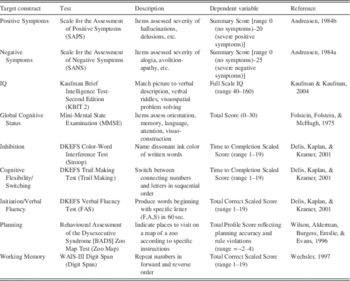
The Structured Clinical Interview for DSM-IV Axis I Disorders- Clinician Version (SCID-CV) modules B and C (psychotic symptoms & psychotic disorders sections) were administered to verify diagnostic information for all potential participants (First, Spitzer, Gibbon, & Williams, Reference First, Spitzer, Gibbon and Williams1997). Diagnostic information also was gathered through intensive consultation with hospital staff (e.g., treating psychiatrist, nurses, etc.) and medical chart review. The Scale for the Assessment of Negative Symptoms (SANS; Andreasen, Reference Andreasen1984a) and the Scale for the Assessment of Positive Symptoms (SAPS; Andreasen, Reference Andreasen1984b) were administered to evaluate clinical symptoms based on patient interview, direct observation, and available additional information (e.g., staff report, chart review). See Table 1 for more details.
Clinical and cognitive measures

Cognitive measures
IQ (Kaufman & Kaufman, Reference Kaufman and Kaufman2004), global cognitive status (Folstein, Folstein, & McHugh, Reference Folstein, Folstein and McHugh1975), and constructs related to executive functioning (Delis, Kaplan, & Kramer, Reference Delis, Kaplan and Kramer2001; Wechsler, Reference Wechsler1997; Wilson, Alderman, Burgess, Emslie, & Evans, Reference Wilson, Alderman, Burgess, Emslie and Evans1996;) were assessed with a series of cognitive tests described in Table 1. These tests were selected because accounts of the everyday action impairment associated with schizophrenia have emphasized global cognition and executive functions (see Kessler et al., Reference Kessler, Giovannetti and MacMullen2007 for a review).
Everyday action
The Naturalistic Action Test (NAT; Schwartz et al., Reference Schwartz, Buxbaum, Ferraro, Veramonti and Segal2003) is a performance-based measure of everyday action. Instructions, object placement, cuing procedures, and scoring are standardized and described in detail in the test manual. The NAT includes three independent trials in which an everyday task(s) is performed with little guidance from the examiner: (1) prepare a single slice of toast with butter and jelly and prepare a cup of instant coffee with cream and sugar; (2) wrap a gift while related distracter objects (e.g., gardening clippers, stapler, etc.) are on the tabletop; and (3) prepare a lunchbox with a sandwich, snack, and a drink and prepare a schoolbag with supplies for school, while several of the necessary objects (knife, thermos lids) are stored out of view in a drawer with additional, and potentially distracting, objects (e.g., ice tongs, measuring tape, etc). The third NAT task also requires participants to ring a bell after they complete each subtask (i.e., after packing the lunchbox and after packing the schoolbag). See supplementary materials for more details on the NAT’s reliability and validity.
Participants performed the NAT under two conditions: (1) Standard NAT (ST-NAT); (2) User-Centered NAT (UC-NAT; Giovannetti et al., Reference Giovannetti, Libon, Brennan, Bettcher, Sestito and Kessler2007). In the ST-NAT condition, the NAT was administered as described in the manual. For the ST-NAT, object placement on a U-shaped testing table is standardized, but objects are neither grouped together in any meaningful way, nor are they laid out on the table in the order that they are supposed to be used in the tasks.
In the UC-NAT condition, participants were required to complete the same tasks included in the ST-NAT. However, three environmental adaptations were implemented to increase the compatibility between the environment and task performance and to facilitate task monitoring. First, objects were grouped together meaningfully, such that objects required for the same task step were in closer spatial proximity than objects required for different steps. Second, objects were arranged on the table from left to right in the order that they should be used in the task, and participants were instructed to work from left to right, using the objects one after another. All distracter objects that were not needed to complete the task were placed at the far right of the table. Third, to encourage monitoring, a bell with a label that read “check your work” was placed to the right of the last essential task object and before any distracter objects. Participants were told to press the bell only after they had checked their work and were finished with the task (Giovannetti et al., Reference Giovannetti, Libon, Brennan, Bettcher, Sestito and Kessler2007).
Video recordings of ST-NAT and UC-NAT performances were coded according to the Comprehensive Error Score (CES). The CES includes multiple error types (e.g., sequence, perseveration, object substitution, action addition, and omission) that have been described in detail in numerous prior publications (Buxbaum, Schwartz, Coslett, & Carew, Reference Buxbaum, Schwartz, Coslett and Carew1995; Giovannetti et al., Reference Giovannetti, Bettcher, Brennan, Libon, Kessler and Duey2008; Giovannetti, Libon, Buxbaum, & Schwartz, Reference Giovannetti, Libon, Buxbaum and Schwartz2002; Kessler et al., Reference Kessler, Giovannetti and MacMullen2007; Schwartz et al., Reference Schwartz, Montgomery, Buxbaum, Lee, Carew, Coslett and Mayer1998). CES errors may be grouped into three dissociable categories in individuals with schizophrenia—omissions, commissions, and object substitutions (Devlin et al., Reference Devlin, Giovannetti, Kessler and Fanning2014; Giovannetti et al., Reference Giovannetti, Bettcher, Brennan, Libon, Kessler and Duey2008). Omission errors include instances when a task step is not performed (e.g., failing to apply jelly to toast). Commission errors include instances when a task step is performed incorrectly, because of mis-sequencing (e.g., adding butter to bread before toasting), perseveration (e.g., adding sugar to coffee on two separate occasions), or the addition of an off-task step that is irrelevant to the task goal (e.g., placing toast in the coffee mug). A third category (i.e., substitutions) includes errors that involve the substitution of a distracter object for a target object (e.g., applying sugar to toast instead of jelly). In sum, the total number of CES errors (Total CES) and the total of three CES error categories (Total Omission, Total Commission, Total Substitution) were collected for each NAT condition. Participants can obtain a minimum of 0 errors; however, there is no absolute maximum number of errors that could be committed. In this study, the maximum number of Total CES errors was 42; in our laboratory database of over 200 heterogeneous dementia participants, the maximum number of Total CES errors committed is currently 45.
We also evaluated the clinical significance of the difference in total errors between the two NAT conditions. We classified participants’ Total CES as “impaired” or “unimpaired” in reference to published normative data obtained from healthy participants performing the ST-NAT. We established a normative cut score for the Total CES (i.e., +2 SD M Total CES of the normative sample; cutoff score=5.84; Schwartz, Segal, Veramonti, Ferrara, & Buxbaum, Reference Schwartz, Segal, Veramonti, Ferrara and Buxbaum2002; Sestito, Schmidt, Gallo, Giovannetti, & Libon, Reference Sestito, Schmidt, Gallo, Giovannetti and Libon2005). Participants who made six or more Total CES errors were classified as “impaired;” those who made fewer than six errors were classified as “unimpaired” on the NAT.
Procedures
Participants signed IRB-approved consent forms and were administered modules B and C of the SCID-CV first to verify diagnostic information. Both versions of the NAT and the neuropsychological tests were administered over two to three testing sessions. The order of the NAT conditions was counterbalanced across participants to minimize order effects. Sessions one and two were separated by at least 1 week to minimize practice effects on the NAT. On few occasions, a third session, which was scheduled within four weeks of the second session, was necessary to complete the cognitive measures. NAT performance was videotaped for subsequent scoring.
Statistical Analyses and Missing and Excluded Data
All statistical analyses were performed using Statistical Package for the Social Sciences, version 21.0. Inter-rater reliability for the NAT CES was established on 20 participants randomly selected from the final study sample. Error codes from two independent coders were compared using Cohen’s κ analyses.
Normality of all variables was examined using Shapiro-Wilk tests, and nearly all variables were not normal. Normally distributed variables included MMSE, SANS scores, IQ, ST-NAT ACE scores, and verbal fluency scores (i.e., FAS). For all analyses, attempts were made to normalize non-normal variables using several transformations (X2, X3, √X, log X, 1/X); however, transformations were often unsuccessful. Therefore, both parametric and non-parametric analyses [i.e., analyses of varance (ANOVAs) with ranked-data] were performed, and the results did not differ across analyses. For repeated measures ANOVAs, the data were examined for potential violations of sphericity, but no violations were present, so corrections to the data were unnecessary. When appropriate, homogeneity of variance was examined.
Data were collected for 50 participants, but eight participants with IQ scores below 70 were excluded. For the remaining 42 participants, NAT data were missing for one person, due to videotape malfunctions. It was not possible to determine age of illness onset for four participants, because medical records did not specify this information and a reliable informant was unavailable. SAPS were available for only 28 participants, because this measure was added midway through data collection. Two participants were unable to complete the Trail Making Test, and three were unable to complete the Zoo Map Test due to failure to comprehend instructions. All other demographic and cognitive test variables were available for the 42 participants.
Results
Characteristics of the Sample
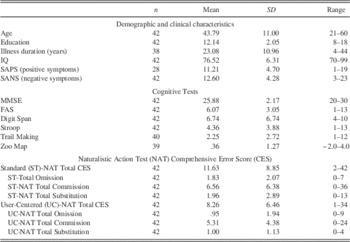
The sample consisted of 42 individuals; 31 met diagnostic criteria for schizophrenia (74%) and 11 met criteria for schizoaffective disorder (26%). Half of the sample was comprised of men (n=22; 52.4%). The majority self-identified as African American (n=32; 76.2%), and others identified as Caucasian (n=9; 21.4) or Latino/Hispanic (n=1; 2.4%). Additional demographic and clinical data are provided in Table 2.
Demographic and clinical characteristics, cognitive test scores, and Naturalistic Action Test (NAT) Comprehensive Error Scores (CES).

SANS=Scale for the Assessment of Negative Symptoms; SAPS=Scale for the Assessment of Positive Symptoms; FAS=DKEFS Verbal Fluency Test.
Inter-rater Reliability
Inter-rater reliability between two coders was strong. Two independent raters demonstrated 98.77% agreement in identifying and classifying errors (CES Cohen’s κ=.88).
Effect of UC-NAT Interventions on Total CES
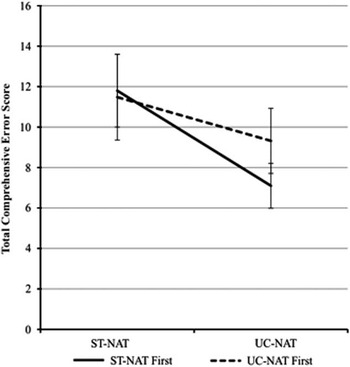
A Condition (ST-NAT, UC-NAT) by Order (ST-NAT administered first, ST-NAT administered second) mixed ANOVA was performed to examine the effect of the intervention along with the potential effect of administration order. Results showed a significant main effect for Condition [F(1,39)=10.76, p<.01, ηp 2=.22, large effect]. The main effect for Order [F(1,39)=.23, p=.63, ηp 2<.01, negligible effect] and the Condition×Order interaction were not significant [F(1,39)=1.93, p=.17, ηp 2=.05, small to medium effect]. As shown in Figure 1, Total CES was lower for the UC-NAT as compared to the ST-NAT condition.
NAT CES by Condition (ST vs. UC) and Order (ST First vs. UC First). Error bars reflect ±1 SEM. NAT CES=Naturalistic Action Test Comprehensive Error Score; ST=standard NAT; UC=user-centered NAT; SEM=standard error of the mean.

To evaluate the clinical significance of the intervention, the percentage of participants who fell in the “impaired” range on the NAT (based on CES cutoff score=5.84; Schwartz et al., Reference Schwartz, Segal, Veramonti, Ferrara and Buxbaum2002; Sestito et al., Reference Sestito, Schmidt, Gallo, Giovannetti and Libon2005) was examined for both ST-NAT and UC-NAT conditions. 78.05% of participants demonstrated impaired performance on the ST-NAT, whereas 57.14% demonstrated impaired performance on the UC-NAT; this difference was statistically significant (χ 2 =4.13, p=.04, φ=.22, small to medium effect).
Effect of UC-NAT Interventions on CES Error Types
An Error Type (omissions, commissions, substitutionsFootnote 2 ) by Condition (ST-NAT, UC-NAT) repeated-measures ANOVA was performed to examine whether the UC-NAT interventions had a specific effect on a particular error type(s). As shown in Table 2, the main effects of Error Type [F(2,39)=17.64, p<.01, ηp 2=.48, large effect] and Condition [F(1,40)=10.10, p<.01, η2=.20, large effect] were both significant. The Error Type×Condition interaction was not significant [F(2,80)=.13, p=.88, η2<.01, negligible effect], indicating that the error types were not differentially affected by the UC-NAT manipulations.
Relations between NAT and Demographic, Clinical, and Cognitive Variables
We examined the demographic, clinical, and cognitive correlates of Total CES for each NAT condition separately. As shown in Table 3, age was significantly correlated with ST- Total CES and UC- Total CES, such that older participants made more errors in both conditions.
Correlation coefficients between NAT variables and clinical/demographic variables

Note. Significant correlation coefficients shown in bold text. N=42, except SAPS n=28.
NAT=Naturalistic Action Test; CES=Comprehensive Error Score.
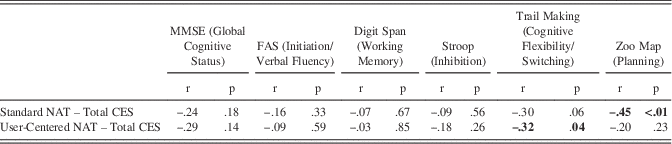
As shown in Table 4, relations with cognitive tests differed for each NAT condition. ST-NAT Total CES was significantly associated with the Zoo Map test; the correlation with the Trail Making Test nearly reached significance. Both correlations were negative, indicating that individuals with more impaired cognitive test performance made more errors on the ST-NAT. For the UC-NAT, only the correlation with the Trail Making Test was statistically significant. The UC-NAT CES was not significantly associated with the Zoo Map Test. Furthermore, the two Zoo Map Test correlation coefficients [i.e., ST-NAT×Zoo Map (−.45) and UC-NAT×Zoo Map (−.20)] were significantly different (Z=−2.08; p=.04), such that the Zoo Map Test was significantly more strongly associated with the ST-NAT than the UC-NAT. The correlation coefficients for the Trail Making Test did not significantly differ across the two NAT conditions (Z=0.1; p=.92).
Correlation coefficients between NAT variables and cognitive measures

Note. Significant correlation coefficients shown in bold text. N=42, except Trail Making n=40, Zoo Map n=39.
MMSE=Mini Mental State Exam; Initiation/Verbal Fluency (FAS)=Verbal Fluency scaled score; Digit Span=Working Memory (Digit Span)=Digit Span scaled score; Inhibition (Stroop)=Stroop Inhibition scaled score; Cognitive Flexibility/Switching (Trail Making)=Trail Making Test scaled score; Planning (Zoo Map)=BADS Zoo Map profile score; NAT=Naturalistic Action Test; CES=comprehensive error score.
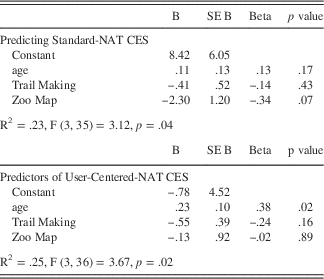
Two multiple regression analyses were conducted to further explore the combined effects of demographic and cognitive variables as predictors of NAT performance. Only demographic and cognitive variables that were significantly correlated to the ST-NAT or UC-NAT (see Tables 3 and 4) were included in the regressions (i.e., age, Trail Making, Zoo Map). As shown in Table 5, the regression for ST-NAT Total CES revealed age, Trail Making, and Zoo Map accounted for a significant portion (23%) of the variance, with the Zoo Map score as the strongest predictor. The regression for UC-NAT Total CES also accounted for a significant portion (25%) of the total variance, but only age was a significant predictor.
Multiple regression analysis with age, Trail Making Test, and Zoo Map Test as predictors of NAT performance

Discussion
The primary aim of this study was to determine whether environmental adaptations improved everyday action performance in people with chronic schizophrenia. Participants performed everyday tasks with (UC-NAT) and without (ST-NAT) environmental adaptations. The UC-NAT and ST-NAT conditions differed only in the implementation of these adaptations, otherwise they included exactly the same tasks, objects, and goals. Also, the task instructions were only minimally different across the conditions, and participants were not trained on the adaptations. Results showed that indeed participants made fewer errors of all types on the UC-NAT compared to the ST-NAT. Importantly, a significantly smaller proportion of the sample performed in the clinically impaired range on the UC-NAT (20%) versus the ST-NAT (43%). Thus, the improvements gained from the adaptations were clinically meaningful.
A second aim of this study was to elucidate the mechanisms underlying improvement from the UC-NAT adaptations. This aim was achieved through a novel methodological feature of this study—the standardized, performance-based assessment of everyday tasks both with and without adaptations in a counter-balanced, repeated measures design. The unique design offered the opportunity to examine differences in patterns of errors and patterns of correlations with clinical, demographic, and cognitive tests between the two NAT conditions. Results showed the environmental adaptations had a pervasive effect on performance, as all error types were comparably lower in the UC-NAT condition. Correlation/regression analyses showed ST-NAT performance was associated with a measure of planning (Zoo Map), but this association was not significant for the UC-NAT condition. Together, these findings suggest that environmental adaptations may have improved all aspects of everyday action performance by reducing planning demands.
On average, participants in our sample showed impaired planning abilities, with over half of the sample performing in the severely impaired range on the Zoo Map test (see Table 2). Holt, Wolf, Funke, Weisbrod, and Kaiser (Reference Holt, Wolf, Funke, Weisbrod and Kaiser2013) have shown that among participants with schizophrenia, everyday functioning was most strongly associated with performance on planning tasks as compared to tests of attention, rule funding, working memory, or inhibition. Prior work from our lab (Seter, Giovannetti, Kessler, & Worth, Reference Seter, Giovannetti, Kessler and Worth2011) has shown evidence for everyday planning difficulties in people with schizophrenia. For example, participants with schizophrenia spend less time planning and more time working on everyday tasks than healthy controls; they also exhibit fewer planning behaviors during everyday tasks (i.e., gathering materials and preparing the workspace before completing task steps) than healthy controls. Additionally, indicators of planning were significantly associated with everyday task performance, such that participants who spent more time planning and who exhibited more planning behaviors performed everyday tasks more accurately (Seter et al., Reference Seter, Giovannetti, Kessler and Worth2011). Thus, the significant correlation between planning ability (Zoo Map) and performance on the ST-NAT supports the recent literature (Holt et al., Reference Holt, Wolf, Funke, Weisbrod and Kaiser2013; Seter et al., Reference Seter, Giovannetti, Kessler and Worth2011) and suggests that everyday activities in schizophrenia are disrupted by executive planning deficits; consequently, minimizing the planning demands of everyday tasks or improving planning skill should improve everyday functioning in this population. In fact, when the environmental adaptations were incorporated into the UC-NAT, performance significantly improved and the relation between errors and planning ability was no longer significant.
Correlation analyses also showed that age and switching abilities (e.g., Trail Making Test) were associated with everyday task performance in both NAT conditions; this finding is consistent with results from prior studies (Kessler et al., Reference Kessler, Giovannetti and MacMullen2007; Harvey, Silverman, et al., Reference Harvey, Silverman, Mohs, Parrella, White, Powchik and Davis1999; Harvey, Parrella, et al., Reference Harvey, Parrella, White, Mohs, Davidson and Davis1999; Friedman et al., Reference Friedman, Harvey, Coleman, Moriarty, Bowie, Parrella and Davis2001). Because age and switching were related to performance in both conditions, the user-centered adaptations likely did not improve everyday task performance by addressing switching skills or the cognitive deficits associated with aging. However, additional adaptations or interventions that target these difficulties may lead to even greater improvement than the user-centered interventions alone, and this should be explored in future research.
The UC-NAT and ST-NAT conditions were counter-balanced across participants to control for order effects, and results showed no statistically significant effect of order or practice. However, the effect size of the condition (ST-NAT vs. UC-NAT)×order (first, second) interaction was small to medium and the results shown in Figure 1 suggest participants performed best when the UC-NAT was administered after the ST-NAT. Thus, repetition or training might facilitate the effect of environmental adaptations, or environmental adaptations might have a more robust effect on tasks that are familiar and well practiced. Future studies should examine the influence of training and task familiarity on the utility of environmental adaptations.
Our results are consistent with past reports that individuals with schizophrenia benefit from compensatory strategies (Velligan et al., Reference Velligan, Bow-Thomas, Huntzinger, Ritch, Ledbetter, Prihoda and Miller2000). Our results also are consistent with the literature emphasizing the importance of the environmental context for optimizing cognitive performance and adaptive functioning in this population (Kern, Liberman, Kopelowicz, Mintz, & Green, Reference Kern, Liberman, Kopelowicz, Mintz and Green2002; Kern et al., Reference Kern, Liberman, Becker, Drake, Sugar and Green2009; Silverstein & Wilkniss, Reference Silverstein and Wilkniss2004). To our knowledge, however, our study extends this past work in several ways. First, our study is the first to demonstrate the efficacy of specific environmental adaptation principles (i.e., increasing S-R compatibility and performance monitoring cues) alone, without training or extensive instruction. Second, to our knowledge, our study is the first to show that increasing S-R compatibility improved performance on multiple-step, everyday tasks; others have demonstrated this principle on cognitive, perceptual, and motor tasks in people with schizophrenia (Hemsley, Reference Hemsley1976; Silverstein et al., Reference Silverstein, Knight, Schwarzkopf, West, Osborn and Kamin1996). Further investigation is needed to determine whether the current results would be replicated with only one of the two adaptation principles (i.e., S-R compatibility vs. monitoring cues) and whether it is feasible to implement these adaptations with minimal training in real life contexts by training caregivers or patients to organize their workspace and insert monitoring cues before initiating an everyday task. However, our results suggest that environmental adaptations may be an effective and efficient alternative approach or adjunctive “intervention” to cognitive remediation for improving functional outcomes, particularly for individuals with chronic schizophrenia for whom cognitive remediation alone may be less effective (Bowie et al., Reference Bowie, Grossman, Gupta, Oyewumi and Harvey2014).
We have previously reported that the environmental adaptations used in this study showed comparable benefits for older adults with dementia (Giovannetti et al., Reference Giovannetti, Libon, Brennan, Bettcher, Sestito and Kessler2007). Individuals with dementia, particularly those with Alzheimer’s disease (AD), have different neuropsychological and everyday action profiles than individuals with schizophrenia. Individuals with AD exhibit an amnestic memory profile and high numbers of omission errors on the NAT (Kessler et al., Reference Kessler, Giovannetti and MacMullen2007). Despite the marked cognitive and functional differences between these clinical populations, environmental adaptations were comparably effective in reducing omission and commission errors (Giovannetti et al., Reference Giovannetti, Libon, Brennan, Bettcher, Sestito and Kessler2007), suggesting the UC-NAT environmental adaptations may circumvent multiple cognitive and action deficits and may be effective for a broad range of patient populations. This wide-ranging benefit contrasts with the relatively circumscribed effects that have been observed by our research team for reminder/goal cues (i.e., cues presented at the end of the task to remind participants of the task goal). Goal cues have been shown to benefit only participants with episodic memory deficits and high numbers of omissions on everyday tasks (Giovannetti et al., Reference Giovannetti, Seligman, Britnell, Brennan and Libon2014). Thus, in contrast to other forms of intervention, environmental adaptations may serve as a “one-size-fits-all” strategy to improve everyday functioning for various populations.
A limitation of the current study is the recruitment of an exclusively inpatient population that was relatively low functioning (i.e., M FSIQ=77), which reduces generalizability of the results. It is not known whether the UC-NAT adaptations would be more or less beneficial for higher functioning individuals who perform more complex activities in their daily lives. The cognitive evaluation focused on global functioning and executive functions; inclusion of tests of other cognitive domains (e.g., episodic memory, perceptual organization) may have shown that the user-centered adaptations reduced more than just planning demands. Another limitation is that the adaptations were evaluated in a highly structured, laboratory task using a counter-balanced design, which had advantages (i.e., within-subject analyses) and disadvantages (i.e., influence of practice effects). The structured task limits our conclusions regarding the effectiveness of the adaptations in real-life settings. Future studies should examine whether the underlying principles of the UC-NAT interventions (e.g., S-R compatibility; monitoring cues) could be used to guide home-based interventions to improve independence and quality of life in people with schizophrenia.
These limitations notwithstanding, this study showed that even relatively simple environmental adaptations could be effective without training and hold promise for improving functional outcomes for individuals with chronic schizophrenia and significant cognitive impairment. The findings also suggested that these adaptations may have worked by reducing the planning demands of everyday tasks.
Acknowledgments
This research, which was conducted in partial fulfillment of the requirements for Rachel K. Kessler’s dissertation research, was supported by internal funds from Temple University and a research and study leave awarded to Tania Giovannetti. We thank Theresa Atwood, Bernadette Hayburn, Yong-Kook Kim, Myles Ladenheim, Julie Rosner, Priscilla Britnell, Molly Fanning, Brandon Ciaudelli, Polina Zilbering, and the staffs of Temple University Episcopal Hospital and Girard Medical Center for their help with participant recruitment and data collection. No financial or other relationships exist that could be interpreted as a conflict of interest.
Supplementary material
To view supplementary material for this article, please visit http://dx.doi.org/10.1017/S1355617715000260