1. INTRODUCTION
For successful deep space exploration, accurate navigation information is crucial. Navigation information provides the predictions for guidance systems and determines what a spacecraft must do to reach its target celestial body (Steiner III, Reference Steiner III2012). As there is only one opportunity in a mission, the orbital capture period is the most critical stage in the whole flight phase of deep space exploration. Due to the remoteness and the large time-delay for communications, real-time accurate navigation information cannot be provided by ground stations, especially during the capture period for Venus exploration (Riedel et al., Reference Riedel, Bhaskaran, Desai, Hand, Kennedy, McElrath and Ryne2000; Smith et al., Reference Smith and Hadaegh2005). There have been numerous missions to Venus since 1961. After the orbit transfer period, there have been five failed Venus exploration missions, and three of these can be traced to problems during the capture period. Fortunately, autonomous celestial navigation can provide real-time accurate navigation information, and can improve the success rate for Venus missions. Celestial Navigation System (CNS) methods can be classified as direction measurements (Ning and Fang, Reference Ning and Fang2007), distance measurements (Long et al., Reference Long, Leung, Folta and Gramling2000) or velocity measurements (Liu et al., Reference Liu, Fang, Ning, Wu and Kang2014).
Direction measurements are also referred to as angle measurements, and are the most common celestial navigation methods. Observing three or more stars, a spacecraft can determine its attitude accurately. After this, the direction of the spacecraft with respect to a near celestial body can be obtained by an imaging navigation sensor. Its tangential position accuracy is proportional to the distance between a spacecraft and a near celestial body. However, radial position cannot be determined by one measurement. It can be only estimated by multiple measurements and use of the orbit dynamic model (Zhang et al., Reference Zhang, Wang and Huang2009; Xu et al., Reference Xu, Cui, Cui and Liu2007). In conclusion, the positioning accuracy of the direction measurement method is related to the distance between a spacecraft and a near celestial body. Thus, as the spacecraft is distant from the target celestial body in the Venus capture period, the navigation system cannot work very well. When two or more near celestial bodies are observed, spacecraft position can be obtained since there are two lines with an intersection point. In the Mars capture period, three near celestial bodies, including Mars, Photos or Deimos can be observed, and navigation systems can work very well. However, unlike Mars, Venus has no natural satellites. Therefore, direction measurements do not have a good performance during the Venus capture period.
Distance measurement methods often utilise X-ray pulsar navigation (Emadzadeh and Speyer, Reference Emadzadeh and Speyer2011; Xiong et al., Reference Xiong, Wei and Liu2015). The navigation system observes X-ray pulse signals from pulsars using an X-ray sensor, and processes them to obtain the pulse Time Of Arrival (TOA). The pulse TOA is effectively the distance measurement. As X-ray pulsar radiation signals are very weak, in order to improve the signal-to-noise ratio of TOA, the pulsar observation period usually lasts for several minutes. Then, depending on the estimated velocity of the spacecraft, the Epoch Folding (EF) procedure is usually adopted to process pulsar signals received in the pulsar observation period. However, in a pulsar observation period, Doppler effects due to the high-speed flight of spacecraft can lead to a pulsar TOA bias, which significantly degrades navigation performance. To suppress this bias, the velocity estimation and orbital dynamic models are combined to compensate for Doppler effects. However, in the Venus capture period, the orbital dynamic model is strongly nonlinear and time-varying (Li et al., Reference Li, Liu, Huang and Qin2010). In this case, if the accuracy of the velocity estimation is very low, pulsar TOA bias will significantly increase. Therefore, distance measurement has difficulty in achieving autonomous navigation for the Venus capture period.
The velocity measurement method measures Doppler frequency shift of the solar spectrum (Guo, Reference Guo1999) using a spectrometer. Based on the Doppler frequency shift, the velocity of a spacecraft with respect to the Sun can be measured precisely. Position information of the spacecraft is obtained from the integration of the Doppler velocity. Unfortunately, by this means, an accumulative error inevitably exists in position information. Thus, positioning precision declines with time. Therefore, this method cannot work alone, and is only utilised as a complementary navigation method. It can only provide velocity along the line-of-sight to the Sun, and not a three-dimensional velocity vector.
The above three measurements have their advantages and disadvantages. Direction/Distance (DD) measurements integrated navigation has been proposed (Qiao et al., Reference Qiao, Liu, Zheng and Xiong2009), as has distance/velocity measurements integrated navigation (Liu et al., Reference Liu, Kang, White, Ma and Tian2011). However, these existing methods do not consider Doppler effects in the received pulsar signals, and the above integrated navigation systems cannot operate normally during the Venus capture period.
The orbital capture period is a crucial stage for deep space exploration missions (Fang et al., Reference Fang, Wu and Zhang2015; Liever et al., Reference Liever, Habchi, Burnell and Lingard2003; Liechty, Reference Liechty2007). Its navigation accuracy directly affects mission success. In the Venus capture period, direction measurement can only provide a single spacecraft position line. The reasons are that Venus has no natural satellites and that the spacecraft is distant from Venus when critical trajectory adjustments must be made. The distance measurement can determine a plane on which the spacecraft lies. Therefore, when a direction measurement is combined with a distance measurement, spacecraft position can be determined since one line and one plane have one intersection point. From the viewpoint of observability analysis, the DD integrated navigation system is observable. In theory, this integrated method can provide highly accurate navigation information. However, after Doppler compensation, a large bias exists in pulse TOA because of the low accuracy of velocity estimation. This is because in the X-ray pulsar observation period, the direction measurement cannot directly or indirectly provide three-dimensional velocity information. Also, the orbital dynamic model in the capture period can be considered as a strongly nonlinear and time-varying system. A large TOA bias results in the divergence of the integrated navigation filter.
To solve this problem, a Direction/Distance/Velocity (DDV) measurements deeply integrated navigation method is proposed. The words “deeply integrated navigation” mean that the direction and velocity measurement are not the only measurement information for navigation, but also Doppler compensation information, which is utilised to suppress Doppler effects in the pulsar observation period. In the observation period of the pulsar signals, direction and velocity measurements can provide highly accurate three-dimensional velocity information, which is used to compensate for Doppler effects. Consequently, pulse TOA bias decreases to a negligible level. The deeply integrated navigation filter is not affected by a small TOA bias. All three measurements are used to update the state estimation, and the navigation filter can converge very well.
This paper is organised into five sections. After the introduction, the orbital dynamic model and three measurement models are described in Section 2. In Section 3, the DDV measurements deeply integrated navigation scheme is developed. The simulation results in Section 4 demonstrate the robustness and accuracy of this presented method and conclusions are drawn in Section 5.
2. ORBITAL DYNAMIC MODEL AND MEASUREMENT MODELS
2.1. Orbital dynamic model for Venus capture period
In this paper, the Sun coordinate frame is adopted. Its origin is at the Sun's centre. The X-axis points to the vernal equinox, the Z-axis points to the celestial North Pole and the Y-axis completes a right-handed system. The Earth-to-Venus transfer orbital dynamic model can be given as:
 $$\left\{\matrix{{\dot{\bi r}}={\bi v} \hfill \cr {\dot{\bi v}}={\bi a}_{sun}+{\bi a}_{venus}+{\bi a}_{earth}+\Delta {\bi F}\cr}\right. $$
where asun, avenus and aearth are the gravitational acceleration of the Sun, Venus and the Earth, respectively. Their expressions can be given as follows:
 $${\bi a}_{sun} = -\mu_s{\bi r}/r^3 $$
 $${\bi a}_{venus}=-\mu_v\lsqb {\bi r}_{pv}/r_{pv}^3-{\bi r}_{sv}/r_{sv}^3\rsqb $$
 $${\bi a}_{earth}=-\mu_e\lsqb {\bi r}_{pe}/r_{pe}^3-{\bi r}_{se}/r_{se}^3\rsqb $$
where μs, μv, μe are the gravitational constants of the Sun, Venus and the Earth, respectively. r = [x,y,z] and v = [v x,v y,v z] are the position and velocity vectors of the Venus Express probe respectively. rpv, rpe are the position vectors of Venus Express with respect to Venus' centre and the Earth's centre, respectively. rsv, rse are the position vectors of Venus' centre and the Earth's centre with respect to the Sun's centre respectively. ΔF = [ΔF X, ΔF Y, ΔF Z] is the perturbation acceleration vector considering the sunlight pressure and other planets.
Equation (1) can be rewritten in the general state equation as:
 $${\dot{\bi X}}\lpar t\rpar =f\lpar {\bi X}\comma \; t\rpar +{\bf \omega}\lpar t\rpar $$
where the state vector X = [x,y,z,v x,v y,v z]T.  ${\dot{\bi X}}\lpar t\rpar $ is the derivative of X. ω = [0, 0, 0, ΔF x, ΔF y, ΔF z]T is the state process noise.
The characteristics of the orbital dynamic model, such as nonlinearity, are different for different periods. In this paper, we analyse the transfer orbit and the capture orbit.
In the transfer orbit, asun plays a dominant role. Its value is in the interval [0·006 m/s2, 0·011 m/s2]. Over five months, its value increases by 0·005 m/s2. In this period, this model can be considered as a weakly nonlinear system.
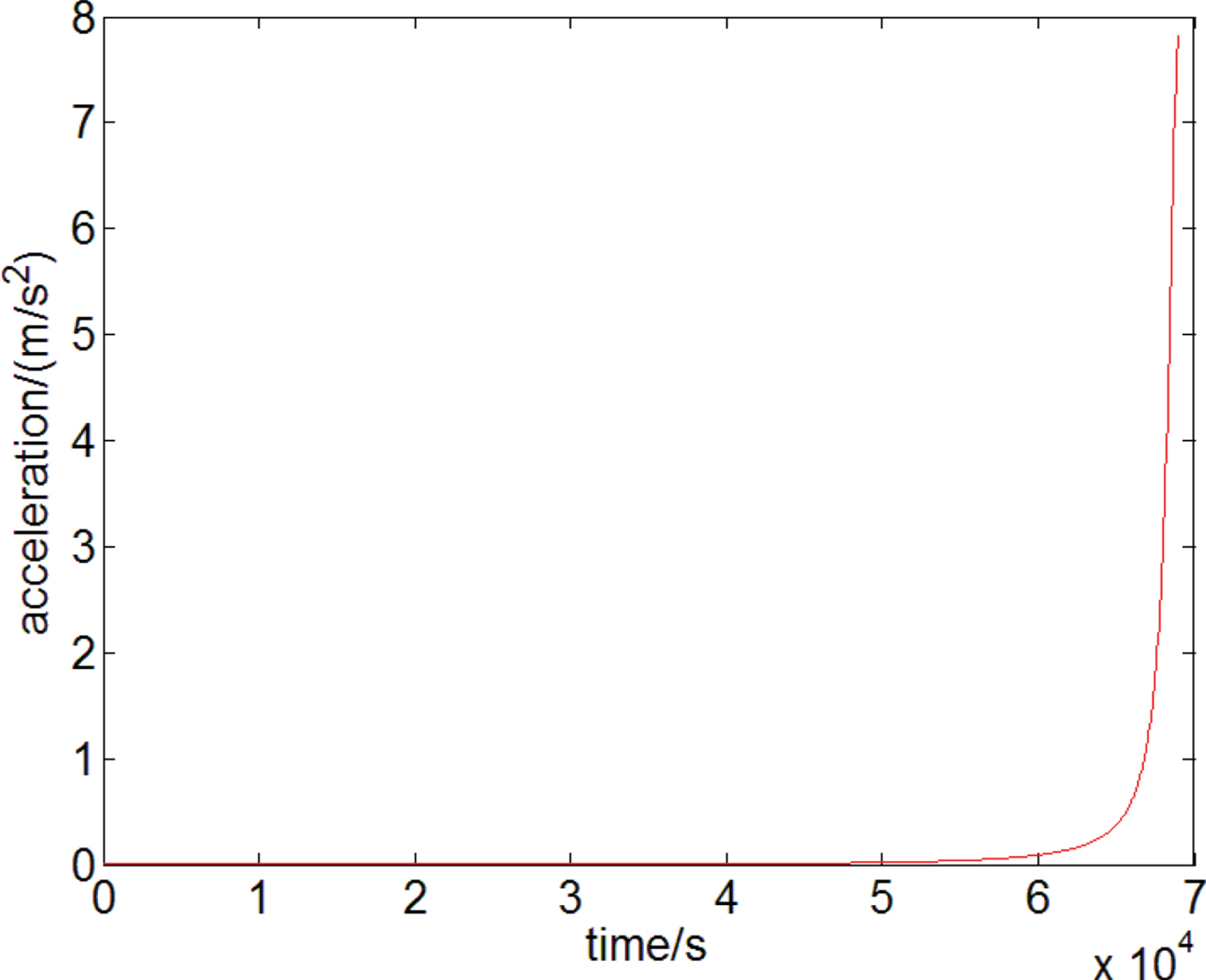
While in the Venus capture orbit, as μs/r 2≪μv/r 2pv, avenus plays a dominant role instead of asun. As shown in Figure 1, its value increases from 0·0026 m/s2 to 7·8 m/s2 in 19 hours, especially in the later stages. In this period, this model can be considered as a strongly nonlinear and time-varying system. In this condition, the state estimation error, ΔX, can cause the nonlinear prediction error, δX. In this paper, we define the nonlinear prediction error, δX, whose expression can be given as:
Spacecraft acceleration for Venus capture period.

 $$\delta {\bi X}=\vint^{T_1}_{T_0} f\lpar {\bi X}+\Delta {\bi X}\comma \; t\rpar dt -\vint^{T_1}_{T_0} f\lpar {\bi X}\comma \; t\rpar dt-\Delta {\bi X}\left[\matrix{{\bi I}_{3\times 3} & \lpar T_1-T_0\rpar {\bi I}_{3\times 3} \cr {\bi 0}_{3\times 3} & {\bi I}_{3 \times 3}}\right]$$
From Equation (6), it can be seen that in a linear system, δX equals zero; while in a nonlinear system, δX is nonzero. Especially in a strongly nonlinear system, it is large and heavily affects navigation system performance. Analysis of the nonlinear prediction error can be found in Section 4.2. Obviously, a strongly nonlinear orbit dynamic model is harmful to navigation performance.
2.2. Direction measurement model
In this section, we introduce the direction measurement and analyse its performance.
The spacecraft observes three or more stars, and determines its attitude. In the direction measurement method, using the imaging camera to observe Venus, the spacecraft obtains the direction of the spacecraft with respect to Venus via calculation. Its measurement model can be expressed as (Qiao et al., Reference Qiao, Liu, Zheng and Xiong2009):
 $${\bi Z} = \displaystyle{{{\bi r}-{\bi r}_{sv}}\over{\vert {\bi r}-{\bi r}_{sv}\vert }}+{\bf{\xi}}$$
where Z is the direction vector of the spacecraft with respect to Venus and ξ is the direction measurement noise.
In the capture period for Mars exploration, the directions of Mars, Photos or Deimos can be obtained. Spacecraft position can be determined since two position lines have an intersection point. However, unlike Mars, Venus has no natural satellites. Therefore, in the capture period for Venus exploration, the direction measurement method can only determine a single position line (Ning and Fang, Reference Ning and Fang2005). Using the geometric technique, we can find that its tangential position accuracy is proportional to the distance between the spacecraft and Venus, while radial position can only be estimated by multiple measurements and the orbit dynamic model. By this means, the radial position accuracy is much lower than the tangential one, and can even be considered meaningless. Therefore, in the Venus capture period, it is difficult for direction measurements to give accurate position information. To achieve high accuracy, this measurement must be integrated with other navigation methods.
2.3. Distance measurement model and Doppler effects compensation in a highly dynamic environment
The X-ray pulsar distance measurement is the difference between the pulse TOA observed by the X-ray sensor on board the spacecraft and that predicted by the pulse timing model at the Solar System Barycentre (SSB). t and t b are the pulse TOAs of the pulsar at the spacecraft and at the SSB, respectively. n is the line-of-sight direction vector of the pulsar. The offset, t b − t, reflects r's projection on n. Considering relativistic and geometric effects, the time-of-arrival transfer model can be given as (Sheikh et al., Reference Sheikh, Pines, Ray, Wood, Lovellette and Wolff2006):
 $$t_b-t = \displaystyle{{1}\over{c}}{\bi n}^{\rm T}{\bi r} + \displaystyle{{1}\over{2cD_0}} \lsqb -r^2+\lpar {\bi n}^{\rm T}{\bi r}\rpar^2 -2{\bi b}^{\rm T}{\bi r} +2\lpar {\bi n}^{\rm T}{\bi b}\rpar \lpar {\bi n}^{\rm T}{\bi r}\rpar \rsqb +\displaystyle{{2\mu_S}\over{c^3}} \ln \left\vert \displaystyle{{{\bi n}^{\rm T}{\bi r}+r}\over{{\bi n}^{\rm T}{\bi b}+b}}+1\right\vert +\sigma $$
where D 0 is the range from the pulsar to the SSB, b is the position of the SSB relative to the Sun, c is the speed of light and σ is the TOA noise.
It is worth noting that the TOA is obtained by comparing the cumulative pulse profile with the standard one. To enhance the Signal to Noise Ratio (SNR) of the pulse profile which is related to the pulsar TOA accuracy, the Epoch Folding (EF) method (Emadzadeh and Speyer, Reference Emadzadeh and Speyer2011) is commonly used.
(1) The X-ray detector records the TOA of each individual X-ray photon.
(2) This set of photons is then folded at the predicted pulse period based on the known pulsar timing model. Dividing the pulse phase into M bins and dropping each photon into the corresponding phase bin, a binned pulse profile can be constructed.
However, the pulsar photon TOAs are subject to Doppler effects due to the high-speed motion of the spacecraft and we must compensate for this.
Next, we give the EF method based on Doppler compensation (Liu et al., Reference Liu, Fang, Kang, Wu and Ning2015) to suppress the effects.
To reduce computation load, we take one pulse period as the unit to compensate the TOA of each X-ray photon. Suppose that the i-th pulse period is P i, the number of pulses in a pulsar observation period is N and the spacecraft velocity in the i-th pulse period is v i. The i-th pulse compensated sub-TOA,  ${\hat T}_{i}$, can be expressed as:
 $${\hat T}_i=t_i-\sum^N_{k=i+1}\left(\displaystyle{{{\bi n}^{\rm T}{\hat{\bi v}}_{k}P_{k}}\over{c}}\right)$$
The Doppler compensation-based EF method is summarised as follows:
(1) The X-ray detector records the TOA of each individual X-ray photon.
(2) The Doppler compensation procedure is as follows: (a) the velocity of spacecraft,
 ${\hat{\bi v}}_{i}$, is estimated; (b) the time of arrival of X-ray photon is compensated with ${\hat{\bi v}}_{i}$ and Equation (9). The velocity, ${\hat{\bi v}}_{i}$, can be propagated by orbital dynamics, or obtained by other measurement methods.
(3) This set of photons is then folded at the predicted pulse period based on the known pulsar timing model.


In the Doppler compensation-based EF method, TOA bias is subject to the velocity prediction error. Next, we build the TOA bias model as follows:
 $$\beta=\displaystyle{{1}\over{N_p}}\sum_{i=1}^N{\hat T}_i=\displaystyle{{1}\over{N_p}}\sum^N_{i=1} \left(t_i-\sum_{k=i+1}^{N_p}\left(\displaystyle{{{\bi n}^{\rm T} {\hat{\bi v}}_kP_k}\over{c}}\right)\right)$$
where the observation period T = N·P 0.
In the transfer orbit, the estimated velocity,  ${\hat{\bi v}}_{i}$, can be considered as constant. Thus, the above model can be simplified as in Liu et al. (Reference Liu, Fang, Kang, Wu and Ning2015). However, in the Venus capture orbit, the orbital dynamic model is strongly nonlinear and time-varying. The spacecraft is in a highly dynamic environment. Thus, the estimated velocity,
 ${\hat{\bi v}}_{i}$, varies greatly. In this condition, this model cannot be simplified. To solve this problem, we can utilise other measurements to provide highly accurate velocity estimation in the pulsar observation period. This Doppler compensation method using other measurements embodies the “deeply” integrated navigation approach.
2.4. Velocity measurement model
In this section, we introduce the velocity measurement and analyse its performance.
In the Doppler velocity measurement method, a spectrometer is used to measure the Doppler frequency shift of the solar spectrum. Based on this Doppler frequency shift, the velocity of the spacecraft at the sight-line of the Sun can be calculated accurately. Its measurement model can be given as (Li et al., Reference Li, Liu, Huang and Qin2010):
 $$V=\displaystyle{{{\bi r}\cdot {\bi v}}\over{\vert {\bi r}\vert }}+\upsilon $$
where V is the Doppler velocity at the sight-line of the Sun and υ is the velocity measurement noise.
Positioning information can be obtained by the integration of the Doppler velocity. However, a cumulative error inevitably exists in position information, which results in the positioning precision declining with time. Therefore, this method cannot work alone, and is only utilised as a complementary navigation method. What is worse, this method can only provide velocity in the sight-line to the Sun, not a three-dimensional velocity vector.
3. DEEPLY INTEGRATED NAVIGATION AND PERFORMANCE ANALYSIS
In this section, we present a diagram of the DDV measurements deeply integrated navigation, and then analyse its performance.
The autonomous navigation system for the deep space explorer is nonlinear, especially for the Venus capture period. Therefore, we employ the Extended Kalman Filter (EKF) (Simon, Reference Simon2006; Bucy and Renne, Reference Bucy and Renne1971; Sunahara Reference Sunahara1970) as a navigation filter due to its good nonlinear performance and small calculation load.
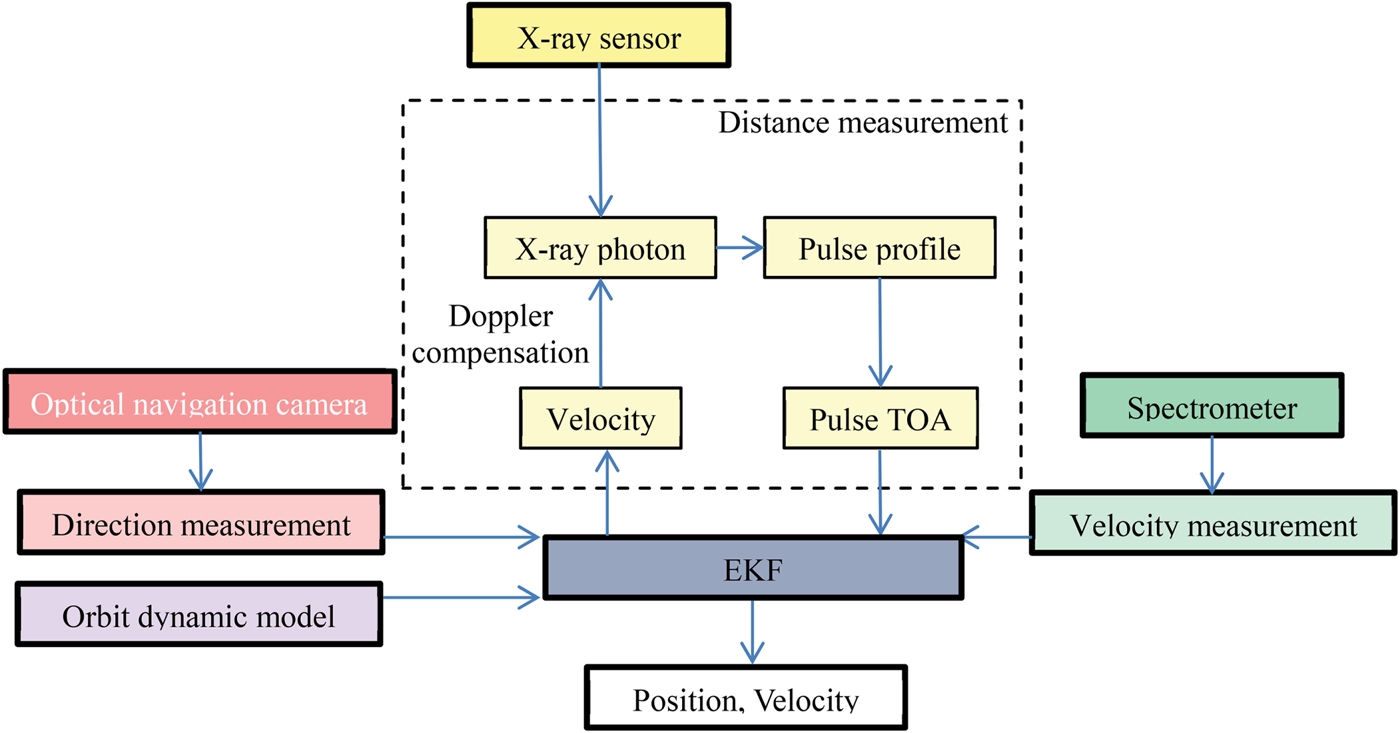
Figure 2 is a diagram of the DDV measurements deeply integrated navigation system. The orbital dynamic model can be expressed as Equation (1). As direction, distance and velocity measurements are not synchronised, we design the measurement model in three situations:
(1) The direction of Venus with respect to the spacecraft is obtained by star sensors and the imaging sensor. On this condition, correspondingly, the measurement model, hD(X, t), and value, YD, can be expressed as:
(12)$${\bi h}_D\lpar {\bi X}\comma \; t\rpar =\displaystyle{{{\bi r}-{\bi r}_{sv}}\over{\vert {\bi r}-{\bi r}_{sv}\vert }} $$(13)$${\bi Y}_D={\bi Z} $$(2) Doppler velocity with respect to the Sun is measured by a spectrometer. The measurement model, h V(X,t), and value, YV, can be expressed as:
(14)$$h_V\lpar {\bi X}\comma \; t\rpar =\displaystyle{{{\bi r}\cdot {\bi v}}\over{\vert {\bi r}\vert }} $$(15)$${\bi Y}_V=V $$(3) X-ray radiation signals of pulsar are collected by X-ray sensors. Pulse TOA can be obtained via dealing with these signals. Once a pulse TOA is produced, it is employed as the navigation measurement. The corresponding measurement model, h X(X,t), and value, YX, can be represented as:
(16)$$h_X\lpar {\bi X}\comma \; t\rpar \, =\, \displaystyle{{1}\over{c}}{\bi n}^{\rm T}{\bi r}\, +\, \displaystyle{{1}\over{2cD_0}}\lsqb -r^2\, +\, \lpar {\bi n}^{\rm T}{\bi r}\rpar^2\, -\, 2{\bi b}^{\rm T}{\bi r}\, +\, 2\lpar {\bi n}^{\rm T}{\bi b}\rpar \lpar {\bi n}^{\rm T}{\bi r}\rpar \rsqb +\displaystyle{{2\mu_S}\over{c^3}}\ln \left\vert \displaystyle{{{\bi n}^{\rm T}{\bi r}\, +\, r}\over{{\bi n}^{\rm T}{\bi b}\, +\, b}}\, +\, 1\right\vert $$(17)$${\bi Y}_X=t_b-t $$


Diagram of DDV measurements deeply integrated navigation.

Direction, distance, velocity measurements are deeply integrated as shown in Figure 2. Equations (1), (9), (13), (15) and (17) are related to the blocks named ‘Orbit dynamic model’, ‘Doppler compensation’, ‘Direction measurement’, ‘Velocity measurement’ and ‘Pulse TOA’, respectively.
In the navigation filter, the Venus capture orbital dynamic model shown as Equation (1) is used as the state prediction model to predict the next state. It is worth noting that the period of the distance measurement is much smaller than that of the direction and velocity measurements, and the state estimation updated by direction and velocity measurements has two effects. First, it can be considered as the output of the navigation filter. Second, the velocity component of the state is utilised to compensate the Doppler effects in X-ray pulsar signals. X-ray pulsar photons are used to accumulate the pulse profile and obtain the TOA. Details of the Doppler compensation can be found in Section 4. When the TOA is obtained, state is updated by the pulse TOA. By this means, the EKF can provide highly accurate navigation information. h(X,t) and Y are designed in two situations: (1) when pulsar TOA is obtained, h(X,t) and Y are calculated by Equations (16) and (17), respectively; (2) otherwise, h(X,t) and Y are calculated by Equations (18) and (19), respectively.
 $${\bi h}\lpar {\bi X}\comma \; t\rpar =\left[\matrix{{\bi h}_D\lpar {\bi X}\comma \; t\rpar \cr h_V\lpar {\bi X}\comma \; t\rpar }\right]$$
 $${\bi Y}=\left[\matrix{{\bi Y}_D \cr {\bi Y}_V}\right]$$
For the DD measurements deeply integrated navigation, h(X,t) and Y are designed in two situations: (1) when pulsar TOA is obtained, h(X,t) and Y are calculated from Equations (16) and (17), respectively; (2) otherwise, h(X,t) and Y are calculated from Equations (12) and (13), respectively.
From Figure 2, we can see that three measurements, including direction, distance and velocity, are integrated. The word “deeply” is embodied in the fact that direction and velocity measurements not only assist pulsar signal acquisition, but are also utilised as the measurement information to update the state estimation.
If we do not consider Doppler effects, the DD deeply integrated navigation system is observable. To eliminate Doppler effects completely, direction and velocity measurements should be combined with each other to provide three-dimensional velocity information in the pulsar observation period. In conclusion, three measurements are necessary. The proposed navigation system has no redundant measurement information.
4. SIMULATION
To demonstrate the feasibility, effectiveness and robustness of the DDV measurements deeply integrated navigation for the Venus capture period, we compare it with DD measurements deeply integrated navigation. Simulation conditions are shown as follows.
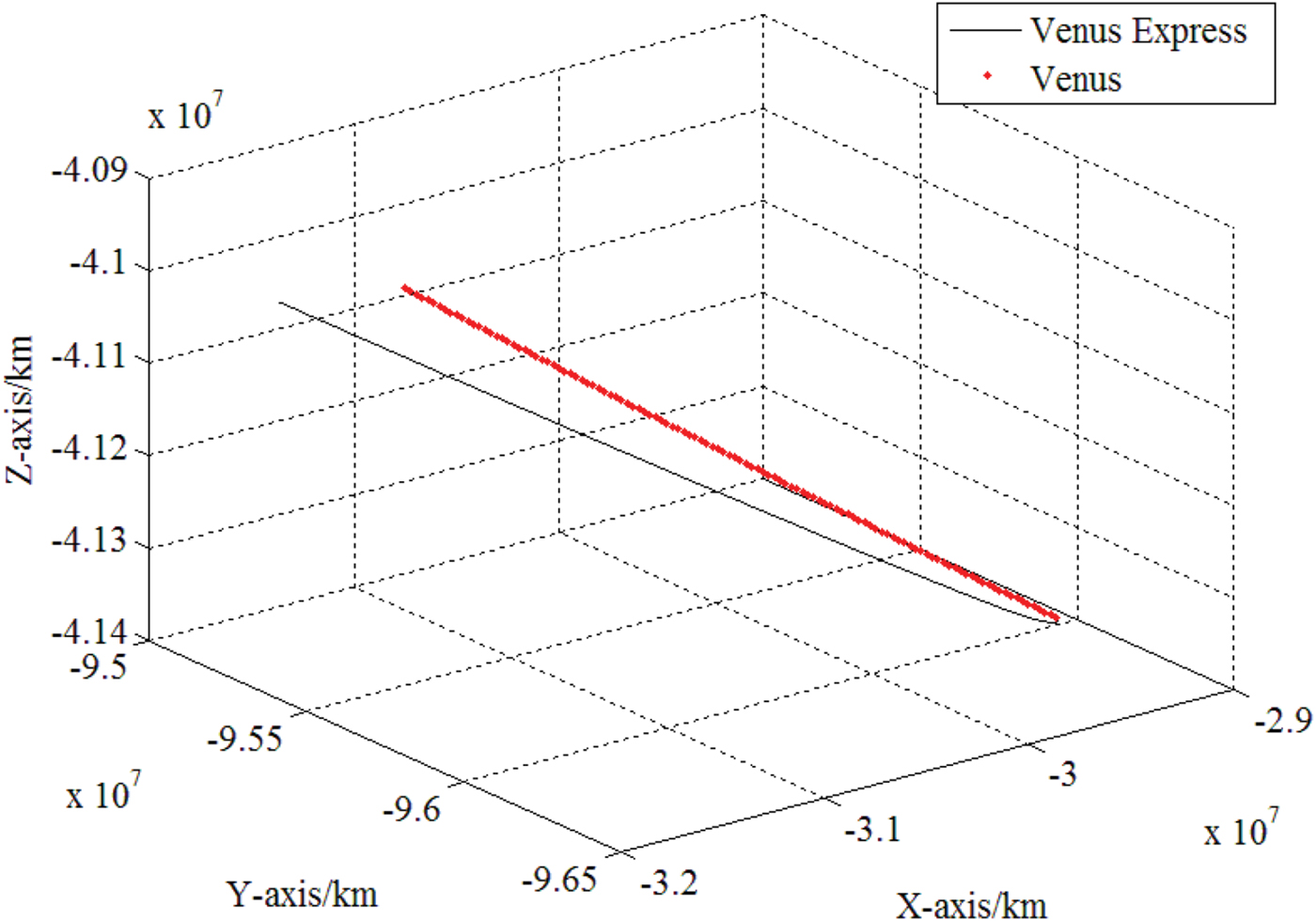
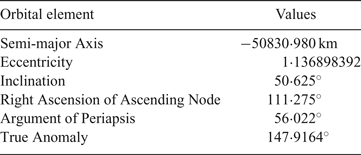
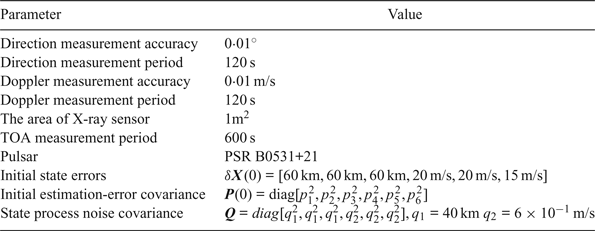
We take the probe Venus Express as a reference. Its initial orbit elements are shown in Table 1. The orbiting data of Venus Express and the planets is generated by the Satellite Tool Kit (STK). Simulation time is from 10 April 2006 12:00:00·000 UTCG to 11 April 2006 07:10:00·000 UTCG since the capture period of Venus Express is in this period. The trajectories of Venus Express and Venus are shown in Figure 3. The parameters of the navigation filter are shown in Table 2. As the Crab pulsar can provide high-accuracy timing and range, this pulsar is selected as the navigation pulsar. The pulsar measurement accuracy calculation method can be found in Sheikh et al. (Reference Sheikh, Pines, Ray, Wood, Lovellette and Wolff2006). p 1, p 2, p 3, p 4, p 5, p 6 in Table 2 are selected at random. p 1, p 2, p 3 obey a uniform distribution in [50 km, 70 km], p 4, p 5 obey a uniform distribution in [18 m/s, 25 m/s] and p 6 obeys a uniform distribution in [14 m/s, 20 m/s].
Trajectory of Venus Express and Venus.

Initial orbital elements of Venus Express.

Parameters of navigation filter.

To demonstrate the superiority of autonomous navigation, ground station-based navigation performance is provided in this section. In the capture period, the distance between Venus Express and the Earth is about 1·21 × 108 km. This means that the round-trip-time of signals is about 800 s. Assume that direction error is 1″ and the position measurement error is about 589 km. From the following simulation results for autonomous navigation, we will demonstrate that navigation performance of autonomous navigation exceeds that of ground station-based navigation.
4.1. Comparison between two deeply integrated navigation methods
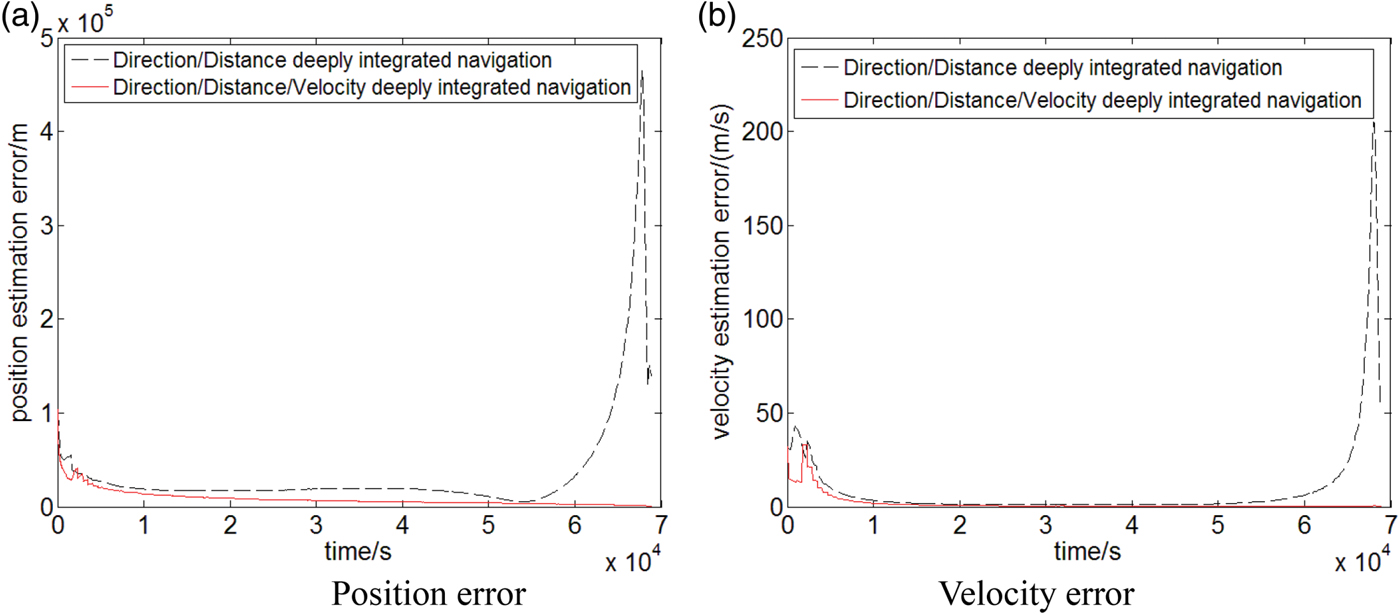
Figure 4 gives comparison results of two deeply integrated navigation methods over 500 Monte-Carlo trials. From Figure 4, it can be seen that before 60,000 s, the two navigation systems are convergent. The DDV deeply integrated navigation is more effective than the DD deeply integrated navigation. After 60,000 s, the DD measurements deeply integrated navigation performance declines, while the DDV measurements deeply integrated navigation performance improves. Over the whole period, with the decrease of the distance between Venus and the spacecraft, accuracy of the DDV measurements deeply integrated navigation performance improves.
Comparison between two deeply integrated navigation methods.

As integrated navigation performance is related to time, we investigate integrated navigation performance with different time intervals in the next sections. Three time intervals can be given as follows: 2 × 10⁴ ~ 6 × 10⁴ s, 6 × 10⁴ ~ 6·9 × 104 s and the end of the capture period. It is worth noting that navigation performance at the end of the capture period is crucial since it greatly affects mission success. Table 3 shows navigation accuracy for the two deeply integrated navigation methods. It can be seen that in the former stage (2 × 10⁴~ 6× 10⁴ s), compared with the DD deeply integrated navigation, the DDV deeply integrated navigation shows about 66·5% and 76·2% improvement for position and velocity, respectively. The reason is that velocity measurement provides more navigation information. While in the later stage (6× 10⁴~ 6·9× 104 s), this proposed method shows about 98·7% and 99·4% improvement for position and velocity, respectively. The reason is that in the pulsar observation period, direction measurement cannot provide three-dimensional velocity information, while direction and velocity measurements can. Also, the orbital dynamic model is strongly nonlinear and time-varying. In the DD deeply integrated navigation, pulsar TOA bias caused by velocity estimation error increases, and its result is the divergence.
Comparison between two deeply integrated navigation methods.

4.2. Doppler effects
The goal of this section is to demonstrate that velocity measurement suppresses TOA bias caused by Doppler effects.
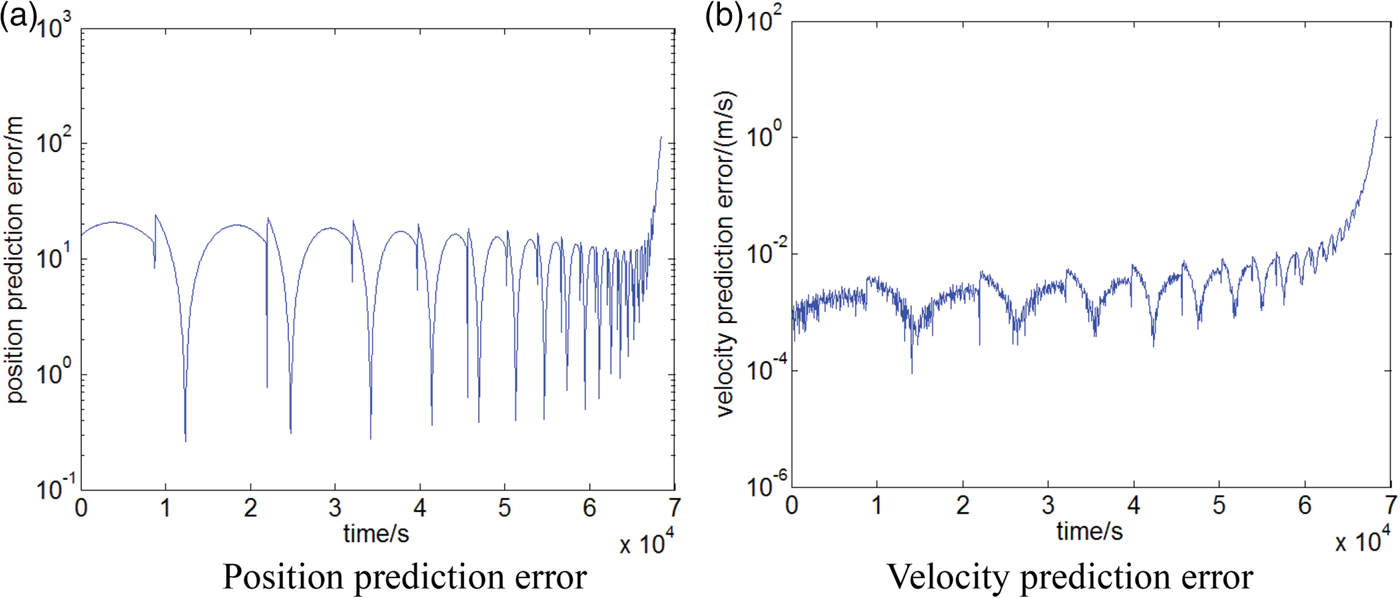
The DD measurements deeply integrated navigation can converge in the former stage of the capture period, while it declines greatly in the later stage. An important reason is that nonlinear prediction error in the orbit dynamic model gradually enlarges, especially in the later stage. Next, we investigate the nonlinear prediction error. The definition for nonlinear prediction error can be found in Section 2. We assume that the position and velocity components of state estimation error are 10 km and 0·02 km/s, respectively, and the prediction period is 120 s. Figure 5 shows the nonlinear prediction error for the orbital dynamic model over 500 Monte-Carlo trials. From Figure 5, we can see that before 60,000 s, nonlinear position and velocity errors are smaller than 30 m and 0·01 m/s. After 60,000 s, nonlinear position and velocity prediction errors increase greatly, even exceeding 100 m and 1 m/s respectively. It is worth noting that nonlinear prediction errors increase with the state estimation error. Therefore, nonlinear error is very large after 60,000 s.
Nonlinear prediction error for orbit dynamic model.

Large nonlinear prediction error will cause a large TOA bias, which results in divergence of the Kalman filter. This will lead to larger state estimation error and stronger nonlinear prediction error. This will generate a vicious circle in the later stages of the capture period.
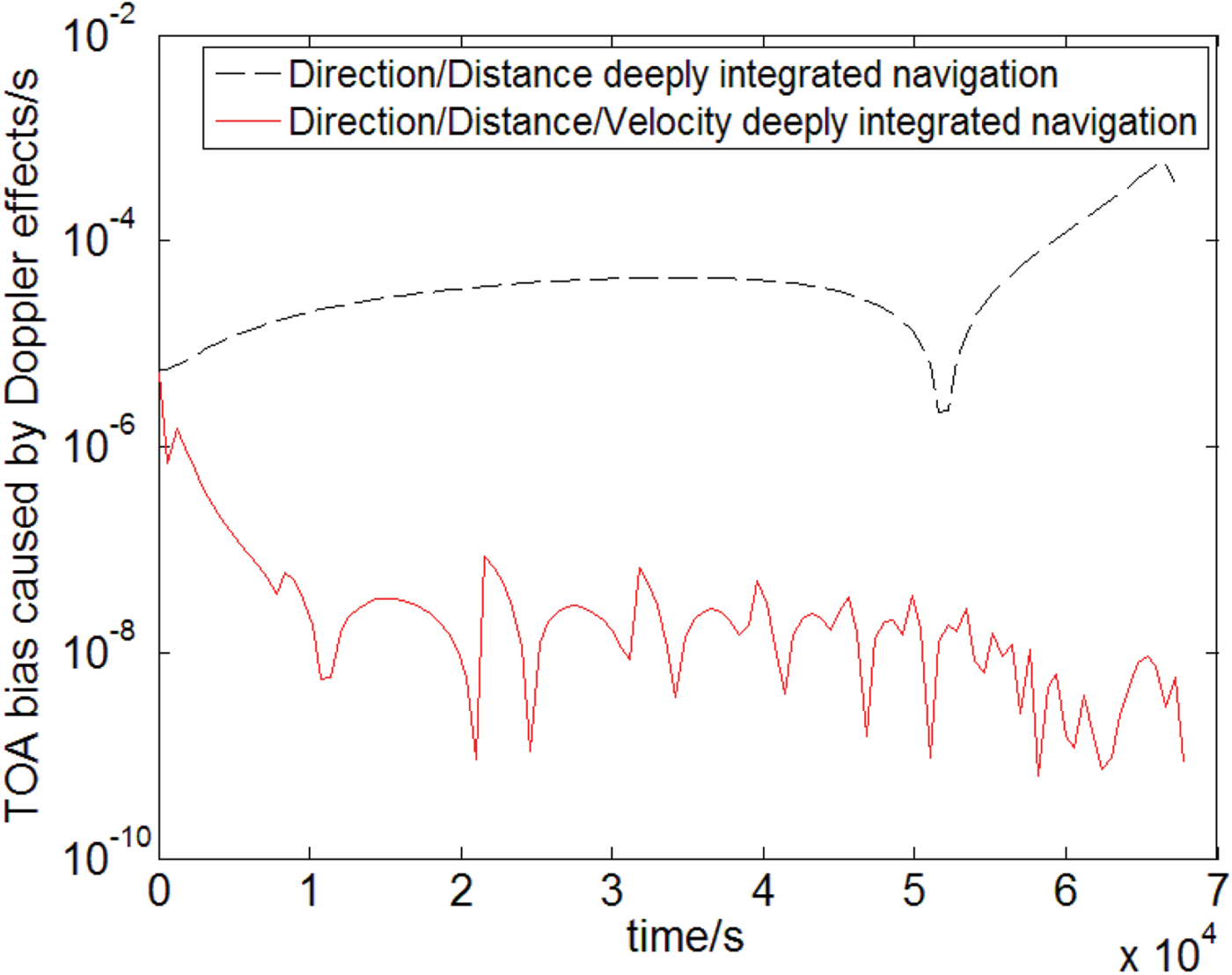
Figure 6 shows pulse TOA bias caused by Doppler effects. From Figure 6, it can be seen that in the DD deeply integrated navigation, TOA bias caused by Doppler effects is in the order of 10−5 s, and is larger than 10−4 s after 60,000 s. Correspondingly, the position measurement error is about 3,000 m, even 30, 000 m~ 150, 000 m after 60,000 s. In DDV deeply integrated navigation, TOA bias caused by Doppler effects is in the order of 10−8 s. Correspondingly, position measurement error is about 3 m, and can be ignored. These results demonstrate that direction and velocity measurements suppress TOA bias very well in the pulsar observation period.
TOA bias caused by Doppler effects.

4.3. Impact of measurement accuracy on navigation performance
The proposed navigation system has three measurements: direction, distance and velocity measurements, whose errors affect the navigation performance. In this section, we analyse this impact.
4.3.1. Direction measurement accuracy
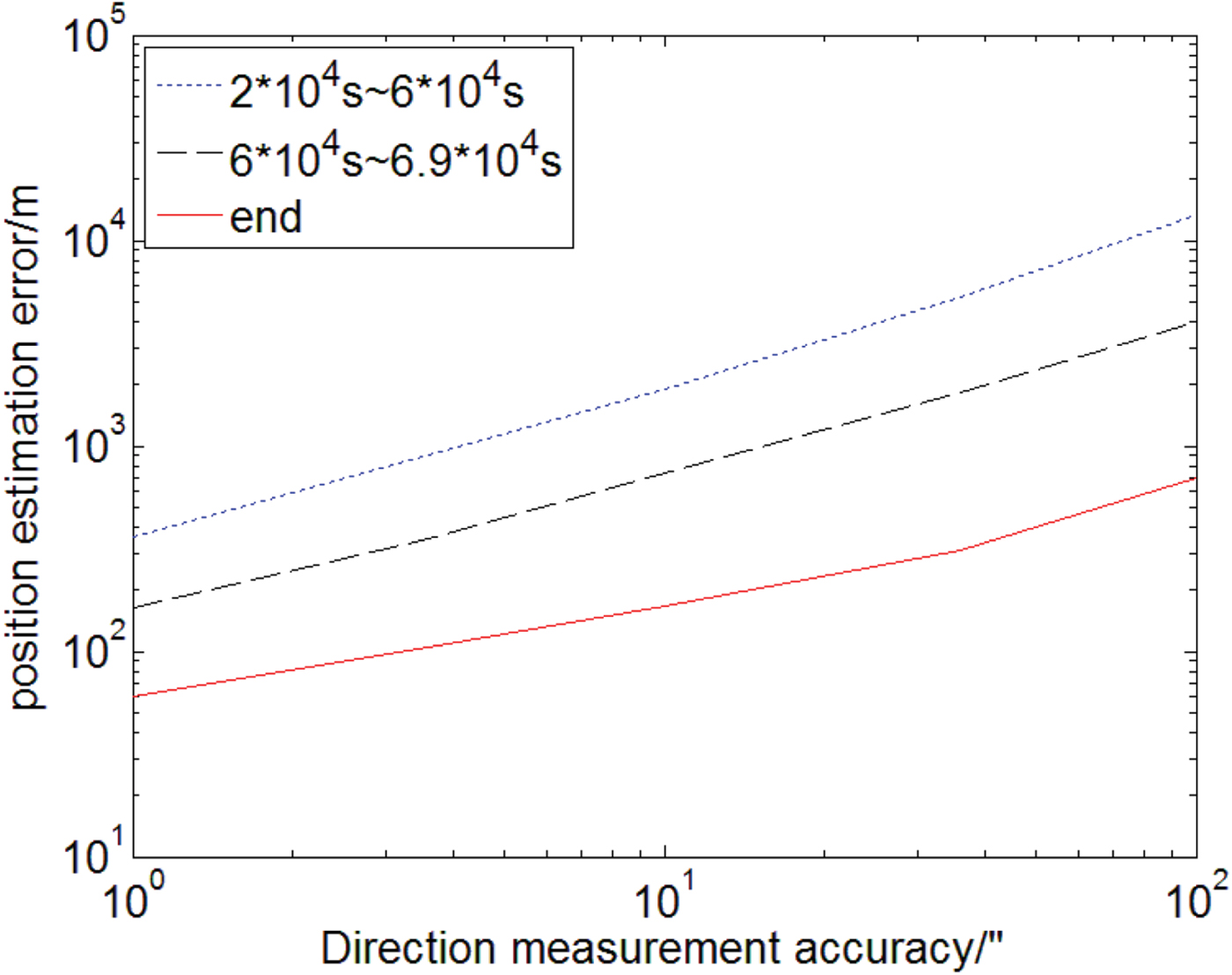
In this section, we investigate the impact of direction measurement accuracy on navigation performance. Figure 7 shows navigation performance with different direction measurement accuracy over 500 Monte-Carlo trials. From Figure 7, we can see that navigation performance improves with decreasing direction measurement error. Even if direction measurement accuracy is in the order of 100″, position accuracy at the end of the capture period is about 700 m and satisfies the requirement for deep space exploration. Measurement error is determined by the optical navigation camera. An optical navigation camera with 100″ accuracy was developed many years ago (Hamption et al., Reference Hamption, Baer, Huisjen, Varner, Delamere, Wellnitz, Ahearn and Klaasen2005; Milsom and Peterson, Reference Milsom and Peterson2001). Currently, the accuracy of optical navigation cameras is in the order of 10″ or less. Therefore, deeply integrated navigation can operate very well using current optical navigation camera technology.
Navigation performance with different direction measurement accuracy.

4.3.2. Distance measurement accuracy
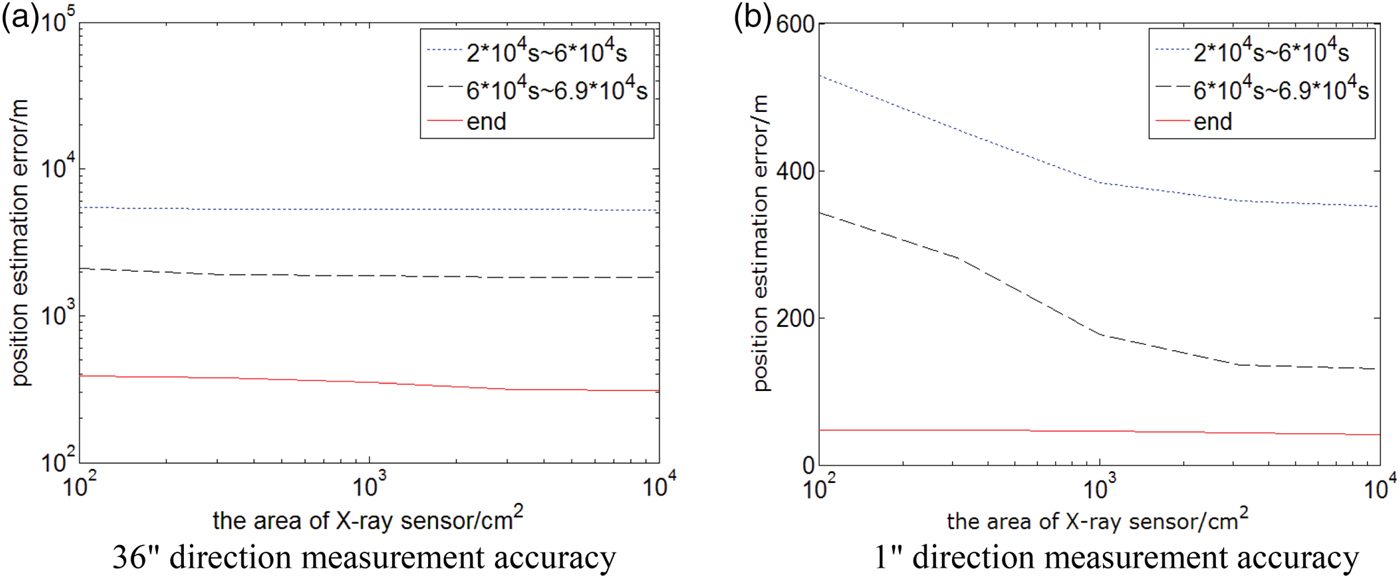
As pulse TOA accuracy is related to the X-ray sensor's area, we analyse the impact of the X-ray sensor's area on navigation performance. Figure 8 shows navigation performance with different X-ray sensor areas over 500 Monte-Carlo trials. Direction measurement accuracies are 36″ and 1″ in Figures 8(a) and 8(b), respectively. From Figure 8, we can see that navigation performance improves with increasing X-ray sensor area. Compared with Figure 8(a), the navigation accuracy in Figure 8(b) is more sensitive to X-ray sensor area. The reason is that the effect of the X-ray sensor area is related to direction measurement accuracy. The tangential error that arises from direction measurement is ξ·|r − rsv|. The distance measurement error is c·σ. When ξ·|r − rsv| is much larger than c·σ, navigation performance is mainly determined by direction measurement error. For instance, the distance measurement error about is 100 m~ 1, 000 m and the distance between the spacecraft and Venus is in the order of 105 km. When direction measurement errors are 36″ and 1″, the tangential errors that arise from direction measurement are in the order of 17 km and 500 m, respectively. Compared with a 17 km tangential error, distance measurement error is very small. The improvement of distance measurement error affects navigation performance slightly. Therefore, where there is a large direction measurement error, X-ray sensor area has little effect.
Navigation performance with varying X-ray sensor areas.

4.3.3. Velocity measurement accuracy
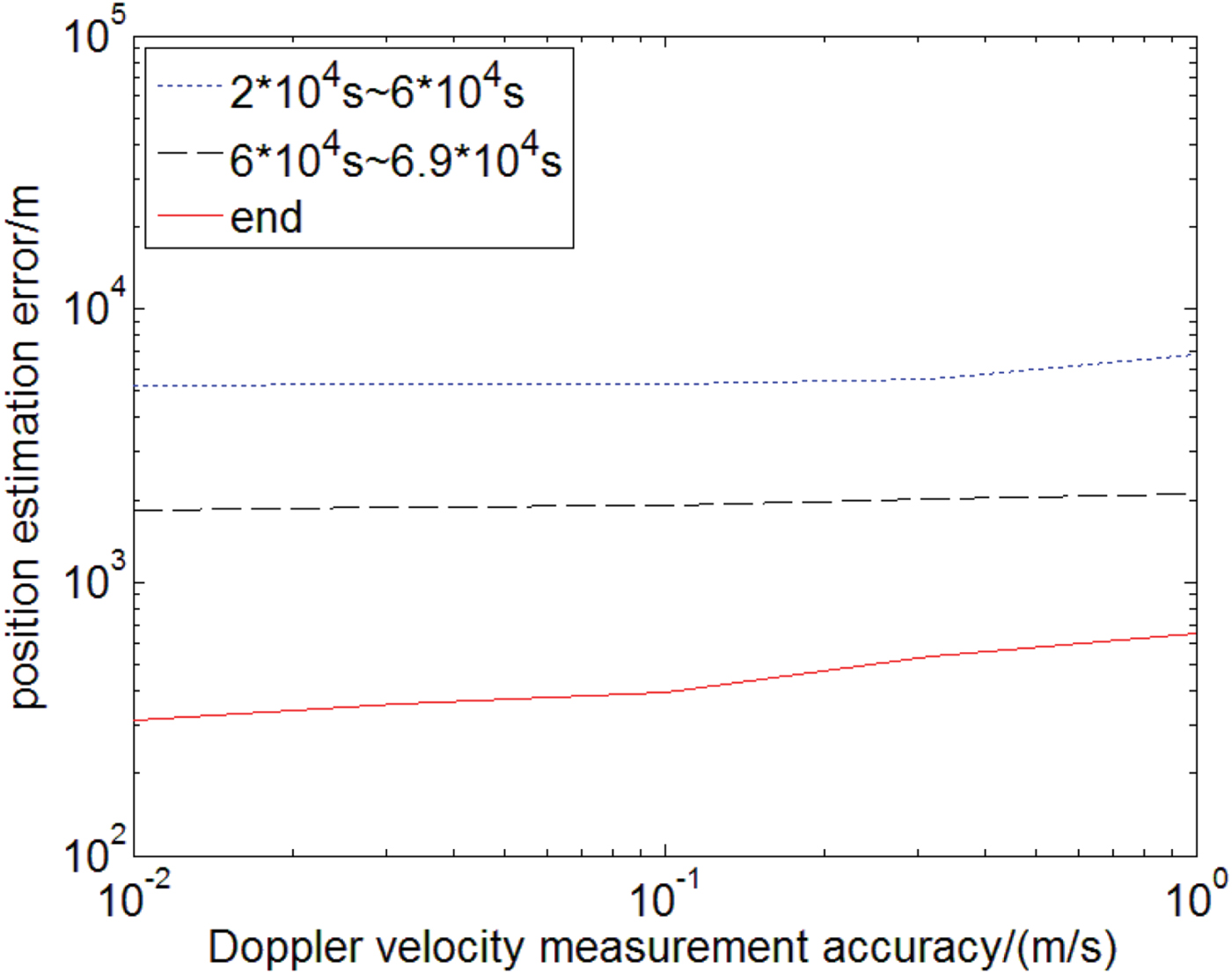
In this section, we analyse the impact of Doppler velocity measurement accuracy on navigation performance. Figure 9 shows navigation performance with different Doppler velocity measurement accuracy over 500 Monte-Carlo trials. From Figure 9, we can see that navigation performance declines slightly with the increase of Doppler velocity measurement error. The reason is that direction measurement error is the largest of the three measurements. Doppler velocity measurement accuracy is determined by spectrometer accuracy. Therefore, a low accuracy spectrometer does not lead to a great decline in navigation performance. This also means a decrease of the technological difficulty in designing a suitable spectrometer.
Navigation performance with different Doppler velocity accuracies.

4.4. Comparison between distance navigation and DDV deeply integrated navigation
In this section, we compare DDV deeply integrated navigation with distance measurement navigation (X-ray pulsar navigation) (Sheikh and Pines, Reference Sheikh and Pines2006). Assume that the direction measurement error is 2″, and the area of the X-ray sensor is 384 cm2 (Lu, Reference Lu2009).
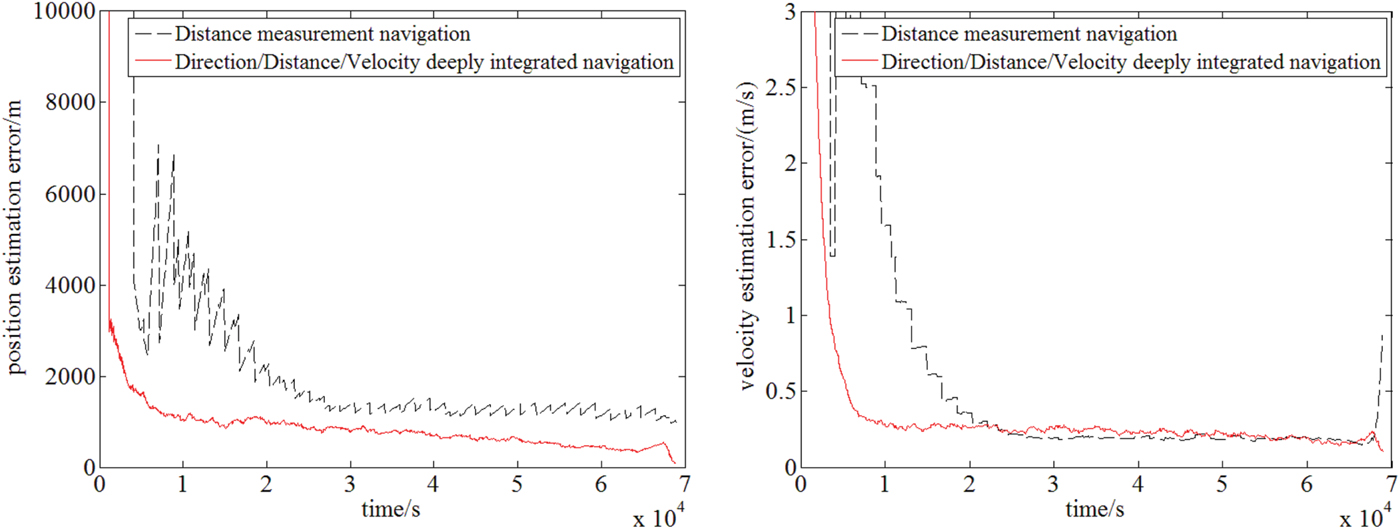
Figure 10 compares results from the two navigation methods over 500 Monte-Carlo trials. From Figure 10, it can be seen that the two navigation systems converge. In the whole period, with the decrease of the distance between Venus and the spacecraft, the accuracy of DDV measurements deeply integrated navigation performance improves, while distance measurement navigation performance remains unchanged.
Comparison between distance navigation and DDV deeply integrated navigation.

Table 4 shows navigation accuracy for the two navigation methods. Compared with distance measurement navigation, position accuracy of the DDV measurements deeply integrated navigation shows around 48%, 66% and 91% improvement for the former stage, the later stage and the final stage, respectively. It is worth noting that navigation performance at the end of the capture period is crucial since it greatly affects the success of the mission. At this crucial period, the performance of the DDV deeply integrated navigation exceeds that of the distance measurement navigation. Velocity accuracy of the distance measurement navigation declines greatly. The reason is that the orbital dynamic model at the end of the capture period is strongly nonlinear and time-varying. In distance measurement navigation, the pulsar TOA bias caused by the velocity estimation error increases, and results in the divergence.
Comparison between distance navigation and DDV deeply integrated navigation.

5. CONCLUSION AND DISCUSSION
In this paper, DDV measurements deeply integrated navigation for the Venus capture period is proposed. This method utilises the least measurement information to achieve highly accurate navigation. The direction and distance measurements determine one line and one plane, respectively. They have an intersection point at the spacecraft's location. Direction and velocity measurements suppress pulsar TOA bias caused by Doppler compensation. The observation sources of direction and velocity cannot be anything but Venus and the Sun, respectively. The Crab pulsar (PSR B0531 + 21) has the highest quality factor. Therefore, it is reasonable to adopt Venus, the Crab pulsar and the Sun as the observation sources for direction, distance and velocity, respectively.
DDV measurements deeply integrated navigation has a low quality requirement for the navigation sensors. Currently, the available optical navigation camera accuracy can satisfy the requirement for autonomous navigation when our method is adopted. An X-ray sensor with a small area and a low accuracy spectrometer will not result in a decline of deeply integrated navigation performance. We adopt only three navigation sensors including one optical navigation camera, one X-ray sensor and one spectrometer. Thus, the load on the spacecraft and the technological difficulty decreases.
The DDV measurements deeply integrated navigation system has the following characteristics: (1) it is completely autonomous; (2) it can operate very well in the capture period; (3) it has high navigation accuracy with low cost and small load; (4) it has a low quality requirement for sensors including the optical navigation camera, spectrometer and X-ray sensor and (5) it has no redundant measurement information. In conclusion, the DDV measurements deeply integrated navigation for the Venus capture period has a low cost and a high positioning accuracy.
ACKNOWLEDGMENTS
This work was supported by the National Natural Science Foundation of China (No. 61501336, No. 61703022, No. 61722301), the State Key Program of National Natural Science Foundation of China (No. 61233005) and the National Basic Research Program of China (No. 2014CB744202).