Introduction
Fungal infection of the external ear canal is termed otomycosis.Reference Kaur, Mittal, Kakkar, Aggarwal and Mathur1 The prevalence and aetiological agents of such infections vary with geographical location and climate. Candida species are the most common fungal pathogens isolated within temperate climates, whereas Aspergillus species are more prevalent in hot climates.Reference Lucente2
The treatment of otomycosis consists of debridement and cleansing in combination with topical antifungal eardrops, although there is no standard regimen. Systemic antifungal therapy may be required in immunocompromised patients.Reference Vennewald and Wollina3 Fungal isolates have been reported to show antifungal resistance both in vitro and in vivo; thus, in vitro antifungal susceptibility testing has become important for appropriate treatment selection.Reference Denning, Venkateswarlu, Oakley, Anderson, Manning and Stevens4–Reference Rex, Rinaldi and Pfaller6
In the present study, we aimed to determine the causative pathogens of otomycosis, and also to evaluate the in vitro activity of the new triazole voriconazole and the widely used azoles fluconazole and itraconazole against fungal otomycotic pathogens. It was hoped that this study would assist clinicians to select optimal antifungal therapy.
Materials and methods
A total of 96 fungal isolate were tested. These included 39 isolate yielding Aspergillus fumigatus, 34 A niger, 12 A flavus and 11 Candida albicans. These isolate were isolated from 92 patients suspected of otomycosis who attended the otorhinolaryngology out-patient department of Gaziosmanpaşa University Hospital (a tertiary care referral hospital) between May 2003 and April 2007.
Specimens for mycological analysis were collected with sterile swabs from the external auditory meatus. The swabs were examined by direct microscopy and then transferred onto two saboraud dextrose agar plates (Oxoid, Basingstoke, Hampshire, UK) supplemented with chloramphenicol. One plate was incubated at 37°C and the other at room temperature (25°C) for 14 days. The moulds were subcultured on Czapek Dox agar (Oxoid). It is well known that Aspergillus species are common laboratory contaminants. In order to eliminate the risk of such contamination, mould was accepted as a pathogen if all direct examinations and both culture plates were found to be positive and to yield the same organism.
Identification of fungal species was performed by macroscopic and microscopic morphological examination of colonies, and also by biochemical methods if required. Yeast isolates were identified using: (1) the germ tube test; (2) chlamydospore formation on cornmeal agar plus Tween 80; and (3) the API 20C AUX commercial system (BioMerieux, Marcy-l'Etoile, France).
E-test method
The in vitro activity of fluconazole, itraconazole and voriconazole against the 96 clinical fungal isolates was assessed by E-test strips (AB Biodisk, Solna, Sweden). The E-test strips were stored at −20°C until use. The E-test was performed in accordance with the manufacturer's instructions.
Each isolate was subcultured onto potato dextrose agar (Oxoid) at 35°C for seven days. Spore suspensions were prepared in sterile saline and adjusted to a turbidity equivalent to that of 0.5 McFarland standard, corresponding to approximately 106 colony forming units per millilitre. The agar plates were prepared using RPMI-1640 medium (Sigma, St Louis, Missouri, USA) supplemented with 1.5 per cent agar and 2 per cent glucose and buffered to a pH of 7.0 with 0.165 mol/l 3-(N-morpholino)propanesulphonic acid (Sigma). The agar plates were inoculated by dipping a sterile swab into the fungal suspension and streaking the whole surface of the agar plates in three directions. After the plates were allowed to dry in a safety cabinet for 15 minutes, E-test strips were applied onto the agar surface using sterile forceps. The plates were incubated in ambient air at 35°C for 24 hours. The minimum inhibitory concentration (MIC) was defined as the drug concentration present at the point where the fungal ellipse intersected the MIC scale on the E-test strip.
Quality control was performed using A flavus ATCC 204304 and C krusei ATCC 6258.
Statistical analysis
During statistical analysis, ‘n’ was taken to represent the number of isolates of each fungal species. Mean MIC values were calculated and compared using Graphpad Prism software; the two-tailed Student's t-test was used, and p < 0.05 was considered significant.
Results
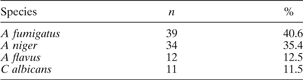
A total of 96 fungal isolates were recovered from 92 patients with otomycosis. The most common pathogen was A fumigatus (40.6 per cent), followed by A niger (35.4 per cent), A flavus (12.5 per cent) and C albicans (11.5 per cent) (Table I). All yeast isolates were identified as C albicans.
Distribution of fungal species isolated

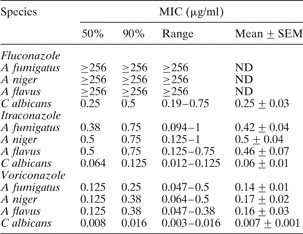
The MIC50, MIC90 and mean MIC of fluconazole, itraconazole and voriconazole for the fungal species isolated are summarized in Table II. The MIC value of fluconazole for all Aspergillus species was ≥256 µg/ml.
MIC50, MIC90, MIC range and mean MIC of fluconazole, itraconazole and voriconazole for fungal species isolated*

* From 96 otomycotic fungal isolate. MIC = minimum inhibitory concentration; SEM = standard error of the mean; ND = not determined
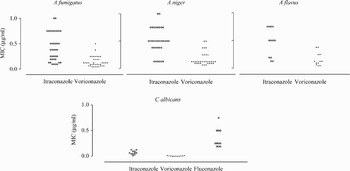
The observed in vitro antifungal susceptibility profiles of A fumigatus, A flavus, A niger and C albicans are presented in Figure 1. The mean MIC of voriconazole for A fumigatus, A niger and A flavus was significantly lower than that of itraconazole (p < 0.01 for all Aspergillus species).
In vitro antifungal susceptibility profiles of isolated otomycotic pathogens, showing distribution of minimum inhibitory concentrations (MICs) of antifungal agents for each fungal species isolated. Fluconazole data are not shown for Aspergillus species, since all these species were found to be resistant. The mean MICs of voriconazole were significantly lower than those of itraconazole (p < 0.01, comparing results for all four species; Student's t-test).

All C albicans isolates were found to be susceptible to fluconazole, itraconazole and voriconazole (Figure 1). The mean MIC of voriconazole for C albicans was significantly lower than those of itraconazole and fluconazole (p < 0.01).
Discussion
This study found that the commonest aetiological agent of otomycosis was A fumigatus (40.6 per cent), with A niger being the second commonest (35.4 per cent). This finding is in agreement with earlier studies indicating that Aspergillus species are more prevalent in hot climates.Reference Kaur, Mittal, Kakkar, Aggarwal and Mathur1, Reference Lucente2, Reference Kombila, Gomez de Diaz, de Bievre, Crepet, Debrie and Belembaogo7 Two epidemiological investigations have been published on otomycosis in different parts of Turkey.Reference Ozcan, Ozcan, Karaarslan and Karaarslan8, Reference Kaya and Kiraz9 One of these, conducted in Ankara, reported that the commonest causative agent of otomycosis was A niger (44.8 per cent), and that the isolation rate of Candida species was 17.9 per cent.Reference Ozcan, Ozcan, Karaarslan and Karaarslan8 Recently, Kaya and Kiraz, working in Düzce, found the causative agent of otomycosis to be A niger in 47.5 per cent of cases and A fumigatus in 35 per cent.Reference Kaya and Kiraz9 These authors did not isolate any Candida species. In contrast, C albicans comprised 11.5 per cent of our study's otomycotic fungal isolates. These differences may support the hypothesis that the prevalence and causative species of otomycosis depend on geographical and environmental variations.
Many topical antifungal agents are available for the treatment of otomycosis. Since antifungal susceptibility testing cannot be performed by all routine laboratories, antifungal therapy is usually given empirically. If empirical therapy is not effective, otomycosis may result in serious complications such as invasive external otitis or otogenic skull base osteomyelitis.Reference Phillips, Bryce, Shepherd and Mintz10–Reference Stodulski, Kowalska and Stankiewicz11 The Clinical and Laboratory Standards Institute has developed an approved, standard method for evaluating the antifungal susceptibilities of filamentous fungi.12 However, this method is too laborious to conduct in a routine mycology laboratory. The agar-based E-test method has been shown to be useful in determining the fluconazole, itraconazole and voriconazole susceptibilities of Aspergillus and Candida species.Reference Espinel-Ingroff and Rezusta13–Reference Pfaller, Diekema, Messer, Boyken and Hollis15 Therefore, we used the E-test method for determining the in vitro antifungal susceptibilities of otomycotic fungal isolates.
We found all Aspergillus isolates to be resistant to fluconazole (minimum inhibitory concentration (MIC) ≥256 µg/ml). It is well known that fluconazole has no activity against Aspergillus species.Reference Sheehan, Hitchcock and Sibley16 The itraconazole MIC50 and MIC90 for A fumigatus were found to be 0.38 and 0.75 µg/ml, respectively. These values were lower than those reported by Pfaller et al. Reference Pfaller, Messer, Hollis and Jones17 and Messer et al.,Reference Messer, Jones and Fritsche18 and similar to those reported by Verweij et al. Reference Verweij, Te Dorsthorst, Rijs, De Vries-Hospers and Meis19 We did not observe itraconazole resistance in A fumigatus isolates, although some authors have reported in vitro itraconazole resistance and therapeutic failure for A. fumigatus isolates.Reference Rex, Rinaldi and Pfaller6, Reference Dannaoui, Persat, Monier, Borel, Piens and Picot20 In addition, the MIC results obtained for A niger and A flavus indicated that both these species were inhibited by itraconazole concentrations of ≤1 µg/ml. Likewise, Pfaller et al. observed that 94 per cent of their Aspergillus species isolates were inhibited by ≤1 µg/ml itraconazole, and that elevated itraconazole MICs (>2 µg/ml) were rare among these isolates.Reference Pfaller, Boyken, Hollis, Messer, Tendolkar and Diekema21
• This study aimed to determine the causative pathogens of otomycosis, and to evaluate the in vitro activity of antifungal agents against these pathogens
• Ninety-six fungal isolates were recovered from 92 patients suspected of otomycosis
• The most common pathogen was Aspergillus fumigatus (40.6 per cent), followed by A niger (35.4 per cent), A flavus (12.5 per cent) and Candida albicans (11.5 per cent)
• Voriconazole had more potent in vitro activity against all Aspergillus species as well as against C albicans, compared with itraconazole
In the current study, the mean MICs of voriconazole for A fumigatus, A niger and A flavus were significantly lower than those of itraconazole. On the basis of these data, we conclude that voriconazole has more potent in vitro activity against A fumigatus, A flavus and A niger, compared with itraconazole. Similarly, previous studies comparing the in vitro activity of voriconazole and itraconazole reported that voriconazole was more active than itraconazole against Aspergillus species.Reference Pfaller, Messer, Hollis and Jones17, Reference Messer, Jones and Fritsche18, Reference Mallié, Bastide, Blancard, Bonnin, Bretagne and Cambon22 Moreover, Verweij et al. showed that voriconazole was active against itraconazole-resistant A fumigatus isolates.Reference Verweij, Te Dorsthorst, Rijs, De Vries-Hospers and Meis19
In this study, all C albicans isolates were found to be susceptible to fluconazole (MIC90 0.5 µg/ml), itraconazole (MIC90 0.125 µg/ml) and voriconazole (MIC90 0.016 µg/ml). The MIC50 and MIC90 values of fluconazole and itraconazole for C albicans isolates were similar to those reported by Messer et al. Reference Messer, Jones and Fritsche18 The mean MIC of itraconazole for C albicans was found to be significantly lower than that of fluconazole (p < 0.01). The mean MIC of voriconazole for C albicans isolates was significantly lower than those of fluconazole and itraconazole (p < 0.01). This result indicates that voriconazole is the more active azole against C albicans isolates. Itraconazole, while less potent than voriconazole, was more effective than fluconazole against C albicans isolates. Similarly, Mallié et al. reported that voriconazole was more active than fluconazole and itraconazole against all Candida species.Reference Mallié, Bastide, Blancard, Bonnin, Bretagne and Cambon22 Pfaller et al. reported that voriconazole had an excellent potency and broad-spectrum activity against all Candida species.Reference Pfaller, Diekema, Messer, Boyken and Hollis15
Conclusion
In this study, the above results indicate that the most frequent otomycotic fungal pathogen was A fumigatus, followed by A niger, A flavus and C albicans. In addition, voriconazole has potent in vitro activity against all Aspergillus species as well as C albicans. Thus, voriconazole may become the drug of choice for treatment of otomycosis.