Even the casual observer of politics is aware of the abundance of think tanks in Washington, D.C. Think tanks are independent policy research organizations that often combine research and advocacy; they represent ‘an organizational commitment to support the promotion of research and ideas’.Footnote 1 Yet the policy implications of think-tank research are subjective, intermingled with the normative ideas that these organizations represent. Given their proliferation and connections with legislators across the ideological spectrum, think tanks have become an important piece of the Washington establishment. What explains the proliferation of think tanks in the United States? We advance the theoretical claim that the nature of debate in legislative committees drives a demand for strategic information, and the benefactors of think tanks, seeing a market opportunity, create and maintain the organizations which supply that information.
One possible characterization of think tanks is that they may simply be understood as interest groups, and their emergence explained through existing theories of group formation. The canonical explanations of interest group growth in political science have concentrated on supply-side factors. Truman’s disturbance theory posited that interest-group growth was a function of the increasing complexity of society and the functions of government: ‘With an increase in specialization and with the continual frustration of established expectations consequent upon rapid changes in the related techniques, the proliferation of associations is inescapable’.Footnote 2 Olson challenged this notion by unmasking the collective action problem inherent in group organization, urging the field to consider the mutual benefits exchanged between leaders and followers required to hold groups together.Footnote 3 Patronage is also an important concern, as interest activity is costly, and group leaders seek to attract those individuals in both government and private sectors who will finance their activity.Footnote 4
The group’s benefactor-leader is a political entrepreneur – an ‘individual who exploits profitable opportunities by providing, or promising to provide, services that are designed to attract support from individuals who might find them of value’.Footnote 5 As such, group foundings (formations or organizational emergence) are also explained by demand-side factors, and scholars have recently taken serious interest in this topic. One branch of the group-demand literature draws theoretically from organizational ecology. Gray and Lowery propose an energy-stability-area model of interest-group density in which system ‘energy – interests that are created by the potential for gaining governmental goods, services and regulations – creates a government-centric demand for interest groups’.Footnote 6 In a recent article, Leech, Baumgartner, La Pira and Semanko argue, with empirical support, that groups are drawn to Washington when Congress places their issues on its agenda.Footnote 7 Government agenda setting in specific policy areas creates a demand for groups in those areas, invoking a micro-level version of the important theme that entire sectors of groups form and change in response to their political opportunities.Footnote 8 Gray, Lowery, Fellowes and Anderson examine the effect of party competition on sectoral and cross-sectoral densities of interest groups, finding a mobilizing effect of party competition. They argue that ‘as party competition increases, the likelihood of sudden policy change increases’, creating policy outcome uncertainty that mobilizes competing interests.Footnote 9
To respect these arguments, any explanation of think-tank growth must incorporate supply and demand factors. Following Moe, we characterize the think tank’s benefactor as a policy entrepreneur who makes an investment to create a successful organization.Footnote 10 This investment decision is based on individual economic benefits to the entrepreneur and political demand for policy advice. But think tanks provide both advocacy and research, and the question of their genesis must also explain the research-based information they provide to policy makers.
Esterling provides a formal theory of the congressional use of research-based information provided by interest groups. Extending Becker’s theory of policy lobbying by interest groups, Esterling adds uncertainty over the transformation of policies into outcomes. His risk-averse legislators prefer more certain policy outcomes to more uncertain ones, and thus a market for research-based advice develops in which interest groups become the providers. Yet it may be difficult to convince students of American politics that think tanks provide objective information that can reduce policy uncertainty without ‘bias’. For example, Groseclose and Milyo use citations of think tanks and other policy groups by members of Congress and media organizations as the basis for constructing a measure of liberal–conservative ideology. Though Esterling’s theory provides an important account of think-tank research in Congress generally, it falls short as an explanation of think tanks’ dual advice and advocacy roles.Footnote 11
Consider a more abstract version of the research-based information problem. If there is uncertainty over the outcome that policy x can induce on a one-dimensional policy space, Esterling’s theory suggests that legislators use research-based information to reduce uncertainty, assisting them in strategically choosing x. Given the proliferation of think tanks on both sides of the liberal–conservative continuum and in virtually every policy issue area, research-based information is available from competing views of legislative policy debates. Given an expected policy outcome x, one think tank may provide research-based information that legislating x will produce outcome x + ε whilst another offers research predicting that x − ε will result, where ε registers some level of uncertainty in the anticipated policy outcome in the direction advocated by the think tank. The direction of the epsilon differential is the notion of ‘biased’ information used throughout this article.Footnote 12 The underlying research of two studies may comport with standards in the scholarly community, but the policy conclusions supported by those studies may conflict.Footnote 13
Research-based information from think tanks, we contend, does not appear to reduce outcome uncertainty, but rather to be born of that uncertainty and its role in debate. Equilibrium research-based information is credible, namely, it is performed in accordance with, for example, social science norms. Consider, for example, the case of cost–benefit analysis, an essential tool for policy analysis and advocacy. Sunstein argues: ‘By itself, the notion of [cost–benefit analysis] is very close to empty; everything depends on how costs and benefits are characterized and on how underlying issues of valuation are resolved’.Footnote 14 Competing cost–benefit analyses may each employ sophisticated econometric methods for empirically supporting causal arguments, yet the choice of what factors are considered costs and benefits may create vastly different results. Thus, the accepted methodology – in this case, econometrics – lends the notion of credibility to both analyses that is central to our argument. Credibility, in the sense used here, is to be distinguished from believability, which, owing to the multidimensional nature of the social setting in which a message is sent, is difficult to ascertain.
The market for biased research we describe is consistent with the predictions and approach in a recent theory of lobbying proposed by Hall and Deardorff. Like their lobbyists, think tanks are specialist, expert suppliers of information that target legislators who are unlikely to substitute support for the think tank’s policy position with an opposing stance. Such legislators are the think tank’s ideological ‘allies’, and Hall and Deardorff predict that ‘legislators who share the same policy objective’ will receive free information-based resources from groups because ‘allies will use resources to work toward progress on [issue] A, not against it’.Footnote 15 Yet the micro-foundations of our claims lie in debate that occurs in congressional committees, not with the think tanks’ allocation decision. Austen-Smith has shown that the transmission of information depends on the credibility of the legislator announcing that information; a claim on which we premise our argument for the market for research-based information.Footnote 16 Think tanks can provide legislators with that credibility through research that supports their ideological policy preferences, rendering the information biased as described.
Competition among suppliers (policy entrepreneurs) to meet congressional demand for research-based information (by creating think tanks that supply information) yields an equilibrium in which the information supplied by think tanks is credible and biased. Thus, demand for think tanks’ policy research can be seen as driven by legislative debate, and political entrepreneurs create think tanks to supply this information to legislators. When the legislature (and consequently its committees) is ideologically polarized, the demand for information expands. Given that the creation of a think tank is in this sense an investment choice for the entrepreneur, meeting legislatively driven demand is balanced against other available investment opportunities. If the benefits outweigh the opportunity cost, a think tank is created. Our theoretical argument, then, is reminiscent of the polarization claim of Gray et al. in the interest-group literature, though it takes the research role of think tanks into account at the micro-level based on coalitional considerations in congressional committees.Footnote 17
As thought-provoking evidence for the theory we present, we examine one key market-level implication of our micro-level argument relating to the relationship between nominal think-tank growth and ideological polarization in the US Congress using data from 1903 to 2003. When controlling for legal and market factors facing entrepreneurs (the opportunity cost of investment in think tanks), we find that greater ideological polarization in Congress (greater demand for think tanks) is associated with an increase in the number of think tanks supplied. Suggestions for empirical tests of our theory beyond this threshold condition are discussed in the conclusion.
In the next section, we discuss the rise of American think tanks, relating this phenomenon to congressional politics. The theory of legislative debate is then discussed and employed to produce the hypothesis that we test statistically. A description of our data, estimation results and a discussion of our findings follow in turn. The article concludes with some brief remarks and implications for future research.
The rise of the American think tank
The earliest American think tanks – the Russell Sage Foundation and the Bureau of Municipal Research (both incorporated in 1907) – grew out of the Progressive movement. In the latter decades of the nineteenth century, progressive reformers sought to change labour and fiscal policies and argued that people could improve the nature of these policies by bettering their living and working conditions. The Russell Sage Foundation explicitly promoted this vision in its original mission statement; it ‘played a central role in a national movement to alleviate poverty through the professionalization of social work, the study of social problems, the shaping of legislation, and the creation of private agencies designed to meet specific social needs’.Footnote 18
The earliest think thanks were organized as advocates for particular policy prescriptions. The New York Bureau of Municipal Research, for example, had the goal of ‘applying the test of fact to the analysis of municipal problems and the application of scientific method to governmental procedure’.Footnote 19 Based on their operations and mission statements, the earliest think tanks in the United States were, by today’s standards, analytic and non-partisan, having boards comprised of academics, lawyers, civic and business leaders. Most of the early activism of the think tanks was undertaken under this aegis of scientific ‘knowledge for practice’, rather than partisan politics.
Yet their work was controversial and took place in a highly politically polarized environment. The earliest American think tanks were formed during the twentieth century’s peak of congressional partisan polarization. The patronage and corruption produced by the height of partisanship in the late nineteenth-century congresses offered considerable fodder for the think tanks’ advocacy of good governance reforms. This reformist beginning would change course by the end of the 1930s, and much later a new generation of political think tanks would emerge in the wake of ‘Great Society’ legislation.
A second wave of think-tank formation began shortly after the Second World War. These think tanks were orientated towards the evaluation of government policy rather than the reform of government practices. Pertinent to our theoretical argument in the following section, the Legislative Reorganization Act of 1946 (LRA) reduced the number of standing committees as well as the maximum number of committees on which members could serve, but gave each surviving committee unique jurisdictional coverage of a substantive policy area: ‘in the aggregate’, under the LRA, the committees ‘should comprehensively cover all areas of public policy’.Footnote 20 This change created conditions under which our polarization-driven demand hypothesis presented in the following section is more likely to be supported. Moreover, in contrast to the Progressive era think tanks, these organizations were situated on a less polarized political space.
A re-evaluation of the role of government and the success of scientific management and scientific knowledge on both the political left and right was nascent. Think tanks founded during this time, and in particular, the RAND Corporation (1947) and the Urban Institute (1968), analysed government policy and were generally supportive of government intervention in both foreign policy and domestic poverty. These organizations advocated and critiqued government programmes. As the 1960s came to a close, the widening gap in political polarization created new opportunities for organized interests to influence the public policy debate. The rapid expansion of think tanks during the 1970s and until 2008 is thought to represent a new era of policy advocacy.
Previous accounts of the formation and development of think tanks have focused on the issue of uncertainty in policy outcomes and increased diversity among constituent groups,Footnote 21 the change in political environment and the rise of the political elite class,Footnote 22 and organizational and ideological developments.Footnote 23 Ricci argues that ‘think tanks grew as Washington responded to expertise and professionalism, the new [politically elite] class, more governmental roles and agencies, the rise of minorities, and confusion over national purpose’.Footnote 24 Abelson claims that among other factors, reduced isolationism, increased anti-war and civil rights activity, perceptions of liberal bias in major American institutions, and changes in corporate financing and tax policy contributed to the rise of the advocacy-oriented think tank that is currently associated with Washington politics.Footnote 25
By focusing on the micro-foundations of the public policy marketplace, we argue in what follows that the common perception that more policy advocacy is being conducted currently than in the past is due to demand-side factors in the political and institutional environment in which public policy debate is situated.Footnote 26 In particular, think tanks since the 1980s have operated in an era of much stronger partisan polarization in the US Congress than their predecessors in the post-war era. Our claim is that partisan polarization in Congress and the think tanks’ emergent role as policy evaluators combined to create a demand for these organizations responsible for their proliferation. To understand the underlying demand mechanism, we draw upon a formal theory of information transmission in congressional debate. It is in the transmission of evaluative information, we argue, that think tanks have come to traffic.
Credibility, ideological polarization and the demand for think-tank research
Given the extent to which the average citizen is exposed through the media, it is not surprising that political debate has often been studied in American politics. Nevertheless, that study primarily follows in the behavioural tradition, where evidence is substantial that the characteristics of political debate on issues, as they are presented to the public by the media, have significant persuasive effect over individual voters and aggregate publics.Footnote 27 For the most part, scholars of political institutions find debate epiphenomenal, for example, to strategic interactions between the separated powers or within a single institution. Yet a set of papers on this topic by Austen-Smith conceptualizes political debate within an institution, namely Congress, as ‘cheap-talk’ signalling in a game of legislative decision making. In this way, floor debate permits the transmission of members’ information when the policy agenda is formed, rather than when roll-call votes are tallied. We argue that think-tank research provides credibility to these cheap-talk debate signals; once a member employs think-tank research in transmitting the signal, no signal is credible without it.Footnote 28
Austen-Smith shows that in equilibrium all members may credibly reveal information only when their policy ideologies are very tightly distributed or, in other words, when they are like-minded with respect to the issue considered in the proposals. Since policy uncertainty generates the incentive for ‘cheap-talk’ signalling, we claim that the equilibrium practice of signalling generates the demand for think-tank analyses. This is crucial. If signalling is done, it is more effective when credible – if one side marshals supportive research, the other side must do likewise to remain credible.
Under conditions of polarization, the distribution of legislators’ ideological preferences is more dispersed than when the legislature is less polarized. Thus, we argue that polarization and the growth of think tanks – as providers of credibility in signalling – are linked at the level of the individual legislator. Yet this micro-foundational linkage has more general implications for the market for evaluative information about policy proposals to which we shall turn momentarily.
If members can use research-based information when signalling their beliefs about the ultimate policy impact of potential policy alternatives, they can enhance credibility by soliciting research-based, evaluative information from an exogenous source (namely the think tanks). The demand for research-based information is augmented because using it imposes minimal costs on legislators.Footnote 29 American think tanks do not levy a pecuniary charge on members of Congress for the information they provide because to do so would jeopardize their tax status with the US Internal Revenue Service.Footnote 30 Since think-tank entrepreneurs have policy interests of their own, the chance to affect legislative policy outcomes supplies a sufficiently powerful incentive for sponsors to organize think tanks as non-profit organizations and provide the information to Congress without cost.
If one committee member has the incentive to seek such credibility-enhancing, evaluative information, then so do the others, and the individual-level equilibrium result is that all debate announcements are endorsed by policy analysis. One can then think of research-based policy analysis as a shift parameter operating on debate announcements. Thus, equilibrium research-based policy analyses make relative comparisons; they favour one potential policy against another. Also, each committee member has the incentive to marshal policy analyses that support his or her claims. In equilibrium, the competing policy analyses, supporting correspondingly competing claims, have the marginal effect of cancelling each other out. This effect leads to the important suggestion that policy analysis does not exert an effect on policy outcomes independently of legislator ideology and agenda setting.Footnote 31 It simply enhances the committee debate that sets the agenda for the floor.
This proposition describes the situation in which policy analysis is equally supportive of each potential policy. Suppose that some short-run phenomena make this equilibrium harder to achieve. For example, a set of conservative policies is analysed by more think tanks than a set of liberal ones. The implication is that the epiphenomenality of policy analysis is a function of the number of policy alternatives for which it is available as well as its quality. To continue the example, if liberal legislators have committee assignments, then the demand for research-based analyses increases. This individual-level phenomenon implies incentives for the development of a market for policy analysis. If that market fails in any way, then better analysis for one policy can make the outcome uncertainty for that policy seem lower than that associated with a competing policy alternative, though uncertainty need not actually be reduced in any way. Thus, if the imbalance continues to favour the conservatives, it will impact debate credibility.
This market-level logic also furthers our understanding of think-tank reputations; for example, the Cato Institute is reliably conservative on regulatory issues. The first draws from the notion that a standard for research methodology is present in equilibrium and is respected by the think tanks that compete to provide information for congressional debate. A critique of basic research methodology – which undermines credibility – renders even biased information uninformative, and the market we describe will sort out inferior information, driving out what might be called ‘hack’ studies.Footnote 32 The second is due to the repetition of the signalling game for different policies. As noted, the LRA induced a specialization of policy interests of congressional committees giving the incentive for think tanks to become ‘repeat players’ in the debate occurring in specific committees. Thus, repetition of the debate game for different policy proposals generates repeat demand for research-based information.Footnote 33
As noted, the linkage between the distribution of legislators’ ideological preferences and the market for think-tank research is important. Credibility of information transmitted in committee debate depends on both uncertainty levels over policy outcomes and the ideology of members. More debate credibility is associated with more like-mindedness (ideological congruence) among committee members: a substitution of ideological proximity for research-based advocacy. As legislators’ ideological cohesion increases (the distribution of ideological preferences tightens), they need place less reliance on research-based policy analysis to enhance credibility. But, as the legislature becomes more ideologically divided (i.e., the distribution widens as a result of elections), research-based policy analysis makes up for credibility lost from ideological proximity and provides an important source of credibility. Its purveyors – think tanks – should increase in number and quality to supply legislative demand for their services.
If polarization remains high for a period, the ideological reputation of individual think tanks becomes stabilized in the minds of legislators; they know which think tanks they can trust for credibility-enhancing information. This, we claim, is a situation similar to that prevailing today. Since agenda setting affects voting behaviour in the future – committees place items on the floor’s agenda for voting in a subsequent period – the policy outcome ultimately chosen by the legislature is a function of the floor’s polarization at the time of the vote. Debaters know this, and set the agenda with such expectations.
The foregoing individual-level argument suggests several empirically testable hypotheses to which we return in the conclusion. In the following section, we test an important aggregate-level hypothesis implied by the micro-foundations just discussed: as ideological polarization in the legislature increases, the number of think tanks increases. Observing such aggregate polarization patterns – tied to the central ideological element of our spatial theory – provides thought-provoking evidence that our behavioural theory is reasonable prima facie. We return to the micro-foundations in the conclusion, presenting several other implications.
Data and methods
Our data on the founding of American think tanks are due to Rich,Footnote 34 and his work was based on the list provided in Hellebust’s Think Tank Directory.Footnote 35 From the Hellebust list, Rich excludes organizations that are not independent (those affiliated with universities or government agencies) as well as those that do not focus on public-policy debates. We expanded Rich’s original list of 306 organizations in 1996 to 348 as of 2003 by following these criteria for exclusion. We collected additional information about each think tank’s financial resources. Using 2003 tax return data for the think tanks in our sample, we determined gross financial receipts for each think tank.Footnote 36
We wish to measure the entry of think tanks into the market for research-based information, which can be seen as analogous to market entry by business firms. In the context of firm entry, Acs and Audretsch argue that the appropriate measure is gross entry (i.e., gross firm ‘births’ not net of ‘deaths’) and that the data should be weighted by the size of firm – either sales or employment.Footnote 37 Without weighting, the measure understates the market impact when the entering firm is large, and correspondingly it overstates a small entrant’s impact. For similar reasons, we include measures of gross foundings and gross receipts, the latter of which is weighted by size. For example, a liberal policy entrepreneur with a great deal of resources can establish a large think tank that commands a large share of the demand driven by Democratic legislators on committees.
We aggregate these data to determine the number of think tanks that were formed in each congress (our unit of analysis). As a concrete example, thirty-two think tanks were formed during the 100th Congress (1987–89). On average, these thirty-two think tanks had $1.04 million in receipts (measured in 2003 dollars). We aggregate similarly for each congress, employing the change in the number of new think tanks since the last congress as the dependent variable in the analysis that follows.Footnote 38
To examine the relationship between political polarization and the growth in think tanks in the United States, we gathered data for each congress from 1903 to 2003 (58th first session through 108th first session). We employ first-dimension DW-NOMINATE estimates to measure legislator ideology during the normal course of legislative business. Poole and Rosenthal argue, with substantial empirical evidence, that a single latent ideological dimension (liberal–conservative) is responsible for correctly classifying the overwhelming majority of roll calls throughout American congressional history.Footnote 39 Our main independent variable of interest is the absolute difference in DW-NOMINATE scores between House party caucus medians to measure congressional party polarization. Think-tank investments are forward-looking, and the entrepreneur must consider the expected party polarization in the House when assessing the demand for research-based policy analysis. We thus consider the change in House party polarization between the current and next congress as a measure of demand.Footnote 40 Increases in this measure are hypothesized to be associated with increases in the number of think-tank foundings. For convenience in interpretation, we have standardized this polarization measure and report the size of effects in terms of standard deviation changes.
Since our theoretical argument rests on the decision of a political entrepreneur to invest resources in creating a think tank, we must consider economic factors that capture the availability of funds for use in this way. Specifically, we must know something about the opportunity cost of investing in think tanks. Since investors could have invested in the equities market, we include the equity rate of return in US markets as measured by the Standard & Poor’s 500 Index, assuming dividend reinvestment when calculating the rate of return during each congress, as a measure of the opportunity cost of investing in a think tank. When returns on equities are high, the opportunity cost of making a political investment is also high.
Shifting investment to policy advocacy also has tax implications for the policy entrepreneur.Footnote 41 To capture these conditions, we include measures of the estate tax exemption, or the dollar amount above which the highest rate applies, and the top marginal estate tax rate. A higher estate tax exemption means that larger estate values remain untaxed, essentially allowing wealthy estates to retain more value and mutatis mutandis increasing the opportunity cost of funding a think tank. Thus, we anticipate a negative effect on foundings.
As our theory has its basis in committee debate, we must also model changes in the committee structure of Congress that occur throughout the period of study. Our model includes a variable indicating all congresses convening after the 1974 House committee reforms to control for the effects of the institutions in place during this post-reform era on our analysis.Footnote 42 Similarly, a variable indicating congresses convening after the LRA of 1946 is included. The creation of permanent standing subcommittees in the LRA increases the significance of the committee as a venue for the debate on which our theoretical story is premised, thereby increasing congressional demand for the evaluative services of think tanks. We hypothesize that these institutional changes increased the importance of our debate micro-foundations, positively impacting think-tank growth.
Member seniority is also anticipated to impact committee debate, and congresses with more new members may make use of research-based advice in different ways.Footnote 43 The percentage of freshmen measures the proportion of members in a given congress who did not serve previously.Footnote 44 This variable controls for majoritarian shifts due to partisan electoral ‘sweeps’ such as the 1994 mid-term election in which thirty-four incumbent Democrats were defeated by Republican challengers. Differences in debate may also be anticipated between presidential and mid-term elections. A variable indicating that a think tank was created during a mid-term election year is included to control for such unobserved attributes.
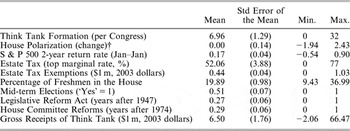
Table 1 provides summary statistics of the measures discussed above and includes the means, standard errors of the means and the minima and maxima in our data. These data are organized by US congress and as such each measure represents a two-year interval. On average, nearly seven think tanks were established per congress over this period, though the vast majority of think tanks were established after 1970. As noted, we use this measure of think-tank foundings as our dependent variable throughout the analysis.
Descriptive Statistics

†House polarization is standardized to have mean 0, standard deviation 1.
The number of think tanks founded during each congress is not normally distributed (it is essentially a count variable); consequently, the use of ordinary least squares regression is inappropriate. In our sample, the growth in think tanks has extra-Poisson variation known as over-dispersion (the mean and variance of the dependent variable are not equal). Negative binomial regression is thus appropriate to model the process contributing to think-tank growth.Footnote 45
One difficulty with this estimation strategy is the time-series nature of our data; it is difficult to disentangle the within-observation variation (over-dispersion or unobserved heterogeneity) from the across-observation variation (time-series trends). These two levels of variation interact: within-observation processes are estimated via the variation between observations conditional on the covariates. Consequently, we use the negative binomial regression technique to estimate the within-observation dispersion parameter separately, whilst carefully specifying the covariates (i.e., time) to control for cross-observation variation.Footnote 46
To control for potential autocorrelation and heteroscedasiticity, we use the Newey–West sandwich estimator of the variance–covariance matrix.Footnote 47 All models correct for both first-order and second-order autocorrelation; tests against a model having three or more lags suggested no appreciable difference in estimates of the standard errors. Estimation results are presented in the following section.
Results
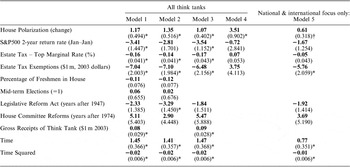
Marginal effects from negative binomial regressions are reported in Table 2, with a variety of specifications reported as evidence of robustness.Footnote 48 As hypothesized, our results indicate that an increase in House polarization leads to a positive and statistically significant increase in think-tank foundings for all our models. Model 1 includes all covariates described in the preceding section, showing that a one-standard deviation increase in the change in polarization is associated with a 1.17 increase in think-tank foundings per congress. This is our most conservative specification, and we believe it effectively controls for the covariates of think-tank formation and adequately addresses time trends. More substantively, then, results from Model 1 indicate that from 1993 to 1995 (103rd –104th Congresses) party polarization increased by 2.4 standard deviations leading to the formation of nearly three (2.8) new think tanks ceterus paribus.Footnote 49 A summary of such effects is presented graphically in Figure 1.
Marginal Effect of Polarization on Think-Tank Formation (with Alternative Controls) in the US House of Representatives, 1903–2003

Notes: Marginal effects calculated as average marginal effect; Newey–West standard errors in parentheses.
†Significant at 5.5%. *Significant at α⩽5%
Think tanks and political polarization Data sources: Keith T. Poole and Howard Rosenthal, Congress: A Political-Economic History of Roll-Call Voting (New York: Cambridge University Press, 1997); Andrew Rich, Think Tanks, Public Policy and the Politics of Expertise (New York: Cambridge University Press, 2004). Note: Results based on negative binomial regression (specification 1, Table 2).

The remaining models assess the robustness of the polarization effect. Model 2 eliminates the gross revenue measure from the specification, raising the marginal effect of polarization. Model 3 eliminates the percentage of freshmen and mid-term election covariates. Model 4 eliminates all variables except for polarization and the major economic factors, namely the equity rate of return and the estate tax measures. Model 5 alters the dependent variable by counting only those think tanks that have either a national or international focus. Whilst this significantly reduces the number of think tanks that are formed during our period of analysis, we still find statistically significant (p = 0.055) results for the polarization measure. Taken together, the models provide strong support for our polarization hypothesis.Footnote 50
Other covariates across the models display effects that comport with our expectations. Increasing the rate of return on equities, as measured by the two-year return rate of the Standard & Poor’s 500 Index, by one percentage point is associated with the formation of approximately 3.5 fewer think tanks (significant effects in Models 1 and 3). The estate tax measures – top marginal rate and the estate tax exemption – show the expected signs and are statistically significant in Models 1–3. Increases in the marginal estate tax rate are associated with increased think-tank formation.
Control variables for the years after the Legislative Reform Act (1947) and House committee reforms in 1974 show large effects (negative for LRA and positive for House Reforms), but the effect was imprecisely estimated and statistically insignificant in nearly all models. In Model 2 the estimated effect of the LRA (an additional time control) was negative and statistically significant. Mid-term elections have no effect on think-tank formation, and the freshman composition of the House is statistically insignificant in all the models that include the measure.
The theory we develop and test situates Congress as the primary consumer of the supply of policy analysis and advocacy in the United States. However, many think tanks do not focus their research or advocacy at the national or international level and may not consider the House of Representatives as an important outlet for their research. To control for this we alter the dependent variable in Model 5 to include only those think tanks that have a national or international, rather than state or local, focus. We estimate this model using the specification in Model 1. In general, we find that our results are similar to those for Model 1. Effects are smaller (owing largely to the elimination of nearly 40 per cent of think tanks from the prior sample), but of the same sign; many of the results remain statistically significant. Most importantly, House party polarization is statistically significant (p = 0.055) and has a positive effect on think-tank formation. We also find that only the amount of income exempt from estate taxes has an impact on foundings, the marginal rate is no longer statistically significant.
We find no evidence that think tanks cause increases in political polarization. A test of Granger causality rejects the hypothesis that think-tank formation Granger-causes political polarization; by contrast, evidence supports Granger-causality of political polarization on think-tank formation.Footnote 51
Taken together, these results strongly support the market-level polarization hypothesis. We now return to our micro-foundations and explore their implications for future research.
Conclusion
Legislative debate is enhanced by research-based information, and we have theoretically posited that think-tank foundings are associated with the micro-level demand generated by congressional committee debate. The response of policy entrepreneurs to this demand admits a supply of reliably ‘biased’ information from think tanks. Whilst the utility of biased information in the legislative process is not new, we argue that the demand for such information, and consequently the think tanks that produce it, has its origins in the nature of legislative debate.Footnote 52 Because persuasiveness – in terms of influence over policy outcomes – in legislative committee debate rests on the credibility of legislators, they demand research-based information to enhance the credibility of their arguments. Departing from the more general argument in Esterling, we posit that this information as provided by think tanks does not reduce uncertainty, but rather takes the uncertainty level over policy outcomes as given, yielding arguments on both sides of partisan political debates.Footnote 53
We developed our micro-level theory to address an aggregate-level puzzle: what explains the proliferation of think tanks? Since our theoretical claims conceptualize debate in spatial (ideological) terms, we operationalized a crucial macro-level implication of our theory, namely, that partisan polarization in Congress increases the demand for this policy-analytic information, and political entrepreneurs invest in its supply (increasing the number of think tanks) as a result. In testing this hypothesis, we do not intend to engage in cross-level inference regarding the implications of our theory for congressional behaviour (consider, for example, ecological regression techniques),Footnote 54 but rather to present a critical piece of prima facie evidence for our theory’s viability. To this end, we show support for the polarization claim in US data for the period 1903–2003. These aggregate trends, of course, may be consistent with various alternatives to our micro-level story. Nonetheless, they are important in that given its spatial decision-making basis, our theory could not be consistent with alternative findings for this aggregate hypothesis.
An aggregate-level explanation mentioned above might be examined against our findings by future scholars. Gray et al. claim that partisan competition increases the likelihood that legislative policy outcomes will change suddenly, attracting interest groups.Footnote 55 Our theory is ideological, rather than partisan, in nature. Our aggregate analysis found no effect of increases in the number of freshmen representatives in the House, which may be correlated with increased partisan competition, yet we do not assess such competition as a competing hypothesis. Future research may attempt to separate our ideological claims from partisan competition at the aggregate level.
At the micro-level of congressional decision making, we have noted Esterling’s argument that the provision of research-based information reduces uncertainty over policy outcomes, which serves to garner support for proposed legislation in Congress.Footnote 56 In the case of Marketable Emissions Allowances in environmental policy, Esterling supports this claim by observing that the ratio of groups supporting to groups opposing a policy increases when research-based support is available from government sources (in this case, the US Environmental Protection Agency). Our argument, rather, has been that uncertainty drives the demand for research-based advice to maintain, rather than produce consensus among, competing policy ideologies. Our expectation is that think-tank research will approach a balance of for and against positions, mirroring the distribution of policy preferences on the relevant committee and that this research will not have an independent effect on the ideological character of legislated policy. It would be an instructive avenue of future research to contrast the impacts of government-provided and think-tank research across a variety of policy proposals to distinguish between Esterling’s uncertainty reduction and our debate credibility-enhancement theories of demand for research-based policy analysis.
It would also be productive to examine empirically different venues for think-tank influence, such as contrasting the legislative strategy examined here and by Esterling with a strategy aimed at changing public opinion. In the context of corporate interests, Smith argued with substantial empirical support that major corporations lose in their attempts to persuade legislators on policy issues unless public opinion is on their side.Footnote 57 Because business interests such as pollution and taxation also get the greatest measure of publicity in the media, public debates on those issues simultaneously raise the issues and inform constituents about legislators in ways that have an impact on electoral results. Think tanks may also pursue public opinion strategies that feed back into elections (consider the activity of MoveOn.org in recent US elections). Future work – both theoretical and empirical – should focus on the venue selection of policy entrepreneurs to assess more accurately the market for research-based information that we have described.
If we are, nonetheless, correct about the legislative demand mechanism, one intriguing implication is that the increase in think tanks may be responsible for the adversarial tilt in contemporary policy analysis. The adversarial model of policy analysis focuses on the interdependence of the main avenues for policy and political intervention. In current policy debate, it is common for each side to arrive at the table not only with a supporting study, but also with research-based evidence of the limits and inaccuracy of opposing claims. Thus the theoretical and empirical evidence supports our contention that during periods in which polarization remains high, the ideological reputation of individual think tanks becomes stabilized in the minds of legislators. In other words, think tanks as institutions become credible with legislators, the media and so forth. The researchers who work in credible think tanks themselves develop reputations for research that is credible as a scientific matter, if ideologically skewed in policy conclusions.Footnote 58 Members know which think tanks they can trust for both credibility-enhancing information and counter-arguments.
We claim that think tanks are sources of strategic information that assist legislators in the adversarial process of US law making, but given the adversarial nature of law making in modern democracies, our analysis has important implications for the institutionalized role of policy analysis in many nations. A natural extension of the framework we describe in this article is to think-tank activity within the United States, which provides variation in legislative institutions as well as ideological polarization. International comparative research should examine the extent to which differences in electoral and governmental structures (single versus multi-member districts, presidential versus parliamentary systems, veto points and so forth) have an impact on the policy-analytic environment. Comparative work in the states and across nations can also provide more variation on the impact of elections on changes in legislative polarization levels, possibly helping to distinguish an electoral effect from an institutional one. Finally, our theoretical argument provides broader implications for the perceptions of uncertainty in specific policy areas. Scholars should compare policy areas with higher and lower levels of perceived outcome uncertainty to understand more deeply the impact of adversarial research-based analysis on political decision making in the United States and other nations.