Introduction
Pediatric bipolar disorder (BD) is a debilitating illness characterized by rapid mood swings, significant functional impairment, and chronic morbidity (see Pavuluri et al. Reference Pavuluri, Birmaher and Naylor2005 and Leibenluft & Rich, Reference Leibenluft and Rich2008 for reviews). Deficits in social and interpersonal functioning are core features of the illness, and are thought to reflect disturbances in cognitive and affect processing circuitry (Schenkel et al. Reference Schenkel, Pavuluri, Herbener, Harral and Sweeney2007, Reference Schenkel, West, Harral, Patel and Pavuluri2008; Rich et al. Reference Rich, Fromm, Berghorst, Dickstein, Brotman, Pine and Leibenluft2008a, Reference Rich, Holroyd, Carver, Onelio, Mendoza, Cornwell, Fox, Pine, Coppola and Leibenluft2010). Significant impairments in attention and working memory (Dickstein et al. Reference Dickstein, Treland, Snow, McClure, Mehta, Towbin, Pine and Leibenluft2004; Pavuluri et al. Reference Pavuluri, Schenkel, Aryal, Harral, Hill, Herbener and Sweeney2006), along with deficits in emotion processing have been documented in BD youth (Schenkel et al. Reference Schenkel, Pavuluri, Herbener, Harral and Sweeney2007; Rich et al. Reference Rich, Grimley, Schmajuk, Blair, Blair and Leibenluft2008b), as well as unaffected first-degree relatives (Bora et al. Reference Bora, Yücel and Pantelis2009; Doyle et al. Reference Doyle, Wozniak, Wilens, Henin, Seidmen, Petty, Fried, Gross, Faraone and Biederman2009). Moreover, disturbances in emotion identification have been found across emotions in pediatric BD patients, and are thought to be an endophenotype for the disorder (Brotman et al. Reference Brotman, Guyer, Lawson, Horsey, Rich, Dickstein, Pine and Leibenluft2008a, Reference Brotman, Skup, Rich, Blair, Pine, Blair and Leibenluftb; Rich et al. Reference Rich, Grimley, Schmajuk, Blair, Blair and Leibenluft2008b).
Recent models of the pathophysiology of pediatric BD suggest abnormalities in fronto-limbic circuitry, and point to important functional interactions in emotion processing between higher cortical cognitive areas and regions associated with the evaluation and processing of affective stimuli (Pavuluri et al. Reference Pavuluri, Marlow-O'Connor, Harral and Sweeney2007). A number of functional magnetic resonance imaging (fMRI) studies of emotion processing in youth with BD have identified abnormal activation in cortical areas such as the dorsolateral prefrontal cortex (DLPFC), ventrolateral prefrontal cortex (VLPFC), ventromedial prefrontal cortex (VMPFC) and anterior cingulate cortex (ACC), along with subcortical areas that include the striatum, and most notably the amygdala (Chang et al. Reference Chang, Adleman, Dienes, Simeonova, Menon and Reiss2004; Rich et al. Reference Rich, Vinton, Roberson-Nay, Hommer, Berghorst, McClure, Fromm, Pine and Leibenluft2006; Pavuluri et al. Reference Pavuluri, Marlow-O'Connor, Harral and Sweeney2007, Reference Pavuluri, O'Connor, Harral and Sweeey2008, Reference Pavuluri, Passarotti, Parnes and Sweeney2010b; Passarotti et al. Reference Passarotti, Sweeney and Pavuluri2010, Reference Passarotti, Sweeney and Pavuluri2011). Additionally, studies have documented smaller hippocampal volume among adolescents with BD relative to controls (Bearden et al. Reference Bearden, Thompson, Dutton, Frey, Peluso, Nicoletti, Dierschke, Hayashi, Klunder, Glahn, Brambilla, Sassi, Mallinger and Soares2008). Together, these regions are involved in receiving, attending to, evaluating, and modulating emotional stimuli, including top-down regulation of emotional responses and the appraisal of reward and punishment (Packard & Cahill, Reference Packard and Cahill2001; Cools et al. Reference Cools, Clark, Owen and Robbins2002; Botvinick, Reference Botvinick2004; Völlm et al. Reference Völlm, Taylor, Richardson, Corcoran, Stirling, McKie and Elliott2006; Weissman et al. Reference Weissman, Perkins and Woldorff2008; Adolphs, Reference Adolphs2009). Additionally, Rich et al. (Reference Rich, Fromm, Berghorst, Dickstein, Brotman, Pine and Leibenluft2008a) reported reduced connectivity between the left amygdala and right posterior cingulate/precuneus and right parahippocampal gyrus, indicating that working memory may be an important factor associated with emotion-identification deficits in BD youth.
Given the complexity and interconnectivity of emotion centers and higher cortical regions, it is likely that emotion-processing impairments and cognitive dysfunction among BD youth are interrelated and bidirectional in nature. For example, the excessive emotional reactivity characteristic of a manic/acute state may have a negative effect on cognitive functioning, and deficient executive control could reduce top-down modulation of the intensity and duration of emotional experiences (Pavuluri et al. Reference Pavuluri, O'Connor, Harral and Sweeey2008). Past behavioral and imaging studies are consistent with this model. For example, Rich et al. (Reference Rich, Schmajuk, Perez-Edgar, Pine, Fox and Leibenluft2005) reported more impaired attentional performance among BD youth when placed in emotionally challenging and frustrating contexts. In addition, our group recently found that BD adolescents show reduced activation in higher cortical centers (e.g. DLPFC, VLPFC) when exposed to emotional stimuli, such as emotional faces or words, and increased activation in the amygdala, suggesting that cortical centers become less active and fail to provide adequate top-down regulation over subcortical emotion areas (Pavuluri et al. Reference Pavuluri, Marlow-O'Connor, Harral and Sweeney2007, Reference Pavuluri, O'Connor, Harral and Sweeey2008; Passarotti et al. Reference Passarotti, Sweeney and Pavuluri2010, Reference Passarotti, Sweeney and Pavuluri2011). Deficient top-down modulation has been observed for positive and negative emotional stimuli among pediatric BD patients; however, findings appear to be more robust for negative ones, suggesting a heightened sensitivity for negative contexts (Pavuluri et al. Reference Pavuluri, O'Connor, Harral and Sweeey2008; Passarotti et al. Reference Passarotti, Sweeney and Pavuluri2011; Pavuluri et al. Reference Pavuluri, Passarotti, Fitzgerald, Wegbreit and Sweeney2012).
Understanding the interface between emotional and cognitive functioning in youth with BD can help to elucidate the underlying mechanisms associated with the disorder, and may also help to distinguish between clinical phenotypes in pediatric BD. To date, there has been limited research on the relationships between attention and memory, and emotion processing in pediatric BD. This is surprising as a number of independent investigations have consistently documented working-memory and emotion-processing deficits in acute and euthymic pediatric BD patients (Pavuluri et al. Reference Pavuluri, Schenkel, Aryal, Harral, Hill, Herbener and Sweeney2006; Schenkel et al. Reference Schenkel, Pavuluri, Herbener, Harral and Sweeney2007, Reference Schenkel, West, Jacobs, Sweeney and Pavuluri2012; Rich et al. Reference Rich, Grimley, Schmajuk, Blair, Blair and Leibenluft2008b). Cognitive and affective systems work in tandem, and the successful interaction between these systems is paramount for adaptive behavior (Pavuluri et al. Reference Pavuluri, Passarotti, Parnes and Sweeney2010b; Passarotti et al. Reference Passarotti, Sweeney and Pavuluri2011). The ability to attend to, store, and process information in short-term memory is essential for successful day-to-day activities. Adaptive behavior also requires the ability to accurately process and respond to emotional cues. Given the rich interaction of these systems, we sought to investigate affect identification and working memory for emotional faces in youth with BD type I (BD I) and type II (BD II) and matched healthy control (HC) subjects. Consistent with past work, we hypothesized that BD youth would perform significantly more poorly compared to healthy subjects when identifying both happy and angry emotional expressions. In addition, we hypothesized that compared to healthy subjects, BD youth would show difficulty attending to and recalling positive and negative emotional facial stimuli, and that these deficits would be most pronounced with negative stimuli. Given the severity of manic symptoms in BD I versus BD II patients, we also hypothesized that youth with BD I would show the most impaired performance on the emotion-processing and working-memory tasks.
Method
Subjects
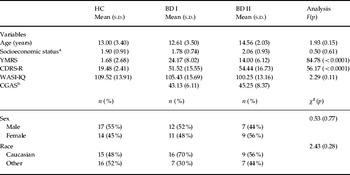
BD subjects were recruited from the Pediatric Mood Disorders Clinic at the University of Illinois at Chicago (UIC). The Institutional Review Board approved the study. Verbal or written assent was provided by all children in addition to the written informed consent of parents. The BD I (n = 23) and BD II (n = 16) unmedicated patients and HC (n = 31) were aged between 8 and 18 years (mean age = 13.39, s.d. = 2.98 years), and were recruited to be similar on age, sex (36 males), parental socio-economic status, and intelligence as assessed by the 2-subtest version of the Wechsler Abbreviated Scale of Intelligence (WASI; Wechsler et al. Reference Wechsler, Wycherley and Benjamin1998). Inclusion criteria for the BD group were a current Diagnostic and Statistical Manual of Mental Disorders, Text Revision (DSM-IV-TR; APA, 2000) diagnosis of BD I, mixed (n = 8) or manic (n = 15) state, or BD II, hypomanic (n = 8) or depressed (n = 8) state, and medication free for at least 1 week prior to testing. In the BD group, 14 (41%) subjects had a co-morbid diagnosis of attention deficit hyperactivity disorder (ADHD). HC subjects were euthymic with Young Mania Rating Scale (YMRS; Young et al. Reference Young, Biggs, Ziegeler and Mayer1978) scores of ⩽8 and Child Depression Rating Scale – Revised (CDRS-R; Poznanski et al. Reference Poznanski, Freeman and Mokros1985) scores of ⩽40. None of the subjects in the HC group met DSM-IV-TR (APA, 2000) criteria for any major psychiatric disorder (see Table 1 for demographic and clinical data).
Demographic and clinical characteristics of the pediatric bipolar disorder I (BD I) and II (BD II) and healthy control (HC) subjects. Means, standard deviations (s.d.), percentages, and significance values are presented below

YMRS, Young Mania Rating Scale; CDRS-R, Child Depression Rating Scale – Revised; WASI-IQ, Wechsler Abbreviated Scale of Intelligence; CGAS, Children's Global Assessment Scale.
a Rated with Hollingshead Index of Social Position.
b CGAS rating (Shaffer et al. Reference Shaffer, Gould, Brasic, Ambrosini, Fisher, Bird and Aluwahlia1983).
Each child and at least one of their parents were interviewed using the Washington University St Louis Kiddie Schedule for Affective Disorders and Schizophrenia (WASH-U-KSADS; Geller et al. Reference Geller, Warner, Williams and Zimerman1998) supplemented by the episode characterization of BD from the KSADS – Present and Lifetime version (KSADS-PL; Kaufman et al. Reference Kaufman, Birmaher, Brent, Rao, Flynn, Moreci and Ryan1997), along with a comprehensive clinical interview. Clinical information from all available sources was combined to provide a consensus clinical diagnosis. The WASH-U-KSADS interviews as well as the YMRS and CDRS-R were completed by trained doctoral-level raters who had no knowledge of social cognition test performance. Live diagnostic interviews of ten cases were coded by three research assistants and M.N.P. to establish inter-rater reliability. By Cohen's κ, reliability of diagnoses was 0.96 between raters. Exclusion criteria for the entire sample were active substance abuse, serious medical problems, IQ <70, or the presence of another current DSM-IV-TR Axis I diagnosis that required psychiatric intervention (pharmacotherapy or psychotherapy) with the exception of ADHD.
Procedure
Measures of emotion processing and working memory
Chicago Pediatric Emotional Acuity Task (Chicago PEAT). The Chicago PEAT is a modified version of the PEAT (Erwin et al. Reference Erwin, Gur, Gur, Smailis and Skolnick1992), and measures the ability to identify happy and angry facial expressions that range from neutral to extreme in emotional intensity. It requires individuals to rate 40 color pictures of child and adult faces along a 7-point continuum of emotional intensity (very happy, moderately happy, slightly happy, neutral, slightly angry, moderately angry, very angry). Facial stimuli were standardized color photographs of varying emotional intensity from the Diagnostic Analysis of Nonverbal Accuracy Scale (DANVA; Nowicki & Duke, Reference Nowicki and Duke1994). Past studies using this measure have demonstrated facial emotion-processing abnormalities among pediatric BD patients (McClure et al. Reference McClure, Treland, Snow, Dickstein, Towbin, Charney, Pine and Leibenluft2005). The task is self-paced, response driven, and takes approximately 4–5 min to complete. Outcome variables are total correct, total incorrect, and mean reaction time for happy and angry stimuli.
Affective N-Back Memory Task (ANMT; Passarotti et al. Reference Passarotti, Sweeney and Pavuluri2010, Reference Passarotti, Sweeney and Pavuluri2011; Pavuluri et al. Reference Pavuluri, Passarotti, Fitzgerald, Wegbreit and Sweeney2012). The ANMT measures working memory for happy, angry, and neutral facial stimuli, and has been shown to effectively differentiate the neuropathophysiology of pediatric BD and ADHD patients (Passarotti et al. Reference Passarotti, Sweeney and Pavuluri2010). It is comprised of two separate working-memory tasks – the ANMT-Positive and the ANMT-Negative. Each task is a two-back memory task, and uses a block design with faces as the targets. There are a total of 80 trials each for the ANMT-Positive (40 happy, 40 neutral) and ANMT-Negative (40 angry, 40 neutral) for a total of 160 trials. Within each task, facial stimuli are presented in a blocked format, and blocks are presented in a counterbalanced pseudo-random sequence. In each block there are eight target faces. Each face is presented for 3 s, and participants are asked to respond if the target face appeared two faces back in the series. Distracter faces were not used more than once. The face stimuli were taken from the Gur et al. (Reference Gur, Sara, Hagendoorn, Marom, Hughett, Macy, Turner, Bajcsy, Posner and Gur2002) database, and were balanced by age, gender, and race. True-positives, false-positives, and mean reaction times were scored for each task.
Statistical analysis
To provide a standard metric for comparison of deficits across the emotion-processing tasks, scores were standardized to z scores based on the means and standard deviations from the HC group (Herbener et al. Reference Herbener, Hill, Marvin and Sweeney2005; Pavuluri et al. Reference Pavuluri, Schenkel, Aryal, Harral, Hill, Herbener and Sweeney2006; Schenkel et al. Reference Schenkel, Pavuluri, Herbener, Harral and Sweeney2007). On the Chicago PEAT, we subtracted total incorrect response scores from total correct response scores in order to form ‘emotion-identification composites’ for both the happy and angry conditions. Total scores for each condition were calculated for the ANMT-Positive and ANMT-Negative by subtracting true-positive from false-positive scores (i.e. z scores for the happy and neutral conditions of the ANMT-Positive, and z scores for the angry and neutral conditions of the ANMT-Negative).
Mixed-model multivariate analyses of variance (MANOVA) using Wilks' lambda were used to assess for group differences between the BD and HC groups on the Chicago PEAT (3 × 2) and the ANMT-Positive (3 × 2) and ANMT-Negative (3 × 2), with diagnostic group as the between-subjects variable and emotional condition as the within-subjects variable, with follow-up post-hoc pairwise comparisons to assess for group differences between the BD I and II groups and the HC group. Where there were significant interaction effects, paired-sample t tests were used to examine mean differences between affective conditions for the BD I and II groups separately. To control for co-morbid ADHD and mood state in the BD groups, separate 3 × 2 MANCOVAs were performed with ADHD and mood state as covariates. Finally, associations between performance on the Chicago PEAT and ANMT, and level of symptomatology (CDRS-R and YMRS scores) and age were analyzed separately for the BD and HC groups using Pearson correlation coefficients.
Results
As expected, there were significant differences between the three groups on the YMRS (F 2,67 = 103.54, p < 0.0001) and CDRS-R (F 2,67 = 66.25, p < 0.0001) (see Table 1 for means and standard deviations). Both BD groups had higher YMRS scores compared to controls (p values <0.0001), and BD I patients had significantly higher YMRS scores compared to BD II patients (p < 0.0001). Similarly, both BD groups had significantly higher CDRS-R scores compared to controls (p values <0.0001); however, the BD I and II groups did not differ from each other on CDRS-R severity (p = 0.74).
Group comparisons on the Chicago PEAT
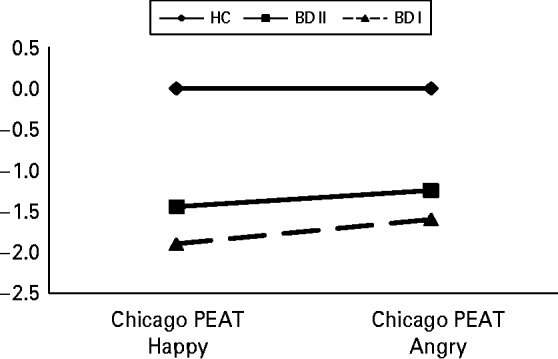
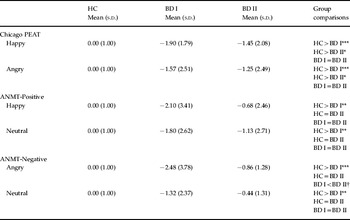
For accuracy scores (correct responses) a 3 (group) × 2 (condition) mixed-model MANOVA indicated a significant main effect of group (F 2,67 = 8.43, p < 0.001), but no significant effect of condition (F 1,67 = 0.27, p = 0.61), or group × condition interaction (F 2,67 = 0.10, p = 0.90). Post-hoc Tukey's honestly significant different (HSD) tests indicated that the control group had more correct responses than the BP I group (p = 0.001), and the BP II group (p < 0.05). The BP I and BP II groups did not differ from each other (p = 0.75). However, group differences were not significantly affected by emotion, in that the magnitude of the group difference was not significantly different across the two emotion conditions (see Table 2 and Fig. 1).
Z scores on the Chicago Pediatric Emotional Acuity Task (Chicago PEAT) of healthy control (HC) subjects and bipolar disorder type I (BD I) and type II (BD II) subjects.
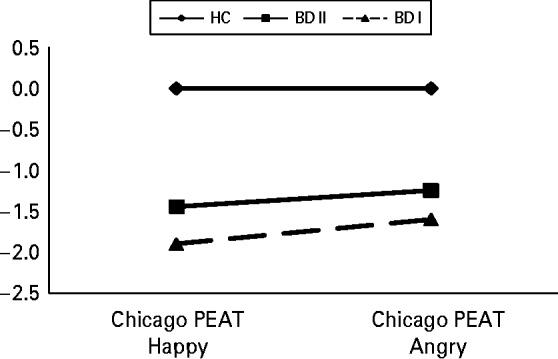
Means, standard deviations (s.d.), and group comparisons on the Chicago Pediatric Emotional Acuity Task (Chicago PEAT) and the Positive and Negative Affective N-Back Memory Task (ANMT) for healthy controls (HC) and pediatric bipolar disorder I (BD I) and II (BD II) subjects. Average z scores for correct responses are presented

† p < 0.1, * p < 0.05, ** p < 0.01, *** p < 0.001.
For reaction time, there were no significant main effects of group (F 2,67 = 0.13, p = 0.88) or condition (F 1,67 = 2.45, p = 0.12), and there was a trend toward a non-significantgroup × condition interaction (F 2,67 = 2.68, p = 0.08).
Secondary analyses: Chicago PEAT
For accuracy, findings did not change using a 3 × 2 MANCOVA with ADHD co-morbidity as a covariate. Specifically, there was a main effect of group (F 2,66 = 5.51, p < 0.005), and no main effect of condition (F 1,66 = 0.22, p = 0.64), or group × condition interaction (F 2,66 = 0.09, p = 0.92).
Similarly, accuracy findings remained the same with mood state as a covariate, with a significant main effect of group (F 2,66 = 3.61, p < .05), and no significant main effect of condition (F 1,66 = 0.74, p = 0.39) or group × condition interaction (F 2,66 = 0.42, p = 0.66).
Group comparisons on the ANMT
ANMT-Positive
For accuracy on the ANMT-Positive, a 3 × 2 MANOVA indicated a significant main effect of group (F 2,67 = 5.32, p < 0.01), with the BD group displaying fewer correct responses than the HC group. However, the main effect of condition (F 1,67 = 0.12, p = 0.73) and group × condition interaction were not significant (F 2,67 = 2.05, p = 0.14).
For reaction time (3 × 2 MANOVA), there was a non-significant trend toward a main effect of group (F 2,67 = 2.50, p = 0.09). The main effect of condition (F 1,67 = 0.32, p = 0.58) and group × condition interaction (F 2,67 = 0.56, p = 0.57) were not significant.
Secondary analyses: ANMT-Positive
For accuracy, with ADHD co-morbidity included as a covariate (3 × 2 MANCOVA), there was a trend toward a significant main effect of group (F 2,66 = 2.54, p = 0.08), and no main effect of condition (F 1,66 = 0.04, p = 0.84) or group × condition interaction (F 2,66 = 1.98, p = 0.15). Similar results were found for reaction time while controlling for ADHD co-morbidity, with no significant main effect of group (F 2,66 = 1.28, p = 0.29) or condition (F 1,68 = 0.00, p = 0.97), and no group × condition interaction (F 2,66 = 0.24, p = 0.79).
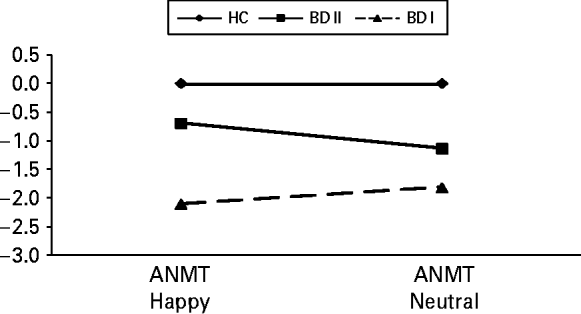
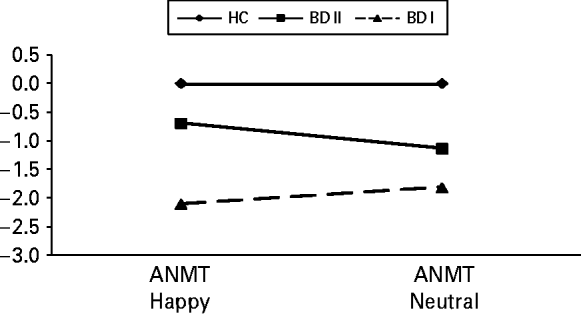
For accuracy with mood state as a covariate, there was a main effect of group (F 2,66 = 4.62, p < 0.05) and condition (F 1,66 = 4.07, p < 0.05), and a significant interaction (F 2,66 = 3.73, p < 0.05) indicating that the magnitude of the group difference was significantly different across the two conditions. Post-hoc HSD tests indicated that, on the happy condition of the ANMT-Positive, the HC group had more correct responses than the BD I group (p < 0.01). There were no significant differences between the BD II group and the HC group, or the BD I and II groups (p values >0.05). On the neutral condition of the ANMT-Positive, the HC group had more correct responses than the BD I group (p < 0.01). There were no significant differences between the BD II group and the HC group, or the BD I and II groups (p values >0.05). When examining the BD I and II groups independently, there were no significant differences between mean scores on the neutral versus happy conditions for BD I (t 22 = 1.14, p = 0.27) or BD II (t 15 = 1.57, p = 0.14) patients (see Table 2 and Fig. 2).
Z composite scores on the Affective N-Back Memory Task (ANMT)-Positive (happy and neutral conditions) of healthy control (HC) subjects and bipolar disorder type I (BD I) and type II (BD II) subjects.
For reaction time with mood state as a covariate, there was a trend toward a significant main effect of group (F 2,66 = 2.46, p = 0.09), and no significant main effect of condition (F 1,66 = 0.07, p = 0.79), or group × condition interaction (F 2,66 = 0.06, p = 0.81).
ANMT-Negative
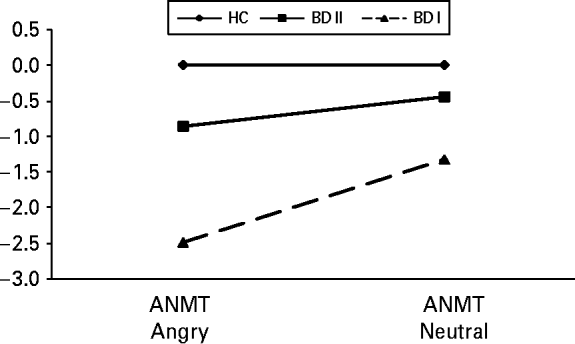
For accuracy on the ANMT-Negative, there was a significant main effect of group (F 2,67 = 6.48, p < 0.01), and condition (F 1,67 = 11.53, p < 0.001), and a significant group × condition interaction (F 2,67 = 5.66), p < 0.01). Post-hoc Tukey HSD tests indicated that, on the angry condition of the ANMT-Negative, the HC group had more correct responses than the BD I group (p < 0.001), and there was a non-significant trend for the BD II group to perform better than the BD I group (p < 0.10). The BD II and HC groups did not differ from each other (p = 0.46). On the neutral condition of the ANMT-Negative, the control group exhibited more correct responses than the BD I group (p < 0.01), and there were no significant differences between the BD I group and the BD II group (p = 0.23) or between the BD II and HC groups (p = 0.66). When examining BD subtype groups independently, both BD I (t 22 = 2.69, p < 0.05) and BD II (t 15 = 3.41, p < 0.01) patients had higher accuracy scores on the neutral compared to the negative condition (see Table 2 and Fig. 3).
Z composite scores on the Affective N-Back Memory Task (ANMT)-Negative (angry and neutral conditions) of healthy control (HC) subjects and bipolar disorder type I (BD I) and type II (BD II) subjects.
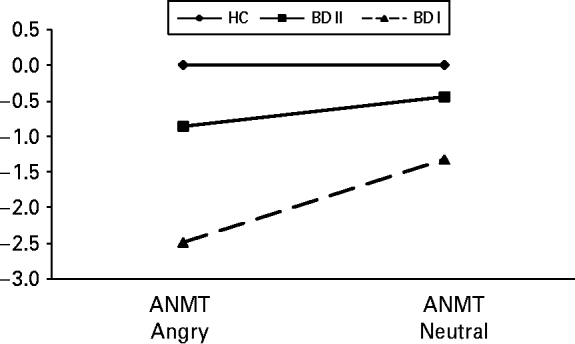
On reaction time, there was a significant main effect of group (F 2,67 = 4.64, p < 0.05), and condition (F 1,67 = 11.63, p < 0.001), and a significant interaction (F 2,67 = 3.91), p < 0.05). Post-hoc Tukey HSD tests indicated that, on the angry condition of the ANMT-Negative, the BD I group had significantly slower reaction times than the HC group (p < 0.001), and there was a non-significant trend for the BD I group to perform more slowly than the BD II group (p < 0.10). The BD II and HC groups did not differ from each other (p = 0.50). There were no significant group differences on the neutral condition (p values >0.05). BD I patients had significantly slower reaction times on the neutral compared to the negative condition (t 22 = 3.30, p < 0.005). There was no significant difference between the two conditions for BD II patients (t 15 = 1.57, p = 0.14).
Secondary analyses: ANMT-Negative
With ADHD included as a covariate (3 × 2 MANCOVA), the accuracy findings did not change. The main effects of group (F 2,66 = 3.62, p < 0.05) and condition (F 1,66 = 14.41, p < 0.0001), and the group × condition interaction (F 2,66 = 7.12, p < 0.005) remained significant. A MANCOVA examining reaction time with ADHD as a covariate was also consistent, with significant main effects of group (F 2,66 = 3.08, p < 0.05) and condition (F 1,66 = 10.75, p < 0.01), and a significant group × condition interaction (F 2,66 = 3.85, p < 0.05).
For accuracy with mood state as a covariate, the main effect of group (F 2,66 = 6.78, p < 0.01) and the group × condition interaction (F 2,66 = 6.13, p < 0.005) remained significant, and there was a trend toward a significant main effect of condition (F 2,66 = 3.31, p = 0.07). Similarly, for reaction time, there was a main effect of group (F 2,66 = 3.45, p < 0.05) and a group × condition interaction (F 2,66 = 3.26, p < 0.05), but no main effect of condition (F 2,66 = 0.67, p = 0.80). See Fig. 1 for group differences on the Chicago PEAT and ANMT.
Relationships with manic and depressive symptomatology
In an effort to reduce the overall number of analyses, the Happy and Angry subscales of the Chicago PEAT were combined and averaged to form an overall Chicago PEAT score. Similarly, the four subscale scores of the ANMT were combined to form an overall ANMT composite. Correlations between the two composite scores and depressive and manic symptomatology were computed separately for the HC and the BD groups. There were no significant associations between YMRS scores or CDRS-R scores and the Chicago PEAT or ANMT scores in the HC group. For BD patients, there were no significant associations between CDRS-R scores and performance on the Chicago PEAT or ANMT. However, higher YMRS scores were associated with fewer correct responses on the ANMT (r = − 0.37, p < 0.05). Additionally, higher scores on the Chicago PEAT were associated with higher scores on the ANMT (r = 0.38, p < 0.05). In the HC group, older age was significantly correlated with increased accuracy on the ANMT (r = − 0.43, p < 0.05); however, there was not a significant association between age and scores on the Chicago PEAT (r = 0.18, p = 0.33). Among BD patients, older age was associated increased accuracy on the ANMT (r = 0.52, p = 0.001) and the Chicago PEAT (r = 0.53, p < 0.001).
Discussion
This study examined the interface between emotion processing and working memory in pediatric BD patients. Consistent with our first hypothesis and past studies, BD youth performed more poorly compared to controls when rating the intensity of both positive and negative emotional expressions (McClure et al. Reference McClure, Treland, Snow, Dickstein, Towbin, Charney, Pine and Leibenluft2005; Schenkel et al. Reference Schenkel, Pavuluri, Herbener, Harral and Sweeney2007; Rich et al. Reference Rich, Grimley, Schmajuk, Blair, Blair and Leibenluft2008b). Emotion-identification deficits were seen in both BD I and II patients, and remained significant after controlling for mood state and co-morbid ADHD. These findings suggest that problematic emotion processing is significant across BD subtypes and is not due to greater clinical dysfunction and/or psychiatric co-morbidity. Moreover, findings from this study support theories that emotion-identification impairments may be a reliable endophenotype for BD (Brotman et al. Reference Brotman, Skup, Rich, Blair, Pine, Blair and Leibenluft2008b). Indeed, a number of investigations have documented significant emotion-identification impairments among BD youth compared to HC and other pediatric clinical populations including ADHD, conduct disorder, and major depressive disorder (McClure et al. Reference McClure, Treland, Snow, Dickstein, Towbin, Charney, Pine and Leibenluft2005; Guyer et al. Reference Guyer, McClure, Adler, Brotman, Rich, Kimes and Leibenluft2007; Rich et al. Reference Rich, Fromm, Berghorst, Dickstein, Brotman, Pine and Leibenluft2008a).
Additionally, compared to HC subjects, pediatric BD patients demonstrated significantly more difficulty remembering facial stimuli regardless of emotional valence; however, working-memory deficits were the most pronounced with negative stimuli and were specific to BD I patients. In particular, BD I patients were less accurate and slower to respond when identifying angry facial expressions. Therefore, BD I patients appear to have a more impaired pattern of social cognitive dysfunction, regardless of emotional valence, but one that is exacerbated in negative contexts. Consistent with this, previous investigations in BD youth have reported a negative bias when identifying and rating the intensity of neutral facial expressions, as well as greater cognitive impairment when placed in negative contexts (Rich et al. Reference Rich, Schmajuk, Perez-Edgar, Pine, Fox and Leibenluft2005) and when required to take another's perspective in negative social situations (Schenkel et al. Reference Schenkel, West, Harral, Patel and Pavuluri2008). Moreover, our results are consistent with findings from Dickstein et al. (Reference Dickstein, Rich, Roberson-Nay, Berghorst, Vinton, Pine and Leibenluft2007) who reported reduced memory for negative emotional faces among pediatric BD youth independent of clinical state or ADHD co-morbidity. Data also support and extend theories that BD I is a more severe and debilitating illness than BD II, with greater functional impairment and more severe cognitive and social-cognitive dysfunction (Simonsen et al. Reference Simonsen, Vaskinn, Birkenaes, Engh, Hansen, Jósdóttir, Ringen, Opjordsmoen, Friis and Andreassen2008; Schenkel et al. Reference Schenkel, West, Jacobs, Sweeney and Pavuluri2012).
Our findings are consistent with neuroimaging models of the pathophysiology of pediatric BD that implicate a ventrolateral prefrontal-striatal-amygdala circuit (Blumberg et al. Reference Blumberg, Kaufman, Andrés, Whiteman, Hongyuan Zhang, Gore, Charney, Krystal and Peterson2003; Rich et al. Reference Rich, Schmajuk, Perez-Edgar, Pine, Fox and Leibenluft2005; Dickstein et al. Reference Dickstein, Rich, Roberson-Nay, Berghorst, Vinton, Pine and Leibenluft2007; Pavuluri et al. Reference Pavuluri, Marlow-O'Connor, Harral and Sweeney2007; Womer et al. Reference Womer, Kalmar, Wang and Blumberg2009; Passarotti et al. Reference Passarotti, Sweeney and Pavuluri2010, Reference Passarotti, Sweeney and Pavuluri2011). Specifically, both positive and negative emotions may impact higher cortical centers associated with emotion processing; however, negative emotions appear to have an even greater effect, and suggest that higher cortical centers of cognitive and affective circuitry are not efficiently recruited under the stress of being exposed to negative emotions. Imaging data from our laboratory from a separate study using this task indicated that BD youth exhibited greater deployment of emotion and emotion-regulation circuitry, particularly for negative faces (ACC, orbito-fronal cortex, amygdala) and reduced deployment of working-memory circuitry (Passarotti et al. Reference Passarotti, Sweeney and Pavuluri2010). Interestingly, while there was an improvement in prefrontal regions such as the VLPFC, increased amygdala activation relative to HC subjects in response to emotional stimuli remained even after pharmacotherapy treatment, suggesting that overactivity of emotion-processing centers may be an important trait-marker for pediatric BD. In addition, this study found that performance on the Chicago PEAT and ANMT were significantly correlated, which lends further support for theories that basic emotion processing and higher-level cognitive control are interrelated and likely bidirectional, and play a significant role in the social-cognitive impairments seen in pediatric BD patients (Passarotti et al. Reference Passarotti, Sweeney and Pavuluri2011).
This study has a number of important clinical implications. First, emotion-identification impairments were present across BD subtypes and were evident for both positive and negative faces. As such, psychosocial interventions with pediatric BD patients should incorporate specific exercises in face processing and emotion identification as part of a comprehensive social skills program. Training programs that focus on attending to salient facial features, face recognition, and emotion identification have been successful at improving interpersonal skills among children with autism spectrum disorders (Hopkins et al. Reference Hopkins, Gower, Perez, Smith, Amthor, Wimsatt and Biasini2011; Tanaka et al. Reference Tanaka, Wolf, Klaiman, Koenig, Cockburn, Herlihy, Brown, Stahl, Kaiser and Schultz2010). Cognitive remediation programs, including computer-based cognitive enhancement, emotion processing, and social skills training are currently underway in our laboratory. Second, results indicate a need to modify use of ‘negative consequences’ in behavioral modification strategies in psychosocial treatments with BD youth. The excessive reactivity and reduced top-down modulation seen among pediatric BD patients in the face of negative and/or frustrating situations warrants modified treatment programs that focus on emotion regulation ability, positive reframing, and exercises in the development of more effective social skills and cognitive control (Pavuluri et al. Reference Pavuluri, Schenkel, Aryal, Harral, Hill, Herbener and Sweeney2006; West et al. Reference West, Jacobs, Westerholm, Lee, Carbray, Heidenreich and Pavuluri2009). Pharmacotherapy interventions also hold promise for improving cognitive and emotion-processing abilities among pediatric BD patients. Treatment with lamotrigine monotherapy has been shown to enhance the functioning of affective (VMPFC, VLPFC) and cognitive (DLPFC) circuitry, as well as improve working- and verbal-memory abilities among BD youth (Pavuluri et al. Reference Pavuluri, Passarotti, Mohammed, Carbray and Sweeney2010a, Reference Pavuluri, Passarotti, Parnes and Sweeneyb; Passarotti et al. Reference Passarotti, Sweeney and Pavuluri2011).
Interestingly, age was not significantly correlated with emotion identification ability among healthy subjects, but was for BD patients. This raises the possibility that illness state may interfere with the successful development of emotion-processing abilities, and could be an indication of why earlier age of onset is associated with a more chronic and severe form of illness among bipolar patients (Carter et al. Reference Carter, Mundo, Parikh and Kennedy2003; Craney & Geller, Reference Craney and Geller2003). It also underscores the need for early diagnosis and intervention. Better working-memory performance was associated with increased age in both the HC and BD groups. This is not surprising as the neurocircuitry involved in working memory does not become fully active until late adolescence/early adulthood (Jolles et al. Reference Jolles, Kleibeuker, Rombouts and Crone2011) whereas emotion recognition develops much earlier and reaches adult levels of competency by middle childhood (Durand et al. Reference Durand, Gallay, Seigneuric, Robichon and Baudouin2007).
There are a number of limitations to the current investigation. First, findings should be interpreted with caution given the relatively small sample used in this investigation. Future studies should be conducted using larger groups of BD I and BD II youth, as well as pediatric patients that do not meet full diagnostic criteria for mania such as those diagnosed with severe mood dysregulation (SMD) who are characterized by a hyper-aroused state that is non-episodic with chronic irritability (Leibenluft et al. Reference Leibenluft, Charney, Towbin, Bhangoo and Pine2003). Interestingly, pediatric BD and SMD patients both demonstrate cognitive- as well as emotion-processing impairments, but show differing profiles of underlying pathophysiology (see Leibenluft, Reference Leibenluft2011 for a review). Additionally, this study used only unmedicated pediatric bipolar patients, and therefore, findings cannot be considered conclusive. However, utilizing an unmedicated sample did allow for careful control of the severity of manic symptoms resulting in a more homogenous sample of patients. Future studies should employ controlled medication clinical trials using longitudinal follow-up designs to better understand the potential influences of mood state, illness severity, and pharmacotherapy on social-cognitive functioning among different clinical phenotypes of pediatric BD.
Our central findings indicate general emotion-identification deficits across pediatric BD subtypes. Working-memory deficits were evident irrespective of emotional valence; however, they were the most pronounced with negative emotional stimuli, and were specific to BD I patients. Pediatric BD I patients, therefore, display a more widespread and severe profile of social-cognitive dysfunction compared to BD II pediatric patients.
Acknowledgements
This study was supported by NARSAD, K23 NIH RR018638 and the Susan and Walter Berger Family Foundation.
Declaration of Interest
None.