French colonialism and colonial archaeology in nineteenth-century Algeria
Since the 1980s, scholars interested in the nexus of the history of archaeology and French colonialism have noted the prominent place of ancient Roman ruins in French endeavours in Algeria.Footnote 1 Not only did the French forcibly displace thousands of existing inhabitants from cities like Algiers from the time of their invasion in July 1830, but they also pillaged abundant vestiges of Roman military presence to support the practical needs of the Armée d'Afrique and European settlers.Footnote 2 Although many of the artistic depictions of the new North Africa colony were intended to exoticize the Algerian landscape, French officers also used historical and artistic renderings of ancient Rome to suggest their rightful tenure as the heirs of ancient Rome.Footnote 3 Their control of the narrative and monuments of Roman archaeology allowed them to perpetuate the idea of European superiority over the Muslim inhabitants of North Africa.Footnote 4 Amidst a war of great violence in which the civilian inhabitants of Algeria suffered enormous loss of property, livelihood and life, French claims to a historical connection to ancient Roman monuments helped the conquerors exercise control over their surroundings and justify ‘restoration’ of the region to European rule.
As was typical of European colonial archaeology in the Mediterranean and the Middle East during this epoch, Western Europeans dominated the resulting discourse on the origins of North Africa to the exclusion of all other voices that had a stake in ancient remains.Footnote 5 It is estimated that the indigenous population of Algeria numbered about 2.5 million in the mid-1860s, and consisted primarily of Muslim Arabs and Berbers (the latter of whom French sources identified as Kabyles).Footnote 6 Although French officers initially depended on these residents’ knowledge of the location of Roman sites in insecure territories of Algeria beyond their reach, they almost entirely excluded the largely rural-based indigenous population from having a voice or meaningful role in interpreting the significance of the archaeological remains of Algeria.Footnote 7 Rather than acknowledging the close familiarity of residents with Roman monuments, they discounted as primitive the existing connections of non-European populations to the ancient landscape. Some scholars claimed that only the French (as opposed to Arab and Kabyle inhabitants) were the legitimate issue of the Roman bloodline.Footnote 8 Indeed, French administrators, officers and scholars used studies of Roman ruins to allege the benefits of imperial expansion and French historical claims to legitimate control of North African territories.Footnote 9 Scholars rarely obfuscated the fact that archaeological research was driven by colonial ambitions. Practitioners of French colonial science were rarely called upon to question their own motives.Footnote 10
The history of French colonial archaeology and physical anthropology in Algeria is thus an important piece of the historical reassessment of the phenomenon that Suzanne Marchand has described as the ‘antiquities rush’. Napoleonic looting of the monuments of Egypt and Rome during the last decade of the eighteenth century normalized and legitimized the competitive looting of classical monuments and artefacts in the decades that followed.Footnote 11 Competitive collecting differed in both scope and ideology from European exploration and colonialism of the early modern period, which brought an assortment of curiosities, natural wonders and valuables back to the British Isles and the Continent.Footnote 12 By contrast, archaeological and later anthropological and ethnographic research in Algeria from the 1830s supported France's future efforts to identify, claim and govern the lands their forces dominated, conquered or occupied. French archaeological exploration of Algeria, occurring in the midst of a particularly brutal colonial occupation, laid the foundation for the French study of classical antiquity in the Mediterranean basin.Footnote 13 Prehistoric archaeology in Algeria never had the same level of exposure as the dominant field of French classical archaeology, and, as we will see below, was not successful in pressing its original narrative of identifying the ancient Gauls of metropolitan France with the builders of stone monuments in North Africa. It nonetheless offers an important vantage point from which to see how deeply implicated archaeological research was in the war effort. As practised by French officers, archaeological exploration offered crucial ideological support for the conquest and ‘pacification’ of the new colony.
In recent studies of French engagement with antiquities in Algeria, historians have placed the greatest emphasis on the period after 1870, when much of the territory was brought under civilian control, and the institutions that directed and displayed archaeological and anthropological activities were formalized.Footnote 14 However, there is much to be learned from the less well-studied era that followed the revolution of 1848, when Algeria was formally incorporated into metropolitan France as the departments of Oran, Algiers and Constantine. As noted by the historian Osama Abi-Mershed, this period brought the formalization of the technocratic administration of the Bureaux arabes (Office of Arab Affairs) and of punitive powers over the non-European population of Algeria. Officers and translators in the Bureaux arabes not only controlled the main avenues of regular French contact with Arabs and Kabyles, but also commandeered the colonial legislation by which the indigenous populations were governed.Footnote 15
Officers and translators of the Bureaux arabes were among the earliest contributors to discussions of prehistoric standing stones in Algeria. These studies constituted one of the few exceptions during the first fifty years of French occupation to the nearly absolute focus of French officers and scholars on prominent monuments of the Roman past. As noted by Gabriel Camps in 1961, the scholarly tradition of studying standing stones had deep roots. From at least the eighteenth century, Europeans visiting North Africa, such as the eighteenth-century British cleric and antiquarian Thomas Shaw, remarked upon intriguing traces of a pre-classical past.Footnote 16 In the French colonial period, those serving in the Bureaux arabes had significant autonomy and regular interactions with native populations, which allowed them, in turn, to interview local inhabitants about the location and significance of prehistoric sites. Their statistical training likewise offered an effective standpoint from which to conduct ethnographical and anthropological studies on their often unwilling interviewees. As Osama Abi-Mershed has noted,
deep complicity with imperial domination continued to taint the intellectual engagements of the officer of Arab affairs. Even his deliberate efforts to inject colonial decision making with more realistic reflection or expectations were repeatedly circumscribed, if not overwhelmed, by the need to adhere to the cultural wish list of French imperialism. In practice, his prescriptions translated into colonial policies that tended to sidestep the local context in order to find solace in broad civilizational paradigms.Footnote 17
That French officers of the Bureaux arabes combined archaeological research undertaken as a hobby with ethnographical data collected in the course of their duties suggests that they viewed the ancient past as relevant to interventions with their Arab and Kabyle charges.
Megaliths and ancient Gauls in Algeria
There is evidence that less than a year following the conquest of Algiers, at least some French officers were moved to record the presence of megalithic stone formations, which were not yet known by this name, on the southern coast of the Mediterranean.Footnote 18 One of the first to document these remains in the newly founded French colony of Algeria was Captain Claude-Antoine Rozet, a member of the topographical section of the French army responsible for surveying the coast between Algiers and Oran following the defeat of the Bey of Algiers.Footnote 19 In a publication of 1833, he noted standing stones to the west of Algiers. He ascribed them to the ancient Gauls, who had constructed similar monuments in the west of France.Footnote 20 In subsequent decades, these striking formations continued to draw the attention of French officers.Footnote 21 Not surprisingly, since they were reminiscent of ruins found in metropolitan France, standing stones constituted the basis of some of the earliest discussions held among the founding members of the Société archéologique de Constantine (f. 1852) and the Société historique algérienne in Algiers (f. 1856).Footnote 22
There seems to have been some trepidation in offering definitive explanations of the origins of standing stones. Officers’ inability to arrive at a consensus about the identification of the builders of these monuments was due in part to their unfamiliarity with methodological approaches used by contemporary prehistorians.Footnote 23 Captain Emmanuel Payen, superior commander of the subdivision of Batna and commissioned in the Bureaux arabes, likewise noted the challenges faced by military officers whose responsibilities left them insufficient time to explore the sites in question in depth.Footnote 24 Payen himself commented on the dolmens and attributed the monuments to the indigenous inhabitants. However, rather than ascribing them to the distant past, he dated them to the relatively recent period of Roman rule.Footnote 25
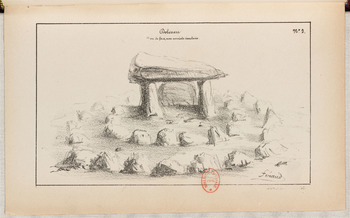
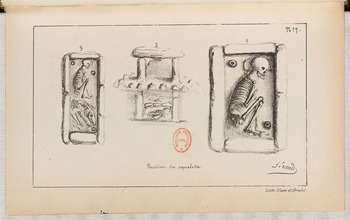
In spring 1863, however, the British palaeontologist and collector Henry Christy visited the springs of Bou-Merzoug with the guidance of Laurent-Charles Féraud, who had lived in Algeria since the age of sixteen and was then serving as the interpreter for the general commander of the division of Constantine.Footnote 26 Situated just thirty-five kilometres south-east of the city of Constantine on the road to Batna, their vicinity revealed a remarkable number of ancient remains. Féraud referred to these as ancient dolmens, cromlechs, menhirs and tumuli using the terminology applicable to such sites in metropolitan France. Both men concluded that the monuments were of Gallic origin, just as Rozet had done three decades earlier (Figure 1). The sponsor of this venture, Christy, who had long been interested in Celtic remains, spent several days at the site with the support of Féraud and four workmen. The latter helped dig among the stones, and Féraud, who was enthused by this experience, made drawings of the large number of remains close to the surface.Footnote 27 Féraud collected some of the human remains they found on-site for future study to determine their age, sex and race (Figure 2). Christy subsequently donated artefacts found during these excavations to the archaeological museum recently established in Constantine.Footnote 28
Laurent-Charles Féraud's depiction of a dolmen surrounded by two rings of standing stones at Bou-Merzoug. Laurent-Charles Féraud, ‘Monuments dits celtiques dans la province de Constantine’, Recueil des notices et mémoires de la Société archéologique de la Province de Constantine (1863), pp. 214–234, Plate 2. Photograph reproduced by permission of the Bibliothèque nationale de France.

Féraud's artistic rendering of human remains found beneath a dolmen at Bou-Merzoug. Féraud, op. cit., Plate 7. Photograph reproduced by permission of the Bibliothèque nationale de France.

Soon after these brief excavations, Féraud made a case for the Gallic origins of the standing stones of Bou-Merzoug to the members of the Société archéologique de Constantine. French officers and civilians resident in Constantine, including a significant number of interpreters, had founded the organization on the model of learned societies in metropolitan France.Footnote 29 They hoped that by educating officers of the Armée d'Afrique about the importance of antiquities and the necessity of recording and conserving ancient monuments, they could help diminish the vandalism and destruction of archaeological sites in the region caused by the French army.Footnote 30 With its focus on prehistoric remains, Féraud's report differed in subject matter from the majority of pieces in the Recueil des notices et mémoires de la Société archéologique de la province de Constantine, which had until then largely concentrated on Roman antiquities and inscriptions.Footnote 31
Féraud's report on the Gallic origins of the megalithic remains outside Constantine quickly became very influential among scholars of prehistory. His publication drew the attention, foremost, of Alexandre Bertrand, then editor of the prominent journal Revue archéologique in Paris and soon to be appointed director of Napoleon III's Musée gallo-romain (later the Musée des antiquités nationales) in Saint-Germain-en-Laye. Bertrand, whose interests ranged from prehistory to the Frankish period, was clearly excited by Féraud's Gallic hypothesis. Rather than arguing directly for the ancient Gauls as the earliest conquerors of North Africa, however, Bertrand proposed a somewhat more subtle attribution of the stone monuments in Algeria to an unnamed race of dolmen builders who had earlier generated monuments and flints in France during the Bronze and Iron Ages.Footnote 32 He thus maintained, as did Féraud, that northern Europeans had conquered the ancient populations of North Africa many centuries earlier and had facilitated in them a developmental stage similar to that of the inhabitants of Western Europe.Footnote 33
In 1864, surveying activities by French officers in the territories of the Oulad Abd-en-Nour tribe gave Féraud an opportunity to explore additional dolmens, including those of Kheneg on the right bank of the Roumel north of Constantine. As a sign of the growing importance of his topic, Féraud published a more comprehensive survey in Bertrand's Revue archéologique in 1865. In it, he briefly described the more than one thousand megalithic remains at Bou-Merzoug, as well as standing stones at a number of other locations in the division of Constantine. Despite Bertrand's alternative interpretation, Féraud continued to argue forcefully in favour of the Gallic attribution of the megalithic monuments of Algeria. He also complained about the superstitious ignorance of native interlocutors, as he had done in his previous article.Footnote 34 Féraud's work found an immediate audience, only some of which was enthusiastic. On the basis of Féraud's claims, for instance, the historian Henri Martin, whose publications laid the groundwork for Celtic studies in France, proposed that the affinity between remains in North Africa and on the European continent stemmed from their contemporaneous origin during the period of Celtic migrations in the centuries prior to the Roman conquest.Footnote 35
It is important to note that the impact of Féraud's opinionated article was not restricted to making a case for the Gallic origins of the Algerian megaliths. As a translator for the general commander of the division of Constantine since 1855, Féraud had access to the local library of the Bureaux arabes, which typically contained works related to both ancient and more recent histories of North Africa.Footnote 36 More importantly, he had regular contact with indigenous inhabitants in the region during his eight-year tenure. His interactions as an administrator at this time were facilitated by his mastery of not only Arabic but also the Berber language.Footnote 37 Féraud's linguistic skills and the authority he wielded over all facets of the livelihood of local tribes, however, did not cultivate great respect for their culture. To reinforce his views about their inferiority, he used what was ostensibly an article on archaeology to criticize Berber customs and beliefs. Underlining the naive and superstitious nature of Arabs and Kabyles, Féraud claimed that they attributed the monuments at Bou-Merzoug to ancient pagans (djouhala) and left the standing stones undisturbed mainly because they believed such sites and nearby caves to be inhabited by vampires and ogres (el-R'oul).Footnote 38 In illustration, he recounted one story he had learned from a local, relating to a dolmen of grey limestone in eastern Kabylia known as El'Aroussa (the fiancée). He alleged that Berbers believed this monument to be the petrified remains of an incestuous couple and their wedding party, who faced divine punishment for celebrating their impious union.Footnote 39
It is difficult to verify the authenticity of his account from contemporary sources, since Féraud was one of the earliest to conduct this manner of interview among largely illiterate interlocutors. However, he was certainly not the last to belittle indigenous relationships with what they perceived as the spirits of ancient monuments and denounce as primitive their propensity to treat these sites as sacred.Footnote 40 With the creation of the French Protectorate of Tunisia in 1881 and that of Morocco in 1912, French ethnographers, including most famously Edmond Doutté, conducted fieldwork in these territories and collected similar lore related to megalithic monuments.Footnote 41 They were predisposed to disrespect their interlocutors as superstitious, ignorant, fanatical and backward: primitive by comparison with their European contemporaries.Footnote 42 They also characterized much of the information they received as far inferior to what was already known in the West by the time of the Romans.Footnote 43 Some recent historical scholarship, while not nearly as biased as these early twentieth-century accounts, has continued to rely uncritically on early ethnographic work echoing Féraud's claims that Kabyle and Arab populations were uninterested in pre-Islamic monuments, and actively dismissive or deeply fearful of them.Footnote 44
We can explain the stimulus for Féraud's derisive comments by following the trajectory of his subsequent publications. After his articles denying of the meaningful nature of local inhabitants’ long-time interactions with ancient monuments, he published an essay on the recent history of the tribes of the region of Constantine that suggested little or no connection to these sites.Footnote 45 At this time, at least some of Féraud's contemporaries recognized the possibility of continuity of practice between the builders of these monuments and contemporary Kabyle tribes, who erected stones at cemeteries and used them at their meeting places.Footnote 46 Drawing from Ann Stoler's eloquent methodology for mapping power relations on colonial archives, we may suggest that Féraud's resistance to ceding this point was inspired by his composition of an alternative French interpretation of the significance of these monuments.Footnote 47
As has been shown by Alice Conklin, French scholars working in many scientific fields implicated in the mission civilisatrice employed the binary of civilization and barbarism to justify and maintain their hegemony in Algeria.Footnote 48 Féraud's work in the Bureaux arabes, and the power relations his position entailed, cultivated his pursuit of an interpretation of the megaliths that legitimized French control of the territories of Algeria.Footnote 49 With his claims to ancient European presence in the region, Féraud envisioned the recent invasion by the Armée d'Afrique as sanctioned by Algeria's prehistoric colonization by Gallic warriors. The Ministry of War appeared to endorse this outlook if we may judge from Féraud's rapid rise through the ranks of the colonial administration as the principal interpreter of the division of Constantine (1871) and the interpreter of the governor general in in Algiers (1872). Fellow officers in the Armée d'Afrique and civilian archaeologists in the colony also rewarded his accomplishments by electing him to the presidency of the Société historique algérienne.Footnote 50
International consensus on Berber origins?
Despite a largely positive reception among French scholars and colonial administrators, Féraud's publications sparked a vocal backlash among the rapidly growing number of European archaeologists, antiquaries, geologists and physical anthropologists interested in the disputed evidence of an antediluvian epoch. Although Féraud enjoyed the powerful support of Bertrand, few non-French scholars of prehistory embraced his allegations of the Gallic or Celtic source of megaliths found in the French colony of Algeria. As pointed out in a devastating response by the Swiss prehistorian Frédéric Troyon, one could extrapolate on the basis of Féraud's logic to claim comparable finds made as far north as Scandinavia as evidence of ancient Gallic settlement. Troyon thus urged greater precision in the attribution of megalithic remains than was the case with Féraud's Celtic hypothesis.Footnote 51 Unlike works underlining the connectivity between the Roman and French past, which were produced and consumed largely by a French audience, the pan-European nature of prehistoric studies demanded a more nuanced and less obviously self-serving explanation of the megaliths. Scholars expected a more objective view, or at least one that did not map so neatly onto French imperial ideology. Despite these criticisms, Féraud continued in subsequent years to advocate recognition of the parallels between prehistoric remains in Algeria and their Gallic equivalents in France.Footnote 52
In the mid- to late 1860s, prehistorians across Europe debated Féraud's thesis, with and without Bertrand's modifications. The majority linked the discovery of megaliths in Algeria to a long tradition of European ethnographical studies and linguistic scholarship that suggested the early presence of northern Europeans in North Africa. Based upon an inscription found in Karnak, Egypt, French scholars argued that light-skinned and fair-haired people had invaded Libya and Egypt at least fourteen centuries before the Common Era.Footnote 53 These arrivals mixed with the indigenous peoples, who were understood by these authors to be the ancestors of the Kabyles. According to this interpretation, the Berber peoples consisted of a blend of indigenous Libyans, northern European blonds, and a smaller proportion of Arabs. Added to this genealogy were small fractions of Phoenicians, Romans, Vandals, sub-Saharan Africans, Israelites and Turks, a heritage that attested to the numerous foreign invasions that had beset the indigenous peoples of Algeria both in ancient times and in the more recent past.Footnote 54 However, according to French scholars, it was entirely owing to European migrants that the ancestors of the Berbers could construct the megaliths, some of which dated to the Stone Age and others to more recent epochs.Footnote 55
It is important to note the ways in which this explanation – why the megaliths in Algeria, Tunisia and Morocco resembled those in France – differed significantly from both ancient and medieval scholarship on the Berbers.Footnote 56 In the early fifth century, Augustine of Hippo used the term ‘Maures’ (‘Moors’) to designate the indigenous inhabitants of Mauretania in North Africa who dwelled neither in the deserts nor in the mountains. He clearly distinguished them from the Vandal warriors who crossed the Mediterranean in 429 CE, just a few years before his death.Footnote 57 In contrast to Augustine, the sixth-century Byzantine historian Procopius identified the Maures as having descended from the Phoenicians. He and his contemporary, the Roman African author Corippus, used the term ‘Maures’ to designate ‘barbarian’ inhabitants of North Africa. He noted that their ‘primitive’ lifestyles and darkly pigmented skin easily distinguished them from both Romans and Vandals.Footnote 58 While we lack contemporary witnesses as to the self-perception of the Maures, Jonathan Conant has argued convincingly that they had become significantly Romanized, and to some extent Christianized, in the course of the fifth and sixth centuries. They acknowledged Byzantine rule yet maintained substantial autonomy up to the time of the Arab conquest.Footnote 59 Medieval Arab historiography regarding Berber ancestry, by contrast, largely sought to identify them as a non-indigenous people. Most suggested Eastern origins for the Berbers, a tradition that was refuted in the fourteenth century by Ibn Khaldûn in his History of the Berbers. Footnote 60
By contrast, when European visitors arrived in the Maghreb during the eighteenth century, they made a novel attempt (given Procopius’ testimony to the contrary) to explain Kabyle ancestry by a link to the Vandals. They based these conclusions on a combination of ancient documents and their impressions of the indigenous people with whom they had presumably made fleeting contact in the loosely aligned Ottoman territories. One of the most influential scholars to write on this subject was Thomas Shaw, who took an ethnographic interest in the peoples he encountered during his thirteen-year appointment as the British consular chaplain in Algiers and his travels in the region in the 1720s and early 1730s. Describing the inhabitants of the Aurès Mountains, he noted that many had lighter-coloured hair, skin and eyes than their contemporaries. He concluded that these ‘northern’ features were evidence of the occupation of the Vandals.Footnote 61 James Bruce, a Scottish wine merchant, Mediterranean traveller and briefly consul to Algiers in the mid-1760s, voiced similar sentiments in the famous travelogue he composed in the late 1760s.Footnote 62 Written decades before Edward Gibbon's Decline and Fall of the Roman Empire made it fashionable to denounce the Germanic peoples as barbaric, these works contributed to British scholars’ evolving understanding of their own connection to the Roman Empire and its Germanic successors.Footnote 63
It is indeed possible that the Kabyle inhabitants of the Aurès Mountains were affected by Vandal presence in the fifth century (something which is difficult to assess due to the highly fragmentary archaeological and historical record of the Vandal conquest).Footnote 64 However, it is perhaps more important to focus on the way in which the work of Shaw and Bruce shaped the thinking of French officers and civilian archaeologists a century later. Not only did their attribution of Vandal ancestry to the Kabyles substantially alter late antique understanding that distinguished sharply between the indigenous inhabitants of North Africa and later Germanic arrivals, but it also conveniently linked the indigenous inhabitants to the alleged destroyers of Roman North Africa, a view no longer maintained by archaeologists today.Footnote 65 Once again, scholarly interpretation of the archaeological data in the nineteenth century allowed the French to posit their own rightful presence in North Africa as opposed to that of the indigenous peoples.
In 1830, at the time of the French conquest of the Regency of Algiers, European observers initially used the term ‘Maures’ to designate city-dwelling Arabs and Berbers as opposed to the Turkish, Kuloglu or Korouglis (descendants of Turkish unions with indigenous women); Kabyle (rural Berbers); Israelite (Jewish); black; and Mediterranean (a category that might include a variety of backgrounds, including Maltese, Greek and Armenian) residents of Algeria.Footnote 66 Edouard Lapène, a lieutenant colonel in the artillery, held that Kabyle ancestry was purportedly shaped by a series of invasions, including the Philistines, Vandals, Goths and Arabs. Despite Procopius’ suggestion of substantial differences and the lack of mixing between Maures and Vandals (which could have conceivably been a later development), Lapène assumed from the light complexions of at least some of the Kabyles that this signalled the contribution of the Germanic peoples to the ethnic landscape of North Africa.Footnote 67 In 1846, the British traveller Dawson Borrer, who had been granted the unusual position of being embedded in a French army column headed for the Sahara, reiterated the opinion that the Kabyles of the Aurès looked as if they were of more Germanic ancestry than Arab. He, too, attributed these features to inherited traces left by the fifth-century Vandal invasion.Footnote 68 The oft-repeated narrative of Berber descent from the Vandals proved enduring and appeared in substantially later works, including the historian Charles Diehl's influential L'Afrique byzantine (1896).
As French tenure in Algeria wore on and the Ottoman legacy faded under the pressures of rapidly expanding military operations, French colonial officers and scholars worked to document in greater detail the genealogy of the groups they encountered. They did so largely on the basis of a traditional amalgam of ancient written sources and their impressions of the physical appearance of the inhabitants of Algeria. Primary among their efforts were the increasingly fine-grained distinctions they made between the Kabyles, whom they characterized as sedentary, industrious, little changed by time, and resistant to the culture of their conquerors, and the Arabs, whom they stereotyped as foreign and fanatical nomadic invaders.Footnote 69 This classificatory scheme of the population of Algeria was appealing to its authors for a variety of reasons: it digested and simplified social realities in a manner that facilitated French rule.Footnote 70
However, this standardized rubric, the basis for French hopes that the Kabyles would be more easily assimilated than Arabs into colonial society, was more difficult to apply in practice than in theory.Footnote 71 In the late 1860s, most French scholars and administrators acknowledged that they had not yet sufficiently familiarized themselves with local custom, dress and language to be consistently adept at distinguishing between Arab and Kabyle residents.Footnote 72 Others attributed this situation to the level of intermarriage between the two groups, which had lessened their differences.Footnote 73 The Berber people remained a particular puzzle and an object of fascination to French observers, since they were difficult to define historically and linguistically. Their physical appearance, including traits that were thought to resemble Europeans’, made them even more of an enigma.Footnote 74
Craniology and Berber origins
To avoid creating the impression that this research occurred within a historical vacuum, it is important to acknowledge the humanitarian catastrophe that was unfolding contemporarily with the historical and archaeological debates laid out above. Not by chance, the integration of physical anthropology into more general ethnological studies of the Kabyles occurred just as French colonization and ‘pacification’ of Algeria were having devastating consequences for the indigenous population. As noted by the historian John Ruedy, between 1830 and 1954 more than 3 million hectares of agricultural land moved from the hands of Muslim natives to European (mainly French) colonists.Footnote 75 These seizures were largely the result of rapacious metropolitan military and administrative policies in the 1840s and 1850s that accelerated French expansion into Algerian territory and increased the rate at which civilian settlers were able to appropriate fertile lands from Arabs and Kabyles.Footnote 76 By the 1860s, these unfavourable conditions, in addition to drought, swarms of locusts and grasshoppers, a powerful earthquake and the spread of cholera, brought on a humanitarian disaster of cataclysmic proportions to the largely subsistence-type economy of Algeria's non-European inhabitants.Footnote 77 The nadir of these rapidly deteriorating circumstances was the Algerian famine of 1868–1869, during which, scholars estimate, between 820,000 and 1,000,000 Arabs and Berbers (roughly one-third to one-half of the Muslim population in the colony), starved to death or succumbed to disease. European civilian settlers seem, by contrast, to have largely escaped the scourge of this man-made demographic catastrophe.Footnote 78
Nadia Abu El-Haj has deftly observed how humanistic and scientific disciplines have historically complemented one another and enabled nations to refine national history and identity from a variety of perspectives.Footnote 79 In the case of Algeria, an increasingly statistical and bureaucratic approach to governance effectively allowed metropolitan authorities and scholars to claim objectivity at the same time as they masked or ignored certain features of the unpalatable realities they had helped create.Footnote 80 Indeed, from the late 1860s, French anthropologists used Algeria as a sort of open laboratory in which they analysed the health and reproductive rates of indigenous peoples and assessed the challenges that Europeans faced in their acclimatization to the North African colony. They hoped to elicit information that would help settlers adapt successfully to their new surroundings.Footnote 81
Important to these studies was the development of morphological categories that anthropologists might use to measure physical distinctions between the Arab and Kabyle populations.Footnote 82 Besides measuring the skulls of living Arabs and Kabyles, they also undertook research aimed at understanding the origins of the populations of Algeria, a project that, as we have seen, was previously conducted mainly on the basis of historical and archaeological sources.Footnote 83 While authorities did not agree on the precise origins and subcategories of their subjects, they were confident that identifying differences in the characteristics of Arabs and Kabyles would help the French attain the submission of the Algerian colony more quickly.Footnote 84 As noted by Paul Topinard, recognizing Kabyle characteristics was critical since, as a more sedentary people than the nomadic Arabs, they were effectively the future workforce of the colony.Footnote 85 Even if, as some argued, the Kabyles could not be construed as a race due to the extent to which they had mixed with other peoples, French scholars believed that racial classification using scientific methods and language had the potential to solidify the hitherto elusive categories of inhabitants necessary to the efficacy of the bureaucracies developing around the Armée d'Afrique and colonial rule more generally.Footnote 86 Ethnographic research, now backed by craniological studies, thus laid the groundwork for both French historical claims and practical methods to gain mastery of the Algerian territory.
European ‘discovery’ of the megaliths was key to the advancement of these discussions. As evidenced by Féraud's explorations in 1863, Algerian standing stones were often found together with human skeletal remains. During the latter part of the decade, by which time French officers and scholars had attributed the construction of the megaliths to the ancestors of the Berbers, and physical anthropology had emerged as an influential discipline, attention shifted to studying these bones for additional evidence about Kabyle ancestry. In contrast to the almost exclusive focus on ancient texts and archaeological artefacts that had dominated previous research on the origins of the Kabyles, this skeletal data called for the classificatory approach of zoologists and physical anthropologists.Footnote 87 Palaeontological remains quickly became integral to the identification of the origins of the inhabitants of Algeria.
Scholars in metropolitan France and Algeria took their cue from race scientists such as Armand de Quatrefages at the Muséum d'histoire naturelle in Paris and Paul Broca and Paul Topinard at the Société d'anthropologie de Paris. These authors blended morphological statistics with tribal genealogy elicited from classical historical and literary accounts and inscriptions. They encouraged archaeological enthusiasts to expand their horizons beyond monuments and to incorporate measurements derived from skeletal remains into their research. French officers, just like administrators and scholars, were attracted by what they characterized as more scientific and objective methods for the identification of race among the populations that had constructed archaeological sites.Footnote 88 These fields of inquiry had advanced sufficiently by the 1860s to give practitioners greater confidence than they had possessed decades earlier, when Jean Guyon, head surgeon of the Armée d'Afrique, had examined prehistoric human remains found at Ras Aconater in 1846 but declined to link them to a specific population.Footnote 89
General Léon Faidherbe, who was serving in the 1860s as the commander of the subdivision of Bône (modern Annaba) and was elected president of the Académie d'Hippone in the same city, was one of the first officers to undertake a study of megaliths that incorporated the formal examination of skeletal remains. In July and October 1867, excavations he conducted at the prehistoric site of Roknia (thermal waters located south-east of Constantine in the vicinity of Guelma) yielded more than three thousand graves. Faidherbe was influenced by the work of Aristide Letouneux, a legal expert, botanist and entomologist who found Féraud's Celtic argument unconvincing and pointed instead to the indigenous origins of the megaliths.Footnote 90 Consequently, Faidherbe attributed these finds to the ancient Libyan ancestors of the Kabyles (and more specifically to the Berber tribe of the Chaouïa). In addition to collecting the dimensions of ancient skulls, Faidherbe measured the heads of Berber volunteers among his soldiers then serving as tirailleurs in the infantry of the Armée d'Afrique.Footnote 91 On this basis, a comparative method likewise used in metropolitan France by Broca and others,Footnote 92 he argued that the Kabyles had been more pure in this prehistoric period than they were under French occupation. This perspective highlighted the esteem with which Faidherbe held the ancient Libyans as compared to contemporary Kabyles, whom he believed had mixed over the centuries with a succession of the region's conquerors. Despite their hybridity, considered a weakness by most contemporary physical anthropologists, Faidherbe nonetheless still praised the Kabyles as being more reliable soldiers than their Arab counterparts.
Jules-René Bourguignat, a naturalist whose work mainly focused on molluscs, passed through Algeria in 1868. He was inspired by ongoing discussions to pursue research on the ancestors of the Berber peoples. With Faidherbe's permission to explore Roknia with the benefit of an escort and soldiers for the undertaking, Bourguignat spent just two brief days at Roknia. He nonetheless managed to excavate as many as twenty-eight dolmens in this short time.Footnote 93 He noted on the basis of the cranial measurements he made at the site that the main constituency buried at Roknia consisted of Kabyles. Importantly, he also noted that this Berber population was supplemented by a certain number of graves of Aryans from the north (Arias) and blacks from sub-Saharan Africa, together with individuals of mixed race and Egyptians. The graves suggested to him that the Kabyle tribe buried at Roknia maintained contact with communities in both Egypt and sub-Saharan Africa. Moreover, Bourguignat attributed the largest graves to Aryans of European origin, and on this basis argued that these powerful individuals from the north were likely to have dominated the Kabyles.Footnote 94
In 1873, Jean-André-Napoléon Périer, originally a member of the 1839 expedition sent by the Académie des inscriptions et belles-lettres to Algeria, entered the debate. He reiterated on the basis of both written sources and craniological studies that the blond hair of the Kabyles suggested the important role in North Africa of unnamed northern invaders who had arrived approximately 1,400 years before the Common Era. He credited these invaders with the unique responsibility for constructing the dolmens of North Africa.Footnote 95 In Paris, Paul Broca's synthesis of these discussions likewise reiterated that the monuments of the dolmen builders were immigrants from Europe by 1400 BCE, the date to which it was thought that the megaliths could be ascribed.Footnote 96
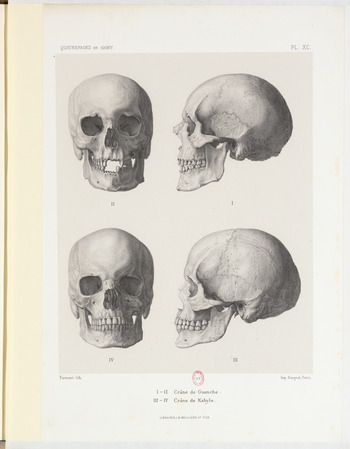
Paul Topinard noted in 1874 that the number of reliably provenanced Arab and Berber skulls on hand for study in Paris was small.Footnote 97 By 1882, the quantity had only increased to thirty-four Berber skulls (Figure 3).Footnote 98 Despite this very small number of samples, Broca was confident about his identification of the Berbers as a dolichocephalic or long-headed race. They thus exhibited characteristics similar to those of the Germanic peoples of northern Europe (though it did mean that they were distinct from those descended from the ancient Gauls, who were thought to have had brachycephalic – rounded – skulls). Broca recorded their average cephalic index as 74.63.Footnote 99 Control of the documentation and interpretation of the Kabyle past, at least for French purposes, allowed Périer, Broca, Topinard, Bourguignat and others to confirm craniometrically the legacy of a series of foreign conquests over the indigenous population that had already been posited by historians of the ancient world. Unsurprisingly, few European contemporaries complained about the circular manner in which the French had effectively naturalized contemporary northern occupation and rule of the Kabyle residents of Algeria through reference to the ancient past.Footnote 100 Enshrined in the metropolitan institution that controlled the narrative of human origins in France, Berber skeletal remains were displayed in a vitrine in the Galérie anthropologique of the Muséum d'histoire naturelle in Paris from at least 1898.Footnote 101
Depiction of the skull of a Kabyle in the atlas of Crania ethnica. Armand de Quatrefages and Ernest-Théodore Hamy, Crania ethnica: Les crânes des races humaines: décrits et figurés d'après les collections du Muséum d'histoire naturelle de Paris, de la Société d'anthropologie de Paris et les principales collections de la France et de l’étranger, 2 vols., Paris: J.-B. Baillière et fils. 1882, vol. 2, Figure XC. Photograph reproduced by permission of the Bibliothèque nationale de France.

As has been noted by Noël Coye, craniological studies did not cause a complete rupture in the former Celtic debate. Within five years of Féraud's first publication on Bou-Merzoug, the introduction of ethnographic classification with strong racial tones into the debate eliminated overt claims for the Celtic origins of the North African megaliths yet effectively subsumed the European origin story that Féraud had advanced. Claims to European dominance of the native inhabitants of Algeria from earliest times remained a central feature of these analyses: prehistorians almost universally agreed that the dolmens were built or at least conceived of by European ancestors who intermarried with, yet also controlled, the Kabyles.Footnote 102 This research also had practical implications beyond charting ancient genealogies. Prehistorians, physical anthropologists and physicians were interested in this information since they believed that they could learn from the successful example of these early European settlers how modern European settlers might adapt more easily to the challenging climate and dangerous microbes found in Algeria.Footnote 103
Conclusion: Kabyle myth and the assimilatory politics of French rule
French arguments claiming the Vandal or Gallic origins of the Kabyles never fully disappeared, and echoes of each were still heard in the 1880s and 1890s. However, the genealogy that alleged partial European ancestry of the Berber peoples became dominant in the end. This narrative, which survived into the mid-twentieth century, hypothesized that the indigenous inhabitants of Algeria had an impressive lineage reaching back a millennium and a half earlier than the Roman imperial period. From the French perspective, Berber descent in part from northern Aryans represented an improvement in the relative merit of the Kabyles’ place in history. According to the tenets of the ‘Kabyle myth’, which was widely embraced by French authorities, including those employed in the Bureaux arabes in the second half of the nineteenth century, the Kabyles represented better candidates for coexistence in the French colony than the Arabs since they lacked the alleged fanaticism of the latter.Footnote 104 Although métissage or miscegenation was not perceived as a positive characteristic by most physical anthropologists of the last third of the nineteenth century (except, perhaps, when it was necessary to acknowledge that the French themselves descended from a mix of Gauls, Romans and Germanic peoples), optimists suggested that the alleged affinities between the French and the Kabyles made the latter's assimilation into European Christian society a greater certainty than that of the Arabs, relative newcomers to North Africa in the seventh century.Footnote 105 Prehistoric studies, and particularly those that related to ethnographic and racial classification of indigenous inhabitants, were thus potent (if unrealistic) ideological tools for the officers of the Bureaux arabes who administered to the Muslim population of Algeria until 1870.Footnote 106
By contrast, French accounts of Berber origins not only posited that the Berbers (and Algeria in general) had no history before their arrival,Footnote 107 but also assumed the general inferiority of the Kabyles’ indigenous ancestors. They underlined the Kabyles’ debt to foreign northern invaders from Europe for their most creative impulses even in deep antiquity. As was assumed of monuments and antiquities found elsewhere in Africa that did not fit degrading stereotypes of Africans’ creative and artistic incapacity, European scholars envisioned the dolmens as a northern import that could not possibly have had indigenous origins.Footnote 108 We should thus be deeply suspicious of the readiness of colonial observers to explain local finds through analogies to European sites. Although dependent upon indigenous interlocutors for information about remote sites, French officers-turned-archaeologists in the mid-nineteenth century were inordinately dismissive of natives’ interactions with these sites.Footnote 109 In the end, a discrediting of indigenous knowledge and capabilities, married to poorly evidenced claims of prehistoric European invasions, allowed French scientists to disassociate Kabyles both from these important ancient monuments and from the territories in which they were located.Footnote 110
Post-colonial archaeology in Algeria has firmly rejected the contention that the source of ancient innovation among the ancestors of the Berbers lies in an admixture of northern peoples and indigenous populations of North Africa.Footnote 111 European scholars no longer confidently assert Berber genealogy, about which there is great uncertainty. Evidence of linguistic uniformity points to a rapid spread of the Berber language west of the Nile between 2500 and 2000 BCE.Footnote 112 Recent studies of the dolmens of Algeria and Tunisia, by contrast, have suggested affinities with those found in Bronze Age Malta and Sicily. While it is likely that there was regular traffic of small groups of people across the Mediterranean, no evidence exists of large-scale migration in either direction.Footnote 113
Naturally, these questions remain important in post-colonial Algeria, where for decades studies of the Kabyles were neglected as a consequence of the National Liberation Front's (FLN) efforts to subsume Berber identity within a united Arabized nation. After this repressive policy ignited a rebellion known as the Berber Spring in 1980, an uprising that was brutally crushed that same year, Algeria saw increased political activism and scholarship on behalf of pan-Berberism, which linked itself to the Amazigh transnational community.Footnote 114 In this context, one wonders what role the prehistoric dolmens of Algeria will come to play in the future: will they become a monumental witness to the heritage of the indigenous people? It is indeed possible to imagine that the megaliths of the Maghreb, once manipulated on behalf of colonial science, will once again take on new life as a potent symbol of the independent and ancient heritage of the Berber people.