The picture–word interference (PWI) task is a widely used paradigm to study cognitive processes involved in speech production.Footnote 1 In this task, a semantic relationship between a written semantic context word such as dog and a target picture such as cat slows naming relative to an unrelated condition (e.g., table; Glaser & Düngelhoff, Reference Glaser and Düngelhoff1984; Lupker, Reference Lupker1979; Schriefers, Meyer, & Levelt, Reference Schriefers, Meyer and Levelt1990; Starreveld & La Heij, Reference Starreveld and La Heij1995). Most models addressing lexical access in language production assume that the time taken to select a target lexical node depends not only on its own activation level but also on the activation level of competing lexical nodes. The higher the relative activation levels of the competitor's lexical nodes, the longer it will take to select the target lexical node. This is known as the lexical selection by competition (LSC) account (Starreveld & La Heij, Reference Starreveld and La Heij1996; Levelt, Roelofs, & Meyer, Reference Levelt, Roelofs and Meyer1999). According to this account, the semantic interference effect is often assumed to occur at the lexical level during speech production (e.g., Levelt, et al., Reference Levelt, Roelofs and Meyer1999; Roelofs, Reference Roelofs1992; Starreveld & La Heij, Reference Starreveld and La Heij1996).
However, the failures to observe interference and reports of facilitatory semantic-context effects cast doubt on the lexical competition account. For instance, Alario, Segui, and Ferrand (Reference Alario, Segui and Ferrand2000) and Costa, Alario, and Caramazza (Reference Costa, Alario and Caramazza2005) found semantic facilitation effects when a part–whole relation was introduced between context words (e.g., anchor) and target pictures (e.g., boat) in the PWI task. To account for the semantic context effects in the PWI task, Finkbeiner and Caramazza (Reference Finkbeiner and Caramazza2006) and Mahon, Costa, Peterson, Vargas, and Caramazza (Reference Mahon, Costa, Peterson, Vargas and Caramazza2007) introduced the so-called response exclusion hypothesis (REH).Footnote 2 The REH posits that context words involuntarily occupy a single-channel response buffer, which holds motor programs, and context words have to be removed from the response buffer before the target can be named. The response buffer is assumed to have rudimentary knowledge concerning “response relevance” (e.g., Glaser & Glaser, Reference Glaser and Glaser1989; La Heij, Reference La Heij1988; Lupker, Reference Lupker1979; Lupker & Katz, Reference Lupker and Katz1981; Simon & Sudalaimuthu, Reference Simon and Sudalaimuthu1979), and as a consequence, semantically related distractor words take longer to remove than unrelated words. The REH not only postulates that semantic interference effects reside at the postlexical processing stage but also assumes that semantically related distractor words can prime target responses at the conceptual level; hence, the observed effect depends on the exact interplay between conceptual and postlexical properties.
THE CONCEPTUAL SELECTION MODEL AS A MODIFIED VERSION OF LSC
Using a word-translation task, Bloem and La Heij (Reference Bloem and La Heij2003) found that context words induce semantic interference, whereas the context pictures induce semantic facilitation. According to the LSC, the concepts of pictures activate their target names at the lexical level and more activation spreads from target concepts to context concepts than vice versa, and hence, the LSC predicts that context pictures induce semantic interference in a similar manner to context words. To explain their findings, Bloem and La Heij proposed a conceptual selection model (CSM), which modified the LSC model in the two respects. They first assumed that only one concept is selected at the conceptual level to enter the process of lexicalization. This selection is realized by assuming a threshold at the conceptual level, and it is important that only a concept that reaches the threshold can activate its corresponding lexical representations. That is, the CSM assumes that context pictures facilitate target identification but do not induce competition at the lexical level. The second modification is that the target concept not only spreads activation to its correct name at the lexical level but also spreads activation to semantic context words when it reaches the threshold at the conceptual level.
As a competitive model, Roelofs (Reference Roelofs2006) argued that the word from encoding by the activation and verification model can account for the polarity shift of semantic context effects. In the case in which words are used as distractors and pictures as targets, the target pictures activate the lemmas of semantically related distractor words to a greater extent than the distractor words activate the target lemma. Therefore, word distractors in picture naming yield longer latencies in the semantic than in the unrelated condition. In the case in which words are used as targets and pictures as distractors, the distractor pictures also activate the lemmas of semantically related words (including target words). Therefore, picture distractors in word naming yield shorter latencies in the semantic than in the unrelated condition. Roelofs's interpretation depends on the task (picture or word naming) and the relationship between the distractors and targets.
Bloem, van den Boogaard, and La Heij (Reference Bloem, van den Boogaard and La Heij2004) manipulated the stimulus onset asynchrony (SOA) between context words and target pictures, and they found that context words induce a semantic interference effect at a 200-ms SOA (context words presented 200 ms after targets) but semantic facilitation effect at a –400-ms SOA (context words presented 400 ms before targets) in a word-translation task. The LSC model has difficulty in accounting for semantic facilitation effects induced by preexposed context words. This is because using the same materials set at SOAs of –400 and 200 ms yielded no reversal of the target–distractor relationship and no task switching from picture naming and word naming in Bloem et al. (Reference Bloem, van den Boogaard and La Heij2004) and Finkbeiner and Caramazza (Reference Finkbeiner and Caramazza2006).
Bloem et al. (Reference Bloem, van den Boogaard and La Heij2004) argued that the threshold plays an important role in explaining the semantic facilitation effect at a –400-ms SOA. Because of the threshold, the activation at the conceptual level cannot spread to the lexical level to activate the lexical representations, while the activation of context word decays to the baseline during the SOA interval. As a result, there is a semantic facilitation effect at the conceptual level but no semantic interference effect at the lexical level. Bloem et al. (Reference Bloem, van den Boogaard and La Heij2004) further assumed that only one concept is selected for lexicalization and the activation at the conceptual level decays slower than the activation at the lexical level. The facilitation effect at a –400-ms SOA arises because of persistent activation at the conceptual level, and the activation of context words declines to the baseline at the lexical level, whereas the interference effect at a 200-ms SOA arises because of the competition between context words and target nodes at the lexical level.
Although the CSM is proposed based on the results of a word-translation task with a bilingual scenario, it can account for observations from the PWI task in a monolingual scenario, especially for certain new findings. For instance, Finkbeiner and Caramazza (Reference Finkbeiner and Caramazza2006) acknowledged that their findings could be easily captured by the CSM. However, Roelofs (Reference Roelofs2007) proposed that the findings from a word-translation task are insufficient to support the CSM in a monolingual context. Therefore, it is necessary to test the CSM's assumption in a monolingual context.
Studies on the PWI task suggest that varying the SOA may change the polarity of the semantic context effect. For example, La Heij, Dirkx, and Kramer (Reference La Heij, Dirkx and Kramer1990) found a sizable facilitation effect (69 ms) at a –800-ms SOA but a minor facilitation effect (11 ms) at a –400-ms SOA. Glaser and Düngelhoff (Reference Glaser and Düngelhoff1984), however, failed to observe any sign of a facilitation effect in picture naming. Given these inconsistent findings, it is necessary to replicate the pattern of the semantic context effect in the PWI task.
THE PRESENT STUDY
We sought to investigate semantic context effects in a PWI task with basic-level context words and basic-level target picture names (a within-level relationship between context words and target names; i.e., the context word is dog, and the target name is cat). A basic-level semantic relationship was considered because this relationship has repeatedly been reported to induce a semantic interference effect. We had two objectives. First, at an empirical level, we sought to investigate whether the manipulation of SOAs could lead to a reversal from semantic interference (at SOA values close to zero) to semantic facilitation (with larger negative SOA values) in picture naming with words as distracters and pictures as targets. Second, we sought to test the CSM's assumption regarding the different decay rates at the conceptual and lexical levels. The CSM predicts different patterns of semantic facilitation and semantic interference as a function of different SOAs, due to different decay rates of the activations at the conceptual and lexical levels. In our experiments, SOAs of –100 to 200 ms, in steps of 100 ms (Experiment 1); SOAs of –1000 to –400 ms, in steps of 200 ms (Experiment 2); and SOAs of –400 and 0 ms (Experiment 3) were used. According to the CSM, we expect the semantic interference effect to arise at SOAs close to zero but the semantic facilitation effect to arise at larger negative SOA values. The semantic facilitation effect would span a broader SOA range than the semantic interference effect, because the CSM assumes that conceptual activation decays slower than lexical activation. The REH does not have a clear position in this respect.
As a control, we also manipulated the phonological (or orthographical) relationship between a context word such as key and a target picture such as cat, which is expected to speed naming relative to an unrelated condition, known as the phonological facilitation effect (Glaser & Düngelhoff, Reference Glaser and Düngelhoff1984; Schriefers, et al., Reference Schriefers, Meyer and Levelt1990; Starreveld & La Heij, Reference Starreveld and La Heij1995). This effect is typically localized at the lexical–phonological level. Under the assumption of a high decay rate at the lexical level, the CSM predicts that context effects that are localized at this level dissipate rapidly over time. Therefore, phonologically and orthographically related conditions were included in Experiments 1 and 2 to determine whether the context effects at the lexical level dissipate rapidly. Participants cannot anticipate the relationship between context words and targets, because four different conditions (semantically related, phonologically related, orthographically related, and unrelated) are randomly presented in the experiments. According to the CSM, we expect that the phonological (or orthographic) facilitation effect would span a narrow SOA range, as this effect arises at the lexical level.
EXPERIMENT 1
Experiment 1 used SOAs from –100 to 200 ms, in 100-ms steps, to examine the semantic context effect with basic-level picture naming and basic-level context distractor words. Context words were presented visually.
Methods
Participants
Twenty-eight students (age range = 20–25 years, mean age = 22.1 years, SD = 1.82 years) at Beijing Forestry University and China Agricultural University participated for a small fee. All were native Mandarin Chinese speakers and had normal or corrected-to-normal vision.
Materials
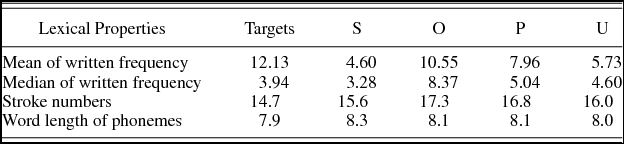
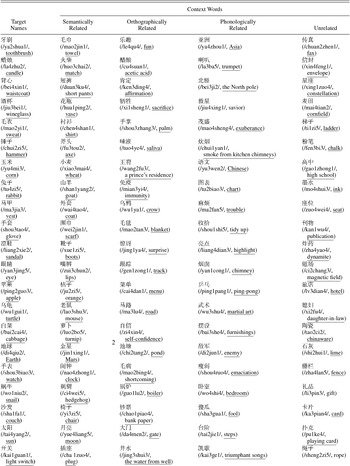
Twenty-one black-and-white line drawings were selected from Zhang and Yang's (Reference Zhang and Yang2003) picture database, and all have disyllabic basic-level names. Each target picture was matched with four context distractor types, corresponding to a semantically related (basic-level context words), orthographically related, phonologically related, and unrelated condition. For these picture names, the semantically related distractor words belonged to the same semantic category as the target pictures (i.e., 背心, /bei4xin1/, waistcoat vs. 短裤, /duan3ku4/, short pants). Orthographically related distractor words shared similar orthographic properties with the first characters of the target picture names (肯定, /ken3ding4/, to be sure). For example, 背 and 肯 share an identical radical 月 (/yue4/, moon). Phonologically related words had common segmental syllables but with different tones from the first characters of picture names (北极, /bei1ji2/, the North pole). Unrelated words (星座, /xing1zuo4/, constellation) did not bear any semantic, orthographic, or phonological relationship with the target picture names. Context words were statistically matched across the two conditions on stroke numbers of disyllabic words and written frequency based on normative information reported in the database of Chinese Lexicon (Chinese Linguistic Data Consortium, 2003). Table 1 reports the mean stroke numbers of two characters and the mean (and the median) of the written frequency of picture names and context words. All items are reported in Appendix A.
Lexical properties of picture names and context words used in Experiments 1 and 2

Note: S, Semantically related; O, orthographically related; P, phonologically related; U, unrelated.
Design
The experimental design included four context types (semantically related, orthographically related, phonologically related, and unrelated) and four SOAs (–100, 0, 100, and 200 ms) as within-participant and within-item variables. Each participant viewed 21 target pictures four times, that is, 84 trials in each SOA condition, resulting in 336 combinations. Trials were blocked by SOA. The order of SOA blocks was counterbalanced according to a Latin square design. The order of items within an SOA block was pseudorandomized to prevent a target from being repeated in 2 consecutive trials. A new sequence was generated for each participant and each block.
Apparatus
The experiment was performed using E-Prime Professional Software (Version 1.1; Psychology Software Tools). Participants were seated approximately 60 cm from a 17-in. CRT computer screen. Naming latencies were measured from target onset using a voice key, connected to the computer via a PST Serial Response Box.
Procedure
Participants were tested individually. They sat in a dimly lit room at a comfortable viewing distance in front of the computer. Before the experiment, participants were informed that their task was to name pictures. Participants were asked to familiarize themselves with the experimental stimuli by viewing each target for 3000 ms with the picture name printed below each picture. Then, each experimental block was administered with 4 warm-up trials and 84 experimental trials for each SOA block.
Each trial involves the following sequence: a fixation point (+) presented in the middle of the screen for 500 ms, followed by a blank screen for 500 ms. Then, the target picture appeared at the center of the screen, and the distractor word was presented at the center of the picture in a manner appropriate for the particular SOA block (–100 ms: distractor onset preceded target onset by 100 ms; 0 ms: target and distractor appeared simultaneously; 100 and 200 ms: distractor onset followed target onset by 100 and 200 ms). Target pictures and distractor words disappeared when participants initiated a voice response. Participants were asked to name the target aloud as quickly and accurately as possible. The maximum response time was set to 3000 ms. Following each response, the experimenter judged whether the response was correct (or whether a voice key error had occurred). The intertrial interval was set at 1500 ms. The experiment lasted approximately 30 min.
Results
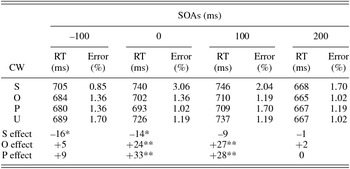
Data from incorrect responses, with naming latencies longer than 1800 ms or shorter than 200 ms, and deviating by more than 3 SD from cell means, were removed from all analyses. The above-mentioned criteria accounted for 1.48%, 0.27%, and 1.83% of the data, respectively. The remaining data were used in the subsequent statistical analysis. Table 2 presents the mean latencies and error percentages, presented by context type and SOA.
Mean naming latencies, mean error percentages, and context effects (ms) for the various context words of Experiment 1
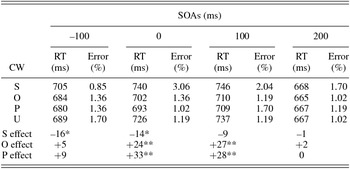
Note: The asterisks represent the latency of picture naming in the S related, O related, or P related condition being significantly different from the U condition. SOA, Stimulus onset asynchrony; CW, context words; RT, reaction time; S, semantically related; O, orthographically related; P, phonologically related; U, unrelated; +, a facilitation effect; –, an inhibition effect, compared to the unrelated condition.
*p < .05. **p < .01.
An analysis of variance (ANOVA) was performed on the response latency means with participants (F1) and items (F2) as random factors and context type and SOA as within-participant and within-item variables. A significant effect of SOA was observed, F1 (3, 81) = 8.34, MSe = 90,920, p < .001, ηp 2 = 0.98; F2 (3, 60) = 87.82, MSe = 62,846, p < .001, ηp 2 = 1.00. The main effect of context type was also significant, F1 (3, 81) = 20.44, MSe = 21,502, p < .001, ηp 2 = 1.00; F2 (3, 60) = 14.13, MSe = 16,775, p < .001, ηp 2 = 1.00. The interaction between SOA and context type was significant, F1 (9, 243) = 3.97, MSe = 3,587, p < .001, ηp 2 = 0.98; F2 (9, 180) = 3.47, MSe = 2,55, p < .01, ηp 2 = 0.96. Newman–Keuls comparisons were used to compare the unrelated condition with all other conditions from an SOA of –100 to 100 ms. The results yielded an effect of semantic inhibition from –100 ms to 0 ms (all ps < .05), orthographic facilitation from 0 ms to 100 ms (all ps < .05), and phonological facilitation from 0 ms to 100 ms (all ps < .05).
A similar analysis was performed for error percentages. The effects of SOA, context type, and the interaction between the two variables were not significant (all F1s ≤ 2.05, all ps ≥ .11; all F2s ≤ 1.68, all ps ≥ .14).
Discussion
The results of Experiment 1 are as follows: at –100- and 0-ms SOA, a substantial semantic interference effect was obtained, indicating that the semantic relationship between context words and target words was sufficiently strong to elicit such an effect. However, at 100- and 200-ms SOA, an identical semantic relationship between context and target words had no effect. The semantic interference effect only spanned a small range, from SOAs of –100 to 0 ms.
The orthographic facilitation and the phonologic facilitation spanned a small SOA range from 0 to 100 ms, indicating that the context effects at the lexical level dissipate rapidly over time. Similar sizes and patterns of the orthographic facilitation and the phonological facilitation were obtained in Experiment 1. The semantic interference effect in the PWI resides at the lexical–semantic level, whereas the phonological (or orthographic) effect resides at the lexical–phonological level. In the framework of the CSM, Bloem and La Heij distinguished two different information-processing levels: conceptual and lexical. The latter includes the lexical–semantic and lexical–phonological levels. The semantic interference effect and the phonological (or orthographic) effect reside at the lexical level but may affect different stages (lexical selection and phonological encoding) of language production. In brief, both the interference effect of a semantic distractor and the facilitatory effect of orthographic and phonological distractors were short-lived within a span of approximately 100 ms, which is in line with the assumption of the CSM that lexical representations exhibit rapid decay.
EXPERIMENT 2
In Experiment 2, we used SOAs of –1000 to –400 ms, in steps of 200 ms, to examine whether semantic facilitation effects could be observed using a PWI task. An SOA of 0 ms was included to confirm the predicated polarity reversal when comparing the effects between larger negative SOAs and (close-to) zero SOAs. We expected that the semantic facilitation effects would be obtained at SOAs of from –1000 to –400 ms, whereas the semantic interference effect would only be obtained at an SOA of 0 ms.
Methods
Participants
Thirty students (age range = 20–25 years, average age = 22.2 years, SD = 1.80 years) from the same student pool participated in the experiment and were paid approximately $2.50. None of them participated in Experiment 1.
Materials
The same materials were used as in Experiment 1.
Design
The experimental design included context type and SOA (–1000, –800, –600, –400, and 0 ms) as within-participant and within-item variables.
Apparatus and procedure
These were identical to those in Experiment 1.
Results
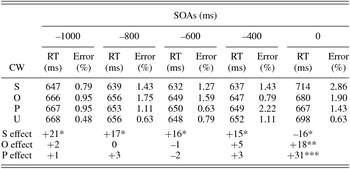
The same three data exclusion criteria as in Experiment 1 were applied, removing 1.24%, 0.16%, and 1.39% of the data. The remaining data were used to calculate means. Table 3 presents the mean latencies and error percentages, presented by context type and SOA.
Mean naming latencies, mean error percentages, and context effects (ms) for the various context words of Experiment 2

Note: The asterisks represent the latency of picture naming in the S related, O related, or P related condition being significantly different from the U condition. SOA, Stimulus onset asynchrony; CW, context words; RT, reaction time; S, semantically related; O, orthographically related; P, phonologically related; U, unrelated; +, a facilitation effect; –, an inhibition effect, compared to the U condition.
*p < .05. **p < .01. ***p < .001.
Repeated measures ANOVAs were performed on the response latency means computed by participants (F1) and by items (F2), with context type and SOA as within-participant and within-item variables. A significant SOA condition effect was observed, F1 (4, 116) = 6.98, MSe = 56,646, p < .001, ηp 2 = 0.97; F2 (4, 80) = 49.72, MSe = 48,910, p < .001, ηp 2 = 1.00. The main effect of context type was significant by subjects, F1 (3, 87) = 4.04, MSe = 4,539, p < .05, ηp 2 = 0.71, but not by items, F2 (3, 60) = 2.66, MSe = 3,062, p = .07, ηp 2 = 0.55. The interaction between SOA and context type was significant, F1 (12, 348) = 7.74, MSe = 6,694, p < .001, ηp 2 = 1.00; F2 (12, 240) = 6.12, MSE = 4,989, p < .001, ηp 2 = 1.00. Newman–Keuls comparisons were used to compare the unrelated condition with all other conditions at all SOA levels. The results revealed a significant semantic facilitation effect at SOAs ranging from –1000 to –400 ms (all ps < .05) and a semantic interference effect at 0-ms SOA (p < .05). There was no significant orthographic or phonological facilitation effect at all negative SOA levels; however, both orthographic facilitation (p < .05) and phonological facilitation effects (p < .01) were significant at 0-ms SOA.
A similar analysis was performed on the error percentages. The main effect of context type was significant, F1 (3, 87) = 4.81, MSe = 23.07, p < .01; F2 (3, 60) = 4.10, MSe = 14.93, p < .01. The effects of SOA and the interaction between the two variables were not significant (all F1s ≤ 1.77, all ps ≥ .14; all F2s ≤ 1.81, all ps ≥ .12).
Discussion
At 0-ms SOA, context words induced a semantic interference effect, a finding in accordance with those of Experiment 1 and many earlier studies (e.g., Damian & Martin, Reference Damian and Martin1999; Zhang & Weekes, Reference Zhang and Weekes2009). It is more important that, using the same set of materials, the polarity of the effect was reversed when context words were presented 400 to 1000 ms before target pictures.
It is interesting that the magnitude of the semantic facilitation effect was similar at all negative SOAs: 21, 17, 16, and 15 ms at SOAs of –1000, –800, –600, and –400 ms, respectively. The results indicated that the semantic facilitation effect spanned a wide SOA range from –1000 to –400 ms. In contrast, the semantic interference effect spanned a narrow SOA window from –100 ms (Experiment 1) to 0 ms. According to the CSM, semantic facilitation is localized at the conceptual level with slow decay, and semantic interference is localized at the lexical level with rapid decay. The CSM can therefore provide a reasonable interpretation of the comparison of the SOA ranges spanned by semantic interference and semantic facilitation.
Under the assumption of a high decay rate at the lexical level, the CSM predicts that the context effects that are localized at the lexical level dissipate rapidly. The lexical representation of a context word would substantially decay after 400 ms to 1000 ms at negative SOA conditions in this experiment, and thus no orthographic or phonological facilitation would be obtained. This was what we found in Experiment 2: the orthographic facilitation effect and the phonological facilitation effect were obtained at 0-ms SOA, but they disappeared when orthographically related or phonologically related context words were presented 400 to 1000 ms before the targets. This finding provides evidence for the assumption that the lexical representations decay rapidly.
EXPERIMENT 3
The design of Experiments 1 and 2 did not match certain other properties of context words. For example, the words differed in syntactic word class. It is conceivable that less interference is obtained when the target and context words do not belong to the same word class (see Mahon et al., Reference Mahon, Costa, Peterson, Vargas and Caramazza2007; Melinger & Koenig, Reference Melinger and Koenig2007; Pechmann, Garrett, & Zerbst, Reference Pechmann, Garrett and Zerbst2004). Lupker (Reference Lupker1979) also proposed that the imageability of context words affects performance in the PWI task. The conventional approach to avoiding confounding factors is to use the same set of context words in the related and unrelated conditions and to form unrelated words by recombining the target picture and the semantic context words. However, the large number of repetitions of the materials and very large SOA values (i.e., –1000 ms) may make participants conscious of the relationship between distractors and targets in Experiment 2. To avoid these problems, only two SOAs (–400 and 0 ms) were used in Experiment 3.
Methods
Participants
Sixteen students (age range = 20–25 years, mean age = 21.9 years, SD = 1.82 years) at Beijing Forestry University and China Agricultural University participated and were paid approximately $2.50. All were native Mandarin Chinese speakers and had normal or corrected-to-normal vision. None of them participated in Experiments 1 or 2.
Materials
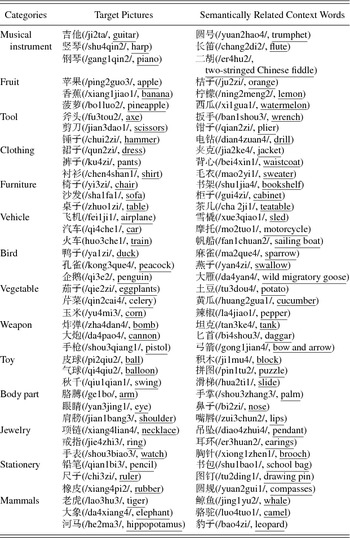
Forty-two black-and-white line drawings were selected from Zhang and Yang's (Reference Zhang and Yang2003) picture database, all of which bore disyllabic names, with an average lexical frequency of 37.65 per million (Chinese Linguistic Data Consortium, 2003) and an average stroke number of 15.38. Target pictures and context words are basic-level concepts selected from 14 semantic categories: musical instruments, fruit, tools, clothing, furniture, vehicles, birds, vegetables, weapons, toys, body parts, jewelry, stationery, and mammals. Each target picture was matched with a semantically related context word (basic level) and unrelated words. Context words in the semantically related condition were then recombined with the picture names to form unrelated conditions. Semantic or associative relationships between picture names and context words were avoided in unrelated combinations. A complete list of target pictures and context words is provided in Appendix B.
Design
The experimental design included relatedness (semantically related vs. semantically unrelated) and SOA (–400 and 0 ms) as within-participant and within-item factors. For each participant, each picture was displayed under each relatedness and SOA condition, resulting in 168 combinations. Trials were blocked by SOA, and the order in which participants received the SOA blocks was varied according to a Latin square design. A new pseudorandom sequence was generated for each participant and each block, with the constraint that neither targets nor context words were repeated in consecutive trials.
Apparatus and procedure
These were identical to those in Experiment 1.
Results
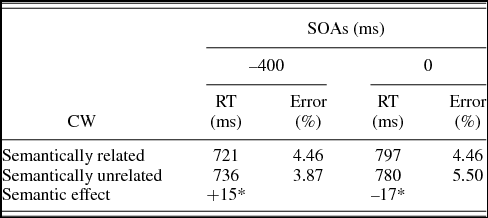
The same three data exclusion criteria as in Experiment 1 were applied, removing 4.58%, 0.11%, and 2.72% of the data. The remaining data were used in the subsequent statistical analysis. Table 4 presents the mean latencies and error percentages, presented by relatedness and SOA.
Mean naming latencies, mean error percentages, and semantic context effects (ms) of Experiment 3
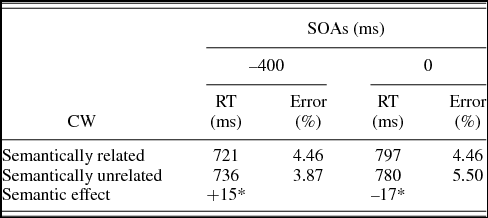
Note: SOA, Stimulus onset asynchrony; CW, context words; RT, reaction time; +, a facilitation effect; –, an inhibition effect, compared to the unrelated conditions.
ANOVAs were conducted on the response latency means, with participants (F1) or items (F2) as random factors and relatedness and SOA as within-participant and within-item variables. A significant effect of SOA was observed, F1 (1, 15) = 29.81, MSe = 58,443, p < .0001, ηp 2 = 1.00; F2 (1, 41) = 154.06, MSe = 164,062, p < .0001, ηp 2 = 1.00. The effect of relatedness was not significant in the participant and item analyses (both Fs ≤ 0.20, ps ≥ .66). It is critical that the interaction between relatedness and SOA was significant, F1 (1, 15) = 10.52, MSe = 3,844, p < .01, ηp 2 = 0.86; F2 (1, 41) = 8.96, MSe = 10,309, p < .01, ηp 2 = 0.83. Planned comparison indicated a significant difference between semantically related and unrelated items at SOA = –400 ms, t1 (15) = –2.91, p < .05; t2 (41) = –2.52, p < .05, and SOA = 0 ms, t1 (15) = 2.95, p < .05; t2 (41) = 2.58, p < .05.
A similar analysis was conducted on the error percentage mean. No effect was significant (F2s ≤ 1.33, ps ≥ .27; F2s ≤ 1.47, ps ≥ .23).
Discussion
In the 0-ms SOA condition, semantic context words induced semantic interference, a finding that is in line with Experiments 1 and 2 and other similar studies in Chinese. The most important point is, using the identical set of stimuli, we observed a semantic facilitation effect when the semantic context words were presented 400 ms before target words. After excluding potential confounding factors (i.e., different word class or different imageability), the manipulation of SOA induced a full reversal from semantic interference to semantic facilitation, and this pattern is in accordance with the observations in Bloem et al.’s (Reference Bloem, van den Boogaard and La Heij2004) study using a word-translation task.
GENERAL DISCUSSION
Using a PWI task, we manipulated a wide range of SOAs to better understand the polarity shift of semantic context effects in speech production. Experiments 1 and 2 used identical sets of materials but varied with respect to SOAs: Experiment 1 used –100 to 200 ms (in 100-ms steps), whereas Experiment 2 used –1000 to –400 ms (in 200-ms steps, with SOA = 0 ms in Experiment 2). Experiment 3 used the same set of materials in the semantically related and unrelated conditions to exclude possible confounding variables (i.e., different word classes or different context words imageability). Context words induced semantic interference in the SOAs close to zero condition, whereas a semantic facilitation effect was observed at larger negative SOA values in the present study. The findings reveal an important phenomenon: namely, the manipulation of SOAs transforms a reliable semantic interference effect into a reliable semantic facilitation effect in the PWI task. The shift in the polarity of the semantic context effect is a function of the onset interval between context words and targets. In the discussion sections of Experiments 1 to 3, we argue that the present data could best be accounted for by the CSM.
Explaining semantic facilitation and interference in the CSM
The CSM assumes two additional modifications to account for the semantic facilitation effect we obtained at larger negative SOA values: only conceptual representations exceeding the threshold spread activation for their corresponding lexical representations, and the decay of activation of lexical representations must be faster than the decay of conceptual representations. When these two modifications are combined and a context word is presented 400 ms before the target picture in the PWI task, the activation of lexical representation has almost completely decayed by the time that the target is presented as a high decay rate of lexical representation, while persistent activation of conceptual representation remained strong. Therefore, we observed a semantic facilitation effect at SOAs ranging from –1000 to –400 ms. It is interesting that the size of the semantic facilitation effect induced by context words at –400-ms SOA is very similar to those induced at other relatively longer SOAs (–1000, –800, and –600 ms). Although the effect at very long SOAs should be interpreted with caution, it is in line with the notion that the effects induced by context words at these SOAs have the same origin as the one at –400-ms SOA. We therefore suggest that the semantic facilitation effects arise at the conceptual level. The comparable effect at negative SOAs ranging from –1000 to –400 ms indicates that the decay of conceptual representation is slow and thus induces a facilitation effect even after context words have been presented for 1000 ms. By contrast, when context words are presented simultaneously with or 100 ms before target pictures, the activation of the lexical representation of context words remains strong, whereas the activation of the conceptual representation of context words is weak due to the lack of sufficient time to spread activation from the lexical level to the conceptual level; thus, a semantic interference effect is induced. We conclude that the semantic facilitation effect arises at the conceptual level, whereas the semantic interference effect arises at the lexical level.
The CSM assumes that the decay of lexical representations is faster than the decay of conceptual representations. We also tested this assumption by comparing the SOA ranges of the semantic interference effect and the semantic facilitation effect. We observed a narrow SOA range for the semantic interference effect (–100 to 0 ms) and a wide SOA range for the semantic facilitation effect (–1000 to –400 ms). According to the CSM, when a word is preexposed by 400 to 1000 ms, its lexical representation is nearly completely decayed, while its conceptual presentation would be activated by the time the target is presented, which accounts for significant semantic facilitation effects at SOAs ranging from –1000 to –400 ms. By contrast, when a word is preexposed by 100 ms or is presented simultaneously with the target picture, its lexical representation remains activated, which accounts for the semantic interference effect at those SOAs. Our findings clearly indicated that a word's conceptual activation can persist for longer than its lexical activation.
The CSM assumes that conceptual activation decays slowly. One may argue that this would predict a decrease in the semantic facilitation effect over time. The semantic facilitation effects were comparable for SOAs ranging from –1000 to –400 ms. The CSM did not explicitly indicate how long the semantic facilitation effect would persist. Studies have demonstrated that activation at the conceptual level can persist for a few seconds (Becker, Moscovitch, Behrmann, & Joordens, Reference Becker, Moscovitch, Behrmann and Joordens1997; Roediger, Reference Roediger1990; Roediger & McDermott, Reference Roediger, McDermott, Spinnler and Boller1993). For example, Roediger (Reference Roediger1990) and Roediger and McDermott (Reference Roediger, McDermott, Spinnler and Boller1993) noted that priming on conceptually driven tasks is a long-term effect. Becker et al. (Reference Becker, Moscovitch, Behrmann and Joordens1997) demonstrated that the semantic priming effect persists over many intervening items and lasts substantially longer than a few seconds. Because of the long persistence of conceptual activation, we therefore suggest that conceptual activation can persist for a few seconds and can span a relatively wide SOA range.
We tested the assumption of the CSM that lexical representations exhibit rapid decay using orthographically or phonologically related context words in a PWI task. For this purpose, it is important to determine the locus of the orthographic effect and the phonological effect in the present study. In the PWI task with orthographically or phonologically related distractor words, Zhang and colleagues found that the orthographic facilitation effect is typically larger than the phonological facilitation effect, and the former is observed at negative SOAs such as –100 or –150 ms, whereas the latter is not. Studies have also reported that both effects arise simultaneously at SOAs of 0 and 100 ms (or 150 ms) at a later stage of language production. Thus, it has been suggested that the orthographic facilitation effect at a –100- or –150-ms SOA is localized at an earlier processing level than the phonological facilitation effect in speech production (Bi, Xu, & Caramazza, Reference Bi, Xu and Caramazza2009; Zhang, Chen, Weekes, & Yang, Reference Zhang, Chen, Weekes and Yang2009; Zhang & Weekes, Reference Zhang and Weekes2009), whereas the orthographic facilitation effect at SOAs of 0 ms and 100 ms (or 150 ms) have the same locus as the phonological facilitation effect (Zhang et al., Reference Zhang, Chen, Weekes and Yang2009; Zhang & Weekes, Reference Zhang and Weekes2009). By contrast, Zhao, La Heij, and Schiller (Reference Zhao, La Heij and Schiller2012) did not find that the orthographic facilitation effect arose earlier than the phonological facilitation effect. In other words, they obtained similar time courses and magnitudes of the two effects at a 0-ms SOA. Zhao et al. therefore suggested that orthographic facilitation and phonological facilitation are localized at the same stage. They further investigated the locus of the orthographic facilitation effect using a categorization task, and no orthographic effect was obtained. Zhao et al.’s findings clearly indicate that the orthographic facilitation effect in Chinese picture naming is most likely localized at the lexical level rather than at the conceptual level.
Similar to Zhao et al.’s findings, similar time courses and magnitudes of the orthographic facilitation and phonological facilitation effects were obtained in the present study. We therefore suggest that the two effects that we obtained are likely localized at the word-form encoding stage (see Zhao et al., Reference Zhao, La Heij and Schiller2012). In Experiments 1 and 2, we found that the orthographic facilitation effect and the phonological facilitation effect at 0- and 100-ms SOA were completely eliminated when identical context words were presented at negative SOAs, in contrast with previous findings (Meyer & Schriefers, Reference Meyer and Schriefers1991; Schriefers et al., Reference Schriefers, Meyer and Levelt1990). This data pattern accords with the results of Bloem et al. (Reference Bloem, van den Boogaard and La Heij2004), who found a substantial phonological facilitation effect at a 200-ms SOA but no effect at a –400-ms SOA in a word-translation task. We suggest that the lexical representation's activation of a context word was substantially decayed when the targets were presented, which is in line with the assumption of the CSM. Our findings therefore extended the CSM to a monolingual context in a PWI task.
Concerning the potential conscious strategy, we do not believe it plays a role in the present study. On the one hand, participants cannot anticipate the relationship between context words and targets, as because different conditions (semantically related, phonologically related, orthographically related, and unrelated) were randomly presented in the experiments. This is a typical method used in PWI tasks (Damian & Martin, Reference Damian and Martin1999; Glaser & Glaser, Reference Glaser and Glaser1989; Starreveld & La Heij, Reference Starreveld and La Heij1995, Reference Starreveld and La Heij1996). On the other hand, if conscious strategies had been employed, we would expect a larger semantic facilitation effect at longer negative SOAs than at shorter negative ones if participants were aware of the relationship between distractor words and targets in the CSM framework. This was clearly not what we observed in Experiment 2. Therefore, we suggest that the participants were not conscious of the relationship between distractor words and target names in the present study.
When the distractor remains on the screen, its conceptual and lexical representations may continue receiving input activity. In other words, the conceptual and lexical representations of distractor words would be activated and persist for a longer time at long negative SOAs than at short negative SOAs. In the PWI task, participants were asked to name pictures and ignore distractor words. The processing of distractor words is mandatory and automatic in a Stroop-like task. The maximum activation of conceptual and lexical representation of distractors should be similar at all negative SOAs. When target pictures are presented, participants must name the picture and ignore the distractors, and the decay of conceptual and lexical representations begins from the introduction of the pictures. Therefore, we observed a similar size of the semantic facilitation effect at negative SOAs ranging from –1000 to –400 ms.
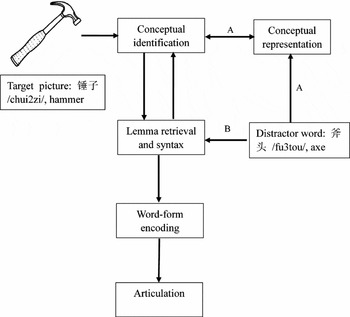
We outline our findings using the CSM framework in Figure 1, which depicts a functional model of picture naming with a semantically related distractor word in Chinese. In the network depicted in Figure 1, perceived targets activate their conceptual representations, and then spread their activation to their lemmas at the lexical level, while perceived words automatically activate not only lemmas and word forms in the lexical network but also conceptual representations. It is important that the CSM assumes that there are links between the conceptual and lexical representations and that words activate their conceptual representations to a greater extent than conceptual representations activate the corresponding words (Bloem et al., Reference Bloem, van den Boogaard and La Heij2004, p. 319). This assumption is in line with the more general assumption that words activate their meanings automatically and rapidly, whereas the retrieval of words from a conceptual representation is controlled and relatively slow. Figure 1 depicts a link between target conceptual activation and the conceptual representation of a distractor word (Route A). Through this link, the activation of target concepts is enhanced in the semantically related condition but not in the semantically unrelated condition. There is another link between lemma retrieval and distractor word perception (Route B). Through this link, the lexical activation of a distractor word is increased in the semantically related condition but not in the semantically unrelated condition. Through these two links, the present study elicited semantic facilitation and semantic interference effects.
A functional model of picture naming with a semantically distractor word in Chinese based on the assumption of the conceptual selection model.

Note that the CSM cannot account for a number of important findings in the literature. For example, the CSM had difficulty in interpreting context effects that are observed when the task is changed from basic-level naming in a speaker's first language to category-level naming in the first language or basic-level naming in a second language (see also Bloem et al., Reference Bloem, van den Boogaard and La Heij2004). Different tasks and the target–distractor relationship between the word and the picture were used in these studies. Clearly, these factors are important for generating semantic context effects in different circumstances. Roelofs (Reference Roelofs2002) proposed that the purpose of a speaker (or, more generally, the intention of communication) affects the processes involved in lexical access. Understanding how different contexts and task instructions affect the processes involved in lexical access is a major challenge for future research in language production.
The CSM also had difficulty in interpreting the distractor frequency effect (Dhooge & Hartsuiker, Reference Dhooge and Hartsuiker2010, Reference Dhooge and Hartsuiker2011; Miozzo & Caramazza, Reference Miozzo and Caramazza2003), which means that unrelated low-frequency distractor words interfere with target naming to a greater extent than unrelated high-frequency distractor words. According to the CSM, an unrelated distractor word does not bear any relationship with the target name, and hence either a low-frequency or a high-frequency distractor word would have a similar effect on picture naming.
Explaining semantic facilitation and semantic interference in the REH
Assuming that the REH holds and semantic effects in the PWI task reflect a postlexical “response buffer” stage, what are the implications of our current results? When participants are presented with a picture–word situation, context words have a privileged relationship with the articulators in a way that pictures do not. Because there is only one channel at the level of articulators in speech production, to name pictures fluently, participants must exclude the representation of the context words from the production system before the articulation of target words. Compared to the unrelated context words, an interference effect is therefore obtained in the related context words condition when SOAs are close to zero because semantic context words are assumed to be more difficult to remove from the output buffer.
To explain the semantic facilitation effect in a masked priming task, Finkbeiner and Caramazza (Reference Finkbeiner and Caramazza2006) included an extra assumption from the CSM. They assumed that semantically related context words could prime target responses at the conceptual level. When a context word is presented at larger negative SOA values (from –400 to –1000 ms), the target representation at the conceptual level is preactivated due to the semantic overlap between the target and context words, and the activation of the target is a relevant response and is not necessary to exclude from the production system. That is, the semantic facilitation effect depends on the exact interplay of conceptual and postlexical properties (see also Dhooge & Hartsuiker, Reference Dhooge and Hartsuiker2010). However, the REH cannot predict the SOA ranges for semantic facilitation and semantic interference covered in the PWI task.
The temporal pattern of semantic, orthographic, and phonological effects in Chinese
One may question the different time courses of information (semantics, phonology, and orthography) activation on specific SOAs. Zhang et al. (Reference Zhang, Chen, Weekes and Yang2009) observed orthographic priming at SOAs of –150, 0, and +150 ms and phonological priming at SOAs of 0 and +150 ms. Zhang and Weekes (Reference Zhang and Weekes2009) reported a semantic interference effect at SOAs ranging from –300 to 0 ms, an orthographic facilitation effect between –100 and 100 ms, and a phonological facilitation effect at 100 ms. By contrast, Zhao et al. (Reference Zhao, La Heij and Schiller2012) noted that the orthographic and phonological facilitation effects were of equal size and had very similar time courses. Therefore, it is hard to determine whether a specific effect (i.e., the orthographic effect) would arise at a specific SOA such as –150 ms. Whether this is the case depends on factors such as the participants, materials, distractor types, and distractor modality employed in the experiment.
We acknowledged that the semantic, phonological, or orthographic effects vary across SOAs. However, the relative temporal pattern of these effects was similar across studies in Chinese spoken language production. The main results were as follows: “classic” semantic interference and phonological (or orthographic) facilitation effects were observed. In the present study, we did not employ a –150-ms SOA but a –100-ms SOA instead. In Experiments 1 and 2, these effects generally appeared at SOAs that were shorter than would be expected from previous research: semantic interference was found at –100- and 0-ms SOA, and phonological (or orthographic) facilitation was obtained at 0- and 100-ms SOA. Thus, this yielded a pattern of “early” SOA in which semantic interference emerged in the absence of a phonological effect or an orthographic effect, followed by an SOA in which all effects were present simultaneously, and finally an SOA in which distractor words were evidently presented too late (relative to target onset) to have any effect on target naming. This pattern is roughly in accordance with what would be expected from previous findings (e.g., Damian & Martin, Reference Damian and Martin1999; Zhang et al., Reference Zhang, Chen, Weekes and Yang2009; Zhang & Weekes, Reference Zhang and Weekes2009; Zhao et al., Reference Zhao, La Heij and Schiller2012).
Conclusion
In the PWI task in a monolingual Chinese context, we found that context words induced semantic interference when they were presented in close temporal proximity to the target and that they induced semantic facilitation when they were presented at larger negative SOAs. At the empirical level, our data suggest that manipulating the SOA can reverse the polarity of the semantic context effect. Based on the aforementioned discussion, we conclude that the CSM provides the most straightforward means of accounting for the reported polarity shift and the different SOA ranges covered by the semantic interference effect and the semantic facilitation effect in the present study. The data reported in this article thus provide evidence for the CSM as a competitive model in the PWI task.
Target names and context words used in Experiments 1 and 2

Stimuli used in Experiment 3

ACKNOWLEDGMENTS
This research was supported by Grants 31170977 and 31471074 from the National Natural Science Foundation of China, Fundamental Research funds for the Central Universities, and Grant 4NXLF12 from the Research Funds of Renmin University of China (all to Q.Z.).