Introduction
Pediatric obsessive compulsive disorder (OCD) is a neuropsychiatric disorder with a prevalence of 0.25–2.7% in pediatric populations.Reference Heyman, Fombonne, Simmons, Ford, Meltzer and Goodman1, Reference Rapoport, Inoff-Germain and Weissman2 In both adults and children, OCD is characterized by unwanted and intrusive thoughts, images, or urges (obsessions) that often result in repetitive and ritualistic behaviors (compulsions), with a predominance of compulsions over obsessions in younger children.Reference Swedo, Rapoport, Leonard, Lenane and Cheslow3 The preservation of insight into the irrational nature of OCD-related thoughts and behaviors is also characteristic of the disorder. Tic disorders (TD) commonly co-occur with pediatric OCD, and include Tourette syndrome (multiple motor and at least one vocal tic over more than one year) and chronic tics (presence of motor or vocal tics for more than one year). Other comorbidities common in pediatric OCD include attention-deficit/hyperactivity disorder (ADHD; with rates ranging from 5–30%),Reference de Mathis, Diniz and Hounie4 other anxiety disorders,Reference Zohar5, Reference Nestadt, Samuels and Riddle6 and social deficits.Reference Eddy and Cavanna7 In epidemiological and clinical samples, OCD, TD, and ADHD co-occur in adultsReference Comings8–Reference Robertson and Cavanna10 and children.Reference Hanna11, Reference Ivarsson, Melin and Wallin12 The frequent co-occurrence of OCD, TD, and ADHD has clear treatment implications,Reference Flessner, Allgair and Garcia13 but also points to possible etiological commonalities. The common co-occurrence of OCD, TD, and ADHD has led some researchers to postulate a common etiologic substrate to all 3 disorders based on shared neurocircuitry.Reference Palumbo, Maughan and Kurlan14–Reference Middleton and Strick16 Genetic-familial relationships between the 3 disorders also exist, in particular between OCD and TD.Reference Pauls, Towbin, Leckman, Zahner and Cohen17–Reference O’Rourke, Scharf and Platko19 Finally, the phenotype of OCD+TD+ADHD has been investigated as a venue to better understand the genetic basis of OCD and TD.Reference Sheppard, Chavira and Azzam15, Reference Mathews and Grados20 In this context, one study has now demonstrated that the OCD+TD+ADHD phenotype “breeds true” in families of TD probands.Reference Mathews and Grados20
Given that OCD and TS are the “core” conditions in this tripartite clinical presentation in children, exploring the nature of the co-occurring ADHD component is highly relevant. In essence, it is critical to dissect the overlay of deficits in attention and inhibitory control with which children with OCD present due to the allostatic load from anxiety and obsessions. In TD alone, there is less evidence for cognitive deficits overall, although some subtle differences are noted with controls. The following research questions need further exploration:
1. What is the extent and nature of the attention and inhibitory deficits in OCD and in TD?
2. Can attention and inhibitory neurocognitive correlates help us to better delineate subtypes of OCD and TD?
The aim of the current study is to examine the relationships between OCD, TD, and attentional and inhibitory deficits in children. The cognitive load hypothesis supports the notion that children with OCD or TD (single condition) are less affected than children with both OCD and TD (comorbid condition). To explore this hypothesis, a well-normed continuous performance test (CPT) is used to test allostatic load on attention and inhibitory control. It is surmised that children with OCD+TD will show increased neurocognitive frailty (eg, increased inattention and impulsivity) compared to children with OCD alone or TD alone.
Methods
Sample
Children and adolescents 7–21 years of age with a diagnosis of OCD or chronic tics/TS in the Johns Hopkins Pediatric Obsessive-Compulsive Disorder and Tic Disorders clinic were selected for inclusion. Patients with primary neurological conditions, autism, intellectual disability or primary affective, disruptive, eating, or psychotic disorders were excluded. IRB approval was obtained to review clinical data.
Clinic visit procedure
During the clinic intake visit, children were administered the Conners’ Continuous Performance Test IIReference Conners, Epstein, Angold and Klaric21 to measure attentional capacity and motor inhibition. At the same visit, the Children’s Yale–Brown Obsessive-Compulsive Scale (CY-BOCS; to catalog OCD symptoms and rate severity)Reference Scahill, Riddle and McSwiggin-Hardin22 and the Yale Global Tic Severity ScaleReference Leckman, Riddle and Hardin23 (YGTSS; to rate tic severity) were administered by a clinician.
CY-BOCS
The CY-BOCS is the pediatric version of the Y-BOCS, which assesses OCD severity. The CY-BOCS has 10 items that are used to rate the severity of obsessive (5 items) and compulsive (5 items) symptoms in children and adolescents. For both obsessions and compulsions, each severity marker is rated from 0 (no symptoms) to 4 (extreme symptoms). The severity markers include (1) time spent, (2) degree of interference, (3) distress, (4) resistance, and (5) control over the symptom. Scores obtained from the subscales are summed to yield a CY-BOCS total score. Scores on the CY-BOCS are rated from 0–40; a score of 16 or more is clinically significant.
YGTSS
The YGTSS is a semistructured clinician-rated interview used to measure the severity of motor and phonic tics. The YGTSS was administered by a clinician in interview format. The YGTSS reports on type of tic and number, frequency, intensity, complexity, and interference of the tics. Each dimension is scored on a 5-point scale, separately for vocal and motor tics. Ratings from 0 (none) to 5 (extreme) are used to rate tic severity, with 25 points possible for each of motor and vocal tics. In this study the global 0–50 score on clinical impairment was not used due to the more subjective nature of that score, with greater weight given to the specific tic ratings (0–50).
Diagnostic procedure
The diagnosis of OCD relied on a clinical interview based on Diagnostic and Statistical Manual of Mental Disorders, 4th Edition, Text Revision (DSM-IV-TR) criteria24; a score of >16 on the CY-BOCS administered by an experienced clinician (M.G.); and a best-estimate final diagnosis arrived at by comparing diagnostic impressions of two expert clinicians (M.S. and M.G.). The diagnosis of a chronic tic disorder or Tourette syndrome (TS) was based on DSM-IV-TR criteria. For the purposes of this manuscript, TD (tic disorder) denotes either the presence of chronic tics or TS, and OCD/TD denotes the group of subjects with OCD or TD. The diagnosis of ADHD similarly followed DSM-IV-TR criteria with the additional specification of the subtypes ADHD-combined and ADHD-inattentive. As with OCD, TD, and ADHD, a best-estimate procedure was followed to diagnose anxiety disorders, following DSM-IV-TR criteria.
Conners Continuous Performance Test II (CPT-II)
The CPT-II is a 14-minute computerized test used to study attention, inhibition, and related cognitive tasks in children ages 8–21 years. When used with other tools such as self-report data, observer-based data, and behavioral and observational information, the CPT-II has proven to be a valid tool in formulating the diagnosis of ADHD. Because the test is administered in 6 segments, the practitioner can observe and analyze how the variables vary from block to block. The instructions require respondents to press the spacebar on a laptop, or click the mouse, whenever any letter of the alphabet appeared on the screen, with the exception of the letter “X.” Commission errors were errors of responding when no response is required, such as pressing the spacebar when an “X.” appeared on the screen. Omission errors were errors of not responding when a response is necessary, such as not pressing the spacebar when a letter besides “X.” appeared on the screen. Reaction time (Hit RT), the time interval between the stimulus (screen) and the response (spacebar), is also measured. The practitioner could observe the Hit RT block by block (Hit RT block change and Hit RT standard error). If the Hit RT slows down during the test, it may indicate inattention due to cognitive fatigue. Scores are represented as T-scores (mean 50, SD 10) relative to a normed population of 17,117 U.S. children.Reference Conners, Epstein, Angold and Klaric21 Per the CPT-II Manual, scores denote mild (55–60), moderate (61–65), or marked impairment (65+).Reference Conners25
The following 8 parameters produced by the CPT-II were considered for analysis:
1. Omission errors: failure to respond to target letters (non-Xs) is thought to reflect distractability.
2. Commissions errors: responses given to non-targets (Xs) are thought to reflect response inhibition failures.
3. Overall hit reaction time: average speed of correct responses for the entire test.
4. Hit reaction time standard error: standard error is a measure of response speed consistency. The higher the overall standard error, the greater the inconsistency in the response speed.
5. Variability of standard error: like overall standard error, the variability of standard error is a measure of response speed consistency. However, variability of standard error measures “within respondent” variability, that is, the amount of variability the individual shows in 18 separate segments of the test in relation to his or her own overall standard error. Although variability of standard error is a different measure than overall standard error, typically the two 2 measures produce comparable results. The higher the variability of standard error, the is greater the inconsistency in the response speed.
6. Detectability (d’): The value d’ is a measure of the difference between the signal (non-X) and noise (X) distributions. As such, d’ provides a means for assessing an individual’s discriminative power since, in general, the greater the difference between the signal and noise distributions, the better the ability to distinguish and detect X and non-X stimuli.
7. Hit reaction time by block: hit reaction time block change measures change in reaction time across the duration of the test. High values of hit reaction time block change indicate a substantial slowing in reaction times. It is thought to reflect cognitive fatigue or lack of intensity in responding. Low values indicate that responses got quicker as the test progressed.
8. Hit standard error by block (hit SE block change): standard error by block detects changes in response consistency over the duration of the test. High values of it SE block change indicate a substantial loss of consistency as the test progressed. Low values on this measure indicate sustained or improved response consistency. Lack of consistency may also reflect deficiencies in sustained attention or cognitive fatigue.
Statistical methods
The differences for quantitative variables employed an ANOVA with post-hoc t-tests when three groups were compared (OCD, TD, OCD+TD) or unpaired t-tests if two groups were compared (OCD/TD, OCD+TD). Frequency tables were analyzed with Pearson’s χ2 or Fisher’s exact (low frequency counts), as appropriate. Stratified analyses were conducted separately for males, females, subjects<12 years (children), and subjects ≥12 years (adolescents) to gauge the effect of CPT results based on sex and age. To test for the effect of a clinical diagnosis of ADHD in the OCD+TD group, the following groups were compared for differences in CPT scores given an ADHD diagnosis: (1) OCD or TD; (2) OCD+TD with no ADHD; (3) OCD+TD+ADHD. Medications were tabulated by category and contrasted between OCD alone, TD alone, and OCD+TD. In this exploratory study, a value of p<0.05 was considered significant. All analyses were performed using statistical software STATA Version 9.
Results
Sample
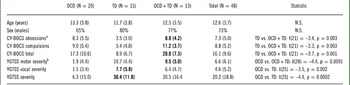
Forty-eight children and adolescents evaluated in a Pediatric Obsessive-Compulsive Disorder and Tic Disorders Clinic were participants. The mean age was 12.6±3.7 years, and 72% were male. OCD alone, TD alone, and OCD+TD did not differ in mean ages or proportion of males, with the highest proportion of males seen in the TD alone group (80%), as well as the lowest age at evaluation in the clinic (11.7±3.8 years) (Table 1).
Clinical characteristics of 48 children and adolescents with obsessive-compulsive disorder (OCD) and chronic tic/Tourette disorders

a OCD, TD alone, n=28 for CY-BOCS.
b OCD, TD alone, n=27 for YGTSS.
CY-BOCS=Children’s Yale–Brown Obsessive-Compulsive Scale; YGTSS=Yale Global Tic Severity Scale.
OCD and tic disorder severity
Forty-two patients completed the CY-BOCS interview. Total CY-BOCS, obsessions, and compulsions scores did not differ between OCD alone and TD alone compared to OCD+TD, except that, as expected, both OCD alone and OCD+TD had higher CY-BOCS scores in all domains than TD alone (p<0.01). Forty patients completed the YGTSS interview. As expected, TD alone and OCD+TD had higher tic severity scores than OCD alone (p<0.01) (Table 1).
OCD symptoms
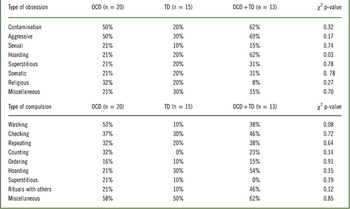
A comparison of OCD compulsions and obsessions between OCD alone, TD alone, and OCD+TD showed that the OCD+TD group reported significantly more hoarding obsessions (χ2(2)=6.74, p =0.03) (Table 2).
Attention-deficit hyperactivity disorder (ADHD) in 48 children and adolescents with obsessive-compulsive disorder and chronic tic/Tourette disorders (TD)

Diagnosis of ADHD
The highest proportion of ADHD diagnoses resided in the OCD+TD group (62% total: 39% ADHD-combined, 23% ADHD-inattentive). The TD alone group also had a significant proportion of patients with ADHD-inattentive diagnoses (20%). Statistically, ADHD diagnoses were highest in the OCD+TD group (62%) compared to OCD alone (20%) or TD alone (27%) (p<0.05). The CPT-II produces a summary clinical confidence index for ADHD, which was highest for OCD+TD (55.4±25.5), lower for OCD alone (44.0±19.3), and intermediate for TD alone (49.8±10.6); these differences were not statistically significant (Table 3).
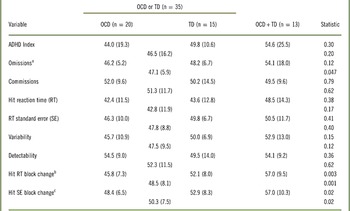
Continuous performance test scores in 48 children and adolescents with obsessive-compulsive disorder, chronic tics/Tourette disorders (OCD/TD) or both disorders (OCD+TD)

a t(46)=–2.04, p =0.047.
b t(46)=–3.10, p =0.003; ANOVA F(2)=7.74; p =0.001.
c t(46)=–2.47, p =0.02; ANOVA F(2)=4.48; p =0.02.
Anxiety diagnoses
The frequency of comorbid disorders in OCD/TD compared to OCD+TD showed that in the OCD+TD group, there were more comorbid anxiety disorders (77% vs. 49%), but this difference was not statistically significant (p =0.08).
Continuous performance test
Forty-eight subjects completed the CPT-II (Table 4). There were no differences between OCD alone, TD alone, or OCD/TD and OCD+TD on commission errors; however, omission errors were higher in the OCD+TD group compared to OCD/TD (t=–2.04, p =0.047). There were no differences between OCD alone, TD alone, OCD/TD, and OCD+TD on the following measures: hit reaction time (RT), RT standard error (SE), variability, or detectability. However, the OCD+TD group had a worse hit RT block change [2 groups: t(46)=–3.10, p=0.003; 3 groups ANOVA F(2)=7.74; p =0.001] and a worse hit SE block change [2 groups: t(46)=–2.47, p=0.02; 3 groups: ANOVA F(2)=4.48; p=0.02], denoting a deficit in sustained attention in OCD+TD over the course of the 6-block test.
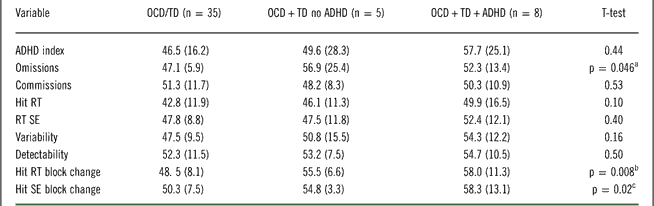
Continuous performance test (Conners CPT-II) scores for 48 children and adolescents with obsessive-compulsive disorder, chronic tic/Tourette disorders (OCD/TD), OCD+TD without ADHD, and OCD+TD with ADHD
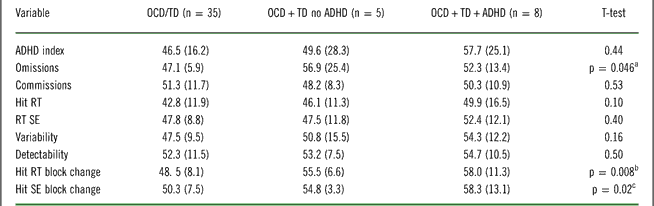
a OCD/TD vs. OCD+TD (no ADHD), t=–2.06(38), p =0.046.
b OCD/TD vs. OCD+TD+ADHD, t=–2.78(41), p =0.008.
c OCD/TD vs. OCD+TD+ADHD, t=–2.35(41), p =0.02.
Analyses stratified by sex and age
OCD/TD and OCD+TD were compared in strata (males only and females only) to examine moderation by sex (data not shown). In males, a significant difference existed for only hit RT block change (p =0.03). In females, there were no significant differences between the OCD/TD and OCD+TD groups across CPT measures. Strata by age were also analyzed separately (<12 years of age and ≥12 years of age). Within the group of younger children, there were clear differences between OCD/TD and OCD+TD for omissions (p =0.019), hit RT SE (p =0.029), variability (p 0.013), hit RT block rate (p =0.015), and hit SE block rate (p ==0.017). In adolescents, (≥12 years) there were no significant differences between OCD/TD and OCD+TD across all CPT measures.
Effect of clinical ADHD on CPT measures
To examine the effect of a clinical diagnosis of ADHD on CPT measures in the OCD+TD group, this group was divided into OCD+TD and no ADHD diagnosis and OCD+TD+ADHD. CPT scores were then compared with the OCD/TD group. Interestingly, for errors of omission, the OCD+TD and no ADHD group had the highest score (OCD/TD vs. OCD+TD no ADHD, t=–2.06(38), p =0.046). As expected, a worse hit RT block change (OCD/TD vs. OCD+TD+ADHD, t=–2.78(41), p =0.008) and a worse hit SE block change (OCD/TD vs. OCD+TD+ADHD, t=–2.35(41), p =0.02) were found in the OCD+TD+ADHD group (Table 5).
OCD symptoms in 48 children and adolescents with obsessive-compulsive disorder, chronic tic/Tourette disorders (OCD/TD) or both disorders (OCD+TD)

Medications
Medication use in each of the groups OCD, TD, and OCD+TD was compared to assess differences between groups, given that medication use may affect CPT measures. As expected, the only significant difference found was the higher use of selective serotonin reuptake inhibitors (SSRIs) between OCD vs. TD alone (55% vs. 20%; Fisher’s exact=0.046) and OCD+TD vs. TD alone (69% vs. 20%; Fisher’s exact=0.02). There were no differences in use of stimulants (5% OCD alone, 7% TD alone, 8% OCD+TD), alpha agonists, neuroleptics, or benzodiazepines between the OCD alone, TD alone, and OCD+TD groups.
Discussion
The current study compares continuous performance cognitive correlates in youth with OCD alone, TD alone, and OCD+TD. The OCD+TD group had significantly higher errors of omission, denoting higher distractability, but not errors of commission, which reflect inhibitory control. OCD+TD also had significantly more variable responses over the 6-block span of the test, as measured by hit RT block change and hit RT SE block change. These differences were most pronounced in younger males, as well as in those children with hoarding tendencies. The sum of the data strongly suggests that the comorbid OCD+TD group harbors a deficit in sustaining attention compared to those with OCD or TD alone.
The literature on OCD and TD has long noted that comorbid OCD+TD presents with greater clinical complexity than OCD and TD alone.Reference Frankel, Cummings, Robertson, Trimble, Hill and Benson26, Reference Zohar, Ratzoni and Pauls27 Comorbid OCD+TD has also been associated with higher rates of ADHD,Reference Coffey, Miguel and Biederman28 as well as lower inhibitory control compared to non-comorbid OCD and TD.Reference Ozonoff, Strayer, McMahon and Filloux29, Reference Roessner, Albrecht, Dechent, Baudewig and Rothenberger30 OCD+TD similarly shows higher levels of broad dimensional psychopathology,Reference Roessner, Albrecht, Dechent, Baudewig and Rothenberger30 more anxiety and mood disorders,Reference Wanderer, Roessner, Freeman, Bock, Rothenberger and Becker31, Reference Lebowitz, Motlagh and Katsovich32 and more aggressive behaviorsReference Stephens and Sandor33 than simple OCD or TD. Of interest, when tic symptoms are more severe in TD, OCD is present more frequently,Reference Coffey, Biederman and Smoller34 suggesting that the complex condition OCD+TD is at least partly a function of the severity of TD.Reference Cath, Spinhoven and van de Wetering35 The current results did not confirm that OCD+TD had higher OCD or TD severity ratings (Table 1). However, given the nature of the sample, which is drawn from a specialized tertiary care clinic, it is not unexpected that the severity of OCD alone and TD alone might be high, and comparable to OCD+TD. Whereas OCD and TD symptom severity was not greater in the comorbid OCD+TD group, the latter group did have a significantly greater frequency of clinical ADHD diagnoses, especially compared to OCD alone (62% vs. 20%; p =0.02) (Table 2). In addition, OCD+TD also harbored a greater number of anxiety diagnoses than the OCD/TD group (77% vs. 49%). The data thus confirm that OCD+TD is clinically more compromised than OCD alone and TD alone, suggesting that the exploration of cognitive correlates of clinical severity in this group is relevant.
A higher omissions T-score in the OCD+TD group (54.1±18.0), compared to the OCD/TD group (47±5.9), is thought to reflect a lack of attending or a sluggish response in this pediatric cohort (p =0.047) (Table 4). Adults with OCD are known to have deficits in executive function, processing speed, and sustained attention,Reference Clayton, Richards and Edwards36, Reference Abramovitch, Abramowitz and Mittelman37 as well as higher distractibility.Reference de Geus, Denys, Sitskoorn and Westenberg38 In children with OCD, visuospatial working memory, flexibility/shifting, time-dependent perceptual deficits are found, but areas of verbal ability, memory, or concentration appear to be spared,Reference Beers, Rosenberg and Dick39–Reference Taner, Bakar and Oner41 whereas in TD alone, there is a “mildly below average” pattern when patients are engaged in a range of neuropsychological tests.Reference Bornstein, Baker, Bazylewich and Douglass42, Reference Mahone, Koth, Cutting, Singer and Denckla43 In this context, one study found that TD+ADHD responded more like TD alone, compared to ADHD alone, which displayed higher slow negative potentials in EEG tracings.Reference Yordanova, Dumais-Huber and Rothenberger44 Thus the errors in omission seen in the comorbid OCD+TD group may be a reflection of compounded factors, such as anxiety in the context of neurocognitive vulnerability. Consistent with this view is an earlier study of undergraduate students, which showed that increased test demands, noise, and anxiety determined more omission errors but not commission errors. These errors were most notable in high anxiety students faced with a difficult task.Reference Ballard45 Ultimately, the explanation for decreased attentional capacity in the comorbid OCD+TD group may be based on the Yerkes–Dodson law. This tenet postulates that lower cognitive performance can be due to suboptimal hyperarousal states.Reference Yerkes and Dodson46 More recently, modifications to the idea of allostatic load have included additional cognitiveReference Cheng and Chang47 and perceptualReference Lavie, Hirst, de Fockert and Viding48 loads. In this model, diminished cognitive capacity may be due to intrusive thoughts (OCD) and urges (TD), which tax working memory and processing efficiency, with a subsequent diminished capacity for processing task-related information.Reference Eysenck, Derakshan, Santos and Calvo49, Reference Eysenck and Calvo50 The cognitive overload model has been applied to adults with OCD to explain attentional deficits due to a continuous attempt to control automatic processes.Reference Abramovitch, Dar, Hermesh and Schweiger51 The ensuing attentional deficits appear to be specific to trait anxiety and not transitory worry.Reference Osinsky, Gebhardt, Alexander and Hennig52, Reference Forster, Nunez Elizalde, Castle and Bishop53 In this context, trait anxiety can result in impoverished recruitment of prefrontal attentional control circuitry.Reference Bishop54 In addition to disruption of attentional capacity due to trait anxiety, it is also plausible that in the comorbid OCD+TD group, aberrant subcortical striato-thalamic afferent inputs to cortical areas act synergistically to disrupt higher cognitive function. These aberrant subcortical inputs increase intracortical excitability and are thought to drive motor disinhibition, resulting in tics.Reference Heise, Steven and Liuzzi55 Intracortical excitability, in this context, has been found to correlate with tic severity and ADHD symptoms.Reference Gilbert, Bansal and Sethuraman56 Similarly, intracortical excitability has also been found to be abnormal in OCD.Reference Greenberg, Ziemann and Cora-Locatelli57 In OCD, as in TD, disruptive basal-ganglia excitability alters procedural learning, such as the serial reaction time task (SRT). In a study of 10- to 18-year-old youth with OCD, SRT deficits correlated with the severity of obsessions.Reference Vloet, Marx, Kahraman-Lanzerath, Zepf, Herpertz-Dahlmann and Konrad58 Even though OCD alone and TD alone may already harbor distractability phenomena, especially OCD alone, a double mechanism of increased cognitive-energetic interferenceReference Sergeant59 and subcortical aberrant firingReference Gilbert, Bansal and Sethuraman56 appears to be crucial in the abnormalities found in the CPT scores of the OCD+TD group.
The number of commission errors in the CPT-II, reflecting inhibitory control, was not different between all 3 groups in this study. OCD alone has been noted to have inhibitory deficits when stop-signal reaction time (SSRT) data are examined, as with ADHD and schizophrenia.Reference Lipszyc and Schachar60 However, children with OCD alone did not display commission errors different than the norm population in the current study, making it less likely that abnormal OCD scores are paired to abnormal TD and OCD+TD scores. In fact, all commission error scores are comparable to the population norm [OCD alone (50.2±14.5), TD alone (52.0±9.6), OCD+TD (49.5±9.6)]. Therefore, the most plausible conclusion is that the inhibitory task demands posed by the Conners CPT-II are not sensitive enough to detect differences between OCD, TD, OCD+TD, and the norm population. In support for this view is a study of inhibitory control in adults with uncomplicated TD. Only the highly demanding flanker tasks produced any difference with controls, leading to the conclusion that TD alone has only mild inhibitory deficits, which are only evident with very high-demand inhibitory control tasks.Reference Channon, Drury, Martinos, Robertson, Orth and Crawford61 Other studies support the notion that TD alone is relatively spared from inhibition and executive deficits. One study of children with TD only showed that response inhibition is normal in a go/no-go task.Reference Ozonoff, Strayer, McMahon and Filloux29 Similarly, a comprehensive battery of executive function applied to children with TD concluded that “children with uncomplicated Tourette syndrome should not routinely be considered to have significant executive function impairments (p. 102).”Reference Mahone, Koth, Cutting, Singer and Denckla43 Only performance on the Purdue Pegboard test of manual dexterity appears to be affected in those with TD alone.Reference Sukhodolsky, Landeros-Weisenberger, Scahill, Leckman and Schultz62 Since tic severity can be related to the presence of comorbid conditions in TD, it is of interest to note that one study found a relationship between worse inhibitory control in a Stroop task and higher ratings on tic severity and body awareness.Reference Eddy, Rickards and Cavanna63 Finally, a study that compared individuals with ADHD, TD, and controls on a CPT battery found more commission and omission errors in ADHD, but only omission errors in TD compared to controls.Reference Oades64 In sum, commission errors, or inhibitory deficits, were not different than population norms in children with OCD alone, TD alone, or OCD+TD in the current study, suggesting that the CPT-II may not be sensitive enough to capture deficits in inhibitory control in these patient groups.
The most notable finding in the current study is that the OCD+TD group has significantly greater intraindividual variability over time in the CPT measures, that is, an inherent inability to sustain attention (Table 4). Multiple studies have identified RT variability as a cardinal neurocognitive feature of ADHD. In a study that focused on RT variability in children with ADHD, affected children had greater RT variability than controls across several tests of attention and inhibitory control (child attentional network task, go/no-go task, stop signal task, N-back task).Reference Epstein, Erkanli, Conners, Klaric, Costello and Angold65 Similarly, another study in 57 children with ADHD vs. controls used two go/no-go tasks with differing levels of cognitive demand to examine moment-to-moment variability in RT. There was consistent intraindividual variability only in children with ADHD compared to controls, dependent on task demands.Reference Vaurio, Simmonds and Mostofsky66 Two other studies have noted higher RT variability when TD is comorbid with ADHD. In a study of comorbid TD+ADHD, the comorbid group showed more premature responses and greater variability in response times in a RT task, compared to TD alone.Reference Thibeault, Lemay, Chouinard, Lesperance, Rouleau and Richer67 Finally, when individuals with TD alone, TD+ADHD, and ADHD alone are compared, an isolated deficit in sustained attention was found—a striking parallel to the results seen in the current study.Reference Sukhodolsky, Landeros-Weisenberger, Scahill, Leckman and Schultz62 It is thus interesting that the OCD+TD group would have this same cognitive marker—a cardinal cognitive marker of ADHD (greater RT variability)—compared to OCD or TD alone. The sum of the data suggests that comorbid OCD+TD has an “ADHD component,” much like schizophrenia, Alzheimer’s disease, and severe depression, which, notwithstanding, needs further characterization. This is not the case for OCD alone or TD alone. In addition, a comparison of OCD+TD+ADHD to OCD alone and TD alone adds to this conceptualization. In the current analysis, a clinical diagnosis of ADHD did not correlate with omission errors (highest in OCD+TD no ADHD), but was associated with higher RT variability, indicating the consistency of deficits in sustained attention (RT variability) in OCD+TD compared to OCD alone and TD alone (Table 4).
Select demographic and clinical characteristics were associated with CPT-defined deficits in sustained attention. Children who were younger age and male showed the most CPT score differences between OCD+TD and OCD/TD (data not shown). In the stratified younger age group (<12 years only analysis), OCD+TD had higher omissions (p =0.02), higher hit RT SE (p =0.03), more variability (p=0.02), higher hit RT block change (p =0.02), and higher hit RT SE (p=0.02) compared to OCD/TD. In the stratified male participant group (males-only analysis), there was a higher hit RT block change in the OCD+TD group compared to OCD/TD (p =0.03). In the female-only and adolescent-only analyses, no CPT differences between groups were apparent. This pattern of CPT deficits is consistent with the association of OCD+ADHD with younger age at onset and more severe symptoms compared to OCD alone.Reference Yeates and Bornstein68 Hoarding tendencies were also significantly more prevalent in the comorbid OCD+TD group compared to OCD alone and TD alone. This finding parallels multiple reports that associate hoarding tendencies with slower and more variable RT, increased impulsivity, and greater difficulty to distinguish targets from non-targets in CPT tasks.Reference Grisham, Brown, Savage, Steketee and Barlow69 Interestingly, a review of hoarding tendencies in the literature showed that the inattentive symptoms of ADHD predicted the severity of hoarding (clutter, difficulty discarding, and acquiring), while no features of OCD predicted hoarding tendencies. This report suggests that hoarding may be more highly associated with, and be more paradigmatic for, ADHD than OCD.Reference Tolin and Villavicencio70 Imaging studies have also noted a different underlying neurocircuitry for hoarding behaviors compared to OCD, with hypofrontality being characteristic of hoarding.Reference Tolin, Witt and Stevens71 Other clinical reports provide mounting evidence that hoarding behaviors are associated with ADHD, and with deficits in attention in particular.Reference Frost, Steketee and Tolin72, Reference Fullana, Vilagut and Mataix-Cols73 Furthermore, hoarding has been noted to be more prevalent in early-onset OCD malesReference Sheppard, Chavira and Azzam15, Reference Jaisoorya, Reddy, Srinath and Thennarasu74 as well as in OCD comorbid with TD.Reference Gomes, de Mathis and Dominguez Alves75 These results reflect a similar pattern to that found in the current data, where the most notable CPT abnormalities are associated with younger age, hoarding tendencies, and comorbid OCD+TD.
The effect of medication on test results was examined, given that medication use may affect CPT scores, with no major role for medication found. There was no difference in medication use between OCD, TD alone, and OCD+TD, except for an expected higher SSRI use in the OCD and the OCD+TD group compared to the TD group. SSRIsReference Koetsier, Volkers, Tulen, Passchier, van den Broek and Bruijn76 and stimulantsReference Wang, Huang, Chiang, Hsiao, Shang and Chen77 are noted to improve CPT scores. However, given the basal rates at which these medications were used in the pediatric cohort studied (<10% stimulants in all 3 groups; similar rates of SSRI for OCD and OCD+TD), it is estimated that the effect of medication was balanced across groups. The plausible explanation for the low rates of stimulant use is that the medication data were recorded at the time of CPT administration at clinical intake. Many children were diagnosed with ADHD post-clinic intake, which appears not to have been diagnosed in the community as readily. Eventually up to 2/3 of children with OCD+TD and 1/3 of those with OCD alone or TD alone were diagnosed with some type of ADHD in this pediatric cohort (Table 2).
The current study seeks to refine the phenotype of OCD and TD for biological studies. Taken together, the data strongly suggest that sustained attention may constitute a marker of comorbid OCD+TD compared to OCD alone and TD alone. Measures of sustained attention in OCD+TD are also greater than population norms used for CPT-II, with t-scores of 57 for both hit RT block change and hit SE block change (Table 4). It is of interest to observe that genetic association studies of putative ADHD-related genes, such as the dopamine transporter DAT1, have preliminarily singled out RT variability as a potential endophenotype for ADHD based on its association with DAT1 variants.Reference Kebir and Joober78 Tests of vigilance and sustained attention are more deficient in subjects with the 10-repeat allele of DAT1.Reference Comings8 A similar deficit in RT variability is observed in subjects with the 7-repeat allele of the dopamine receptor type 4 (DRD4).Reference Bellgrove, Hawi, Gill and Robertson79 The imaging correlates of sustained attention have been more difficult to identify. One study associates excessive engagement of task-positive networks (brain areas opposed to the default mode network) with deficits in sustained attention, following a model of excessive engagement in conscious processes as causing decreased vigilance.Reference Esterman, Rosenberg and Noonan80 Sustained attention deficits are also associated with gray matter right inferior frontal abnormalities, a finding that is true for child probands with ADHD and their first-degree relatives.Reference Pironti, Lai and Muller81 One brain area, in particular, poses an intriguing overlap between attention and OCD neurocircuitry. The anterior cingulate (ACC) has been linked to attentional states given its role in multiple functions that rely on attention: decision-making, error-detection, monitoring, and resolving conflict.Reference Brocki, Clerkin, Guise, Fan and Fossella82, Reference Weible83 The ACC is also known to have notable associations with OCD through imagingReference Milad and Rauch84 and physiological studies.Reference Hajcak, Franklin, Foa and Simons85 Clearly, additional research is needed to identify neurocircuitry and genetic determinants of OCD and TD. Identifying a “crisp” phenotype, as well as an endophenotype, for OCD and TD will benefit biological studies and serve to robustly advance knowledge of the pathophysiology of OCD and TD.
Limitations
The sample was relatively small and unable to detect minor effect sizes; therefore, those differences that are found should be interpreted as potentially salient. At the same time, the hypothesis-generating nature of the analysis limits the generalizability and any broad conclusions from this single study. The naturalistic setting of the sample acquisition also poses limitations to control variables such as medication use. Despite these limitations, we note that recorded medication use would have diminished the differences between groups, with the higher use of SSRIs potentially improving CPT results in the affected OCD+TD group. Limitations inherent to the CPT-II have been noted, such as possible problematic stability over several months of the CPT-II T-scores, although one study recorded stability of the CPT-II over a shorter period of time.Reference Soreni, Crosbie, Ickowicz and Schachar86 Finally, the subjects in this study were all treatment-seeking and referred to a tertiary care center, and may thus represent a more severe group of OCD and TD patients. This ascertainment may explain the lack of differences in OC symptom and tic severity between OCD and TD along with OCD+TD that has been noted in prior studies.
Conclusions
To conclude, hit RT variability is a cardinal neurocognitive feature of ADHD and the distinguishing CPT measure differentiating OCD+TD from OCD alone and TD alone in the data. The results suggest that OCD+TD has an “ADHD component,” which is characterized as a deficit in sustained attention. The clinical manifestation of this deficit is either subclinical ADHD or frank ADHD.
Disclosures
Matthew Specht has the following disclosure: Tourette Syndrome Association, speaker, research support. The remaining authors have nothing to disclose.