





Introduction
Invisible anthropogenic threats
SENSBIOM connects industry and academia to explore senseable, biochemically augmented and environmentally active matter that can detect and neutralize health-threatening particles – including photons, smoke, pathogens and other toxic volatiles – in support of human and environmental health. Invisible threats such as radiation and pollution can deteriorate the health of living systems. Ultraviolet radiation (UVR) can neither be seen nor felt, yet it can damage skin and eyes; in excess, it also affects processes connected to Earth’s carbon cycle, for example by inhibiting photosynthesis in phytoplankton that produce roughly half of the planet’s oxygen (Smithsonian 2019). Two decades ago, chlorofluorocarbon emissions were banned to slow stratospheric ozone depletion and preserve the ozone layer’s protection against UVR. Today, climate change driven by fossil-fuel burning has been associated with increases in UV exposure, contributing to deoxyribonucleic acid (DNA) damage across humans, flora and fauna. Occupational exposure remains a concern: outdoor workers exposed daily are at risk of developing non-melanoma skin cancers (World Health Organization 2022). Children are particularly vulnerable, as early-age sunburns can increase later risk, and UVR can reach retinal tissues.
We may encounter more than 80,000 airborne toxic chemicals each day as we work, play, sleep and learn. Airborne toxins enter and concentrate in households through outdoor pollution – emissions from cars, factories and power plants burning wood, coal or hydrocarbons – alongside mold, airborne viruses and dust (Manisalidis et al. Reference Manisalidis, Stavropoulou, Stavropoulos and Bezirtzoglou2020). They are also released indoors through less visible processes, including off-gassing and abrasion of compounds in paints, stains and adhesives used in building materials (Jones Reference Jones1999). Inhalation of these mixtures is associated with nervous and respiratory impacts that remain difficult to predict, as well as documented reproductive issues, hormonal imbalances, cellular mutations, cancer and birth defects. These exposures disproportionately affect vulnerable populations, including babies and school-age children whose physiological systems are still developing, adults with compromised immune systems or respiratory conditions and residents of low-income housing worldwide, which is often closer to pollution sources and constructed with materials and finishes that can contribute to indoor chemical exposures (Kampa and Castanas Reference Kampa and Castanas2008).
Here we present SENSBIOM 1.0, 2.0 and 2.1 as a series of architectural installations that investigate both raising awareness of and responding to anthropogenic harms affecting human and environmental health. Across versions, bioplastic lattices and cast biomaterial skins act as distributed interfaces that host a catalog of chemically and biologically powered reactions for sensing and response to otherwise imperceptible threats. Implemented as canopies, partitions and curtains, these structures make environmental conditions legible through material transformation – most directly through colorimetric change – while also pointing toward functional pathways that could support mitigation. The series positions biomaterials as sustainable building alternatives that can help diagnose and communicate the state of our surroundings and, in doing so, support healthier futures (Figure 1).
SENSBIOM 2.0; an ultraviolet radiation-responsive canopy assembled from 300 oval lattices (Spring 2023, Milan Design Week, photography by Adam Šakový).

Printed responsive biomaterials
In nature, material systems assemble, grow and repair through biochemical processes, remaining responsive as they evolve and interact with their environments. This motivates additive manufacturing approaches that combine bio-based substrates with active components, so responsiveness is intrinsic to the fabricated object. SENSBIOM contributes to this direction by treating modular, additively manufactured assemblies as distributed sensing interfaces that register environmental change and communicate it through visible and tangible material transformation.
Our related work on Printed Responsive Biomaterials (PRBs) reviews how additive manufacturing of bio-based substrates can be paired with active molecules, electrochemical reactions and biological components to produce systems that maintain responsiveness after fabrication (Mogas-Soldevila and Zolotovsky Reference Mogas-Soldevila and Zolotovsky2024). Within that framing, non-living PRBs host biochemical reactions and colorimetric or electrochemical responses without living organisms, while DNA-encoded interactions can be implemented through living cells, spores or cell-free systems (Ho et al. Reference Ho, Kubušová, Irabien, Li, Weinstein, Chawla, Yeung, Mershin, Zolotovsky and Mogas-Soldevila2023; Nguyen et al. Reference Nguyen, Courchesne, Duraj-Thatte, Praveschotinunt and Joshi2018). SENSBIOM builds on this lineage through a series of prototypes that develop complementary directions: scent-releasing extrusion-printed cellulosic lattices (SENSBIOM 1.0), cell-free strand embedded into these cellulosic lattices that extends interactivity toward DNA-programmable biochemical sensing without requiring cultivation (Ho et al. Reference Ho, Kubušová, Irabien, Li, Weinstein, Chawla, Yeung, Mershin, Zolotovsky and Mogas-Soldevila2023) and photochromic skins cast into lattices that make UV radiation directly legible through reversible color change (SENSBIOM 2.0, 2.1). Across directions, the key design challenges concentrate at interfaces – between printed structural modules, cast skins and localized bioactive zones – where attachment strategies, moisture management and maintenance routines determine viability outside the lab.
Large-scale biochemical computation
Our modular structures align with broader efforts to move sensing and diagnostics beyond the lab bench and into conventional devices by embedding response directly into everyday material systems. Recent work in smart, bioactive and chemically interactive materials has demonstrated directed responses to humidity, pressure, chemicals and light in contexts ranging from textiles and wearables to architectural skins (McBee et al. Reference McBee, Lucht, Mukhitov, Richardson, Srinivasan, Meng and Chen2022; Menges and Reichert Reference Menges and Reichert2015; Wang et al. Reference Wang, Yao, Cheng, Zhang, Atsumi, Wang and Wang2017). In wearables, cell-free technology examples include engineered living textiles as skin patches and as air-filtering capsules in face masks for much-needed real-time pathogen detection (Nguyen et al. Reference Nguyen, Courchesne, Duraj-Thatte, Praveschotinunt and Joshi2018). Microbial cells have been embedded into athletic garment to activate hygroscopic behaviors and ventilate the human body with curling back flaps (Wang et al. Reference Wang, Yao, Cheng, Zhang, Atsumi, Wang and Wang2017). Also in response to sweat, silk fibroin has been used to encapsulate analytes in silk scarves printed with pH-sensing bioinks able to colorimetrically depict changes in fluid acidity and track diet or stress (Mogas-Soldevila Reference Mogas-Soldevila2020). Similarly distributed reactive sites screen-printed on cotton t-shirts visualize multiplex conditions of lactate and pH to map color to athletic performance (Matzeu et al. Reference Matzeu, Mogas-Soldevila, Li, Naidu, Turner, Gu and Blumeris2020). At the architectural scale humidity-responsive façades and self-ventilating envelopes are enabled by tailoring fiber alignment in thin wood-like printed systems to achieve programmed warp geometries under environmental humidity changes (Correa et al. Reference Correa, Papadopoulou, Guberan, Jhaveri, Reichert, Menges and Tibbits2015). Other building skins have been developed that integrate hydrogels and microalgae to support photosynthesis and resource production as living facades to alleviate pollution pressures in cities as carbon dioxide sinks (Pasquero and Poletto Reference Pasquero and Poletto2020). In other examples currently implemented in water tanks and retaining walls, concrete blends infused with calcifying bacteria strains help crack pathologies to self-heal when sensing water infiltration (Heveran et al. Reference Heveran, Williams, Qiu, Artier, Hubler, Cook, Cameron and Srubar2020; Jonkers Reference Jonkers and van der Zwaag2007). These examples point to the possibility of architectural matter that behaves “alive” in use (Dade-Robertson Reference Dade-Robertson2020).
Framed within bio-based additive manufacturing for the built environment, SENSBIOM contributes to this landscape with an assembly logic from unit to system as canopies and curtains at the interior design and architecture scale. It outputs flat-to-formed foldable lattices, cast responsive skins and plug-in biosites – designed for iterative deployment, service and reuse, foregrounding methodological lessons for interdisciplinary biodesign and integrating biological behaviors into modular matter through material transformation.
Sensing integration
SENSBIOM explores two sensing-and-response pathways that carry different tradeoffs when translated into architectural matter: non-living biochemical reactions and cell-free biological reactions. Biochemical sensing in SENSBIOM relies on non-living reactions embedded in cast skins or blends, which makes it the most deployment-ready pathway for public installations: components can be fabricated dry, handled safely, installed quickly and replaced when performance drifts (e.g., fading or abrasion). DNA-based sensing, by contrast, offers a different advantage: instead of selecting a single dye or molecule for one fixed response, DNA can encode a library of input–output programs that in principle support greater specificity, tunability and extensibility over time (Rolf et al. Reference Rolf, Rosenthal and Lütz2019).
To embed biological interaction in our systems, we used a new technique called cell-free systems that use DNA as a stable, compact and adaptive blueprint molecule for sensing, information processing and response actuation (Ho et al. Reference Ho, Kubušová, Irabien, Li, Weinstein, Chawla, Yeung, Mershin, Zolotovsky and Mogas-Soldevila2023). Cell-free systems provide a practical middle ground between biochemical and fully living systems, because they enable DNA-programmable outputs without cultivation; bioactivity can be packaged into discrete biosites and activated when needed, although stability, moisture sensitivity and cost remain key scaling constraints. Living sensing systems, by comparison, can offer sustained activity, growth and repair, but they typically require wet operation, nutrient support and stronger biosafety/regulatory considerations; at scale, they often depend on bioreactor-like infrastructure and careful maintenance regimes (Srubar Reference Srubar2021).
Within this landscape, SENSBIOM 2.0 and 2.1 primarily develop non-living biochemical legibility through photochromic skins, while SENSBIOM 1.0 develops aroma encapsulation and a cell-free strand that tests DNA-encoded outputs as a steppingstone toward future indoor air modification. Figure 3d shows multi-typology organizations of our system for close-range interaction, collective ambient awareness and contextual sensing of biochemistries, such as aroma, volatile organic compounds (VOCs) and radiation, that can be extended to pathogens, temperature, humidity, pH or other kinds of biochemical or biological sensing and actuation.
SENSBIOM 1.0 Multiscale Bio-interactive Systems. (a) Diagrammatic description of the bioreaction-material integration – cell-free reactions are added to biomaterial blends and freeze-dried for structural integration (i) TXTL, Mastermix and DNA composing the expression kit (ii) silk fibroin and sodium alginate solutions (iii) lyophilization. (b) Biomaterial blend disks are made by lyophilization as mechanical support to host cell-free reactions. (c) Pebbles (a) are embedded into “b” to form biosites. (d) Biosites are press-fitted into specific cells within 50 cm-long biopolymeric lattices. (e) Zones of low cell density and high porosity in the lattices support biosite performance. (f) An oval lattice with a longitudinal slit is chosen as (g) a 2D-to-3D folding modular shape able to conform into ribbons. (h) Ribbons are designed as indoor surfaces or partitions and envisioned as air-interactive devices in our future work. (Adapted from Ho et al. Reference Ho, Kubušová, Irabien, Li, Weinstein, Chawla, Yeung, Mershin, Zolotovsky and Mogas-Soldevila2023).

Summary of workflow. (a) Biochemical Computation. Our development starts by defining input-output pathways for biochemical computation in which (1) aroma molecules are released from biomaterial matrix for olfactory awareness; (2) airborne compounds activate biomolecules synthesis encoded in cell-free DNA for visual readout; or (3) UV light activates reversible photochromic dye isomerization as visual indication of ultraviolet radiation (UVA/UVB). (b) Materials & Fabrication. (1) Biochemical/genetic response is embedded in bio-based substrates from cellulose pulp, chitosan hydrogel, silk fibroin protein, sodium alginate hydrogel and microbial biopolymer from polyhydroxyalkanoate (PHA). (2) Digital fabrication combines structural bio-based scaffolds with functional bioactive material blends: direct ink writing using pneumatic extrusion is used in SENSBIOM 1.0; fused filament manufacturing and (c) casting of chemically active biomaterial blends is used in SENSBIOM 2.0 and 2.1. (3) Materials are functionally distributed across 50-cm-long lattices with varied cell size. Lattice cell size is graded to target two distinct behaviors; sparse areas with cell sizes ranging from 5 to 8 mm and coarse areas with cell sizes ranging from 1 to 4 mm along structural axes for stiffer behavior. Different areas are defined for insertion of interactive biosites or skins. (c) Geometry & Assembly. Structures can be composed of multiple modules. (1) Two types of 2D-to-3D lattice systems are designed; oval (for versions 1.0 and 2.0) and square (for version 2.1). (2) Shapes undergo folding and are fixed in position using mechanical clips. (3) Curvature analysis guides the folding of latticed modules. (4) Modules are connected to create a variety of architectural designs such as ribbons, curtains, screens or canopies. (d) Deployment & Interaction. Assemblies are designed for diverse exhibition spaces and tailored to human interaction: SENSBIOM 1 defined ribbons for close-range olfactory interaction; SENSBIOM 2 and SENSBIOM 2.1 were realized as canopy and curtains respectively for collective experience and localized awareness of UV radiation.

Figure 3. Long description
Panel A: Biochemical Computation. This panel shows three biochemical computation pathways. The first pathway involves aroma molecules released from a biomaterial matrix for olfactory awareness. The second pathway shows airborne compounds activating biomolecule synthesis encoded in cell-free DNA for visual readout. The third pathway illustrates UV light activating reversible photochromic dye isomerization as a visual indication of ultraviolet radiation. Panel B: Materials & Fabrication. This panel describes the embedding of biochemical and genetic responses in bio-based substrates such as cellulose pulp, chitosan hydrogel, silk fibroin protein, sodium alginate hydrogel, and microbial biopolymer from polyhydroxyalkanoate. It also shows digital fabrication methods combining structural bio-based scaffolds with functional bioactive material blends. Direct ink writing using pneumatic extrusion is used in SENSBIOM 1.0, while fused filament manufacturing and casting of chemically active biomaterial blends are used in SENSBIOM 2.0 and 2.1. Materials are functionally distributed across 50-cm-long lattices with varied cell sizes. Panel C: Geometry & Aggregation. This panel illustrates the composition of structures from multiple modules. Two types of 2D-to-3D lattice systems are designed: oval for versions 1.0 and 2.0, and square for version 2.1. Shapes undergo folding and are fixed in position using mechanical clips. Curvature analysis guides the folding of latticed modules. Modules are connected to create a variety of architectural designs such as ribbons, curtains, screens, or canopies. Panel D: Deployment & Interaction. This panel shows the design of assemblies for diverse exhibition spaces and tailored to human interaction. SENSBIOM 1 defined ribbons for close-range olfactory interaction. SENSBIOM 2 and SENSBIOM 2.1 were realized as canopy and curtains respectively for collective experience and localized awareness of UV radiation.
Methodology
Multiscale design workflow
SENSBIOM structures are built from modular surfaces that are additively manufactured with intricate lattice designs and layered with casted interactive skins. They are composed either of oval or square surfaces folded and interconnected into indoor partitions, hanging ribbons, curtains and cloud-like canopies. All lattices were computationally designed within Rhinoceros-3D computer-aided design platform and its parametric plugin Grasshopper. The integration of biochemical or biological material intelligence varied in each system as outlined in the methods below.
SENSBIOM 1.0
Biochemical computation: SENSBIOM 1.0 is the first version in the SENSBIOM series. It combines an installation-scale aroma-active biochemical demonstration with a parallel laboratory prototype that establishes a pathway toward DNA-programmable sensing (Figure 3a). In the public installation at the Institute of Contemporary Art (ICA) in Philadelphia during ACADIA 2022 (Bray Reference Bray2023), visitors could approach the ribbons and perceive output through slow aroma diffusion from a zingerone-doped biomaterial blend producing a near-field cue inviting viewers to move closer. Only in the laboratory strand of 1.0 did we develop cell-free biosites as a path toward DNA-programmable sensing in architectural matter. Cell-free reactions expressed proteins from DNA as a first step toward large-scale bioactive lattices. The reaction was embedded in a structural biopolymer blend and expressed green fluorescent protein (GFP). We measured fluorescence as an indicator of biological activity that can later be replaced with application-specific input–output pathways (e.g., pathogen detection or olfactory outputs) (Ho et al. Reference Ho, Kubušová, Irabien, Li, Weinstein, Chawla, Yeung, Mershin, Zolotovsky and Mogas-Soldevila2023).
Materials + fabrication: In SENSBIOM 1.0 blends based on cellulose (plant-derived fibers), chitosan (a polysaccharide gel from shrimp shells) and fibroin (an aqueous protein solution derived from silk cocoons) were developed and pneumatically extruded with a platform operating at ambient conditions (Mogas-Soldevila et al. Reference Mogas-Soldevila, Duro-Royo and Oxman2014) using a 1.4 mm inner-diameter nozzle (Figure 3b). The installed iteration was aroma-active and made by integration of zingerone crystals in the extruded biomaterial blend to enable slow diffusion of a spicy scent into indoor air.
In the lab version, a cell-free strand packages biological activity into discrete biosites that can be handled as components. A cell-free transcription–translation (TXTL) reaction is combined with a biopolymer matrix of sodium alginate and silk fibroin, then freeze-dried to form a porous structural pellet (Figure 2a–c). These bioblends support fluorescent protein expression (Ge et al. Reference Ge, Luo and Xu2011; Lee et al. Reference Lee, Hung, Phillips, Buck, Gupta and Lux2020), yielding pellets that are both mechanically stable and biologically active. The pellets can be stored dry and activated by rehydration, which supports a workflow where bioactivity is localized to small inserts that can be swapped and staged during deployment.
Geometry + aggregation: To scale up focused biological activity, we mechanically press-fit bioactive pellets into selected cells within additively manufactured 50 cm-long fibrous biopolymer lattices (Figure 2d and e). An oval module geometry and its global lattice pattern draw inspiration from the intricate mineral-like skeletons of radiolarian organisms. Within each module, we computationally designed a functionally graded cell-size distribution to balance structural stability with exchange. Lattice geometry is treated as a functional gradient at the scale of biosite integration. Regions designated for insertion are designed with higher sparsity and porosity to support exchange at the pellet interface (Figure 2f). Denser structural lines are reserved for fold axes that carry loads during transformation. This coupling between local high-exchange zones and structural fold lines supports 2D-to-3D folding of modular shapes into larger ribbon assemblies (Figure 2g and h). Folding increases exposed surface area at biosite locations while preserving modular assembly logic, aligning with future goals of air-interactive indoor partitioning in which biosites can be distributed, serviced and replaced within larger assemblies (Figures 2h and 3c).
The SENSBIOM 1.0 installation was composed of eight hanging ribbons assembled from twelve oval modules each, yielding 96 modules total (Figure 5a). The oval module includes a longitudinal slit that enables folding into a hypar-like geometry, increasing three-dimensional stiffness while exposing surfaces to airflow and touch at close range. In the companion laboratory strand, the same foldable lattice logic serves as a host for biosites: selected lattice cells function as sockets for press-fit pellets (Figure 2d and e), linking component-scale bioactivity to architectural-scale assemblies.
SENSBIOM 2.0/2.1 Component lattices shown unfolded, folded with reactive skin cast on and corresponding color change range according to UV radiation. (a) Oval component. (b) Square component.

(a) SENSBIOM 1.0: A series of 8 scented ribbons of 12 oval modules were installed at the Philadelphia Institute of Contemporary Art (ICA) during the ACADIA 2022 conference in the Fall of 2022. (b) SENSBIOM 2.0: A UVI-responsive canopy was built in Spring 2023 for Milan Design Week from a collection of 300 oval lattices. (c) SENSBIOM 2.1: A UVI-responsive curtain made of 160 square lattices was deployed at Material Matters London Design Week in the Summer of 2023. (d) SENSBIOM 2.0: Another iteration of the original 2.0 UVI-responsive system was built in Fall 2023 for Dutch Design Week in Eindhoven from a collection of 200 oval lattices. (Photography by Eric Sucar (ICA), Daniela Trost (MDW), Welina (LDF) and Marleen van Veen (DDW)).

SENSBIOM 2.0
Biochemical computation: SENSBIOM 2.0 shifts the output from slow diffusion (1.0) to an immediate, reversible, colorimetric response that makes ultraviolet radiation legible through photochromic change. Here, sensing is biochemical and non-living: the cast skin incorporates UV-sensitive dyes that respond directly to UV exposure. The interaction is therefore distributed across the entire assembly surface: the structure becomes a large-scale display where color change is continuously produced by environmental conditions (Figures 1 and 3a). This version foregrounds interpretability at architectural scale – users can read radiation conditions by looking at the material transformation in real time.
Materials + fabrication: SENSBIOM 2.0 combines additively manufactured lattices with cast photochromic skins. This “lattice + skin” strategy separates structural performance from sensing performance, allowing skins to be treated as replaceable responsive components. Structural modules were additively manufactured with a filament-based fused deposition system and software-optimized FDM 3D printer Creality CR-10 MAX with an inner-diameter nozzle of printing 0.8 mm wide and 0.4 mm high layers of bioplastic blend Nuatan® (PHA/PLA) (Figure 3b). Photochromic skins were cast as thin layers (cellulose + sodium alginate as a matrix with photochromic dye additives), then dried prior to folding and assembly.
Geometry + aggregation: The 2.0 assemblies used the oval module geometry and the longitudinal slit to enable folding into hypar-like surfaces that present multiple orientations to the sun and ambient light (Figure 4a). At scale, a canopy assembly built for Milan Design Week comprised 300 oval lattices (Spring 2023) (Aouf Reference Aouf2023) and 200 for Dutch Design Week (Fall 2023). This geometry mediated between sensing and architecture by maximizing exposed surface area and enabling airflow/light penetration through the lattice field, while maintaining an assembly that can be suspended, rotated and read from a distance (Figures 1, 3c, 5b, 5d).
SENSBIOM 2.1
Biochemical computation: SENSBIOM 2.1 retains the non-living photochromic sensing mechanism of 2.0 but translates it into a typology that many viewers associate with domestic or interior architectural elements (curtains, screens, dividers). The output is again reversible color change driven by UV exposure, but the interaction becomes more localized and situational: proximity to windows and direct sunlight gradients create readable variation across the curtain surface (Figures 3a and 5c). In addition, the installation supported user-driven interaction, where visitors could induce color change using UV flashlights, revealing the system as an interface rather than a static surface.
Materials + fabrication: Each square module was printed flat with an inner lattice, then cast with interactive dyes and folded three-dimensionally prior to assembly. The photochromic skin used the same general material logic as 2.0 (biopolymer matrix and photochromic dyes), but the curtain format introduced additional requirements for durability in touch and handling and for maintaining consistent skin adhesion across many modules (Figure 3b).
Geometry + aggregation: SENSBIOM 2.1 was built from 160 square lattices assembled into a curtain deployed at Material Matters London Design Week (Summer 2023). Squares were developed to maximize the surface area of the manufacturing bed, increasing throughput and enabling denser assembly (Figure 4b). Through parametric design, cuts were set as primary constraints to configure two overlapping layers that rotate against one another and define line patterns; these cuts allow folding a flat square into a complex ruled surface and define multiple module-to-module assembly possibilities. In this way, geometry mediates between sensing and architectural placement: modules can be distributed to match window layouts for maximum light exposure while still functioning as a boundary element that shapes space behind it (Figure 3c).
Results
Validation and public deployment
SENSBIOM 1.0
Validation: For the deployed 1.0 installation, validation was primarily experiential and interaction-focused: the output was detectable through proximity, and the installation confirmed that scent release can function as a legible material cue in a public interior context. For the laboratory biosite strand, validation is reported in Ho et al. (Reference Ho, Kubušová, Irabien, Li, Weinstein, Chawla, Yeung, Mershin, Zolotovsky and Mogas-Soldevila2023) and centers on measurable protein expression from DNA templates (GFP as a reporter), confirming that (i) the biomaterial matrix is compatible with cell-free expression and (ii) porous pellets retain biological activity after fabrication and handling. This establishes a baseline for later swapping GFP with application-specific sensing pathways and tangible outputs, including olfactory or visible responses, while keeping biological activity bounded to small components.
Deployment + interaction: SENSBIOM 1.0 was deployed as a public-facing demonstration at the Institute of Contemporary Art (ICA) Philadelphia during the ACADIA 2022 conference closure (Fall 2022), where visitors navigated the ribbon assemblies suspended within the lobby (Figure 5a). The mezzanine placement brought the modules close to face level, supporting touch and near-field perception of aroma. In contrast, the cell-free biosite work in 1.0 was not deployed as a living installation; it was developed on lattice hosts in the lab as a bridge toward future architectural biosensing, where componentization (biosites as cartridges) can support safer handling and staged activation (Figure 3d).
Main takeaway: SENSBIOM 1.0 shows that biochemical outputs embedded in biomaterials can create legible, low-infrastructure interactions in installation contexts, while also motivating a parallel path toward DNA-programmable sensing through componentized cell-free biosites. Together, these strands clarify a central architectural lesson: scaling bio-interactivity depends as much on how activity is packaged, inserted and maintained as on the chemistry or biology itself.
SENSBIOM 2.0
Validation: Validation for 2.0 includes both visual legibility in deployment and bench testing of photochromic skins. UV-reactive casts were tested for lightfastness (resistance to fading under light exposure) using a Q-Sun xenon light chamber (Q-LAB, Xe-1-S). Color values before and after exposure were measured using a Spectrodens Techkon spectrophotometer (Lab* space) and photochromic response was characterized using an Ossila Solar Simulator with 390 and 450 nm LEDs, with measurements performed via spectrophotometry.
Deployment + interaction: As mentioned, SENSBIOM 2.0 was deployed at Milan Design Week and later at Dutch Design Week in Eindhoven, where large audiences could observe the structure’s real-time material response to solar radiation (Figures 1, 5b, 5d). The canopy typology produced a strong atmospheric volume and read as a field condition rather than a localized sensor, which is appropriate for communicating invisible, ambient exposure (Figure 3d). The assembly’s modularity also supported iterative redeployment: damaged modules can be replaced and the same design logic can be scaled up or down without redesigning the entire system.
Main takeaway: SENSBIOM 2.0 demonstrates that non-living biochemical skins can produce immediate, interpretable, architectural-scale sensing without the overhead of electronics or living maintenance. It also surfaces the core scaling constraint of the photochromic strand: long-term legibility depends on skin stability and service routines (handling, abrasion, storage, replacement), which become design problems at the same level as geometry.
SENSBIOM 2.1
Validation: Validation for 2.1 includes both the shared bench protocol used for photochromic skins (lightfastness and UV-response range via Q-Sun chamber, spectrophotometry and solar-simulator irradiation) and deployment-based observation of interpretability and interaction. In London, the curtain’s color palette shifts (white to hot pink to deep burgundy) were legible near windowpanes, and the flashlight interaction provided an informal but powerful validation of responsiveness and reversibility in real time (Figures 4b and 5c).
Deployment + interaction: SENSBIOM 2.1 was deployed as a curtain aligned to an existing window distribution, with assemblies distributed for maximum exposure to daylight while also protecting the living space behind them (Figure 5c). This deployment strategy differs from the canopy: rather than producing a “cloud-like” volume, the curtain format invites comparisons to familiar interior elements and supports discussions about adoption in households, offices, lobbies and partitions. The large number of repeated modules also makes the system a testbed for maintainability: if skins fade or delaminate, modules can be re-cast or swapped without rebuilding the entire installation (Figure 3d).
Main takeaway : SENSBIOM 2.1 shows that typology and placement strongly shape interpretation and imagined use: the same biochemical sensing mechanism becomes more deployable when embedded in an element that already belongs to everyday interiors. It also reinforces the need for standardized casting/maintenance procedures at scale, because repeatability across many modules becomes a primary determinant of performance and legibility.
Discussion
Interface between users and systems
Our results show first steps towards modular multiscale fabrication of large structures with biologically active zones. There are still many challenges to integrating biological activity into architectural surfaces, including the robustness and stability of protein expression and the high cost of cell-free systems. We aim to develop custom in-house cell-free mixes that will be specifically tailored for architectural applications. To explore the potential of bioactive systems we will replace the fluorescent reporter with biosensing systems with tangible outputs.
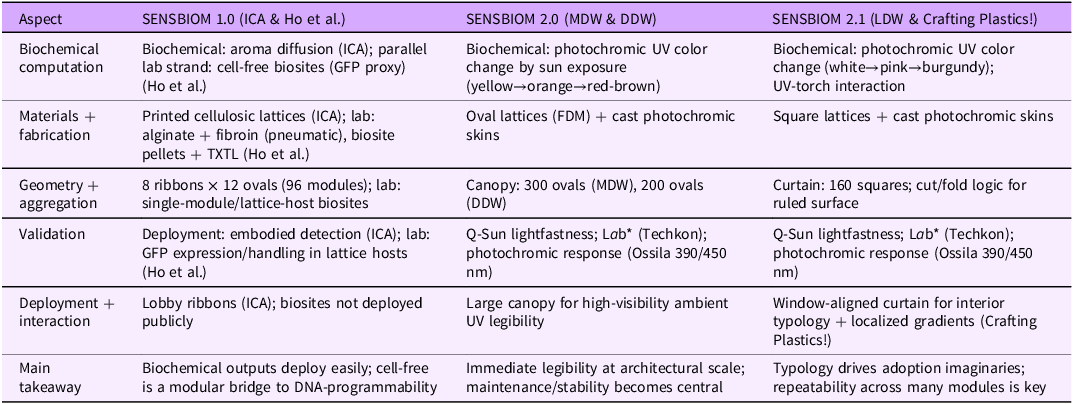
Across the three installations (Table 1), SENSBIOM evolved as a series rather than a single integrated system: 1.0 establishes a close-range, embodied mode of interpretation through a biochemical demonstration, while 2.0 and 2.1 translate sensing into large-area visual legibility through photochromic skins. The comparison highlights how architectural typology and placement shape what the same underlying strategy can communicate – canopy scale (2.0) reads as ambient, collective exposure, whereas the window-aligned curtain (2.1) foregrounds gradients, thresholds and user agency through direct interaction.
Comparison summary of SENSBIOM 1.0, 2.0 and 2.1 across interaction/output, materials and fabrication, geometry and scale, validation approach, deployment strategy and main takeaway

Table 1. Long description
A table comparing different aspects of SENSBIOM installations 1.0, 2.0, and 2.1. The table has six rows and four columns, including the header row. The columns are labeled Aspect, SENSBIOM 1.0 (ICA & Ho et al.), SENSBIOM 2.0 (MDD & DDW), and SENSBIOM 2.1 (LDW). The rows compare various aspects such as Biochemical computation, Materials + fabrication, Geometry + aggregation, Validation, Deployment + interaction, and Main takeaway. Row 1: Biochemical computation, SENSBIOM 1.0: Biochemical: aroma diffusion (ICA); parallel lab strand: cell-free biosites (GFP proxy) (Ho et al.), SENSBIOM 2.0: Biochemical: photochromic UV color change by sun exposure (yellow->orange->red-brown), SENSBIOM 2.1: Biochemical: photochromic UV color change (white->pink->burgundy); UV-torch interaction. Row 2: Materials + fabrication, SENSBIOM 1.0: Printed cellulosic lattices (ICA); lab: alginate+fibroin biosite pellets + TXTL (Ho et al.), SENSBIOM 2.0: Oval lattices (pneumatic/FDM) + cast photochromic skins, SENSBIOM 2.1: Square lattices + cast photochromic skins. Row 3: Geometry + aggregation, SENSBIOM 1.0: 8 ribbons x 12 ovals (96 modules); lab: single-module/lattice-host biosites, SENSBIOM 2.0: Canopy: 300 ovals (MDD), 200 ovals (DDW), SENSBIOM 2.1: Curtain: 160 squares; cut/fold logic for ruled surface. Row 4: Validation, SENSBIOM 1.0: Deployment: embodied detection (ICA); lab: GFP expression/handling in lattice hosts (Ho et al.), SENSBIOM 2.0: Q-Sun lightfastness; Lab* (Techkon); UV response (Ossila 390/450 nm), SENSBIOM 2.1: (No specific validation method mentioned). Row 5: Deployment + interaction, SENSBIOM 1.0: Lobby ribbons (ICA); biosites not deployed publicly (Ho et al.), SENSBIOM 2.0: Large canopy for high-visibility ambient UV legibility, SENSBIOM 2.1: Window-aligned curtain for interior typology + localized gradients. Row 6: Main takeaway, SENSBIOM 1.0: Biochemical outputs deploy easily; cell-free is a modular bridge to DNA-programmability, SENSBIOM 2.0: Immediate legibility at architectural scale; maintenance/stability becomes central, SENSBIOM 2.1: Typology drives adoption imaginaries; repeatability across many modules is key.
Outlook
Healthier futures by senseable matter
SENSBIOM explores biodegradable and bio-based materials designed to reduce environmental impact while behaving like living materials by sensing their surroundings and signalling change. As discussed above, we have successfully encapsulated aromas, colorimetric dyes and biosensing pathways within our materials to validate viability of our biomaterial platform to interact with the makeup of air and to evidence radiation levels.
Limitations and scaling considerations differ across the two strands in this series. For the photochromic skin prototypes (SENSBIOM 2.0 and 2.1), the primary constraints are material stability and environmental robustness: cast skins remain sensitive to prolonged light exposure, humidity and abrasion, which can shift baseline color, reduce contrast or accelerate fading over time. At architectural scales, these behaviors become maintenance questions as much as material questions – skins must be treated as replaceable components with clear inspection intervals, storage conditions and re-casting workflows, rather than as permanent finishes. In this sense, scaling depends on designing not only the responsive chemistry, but also the attachment interfaces and service routines that keep legibility consistent across deployments.
For the cell-free strand (SENSBIOM 1.0), limitations center on the operational envelope of biosensing sites: storage life, rehydration and activation protocols, response time and the cost and reproducibility of preparation across batches. In contrast to living cultures, cell-free reactions can be deployed without ongoing cultivation, but they still require careful control of moisture, temperature and packaging to preserve function until activation. Scaling therefore benefits from a modular strategy in which biosites are treated as discrete, swappable “cartridges” with standardized geometries and handling procedures, enabling replacement without rebuilding the surrounding structure. Across both strands, a shared scaling roadmap emerges: move from one-off prototypes toward component standards (skin recipes and thickness ranges; biosite formats and activation steps), paired with simple validation routines (e.g., visual calibration swatches for photochromic skins; positive/negative controls for biosites) that support reproducibility in field conditions.
A broader vision for our SENSBIOM platform is to harness it as an architectural interface that translates otherwise hard-to-perceive environmental conditions into legible, material outputs (Figure 3d). In a vision implementation, potential inputs include temperature, pH and humidity as well as biological and chemical signals such as pathogens and VOCs. These inputs could be routed through localized “porous biosites” based on a cell-free system, which can be distributed across a larger architectural assembly to create site-specific sensing zones. Output families can be considered in color release, aroma release or air-cleaning functions – as examples of how environmental information could be communicated or acted upon through material change. Key scaling constraints and design opportunities at building scale will depend on stability and robustness of expression and on cost, while the design potential ranges from invisible-threat communication to personalized well-being cues and VOC detection/bioremediation pathways.
Our future goals include expanding our system towards detection and neutralization of pathogens such as airborne virus, designing aroma release to repel pests or olfactory-active biosensors detecting and correcting scents to reduce stress levels or direct air cleaning by detecting and trapping VOCs and releasing pollution-remediating compounds in response. We strive to develop robust solutions as we consider a world where these systems can be embedded into objects such as wall dividers, tiles, ceiling, furniture and, with further weathering resistance or with encapsulation, such systems will be able to be part of building skins and roofs.
Data availability statement
Data will be available upon request.
Author contributions
Conceptualization: LMS, VK. Data Acquisition: SC, AW, SO, MB, JO, LG, VL. Visualization: VK. Writing original draft: LMS, VK, KZ. All authors approved the final submitted draft.
Financial support
This work is supported by DumoLab Research at the Stuart Weitzman School of Design University of Pennsylvania, and by Crafting Plastics! Studio. Grants from the Johnson & Johnson Foundation WiSTEM2D, the Penn Research Foundation URF and the Sachs Program for Art Innovation to Laia Mogas-Soldevila and from the Slovak Art Council, Slovak University of Technology in Bratislava, Fulbright Slovakia, Massachusetts Institute of Technology International Science & Technology Initiatives (MISTI), Slovakia Global Seed Funds grant to Vlasta Kubusova. The authors are grateful to Canon Virginia for their contribution to this research with in-kind materials, to Zoe Ryan art curator at the ICA in Philadelphia, Sevile Mannickarottu at the George H. Stephenson Foundation Bioengineering Educational Laboratory and Bio-MakerSpace for providing lab space, Joseph Grima and Valentina Ciuffi curators of Alcova platform at Milan Design Week, Grant Gibson and William Knight founders of Material Matters at London Design Festival 2023, Michala Lipková head of Design Department at Faculty of Architecture and Design at Slovak University of Technology. SENSBIOM methods bring academia and industry together and version 2.1. shown at the London Design Week was developed entirely at Crafting Plastics! The authors would also like to acknowledge Miroslav Král, co-founder of Crafting Plastics!, for his contribution to the development and realization of SENSBIOM 2.1. The UV testing on material was conducted at the Department of Polygraphy and Applied Photochemistry, Faculty of Chemical and Food Technology at Slovak University of Technology in Bratislava.
Competing interests
Authors declare no competing interests.
Ethical standards
Not applicable.



 Open access

