


The predominantly Yorùbá-speaking island of Lagos, situated on the West African coast, became a British colony in 1861. From 1900, Britain expanded its reach into other Yorùbá-speaking territories beyond Lagos (the hinterlands) to create the Southern Nigeria Protectorate. Since the appearance of Martin Chanock’s Law, Custom, and Social Order in 1985, historians of law in Africa have illustrated how European officials codified African customs or simply integrated uncodified customs within new European legal frameworks to facilitate colonial jurisprudence.Footnote 1 In the Colony of Lagos, British administrators did not codify native customs in a manner consistent with Jeremy Bentham’s classic definition of codification as a process of reducing the corpus juris to enacted, written, and systematic law. Instead of producing Yorùbá customs as formal, rigid, and comprehensive codes, colonial governance relied on a flexible and layered approach, a practice that Lauren Benton identifies as a defining feature of British imperial jurisprudence.Footnote 2 Under this system, Yorùbá customs were selectively recognized, interpreted, and reshaped to align with imperial legal and administrative objectives. G. Edward White’s argument about legal codes in his synthesis on American legal history illuminates this dynamic by emphasizing that law evolves through institutional mediation and contestation rather than simple statutory codification.Footnote 3
The point about mediation and contestation is a methodological insight echoed in recent African scholarship on colonial law. For example, Rabiat Akande’s work on the jurisprudence of colonial Northern Nigeria demonstrates how British authorities governed through contingent recognition and discretionary application of local norms, revealing law as an imperial project shaped simultaneously by colonial imperatives and Indigenous practices.Footnote 4 Similarly, Salmon A. Shomade’s comparative analysis of colonial governance in Ghana, Kenya, and Nigeria illustrates how legal pluralism persisted beyond formal colonial rule, underscoring the limits of conventional codification and the enduring legacy of colonial legal hybridity.Footnote 5 Therefore, in the Colony of Lagos and Southern Nigeria, rather than pursue conventional codification, Britain introduced two parallel legal systems.
The first was a native court system in which Yorùbá chiefs and noblemen were authorized to apply Yorùbá laws and customs, in addition to specified colonial ordinances. These native courts existed in Southern Nigeria, except in the Colony of Lagos. The Colony of Lagos had no native courts until 1938. The second was an English court system—spearheaded by the Supreme Court of Lagos—where British judges applied English law and considered Yorùbá laws and customs only occasionally when cases involved Yorùbá litigants. In the absence of native courts in the Colony of Lagos, the Supreme Court acted as the highest court in that jurisdiction. This article explores how the Supreme Court of Lagos adopted the English idea of justice as it sought to make sense of Yorùbá laws and rituals that undergirded inheritance.
In the Supreme Court of Lagos, British judges were authorized to declare any Yorùbá customs they did not like as inadmissible, inapplicable, and “repugnant to natural justice, equity, and good conscience.”Footnote 6 When Yorùbá residents of the colony brought their inheritance disputes before the court, Yorùbá law and customs clashed with English laws. In these clashes, British judges often treated the core principles of Yorùbá inheritance rituals as repugnant, engendering legal and cultural tensions in the colony. The court created a new legal regime that, under the repugnancy clause, stripped several categories of Yorùbá subjects of the inheritance rights they had enjoyed before colonial rule. Elizabeth Povinelli has demonstrated how the legal recognition of Indigenous law is often governed by conditional hierarchies, where state authorities accept practices only if they align with dominant norms and label others as repugnant.Footnote 7 Her analysis of the repugnancy clause explains why certain Yorùbá inheritance practices were declared incompatible with English law. In the Lagos cases, the Supreme Court’s reliance on chiefs’ testimony illustrates this dynamic: customary law was recognized selectively, yet it was always subordinated to English legal standards, producing a conditional and contested form of legitimacy rather than true equivalence.
Through protests and intellectual debates, colonial subjects expressed dissatisfaction and influenced colonial discourses about creating an ideal judicial tradition in early colonial Lagos. This point about jurisprudence in the Colony of Lagos buttresses the seminal argument made by Richard Roberts and Kristin Mann, claiming that colonial courts and tribunals in Africa were arenas of interaction and contestation where law was “a dynamic historical formation” shaped by both European officials and African litigants.Footnote 8
This article then makes two arguments. First, it argues that the tensions over inheritance in the Colony of Lagos did not only stem from the court’s disregard for Yorùbá laws and customs, which British officials argued were unstable and therefore unfit for colonial modernity, but mainly from what I am calling “structural mimicry.” I take the idea of mimicry from Homi Bhabha. Whereas Bhabha employs mimicry to illustrate how colonial subjects occasionally imitate British forms and values, I consider mimicry in the reverse. That is, Britain’s mockery and subversive imitation of the colonized’s (Yorùbá) structures of legal arbitration in ways that were “almost the same, but not quite.”Footnote 9
Second, this article posits that the introduction of new technologies of judicial control—English laws, British judges, and the Lagos Supreme Court—to facilitate this mimicry and replace the supposedly “primitive” Yorùbá structures engendered a new justice system that was even more problematic, unstable, and exclusionary. The court’s stance on inheritance erratically shifted between Yoruba customs and English laws without establishing concrete precedents. Over time, the precarious nature of the court’s judgments on inheritance disputes stripped sections of the Yorùbá public of the right to inherit from deceased relatives. The Yorùbá public resisted and articulated that inheritance was not simply a legal process. Instead, they argued that sacred rituals were performed in order to maintain the connection between the living and their ancestors and also to facilitate the deceased’s transition into the ancestral world. Therefore, this article additionally examines the spiritual and legal foundations of Yorùbá inheritance rituals and the Indigenous institutions that underpinned such rituals.
Historians of colonial law have long emphasized the hybrid and contested character of imperial legal systems, yet few have examined their intersection with Indigenous spiritual and social practices. Christian R. Burset’s recent work on the British Empire shows that British authorities deployed legal pluralism strategically, privileging English law while selectively recognizing local norms, generating instability rather than coherent justice.Footnote 10 To Sally Falk Moore, such privilege devalued Indigenous epistemologies and ritual knowledge across the Empire.Footnote 11 Meanwhile, Burset’s argument about the unstable consequence of imperial jurisprudence speaks even more to an earlier observation by Lauren Benton and Richard J. Ross that overlapping jurisdictions (between English law and native customs and Indigenous laws in colonies) produced conflicting, exclusionary outcomes.Footnote 12 Brian Z. Tamanaha has suggested that this outcome engendered a persistent uncertainty about normative authority inherent in colonial pluralism.Footnote 13
I insert Yorùbá inheritance and its spiritual underpinnings into this debate to expand our understanding of how colonial law interacted with African spiritual epistemologies and beliefs about death. I argue that the Lagos Supreme Court’s erratic oscillation between English law and Yorùbá customs, without establishing stable precedents, undermined sacred social orders, excluding families from inheritance and disrupting rituals essential to the deceased’s transition to the ancestral realm. While Africanist scholars of legal history, from the pioneering work of Chanock to Roberts, Mann, and, more recently, Akande, have insightfully documented how colonial courts transformed and, in some instances, even invented African customs, these studies have not fully examined the role of African spiritual beliefs and death rituals in these legal transformations, particularly in relation to inheritance law. As Samuel E. Thorne established, law and religion are deeply intertwined, shaping both norms and practice in ways that written codes alone cannot capture.Footnote 14 This article, then, explores how colonial courts in Lagos and Southern Nigeria engaged with Yorùbá spiritual practices and rituals of death, revealing a dimension of legal transformation that has remained largely invisible in historiography. It actualizes the suggestion of Taslim Elias about how the customary laws of native communities in Nigeria, previously fluid and context-dependent, were interpreted in ways that froze certain native ritual practices, often stripping them of their spiritual nuances.Footnote 15
To understand how the Lagos Supreme Court encountered Yorùbá laws and customs, I turn in part to how discourses over inheritance evolved in the streets of Lagos, following Martha Jones’s and Joseph Roach’s suggestion that “legal history begins first in the streets.”Footnote 16 I invoke the street as a spatial category of analysis to include locations where Yorùbá subjects deliberated over ongoing inheritance litigations while trying to make sense of the court’s shifting positions. The street, therefore, included family houses, newspaper publishing houses, churches, mosques, and event halls, all existing as alternative spaces where colonial subjects engaged colonial jurisprudence. Summoning the street equally exemplifies Omoniyi Adewoye’s recommendation that the quest to account for the role of law and the courts in colonial and postcolonial Africa must “take cognisance of the milieu in which they were operating.”Footnote 17 Accordingly, looking at newspaper articles, protest reports, oral history interviews, and other avenues of public opinion, on the one hand, helps this article account for the voice of deceased persons whose relicts were the leading cause of the disputes in this history. On the other hand, it spotlights the agency of Yorùbá subjects, many of whom never stepped foot in the colonial courtroom or acquired a Western education. It joins other scholars who have written about how Lagos residents’ actions influenced the creation of British administrative and judicial order in the colony.Footnote 18 Protest emerges in this article not only through overt resistance by Western-educated men, religious leaders, and political elites but also through less visible yet consequential legal actions undertaken by women. Aggrieved wives and daughters, dissatisfied with rulings issued by the lower arm of the Supreme Court of Lagos, frequently appealed their cases in pursuit of more favorable outcomes. These appeals constituted a distinct form of protest that challenged judicial authority from within the colonial legal system. By persistently contesting inheritance rulings, these female litigants not only sought personal redress but also actively shaped legal discourse surrounding the relicts of deceased relatives.
I elect to use “relict” instead of “property” or alternatives like “possession,” “personal effect,” or “belonging” to describe the heritable elements that survived deceased Yorùbá persons in Lagos. “Property” is insufficient to represent the heritable things under Yorùbá laws and customs, including Òrìṣà shrines, ancestral paraphernalia of spiritual significance, and even wives. Wives, in particular, although heritable, were not the property of their husbands. In law, “relict” is used to represent the survivor of a pair of married couple, i.e., a widow or widower. In regular non-legal usage, “relict” means a surviving piece from an object that ceases to exist as a whole. Ergo, I use “relict” to represent humans, effects, objects, anything, and anyone left behind by a deceased person, which were heritable under Yorùbá law and customs.
This article starts in 1876 when Britain created the Supreme Court of Lagos and ends in 1938 when native courts first emerged in Lagos. However, its structure is thematic, following the experiences of historical actors and events that influenced inheritance discourses, rather than being constructed along a rigid chronological timeline. It takes this approach to avoid relegating African actors to the role of historical subjects whose agency is better interrogated only when spotlighted along the usual European-defined temporal markers of colonial history (amalgamation, annexation, governorship, regime change, promulgation of landmark laws, etc.). Instead, I let the activities of colonial subjects (autoethnographers, chiefs, litigants, newspaper critics, protesters, etc.) create the article’s chronology.
The sources for this narrative are of two categories: colonial state records and sources created by colonial subjects. The primary colonial government source is the Lagos Supreme Court’s annual report of selected appeal cases. Although the cases I consult exclusively involve Yorùbá-speaking litigants, these court reports are written in English to describe the contested issues, litigants’ statements, and the court’s judgment. They rarely include verbatim translations of litigants’ testimonies. These weaknesses silenced litigants’ voices and concealed their emotions. Other colonial records of interest include ordinances, correspondence among colonial officers, annual reports on Lagos and Southern Nigeria, and land ownership surveys. The second category of sources, the written and non-written evidence created by Yorùbá subjects, includes autoethnographies, contemporaneous oral history interviews, ethnographies, newspaper articles, petitions, and proverbs.
Lastly, it is critical to establish the ambiguity of the designation “Yorùbá customs,” as used in this article. The term remained in flux throughout the colonial period because litigants, lawyers, chiefs serving as expert witnesses, Western-educated elites, and other colony residents had different interpretations of “Yorùbá customs.” J. F Ade-Ajayi, Robin Law, J. D. Y. Peel, and other early scholars of colonial Lagos and Southern Nigeria have explained that in the early nineteenth century, “Yorùbá” was a national label for people of Ọ̀yọ́ descent. “Yorùbá” was re-invented midway in that same century by Christian missionaries (both Europeans and Africans) as a collective label for previously sovereign/quasi-sovereign territories neighboring Ọ̀yọ́, including Lagos, Ẹ̀gbá, Ifẹ̀, Ìjẹ̀bú, Ìjẹ̀ṣà, and indeed most territories in what would fall under the Southern Nigeria Protectorate in 1900.Footnote 19 Colonial administrators institutionalized this re-invented name, though it remained contested among colonial subjects throughout British rule.Footnote 20 Against this backdrop, I cautiously deploy “Yorùbá” as a collective identity for people in the mentioned territories, including Lagos. “Yorùbá customs” then represents a collective articulation of their shared values.
Structural mimicry and Yorùbá inheritance arbitrators: Ògbóni, Baále, and Bàbánsìkú
In the early decades of colonial rule, Yorùbá subjects imagined inheritance as a spiritually involved, intricate ritual performed as part of the procedures of burying the dead. Inheritance ritual performance embodied “form, structure, and aesthetics,” just like other burial procedures, including embalming and internment.Footnote 21 The ritual’s relevance echoes in the Yorùbá proverb, “ìṣẹ́ òkú ni ìjẹ ogún” (to inherit from the dead is to perform the dead’s burial rituals).Footnote 22 In Lagos and elsewhere in the Yorùbá hinterlands, three Indigenous institutions oversaw the performance of inheritance rituals. These institutions also had the power to settle related disputes among a deceased’s family. They were the baále (family head), baálẹ̀ (village or hamlet head), bàbánsìkú (a close friend of the deceased or the deceased’s family), and ògbóni/òṣùgbó (a revered secret society with religious and judicial powers).
The ògbóni is particularly relevant in inheritance discourses due to its supremacy among the four institutions. Different European and African sources imagine the ògbóni through diverse lenses. Both Yorùbá and European observers writing before 1930 generally described ògbóni as a “senate.”Footnote 23 Even the widely infamous 1913 travelogue of Leo Frobenius, in his hunt for Atlantis in Africa, defined ògbóni as a spiritually involved senate-like institution that enforced order in the Yorùbá towns he visited.Footnote 24 Ògbóni as an institution was well in existence in Lagos before Britain annexed that island in 1861, and it remained a critical Indigenous judicial body during the early decades of colonial rule.Footnote 25 In History of Lagos (1914), John Losi had an even more expansive assessment of the ògbóni in Lagos, referring to them as a group of “councilors and judges.” Losi also translated the roles of the Lagos ògbóni’s leading chiefs, the Olúwo and the Apènà, as the “Chief of Council and Judge” and the “Magistrate,” respectively. Apart from being leaders of the ògbóni, both Olúwo and Apènà also doubled as members of Ìjòyè Oní Fìlà Fúnfún (Lagos White-Capped Chiefs or Council to the Indigenous Ruler of Lagos) under the supreme authority of the Ọba Èkó (Indigenous Ruler of Lagos).Footnote 26 The Lagos ògbóni’s judicial authorities started to diminish by the 1890s, partly due to the colonial government’s gradual stripping of the former’s abilities to enforce its judgments. However, the ògbóni retained its relevance and punishment powers in the Yorùbá interior, even in towns closer to Lagos, including Abeokuta, through the early twentieth century.Footnote 27 Nonetheless, I do not suggest that ògbóni is a timeless “pre-colonial” entity. There is even a separate debate on whether it existed in the Ọ̀yọ́ Empire, the most well-known Yorùbá empire, which was also the closest empire to the beginning of colonial rule.Footnote 28
In the 1870s through the 1930s, when an individual died, Yorùbá customs dictated that family members inform the ògbóni. Although colonial laws made provisions for how the coroner and the police must be made aware of deaths, the ògbóni was the Yorùbá institution patronized by natives with the power to inspect burial rites.Footnote 29 Ògbóni did not complete the actual interment of a corpse in all burial cases. However, it must be involved in the burial of corpses with exceptional circumstances, like the death of someone who suffered from kyphosis or leprosy or a pregnant woman, an individual struck by lightning, etc. Ògbóni’s burial authorities were so revered. It could order families to exhume an already interred corpse if certain burial rites were not completed before interment.Footnote 30 Apart from overseeing internment rituals, ògbóni intervened in the event of inheritance disputes within the family.
Ògbóni heard dispute cases in the ilédì or ìta ògbóni (a courthouse or an outdoor court setting). Its judgments were generally final and feared. In Lagos, the ògbóni predominantly consisted of White-Capped Chiefs, i.e., Lagos chiefs were ògbóni. It was not unusual for cases judged by the ògbóni to make their way into the Lagos Supreme Court. It was common for British judges to consider the former’s judgment before hearing such cases. But not everyone imagined the ògbóni as a positive institution. For example, Christian missionaries, more so members of the Church Missionary Society, believed the ògbóni was an enemy of civility. Ògbóni members and Christian missionaries were already at loggerheads over burial rites as early as 1849, well before Britain annexed Lagos.Footnote 31 This standoff continued into the colonial period, with missionaries holding anti-ògbóni sermons and publishing articles and pamphlets repudiating ògbóni members on allegations of financial extortion, monopolization of local markets, and engaging in blood rituals. The anti-ògbóni cause among missionaries, in turn, inspired anti-church sentiments among a section of Western-educated Yorùbá elites, several of whom took to the newspapers to defend the ògbóni. One critic writing in 1914 reminded missionaries that the ògbóni was, in fact, “responsible for the maintenance of peace and order…prior to the advent of the British.”Footnote 32
The Yorùbá articulated during the early decades of colonial rule that the deceased’s spirit lingered around its earthly residence among the living until burial rites, including inheritance, were completed appropriately.Footnote 33 Ògbóni members were not the primary administrators of a deceased’s relicts, but the bàbánsìkú. Therefore, after the ògbóni got notified of a death, the deceased’s family generally appointed a bàbánsìkú to oversee other components of the burial rites, including interment (if not interred by the ògbóni), administration of relicts, and settling the deceased’s debt. Bàbánsìkú could not be a stranger to the family.Footnote 34 In some cases, the bereaved family’s compound head, i.e., the baále or its equivalents (mọgàjí, olórí agbo-ilé, etc.), also participated in the allocation of relicts. The baále could also double as a bàbánsìkú. Should this be the case, to avoid conflict of interest, an external assessor, usually a respected friend of the family, would be invited to work with the baále to complete the process.Footnote 35 The baále, as described in a colonial government survey in the 1930s, was “the manager of the household,” and “his duties were to see that each one who was entitled to movable and immovable property got his or her fair share.”Footnote 36 In effect, relicts were domiciled in the baále’s trust until it was time to allocate.Footnote 37 However, if such relicts involved pieces of land and both the bàbánsìkú and baále could not help the family agree on how or who should inherit, such cases made their way to the baálẹ̀ (village or hamlet head) for further adjudication (see Figure 1).Footnote 38
Conversation about the devolution of relicts generally occurred in the àkòdì-ọ̀kánkán (the frontmost chamber within the extended family’s compound reserved for the baále’s exclusive use) or any other spaces the baále designated for such conversation. An informant from the town of Ifẹ̀ in the hinterlands, describing this conversation during an oral history interview in 1937, noted that “at the death of a man, when the property was to be divided, the whole family would assemble [in the àkòdì-ọ̀kánkán], both on the mother’s and the father’s side. This was to see that things went to the right people and to avoid fighting later.”Footnote 39 The setting described by this informant would not have occurred too differently in Lagos. The significance here is that the physical space where such conversations happened was on the same family compound where the deceased would be interred—except when interment occurred in government cemeteries—symbolizing the essence of family land as the kinship belt that tied the dead to living relatives.
The Zimbabwean historian, Mhoze Chikowero, reminds us that in the desire to establish what they considered modernizing institutions in Africa, Europeans scripted pre-existing African institutions as the Other. Colonialism, Chikowero notes, relied on the “persistent debasement, proscription, and appropriation of selected aspects of African lifestyles, practices, signs, and symbols.”Footnote 40 In pursuing these proscriptions and appropriations, Britain tried to supersede the pre-existing Yorùbá judicial structure that oversaw inheritance discourses by imposing new legal technologies. The Lagos Supreme Court was one such newly imposed technology. British judges in that court were unable to interpret Yorùbá customs correctly. Judges tried to get their interpretation right by bringing Yorùbá chiefs from Lagos and the Yorùbá hinterlands into the courtroom as amici curiae. These experimentations helped the court achieve some modicum of clarity. In the greater sense, it exacerbated tensions in the colony, prompting Yorùbá subjects to produce counter-interpretations of the inheritance customs in dispute.
In this attempt to understand and adopt Yorùbá laws and customs about inheritance, the court ended up in messy entanglements of appropriations and mimicry. I call this condition structural mimicry. In this study, I introduce the concept of “structural mimicry” to capture the complex, often contradictory dynamics that emerge when colonial legal institutions attempt to incorporate, regulate, or replace Indigenous legal and spiritual orders. Structural mimicry, rather than structural appropriation, is more applicable in this instance because the latter implies one-sided taking. In contrast, the former captures how colonial institutions unintentionally replicated and mirrored the authority of Yorùbá structures they aimed to replace. Therefore, structural mimicry describes a condition in which the instruments of colonial jurisprudence—the Supreme Court of Lagos, British judges, coroners, and court registrars—unintentionally reproduce aspects of the social authority and ritual significance of the very Yorùbá institutions they were designed to supplant, including bàbánsìkú, baále, baálẹ̀, and the ògbóni society. This process was not a simple imitation; it was a problematic and disjointed replication, a phenomenon captured in the idea of being “almost the same [as the colonial subject Other], but not quite.”Footnote 41 The court’s projection of itself as the paramount equivalent of these Other—bàbánsìkú, baále, baálẹ̀, and ògbóni—was a mockery and mimicry of the Other. In other words, introducing a foreign legal structure into a territory where an Indigenous alternative is pre-existing, with the former existing as the superior structure amid its recognition of the latter’s relevance, was in and of itself a mimicry.
Structural mimicry is analytically useful in two interconnected ways. First, it illuminates the structural contradictions of colonial legal authority, showing how courts projecting themselves as ultimate arbiters of law often had to adapt to, accommodate, and sometimes absorb Indigenous forms of legitimacy, particularly in domains like inheritance law that were deeply intertwined with spiritual beliefs. Rather than achieving full dominance, colonial law often enacted a mocking parallelism, presenting a formal legal hierarchy while inadvertently reproducing the social functions of the institutions it marginalized. Second, structural mimicry provides a lens for understanding intersections between law, ritual, and spiritual epistemology in colonial Africa. It foregrounds the ways in which colonial legal systems were shaped by the pre-existing ontologies and moral orders of African societies, revealing that legal authority is never purely procedural or textual but always embedded in cultural, religious, and social frameworks. By naming and theorizing this phenomenon, structural mimicry extends the vocabulary of both legal history and African studies, offering scholars a tool for analyzing the tensions, negotiations, and entanglements that arise when foreign legal structures confront Indigenous legal and spiritual epistemologies.
In this context, the Supreme Court of Lagos did not replace Yorùbá judicial institutions but instead mimicked them, reproducing elements of their authority and social role while claiming legal superiority. The court’s purpose for the law was, in part, to facilitate the subjectivity of natives. It had no interest in fostering kinship ties. In contrast, the parallel Yorùbá judicial institutions aimed not only to resolve disputes but also to promote interpersonal reconciliation and to preserve kinship ties among the parties involved. The bàbánsìkú, baále, baálẹ̀, and ògbóni members were usually well acquainted with the aggrieved parties by being relatives, family friends, or fellow members of the community. The British judges in the Lagos Supreme Court lacked this sense of stake. The court’s inability to appreciate the kinship ties and spiritual forms that inheritance rituals inhibited caused the court to violate the voice of the dead, which, in contrast, the Yorùbá judicial institutions embodied. Such a lack of appreciation by the court, in the imagination of Yorùbá colonial subjects, unsettled the dead and deprived them of a passage into the ancestral world.
Inheritance tensions and native resistance
Before Britain annexed Lagos in 1861 on the pretext of replacing the slave trade on the island with the “blessings of industry, commerce, and Christian civilization,” British representatives already had legal encounters with the island’s residents.Footnote 42 Following the appointment of John Beecroft as Britain’s first consul of the Bights of Benin and Biafra in 1849, Lagos residents, British traders, and European settlers brought disputes to the consul’s court for resolution. When the Supreme Court of Lagos emerged in 1863, it consisted of a Divisional Court (lower) and a Full Court (appeal). A decade later, colonial officials introduced a law called the 1876 Supreme Court Ordinance of the Gold Coast Colony (and Lagos). This law established the grounds for the court’s relationship with existing Yorùbá customs concerning inheritance. More importantly, it declared that the court could “observe and enforce…any law or customs existing in the colony” to adjudicate cases relating “to the tenure and transfer of real and personal property and to inheritance,” except when such laws are “repugnant” or are found “incompatible” with English laws.Footnote 43 This 1876 ordinance, in effect, empowered British judges to distinguish between what Yorùbá laws were compatible with colonial modernity and those that were unfit.
In the decades following the ordinance’s enactment, court records show how relicts of deceased men, in contrast to women, were vigorously disputed among the island’s residents. This gendered disparity also emanated in the hinterlands so prevalently that it resonates in a contemporaneous proverb, “gbẹ̀dẹ̀ bíi ogún ìyá, a ni ẹni lára bíi ogún bàbá” (easy as inheriting from a mother, problematic as inheriting from a father).Footnote 44 The main reason for this disparity was that between the late nineteenth and early twentieth centuries, “real property” (land and houses) among the Yorùbá in Lagos, became the most contested relicts and were mostly owned by men. Expectedly, most inheritance cases brought before the Lagos Supreme Court related to the land and houses of deceased fathers, grandfathers, and great-grandfathers. In many of these cases, the deceased men died without leaving written and certified wills. Will-making was a colonial import that had yet to gain currency among the Yorùbá in Lagos. But according to the English laws that guided the Supreme Court of Lagos, the ultimate evidence in any inheritance dispute was a written and certified will. Thus, according to English laws, these Yorùbá men died intestate. In contrast, intestacy did not exist in Yorùbá laws and customs. Instead, the Yorùbá considered nuncupative wills and participation in certain burial rituals as indicators of an individual’s right to inherit. These divergent views about will and intestacy were at the heart of inheritance disputes in Lagos.
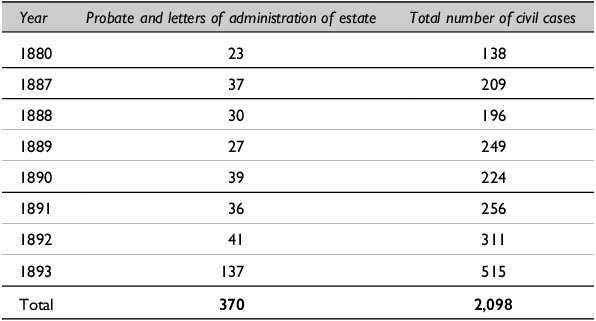
The Lagos Supreme Court’s engagement with the question of inheritance started in the 1880s, primarily by issuing letters of estate administration (see Table 1), a document that empowered a party to manage and oversee the entire process of distributing and preserving the estate of a deceased person. However, inheritance lawsuits among residents did not significantly appear in the Lagos Supreme Court records until 1898. The absence of recorded cases before 1898 does not mean the court did not hear inheritance disputes earlier; 1898 is used as the starting point because it represents the earliest cases preserved in the sources accessible to this research. Court records establish that many of these cases were initially disputes within the family that were not resolved even after the intervention of community elders. When cases appeared before the court, it was usually because a member or section of the family attempted to claim the right to inherit from a deceased relative based on English law, and the disagreeing party asked for the supremacy of Yorùbá customs.
Civil cases before the Lagos Supreme Court between 1880 and 1893a

Table 1. Long description
A table showing the number of probate and letters of administration of estate and total number of civil cases in Lagos Supreme Court from 1880 to 1893. The table has 9 rows and 3 columns. The columns are labeled Year, Probate and letters of administration of estate, and Total number of civil cases. The rows are labeled with the years 1880, 1887, 1888, 1889, 1890, 1891, 1892, 1893, and Total. The values in the table are as follows: Row 1: 1880, 23, 138. Row 2: 1887, 37, 209. Row 3: 1888, 30, 196. Row 4: 1889, 27, 249. Row 5: 1890, 39, 224. Row 6: 1891, 36, 256. Row 7: 1892, 41, 311. Row 8: 1893, 137, 515. Row 9: Total, 370, 2098.
Source: UK House of Commons Parliamentary Papers.
a PP-CP/7629-15/ 69/1895, ‘In the Supreme Court of the Colony of Lagos. Statistics, 1886 to 1893’, 7.
Settling these disputes required the court to rely on Yorùbá sources of laws and customs. Under the 1876 Supreme Court ordinance, judges were given the power to call on Yorùbá chiefs to act as experts by interpreting Yorùbá inheritance laws and customs in the courtroom. Chiefs’ testimonies were to be treated as “evidence” while the court retained the prerogative to “presume the correctness of such evidence.”Footnote 45 From 1877 onward, Yorùbá chiefs testified in the court. The earliest major highlight of such so-called expert testimonies involved the sensational appearance of Ọba Dosunmu (the Indigenous ruler of Lagos) in the court in February 1878 to testify in a land ownership dispute (Martin v. Martin). Ọba Dosunmu’s appearance attracted hundreds of Lagos residents who trooped to the court’s premises to catch a glimpse of what they must have imagined to be a strange and unprecedented occurrence.Footnote 46 This episode clarifies the mechanics of structural mimicry by showing how the Supreme Court of Lagos’ authority was constituted through dependence rather than displacement. By converting a chief’s knowledge into courtroom expertise, the court attempted to re-center Yorùbá legal interpretation within an English juridical framework without fully mastering or internalizing its spiritual, epistemological, and ritual foundations. The formal power to presume the correctness of a chief’s testimony reveals a crucial asymmetry: Yorùbá authority was acknowledged necessary, yet it was rendered incomplete unless validated by colonial procedure. The spectacle surrounding Ọba Dosunmu’s appearance underscores this tension, as public recognition of his authority coexisted with such authority’s procedural domestication. Rather than signaling the triumph of colonial law, these moments exposed its fragility and improvisation. Structural mimicry thus names a mode of governance in which colonial courts stabilized their legitimacy by selectively reproducing Indigenous legal roles, even as they reconfigured those roles to fit the logics of imperial adjudication.
The role of chiefs in the evolution of inheritance discourses in Lagos is poignant. After professionals like doctors and architects, chiefs earned the most money as experts in the court.Footnote 47 These chiefs equally brought their family disputes before the court, often involving the same aspects of Yorùbá customs that punctuated the other cases in which they were invited as experts. In other words, chiefs were incentivized to provide testimonies about customs in a way that such testimonies would later benefit their own cases in the same court. Chiefs also found themselves in a precarious role as sub-colonial agents in this judicial process. For example, there was significant pressure on them to facilitate colonial modernity, so much so that colonial governors easily dismissed individuals who did not conform. Such conflicts of interest and fears of dismissal likely influenced how chiefs talked about Yorùbá customs or opposed English law in the court. Court records were written in English, and they hardly include verbatim translations of chiefs’ testimonies, making it difficult to fully understand their activities in the courts.
To Yorùbá litigants and their relatives outside the courtroom, the new legal regime created more dissatisfaction than appreciation. It produced a genre of justice that divided Lagos along class and religious lines. While it prioritized the right of women who contracted Christian/civil marriages (and children of those marriages) to inherit from deceased men, it relegated the rights of women who married under Yorùbá customs. Also, as Christian clerics sang the praise of English laws of inheritance in church sermons because such laws strengthened their advocacy for Christian/civil marriage over Yorùbá marriage, that same development irritated Muslim residents who believed that English law was biased against Islam. The subaltern category of relegated and disgruntled Lagos residents, most of whom did not acquire a Western education, still found ways to articulate their positions.
One of these positions’ earliest and major articulations emanated on July 10, 1894. The colony’s Muslim community, led by the influential businessman Mohammed Shitta Bey, contracted the president of the Liverpool Muslim Association, a British man named Abdullah Quilliam, to write a petition to the governor of Lagos, Gilbert Carter. In the petition, the aggrieved residents expressed grave concerns about how discourses on inheritance in the Lagos Supreme Court “seek to alter the manner and mode in which the property and estates of deceased Muslims would naturally devolve under the ordinary Muslim law and practice.”Footnote 48 They did not see much difference between how inheritance devolved under both Yorùbá laws and customs and Islamic law.
Some days after the petition’s submission, Governor Carter and Chief Justice Smalman Smith met with the protesters. Smith stressed the court’s reliance on and commitment to working with “experts” to properly interpret Yorùbá customs and Islamic laws in cases involving Yorùbá Muslims. The petitioners were less moved by his assurance and instead suggested a viable solution would be to create native courts where litigants could argue “in their own [Yorùbá] language without the introduction of an interpreter…[so] everybody will understand everything that is said and justice will be done” because “at present, our people lose their heads and get confused in the courts.” Chief Justice Smith rejected the idea, noting, “You are, as fact, in no way bound to come to our Courts in civil cases. You have perfect liberty to appoint an arbitrator among yourselves, agree to be bound by his decision, and have it registered as a judgment.” Governor Carter added to Smith’s pushback with a more confrontational response and maintained that these protesters patronized the Supreme Court of Lagos “because you know that you will get justice there and you feel no confidence in your own men. Supposing such a Native Court as you suggest, there would be a constant appeal from it to our Court, as you know very well.”Footnote 49 Not much of an impact ensued immediately after the meeting because the protest did not ultimately made the court to treat Yorùbá laws and customs and Muslim litigants differently. However, Carter and Smith’s decision to meet with the protesters suggests a strong level of seriousness with which the colonial government considered such grievances over inheritance in maintaining public order.
Later in 1914, another protest challenged the government’s policy on customs. This time, diverse religious sections and classes of people in the colony participated. On February 3rd of that year, about 200 protesters, many of whom were Yorùbá lawyers (also members of the English bar), converged at the Glover Memorial Hall in Lagos. They protested the Provincial Courts Ordinance announced in January by the governor-general of Nigeria, Frederick Lugard. The ordinance subjected native courts (where Yorùbá monarchs and noblemen acted as judges) in the Yorùbá hinterlands to the supervision of British district officers and residents.Footnote 50 The protesters felt that since 1878, British officials had demonstrated that they could not understand Yorùbá laws and customs and that these native structures could not coexist with English laws. They thought that extending such forceful coexistence into the hinterlands would also fail, albeit to the detriment of colonial subjects in those territories. The lawyers present at the protest also rejected the fact that the ordinance excluded them from pleading in the native courts in the hinterlands, which they argued was “not only oppressive but takes away the liberty and rights of the people” to legal representation.Footnote 51 This 1914 Glover Memorial Hall protest demonstrated that Lagos residents, across class and religious lines, not only disagreed with the court’s treatment of Yorùbá laws and customs but also feared that the same calamity could permeate into the Yorùbá interior and cause grave consequences.
Throughout the late 1900s and 1910s, Yorùbá lawyers and other dissatisfied residents of Lagos continued to petition the colonial government to improve how British officials interacted with Yorùbá laws and customs, especially as it concerned inheritance. Among the dissatisfied residents were Lagos newspaper editors and columnists. This category of critics presented an intellectual dimension to the resistance movement and served as a conduit that transferred the public’s dissatisfaction to colonial officials. For example, during the 1914 Glover Memorial Hall protest, a leading native-run English newspaper in Lagos, The Nigerian Chronicle (TNC), provided a formidable media footing for the protest. TNC expressed the same distrust about the compatibility of English ideas of justice with Yorùbá laws and customs, especially as it concerned contentious aspects like inheritance. Its editorial desk cautioned the colonial government that the ordinance not only stood to inflict “severe hardship and very great oppression” upon people in the hinterlands but that it would also impact the Lagos Yorùbá population as well.Footnote 52 Newspapers like the TNC did not simply leave their protests to the rhetoric of condemnation. They also produced counter-interpretations of what they believed were the ideal Yorùbá laws and customs of inheritance. A case in point is a TNC special series on Yorùbá burial rites from 1908 through 1909. That series was a reader’s favorite. It was an eleven-month-long, elaborate investigation into some of the most sacred aspects of burial rites. The series also berated British officials like Alfred Burdon Ellis, whose famous 1894 ethnography of the Yorùbá guided the Lagos Supreme Court judges in adjudicating cases.Footnote 53
Native intellectuals who protested by writing columns in newspapers also published what would become some of the earliest ethnographies of the Yorùbá produced by Yorùbá natives. Among such icons of intellectual resistance was Adebesin Folarin, one of the leading organizers of the 1914 Glover Memorial Hall protest. Folarin is a largely neglected icon of Yorùbá nationalism in the early twentieth century. He once served as legal adviser to the Egba United Government and as president of the Egba Native Court, both in the hinterland town of Abeokuta. Folarin wrote several articles in Lagos newspapers defending Yorùbá customs in the 1910s, and he later published a monumental ethnography, The Laws and Customs of Egba-Land, which was one of the first elaborate legal inquiries into Yorùbá customs that covered inheritance rituals and burial rites. Although Folarin notes in the book’s preface that he intended for it to guide Yorùbá judges in native courts, he must have also hoped that British judges in Lagos took notice of this treatise.Footnote 54
Before the appearance of Folarin’s work, and probably sometime in the 1920s, another Lagos-based Yorùbá lawyer and playwright, Ajayi Ajisafe (alias Olympus Moore), published The Laws and Customs of the Yoruba People. Ajisafe’s book was also a legal treatise on Yorùbá kinship and property ownership that included an extensive explanation of inheritance rituals.Footnote 55 As a solicitor of the Lagos Supreme Court, he also likely envisioned his work as a guide for British judges in that court as much as it was intended to educate his lay Yorùbá readers. Another icon of this intellectual resistance was Isaac Delano, a prominent historian of Lagos and son of a former Egba Native Court president. Delano started collecting data on Yorùbá customs in the 1920s, culminating in the publication of The Soul of Nigeria. His scholarship is an autoethnography on the Yorùbá, contrary to its title. Several chapters in that book address inheritance-related customs, revealing the “seriousness and solemnity attached to the dead” among the Yorùbá.Footnote 56 Delano submitted that “from time immemorial the ceremonies connected with the burial of the dead have occupied a special province of their own in the life of the…[Yorùbá] natives.” He further establishes that such rites represented “self-expressions of faith and intimate outpourings of the mind.”Footnote 57
The significance of these kinds of contributions, both in the form of newspaper articles, ethnographies, and autoethnographies, is that Yorùbá lawyers who had gone through English law trainings around the turn of the twentieth century and African newspaper editors in Lagos were the intellectual heads who recast Yorùbá burial rites as being “fit enough” for colonial modernity. Their treatises challenged British officials to recalibrate their interpretive frameworks in accordance with Indigenous normative orders. By privileging the production of counter-narratives on Yorùbá customs, these lawyers asserted epistemic sovereignty and endeavored to institutionalize Yorùbá rituals of death within the colonial judiciary.
Discriminatory and Exclusionary Justice
From the 1880s, when the Lagos Supreme Court started to deal with inheritance cases significantly, until the 1920s, the overwhelming majority of the cases it heard related to the disputed real property of deceased men. In adjudicating some of these cases, the court created some of the most consequential precedents that violated Yorùbá inheritance rites and customs around land ownership. In cases where the court found it hard to use Yorùbá customs and English laws to arrive at a judgment, it instead resorted to ordering the sale of land and houses. However, in the imagination of Yorùbá subjects, this new abhorrent judicial trend severed their ties to deceased relatives. Selling land and family houses was an abominable act in Yorùbá customs before colonial rule because they were considered to be spiritual spaces that tied the living and the dead.
One of the earliest cases that cemented this trend as a precedent occurred in 1909. On 12 November 1908, the Divisional Court (lower arm of the Supreme Court of Lagos) heard pleas concerning the estate of Chief Mabinuori (Lewis v. Bankole). Mabinuori was a formerly enslaved Yorùbá man, likely in the Caribbean or South America, and he died “intestate” in Lagos in 1874. He left behind, among other things, a highly valued piece of land along the Marina and Broad Streets in the colonial capital city of Lagos. In the two decades following Mabinuori’s death, some of his children (five sons and seven daughters) and grandchildren built houses and occupied different sections of the disputed land. As Marina and Broad Streets transformed into one of the commercial epicenters of British West Africa at the turn of the twentieth century, some of Mabinuori’s grandchildren started to lease portions of the land to private companies. Other family members were aggrieved by this action and asked the Divisional Court in 1906 to declare the entire land a family relict and non-leasable by one person.
On the one hand, the grandchildren who wanted the land to be declared a family relict believed that the Yorùbá customs in Lagos had lost their integrity because of their contact with European culture. Even British judges in Lagos were of the opinion that “Yoruba law and customs are less affected by European influence” in the hinterlands, in contrast to Lagos.Footnote 58 Therefore, the grandchildren went to the Yorùbá hinterlands to find chiefs who could come to Lagos and testify as experts about “genuine” Yorùbá customs. On the other hand, the category of grandchildren who were interested in individual ownership of sections of the land turned to the chiefs in Lagos. These geographical differences in expert choices transformed Lewis v. Bankole and many similar cases, from ordinary legal disputes to cultural disputes that typify the struggle over colonial modernity in urban (often littoral) and rural (often hinterland) spaces in colonial Africa. Mahmood Mamdani described the colonialist urban-ritual dichotomy of a bifurcated African colony as friction between the “exposed” Lagos Yorùbá culture (city/littoral/modern) and the “unexposed” provincial Yorùbá culture (hinterland/interior/tribal).Footnote 59
During the hearing, British judge Edwin Speed cited the 1876 Supreme Court Ordinance, establishing that the idea of family ownership, even if existing in the hinterlands, was an “ancient native law” that was “repugnant to the principles of equity” under English laws. He ruled that each of the houses within the compound should be “separately owned.”Footnote 60 However, six months later, when an appeal came before the Full Court (the appeals arm of the Supreme Court of Lagos), British chief justices Willoughby Osborne and John Winkfield disagreed with their colleague at the Divisional Level. They instead held that the compound, from the days of Mabinuori to his grandchildren, was always treated as a family relict and that anyone who claimed to own sections of the compound, only had “possession as members of the family of Mabinuori,” which meant that other family members had “joint interests on the land” as well.Footnote 61 Therefore, the case was remitted to the Divisional Court for further consultation with Yorùbá customs. Upon a review in that court in July 1909, amid new testimonies from five senior Lagos White-Capped chiefs (Aṣọ̀gọ́n, Élétǔ Òdìbò, Ọjọrá, Ọlọ́tọ̀, Onitànọ̀), Osborne arrived at what would be two landmark pronouncements in the history of (colonial and postcolonial) Nigeria.
First, while reiterating the Full Court’s position that the entire compound was, in effect, a family relict, he declared that “the present Lagos customs [in 1909] are modifications of the original Yorùbá customs” from the provinces. Second, because the case had dragged on with immense confusion over the “ideal” Yorùbá customs on inheritance, Osborne declared that a lasting resolution would be for the court to sell the entire land. Soon afterward, Mabinuori’s land, his conduit to living relatives, was taken over by a European company that erected a factory upon it. This case was one of colonial Nigeria’s earliest publicly sensational landmark cases, drawing in the press, the church, Western-educated African elites, and European corporations. Extensive transcripts of the court’s examination of experts and the judges’ opinions appeared in the Lagos press throughout the year-long debacle, emphasizing the case’s interest to the Lagos public.Footnote 62
It was not as though the court was unaware that its judgment, ordering the land be sold, violated the Yorùbá customs that it pretended to entertain. If anything, the court had more than enough sources to draw from. For example, a Lagos chief named Faro (formerly Chief Ọjọrá before he was deposed by Governor John Glover in 1864 for a land-related issue) had, around 1891, famously testified in the Lagos Supreme Court that although “the White-Capped chiefs have the power to dispose of land…they cannot sell land and no chief could sell land” in Lagos.Footnote 63 The pioneer clerk of the court, Otonba Payne, later established the same fact about land ownership in Lagos in a 1893 publication produced for the court.Footnote 64 It was not as though the practice of not selling land faded among the Yorùbá due to colonial rule. If anything at all, it remained respected, especially in the hinterlands. A colonial government inquiry into Yorùbá customs in the 1930s attests to the fact that the practice of selling land was still abominable in the hinterlands around that decade.Footnote 65 Ajayi Ajisafe, a Yorùbá lawyer who solicited in the Lagos Supreme Court in the 1920s, cautioned in his ethnography that Yorùbá “native law in its true meaning does not recognize the sale of land” irrespective of the complex nature of an inheritance dispute.Footnote 66
The significance of the Mabinuori case lies in the fact that, despite an elaborate interaction with diverse versions of Yorùbá customs, judges in the court still struggled to make a space for those Yorùbá customs in their construction of the ideal colonial justice. Additionally, the court arrived at that calamitous resolution to sell Mabinuori’s land because it failed to treat inheritance as a ritual in the same manner as Yorùbá institutions. The court was utterly ignorant of the central questions that determined the right to inherit among the Yorùbá. The baále, baálẹ̀, bàbánsìkú, and ògbóni would have asked which relatives contributed money for the facilitation of the deceased’s burial rites? Who contributed the clothing with which the deceased was interred? Did the deceased perform a nuncupative will before death? Such ignorance and confusion among judges also resonated significantly in matters relating to will-making.
To British judges, only a written and certified will could signify the deceased’s right to speak about which surviving relatives could inherit. Whereas to the Yorùbá in this colonial period, nuncupative wills performed by a testator before death, usually to a non-relative confidant or the baále, legitimately conveyed the deceased’s right to speak. The Lagos Supreme Court was aware of this Yorùbá practice but disregarded it, hence the prevalence of intestacy cases in the court. A nuncupative will was a preferred option among Yorùbá subjects well into the 1930s.Footnote 67 These were not mere oral testimonies by testators. Instead, such testimonies also carried curses. These curses served as a form of deterrence to both the confidant, who was to relay the testimonies upon the testator’s death without any additions or subtractions, and the living relatives, who were to listen to such testimonies and take them as sacrosanct. Anyone who contravenes the nuncupative will risk bringing upon themselves grave maleficent afflictions by the spirit of the deceased and other ancestors. The Yorùbá codified such beliefs in a proverb that was still well used as a principle in the 1930s. The proverb cautioned that a “kì yí ohún òkú padà” (no one must alter the voice, that is, the will/wishes of the dead), which affirms the sacredness of a testator’s nuncupative will contrary to the dismissive view of British judges.Footnote 68
On occasions where a deceased did not leave a nuncupative will, the baále, baálẹ̀, bàbánsìkú, and ògbóni had the authority to speak for the deceased. Thus, the presence of nuncupative wills and the authority of these four actors invalidates suggestions by the Lagos Supreme Court that Yorùbá men died intestate because there were no written wills. But even when Yorùbá subjects started to embrace the idea of a written will, the court found other ways to dismiss the agency of such deceased subjects. For example, when a prominent Lagos Muslim leader, Chief Seriki Abasi Musulumi, died in 1919 and his estate became disputed two years later (Abasi v. Kopon and Others), the court had issues with Musulumi’s written will. It posited that the will was drawn up by someone who had no legal training and, partly for that reason, excluded the deceased’s son from inheriting from his father.Footnote 69
The court’s idea of inheritance was not only exclusionary but discriminatory. It often discriminated against the relatives of deceased men and instead privileged Christian wives as primary inheritors, contrary to Yorùbá laws and customs. Also, in the same breath that the court elevated the ability of such wives of Christian/civil marriages to inherit, it stripped Yorùbá women who married under native customs from inheriting from their Christian husbands. The discriminatory regime also applied to the children of marriages that were other than Christian/civil marriages. These three demographics of natives—relatives of Christian men, children of non-Christian/civil marriages, and wives of non-Christian marriages—experienced the most significant exclusion and discrimination in the court.
One of the earliest cases that exemplifies the exclusion of relatives appeared in 1898 (Cole v. Cole), concerning the estate of a Christian Yorùbá man, James William Cole. James was the former vice president of the Lagos Chamber of Commerce and a wealthy resident in the colony. In the court’s knowledge, James died intestate on April 24, 1897. Later, in 1898, the court granted letters of administration concerning the estate of James’s broader, Abraham Benjamin Cole. When the estate became disputed, the Divisional Court ruled that, according to what it heard from expert witnesses about Yorùbá customs, Abraham was the “customary heir of his brother, J.W. Cole, being born of the same father.”Footnote 70 However, the problem for Abraham was that the colonial government had introduced a law about a decade earlier, in 1884, called the Gold Coast Marriage Ordinance, when Lagos was still jointly administered alongside the Gold Coast. The law provided that no man could marry a woman under Christian rites and subsequently marry another wife under African rites. It effectively recognized wives of Christian marriages as primary inheritors under any condition. Therefore, James’s widow, Mary Cole, whom he married in 1864 in Sierra Leone under Christian/civil rites, and her son, Alfred Cole, petitioned the Full Court, citing this law. They asked to be recognized as the rightful inheritors instead of Abraham. Their plea was for English law to prevail based on James’s Christian marriage to Mary. The appellate judges agreed and departed from the lower court. It ruled that although James was Yorùbá, the fact that he engaged in a Christian marriage with Mary in a British territory (Sierra Leone) dictated that English law must apply. Thus, the court recognized Mary and Alfred in place of Abraham.Footnote 71
The Lagos Supreme Court’s privileging of Mary and Alfred angered members of the Lagos public. Throughout August and September of 1898, the colony’s leading African newspaper, The Lagos Weekly Record, led a fierce campaign against the court during the hearing. The publication and its African editor, John Payne Jackson, thought the court’s position only “subverts native conceptions and law regarding marriage, succession, and inheritance” and that the court had “not only ignore native institutions and ethics but wantonly insult them.” The publication echoed the sentiments of several Yorùbá critics of the court in noting further that the court demonstrated the English idea of justice could not accommodate Yorùbá customs because the former were “incompatible and in conflict with all that makes up life and traditions of the [Yorùbá] people.”Footnote 72
This point about incompatibility also punctuated cases that relate to the exclusion of wives and children of non-Christian/civil marriages. One of the earliest cases in the court along this line occurred in 1900 (Asiata v. Goncallo), just two years after Cole v. Cole. Another Yorùbá man, Alli Marques Elese, was also declared to have died intestate. Alli was formerly enslaved in Brazil, where he married his first wife under Christian rites. He later returned to Lagos as a freeman and became wealthy. He subsequently married two more wives, the first under Yorùbá rites and the second under Islamic rites, both of which recognized polygamy. When his estate became disputed many years later among his children, the Lagos Supreme Court declared Alli’s two subsequent marriages invalid, such that only the Christian marriage wife and her children could inherit the estate. Children of the invalidated marriages appealed the judgment, and the Full Court overturned it, ruling in their favor and noting that all children from the three marriages had equal rights to inherit because their mothers’ marriages were all valid under Yorùbá customs.Footnote 73 Indeed, this value manifests in a Yorùbá proverb recorded in the 1930s that affirmed “orogún kìí jẹ ogún orogún,” i.e., a wife cannot deprive another wife of inheriting irrespective of their differences.Footnote 74
The decision in this particular appeal was one of the rare occasions where the court sided with Yorùbá customs in inheritance cases. The court’s default position was to favor wives and children of Christian/civil marriages.Footnote 75 It was a tough condition several Yorùbá children and wives found themselves in, many of whom did not possess the resources to hire lawyers to fight for them in the lower court even to go as far as the appeals court, like Alli’s children. This outcome also reflects what scholars of colonial legal history describe as the pragmatic limits of legal imperialism, in which courts occasionally upheld customary law when rigid adherence to English norms threatened social stability or exposed contradictions within colonial governance. In such moments, colonial authority adjusted rather than imposed.
Another landmark case belonging to this discriminatory category happened in 1927. In that year, the Divisional Court heard a case (Haastrup v. Coker) regarding the estate of Ọwá Iléṣà (ruler of Iléṣà town in the hinterlands), Federick Kumokun Haastrup, who died back in 1901. Haastrup and many of his relatives lived in Lagos and acquired houses across the colony. He married Christiana Fagumell in Sierra Leone around 1848 under English law and produced two children. Haastrup later ascended the Iléṣà throne, and in line with the Yorùbá customs prevailing in the late 19th century, Haastrup inherited his deceased father’s fifty wives.Footnote 76 He had nine more children with the inherited wives. The case before the Divisional Court was to determine if Haastrups’s estate belonged only to the two children of the civil marriage or to all eleven children. Citing the landmark Cole v. Cole case, the court refused to observe Yorùbá customs again. Instead of drawing precedent from Asiata v. Goncallo, where the children of Yorùbá and English law marriages had equal rights to inherit, the court submitted that Haastrup and Fagumell married under Christian rites because they “intended to be bound by its consequences.”Footnote 77 It ruled in favor of the children of Christian/civil marriage.
Conclusion
The inheritance disputes in the Colony of Lagos exposed British justice’s exclusionary and discriminatory character. Under the 1876 Ordinance, the Supreme Court wielded the power to reject any Yorùbá practice deemed “repugnant,” yet its judges—lacking familiarity with Indigenous customs—merely replicated Yorùbá institutions without grasping their communal or spiritual significance. By privileging written wills and Christian/civil marriage spouses over nuncupative testamentary wills and customary unions, the court disenfranchised some women and their children.
Landmark decisions such as Lewis v. Bankole (1909) and Cole v. Cole (1898) illustrate how elevating written evidence over non-written sources of evidence severed families and undermined Yorùbá rituals of death. Yorùbá institutions charged with voicing the deceased’s wishes were sidelined and became legally invisible under a regime that equated “civilized” justice with the Western conception of arbitration. Meanwhile, in Yorùbá’s imagination, law must honor the spiritual and communal dimensions of personhood. Therefore, they resisted the colonial judicial regime. Lagos residents mobilized across religious and class lines, demanding a more accommodating judicial framework for deciding inheritance cases. Western-educated Yorùbá scholars recast burial rituals as fit for colonial modernity, rebutting the colonial portrayal of Yorùbá laws and customs as arbitrary.
In all, tensions over the right to inherit from the dead in this West African colony of Britain illuminate the perils of transplanting foreign legal apparatus onto ritual-embedded societies without substantive engagement. Even British officials’ mimicry of Indigenous Yorùbá institutions proved insufficient to bridge epistemic divides. Instead, it provoked resistance that reshaped the contours of both Indigenous and colonial ideas about justice.
Flow illustrating the stages of relicts management and the actors/institutions in charge.



 Open access

