INTRODUCTION
We have this saying that we are in a golden cell—la jaula de oro. It’s like we are trapped, but at least the cage is gold. It feels nice being here and I love it, but there’s also that feeling where you feel a little trapped, because you can’t leave …. It might be a false sense of security because they could take it [DACA] away whenever and then you don’t know where you stand. So, it is kind of scary jumping into something like graduate school and not knowing where I’m going to be in my status halfway through my studies. So that’s a little bit limiting because you can only make two-year plans. So that’s probably the biggest [limit]—not being able to travel and not being able to make long-term plans.
—Emilio
As Emilio, a twenty-two-year-old college graduate, reflected during our interview, the Deferred Action for Childhood Arrivals (DACA) program had significant benefits for him. The Obama administration enacted DACA through an executive action in June 2012, in response to mounting pressure from immigrant activists and Congress’s failure to pass immigration reform. DACA provides a stay of deportation and work authorization to eligible undocumented immigrants who came to the United States as children, finished high school or served in the armed forces, and do not have criminal records.Footnote 1 The relief provided by DACA must be renewed every two years and does not create a pathway to permanent residency or citizenship.
Prior to the announcement of the DACA program, Emilio planned to return to Mexico after high school graduation, but when he received DACA in spring 2013, he decided to stay in the United States to attend college. He found a job on his college campus, traveled extensively within the United States, and wanted to attend graduate school. His status as a DACA recipient had limitations, however, preventing him from traveling abroad and making long-term plans about graduate school and his career. Emilio describes his experience as una jaula de oro, a golden cage, because his opportunities have expanded yet important limitations remain. The sentiment that DACA is a golden cage is common among DACA holders and highlights the liminality of DACA status (Pérez Huber Reference Pérez Huber2015). Emilio’s narrative shows that despite significant benefits for undocumented young adults created by the DACA program, this group continues to face persistent uncertainty, which was amplified under the Trump administration.
In September 2017, the Trump administration moved to rescind DACA. A series of legal challenges led to a nationwide injunction in January 2018. Under the injunction, DACA renewals were allowed, pending a decision of the United States Supreme Court, which heard oral arguments in the case in November 2019. The Supreme Court issued a decision in June 2020 rejecting the Trump administration’s termination of the program. In this article, we examine how recipients experience the precarity of DACA, highlighting the centrality of temporariness and uncertainty in DACA status both before and after the Trump administration’s decision to rescind the program. Previous research shows that despite important gains, including economic and educational advancement and a stronger sense of belonging, DACA recipients and all undocumented immigrants continue to navigate a precarious existence in the United States (Gonzales et al. Reference Gonzales, Murillo, Cristina, Kristina, Franco, Jaein and Vasudevan2017; Wong et al. Reference Wong, Sanaa, Claudia, Tom, Ignacia Rodriguez, Greisa Martinez, Holly and Wolgin2019). DACA by its very nature was a temporary solution, and while it invited some stability into the lives of eligible undocumented immigrants, their gains have always been tenuous. We engage the concept of liminal legality to make sense of this precarity and extend this concept to show how place and historical time shape the intensity of the experience of liminality.
We draw from 179 surveys and 28 interviews with undocumented young adults in Colorado, including surveys administered before and after the Trump administration announced the rescission of DACA. Our study is situated within the broader context of the immigration policy landscape in Colorado, a site that is often overlooked but provides an interesting case because it is a mixed political context that has only become more welcoming in the last few years (Martinez Reference Martinez2014; Singer Reference Singer2015). To capture a more complete contextual picture of state-level dynamics in the wake of the DACA rescission, we also conducted community stakeholder interviews and observations at community meetings across the state. We focus on DACA recipients’ experiences across educational, economic, and emotional spheres, showing how the liminality DACA holders already experienced increased with efforts to terminate DACA. The unfolding case of DACA shows how the experience of liminality is not static in its “temporariness” but is instead dynamic, dependent on political context and place. Finally, we highlight ways that these young adults continue to navigate and make sense of their day-to-day lives despite the uncertainty of DACA, demonstrating resilience in the face of increasingly detrimental immigration policies, practices, and rhetoric.
THEORETICAL FRAMEWORK
Immigrant “Illegality” and Liminal Legality
The contemporary experience of immigrant “illegality” is a sociopolitical process that has been shaped by the historical development of US immigration law (De Genova Reference De Genova2002; Ngai Reference Ngai2004; Menjívar and Kanstroom Reference Menjívar and Daniel2014). Immigrant “illegality” also encompasses a juridical relationship to the state that in theory positions undocumented immigrants “against the law,” unable to distance themselves from the everyday influence of the law as they navigate daily life under the threat of deportation (Ewick and Silbey Reference Ewick and Silbey1998; Abrego Reference Abrego2011; Swan and Clark-Ibañez Reference Swan and Marisol2017). Yet, the experience of being against the law, that is, living in a constant state of exclusion, is not fully realized for the undocumented 1.5 generation because, as research has demonstrated, this group experiences social inclusion despite their formal legal exclusion (Abrego Reference Abrego2006; Gonzales Reference Gonzales2011; Enriquez Reference Enriquez2017). This is due in part to the 1982 Supreme Court decision in Plyler v. Doe, guaranteeing undocumented children the right to attend public school through high school (Olivas Reference Olivas2012; Motomura Reference Motomura2014). Because most undocumented young adults have spent most of their lives in the United States and attended public school through high school, the contradictory mix of inclusion and exclusion is a key aspect of this experience (Gonzales Reference Gonzales2015; Enriquez et al. Reference Enriquez, Martha Morales, Daniel and Daisy2019). And much of the research about undocumented young adults examines this exact paradox—social inclusion as youth and increasing legal exclusion during the transition to adulthood (Abrego Reference Abrego2006; Gonzales Reference Gonzales2011; Enriquez Reference Enriquez2017).
Sociologist Cecilia Menjívar (Reference Menjívar2006) introduced the concept of liminal legality to explain how Central American immigrants with Temporary Protected Status (TPS) inhabited a legal in-between space, experiencing characteristics of both an undocumented and a documented status. In the absence of comprehensive immigration reform, liminal legality has become the status quo for many immigrants, including DACA recipients (Menjívar and Lakhani Reference Menjívar and Lakhani2016; Gomberg-Muñoz Reference Gomberg-Muñoz2017). Kara Cebulko (Reference Cebulko2014) first analyzed DACA as a form of liminal legality, noting that DACA does not fully resolve undocumented status but does offer some benefits associated with documentation, including permission to work and a stay of deportation. Because DACA recipients must renew their status every two years, the right to work and other benefits are mitigated by the temporary nature of the legal status and prolonged periods of uncertainty. The two-year term of the status makes it difficult to make long-term plans, as seen in Emilio’s quote shared at the beginning of this article, creating a sense of “permanent temporariness” (Bailey et al. Reference Bailey, Wright, Alison and Miyares2002, as quoted in Menjívar Reference Menjívar2006). DACA recipients may be able to access other benefits such as driver’s licenses and in-state tuition, although this varies by state. This underscores the importance of understanding DACA’s impacts beyond traditional immigrant gateways and welcoming sociopolitical contexts, as we do in this article (Martinez Reference Martinez2014; Cebulko and Silver Reference Cebulko and Alexis2016; Roth Reference Roth2018; Silver Reference Silver2018). Furthermore, we show how the intensity of the experience of liminality varies not only by place but also by political context and time.
DACA’s creation via executive action, through a memorandum of prosecutorial discretion for individuals who came to the United States as children, further exacerbates the liminality of the DACA experience (Cebulko and Silver Reference Cebulko and Alexis2016; Cebulko Reference Cebulko2018). Executive actions are more vulnerable to repeal than legislation (Mayer Reference Mayer1999). This vulnerability was made clear when the Trump administration rescinded the program on September 5, 2017. The rescission threw the lives of DACA recipients into a heightened state of uncertainty. US Citizenship and Immigration Services (USCIS) issued a phaseout plan that excluded new applications and would let current DACA recipients’ work permits expire, stating that USCIS would not accept renewal applications after March 5, 2018. In addition to its attempt to dismantle DACA, the Trump administration’s hostile stance toward immigrants ushered in an unprecedented era of fear and anxiety, increasing both border and interior enforcement and expanding its focus to target all removable undocumented immigrants (Capps et al. Reference Capps, Muzaffar, Julia, Jessica and Ruiz Soto2018; Pierce Reference Pierce2019). Trump also issued a series of immigration-related executive actions to ban travel from Muslim countries, to limit asylum seekers, and most recently to completely halt immigration in the wake of COVID-19 (Pierce and Bolter Reference Pierce and Jessica2020). This reality, coupled with the administration’s nativist and racist rhetoric, policy of family separation, and workplace raids, created a climate of uncertainty for all undocumented immigrants living in the United States. For DACA recipients, the announced end of the DACA program underscored the centrality of liminal legality and specifically undocumented status as a key dimension of ongoing social stratification, which has detrimental consequences not just for DACA recipients but also for the communities they call home (Cebulko Reference Cebulko2014; Patler and Pirtle 2017; Cebulko Reference Cebulko2018).
DACA’s Impacts
DACA, like other immigration policies and practices, is a key structural force that shapes immigrants’ incorporation pathways and sense of belonging (Menjívar and Abrego Reference Menjívar and Abrego2012). As research shows, the transition to adulthood and “illegality” (Gonzales Reference Gonzales2011, 2015) is fraught for undocumented young adults precisely because they occupy a relatively protected social position as children, especially in relation to undocumented immigrants who migrate as adults into the world of work (Abrego Reference Abrego2011; Gleeson and Gonzales Reference Gleeson and Gonzales2012). This socializing experience profoundly shapes undocumented young adults’ aspirations and expectations for social mobility in the United States (Gleeson and Gonzales Reference Gleeson and Gonzales2012; Terriquez Reference Terriquez2014). Distinct from undocumented immigrants whose primary socializing experience is through work, undocumented young adults, particularly high-achieving students, experience significant social inclusion through school (Abrego Reference Abrego2011; Gleeson and Gonzales Reference Gleeson and Gonzales2012; Aranda, Vaquera, and Sousa-Rodriguez Reference Aranda, Elizabeth and Isabel2015). As a result, those who migrated as children develop a different sense of belonging in the United States, envision different opportunities for social mobility, and have different expectations for their futures—most cannot imagine returning to their country of birth (Gleeson and Gonzales Reference Gleeson and Gonzales2012). This desire to stay in the United States was amplified with the introduction of the DACA program, which for the first time brought undocumented young adults’ hopes and aspirations into alignment with their legal opportunities for social mobility and reprieve from the direct threat of deportation.
Since 2012, when DACA was introduced, research has shown significant economic and social gains for eligible undocumented young adults (Gonzales, Terriquez, and Ruszczyk Reference Gonzales and Bautista-Chavez2014; Gonzales et al. Reference Gonzales, Murillo, Cristina, Kristina, Franco, Jaein and Vasudevan2017; Wong et al. Reference Wong, Sanaa, Claudia, Tom, Ignacia Rodriguez, Greisa Martinez, Holly and Wolgin2019). Within the first two years of the program’s implementation, many DACA recipients reported getting new jobs, increasing their work earnings, and experienced reduced fear and anxiety related to deportation (Gonzales, Terriquez, and Ruszczyk Reference Gonzales, Veronica and Stephen2014). This trend has continued, with longitudinal research showing that many DACA-eligible undocumented young adults also returned to school, entered training programs, and got jobs that better matched their education and skills (Gonzales et al. Reference Gonzales, Murillo, Cristina, Kristina, Franco, Jaein and Vasudevan2017; Hsin and Ortega Reference Hsin and Francesc2018; Wong et al. Reference Wong, Sanaa, Claudia, Tom, Ignacia Rodriguez, Greisa Martinez, Holly and Wolgin2019). With these increased economic opportunities, DACA recipients have also purchased cars and homes (Wong et al. Reference Wong, Sanaa, Claudia, Tom, Ignacia Rodriguez, Greisa Martinez, Holly and Wolgin2019).
Beyond these socioeconomic benefits, there have been important emotional and psychological well-being effects for DACA recipients. Drawing from survey data collected with Latino undocumented youth, Patler and Pirtle (Reference Patler and Whitney2018) showed that gaining DACA status significantly reduced negative emotions and increased well-being. Relatedly, DACA recipients reported a more secure sense of self. A separate study found that DACA recipients reported an increased sense of legitimacy (Gonzales, Terriquez, and Ruszczyk Reference Gonzales and Bautista-Chavez2014) and lowered anxiety about their own deportation (Enriquez and Millan Reference Enriquez and Millan2019). Nevertheless, DACA recipients express continued fear and anxiety about the deportation of their parents and other family members who are not protected by DACA (Patler and Pirtle Reference Patler and Whitney2018; Enriquez and Millan Reference Enriquez and Millan2019).
DACA and Place
There is growing evidence that DACA’s impact varies depending on where one lives (Martinez Reference Martinez2014; Cebulko and Silver Reference Cebulko and Alexis2016; Gonzales and Burciaga Reference Gonzales and Burciaga2018; Roth Reference Roth2018; Silver Reference Silver2018). The decades-long inability of the US Congress to pass major immigration legislation has ushered in a period of devolution and “immigration federalism,” with significant differences in policy and legal regimes across cities, counties, and states (Coleman Reference Coleman2012; Gulasekaram and Ramakrishnan Reference Gulasekaram and Ramakrishnan2015). The context of reception is also differentiated according to local economic, social, and political characteristics (Ellis and Almgren Reference Ellis and Gunnar2009; Phillips and Robinson Reference Phillips and David2015).
Given the increased importance of place in determining immigrant reception and incorporation, scholars have noted the need to diversify research on DACA, which has primarily been conducted in the major gateway states with the highest concentrations of DACA recipients (Cebulko and Silver Reference Cebulko and Alexis2016; Cebulko Reference Cebulko2018; Roth Reference Roth2018; Silver Reference Silver2018). This article contributes to the effort by focusing on Colorado, a reemergent immigrant gateway (Singer Reference Singer2015) and the state with the eleventh-largest number of DACA recipients.Footnote 2 Colorado is an advantageous study site because it has historic links to Mexican migration, like a traditional immigration gateway, but also shares many characteristics with new immigrant destinations because immigration has re-intensified and diversified in recent decades, after a relatively dormant period in the mid twentieth century (Singer Reference Singer2004, Reference Singer2015; Durand, Massey, and Capoferro Reference Durand, Massey, Chiara, Zuñiga and Hernandez-Leon2005). Denver’s population is now 30 percent Latino and 15 percent foreign born.Footnote 3 Colorado is also at the heart of “New West” rural migration trends, with wealthy domestic migrants and vacation home buyers driving gentrification in mountain resort towns. This has spurred a parallel migration, attracting new influxes of immigrants to work in the construction and service industries in these towns (Schmalzbauer Reference Schmalzbauer2014; Nelson, Trautman, and Nelson Reference Nelson, Laurie and Nelson2015). Finally, agriculture brought immigrants to Colorado’s rural plains and valleys historically and continues to do so today (McIntosh Reference McIntosh2016; Simpson Reference Simpson2017).
The state’s traditionally moderate-to-conservative political context fueled an initial restrictive response to this growth. In 2006, Colorado became one of the first states to introduce a “show me your papers” law (Martinez Reference Martinez2014). More recently the state has become more welcoming (Jones Reference Jones2018), with long-term grassroots mobilization securing passage of an in-state tuition law for undocumented students and access to driver’s licenses for undocumented residents. In May 2019, Governor Jared Polis signed a law granting access to state financial aid to undocumented college students. Despite this trend, supporters of restrictive immigration policy remain a strong constituency in Colorado. Our focus on Colorado highlights how DACA recipients are faring in nontraditional immigrant gateways and in mixed sociopolitical contexts.
DATA AND METHODOLOGY
Data Collection
We started the Colorado DACA Project in Spring 2016 with the aim of understanding variability among undocumented young adults within one state. The Trump administration’s changes to the sociopolitical context at the national level after it took power in 2017 prompted an additional research question: How were DACA recipients perceiving the legal uncertainty of the particular moment? This article draws from unique pre- and post-Trump survey data, complemented by interviews with DACA recipients and community stakeholders, to understand both how DACA recipients in Colorado experienced positive gains and how they responded to the proposed termination of the program.
Survey
We conducted two rounds of onlineFootnote 4 surveys, with substantial but not complete overlap between the questionnaires. The first round of surveys were collected in March and April of 2016 with email recruitment of DACA recipients in partnership with a single community organization in the Denver-Boulder area. This first round (“2016 survey”) yielded fifty-seven completed responses. The second round (“2018 survey”) were collected from September 2017 through October 2018, with more than 85 percent of responses collected in 2018. We worked with community groups and immigrant-serving nonprofits to recruit survey participants, including through direct emails, flyers, and Facebook posts. We collected a total of 122 completed responses to the 2018 survey. It is possible that some individuals participated in both the 2016 and 2018 surveys, but due to the anonymous data collection and storage protocols, we are not able to estimate the overlap nor link individuals’ responses between rounds.
In both survey rounds, we offered $20 incentives for completed, valid responses. We took multiple steps to safeguard the validity of responses, including using anti–ballot stuffing features in the Qualtrics survey software to prevent multiple responses from a single IP address, using a Captcha test to prevent automated responses, using a geolocation feature allowing confirmation that responses came from within Colorado, and finally employing a mix of automated and manual screening to exclude responses that appeared to be fraudulent, looking for things like extremely short response times, nonsensical short answer responses, substantial inconsistencies between answers, and copied-and-pasted text appearing verbatim in multiple responses.Footnote 5
Given the limitations of surveying DACA recipients, we are not able to calculate error margins nor claim that our sample is representative of the larger population of Colorado DACA recipients. It is important to recognize that the data presented here are only a description of our participants’ responses. Furthermore, comparing our data to other sources suggests that our sample from 2018 is skewed toward younger respondents, particularly overrepresenting college students. According to USCIS data from February 2019, active DACA recipients had a median age of 25 and an average age of 25.2.Footnote 6 In contrast, our 2018 sample had an average age of 22.4 and a median of 21. The younger age distribution of our survey respondents likely affects our results. For example, the respondents to our 2018 survey were more likely to be single (never married) compared to the composite data from USCIS (90 percent vs. 78 percent).
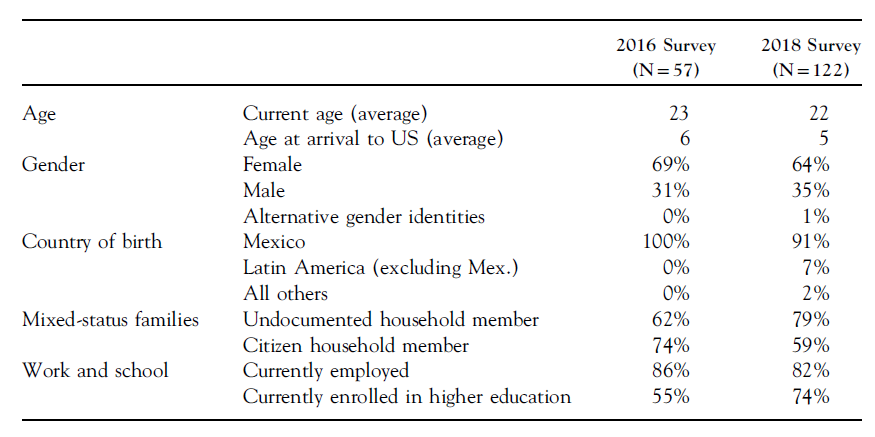
The characteristics of respondents from the 2016 and 2018 surveys are summarized in Table 1.
Respondent Characteristics, 2016 and 2018 Colorado DACA surveys

Interviews
In addition to surveys, we completed twenty-eight semistructured interviews with DACA recipients, conducted between December 2018 and December 2019. Twenty interviews were completed with DACA recipients who currently live in Denver and Boulder; seven interviews with DACA recipients living in the Grand Junction region, also referred to as the Western Slope; and one interview with a participant living in a mountain resort community. Interview questions focused on participants’ experiences with applying for DACA, the renewal process, the material and symbolic benefits of receiving DACA, and future plans. Interviews were audio-recorded and lasted between ninety minutes and two hours, and participants were compensated with a $40 gift card for their time. Interviews were transcribed by both professionals and research assistants.
Between the first and second survey rounds, we also conducted three in-person interviews with staff members at immigrant rights community-based organizations in different parts of the state. The initial purpose of these meetings was to continue refining our data collection and analysis approach, improve recruitment for the second survey round, and to incorporate the perspectives and knowledge of these key stakeholders. These interviews during the summer and fall of 2017 yielded crucial insights about how immigrant rights organizers and legal services providers were navigating the termination of the DACA program alongside DACA recipients. Visiting each place in person, though briefly, also strengthened our understanding of the diverse contexts within which Colorado DACA holders live. During this time, we also attended two community forums in rural areas, in which community organizers provided updates about DACA. During these interviews and meetings, we took extensive fieldnotes, which we later transcribed and include in our data analysis and results. All names used in the article are pseudonyms.
FINDINGS
Through survey and interview data, we found that DACA recipients were acutely aware of the limitations and temporary nature of the program. The announcement of the end of the DACA program in 2017 amplified the uncertainty participants had mostly managed until that point and underscored the need for a permanent and long-term solution. In the sections that follow, we trace how DACA recipients in Colorado have responded to and experienced liminal legality. We start by showing how recipients in Colorado benefited from DACA and how they perceived the liminality of their status, especially as the 2016 presidential election was unfolding. We then show how community stakeholders and DACA recipients responded to the election of Donald Trump and the announcement of the termination of DACA. Participants conveyed an array of emotions and reactions, including anger, worry, hope, and resolve. This was true across our analyses of surveys and interviews and often occurred within one interview, emphasizing the complexity of this experience. DACA recipients described the educational, economic, and emotional implications of the announced wind-down of the program. Just as DACA had important psychological and well-being implications for recipients, tied in part to increased financial independence and security both for themselves and their families, the prospective end of the program threatened these gains. Finally, we discuss how DACA recipients were coping and making sense of the amplified legal uncertainty under the Trump administration, demonstrating resilience and hope in the face of an increasingly hostile sociopolitical context.
Liminal Legality Pre-Trump: The Fundamental Uncertainty of DACA
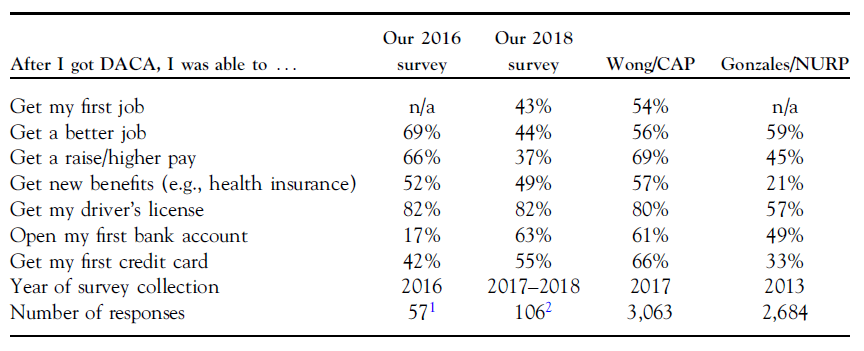
The first major, national survey of DACA recipients, completed in 2013, the first year of the program’s existence, revealed that many DACA holders found new jobs, increased earnings, obtained driver’s licenses, and opened bank accounts (Gonzales, Terriquez, and Ruszczyk Reference Gonzales, Veronica and Stephen2014). Subsequent national surveys document similar benefits among DACA recipients and continued career progression and wage growth (Wong et al. Reference Wong, Greisa Martinez, Adam, Henry, Adrian, Patrick, Tom and Wolgin2017). While the inherent limitations of our surveys preclude us from drawing statistically significant comparisons, we note that our respondents in 2016 and again in 2018 saw substantial employment, educational, and general life gains with DACA, mirroring the national data (Table 2).
DACA Benefits: Comparison of results from our Colorado data with Wong et al. (Reference Wong, Greisa Martinez, Adam, Henry, Adrian, Patrick, Tom and Wolgin2017) and Gonzales et al. (Reference Gonzales, Veronica and Stephen2014) surveys. Comparisons are approximate—question wording and survey design were not standard and precise equivalence cannot be assumed between surveys

1 It is possible that some individuals participated in both the Boulder pilot and the final Colorado DACA survey, though we estimate that the overlap is small.
2 Our total sample size was 122, but 16 respondents completed an earlier version of the survey that did not include these questions in their final format, leaving 106 completed responses to these questions.
The first round of the Colorado survey was collected during March and April of 2016, when the Obama administration had nearly a year remaining, and a Trump presidency still seemed a remote possibility to many observers. At that time, four major candidates remained in the Republican presidential primary field, and Trump would not clinch the nomination until May and the presidency until November. A few participants did mention Trump by name in their responses to our 2016 survey, but by and large we consider the responses to be reflective of Obama-era experiences and perspectives. Even under the Obama administration, there were substantial concerns about the impermanence and limitations of DACA. Other studies have also revealed this reality, for example, documenting the substantial numbers of DACA-eligible young people who did not apply (Batalova, Hooker, and Capps Reference Batalova, Sarah and Randy2014; Wong and Garcia Reference Wong and Angela2016), with fear or lack of trust in the program being a significant reason for staying away (Gonzales and Bautista-Chavez Reference Gonzales and Bautista-Chavez2014).
Our surveys found impermanence and limitations were central concerns for DACA recipients. Many 2016 survey respondents noted the expiration dates printed on their work permits and the need to renew DACA every two years. Some respondents felt that employers were reluctant to promote them or invest in them because their work permits have a two-year expiration cycle. Vanessa, a twenty-eight-year-old working in the health care sector, explained, “The fact that it’s a temporary status, you can have it now but nothing guarantees you’ll have it always. A lot of jobs want long term employees, that’s not always possible when you’re given permission to work for two years at a time and have to renew your work permit every time.” Others said banks would not approve them for loans for the same reason. Bryan recounted, “a housing loan application did not believe I had status or that my status was going to be available/valid after the expiration date on my employment document.” DACA status had allowed him to quit the overnight shift at a fast-food restaurant and instead work as a paralegal making three times as much, yet the liminality of a two-year renewal cycle precluded him from buying a home. The same was true for Luz, who explained how it affected not just her, but her family as well. “As a mother I want to provide my son with a stable home for us and a lot of banks don’t offer home mortgages to DACA people. And it’s very hard to get loans on anything since they see it as a ‘temp’ residency.” Luz, like other DACA recipients who answered the 2016 survey, observed that DACA was as a “temporary” residency, limiting longer-term job mobility and homeownership.
In addition to the concrete ways that expiration dates and renewal cycles affect aspects of their lives such as jobs and mortgages, more intangible forms of uncertainty were also widespread among respondents in 2016. They noted many positive changes that DACA had facilitated, but nonetheless were aware that it had significant limitations. The following brief quotes reflect the feelings of instability and fear that were prevalent in the 2016 survey responses:
“I am absolutely lucky to have DACA status, it is terrifying though that it can all go away in any given moment.” Ruby, 19.
“DACA has been a very positive thing to my life in general. However, there is always the fear of political decisions taking away this dream and throwing my life into chaos.” Mario, 18.
“Even though I am really grateful for the opportunities that DACA brings there is still that fear of losing everything.” Liz, 22.
“There is a sense of insecurity as well, not knowing what will happen with the new presidential election, however, I am blessed to have this opportunity and I will take advantage of it as much as I can.” Guadalupe, 26.
“DACA is only temporary and at the moment that it’s eliminated [it] could jeopardize my whole life.” Kevin, 20.
Most recipients were fully aware of DACA’s limitations even before the Trump administration announced the program’s wind-down. They understood and viscerally experienced the reality that DACA was from the start a liminal status, short of full rights and with no pathway to achieve them. Bertha, a paraeducator from Boulder, captured the full complexity of this uncertainty: “I guess we are still seen as illegal immigrants and we still don’t get all the benefits of being a resident … DACA has opened many opportunities for me. I am very grateful, but I hope that one day we can have the opportunity to become US permanent residents and US Citizens.” Even as respondents noted the limitations of DACA, they confidently exerted their claims to belonging and the need for a permanent fix, as exemplified by Danira’s comment: “I wish there could be a road to citizenship with DACA. My life is here, I was not born here but I was brought to the US [when] I was eight months [old]. My country is the US, I grew up here, I was taught here. Mexico is my native country and I’m proud to be Mexican, but I don’t know Mexico.” The 2016 survey responses revealed the ways that impermanence and liminality have been part of the DACA experience since the program’s introduction in 2012. DACA was never a clean or complete break from the precarity of undocumented life. The election of Donald Trump and the ascendance of nativism heightened uncertainty, but, as our survey data from 2016 clearly demonstrate, the weight of uncertainty and impermanence did not begin with the Trump administration although it did intensify in 2016 with his election. While uncertainty and inability to plan for the longer term is a defining characteristic of the liminal legal status of DACA recipients, the sections that follow demonstrate how this experience has varied over time and was shaped by the national political context.
Post–Presidential Election and DACA Rescission
The DACA rescission was announced in 2017, after our 2016 survey had been administered but before we could expand and launch a second round, prompting a delay of second-round data collection. We were deliberate about providing space for DACA recipients to process the disruptive nature of the decision to terminate the program, and we did not want to burden potential participants or risk additional emotional distress during this period. Rather than immediately continue the planned data collection, we conducted informational interviews and attended community forums about the rescission announcement to gauge the appropriateness of continuing the study. Within the first month after the termination announcement, community stakeholders including legal services providers and community organizers told us that a sense of apprehension was heightened among DACA recipients. They shared that DACA recipients, especially in the rural-agricultural and mountain resort areas outside of the metropolitan Denver region, were “going back into hiding.” Describing an increase in anti-immigrant hostility, one community organizer lamented, “we feel like we’ve gone fifty years back, literally, overnight” (Fieldnotes, September 15, 2017). In the year following the election of Trump, community-based organizations described investing time and effort in securing and expanding mental health services for all undocumented immigrants, including DACA recipients (Fieldnotes, September 15, 2017), highlighting the emotional toll that his anti-immigrant and nativist politics had taken.
At the same time, multiple rural and resort community stakeholders emphasized that in the context of increased fear and tensions, they were trying to keep a low profile and avoid stoking any controversy or drawing unwanted attention to their organizations or the immigrant communities they belong to and serve (Fieldnotes, September 1, 2017, September 15, 2017). In one meeting, a rural Latinx organization had been invited by allies from the white community to participate in a rally against the cancelation of DACA. There was palpable discomfort in the room, as people worried that anti-immigrant counterprotesters might come to confront them or even provoke violence. The organization’s leader called the local newspaper specifically to ask that they not mention the rally in the newspaper’s list of upcoming events (Fieldnotes, September 8, 2017). These observations show that the undocumented immigrant community in this rural setting experienced a stronger sense of unwelcome and were motivated to be more cautious than organizers in the Denver metropolitan region. In contrast, on the day the rescission was announced, an estimated 2,500 people gathered at a university campus in downtown Denver to protest the decision, and one activist shared in front of the crowd, “I’m still an immigrant, I’m still undocumented, but I will not stand down just because they tell me to” (Fieldnotes, September 5, 2017).
By 2018, it was clear that most DACA recipients sensed that the election of Donald Trump had emboldened anti-immigrant supporters, making our respondents feel as if they did not belong, even with DACA. Gloria, who was pursuing a graduate degree and taught college students, described in our interview how in the wake of the presidential election, a student came to her class wearing a “Make America Great Again” hat. She observed, “Racism is a foundation of this country, but it was hidden. They felt they had to be politically correct, but since it is now legitimized by the authorities, people are coming out of the shadows … since the election I’ve had more students that are just freer in expressing their conservative views.” As Gloria and others noted, the election of Donald Trump, who relied on xenophobic and nativist discourse, empowered others to express these same sentiments. Gloria draws from a metaphor often used to describe undocumented youth activists, “coming out of the shadows,” to emphasize the point. Giselle, a college student, echoed during an interview, “I think Trump has given a voice to those people that don’t like immigrants. Now they are very vocal in expressing that immigrants should go back to wherever they come from.” Amplifying Gloria’s sense that this anti-immigrant sentiment was not a new phenomenon, Jorge, also a college student, shared, “Under Obama, the negativity was still there, but not as outspoken … now that we are under the Trump administration, since one of his main viewpoints is ‘build a wall,’ more people are comfortable sharing that view because a person in power and public figure has the same mentality as them.” The rhetoric of the administration made many respondents question their sense of social belonging. It also affected their sense of well-being. As one survey respondent shared, “I feel disheartened by the new administration. I feel like people wildly misunderstand the reasons people are pushed to immigrate to this country and they misunderstand how much the US contributes to the problems that pushes families to immigrate to the US.” Revealing a nuanced understanding of the sociopolitical context, nearly all of the survey respondents and interviewees expressed frustration, disappointment, and anger about the administration’s stance toward immigrants. They also intuited the rhetoric of the Trump administration as a prelude to action. These anxieties were realized when the Trump administration announced the cancelation of the DACA program.
The Educational, Economic, and Emotional Consequences of the Termination of DACA
Our 2018 round of surveys and interviews were conducted in the months following the announcement of the DACA rescission. During this time, the fate of the program was in the hands of the courts. The surveys and interviews showed that the educational, economic, and emotional gains respondents made because of the DACA program were intimately connected. During interviews, individuals described gaining self-confidence through their educational achievements and economic stability. Being able to purchase a car or put telephones in their own name for themselves and their families increased their sense of self and independence. The termination of the program threatened multiple facets of their lives, which were difficult to disentangle and engendered complex and at times contradictory responses within and across surveys and interviews.
Seventy-two percent of respondents to the 2018 survey said it was unlikely or very unlikely they could keep their current jobs if DACA were terminated. DACA recipients expressed anxiety about how they would continue to meet their financial obligations including paying bills, rent, and school expenses. Many highlighted that it would become much more difficult to pursue higher education due to loss of scholarships and jobs that make education possible, even with in-state tuition for undocumented students. While Colorado now offers in-state financial aid for undocumented students, in 2018, Colorado did not offer this benefit and participants often worked multiple jobs to pay for college. These cascading consequences would close the doors that DACA had opened and upend lives in ways that go far beyond the ability to work legally. Tania described in an interview how both she and her brother, also a DACA recipient, had taken primary financial responsibility in their family. Tania shared, “Me and my brother both have full time jobs, and with our mom she doesn’t have any working status, so she mostly relies on us to pay the bills. So, it [DACA] has helped to create more financial stability.” Tania went on to describe that with DACA both she and her brother purchased cars and were building their credit, not only an indicator of financial independence but also a source of pride.
When we interviewed thirty-three-year-old Clarisa, a mother of two young children, she, like Tania, described the immediate impact of DACA on what she had been able to accomplish. “The dream that I had when I was small—getting my license, being able to buy my own things with credit, normal stuff that people do.” Clarisa, who lived on the Western Slope, a rural part of the state, emphasized that with DACA, she moved into a job with “better pay, hours, and benefits” that gave her the financial freedom she needed to buy a car. She used her car to take her children to school and to get to work, and it made life easier for her family, especially in the winter. She elaborated that one intangible benefit of DACA was, “I am more confident. I can do stuff by myself instead of depending on others—a sense of independence.”
Like Clarisa, eighteen-year-old Gael, who had just completed his first year of college at the time of our interview, shared, “I think it has affected my self-confidence … I don’t look at challenges or even daily life as something that could be an obstacle anymore. With DACA I have been able to travel for school and I think that’s an experience that you can’t take away regardless of what happens next.” With DACA, Gael was able to obtain a prestigious internship that facilitated travel around the United States. He described visiting New York City, Atlanta, San Francisco, and Los Angeles. While the day-to-day lives of Gael and Clarisa looked different, they both experienced increased sense of self and confidence navigating the world. Both in the survey and in interviews, participants described feeling normal, experiencing an increased sense of security and lowered anxiety related to the transition to increased job stability and security.
In addition to obtaining jobs that offered security, DACA recipients also described transitioning into jobs that were on a path to social mobility. Valeria, an interviewee who worked in administration at a dentist’s office, shared that without DACA, “I definitely wouldn’t be able to work, at least not where I work now.” As one survey participant reflected on DACA, “I was able to have goals in education, to think about having a professional career. Nobody, not even my family taught me to aspire toward those things because they believed it would be impossible. I had the motivation in high school, despite all the odds against me. All that was missing was the status. I now have an exceptional career that far exceeds what anyone had envisioned for me.”
For some participants, their work enriched their sense of purpose. Pedro worked in student services at his university. In this position, he helped other students navigate the process of entering college. During our interview, he shared that it helped him to feel like he belonged, as he described, “I feel like I do a really good job and I feel like my dignity and respect is acknowledged.” A survey participant described how with DACA he stopped working under the table in restaurants, and instead started working as a community organizer. Rather than enabling just any job, DACA opened doors for social mobility and community impact—as Rolando noted in the survey, his work allowed him to “give back to mi gente (my community).” Rolando was working at the time for a major immigrant rights organization in the state, advocating with DACA recipients and the broader undocumented immigrant community in mountain resort communities. During our interview, Sabrina, who was working two jobs to pay for school, shared that her prospective career as a teacher gave her pride and a sense of belonging. The end of the DACA program, however, “would break everything. It will probably make it difficult to finish my degree because working with children requires you to pass a background check, and I would not pass. So literally everything I do, I wouldn’t be able to do it anymore. Not legally for sure.”
The threat of losing DACA status was a constant stressor for participants, in part because it would have very concrete consequences, including those related to work. Beyond work, however, many participants had developed more confidence and sense of self, and assumed more responsibility within their families. The threat of the DACA program ending had consequences for their emotional health and well-being. While the survey did not explicitly ask how participants felt about its possible termination, some participants did reflect on the potential loss of DACA in open-ended responses. As one young woman survey participant summarized, “If I lose my DACA, I will lose my jobs after my work permit expires, my ability to be proud of my status and my story goes away because I am no longer safe from deportation, I will lose confidence in this country.” Another respondent reflected: “Losing DACA would be an interruption for my identity formation. I was raised in Colorado since [I was] eight months of age and since have never stepped a foot in my country of birth. Understanding my place in the world, when the world I know is taken away, will be my greatest challenge. My entire goals and aspirations in life would have to change.” Others expressed acute fear, anxiety, and worry. A survey respondent described “feel[ing] on edge all of the time because I don’t know if DACA will be removed while I am in college.” Another shared, “I am worried. I try not to let it get to me, but there’s always a worry in the back of my head.” Survey respondents and interviewees described the toll that the DACA rescission was having on their mental health. As one survey respondent shared, “The impact of waking up one day without DACA cannot be overstated. One can have a plan, but no plan is 100 percent reliable. The mental toll it takes on people is harsh. It affects every single part of the day. One cannot feel at ease and enjoy a moment of leisure without having to carry the uncertainty that lies ahead while having DACA.” Similarly, Patricia, a full-time college student, shared “I feel scared for the future of DACA, I want to be hopeful but with this political climate I am mostly fearful.”
For most of our respondents, the impact of DACA extended beyond their own lives to their families. Joanna, a recent college graduate we interviewed, had plans to attend graduate school but noted that those plans would be off the table if she lost DACA. She also enjoyed traveling around the United States and wanted to find a job that would be a “career.” Beyond the impact on her future plans, she shared that she and her friends, also DACA recipients, were “really happy” to get DACA because they could work and help their parents with bills. She elaborated, “I think it’s [losing DACA status] going to be like a very heartbreaking moment for my family …. It’s going to be a heavy burden on my dad because we’re helping him with bills. He would have to take responsibility back to work extra hard. That’s why for me it breaks my heart because I don’t want them to be working hard. You know, now that I can work, I want them to have to work less.” DACA recipients were painfully aware of the ripple effects that cancelation of DACA would have for their families. In fact, during interviews, it was often when discussing their parents and families that participants became the most visibly emotional. This emotionality reflected a deeply felt understanding of the sacrifices their parents made by immigrating to the United States, and an acknowledgment that there was no path for their parents to adjust their status or apply for any form of legal protection. In both interviews and surveys, respondents referred to their parents as the “original dreamers” and wanted to see immigration policy recognize their parents’ humanity. As one survey respondent wrote, “I am fine with DACA, but my mother and family members also deserve something. I am no more of a human than my mother is, and I do not deserve anything more than she does.” Another survey respondent noted, “My family matters just as much as I do. My mother matters, my aunt matters, my cousins matter.” Underscoring the sense that DACA is not enough, another survey respondent observed, “I hope to see a change that can help all undocumented people including adults that don’t have an education. I know it is something that is not realistic with our current political climate, but I do not want to lose hope that one day, someone will advocate enough to grant everyone a pathway to citizenship.” Despite the temporary nature of DACA and the persistent uncertainty DACA recipients experienced, both survey and interview participants described maintaining a sense of hope as they navigated their day-to-day lives, asserting agency in the face of significant structural challenges.
Coping with Intensified Liminality and the Threat of Cancelation
A common feature of our interviews and surveys was the inclusion, from a single respondent, of both deeply pessimistic and brightly optimistic attitudes toward DACA and life in general. The intensified liminality caused by the announced cancelation created mixed effects that in turn provoked complex and at times contradictory feelings in DACA recipients. These contradictory feelings about DACA emerged throughout our interviews with participants but were most apparent when recipients discussed how they would manage day-to-day life should the DACA program end. David, who was an outlier in the study because he had not completed or enrolled in college at the time of our interview, described how DACA offered the chance to explore a different career path. At the time of our interview, he was an independent contractor working in graphic design and the film industry, a job that did not require DACA. While he was anxious about losing DACA, he knew he would be able to continue working with or without DACA. He shared that he did not feel “as anxious or nervous because I am not in school and do not depend on DACA for a work permit for my job.” But he also joked, “come back to me in a year or two when my DACA is closer to expiring” to see if he felt differently. While David surmised that he felt less anxiety about the end of the DACA program because he was an independent contractor and not a college student, he also reflected about his parents’ ability to make it in the United States as undocumented immigrants. Specifically, he drew from his father’s experience as a business owner for comfort and inspiration.
Like David, most of the DACA recipients surveyed and interviewed for this study understood that it was possible to navigate daily life “fully undocumented.” This was because many participants were part of mixed-status families and had undocumented parents who had built a life in Colorado without papers. While in the early 2000s Colorado was at the forefront of moves toward restrictive state-level immigration policies, mobilization by immigration advocates pushed the state to become more welcoming. This organizing led to the repeal of anti-immigrant laws and passage of new ones making driver’s licenses and in-state tuition available to undocumented immigrants (Burciaga and Martinez Reference Burciaga and Martinez2017). Experience with Colorado’s hostile-then-welcoming political climate formed the context within which participants conceptualized what losing DACA would mean. Although the shift in the political context in Colorado explains why some participants could envision a life in Colorado post-DACA, participants drew inspiration from their parents, many of whom had never been eligible for any form of immigration relief. As one survey participant noted, “DACA has opened so many doors for me … I do not define all my successes or my identity around DACA, it is a paper. But it is also not the end of my world if they take it away because I have seen my parents get ahead without it.” Echoing this sentiment, another survey respondent reflected, “Although I am grateful for DACA, it is not enough. I also do not think DACA nor my undocumented identity defines or diminish[es] me. They are a part of me, but they do not define or diminish me.” While the constraints of the DACA program, including the threat of termination, shaped how DACA recipients navigated daily life, these reflections demonstrate how participants asserted agency by challenging discursive and policy attempts to erase or essentialize their experiences. By articulating critiques of DACA and by extension the broader immigration system, DACA recipients were able to make sense of the program’s benefits and drawbacks, and also assert an oppositional consciousness, or an acknowledgment of the “relation between the lived experience of oppression and the empowered realization that things do not have to be this way” (Negrón-Gonzales Reference Negrón-Gonzales2013, 1289; Martinez and Salazar Reference Martinez2018).
Another way that DACA recipients managed day-to-day life was to stay focused on the present moment and the goals they could achieve with DACA. Emilio, the recent college graduate quoted on the first page, discussed how DACA made him feel not quite secure, but more hopeful. During the interview he described how he felt at times like he was at “the mercy of politicians who have their own agendas.” But that he did not really “put his security on them,” demonstrating that he was taking control of his own life despite the uncertainty of DACA. He added, “I just try to put myself in the best position possible for anything that happens—whether they decide to give us a path to citizenship or whether they decide to take all protections away …. But I’m hopeful and I’ve been very lucky to have gotten DACA when I did and to be where I am. So, I don’t worry too much about what they are doing. I keep my hopes up.” For Emilio, putting himself in the best position possible meant finishing his undergraduate degree, gaining research experience, and positioning himself to attend graduate school. Survey respondents echoed this orientation toward the present and focusing on what is within their control, including continuing their education and advancing at work. As one survey respondent shared, “You never know where things will be in a year, work hard so when opportunities do arise you are ready for them.” We note, however, that this strategic adoption of a short-term orientation that helps DACA recipients maintain a positive outlook must also be recognized as a coping strategy against the legal violence of liminal legality, through the enforced inability to plan for and shape one’s own future (Menjívar and Abrego Reference Menjívar and Abrego2012). As Braulio shared, “there’s an expiration date to the things you want to do. I know people who have had issues getting a five-year car loan … or buying a house. So, it [DACA] is limited in that sense where people just see that number and say well, that’s where the opportunity stops. At the beginning when Colorado started giving IDs, they were only valid until the date that DACA expired, and other states do the same. Everything you have is only valid until that date.” Among survey respondents, only 32 percent thought a permanent or long-term fix for DACA was likely within the next year, especially under the Trump administration. Almost all respondents (88 percent) followed news about DACA and immigration issues on a daily or weekly basis. Many survey respondents have taken part in demonstrations and rallies (58 percent) and/or belong to community or student organizations related to immigration issues (63 percent). These activities are often linked to engagement in political activism and mobilization for social and legal reforms (Burciaga and Martinez Reference Burciaga and Martinez2017), suggesting that the DACA recipients we interacted with are likely to continue managing and resisting the legal violence caused by liminal legality.
CONCLUSION
In this article we have shown how the precarity of the DACA program, through introduction by executive action and in the absence of more durable legislative reform, intensified under the Trump administration. The ongoing legal battle following the proposed wind-down of the program further heightened the experience of liminality. On November 12, 2019, the day of oral arguments at the Supreme Court of the United States, several thousand DACA recipients and supporters from across the country gathered at the steps of the Court to rally and show what was at stake for undocumented young adults (Aviles and Guadalupe Reference Aviles and Patricia2019). Like the participants in this study, DACA recipients shared how DACA had changed their lives. Some of the changes DACA facilitated were significant—a return to school, getting a new job, or finally entering a career they had trained for. Other changes were smaller but still meaningful, including establishing credit, buying a new car, or traveling within the United States. While these changes are best identified as material consequences of the DACA program, our participants’ narratives demonstrate that they had important emotional and well-being implications, as well, as respondents developed a stronger sense of self and confidence.
As our respondents identified, the most immediate impact of the end of DACA would be financial. Given the age and life stage of many participants in the study, building financial stability is crucial during the transition to and through adulthood and is an important rite of passage. Financial stability was a building block for many of the participants in our study, allowing them to turn their attention to other aspects of their lives. This included pursuing a first or second educational degree, making big purchases such as a new car or home, and traveling, albeit within the United States. Participants reported that they were not only able to establish financial security for themselves but also for their families, whether their own children or their parents. Beyond financial security, the DACA program also alleviated their own fear of deportation. However, fear of deportation remained quite strong for family members, including parents (Enriquez and Millan Reference Enriquez and Millan2019; Patler et al. Reference Patler, Erin, Kelsey and Robin2019). Finally, considering the consequences of the wind-down of the DACA program, participants also reflected on the emotional effects. The foremost emotional consequence was navigating the present in the face of an uncertain future. We found that it is difficult to disentangle the educational, economic, and emotional consequences of the proposed termination of the DACA program.
Facing the immediate prospect of the DACA program ending, respondents shared that they were focused on the present moment and the aspects of their lives that were within their control, such as completing their degrees or doing well at their jobs. As Nicholas De Genova (Reference De Genova2002, 427) notes, a key characteristic of illegality is an “enforced orientation to the present.” DACA recipients shared that even with DACA, it was difficult to make long-term plans. Cecilia Menjívar and Leisy Abrego (2012) argue that the inability to plan is a form of legal violence, a way in which immigration policies and practices have violent effects for the everyday lives and incorporation trajectories of undocumented immigrants (see also Swan and Clark-Ibañez Reference Swan and Marisol2017; Roth Reference Roth2018). For the DACA recipients in this study, uncertainty manifested in two ways. First, through the precarity built into the program given its two-year term and its vulnerability to executive power. Second, through the announcement of the end of the program in 2017. Despite this, study participants showed resilience. Many DACA recipients drew from their own and their parents’ experiences building lives in the United States despite being undocumented. Given Colorado’s shift from a hostile climate for undocumented immigrants in the early 2000s to a more welcoming context, particularly in the Denver metropolitan region, DACA recipients could reluctantly imagine a life post-DACA, creating a mix of contradictory feelings about the program. In addition, DACA recipients offered a nuanced critique of the DACA program and by extension the failure of US immigration law and policy to recognize the full humanity and experience of undocumented immigrants in the United States.
On June 18, 2020, in a five-to-four decision, the Supreme Court issued an opinion allowing the DACA program to continue. While the decision addressed a procedural issue, determining that the Trump administration did not have an adequate reason to end the program, it was a victory for DACA recipients, their families, and immigrant rights advocates (Alvarez Reference Alvarez2020). It was greeted with surprise and relief. Immediately following the Supreme Court decision, in July 2020, the Department of Homeland Security issued a revised DACA memo. The revised memo requires US Citizenship and Immigration Services to reject new DACA applications; to reject applications for permission to travel outside of the United States, also known as advanced parole; to continue processing renewals; and to limit the term for work reauthorizations to one year. Intensified liminality continued under the Trump administration as DACA recipients faced a shorter term of work authorization and uncertainty about the November 2020 presidential election.
As we demonstrate, the DACA program is part of a broader turn in US immigration law toward “precarity as policy” (Gomberg-Muñoz Reference Gomberg-Muñoz2017, 147); this remains true even with the Supreme Court decision to let the DACA program stand and even with President Biden’s swift executive action to protect DACA, issued in January 2021. The intensification of liminal legality applies not only to DACA recipients, but also to TPS holders and others with an “in-between” status. The turn in US immigration policy away from integration of immigrants will have significant consequences for DACA recipients and their families, as we have shown in this article, but there are also broader implications for notions of citizenship and inclusion. Our examination brings into focus the potential impacts of disenfranchising longtime members of our communities, including DACA recipients and others with liminally legal statuses through prolonged periods of uncertainty and vulnerability to executive action, underscoring the urgency for legislative reform.
Biographical Statement/Acknowledgments
Edelina Burciaga (edelina.burciaga@ucdenver.edu) is an Assistant Professor of Sociology at the University of Colorado, Denver.
Aaron Malone (amalone@mines.edu) is a Postdoctoral Research Fellow at the Colorado School of Mines.
The authors thank the anonymous reviewers for their comments. We also appreciate the support provided by our study participants and community research partners. We would like to thank our collaborator on interviews, Dr. Ming Hsu Chen, and research assistants, Edyael Casaperalta and Ashlyn Kahler-Rios.
Funding for the pilot study was provided by the Immigrant Legal Resource Center of Boulder County through a grant by the Denver Foundation. Funding for the follow-up study was provided by the CU Denver Office of Research Development and Education through a New Faculty Grant. IRB Approval was provided by the University of Colorado, Denver.