Introduction
Patients with dementia are often treated with antipsychotic drugs (APD) to alleviate behavioral symptoms, even though there is little evidence of their efficacy for this indication and it has never been shown that long-term APD therapy in patients with dementia positively influences quality of life (Schneider et al., Reference Schneider, Dagerman and Insel2006; Devanand et al., Reference Devanand2012). Furthermore, the use of APDs in patients with dementia is associated with serious adverse effects, with reported increased mortality (Huybrechts et al., Reference Huybrechts, Rothman, Silliman, Brookhart and Schneeweiss2011). Despite uncertainties about the benefits and risks of APDs in the elderly, the prevalence of APD use in the elderly population remains high, especially in long term care facilities (LTCF) with an estimated 25% in the USA (Kamble et al., Reference Kamble, Chen, Sherer and Aparasu2008), 18%–22% in the UK (Shah et al., Reference Shah, Carey, Harris, Dewilde and Cook2011), 33% in Belgium (Azermai et al., Reference Azermai, Elseviers, Petrovic, van Bortel and Stichele2011), 28% in Germany (Richter et al., Reference Richter, Mann, Meyer, Haastert and Kopke2012), and 37% in a large sample of nursing homes the Netherlands (Nijk et al., Reference Nijk, Zuidema and Koopmans2009). However, the variability in use of APDs is high between nursing homes within a country (Chen et al., Reference Chen, Briesacher, Field, Tjia, Lau and Gurwitz2010), indicating that the decision to prescribe APDs is not only driven by the clinical need of the resident, but is also strongly influenced by physicians’ attitudes and beliefs, and the organizational culture of the long-term care environment (Hughes et al., Reference Hughes, Lapane, Watson and Davies2007). Although several studies showed the existence of large variation in the extent of APD prescribing between nursing homes, little research has been done into factors associated with this variability. In this study, we investigate the variability in prevalence of APD use in a sample of Dutch nursing homes, and examine the differences by relating these to LTCF and patient related characteristics.
Methods
Setting and LTCF selection
A point prevalence study was conducted in the Netherlands using LTCF and resident characteristics collected with the Resident Assessment Instrument (RAI/MDS) 2.0, and information on organizational resources and facility-level resident satisfaction surveys from the National Institute for Public Health and the Environment (RIVM), an independent government funded institute. The VU University Resident Assessment Instrument Database (VURAI) is a database, which at the end of 2010 contained over 60,000 Minimum Data Set (MDS) assessments of 9,387 residents of 48 LTCFs, collected from 1997 onwards (Morris et al., Reference Morris1997). These assessments contain over 400 items (demographic, diagnostic, clinical, and treatments), including the use of APDs, the diagnosis of dementia, and items from which rating scales can be derived to adjust for severity of dementia, behavioral disturbances, and concurrent delirium. LTCF nurses are required to complete assessments for all residents. Residents are generally assessed upon admission and every three months thereafter. Extra assessments are performed in case of a significant change in a resident's condition. Staff performing the MDS assessments on each of the wards had received standardized training. Additional data on the various characteristics of LTCFs in the Netherlands were collected from the RIVM. These data include information on organizational resources and results from a validated questionnaire on the quality of care to be completed by residents or their legal representatives of LTCFs. This survey is conducted by independent research institutes under supervision of the Centre of Consumer Experiences in Health Care (CKZ), using the Consumer Quality index for Long-term Care (CQ-index). The CQ-index is based on the American Consumer Assessment of Healthcare Providers and Systems (CAHPS) nursing home survey (Agency for Healthcare Research and Quality, 2003) and enables a nationwide comparison of the quality of long-term care (Triemstra et al., Reference Triemstra, Winters, Kool and Wiegers2010). Surveys were held every two years from February 2008 onwards. In each LTCF the residents were interviewed or, in psychogeriatric wards, legal representatives of residents were sent a mail questionnaire. If a legal representative survey was not conducted or not available (e.g. because of small or mixed patient groups) the resident interview survey was used as a proxy. All LTCFs were included who had at least ten patients with a diagnosis of dementia without concomitant diagnosis of schizophrenia, residing at the facility at the time of the CQ-index survey.
Prevalence of LTCF facility-level antipsychotic use
For each resident within the selected LTCFs having a diagnosis of dementia (but not schizophrenia), the resident assessment closest to the date of the latest CQ-index survey of the LTCF was taken, allowing a maximum gap of three months. Nursing home staff recorded the frequency of use of antipsychotic drugs taken by the resident in the seven days before the assessment. Exposure to antipsychotics was considered to be present if any use was recorded.
Determinants of antipsychotic drug use
Facility characteristics were drawn from both the MDS assessment and the CQ-index survey. These included mean age and sex of the population, setting and size of the LTCF, and satisfaction of the residents or their legal representatives with the LTCF. From the MDS assessments, we selected gender, age, use of other psychotropics, dementia severity (measured by cognitive symptoms and ADL dependency), and indicators of depression, as these factors have been shown to be potentially correlated to APD use (Chen et al., Reference Chen, Briesacher, Field, Tjia, Lau and Gurwitz2010; Zuidema et al., Reference Zuidema, de Jonghe, Verhey and Koopmans2011). From the MDS medication section, the concomitant use of anxiolytics, antidepressants, and hypnotics was analyzed. To assess behavior the following items from the RAI 2.0 section on anxiety/mood were analyzed: resisting care (ADL assistance, eating, or medication), anxiousness or restlessness, verbally abusive behavior, physically abusive behavior, conflict with caregiver, socially inappropriate/disruptive behavior, wandering, hallucinations, delusions, and the worsening or new onset of indicators of delirium (i.e. being easily distracted, showing disorganized speech, and having a fluctuating consciousness). These items were dichotomized into “observed” or “not observed” in the last three days before measurement. The used MDS items have been validated in three studies (Snowden et al., Reference Snowden, Sato and Roy-Byrne2003). Cognitive function was dichotomized, using the validated MDS Cognitive Performance Scale (CPS). A score from 0–3 on this scale equals a normal to moderate impairment, a score above 3 equals severe to very severe impairment. The CPS has been validated against the Mini-Mental State Examination (Hartmaier et al., Reference Hartmaier, Sloane, Guess, Koch, Mitchell and Phillips1995). ADL dependency was also dichotomized, using a validated MDS ADL self-performance hierarchy scale, which ranges from 0 to 6 (Gerritsen et al., Reference Gerritsen, Ooms, Steverink, Frijters, Bezemer and Ribbe2004). A score between 0 and 3 was recorded as relatively independent, a score from 4 to 6 was recorded as dependent. Depression was measured with the Depression Rating Scale (DRS), a summative measure of seven symptoms of depression, which has been found to perform well against several gold-standard depression scales (such as the Geriatric, Hamilton, and Cornell depression scales) (Koehler et al., Reference Koehler2005). Scores of 3 or higher on the DRS have been shown to be indicative of depression. The CQ-index questionnaire contained 65 questions, of which results on 17 items have been published. Of these, three questions best reflecting the perceived quality of care were pre-selected by consensus procedure by the authors: (1) do you feel there are enough nurses and aides; (2) do the nurses and aides pay enough personal attention to your family member; and (3) does the nursing home provide enough recreational and social activities. For each of these questions, the average score of the respondents of the LTCF was compared with the average score of all LTCFs and categorized into three categories: below average, average, and above average.
Data analysis
The LTCFs were classified into tertiles (high, medium, and low prevalence of APD use), based on the proportion of patients with dementia exposed to APDs at the time (±3 months) of the resident satisfaction survey. The Chi squared test for trend was used to compare frequencies between LTCFs with high, medium, and low APD use, weighted by the number of patients. Analyses were performed with SPSS (SPSS Inc. Chicago, Illinois, USA) for Windows, version 16.0.
Results
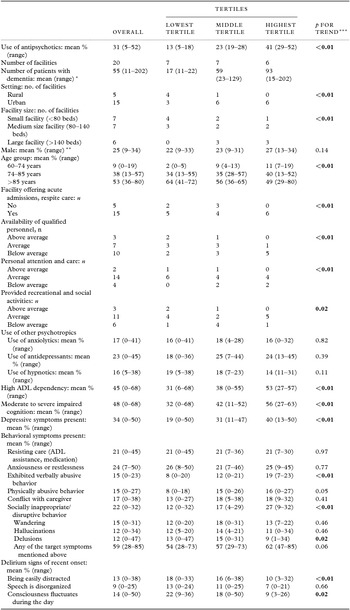
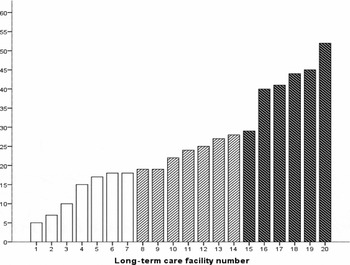
MDS data were available for 48 LTCFs from January 1, 2006, to January 1, 2010. CQ-index surveys were measured from 2008 onwards for 36 of these facilities. After exclusion of 16 facilities because of an insufficient number of patients with dementia, 20 facilities remained available for analysis (Table 1). Alzheimer's dementia was diagnosed in 48% of patients, and mixed or other forms of dementia in 52%. The prevalence of APD use varied between LTCFs from 5% to 52%; the overall prevalence was 31%. The seven facilities in the lowest tertile of APD use had a mean prevalence of 13% (range 5%–18%, Figure 1). The seven facilities with medium APD use had a prevalence of 23% (range 19%–28%), and the six facilities in the highest tertile for APD use recorded a prevalence of 41% (range 29%–52%). There was no significant difference between prevalence of anxiolytic, antidepressant, and hypnotic use between these groups. There was an almost significant trend toward more behavioral symptoms in facilities with a higher prevalence of APD use (p = 0.06): in the six LTCFs with a high prevalence of APD use, at least one of the behavioral symptoms was present in 62% of the patients. In the next seven facilities behavioral problems remained frequent (57%), and in the seven facilities with the lowest APD use still 54% was recorded to exhibit at least one of the behavioral symptoms. The facilities with the highest prevalence of APD use reported significantly (p < 0.05) higher levels of verbally abusive behavior and socially inappropriate/disruptive behavior, but showed lower levels of indicators of delirium (being easily distracted, showing a fluctuating consciousness, and delusions). Facilities with a high prevalence of APD use generally had more severely ADL-dependent and cognitively impaired patients. Facilities in the highest tertile of APD use had a mean percentage of 40% of patients with a DRS indicative of depression, while the lowest tertile reported 20%. Compared with facilities in the lowest tertile, facilities with a high prevalence of APD use are more often large (3 vs. 0) and more often situated in urban communities (6 vs. 3). CQ-index surveys were available for all facilities; 12 facilities reported results from legal representatives mail questionnaires and 8 facilities reported results from resident interviews. Facilities in the highest tertile of APD use have more often below average satisfaction on staffing (5 vs. 2) and personal care (2 vs. 0).
LTCF characteristics with a low, medium, and high antipsychotic prescription prevalence

*Included in this study.
**Mean percentage of patients and range between facilities.
***Chi-square test for trend, p-values <0.05 are marked in bold.
****Consumer Quality survey items reflecting perceived quality of care by the residents or their legal representatives: above average = % of LTCF with scores comparable to the 30% LTCFs best performing; average = % of LTCF with scores within the range of 30%–70% of all LTCFs; below average = % of LTCFs with scores comparable to the 30% worst performing LTCFs.
Note: LTCF = long term care facility; APD = antipsychotic drug; ADL = activities of daily living.
Mean prevalence of antipsychotic therapy per participating LTCF. The facilities are shown in increasing order of prevalence (%). White bars represent the lowest tertile (range of APD use 5%–18%), gray bars the next tertile (range 19%–28%), and black bars the highest tertile (range 29%–52%).

Discussion
In this study, we investigated the variability of APD use in a sample of Dutch LTCFs, and we related this APD use to the prevalence of behavioral symptoms. Our study showed a high variability between LTCFs in APD use. Although facilities with a high prevalence of APD use reported more patients with certain behavioral problems, we found a discrepancy between the difference in prevalence of APD use among the facilities in the lowest and highest tertile of APD use (13% vs. 41%), and the difference in prevalence of behavioral symptoms among these facilities (i.e. at least one symptom present; 54% vs. 62%). The remarkable large variability in APD use found in our study (5%–52%) thus, cannot be explained fully by differences in the prevalence of behavioral symptoms across facilities. We also examined the variability in APD use by relating it to resident (or resident representative's) satisfaction, as measured with the CQ-index. A high prevalence of APD use was associated with average to below average satisfaction on staffing, personal care, and activities.
The large variability in APD use is comparable with results from other studies. The first report dates from 1980, showing that APD use in US nursing homes varied from 0% to 46%, with the larger nursing homes accounting for most of the prescriptions (Ray et al., Reference Ray, Federspiel and Schaffner1980). In Norway a wide variation in APD use (0%–61%) was found, which could not be explained by size or nursing staff/resident ratio (Ruths et al., Reference Ruths, Straand and Nygaard2001). In the UK, Guthrie found an unexplained variation in prescribing, showing a threefold use of APDs in the highest prescribing practices (Guthrie et al., Reference Guthrie, Clark and McCowan2010). In the Netherlands, Zuidema found antipsychotic drug use differed considerably between 59 dementia special care units (7%–69%) (Zuidema et al., Reference Zuidema, de Jonghe, Verhey and Koopmans2011). A large proportion of this variance (80%) could not be explained by patient factors.
The finding that this variability in APD use in LTCFs cannot fully be explained by resident characteristics is in line with international studies. Rochon also found that differences in prescribing rates between nursing homes in Canada could not be explained by the variation in clinical condition of their patients (Rochon et al., Reference Rochon2007). Chen concluded the same from a similar study in the USA nursing homes (Chen et al., Reference Chen, Briesacher, Field, Tjia, Lau and Gurwitz2010). In Belgium, APD use was significantly lower in nursing homes where patients received treatment from a general practitioner with additional training in gerontology (Azermai et al., Reference Azermai, Elseviers, Petrovic, van Bortel and Stichele2011). This suggests the presence of a prescribing culture where in some settings physicians prescribe APDs, while in other settings physicians would have prescribed non-pharmacological interventions. This might be explained by a lack of possibilities for non-pharmacological treatment of the behavioral problems of dementia in some facilities. The use of recreational activity programs can improve quality of life, and decrease the demand for APD therapy (Vernooij-Dassen et al., Reference Vernooij-Dassen, Vasse, Zuidema, Cohen-Mansfield and Moyle2010). We found a strong association between low satisfaction on provided recreational activities, and facility-level APD use. Small-sized, non-urban LTCFs with high resident or resident legal representatives satisfaction reported the lowest prevalence of APD use. Rural LTCFs have been associated with high caregiver satisfaction, possibly because of closer relationships between professional and family caregivers within the community (Tornatore and Grant, Reference Tornatore and Grant2004). Our results correspond to those of Testad et al., who compared nursing homes in the UK, Austria, and Norway, and found significantly lower prevalence of APD use in LTCFs with smaller units of care, and a better care staff–resident ratio (Testad et al., Reference Testad2010).
In the study presented here, a high prevalence of APD use is associated with low satisfaction on staffing levels. In a survey exploring the reasons to prescribe APDs, elderly care physicians often named the lack of good qualified nurses as a barrier to the success of non-pharmacological interventions, thereby, increasing the demand for APDs (Cornege-Blokland et al., Reference Cornege-Blokland, Kleijer, Hertogh and van Marum2012). Staff distress has been shown to be independently associated with antipsychotic use (Zuidema et al., Reference Zuidema, de Jonghe, Verhey and Koopmans2011). Increased nurse staffing levels have shown to improve the quality of care in U.S. nursing homes (Hyer et al., Reference Hyer, Thomas, Branch, Harman, Johnson and Weech-Maldonado2011). This suggestion is supported by the study of Fossey et al. that showed that training programs for nursing home staff resulted in a decrease of the proportion of patients using APDs by 54% without a change in behavioral scores (Fossey et al., Reference Fossey2006). Small homelike care environments are believed to improve the quality of life of elderly people with dementia, possibly leading to less behavioral problems and consequently less APD use, but this assumption awaits further confirmation (Verbeek et al., Reference Verbeek, van Rossum, Zwakhalen, Kempen and Hamers2009). Analyses of the care programs of facilities with a high and low prevalence of APD use may result in best practice models that can help to reduce APD use. In Finland, benchmarking care outcomes between LTCFs, including the publication of prevalence of APD use, has led to a remarkable decrease in the use of APDs and various improvements in nursing care patterns (Finne-Soveri, 2010).
Nevertheless, we found more patients with certain behavioral problems (verbally abusive behavior and socially inappropriate/disruptive behavior) in facilities with a high prevalence of APD use. In addition, patients were more ADL dependent, and showed more cognitive decline and signs of depression. These higher patient care needs may cause a relative shortage of care in these facilities. Although this can explain part of the variation in APD use, other explanations cannot be ruled out.
Although the items in the RAI database are descriptive, the scoring of behavioral problems can be subjective and depending upon the tolerance of nursing staff for specific behavioral patterns. Also, the presence of more residents with severe behavioral problems, often already treated with APDs at admission, may facilitate the prescription of APDs to residents with moderate problems. Bronskill found an unexplained higher mortality in nursing homes with a high prevalence of APD use (Bronskill et al., Reference Bronskill2009). The use of APDs in patients with dementia has not only been shown to increase the risk of death, stroke, and cardiac arrhythmias, but also several adverse effects such as APD induced parkinsonism, gait disturbances, and daytime sedation, have been shown to negatively influence quality of life. As these adverse effects are common, a facility with a high prevalence of APD use is likely to have a large proportion of patients in which these adverse effects outweigh the benefits of their treatment. Therefore, a high prevalence of APD use signals potentially inappropriate prescribing.
It is remarkable that facilities with a high prevalence of APD use show depressive symptoms in 40% of their patients, while only 24% of patients use antidepressants. On the other hand, facilities in the lowest tertile show depressive symptoms in only 19% of their patients while 23% uses antidepressants. These findings suggest that unrecognized or untreated depression may worsen behavioral problems. Another possibility is that physicians in facilities with a low APD prescription rate more often prescribe antidepressants for the treatment of behavioral problems.
This study has several limitations. First, the 20 LTCFs for which detailed information was available are not necessarily representative of all 1,700 LTCFs in the Netherlands, as the LTCFs decision to work with RAI is voluntary. The small sample size also limits the generalizability of the results. As we used a cross-sectional design, the associations between prevalence of APD use and facility characteristics cannot be used to infer causation.
An important limitation of this study relates to the inherent limitations of the RAI database. In the MDS, no special emphasis is placed on the reporting of behavioral symptoms and these symptoms may be under-reported when compared to the use of specific instruments, such as the Cohen Mansfield Agitation Inventory. Also, only the frequency of behavioral problems is recorded, while in specific instruments the severity of the behavior is taken into account. However, as we used aggravated data to compare groups of patients residing in different nursing homes, we think the behavioral burden of the nursing homes can be adequately compared using the percentage of the residents showing any of the behavioral symptoms.
The results of the CQ-index survey should be interpreted cautiously, as, for the purpose of this study, we restricted us to three pre-selected questions, not necessarily reflecting the global impression of the quality of care. We used results of direct interviews with the residents (8 facilities) and mail questionnaires to legal representatives (12 facilities). Both types of surveys have their limitations. Patients with dementia are likely to be underrepresented in the sample of residents interviewed for the survey. The legal representative's opinion does not necessarily reflect the quality of the provided care itself, and has been found to depend on the quality of the caregiver-resident relationship (Huang et al., Reference Huang, Chang, Tang, Chiu and Weng2009). Verbeek compared small-scale facilities with wards within large facilities, and found an association of small-scale facilities and caregiver satisfaction with nursing staff, but did not find differences in quality of life for the patients themselves between these settings (Verbeek et al., Reference Verbeek, Zwakhalen, van Rossum, Ambergen, Kempen and Hamers2010). However, legal representatives’ reports have been shown to correlate well with self-rated quality of life in patients with dementia (Beer et al., Reference Beer2010).
We do not know the reasons to prescribe APDs, and do not know to what extent the behavioral symptoms are influenced by the use of APDs. If APDs are effective in reducing behavioral symptoms, this might partly explain the small variation in behavioral symptoms between the APD prevalence tertiles. However, in a previous study, we have shown that the effect of APDs on behavioral symptoms, as measured with the RAI assessment instrument, is limited, with most patients showing equal or even higher symptom scores after the start of therapy (Kleijer et al., Reference Kleijer2009).
Strengths of our study included the availability of both detailed resident assessments and satisfaction surveys, enabling to associate APD use with perceived quality of care at facility level.
In conclusion, in a sample of 20 nursing homes in the Netherlands we found a large variability of APD use. The large variability in APD use could only partly be explained by the patients’ characteristics, and was clearly correlated to facility characteristics, such as facility size, and the perceived quality of care. The association between a high prevalence of APD use, and low quality of care as perceived by the residents and their legal representatives is worrisome and warrants further investigation. To elucidate the reasons of this association, future studies might focus on the relationship between the quality of care and the effect this has on behavioral symptoms. Another question that needs to be addressed is if the threshold for physicians to prescribe antipsychotics differs between LTCFs, and if so, why prescribing cultures with a low threshold to antipsychotic use still exist.
Conflict of interest
None.
Description of authors’ roles
All authors participated in designing the study; D. Frijters and M. W. Ribbe provided the VURAI data; E. R. Heerdink, R. van Marum, and D. Frijters contributed in analyzing the data; and B. C. Kleijer wrote the paper. All authors contributed to paper preparation, and read and approved the final paper.