Introduction
Today, with recorded audio everywhere, it’s difficult to imagine a time when the phonograph and its records were new and rare inventions. Thomas Edison demonstrated his talking machine to awed audiences in 1877, but despite the wonder it generated initially, the instrument faced an uncertain future. It wasn’t clear who would want to record sounds or for what purpose. Who, some wondered, would be listening?
Answers to those questions emerged in a series of complex episodes over several decades. Inventors, entrepreneurs, performers, and listeners everywhere transformed the singular talking machines of the late 1870s to the ubiquitous music machines of the twentieth century.
Looking back, we now know the effects on the existing entertainment business were gradual but ultimately revolutionary. Mechanically reproduced sounds at first coexisted with established forms in the music business. As this photo of an Iowa music store in 1910 shows, not just record players and records were on sale, but also pianos, rolls for player pianos, and sheet music. Recorded sound steadily displaced them all (Figure 1).
Interior of Holley’s Music Store, Colfax, Iowa, about 1910, Holley Family Photograph Collection, State Historical Society of Iowa, Des Moines, Iowa (PH2002.3.1).

In the following essay, selected images and links to period sounds offer a chronological glimpse of interacting social, technical, and entrepreneurial forces at work that initiated that revolution. Specific documents, objects, and audio from the period between roughly 1878 and 1920 combine here in rich and meaningful ways, not just as evidence of a specific time period, but also as agents that shaped meanings, attitudes, and methods by which people understood their world. The combination of visual, aural, and material cultures, as the editors of this special issue have argued in their introduction, help us to historicize “listening practices and the technologies that have structured them.”Footnote 1
Put another way, interpreting pictures, sounds, and objects together—rather than separately as either visual culture, sound studies, or material culture—enlarges the historian’s toolbox. Jonathan Stern pointed out in The Audible Past that sight and sound aren’t mutually exclusive senses, and their study need not be either.Footnote 2 If we add material culture to the mix, we can, as our editors have pointed out, “open new pathways into the history of the late nineteenth and early twentieth centuries.”
Inventing the Talking Machine
In 1877, Thomas Edison invented the first instrument to ever record and play back sound. The phonograph, also known as the talking machine, captured soundwaves with a mouthpiece and caused a stylus attached to a vibrating diaphragm to move up and down. The stylus made indentations on a sheet of tinfoil wrapped around a rotating drum. In playback, the stylus traced those indentations, causing the diaphragm to vibrate and recreate a recognizable version of the original sound (Figures 2, 3, and 4).
Thomas Edison with tinfoil phonograph, [between 1870 and 1880], Brady-Handy photograph collection, Prints and Photographs Division, Library of Congress, Washington, DC.

Tinfoil phonograph, 1878, National Museum of American History, Smithsonian Institution, Washington, DC. Photograph by Jacyln Nash.

Tinfoil record fragment, 1878, National Museum of American History, Smithsonian Institution, Washington, DC. Photograph by Jacyln Nash.

Edison’s invention was a public sensation. The talking machine—not the light bulb—earned him the nickname “Wizard of Menlo Park.”Footnote 3 People first read about the device in the newspapers, but soon heard it for themselves at public demonstrations held in the United States and Europe.
The recorded selections at demonstrations varied based on the event. One rare surviving example from 1878, from which sound was recovered in 2012, was originally recorded in St. Louis, Missouri, in June 1878. It featured a cornet solo and a man reciting “Mary Had a Little Lamb” and “Old Mother Hubbard.”Footnote 4
Edison imagined the primary commercial use of his machine would be for making an audio record of business matters. But its recordings were hard to understand, fragile, and short-lived. Sales were disappointingly low. After the initial excitement, the inventor turned to other ventures.
Improving the Talking Machine
Alexander Graham Bell and his associates at the Volta Laboratory in Washington, DC, set out to perfect Thomas Edison’s original phonograph. They were convinced of the profit-making potential of an improved device—especially one that could capture more clearly a speaking voice for business dictation. By 1886, they patented wax cylinder records and developed a machine to record and play them. They called it the graphophone (Figures 5, 6, and 7).Footnote 5
Alexander Graham Bell, 1876, Smithsonian Institution Archives, Washington, DC, Image SIA2012-1090.

Charles Sumner Tainter, 1877. Courtesy of the Dictaphone Corporation.

Chichester Alexander Bell, Science and Society Picture Library, London, UK.

The competition from Bell and his associates spurred Edison to revisit his talking machine.Footnote 6 Edison made multiple improvements and introduced new machines for recording and playing cylinder records that found popular appeal. Today, the differences between the phonograph and the graphophone seem subtle, but at the time they represented a ferocious rivalry between the Edison and Bell camps for an invention without immediate demand from consumers (Figures 8 and 9).
Prototype Graphophone, 1886, National Museum of American History, Smithsonian Institution, Washington, DC. Photograph by Jacyln Nash.

Cylinder record, 1889, National Museum of American History, Smithsonian Institution, Washington, DC. Photograph by Richard Strauss.

Business dictating machines did evolve: Edison’s invention would endure as the Ediphone, and the graphophone as the Dictaphone. But neither inventor foresaw how his inventions would revolutionize the music business.
Demonstrating the Talking Machine
When improved talking machines became available in the late 1880s and 1890s, traveling demonstrators continued to gather listeners, mostly in small groups, across the United States. The audience—sometimes as many as four to six people simultaneously—heard a cylinder record through white rubber ear tubes attached to the machine. The demonstrator often recorded the cylinder on the spot, so the content varied considerably from place to place (Figure 10).
W. A. White, “Coming of the Gramophone,” kids gathered around burro listening to phonograph, Baldy, New Mexico, Palace of the Governors Photo Archives, New Mexico History Museum, Santa Fe, New Mexico, Neg. 014636.

Listening in Public: Coin-in-slot Machines
While demonstrators set out across the country, in urban public places, agents for both Edison’s phonograph and the competing graphophone set up coin-in-the-slot machines. Placing them in hotels, drug stores, railroad stations, and beer gardens, they looked to improve business for the new talking machine. Noting the public’s appetite for recorded sound, some entrepreneurs established specialized amusement parlors where, for a nickel a record, listeners could hear ever-changing selections on the purpose-built phonographs and, later, watch motion pictures on kinetoscopes. Music and comic recitations were popular sound recordings. Favorite tunes in 1891, reportedly, were the hymn “Nearer My God to Thee” and Sousa’s United States Marine Band playing “Stars and Stripes Forever” (Figures 11, 12, and 13).Footnote 7
Edison Automatic Phonograph, about 1900, National Museum of American History, Smithsonian Institution, Washington, DC. Photograph by Jacyln Nash.

Detail, Edison Automatic Phonograph (see Figure 11).

“Listening to the Edison Automatic Phonograph,” The Phonogram, February 1891.

As the century turned, these parlors for listening in public gradually disappeared. Phonograph manufacturers shifted tactics and convinced consumers to buy redesigned record players for home use.
Talking for Toys
When Thomas Edison imagined the uses for his new talking machine, he speculated that, beyond serving as a means of preserving speech, it might animate toys. His idea took form in a talking doll, manufactured briefly in 1890.
In 1887, Edison had licensed W. W. Jacques and Lowell C. Briggs of Boston to make and sell talking dolls as the Edison Toy Phonograph Company. The Edison Phonograph Works, in West Orange, New Jersey, manufactured the phonographs, inserted them into dolls, and packaged them for sale. The talking dolls worked imperfectly, sold poorly, and proved a costly mistake for Edison. By 1896, all remaining unsold phonographs for dolls were reportedly destroyed.Footnote 8
This example of an Edison talking doll has a ceramic head, a metal body, and articulated limbs made from painted wood. Inside the torso is mounted a tiny phonograph bearing a brown wax record that recites the children’s rhyme “Jack and Jill,” as recorded by a young woman.Footnote 9 This nursery rhyme was one of twelve recitations available. Turning a crank inserted into the back of the doll’s torso rotates the record for play, and shifting an adjacent lever returns the stylus of the phonograph to the start position. Whether this doll was ever finished with a wig and clothing is unknown (Figures 14, 15, and 16).
Edison talking doll, about 1890, National Museum of American History, Smithsonian Institution, Washington, DC. Photograph by Richard Strauss.

Edison talking doll (see Figure 14), reverse.

Phonograph from Edison talking doll (see Figure 14).

Listening at Work
Inventors and investors initially saw recorded sound as a tool for business, not musical entertainment.
Middle-class men held most office jobs at the time the phonograph was invented, but the office environment changed drastically in the following decades as city business districts expanded and the demand for clerical workers grew with them. Women increasingly entered the workforce, and by the early twentieth century, clerical work had become a feminine occupation (Figure 17).
Miss Brady listening to Edison dictation machine and transcribing on Oliver typewriter, Philadelphia, 1905, Thomas Edison National Historical Park, U.S. National Park Service, West Orange, New Jersey.

Simultaneously, new technologies entered office spaces—not just the dictation machine, but also telephones and typewriters. As managers introduced these mechanisms to automate secretarial tasks, the status of clerical work and wages for that work fell. The results were cost savings for businesses but fewer advancement opportunities for women workers.Footnote 10
Big businesses like Sears, then the largest retailer in the United States, automated office tasks to increase efficiencies in their ever-growing administrative departments. The caption on the reverse of the stereo card shown here explains that approximately two hundred stenographers, using graphophones to transcribe dictation, produced about ten thousand letters a day at Sears, Roebuck and Co. Machines that could record and play sound reinforced office workplace hierarchies, with male managers composing and recording dictation while female typists listened and generated paperwork. Female clerical workers were often socially and spatially distanced from male coworkers, as this view of the Sears Stenography Department illustrates (Figure 18).
Stereograph card, Sears Stenographic Department, Chicago, 1908, Warshaw Collection of Business Americana—Stereographs, Archives Center, National Museum of American History, Smithsonian Institution, Washington, DC.

Gathering Ethnographic Evidence
Portable versions of machines for making cylinder recordings transformed the study of cultures in the fields of anthropology and folklore. Audio ethnographers like Jesse Walter Fewkes and Benjamin Ives Gilman, interested in capturing what they believed were disappearing races and cultures, cast the phonograph as an objective, reliable listener and recorder in contrast to human listeners who might differ about what they heard from speakers of unfamiliar languages (Figure 19).Footnote 11
Mountain Chief (Blackfoot/South Piegan) recording a song for ethnologist Frances Densmore, February 9, 1916, Harris & Ewing Collection, Prints and Photographs Division, Library of Congress, Washington, DC, LC-DIG-hec-06467.

At the turn of the twentieth century, researchers made thousands of recordings, many of which survive in various archives around the world. In collaborative programs, modern researchers partner with communities to draw on these recordings, to revitalize and sustain diverse endangered languages and knowledge.Footnote 12
Inventing the Gramophone
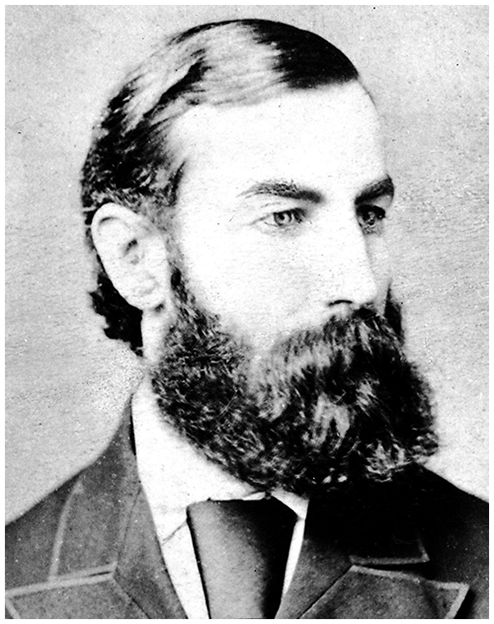
In 1887, German immigrant Emile Berliner patented the first in a series of inventions that would result in a commercially successful disc record and a machine to play it, the gramophone. Berliner also created a process to mass-produce multiple copies from a single master recording (Figure 20).
Emile Berliner, 1881, Motion Picture, Broadcasting and Recorded Sound Division, Library of Congress, Washington, DC.

Flat discs were longer playing, easier to store, and more durable than cylinders, the then-popular sound carriers for phonographs and graphophones. But unlike those machines, Berliner’s innovations required a specialized setting to record and copy sounds. The gramophone was not a dictating device and brought about a significant shift for listeners. With the gramophone, they played back records made by others rather than recording themselves (Figures 21 and 22).
Experimental celluloid record, 1888, National Museum of American History, Smithsonian Institution, Washington, DC. Photograph by Jacyln Nash.

Prototype gramophone, 1888, National Museum of American History, Smithsonian Institution, Washington, DC. Photograph by Jacyln Nash.

The first list of Berliner discs for sale in 1894 featured mostly unknown performers, and an analysis of the content of surviving Berliner discs from before 1900 suggests their content reflects a broad appeal to popular tastes in music at the time, with a few spoken selections but mostly entertainment drawn from minstrelsy and burlesque.Footnote 13
Launching a Revolution
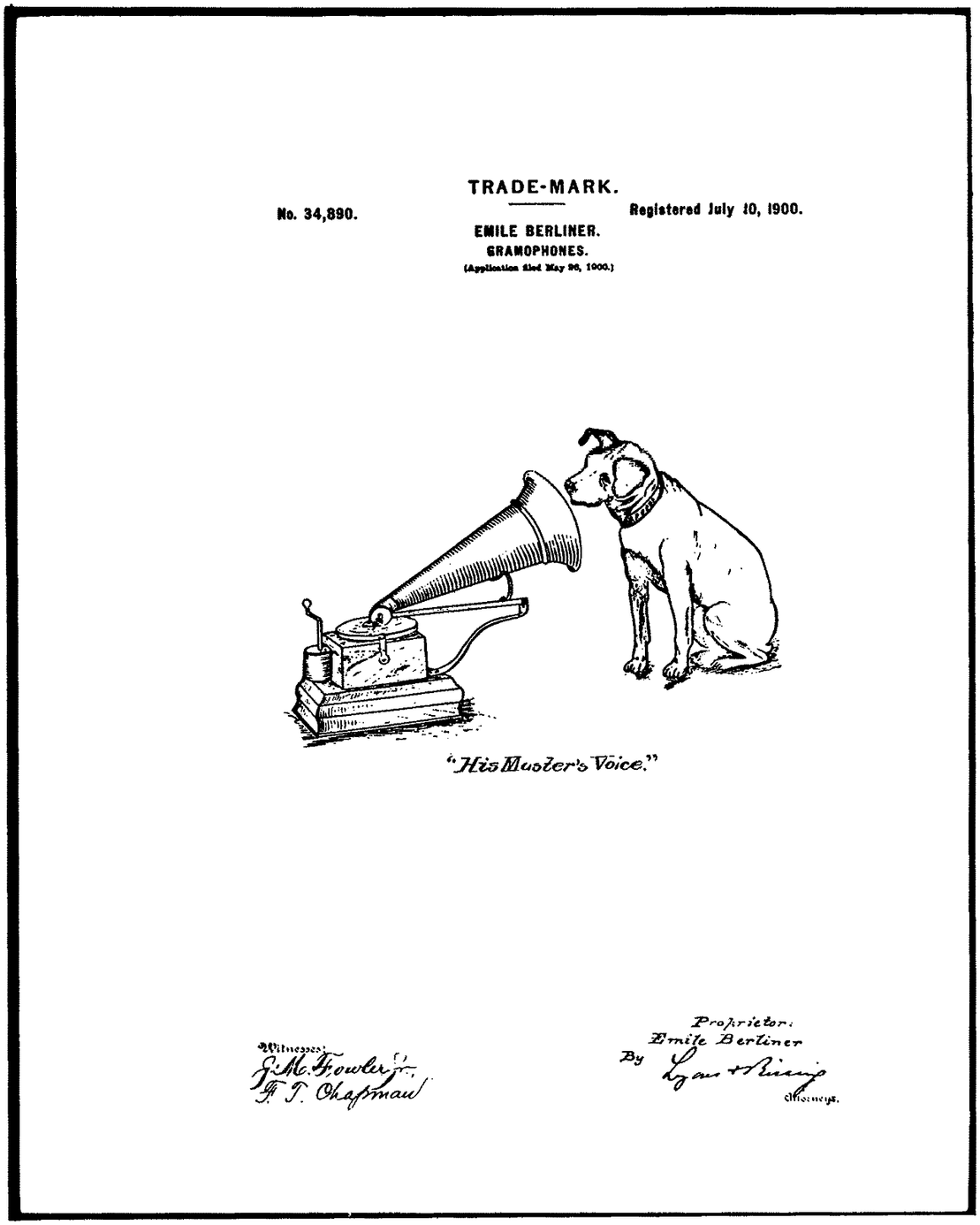
An image of a dog listening to a record on a gramophone served as the trademark for Emile Berliner’s company, which in 1901, became the Victor Talking Machine Company (later RCA). A stained-glass window showing the trademark, one of the most recognized in the world, was one of four made in 1915 by D’Ascenzo Studios in Philadelphia for a tower at the Victor Company’s headquarters in Camden, New Jersey (Figures 23 and 24).
Emile Berliner’s trademark document, granted 1900, Official Gazette of the United States Patent Office, 92 (July 1900): 379.

Stained glass window with logo, 1915, National Museum of American History, Smithsonian Institution, Washington, DC. Photograph by Jacyln Nash.

In an 1899 legal dispute with one of his suppliers (who was also an illegal competitor), Berliner lost the rights to operate the business he started in the United States. He nevertheless succeeded in Canada, the United Kingdom, and Europe, where “gramophone” became the generic term for record player. Eldridge Johnson of Camden, New Jersey, took over Berliner’s patents, and together they formed the Victor Talking Machine Company. Victor went on to outdo its rivals by enlisting celebrity performers from the world of opera like Enrico Caruso, improving technical sound quality, and aggressively advertising the company’s products. The firm grew to dominate the market for machines and records and helped launch a commercial revolution in American music.Footnote 14
Mass Producing Disc Records
With his U.S. business ensnared in court battles, Emile Berliner launched a Canadian version of his enterprise and prospered. A glimpse into Berliner’s Montreal storage for the molds for hundreds of recordings reminds us that part of his success stemmed from mass-production methods he devised. In that multistep process, a performer made a master recording in wax (Figure 25). The record factory workers then made from the master a heavy metal mold or matrix, a mirror image of the grooves on the original. From the matrix, they could stamp multiple copies for the market.Footnote 15
Record Matrix Room, Berliner Gramophone Co., Montreal, 1910, McCord Stewart Museum, Montreal, Quebec.

Berliner experimented with a variety of materials for records, including zinc, celluloid, and hard rubber. By 1895, he settled on a shellac compound called Duranoid.Footnote 16 The design for a laterally cut disk made of shellac, playing at seventy-eight revolutions per minute, became the industry standard.
Targeting Consumers: Music Stores
In this photo, a Victor dealer in New Hampshire used window displays and horse-drawn mobile advertising to announce that pianos and talking machines were available for home entertainment and the newest recordings had arrived for holiday shopping. Note the statue of Victor’s trademark dog Nipper sitting on the horse (Figure 26).
W. H. Avery Music Store, Concord, New Hampshire, about 1910, New Hampshire Historical Society, Concord, New Hampshire. Digitization supported by the New Hampshire Historical Society’s Connections through Time: Campaign for New Hampshire History.

The leading phonograph companies in the early twentieth century—Victor, Columbia, and Edison—all engaged in robust advertising campaigns to encourage consumers to buy records and machines to play them. The companies worked with thousands of existing music merchants, instead of building their own retail stores, to reshape the music business at a local level.Footnote 17
Targeting Consumers: Magazine Advertising
The phonograph and record companies mastered consumer marketing and reached out to customers not only through merchants—like the W. H. Avery and Holley stores pictured in this essay—but also in advertisements in national magazines (Figures 27, 28, and 29). In their advertising, the firms sought to associate music and respectability, whether it was opera or the latest tunes from popular dance orchestras. Every household, they argued, should have a record player—to entertain distinguished company, to bring the voices of the best performers into the home at will, to pass on discerning musical taste to children. Chicago manufacturer Brunswick summed up the pitch: “Keeping up with the times musically is a precept of the cultured. Keeping your children conversant with good music and with great artists is an educational duty every parent owes his children.”Footnote 18
Advertising for Columbia Graphophones, 1906, Special Collections, University of Washington Libraries, Seattle, Washington, ADV0077.

Advertising for Edison cylinder records, 1900, Rodgers and Hammerstein Archives of Recorded Sound, New York Public Library, New York, New York.

Advertising for Brunswick Phonographs and Records, Brunswick-Balke-Collendar Co., Saturday Evening Post, April 26, 1924.

Listening to Music at Home
Until the mass production of cylinder and disc recordings, the music that most Americans experienced at home was live—hymns or popular tunes played or sung by family members. By the turn of the twentieth century, record players joined pianos in parlors for home entertainment. Just as merchants sold both music machines, customers used both. The two products coexisted. In this scene from a Minnesota home of that time, a young girl sits at a piano laden with sheet music, and the record player stands at the ready in the corner nearby. It would be several more decades before popular preferences for live music gave way to mechanically reproduced music (Figure 30).Footnote 19
Alice Zila at the piano, Hutchinson, Minnesota, about 1915, Minnesota Historical Society, St. Paul, Minnesota.

Sheet Music
The new record-playing machines—from the earliest tinfoil machine to cabinet parlor models decades later—were sometimes the subject of popular tunes, and their illustrations appeared on sheet music covers. More often, popular songs from theater shows with big-name artists—the famous African American performers Bert Williams and George William Walker, for example—appeared as both sheet music and records.Footnote 20 The examples shown here underscore how the two forms of entertainment shared domestic space and even informed each other’s use. In the case of Edison recordings at least, those deciding what music to record often took their cues from what music had been committed to sheet music. A surviving collection, accumulated for this purpose at the Edison recording operation, holds over 100,000 pieces of sheet music from before 1920 (Figures 31–34).Footnote 21
Sheet Music for “Phonograph March Brillante,” Sam DeVincent Collection, Archives Center, National Museum of American History, Smithsonian Institution, Washington, DC.

Sheet Music for “At Home with my Pathé Pathéphone,” Sam DeVincent Collection, Archives Center, National Museum of American History, Smithsonian Institution, Washington, DC.

Recording of Walker and Williams, “Her Name’s Miss Dinah Fair,” 1901, Library of Congress, Washington, DC. Sound file at https://www.loc.gov/item/jukebox-3024/.

Sheet Music, “Album of Gems by Williams and Walker,” National Portrait Gallery, Smithsonian Institution, Washington, DC.

“Music Makes Morale”
When the United States entered World War I, demand for phonograph records with music ramped up, to entertain and lift the spirits of soldiers at home and abroad. “Music Makes Morale”Footnote 22 was an often-repeated phrase. By then, the transition of talking machine to music machine was complete.
Manufacturers pressed few new records in wartime because of shellac rationing measures, and efforts to supply those in the military resulted in a campaign to gather up existing used recordings. The Phonograph-Records Recruiting Corps, a civilian group organized in New York by author and composer Vivien Burnett, commissioned this poster from artist Charles Buckles Falls of Indiana in 1917, and a year later selected a week in October for a coordinated record drive.Footnote 23 At the time, “slacker” was a pejorative word for wartime draft dodger, and in the wave of patriotism that washed over the country, “the worst expression of contempt in the American language in 1918,” according to historian Alfred Crosby.Footnote 24 “Slacker” records were by implication lying idle without serving the greater national purpose (Figure 35).Footnote 25
Charles Buckles Falls, “Now for Some Music,” 1917, Princeton University Poster Collection, Archives Center, National Museum of American History, Smithsonian Institution, Washington, DC.

The drive for records, record players, and even phonograph needles was successful, judging by the abundance of surviving photos of hospital wards and military camps equipped with machines and a variety of recordings. Seen here through the lens of now-famous photographer Lewis Hine, wounded American soldiers spend time around a phonograph in 1918, at an Army hospital run by the American Red Cross in St. Denis, France (Figure 36).Footnote 26
Lewis Hine, wounded American soldiers at a Red Cross hospital, St. Denis, France, August 1918, American National Red Cross Collection, Prints and Photographs Division, Library of Congress, Washington, DC, LC-DIG- anrc-07204.