


Introduction and literature review
Formulation has been defined as a ‘hypothesis about a person's difficulties, which links theory with practice and guides the intervention’ (British Psychological Society, 2011, p. 2). It has been a major feature of clinical psychology practice for many years and has been put forward as a key component of clinical work throughout this time, for example Shapiro's (Reference Shapiro1951) discussion of the stages of hypothesis generation, information gathering and testing, and reformulation as appropriate.
Bergner (Reference Bergner1998, p. 287) claimed that ideally, formulations should:
(a) organize all of the key facts of a case around one causal/explanatory source; (b) frame this source in terms of factors amenable to direct intervention; and (c) lend itself to being shared with the client to his or her considerable benefit.
This ‘considerable benefit’ implies that formulation can be considered an intervention in its own right, something that is supported by the Division of Clinical Psychology (DCP) guidelines on the use of formulation (British Psychological Society, 2011), which suggest various potential benefits for clients, therapists, and teams, including:
-
• Explaining the development and maintenance of the service user's difficulties.
-
• Identifying the best way forward and informing the intervention.
-
• Helping the service user to feel understood and contained.
-
• Strengthening the therapeutic alliance.
-
• Normalizing problems; reducing service user self-blame.
-
• Increasing the service user's sense of agency, meaning, and hope (pp. 6–8).
A question is therefore raised as to the evidence base for formulation, both as a process in its own right, and with respect to its potential role as an intervention. Kuyken (Reference Kuyken and Tarrier2006) highlighted the complexity of considering the evidence base in this area, drawing a distinction between ‘top-down’ and ‘bottom-up’ forms of evidence; that is evidence for the underlying models and theories on which formulations are based, and evidence for the reliability and validity of the process of producing, and the ‘end-product’, formulations themselves.
Within the cognitive and cognitive-behavioural psychotherapies, bodies of ‘top-down’ evidence for relevant models and theories are more established, for example evidence of theoretically important constructs and processes, such as attentional bias, cognitive appraisals and strategic avoidance in anxiety and depression (e.g. Cisler & Koster, Reference Cisler and Koster2010; Kleim et al. Reference Kleim, Grey, Wild, Nussbeck, Stott and Hackmann2013; Ottenbreit et al. Reference Ottenbreit, Dobson and Quigley2014), or empirical support for specific theoretically driven cognitive models (e.g. Fairburn et al. Reference Fairburn, Cooper and Shafran2003; McManus et al. Reference McManus, Sacadura and Clark2008).
There is, however, a surprising and frequently observed lack of research into the ‘bottom-up’ processes of case formulation, meaning that it tends to be recommended on the basis of ‘good practice’ rather than through empirical evidence (Dudley & Kuyken, Reference Dudley, Kuyken, Johnstone and Dallos2006). A recent review of formulation efficacy highlighted that while there is some evidence to suggest formulations aid the treatment process, it is far from clear whether they influence outcomes directly or simply provide a context to instil hope or develop the therapeutic relationship (Aston, Reference Aston2009). Although clinicians value them highly in practice, the reliability and validity of formulations is unclear (Bieling & Kuyken, Reference Bieling and Kuyken2003), with a number of potential issues being highlighted (see Kuyken et al. Reference Kuyken, Fothergill, Musa and Chadwick2005; Mumma, Reference Mumma2011).
Clearly, a much greater understanding of formulation is needed, both in terms of its potential ability to guide the course of therapy and to deliver positive client outcomes. Another facet of the ‘bottom-up’ forms of evidence is that which explores how formulation is perceived by clients, to address questions such as whether it is considered helpful or important, or whether it is perceived to provide the benefits suggested above. Again there is little literature in this area, but studies suggest that clients commonly feel ambivalent about the process. In two studies of people with psychosis, participants identified both positive and negative responses to formulation (Chadwick et al. Reference Chadwick, Williams and Mackenzie2003; Pain et al. Reference Pain, Chadwick and Abba2008), such as seeing a way forward, feeling reassured, or becoming more optimistic about therapy, yet also finding the number of relevant factors to be overwhelming, or finding the process to be saddening or worrying. Kahlon and colleagues (Reference Kahlon, Neal and Patterson2014) in their study of CBT formulations in depression, highlighted a trend for negative feelings towards formulations to be common particularly in the early stages of therapy, which became more positive as therapy progressed. Nearly all the participants in this study also expressed that they found it difficult to talk to their clinicians about their feelings towards the formulation. If it is the case that people with depression may not feel formulation is beneficial in the early part of therapy, there is a significant need to understand more about how it is perceived within this population, in order to find methods of formulating that are more acceptable.
It could be argued that differences between clinical problems and between individuals are also likely to mean that formulation will be more beneficial in some circumstances than others. For example, a formulation of a ‘simple’ problem such as panic disorder may be perceived as more acceptable, and perhaps more helpful, than an attempt to summarize a more complex problem such as psychosis. Clients are likely to vary in the extent to which they feel they understand their difficulties, ranging from clear views as to relevant causal and maintenance factors, to significant confusion as to why they have come about. Given that formulation is thought of widely as a sense-making process, it follows that for clients in the latter category the process of developing a formulation may have increased significance, and perhaps greater interventive power relative to other clients. This report describes such a client who was recovering from a significant episode of depression and suicidal ideation. It outlines the assessment process and reviews the content, process, and interventive capacity of the formulation that was developed.
Case description
‘Julie’ (name anonymized) a 32-year-old woman, was referred by her care coordinator due to difficulties with low mood and suicidal thoughts, which had resulted in a recent inpatient admission. The referral noted that Julie's family had a history of anxiety- and depression-related symptoms, and hoped that therapy might support Julie in learning new ways of managing her difficulties. She had been discharged from hospital a few months prior to the referral.
Notes indicated that Julie had experienced the above symptoms for 6 months prior to her admission, which was precipitated by her expressing a wish to end her life and running home from a visit to friends, later being found with a knife by her partner. It was reported that Julie felt unable to cope with the responsibility of looking after her two young children, and felt hopeless about the future. She was unclear what had triggered this period of low mood.
Process of assessment
Assessment of Julie's difficulties focused primarily on the following areas:
History of difficulties around mood
Julie had experienced some mild mood difficulties following the birth of her first child, although had not experienced a more significant episode of depression until around 2 years ago. This followed her partner being unwell and she described struggling to deal with the anxiety this caused. This was managed effectively with medication. The most recent episode of depression had started around 9 months ago, and Julie was unable to identify any triggers for this.
Current functioning
Julie was feeling positive about this having recently returned to work. She was not experiencing any major difficulties, and was feeling as though she was settling back into her normal routine.
Risk
Risk was assessed through exploring the extent of current difficulties. There were no concerns regarding risk to self or others.
Family
The assessment focused on family structure and relationships, experiences of depression and anxiety in the family and how these were addressed. Julie felt that it was common for the women in her family to be ‘people-pleasers’, and that caring for others was an especially important value in her family.
Early experiences
Julie described her childhood positively, and did not report any particularly difficult or traumatic experiences. Through discussion a tendency to hold quite high expectations of herself was identified, and she spoke about events such as her older sister's difficulties with drugs, her plans for college, and the birth of her first child when she was aged 19.
Experience of being in hospital
Julie described experiencing a number of difficult thoughts at this time, including the idea of her being a burden to her family, and not being able to ‘get well’ for her children.
Current concerns and worries
Although Julie was not currently feeling low, she reported having occasional ‘bad days’. Her main concern was that things would go downhill in the future.
Goals and aims for therapy
Given that Julie felt quite confused about why her mood dropped so significantly, and describing feeling ‘terrified’ that this might happen again, the primary goal for therapy was to try to make sense of what had happened to her, and to consider what might make her vulnerable to this in future. Julie wanted to be better able to predict future problems and address them early to prevent this happening again, and it was agreed that focusing on some skills and strategies for managing mood and anxiety would also be important. Specifically, Julie was concerned about getting through the upcoming Christmas and New Year period, and early January, the time where her difficulties with mood began a year ago.
As such, Julie's goals for therapy were broadly in line with the aims of formulation, particularly regarding sense-making, and being able to predict future difficulties, which can only be achieved through an understanding of the mechanisms and patterns that may maintain the problems.
Method
Measures
The following measures were used prior to and following formulation, to review any interventive effects of this process:
Depression Anxiety and Stress Scale – 21-item (DASS-21; Henry & Crawford, Reference Henry and Crawford2005; Lovibond & Lovibond, Reference Lovibond and Lovibond1995)
This measure is a brief and widely used assessment of psychological distress, with specific depression, anxiety and stress subscales. It has good validity (Henry & Crawford, Reference Henry and Crawford2005) and reliability (Antony et al. Reference Antony, Bieling, Cox, Enns and Swinson1998). A score out of 21 is obtained for each subscale, with higher scores reflecting more severe difficulties, and clinical severity cut-offs defined independently for each subscale. The DASS-21 was chosen to provide an overview of symptoms and difficulties Julie had described in the assessment.
Rosenberg Self-Esteem Scale (RSE; Rosenberg, Reference Rosenberg1986)
This 10-item scale is widely used and psychometrically validated in the assessment of self-esteem, and has a maximum score of 30, where higher scores reflect greater self-esteem. The RSE was chosen partly due to the difficult thoughts Julie expressed about herself, and partly to explore the hypothesis that formulation may reduce self-blame, perhaps impacting on self-esteem.
CORE Outcome Measure (CORE-OM; Evans et al. Reference Evans, Connell, Barkham, Margison, McGrath and Mellor-Clark2002)
The CORE-OM was developed as a generic outcome measure for therapy and contains 34 items assessing wellbeing, functioning, symptoms, and risk. It has been widely studied and shows good reliability and validity across various client groups. Each item is scored between 0 and 4, with higher scores indicating greater difficulties. The CORE-OM was chosen to capture any broader changes in outcomes as a result of formulation.
Interview
Although tools exist to evaluate to evaluate formulation quality, such as the Quality of Cognitive Case Formulation Rating Scale (Fothergill & Kuyken, 2002, cited in Kuyken et al. Reference Kuyken, Fothergill, Musa and Chadwick2005) or the ‘Rating the Quality of Case Formulation for Obsessive–Compulsive Disorder’ scale (Zivor et al. Reference Zivor, Salkovskis, Oldfield and Kushnir2013), there are no standardized instruments available to specifically capture their effectiveness or impact, or how they are perceived by clients. To explore this, a brief semi-structured interview was conducted with Julie to discuss her experiences of the formulation process, which took place during the intervention phase of therapy. The questions were derived from information presented in the DCP good practice guidelines on the use of psychological formulation (British Psychological Society, 2011) regarding what formulation is expected to provide for clients. A semi-structured interview was chosen to allow more specific questions to be addressed, while providing opportunities for Julie to elaborate or focus on the areas she found most important.
The interview began with a brief explanation of formulation using the definitions outlined above before proceeding to the individual questions. Responses were transcribed verbatim and reviewed by both authors independently. Framework analysis techniques (see Gale et al. Reference Gale, Heath, Cameron, Rashid and Redwood2013) were used to review responses in relation to each proposed benefit of formulation.
Formulation
A number of difficult situations and past events were collaboratively formulated with Julie over the course of three sessions during the early phase of therapy. This led to the development in session of a more generic formulation diagram that would aim to summarize the difficulties Julie had been experiencing, and to draw out the patterns involved in their development and maintenance (see Fig. 1). Again this formulation was developed as a collaborative process.
Cognitive behavioural formulation of Julie's difficulties based on the longitudinal model of depression (Beck et al. 1979).

Julie did not describe any strongly aversive childhood experiences, reporting positive memories of childhood and family life. She experienced some difficulties with anxiety during school examinations, and her sister experienced some difficulties with drugs, although Julie felt these events were not significant. Julie became pregnant aged 19, and described feeling fearful as to how her parents would react. Although they were supportive, Julie felt a need to prove to herself and others that she was capable of looking after a family, and given her own childhood memories, had clear standards to aim for.
It was discussed how as a result, Julie may have developed strong beliefs around the importance of caring and providing for family, and that her feelings of self-worth and capability were in part tied to this. It is noted that these core beliefs are not classically ‘dysfunctional’ as is perhaps more commonly the case (see Bridges & Harnish, Reference Bridges and Harnish2010). The possible intermediate or conditional beliefs arising from this are again not problematic in their own right, but perhaps confer a level of vulnerability to difficult situations where providing for her family becomes difficult, or she feels she has failed. This seems to have occurred following the previous Christmas break, with Julie finding it hard to motivate herself to return to usual routines, and finding her mood and functioning impaired and unresponsive to her attempts to resolve this, which had been effective during previous experiences of low mood.
A series of catastrophic thoughts seemed to arise as a result of these events, with a significant emotional impact. It is likely that other depressive cognitive biases may have also played a role, for example a ‘black and white thinking’ style leading to polarized views such as ‘success/failure’ or ‘coping/not coping’. It was identified how Julie used a combination of avoidance and pushing/striving behaviours in response to this, which while well-intentioned, may have reinforced the difficult thoughts, establishing a maintenance cycle. This cycle developed to the point where admission to hospital was warranted, further supporting the problematic thoughts Julie was experiencing. Julie felt that during the admission, being supported to attend her daughter's school sports day was a significant positive event for her, which seems to support this formulation of events.
Results
Measures
Julie's scores on the DASS-21 were largely unchanged when pre- and post-formulation responses were compared (depression: pre = 6, post = 6; anxiety: pre = 0, post = 0; stress: pre = 8, post = 12). As was expected from the assessment, the scores reflect that Julie was not experiencing significant distressing symptoms at the outset of therapy, as none of these scores fall in the clinical range. Her scores on the RSE also remained stable and in the normal range at 18/30 both pre- and post-formulation. This perhaps suggests that the formulation process did not affect her self-blame or self-esteem as hypothesized, and that these would need to be explored further in later sessions.
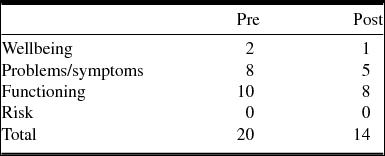
Julie's scores on the CORE-OM can be seen in Table 1. Some changes were observed, and although these were minor and perhaps explicable through normal variation, it is possible that formulation led to small improvements in Julie's overall outcomes. Again both pre- and post-formulation scores fall in the non-clinical range.
Julie's pre- and post-formulation scores on the CORE-OM subscales

CORE-OM, CORE Outcome Measure.
Interview
Julie's reflections on whether her experience of formulation delivered the benefits suggested by the DCP guidelines (British Psychological Society, 2011) are outlined below.
Explaining the development and maintenance of the service user's difficulties
In the semi-structured interview Julie reported formulation to be a helpful experience overall, allowing her to make sense of the difficulties she was experiencing. Although there still remained unanswered questions for her, particularly around the onset of the difficulties, she found it helpful to think about possible contributory events further back in her life:
It has actually made me realize that this has come back from way back, not just something in the present.
Identifying the best way forward and informing the intervention
Julie described how developing a formulation provided a context for other intervention work such as thought recording, feeling this would not have made sense without establishing an understanding of the underlying patterns:
We wouldn't have, you know, had the cycles and things like that so, you could go on about however many unhelpful thoughts and things that you had, but if you didn't have the pattern . . . we wouldn't really actually see what they then . . . what it turned into.
Helping the service user to feel understood and contained
Julie felt that it had been difficult at times to discuss the issues, feeling that she did not want to be seen to be putting blame on others, but that it ultimately had been helpful in being able to recognize and contain patterns, cycles, and their consequences:
Just seeing it, physically – it's not just going round and round in your head anymore.
Strengthening the therapeutic alliance
While Julie did not talk about the relationship between formulation and the therapeutic alliance directly, her reflections on how therapeutic activities were planned and undertaken suggests she viewed the relationship as supportive and collaborative:
If we didn't have this [formulation diagram], if we hadn't gone through this we wouldn't really have a lot to go on would we?
Normalizing problems; reducing service user self-blame
Julie was unsure as to whether formulating made her difficulties feel more normal, feeling she would need to hear about others’ experiences for this to occur:
It does feel like quite a lot of people could, you know, could think this way, but I suppose I think because . . . I’ve got nothing else really to go by, if I’d spoke to somebody and had heard their experiences and stuff as well I’d maybe feel like it was a bit more normal.
Increasing the service user's sense of agency, meaning, and hope
Julie's descriptions did indicate that formulation increased feelings of agency and hope for the future:
If I could then start to notice when the pattern is beginning, I could hopefully stop it in its tracks, or kind of make some, . . . changes anyway I suppose in how I think and how I act, . . . so yeah it does give me a bit of hope that working on this, maybe stop it from ever getting so bad again.
Plans for further intervention work
Based on the formulation of Julie's difficulties, the following further interventions were agreed:
-
• Diary recording to identify and evaluate unhelpful thoughts and cognitive biases.
-
• Focusing on situations where perfectionist tendencies become unhelpful, and developing strategies for managing these.
-
• Strategies for self-care and awareness of own needs.
Discussion
The interview with Julie highlighted that she found the process of formulating to be very meaningful, and valued it as an important part of therapy. Her comments regarding the role it played for her in making sense of her difficulties, and providing context and structure for further intervention clearly show this and relate well to her overall goals for therapy. These benefits support those some of those outlined in the DCP guidelines (British Psychological Society, 2011), although others, such as making difficulties seem more normal, were less well supported. Julie also felt that formulating had helped by stopping things going round in her head, perhaps pointing to a potential role for formulation in reducing rumination.
In this sense the therapeutic intervention can be viewed as broadly successful. However, Julie's scores on the measures used showed no major changes between pre- and post-formulation, indicating this did not appear to lead to changes in symptoms or functioning in the short term. This suggests that while the intervention was acceptable and meaningful for Julie, it perhaps lacked interventive power with regard to clinical improvement. It should be considered whether formulation might have longer term impacts given its focus on summarizing large amounts of information which may take time to process and act upon. Also it is noted that Julie's scores were not in the clinical range to begin with, therefore it may be possible that formulating could show greater impact for people experiencing more acute difficulties.
As a single case any ‘findings’ arising here are not intended to be definitive, but to perhaps highlight possibilities and hypotheses for further investigation. Clearly it is not ideal that the present interview was conducted by the therapist, and it may have been that Julie felt reluctant to give critical feedback, given her self-reported ‘people-pleaser’ tendencies, despite this being actively sought. The timing of this interview is also important to consider, as while it was an appropriate point at which to reflect on the formulation process, it may be that specific details of Julie's experience of the formulation sessions were forgotten. Conversely, it could be argued that obtaining an overall perspective on formulation as part of therapy is not fully possible until the end of therapy, where it can be seen in context.
A potential limitation is the ‘retrospective’ nature of therapy with Julie, given she was not currently experiencing mood or anxiety difficulties when the formulation was being developed. Formulating retrospectively may have advantages, such as a greater ability for clients to take in and systematically process various information, to utilize the benefits of hindsight and ‘distance’ from the material being discussed, and its value in preventing difficulties in future. There may also be disadvantages including lesser emotional connection to the material, less clear memories of relevant events, and possible ‘hindsight bias’. Additionally it may be that too much focus is placed on understanding difficulties at the expense of facilitating change.
While it is less common for this form of retrospective formulating to occur in mental health services due to the necessary focus on supporting those with more acute difficulties, this report does raise the question of whether formulation of this kind would be appropriate to incorporate into routine care pathways following an acute ‘episode’ or inpatient admission. Given that it is not always possible to collaboratively formulate during these times, formulations are commonly developed within teams. While team formulations of clients’ difficulties enable a more nuanced and individualized care pathway to be developed, it can only be the collaborative formulation process that may encourage a sense of self-agency that is likely to be important in the recovery process. Moreover, it can help the client and the clinician to make choices about care that maximize the potential usefulness and effectiveness of interventions. As such, it is important that team formulations occur in addition to, rather than replacing the process of collaborative case formulation with the client.
The issue of when a client is ready to engage in formulation work will be influenced by the client's ability to reflect and make sense of their distress, and the skills of the workforce supporting them. Practically, it may be appropriate to delay formulating with the client until it is more acceptable for them and they are in a position to contribute to, and potentially gain from, the process. The unfortunate side of this is that clients may well have been discharged at this point, therefore may or may not be receiving psychology input. Clearly there are a number of service and pathway-level questions around formulation to be considered.
Retrospective formulation of this sort, and the effectiveness and client experience of formulation more generally would benefit from greater research attention, to explore a range of questions, such as:
-
• Does retrospective formulation have preventative value?
-
• Does formulation impact the therapeutic relationship?
-
• What determines when formulation might have an interventive impact, and how can this be maximized?
-
• Might some aspects of formulation be more relevant than others at different stages of therapy?
-
• What do clients find unhelpful about formulation, and can these be reduced/removed?
More robust methodologies are required, for example quantitative designs ideally incorporating non-formulating control groups, with formal qualitative approaches to further explore how formulation is perceived and experienced. It appears the great deal of thought and hypotheses as to what might be expected to change through formulation requires more systematic enquiry, separating out what is valuable for the client and for the therapist (or team).
Overall it appears that despite decades of formulation in clinical practice, the evidence base around this is lacking, suggesting there is still a way to go in understanding if and how it might be helpful in guiding therapy and facilitating improvements in client outcomes. Work with Julie has demonstrated at an individual level that it can be a meaningful process that provides a context for undertaking further intervention, and that it may have an important role to play in the ‘sense-making’ process following a period of acute difficulties.
Summary
-
• Formulation within psychological therapy is thought to have a number of direct benefits for clients, though there are few empirical studies exploring this (see Aston, Reference Aston2009).
-
• Where clients are struggling to make sense of their difficulties, it may be that formulation can be particularly helpful as in intervention in its own right.
-
• The client described here felt that formulation was a meaningful and helpful part of her therapy. She felt it had helped to make sense of her difficulties and guide subsequent therapeutic work. She did not feel it had made her difficulties seem more normal, but described it as helpful in reducing rumination. However, her scores on standardized outcome measures were not affected.
-
• Further research on the impact of formulation, both during and following periods of psychological difficulties, and retrospectively is required.
Statement of confidentiality and consent
All identifiable information in this report has been removed or changed to preserve confidentiality. Julie consented to being interviewed and for this report to be written.
Acknowledgements
The authors extend their thanks to Julie, and to Falguni Nathwani and Paul Salkovskis for their comments on the manuscript. This research received no specific grant from any funding agency, commercial or not-for-profit sectors.
Declaration of Interest
None.
-
• To review the intended benefits of formulation.
-
• To consider the possible interventive effects of formulation in the context of a single case.
-
• To explore the client's experience and perceptions of formulation.
-
• To consider directions for further research into formulation.




Comments
No Comments have been published for this article.