Introduction
Rotational errors always exist in set-up processes during radiation therapy treatment, introducing extra clinical target volume and planning target volume margins and dosimetry errors. Reference Roper, Chanyavanich, Betzel, Switchenko and Dhabaan1–Reference Yue, Knisely, Song and Nath10 Different kinds of six-degree-of-freedom (6-DOF) couches have been utilised to correct rotational errors. Reference Jin, Yin, Tenn, Medin and Solberg11–Reference Guckenberger, Meyer, Wilbert, Baier, Sauer and Flentje16 The Varian 6-DOF PerfectPitch robotic couch recently introduced to clinic by Varian (Varian Medical Systems, Palo Alto, CA, USA) can compensate for such errors if detected. Reference Schmidhalter, Fix, Wyss, Schaer, Munro, Scheib, Kunz and Manser17–Reference Fu, Ma, Shang, Qiu, Meng, Duan and Yin20 .
Cone beam CT (CBCT) is a standard method used in patient set-up. By registration of patient’s set-up CBCT and planning CT images, translational and rotational errors can be determined. Reference Froseth, Strickert, Solli, Salvesen, Frykholm and Reidunsdatter21–Reference Xu, Yan, Ouyang, Wang, Zhou, Cervino, Jiang and Jia25 Besides CBCT, AlignRT (Vision RT, London, UK) is a video-based 3D optical surface imaging system which has been widely applied in radiation therapy. Reference Cervino, Pawlicki, Lawson and Jiang26–Reference Scheffel, Harms, Sroka-Perez, Schlegel and Karger32 AlignRT acquires and registers patient’s optical surface images before and during treatment with the reference surface image generated through the same patient’s 3D planning CT image in order to monitor patient organ/tissue motion in the course of treatment. It has been used for treatment set-up and monitoring for stereotactic radiosurgery (SRS), stereotactic body radiotherapy (SBRT) and breast patients.
Vision RT can also be used for gating treatments. For breast treatments, Vision RT and deep inspiration breath-hold patients normally receive less dose to heart. Reference Tang, Cullip, Dooley, Zagar, Jones, Chang, Zhu, Lian and Marks31,Reference Bergom, Currey, Desai, Tai and Strauss33
Vision RT and CBCT are two standard methods for patient set-up in EdgeTM Radiosurgery System (Varian). We compare the accuracy of the two methods in detection for SRS and SBRT patients.
In Ref. Reference Zhang, Driewer, Wang, Li, Zhu, Zheng, Cao, Zhang, Jamshidi, Cox, Knisely, Potters and Klein18, the authors tested a new methodology for rotational accuracy assessment. This method is fully adaptable to clinical usage using Varian’s IsoCal phantom (Varian Medical Systems, Palo Alto, CA, USA) which was designed for isocentre calibration. Reference Gao, Du, Balter, Munro and Jeung34,35 The 3D kV CBCT scans of IsoCal phantom were used and registered to CBCT image at neutral positions. By registration of 16 tungsten carbide BBs with known geometry inside IsoCal phantom at different rotational angles, the authors found that the accuracy level of Varian 6-DOF PerfectPitch couch is sufficient for patient treatments.
We used the method described in the previous publication Reference Froseth, Strickert, Solli, Salvesen, Frykholm and Reidunsdatter21 to detect the BBs inside an SRS phantom and to register those BBs at different rotational angles to estimate the rotation angles. By comparing the calculation results between CBCT and Vision RT, the accuracy of the Vision RT was evaluated.
Materials and Methods
SRS phantom and 6DOF of couch
The Varian SRS phantom is a cube with a side length of 15 cm. There are five tungsten carbide BBs inside the phantom, each with 7·5 mm in diameter, arranged in a known geometry and specifically designed for imaging isocentre calibration. The five BB positions are given in Table 1.
Position index of the five BBs in the SRS phantom. When one faces the machine, X direction is from left to right and positive Y direction is towards machine and positive Z direction towards ceiling. Sphere positions listed are respect to the centre of the phantom which is also the centre of sphere 3 when the phantom is correctly positioned in the machine system

Detailed information about this phantom’s usage can be found in reference. 36 The Varian SRS phantom and its five BBs positions inside the phantom are displayed in Figure 1.
Arrangement of the five BBs inside the SRS phantom.

The PerfectPitch couch from Varian was used in this study. This couch can be rotated with a combination of known yaw, pitch and roll angles.
Determination of the BBs’ positions inside the SRS phantom
Moving a sphere of 7·5 mm diameter in the CBCT image, when the sum of the CT numbers inside this sphere reached a maximum, the sphere was assumed to coincide with a BB. The centre of this sphere was defined as the position for this BB. All five BBs positions were determined in this way. The centre of the third BB was defined as the isocentre of the mechanical system according to the phantom design.
From the console, different couch rotation angles were input. A CBCT image was taken for each combination of rotation angles. The BBs positions were determined using the method given above. By using a rotation matrix and a translation matrix, the different positions of five BBs at different angles can be linked to their initial positions where all rotational angles were zeros. Consequently, a rigid transformation with rotations and translations can be estimated. Therefore, differences of three rotational angles between the console input values and calculated values can be determined. Those differences were taken as the residual errors of the system.
The coordinate system
The laboratory coordinate system definition by Siddon et al.
Reference Siddon37
was used in this study. The origin of the laboratory coordinate system is the isocentre of the linear accelerator. The
 ${X_{Lab}}$
axis directed to the viewer’s right when facing the gantry, the
 ${Y_{Lab}}$
directed from the isocentre towards the gantry and the
 ${Z_{Lab}}$
directed upwards from the isocentre. The
 $\alpha $
,
 $\beta $
and
 $\gamma $
denote pitch, roll and yaw, respectively. Those three rotations are around X, Y and Z directions. The rotated coordinate system was named as the experimental system, and the three axes were labelled as
 ${X_T},{Y_T}$
and
 ${Z_T}$
. In the following, seven equations were introduced and used in data analyses. A list of those equations and their explanations are given in Table 2.
List of equations used in this paper

The experimental coordinate system was determined by matching the CBCT images with the planning CT images. There are N (which is 5 in this publication) small BBs with the coordinate values of
 ${\vec V_{CT}}\left( i \right),i = 1,2,3, \ldots ,5$
and
 ${\vec V_{CBCT}}\left( i \right),i = 1,2,3, \ldots ,5$
in the experimental coordinate system, which is defined to be the same as the laboratory coordinate system, and rotation in the 3D space is denoted as:

and translation is
 $${T_3}({X_T},{Y_T},{Z_T}) = \left[ {\matrix{ { - {X_T}} \cr { - {Y_T}} \cr { - {Z_T}} \cr } } \right]$$
Then CBCT images and CT images are related through the following equation:
 $${\vec V_3}_{CBCT}(i) = {R_3}{\vec V_3}_{CT}(i) + {T_3}({X_T},{Y_T},{Z_T}) \rm\; for\; i=1,..., \,N$$
where
 ${\mathord{\buildrel{\lower3pt\hbox{$\scriptscriptstyle\rightharpoonup$}} \over V} _{3CBCT}}(i)$
and
 ${\vec V_{3CT}}(i)$
are the position vectors of a point in three-dimensional space.
Calculation of the rotation errors
In CBCT images of the SRS phantom, the rotational angles of pitch, roll and yaw for the five BBs were assumed to be
 $\alpha $
,
 ${\beta _{}}$
and
 $\nu $
, respectively. Following the suggestion in Ref. 18, the ‘CBCT image’ at neutral position was used to replace the planning CT image in the image registration.
 ${V_{3CBCT}}{(i)_{_{\alpha = \beta = \nu = 0}}}$
is the i-th BB position of the CBCT images taken at neutral position. With known rotation angles
 $\alpha $
,
 ${\beta _{}}$
and
 $\nu $
, the i-th BB position should be
 ${\vec V_{3CBCT}}\left( i \right)$
which is
 ${R_3}(\alpha ,\beta ,\nu ){V_{3CBCT}}{(i)_{_{\alpha = \beta = \nu = 0}}} + {T_3}$
, and
 ${T_3}$
is the couch translation motion caused by the couch rotation.
A linear least square fit method was used to determine the rotations and translations. Reference Zhang, Driewer, Wang, Li, Zhu, Zheng, Cao, Zhang, Jamshidi, Cox, Knisely, Potters and Klein18,Reference Li, Wei, Huang, Chen, Gaebler, Lin, Yuan, Rimner and Mechalakos28
In this method, a solution of R 3 and T 3 would be found such that
 $${\sum\limits_{i = 1}^N {\left| {{{\vec V}_{3CBCT}}(i) - {R_3}{{\bar V}_{3CT}}(i) - {T_3}} \right|} ^2}$$
reaches a minimum for all N points; thus, the difference between observation and expectation is minimal. It can be examined that the corresponding solutions are Eq. (5) and Eq. (6) Reference Umeyama38,Reference Press, Teukolsky, Vetterling and Flanenery39 :
 $${T_3} = {{\sum\limits_{i = 1}^N {{{\vec V}_{3CBCT}}(i)} } \over N} - {R_3}{{\sum\limits_{i = 1}^N {{{\vec V}_{3CT}}(i)} } \over N}$$
and
 $${R_3} = US{V^T}$$
with

Here,
 $UD{V^T}$
is the singular value decomposition of the matrix, and the detail information can be found in Refs. 38 and 39,
 $D$
is a diagonal matrix. S is also a diagonal matrix which is determined by U and V.
Reference Umeyama38,Reference Press, Teukolsky, Vetterling and Flanenery39
Once the matrix
 ${R_3}$
is determined, so are the rotational angles. The differences between these rotation angles and the inputs from the console were defined as the uncertainties of the rotational angles. The translation of the central BB was calculated and represented the isocentre shift of the couch during the rotation. Detailed derivations of Eq. (4) to Eqs (5) and (6) can be found in Ref. 38, and the explanation of the singular value decomposition method can be found in Ref. 39.
In our data analyses, 15 equations were used to determine 6 parameters of the rotation and translation. The number of the equations was more than the number of variables. Thus, the system was an overdetermined system.
Results
Accuracy test of the proposed methodology
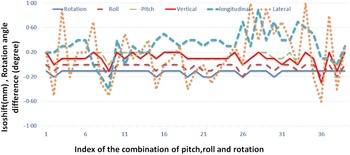
The following experiments were carried out with a uniformly distributed weight of 200 kg on the couch. Figure 2 shows the isocentre shifts for all 39 combinations of pitch, roll and rotation by using Vision RT. The maximum isocentre shifts were 0·8 mm in the X direction, 0·7 mm in the Y direction and −0·1 mm in the Z direction. The mean values and standard deviations were −0·16 ± 0·45 mm, 0·22 ± 0·24 mm and −0·02 ± 0·45 mm for X, Y and Z directions, respectively. The rotation angle differences between those Vision RT detected and the PerfectPitch couch programmed are also plotted in Figure 2. These differences represent the remaining rotational errors even after 6-DOF couch corrections. The maximum rotation angle differences were 0·2 degree for pitch, 0·1 degree for roll and −0·2 degree for couch rotation. The mean values and standard deviations were 0·16 ± 0·06 degree, 0·08 ± 0·06 degree and 0·12 ± 0·04 degree for pitch, roll and rotation, respectively. These angles are quite small and can be safely ignored in clinical applications.
The isocentre translation shifts for different combinations of pitch, roll and yaw by Vision RT, and the rotation angle differences between Vision RT and console input for different combinations of pitch, roll and yaw.

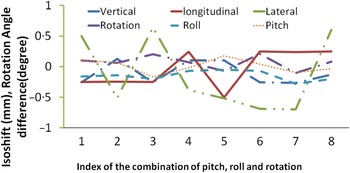
For CBCT image study, because of its complex and time-consuming process, only those phantom CBCT images at the eight most allowed combinations of rotation, roll and pitch of the 6-DOF couch were acquired and named as 1 to 8: (3,3,3), (3,357,3), (3,3,357), (3,357,357), (357,3,3), (357,357,3), (357,3,357) and (357,357,357). Those represent the most allowed cases in clinical practice and should be enough for this study. The CBCT image registration results are shown in Figure 3. The results are similar to those of the Vision RT image method.
The translation shifts and residual rotation angles for all eight combinations of pitch, roll and yaw from the CBCT method.

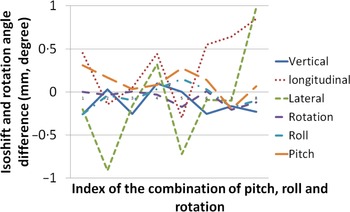
The differences between Vision RT and CBCT results are given in Figure 4 for the eight most allowed combinations of rotation, roll and pitch. It is clear that the rotation angle differences between Vision RT and CBCT are less than 0·3 degree, and the translation errors are less than 1 mm. Thus, Vision RT is accurate for application in the patient pre-set-up and monitoring during patient treatments.
The translation shifts and residual rotation angles between Vision RT and CBCT for all eight combinations of pitch, roll and yaw.

Conclusions
To verify the accuracy of 6-DOF couch, a total of 39 combinations of pitch, yaw and roll rotations of an SRS phantom were evaluated by using Vision RT system. This evaluation was done with a weight of 200 kg on couch. The uncertainties of rotation and translation were estimated.
CBCT images of the SRS phantom were acquired under a total of eight extreme conditions of rotation. An in-house software was used to detect the five BBs inside the phantom and register those BBs to calculate rotation. The accuracy between CBCT and Vision RT were also compared for the eight cases. It was observed that the results from those two methods are in good agreement.
All shifts of isocentre caused by residual rotation errors were less than 1 mm and considered clinically insignificant for the majority of radiotherapy treatments where the set-up margins are generally bigger than 3 mm. The applied margins for SRS cases are varied from one institution to another. From our clinical experience, the evaluated couch and imaging guidance systems can be safely used for the cases where the CTV to PTV margins are around or bigger than 2 mm.
Financial Support
No funding.
Conflict of Interest
No conflict of interest.