


Introduction
The UK is often considered a nation of animal lovers. However, concerns exist over the welfare of many companion animals (Royal Society for the Prevention of Cruelty to Animals [RSPCA] and Scottish SPCA 2022). Whilst owners often do not set out to deliberately cause harm to their animals, poor welfare can occur due to limited understanding of their care needs (Philpotts et al. Reference Philpotts, Dillon and Rooney2019). In the UK, the welfare of companion animals is protected by the Animal Welfare Act (2006), the Welfare of Animals Act (Northern Ireland) (2011), and the Animal Health and Welfare (Scotland) Act (2006) (jointly referred to hereafter as AWA). In 2020, whilst 76% of owners were found to be aware of the AWA, only 42% were familiar with the responsibilities within it (People’s Dispensary for Sick Animals [PDSA] 2020). In the ten years to 2020, despite awareness campaigns from animal welfare organisations, there has been little change in legislative awareness amongst companion animal owners (Wensley et al. Reference Wensley, Betton, Gosschalk, Hooker, Main, Martin and Tipton2021). Expert consensus has also highlighted lack of owner knowledge of appropriate companion animal care as a priority welfare issue (Rioja-Lang et al. Reference Rioja-Lang, Bacon, Connor and Dwyer2020).
The AWA imposes a duty of care upon any person responsible for an animal protected under the legislation to ensure the needs of the animal are met. These needs (hereafter referred to as the Five Welfare Needs [FWN]) include: their need for a suitable environment; their need for a suitable diet; their need to be able to exhibit normal behaviour patterns; any need they have to be housed with, or apart from, other animals; and their need to be protected from pain, suffering, injury and disease (Animal Welfare Act; s9.2 2006). Only 20% of cat, dog and rabbit owners had heard of the FWN prior to participating in research about companion animal welfare (PDSA 2020). Owner awareness of the FWN amongst UK companion animal owners is limited and varies between individual welfare needs, with companionship being the least recognised (PDSA 2022). Other literature suggests that a lack of animal-welfare legislative knowledge is evident worldwide (Weng et al. Reference Weng, Kass, Hart and Chomel2006; Farnworth et al. Reference Farnworth, Campbell and Adams2010; Keogh et al. Reference Keogh, Hanlon, Kelly, Devitt and Messam2022). To date, studies exploring legislative awareness amongst companion animal owners have mainly focused on dogs and cats, with limited work on rabbits, and virtually nothing on other popular companion animals, such as rodents, highlighting a gap in knowledge.
Concerns relating to companion animal welfare have been raised across provision of all of the FWN for a range of different companion animal species, including traditional companion species such as dogs and cats and common exotic species such as rabbits and rodents. For small mammals such as rabbits and Syrian hamsters, problems are regularly highlighted in relation to: inappropriate accommodation; inadequate diet leading to dental issues (Rioja-Lang et al. Reference Rioja-Lang, Bacon, Connor and Dwyer2020); and lack of an appropriate companion (Bradbury & Saunders Reference Bradbury and Saunders2022). Restrictions on opportunities to perform natural behaviours and limited resource availability in multi-cat households can be detrimental to cat welfare (Elzerman et al. Reference Elzerman, DePorter, Beck and Collin2020; Cisneros et al. Reference Cisneros, Litwin, Niel and Stellato2022). For dogs, as a social species, being left alone can result in welfare concerns (Bradshaw et al. Reference Bradshaw, Mcpherson, Casey and Larter2002). Challenges related to breeding and extreme conformation also detrimentally impact dog health and welfare (Rioja-Lang et al. Reference Rioja-Lang, Bacon, Connor and Dwyer2020). Across all species, access to appropriate veterinary care is not always provided, and experts highlight this as a priority welfare issue (O’Neill et al. Reference O’Neill, Craven, Brodbelt, Church and Hedley2020; Wallis et al. Reference Wallis, Radford, Belshaw, Jackson, Kubinyi, German and Westgarth2023). Some challenges can be a result of more than one welfare need not being appropriately met. For example, obesity is a major welfare concern, with links to both suitable diet and appropriate exercise opportunities (Lloyd et al. Reference Lloyd, Furtado, German, Watkins, Christley and Westgarth2023; O’Neill et al. Reference O’Neill, Gunn-Moore, Sorrell, McAuslan, Church, Pegram and Brodbelt2023).
Awareness of welfare legislation has been shown to vary with owner demographics in previous international research. In Taiwan, women were less likely to have adequate knowledge of animal welfare legislation than men (Weng et al. Reference Weng, Kass, Hart and Chomel2006). In New Zealand, respondents aged 41 and over were significantly more likely to be aware of legislation relating to cats compared to younger participants (Farnworth et al. Reference Farnworth, Campbell and Adams2010). Furthermore, those who have spent more years in education were less likely to have an adequate understanding of animal protection law (Weng et al. Reference Weng, Kass, Hart and Chomel2006). Developing an understanding of owner demographics to target through awareness messaging and campaigns could be beneficial for animal welfare organisations, where resources to do so may be limited (Stavisky et al. Reference Stavisky, Brennan, Downes and Dean2017; Mee et al. Reference Mee, Tipton, Oxley and Westgarth2022). In other sectors, such as risk and health communication, the importance of tailoring communications to specific audiences has been highlighted, particularly in relation to socially disadvantaged or minority groups (Bartolucci et al. Reference Bartolucci, Aquilino, Bril, Duncan and van Steen2023; Habib et al. Reference Habib, Yousuf, Bredius, Bindraban, Winter, Scherder, Van Der Linden, Narula and Hofstra2023).
This study explored UK companion animal owner awareness and knowledge of the AWA through two research questions: (1) What is the awareness of the AWA and FWN amongst companion animal owners? And (2) Does awareness of the AWA and the FWN differ with respondent demographics?
Materials and methods
Ethical considerations
Ethical approval was granted by Hartpury University Ethics Committee (Ref: ETHICS2023-11).
Participant recruitment
Inclusion criteria required respondents to be over the age of 18 and own at least one of the following species: dog, cat, rabbit or Syrian hamster. These species were chosen to broaden the research exploring legislative awareness of companion animals beyond the more frequently investigated dogs and cats. In the UK, rabbits are the third most popular mammalian companion animal, after dogs and cats (UK Pet Food 2026). Hamsters represent the most popular of the smaller rodent species commonly kept as pets, and Syrian hamsters were specifically chosen as the most popular hamster species in the UK (O’Neill et al. Reference O’Neill, Kim, Brodbelt, Church, Pegram and Baldrey2022; UK Pet Food 2024).
Participants were invited to complete an online questionnaire hosted on the Qualtrics® platform between December 2023 and February 2024. Recruitment for the study was through social media groups and online fora and in-person advertising at charity shops run by Woodgreen Pets Charity, Cambridgeshire, UK. Social media groups frequented by the owners of the target species and general community groups were used. The dual approach to advertising was chosen to attempt to overcome the sampling bias traditionally noted in online convenience samples in animal welfare research, where highly committed owners are thought to be overrepresented (Welsh et al. Reference Welsh, Gruffydd-Jones and Murray2013).
Study procedure
The questionnaire consisted of 51 questions across seven sections (see Supplementary material). This paper focuses on the data from sections one, three and seven. The questions were initially developed through author discussion alongside consideration of existing literature. Content validity was assessed through sharing the survey with three companion animal experts through the question development phase, which also involved significant discussion between the research team. The questionnaire was piloted with a small group of nine participants and edited for readability and understanding based upon their feedback.
The total number of questions asked varied depending upon the number of different species owned by participants. Section one “About your pets” asked participants about which of the target species they own, alongside where their animal was acquired from, the research they undertook prior to acquisition and the motivation behind acquisition. If participants owned more than one of each species, they were asked to provide answers for the individual whose name came first in the alphabet to avoid bias in selecting the individual they were most attached to. Section two consisted of questions relating to the care practices for each owned species. Section three “Pets and the Law” focused on participants’ awareness and recognition of the legislation relating to companion animals in the UK. Sections four and five explored participants’ views on the importance of each of the FWN and differences between the target species. Section six asked participants to qualitatively report how they meet the needs of each species of companion animal they own. Section seven focused on participant demographics (age, gender, annual household income and education level).
Statistical analysis
The data were exported and cleaned with Microsoft 365 Excel®. Missing data were excluded from analysis. Statistical analyses were performed in IBM SPSS® Statistics v.29.
Descriptive statistics were produced for: Owner demographics; Species type; AWA named; FWN selected; Environment selected; Diet selected; Behaviour selected; Companionship selected; and Protection selected. Owner sex was chosen for analysis due to the distribution of categories within the gender variable having categories too small for analysis. Owner education was re-categorised due to limited responses in the ‘Primary school’ and ‘Secondary school’ categories, which were combined to form a new category of ‘Primary or Secondary school’. A new variable ‘Species type’ was created from ownership data which included the categories ‘Dog and/or Cat’ (Companion), ‘Rabbit and/or Syrian hamster’ (Small) and ‘Dog and/or Cat plus Rabbit and/or hamster’ (Combo). A new variable ‘AWA named’ was created from a qualitative question in Section 3 asking, ‘Can you name any legislation which sets out pet owner responsibilities towards their pets?’ Answers that included the three words “Animal Welfare Act”, with allowance for clear and obvious spelling errors were coded as ‘Yes’ for this variable. The year of enactment was not required. The variable ‘FWN selected’ was coded as ‘Yes’ if all five needs were correctly selected in the latter question ‘Which of the following welfare needs are explicitly stated in the Animal Welfare Act?’ For this question, participants were asked to select from a list of 10 needs statements, five of which were decoy statements. The variables for each individual welfare need were coded as ‘Yes’ if selected from this same question.
Univariate and multivariate logistic regression were performed to explore the relationship between owner demographics (sex, age, education, annual household income and species type) and naming the AWA, selecting all FWN and selecting each of the FWN individually. Variables with a P-value of 0.2 or less in univariate analyses (see Supplementary material) were selected for backwards elimination multivariable modelling. A backwards elimination approach was utilised as there was no theoretical basis on which to specify a hierarchical approach to entering the demographic variables. In the interest of striving for parsimony (Field Reference Field2024), this approach allowed development of a concise model, whilst avoiding the risk of suppressor effects through alternatives such as forward methods.
The significance value for multivariable modelling was set at a P-value of 0.05 or less. Multicollinearity of each variable was assessed by calculating variance inflation factor (VIF) where multiple predictive variables were retained in the final model. Variables would have been excluded where VIF > 5, but this was not required (Senaviratna & Cooray Reference Senaviratna and Cooray2019).
As multiple comparisons were being made through this analysis, there was a risk of potential Type I errors arising. To control for this the Benjamini-Hochberg False Discovery Rate (FDR) (Benjamini & Hochberg Reference Benjamini and Hochberg1995) procedure was applied. The False Discovery Rate was controlled at 5%. To ensure thorough reporting of results, variables with P-values between the BH-adjusted q-value and P < 0.05 are reported as trends but not discussed as in Jackson et al. (Reference Jackson, Betts, Hedley and Burn2025).
Results
Sample characteristics
A final dataset of 2,798 participants remained after data cleaning (Table S1; Supplementary material). A significant proportion of the sample were female (91.85%) and 96.28% of participants reported that they identify with the same sex as they were registered at birth. The predominant level of education reported amongst participants was further education (pre-university after secondary school) (32.81%). The most common response to the annual household income question was ‘prefer not to say’ (16.80%), with the second most reported household income being £50,000–£69,999 (16.65%).
The majority of participants owned just one of the species within the scope of the study (69.23%) (see Table S2; Supplementary material). The most common target species owned by the sample were dogs (55.90%). Most participants were classified as ‘Companion’ owners as they owned a dog and/or a cat (67.70%).
Awareness of legislation
The majority (72.02%) of the sample reported that they were aware of the legal responsibilities of companion animal owners in the UK (Table 1). Three-quarters (74.59%) of participants agreed (strongly agree and somewhat agree combined) with the statement “I am confident that I know what the legal responsibilities of pet owners are”. Roughly half (44.93%) of participants agreed with the statement “I considered the legislation relating to caring for pets before acquiring my pet(s)” while 44.67% of participants agreed with the statement “The legislation in UK law which relates to pets informs how I take care of my pets(s)”.
Proportion of UK companion animal owners reporting awareness and recognition of the Animal Welfare Act 2006 and Five Welfare Needs (n = 2,798)

Table 1. Long description
Table 1 summarises awareness and recognition of the Animal Welfare Act 2006, or equivalent UK legislation, among 2,798 companion animal owners. Results are presented as numbers of respondents and percentages of the full sample. The table has four sections. In section 1, 72.02% of respondents reported awareness of the legal responsibilities of pet owners in the UK. Section 2 shows 23.12% of participants were able to name the Animal Welfare Act. Section 3 shows that the most widely recognised need was protection from pain, suffering, injury and disease, selected by 95.21%. The least recognised need was appropriate companionship selected by 32.81%. Section 4 shows 28.70% of participants correctly selected all five welfare needs.
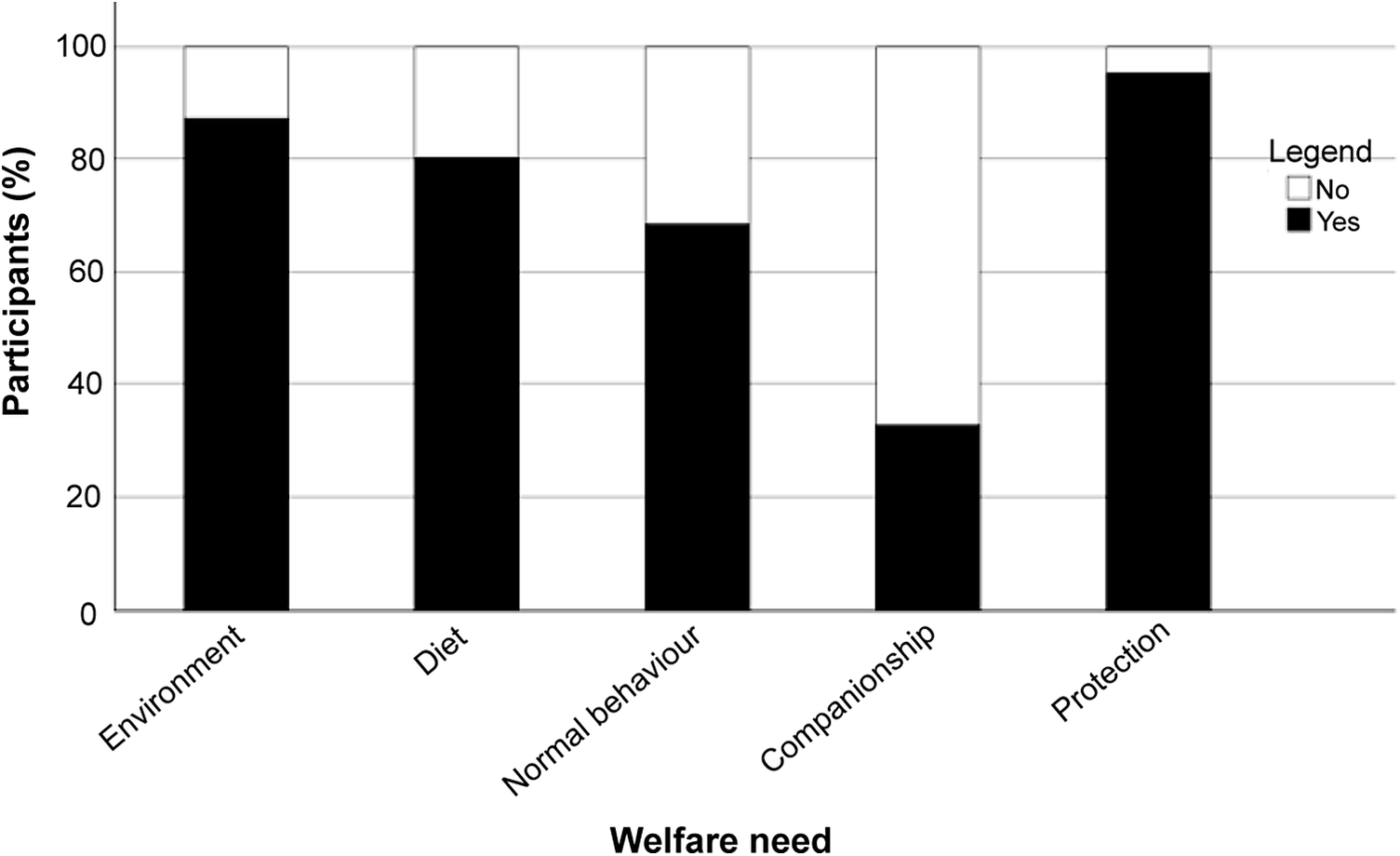
Only 23.12% of participants named the AWA when asked to name legislation that sets out owner responsibilities towards their animal and 28.7% correctly selected all of the FWN. The level of recognition of each of the individual FWN varied: Protection (95.21%); Environment (87.10%); Diet (80.02%); Behaviour (68.44%) and Companionship (32.81%) (Figure 1). The most often selected decoy need statement was “The need for a comfortable bed” (21.73%).
Percentage of UK companion animal owners (n = 2,798) selecting each of the Five Welfare Needs prescribed in the Animal Welfare Act (2006) (AWA) from a list of 10 needs statements (5 stated in AWA, 5 decoy statements).

Figure 1. Long description
Presents the percentage of 2,798 UK companion animal owners who selected each of the Five Welfare Needs prescribed in the Animal Welfare Act 2006 from a list of ten statements. Five statements represented genuine welfare needs and five were decoys. The most frequently recognised need was protection from pain, suffering, injury and disease, selected by 95.21% of respondents. This was followed by the need for a suitable environment, selected by 87.10%, and the need for a suitable diet, selected by 80.02%. Recognition was lower for the need to be able to exhibit normal behaviour patterns, which was selected by 68.44% of respondents and the need to be housed with, or apart from, other animals as appropriate, selected by 32.81%.
Owner demographic factors associated with legislation awareness
The univariate analysis of owner demographic factors associated with the explored elements of companion animal welfare legislation is shown in Tables S3, S5, S7, S9, S11, S13, S15 in the Supplementary material.
The significant predictors from the multivariate analyses of the legislative awareness and recognition outcomes are reported in Table 2. Full multivariable model results are presented in Tables S4, S6, S8, S10, S12, S14, S16 in the Supplementary material.
Statistically significant results and trends from multivariable binary logistic regression modelling of Animal Welfare Act 2006 awareness and recognition variables amongst companion animal owners (n = 2,798) in the United Kingdom

Table 2. Long description
Younger age, higher education and owning both companion and small-pet species were generally associated with greater awareness of the Animal Welfare Act and recognition of the Five Welfare Needs. The table reports significant associations and trends using odds ratios, 95% confidence intervals, p-values and false-discovery-rate-adjusted q-values.
The False Discovery Rate was controlled at 5%. BH adjusted q-values were calculated using the Benjamini–Hochberg equation: (i / m) * 0.05. Significant results P < BH-adjusted q-value. For completeness of reporting, FDR indicates nonsignificant trends after controlling for the false discovery rate.
Animal Welfare Act named
The overall model was found to be statistically significant (Chi-squared value [13] = 97.275; P < 0.001), with Nagelkerke R-squared value of 0.052. The Hosmer-Lemeshow test has a Chi-squared value of 7.415 with a significance value of 0.493, indicating a good model fit.
Younger respondents (18–24) were significantly more likely to name the AWA than all other age categories, except for those who preferred not to disclose their age. Respondents whose highest level of education completed were foundation degree (OR = 3.17, 95% CI = 1.997–5.034; P < 0.001, BH-adjusted q = 0.007), undergraduate degree (OR = 1.653, 95% CI = 1.118–2.446; P = 0.012, BH-adjusted q = 0.021) or postgraduate degree (OR = 1.962, 95% CI = 1.315–2.928; P < 0.001, BH-adjusted q = 0.013) were significantly more likely to name the AWA than respondents whose highest level of education was primary or secondary school. Those who completed further education were more likely to name the AWA, but this did not retain significance following FDR correction.
‘Combo’ owners were significantly more likely to name the AWA than ‘Companion’ (OR = 0.690, 95% CI = 0.541–0.880; P = 0.003, BH-adjusted q = 0.017) or ‘Small’ owners (OR = 0.694, 95% CI = 0.515-0.935; P = 0.016, BH-adjusted q = 0.022).
Selected all FWN
The overall model was found to be statistically significant (Chi-squared value [8] = 132.359; P < 0.001), with Nagelkerke R-squared value of 0.066. The Hosmer-Lemeshow test has a Chi-squared value of 3.152 with a significance value of 0.871, indicating a good model fit.
Respondents in the 18–24 category were significantly more likely to select all FWN than those in all other age categories, except for those who answered ‘prefer not to say’. ‘Combo owners’ were significantly more likely to select all FWN than ‘Companion’ owners (OR = 0.485, 95% CI = 0.386–0.609; P < 0.001, BH-adjusted q = 0.001).
Environment need
The overall model was found to be statistically significant (Chi-squared value [15] = 81.069; P < 0.001), with Nagelkerke R-squared value of 0.053. The Hosmer-Lemeshow test has a Chi-squared value of 3.299 with a significance value of 0.914, indicating a good model fit.
Owners with a combination of small and companion pets were significantly more likely to select the environment welfare need than those owners with only a dog and/or a cat (OR = 0.421, 95% CI = 0.279–0.635; P < 0.001, BH-adjusted q = 0.003). Owners of only ‘small’ companion animals were less likely to select the environment welfare need, but this did not retain significance following FDR correction. Female participants were more likely to select the environment need than males as were respondents in the 18–24 category compared to those in the 25–34 category, but following FDR correction these results were no longer significant.
Diet need
The overall model was found to be statistically significant (Chi-squared value [13] = 89.392; P < 0.001), with Nagelkerke R-squared value of 0.048. The Hosmer-Lemeshow test has a Chi-squared value of 4.606 with a significance value of 0.799, indicating a good model fit.
‘Combo’ owners were significantly more likely to select the diet welfare need than ‘Companion’ owners (OR = 0.575, 95% CI = 0.427–0.776; P < 0.001, BH-adjusted q = 0.003). Younger respondents, aged 18–24 years, were more likely to select the diet need than those in the 45–54 years category and the ‘prefer not to say’ category, however these results did not retain significance following FDR correction.
Respondents whose highest level of education was undergraduate degree (OR = 1.546, 95% CI = 1.103–2.167; P = 0.011, BH-adjusted q = 0.020) or postgraduate degree (OR = 1.788, 95% CI = 1.258–2.542; P = 0.001, BH-adjusted q = 0.014) were more likely to select the diet need than those in the primary or secondary school category.
Behaviour need
The overall model was found to be statistically significant (Chi-squared value [13] = 99.142; P < 0.001), with Nagelkerke R-squared value of 0.049. The Hosmer-Lemeshow test has a Chi-squared value of 8.567 with a significance value of 0.380, indicating a good model fit.
‘Combo’ owners were significantly more likely to select the behaviour welfare need than owners with just dogs and/or cats (OR = 0.482, 95% CI = 0.373–0.622; P <0.001, BH-adjusted q = 0.003).
Respondents in the 18–24 age category were significantly more likely to select the behaviour need than those in the 45–54 category (OR = 0.598, 95% CI = 0.416–0.859; P= 0.005, BH-adjusted q = 0.018). Companion animal owners in the 25–34 years and the 35–44 years categories were less likely to select the behaviour need than 18–24 year olds, but these findings did not remain significant following FDR correction.
Respondents whose highest level of education was primary or secondary school were significantly less likely to select the behaviour need that those whose highest level of education was further education (OR = 1.583, 95% CI = 1.192–2.103; P = 0.002, BH-adjusted q = 0.015), foundation degree (OR = 1.848, 95% CI = 1.241–2.752; P = 0.003, BH-adjusted q = 0.017), undergraduate degree (OR = 2.376, 95% CI =1.758–3.212; P < 0.001, BH-adjusted q = 0.002) or postgraduate degree (OR = 2.190, 95% CI = 1.608–2.982; P < 0.001, BH-adjusted q = 0.007).
Companionship need
The overall model was found to be statistically significant (Chi-squared value [8] = 139.116; P < 0.001), with Nagelkerke R-squared value of 0.068. The Hosmer-Lemeshow test has a Chi-squared value of 2.014 with a significance value of 0.918, indicating a good model fit.
Respondents in the 18–24 age category were significantly more likely to select the companionship need than those in the 35–44 category (OR = 0.500, 95% CI = 0.366–0.683; P < 0.001, BH-adjusted q = 0.010), the 45–54 category (OR = 0.439, 95% CI = 0.318–0.605; P < 0.001, BH-adjusted q = 0.006), 55–64 category (OR = 0.466, 95% CI = 0.329–0.661; P < 0.001, BH-adjusted q = 0.011) and the 65 and older category (OR = 0.514, 95% CI = 0.338–0.783; P = 0.002, BH-adjusted q = 0.016). Respondents aged 25–34 years were less likely to select the companionship need than those aged 18–24 but following FDR testing this was no longer significant. ‘Combo owners’ were significantly more likely to select the companionship need than ‘Companion’ owners (OR = 0.506, 95% CI = 0.405–0.633; P < 0.001, BH-adjusted q = 0.001).
Protection need
The overall model was found to be statistically significant (Chi-squared value [5] = 19.967; P = 0.001), with Nagelkerke R-squared value of 0.022. The Hosmer-Lemeshow goodness-of-fit test for the final model yielded a P-value of 1.0. This reflects that the final model included a single predictor and should not be interpreted as evidence of perfect model fit.
Companion animal owners with undergraduate (OR = 2.683, 95% CI = 1.315–4.788; P = 0.002, BH-adjusted q = 0.015) or postgraduate level (OR = 2.084, 95% CI = 1.031–3.03; P = 0.021, BH-adjusted q = 0.023) education were more likely to select the protection need than those with primary or secondary school level education.
Discussion
This study found that UK companion animal owners have limited awareness and recognition of the legislation about companion animal care. Despite a large proportion of owners agreeing that they were confident they knew their legal responsibilities, substantially fewer were able to identify the legislation and its contents. The findings also highlighted that owner demographic and species ownership factors were associated with awareness of the AWA and recognition of the FWN.
The AWA was named by 23.12% of participants when asked to name legislation that sets out owner responsibilities towards their companion animal. These findings echo a study of Irish dog owners, which reported low legislative awareness, particularly of the responsibilities that result in direct negative consequences to dogs instead of humans (Keogh et al. Reference Keogh, Hanlon, Kelly, Devitt and Messam2022). Similarly, in New Zealand, the majority of respondents were reported to not be aware of animal welfare legislation (Farnworth et al. Reference Farnworth, Campbell and Adams2010). Lack of legislative awareness can also extend beyond owners, with Italian veterinary students demonstrating a lack of knowledge about European Union animal welfare legislation (Magnani et al. Reference Magnani, Ferri, Dalmau and Messori2017).
This study also sought to explore whether owners had awareness of the elements contained within the AWA, because it is not assumed that being unable to name legislation is indicative of an individual not knowing what is enshrined within the law. Recognition of the FWN within the AWA was limited, with less than 30% of participants able to recognise all of the FWN enshrined within the legislation. Wensley et al. (Reference Wensley, Betton, Gosschalk, Hooker, Main, Martin and Tipton2021) reported that between 2011 and 2018, owner awareness and familiarity with the AWA decreased, despite the efforts of campaigners. In Ireland, only 17.9% of dog owners were aware of all their dog-related legal responsibilities (Keogh et al. Reference Keogh, Hanlon, Kelly, Devitt and Messam2022). Literature from other legislative areas provides a potential basis for this finding, which could be applicable to animal welfare law, although this is not tested as part of this study. In road-related legislation, knowledge of the law may be high immediately after its introduction, however this awareness can erode over time, particularly if enforcement is limited (Elvik Reference Elvik, Tiwari and Mohan2021). As such, if owners are not seeing enforcement of the AWA and consider the risk of detection of breaches low, their perceived need to remain aware of the legislation detail may diminish.
The introduction of the AWA aimed to move beyond previous provisions in the Protection of Animals Act (1911) where the premise was preventing cruelty, towards the promotion of good animal welfare (Department for Environment and Rural Affairs undated). This includes consideration that a responsible person could commit an offence if they caused unnecessary physical or mental suffering to a protected animal. The results of this study suggest that companion animal owners may still not recognise the importance of the mental aspects of welfare. The elements of welfare which support physical health such as a suitable environment and diet, along with protection from pain, suffering, injury and disease were more frequently selected, whereas opportunities to perform natural behaviours and have appropriate companionship were recognised by fewer participants. In Austria and Switzerland, it is specified within the law that social species such as guinea pigs must be housed socially (Bundesamt für Lebensmittelsicherheit und Veterinärwesen 2025; Bundeskanzleramt der Republik Österreich 2026). Since the introduction of the FWN, the development of alternative welfare frameworks such as the Five Domains now offers a clearer incorporation of positive welfare states (Mellor & Beausoleil Reference Mellor and Beausoleil2015). If owners do not see effective enforcement of these elements of the legislation, the effect of their inclusion in the law may be limited (Rodriguez Ferrere Reference Rodriguez Ferrere2022).
A person responsible for a protected animal is required to meet the needs of their animal to the extent required by good practice to avoid committing an offence under the AWA – something that arguably could be difficult without legislative awareness. With that said, it is possible that an owner could possess adequate knowledge of good practice care for their animal with no knowledge of the legislation. There is limited literature in this area, however a study of Chilean dog owners found that awareness of the current legislation was associated with the microchipping, vaccinating and neutering of dogs (Tadich et al. Reference Tadich, Alegría-Morán and Escobar-Aguirre2024). Similarly, Philpotts et al. (Reference Philpotts, Blackwell, Dillon, Tipton and Rooney2024) reported that dog owners who were more informed about the FWN reported fewer behaviour problems with their dog, however there was no difference in reporting their dog had the correct weight-related body shape. It is important that legislation and regulations are clear and accessible for owners if they are to have knowledge of them (Zamora-Nasca & Lambertucci Reference Zamora-Nasca and Lambertucci2023). The creation of codes of practice, such as the Code of Practice for the Welfare of Dogs (Department for Environment, Food and Rural Affairs 2018) could support owners to improve their knowledge of how to care for their animals alongside their legal responsibilities. At present in the UK, statutory codes exist for limited companion animal species, namely dogs and cats, except in Wales and Scotland where rabbits are also included (Llywodraeth Cynulliad Cymru 2009; The Scottish Government 2018). Species-specific organisations have produced equivalent documents to assist owners (All-Party Parliamentary Group for Animal Welfare 2023). Whilst these codes are beneficial, they also present inherent challenges, as they still require an owner to make a judgement on behalf of their animal. In the case of an indoor housed cat, for example, an owner could be expected to balance the need for their cat to perform natural behaviours, something that may be restricted by living indoors, with the need to protect them from injury, which may be more likely with outdoor access (Tan et al. Reference Tan, Stellato and Niel2020).
Owner demographics were found to be associated with knowledge of companion animal legislation. (Farnworth et al. Reference Farnworth, Campbell and Adams2010; Keogh et al. Reference Keogh, Hanlon, Kelly, Devitt and Messam2022). Participant age was found to be associated with awareness of the AWA and recognition of the FWN, with younger participants significantly more likely to be aware of the AWA and select the behaviour and companionship needs than older age groups. In New Zealand, the opposite was reported in relation to awareness of cat-related legislation, with respondents aged 41 or over being significantly more likely to be aware of the legislation than those 40 or under (Farnworth et al. Reference Farnworth, Campbell and Adams2010). The authors argue that this could be due to older participants having a higher likelihood of exposure to information about cat welfare than younger respondents. In the current study, it is possible the opposite is true, as younger individuals have been reported to consult more information sources during pre-acquisition research than older individuals (Philpotts et al. Reference Philpotts, Blackwell, Dillon, Tipton and Rooney2024). Younger owners may also have received school-based education related to the AWA (Hawkins & Williams Reference Hawkins and Williams2017; Wensley et al. Reference Wensley, Betton, Gosschalk, Hooker, Main, Martin and Tipton2021). For older owners, who may rely on past experience, the AWA may have been introduced since their ownership journey began, hence limiting their exposure to related information.
Participants with higher levels of education were significantly more likely to name the AWA and select the diet, behaviour and protection welfare needs than those with a primary or secondary school level education. Philpotts et al. (Reference Philpotts, Blackwell, Dillon, Tipton and Rooney2024) found that those with a higher education level carried out more pre-purchase research prior to acquiring their dog, something that was associated with feeling more informed about the FWN. Similar findings were reported in Texas, US, where individuals with higher levels of education had more knowledge about animals (Ramón et al. Reference Ramón, Slater and Ward2010). Conversely, in Taiwan, the longer a respondent had spent in education, the less likely they were to have an adequate understanding of animal protection law (Weng et al. Reference Weng, Kass, Hart and Chomel2006). Those whose highest level of education was “Foundation degree”, which in the UK can include animal welfare courses, were more than three times as likely to name the AWA than those with primary or secondary level education. Primary and secondary school animal welfare education is frequently provided by animal welfare charities, however, sessions including information about the AWA would only have been provided to participants who left school within the last 20 years since the introduction of the legislation (Blue Cross undated; Pet Education Partnership undated). This study did not ask participants about the subject focus of their education or whether they had received animal welfare-based information during their education, therefore associations with an animal welfare-based education could not be explored.
Owners with a combination of species types were significantly more likely to name the AWA and select the welfare needs, particularly compared to those who only owned a dog and/or a cat. For naming the AWA, those with just small pet species also performed worse than those with a combination of species. It would be valuable for future research to explore the association between ownership of different species/types of companion animal and legislative awareness in more detail. It is possible that those who are more engaged and knowledgeable about animal welfare could be more likely to own multiple species due to personal interest. Another potential explanation could be that those who acquire multiple species are exposed to more information through different acquisition sources (Freiwald et al. Reference Freiwald, Litster and Weng2014; Gates et al. Reference Gates, Walker, Zito and Dale2019). It is plausible, although not tested here, that for species that are more likely to be anthropomorphised, such as dogs (Bouma et al. Reference Bouma, Dijkstra and Arnt Rosa2023), owners could presume to know their welfare needs and expect them to align closely with their own. They may therefore be less likely to research their species-specific needs as much as an owner with alternative species might and they may naturally be less likely to come across information about the legislation. The impact of anthroporphism on legislative awareness and information seeking prior to acquiring a companion animal would be an interesting avenue for future research.
Study limitations
Participant recruitment through the channels utilised within this study likely resulted in self-selection bias and therefore highly engaged owners may be overrepresented within the sample as is common for this type of research, despite attempts to balance recruitment (Rohlf et al. Reference Rohlf, Bennett, Toukhsati and Coleman2010; Harrup & Rooney Reference Harrup and Rooney2020; James & Wills Reference James and Wills2025). However, the findings can be considered a best-case scenario, reflecting the need for increased awareness of companion animal legislation amongst owners. Asking participants where they heard about the study might have enabled the diversity of the sample to be explored.
It should also be noted that the study is acknowledged as being disproportionately female, which limits the representativeness of the study findings. However, it is possible that this reflects the demographics of pet owners, as females are more likely to both own pets and be the main caregiver for them (Fraser et al. Reference Fraser, Huang, Robinson, Wilson, Bulbulia and Sibley2020; Mueller et al. Reference Mueller, King, Callina, Dowling-Guyer and McCobb2021; Cudworth et al. Reference Cudworth, Van Patter, Linares-Roake, Rice and Breen2026). Given that gender differences have previously been reported in both legislative knowledge and animal care practices, care should be taken in generalising these findings (Weng et al. Reference Weng, Kass, Hart and Chomel2006; Mee et al. Reference Mee, Tipton, Oxley and Westgarth2022). Additionally, the survey did not ask participants whether they had received any animal welfare-based education which would have been helpful for considering the differences between levels of education. Future work could explore where UK companion animal owners have heard about animal welfare legislation and whether elements of this were featured within their education.
The use of recognition-based questions with predefined statements to assess welfare need knowledge may have resulted in an overestimation of actual legal knowledge amongst the participants, as they may have intuitively guessed responses. Multiple choice question formats risk measuring recognition due to cueing effects rather than assessing true knowledge (van Wijk et al. Reference van Wijk, Janse, Ruijter, Rohling, van der Kraan, Crobach, de Jonge, de Beaufort, Dekker and Langers2023). However, if this is the case the limited awareness reported within the study may be an underestimation and therefore consideration of this limitation would further support the need to raise awareness amongst UK companion animal owners. Although the survey responses were anonymous, all data were participant-reported and therefore could be at risk of social desirability bias. The cross-sectional design of this research allows for exploration of associations between demographic variables and legislative awareness but does not allow for causal relationships to be established. Caution should be exercised with any interpretation of causality as further research is warranted here.
In the logistic regression analyses, whilst the models were significant and demonstrated good model fit, low Nagelkerke R² values across all models indicates that the owner demographic variables explained only a small proportion of the observed variation in legislative awareness and welfare need recognition. Future research should look at other factors that may be important in predicting legislative awareness amongst companion animal owners such as literacy levels, normative beliefs and information sources (Oxley Reference Oxley2012; Van Rooij Reference Van Rooij, van Rooij and Sokol2021; Agyapon-Ntra & McSharry Reference Agyapon-Ntra and McSharry2023).
Animal welfare implications and conclusion
In conclusion, UK companion animal owner awareness of the AWA and recognition of the FWN is limited, despite a substantial proportion reporting that they were confident they knew their legal responsibilities as owners. The limited recognition of the need for companion animals to be able to perform natural behaviour and have appropriate conspecific companionship is a concern. Future research should seek to explore the relationship between awareness of companion animal welfare legislation and the care practices of companion animal owners. As owner demographics are associated with companion animal welfare legislation awareness and recognition, this highlights opportunities for welfare organisations and other advice sources to consider targeted approaches to legislative awareness campaigns.
Supplementary material
The supplementary material for this article can be found at http://doi.org/10.1017/awf.2026.10131.
Data availability statement
The data that support the findings of this study are available from the corresponding author upon reasonable request once the PhD programme has been completed.
Acknowledgements
The authors would like to thank the companion animal owners who participated in this study. We would also like to extend our thanks to the reviewers for useful feedback on an earlier draft of this manuscript. This study was completed as part of NP-W’s PhD which is funded by Woodgreen Pets Charity.
Competing interests
NP-W is employed by Woodgreen Pets Charity who funded the study.



 Open access

