Across all age groups, cultures, and societies, belonging to a social group is one of the most important factors contributing to physical and psychological health and well-being (Aboud, Reference Aboud2003; Brown, Reference Brown1991; Dunbar, Reference Dunbar2018; Dunham, Baron, & Carey, Reference Dunham, Baron and Carey2011; Dunham & Emory, Reference Dunham and Emory2014) and is proposed to be essential for survival (Baumeister & Leary, Reference Baumeister and Leary1995). Indeed, social isolation increases risk for premature death as much as smoking, diabetes, or obesity (Holt-Lunstad, Smith, Baker, Harris, & Stephenson, Reference Holt-Lunstad, Smith, Baker, Harris and Stephenson2015; House, Landis, & Umberson, Reference House, Landis and Umberson1988). It has therefore been proposed that social belonging is one of the most fundamental human needs (Baumeister & Leary, Reference Baumeister and Leary1995; Cruwys, Haslam, Dingle, Haslam, & Jetten, Reference Cruwys, Haslam, Dingle, Haslam and Jetten2014; Pickett & Gardner, Reference Pickett, Gardner, Williams, Forgas and Von Hippel2005). The importance of belonging to a group becomes increasingly salient as youth enter adolescence, a time when individuals strive to achieve a sense of connection within a valued social group (Crockett, Losoff, & Petersen, Reference Crockett, Losoff and Petersen1984; Furman & Buhrmester, Reference Furman and Buhrmester1992; Hart & Fegley, Reference Hart and Fegley1995; Newman & Newman, Reference Newman and Newman2001).
The Belonging Regulation Model
One promising theory that seeks to explain the processes supporting the human need to belong is the Belonging Regulation model (Gardner, Pickett, Jefferis, & Knowles, Reference Gardner, Pickett, Jefferis and Knowles2005). According to this model, all humans possess an innate Social Monitoring System (SMS) to regulate belonging needs (Gardner et al., Reference Gardner, Pickett, Jefferis and Knowles2005). The SMS assesses current levels of belonging need. When belonging levels are too low, the SMS produces a type of social hunger such that increased need to belong leads to increased social monitoring, which involves increased attention, processing, and memory for social information. This leads to an intensified focus on opportunities for social interaction and belonging (Gardner et al., Reference Gardner, Pickett, Jefferis and Knowles2005). Similar to physical hunger directing attention towards food cues, social exclusion produces a social hunger that heightens attention, processing, and memory of social cues (Gardner, Pickett, & Brewer, Reference Gardner, Pickett and Brewer2000). Indeed, findings from behavioral research show that individuals who have been socially rejected demonstrate improved perspective-taking skills (Knowles, Reference Knowles2014), greater ability to detect subtle social cues in vocal tone and facial expressions (Pickett, Gardner, & Knowles, Reference Pickett, Gardner and Knowles2004), heightened nonverbal affiliative behaviors (Lakin, Chartrand, & Arkin, Reference Lakin, Chartrand and Arkin2008), improved memory for social events about others (Hess & Pickett, Reference Hess and Pickett2010; Knowles, Reference Knowles2014), and more cooperative and generous behavior with group members (Maner, DeWall, Baumeister, & Schaller, Reference Maner, DeWall, Baumeister and Schaller2007; Williams & Sommer, Reference Schwartz, Gorman, Dodge, Pettit and Bates1997), all of which are thought to reflect reinclusion strategies. Indeed, the final stage of the belonging regulation model is to use the information acquired through increased social monitoring to re-establish social inclusion (Gardner et al., Reference Gardner, Pickett, Jefferis and Knowles2005).
While the need to belong is important across the lifespan, it is particularly salient during adolescence, a developmental period marked by a strong need to affiliate with peers (Crockett, Losoff, & Petersen, Reference Crockett, Losoff and Petersen1984; Furman & Buhrmester, Reference Furman and Buhrmester1992; Hart & Fegley, Reference Hart and Fegley1995; Kroger, Reference Kroger2000; Newman & Newman, Reference Newman and Newman2001; Tajfel & Turner, Reference Tajfel, Turner, Austin and Worchel1979). Because the need to belong is so strong in adolescence, adolescents are acutely aware of their peers’ behaviors and perceptions, even more so than adults and children. Compared with children and adults, adolescents display heightened neural, behavioral, and autonomic arousal when being observed by a peer (Somerville et al., Reference Somerville, Jones, Ruberry, Dyke, Glover and Casey2013), are more likely to alter their behavior in the presence of peers (Gardner & Steinberg, Reference Gardner and Steinberg2005), and, following both acute and chronic peer rejection, are more likely to engage in risky behaviors (Peake, Dishion, Stormshak, Moore, & Pfeifer, Reference Peake, Dishion, Stormshak, Moore and Pfeifer2013; Telzer, Miernicki, & Rudolph, Reference Telzer, Miernicki, Rudolph, Austin and Worchel2018). Thus, due to their increased peer focus and elevated need to belong, adolescents may have a particularly strong SMS.
Importantly, salient group membership influences social monitoring, whereby individuals seek to fulfill their belonging needs by affiliating more with members of their own group (i.e., in-group) relative to disliked or even unknown others (i.e., out-group; Van Bavel, Swencionis, O'Connor, & Cunningham, Reference Van Bavel, Swencionis, O'Connor and Cunningham2012). According to social identity theory, individuals orient more towards in-group members, which contributes to their sense of self (Tajfel, Billig, Bundy, & Flament, Reference Tajfel, Billig, Bundy and Flament1971; Turner, Reference Turner and Tajfel1982). Because in-groups are more likely to strengthen one's sense of belonging, these types of group memberships are most likely to be activated after rejection (Knowles & Gardner, Reference Knowles and Gardner2008). Consistent with social identity theory, individuals generally display increased social monitoring for in-group members. For instance, following an exclusion experience from an in-group, individuals show increased nonverbal affiliative behaviors with a subsequent in-group but not out-group partner, suggesting that people are selective in their reinclusion strategies (Lakin et al., Reference Lakin, Chartrand and Arkin2008). Even in minimal group paradigms, where in-group and out-group distinctions are artificial, individuals display an in-group bias, including improved memory for in-group members (Bernstein, Young, & Hugenberg, Reference Bernstein, Young and Hugenberg2007; Van Bavel et al., Reference Van Bavel and Cunningham2012); moreover, following social rejection from a minimally constructed in-group, individuals increase their social monitoring by demonstrating preferential recall for social information about peers (Gardner et al., Reference Gardner, Pickett and Brewer2000) and by working harder at a collective task (Williams & Sommer, Reference Schwartz, Gorman, Dodge, Pettit and Bates1997). Even just remembering a real past experience of social exclusion from one's in-group can increase the entitativity (i.e., perceived meaningfulness of a group) and importance of in-groups but not out-groups (Knowles & Gardner, Reference Knowles and Gardner2008). In each of these studies, rejection from an in-group increased social monitoring, presumably in an attempt to demonstrate commitment to the group in the hopes of improving their belonging. Ultimately, socially rejected individuals may use this greater awareness of social cues to satiate belonging needs with salient in-group members.
The Belonging Regulation System in the Brain
Within any regulatory system, there are biological mechanisms in place to monitor and regulate needs in order to maintain homeostasis. When an individual's state of belonging is satisfactory, the system is in a state of equilibrium and can remain at rest. However, when an individual's belonging level is low, the regulatory system becomes engaged in an attempt to restore adequate levels (Gardner et al., Reference Gardner, Pickett, Jefferis and Knowles2005). Although prior studies have not directly identified a neural SMS, research with adults and adolescents has identified several neural networks that may be involved in social monitoring given their role in processing group belonging, including regions involved in affective salience, social perception, and mentalizing.
Affective regions of the brain, including the amygdala, ventral striatum, and orbitofrontal cortex (OFC) are involved in detecting the salience of group membership in adults (Van Bavel, Packer, & Cunningham, Reference Van Bavel, Packer and Cunningham2008) and adolescents (Guassi Moreira, Van Bavel, & Telzer, Reference Guassi Moreira, Van Bavel and Telzer2017). The amygdala tracks developmental changes in the salience of social identities, including race (Telzer et al., Reference Telzer, Humphreys, Shapiro and Tottenham2013), gender (Telzer et al., Reference Telzer, Flannery, Humphreys, Goff, Gabard-Durman, Gee and Tottenham2015), and novel in-groups (Guassi Moreira, Van Bavel, & Telzer, Reference Guassi Moreira, Van Bavel and Telzer2017). The ventral striatum and OFC track the subjective value of important social groups and tend to be activated when favoring in-group over out-group members (Telzer, Ichien, & Qu, Reference Telzer, Ichien and Qu2015), which increases from childhood to adolescence (Guassi Moreira, Van Bavel, & Telzer, Reference Guassi Moreira, Van Bavel and Telzer2017). These developmental increases in activation to in-groups coincide with adolescents’ strong need to affiliate with peers (Crockett, Losoff, & Petersen, Reference Crockett, Losoff and Petersen1984; Furman & Buhrmester, Reference Furman and Buhrmester1992; Hart & Fegley, Reference Hart and Fegley1995; Kroger, Reference Kroger2000; Newman & Newman, Reference Newman and Newman2001; Tajfel & Turner, Reference Tajfel, Turner, Austin and Worchel1979), underscoring the salience of group belonging in adolescence.
In addition, social perception regions, such as the fusiform gyrus, facilitate deeper perceptual encoding of in-group faces in adults (Van Bavel et al., Reference Van Bavel, Packer and Cunningham2008). Moreover, adolescents show heightened fusiform activation when receiving positive feedback from peers (Guyer et al., Reference Guyer, Choate, Detloff, Benson, Nelson, Perez-Edgar and Ernst2012), and there are linear increases in fusiform activation to in-group relative to out-group faces from childhood to adolescence (Guassi Moreira et al., Reference Guassi Moreira, Van Bavel and Telzer2017). These studies suggest that group belonging facilitates deeper perceptual processing of in-group faces across development, a process involving the fusiform.
Finally, regions supporting mentalizing (e.g., temporoparietal junction [TPJ], posterior superior temporal sulcus [pSTS], and dorsal medial prefrontal cortex [dmPFC]) may promote attention to in-group peers. When monitoring a social environment, individuals anticipate and infer the intentions of others. Especially in a context in which group belonging and a shared group identity are emphasized, adolescents may focus on inferring the mental states of in-group peers. Neural regions involved in mentalizing show developmental changes in activation across development (Blakemore, Reference Blakemore2010; Burnett, Bird, Moll, Frith, & Blakemore, Reference Burnett, Bird, Moll, Frith and Blakemore2009; Gweon, Dodell-Feder, Bedny, & Saxe, Reference Gweon, Dodell-Feder, Bedny and Saxe2012; van den Bos, van Dijk, Westenberg, Rombouts, & Crone, Reference van den Bos, van Dijk, Westenberg, Rombouts and Crone2011). For example, adolescents display greater TPJ activation during social perspective taking than children, with increased activation correlating with increased sensitivity to another's perspective (van den Bos et al., Reference van den Bos, van Dijk, Westenberg, Rombouts and Crone2011). Moreover, adolescents (Guassi Moreira et al., Reference Guassi Moreira, Van Bavel and Telzer2017) and adults (Van Bavel et al., Reference Van Bavel, Packer and Cunningham2008; Van Bavel et al., Reference Van Bavel, Packer and Cunningham2011) who have stronger in-group biases show heightened activation to in-group relative to out-group members in regions involved in mentalizing (e.g., TPJ, pSTS), with such activation increasing from childhood to adolescence (Guassi Moreira et al., Reference Guassi Moreira, Van Bavel and Telzer2017). Together, this collection of research underscores adolescence as a key developmental period during which neural regions involved in affective salience, social perception, and mentalizing may be particularly sensitive, highlighting several candidate neural regions involved in the SMS.
Peer Victimization and Social Hunger
The SMS is an adaptive mechanism for satisfying the need to belong. When belonging levels are too low, the system will activate to guide information processing in an effort to regain social connection (Pickett et al., Reference Pickett, Gardner and Knowles2004). In the short-term, this system may motivate individuals to maintain healthy social bonds. However, frequent activation of this system will result in unsatiated social hunger, or a socially starved individual (Pickett et al., Reference Pickett, Gardner and Knowles2004). As such, the SMS may become maladaptive when belonging needs remain unfulfilled (Gardner et al., Reference Gardner, Pickett and Brewer2000). Belonging needs are likely unmet among youth who are exposed to frequent or severe victimization by their peers (i.e., being the recipient of peers’ physical, verbal, or psychological threats and aggression). Victimized youth show heightened sensitivity to social threat (Taylor, Sullivan, & Kliewer, Reference Taylor, Sullivan and Kliewer2013) and are more concerned about being negatively socially evaluated (Storch, Nock, Masia-Warner, & Barlas, Reference Storch, Nock, Masia-Warner and Barlas2003) and becoming socially isolated (Hunter & Boyle, Reference Hunter and Boyle2004), which may intensify their motivation toward group belonging. Indeed, chronically victimized adolescents report a greater threat to their need to belong after an acute exclusion experience then do nonvictimized youth (Rudolph, Miernicki, Troop-Gordon, Davis, & Telzer, Reference Rudolph, Miernicki, Troop-Gordon, Davis and Telzer2016). A history of exposure to peer victimization may therefore lower the threshold for activation of the SMS.
While victimized youth may display increased attention to social information and cues about their in-group, they may lack the social skills and social resources to correctly interpret these social cues or effectively use this information to establish social inclusion. Indeed, victimized youth struggle with many processes that enable individuals to turn social information into effective social action. For instance, while victimized youth generally correctly perceive their own victim status (Bellmore & Cillessen, Reference Bellmore and Cillessen2006; Prinstein, Cheah, & Guyer, Reference Prinstein, Cheah and Guyer2005), they tend to perform worse than nonvictimized children on perspective-taking tasks (Gasser & Keller, Reference Gasser and Keller2009; Gini, Reference Gini2006), often do not interpret social cues correctly (Ziv, Leibovich, & Shechtman, Reference Ziv, Leibovich and Shechtman2013), and have lower quality friendships, potentially because of less sophisticated social reasoning (Parker & Asher, Reference Parker and Asher1993), poorer conflict resolution skills (Champion, Vernberg, & Shipman, Reference Champion, Vernberg and Shipman2003), or overdisclosure that might put them at risk for future victimization (Holt & Espelage, Reference Holt and Espelage2007). In addition, youth who are victimized may misperceive group membership, orienting to their peers who do not reciprocate in-group belonging, which may elicit more peer victimization. Indeed, victimized youth tend to have fewer reciprocal friends (Scholte, Overbeek, Ten Brink, Rommes, De Kemp, et al., Reference Scholte, Overbeek, Ten Brink, Rommes, De Kemp, Goossens and Engels2009).
Although being tuned to social information is an important social skill, hyperattunement to social cues may be maladaptive. Indeed, adolescents who show very low or very high attunement to social cues (measured at the behavioral and neural level) show poor decision-making skills, whereas moderate levels of social sensitivity are adaptive (van Hoorn et al., Reference van Hoorn, McCormick and Telzer2018). Thus, moderate social sensitivity is crucial for competently interacting with others and engaging in flexible social behavior, whereas too much social sensitivity may be maladaptive, as it hinders effectively navigating the social world. For instance, socially anxious individuals are hyperattentive to social cues and misinterpret affiliative social signals, hampering their social reintegration and resulting in distress and impaired social functioning in daily life (see Gilboa-Schechtman & Shachar-Lavie, Reference Gilboa-Schechtman and Shachar-Lavie2013). Therefore, victimized youth may have difficulty translating their increased social monitoring into effective reinclusion strategies, which may place them at risk for maladjustment. Although some research suggests that victimized youth show altered processing of socially threatening information (e.g., Rosen, Milich, & Harris, Reference Rosen, Milich and Harris2007), to our knowledge no prior research has expressly examined victimized youths’ attention to, or memory of, social information in nonthreatening situations. We would expect that peer-victimized youths’ pattern of belonging regulation would mirror that of lonely individuals, who struggle to translate heightened social monitoring into actual opportunities for positive social interaction (Gardner et al., Reference Gardner, Pickett, Jefferis and Knowles2005).
Current Study
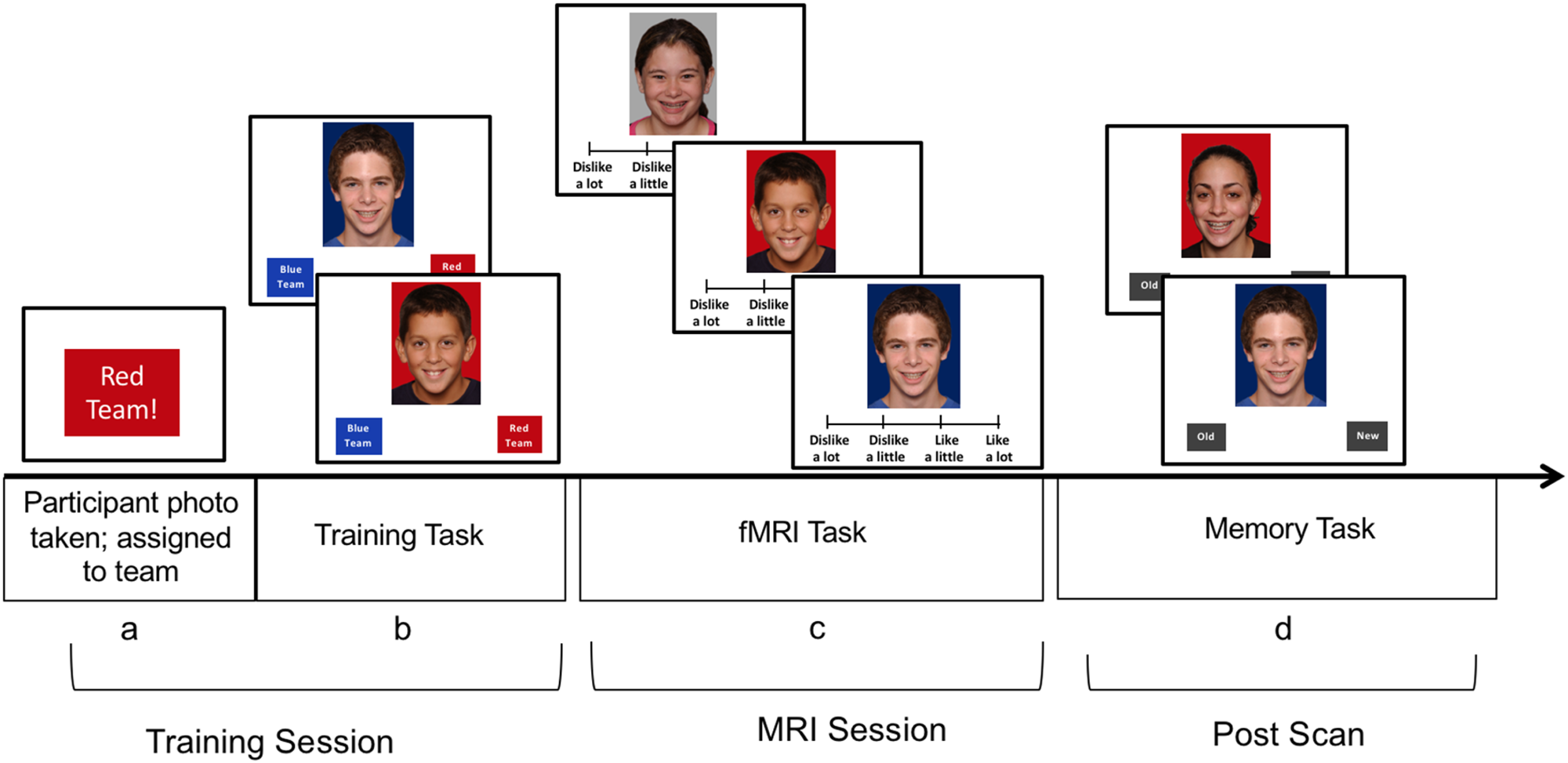
In the present study, we used a minimal group paradigm to examine the association between a history of exposure to peer victimization and heightened social monitoring at the behavioral and neural levels in adolescent girls. In minimal group designs, individuals are assigned to an arbitrary group (Tajfel, Billig, Bundy, & Flament, Reference Tajfel, Billig, Bundy and Flament1971). Even when such groups are based on random assignment and group members do not meet each other, both children (Dunham et al., Reference Dunham, Baron and Carey2011) and adults (Ashburn-Nardo, Voils, & Monteith, Reference Ashburn-Nardo, Voils and Monteith2001; Tajfel et al., Reference Tajfel, Billig, Bundy and Flament1971) develop strong in-group favoritism, highlighting how readily people identify with social in-groups. Minimal group designs are optimal for well-controlled neuroimaging studies, because familiarity with the in- and out-group members is matched, and group membership is not based on a history of learned associations. In the current study, we randomly assigned participants to the red or blue team. After being exposed to pictures of 20 in-group and 20 out-group peers during training, participants completed an fMRI scan during which they rated how much they liked or disliked each peer, and they then completed a memory test following the scan (see Figure 1). We used a longitudinal design, in which exposure to peer victimization was prospectively assessed across 2nd through 8th grade, providing a robust measure of peer victimization across mid childhood through adolescence that is not affected by recall biases. We examined whether experiencing more severe peer victimization across seven years is associated with heightened social monitoring in adolescent girls.
Task Design: (a) A photo of the participant was taken and a computer randomly assigned them to a team (red team or blue team). (b) Participants completed a training task, in which they saw 40 peers and indicated whether each peer was on the red team or blue team. (c) During an fMRI scan, participants rated how much they like/dislike 20 in-group, 20 out-group, and 20 unaffiliated peers. (d) After the scan, participants completed a memory task, in which they indicated whether each peer is a new or old peer.

Motivational accounts of social identity suggest that individuals will experience differential motivation to encode relevant targets that belong to a social group as a means of social affiliation (Van Bavel et al., Reference Van Bavel, Swencionis, O'Connor and Cunningham2012). Thus, we predicted that higher levels of victimization would be associated with stronger engagement in social monitoring of in-group relative to out-group peers. Reflecting this stronger in-group orientation, and consistent with prior work in adults (Van Bavel et al., Reference Van Bavel, Swencionis, O'Connor and Cunningham2012; Van Bavel & Cunningham, Reference Van Bavel and Cunningham2012), we hypothesized that more severe peer victimization would be associated with behavioral biases favoring the in-group, including implicit biases (which include (a) slower reaction time to rating in-group relative to out-group peers, representing longer processing time and selective allocation of attention to in-group peers; improved memory for in-group relative to out-group peers, and (b) reflecting greater encoding of the in-group) and explicit biases (which include (a) preferential liking of in-group relative to out-group peers; and (b) greater self-reported collective belonging to in-group). Indeed, prior research with adolescents and adults has shown that individuals report greater preferential liking of minimal in-group peers (Brewer, 1979; Van Bavel et al., Reference Van Bavel, Packer and Cunningham2008; Guassi Moreira et al., Reference Guassi Moreira, Van Bavel and Telzer2017); adults show longer response time biases when encoding in-group relative to out-group members, which relates to greater memory bias for in-group peers (Van Bavel & Cunningham, Reference Van Bavel and Cunningham2012); and adults exposed to social rejection show greater memory for in-group relative to out-group peers (Van Bavel et al., Reference van den Bos, van Dijk, Westenberg, Rombouts and Crone2018). At the neural level, based on prior studies using a similar task in youth (Guassi Moreira et al., Reference Guassi Moreira, Van Bavel and Telzer2017) and adults (Van Bavel et al., Reference Van Bavel, Packer and Cunningham2008; Van Bavel et al., Reference Van Bavel, Packer and Cunningham2011), we predicted that more severe peer victimization would be associated with neural biases, including greater activation to in-group relative to out-group peers in regions that code for affective salience (e.g., amygdala, ventral striatum), social perception (e.g., fusiform gyrus), and mentalizing (e.g., TPJ, pSTS, dmPFC).
We also conducted follow-up analyses as a way to validate our neural results. The Belonging Regulation model proposes that feelings of low self-esteem alert the SMS that in-group belonging levels have dropped too low (Leary, Reference Leary1999). Further, excessive social monitoring suggests a need to belong that is not being met (Gardner et al., Reference Gardner, Pickett, Jefferis and Knowles2005; Slavich, Donovan, Epel, & Kemeny, Reference Slavich, Donovan, Epel and Kemeny2010), which is linked to internalizing and externalizing symptoms (Donnellan, Trzesniewski, Robins, Moffitt, & Caspi, Reference Donnellan, Trzesniewski, Robins, Moffitt and Caspi2005; Haney & Durlak, Reference Haney and Durlak1998; Orth, Robins, Trzesniewski, Maes, & Schmitt, Reference Orth, Robins, Trzesniewski, Maes and Schmitt2009). If patterns of neural activation linked to peer victimization are indicative of an overactive neural SMS, low self-esteem should be associated with heightened social monitoring at the neural level and heightened neural processing should be linked with higher levels of internalizing and externalizing symptoms.
We focused on adolescent girls given their heightened need to belong relative to males, which is a stronger predictor of self-esteem, internalizing symptoms, and externalizing symptoms in girls than in boys (see Leibovich, Schmid, & Calero, Reference Leibovich, Schmid and Calero2018; Newman, Lohman, & Newman, Reference Newman, Lohman and Newman2007). Moreover, adolescent girls’ show greater endorsement of connection-oriented goals in relationships, increased sensitivity to peer evaluation, and heightened reactivity to interpersonal stress relative to adolescent boys (La Greca & Lopez, Reference La Greca and Lopez1998; Rose & Rudolph, Reference Rose and Rudolph2006; Telzer & Fuligni, Reference Telzer, Humphreys, Shapiro and Tottenham2013). Girls also show heightened sensitivity to social threats that peak in adolescence, as evidenced by greater activation in affective regions of the brain during peer evaluation (Guyer et al., 2009, Reference Guyer, Choate, Detloff, Benson, Nelson, Perez-Edgar and Ernst2012) and heightened cortisol peaks following social rejection challenges (Stroud, Salovey, & Epel, Reference Stroud, Salovey and Epel2002). Thus, we expected that the processes of interest would be particularly relevant for adolescent girls.
Method
Participants and Procedures
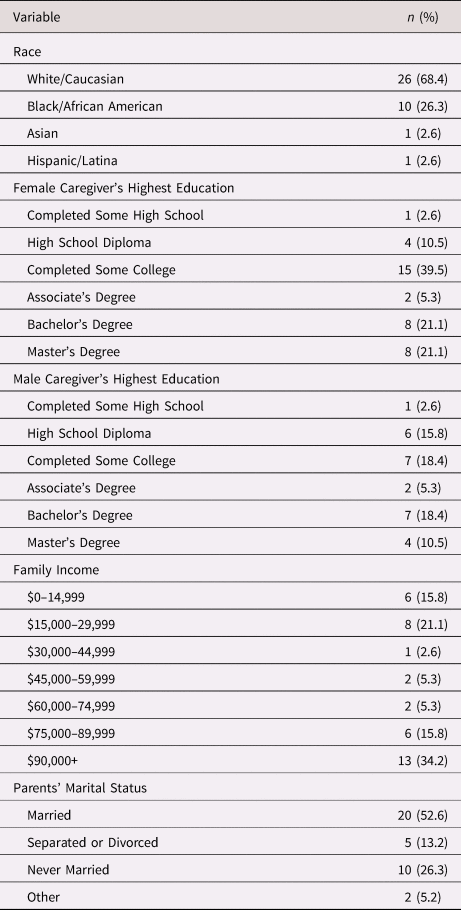
Thirty-eight 9th-grade adolescent girls (M age = 15.43 years, SD = .33, range = 14.90–16.34 years; see Table 1 for demographics) were recruited from a longitudinal study that tracked 636 youth from 2nd to 8th grade. Of the 636 participants, 115 were identified as eligible to participate based on being female and meeting criteria for low or high peer victimization across the seven years. Of these, 8 had contraindications for MRI; 6 were not interested in participating; 51 were not recruited because they had moved out of town, were not reachable, or we had reached our target sample size of 50 prior to their recruitment. An additional 12 girls participated but were not included in the current manuscript due to technical problems with the task during the scan (n = 6) or noncompliance on the task (i.e., not responding, pressing the incorrect buttons; n = 6Footnote 1). Based on participants’ annual reports of peer victimization scores across the seven years, we recruited adolescent girls who had been chronically victimized (n = 21) or nonvictimized (n = 17). Selection criteria for victimization was based on scoring > .75 SD above or below the mean on victimization for at least three years, at least one of which was in middle school. We selected .75 standard deviations to distinguish girls who showed fairly extreme deviations from the mean but would still provide a large enough sample to select from as well as variability in victimization experiences. Chronically victimized girls scored > .75 SD above the mean on victimization for at least three years (range = 3 to 7 years), with an average of 1.22 standard deviations above the mean across the 7 years (SD = .46). Nonvictimized girls scored < .75 below the mean on victimization for at least three years (range = 3 to 7 years) with an average of .78 standard deviations below the mean across the 7 years (SD = .15). Parents provided written consent and adolescents provided written assent in accordance with the University's Institutional Review Board. Participants were given a minimal-group assignment and then completed a social-evaluation task during an fMRI scan. Following the scan, they completed a memory task.
Family demographics

Note: Percentages are based on the full sample (n = 38). Variable categories that do not sum to 100% represent missing data.
Participants completed questionnaires assessing internalizing and externalizing symptoms at the time of the scan as well as 3, 6, and 9 months following the scan. Thirty-five participants (92.1%) completed all four assessments, two participants completed three of the assessments, and one participant only completed the assessment at the time of the scan. We used a composite score of their internalizing and externalizing symptoms, averaging across the four waves, so we did not have any missing data. The number of waves during which the participants completed the assessments was included as a control in analyses examining associations with symptoms.
Self-Report Measures
Peer victimization
Each year from the 2nd through 8th grades, youth reported on their victimization experiences using the Social Experiences Questionnaire-Revised (Rudolph et al., Reference Rudolph, Lansford, Agoston, Sugimura, Schwartz, Dodge and Bates2014; Rudolph, Troop-Gordon, Hessel, & Schmidt, Reference Rudolph, Troop-Gordon, Hessel and Schmidt2011). The measure taps overt victimization (i.e., being the target of behaviors intended to harm others through physical damage, threat of such damage, or verbal aggression; 11 items; e.g., “How often do you get hit by another kid?” or “How often does another kid insult you or put you down?”) and relational victimization (i.e., being the target of behaviors intended to harm others through manipulation of relationships; 10 items; e.g., “How often does another kid say they won't like you unless you do what they want you to do?”). Using a 5-point scale, participants indicated how often they had experienced each type of victimization. Scores were computed as the mean of the 21 items. The scale had high internal reliability across all seven waves (αs = .95–.98). The correlations (rs)between consecutive waves ranged from .35–.77. For instance, the correlation between grade 5 and grade 6 (i.e., before and after the middle school transition) was r = .77, p < .0001. The correlation between grade 4 and grade 5 was r = .69, p < .0001. These correlations suggest stability in victimization across grades, with stability across the middle school transition similar to stability prior to the transition. To capture individual variability in exposure to victimization, we computed a continuous index of victimization severity, reflecting the mean level across the seven waves.
Social Self-Esteem
Each year from the 2nd through 7th grades, youth completed the negative self-perceptions subscale of the Perceptions of Peers and Self Questionnaire (Caldwell, Rudolph, Troop-Gordon, & Kim, Reference Caldwell, Rudolph, Troop-Gordon and Kim2004), which assesses low self-esteem in the context of relationships (7 items; e.g., “It's a waste of other kids’ time to be friends with me”). For each item, youth checked a box indicating how true each statement was on a 4-point scale. This measure shows strong internal consistency, test-retest reliability, and convergent and predictive validity (Caldwell et al., Reference Caldwell, Rudolph, Troop-Gordon and Kim2004). In the current study, the scale had good internal reliability across waves (αs = .70–.81). We formed a composite variable of low social self-esteem by averaging this measure across the six waves, where higher scores indicate lower social self-esteem.
Internalizing symptoms
At the time of the scan and 3, 6, and 9 months following the scan, participants completed two measures of internalizing symptoms. First, youth completed the Short Mood and Feelings Questionnaire (Angold, Costello, Messer, & Pickles, Reference Angold, Costello, Messer and Pickles1995) to assess depressive symptoms (e.g., “I felt unhappy or miserable”). Youth responded to 12 items to indicate how much they experienced each symptom over the past two weeks on a 4-point scale. Across the four waves, the scale had high internal reliability (αs = .93–.96). Second, youth completed the Revised Child Manifest Anxiety Scale (Reynolds & Richmond, Reference Reynolds and Richmond1978), a 28-item measure that taps general anxiety over the past two weeks. Participants responded “yes” or “no” to each item (e.g., “I worry about what is going to happen” or “I am nervous”). Across the four waves, the scale had high internal reliability (αs = .93–.95). The correlations between consecutive waves ranged from .65–.80 for depression and rs = .84–.86 for anxiety. Moreover, depression and anxiety were highly correlated within (rs =. 77–.85) and between waves (rs = .69–.86). Given these strong correlations and our similar predictions regarding the association between heightened social monitoring and both types of internalizing symptoms, we formed a composite variable of internalizing symptoms by standardizing and averaging depression and anxiety at each point and then averaging this index across the four waves. This index provides a more robust measure of internalizing symptoms that captures the stability of internalizing symptoms across the 9 months following the fMRI scan.
Externalizing symptoms
At the time of the scan and 3, 6, and 9 months following the scan, participants completed a measure of their externalizing symptoms using an antisocial behavior questionnaire adapted from Nolen-Hoeksema and colleagues (Nolen-Hoeksema, Stice, Wade, & Bohon, Reference Nolen-Hoeksema, Stice, Wade and Bohon2007). Participants completed 13 items using a 5-point scale to indicate how much each item described them (e.g., “I stole things,” “I cut classes or skipped school,” or “I hung around with kids who get in trouble”). The scale had high internal reliability across the 4 waves (αs = .90–.93). The correlations between consecutive waves ranged from .75–.91. Again, we formed a composite variable of follow-up externalizing symptoms by averaging this index across the four waves.
Minimal Group Task
Establishment of minimal group
Participants arrived at the imaging center and posed for a digital photograph. Participants were then assigned to the red team or blue team, which was randomly selected by a computer (Figure 1a) and were instructed that they would be a part of this team for the duration of the study (Bernstein et al., Reference Bernstein, Young and Hugenberg2007; Van Bavel & Cunningham, Reference Van Bavel and Cunningham2009; Van Bavel et al., Reference Van Bavel and Cunningham2012). Participants were told they could win points for their team to earn a prize as part of another task (see Telzer et al., Reference Telzer, Miernicki, Rudolph, Austin and Worchel2018). Next, participants were shown pictures of in-group and out-group team members (totaling 40 peers), who were described as participants who had already completed the study. Each picture was displayed in random order, one at a time. Two labels appeared at the bottom of the screen indicating “red team” and “blue team,” and participants were instructed to press one of two buttons to indicate the correct team of each peer (Figure 1b). Photos were placed on blue or red backgrounds to provide a visual cue to team membership. Participants also saw their own picture two times on the colored background and categorized themselves into the appropriate team in order to enhance their in-group identification (Van Bavel et al., Reference Van Bavel, Packer and Cunningham2008). The task was self-paced, and the next trial proceeded after participants pressed a button.
The face stimuli included equal numbers of males and females and were racially and ethnically diverse. All faces were looking into the camera and smiling. Pictures were taken from several databases, including the National Institute of Mental Health Child Emotional Faces Picture Set (NIMH-ChEFS (Egger et al., Reference Egger, Pine, Nelson, Leibenluft, Ernst, Towbin and Angold2011)), as well as internal pictures collected from prior studies. Faces were randomly assigned to the teams ensuring equal representation of race, gender, and age across the teams, and assignment was fully counterbalanced so that participants were equally likely to see each face as an in-group or out-group member. This ensured that any visual differences in the stimuli (e.g., attractiveness, luminance) could not account for observed differences between in-group and out-group members.
Social evaluation task
After completing the learning task, participants were placed in the scanner and completed a social evaluation task. During the task, participants were presented with picture of 60 faces: 20 in-group faces, 20 out-group faces, and 20 novel faces who were unaffiliated with the in-group or out-group (Van Bavel et al., Reference Van Bavel, Packer and Cunningham2011). The in-group and out-group peers were identical to those seen during the learning task and the unaffiliated peers had not been seen previously. The in-group and out-group peers were presented on their respective colored backgrounds, and the unaffiliated peers were presented on grey backgrounds. For each trial of the task, participants were instructed to indicate how much they liked or disliked each person (Figure 1c). Participants pressed one of four buttons to indicate their response (1 = dislike a lot, 2 = dislike a little, 3 = like a little, 4 = like a lot). Each picture was presented for 3 s with an intertrial interval that was jittered randomly between 1.5 to 3 s.
We calculated a preferential bias score by subtracting the mean ratings for in-group peers minus out-group peers such that higher scores indicated preferential biases for in-group peers. We also calculated a response time bias score by calculating the mean response time (MRT) for rating in-group peers minus out-group peers.
Memory task
After completing the scan, participants were tested on their memory of the faces. They were presented with pictures of 40 faces, half of which were new faces and half of which were old faces (i.e., seen during the learning task and social evaluation task; balanced between in- and out-group members), all of which were displayed on blue and red backgrounds (Van Bavel et al., Reference Van Bavel, Packer and Cunningham2011). Participants indicated whether the face was old or new (Figure 1d). Pictures of the peers were presented in random order. Memory was relatively high for all 3 groups (% hit: in-group = 86%, range = 65–100%; out-group = 85.25%, range = 50–100%; new faces = 87.15%, range = 35–100%). We calculated a memory bias score, which represented the percent of hits (i.e., correctly remembered peers) for in-group minus percent of hits for out-group such that higher scores indicate a memory bias towards in-group peers.
Collective group identity
Finally, participants responded to questions indicating their collective group identity using items commonly used in the social identity literature (Ashmore, Deaux, & McLaughlin-Volpe, Reference Ashmore, Deaux and McLaughlin-Volpe2004). For both the red and blue team, participants indicated (a) whether they value being a member of the team, (b) whether they are proud of being a member of the team, and (c) whether being a member of the team is important to their identity (1 = strongly disagree to 6 = strongly agree). As done in other work (Van Bavel et al., Reference Van Bavel, Swencionis, O'Connor and Cunningham2012; Do et al., Reference Do and Telzer2019; Guassi Moreira et al., Reference Guassi Moreira, Van Bavel and Telzer2017), we took the average of these three items to create an index for in-group and out-group identity and calculated a group identity bias score by subtracting the mean ratings for in-group identity minus out-group identity such that higher scores indicate higher in-group identity.
Summary of behavioral bias scores
We calculated four bias scores in the current study, which represented different ways of examining biases towards in-group relative to out-group peers. Preferential Liking Bias represents the mean ratings for in-group peer minus out-group peer (calculated from the social evaluation task). Response Time Bias represents the MRT for rating in-group peers minus out-group peers (calculated from the social evaluation task). Memory Bias represents the percent of faces correctly remembered for in-group peers minus out-group peers (calculated in the postscan memory task). Group Identity Bias represents the mean ratings for in-group minus out-group identity (calculated in the postscan questionnaire). Two of these measures (Preferential Liking Bias and Group Identity Bias) represent explicit biases, and two of these measures (Response Time Bias and Memory Bias) represent implicit biases.
fMRI Data Acquisition and Analysis
fMRI data acquisition
Imaging data were collected using a 3 Tesla Siemens Trio MRI scanner. The task included T2*-weighted echoplanar images (EPI), 38 slices, slice thickness = 3 mm; TR = 2s; TE = 25 ms; matrix = 92 × 92; FOV = 230 mm; and voxel size 2.5 × 2.5 × 3 mm3. Structural scans consisted of a T2*weighted, matched-bandwidth (MBW), high-resolution, anatomical scan, TR = 4s; TE = 64ms; FOV = 230; matrix = 192 × 192; 38 slices, slice thickness = 3 mm, and a T1* magnetization-prepared rapid-acquisition gradient echo (MPRAGE), TR = 1.9s; TE = 2.3ms; FOV = 230; matrix = 256 × 256; sagittal plane; 192 slices, slice thickness = 1 mm. The orientation for the MBW and EPI scans was oblique axial to maximize brain coverage.
fMRI Data preprocessing and analysis
Neuroimaging data were preprocessed and analyzed using Statistical Parametric Mapping (SPM8; Wellcome Department of Cognitive Neurology, Institute of Neurology, London, UK). Preprocessing for each participant's images included spatial realignment to correct for head motion (no participant exceeded 2 mm of maximum image-to-image motion in any direction). The realigned functional data were coregistered to the high resolution MPRAGE, which was then segmented into cerebrospinal fluid, grey matter, and white matter. The normalization transformation matrix from the segmentation step was then applied to the functional and T2 structural images, transforming them into standard stereotactic space as defined by the Montreal Neurological Institute and the International Consortium for Brain Mapping. The normalized functional data were smoothed using an 8 mm Gaussian kernel, full-width at half-maximum, to increase the signal-to-noise ratio.
Statistical analyses were performed using the general linear model in SPM8. Each trial was convolved with the canonical hemodynamic response function. High-pass temporal filtering with a cutoff of 128 s was applied to remove low-frequency drift in the time series. Serial autocorrelations were estimated with a restricted maximum likelihood algorithm with an autoregressive model order of 1. In each participant's fixed-effects analysis, a general linear model (GLM) was created with 3 regressors of interest, modeled as events: in-group faces, out-group faces, and unaffiliated faces. Null events, consisting of the jittered intertrial intervals, were not explicitly modeled and therefore constituted an implicit baseline. The parameter estimates resulting from the GLM were used to create linear contrast images. Our primary contrast of interest in the current study was In-group>Out-group.
Random effects, group-level analyses were performed on all individual subject contrasts using GLMFlex. GLMFlex corrects for variance-covariance inequality, partitions error terms, removes outliers and sudden activation changes in the brain, and analyzes all voxels containing data (http://mrtools.mgh.harvard.edu/index.php/GLM_Flex). We conducted whole brain regression analyses with continuous scores of victimization entered as the regressor to examine neural regions that showed increased activation as a function of peer victimization when rating in-group relative to out-group peers. In order to examine brain-behavior relationships, we extracted parameter estimates of signal intensity from the clusters of activation that correlated with peer victimization and ran correlation analyses in SPSS with behavioral biases (Preferential Liking Bias, Reaction Time Bias, Memory Bias, and Group Identity Bias) and adjustment (social self-esteem, internalizing and externalizing symptoms).
To correct for multiple comparisons, we conducted a Monte Carlo simulation implemented using 3dClustSim in the software package AFNI (Ward, Reference Ward2000) and the -acf option in 3dFWHMx to estimate the smoothness. Simulations were run separately for each analysis. Results of the simulation for the whole-brain regression with peer victimization on the contrast in-group>out-group yielded a voxel-wise threshold of p < .001 combined with a minimum cluster size of 32 voxels for the whole brain, corresponding to p < .05, with family-wise error corrected. Because the ventral striatum and amygdala are anatomically small structures and we had a priori hypotheses about their involvement in monitoring social inclusion, we used a small volume correction by conducting a Monte Carlo simulation using anatomically defined regions for the amygdala and ventral striatum, which yielded a voxel-wise threshold of p < .001 combined with a minimum cluster size of 5 voxels for the amygdala and ventral striatum, corresponding to p < .05, small volume corrected. All fMRI analyses presented in the results are available on Neurovault (see https://neurovault.org/collections/5959/).
Results
Peer Victimization and Behavioral Correlates of In-group Bias
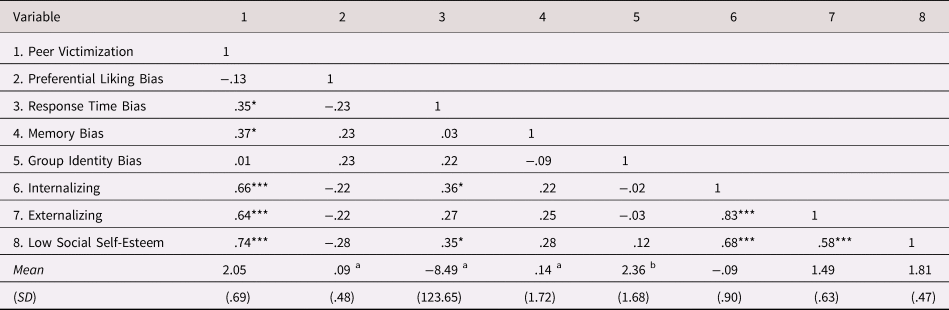
We first examined the hypothesis that peer victimization would be associated with in-group bias at the behavioral level. To this end, we ran four separate correlations, with peer victimization correlating with each behavioral bias score. Higher levels of peer victimization correlated with the two implicit bias scores (Table 2). In particular, peer victimization was associated with response time bias such that girls exposed to more victimization took longer to rate in-group relative to out-group peers during the social evaluation task, suggesting that victimization is associated with longer processing time to rate in-group peers. Peer victimization was also associated with a greater memory bias such that girls exposed to more victimization were more likely to accurately remember in-group relative to out-group faces, suggesting greater encoding of in-group peers during the fMRI task. Peer victimization was not associated with the explicit bias scores. For descriptives and correlations between all study variables, see Table 2.
Means, standard deviations, and correlations between all of the study variables

Note: Peer victimization represents average victimization across the 7 years prior to the scan. Preferential Liking Bias represents the mean ratings for in-group peers minus out-group peers. Response Time Bias represents the mean RT for rating in-group peers minus out-group peers. Memory bias represents the percentage of faces correctly remembered for in-group peers minus out-group peers during the postscan memory task. Group Identity Bias represents the mean ratings for in-group minus out-group identity. Internalizing and Externalizing represent the average symptoms at the time of the scan, 3, 6, and 9 months following the scan. Social self-esteem represents the average social self-esteem across grades 2 through 7. a A one-sample t-test relative to 0 indicated no significant difference, suggesting that preferential liking bias, response time bias, and memory bias are not different for the in-group relative to the out-group. b A one-sample t-test relative to 0 indicated significant difference, suggesting that group identity is higher for the in-group than out-group. ***p < .001, *p < .05.
Peer Victimization and Neural Correlates of In-group Bias
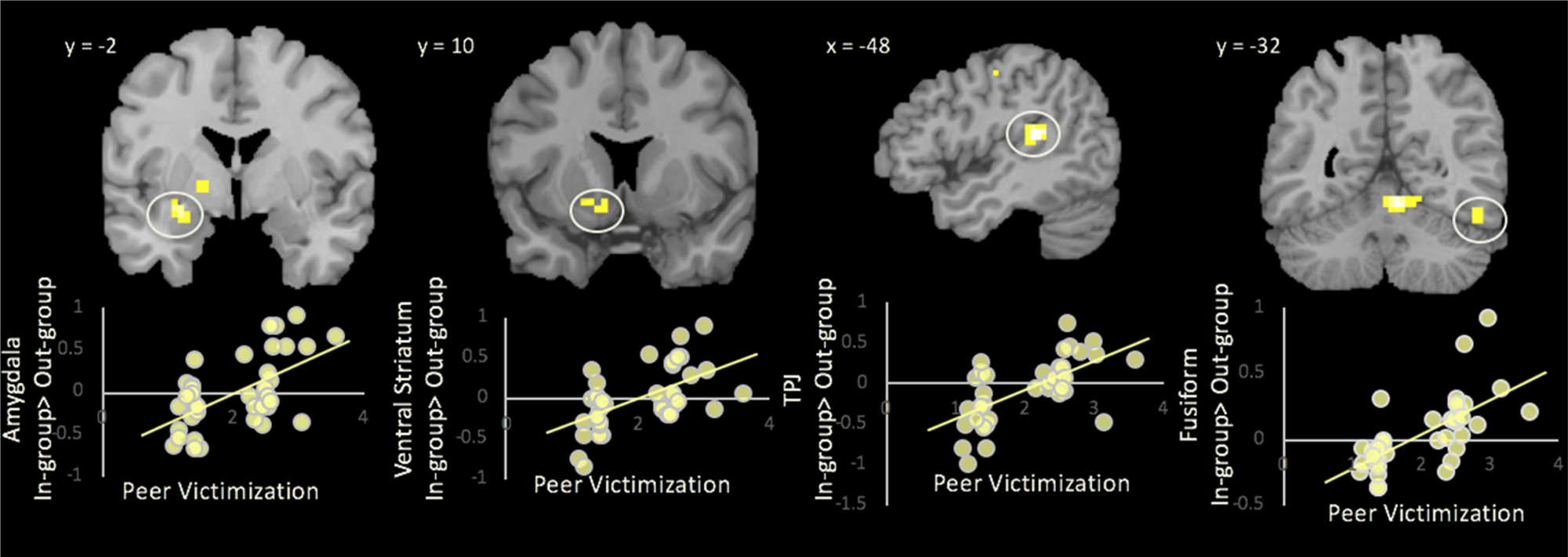
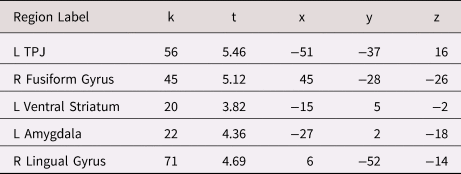
Before examining how victimization correlates with neural activation, we conducted a whole-brain t test to examine the main effect for the contrast in-group>out-group (and vice versa). No regions were significantly activated. Next, in whole-brain regression analyses, we regressed adolescents’ mean victimization across the 7 years onto neural activation for the contrast in-group>out-group. As hypothesized, a history of greater exposure to peer victimization was associated with heightened activation to in-group relative to out-group peers in the amygdala, ventral striatum, fusiform gyrus, and TPJ (see Table 3, Figure 2). Peer victimization was not associated with greater activation to out-group peers in any region.
Peer victimization correlated with activation in the amygdala, ventral striatum, TPJ, and fusiform to In-group>Out-group peers. For descriptive purposes, the parameter estimates of signal intensity were extracted from each region and plotted with peer victimization.

Neural regions that correlate with peer victimization when rating In-group>Out-group peers

Note: L and R refer to left and right hemispheres; k refers to the number of contiguous voxels in each significant cluster; t refers to peak activation in each cluster; x, y, and z refer to MNI coordinates. No regions correlated negatively with peer victimization for this contrast.
Brain-Behavior Bias Correlations
To elucidate the implications of heightened neural activation to in-group peers, we conducted analyses to examine (a) whether there was a correlation between neural and behavioral biases for in-group versus out-group peers and (b) whether there was a correlation between neural biases, social self-esteem, and maladjustment. To this end, we created functional ROIs from the brain regions that showed a significant correlation with victimization. From the in-group>out-group contrast, we extracted parameter estimates of signal intensity from the functional ROIs and examined correlations with the behavioral bias measures and with the self-esteem, internalizing, and externalizing self-report measures.
Behavioral correlates
Activation in the ventral striatum (r = .33, p < .05), TPJ (r = .46, p < .005), and amygdala (r = .35, p < .05) was significantly associated with a greater memory bias for in-group faces. These results indicate that participants with greater in-group bias at the neural level have greater in-group memory bias. Activation in the fusiform was significantly associated with slower RT to in-group relative to out-group peers (r = .33, p < .05). These results suggest that the fusiform may be involved in deeper encoding of in-group faces, resulting in slowing down and processing those faces in more depth. Neural activation was not associated with ratings of liking in-group relative to out-group members or collective group identity.
Self-esteem and adjustment correlates
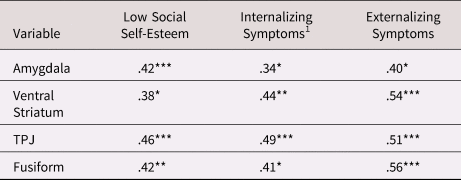
Heightened activation in the amygdala, ventral striatum, fusiform, and TPJ to in-group relative to out-group peers was associated with lower social self-esteem across the school years and with elevated internalizing and externalizing symptoms across the 9-month follow-up (see Table 4).
Correlations between neural biases to In-group>Out-group and social self-esteem, internalizing and externalizing symptoms

Note: 1We ran separate analyses with anxiety and depression, each of which were nearly identically correlated with neural activation ***p<. 005, **p < .01, -*p< .05; corrections for multiple comparisons (i.e., correlations with 4 brain regions) required a statistical threshold of p < .0125.
Discussion
Belonging to a social group is one of the most fundamental human needs (Baumeister & Leary, Reference Baumeister and Leary1995; Dunbar, Reference Dunbar2018). When belonging levels are too low, the SMS produces social hunger, leading to increased social monitoring (Gardner et al., Reference Gardner, Pickett, Jefferis and Knowles2005). Our study demonstrates that exposure to peer victimization across the school years is associated with social monitoring at the behavioral and neural level during adolescence. By measuring prospective reports of victimization across 7 years, we were able to capture a rich measure of peer victimization experiences that was not confounded by recall biases. We found that a history of more severe victimization in adolescent girls was associated with longer response times for rating in-group peers, better memory for in-group peers, and increased activation to in-group peers in neural regions associated with affective processing, social perception, and mentalizing. Such heightened social monitoring may have implications for youths’ adjustment.
Behavioral Correlates of Social Monitoring
The primary goal of the SMS is to attune individuals to information that will help them navigate their social environment in order to fulfill their belonging needs (Pickett & Gardner, Reference Pickett, Gardner, Williams, Forgas and Von Hippel2005). Social exclusion is thought to produce a social hunger that heightens attention to and memory of social cues (Gardner, Pickett, & Brewer, Reference Gardner, Pickett and Brewer2000). Motivational accounts of social identity suggest that individuals will experience differential motivation to encode relevant targets that belong to a social group as a means of social affiliation (Van Bavel et al., Reference Van Bavel, Swencionis, O'Connor and Cunningham2012). Such social motives will influence attention and social memory. Consistent with this model, prior behavioral studies in adults have shown that experimentally manipulated rejection increases social monitoring (Gardner et al., Reference Gardner, Pickett and Brewer2000; Knowles, Reference Knowles2014; Van Bavel et al., Reference Van Bavel, Swencionis, O'Connor and Cunningham2012), chronic loneliness increases social monitoring (Gardner et al., Reference Gardner, Pickett, Jefferis and Knowles2005; Pickett et al., Reference Pickett, Gardner and Knowles2004), and high trait-level need to belong increases encoding of, and memory biases for, in-group relative to out-group peers (Van Bavel et al., Reference Van Bavel, Swencionis, O'Connor and Cunningham2012).
The current study builds upon prior work in adults by demonstrating that a history of more severe peer victimization throughout childhood is associated with selective, in-group focused social monitoring in adolescence, including heightened memory biases for and slower reaction time to rating in-group peers. Heightened social memory and slower reaction time to in-group peers may reflect selective allocation of attention to in-group peers, whereby individuals slow down to encode and process in-group peers in more depth. Although we suggest that longer response time to rating in-groups represents differential motivation to encode salient group members (Van Bavel et al., Reference Van Bavel, Swencionis, O'Connor and Cunningham2012), it is also possible that faster response times to rating out-group peers indicates biased or vigilant attention to the out-group. Indeed, adolescents demonstrate a response time bias such that they show faster reaction times for predicting that their peers will dislike them versus like them (Rodman et al, Reference Rodman, Powers and Somerville2017). Such faster response times are interpreted to reflect biased expectations of rejection in adolescence. Interestingly, we did not find associations between peer victimization and explicit biases, and analyses focusing on mean level behavioral biases across the whole sample showed that only group identity bias was significantly higher for in-group relative to out-group peers. This is inconsistent with prior findings in adults and youth, which revealed significantly higher preferential liking biases for minimal in-group peers (Guassi Moreira et al., Reference Guassi Moreira, Van Bavel and Telzer2017; Van Bavel et al., Reference Van Bavel, Packer and Cunningham2008).
Neural Correlates of Social Monitoring
At the main effect level, we did not find significant differences in neural activation when processing in-group relative to out-group peers. Prior research in children and adolescents has also shown no meaningful mean-level differences in activation to this contrast (Guassi Moreira et al., Reference Guassi Moreira, Van Bavel and Telzer2017). This is likely due to individual differences in the salience of group membership, Indeed, we found that adolescent girls exposed to more severe peer victimization showed greater amygdala and ventral striatum activation to in-group relative to out-group peers. The amygdala belongs to a neural detection network that draws attention to salient stimuli (Cunningham & Brosch, Reference Cunningham and Brosch2012) and the ventral striatum codes for subjective value of important social groups and is involved in directing focus to the salient elements of group membership in adults (Van Bavel et al., Reference Van Bavel, Packer and Cunningham2008) and adolescents (Guassi Moreira et al., Reference Guassi Moreira, Van Bavel and Telzer2017; Telzer et al., Reference Telzer, Flannery, Humphreys, Goff, Gabard-Durman, Gee and Tottenham2015). Moreover, amygdala-ventral striatum connectivity increases from childhood to adolescence when detecting in-group peers (Guassi Moreira et al., Reference Guassi Moreira, Van Bavel and Telzer2017), suggesting that in-group belonging becomes particularly salient as youth transition into adolescence.
We also found that more severe peer victimization was associated with heightened fusiform activation when encoding in-group relative to out-group peers. The fusiform plays a key role in social perception (Haxby, Hoffman, & Gobbini, Reference Haxby, Hoffman and Gobbini2002) and individuating faces (Gauthier et al., Reference Gauthier, Tarr, Moylan, Skudlarski, Gore and Anderson2000; Kanwisher, McDermott, & Chun, Reference Kanwisher, McDermott and Chun1997; Rhodes, Byatt, Michie, & Puce, Reference Rhodes, Byatt, Michie and Puce2004). Indeed, the fusiform is more activated in response to in-group than out-group members (Golby, Gabrieli, Chiao, & Eberhardt, Reference Golby, Gabrieli, Chiao and Eberhardt2001; Van Bavel et al., Reference Van Bavel, Packer and Cunningham2008; Van Bavel et al., Reference Van Bavel, Swencionis, O'Connor and Cunningham2012), a pattern that increases from childhood to adolescence (Guassi Moreira et al., Reference Guassi Moreira, Van Bavel and Telzer2017). Moreover, adolescents show increased fusiform activation when receiving acceptance feedback from peers (Guyer et al., Reference Guyer, Choate, Detloff, Benson, Nelson, Perez-Edgar and Ernst2012). Because in- and out-group faces were based on a minimal group design, fusiform activation in the current study does not represent perceptual expertise; instead, it likely reflects attentional biases and greater individuation and encoding of in-group faces, as found in adults (Van Bavel et al., Reference Van Bavel, Packer and Cunningham2008). Thus, more severe victimization may activate the fusiform to increase the perceptual encoding of motivationally relevant faces.
Finally, we found that more severe peer victimization was associated with heightened activation in the TPJ when evaluating in-group relative to out-group peers. The TPJ is a key region of the mentalizing network (Blakemore, Reference Blakemore2008), suggesting that more severe peer victimization is associated with intensified social cognition toward the in-group. Indeed, individuals tend to mentalize about the needs and intentions of in-group peers more often (Harris & Fiske, Reference Harris and Fiske2006, Reference Harris and Fiske2009) and more accurately (Adams et al., Reference Adams, Rule, Franklin, Wang, Stevenson, Yoshikawa and Ambady2010) than out-group peers, and youth show developmental increases from childhood to adolescence in TPJ activation when evaluating members of in-group versus out-group peers (Guassi Moreira et al., Reference Guassi Moreira, Van Bavel and Telzer2017). The current study extends this prior work by demonstrating that exposure to peer victimization may intensify this normative developmental process, devoting attentional resources toward evaluating the intentions of in-group peers. Among the social brain regions, we only found this pattern of effects for the TPJ. Prior research has found that the TPJ differentiates social sensitivity in adolescents, where the lowest and highest levels of TPJ activation are indicative of poor social competence (van Hoorn et al., Reference van Hoorn, McCormick and Telzer2018), suggesting that high TPJ activation may signal maladaptive social sensitivity. In contrast, the pSTS is associated with better mental state reasoning toward in-group relative to out-group peers (Adams et al., Reference Adams, Rule, Franklin, Wang, Stevenson, Yoshikawa and Ambady2009), suggesting that high pSTS activation might signal adaptive social sensitivity. Thus, we may have only identified TPJ activation in the current study, as it may be uniquely involved in social monitoring under more perilous circumstances.
Implications of Heightened Social Monitoring
Overall, our results suggest that peer victimization is associated with implicit biases (i.e., differential attention and memory) toward in-group relative to out-group peers and with heightened activation to in-group peers in regions associated with affective salience (i.e., amygdala, ventral striatum), social perception (i.e., fusiform), and mentalizing (i.e., TPJ). Although heightened activation to in-groups in each of these regions is developmentally normative in adolescence (Guassi Moreira et al., Reference Guassi Moreira, Van Bavel and Telzer2017), the SMS appears to be even more activated in girls exposed to peer victimization. Consistent with the Belonging Regulation Model (Gardner, Pickett, Jefferis, & Knowles, Reference Gardner, Pickett, Jefferis and Knowles2005), social exclusion may produce a social hunger that heightens attention to motivationally relevant social cues in the environment in an attempt to seek social inclusion (Gardner, Pickett, & Brewer, Reference Gardner, Pickett and Brewer2000). Perhaps this social monitoring at the behavioral and neural levels is directed at restoring adolescents’ social affiliation with their in-group by focusing on peers who may be more likely to fulfill their belonging needs. These findings suggest that one reason victimized youth may withstand teasing, stigmatization, and mockery within an in-group clique (Adler, & Adler, Reference Adler and Adler1995, Reference Adler and Adler1996) is that their SMS is overactivated, potentially as a way to fulfill their belonging needs and to seek acceptance within their in-group.
While moderate levels of social sensitivity tend to be adaptive, high levels of social sensitivity may place youth at risk for psychopathology. For instance, social approach/avoidance motivation, which focuses on sensitivity to cues of acceptance/positive judgments versus rejection/negative judgments, can have adverse effects (Llewellyn & Rudolph, Reference Llewellyn and Rudolph2014; Rudolph, Abaied, Flynn, Sugimura, & Agoston, Reference Rudolph, Abaied, Flynn, Sugimura and Agoston2011; Rudolph, Troop-Goedon, & Llewewllyn, Reference Rudolph, Troop-Gordon and Llewellyn2013), and children (Chen et al., Reference Chen, Liu, Ellis and Zarbatany2016, Reference Chen, Fu, Liu, Wang, Zarbatany and Ellis2018) and adolescents (van Hoorn et al., Reference van Hoorn, McCormick and Telzer2018) with high social sensitivity tend to have poor adjustment, including higher depression and loneliness, lower self-worth, and a greater likelihood of being nominated as the least liked. In the current study, we found that heightened social monitoring at the neural level (i.e., greater neural activation to in-group relative to out-group peers in the amygdala, ventral striatum, fusiform, and TPJ) was associated with lower social self-esteem and higher levels of internalizing and externalizing symptoms. The Belonging Regulation Model proposes that feelings of low self-esteem alert the SMS that in-group belonging levels have dropped too low (Leary, Reference Leary1999). This decline in self-esteem induces social hunger and activates the SMS to find new opportunities for socialization (Pickett et al., Reference Pickett, Gardner and Knowles2004). Although increases in the SMS are adaptive following acute instances of social rejection, overactivation of this system becomes maladaptive when belonging needs remain unfulfilled (Gardner et al., Reference Gardner, Pickett and Brewer2000). In this study, we were unable to examine whether girls exposed to victimization across childhood show chronic overactivation of the SMS, and our sample size did not allow us to examine emerging trajectories of internalizing and externalizing symptoms over time. However, our results are consistent with theoretical predictions and provide evidence that heightened activation of the SMS linked to a history of victimization is associated with maladjustment in adolescent girls.
Strengths, Limitations, and Future Directions
One important strength of our study involves the use of a sample in which we assessed victimization prospectively across seven years, providing a comprehensive index of girls’ victimization history. However, our analyses are correlational and we cannot be certain about the casual pathways linking victimization, social monitoring (i.e., neural and behavioral biases to in-group peers), and maladjustment. For example, it is possible that for adolescents in particular, due to more time with peers, a heightened need to belong, and heightened sensitivity to peer evaluation, experiencing depressive and anxiety symptoms activates the social monitoring system at both the behavioral and neural levels, which in turn makes such youth easy targets for victimization. Thus, the direction of effects may start with internalizing and externalizing symptoms, lead to heightened social monitoring, and ultimately induce victimization. Indeed, prior work has shown that depressive symptoms predict increases in victimization (Marsh et al., Reference Marsh, Craven, Parker, Parada, Guo, Dicke and Abduljabbar2016). It is also possible that the social exclusion that accompanies peer victimization leads to in-group sensitivity, which results in increased social monitoring in an environment without opportunities for improved belonging. This unmet need to belong may then undermine self-esteem and increase internalizing and externalizing symptoms, which may trigger more peer victimization (Hodges & Perry, Reference Hodges and Perry1999; Reijntjes et al., Reference Reijntjes, Kamphuis, Prinzie, Boelen, Van Der Schoot and Telch2011), resulting in an even greater sense of social isolation. Risks such as social anxiety may both precede victimization and contribute to heightened social monitoring. Thus, characteristics of victimized youth and their environments may transact over time, creating a self-perpetuating cycle. Thus, it will be important to examine dynamic and reciprocal influences among these processes to unpack the direction of effects.
One way to potentially disrupt this cycle could be to provide opportunities for social inclusion with peers outside of the environment in which peer victimization takes place, helping direct adolescents towards an environment with peers who provide greater opportunities to satiate social hunger. Although victimization tends to be stable across time and context (Paul & Cillessen, Reference Paul and Cillessen2003), making disruption of the cycle a challenge, it is possible that promoting dyadic friendships among victimized youth may provide a context for them to develop self-regulatory skills, enhance self-esteem, and increase security in social relationships (Schwartz, Gorman, Dodge, Pettit, & Bates, Reference Schwartz, Gorman, Dodge, Pettit and Bates2008), thereby decreasing the need to socially snack. Indeed, peer support buffers the link between victimization and youth adjustment (Hodges, Boivin, Vitaro, & Bukowski, 1999; Schwartz et al., 2008; Waldrip, Malcolm, & Jensen-Campbell, Reference Waldrip, Malcolm and Jensen-Campbell2008), especially for girls (Cuadros & Berger, Reference Cuadros and Berger2016). Importantly, it is essential for these friendships to involve well-adjusted peers, as friendships with peers who are aggressive, engage in bullying behaviors, or are not supportive can accelerate trajectories toward negative outcomes (Schwartz et al., Reference Schwartz, Gorman, Dodge, Pettit and Bates2008).
Another possible locus for intervention is social skills training. Youth suffering from internalizing and externalizing disorders often have reduced social competence (Bornstein, Hahn, & Haynes, Reference Bornstein, Hahn and Haynes2010; Burt, Obradović, Long, & Masten, Reference Burt, Obradović, Long and Masten2008). Interventions that improve social competence could harness the fact that socially hungry individuals actually encode more social information than socially sated individuals due to the ongoing activation of their SMS (Gardner et al., Reference Gardner, Pickett, Jefferis and Knowles2005). These interventions could teach specific strategies for using the high volume of social information about in-groups that they have encoded to create positive social interactions.
A strength of our study is the use of a minimal group design, showing that within just minutes of being assigned to an in-group, girls with a history of more severe victimization demonstrate high levels of selective social monitoring specific to their in-group, including response time and memory biases as well as heightened activation in neural regions supporting the SMS. Operationalizing behavioral markers of social hunger in terms of explicit and implicit biases when processing in-group relative to out-group information is consistent with prior work in adults that focuses on preferential recall for information concerning group membership (Gardner et al., Reference Gardner, Pickett and Brewer2000), improved memory for in-group members’ faces (Bernstein, Young, & Hugenberg, Reference Bernstein, Young and Hugenberg2007; Van Bavel et al., Reference Van Bavel, Swencionis, O'Connor and Cunningham2012), and increased importance of in-groups but not outgroups (Knowles & Gardner, Reference Knowles and Gardner2008). Nonetheless, future research using a more explicit task could make a more direct link to social hunger by testing whether unmet belonging needs motivate individuals to work harder at a collective task (e.g., Williams & Sommer, Reference Schwartz, Gorman, Dodge, Pettit and Bates1997) or sacrifice something valuable in order to connect with others (but see Will, Crone, van Lier, & Güroğlu., Reference Will, Crone, van Lier and Güroğlu2016, Reference Will, Crone, van Lier and Güroğlu2018).
Our focus on adolescent girls was based on theory and research suggesting that this group may be most likely to engage in social monitoring due to their greater emphasis on creating and maintaining positive relationships with peers and may be particularly reactive to compromised social ties with peers given their sensitivity to interpersonal stressors (La Greca & Lopez, Reference La Greca and Lopez1998; Rose & Rudolph, Reference Rose and Rudolph2006). However, future studies should examine whether these effects are similar in male adolescents as well as at other developmental stages.
Conclusion
In conclusion, this is the first study to link past exposure to peer victimization with potential neural markers of the SMS. Our research suggests that victimization experiences are associated with differential processing of social categories—even in minimal groups—to dynamically shape attention, memory, and neural encoding of group belonging in ways that may be detrimental for their adjustment. Importantly, our findings implicate social sustenance as a fundamental need for adolescent girls’ well-being.
Acknowledgments
We thank the families and schools who participated in this study. We are grateful to Michelle Miernicki, Jamie Abaied, Monica Agoston, Samirah Ali, Suravi Changlani, Megan Flynn, Inge Karosevica, Nicole Llewellyn, Jennifer Monti, Heather Ross, and Niwako Sugimura for their assistance in data collection and management.
Financial Support
This work was supported by a University of Illinois Research Board Award and National Institute of Mental Health Grants MH68444 (to K.D.R.) and MH105655 (to K.D.R. and E.H.T.).