Introduction
On 13 September 1857, Heremaia from Whareroa wrote to Te Karere o Poneke:
ko nga Nupepa e taia ana ki te reo Māori, e pai ana; ko te pai tenei, ko te whakaatu mai ki a matou i nga ritenga pai a te Pakeha, me nga ritenga e whiwhi ai matou ki te mohiotanga, me te whakaakoranga pai e puta mai ana i roto i nga Pakeha.Footnote 1
[The newspapers printed in the Māori language are good; what is good about them is that they show us the good practices of the Pākehā [European], and the practices by which we may gain knowledge, and the good teachings that come from the Pākehā.]Footnote 2
It would be difficult to identify the writer further—Heremaia renders as “Jeremiah,” a common Māori Christian name of the time; Whareroa, once a small Māori settlement not far from Paekākāriki on the Kapiti coast, has long ceased to exist as a village. Nor was his message distinctive, as a number of Māori, including important chiefs, wrote to Te Karere o Poneke (“The Port Nicholson Messenger”) in Wellington extolling the virtues of Pākehā ways. More importantly perhaps, how did the niupepa (Māori-language newspaper) impact upon the discursive practices of Heremaia and other Māori readers?
This essay uses the Māori correspondence in Te Karere o Poneke to test some of the theoretical positioning around the “public sphere,” with regard to indigenous communities under colonial conditions. For example, to what extent could Māori form a “public,” and did this particular niupepa provide a public sphere in which its readers could discuss the issues of the day as social and political members of their society? Of course the brief, although prolific, outpouring of Māori correspondence in Te Karere o Poneke was produced in its own unique locality and time period in which Māori society was undergoing significant change. The dynamic nature of the mid-nineteenth century impacted on intellectual output in a way that makes simple dichotomies of coloniser and colonised problematic. Wellington Māori sometimes espoused ideas learned from missionaries or officials that, as they understood the praxis of colonialism more deeply, were subsequently transformed or discarded as appropriate. This case study therefore endeavours to provide a framework in which later Māori engagements with niupepa may be assessed,Footnote 3 as well as those of other colonised indigenous communities.
The idea of the public sphere has been heavily theorised. In particular, scholars have sought to categorise various social and cultural characteristics as prerequisites for the advent of a public sphere. As discussed below, these features tend to favour modern societies in which its citizens produce and consume political discourses through print, and where traditional hierarchical structures and obligatory loyalties have broken down, allowing a community's members to associate with each other on a voluntary basis and to form a “public.” According to this argument, “tribal” societies, largely oral in nature, whose members are supposedly in thrall to customary practices and traditional social orders, are deemed incapable of generating a public sphere in which social and political issues may be debated openly.
This essay posits that the dominant theory around what constitutes a public sphere is both artificial and Eurocentric, and challenges the theoretical assumption that the niupepa's Wellington Māori readership of the late 1850s could not have constituted a public operating within a public sphere. It also argues that the historical context of colonialism, which provided a counterpoint through which indigenous colonised peoples might critique their new realities, is vital when investigating this topic. If the public sphere in the West not only reflected upon but also contributed to ongoing structural change within society, could not different but perhaps even more unsettling adjustments, when conditions are right, give rise to analogous scrutiny and critiques of colonialism within an indigenous public sphere?
The essay's first section provides a brief background on Te Karere o Poneke, its editor and raison d’être, and the nature of Māori engagement with it. The second section points to scholarly discussion on public spheres, and how it would be difficult to include the Māori who contributed to the niupepa as forming a public sphere aligning to the theoretical model. “Traditional” indigenous groups are sometimes seen as static, unchanging, even ahistorical, but the impact of white newcomers on their technologies and institutions could be sudden and profound, leading to a far more rapid and unsettling cultural adjustment than that experienced by the coloniser. Any discussion of a historical indigenous public must be firmly focused on the context of the particular society, not just in terms of its culture, demographic change, or local colonial regime, but also, given the dynamic nature of colonialism, the specific point of time within the historical continuum. The third section of the essay thus describes the change over the first half of the nineteenth century in the lives of Wellington Māori who formed the readership of Te Karere o Poneke. Using Māori letters sent to Te Karere o Poneke, the final section illustrates how the niupepa provided a discursive space for its readers, and how the correspondents, although still “pre-modern” in many respects, engaged with both the promises and challenges of colonialism, projecting their public voices out to a wider readership.
Te Karere o Poneke
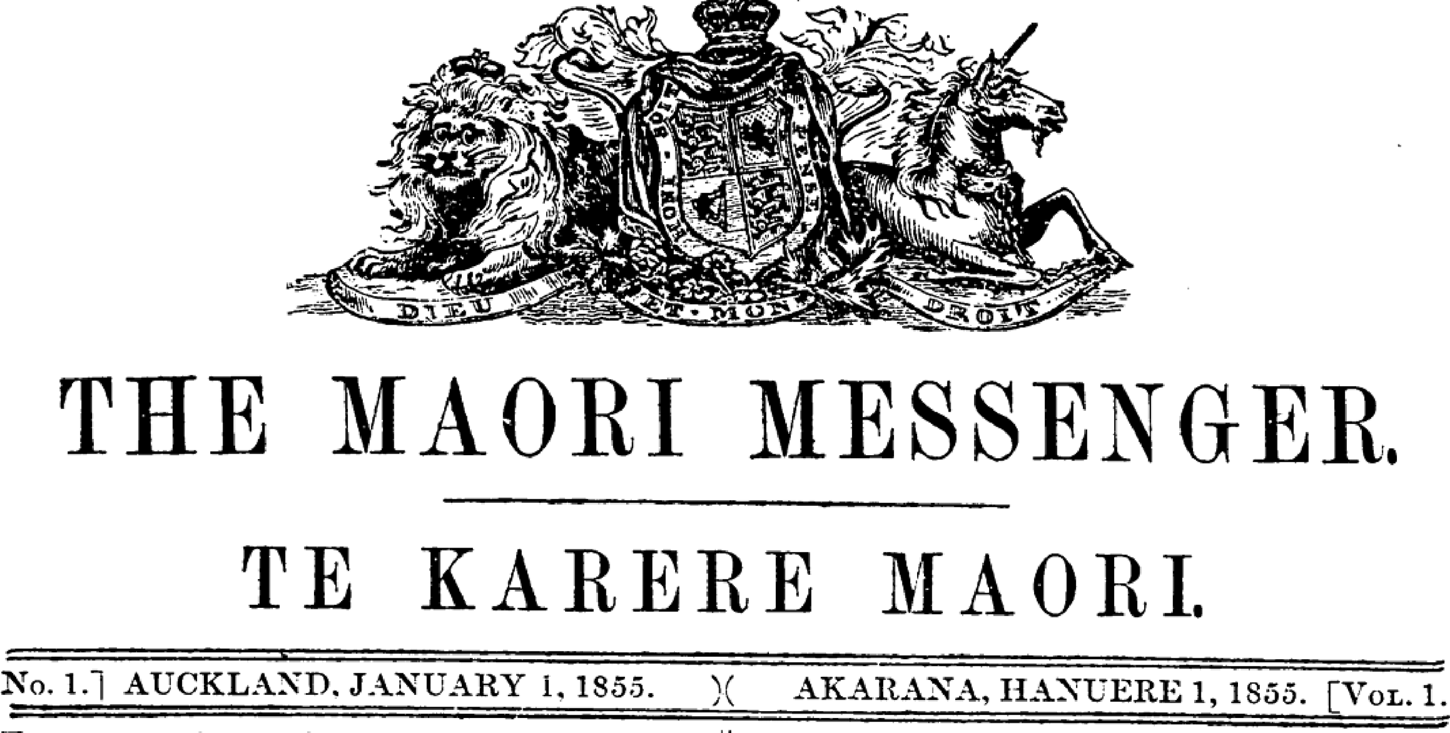
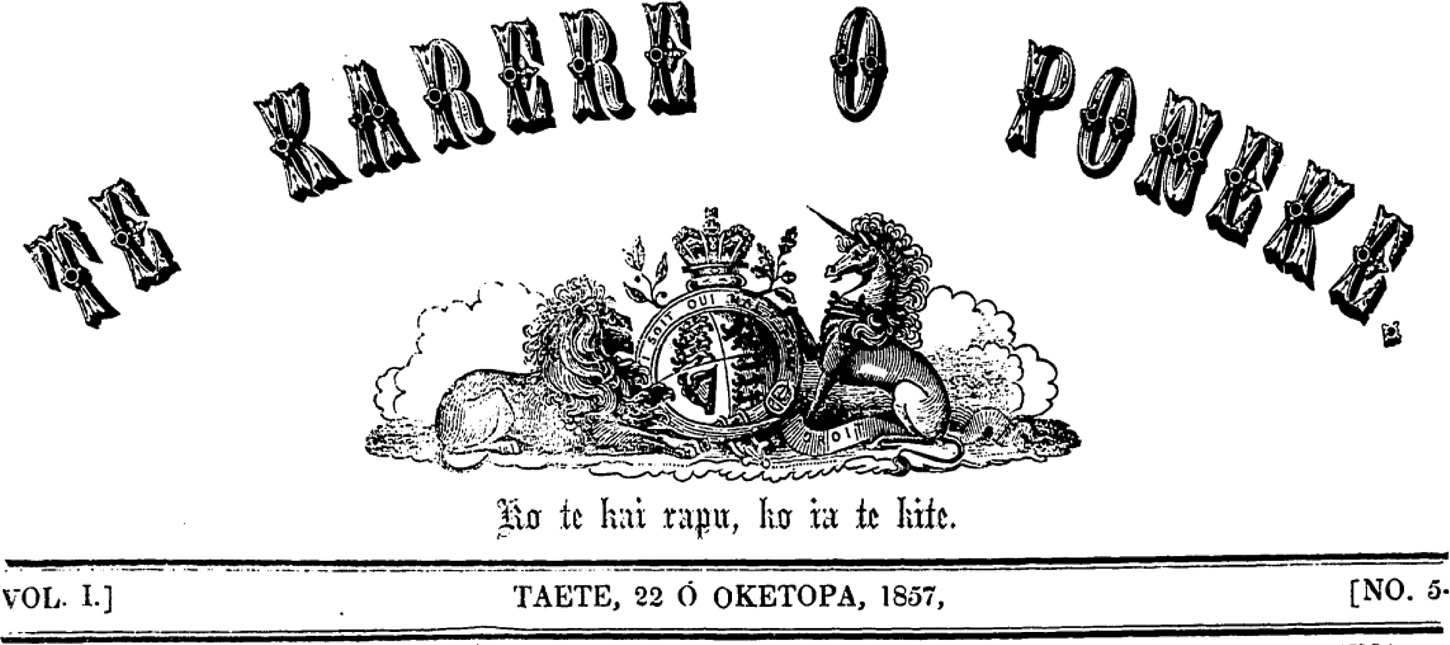
Looking at the cover of Te Karere o Poneke a reader may be mistaken in thinking that the government operated the niupepa. Like the government's official niupepa, the bilingual Te Karere Maori published in Auckland, the Wellington-based Karere was small in size (270 by 212 mm) and sported a version of the royal arms in its nameplate. Nineteen-year-old Walter Buller, who established Te Karere o Poneke in September 1857, worked as a government interpreter, and as editor he generally followed the official government line, even occasionally cutting and pasting articles from the Te Karere Maori.Footnote 4
Nameplate of the government-run Auckland-based Te Karere Maori. Source: Papers Past, https://paperspast.natlib.govt.nz/

Nameplate of Walter Buller's Wellington-based Te Karere o Poneke. source: Papers Past, https://paperspast.natlib.govt.nz/

But despite Buller's connections, the paper was not an official government publication. Advertisements always filled most of the first of its four pages, and Māori subscribers paid “Twenty shillings per annum, payable half-yearly” for the weekly newspaper.Footnote 5 Buller's attempts to gain a government subsidy were only partially successful, with the meagre £40 awarded unable to sustain the paper's future.Footnote 6 Like all other niupepa, the primary purpose of Te Karere o Poneke was not to make money but to push social or political agendas. In July 1858, the niupepa claimed subscriptions had grown to two hundred.Footnote 7 This compares well with the five hundred copies of the government's niupepa distributed free across the country.Footnote 8 But, as discussed below, Māori use of niupepa was often communal;Footnote 9 the niupepa thus made regular appeals for more subscriptions until its demise in December 1858.Footnote 10
Just as pertinent to Buller's enterprise was his upbringing as the son of a Wesleyan missionary.Footnote 11 While the newspaper was not ostensibly religious in nature, a number of clergy, including Buller's father, on occasion wrote letters addressed to the Māori readership and may also have contributed to the anonymous editorials. Te Karere o Poneke was printed in the offices of the Wellington Independent, which had earlier attempted to produce a niupepa, Ko Te Ao Marama,Footnote 12 in 1848. Its Presbyterian Scots proprietors, who positioned themselves politically against Wellington's Anglican establishmentFootnote 13 (and who had earlier defended Buller and his father against accusations of political bias in their dealings with Māori)Footnote 14 may have partially underwritten Buller's venture.
Te Karere o Poneke also differed from Te Karere Maori in that it allowed significantly more correspondence from Māori. Not counting advertising, about 481 separate items appeared in the pages of Te Karere o Poneke over its sixteen-month lifespan; 283 were inward correspondence, only twenty-two of which appear to have been written by Pākehā, including ministers.Footnote 15 In comparison, inward letters in the official and more tightly controlled Te Karere Maori (1855–63)Footnote 16 comprise a mere 234 out of 1,154 total items (20%), and the Wesleyan Te Haeata (1859–62) just 29 out of 260 articles (11%).Footnote 17 It is the high proportion of Māori letters (54% of items) that makes Te Karere o Poneke interesting in terms of analysing whether the Māori writers and readers constituted a “public” (or even a subpublic, or counterpublic) within a colonial “public sphere.”
A Colonial Public Sphere?
Māori readers read Te Karere o Poneke (and other niupepa) but did they constitute a “public”? Certainly, Pākehā-run niupepa sought to create Māori publics, although ones defined within colonising structures. For example, the first such publication, the government's Te Karere o Nui Tireni stated in 1842 that it would be promulgating official information and explanations of the state functions, but
if anyone is alarmed at, or dislikes, one of the Governor's policies, he will write his objections or concerns so that it can be printed in this book [publication] so everyone can see it. This is what the Pākehā does; he writes his objections to the newspaper, so everyone will hear his thoughts.Footnote 18
Indeed, in the 1840s such was the novelty of the government newspaper that Māori chiefs came to Auckland on publication day:
One native of a party is generally selected to read the news aloud: when he takes his seat upon the ground, a circle is then formed, and after the reader has promulgated the contents, the different natives, according to their rank, stand up and argue the different points contained; which being done, they retire home, and answer the different letters by writing to the editor.Footnote 19
While by the 1850s Māori may not have sought out niupepa so ostentatiously, the integration of public spoken discourse with information from and letters to newspapers remained a feature of Māori society. Buller, as editor of Te Karere o Poneke, emphasised the civilising function of newspapers, but also made it clear that it was a forum for Māori opinion.
When a person reads his book, a thought comes to him; then he mulls it over until it's clear; then he takes his pen and writes, and sends it off to be printed for his fellows to see, to show what he was thinking of.Footnote 20
Māori writers did not disappoint, often prefacing their letter with a request (or demand) that the newspaper print their thoughts. The Māori mailman, Tame Irihana, even published a letter informing correspondents of the need to pay for the postage “because it is a great bother to Buller and McKenzie to pay for your letters at the Wellington post office.”Footnote 21 Such was the flow of correspondence that Buller felt compelled to tell correspondents not to despair if their letters were not printed; it was not that they were bad but that some space was needed for news. “Reading the newspaper would perhaps be tiresome if it was only letters.”Footnote 22 In eight of its issues, a two-page supplement was added to accommodate additional correspondence.
Theorists have tended to set a number of criteria with which to define the boundaries of what constitutes a “public” or a “public sphere,” which can prove problematic when applying them to some situations. In this collection, for example, Christina Soriano offers the example of a public sphere emerging in a semiliterate Venezuela that lacked printing presses. Colonial societies are generally marked by racial divisions, and in many, a dichotomy existed between colonisers and a colonised indigenous population. However, the differing nature and histories of these societies works against conceptualising one-size-fits-all theories that might be applicable to all colonised indigenous peoples. Within the British Empire, a number of factors influenced subsequent colonial histories and how indigenous peoples experienced and reacted to imperial regimes. These include whether the colonised already possessed literacy and a script-based religion; the relative difference in their socioeconomic systems and technology to the imposing foreign power; whether their colonisation occurred prior to, during, or after the peak of humanitarianism; their resistance to epidemic diseases; the attractiveness of their lands and resources; and whether their numbers allowed them to remain the majority population, or be quickly swamped by mass European immigration. For example, the experience of British colonialism in 1850s New Zealand was quite different from the northern India of the late nineteenth century or Kenya of the 1950s discussed by Leigh Denault and Bodil Folke Frederiksen in this volume. The factors that shaped the scale and nature of colonial rule were thus instrumental in determining the nature of any indigenous public sphere that formed, and when it did so.
The question is then, could late 1850s Wellington Māori producing and consuming the discourses in Te Karere o Poneke have constituted a public sphere? Michael Warner argues that a public (as opposed to the public) “comes into being only in relation to texts and their circulation,” a “social space created by the reflexive circulation of discourse.”Footnote 23 Some New Zealand scholars certainly have cast doubt on the extent of Māori literacy, or whether Māori society to this day is essentially oral in nature.Footnote 24 Ian Stuart suggests that marae-ātea, the courtyard of the marae (communal complex of individual Māori iwi, hapū, or whānau Footnote 25) where issues are debated through formal oratory, continue to constitute the Māori public sphere.Footnote 26 However if engagement with texts is critical, for many of Te Karere o Poneke's readers, it was also literal. The newspaper itself—as both material entity and agent of change—became a subject of discussion. Many wrote of their appreciation of this new source of information, such as Rīwai Te Ahu, an Anglican deacon, who listed in the first issue all the sorts of useful information readers might expect.Footnote 27
In the following year however, Te Ahu questioned its cost, asking “Am I the only one annoyed at the small size of the newspaper and the increased price?” His argument that the English-language papers were the same cost but much larger in size prompted an editorial explaining that fewer subscribers bought the Māori niupepa, and it was harder work for the Pākehā printers who did not know the language.Footnote 28 Notwithstanding this rebuttal, Rauhihi of Manawatū wrote in supporting Te Ahu's argument.Footnote 29 This triggered Te Hoa Aroha (“Loving Friend,” likely a Pākehā clergyman) to pen a response in which he compared newspapers to gold, silver, and copper; that Te Karere o Poneke represented the former justified its higher price.Footnote 30 Te Ahu responded, objecting at this attempt “to repress the words of my letter,” but his letter broadened to attack the Pākehā correspondents, whose moralistic epistles tended to criticise Māori for failing to progress sufficiently. Citing earlier issues, he argued that on quality and intrinsic value the various texts produced by Pākehā writers were actually copper rather than gold.Footnote 31
More problematic perhaps is Warner's assertion of modernity as a key ingredient in the formation of a public, in which voluntary participation holds the members together, rather than more traditional relationships such as kinship or customary status, or other more “ascriptive” forms of belonging. Nineteenth-century Māori society was largely communal in nature, in which the inherited status of chiefs remained important. This suggests that it may be difficult to argue that Māori at this time could form the “modern” form of public suggested by some theorists. But chiefly descent of varying quality permeated through most people's genealogy, and most ariki (paramount chiefs), although highly respected, possessed little real power over their lesser kin,Footnote 32 a tendency that colonisation exacerbated. Warner largely discusses his ideas in a bubble devoid of context, in which hypothetical societies transitioned from fixed hierarchies into communities of private citizens over a period of time. The transformation of such societies was slow, with long histories of religious change, the spread of literacy, emerging capitalism, and centralising states. Although these could perhaps be England, France, or Germany, the model is presented as both acultural and historical (as opposed to anthropologised “native” experiences) and thus the standard that separates the Western and modern from the rest. However, as Charles Taylor posits, “the belief that modernity comes from one single universally applicable operation imposes a falsely uniform pattern on the multiple encounters of non-Western cultures with the exigencies of science, technology, and industrialization.”Footnote 33 The European experience contrasts with that of many colonised peoples, especially those like Māori who suddenly encountered Christianity, print, and a market economy in modern form, swiftly followed by a flood of settlers, a colonial administration, albeit initially inchoate, and English law, all over the space of several decades.
Western-derived models of modernity-induced change do not necessarily sit well on non-Western cultures. As I have argued previously with regard to Benedict Anderson's model of “imaginary communities,” newspapers and print combined with colonisation (rather than with modernity and capitalism fully in place) can induce a nascent sense of national consciousness in an indigenous society. It was not modernity's atomisation of individuals that induced a form of Māori nationalism in the late 1850s and 1860s, but the confrontation of new ideas, and new imaginations of belonging, that may appear retrograde when compared to Anderson's model.Footnote 34 For example Anderson saw Christianity and monarchy as relics of traditional society acting as a brake on nationalism,Footnote 35 but these were innovative and “modern” concepts in Māori culture that allowed Māori to look beyond supposedly ascriptive “tribal” affiliations. While the Māori nationalism engendered by the Kīngitanga (Māori King Movement) was effectively crushed militarily in the mid-1860s, in Hawai'i the combination of print, Christianity, and indigenous monarchy facilitated a flourishing nationalism through the nineteenth century.Footnote 36 As Partha Chatterjee asks with regard to the postcolonial world, if the non-Western forms of nationalism are forced to align to Western archetypes, “what do they have left to imagine?”Footnote 37 If we accept that Māori had not yet fully transitioned from the pre-modern to modern in the first two decades of colonialism yet still developed a form of nationalism, relatively modern yet definitely indigenous, then it is not unreasonable to suggest they also operated within a similar variant of public sphere.
It might be possible to define Māori engagement through print in terms of forming a subpublic or counterpublic, but even these terms are problematic for indigenous groups within colonial times. Counterposed against a singular (bourgeois white male) public, Nancy Fraser suggests that “members of subordinated social groups—women, workers, peoples of colour, and gays and lesbians—have repeatedly found it advantageous to constitute alternative publics . . . where members of subordinated social groups invent and circulate counter discourses to formulate oppositional interpretations of their identities, interests, and needs.”Footnote 38 The concept of counterpublic is apposite for groups that exist within a society, such as women, the working class, and sometimes subordinate ethnic groups in the modern urban milieu. But the extent to which mid-nineteenth-century Māori formed “part” of a wider New Zealand society is debatable. While Māori were (nominally) under the same imperial/colonial regime, subject (for the most part) to the same laws, and (in theory) possessing the same civil rights as Pākehā, their worlds were mediated by different languages, customs, and worldviews. These worlds also sat socially separate from each other, even when physically close, with most Māori living in their own villages while most settlers inhabited towns or farms within Pākehā zones expanding out from initial settlements.Footnote 39 It was at particular interactions around commerce, land, religion, politics, and war that these two worlds and their respective discourses intersected, with most day-to-day activities and concerns existing in relative isolation from each other. The colonial project that sought to “amalgamate” Māori into the Pākehā world, in its infancy in the 1850s, never quite succeeded in its aims.Footnote 40
Another condition of the theoretical public sphere asserts that the discourses that emerge represent an organic intellectual voice standing against the power of the government. As Jürgen Habermas suggests, “although state authority is so to speak the executor of the political public sphere, it is not part of it.”Footnote 41 By implication, we can assume that those producing the public's discourse also have some control over its means of production: that a “public” produced the newspapers, consumed the texts, and reproduced the arguments. This was certainly possible in colonial locations where settler populations might create their own public spheres in opposition to an appointed governor or elected elites; or where, such as in India, colonised peoples possessed a tradition of indigenous literacy and access to an economy and technology with which they could readily produce newspapers and books.Footnote 42 In 1850s New Zealand, newly literate Māori still largely lived in communal villages where often even obtaining writing paper was difficult.Footnote 43 The first Māori-run press printed the Kīngitanga's anti-government and nationalist Te Hokioi from 1861 but was effectively lost when the British Army invaded the Waikato several years later.Footnote 44 The much more prolific Te Wananga, under the control of Ngāti Kahungunu chief Hēnare Tomoana, did not appear until 1874, but it was partially funded, and sometimes edited, by Pākehā.Footnote 45 Buller's ethnicity should thus preclude Te Karere o Poneke from providing any kind of Māori public sphere. As a Pākehā of missionary background and in official government employment, actively encouraging colonising discourses, he was effectively an outsider to the readership who consumed the discussions he encouraged and printed.
A Time of Dynamic Change
Polynesians reached New Zealand some time between the thirteenth and fifteenth centuries,Footnote 46 subsequently developing the Māori culture in relative isolation. Tradition alludes to Māori originally migrating from Hawaiki, but according to Margaret Orbell, Hawaiki became a “religious” concept, and “Māori had assumed they were the only men, and that their islands, and Hawaiki, were the only lands.”Footnote 47 Māori had no need for any notion of ethnicity, with social and political divisions based around kin relationships. The term māori means “normal” or “human,” and only became a significant point of similarity for Māori after encountering the strange newcomers from afar. Although Māori culture was not static, precontact change was relatively slow and evolved from within their own culture.
When looking at Māori engagement with texts and their interactions with the state, one must be mindful of the rapid sociopolitical adjustment through the nineteenth century. The arrival of explorers in New Zealand, such as James Cook and Jean François Marie de Surville in 1769, marked the beginning of the end of New Zealand's centuries-long isolation from the rest of the world.Footnote 48 In the 1790s sealers appeared, followed by whalers, traders, and missionaries. Early Pākehā who arrived needed to be alert to local customs and politics to survive. Although this was still a Māori-dominated world, Pākehā contact nevertheless brought a period of dynamic change for Māori living in the Wellington area. Due to the pressure of communal warfare, exacerbated by the introduction of muskets, Māori iwi from the Waikato and Taranaki migrated south in the early 1820s to the Cook Strait region, in turn displacing iwi resident there. The principal instigator of this migration, Te Rauparaha, not only sought safer territories for his own people, but also better opportunities to trade with Pākehā, while continuing military operations against his enemies.Footnote 49
However, more Pākehā were soon to arrive. In 1839 the London-based New Zealand Company, endeavouring to establish model Wakefieldian colonies, exchanged goods with Māori, including in the Cook Strait region, in the belief that it was purchasing vast areas of land. Nine hundred colonists left England without knowing if the first party had reached New Zealand, let alone purchased any land, sailing into the Wellington Harbour in January 1840, just one month before the first Māori chiefs in the north of the North Island signed the Treaty of Waitangi that absorbed New Zealand (nominally at first) within the British Empire.Footnote 50
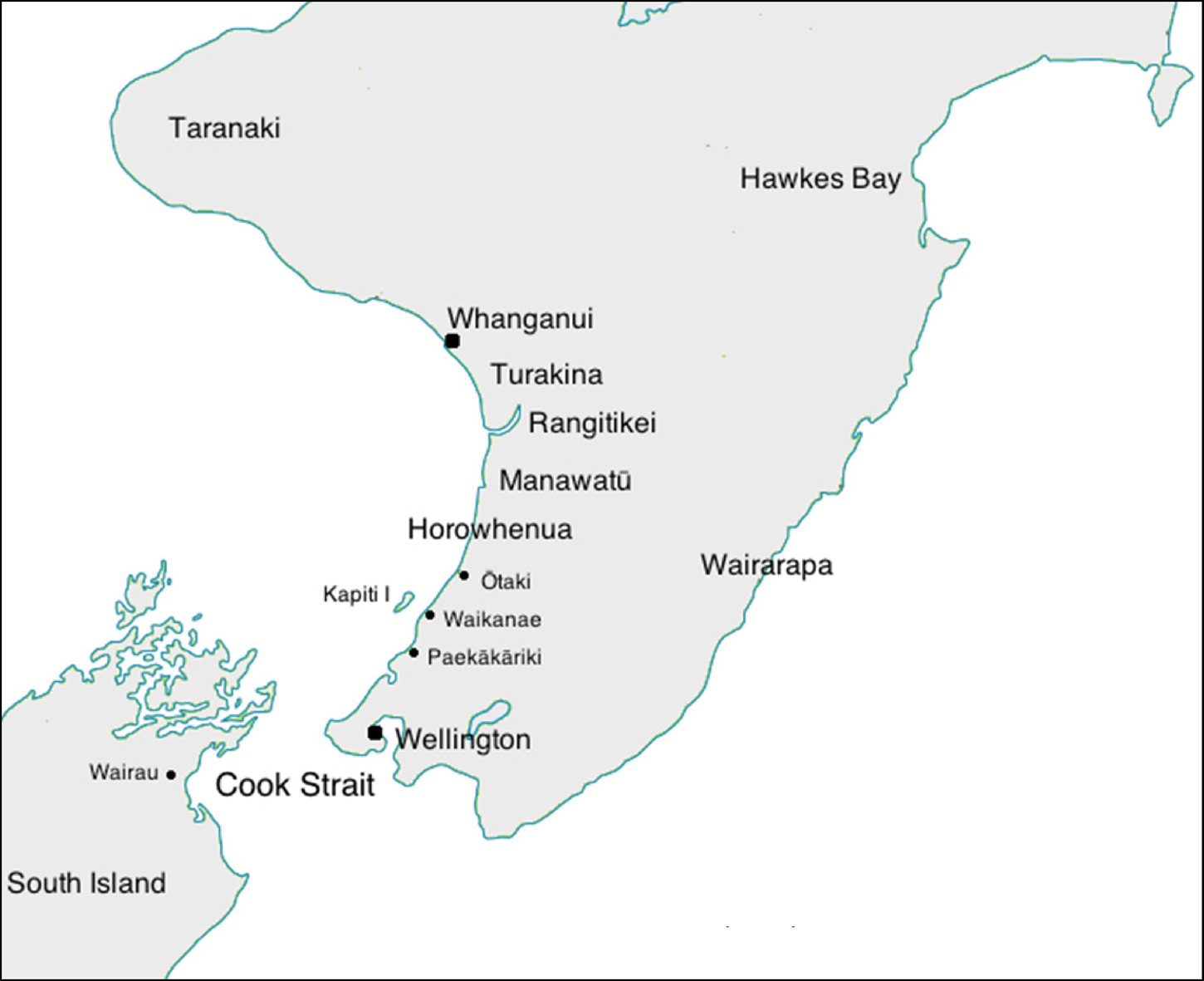
Lower North Island (Created by author.)

Tensions between Māori and settlers over land soon led to conflict, especially due to doubts over the validity of the early sales. A skirmish with Te Rauparaha's warriors in 1843 at Wairau, Cloudy Bay, resulted in the deaths of twenty-two Nelson colonists, but Governor Fitzroy, lacking effective military power, exonerated the chief, much to the settlers’ anger. George Grey, Fitzroy's replacement, was less scrupulous. When Māori occupied the Hutt Valley north of Wellington in 1846, Grey kidnapped Te Rauparaha then used British troops to push the occupiers north away from Pākehā settlements. Māori attitudes were also changing. Pākehā settlement had introduced a new order, including trade and other opportunities, leading a number of the local Māori to aid the British militarily against their own relatives.Footnote 51
The period was also a time of intense and rapid cultural change. Christianity came to New Zealand in 1814 when Church Missionary Society (Anglican) missionaries settled in the north, in the Bay of Islands. The missionaries sought not just spiritual conversion, but for Māori to also adopt European customs, such as clothing, education and a Protestant work ethic, while discarding “objectionable” Māori practices, such as polygamy, warfare, and cannibalism. They struggled to win souls initially, but by the 1830s they had found more success, especially once an effective orthography for te reo Māori (the Māori language) had been developed in 1820 and a flood of scriptural texts facilitated a relatively straightforward acquisition of literacy alongside relatively rapid conversion.Footnote 52
Other iwi sought this new knowledge and in 1839 Tamihana Te Rauparaha, the son of the great warrior, and his cousin Mātene Te Whiwhi sailed to the Bay of Islands, bringing back to Ōtaki their own Anglican missionary, Octavius Hadfield, who soon garnered a good harvest of souls.Footnote 53 For Māori in the Wellington region, the new religious order coincided with further political and cultural change. The Treaty of Waitangi, signed by many Māori chiefs around the country in 1840, ushered in a fledgling colonial government headed by a London-appointed governor. From the start, this government promoted the message of European civilisation while also seeking to persuade Māori to accept its authority, the rule of law, and the market economy, and to sell land to the government to enable further Pākehā settlement.Footnote 54
As Pākehā immigrants began to swamp the indigenous population, the British parliament passed the New Zealand Constitution Act in 1852, establishing Houses of Parliament as well as six provincial administrations. Although the first meeting only occurred in 1854, parliament gained full representative government (except for Native Affairs and defence) two years later. The franchise applied to Māori men who had gained the rights of Englishmen under the Treaty of Waitangi but most, who owned their land communally under native title, were effectively excluded by the property qualification.Footnote 55
In effect, Māori were assaulted by modernity in the first half of the nineteenth century, but this did not mean that they crumpled from “fatal impact.” In a matter of a few decades autonomous hapū and iwi whose primary political and military activity focused on each other, who might eat, enslave, or be chivalrous to those whom they defeated, and whose social hierarchies were based on genealogical standing and mana, were confronted with new peoples, new diseases, new technologies, new economies, and new knowledge and belief systems. Māori engaged with literacy, muskets, and new crops; many traded with Pākehā and worked alongside shore whalers; and by the 1840s many were professing Christians. While these changes could still be easily assimilated within the Māori world, many also saw potential opportunities in the new colonial system.
However, as colonisation progressed, misapprehensions developed. Pākehā were streaming into the country, with the two populations reaching numerical parity by the mid-1850s. Māori were also concerned about the diminution of their estates held in common, the decline of chiefly authority, and especially the inter- and intra-iwi conflicts triggered by the government's pressure on iwi and hapū to sell land. Although kin-group differences and loyalties remained, many Māori began to align more strongly with their indigenous identity, partly in response to these tensions, and to the colonial discourse of racial difference.Footnote 56 But no warfare broke out between Māori and Pākehā in the 1850s. Whatever the fears, many Māori were still keen to engage with the new order that offered hope of sharing the prosperity and modernity that the Pākehā brought. It is in this context of rapid change and uncertainty that the Te Karere o Poneke emerged in September 1857.
Māori Correspondence
Te Karere o Poneke published 261 letters from Māori. Some of the correspondence does not indicate a locality. Much correspondence came from its “natural” constituency, the environs of Wellington Harbour stretching northwards on the western coast up to Kapiti and Ōtaki. But at least 105 derived from farther afield, indicating that the newspaper's reach was more than purely local. Many of these were sent from localities on the western side of the island, areas either conquered by Te Rauparaha and his allies or with genealogical links to Māori iwi who had migrated to the Wellington region: Horowhenua, Rangitikei, and Manawatū (46); Turakina and Whanganui (23); Taranaki (15). Three letters were even sent from the distant Chatham Islands, conquered in 1835 by several Taranaki iwi that had migrated south first to the Cooks Strait region before moving almost eight hundred kilometres offshore.Footnote 57 In contrast the eastern seaboard, without the same iwi connections, attracted less correspondence, with only twelve letters from the Wairarapa and Hawkes Bay. Generally, only one name was appended to each letter, one of which, at least, was from a woman. Only nine were written by two people, and seven by larger groupings, three of which indicated their letter was on behalf of a rūnanga (iwi council). By comparison twelve of the thirty-one Māori letters in the government's Te Karere Maori in a similar period (1857–58) were multiauthored. Although a chief may well have written on behalf of or in consultation with his people, the preponderance of sole-authored letters in Te Karere o Poneke (94%) suggests a less corporate iwi standpoint and more personal opinions.
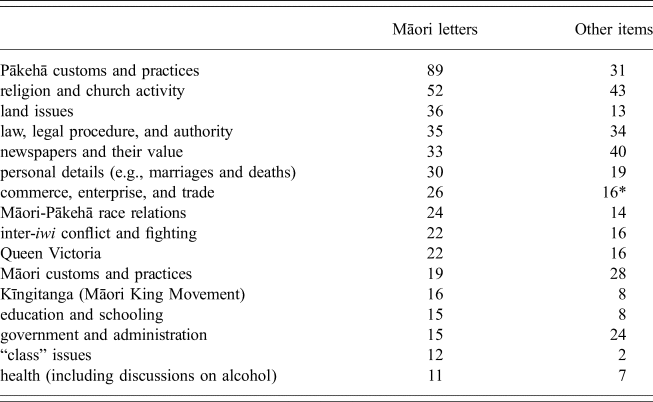
By coding the correspondence, we can see the various concerns that prompted Māori to write, or themes they referenced, as opposed to other items, such as articles and letters written by Pākehā. As discussed below, many of the coding categories are themselves linked, and correspondents might touch on a number of issues in a single letter. By far the largest subject category is ngā tikanga pai o te Pākehā, literally “the good customs of the Pākehā.” This term however was also used to define the wider concept of “civilisation,” a concept unknown to precontact Māori who lacked other peoples to compare themselves with. Civilisation was also sometimes translated in terms such as rangatiratanga (chieftainship, nobility), kakenga (ascension), or māramatanga (clarity/understanding), but at this time tikanga pai or ritenga pai (good customs, practices) was the usual terminology.Footnote 58
Referenced Topics in Māori Letters, and Other Articles and Letters

* This figure does not include paid advertisements, or tables of market prices.
Because Western civilisation inherently exists within or is a consequence of civil society, which in turn is subject to or emerges from good governance and the rule of law, assertions of a willingness to embrace ngā tikanga pai related to more than mere social and cultural change but were, in essence, political statements. Christianity, literacy, and textual culture, engagement in the market economy, sending children to missionary schools, European clothing, table manners, and housing were all bundled together into ngā tikanga pai o te Pākehā, together with eschewing undesirable Māori customs, such as feuding and feasting. But most significantly perhaps, the mix also aligned with colonial imperatives, such as the sale of land to encourage Pākehā settlement, and acceptance of Pākehā government and English law.Footnote 59
Buller portrayed European-style civilisation in Te Karere o Poneke as a package deal that would provide access to modernity, prosperity, and law as the means of material advancement.Footnote 60 His newspaper perhaps gave the most space to this modular yet interconnected concept, but was in step with other Pākehā niupepa of the time, such as the Wesleyan Te Haeata and the government's Te Karere Maori.Footnote 61 This, of course, did not preclude either the niupepa or Māori engaging in more focused discussion of individual ritenga (practices), or aligning them with more specific themes, such as religion or commerce. For example, in 1858 Te Haeata criticised large-scale Māori feasting not just for debts incurred, but for wasting what God had provided.Footnote 62 Hoani Te Ōkoro and Pātara Piopio wrote in favour of using government services to facilitate land subdivision and prosperity, without mentioning the wider discourse.
For some Māori, the change inherent in ngā tikanga pai impacted on domestic culture. Kiharo of Ōtaki urged the readers, “Let us now look at the Pākehā's customs. Friends, what a knowledgeable people these Pākehā are. This is the failing of the Māori, the poor housing, the poor food, sleeping on the ground, and wearing blankets during the day.”Footnote 63 Surprisingly, neither the editor of Te Karere o Poneke nor its Māori correspondents discussed gender issues in any meaningful way. Within the government's niupepa and the Wesleyan Te Haeata, discussion on women at this time tended to focus on health, in particular the effects of overwork, poor food, hygiene, and fornication on a decreasing Māori population.Footnote 64 The fact that an article also encouraged iwi to forbid women from their council meetings suggests that the lack of female visibility does not preclude women's involvement in decision-making.Footnote 65 Gender issues tended to impact on the internal domain; these do not appear to have concerned the predominantly male correspondents to Te Karere o Poneke, whose discourses on modernity more often focused on more external concerns.
Māori also retained existing tikanga when they deemed it appropriate without completely forsaking notions of modernity. For example, one chief's determination to sell land in Hawkes Bay against the wishes of other chiefs led to intra-iwi warfare in 1857.Footnote 66 The Ngāti Kahungunu chiefs opposed to the sales wrote a letter to the Hawkes Bay Herald (which was subsequently reprinted in Te Karere Maori and Te Karere o Poneke) seeking to reassure Pākehā that their conflict with another grouping within the iwi should not concern them:
Our fight is just between ourselves. You, the Pākehā, may live peacefully among us. We do not want to turn and murder the people who imparted good customs to our villages . . . so that we all work together on the activities that enrich men, such as flour mills, cultivation, raising sheep, and such like.”Footnote 67
However, many Māori spoke of ngā tikanga pai in the same way as Pākehā presented them, as a single conceptual package.Footnote 68 This blending of the various aspects of modernity can be seen in the letter of Rapihana Te Otaota of Waikanae.
This is my opinion. I eagerly seek the good practices of the Pākehā. We, the Māori people, should not say that it was through our efforts that we gained good customs. No, it was from the Pākehā. And the mana of the Queen that came here. The Pākehā gave us religion, and the fruits of religion can be seen, that is, harmony and peace. And so we saw the great work of the Pākehā. The college, where each man and child gains his knowledge. You also showed us [flour] mills, that we, the Māori people, gained wealth. The [cultivated] foods by which we make money come from the Pākehā alone.Footnote 69
Many correspondents also considered ngā tikanga Pākehā in terms of law and government. But “law” and “government” were not yet fixed entities. Ihakara Tukumaru, for example, may have approvingly suggested that “the yoke has been put on the necks of the Māori people of New Zealand, that is, the Pākehā ideas that are a means to pacify and improve us,”Footnote 70 but in 1858 Māori could engage in Christianity, education, and the market economy and pay lip-service to the Crown's authority while still retaining effective autonomy. Mīhaka Te Maurara's words below are clear in his desire for the rule of law, but he was most likely less certain as to what “law” might develop into.
The Law is the head of [all] activity. Explain it so that we understand the good practices, whatever ones they are. But explain it, because we are children. Law, let the blind see, punish the children so they obey their fathers, so they live kindly disposed to each other—so that Governor Browne knows that we have repented, and he will then show his love.Footnote 71
As Lyndsay Head states, “Maori thinking about citizenship was characterised by a nervy consciousness.”Footnote 72 Given the conflation of ngā tikanga pai as a single concept, any debate on the topic meant, at least implicitly, approving or contesting colonisation, the form of political governance being instituted.
Critiquing Colonialism
Although Wellington Māori generally saw some benefit in the new colonial order, about a quarter of Te Karere o Poneke's Māori letters contained a complaint or expressed some dissatisfaction or critique. Public argument and discussion was nothing new to Māori, although in the past this was restricted to speeches on the marae-ātea, or in the whare rūnanga (meeting house). Indeed, the Māori need to discuss the impacts of colonisation encouraged larger pan-iwi meetings, and even larger whare rūnanga were built.Footnote 73 The newspaper, rather than replace oral discourses, acted as an extension rather than a replacement to this debate.
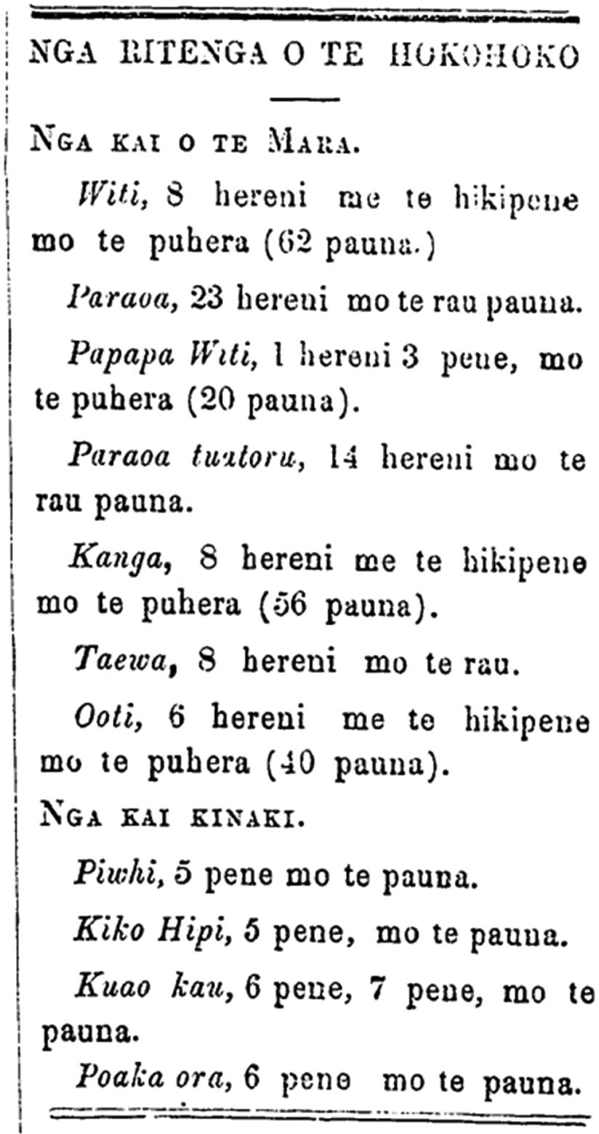
As with the arguments on the relative value of the niupepa discussed above, dissenting discourse in Te Karere o Poneke would sometimes stimulate a further argument from the editor or other readers. Given that many Māori were cultivating crops for sale, such as wheat and potatoes, they felt aggrieved when they believed that Pākehā merchants and traders were attempting to swindle them, especially when the prices offered were under those published in the niupepa's list of market prices.
An example of prices for potatoes, flour, grains and meats. Te Karere o Poneke, 1 November 1858.

Te Karere o Poneke published seven such letters.Footnote 74 Such actions were not seen just as disputes between individuals, but as affecting race relations as a whole. As Te Naera Te Angiangi of Waikawa recounted:
[The Pākehā] said that it was 2½d. I said that it was 4d according to the newspapers. He said that that was of no account, so we argued over that. And so I say that this is a fraudulent act on us, the Māori, so we won't feel aggrieved. And so, my friends, I say, stop this duplicity. How can it be said that the Māori and Pākehā can come together as one?Footnote 75
Some Māori would have believed such information to have possessed a veracity and authority lacking in mere verbal assertion; just as the Bible represented spiritual truth, printed information was expected to be correct and stable. Not all correspondents were so negative. Taimona Pita Te Ahuru of Wellington wrote to encourage Māori to follow his example and engage in Pākehā work. “I started work on 16 December 1856. I think that this work is the best. My Pākehā is very good—his kindness to me, and mine to him.”Footnote 76
Several readers also objected to the condescending and disparaging articles penned by “Hutana” (the Anglican Rev. Thomas Hutton) that critiqued Māori custom and behaviour with Aesop's fables, sometimes with New Zealand native animals substituted as the characters. Hutton also linked these fables to the need for Māori to embrace ngā tikanga pai.Footnote 77 For example, the “ass in the lion's skin” fable was applied to Māori who wrote letters to the newspaper just to see their name in print. In a few cases Māori writers, one a mission teacher, agreed,Footnote 78 but several writers took exception to these stories. The chief, Hēnere Te Puni of Pītone, objected to Hutton using the fable of the “dog and his reflection” to critique Māori who departed for the gold diggings. “My friend, Hutton, you say that the men who use their money crossing on the steamer [to the diggings] are dogs. Which is better—to be lazy and not go and look for sustenance for themselves?” He then addressed the readership, not just his Te Āti Awa kin, but all iwi. “Friends, Māori people, this is what I say to you—let the Pākehā denigrate our ignorance; it is not good for us to put ourselves down.”Footnote 79 Wātene Te Kaharunga of Aratangata was incensed at Hutton's use of the “bird in borrowed feathers” fable to belittle Māori use of European clothing and critique the superficiality of Māori progress. He wrote, “I say that the disparagement of the faults of our past, of our Māoriness, should be stopped.” Neither did Wātene think that Māori needed to take on all the trappings of ngā tikanga pai: “We have taken on shoes, shawls, and other things we see—but we will never take on Pākehā customs. We will never take on the language of the Pākehā.”Footnote 80
One custom that Ahitara Tangatangata of Manawatū was happy to partake in was drinking rum. Despite the Treaty of Waitangi supposedly granting equal rights between the races, the government attempted to protect Māori from drunkenness with the Sale of Spirits to Natives Ordinance of 1847, that banned or limited the sale of alcohol to Māori. This was followed by further regulations that created “dry” zones in Māori areas.Footnote 81 Tangatangata critiqued these restrictions:
Friends, I have been thinking about the person who drinks rum. I think it's fine, because he's paying for it with his own money. Do not prosecute that person. The reason I think this way about drinking rum, is because the mana of the Queen is over the Māori; [we have] become relatives [of the Pākehā], younger and older brothers, parents and children. So, I say therefore, do not put down the person who spends his money on rum. But if a Māori is drunk, treat him like the Pākehā, so that our law of the Queen's mana is the same [for both].Footnote 82
By using the government's own discourse, that Māori and Pākehā were now brethren and should adhere to the same law and authority, he questioned why Māori were prohibited from an activity open to Pākehā. Buller appended his own opinion to the letter, suggesting that the governor was acting as a father to his Māori children.Footnote 83 An exchange with the editor's father, Rev. James Buller, ensued, in which Tangatangata asserted that he would continue to drink rum while it was still available for sale.Footnote 84
Critiquing Chiefly Rule
The difficulty of applying the concept of a public sphere to colonised indigenous peoples can be that their resistance to imposed foreign rule fits neatly into a coloniser–colonised dichotomy, whereas accounting for dissatisfaction with internal indigenous hierarchies, such as class, is more problematic. While individuals could enhance their mana (power, authority, and status) in Māori society through their actions, genealogical descent from significant ancestors, especially through first-born male lines from eponymous iwi founders, was still of primary importance. Rangatira (chiefs) thus comprised a broad class, from ariki (high chiefs) to individuals of much lesser status. People of no account (especially those tainted with descent from war captives and slaves) were termed tūtūā. The influence of chiefs often proved useful for missionaries or government officials, but as the inherent logic of colonisation was to consolidate and validate government authority, the position of rangatira was inevitably at risk. For tūtūā who wished to improve their lowly position, ngā tikanga pai, like Christianity available to all, offered opportunities unknown prior to European contact. It is perhaps unsurprising that they saw Te Karere o Poneke not just as a source of new knowledge, but also as a vehicle to critique their superiors and assert themselves.
Heremaia of Whareroa noted that the newspaper wanted Māori to abandon what was seen as excessive feasting and funereal customs, activities he saw as being practised by chiefs. “If these customs were ours, of the tūtūā, the rangatira would be emphatically telling us that they were very bad customs; the reason they don't want to give them up is because they are customs the chiefs practice.”Footnote 85 Some correspondents merely wished that all people should be treated equally, and that they be judged on their knowledge rather than their breeding.Footnote 86 As Wiremu Te Haeana Tākiri of Turakina wrote, “both the tūtūā and the rangatira is born of man. So I say, allow the thoughts of the tūtūā and print them in the newspaper. Let the Pākehā decide whether they are right or wrong.”Footnote 87
For others, the criticism was more focused. The government often used rangatira as assessors, a form of judge who sometimes worked alongside a Pākehā judge or on their own. Pehira Karatau of Whanganui complained about the process.
Friends, this is what I have to say, to let your judgement be sound in the disputes of the tūtūā and the rangatira. This is what I know, if the tūtūā and the rangatira have a dispute, they are judged according to the law. Although what the tūtūā says is true, and what the rangatira says is wrong, the tūtūā's word is discounted, and the rangatira's is deemed correct.Footnote 88
This he saw as a clear breach of Christian justice and how the law should work. “And so I say, the Pākehā's custom is not like this, but they operate in accordance with the sound and honest principles of the most powerful God.”Footnote 89
For other tūtūā, the issue was land rights. In a letter concerning an intra-iwi war over land in Wairarapa, Īhaka Whatarau of Papawai blamed the government for pursuing sales and for listening only to the rangatira, but also the chiefs for not sharing the money with “the little man.” Māori of this time were not to know that subdivision of hapū and iwi estates would hasten land alienation in later decades, and Whatarau suggests that “in my opinion, let the little man dispose of his own piece, and hold on to the payment for it.”Footnote 90 Ahitara Tangatangata, discussing a meeting over a possible land sale, noted that his “tūtūā heart” remembered the chiefs’ unwise sales in the past. He too considered “each person should survey their own land, so the acreages are known, and any consideration of the price is clear.”Footnote 91
Although tensions obviously existed between the social groups, cultural practices, including chiefly authority, were still strong. In later years, when the impact of colonisation was clearer, with land loss through war, land courts, and confiscation, such class divisions within iwi groups are much less apparent. Certainly some Māori wanted unity in the 1850s. As Aperahama Te Haupatu Te Rangiwhakaruhi of Ōhara wrote, “This is what I think, let the visiting party be called on, whether they are a group of tūtūā or a group of rangatira. Let them call for their village to be as one.”Footnote 92
Debate on Land Sales
Hapū and iwi groups held land in common under customary title, and prior to the establishment of the Native Land Court in 1862, sales of land to the Crown's agents were not supposed to proceed without general and public accord. While initially many groups were keen to sell in order to gain Pākehā to trade with, by the mid-1850s enthusiasm had waned. Sales money was soon spent, and Pākehā neighbours, who did not consider themselves subject to iwi authority, often brought tensions or summoned unwanted government attention. As readily-available land dried up, land purchasers sometimes resorted to secrecy and underhand tricks to effect a deal. Arguments over whether to tuku (release for sale) or pupuri (hold back) land disrupted iwi unity, sometimes leading to murders and fighting. Māori thus extensively discussed land issues in Te Karere o Poneke.
Some rangatira, such as the Mātene te Whiwhi and Tamihana Te Rauparaha at Ōtaki, encouraged iwi to subdivide their lands so each person could sell their piece if they wished.Footnote 93 Ihakara Tukumaru of Manawatū agreed, arguing that modernity and prosperity would come along with Pākehā settlers.Footnote 94 More prevalent, however, were letters opposing the sale of land. Heremaia Te Tuere of Ōtaki, referencing an inter-hapū war in Taranaki over land, and a murder of a prominent chief there, queried where the fault lay.
Therefore I say that what the land sellers are doing is causing much trouble. I ask, is the Māori or the Pākehā at fault? This is what is wrong in what they do: there are two people in the deal, one Māori and one Pākehā. It is not right for two [Māori] people, or ten, agreeing on the land to be sold to the Pākehā. But the whole iwi should agree on what lands they want to sell, and then it is alright.Footnote 95
One assembly of young men discussed Ihakara Tukumaru's letter, then wrote to the niupepa:
We have seen the words of our Māori friends, and our council of young chiefs of Ngāti Pikiahu have looked at them. We objected to what Ihakara said, that the land should be sold so that people get rich. No, a person will never get rich by doing that. But let him work the land himself, for potatoes, wheat, corn, oats, and sell them to buy cows and sheep. When he has a lot of cows and sheep and other things, he can sell them to the Pākehā. But if he sells the land, it's the same as something that is sold as food—gone forever.Footnote 96
Terepata Te Roihe accused those who had sold land of drifting into poverty, reduced to selling firewood to the Pākehā. “Friends, I think that the people of Wellington and Heretaunga are not living well. They do not cultivate food for themselves. Perhaps soon it will be high tide (what I mean by that, is the multitude of Pākehā) and we, the Māori, will be like the seagull cracking shellfish on the beach.”Footnote 97
The desire for iwi to hold on to their land, the source of their autonomy, led some in the central North Island to unite and appoint the aged Tainui ariki, Pōtatau te Wherowhero, as the first Māori king. The government realised that the Kīngitanga was a threat to its own claims of sovereignty but chose largely to ignore this alternative political entity in the hope that it would come to nothing. In 1857 emissaries of the new movement, Te Heuheu and Taonui, came south to Ōtaki to try to gain support. Tamihana Te Rauparaha, son of the warrior chief, wrote to Te Karere o Poneke on how the local Māori rejected the message of the visiting chiefs, preferring instead to pursue ngā tikanga pai o te Pākehā, and remain loyal to Queen Victoria.Footnote 98
Conclusion
If the acquisition of a modern civil society is a prerequisite to the formation of a public sphere, then the Māori society of Wellington and neighbouring districts no doubt fails to qualify in 1857–58. About four decades earlier, the Ngāti Toa iwi, under Te Rauparaha, had violently seized the region with the help of newly introduced muskets, populated the land with related and allied iwi, then engaged in commerce with rough-and-ready whalers and traders. Less than two decades before, they had welcomed their first missionary, witnessed the first organised wave of Pākehā settlers, and were incorporated into the British Empire. Their world was in flux, politically, economically, and culturally, and they sat at the edge of the European “civil society” rather than as part of it. Māori at this time, still living according to hapū and iwi imperatives and loyalties, newly and often fervently religious, and relatively lacking in Western education, were insufficiently liberal, modern, and bourgeois to have constituted a Habermasian public sphere. Although largely literate in their own language, they possessed just a few of the materials associated with reading and writing: paper, pens, and limited printed literature, but no printing press of their own. Te Karere o Poneke, run by a young Pākehā government official of missionary parents who wished to amalgamate Māori into his own cultural and religious world, hardly appears to be the vehicle on which a genuine emerging public sphere might develop.
Despite not satisfying the theorists’ preconditions, Wellington Māori engaged in a form of public sphere through the pages of Te Karere o Poneke. According to the theory, modern conditions produce a break from old thinking that allows a public to form that critiques existing power structures. It is the impact of colonialism, sudden and intense but not fatal, including the rapid introduction of literacy and print, that provided opportunities for Māori to debate the practices of their own communities as well as those of the Pākehā settlers and the new regime attempting to assert itself.
It was Buller's own liberalism that provided a platform where Māori voices might be heard, for the new and changing society they encountered to be discussed and critiqued. Of the various niupepa available to Māori in the first two decades of colonisation, Te Karere o Poneke was most generous in the space it allowed for Māori correspondents, as well as the range of views it recorded, including those that ran against the editor's own principles. New Zealand's colonisation was supposed to be based on humanitarian ideals, with Māori possessing the same civil rights as the British colonists streaming into the country. As Māori still retained much mana through their land and iwi autonomy, a new order in which both races might flourish at least seemed possible.
The key to this new ideal was ngā tikanga pai o te Pākehā, an amalgam of the many practices, customs and institutions of Western society. Elements, such as Māori acceptance of law, government authority, and unencumbered Pākehā settlement, were vital to successful colonisation of New Zealand. Early niupepa portrayed these as necessary prerequisites that Māori must accept to share in the benefits of Pākehā knowledge, prosperity, modernity, and the rule of law. The very newness of what they were confronting heightened their awareness of their changing lives, and the prospect of participating on an equal footing in their rapidly transforming world explains why so many Māori published letters extolling the virtues of the new Pākehā customs. But the correspondents were no mere sycophants. They commented keenly on their situation, and were prepared to critique those aspects of colonisation they did not agree with. For a brief time in 1857–58, Māori of the lower North Island were able to express their hopes and concerns to others through Te Karere o Poneke. If we cannot define this experience as that of an emerging public sphere, then doubt must be cast on whether the theory can apply to colonised indigenous peoples, at least those, like the Māori, who were demographically swamped by European settlement. Ultimately it is the colonial context that is important. The niupepa's readers analysed and debated their situation, effectively utilising a colonial tool for their discourses in order to project their public voice.
Acknowledgements
Ka nui āku mihi whakawhetai ki ngā tāngata katoa i āwhinatia ai ahau kia puta mai te tuhinga nei. I would like to thank the many people who have assisted me in developing this essay, in particular the editors Emma Hunter and Leslie James, participants in Print Media in the Colonial World at Cambridge University and Print Worlds and the Making of a Colonial Public Sphere at Yale University, the Cambridge Centre for Research in the Arts, Social Sciences and Humanities, the Edward J. and Dorothy Clarke Kempf Memorial Fund, and the MacMillan Center for International and Area Studies at Yale University, whose financial support facilitated my attendance at these events.