

Legal mobilization has evolved as an increasingly important strategy of social movements to advance their causes and to legitimize their goals. Footnote 1 A central form of legal mobilization is litigation in court, most often pursued with the strategic goal of eliciting a favorable judgment to support demands and arguments for legal change. Social movement organizations or groups launch or support test cases in court in order to promote legal and social change, endeavoring to change law and policies, to ensure that laws are properly interpreted and enforced, or to identify gaps in the existing law. Rulings can also directly alter practices, or they can be used to press for policy changes. Goals of strategic legal support also include raising public awareness or setting political agendas. Research to date has focused mainly on cases in common law countries where the courts are requested to find solutions based on precedent. Here, courts have thousands of well-documented cases every year. However, we have little data regarding legal mobilization in civil law countries, where courts attach much more importance to legislation than to case law. Thus, strategic litigation becomes a less obvious option for exercising political pressure. Differences in the use of strategic litigation between legal systems, i.e., between common and civil law countries, seem quite understandable. But how we can explain the great differences in using the courts in similar cases in civil law countries?
This paper explores legal and institutional factors that may account for the varying levels of legal mobilization used by social movements in different countries. Analyzing these factors will be a necessary condition to understand differing levels of legal mobilization. The article examines the different legal opportunity structures and the extent to which strategic litigation has been employed by trade unions and other social actors to promote equal pay in four European civil law countries: Switzerland, Germany, France, and Poland. Since equality in the workplace is regulated not only by law but also by governance structures between labor, employers, and sometimes the state, an analysis of legal factors is not fully sufficient to understand the differing litigation levels. I will argue for such relevant additional elements in the discussion and conclusion.
The paper uses principally data derived from cases between 1996 Footnote 2 and 2006, Footnote 3 although it also refers to more current developments. The data derives from national judicial databases, namely court rulings and case notes. This is supplemented with analysis of court reports published in two national, high-quality newspapers per country. Finally, data has been collated from interviews with approximately sixty experts from universities, trade unions, and NGOs, and claimants as well as the lawyers who litigated equal pay cases. Footnote 4
The issue of equal pay is well suited for a comparative study on legal mobilization for a number of reasons: Gender equality is a core value of modernity, and democracy and is now comprehensively codified throughout Europe. European Union policy on gender equality and anti-discrimination is one of its most advanced policies, and the directives which govern this Footnote 5 create a comparably uniform legal background in the member states (and indirectly, also in Switzerland, which is not a member of the EU). Nevertheless, the gender wage gap in the member states remains as high as 25 percent Footnote 6 . A political commitment to gender equality would be credible if applied also to this redistribution issue. In addition, the gender pay gap is currently a prominent issue in European society. According to a Eurobarometer survey, it is also among the three top priority areas for action against gender inequality in the EU member states under focus in this paper. Footnote 7
There are other ways to successfully combat the gender wage gap in addition to legislation and strategic litigation, for instance, collective bargaining and anti-discrimination authorities. Footnote 8 Therefore, one must ask, under what circumstances do social actors turn to litigation? Many studies on legal mobilization use a political process model to answer this question. Footnote 9 Following paradigms of social movement research, they look at resource mobilization and at legal and political opportunities. Social-constructivist analysis in the study of social movements, on the other hand, has pointed to the relevance of shared beliefs and cognitive frames both in society and in movements for mobilization. Footnote 10 If and how actors mobilize for the political objective of equal pay is thus not only a question of the legal situation, but also of the significance and meaning society attributes to the value of gender equality. This article focuses on the concept of legal opportunity structures (LOS). Footnote 11 In particular, it explores the hypothesis that legal mobilization is more likely to happen when LOS are strong and conducive to strategies of legal mobilization.
The first section of the article discusses the concept of legal opportunity structures and explains the selection of countries. The article then describes the actual legal opportunity structures in the above-mentioned countries and in the European Union more generally. Quantitative and qualitative data on actual strategic litigation for equal pay will be presented in the third section, and the paper proceeds to discuss in which respect LOS can explain the different patterns observed between the countries. The paper suggests in which respects the LOS should be differentiated and complemented with other explanations such as norms, gender roles, and social movement action frames as well as the role of mass media. The concluding section then proposes further avenues for research.
1. The Concept of Legal Opportunity Structures
The political opportunity structure paradigm in social movement research states that political opportunities shaped by access to the political system or alliance and conflict structures influence the choice of protest strategies and the impact of social movements on their environment. Footnote 12 Drawing from this paradigm, and by analogy to political opportunity structures, socio-legal scholars have developed the concept of legal opportunity structures (LOS), which are mainly defined in relation to the judicial arena. Footnote 13 The existing literature stresses two sets of factors that variably combine to determine LOS: legal access, and substantive and procedural law.
Access to the court is the precondition for litigation. Who is eligible to sue? Do organizations have access to the courts (“associational standing”)? Footnote 14 Strategic litigation is more likely when legal rules allow for, or facilitate, group action. In the field of gender equality, most processes supported or initiated by social movements or trade unions are brought forward by individuals or on their behalf. Another important factor shaping legal access is also linked to the availability of resources, which influences who can afford to go to court. In this regard, the existence of state legal aid, or the provision of aid and legal representation through membership organizations like trade unions, also crucially determines legal access.
As far as procedural law is concerned, legal mobilization is more likely to occur alongside procedural benefits in favor of the plaintiff, such as a reduced burden of proof or the court’s obligation to investigate on its own initiative. Legal mobilization can be helped also by having an independent institution in the background that can launch investigations on its own (like the French Haute Autorité de la Lutte contre les Discriminations et pour l’Égalité (HALDE)) or initiate legal action itself (such as the Equal Employment Opportunity Commission (EEOC) in the United States or the Canadian Human Rights Commission (CHRC)). Logically, the stronger the position of individual or organizational claimants, the lower the expected financial, political, or emotional costs of a claim, and the higher the expected respective gains. Material provisions and justiciable rights provide the grounds for a claim and can render it more or less legitimate. A conducive opportunity structure would explicitly cite equal pay in the law, have a specific definition of what constitutes equal pay, as well as a clear definition of the judicial procedures available. If plaintiffs can refer to explicit and specific laws and regulations, their claims are legitimate. As it is rightly stated, “Constitutionally entrenched rights are particularly powerful because they enable interests to reframe their political demands as rights-based legal claims that may be used in the courts to trump policy decisions taken in the democratic decision-making arenas.” Footnote 15
For this research project, two countries with strong LOS “on the books,” Switzerland and France, and two countries with weak LOS, Germany and Poland, were selected. Switzerland, a non-member of the EU, is nevertheless surrounded by EU member states, and it selectively participates in Europeanization. It transposes European law autonomously where it is appropriate and politically feasible. Footnote 16 Poland was selected as a country with a state socialist past and a generally weak tradition of legal rights. Footnote 17 A description of the country-specific legal opportunity structures is provided in greater detail below in order to explain their categorization as having either strong or weak LOS.
In civil law countries, the relationship between court judgments and sustained changes in legal practice and jurisdiction differs from that within the common law tradition, as in the civil law there is no system of binding precedent. The primary sources of civil law are comprehensive codes and written laws, codified and amended by the respective legislatures. In their decisions, judges are bound only to the law and the Constitution. Footnote 18 This would suggest that legislative politics are more important than judicial decisions for realizing political objectives. However, when a law comes into force, courts have to clarify and interpret it, sometimes in the light of paramount legislation like European Union directives or human rights conventions. In fact a ruling by a higher court, or several rulings in similar cases, may develop a persuasive authority. This may open up or close down opportunities to engage in legal action. Strategic litigation may be part of the interplay between case law emanating from different levels of the judiciary, academic interpretation, and legislation. This interplay results in a “prevailing opinion” (“herrschende Meinung”) that becomes hegemonic in the legal and academic community. Footnote 19 Thus, case law in the civil law tradition has effects that are more indirect.
2. LOS in the European Union and the four Countries under investigation
National and European laws serve as a framework for actual litigation. EU law has been instrumental in achieving progress on gender equality issues in the workplace across the member states. In primary law, the Treaty of Rome (1957) first introduced the equal pay principle in Article 119 (now Article 157 of the Treaty on the Functioning of the European Union, TFEU) in order to prevent unfair competition. Footnote 20 Article 3(3) of the Treaty on European Union states that the promotion of equality between men and women is a task for all member states. Article 8 of TFEU lays down the gender mainstreaming principle, stating: “In all its activities, the Union shall aim to eliminate inequalities, and to promote equality, between men and women.” Since 1976, the European Union has issued over a dozen directives (secondary laws), which the member states had to transpose into national law.
Directive 2006/54/EC on the implementation of the principle of equal opportunities and equal treatment of men and women in matters of employment and occupation is a recast of several directives relevant in the context of equal pay. Article 4 of this directive introduces the principles of equal pay for equal work or for work of equal value. Article 2 prohibits harassment, less favorable treatment related to pregnancy or maternity leave, as well as direct and indirect discrimination. Indirect discrimination is defined as “an apparently neutral provision, criterion or practice that would put persons of one sex at a particular disadvantage compared with persons of the other sex.” Article 3 allows for positive action in order to ensure “full equality in practice between men and women in working life.” Member states shall ensure judicial procedures for the enforcement of the directive’s obligations, and they shall ensure some form of associational standing on behalf or in support of complainants (cf. Article 17(2)). The directive provides for effective and dissuasive penalties for discrimination, and compensation must not have a legally defined limit (Article 18). Article 19 deals with the burden of proof in discrimination cases: complainants only have to establish facts from which it may be presumed that there has been discrimination. It shall then be for the defendant to prove that there has been no breach of the principle of equal treatment. Finally, Article 20 stipulates the establishment of equality bodies for the “promotion, analysis, monitoring and support of equal treatment.”
Sustained legal action before the Court of Justice of the EU by lawyers, individuals, and trade unions has substantially contributed to the development of anti-discrimination law. Footnote 21 Hence the case law of the Court of Justice has great importance for national laws on gender equality, and in this regard, under the preliminary reference procedure, the Court of Justice has the final authority in the interpretation of EU law. As of 2008, the Court had issued about two hundred judgments related to equality. Footnote 22 The CJ’s decisions serve as an “interpretative guideline” for the national court to find a specific solution. Footnote 23 Several provisions in the directive 2006/54/EC (e.g., reversing the burden of proof in gender equality claims to fall on the employer rather than the victim), show that the European Union has provided an excellent legal opportunity structure for gender equality claims and that its law also substantially informs LOS in the member states.
The paper will now evaluate the LOS in the selected countries, starting with the two examples of weak structures, Germany and Poland, followed by the two examples of strong structures, France and Switzerland. In Germany, although equal rights between men and women and respective state action are laid down in Article 3(2) of the German Basic Law, the LOS in Germany have been weak in the past and continue to be so, despite the adoption of the General Act on Equal Treatment in 2006. Initially, anti-discrimination clauses were introduced into the Civil Code (Bürgerliches Gesetzbuch) in 1980. However, the Federal Republic of Germany at the time did not recognize the then-European Community law as the supreme legal system; therefore, the provisions introduced were nominal and, as soon became obvious, inadequate to prevent discrimination at the workplace. Sexual discrimination in hiring, promotion, instructions, and dismissal was prohibited (BGB §611a Abs. 1). Compensation for discrimination in refusing to hire someone went up from application expenses (until 1994), to a maximum of three months salary (until 1998), and afterwards had no legal limit (BGB §611a, Abs. 2). Equal pay for equal work or work of equal value was explicitly mentioned in BGB §612 Abs. 3. A separate act has banned discrimination against part-time and fixed-term employees since 2000. Footnote 24 In 1998, the reduced burden of proof on victims of sex discrimination was introduced in BGB §611a. However, no associational standing existed.
In 2006, the General Act on Equal Treatment (Allgemeines Gleichbehandlungsgesetz (AGG)) was passed after lengthy discussions, mainly in order to implement directives on other grounds of discrimination and in the domain of goods and services. Footnote 25 The AGG forbids discrimination on the relevant grounds and in different areas, but it abandons the former explicit clauses on equal pay in the Civil Code. Organizations may now act as “legal advisors” in an individual’s court hearings (Art. 23, 2 AGG), but this provision is far from ensuring strong associational standing. The AGG also set up a Federal Anti-discrimination Agency, which may advise on judicial possibilities and engage in counseling, research, and awareness raising. It cannot support aggrieved persons, investigate cases, or act as a party in court (§§25-30 AGG).
Concerning components of legal access other than associational standing, Germany has means-tested state legal aid, and trade union members enjoy free legal counseling and representation. In court, claimants have to produce all the evidence. No specific procedures exist for discrimination cases; in labor law cases, the court will have an obligatory reconciliation hearing (Arbeitsgerichtsgesetz § 54). In short, in Germany legal opportunity structures are weak because the German legal system does not provide for associational standing, it has a weak equality body, and equal pay for work of equal value is no longer explicitly mentioned in the AGG. While, as a result of CJ rulings, stronger provisions were introduced into German law between 1980 and 2006, and in the 1980s and 1990s several strategic individual cases, mainly dealing with indirect discrimination, were supported by trade unions, Footnote 26 unfortunately, equal pay litigation was not pursued and German provisions in this area remain weak today. Footnote 27
Legal opportunity structures in Poland are also rather weak. As in all post-communist countries, equal rights between men and women had been laid down in constitutions after 1945. However, the equal rights provision that is now Article 33 of the Polish Constitution of 1997 includes no obligation for the state to take action to promote gender equality. During EU accession negotiations, the adoption of the so-called gender acquis was delayed by heated and polemic debates until autumn 2001, Footnote 28 and the European Commission did not push very hard for adoption. Footnote 29 Later, Directive 2006/54/EC was incorporated directly into Polish law. Thus, the adoption of formal gender equality ultimately transpired much faster in Poland than it did in the older EU member states, and the final outcome was also more homogeneous. Footnote 30 The Labor Code took over the literal wording of EU prohibitions, definitions and measures (see Art. 9, Art. 11 and Art. 18).
It was not until the end of 2010 that an equal treatment law was adopted. Footnote 31 The Polish Human Rights Defender Ombudsperson was declared responsible for conducting surveys, analyzing, monitoring and supporting equal treatment of all people, publishing reports, and making recommendations on any discrimination issue. Contrary to these new assignments, the budget was significantly reduced in 2011 (by around 400.000 euros). Footnote 32 Furthermore, the Plenipotentiary for Equal Treatment is responsible for all information and awareness raising issues. Various governmental bodies for equality had existed since the early 1990s, which, however, were characterized by institutional instability due to political changes in government. Footnote 33
In 2004, organizations obtained legal standing on behalf of aggrieved persons and may now join proceedings at any stage (Code of Civil Procedure, Kodeks Postępowania Cywilnego, Art. 61–63 and 462). However, unlike in the other countries analyzed here, state legal aid in Poland operates without a comprehensive legal basis and is materially insufficient. Trade unions give legal advice to their members, but they cannot afford to represent all of them in court. Footnote 34 Legally weak institutions charged with enforcing the anti-discrimination provisions, insufficient aid and support, as well as the obstacles to accessing justice, give rise to weak LOS in Poland.
In contrast to Germany and Poland, the legal opportunity structures in France look rather strong and more conducive to legal mobilization. The preamble of the French Constitution in 1946 stated, “La loi garantit à la femme, dans tous les domaines, des droits égaux à ceux de l’homme.” In 1983, labour law prohibited discrimination on the grounds of sex. The provisions have been constantly broadened and strengthened since then. The French law especially envisages the adoption of “plans pour l’égalité professionnelle” on the enterprise level between trade unions and management (Articles L-1143-1 to -3). Furthermore, it provides for an annual comparative gender equality report to the company’s work council on the working situation for men and women (Articles L-2323-57 to -59). Footnote 35
Discrimination is also forbidden in the Penal Code, albeit with differing definitions and sanctions. Claimants often choose a criminal procedure, although no reduced burden of proof applies. Footnote 36 After electoral parity, professional parity was introduced with a constitutional amendment in 2008. Article 1 now reads, “La loi favorise l’égal accès des femmes et des hommes aux mandats électoraux et fonctions électives, ainsi qu’aux responsabilités professionnelles et sociales” (“The law promotes equal access of women and men to electoral mandates and elective functions, as well as professional and social responsibilities”).
Since 2001, trade unions and NGOs have also been able to take part in legal action. Footnote 37 As in Germany, state legal aid and trade union legal support is available. Labor law cases in the first instance are heard by the Tribunaux de prud’hommes (employment tribunals), which are quasi-judicial bodies with representatives elected from among employers and employees. It is assumed that the prospect of dealing with a tribunal made up of lay representatives generally lowers individuals’ inhibitions in taking legal action.
As an institution that investigates and negotiates claims of all forms of discrimination, the HALDE has contributed to strong LOS in France. This independent High Authority was also increasingly involved in the pursuit of gender equality. Footnote 38 The HALDE was established in the context of transposition of several European directives. Footnote 39 In May 2011, the HALDE was merged with the “défenseur des droits.” Footnote 40 Anybody who felt discriminated against could file a complaint, which could be supported by trade unions and other associations. The HALDE could initiate its own investigations. It collected all information concerning the case, and it could demand inspection of the documents, interrogation of witnesses, or investigation on site. The organization supported victims in choosing suitable legal procedures and endeavored to mediate. After hearing a case, the HALDE could make recommendations; however, it could not issue binding decisions. It could, though, give a prosecutor information on a case or even request that the government change its discriminatory laws and provisions (Loi no. 2004-1486).
In summary, the legal opportunity structures in France are strong because legal definitions relevant to equal pay claims were clearly written into French labor law, and existing regulations provided for associational standing. The HALDE was a powerful institution for the promotion of equal rights, because it had its own rights of investigation, supported victims, and had a reasonably large budget. It has basically been able to retain these rights, though it remains to be seen how its situation and budget will develop within the institution of the Défenseur des droits. Footnote 41
As in France, the legal opportunity structures in Switzerland are also quite strong. The principle of equal pay for work of equal value and the state’s duty to take action to enforce this principle have been codified in the constitution since 1981 as the result of a popular initiative. Footnote 42
Following an expert report on equal pay in 1988, Footnote 43 the Loi sur l’égalité Footnote 44 (Gender Equality Act (GEA)) was finally adopted in 1995. It reflects the state of affairs in the EU in the mid-1990s, since the Swiss government sought to adapt national legislation as much as possible to European legislation. Footnote 45 Compared with other European anti-discrimination laws, the Swiss Equality Act is a simply written, uncomplicated law. It clearly prohibits sexual harassment, as well as direct and indirect discrimination, yet does not define them (Art. 3, 2 GEA). The act reduces the burden of proof on claimants (Art. 6) except for sexual harassment and hiring. Organizations can have a “finding of discrimination” declared if the case promises to be relevant for a considerable number of jobs (Art. 7). This allows for a form of group or class action, yet individuals have to sue for back payments. Switzerland has state legal aid, and trade unions can provide legal counseling and representation to their members.
Contrary to cases in other countries, in cases under the GEA, not only is evidence produced by the claimants, but the court is also required to investigate the facts on its own (as put forth in Article 243 of the Code of Civil Procedure). The GEA also set up conciliation procedures before special cantonal commissions (Art. 11 and 12). These very diverse procedures have been standardized and integrated into the first national Code of Civil Procedure of 2011 (cf. Articles 197-212). The procedure is free of charge (Art. 113, 2), “informal,” and aims at reconciliation between the disputing parties. The commission’s composition must be balanced, with both genders as well as employers and employees being represented. The commission also has to investigate the facts. Footnote 46
In 2005, the GEA was thoroughly evaluated. The report pointed out its central shortcoming, namely the individualist conception of the law that
la responsabilité de la mise en œuvre concrète de l’égalité est ainsi transférée presque exclusivement aux victimes de discrimination. Les auteurs et auteures de discrimination ne courent par contre guère de risques : les sanctions ne sont pas importantes au point d’avoir un effet dissuasif. L’Etat en tant que tel n’assume guère de responsabilité d’application. Footnote 47
The report unsuccessfully proposed setting up administrative institutions with investigative power. Footnote 48 Currently, no political majorities exist to integrate further developments in EU anti-discrimination law into Swiss law (namely, the inclusion of other grounds of discrimination and the prohibition of discrimination in the provision of goods and services). Nevertheless, the LOS in Switzerland are strong, given the existence of the constitutional equal pay provision, a law that grants associational standing and determines specific procedures, including the courts’ obligation to establish evidence. However, no equality body with investigative or controlling power exists.
To summarize, there are marked differences regarding the LOS in the four countries analyzed despite the fact that the relevant national legal provisions are commonly guided or influenced by the respective EU directives (which, in Switzerland, are transposed in a voluntary and incomplete manner). Certain provisions, such as the reduced burden of proof, as well as positive anti-discrimination measures, such as affirmative action programs, gender quotas for hiring, and promotion, are in force in all countries. Whereas the wording of the provisions is more detailed and legally complex in France and Germany, Poland transposed the EU directives verbatim, and in sharp contrast, the Swiss text is concise and lacks precise definitions. In German court proceedings, associational standing is defined quite narrowly as an organization’s capacity to act as a “legal advisor.” Individual legal access seems to be weakest in Poland.
The design of equality bodies for “promotion, analysis, monitoring and support of equal treatment” (Article 20 2006/54/EC) also varies across the four countries. Equality bodies can be comprehensive with investigative powers, as in France, or have limited functions, such as the provision of counseling and information, as in Germany. Prior to 2011, the Polish authorities had failed to establish any procedures or introduce any administrative measures at all. In the other countries, provisions for legal action were laid down in the various laws: victims in France can decide to file their claims in court or at the HALDE/Défenseur des droits. Swiss complaints are handled by special conciliation commissions preceding court action.
The unique Swiss constitutional provision on equal pay empowers potential claimants, and the German and Swiss constitutional obligations for the state to actively pursue gender equality add legitimacy to legal action. Considering the LOS in the four countries under study, one would expect a higher level of litigation in France and Switzerland and fewer cases in Poland and Germany.
3. Legal Mobilization
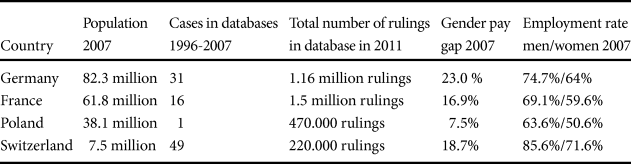
In order to assess levels of litigation on equal pay across the four countries, the research used data gathered from national judicial databases searched in 2008. The information was then correlated to basic demographic data such as population, gender pay gap, and employment rate, and factors that account for the marked differences were identified. In this section, patterns of litigation in the countries under study are discussed using relevant court rulings as well as interviews with experts and lawyers.
The number of registered cases in the national databases differs greatly, leading to an initial question of whether such differences really do reflect accurately the different levels of litigation in practice. Databases are designed as an information service and tool for lawyers and judges, i.e., they refer to rulings that are important, exemplary, or interesting. Larger countries tend to have a greater number of rulings in the databases, but the different size of the databases cannot in itself explain the differences. Experts estimate that between 5 and 10 percent of all rulings enter the German database. Footnote 49 A comparison of the commercial Swisslex with two databases that record almost every court case according to the Gender Equality Act shows that about half of all cases were registered with Swisslex. Footnote 50
Estimated levels of equal pay litigation do not appear to correspond to the gender pay gap, as can be seen in Table 1. However, they do seem to reflect the respective female employment rates across the four countries. Based on the information obtained from national case law databases, one may cautiously conclude that, relative to the population, litigation for equal pay is highest in Switzerland and lowest in Poland, whereas France and Germany have intermediate levels. High litigation in Switzerland and a low level in Poland would be in line with the LOS presented above, yet the possibly medium level in France and Germany is surprising.
Reported court cases for equal pay and context data

Population and employment rates: Eurostat. Judicial databases: juris.de for Germany, lexbase.fr for France, lex.pl for Poland and swisslex.ch for Switzerland.
Features of national litigation
Looking at the variety of actual cases, several features can be observed. Bringing a case in Germany was not popular and did not result in a substantial mobilization, although important successes for equal pay were achieved. The cases here were mainly supported or initiated by trade unions. They dealt often with complicated issues, namely, whether certain benefits, such as early-retirement schemes or additional payments, constitute indirect discrimination. These cases were not well suited for political mobilization, which flourishes on unambiguous issues and demands. Yet in the late 1980s, a trade union lawyer saw the strategic importance of a problem with the company pension scheme of Deutsche Post and Telekom and took legal action. The case took five women through all stages of appeal. They sued for indirect discrimination, because the Deutsche Post had arbitrarily excluded part-time workers working less than 50 percent from the company pension scheme. The Federal Labor Court decided in favor of the women in 1995, but the employers succeeded in having a preliminary reference made to the Court of Justice of the EU on the question of the retroactive effect. They lost their case and had to pay entitlements dating back to 1976, which amounted to about 150 million euros. Footnote 51 This case concerned one of the highest sums of back pay in Germany. Many interviewees explained the low number of cases as a result of general obstacles to litigation, such as finding the right cases and the lack of class action. Many of them quite resolutely demanded the introduction of a proper form of group action as an urgent amendment to the anti-discrimination law. Footnote 52
According to the analysis of legal opportunity structures, one would have expected more litigation in France. The country does, however, present an example of how a judicial ruling may become almost a precedent and then encounter problematic interpretations. The decision in the Ponsolle case in late 1996 became a crucial ruling on equal pay. The court declared, “L’employeur est tenu d’assurer l’égalité de rémunération entre tous les salariés de l’un ou l’autre sexe, pour autant que les salariés en cause sont placé dans une situation identique.” Footnote 53
In cases that followed, an unexpected focus was placed on the definition of “identical situations,” which proved to be highly problematic for later cases. Although not considered a binding precedent, the court ruling developed into a persuasive authority. Several equal pay cases that followed were dismissed because claimants and their better-paid colleagues were found not to be in an “identical situation” or did not perform the same duties. Footnote 54 Consequently, equal pay for work of equal value is rarely justiciable in France today.
As one could guess from the LOS in Poland, this country had the lowest level of legal mobilization, namely one case of direct pay discrimination registered in the database of lex.pl. In this case, the Supreme Court decided that employers must treat old and new employees equally. The employer is entitled to wage differentiation for the amount and quality of work. In the case, a municipality had paid newly recruited employees higher wages, justifying this through a good deal of additional training. Since these trainings had nothing to do with the tasks performed, the court saw no justification for higher wages. Footnote 55 Despite the fact that only one equal pay case is registered in the database, legal mobilization for women’s rights is well known in Poland, for example in discrimination cases concerning retirement age and forced retirement for women. There has been substantial legal mobilization concerning employment rights in supermarkets. These cases have been supported by women’s NGOs, grassroots organizations, and the Strategic Litigation Programme of the Helsinki Foundation. Footnote 56 This means, however, that equal pay is just one of several issues that could be fought for in the context of women’s rights in the workplace.
As hypothesized, legal mobilization was at its highest in Switzerland. Most cases and most group action under the Gender Equality Act have been about equal pay. Group action concerned discrimination in typical female professions in public administration, such as nursing, and kindergarten and primary school teaching. Often as a consequence of court decisions, the pay scale classification had to be substantially adapted. The very first, case in 1987, was initiated by feminist kindergarten teachers in Basel on the grounds of the constitutional provision on equal pay for work of equal value, now Article 8, 3, and the final decision was handed down in 1999. An exemplary group action is the case of health workers in Zurich that was carefully prepared by trade unions and health worker organizations and was filed on the day the Equality Law came into force, July 1, 1996. The workers claimed that nurses, their vocational teachers, as well as physical and occupational therapists, had been classified in a discriminatory manner in the new pay scale that came into force in 1991. The nurses compared their profession with that of the higher-classified police officers. In 1998, the court ordered for all four cases a job evaluation expertise. In 2001, the employees won a partial victory in their case: nurses were upgraded one or two pay classes (which amounted to 500 to 1,000 Swiss francs more in monthly salary). The resulting additional costs amounted to 70 million Swiss francs annually and back pay of about 280 million Swiss francs. This case was built upon a high degree of regional legal mobilization for the improvement of working conditions in the health sector in general, including many demonstrations and protests, especially in 1999 and 2000. Footnote 57 Trade unions supported many other similar group actions in public administration. It is striking that different strategies, e.g., protest and litigation, dovetailed. Litigation thus seems to be embedded in trade union work.
Discussion of findings
Are legal opportunity structures useful in understanding and explain different levels of legal mobilization? The presented facts suggest that LOS have some explanatory power. Where state legal aid is insufficient, as in Poland, fewer cases are taken to court, and/or this only occurs with the support of NGOs. Associational standing, as in Switzerland, makes it feasible and reasonable to attack structural discrimination in pay schemes via group action. The Swiss evaluation also suggests a high impact of the proper application of procedural rules on success. This points to the relevance of expert knowledge in the courts as a part of legal context. The ever-increasing number of complaints that had been placed at the French HALDE demonstrates social awareness of the discrimination issue. At the same time, the neglect of the concept of indirect discrimination in France lowers the prospect of success. It points to the importance of notions of discrimination and equality in society and its representation in rulings and prevailing opinion. If the factors of the legal context and the specifics of particular areas of law, like labor law, are added to the LOS, the different levels of legal mobilization become more comprehensible. So any understanding of the LOS must take into account three additional factors: (1) the state’s commitment to, and interpretation of, the rule of law, duration of legal proceedings, and situation as regards law enforcement; (2) the degree of expert knowledge by lawyers and courts, and whether this leads to a smooth application of the law; and (3) the specific legal issue in question.
Firstly, strategic litigation only makes sense if basic elements of the rule of law are in place and if potential claimants and organizations have trust in state institutions and the legal system. Levels of trust in the law in the four countries studied here corresponded to the different levels of litigation. According to the European Social Survey, people trust state institutions like government, police, and the legal system most in Switzerland and least in Poland (consistent ranking Switzerland > Germany > France > Poland). On a scale from 1 to 10, trust in the legal system in 2002 was 6.2 in Switzerland, 5.7 in Germany, 4.8 in France, and only 3.7 in Poland. These figures have been almost constant, except that in Poland trust in the law increased to 4.3 in 2010. Footnote 58 When asked about obstacles to legal mobilization, interviewees in Poland especially mentioned the duration of proceedings as a discouraging factor. Since “justice delayed is justice denied,” overlong procedures and heavy backlogs in the courts inhibit legal mobilization and the adoption of litigation as a political strategy. French experts also complained about low levels of law enforcement Footnote 59 in labor law and as a general feature of the judicial system.
This is the situation on equal pay; it is a political issue not a legal issue. And therefore there is something really funny. Every five years there is a new law to say the same thing, when the preceeding law has not been enforced. So we are in this five-year cycle and it is ridiculous. (Interview F4: 30)
The inclination to add more details to existing laws in order to close legal gaps tends to complicate the legal situation and opens the law to contradictions. From this perspective, the boldly written French anti-discrimination provisions actually conceal weak legal opportunity structures in action.
Secondly, the proper application of important procedural rules in anti-discrimination law by judges, such as the reduced burden of proof on victims, was found to be closely connected to the success of claimants in research conducted during the evaluation of the Swiss Gender Equality Law. Footnote 60 This study also identified severe shortcomings and gaps in legal reasoning, particularly in courts of first instance. A high degree of expert knowledge by the judges would also increase trust in their ability to handle a specific case with care and knowledge. Restricting the application of equal pay provisions to absolutely identical situations derives from a very formal understanding of equality in French (legal) culture; Footnote 61 the concept of indirect discrimination is thus difficult to understand. In some equal pay cases, a claim of indirect gender discrimination could have been made, but litigants did not pursue this route. Footnote 62 The first French ruling about indirect gender discrimination in retirement schemes was issued in 2010. Footnote 63 Lawyers complained about the lack of awareness of the nature of gender discrimination in French society in general, but especially on the part of judges and the media. Footnote 64 The result is that indirect discrimination is rarely acknowledged by judges in France.
Thirdly, issue specific law—in this case, labor law—shapes opportunities for legal mobilization in a given area. The issue-specific law of a country may define possible pathways to achieve a particular political goal or compensation for individuals other than through litigation. Thus the issue-specific law needs to be taken into account in determining the LOS. Relevant provisions include the protection against unfair dismissal or provisions on industrial relations and collective bargaining. One such example is the Swiss protection against wrongful dismissal, which is weak. Footnote 65 There is no right to continued employment; instead, compensation payments are limited to six monthly salaries (Code of obligations, Art. 336a). The GEA reserves claims for damages for financial loss and suffering (Art. 5, 5). If there is nothing to lose, filing a claim might be more likely here than in the other countries, where the protection is quite high and lawyers might be able to demand return of an applicant to work or a high compensation payment.
As far as industrial relations are concerned, trade unions have the strongest position, legally and practically, in Germany. Collective negotiations and agreements and the right to form trade unions are constitutionally protected under Article 9, 3 of the Basic Law. Collective agreements apply directly and are obligatory between the contracting parties (§4, 1 Tarifvertragsgesetz). They are widespread, comprehensive, and rather specific on pay classification. As part of the “tariff autonomy,” which includes the right to free collective bargaining, this position is highly valued, and unionists are very reluctant to attack a discriminatory agreement in court. Footnote 66 Strong trade unions can pursue alternative strategies to litigation to achieve their goals. Since the mid-1990s, German public employees’ trade unions have tried to renegotiate and to “mainstream” gender considerations into collective agreements that respect the principle of equal pay for work of equal value. Footnote 67 This is an intriguing approach, but both unions and employers’ associations seem to be systematically overburdened with the task of implementing equal pay. Employers want to keep labor costs down and unions also represent the interest of workers in male-dominated jobs, which may be threatened by relative pay cuts due to the re-valuation of feminized jobs.
Collective bargaining is also part of Swiss industrial relations, yet collective agreements are not very specific on pay classification schemes. Change by litigation and with the help of job evaluation questionnaires seems to be a more promising avenue. Union pluralism in Poland is high and unionization is low, especially in the private and the service economy. Footnote 68 Collective agreements are rare, as many employers are not members of their respective associations. So, little is to be expected from negotiations, all the more so since gender equality is not high on the unions’ agenda. Footnote 69 France also has high union pluralism, with five representative federations, yet lower unionization than Germany. Mandatory negotiations on gender equality in business make outcomes more contingent on individual personalities and an awareness of gender equality issues than in more centralized systems. Thus, the integration of issue-specific law would let us better understand the legal context that influences the ability and willingness of social actors to take legal action as opposed to adopting an alternative political strategy in pursuit of equal pay in the different countries.
Differences in areas of substantive law and in industrial relations can also help to explain why unions use different strategies for workers’ rights in the different countries. One could also hypothesize that the salience of equal pay differs in the various states and that gender equality in the workplace may be negotiated alongside other aspects of workers’ rights.
Conclusion
While every component of LOS influences legal mobilization, legal factors and legal context alone are not sufficient to explain the observed variations. Rather, they are an important general framework, where other social and political context factors develop significance. Most importantly, the components of LOS do not explain how norms and values about gender roles, equality and equal pay, as well as litigation develop in a given society, and how they influence the probability to go to court. In this field of norms and values, two issues seem to be especially relevant and emerge as a rewarding field of analysis—namely, the role of media coverage and organizational action frames.
Mass media is the major, generally accepted site of political contest. It does not only indicate broader cultural changes, but also influences them. Footnote 70 Politicians take into account the possible effects of “published opinion” on public opinion when making political decisions. Footnote 71 Since in modern democracies people experience politics almost exclusively via the media, a non-published event is a non-event. Therefore, it is crucial for political actors to catch media attention when seeking support for their issues. Mass media coverage will essentially contribute to problem diagnosis and prognosis of equal pay. It will thus influence the expectations of organizations and possible claimants as to whether legal mobilization is worthwhile, and whether the public perceives the strategy of litigation as a legitimate and effective form of action. Footnote 72 An analysis of two high-quality newspapers per country, Footnote 73 which was conducted in the context of the present study, revealed that the chances to advertise legal mobilization through mass media seem limited, as it is very difficult for social movement actors to get their arguments heard or their cases published.
Furthermore, movement identity and collective action frames are crucial as to whether organizations employ a litigation strategy or not, as Lisa Vanhala convincingly argues. Footnote 74 Movement identity and suitable action frames make legal mobilization more likely, and it is possible that they can even overcome weak legal opportunity structures. Interview data suggest that this is also true for the issue of equal pay litigation: Only if equal pay emerges as an important issue in trade unions, political action, and campaigns does litigation become feasible. It would thus be important to have a closer look at agenda-setting processes for gender equality within trade unions, in order to closely investigate organizational processes of what has been memorably defined as “naming-blaming-claiming,” Footnote 75 including the significance of networks, core groups of claimants or lawyers, and the role of gender stereotypes and concepts of gender discrimination. Finally, one should examine how a litigation strategy dovetails with other strategies, like legal literacy, collective bargaining, or awareness raising. Footnote 76 The organizational perspective seems essential in explaining legal mobilization.
Compared to common law countries, civil law systems seem to give more opportunities for agenda setting of a political problem via legislative procedures than via court cases. However, it has been shown in this research that activist lawyers have successfully attacked insufficient anti-discrimination provisions in written law, as with the issue of compensation in Germany. In countries with a strong constitutional court, complaints of unconstitutionality (Verfassungsklage) and voidance petitions (Normenkontrollklage) are used to preclude the enforcement of laws even once they have been adopted. Footnote 77 This suggests that the significance of strategic litigation in civil law systems as additional channels of political influence might have been underestimated to date, by researchers and social movements alike.