Introduction
Current practice amongst ENT surgeons in nasal airway assessment in the UK is unknown, and a UK study of nasal airway assessment practice has not been performed. Nasal obstruction is a highly prevalent complaint in clinical and ENT practice,Reference Jessen and Malm 1 leading to approximately $5 billion per year in treatment costs in the USA.Reference Chandra, Patadia and Raviv 2 The causes and sites of obstruction are numerous; accurate diagnosis is therefore essential for effective management. There is a patient dissatisfaction rate of 30 per cent following surgery for nasal obstruction, and hence a growing need to improve our assessment of nasal patency.Reference Lund 3
Murrell performed a survey of USA practice in functional nasal airway assessment in 2013, and concluded that clinical history and nasal examination with anterior rhinoscopy were the two most universal parts of a nasal blockage functional assessment.Reference Murrell 4 However, these measures prove challenging when used to assess outcome because of their subjective interpretation. Hence, Murrell additionally recommended: using a symptom-specific questionnaire in the form of the validated Nasal Obstruction and Symptom Evaluation scale; employing nasal endoscopy, to exclude a posterior obstruction (reported to be present in 28 per cent of cases); observing the clinical response to nasal decongestants, to indicate reversible inflammatory obstruction; and observing the response to Breathe Right® strips, to exclude structural nasal valve obstruction.Reference Murrell 4
Our survey aimed to determine current practice in nasal patency assessment in the UK, and to assess areas for development and determine areas of further need.
Materials and methods
Participants completed a written questionnaire, containing five domains. First, respondents were queried regarding basic information: the respondent's occupation and grade, years of experience, and the number of nasal procedures recommended per week. Second, respondents were asked about the subjective and objective methods currently utilised to carry out each of the following four tasks: diagnosing nasal obstruction, selecting patients for nasal surgery, evaluating results of nasal surgery and patient education. Third, respondents who used at least one objective method in the second domain were asked what they felt were the most important characteristics of these methods, and if and how they could be improved. Fourth, the respondents who did not report using any objective methods were asked why not. Finally, the respondents were asked for the desirable attributes of a hypothetical new nasal blockage assessment device.
The setting for dissemination of the questionnaire was the British Academic Conference in Otolaryngology 2015. Questionnaires were distributed amongst 2 of the British Academic Conference in Otolaryngology rhinology symposia, where the lead author was presenting, with a delegate population of 250. The questionnaires were left on the seats prior to the talks; the participants were then invited to complete them. Although an international response was recorded, only UK respondents were included in the study.
Results
Seventy-eight UK-based rhinologists were surveyed at the 2015 British Academic Conference in Otolaryngology, from a cohort of 250 delegates attending 2 symposia on rhinology, with a response rate of 31 per cent.
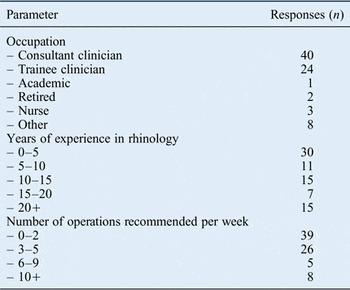
Of the 78 respondents, there were 40 consultant clinicians (51 per cent) and 24 trainees (31 per cent). Fifty-three per cent (n = 41) reported having up to 10 years of experience in rhinology and 47 per cent (n = 37) reported having more than 10 years. Fifty per cent (n = 39) recommended up to two patients per week for nasal airway corrective surgery, and 33 per cent (n = 26) recommended between three and five patients. Table I summarises this basic information.
Survey respondents’ basic information

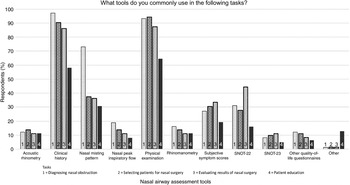
Almost all respondents reported using clinical history (97 per cent) and physical examination (93 per cent) to diagnose nasal blockage. Seventy-three per cent also used the nasal misting pattern on a metal spatula. The most commonly used objective measurement device was the peak nasal inspiratory flow (PNIF) meter, utilised by 19 per cent of the respondents. The most commonly used subjective measurement questionnaire was the Sino-Nasal Outcome Test 22 or 23 (SNOT-22 or SNOT-23), with a 29 per cent uptake rate (Figure 1).
Tools used by respondents in nasal airway assessment. SNOT = Sino-Nasal Outcome Test

When asked what measures were used to aid decisions regarding whether or not to operate and to assess the post-operative outcome, we found that very similar answers were given, apart from the use of the nasal misting pattern, which decreased to 37 per cent. Sixty-two respondents commented on how they engaged in patient education: the most commonly used methods were physical examination (65 per cent), followed by patient history (58 per cent), and 30 per cent used the nasal misting pattern.
When asked to rate the most important characteristics of an ideal objective assessment tool, accuracy scored the highest, with 19.5 per cent on the points-based system used, followed by ease of operation (16.6 per cent of points). Portability was the least important characteristic (3.2 per cent), with the remaining options assigned a similar low level of importance by the respondents.
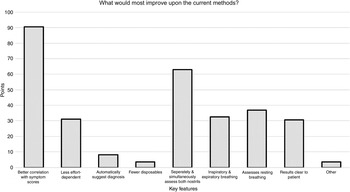
Using a Likert scale, 38 of 42 respondents (90 per cent) either agreed or strongly agreed that the existing objective methods for quantifying nasal patency could be improved. The attribute that could be most improved was ‘correlation with symptom scores’, with a 30 per cent score on the points system used. The capability to ‘separately and simultaneously assess both nostrils’ was ranked second, with 21 per cent of the points (Figure 2).
Key features of an ideal objective measure of nasal blockage.

Sixty participants provided reasons for not utilising objective methods of nasal patency assessment. The most common reason was that these methods were not available to the clinician (63 per cent). Other common responses included the perception that objective measurement was too time-consuming (23 per cent), and that these measurements correlated poorly with subjective symptom scores (22 per cent). Forty-nine out of 59 respondents stated that they would use an objective measure if current issues were addressed, while 10 respondents would not. With respect to a hypothetical new nasal blockage analyser, a clear consensus on how best to present the data to patients was not demonstrated.
Discussion
Our data, obtained from a range of clinicians engaged in rhinological practice, provide a new insight into the under-utilisation of objective measurements during the assessment of nasal airway patency in the UK.
Nearly all respondents use clinical history and physical examination to: diagnose nasal blockage, make decisions on whether to operate and further evaluate post-operative results. Relatively few respondents use subjective measures, with the SNOT-22 or SNOT-23 quality-of-life questionnaire being the most commonly used. The main use of such measures amongst respondents was in the evaluation of surgical outcomes (44 per cent). The majority of respondents found the nasal misting pattern helpful in the diagnosis of nasal blockage, although only 37 per cent used it as part of the assessment for surgery.
Objective assessments were rarely used by the respondents in the diagnosis of nasal blockage, with only 19 per cent using PNIF rate, which was the most commonly used objective measure. The main reason cited was lack of availability. The large majority of respondents felt that existing objective nasal patency assessment tools could be improved. The ability to assess both nostrils independently, with measurement of non-forced resting breathing, and improved correlation with symptom scores, were prioritised by respondents as desirable features of a potential novel nasal patency assessment tool.
Murrell carried out a similar survey at the 2011 Rhinoplasty Society meeting in Boston, Massachusetts, USA.Reference Murrell 4 The results from that survey are broadly in keeping with our data. Almost all of the respondents in that study used anterior rhinoscopy (which in this survey was included as part of the physical examination). Objective methods were also rarely used. Four respondents (out of a total of 49) used rhinomanometry for pre-operative assessment, which was the most frequently used objective measure. Clinical history and misting patterns were not mentioned in Murrell's study, although in the case of the former, this was likely because of the reasonable assumption that it would be used universally. The main difference between the two studies was the low reported use of patient-reported outcome measures in the UK study, compared to just under two-thirds of the US respondents who did use them.
The interpretation of the results is potentially limited by the sample size and heterogeneity in terms of the level of expertise amongst the respondents. There could have been a selection bias given that the trainees attending could be working with the consultants attending, and may thus have similar views. The nature of sampling (voluntary questionnaire) may have introduced a degree of selection bias; however, the response rate of 74 out of 250 was reasonable. Nevertheless, demographic information revealed a representative cohort, with similar proportions of senior and less senior respondents. Not all questions were answered by all respondents, possibly because of the length of the questionnaire. The use of a multiple choice model for surveying opinion, rather than free text, allowed for effective and simplified data interpretation, but may have potentially added a leading element to some of the questions.
This study provides a broad overview of the current methods used by UK clinicians for nasal obstruction assessment. It allows other specialists to compare their practice to those of a representative cohort. At present, UK clinicians base their decision-making in rhinology chiefly on clinical history and examination, with very limited use of subjective and objective measures of nasal patency.
There are a number of objective methods capable of quantifying nasal obstruction, which are most often utilised in clinical research and occasionally employed in clinical practice. These include acoustic rhinometry, rhinomanometry and PNIF.Reference Hellings, Scadding, Alobid, Bachert, Fokkens and Gerth van Wijk 5
Acoustic rhinometry is user-dependent and subject to inter-user variability. It can localise the area of nasal obstruction through measurement of a cross-sectional area at multiple points within the nasal cavity. It is also used to assess mucosal reversibility via pre- and post-decongestant assessment. However, it does not offer a dynamic measurement of nasal airflow and hence does not directly assess function.Reference Hilberg 6 , Reference Clement, Halewyck, Gordts and Michel 7 Similarly, cross-sectional imaging provides excellent anatomical definition of the nose; however, it cannot provide functional information.Reference Mamikoglu, Houser, Akbar, Ng and Corey 8 , Reference Corey, Gungor, Nelson, Fredberg and Lai 9
Rhinomanometry enables a dynamic assessment of nasal patency, and can be used for unilateral assessment. It is considered the ‘gold standard’ in objective nasal assessment; however, it is relatively expensive, user-dependent and time-consuming.Reference Chaves, de Andrade and Ibiapina 10
Peak nasal inspiratory flow rate is increasingly used in clinical practice and is a validated method of assessing nasal patency. However, it is dependent on lung function; therefore, readings may be falsely low in patients with pulmonary disease. In addition, the technique is effort-dependent, and therefore subject to inter-observer variability and potential user bias. It assesses forced inspiratory nasal breathing only, which introduces non-physiological cartilaginous collapse through the Bernoulli effect. This decreases the applicability of the result to resting nasal patency, and may explain its limited correlation with subjective symptom scores.Reference Andrews, Chowdhury, Takhar, Poirrier, Jacques and Randhawa 11 The technique is also unable to delineate the level of obstruction.Reference Nathan, Eccles, Howarth, Steinsvåg and Togias 12
Validated patient-reported outcome measures are frequently used to assess nasal disease severity and to determine treatment effect. The Nasal Obstruction and Symptom EvaluationReference Stewart, Witsell, Smith, Weaver, Yueh and Hannley 13 and the SNOT-22 or SNOT-23 are commonly used questionnaires. The SNOT-22 and SNOT-23 scores have been validated independently in patients undergoing septorhinoplastyReference Takhar, Stephens, Randhawa, Poirrier and Andrews 14 , Reference Poirrier, Ahluwalia, Goodson, Ellis, Bentley and Andrews 15 and endoscopic sinus surgery.Reference Hopkins, Gillett, Slack, Lund and Browne 16
This study confirms the desire amongst clinicians for a novel device capable of providing an objective, dynamic assessment of nasal airflow that correlates well with the patient's subjective experience of blockage, and which allows the patient and clinician to visualise and understand their pathology during resting nasal breathing. Direct real-time comparison of left- versus right-sided airflow would be valuable in planning surgery for septoplasty or functional septorhinoplasty, and for assessing post-operative outcomes in clinical practice and research. Equally, there is a growing need to improve patient education, and a need to reassure a subgroup of patients who may have the subjective experience of nasal blockage but who in reality have patent nasal airways. These data provide a knowledge base to guide the design of such a device, particularly regarding clinicians’ preference for a simple test administration, best demonstrated by the popularity of nasal misting pattern testing.
We are conducting a further study to investigate the end-user experience of patients regarding nasal blockage measurement, with the aim of finding the best way to convey the findings to patients.
In the current absence of a widely adopted objective measure of nasal airflow, we recommend use of PNIF, and the validated Nasal Obstruction and Symptom Evaluation scale and SNOT-22 or SNOT-23 patient-reported outcome measures, to aid patient assessment and monitor treatment outcomes.
-
• Nasal patency can be assessed by subjective and objective means; use of the latter is not yet widespread in routine clinical practice
-
• This survey demonstrates that most UK clinicians use no objective methods in assessing nasal patency
-
• Peak nasal inspiratory flow was the most widespread objective measure, utilised by 19 per cent of respondents
-
• UK clinicians would be more likely to use an objective assessment tool if the limitations of current methods were addressed
-
• These limitations include: correlation with patient experience, resting breathing measurement, and simultaneous and separate assessment of both nostrils