Correct and successful medical treatment is reported to require diagnostic imaging in at least one-fourth of patients worldwide (Reference Ostensen and Volodin14). Diagnostic imaging enables physicians to diagnose diseases at earlier stages, so that more invasive diagnostic procedures could be avoided (17). The upward trend in diagnostic imaging costs over the past 2 decades indicates the utilization of imaging technology has increased all over the world. The scientific and technological developments in diagnostic imaging systems during the past 20 years have contributed to a considerable increase in utilization of these systems. The increase in the availability is also associated with higher use. Another factor behind increased use is patient demand for imaging scans to relieve anxieties about their health (17).
A review of the literature indicates that in many countries the utilization of magnetic resonance imaging (MRI) has been increasing more rapidly than other diagnostic imaging procedures (Reference Henley, Mann and Holt7;Reference Khorasani, Goel and Ma'luf9;Reference Semin, Demiral and Dicle19). It has also been suggested that MRI has substituted previous imaging techniques (Reference Khorasani, Goel and Ma'luf9). Overuse of diagnostic imaging has also been demonstrated by National Imaging Associates in the United States, 30–40 percent of diagnostic imaging examinations were used inappropriately or could not help to make a diagnosis or treatment decision (17). Inappropriate medical imaging is a serious quality of care issue as well as an economic issue. Utilization of advanced and expensive technologies requires considerable financial resources, expert personnel, and capital consuming equipment. In low- and middle-income countries these resources are limited so that their allocation to one part of health care necessitates depriving other parts.
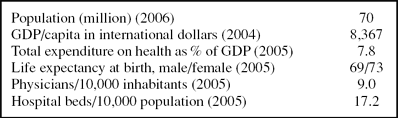
Demographic, economic, and health worker indicators for Iran.

a World Health Organization. Accessed June 2008. www.who.int.
b World Health Organization. Accessed June 2008. www.emro.who.int. GDP, gross domestic products.
The Islamic Republic of Iran is a middle-income country located in the Middle East region. Demographic, economic, and health worker indicators for Iran are presented in Box 1.
Health care in Iran is provided by the public sector (43.5 percent), private sector (56.5 percent), and health insurance organizations (Reference Azizi, Gouya and Vazirian2;23). The Ministry of Health (MOH) finances primary health care, whereas secondary and tertiary health care are financed through insurance schemes.
Access to health care at secondary and tertiary level is selective, guided by patients' willingness and their ability to pay. As there is no patient referral system people can go directly to general physicians, office-based or hospital-based specialists and subspecialists, when sick or injured. In such system, a gatekeeper—one who should direct the patient to a proper level of care—is actually unknown.
Iran launched its first MRI machine in 1991. Since then, this technology has had a rapid diffusion in the country. The number of MRI per one million inhabitants had a 20-fold increase in the period 1993 to 2003, a unique growth by international comparison (Reference Palesh, Fredrikson, Jamshidi, Jonsson and Tomson15). At the time of the study, there were twenty-six provinces with one to twelve magnetic resonance imaging (MRI) units which were providing services to the Social Security Organization (SSO) beneficiaries.
Analysis of and understanding the utilization patterns of high-tech imaging systems is important for planning health systems especially in middle- and low-income countries.
To our knowledge, almost all published studies have been focused on utilization trends and/or utilization rates of MRI over time and little has been published about utilization patterns of MRI. So, this study identifies and describes the utilization pattern of magnetic resonance imaging in Iran.
Methods
There are four main health insurance organizations in Iran. Our attempts at collecting data from the largest one (with more than 37 million beneficiaries in 2004) were not successful because its administrative part was not able to manage the collection of data required. The second largest health insurance organization is the Social Security Organization (SSO) which is involved in the social security protection program in the Country and was established in 1930. The SSO covers employees and their dependents. At the time of the study it covered over 27 million Iranian citizens. The SSO covers blue-collar workers, self-employed persons, voluntary insured persons, truck and bus drivers, clergymen, and all employees in the art and film industries (Reference Soleymani Amiri and Zargari20). The SSO provides a full range of healthcare services including diagnostic, therapeutic (all kinds of surgeries and all types of medications) and rehabilitative services for beneficiaries through two national networks: (i) Direct Health Network, which includes hospitals and healthcare centers that belong to the SSO. Here, for those insured all services are provided free of charge. (ii) Indirect Health Network, which is based on purchasing services for beneficiaries through contracts with public and private health facilities. For inpatient services 90 percent of expenses are paid by the SSO, for outpatient services 70 percent. The insured should pay the rest of expenses. The Direct and Indirect Health Networks cover the entire country including rural areas. Hence, all of the insured populations in urban and remote areas should have access to all medical services (Reference Soleymani Amiri and Zargari20). As a rule, only specialists are allowed to order MRI examination for patients. Currently, there are approximately 22 specialties in different fields of surgery and internal medicine. All of them except radiologists are allowed to refer patients for MRI examination.
The SSO headquarters, which has provincial administrative offices in all thirty provinces throughout the Country, is located in Tehran (the capital of Iran). MRI units which provide services to SSO beneficiaries collect all referrals and copies of MRI reports during each month and send them to the provincial office of SSO at the end of the month as claims for expenses.
Data Collection
The study population is referrals and MRI reports available from the provincial offices of SSO. A referral could be defined as a written recommendation by a physician for a patient to receive care from a different physician, provider or facility. An MRI report is an interpretation of an examination by a radiologist. Each referral contains some information about the patient (e.g., name, sex, age), some information about the physician (e.g., name, specialty, ID number), and some information about the examination performed (e.g., name of organ imaged, with or without contrast, cost of imaging; paid both by the patient as out of pocket payment and by the SSO).
Data were collected from a sample of referrals and MRI reports available in the twenty-six SSO provincial offices throughout the Country (four provinces did not have any MRI machine under contract to the SSO). These referrals, in total 21,362, pertained to patients who had undergone an MRI examination during 1 month (Aban in Iranian calendar which coincided with October 13th to November 12th, 2005). In the SSO, there was not any digital database for obtaining information about patients and their MRI examination. Thus, the data had to be gathered based on a manual search of 42,724 (21,362 × 2) referrals and MRI reports by twenty-six experts in the all SSO offices across the Country. Therefore, because of practical limitations for data collection, the focus was on 1 month only, to limit the task to realistic proportions. The list of patients was used as the sampling frame. After adjustment for finite population the sample size required was found to be 2,070 patients to obtain a 95 percent confidence interval of size ± 0.02 assuming a proportion of 0.50. The size of the sample drawn randomly from each province was then chosen to be in direct proportion to the total number of MRI examinations performed for SSO beneficiaries in that province. The study period was not in winter and was selected in a period without holidays to avoid oversampling of seasonal and road injuries.
Definition of terminologies: Normal = No abnormality detected by MRI; Pathologic, related = MR imaging detected abnormality related to the primary diagnosis and/or chief complaint; Pathologic, unrelated = MR imaging detected abnormality not related to the primary diagnosis and/or chief complaint; Pathologic, unknown relevance = MR imaging detected abnormality but its relevance was unknown because of lack of primary diagnosis and chief complaint in the referral.
Data Analysis
The statistical analysis was performed using Excel for Windows and STATA version 9. We assumed that the number of referrals could be an indicator of utilization level of MRI. To explain the variations in utilization across provinces we estimated the linear correlation between the number of referrals per 100,000 population covered by SSO (province-level utilization) and the number of MRI per 100,000 population.
The percentage of different medical specialist groups ordering MRI examination was calculated and compared to determine the most common users of MRI technology. The percentage of imaging of each part of the body across patients was calculated and compared to identify the most common anatomical locations for which MR imaging was used.
Ethical Approval
The study was approved by the Iranian National Ethical Committee of the Undersecretary for Research and Technology of the Ministry of Health (document number P/391- Aug 2, 2005).
Results
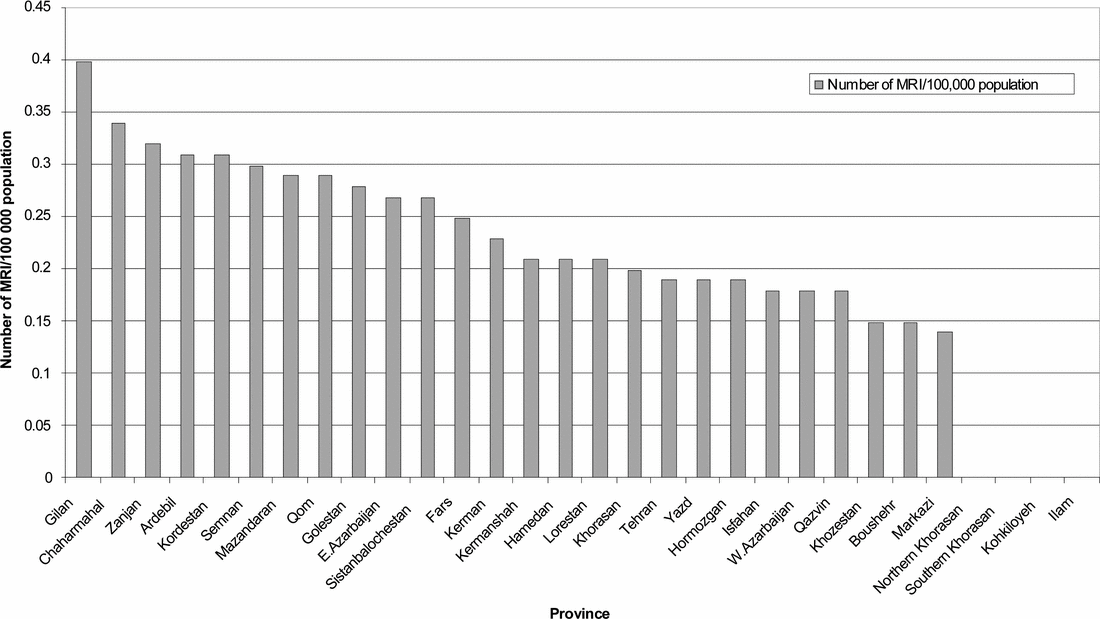
MRI availability per 100,000 SSO beneficiaries by province in 2005 is illustrated in Figure 1. Isfahan city (capital of Isfahan province) failed to send data required. Tehran city (capital of Tehran province) was not able to collect data regarding MRI machines sited in hospitals. Two provinces (Kermanshah and Khozestan) only sent referrals and not MRI reports. Ultimately, in our data set we had 1,656 referrals to MRI facilities and 1,547 MRI reports. Referrals consisted of 855 male patients and 801 female patients, in total 1,656 individuals. Mean and median of patients' age were 40.6 years (SD 16.1) and 39.0 years, respectively. Referrals had been ordered by 825 male physicians and 67 female physicians. The sex of seven physicians was not indicated.
Number of MRI/100 000 SSO beneficiaries by province in Iran, 2005.

No clear association was found between the number of referrals per 100,000 population and the number of MRI machines per 100,000 population (r = 0.30; p = .13).
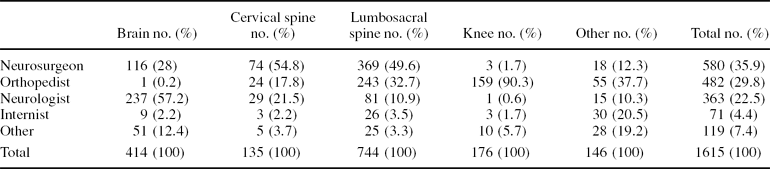
Considering almost 27.3 million of the population covered by the SSO in the Country and 21,362 MRI examinations performed during 1 month, the MR imaging test use rate was 78.4 per 100,000 population. Four groups of specialists including neurosurgeons, orthopedists, neurologists, and internists were the most common users of MRI technology, respectively. For forty-one referrals, the specialty of the physician was not indicated. The brain, spinal column, and knee were the most common parts of the body scanned by MRI. Table 1 shows how most users of MRI applied this technology for diagnosing diseases.
Most Commonly Requested MRI Examinations by Referring Specialty

As shown in Table 1, lumbosacral spine scans were ordered mostly by neurosurgeons and orthopedists. Scans from the cervical spine were, however, ordered mainly by neurosurgeons and neurologists. More than 85 percent of the brain scans were ordered by neurologists and neurosurgeons.
Referring physicians are supposed to write chief complaint (CC) and primary diagnosis (PD) in referrals when requesting an MRI examination. We found that they did not completely follow this rule in practice. Available CC and PD in referrals for brain, spinal column and knee were as follows:
Of 423 referrals for brain MRI, physicians cited chief complaint and primary diagnosis in 131 (30.9 percent) and 96 (22.6 percent) referrals, respectively. The most common CCs were headache (44/131 [33.5 percent] cases) and seizure (17/131 [13 percent] cases), while common primary diagnoses were multiple sclerosis (19/96 [19.8 percent] cases), and epilepsy (10/96 [10.4 percent] cases). According to 395 available MRI reports of brain imaging, 105 (26.6 percent) scans were pathologic, and 173 (43.8 percent) scans were normal. In eighty-two (20.8 percent) scans there was a pathologic finding related to CC or primary diagnosis, and in thirty-five (8.9 percent) scans there was an incidental pathologic finding.
Of 920 referrals for spinal column examination, 296 (32.2 percent) had chief complaint as a reason for imaging. Low back pain was the most common CC followed by neck pain. Primary diagnosis was cited in 253 (27.5 percent) referrals for spinal column imaging. Discopathy in 130 (14.1 percent) cases, radiculopathy in 63 (6.8 percent) cases, and spinal stenosis in 26 (2.8 percent) cases were the most prevalent diagnoses before imaging. MRI reports were available for 239/253 (94.5 percent) referrals with primary diagnosis. No abnormality was detected in 30 (12.5 percent) scans. MR imaging detected pathology in relation with primary diagnosis in 198 (82.8 percent) scans and an incidental abnormality was found in 7 (2.9 percent) scans.
Of 182 referrals for knee imaging, there was primary diagnosis in 87 (47.8 percent) referrals, of which the most common were meniscal and ligamentous injuries. Chief complaint had been cited in twenty-three (12.6 percent) referrals, of which knee trauma and knee pain were the most common ones.
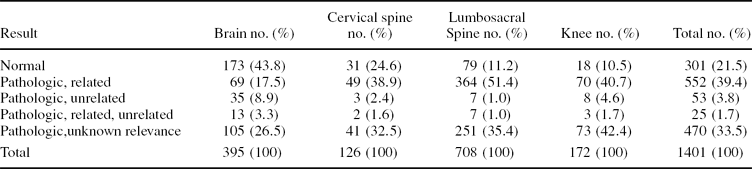
In Table 2, the relevance of MRI findings to CC or PD provided by referring physician is illustrated. We were able to show relevance if CC and/or PD were stated in the referral. Table 2 shows that normal and pathologic findings were mostly seen in the brain and lumbosacral examinations, respectively.
(MRI) Findings in Most Common MRI Examinations

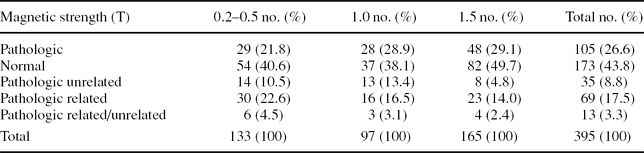
In provinces with more than one MRI machine and different magnetic strengths, we calculated the number of scans in terms of the magnetic strengths of the machines to estimate the tendency of physicians to use MRI machines with higher magnetic fields. Less than 30 percent of MRI machines had a magnetic field of 1.5 Tesla (T) but 44 percent of the scans had been performed using them.
Table 3 shows that brain scans were mostly performed by 1.5 T MRI machines (41.7 percent) followed by scans with magnetic strengths of 0.2–0.5 T (33.6 percent).
Number of Brain Imaging Findings Using Different Magnetic Strengths

A lower number of pathology was detected in the brain scans performed at a magnetic strength of 1.5 T compared with that of 0.2–0.5 T.
Findings on brain MR imaging requested by specialists that had ordered more than ten brain scans indicate that the percentage of scans revealing abnormalities was higher when ordered by neurologists or neurosurgeons.
Discussion
Our findings demonstrated that four groups of specialists commonly used MRI in their practice. Among them, neurosurgeons, orthopedists and neurologists contributed more than 88 percent of MRI utilization. Because very few studies have analyzed the pattern of MRI utilization, it is difficult to compare and interpret our findings from a wider perspective. In a study from Asian countries (Reference Hutubessy, Hanvoravongchai and Edejer8), neurologists and orthopedists together constituted 55.5 percent (Republic of Korea) and 71 percent (Thailand) of the referring physicians for MRI examinations. These findings indicate that any plan for modifying or improving MRI use should focus mainly on these specialists.
MRI examinations, in our study, had been ordered by 825 male and 67 female physicians. One reason for this large difference between numbers of physicians in terms of their sex is that the number of female physicians in the three specialties that were main users of MR technology is low all over the Country. Traditionally, female physicians in Iran tend to be specialized in obstetrics and gynecology, pediatrics, or internal medicine. After the Islamic revolution, educational policies turned toward having more female physicians in all medical specialties, resulting in slightly increasing numbers of women in other areas of medicine.
We found that MRI service was used almost evenly by sex of the patients. Equity in health could be interpreted as equal utilization of health care for those in equal need of health care (Reference Oliver and Mossialos13). Because we did not examine patients' need, even utilization, in our study, does not mean equitable use of MRI service by gender. Another study (Reference Palesh, Jonsson and Jamshidi16) demonstrated such an almost even use of health service by gender in Iran.
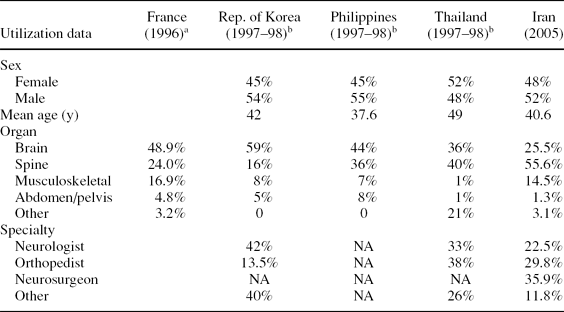
We demonstrated that the most common parts of the body scanned by MRI were the spinal column (55.5 percent), brain (25.5 percent), and knee (11.0 percent), respectively. An overview of international comparison of the utilization pattern of MRI is shown in Table 4. In another study (Reference You, Alter and Iron24), the use rate of MRI per 100,000 population for brain, spine, and extremities was 817, 747, and 674, respectively. The figures regarding spinal column and brain clearly show that MRI examinations were mainly used for diagnosing central nervous system (CNS) diseases or diseases affecting CNS.
Utilization Pattern of MRI in France, Republic of Korea, Philippines, Thailand and Iran

aFrija et al. (Reference Frija, Lhoste and Grisoni4).
bHutubessy et al. (Reference Hutubessy, Hanvoravongchai and Edejer8).
NA, Data not available.
There is a wide difference in MRI availability for SSO beneficiaries throughout the provinces. In Gilan province, MRI availability is 2.8 times higher than that in Markazi province (Fig. 1). With the exception of eight provinces with two to fifteen MRI machines under contract with the SSO, there is only one MRI unit in each of the other eighteen provinces. It is generally believed that the more available the health services the higher the utilization (Reference Malcolm11). We found that the distribution of MRI was not proportional to SSO beneficiaries in different provinces. It should be noted that due to lack of information about indication of MR exams, the extent to which utilization patterns had been appropriate or inappropriate could not be easily ascertained. Furthermore, because the number of MRI units generally is low, the presented measure of availability ‘number of MRI units per 100,000 population’ changes greatly if one new unit is added to a province. This change has a discrete nature which affects the analysis of correlation.
In our study of the use of MRI over 1 month, the use rate was 78.4/100,000 population. Another study (Reference Semin, Demiral and Dicle19) reported twenty-seven MR imaging per 1,000 patients referred to hospital. Levels of utilization of MRI are dependent on factors such as MRI availability and accessibility, distribution and characteristics of physicians in a given region. Hence the appropriate amount of MRI imaging at the population level is still unknown (Reference You, Alter and Iron24).
We found that physicians, tended to refer their patients to MRI units with higher magnetic strength. The advantage of high-field is a higher signal-to-noise ratio (SNR) which leads to higher resolution. However, another study argues that it could also lead to higher susceptibility to artifacts (Reference Abduljalil and Robitaille1). It has also been demonstrated that there is not a direct relationship between increasing the magnetic strength and its SNR, and the ability for better visualization of anatomical conditions of organs imaged (Reference Hart, Bottomley and Edelstain6;Reference Lee, Vellet and Eliasziw10;Reference Schindera, Miller and Ho18;Reference Vellet, Lee and Munk21). In the literature, we found arguments concerning the relationship between field strength and quality of images (Reference Fischbach, Muller and Bruhn3;Reference Wattjes, Lutterbey and Harzheim22;Reference Zivadinov, Stosic and Cox25). There is still no agreement on MRI machines with higher magnet strength will always producing better images than MRI machines of lower magnet strength (Reference Hailey and Marshall5). As Marti-Bonmati and Kormano (Reference Marti-Bonmati and Kormano12) point out “if an optimal field strength for MR imaging exists, then there is still no consensus as to what it is”.
Methodological Consideration
One important limitation of our study which may bias the external validity of our findings was selecting the population covered by a health insurance organization. It might limit the generalizability of the study. The study population might well not be nationally representative, however, the size of the population covered, that is, more than 27 million citizens, and the number of referrals (21,362) from which the sample was drawn may be considered as an appropriate size for a study sample.
Practical limitations for gathering data because the SSO lacking a digital data base drove us to limiting the time period of data collection to 1 month. We have no knowledge of variations in the referral patterns over the year, but the results within the selected limited time frame might not represent the average utilization pattern of a full year.
CONCLUSION
We identified that some specialties, that is, neurosurgeons, orthopedists, neurologists, and internists are the most frequent users of MRI technology in Iran. If one would like to modify MRI use, one should focus on those specialties. International evidence on using MR technology for examining the brain and spine indicates that this technology is mainly used more in diagnosing CNS diseases or diseases affecting CNS than in diagnosing diseases in other parts of the body. We did not find a positive correlation between MRI availability and MRI use in Iran.
POLICY IMPLICATIONS
The Ministry of Health and health insurance organizations could consider guidelines for improving the use of MR technology. Such guidelines should target neurosurgeons, orthopedists, and neurologists as high-priority specialists.
CONTACT INFORMATION
Mohammad Palesh, MD (mohammad.palesh@ki.se), PhD Student, Division of International Health, Karolinska Institutet, Nobels väg 9, SE-171 77 Stockholm, Sweden
Sten Fredrikson, MD, PhD (sten.fredrikson@ki.se), Professor of Neurology, Department of Clinical Neuroscience, Division of Neurology R54 Huddinge, Karolinska Institutet, Karolinska University Hospital Huddinge, S-14186 Stockholm, Sweden
Hamidreza Jamshidi, PharmD, PhD (jamshidik@gmail.com), Associate Professor, Department of Pharmacology, Faculty of Medicine, Shaheed Beheshti, University of Medical Sciences, Velenjac Street, Tehran, Iran
Goran Tomson, MD, PhD (goran.tomson@ki.se), Professor, Head, Health Systems Policy, Department of International Health Public Health Sciences, Karolinska Institutet, Nobels Väg 9, SE-171 77 Stockholm, Sweden
Max Petzold, PhD (max@nhv.se), Associate Professor, Nordic School of Public Health, PO Box 12133, SE-402 42 Göteborg, Sweden