Introduction
Schizophrenia (SZ) and related psychoses are among the most severe and disabling of psychiatric disorders. Given the often progressive nature of these conditions, and evidence supporting the benefits of early detection and intervention in improving prognosis, research has focused on developing means of identifying individuals in the clinical high-risk (CHR) phase, characterized by attenuated positive symptoms, which typically antedates full-blown psychotic illness (Correll et al. Reference Correll, Hauser, Auther and Cornblatt2010; Fusar-Poli et al. Reference Fusar-Poli, Borgwardt, Bechdolf, Addington, Richer-Rossler, Schultze-Lutter, Keshavan, Wood, Ruhrmann, Seidman, Valmaggia, Cannon, Velthorst, De Haan, Cornblatt, Bonoldi, Birchwood, McGlashan, Carpenter, McGorry, Klosterkotter, McGuire and Yung2013). In North America, identification and progression of CHR individuals have chiefly been assessed using the Structured Interview for Psychosis-Risk Syndromes (SIPS, McGlashan et al. Reference McGlashan, Miller, Woods, Hoffman, Davidson, Miller, Mednick, McGlashan, Liberger and Johannessen2001; Miller et al. Reference Miller, McGlashan, Rosen, Somjee, Markovich, Stein and Woods2002; Rosen et al. Reference Rosen, Woods, Miller and McGlashan2002), which defines an Attenuated Positive Symptom Syndrome (APSS).
Evidence generated from this research led to the proposal of an Attenuated Psychosis Syndrome (APS) for the fifth edition of the Diagnostic and Statistical Manual of Mental Disorders (DSM-5, APA, 2013). The diagnosis is identical to the SIPS APSS, except that it requires that symptoms be sufficiently distressing and disabling to prompt help-seeking. Ultimately, it was not accepted as a formal diagnosis, but included in the appendix as a condition for further study, although it can be coded in the Other Specified SZ Spectrum and Psychotic Disorders category. While the syndrome's reliability and validity have been well-established, its readiness for clinical application remains uncertain (Woods et al. Reference Woods, Carlson and McGlashen2010; Tsuang et al. Reference Tsuang, Van Os, Tandon, Barch, Bustillo, Gaebel, Gur, Heckers, Malaspina, Owen, Schultz and Carpenter2013). Specific issues include concerns that clinicians may not reliably identify APS based upon proposed criteria (Carpenter & Van Os, Reference Carpenter and Van Os2011); high false-positive rates (Haroun et al. Reference Haroun, Dunn, Haroun and Cadenhead2006; Corcoran et al. Reference Corcoran, First and Cornblatt2010; Fusar-Poli et al. Reference Fusar-Poli, Cappucciati, Rutigliano, Schultze-Lutter, Bonoldi, Borgwardt, Richer-Rossler, Addington, Perkins, Woods, McGlashen, Lee, Klosterkotter, Yung and McGuire2015); stigmatization (Drake & Lewis, Reference Drake and Lewis2010; Carpenter & Van Os, Reference Carpenter and Van Os2011; Yang et al. Reference Yang, Link, Ben-David, Gill, Girgis, Brucato, Wonpat-Borja and Corcoran2015); disagreement on the demarcation between attenuated and threshold psychosis (Fusar-Poli & Van Os, Reference Fusar-Poli and Van Os2013); uncertainty about treatments (Stafford et al. Reference Stafford, Jackson, Mayo-Wilson, Morrison and Kendall2013; Van der Gaag et al. Reference Van der Gaag, Smit, Bechdolf, French, Linszen, Yung, McGorry and Cuijpers2013); high co-morbidity with other psychopathologies (Fusar-Poli et al. Reference Fusar-Poli, Bonoldi, Yung, Borgwardt, Kempton, Valmaggia, Barale, Caverzasi and McGuire2012; Guadiano & Zimmerman, Reference Guadiano and Zimmerman2013); and similarities with related categories, such as schizotypal personality disorder (SPD; Tsuang et al. Reference Tsuang, Van Os, Tandon, Barch, Bustillo, Gaebel, Gur, Heckers, Malaspina, Owen, Schultz and Carpenter2013).
Additionally, little is known about clinical and demographic factors beyond psychosis-risk criteria which might contribute to conversion risk (Fusar-Poli et al. Reference Fusar-Poli, Bonoldi, Yung, Borgwardt, Kempton, Valmaggia, Barale, Caverzasi and McGuire2012). Common co-morbid mental disorders, such as anxiety and depression, have not been shown to independently predict conversion (Fusar-Poli et al. Reference Fusar-Poli, Nelson, Valmaggia, Yung and McGuire2014). One study (Waford et al. Reference Waford, MacDonald, Goines, Novacek, Trotman, Elaine, Addington, Bearden, Cadenhead, Cannon, Cornblatt, Heinssen, Mathalon, Tsuang, Perkins, Seidman, Woods and McGlashan2015) found that older CHR participants exhibited increased suspiciousness, females reported more perceptual disturbances, and higher education level was associated with more severe unusual thought content and less severe perceptual abnormalities. However, demographic variables did not predict psychosis. Barajas et al. (Reference Barajas, Ochoa, Obiols and Lalucat-Jo2015) found similar conversion rates across sexes. Anglin et al. (Reference Anglin, Lui, Espinosa, Tikhonov and Ellman2016) identified no direct relationship between ethnicity and psychosis risk, but fewer symptoms in participants with stronger ethnic group affiliation.
In an effort to identify more definitive demographic and clinical predictors, CHR researchers have combated studies’ generally low sample sizes (Woods et al. Reference Woods, Addington, Cadenhead, Cannon, Cornblatt, Heinssen, Perkins, Seidman, Tsuang, Walker and McGlashan2009; Van der Gaag et al. Reference Van der Gaag, Smit, Bechdolf, French, Linszen, Yung, McGorry and Cuijpers2013), partly attributable to the rarity of CHR individuals [estimated prevalence in the general population as low as 0.3% (Schultze-Lutter et al. Reference Schultze-Lutter, Michel, Ruhrmann and Schimmelmann2014)]; estimated incidence 1/10 000 (Addington et al. Reference Addington, Cadenhead, Cannon, Cornblatt, McGlashan, Perkins, Seidman, Tsuang, Walker, Woods and Heinssen2007) by employing multi-site or network approaches (Addington et al. Reference Addington, Cadenhead, Cannon, Cornblatt, McGlashan, Perkins, Seidman, Tsuang, Walker, Woods and Heinssen2007, Reference Addington, Cadenhead, Cornblatt, Mathalon, McGlashan, Perkins, Seidman, Tsuang, Walker, Woods, Addington and Cannon2012, Reference Addington, Liu, Buchy, Cadenhead, Cannon, Cornblatt, Perkins, Seidman, Tsuang, Walker, Woods, Bearden, Mathalon and McGlashan2015). The six-site European Prediction of Psychosis Study (EPOS) recruited 245 participants (Ruhrmann et al. Reference Ruhrmann, Schultze-Lutter, Salokangas, Heinimaa, Linszen, Dingemans, Birchwood, Patterson, Juckel, Heinz, Morrison, Lewis, von Reventlow and Klosterkotter2010). The eight-site North American Prodrome Longitudinal Study (NAPLS-1; Addington et al. Reference Addington, Cadenhead, Cannon, Cornblatt, McGlashan, Perkins, Seidman, Tsuang, Walker, Woods and Heinssen2007) followed 370 participants for 2 years. A second phase, NAPLS-2, followed 764 participants for 2 years (Addington et al. Reference Addington, Liu, Buchy, Cadenhead, Cannon, Cornblatt, Perkins, Seidman, Tsuang, Walker, Woods, Bearden, Mathalon and McGlashan2015). Only a few large single-site samples have been collected, including, but not limited to, Melbourne, Australia's Personal Assessment and Crisis Evaluation (PACE) clinic (Nelson et al. Reference Nelson, Yuen, Wood, Lin, Spiliotacopoulos, Bruxner, Broussard, Simmons, Foley, Brewer, Francey, Amminger, Thompson, McGorry and Yung2013) and the Recognition and Prevention (RAP) program in Long Island, New York (Cornblatt et al. Reference Cornblatt, Lencz, Smith, Correll, Auther and Nakayama2003). Of note, reliance upon multiple sites and the need for separate raters may contribute to the heterogeneity of participant characteristics, symptoms found to predict conversion, and site-by-site conversion rates. Thus, sufficiently powered single-site studies can meaningfully contribute to our knowledge regarding attenuated psychosis.
Declining conversion rates have also impeded progress (Yung et al. Reference Yung, Yuen, Berger, Francey, Hung, Nelson, Phillips and McGorry2007; Simon et al. Reference Simon, Umbricht, Lang and Borgwardt2014). Hartmann et al. (Reference Hartmann, Yuen, McGorry, Yung, Lin, Wood, Lavoie and Nelson2016) observed that, in the initial years of CHR research, 40% of individuals converted within 12–30 months (Miller et al. Reference Miller, McGlashan, Rosen, Somjee, Markovich, Stein and Woods2002; Yung et al. Reference Yung, Phillips, Yuen, Francey, McFarlane, Hallgren and McGorry2003; Mason et al. Reference Mason, Startup, Halpin, Schall, Conrad and Carr2004; Cannon et al. Reference Cannon, Cadenhead, Cornblatt, Woods, Addington, Walker, Seidman, Perkins, Tsuang and McGlashen2008), but the global rate has gradually decreased to 15% within 12 months (Yung et al. Reference Yung, Stanford, Cosgrave, Killackey, Phillips, Nelson and McGorry2006, Reference Yung, Yuen, Berger, Francey, Hung, Nelson, Phillips and McGorry2007; Simon & Umbricht, Reference Simon and Umbricht2010; Ziermans et al. Reference Ziermans, Schothorst, Sprong and van Engeland2011; Nelson et al. Reference Nelson, Yuen, Wood, Lin, Spiliotacopoulos, Bruxner, Broussard, Simmons, Foley, Brewer, Francey, Amminger, Thompson, McGorry and Yung2013; Simon et al. Reference Simon, Umbricht, Lang and Borgwardt2014), supported by an independent meta-analysis (Fusar-Poli et al. Reference Fusar-Poli, Bonoldi, Yung, Borgwardt, Kempton, Valmaggia, Barale, Caverzasi and McGuire2012). The authors hypothesized that more recent studies ascertain individuals with less severe symptoms, satisfying enrollment criteria, but rarely progressing. Consistent with this finding, NAPLS-1 (Addington et al. Reference Addington, Cadenhead, Cornblatt, Mathalon, McGlashan, Perkins, Seidman, Tsuang, Walker, Woods, Addington and Cannon2012) reported 35% conversions after 2 years, while NAPLS-2 (Addington et al. Reference Addington, Liu, Buchy, Cadenhead, Cannon, Cornblatt, Perkins, Seidman, Tsuang, Walker, Woods, Bearden, Mathalon and McGlashan2015) noted 15.2%, or 25.3% of 367 participants who either converted or completed 2-year follow-up.
Additionally, Addington et al. (Reference Addington, Liu, Buchy, Cadenhead, Cannon, Cornblatt, Perkins, Seidman, Tsuang, Walker, Woods, Bearden, Mathalon and McGlashan2015) noted that little is known about the individual frequencies and relationships to conversion of the 19 symptoms assessed by the Scale of Prodromal Symptoms (SOPS) within the SIPS (Miller et al. Reference Miller, McGlashan, Rosen, Cadenhead, Cannon, Ventura, McFarlane, Perkins, Pearlson and Woods2003). They found that baseline ratings of Unusual Thought Content, Disorganized Communication and overall Disorganization symptom scores distinguished converters and non-converters. This critical finding, while thus far never fully independently replicated, is partially supported by DeVylder et al. (Reference DeVylder, Muchomba, Gill, Ben-David, Walder, Malaspina and Corcoran2014), who performed a trajectory analysis on a subset of the present cohort. Elevated SIPS/SOPS Disorganized Communication scores over time predicted conversion, but less so than baseline Disorganized Communication scores. Positive symptoms were the most common in NAPLS-2 (Addington et al. Reference Addington, Liu, Buchy, Cadenhead, Cannon, Cornblatt, Perkins, Seidman, Tsuang, Walker, Woods, Bearden, Mathalon and McGlashan2015), followed by Negative, Disorganization, and General symptoms. Previously, Velthorst et al. (Reference Velthorst, Nieman, Becker, van de Fliert, Dingemans, Klaassen, de Haan, van Amelsvoort and Linszen2009) found that 18 converters showed more Social Anhedonia and Bizarre Thinking than 55 non-converters, although neither is part of the Positive symptom subset determining conversion. Piskulic et al. (Reference Piskulic, Addington, Cadenhead, Cannon, Cornblatt, Heinssen, Perkins, Seidman, Tsuang, Walker, Woods and McGlashan2012) reported that 82% of 138 NAPLS-1 participants had at least one Negative symptom scored 4–6.
The Center of Prevention and Evaluation (COPE), located in the New York State Psychiatric Institute (NYSPI) at Columbia University Medical Center (CUMC) in New York City, has prospectively studied 200 CHR individuals, monitoring symptom progression over 2 years. All participants met criteria for the SIPS Attenuated Positive Symptom Syndrome (APSS), and additionally met DSM-5 APS criteria, as all were help-seeking. To address both the dearth of literature on specific SIPS/SOPS symptoms, and concerns surrounding the APS, we analyzed our cohort's baseline demographic and clinical characteristics to determine: (1) individual SIPS/SOPS symptoms most associated with progression to psychosis, with the a priori hypothesis that Unusual Thought Content and Disorganized Communication would best predict conversion, as in NAPLS-2 (Addington et al. Reference Addington, Liu, Buchy, Cadenhead, Cannon, Cornblatt, Perkins, Seidman, Tsuang, Walker, Woods, Bearden, Mathalon and McGlashan2015); (2) demographic and clinical features of predictive value beyond APSS and APS criteria; and (3) differences in time to conversion and conversion age between sexes and conversion diagnoses.
Method
Subjects
We recruited 200 help-seeking individuals from 2003 to 2015, all meeting criteria for the APSS and some additionally meeting for one of the other two syndromes defined by the SIPS (see below), as well as DSM-5 APS criteria. Recruitment sources are listed in online Supplement 1.
Following telephone screening, potential participants underwent in-person evaluations. Written informed consent was provided by those aged ⩾18 years. Minors gave written assent, with written informed consent provided by a parent/legal guardian. Separate consents and assents were signed by eligible individuals electing to participate. The study was preapproved by NYSPI's Institutional Review Board.
Exclusion criteria included being outside the age range (<13 or >30); lack of proficiency in English; a current or lifetime DSM Axis-I psychotic disorder, including affective psychoses; a DSM disorder better accounting for the clinical presentation; IQ < 70; medical conditions affecting the central nervous system; marked risk of harm to self or others; unwillingness to participate in research; geographic distance; or current substance abuse or dependence. Use of antipsychotic medication was not exclusionary, provided clear evidence that positive symptoms of an attenuated, but never fully psychotic level were present at medication onset.
Clinical assessments
The SIPS (McGlashan et al. Reference McGlashan, Miller, Woods, Hoffman, Davidson, Miller, Mednick, McGlashan, Liberger and Johannessen2001; Miller et al. Reference Miller, McGlashan, Rosen, Somjee, Markovich, Stein and Woods2002; Rosen et al. Reference Rosen, Woods, Miller and McGlashan2002) involves a semi-structured interview which probes for past and current signs and symptoms of attenuated v. threshold psychotic states. The measure includes the SOPS (Miller et al. Reference Miller, McGlashan, Woods, Stein, Driesen, Corcoran, Hoffman and Davidson1999; McGlashan et al. Reference McGlashan, Miller, Woods, Hoffman, Davidson, Miller, Mednick, McGlashan, Liberger and Johannessen2001; Hawkins et al. Reference Hawkins, Quinlan, Miller, Woods, Zipursky, Perkins, Addington and McGlashan2004), a checklist of symptoms of SPD taken from DSM-IV (APA, 1994), a questionnaire collecting family history of mental illness (Andreasen et al. Reference Andreasen, Endicott, Spitzer and Winokur1977), and a modified version of the DSM-IV Global Assessment of Functioning scale (GAF; Hall, Reference Hall1995). Participants were included in the study if they met the criteria for any of the SIPS-defined psychosis-risk syndromes (APSS, Genetic Risk and Deterioration (GRD), or Brief Intermittent Psychotic Syndrome (BIPS), detailed in online Supplement 1) without meeting the criteria for a full-blown psychotic illness.
Participants were seen for follow-up with the SIPS every 3 months for 2 years, or else whenever conversion was suspected. Post-conversion diagnoses were established by COPE psychologists and/or psychiatrists. SIPS administrators were certified and established scoring consensus.
At baseline, participants also completed either the Diagnostic Interview for Genetic Studies (DIGS, Nurnberger et al. Reference Nurnberger, Blejar, Kaufmann, York-Cooler, Simpson, Harkavy-Friedman, Severe, Malaspina and Reich1994) or Structured Clinical Interview for DSM-IV Axis-I Disorders, Patient Edition (SCID-I/P, First et al. Reference First, Spitzer, Gibbon and Williams2002). Those aged <16 completed the Kiddie Schedule for Affective Disorders and Schizophrenia, Present and Lifetime Version (K-SADS-PL, Kaufman et al. Reference Kaufman, Birmaher, Brent, Rao and Ryan1996).
Social (conflict and quality of interpersonal relationships) and role (performance in age-appropriate roles) functioning were also assessed at baseline and follow-up using the Global Functioning Scale: Social (GF: Social) and Global Functioning Scale: Role (GF: Role, Cornblatt et al. Reference Cornblatt, Auther, Niendam, Smith, Zinberg, Bearden and Cannon2007).
Statistical analyses
Descriptive statistics, and mean differences in baseline demographic (age, gender, race, ethnicity, and education level) and clinical features (SIPS/SOPS individual and subsection total scores and COPS category; first-degree family history of psychosis; SPD; DSM diagnosis; antipsychotic use; and GF scores) between converters and non-converters were derived using SPSS v. 22 (IBM Corporation, 2013). Group differences were evaluated using one-way ANOVAs for continuous variables (e.g. SIPS scores) and, for categorical variables (e.g. diagnosis), Pearson χ2 tests, or Fisher's exact test where warranted by low cell counts. Variables of interest identified through a comprehensive review of the literature were used to predict conversion in a binomial logistic regression, evaluating the impact of baseline clinical and demographic variables on conversion likelihood. Analyses revealed no group effects of missing data (see online Supplement 1).
Results
Basic baseline demographics
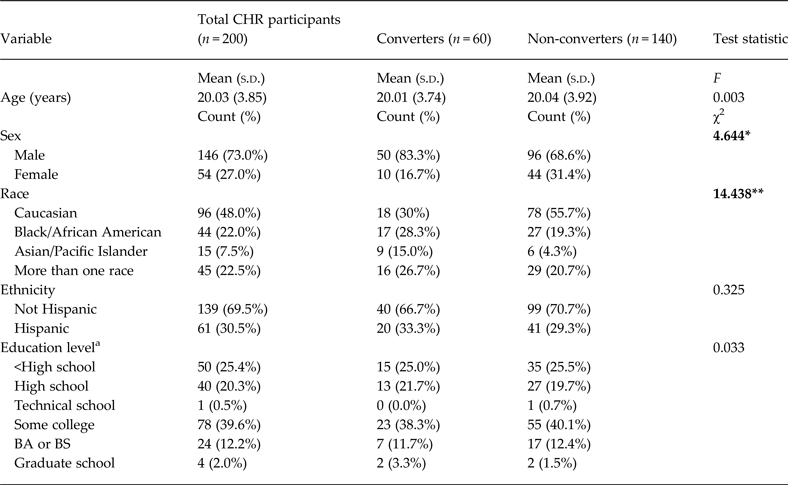
Demographic data (see Table 1) indicate a racially diverse, predominantly male sample. Five (2.5%) participants were transgender. Of note, no sex differences in age were observed (t 198 = −1.861, p = 0.064). Mean follow-up time was 12.65 months (s.d. = 12.21), with a range of 1 (where participants left the program prematurely) to 74 months (where medical records or contact with participant beyond the time of the program indicated the participant's conversion status).
Baseline demographic characteristics of COPE sample

COPE, Center of Prevention and Evaluation; CHR, clinical high risk.
a n = 197.
*p < 0.05, **p < 0.01, comparisons between converters and non-converters.
Baseline clinical characteristics
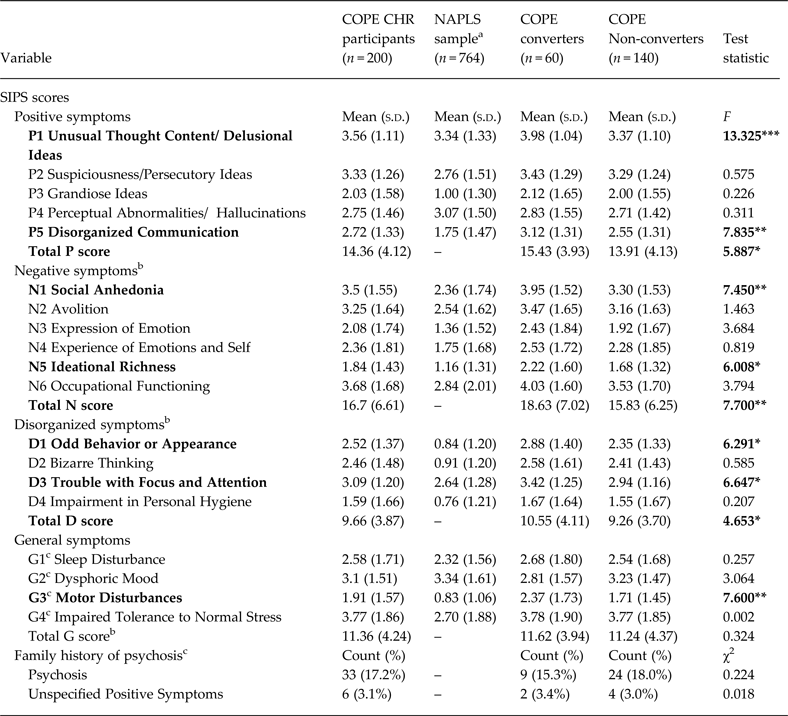
Evaluating individual SIPS/SOPS symptoms (see Table 2), P1 (Unusual Thought Content/Delusional Ideas) had the highest mean score (3.56, s.d. = 1.11), closely followed by P2 (Suspiciousness/Persecutory Ideas; 3.33, s.d. = 1.26). P3 (Grandiose Ideas) showed the lowest mean (2.03, s.d. = 1.58). The Positive symptoms most frequently endorsed at baseline were P1 (87%) and P2 (82%). P4 (Perceptual Abnormalities/Hallucinations) and P5 (Disorganized Communication) were endorsed in 68% and 57.5% of the sample, respectively. P3 was the least endorsed (46.5%).
SIPS scores for COPE sample (n = 200)

SIPS, Structured Interview for Psychosis-Risk Syndromes; COPE, Center of Prevention and Evaluation; CHR, clinical high risk; NAPLS, North American Prodrome Longitudinal Study.
a Data from total sample of Addington et al. (Reference Addington, Liu, Buchy, Cadenhead, Cannon, Cornblatt, Perkins, Seidman, Tsuang, Walker, Woods, Bearden, Mathalon and McGlashan2015).
b n = 193.
c n = 192.
*p < 0.05, **p < 0.01, ***p < 0.001, comparisons between converters and non-converters.
All participants met SIPS APSS criteria. While 53.5% met SPD criteria and 17.2% with known family histories reported first-degree relatives with past or current psychosis, only seven (3.5%) satisfied the GRD syndrome's prerequisite GAF decline. No participant met BIPS criteria.
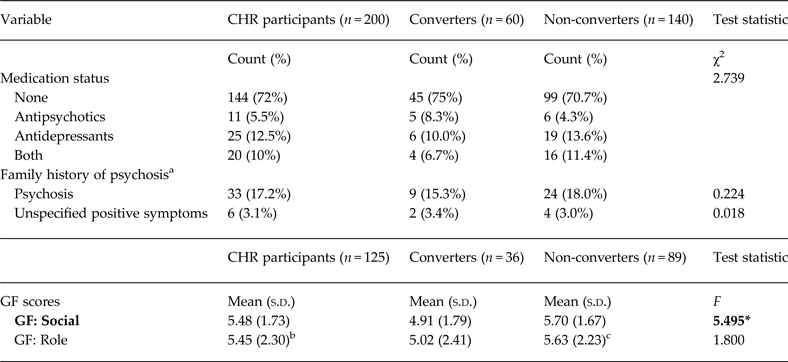
In terms of DSM diagnoses, 78% and 47.8% of participants met criteria for one or more than one Axis-I disorder, respectively (see online Supplement 2 for specific diagnoses). The most common lifetime diagnoses were major depressive disorder (MDD, 40.1%), obsessive-compulsive disorder (OCD, 17.0%) and social phobia (SP, 13.1%). Past substance dependence or abuse were present in 8.8% and 9.9%, respectively, with cannabis being the substance most used (17.4%). (See Table 3 and online Supplement 3 for information regarding baseline medication use, family history of psychosis and GF scores.) Participants showed generally low average scores on both the GF: Social (mean = 5.48, s.d. = 1.73) and GF: Role (mean = 5.45, s.d. = 2.3).
Additional baseline clinical characteristics: medication status, family history of psychosis, and GF scores for COPE Sample (n = 200)

GF, Global Functioning; COPE, Center of Prevention and Evaluation; CHR, clinical high-risk.
a n = 192.
b n = 124.
c n = 88.
*p < 0.05, comparisons between converters and non-converters.
Conversion outcomes
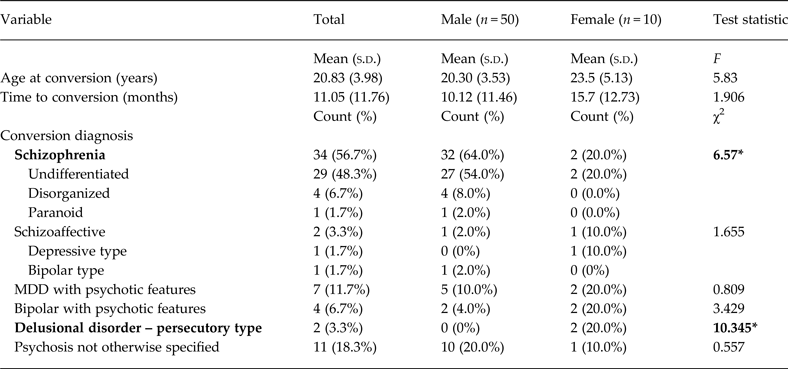
Table 4 displays conversion outcome data. Sixty (30%; 50 males, 10 females) participants progressed to psychosis. Excluding 41 non-converters who had not yet completed 2-year follow-ups, the rate becomes 60/159 (37.7%).
Conversion outcomes for COPE sample (n = 60)

COPE, Center of Prevention and Evaluation; MDD, Major depressive disorder.
*Two-sided Fisher's p < 0.05, comparisons between male and female converters.
Average conversion time was 11.05 months (s.d. = 11.76, median = 5.5), with no difference between sexes. The majority (36, 60%) developed SZ or schizoaffective disorder (SAD). Notably, conversion time to SZ (mean = 7.97 months, s.d. = 9.89) was significantly briefer than to other psychoses (mean = 15.68 months, s.d. = 12.98; F 1,58 = 6.800, p = 0.012). Mean conversion age was 20.83 years (s.d. = 3.97). The averages were 20.30 years (s.d. = 3.53) and 23.5 years (s.d. = 5.12) for males and females, respectively. While this difference was statistically significant (t 58 = −2.414, p = 0.019), the distributions failed Levene's test (F = 6.390, p = 0.014), likely due to few female converters.
Demographic differences between converters and non-converters
There was no relationship between baseline age and conversion (F 1,197 = 0.003, p = 0.960). Significantly more males (50/146, 34.2%) than females (10/54, 18.5%) converted to psychosis (χ2 1,200 = 4.644, p < 0.05). Race was also significant (χ2 3,200 = 14.438, p = 0.004) with fewer Caucasians (18/96, 18.75%) and more Asians/Pacific Islanders (9/15, 60.0%) converting than might be expected by chance. Group differences for other demographic factors were insignificant (see Table 1).
Clinical differences between converters and non-converters
Ten SIPS/SOPS indices distinguished converters from non-converters (see Table 2). Of the positive symptoms, group differences were found in P1 (F 1,198 = 13.235, p < 0.001), P5 (F 1,198 = 7.835, p < 0.01) and the sum of Positive symptoms (F 1,198 = 5.887, p < 0.05), driven by P1 and P5.
N1 (Social Anhedonia: F 1,191 = 7.450, p < 0.01) and N5 (Ideational Richness: F 1,191 = 6.008, p < 0.05) were significantly related to conversion, along with the sum of Negative symptoms (F 1,191 = 7.700, p < 0.01). In addition, group differences were also found in D1 (Odd Behavior or Appearance: F 1,191 = 6.291, p < 0.05) and D3 (Trouble with Focus and Attention: F 1,191 = 6.647, p < 0.05), the sum of Disorganization symptoms (F 1,191 = 4.653, p < 0.05) and of General symptoms, G3 (Motor Disturbances; F 1,190 = 7.600, p < 0.01).
Additionally, baseline GF: Social score significantly distinguished converters from non-converters (F 1,123 = 5.495, p < 0.05). Group differences were insignificant for all other clinical variables.
Examining predictors of conversion
To examine which baseline demographic and clinical characteristics might facilitate or protect against conversion, conversion status was regressed on these characteristics using binomial logistic regression. Variables were included in the model with the aims of identifying positive symptoms more likely to predict psychosis; confirming and expanding upon NAPLS-2 findings (Addington et al. Reference Addington, Liu, Buchy, Cadenhead, Cannon, Cornblatt, Perkins, Seidman, Tsuang, Walker, Woods, Bearden, Mathalon and McGlashan2015); including baseline differences in demographic variables and SIPS/SOPS scores other than positive symptoms and; minimizing covariation of predictors; and maximizing analytic sample size. Specifically, we included race [‘White’ (reference group), ‘Black/African-American’, ‘Asian/Pacific Islander,’ ‘more than one race’]; sex (‘male’, ‘female’); and ethnicity (‘not Hispanic’, ‘Hispanic’); age; all SIPS/SOPS Positive symptoms; and totals of Negative, Disorganization and General symptoms. The latter subscale totals were used to limit the number of predictors, reducing the possibility of overfitting to the data. Although ANOVAs demonstrated lower baseline GF: Social scores among converters, GF scores were excluded from the regression to avoid sample size limitations.
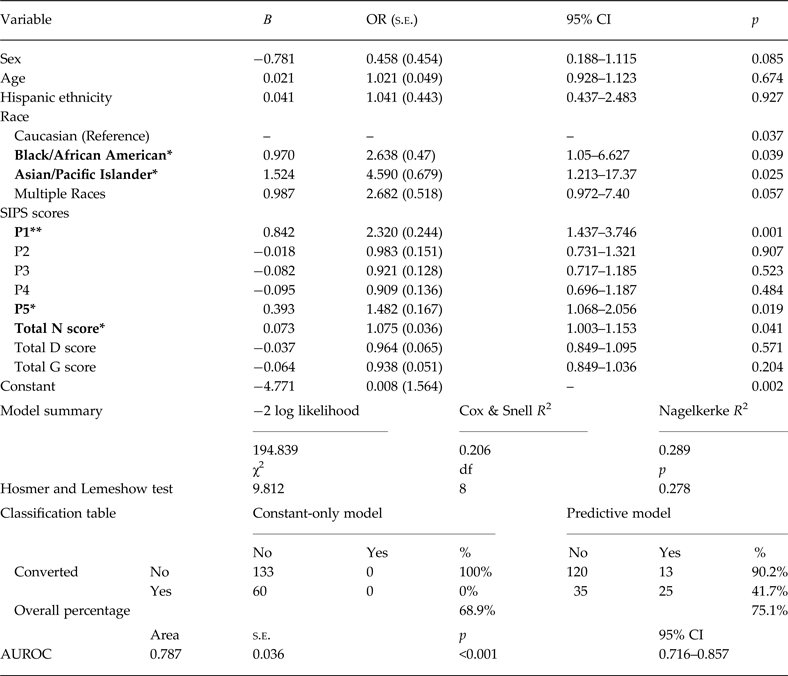
Table 5 displays regression results and model fit information. The model accounts for significantly more variance than a constant-only model (χ2 = 44.505, p < 0.001, df = 14). P1, P5 and total Negative symptoms significantly predicted conversion. Accounting for the variance produced by all other variables, CHR individuals are 2.32 (s.e. = 0.244, p = 0.001), 1.482 (s.e. = 0.167, p = 0.019) and 1.075 (s.e. = 0.036, p = 0.041) times as likely to convert for every one-point increase in baseline P1, P5, and total Negative symptom score, respectively. Additionally, race significantly predicted conversion, where ‘Black/African-American’ and ‘Asian/Pacific Islander’ participants were, respectively, 2.638 (s.e. = 0.470, p = 0.039) and 4.590 (s.e. = 0.679, p = 0.025) times as likely to convert as ‘Caucasian’ participants.
Results of binary logistic regression predicting conversion for COPE sample (n = 193)

COPE, Center of Prevention and Evaluation; OR, Odds ratio; CI, confidence interval; SIPS, Structured Interview for Psychosis-Risk Syndromes; AUROC, Area Under ROC Curve.
Adding baseline diagnosis (collapsed into any lifetime anxiety disorder, depressive disorder, bipolar disorder, past substance/alcohol use disorder, eating disorder, and any other disorder); SPD; family history of psychosis; and medication status [‘none’ (reference group), ‘neuroleptics’, ‘antidepressants’, ‘both’] to the model did not affect the significance of these SIPS factors, or yield additional significant predictors. However, ‘Black/African-American’ race was no longer significant (p = 0.081), while the significance of ‘Asian/Pacific Islander’ race remained [odds ratio (OR) 5.739, s.e. = 0.732, p = 0.017]. Notably, this model reduced the analytic sample from 193 (with 60 converters) to 168 (54 converters).
Additional sensitivity checks were run in which the potentially important factors of medication status, education level, SPD diagnosis, and past substance abuse were added individually and separately to the model. When either education level, past substance abuse or SPD was added, all beta weights remained within ±0.2 of their original values, and there were no changes to significant findings. Adding medication status alone to the model pushed ‘Black/African-American’ race slightly above the significance threshold (p = 0.054), but all beta weights remained within ±0.2 of their original values and P1, P5, Total N, and ‘Asian/Pacific Islander’ race remained significant.
Another concern may be that baseline total SIPS score as a measure of severity of global psychopathology, may predict psychosis over and above the Positive subscale or any individual symptom. Total SIPS score was significantly higher among converters (mean = 56.23, s.d. = 12.89) than non-converters (mean = 50.17, s.d. = 13.67; t 191 = 2.9, p = 0.004). However, an additional regression containing only demographic characteristics, P1, and Total SIPS score excluding P1 found that baseline P1 (OR 1.832, s.e. = 0.210, p = 0.004) predicted conversion over and above Total SIPS (OR 1.021, s.e. = 0.210, p = 0.142). Furthermore, a regression containing demographic characteristics and total P, N, D, and G scores revealed total P score as significant (OR 1.121, s.e. = 0.051, p = 0.025), with only total N approaching significance (OR 1.061, s.e. = 0.049, p = 0.068). Importantly, total P yielded an odds ratio far below P1 separately, demonstrating specifically the utility of P1 in predicting conversion to psychosis.
Discussion
This large single-site longitudinal prospective psychosis-risk study examined the baseline demographic and clinical characteristics of 200 CHR individuals, to determine how these related to conversion to psychosis over 2 years of follow-up. We replicated findings from NAPLS-2 (2015) that the SIPS/SOPS Unusual Thought Content and Disorganized Communication subscales, measures of attenuated odd delusions and thought disorder, best predicted psychosis (Addington et al. Reference Addington, Liu, Buchy, Cadenhead, Cannon, Cornblatt, Perkins, Seidman, Tsuang, Walker, Woods, Bearden, Mathalon and McGlashan2015). We additionally found total Negative symptoms, and both African-American and Asian/Pacific Islander race to be predictive, although only the latter racial group survived multiple regression models. Converters and non-converters were further distinguished by five SIPS/SOPS subscales beyond Positive symptoms, male sex and GF: Social scores. As no Axis-I diagnosis or schizotypy predicted conversion, the APS diagnosis proposed in DSM-5 (APA, 2013) is supported as a distinct syndrome.
Our cohort's mean age (20.03, s.d. = 3.85) was slightly higher than that in NAPLS-2 (18.45, s.d. = 4.23; Addington et al. Reference Addington, Liu, Buchy, Cadenhead, Cannon, Cornblatt, Perkins, Seidman, Tsuang, Walker, Woods, Bearden, Mathalon and McGlashan2015). However, our age range was 13–30, while NAPLS-2 recruited participants aged 12–35. Regardless, both groups’ data are in accord with the APS onset in mid- to late adolescence which the DSM-5 describes (APA, 2013). The DSM also notes a ‘slight preponderance’ of male APS cases. Our cohort was disproportionately male (73%), while the NAPLS-2 cohort was more evenly distributed (57.1%). Our 2.5% transgender rate is comparable to the 3% estimated rate in the general American population (Gates, Reference Gates2011). Caucasian participants constituted the largest racial group in our cohort (48%) and NAPLS-2 (62.6%). NAPLS-2 participants reported, on average, 11.28 years of education (s.d. = 2.82). We categorically rated this variable, finding that 45.7% of participants completed high school or less and 53.3% completed some or all of college. Our cohort's somewhat higher education level may reflect that 13% of participants were recruited at college and university counseling centers.
Of note, nearly twice the number of males (34.2%) as females (18.5%) converted, although sex did not significantly predict conversion. Literature regarding sex differences in conversion rates among CHR individuals has been equivocal. Lemos-Giráldez et al. (Reference Lemos-Giráldez, Vallina-Fernández, Fernández-Iglesias, Vallejo-Seco, Fonseco-Padrero, Paino-Pineiro, Sierra-Baigrie, García-Pelayo, Pedrejón-Molino, Alonso-Bada, Gutiérrez-Pérez and Ortega-Ferrández2009) found 22.5% and 23.8% conversion rates for at-risk males and females, respectively, over 3 years. Ziermans et al. (Reference Ziermans, Schothorst, Sprong and van Engeland2011) showed that more males than females developed psychosis across 2 years. In the NAPLS-2, there were no differences in transition rates (24.5% males, 26.5% females; Walder et al. Reference Walder, Holtzman, Addington, Cadenhead, Tsuang, Cornblatt, Cannon, McGlashan, Woods, Perkins, Seidman, Heinssen and Walker2013). Our finding appears more consistent with the literature on sex differences in the distribution of SZ and other psychoses (Ochoa et al. Reference Ochoa, Usall, Cobo, Labad and Kulkarni2012), whereby males are more affected. It also supports a continuum from attenuated to threshold psychotic illness, whereby the same gender-related factors observed in full-blown illness might be expected in the prodromal phase (Van Os et al. Reference Van Os, Linscott, Myin-Germeys, Delespaul and Krabbendam2009).
We find little support for our finding that 60% of Asian/Pacific Islander participants converted. In fact, a study (Cohen & Marino, Reference Cohen and Marino2013) of 16 423 members of the general population showed higher lifetime rates of psychotic symptoms for African-Americans (15.3%) and Latinos (13.6%) than Caucasians (9.7%) and Asians (9.6%). The literature suggests Asian-Americans tend to underutilize mental health services (Abe-Kim et al. Reference Abe-Kim, Takeuchi, Hong, Zane, Sue, Spencer, Appel, Nicdao and Alegria2007; Li et al. Reference Li, Friedman-Yakoobian, Min, Gnong Granato and Seidman2013) and harbor unfavorable attitudes toward help-seeking (Sue, Reference Sue1994; Compton et al. Reference Compton, Kaslow and Walker2004; Shea & Yeh, Reference Shea and Yeh2008; Masuda & Boone, Reference Masuda and Boone2011) so that they may seek treatment only after attenuated symptoms have progressed toward psychosis. However, one-way ANOVAs revealed no differences in conversion time (F 1,58 = 0.122, p = 0.728) or total baseline Positive symptoms (F 1,198 = 0.051, p = 0.822) between Asian/Pacific Islanders and other racial groups in our cohort.
Our current conversion rate of 30%, or 37.7% excluding participants enrolled under two years, is comparable to the higher rates Hartmann et al. (Reference Hartmann, Yuen, McGorry, Yung, Lin, Wood, Lavoie and Nelson2016) associated with earlier CHR studies, and has remained stable from 2003 to 2015. To determine if our high conversion rate was a function of more converters in the first half of the sample, we divided the sample into two epochs, separately analyzing the 56 participants ascertained from 2003 to 2008 and 86 from 2009 to 2013, and excluding 58 who did not reach the 2-year point. Seventeen out of 56 (30.36%) in the earlier group converted at an average of 17.78 months (s.d. = 15.46) and 26/86 (30.236%) in the later group converted at an average of 11.04 months (s.d. = 10.16). While our conversion rate is stable over time, the reduction in mean time to conversion between epochs does suggest some differences between individuals enrolled more recently compared to those enrolled a less recently.
Consistent with the APS features defined in DSM-5 (APA, 2013), most conversions (60%) in our cohort were to SZ, with 11 (18.33%) to psychotic affective disorders. The description also reflects collective knowledge from multiple investigations that genetic risk, poorer social functioning and Positive symptoms consistently predict conversion, with algorithms combining these factors yielding positive predictive power above 80% (Gee & Cannon, Reference Gee and Cannon2011). In contrast, we find no support for family history of psychosis as a risk factor (χ2 1,192 = 0.224, p = 0.636). In terms of functioning, means for both the GF: Social (mean = 5.48, s.d. = 1.73) and GF: Role (mean = 5.45, s.d. = 2.3) were generally low in our cohort, suggesting impairments across multiple domains, although only GF: Social was related to psychosis (F 1,123 = 5.495, p < 0.05), consistent with Cornblatt et al. (Reference Cornblatt, Carrión, Addington, Seidman, Walker, Cannon, Cadenhead, McGlashan, Perkins, Tsuang, Woods, Heinssen and Lencz2012).
Our finding that neither baseline DSM Axis-I diagnosis nor SPD predicted conversion helps address concerns about the APS’ high co-morbidity with other disorders (Fusar-Poli et al. Reference Fusar-Poli, Bonoldi, Yung, Borgwardt, Kempton, Valmaggia, Barale, Caverzasi and McGuire2012; Guadiano & Zimmerman, Reference Guadiano and Zimmerman2013) and its similarities with related conditions. Interestingly, 19/60 converters (31.67%) met criteria for MDD at baseline, but a majority of these (10/19; 52.63%) developed SZ, as opposed to psychotic MDD or bipolar disorder. Among the eight converters (13.33%) initially meeting OCD criteria, virtually all (7/8, 87.5%) developed SZ. In each case, the central obsession was implausible in nature and accompanied by the insight which characterizes both OCD and APS, highlighting the challenging differential between these diagnoses.
In examining the SIPS, we adopted NAPLS-2's approach of separately analyzing the SOPS symptoms, in terms of frequency and association with conversion (Addington et al. Reference Addington, Liu, Buchy, Cadenhead, Cannon, Cornblatt, Perkins, Seidman, Tsuang, Walker, Woods, Bearden, Mathalon and McGlashan2015). We independently replicated their key findings that P1 is the Positive symptom most associated with conversion, closely followed by P5. In both cohorts, P3 was less common, and P2 and P4 were frequently endorsed, but did not predict psychosis. In NAPLS-2, P5 was an uncommon symptom, whereas we found it in 57.5% of participants. Unlike NAPLS-2, we found that total Positive symptoms, N1, N5, total Negative symptoms, D1, D3, and G3 also distinguished converters from non-converters. In both cohorts, Positive symptoms were the most common, followed by Negative, Disorganization, and General. All COPE participants endorsed one positive symptom or more, similar to the 92% rate in NAPLS-2. In COPE, 91.09% had at least one Negative symptom and 71% had ⩾3; in NAPLS-2, the rates were 82% and 44%, respectively. In both groups, N2 and N6 were the most common. G2 was endorsed by 66.67% of our sample, while NAPLS-2 reported 68%.
The uniformity of SIPS/SOPS findings across NAPLS-2 and our cohort is quite striking. They suggest that attenuated odd delusions (P1) and thought disorder (P5) may predict psychosis, while attenuated suspiciousness (P2) and perceptual abnormalities (P4) may be commonly endorsed by CHR individuals, irrespective of conversion. Notably, while an ANOVA replicated the NAPLS-2 total Disorganization score result, this did not survive a binomial logistic regression. Also of note, even after accounting for baseline clinical and demographic characteristics, we found that total Negative symptoms predicts conversion, although it is solely Positive symptoms which presently define transition to psychosis in the SIPS.
While these results provide an important replication of the predictive capacity of specific symptom criteria, demographic and symptom-based measures remain inadequate to meet the requirements for diagnostic and treatment applications in standard clinical practice. Some recent studies (Cannon et al. Reference Cannon, Yu, Addington, Bearden, Cadenhead, Cornblatt, Heinssen, Jeffries, Mathalon, McGlashan, Perkins, Seidman, Tsuang, Walker, Woods and Kattan2016; Carrion et al. Reference Carrion, Cornblatt, Burton, Tso, Auther, Adelsheim, Calkins, Carter, Neindam, Sale, Taylor and McFarlane2016) have proposed combining current CHR criteria with specific demographic factors, as well as various neurocognitive, psychosocial and/or biometric assessments, to develop algorithms with improved predictive power. Importantly, they observed that positive symptoms, primarily a combination of P1 and P2 from the SIPS, drove the predictive power of the calculator, as opposed to any other measure, similar to the findings from the current study. Those proposed thus far are clinically limited, in that they require data from psychological instruments not routinely available or employed in clinical practice. The factors beyond CHR criteria we have identified, which are readily elicited from patients by way of simple inquiry, might well be incorporated into future algorithms, if replicated by other research.
An additional limitation of our study is that 41 (20.5%) participants have not yet completed the 2-year follow-up. As all were help-seeking, and the sample was predominantly male, our findings may not be generalizable to the wider population. Furthermore, we were not able to analyze our entire sample's functional status in relation to conversion potential, as the GF scales were not published until the fourth year of the COPE study. Finally, there remains an ongoing debate about the benefits of identifying CHR as a ‘unitary class’ and transition to psychosis as a ‘binary’ variable. While the data presented herein, taken together with consistent data from numerous other sites, support the CHR diagnosis and treating transition to psychosis as a binary variable, further study is needed to determine the ideal nosological structure for individuals at risk for psychosis.
Supplementary material
The supplementary material for this article can be found at https://doi.org/10.1017/S0033291717000319.
Acknowledgements
The project was supported by the NIH: Center for Research Resources and the National Center for Advancing Translational Sciences, UL1TR000040 and 2KL2RR024157; K23MH066279; R21MH086125; R01P50MH086385; R01MH093398-01; and the Brain and Behavior Research Foundation; Lieber Center for Schizophrenia Research; New York State Office of Mental Hygiene; and K23MH106746.
Declaration of Interest
R.R.G. discloses research support from Otsuka, PharmaNac and Genentech. D.K. serves as a consultant to Neurocog Trials.