Cardiac arrhythmias are a known complication of diabetic ketoacidosis, likely secondary to the fluid and electrolyte imbalances.Reference Podrid 1 At the time of presentation, patients with diabetic ketoacidosis are often hyperkalaemic, which can precipitate ventricular arrhythmias; however, by 12 hours of therapy, most patients will become hypokalaemic. The most common arrhythmias seen with hypokalaemia are premature atrial or ventricular contractions and supraventricular tachycardia.
We present the case of a previously healthy 15-year-old boy with new onset diabetic ketoacidosis, severe metabolic disturbances, and moderate hypokalaemia who developed a slow ventricular tachycardia.
Case presentation
A 15-year-old boy, with no significant past medical history, presented with weight loss, polydipsia, abdominal pain, and lethargy to a local emergency room. On examination, he was noted to have Kussmaul breathing and was difficult to arouse. Examination for vital signs revealed an oral temperature of 96.6, heart rate of 130 bpm, respiratory rate of 32, and his blood pressure was 120/71 mmHg. Cardiovascular examination revealed a regular tachycardia, normal heart sounds without murmur or gallop. He was noted to have delayed capillary refill of about 3 seconds. Respiratory examination showed deep and laboured breathing, and neurological examination showed a Glasgow coma scale of 8, responding only to sternal rub. His initial blood glucose concentration was 849 mg/dl, and arterial blood gas values were as follows: pH 6.99, carbon dioxide partial pressure 10, and bicarbonate 2.3 with base deficit of 27. Serum potassium level was 2.7 mmol/L (normal 3.9–5.1 mmol/L). He was given 500 ml of normal saline, 10 units of regular insulin, and 50 mEq of sodium bicarbonate. He was then transferred to our facility.
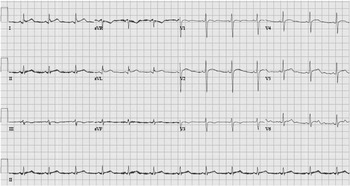
On arrival, examination of his vital signs revealed a temperature of 35.4, heart rate of 138 bpm, blood pressure of 105/72 mmHg, and respiratory rate of 35. Telemetry showed sinus tachycardia at heart rate of about 130 bpm; shortly afterwards, he was noted on monitor to have wide complex tachycardia at a rate of 140 bpm. Pulses were present. His blood pressure was not significantly changed at the time. A 12-lead electrocardiogram was performed during his ventricular rhythm (Fig 1). His arterial blood gas values at the time of his ventricular tachycardia were as follows: pH 7.03, carbon dioxide partial pressure 27, and bicarbonate 7 with a base deficit 22. Serum potassium level was 2.1 mmol/L, and magnesium level was 4.6 mg/dl (n=1.6–2.3). The intensive care team proceeded with anti-arrhythmic therapy for wide complex tachycardia due to the patient’s ill appearance. Lidocaine (60 mg intravenous once), amiodarone (300 mg intravenous once), and sodium bicarbonate (50 mEq) boluses were administered without immediate effect. A potassium bolus was subsequently administered. He converted to junctional rhythm at a heart rate of about 110 bpm and then back to sinus tachycardia. His acidosis was slowly corrected, and he had no further wide complex tachycardia. A baseline 12-lead electrocardiogram showed normal sinus rhythm with normal QRS morphology and ST segment changes consistent with early re-polarisation (Fig 2). His cardiacechocardiogram revealed normal intra-cardiac anatomy and bi-ventricular function.
Electrocardiogram showing wide complex tachycardia at the rate of about 140 bpm with atrioventricular dissociation (second beat in lead I–III). There is a sinus capture beat (second beat in lead V1). The ventricular rate is about 140 bpm. There is a left bundle branch block pattern and left axis suggestive of right ventricular origin.

Normal sinus rhythm.

Discussion
The electrocardiogram shown suggests a slow ventricular tachycardia. The differential diagnosis includes ventricular tachycardia, accelerated idioventricular rhythm, and junctional tachycardia with aberrancy.
Accelerated ventricular rhythm as described by Zipes et alReference Zipes and Jalife 2 is an ectopic rhythm with rate often similar to the prevailing sinus rate and causing isorhythmic dissociation. Accelerated idioventricular rhythm is most frequently seen in adults after successful re-perfusion after a myocardial infarction.Reference De Soyza, Bissett, Kane, Murphy and Doherty 3 It has also been reported in patients with myocarditis, digoxin toxicity, hypothermia, cocaine use, hypertension, and neonates with structurally normal hearts. They are less common in the paediatric population, but are seen in patients with CHD.Reference Reynolds and Pickoff 4 Although a consensus on the diagnostic criteria of accelerated idioventricular rhythm is lacking, it is typically characterised by heart rate <10% above sinus rate,Reference Reynolds and Pickoff 4 no haemodynamic derangement, lack of response to anti-arrhythmic therapy or cardioversion, and gradual onset and termination.Reference Perry 5 The mechanism is not well-understood, but is thought to be related to an enhanced automatic ventricular focus that is autonomically responsive.Reference Chiale, Sicouri, Elizari and Rosenbaum 6 , Reference Perez-Riera, Barros, De Sousa and Baranchuk 7
Accelerated idioventricular rhythm has never been described in the setting of severe diabetic ketoacidosis. Our patient’s heart rate was >10% above sinus, and there was lack of isorhythmic dissociation, as seen on the electrocardiogram, making slow ventricular tachycardia the most likely diagnosis. This ventricular tachycardia mechanism is unlikely that of a typical re-entrant mechanism, but rather likely the cardiac mileu being unbalanced due to multiple factors. He had multiple electrolyte abnormalities including moderate hypokalaemia as well as severe metabolic acidosis and mild hypothermia. We postulate that he had enhanced ventricular automaticity related to these abnormalities.
The most effective therapy for this rhythm in a haemodynamically stable patient with a structurally normal heart is treatment of his underlying metabolic derangements, including electrolyte replacement. He did not have any significant haemodynamic changes with his arrhythmia, and therefore anti-arrhythmic medications are not warranted and unlikely to be effective.
Summary
We present the case of a child with slow ventricular tachycardia in the setting of diabetic ketoacidosis with metabolic and electrolyte derangements. The therapy for this rhythm is to treat the underlying metabolic/electrolyte abnormalities and not anti-arrhythmic drug therapy or cardioversion.
Acknowledgement
None.
Financial Support
This research received no specific grant from any funding agency, commercial or not-for-profit sectors.
Conflicts of Interest
None.