Introduction
Calophya schini Tuthill (Calophyidae) is a leaf galling psyllid that feeds exclusively on Peruvian pepper tree, Schinus molle L. (Anacardiaceae) (Burckhardt and Basset, Reference Burckhardt and Basset2000). The native range of C. schini is limited to Bolivia and Peru, but its South American distribution has expanded to include Argentina, Chile (Burckhardt and Basset, Reference Burckhardt and Basset2000) and Columbia (Pinzon and Gonzalez, Reference Pinzon and Gonzalez2001). Outside of South America, C. schini is present in California, USA (Downer et al., Reference Downer, Svihra, Molinar, Fraser and Koehler1988), Mexico (Alvarez-Zagoya and Cibrian-Tovar, Reference Alvarez-Zagoya and Cibrian-Tovar1999), Portugal (Zina et al., Reference Zina, Lima, Caetano, da Silva, Ramos and Franco2012), New Zealand (Burckhardt and Basset, Reference Burckhardt and Basset2000) and South Africa (Giliomee, Reference Giliomee2011).
Calophya schini oviposits an average of 50 translucent white eggs on young leaf tissue, which become an iridescent black colour before hatching. First-instar nymphs (crawlers) settle on the upper and lower sides of leaves and less frequently on petioles, immature flower buds or green twigs (Alvarez-Zagoya and Cibrian-Tovar, Reference Alvarez-Zagoya and Cibrian-Tovar1999). Nymphal feeding in the phloem stimulates the formation of pit galls (Downer et al., Reference Downer, Svihra, Molinar, Fraser and Koehler1988). There are differing opinions about the number of nymphal instars of C. schini, with some authors reporting four (Downer et al., Reference Downer, Svihra, Molinar, Fraser and Koehler1988; Pinzon and Gonzalez, Reference Pinzon and Gonzalez2001) and one author reporting five (Alvarez-Zagoya and Cibrian-Tovar, Reference Alvarez-Zagoya and Cibrian-Tovar1999). The closely related Calophya terebinthifolii Burckhardt & Basset (Hemiptera: Calophyidae) completes five instars (Christ et al., Reference Christ, Cuda, Overholt, Vitorino and Mukherjee2013). The complete development of C. schini at 23 °C requires approximately 43 days, and adult females live about 5 days (Alvarez-Zagoya and Cibrian-Tover, Reference Alvarez-Zagoya and Cibrian-Tovar1999).
Damage to S. molle trees can be severe, with heavy infestations resulting in deformed leaves and extensive leaf drop (Downer et al., Reference Downer, Svihra, Molinar, Fraser and Koehler1988). In California, where S. molle is a valued ornamental (although it is now listed as an invasive plant [California Invasive Plant Council, 2006]), a biological control programme targeting the psyllid was initiated in 1987. A eulophid parasitoid from Chile, Tamarixia schina Zuparko (Hymenoptera: Eulophidae), was released, and it reportedly provides good control (Zuparko et al., Reference Zuparko, De Queiroz and La Salle2011).
Materials and methods
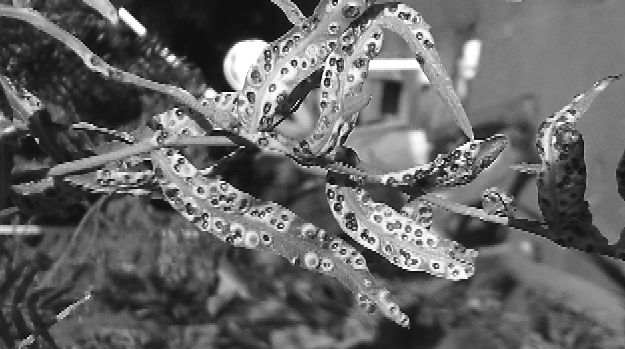
In April 2013, S. molle trees with pit galls on leaves (Fig. 1) were observed in Addis Ababa, Ethiopia (N9.0126, E38.7560). Although some leaves were heavily attacked, the infestation was largely restricted to leaves located at the apices of lower branches. Several leaves with pit galls were preserved in 70% ethanol for later inspection. In Kenya, galled leaves of S. molle were found on the campus of the International Centre of Insect Physiology and Ecology (icipe) in Nairobi (S1.2205, E36.8968), and similar to that observed in Ethiopia, the infestation was light with no sign of serious damage to trees. Leaves with galls were collected and held in resealable plastic bags until the emergence of adults. In addition, several adult psyllids found walking or motionless on S. molle leaves from the same trees were collected. Adults collected from leaves and those emerging in the plastic bags were preserved in 70% ethanol. Voucher specimens are deposited in the Florida State Collection of Arthropods (FSCA), Gainesville, FL, USA.
Calophya schini pit galls on Schinus molle leaves in Addis Ababa, Ethiopia, 19 April 2013. Photo credit: W. A. Overholt.

Results
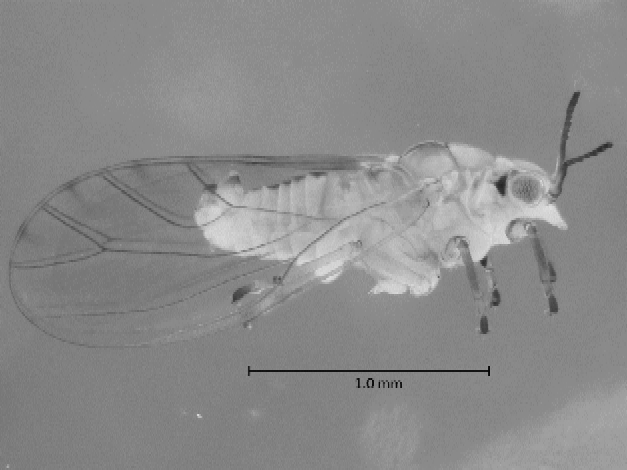
The Kenya collection (FSCA no. E2013-3408) included 28 adult psyllids (Fig. 2) that were identified as C. schini by S.E.H. and Daniel Burckhardt (Naturhistorisches Museum Basel, Switzerland). In addition, three tetrastichine (Eulophidae) parasitoids emerged from the samples, which were probably of the genus Tamarixia, although they were definitely not T. schina (Robert Zuparko, personal communication). Inspection of the galled leaves from Ethiopia revealed two intact, late-instar C. schini nymphs (FSCA no. E2013-3409, identified by S.E.H.), along with evidence of several nymphs from which parasitoids had emerged, one nymph with a parasitoid egg underneath it, an immature parasitoid larva under another nymph and one unemerged parasitoid pupa found in a nymphal skin.
Calophya schini collected in Kenya, lateral view. Photo credit: Anthony A. Dickens, Florida Department of Agriculture and Consumer Services, Division of Plant Industry.
Discussion
Schinus molle, a native of the Andes Mountains in Peru, Chile, Ecuador and Colombia (Kramer, Reference Kramer1957), was moved to other areas in the world beginning in the 1500s. It was introduced into South Africa in the 1800s (Iponga et al., Reference Iponga, Milton and Richardson2008) and was present in Kenya by 1909 (Hutchins, 1909). Schinus molle is now found in Eritrea, Ethiopia, Kenya, South Africa, Sudan, Tanzania and Uganda (Orwa et al., Reference Orwa, Mutua, Kindt, Jamnadass and Simons2009). In South Africa, S. molle, along with its South America congener Schinus terebinthifolia Raddi, is considered to be invasive (Henderson, Reference Henderson2001), whereas in Kenya and Ethiopia, S. molle is a valued resource used for firewood, charcoal, bee forage, soil conservation, shade and other purposes (Maudo and Tergnäs, Reference Maudo and Tengnäs2005; Bekele-Tesemma, Reference Bekele-Tesemma2007). It is plausible that C. schini was introduced into Kenya and Ethiopia along with its host. Alternatively, the psyllid may have spread northward from South Africa, where it was first seen in 2001 (Giliomee, Reference Giliomee2011), or spread from other African locations where it has not been reported. The minimal damage that we observed to S. molle foliage at the locations where the psyllids were collected in Ethiopia and Kenya, along with an absence of published reports of damage in either country, suggests that C. schini may not pose a serious threat to S. molle in eastern Africa. The presence of parasitoids in both countries may suppress the population densities of C. schini and thereby limit damage to S. molle trees. The origin of the parasitoids is unknown, but with the exception of cecidomyiidae (Diptera), introduced gall makers rarely suffer high mortality from native parasitoids (Harris and Shorthouse, Reference Harris and Shorthouse1996). Moreover, there is no Calophya spp. native to the Afrotropical region (Burckhardt and Basset, Reference Burckhardt and Basset2000), suggesting that it is unlikely that African parasitoids would have expanded their host ranges to include C. schini. Thus, we speculate that the parasitoids are of South American origin and were introduced fortuitously along with their host, C. schini.
In addition to C. schini, both S. molle and S. terebinthifolia are attacked in Africa by Megastigmus transvaalensis (Hussey) (Hymenoptera: Torymidae), a native African seed wasp of Rhus spp. that has expanded its host range to include the two exotic Schinus spp. (Grissell and Prinsloo, Reference Grissell and Prinsloo2001; Scheffer and Grissell, Reference Scheffer and Grissell2003). Although M. transvaalensis has not been reared from S. molle fruits in Kenya or Ethiopia, it has been reared from S. terebinthifolia in Kenya, and is likely to attack S. molle as well (Scheffer and Grissell, Reference Scheffer and Grissell2003).
Acknowledgements
The authors thank Robert Zuparko, Essig Museum of the University of California, Berkeley, for assistance with the identification of the parasitoids reared from C. schini in Kenya and Daniel Burckhardt, Naturhistorisches Museum Basel, Switzerland, for confirmation of the identity of the Kenyan psyllids. They also thank Anthony A. Dickens of the Florida Department of Agriculture and Consumer Services, Division of Plant Industry, for the image of C. schini in Fig. 2. They thank an anonymous reviewer who informed them of early literature about the introduction of S. molle into East Africa. Finally, the authors wish to thank the USAID-funded IPM CRSP project for funding the travel to Ethiopia.