1 Introduction
Sponsors of defined contribution plans often hire financial advisors to help them design and monitor their plans. These advisors specialize in pension consulting and frequently take on fiduciary liability along with the plan sponsor. One of the responsibilities of the advisor is to select and monitor the investment options offered by the plan. Existing literature finds that the investment options offered by the plan can have dramatic effects on saving outcomes (e.g., Benartzi and Thaler, Reference Benartzi and Thaler2001; Choi et al., Reference Choi, Laibson and Madrian2004; Brown et al., Reference Brown, Liang and Weisbenner2007). Given the importance of investment options for savings outcomes, this paper examines the role of that plan advisors play in determining these investment options.
My strategy is to compare the design of plans that advisors help create (client plans) to those that plan advisors use themselves (advisor plans). The null hypothesis is that controlling for the characteristics of the sponsor and advisor (e.g., size of the plan) the client plans resemble those of their advisors – if an investment option is good for the advisor it should also be good for the client. The alternative hypothesis is that client plans differ from those of their advisors in a systematic way. The relationship between the plan sponsor and its advisor is that of a principal and an agent. Sponsors want a plan that allows its employees earn investment return and diversify risk. Advisors’ goal is to maximize their own compensation. They may steer plan sponsors toward investments that generate indirect compensation for the advisor but may not be in the best interest of the plan sponsor or plan participants, (e.g. see Bergstresser et al (Reference Bergstresser, Chalmers and Tufano2009) or GAO (2009)).
I ask whether the agency problem between the sponsor and the plan advisor is responsible for the poor designs of many 401k plans. Brown et al. (Reference Brown, Liang and Weisbenner2007) find that two thirds of investment options added to 401k plans between 1998 and 2002 were high-cost actively managed fund resulting in an increase the expense ratio paid by participants. In a different study, Elton et al. (Reference Elton, Gruber and Blake2006) find that only half of existing 401k plans provide an adequate menu of investment options. In the follow-up work, Elton et al. (Reference Elton, Gruber and Blake2007) find that plans tend to delete funds that subsequently do no worse than the funds with which they were substituted.Footnote 1
The principal-agent literature has a tradition of uncovering conflicts of interest by comparing services that agents perform on themselves to services they perform on their clients. For example, Levitt and Syverson (Reference Levitt and Syverson2008) show that real estate agents sell their own houses for more than they sell houses of their clients. Domenighetti et al. (Reference Domenighetti, Casabianca, Gutzwiller and Martinoli1993) find higher surgery rates among the general population than among physicians. My paper does the same for retirement plan advisors: comparing funds in advisor plans to funds in their clients' plans.
Using data on 131 client plans and 19 advisor plans, I find evidence that 401k advisors have a strong impact on the design of their clients’ investment menus. Clients of the same advisor tend to have the same funds and use the same fund families. However, there are some funds on client menus that are not on advisors’ menus. These funds tend to have higher expense ratios than funds that also appear advisors’ menus. Since the vast majority of advisors receive indirect compensation through commissions or revenue sharing, this pattern is consistent with misaligned incentives on the part of advisors and their clients. I test whether the cost of funds on clients’ menus is driven by the nature of advisors’ compensation. Overall, the results are inconclusive but there appears some suggestive evidence that advisors that are compensated only through commissions or revenue sharing have clients with more expensive funds.
This paper fits in the literature on the compensation structure of financial intermediaries. Christoffersen et al. (2013) show that brokers sell fund that give them higher compensation. Similarly, Edelen et al. (Reference Edelen, Evans and Kadlec2012) find that funds that compensate brokers though opaque payments receive greater fund inflows. Mullainathan et al. (Reference Mullainathan, Noeth and Schoar2012) use an audit study of personal financial advisors. They find that advisors push for actively managed funds and encourage return chasing – advice likely driven by conflicts of interests. Most recently, Pool et al. (Reference Pool, Sialm and Stefanescu2013) find that funds affiliated with the trustee of the 401k plan were much less likely to be deleted from the investment menus than non-affiliated funds.
This paper also complements burgeoning theoretical literature on financial intermediation. Stoughton et al. (Reference Stoughton, Wu and Zechner2011) examine the reasons for the existence of financial intermediaries and the use of kickbacks as compensation. In a different theoretical model, Inderst and Ottaviani (Reference Inderst and Ottaviani2012) view kickbacks as incentives to learn about appropriate investments for sophisticated clients and as tools of exploitation of unsophisticated clients. Carlin and Manso (Reference Carlin and Manso2011) examine dynamic model of investor learning and financial product obfuscation. Carlin and Gervais (Reference Carlin and Gervais2009) explore the legal rules that maximize welfare in retail financial markets.
2 Data
2.1 Advisors
I use data from Form 5500 that all private pension plans must file with the Department of Labor. The form includes basic information about the plan including the name and address of the plan sponsor, funding arrangements and the number of participants. There are a number of schedules attached to the form that contain more detailed financial information. Plans with over 100 participants are required to file Schedule C, which contains detailed information about service providers to the plan. Until 2009 the schedule included information only on providers that received direct compensation from the plan. However, beginning with filings for 2009 the schedule has been expanded to include providers who received indirect compensation. It thus enables me to identify providers that received any compensation.
Schedule C distinguishes among 50 different types of services provided to a plan. These range from recordkeeping to audit services. I focus on general consulting, pension consulting, and plan investment advisory services (service codes 16, 17, and 27, respectively). Note that I do not include firms that provide participant advisory services (service code 26) or firms that provide investment management services (service codes 51 and 52). This is because I am looking for firms that help with the overall design of the plan rather than firms that help individual participants, or firms that manage a specific fund or a separately managed account for the plan.
There were about 1,800 different advisors (identified with service codes 16, 17, and 27) to private defined contribution plans reported in 2009. Many advisors appear to be small firms. Only 189 were large enough to file the ‘long’ Form 5500 for their own defined contribution plan. The ‘long’ form contains information on plan holdings necessary for my analysis. The remaining firms either did not have a retirement plan for their own employees (unlikely since they work in the retirement business), or their plan had fewer than 100 participants absolving them from having to file the ‘long’ form. I looked up the website of every advisor and check that their primary business is advisory. Of the 189 that filed their own ‘long’ Form 5500, about half appear to be law firms, which I exclude from my sample. I also exclude firms such as Daily Access or ADP whose primary business is payroll processing rather than advisory. For example PricewaterhouseCoopers is a consultant to a number of plans but I exclude it because its consulting is more likely to do with accounting and risk assurance rather than plan design. Finally, I require that both client and advisor plans consist mostly of mutual funds. For example, a huge pension and benefits consultant Hewitt has a plan that consists of mostly separately managed accounts. I end up with a sample of 19 advisors.
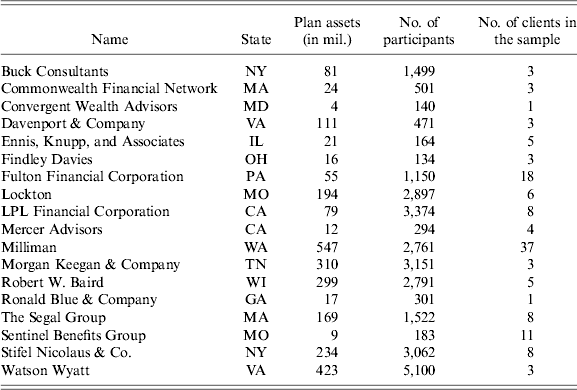
The names and characteristics of the 19 advisors appear in Table 1. The list includes some of the largest pension advisors such as Watson Wyatt or Milliman, as well as much smaller players such as Sentinel Benefits Group out of Boston, MA. The number of clients I have for each advisor varies from 37 clients of Milliman to one client of Convergent Wealth Advisors and Ronald Blue & Company.
List of 401k plan advisors

Advisors are identified on clients’ Schedule C of Form 5500 as providers of general consulting, pension consulting, and plan investment advisory services (service codes 16, 17, and 27, respectively). The table shows retirement plan advisors in my sample, the state of the address on their Form 5500, assets and the number of participants in their own 401k plan. The last column is the number of client plans in my sample of client plans associated with each advisor.
2.2 Clients
As with advisors, I focus on clients whose plans consist mostly of mutual funds. It is common that large 401k plans offer separately managed accounts as investment options instead of mutual funds. These large plans may contract with an investment manager to manage these accounts with lower costs than with an off-the-shelf mutual fund (see Kopcke et al., Reference Kopcke, Vitagliano and Muldoon2009). The problem is that it is impossible to learn how actively managed these accounts are or what the expenses are. Schedule H on Form 5500 differentiates between the value of assets in separately managed accounts and value of assets in registered investment companies (mostly mutual funds). Thus, I screen out any plans that have at more than 20% of assets (ignoring company stock) in separately managed accounts.
I also limit my sample to plans who reported having an advisor (service codes16, 17, and 27) on their Schedule C. As of 2009 plans are required to report all service providers that received indirect compensation, or were paid directly using plan assets. In cases where plan sponsors paid a provider with sponsors' own funds, and the provider received no indirect compensation, the provider would not be reported on Schedule C. Since I am interested in comparing client plans to their advisor's plans, each plan's advisor has to have a plan on its own, i.e., it has to be one of the 19 advisors described in the previous section. I end up with a sample of 131 client plans. I collect information for two years: 2009 and 2010. There were seven plans that have information only for 2009. In 11 cases, the advisor changed from 2009 to 2010. For those plans, when calculating the characteristics of the plan I use only year 2009. The geographic distribution of client and advisor plans, as shown in Figure 1, broadly mirrors the distribution of population with most plans in the northeast, the great lakes and coastal areas.
Geographic distribution of clients and their advisors. The circles in the graph indicate zip code of plan sponsor's address as indicated on Form 5500. Red circles are advisors, blue circles are clients.
2.3 Plan characteristics
Information on the number of participants and the total value of plan assets is easily extracted from DOL's plain text file where each plan is identified by the sponsor EIN and plan number. Unfortunately, the plain text files do not include the list of assets held by the plan. This list is only available in the PDF appendix to the filing. The appendices can be downloaded through DOL's EFAST filing system. The listing of assets in the form 5500 includes names of mutual funds and the dollar values invested in each mutual fund. The names of funds are not standardized because every plan uses slightly different abbreviations for fund names. Therefore, I manually matched the fund names to fund tickers. In large number of cases the name of the fund did not specify share class. Therefore, following Pool et al. (Reference Pool, Sialm and Stefanescu2013), I conduct all of our analysis at the fund level rather than share class level. I calculate the characteristics of each fund as the asset weighted average of each share class. Doing the analysis at the fund level means that any differences across plans are driven by the differences in funds rather than the differences in the classes of shares.
I construct five characteristics of the mutual funds in each plan. First, I add up the number of mutual funds in the plan. This approximates the number of investment options. It is only an approximation because some of the assets held by the plan may not be currently available to participants. I also ignore company stock, separately managed accounts, insurance contracts, or self-directed brokerage accounts. I count all life-cycle or target-date funds as one investment option. Second, I count the number of mutual fund categories represented by the funds in the plan. I use the Morningstar category classification with municipal bond fund categories consolidated into one. This classification has 69 different categories. Third, I calculate the average expense ratio of the mutual funds in the plan. I use the prospectus and audited expense ratio from Morningstar's Principia database.Footnote 2 I also calculate adjusted expense ratios as the difference between the expense ratio and the asset weighted average expense ratio in the fund's Morningstar category. Fourth, to measure how actively managed are the investment options, I calculate average turnover as well as average adjusted turnover which is the turnover minus the asset weighted average turnover in the fund's Morningstar category. Finally, I use Morningstar's stewardship grade to measure how well the funds are governed. The stewardship grade reflects ‘the degree to which the management company's and fund board's interests are aligned with fund shareholders; and the degree to which shareholders can expect their interests to be protected from potentially conflicting interests of the management company.’ Morningstar evaluates qualitative factors such as ‘board quality, manager incentives, fees, and corporate culture;’ and assigns each fund a grade ranging from F (failing) to A (excellent). I translate these into a numerical scale of 0 (failing) to 4 (excellent). When averaging across funds down to the plan level, I use unweighted averages as my goal is to describe the characteristics of the menu of investment options rather than participants investment allocations.
In addition to mutual fund characteristics I also measure the intensity of changes in the menu of investment options between 2009 and 2010. I calculate the percent change in the investment menu as the number of added and deleted funds divided by the sum of the number of investment options in 2009 and 2010.
 $${\rm Percent}\,{\rm change}\,{\rm in}\,{\rm menu}_i = \displaystyle{{{\rm no}{\rm.} \,{\rm of}\,{\rm funds}\,{\rm deleted + number}\,{\rm of}\,{\rm funds}\,{\rm added}} \over {{\rm (no}{\rm.} \,{\rm of}\,{\rm funds}\,{\rm in}\,{\rm 2009 + number}\,{\rm of}\,{\rm funds}\,{\rm in}\,{\rm 2010)}}}$$
This measure ranges from 0 (no change in the menu) to 1 (a completely different menu).
The final two characteristics of a plan are dummy variables indicating the nature of advisor's compensation. Schedule C asks a yes-or-no question of whether a provider received indirect compensation in connection with the provider's service to the plan. This may include commissions and revenue sharing received from mutual funds. Schedule C also asks about the amount of direct compensation. It is possible – in fact, it is quite frequent – that a provider would receive both direct and indirect compensation. Therefore, I created two dummy variables: one indicating whether an advisor was compensated through indirect compensation only; and one indicating whether an advisor was compensated through direct compensation only.
2.4 Descriptive statistics
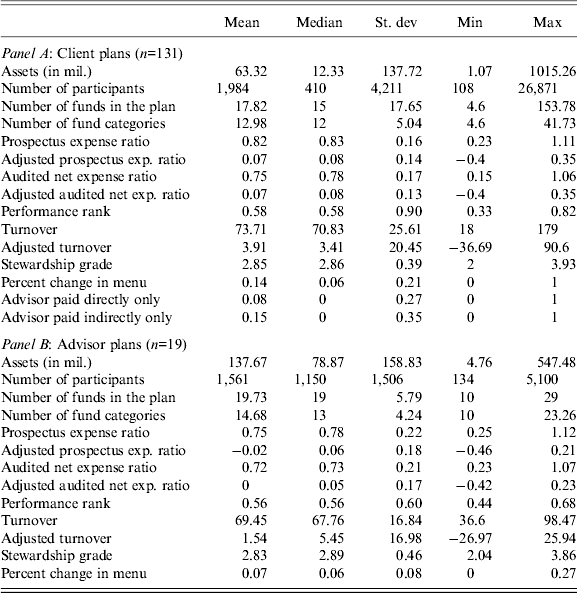
Table 2 shows the descriptive statistics of my dataset. Panel A shows the statistics for the 131 client plans; Panel B does the same for the 19 advisor plans. We see that client plans have on average 63 million dollars in assets and almost 2,000 participants. Advisor plans have on average about the same number of participants but more than twice the assets. This is to be expected as the professionals employed by advisors probably have higher incomes than the average worker at their client firms. We see that on average client plans have about 18 mutual funds in their plans with advisors slightly higher at 20 mutual funds per plan. Both of these are somewhat higher than the average number of investment options of 12 reported by Deloitte (2010). The number of mutual fund categories is also slightly higher for advisor plans (15 fund categories) than client plans (13 fund categories). Thus, advisor plans appear slightly more complex than client plans perhaps reflecting the greater sophistication of participants who work as financial advisors.
Descriptive Statistics
No. of fund categories is the number of Morningstar mutual fund categories represented by the funds in the plan. Prospectus and audited expense ratios are from Morningstar's Principia. Adjusted expense ratios and turnover are differences between actual values and the asset weighted average of funds in the same category. Performance rank is the percentile rank of fund's return in its Morningstar category for 2008 through 2010 (high rank=good performance). Stewardship grade is also from Morningstar's Principia. Fund characteristics are unweighted averages. Percent change in menu is the number of deleted and added funds between 2009 and 2010 divided by the number of funds in 2009 and 2010. The dummies on direct and indirect compensation of advisors are derived from Schedule C of the Form 5500.
The expense ratios in client plans are 0.82 roughly similar to the average of 0.79 reported by ICI (2011). Advisor plans have expense ratios few basis points lower. The style adjusted expense ratios are also a few basis points lower for advisor than client plans. 3-year performance percentile rank in fund's category for 2008 through 2010 is 0.58 and 0.56 for client and advisor plans, respectively. This indicates that funds in both client and advisor plans performed somewhat better than other funds (higher rank percentile rank means better performance). Turnover is also higher for client plans than for advisor plans. The stewardship grade is about 2.8 and roughly the same for clients and advisors. The average change in the menu of investment option is 12% for client plans, and 8% for advisor plans. About one third of plans did not add or delete any funds from their menus between 2009 and 2010, but one plan changed its menu completely. It is this fund that changed its advisor between 2009 and 2010. On average, client plans changed 14% of their menu while advisor plans changed only 7% of their menu. Finally, we see that only 8% of client plans compensated their advisors with direct compensation only; 15% of plans compensated their advisors with indirect compensation only. Thus, the vast majority of plans (77%) were compensated through both direct and indirect means.
3 Analysis
3.1 Is an average advisor plan systematically different from an average client plan?
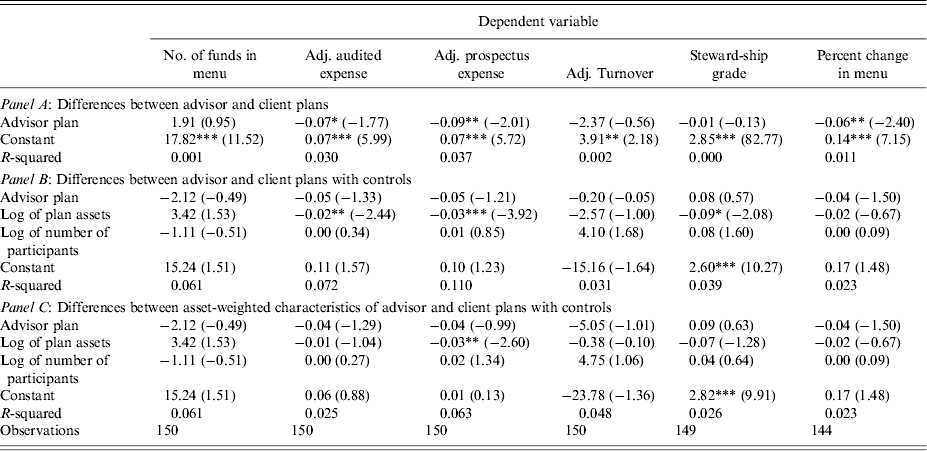
I first examine whether the differences in average characteristics of client and advisor plans are statistically significant and whether they persist after controlling for other plan characteristics. In Panel A of Table 3 I regress various plan characteristics including the number of funds, style-adjusted expense ratios, turnover, and the change in the investment menu on a dummy indicating that a plan is an advisor plan rather than a client plan. I estimate standard errors taking into account their clustering by advisor. The first column shows that advisor plans are not significantly different in terms of the number of mutual fund options they offer. The second and third columns show that advisor plans have somewhat less expensive funds than their clients – both in terms of the style-adjusted audited net expense ratio and in terms of the style-adjusted prospectus expense ratio. The effect is about seven basis points for adjusted audited expense ratio and nine basis points for prospectus expense ratio. The effect is statistically significant at the 10% level for the audited expense ratio and at the 10% level for the prospectus expense ratio. The difference between style-adjusted turnover in advisor and client plans is statistically insignificant. Similarly, there is no difference between the average stewardship grade of client and advisor plans. Finally, advisors change their menus less than clients, the difference is six percentage points and is statistically significant.
Differences in average characteristics of client and advisor plans
The data include 136 client and advisor plans. Advisor plan is a dummy variable equal to one if the plan is that of an advisor. Plan assets are in millions. Adjusted expense ratios and turnover are the differences between actual values and the asset weighted average of funds in the same category. Stewardship grade is from Morningstar's Principia. Percent change in menu is the number of deleted and added funds between 2009 and 2010 divided by the number of funds in 2009 and 2010. t-statistics based on advisor-clustered standard errors are in parentheses. A *, **, and *** denote significance at the 1%, 5%, and 10% levels, respectively.
In Panel B of Table 3, I control for the size of the plan. The statistical significance on the advisor dummy goes away for the audited expense ratio, and becomes statistically insignificant. Thus, controlling for plan size, there is no evidence that client plans have on average more expensive funds. As expected, size of the plan in terms of assets reduces the average expense ratio as bigger size gives plan access to less expensive funds.Footnote 3
Finally, in Panel C I examine if taking into account participant allocations across funds would make advisor and client plans different. Therefore, when averaging down to the plan level data I weigh each fund characteristic by assets invested in that fund. The results again show that there are no statistically significant differences between client and advisor plans.
Overall, the average characteristics of client and advisor plan are similar. In the next two sections, I examine whether this similarity is driven by the similarity in fund holdings.
3.2 Do client plans that have the same advisor have similar funds?
To measure similarity in holding between two plans I use three progressively broader measures of commonality in the investment menu. The first is the percentage of funds that are common to both plans. It is calculated as the number of funds that appear in both plans divided by the average number of funds in the two plans.
 $${\rm Common}\,{\rm funds}_{i{\rm,} j} = \displaystyle{{{\rm no}.\,{\rm of}\,{\rm funds}\,{\rm common}\,{\rm to}\,{\rm plans}\,i\,{\rm and}\,j} \over {{\rm (no}.\,{\rm of}\,{\rm funds}\,{\rm in}\,{\rm plan}\,i + {\rm no}.\,{\rm of}\,{\rm funds}\,{\rm in}\,{\rm plan}\,j)/2}}$$
This measure ranges from zero (no common holdings) to one (complete overlap). The second measure uses the fund family as the indentifying characteristic of a fund. It is the number of funds in both plans that are from the same fund family expressed as the percentage of average number of funds in the two plans. It can be written as follows:
 $$\sum\limits_{{\rm fund}\,{\rm families}} {\displaystyle{{{\rm min(no}{\rm.} \,{\rm of}\,{\rm funds}\,{\rm from}\,{\rm family}\,f\,{\rm in}\,{\rm plan}\,i,\,{\rm no}{\rm.} \,{\rm of}\,{\rm funds}\,{\rm from}\,{\rm family}\,f\,{\rm in}\,{\rm plan}\,j} \over {{\rm (no}{\rm.} \,{\rm of}\,{\rm funds}\,{\rm in}\,{\rm plan}\,i + {\rm no}{\rm.} \,{\rm of}\,{\rm funds}\,{\rm in}\,{\rm plan}\,j)/2}}} $$
The third measure is defined analogously except the defining characteristic of a fund is its Morningstar category.
With 150 different plans I have 11,175 different pairs of plans. Table 4 shows the average value of these three commonality measures for all pairs of plans and for different subsets. Among all plans the average percentage of common fund holdings is about 8%. Naturally, the percentage of common family holdings is much higher at 36%, and still higher when looking at the percentage of funds that belong to the same mutual fund categories. The second and third rows show similarities among client plans, and among advisor plans. I see that advisor plans are somewhat less similar to each other than client plans are to each other. The commonality of holdings between the 131 pairs of advisors and their own clients is 15% – almost double the commonality among all plans. As a check, I calculate the commonality measure between every client and advisors to other plans. The commonality is about 7%. Thus, it is the specific relationship between client and its own advisor that predicts commonality of holdings. Panel B shows that this difference is statistically significant. The last rows in Table 4 show that there is also a great deal of commonality among plans that share the same advisor – about 14%. This is much higher than the commonality among clients that use different advisors – about 7%. Once again, Panel B shows that this difference is statistically significant.
Commonality of plan holdings
Commonality of funds is the share of funds common to each pair of plans. Commonality of fund families is the share of funds in each pair of plans that belong to the same fund family. Commonality of fund categories is the share of funds that belong to the same Morningstar category. Panel A shows the commonality for different sets of pairs of plans. Panel B shows the differences in commonality across different sets of pairs.
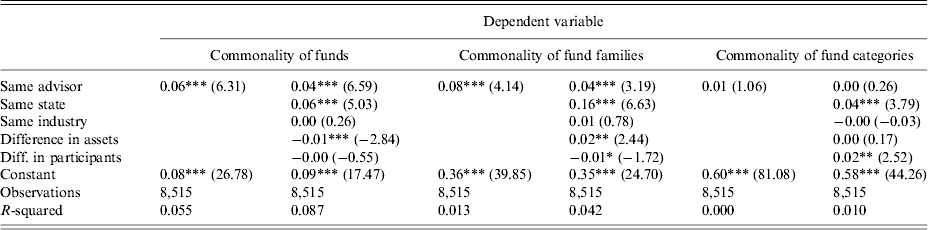
To find out if commonality of holding among plans of the same advisor is driven by some other factors, I estimate a set of regressions where the dependent variable is commonality of holdings, and the independent variables are dummies for whether a pair of plans has the same advisor, are located in the same state, and whether the plan sponsors are in the same industry (identified by a 2-digit SIC). I also calculate the absolute percent difference in size – both in terms of assets and the number of participants. Since I am interested in the impact of having the same advisor on client plans, I use only pairs of client plans in these regressions. With 131 client plans I have 8,515 pairs. The standard error estimates take into account clustering of errors by client.
The results are shown in Table 5. Having the same advisor increases the commonality of fund holdings by six percentage points. Controlling for whether or not plans are in the same state and industry, and for differences in assets and the number of participants, having the same advisor increases fund commonality by four percentage points. The effect of the same advisor is highly statistically significant. Given that the overall commonality of fund holdings is mere 8%, the four percentage point effect of having the same advisor is economically significant. Being in the same state increases commonality by statistically significant six percentage points. Being in the same industry has no effect. The coefficient on the difference in the size in terms of assets is statistically significant showing that plans that are different in size are also different in what funds they hold. The magnitude of the effect is that for each percentage point difference in size the commonality measure decreases by one hundredth of a percentage point.
The determinants of commonality of holdings among client plans
The data use every possible pair among 131 client plans. Same advisor is a dummy indicating that the pair of plans has the same advisor. Same state and same industry are defined analogously. Difference in assets (participants) is the absolute value of the difference in assets (participants) divided by the average assets (participants) of the two plans. Commonality of funs is the percentage of funds common to each pair of plans. Commonality of fund families is the percentage of funds in each pair of plans that belong to the same fund family. Commonality of fund categories is the percentage of funds that belong to the same Morningstar category. t-statistics based on plan-clustered standard errors are in parentheses. A *, **, and *** denote significance at the 1%, 5%, and 10% levels, respectively.
The results are similar when considering commonality of fund families. Controlling for other similarities, plans that have the same advisors have four percentage points more funds come from the same family. The effect of plans being in the same state is a whopping 16 percentage points. The effect of being in the same industry is again statistically insignificant. The effect of the same advisor is negligible when looking at commonality of fund categories. The fact that industry has no effect on commonality of holdings is inconsistent with the hypothesis that plans are designed to diversify participants’ labor income. To the extent that labor income is correlated within industries one would expect plans in the same industry to select similar funds or at least similar categories of funds. Overall, even controlling for a variety of factors, it is clear that having the same advisor predicts commonality of holdings.
3.3 Do clients and their own advisors have similar funds?
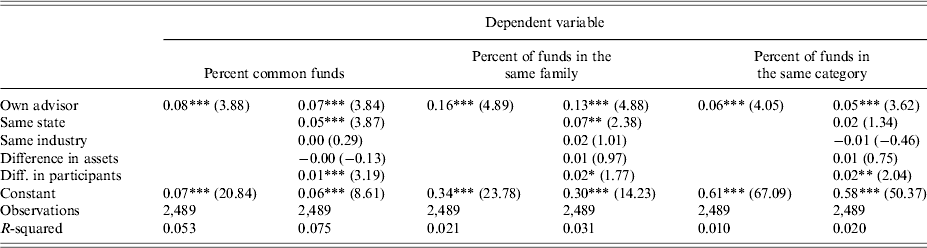
To examine the degree of similarity between clients and their own advisors I re-estimate the regressions in Table 5 using pairs of clients and advisors. This includes pairs of every client with every advisor. The independent variable of interest is the ‘own advisor’ dummy that identifies pairs of clients and their own advisors. The results are in Table 6. They show that commonality of holdings between clients and their own advisors is much higher than between clients and someone else's advisors. This is true across all measures of commonality: individual funds, fund families, and fund categories. The effect is seven percentage points for commonality of funds, 13 percentage points for commonality of fund families, and five percentage points for commonality of fund categories. The effect remains large and significant even after controlling for other commonalities such as same state, industry, number of participants, and size.
The determinants of commonality of holding for client and advisor pairs
The data use pairs of plans every client with every advisor. Own advisor is a dummy indicating that the pair of plans is that of a client and its own advisor. Same state and same industry are defined analogously. Difference in assets (participants) is the absolute value of the difference in assets (participants) divided by the average assets (participants) of the two plans. Commonality of funs is the percentage of funds common to each pair of plans. Commonality of fund families is the percentage of funds in each pair of plans that belong to the same fund family. Commonality of fund categories is the percentage of funds that belong to the same Morningstar category. t-statistics based on plan-clustered standard errors are in parentheses. A *, **, and *** denote significance at the 1%, 5%, and 10% levels, respectively.
3.4 Do clients and advisor add and delete the same funds?
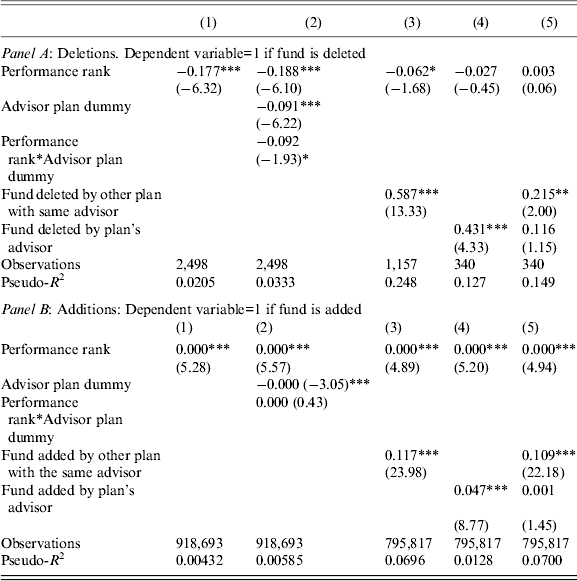
In this section, I ask if clients and plans delete and add the same funds. I use information on 123 client and 13 advisor plans for which I have holding information for both 2009 and 2010. In panel A of Table 7, I report results from probit regressions where the dependent variable is one if a fund was deleted from an investment menu. The first specification shows that, as expected, poorly performing funds are more likely to be deleted. The coefficient on fund's category performance rank is statistically significant and shows that a one decile jump in performance rank decreases the probability of deletion by about 2%. In the second specification, I include a dummy to indicate an advisor plan, and the interaction between that dummy and the performance rank. The interaction effect is negative but statistically significant only at the 10% level showing that advisor plans are probably no more or less sensitive to performance rank than client plans. The advisor dummy is negative and significant showing that advisor plans are about 9% less likely to delete a fund. This is consistent with results reported in Table 3 showing that advisor plans change their menus less than client plans.
Determinants of deletions and additions
The table reports marginal effects of probit regressions. The unit of observation is plan and fund. The observations in panel A regressions include funds that appeared on the 2010 investment menu. The dependent variable in panel A equals one if a fund was deleted from the investment menu, zero if the fund remained on the menu. Performance rank is fund's percentile performance rank in the fund's category (high rank means good performance) from 2008 to 2010. Advisor plan dummy equals one of plan is an advisor plan. In specification (2), the marginal effect of performance rank is calculated given that advisor plan dummy is zero; the interaction term shows the marginal effect given that advisor plan dummy is one; the marginal effect of advisor plan dummy is calculated at mean performance rank. Specification (3) includes only client plans and funds that appeared on the investment menu of at least two plans who share an advisor. Specifications (4) and (5) include plans and funds that appeared on client and their advisors’ menus. The observations in panel B regressions include funds available for investment by each plan. The dependent variable in panel B equals one if a fund was added to the investment menu, zero otherwise.
In specification (3) in panel A of Table 7 I consider only funds that in 2009 appeared on at least two client plans that shared an advisor. I include a dummy indicating that another client of a plan's advisor deleted a fund. The effect is very strong and statistically significant. When one client of an advisor deletes a fund, it increases the probability that another client of that advisor deletes the fund by 50%. Specification (4) shows that if a plan's advisor deletes a fund, the client is 20% more likely to delete that fund. Including both the dummy for another client deleting a plan, and the dummy for advisor deleting a plan in specification (5) shows that controlling for another client deleting a fund, advisor deleting a plan does lead to that funds deletion. In summary, what other clients of a plans advisor are doing has a bigger effect than what the advisor is doing himself/herself.
Panel B of Table 7 shows analogous results for fund additions. The observations in these regressions consist of Morningstar universe of funds (not share classes) for each plan. Thus, I have over 7,000 observations for each plan. The dependent variable equals one if the plan added a specific fund, zero otherwise. Given the large number of funds in the fund universe compared to 10–20 investment options, only 0.04% of funds were added. The results show that additions are influenced by performance rank – the better performing funds are more likely to be added. As with deletions, advisor plans are no more sensitive to performance than client plans. And, as with deletions, another client of a plan advisor adding a fund had a bigger effect than advisor him- or herself adding that fund.
In summary, and not surprisingly, given the commonality of holdings documented in section 3.3, deletions and additions follow the pattern of commonality of holdings: plans that have the same advisor tend to delete and add the same funds. Another piece of evidence that advisors have an impact on their clients is from the 11 clients that switched advisors between 2009 and 2010. Of those 11, one plan changed its menu completely, another replaced 75% of its funds. On average, funds that had a new advisor changed their menu by 44% compared to 10% for plans that did not change their advisor.
3.5 What funds do clients hold that advisors don't and vice versa?
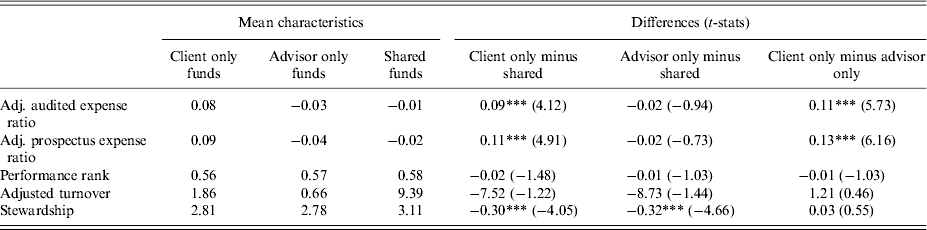
In section 3.3 I found that clients and advisors on average share only 15% of investment options. In this section, I examine the portion of plan holdings that advisors and clients do not share. Specifically, for each client and advisor pair I calculate the characteristics of three groups of funds: funds held by the client but not by the advisor (‘client only’ funds); funds held by the advisor but not by the client (‘advisor only’ funds); and funds held by both clients and advisors (‘shared’ funds).
Table 8 shows the characteristics of these three groups of funds. It shows that adjusted audited and prospectus expense ratios of ‘client only’ funds are nine and eleven basis points higher than the expense ratios of funds that advisor and clients share. The effect is statistically significant with the t-statistic of about four. 'Client only’ funds are even more expensive when compared to advisor only plans. The effect is eleven basis points using audited expense ratio and 13 basis points using prospectus expense ratio. Interestingly, the difference between funds that advisors share with their clients and funds that only advisors use are small and statistically insignificant. The differences for turnover and performance across all three groups are insignificant. The fourth row shows that ‘client only’ funds have lower stewardship grades than funds shared with advisors. The effect is 0.3 of a grade point and is highly statistically significant. In summary, it appears that ‘client only’ funds are more expensive and poorly governed.
Characteristics of ‘client only’ and ‘advisor only’ funds
Client only funds are mutual funds in client's plan not found in the client's advisor's plan. Advisor only funds are defined analogously. Share funds appear in both client and advisor plans. The data are 130 client plans. (One client plan is excluded because it had no client only funds.)
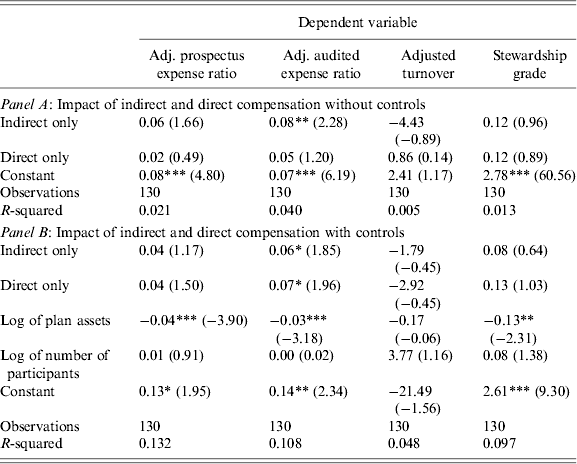
Impact of indirect and direct compensation on client only fund characteristics
The data are 130 client plans. The dependent variables are characteristics of funds found only in clients’ plans. Indirect only is a dummy variable indicating that a plan compensated its advisor only indirectly. Direct only is defined analogously. The base category is plans that compensated their advisors both directly and indirectly. t-statistics based on advisor-clustered standard errors are in parentheses. A *, **, and *** denote significance at the 1%, 5%, and 10% levels, respectively.
3.6 Does indirect compensation of advisors impact the characteristics of their clients’ plans?
Why are ‘client only’ funds significantly more expensive and poorly governed? Moreover, why do advisors shun these funds but allow them in their clients’ plans? One hypothesis is that advisors benefit from having their clients hold expensive funds. Advisors may receive indirect compensation in the form of commissions and revenue sharing – the more expensive the funds in their client plans, the more commissions and revenue sharing.
I test this hypothesis by regressing the characteristics of the ‘client only’ funds on the two dummies capturing the nature of advisor's compensation. This divides the client plans into three groups: those that compensate advisors only indirectly (20 plans), those that use only direct compensation (10 plans) and those that use both types of compensation (100 plans). With the vast majority of plans using both types of compensation, there is little statistical power to detect significant differences. Nonetheless, the results in Panel A of Table 9 show that compared to plans that use both types of compensation, plans that use only indirect means have significantly higher adjusted audited expense ratios. There is no statistically significant difference between ‘indirect only’ and ‘direct only’ plans, nor there is a difference between ‘direct only’ plans and plans that use both types of compensation. The significance on ‘indirect only’ dummy drops to the 10% level when I control for plan size in Panel B. Type of compensation does not matters for the adjusted prospectus expense ratio, adjusted turnover or stewardship grade. Overall, the results are somewhat inconclusive as to whether the nature of advisor's compensation plays a role in the types of funds clients hold.
4 Conclusion
This paper shows that financial advisors play an important role in determining 401k menus of their clients. Clients of the same advisor tend to have similar plans, and these plans are similar to the advisor's plan. They also tend to delete and add the same funds. Thus, to a large extent 401k advisors take their own advice. However, funds in clients’ plans that are not included in the advisors’ plan have significantly higher expense ratios than funds that clients and advisors share. I could not find conclusive evidence that plans with directly compensated advisors have less expensive plans than plans with indirectly compensated advisors. Nevertheless, given that 92% of advisors in my sample receive at least some indirect compensation, recommending more expensive funds is in the advisors’ interest though not necessarily in the interest of their clients.
Aligning the incentives of the advisors with those of plan sponsors and plan participants could be an important step in improving the quality of 401k menus. While advisors should be compensated it is not clear that indirect compensation is the optimal arrangement. First, the cost of the advisor is unevenly distributed. Participants who invest in the expensive funds bear the cost of plan advice. Second, as Gil-Bazo and Ruiz-Verdú (Reference Gil-Bazo and Ruiz-Verdú2009) find, high-cost funds tend to perform worse even before fees. Therefore, using high-cost funds to compensate advisors entails additional costs in the form of lower fund performance. Finally, since the disclosure of indirect compensation has only been mandated since 2009, it is not clear that all plan sponsors realize the amount of indirect compensation that advisors receive thereby possibly paying more than if the compensation were direct and more transparent.