Introduction
Electronic cigarette (e-cigarette) use is increasing in the USA (King, Patel, Nguyen, & Dube, Reference King, Patel, Nguyen and Dube2015; McMillen, Gottlieb, Shaefer, Winickoff, & Klein, Reference McMillen, Gottlieb, Shaefer, Winickoff and Klein2015). In 2014, 12% of adults used e-cigarettes and almost 4% used them daily (Schoenborn & Gindi, Reference Schoenborn and Gindi2015). Among those who have ever used an e-cigarette, 70% currently smoke traditional cigarettes and 20% are former smokers (Farsalinos, Poulas, Voudris, & Le Houezec, Reference Farsalinos, Poulas, Voudris and Le Houezec2016). Between 70% and 80% of e-cigarette users report use as a smoking cessation aid (Coleman et al., Reference Coleman, Rostron, Johnson, Ambrose, Pearson, Stanton and Hyland2017; Patel et al., Reference Patel, Davis, Cox, Bradfield, King, Shafer and Bunnell2016). Among US smokers, twice as many report using an e-cigarette as part of their quit attempt as compared to a nicotine patch or gum (Caraballo, Shafer, Patel, Davis, & McAfee, Reference Caraballo, Shafer, Patel, Davis and McAfee2017).
Recent reviews suggest that e-cigarette use may help smokers quit (Gualano et al., Reference Gualano, Passi, Bert, La Torre, Scaioli and Siliquini2015; Khoudigian et al., Reference Khoudigian, Devji, Lytvyn, Campbell, Hopkins and O'Reilly2016; Malas et al., Reference Malas, van der Tempel, Schwartz, Minichiello, Lightfoot, Noormohamed and Ferrence2016; McRobbie, Bullen, Hartmann-Boyce, & Hajek, Reference McRobbie, Bullen, Hartmann-Boyce and Hajek2014; Rahman, Hann, Wilson, Mnatzaganian, & Worrall-Carter, Reference Rahman, Hann, Wilson, Mnatzaganian and Worrall-Carter2015) with predictors of success being frequent use (Biener & Hargraves, Reference Biener and Hargraves2015; Brose, Hitchman, Brown, West, & McNeill, Reference Brose, Hitchman, Brown, West and McNeill2015; Subialka Nowariak, Lien, Boyle, Amato, & Beebe, Reference Subialka Nowariak, Lien, Boyle, Amato and Beebe2018), use of newer generation, refillable tank e-cigarette products (Hitchman, Brose, Brown, Robson, & McNeill, Reference Hitchman, Brose, Brown, Robson and McNeill2015), and use with the specific purpose of quitting (Vickerman et al., Reference Vickerman, Schauer, Malarcher, Zhang, Mowery and Nash2017b). However, e-cigarette users appear to be a unique subgroup of smokers who tend to experience greater difficulty in quitting. Compared to non-users, they are more likely to be heavy smokers (Biener & Hargraves, Reference Biener and Hargraves2015), have a mental health condition (Spears, Jones, Weaver, Pechacek, & Eriksen, Reference Spears, Jones, Weaver, Pechacek and Eriksen2016), and have made more prior quit attempts (Zhu et al., Reference Zhu, Gamst, Lee, Cummins, Yin and Zoref2013). Given that more quit attempts are related to higher nicotine dependence, this may inhibit successful quitting (Gelenberg, de Leon, Evins, Parks, & Rigotti, Reference Gelenberg, de Leon, Evins, Parks and Rigotti2008; John, Meyer, Hapke, Rumpf, & Schumann, Reference John, Meyer, Hapke, Rumpf and Schumann2004).
E-cigarette use is common among smokers who utilize US quitline services. In 2012, 31% of quitline callers reported having ever used an e-cigarette (Vickerman, Carpenter, Altman, Nash, & Zbikowski, Reference Vickerman, Carpenter, Altman, Nash and Zbikowski2013). Between 2013 and 2015, 10% of quitline participants were using e-cigarettes at the time of enrollment (Vickerman, Beebe, Schauer, King, & Magnusson, Reference Vickerman, Beebe, Schauer, King and Magnusson2015a). These estimates are consistent with rates in the general population of smokers, 38% ever use and 11% current use, respectively (Levy, Yuan, & Li, Reference Levy, Yuan and Li2017). In a small sample of quitline callers, most e-cigarette users stated that doing so helped them cut down or quit smoking, though they differed in whether they preferred e-cigarettes to other nicotine replacement therapies or medications approved by the US Food and Drug Administration (FDA) (Vickerman, Beebe, Schauer, Magnusson, & King, Reference Vickerman, Beebe, Schauer, Magnusson and King2017a). In a separate quitline study, those who used e-cigarettes for a purpose other than quitting tobacco were less likely to be abstinent at follow-up compared to those using e-cigarettes as a cessation aid (Vickerman et al., Reference Vickerman, Schauer, Malarcher, Zhang, Mowery and Nash2017b).
To assess the association between e-cigarette use and tobacco cessation, patterns of e-cigarette use and user characteristics (e.g., mental health condition, nicotine dependence) must be taken into account. Prior studies of e-cigarette use in quitline settings did not control for these factors (Vickerman et al., Reference Vickerman, Carpenter, Altman, Nash and Zbikowski2013) or the analysis was restricted to a distinctive population of tobacco users, like employer and health plan-sponsored quitline callers (Vickerman et al., Reference Vickerman, Schauer, Malarcher, Zhang, Mowery and Nash2017b). The purpose of this study was to examine the association between e-cigarette use and tobacco cessation within a general population of tobacco users participating in a quitline program. Using caller data from the Arizona Smokers’ Helpline (ASHLine), we first assessed this association among participants who reported using an e-cigarette at any time during their quit attempt. We then investigated patterns of e-cigarette use in an exploratory analysis to examine if tobacco cessation outcomes varied for e-cigarette users who sustained, adopted, or discontinued use between enrollment and follow-up. Adjusting for mental health status, cessation medication use, and program utilization, we hypothesized that in the primary analysis, callers ever using e-cigarettes would not experience different odds of quitting compared to those who did not use.
Methods
Study sample and setting
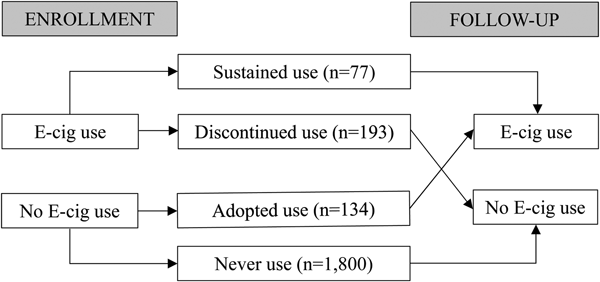
In this retrospective cohort study, we examined data from ASHLine callers who received tobacco cessation assistance between April 2014 and June 2016. Program callers were eligible for analysis if they completed enrollment and 7-month follow-up surveys between November 2015 and January 2017 and responded to the e-cigarette use and covariate questions at both time points (Figure 1). We used de-identified data and followed STROBE (Strengthening The Reporting of Observational Studies) checklist guidelines (von Elm et al., Reference von Elm, Altman, Egger, Pocock, Gøtzsche and Vandenbroucke2007). The University of Arizona's Institutional Review Board reviewed our study protocol and deemed it to be exempt.
Sample selection diagram.

ASHLine is a state-based quitline that provides telephone-based behavioral coaching and up to 4 weeks of nicotine replacement therapy (NRT) – patches, gum, and lozenges – to support cessation for tobacco users living in Arizona. Participants are assigned a coach trained in motivational interviewing and cognitive behavioral strategies for quitting tobacco. Coaches proactively call program participants and assist them to identify triggers, set quit dates, develop strategies to manage their urges to smoke, set cessation goals, and provide positive reinforcement. To promote relapse prevention, callers are encouraged to continue participating in weekly or biweekly coaching sessions until they become 90-days abstinent. After 90-days, callers receive a certificate of achievement and are graduated from the program.
Measures
We assessed e-cigarette use by asking, ‘are you using e-cigarettes?’ at enrollment and 7-month follow-up. In the primary analysis, e-cigarette use reported at the time of enrollment, follow-up, or both were classified as any use. To account for differences in e-cigarette use, in the exploratory analysis we created four user categories: (1) sustained user – use at enrollment and follow-up, (2) adopted user – use at follow-up but not enrollment, (3) discontinued user – use at enrollment but not at follow-up, and (4) non-user – no use at enrollment or follow-up (Figure 2). The primary outcome was tobacco cessation 7-months after enrollment, measured as self-reported, 30-day point prevalence abstinence.
Client distribution across e-cigarette use categories.

We selected additional covariates based on a review of the literature. Low income, racial minority, and chronically ill individuals are known to smoke at disproportionately high rates (CDC's Office on Smoking & Health, 2016; Schroeder & Morris, Reference Schroeder and Morris2010). Smoking history, dependence, and perceived ability to quit are also associated with smokers’ odds of quitting (Vangeli, Stapleton, Smit, Borland, & West, Reference Vangeli, Stapleton, Smit, Borland and West2011). To account for these factors, we included demographic and tobacco use history variables. At enrollment, callers self-reported their gender (male, female), age (18–24, 25–44, 45–64, 65+), race (white, non-white), ethnicity (Hispanic, non-Hispanic), and education (HS or less, some college or more). We measured chronic health status (yes, no) as having ever been diagnosed with at least one of the following conditions: asthma, hypertension, cancer, chronic obstructive pulmonary disease (COPD), diabetes, or heart disease. We assessed mental health status (yes, no) as having ever been diagnosed with at least one of the following: anxiety disorder, depression, bipolar disorder, schizophrenia, or alcohol or drug abuse disorder.
At the time of enrollment, we used the Fagerström test to assess nicotine dependence (low 0–2, moderate 3–5, heavy 6–10) (Heatherton, Kozlowski, Frecker, & Fagerström, Reference Heatherton, Kozlowski, Frecker and Fagerström1991). Home smoking bans were assessed and individuals were assigned to one of three categories: smoking not allowed anywhere in the home (full ban), smoking allowed in some places (partial ban), and smoking allowed anywhere (no ban). We dichotomized callers’ confidence in quitting as not confident (not or somewhat confident) and confident (confident, very confident, or extremely confident). Callers’ intention to quit tobacco in the next 30 days was assessed using a single-item measure (yes, no). We also included program engagement variables to control for variance in treatment engagement and/or intensity: self-reported use of cessation medication during the quit attempt (yes, no), number of coaching sessions (0–3, 4–7, 8+), and program completion status (completed, did not complete). We created coaching session categories based on prior literature that showed limited effect from few sessions (Fiore et al., Reference Fiore, Jaen, Baker, Bailey, Benowitz, Curry and Wewers2008; Stead, Hartmann-Boyce, Perera, & Lancaster, Reference Stead, Hartmann-Boyce, Perera and Lancaster2013) and declining effect after 90 or more total minutes of counseling, or about eight sessions (Fiore et al., Reference Fiore, Jaen, Baker, Bailey, Benowitz, Curry and Wewers2008). To complete the program, callers participated in coaching sessions for at least 90 days after becoming tobacco abstinent.
Primary analysis
We used χ2 and t-tests to examine demographic, tobacco use history, and program differences between callers who used and did not use e-cigarettes. We fit logistic regression models to examine unadjusted and adjusted odds ratios (OR) and 95% confidence intervals (CI) of 30-day point prevalence abstinence for e-cigarette use at enrollment or 7-month follow-up. Prior to analyses, we used the literature to guide the variable selection process. Covariates that were originally continuous (age, Fagerström score, and number of coaching sessions) were tested in the logistic unit using restricted cubic splines and did not meet linearity (Desquilbet & Mariotti, Reference Desquilbet and Mariotti2010). They were categorized to meet the assumptions for logistic regression. Wald tests were used to assess interactions between e-cigarette use and mental health, gender, age, and Fagerström score.
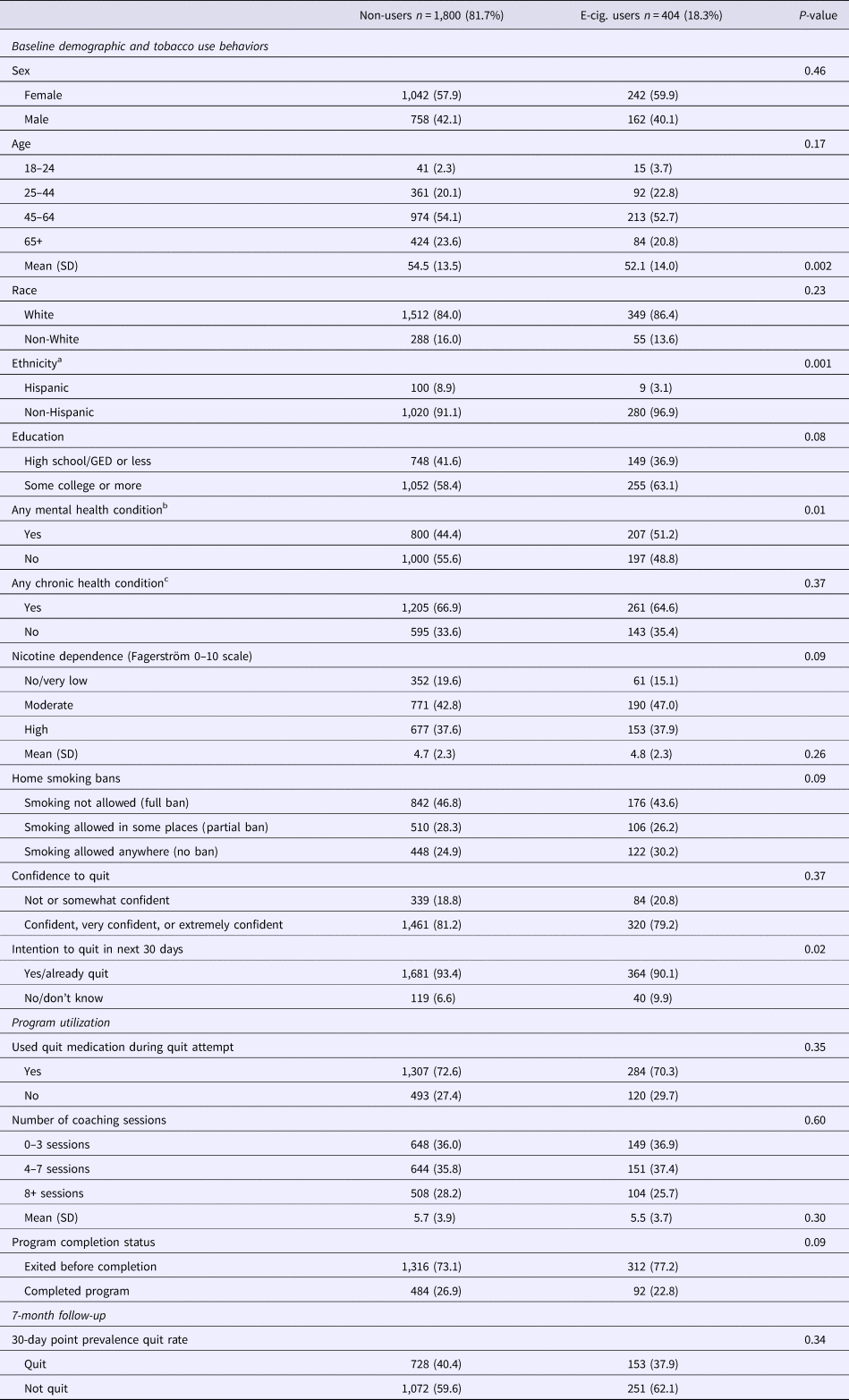
Initially, we included all the variables presented in Table 1 in a full model, except for ethnicity. It was not included due to a high degree of missingness (33%). This represents our full model. To avoid model over fit, we used backward selection to identify and remove variables that were not significantly associated with 30-day abstinence at 7-month follow-up. We excluded covariates with a P-value >0.2. Gender, age, mental health condition, nicotine dependence, home smoking ban, intention to quit, and program completion remained. This represents our reduced model. We used a likelihood ratio test to assess differences between the full and reduced models.
ASHLine client demographics, smoking history, program engagement, and follow-up responses by dichotomous e-cigarette use status (April 2014–June 2016)

SD, standard deviation.
Categorical variables display n (%) and continuous variables display mean (SD).
a Ethnicity is missing for 795 clients.
b Mental health conditions: anxiety, depression, bipolar disorder, alcohol/drug abuse, or schizophrenia.
c Chronic health conditions include: asthma, cancer, COPD, diabetes, heart disease, or hypertension.
Exploratory analysis
To examine our exploratory hypothesis, we changed the primary independent variable by categorizing e-cigarette use to reflect four patterns of use – sustained use, adopted use, discontinued use, and did not use e-cigarettes (Figure 2). We used ANOVA and χ2 tests to examine group differences by caller characteristics and program utilization. We used logistic regression models to assess unadjusted and adjusted odds of 30-day abstinence for the different e-cigarette use patterns. Backward variable selection was again used to remove covariates that overfit the full model. The reduced model in the exploratory analysis included the same covariates as in the primary analysis, with the exception that race was retained and age was removed. As before, a likelihood ratio test was used to compare the exploratory full and reduced models. All statistical tests were based on a significance level of 0.05 and were performed in SAS 9.4 (SAS Institute, Cary, NC).
Results
Primary analysis
Between April 2014 and January 2017, 2,204 ASHLine callers provided complete information in enrollment and 7-month follow-up surveys. Just over 12% reported using e-cigarettes at the time of enrollment and 18% at enrollment, follow-up, or both. Two of the 2,204 callers (0.1%) reported only using e-cigarettes, and not tobacco, at the time of enrollment.
Compared to non-users, callers who used e-cigarettes at any time during their quit were more likely to be younger, non-Hispanic, not intending to quit tobacco in the next 30 days, and reported having a mental health condition. Callers’ gender, race, education, other chronic health conditions, nicotine dependence, home smoking bans, and confidence to quit were not statistically different between callers who used e-cigarettes at any point during their quit attempt and those who did not. E-cigarette use was not associated with callers’ utilization of program services – about 70% of all callers used NRT and received around 5.5 coaching sessions. About 27% of non-users and 23% of e-cigarette users remained in the program until completion (Table 1).
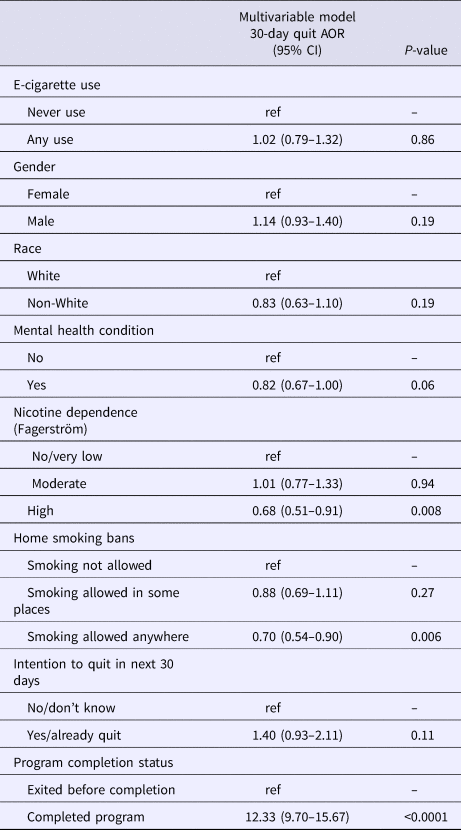
In a crude model, e-cigarette use was not associated with quitting. Compared to non-users, the unadjusted odds of quitting were not statistically significant for callers who used e-cigarettes (OR = 0.90, 95% CI 0.72–1.12). Results from the multivariable logistic regression model are provided in Table 2. No interaction terms were included because they were all found not to be significant in the model. The likelihood ratio test showed there was not a significant difference in fit between the full and reduced models, so we used the reduced model (P < 0.77). In the reduced model, the adjusted odds of any e-cigarette use was also non-significant (OR = 1.02, 95% CI 0.79–1.32). However, callers who completed ASHLine's program and received coaching for 90 days while abstinent were over three times more likely to be quit at follow-up compared to those who exited early (OR = 12.33, 95% CI 9.70–15.67) regardless of e-cigarette use. Compared to no or low dependence, high nicotine dependence (OR = 0.68, 95% CI 0.51–0.91) was negatively associated with being quit at follow-up. Likewise, the absence of home smoking bans was associated with lower odds of being quit (OR = 0.70, 95% CI 0.54–0.90). Having a mental health condition neared statistical significance (OR = 0.82, 95% CI 0.67–1.00).
Adjusted odds ratios (AOR) of 30-day point prevalence tobacco abstinence (n = 2,204) for dichotomous e-cigarette use

Exploratory analysis
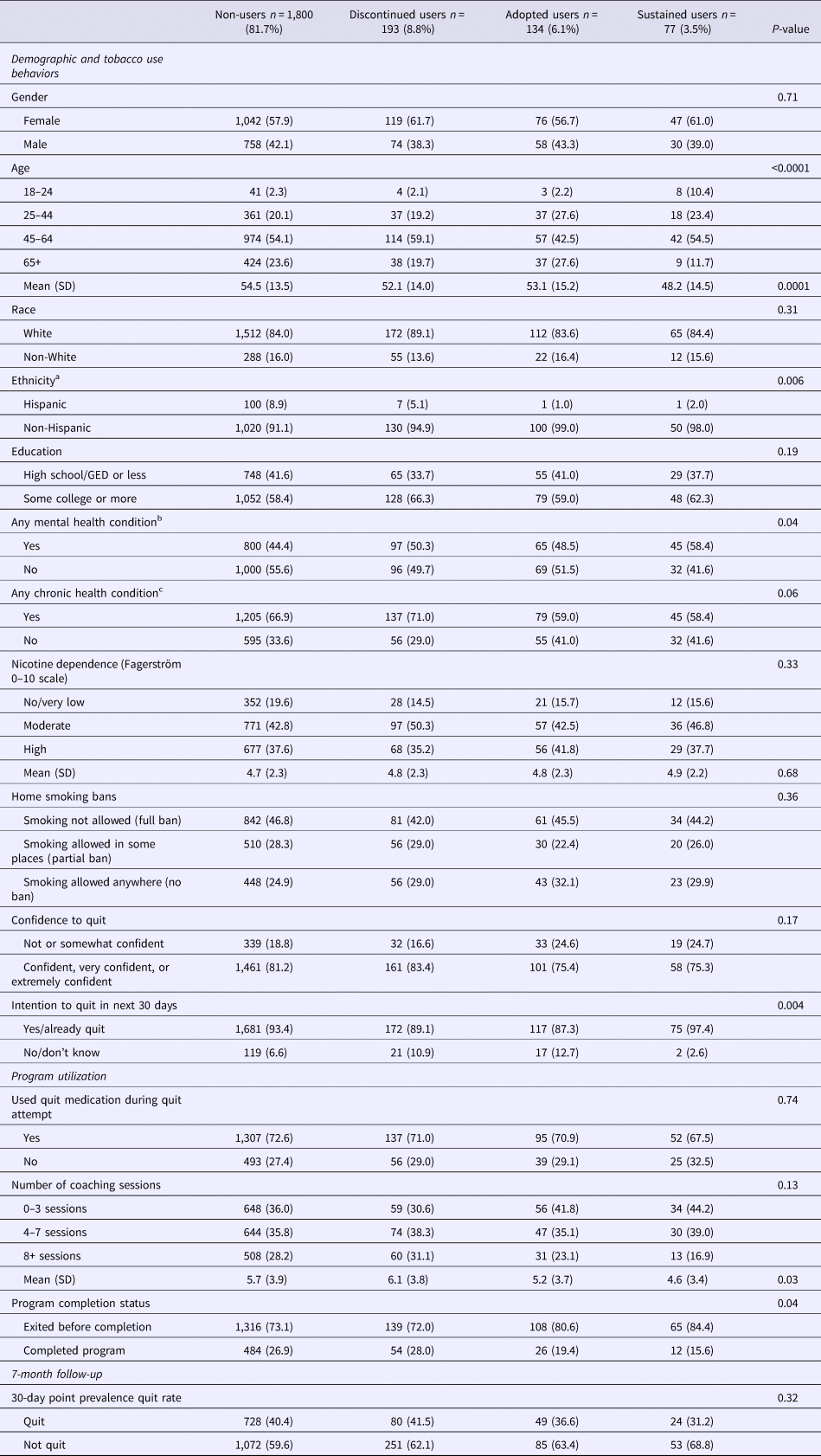
In the exploratory analysis, descriptive findings of the patterns of e-cigarette use were similar to the primary analysis, with a few important differences. All three e-cigarette user groups were younger and less likely to be Hispanic than non-users. However, the sustained user group differed from the other e-cigarette groups. Nearly 60% of sustained users reported having a mental health condition compared to 44% of non-users. At enrollment, a higher proportion of sustained users also reported intending to quit smoking in the next 30 days compared to adopted, discontinued, or never users, though sustained users received fewer coaching sessions and were less likely to complete the program than the other groups of e-cigarette users (Table 3).
ASHLine client demographics, smoking history, program engagement, and follow-up responses by categorized e-cigarette use (April 2014–June 2016)

SD, standard deviation.
Categorical variables display n (%) and continuous variables display mean (SD).
a Ethnicity is missing for 795 clients.
b Mental health conditions: anxiety, depression, bipolar disorder, alcohol/drug abuse, or schizophrenia.
c Chronic health conditions include: asthma, cancer, COPD, diabetes, heart disease, or hypertension.
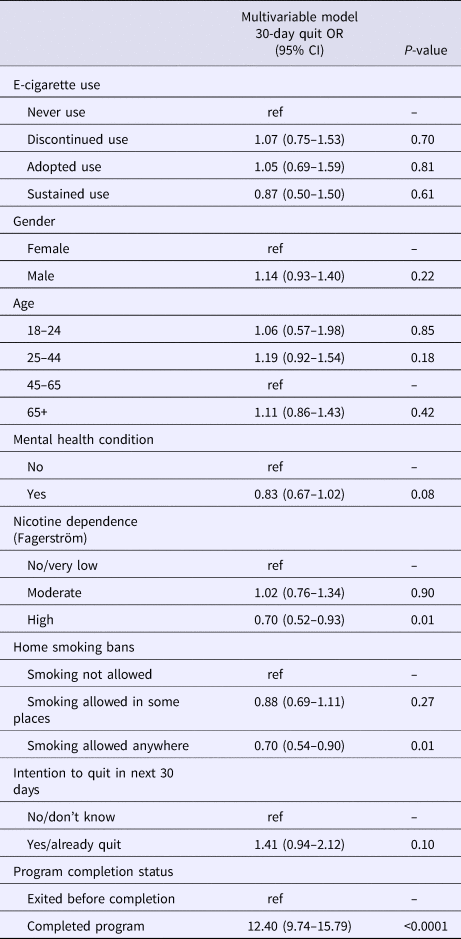
We reassessed the same interaction terms and again found them to be non-significant. Similar to the primary analysis, we did not identify an association between e-cigarette use and tobacco cessation. Compared to non-users, the unadjusted odds of quitting were not significant for sustained e-cigarette users (OR = 0.78, 95% CI 0.54–1.12), adopted users (OR = 0.84, 95% CI 0.64–1.10), or discontinued users (OR = 0.91, 95% CI 0.73–1.13). The exploratory multivariable logistic regression model results are provided in Table 4. The likelihood ratio test did not show a significant difference in fit between the full and reduced models (P < 0.62). As before, we presented findings from the reduced model. In the adjusted, reduced model, the odds of quitting remained unchanged. Callers who sustained (OR = 0.87, 95% CI 0.50–1.50), adopted (OR = 1.05, 95% CI 0.69–1.59), or discontinued e-cigarette use (OR = 1.07, 95% CI 0.75–1.53) were no more likely to be quit at 7-month follow-up compared to callers who never used e-cigarettes.
OR of 30-day point prevalence tobacco abstinence (n = 2,204) for categorized e-cigarette use

Discussion
E-cigarette use has become more common among smokers who utilize quitline services. For example, we found that 12% of ASHLine callers used e-cigarettes at enrollment, similar to the 10% average identified among 25 US state-based quitlines (Vickerman et al., Reference Vickerman, Beebe, Schauer, King and Magnusson2015a). However, we found that e-cigarette use was not associated with 7-month quit outcomes. These results remained when we classified e-cigarette use as any/no use or by categorical patterns of use – sustained, adopted, discontinued, or none. Our results are congruent with previous observational studies that have found no association between e-cigarette use and tobacco cessation (Glasser et al., Reference Glasser, Collins, Pearson, Abudayyeh, Niaura, Abrams and Villanti2017), including a study of quitline callers (Vickerman et al., Reference Vickerman, Schauer, Malarcher, Zhang, Mowery and Nash2017b).
A strength of this study is that it controlled for co-morbid mental health conditions. Prior research has shown that quitline callers may have twice the prevalence of mental health conditions than the national average of tobacco users (Hebert, Cummins, Hernandez, Tedeschi, & Zhu, Reference Hebert, Cummins, Hernandez, Tedeschi and Zhu2011) and those with mental health conditions experience greater difficulty in quitting (Lukowski, Morris, Young, & Tinkelman, Reference Lukowski, Morris, Young and Tinkelman2015; Vickerman et al., Reference Vickerman, Schauer, Malarcher, Zhang, Mowery and Nash2015b). In this study, the prevalence of having a mental health condition was greater among individuals who used e-cigarettes, particularly among sustained users. This may indicate that in a quitline setting, e-cigarette users are a unique group of tobacco users who experience additional barriers in quitting.
Our findings suggest that e-cigarette use may neither facilitate nor deter tobacco cessation among quitline callers. In building quitline practices, it is possible to interpret these findings in a few ways. Given that e-cigarettes are not an evidence-based practice and have not been approved by the FDA, quitlines may instruct coaches to discourage callers from using e-cigarettes as a cessation aid. Instead, they may emphasize other approved cessation mediations and nicotine therapies. Surveyed quitline staff in the USA and Canada agreed with this position; the majority of coaches reported perceiving e-cigarettes to be ineffective, addictive, and more similar to cigarettes than NRT (Cummins et al., Reference Cummins, Leischow, Bailey, Bush, Wassum, Copeland and Zhu2016).
However, quitline coaches’ perspectives may be at odds with callers’ interests. Research suggests that quitline callers are interested in counseling that informs and supports those who are interested in using traditional nicotine replacement products, e-cigarettes, or a combination of both (Vickerman et al., Reference Vickerman, Beebe, Schauer, Magnusson and King2017a). As Cummins et al. (Reference Cummins, Leischow, Bailey, Bush, Wassum, Copeland and Zhu2016) note, quitline coaches commonly provide guidance around other unproven aids, like herbs or acupuncture, and usually prioritize encouraging smokers to make a quit attempt over using a specific method. In their view, hardline positions against e-cigarettes may be inconsistent with traditional quitline practices. Noteworthy, as of 2015, no US quitline service provider had implemented a specialized e-cigarette protocol (Linde, Ebbert, Talcott, and Klesges, Reference Linde, Ebbert, Talcott and Klesges2015).
In this study, callers who completed ASHLine's program had greater odds of being tobacco abstinent at 7-month follow-up, regardless of e-cigarette use. Likewise, positive lifestyle changes like instituting a home smoking ban were also more strongly associated with quitting than e-cigarette use (Jung, Schweers, Bell, Nair, & Yuan, Reference Jung, Schweers, Bell, Nair and Yuan2017). Although sustained e-cigarette users were the most likely to report an intention to quit in the next 30 days, they received fewer coaching calls and had the lowest program completion rate compared to the other groups. An e-cigarette coaching protocol that emphasizes program engagement may better allow coaches to address these individuals’ unique barriers to quitting tobacco. This may also increase program engagement and reduce non-adherence and drop-out which are known problems within quitline services (Burns, Levinson, & Deaton, Reference Burns, Levinson and Deaton2012).
Future research
It is important to continue exploring how e-cigarette use may impact quitting. This is especially relevant in quitline settings where participants are actively seeking to quit tobacco. As we have noted, e-cigarette users appear to be a distinct group of smokers. Their decision to self-select e-cigarette use may follow from perceived lower appeal or benefit from traditional NRT and abstinence-focused services. These callers may be better served by developing more inclusive and flexible protocols. The National Academies of Sciences, Engineering, and Medicine (2018) indicates that e-cigarettes may be effective smoking cessation aids, but evidence is limited and uncertain. Future studies that incorporate shared decision-making practices, particularly around the use of e-cigarette, would provide the much-needed additional evidence and preliminary efficacy data within a quitline setting. Given the variety of e-cigarette product types, modes of use, and contradictory recommendations around using e-cigarettes (Brady, De La Rosa, Nair, and Leischow, Reference Brady, De La Rosa, Nair and Leischow2019), it will be important for quitlines to determine how best to tailor coaching protocols to assist e-cigarette users in quitting tobacco.
Limitations
There are several limitations to this study. In addition to measuring any e-cigarette use, more robust measures of e-cigarette use are needed. The findings in the current analysis may be due to our study's small sample as well as to the limited measure of e-cigarette use. As a cohort of quitline callers, these results may not generalize to all smokers. The sample may also be biased from excluding callers lost at follow-up or missing values for key variables. However, our sample attrition is consistent with dropout rates found among US quitlines nationally. In 2017, US quitlines reported reaching between 20% and 57% of callers at 7-month follow-up (North American Quitline Consortium, 2018). Finally, these data are based on caller self-report, including callers’ e-cigarette and tobacco use status. Self-reported outcomes, especially when they are socially expected, are known to be inflated. In quitline settings, however, the degree of inflation has been shown to be minor (North American Quitline Consortium, 2009). Finally, because the results are observational in nature, they should not be used to infer causality.
Conclusion
We found that almost one in five callers to the ASHLine used e-cigarettes during their quit attempt. After controlling for important demographic, tobacco use, and program utilization factors, we did not find that e-cigarette use was statistically associated with tobacco cessation at 7-month follow-up. This result remained when we differentiated by pattern of e-cigarette use – sustained, adopted, discontinued, or none.
Author ORCIDs
Benjamin R. Brady, 0000-0003-3534-1027.
Acknowledgements
This research was supported by the Arizona Department of Health Services and Arizona Smokers’ Helpline.
Financial support
This research was supported by the Arizona Department of Health Services Grants ADHS11-007339, ADHS16-106672, and ADHS13-026130:5. Services and products in support of the research project were generated by the University of Arizona Cancer Center Behavioral Measurement and Interventions Shared Resource, supported, in part, with funding from NIH-NCI Cancer Center Support Grant P30 CA023074. The content is solely the responsibility of the authors and does not necessarily represent the official views of the funding agencies or the University of Arizona.
Conflict of interest
None.
Ethical standards
The authors assert that all procedures contributing to this work comply with the ethical standards of the relevant national and institutional committees on human experimentation and with the Helsinki Declaration of 1975, as revised in 2008.