Nonspecific signs and symptoms of infection make diagnosis of true urinary tract infections (UTIs) challenging, particularly when confounded by multiple comorbid conditions.Reference Foxman1,Reference Magill, Edwards and Bamberg2 Positive urine culture results often unduly influence clinical decision making, leading to systemic antibiotic therapy.Reference Drekonja, Abbo, Kuskowski, Gnadt, Shukla and Johnson3,Reference Flokas, Andreatos, Alevizakos, Kalbasi, Onur and Mylonakis4 Positive urine cultures in the absence of signs and symptoms of true UTI, defined as asymptomatic bacteriuria (ASB), rarely require antibiotic management.Reference Nicolle, Gupta and Bradley5 In a prospective study of patients at the Minneapolis Veterans’ Health Administration (VHA), 63% of urine cultures were obtained without any documented UTI-specific signs and symptoms.Reference Drekonja, Gnadt, Kuskowski and Johnson6 Additionally, a retrospective analysis within the VHA reported 72% of ASB cases inappropriately received antibiotic therapy.Reference Spivak, Burk and Zhang7 As such, ASB has been demonstrated to be a major driver of inappropriate antibiotic prescribing.Reference Trautner8,Reference Köves, Cai and Veeratterapillay9
Recognizing the strong impact of positive urine cultures on the likelihood of initiating antimicrobial therapy, greater emphasis has been placed on evaluating urine culturing practices through diagnostic stewardship, which involves processes of modifying ordering, performing, and/or reporting cultures to improve diagnosis and treatment.Reference Morgan, Malani and Diekema10,Reference Trautner, Petersen, Hysong, Horwitz, Kelly and Naik11 Various strategies under the umbrella of diagnostic stewardship have been implemented to limit unnecessary urine cultures, including provider education, restrictions on culture ordering, and restrictions on reporting urine culture results.Reference Claeys, Blanco, Morgan, Leekha and Sullivan12,Reference Sullivan, Morgan and Leekha13 Several studies have documented the ability to decrease unnecessary urine cultures through reflex or “conditional” urine culturing.Reference Stagg, Lutz and Kirpalaney14–Reference Howard-Anderson, Ashraf, Overton, Reif, Murphy and Jacob18 Conditional urine reflex culturing relies on policies wherein urine cultures are only performed when certain criteria are met on urinalysis (UA) that indicate inflammation in the presence of bacteria.Reference Epstein, Edwards and Halpin15,Reference Sarg, Waldrop and Beier16 These studies, however, are primarily in single centers, focus on specialized patient populations (eg, ICU patients), and do not report safety data or unintended consequences of lack of culturing. Data demonstrating the impact of conditional urine reflex culture policies on urine culturing rates within the VHA or in large multicenter studies are limited. The objective of the current study was to evaluate the impact of conditional urine reflex culture policies across acute-care sites within the VHA.
Methods
Study design and setting
In this retrospective, multicenter, quasi-experimental (nonrandomized) intervention study, we examined the effectiveness of conditional urine reflex policies across acute-care hospitals within the VA-CDC Collaborative Research to Enhance and Advance Transformation and Excellence (CREATE) Initiative Practice-Based Research Network (PBRN). The VA-CDC CREATE PBRN was formed in 2014 through a CDC and VA HSR&D service grant and contains 15 collaborating hospitals in 10 geographically diverse sites across the country, each with a research site coordinator and central data and implementation core in Iowa City. Overall, 6 acute-care VHA sites were included in the study. These sites were geographically distinct across urban areas in the Northeast, Southeast, Southwest, as West regions. These facilities also varied in census and specialty services. Data from August 1, 2013, to January 31, 2018, were included in the analysis.
Intervention
Of the 6 participating VHA sites, 3 sites implemented conditional urine reflex testing policies, which serve as intervention sites, and 3 VHA sites served as control sites. Control sites were chosen based on geography and bed size to be similar to intervention sites. Conditional urine reflex testing policies consisted of laboratory guidelines to hold urine samples for 48–72 hours after collection to allow for testing based only on specific criteria met on UA or by explicit provider request. Additionally, the conditional reflex order set was placed at the top of the urine test order set options within the electronic medical record above separate UA and urine culture orders.
Patient population
Patients included in the analysis were adults (age ≥18 years) admitted to acute-care beds, who were not pregnant within 1 year and/or had not undergone urological procedures within 90 days of index urine culture. Patients could be included more than once during the study period.
Data source
The VA Corporate Data Warehouse (CDW), a national repository of VA medical encounter data, was queried for variables of interest, including hospital, age, sex, urinalysis (UA) characteristics, urine culture results, bloodstream infections, and comorbidities. Data were stored and analyzed within the VHA Informatics and Computing Infrastructure (VINCI). The study was approved by both the Investigational Review Board of University of Maryland (HP-00079734) and by the VA Central Institutional Review Board.
Outcomes and definitions
The primary outcome was the rate of urine cultures performed by each facility’s clinical microbiology laboratory per 1,000 patient days. The denominator of patient days was developed from monthly census data for each participating site. The number of urine cultures performed and the number of patient days per site per month were standardized to be within 2 years before and after the intervention month. Rates of urine cultures performed were additionally stratified for permissive versus restrictive policies, and differences between policies implemented at each site are detailed in Table 1. Only 1 site, defined as permissive, allowed culturing after meeting any of the following criteria: positive leukocyte esterase, positive nitrite, or urine WBC (white blood cell count) cutoff of >5 cells per high-powered field (cells/hpf). Additionally, this site did not have specific policy exclusions based on specific patient populations, such as pregnant patients or those undergoing urological procedures. The other 2 sites allowed urine culturing only when the urine WBC was >10 cells/hpf, without considering leukocyte esterase or nitrite. These criteria were defined as restrictive. Among all intervention sites, providers could still request urine cultures to be performed if the UA did not meet the aforementioned criteria.
Comparison of Urine Culture Policies Across Veterans’ Health Administration Sites

Note. WBC, white blood cell count; hpf, high-powered fiele; N/A, not available.
To account for potential unintended consequences of the conditional urine reflex testing policies, we collected data on the rate of gram-negative bloodstream infections (BSIs) per 1,000 patient days because BSI is the most common severe outcome of untreated UTI. Gram-negative BSI was defined as the presence of at least 1 blood culture positive for an aerobic gram-negative organism. Positive blood cultures within the first 7 days after index culture were considered duplicative and were removed from the numerator. Gram-negative BSI per site per month were constructed and truncated similarly as rates of urine cultures performed. Notably, information on indwelling urinary catheter use was not included because documentation of placement was inconsistent and underutilized at certain sites during the study period.
Statistical analysis
Comparisons between intervention and control sites were made in aggregate and were standardized to the time of the intervention as time zero. To standardize times for control sites, these were matched 1:1 to intervention sites based on patient census and regional proximity. Demographics and baseline clinical characteristics of patients were compared between study sites in aggregate, intervention versus control, using descriptive statistics including means (with standard deviations) or medians (with interquartile ranges) as applicable for continuous variables and proportions for nominal variables. Comparisons were made using generalized estimating equations with a normal distribution for continuous variables and binomial distribution and logit link for binary variables, as applicable, respectively.
Rates of urine cultures performed and gram-negative BSIs, standardized for patient census per 1,000 patient days, were compared between control and intervention sites before versus after the intervention. Overall, average rates before versus after the intervention were compared using the Student t test. In addition to aggregate statistical testing before versus after the intervention, interrupted time series with segmented negative binomial regression was used to determine whether there were changes in trends of urine culturing from month to month over the study period, both before and after the policy intervention. Additionally, interrupted time series analysis was used to determine whether there was an immediate postintervention effect on urine culture rates among the intervention sites. In each negative binomial regression model, variables representing intervention and postintervention with interactions with standardized time were included. The logarithm of the number of patient days per site per month was used as an offset variable in the models to control for different volumes across sites. We also performed interrupted time series with segmented negative binomial regression using combined data from intervention sites only, where the models included a centered time variable, a postintervention indicator, and an interaction between the centered time variable and the postintervention indicator. Each negative binomial regression model was then used to describe differences in monthly trends and before and after comparisons relative to control sites. All statistical analyses were conducted using SAS version 9.4 software (SAS Institute, Cary NC).
Results
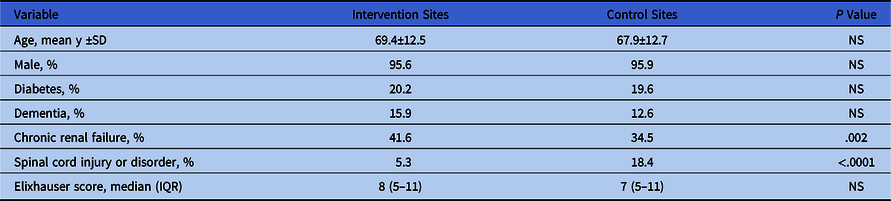
In total, 66,982 patient admissions occurred during the study period across the 6 study sites. Duplicate cultures performed (n = 3,150), pregnant patients (n = 31), those who had undergone a urological procedure (n = 4,493), or those with an admission date outside the study period (n = 8,404) were removed. This exclusion resulted in a total of 50,901 patient admissions from 24,759 unique patients. Among these patients, 224,573 urine cultures were performed. Additionally, 900 cases of BSI caused by aerobic gram-negative bacteria were documented. Overall, most patients were men (n = 48,791, 95.8%), and the mean age was 68.3 years (SD, ±12.6). Baseline demographics and clinically relevant comorbid conditions were similar between the intervention and control sites (Table 2). Intervention sites had a higher proportion of chronic renal failure (42% vs 35%). Control sites had a higher proportion of patients with a history of spinal cord injury or disorder (18% vs 5%).
Baseline Demographics by Intervention Versus Control Sites

Note. SD, standard deviation; IQR, interquartile range; NS, not significant.
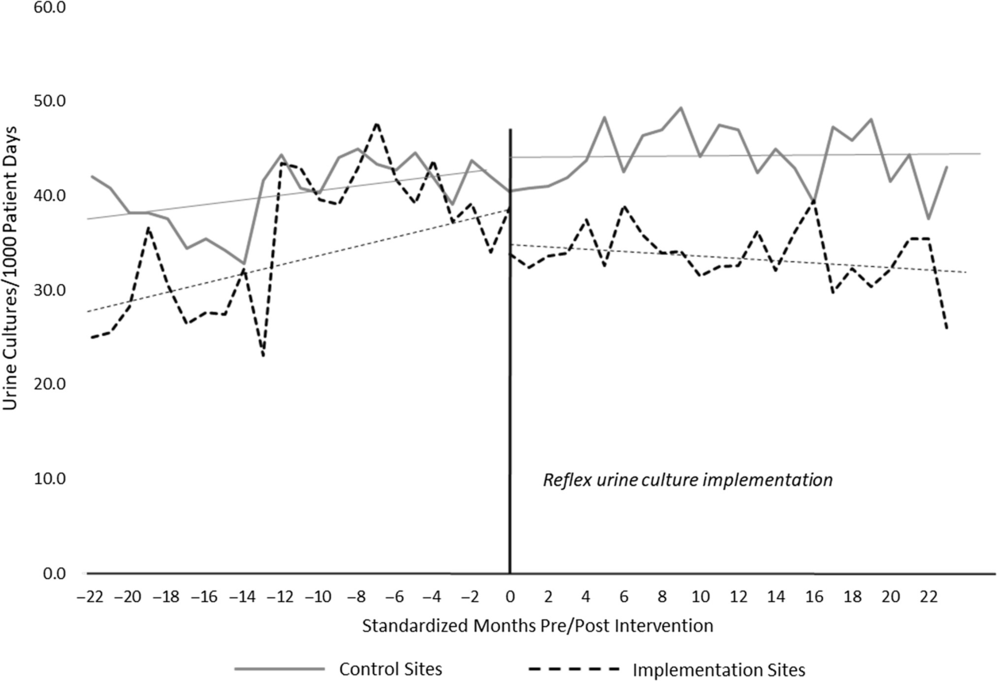
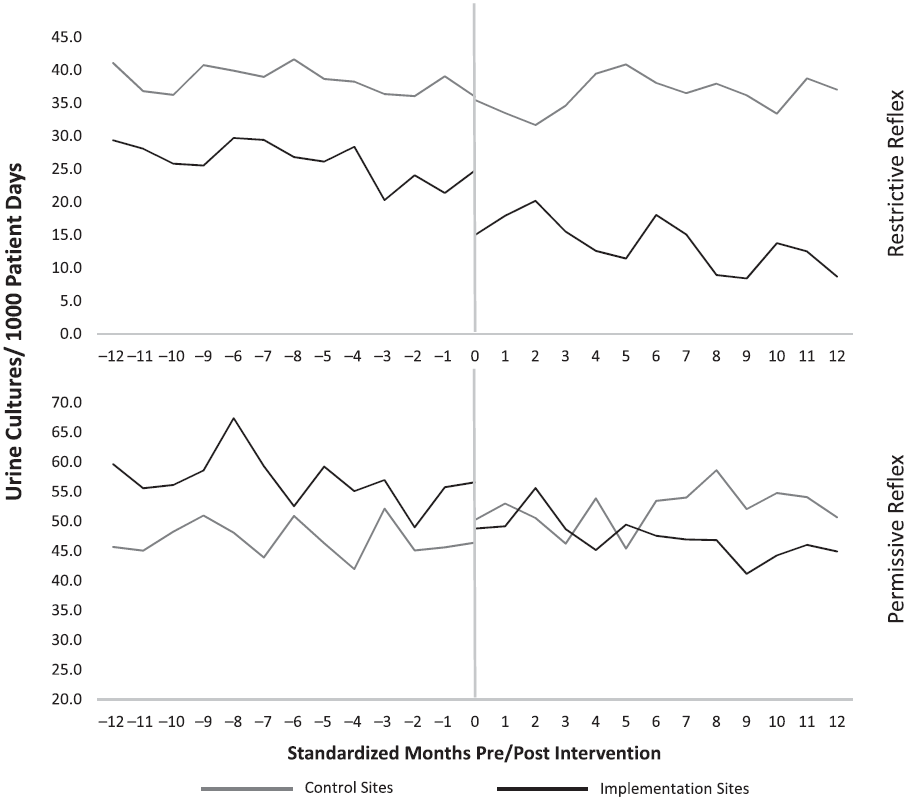
Among the control sites, monthly urine culturing rates throughout the preintervention period increased from an average of 40.3 cultures per 1,000 patient days to an average of 44.2 cultures per 1,000 patient days throughout the postintervention period (P = .67). Trends in monthly rates of urine culturing among the control sites did not significantly change before the intervention versus after. Among the intervention sites, average monthly urine culturing rates through the entire preintervention period were 35.8 cultures per 1,000 patient days, which decreased to 33.7 cultures per 1,000 patient days during the postintervention period, resulting in a 5.9% decrease (P = .29) (Fig. 1). Using negative binomial regression, the implementation of reflex urine culture policies at the intervention sites resulted in a 21% decrease in the rate of urine cultures performed relative to control sites (P ≤ .01). When stratified by type of conditional urine reflex policy (restrictive versus permissive criteria), the difference after the intervention was only present among those sites with more restrictive criteria, compared to the more permissive criteria (Fig. 2). Among restrictive sites the monthly average rates of urine culture changed from 27.1 sites per 1,000 patient days to 13.8 sites per 1,000 patient days with implementation of conditional urine reflex cultures (P < .01). In contrast, permissive sites changed from a monthly average of 57.2 sites per 1,000 patient days to 48.8 sites per 1,000 patient days with implementation of conditional urine reflex cultures (P ≤ .05).
Urine cultures per month, pre- versus post-reflex urine culture intervention.

Comparison of permissive versus restrictive urine reflex policy sites.

The primary safety outcome was rate of BSI caused by aerobic gram-negative bacterial organisms. Removing duplicate records and cultures that were positive for the same organism within 7 calendar days of index culture, 900 cases of BSI were documented. Overall incidence of gram-negative BSI was rare, ranging from 0 to 2 cases per 1,000 patient days. Among intervention sites, average rates of BSI changed from 0.6 cases per 1,000 patient days to 0.8 per 1,000 patient days. Among control sites, average rates of BSI changed from 0.7 cases per 1,000 patient days to 0.6 cases per 1,000 patient days. With the implementation of conditional urine reflex culturing, there was no significant difference in the rate of gram-negative BSI before versus after the intervention at the intervention sites (P = .49). Prior to the intervention, there was no significant difference in monthly trend between intervention sites versus control sites with respect to the rate of documented gram-negative BSI (P = .09). Similarly, we detected no significant differences in monthly trends after implementation between intervention versus control sites (P = .13).
Discussion
The implementation of conditional urine reflex testing was associated with decreased rates of urine cultures performed at intervention sites compared to control sites within the VHA. This change was observed immediately following implementation of the policy intervention. The 21% change, although relative to control sites, is potentially clinically impactful. Previous single-center studies have reported similar findings. For instance, cancelling urine culture orders in patients deemed to be low risk resulted in a >30% decrease in number of cultures ordered without subsequent negative clinical consequences.Reference Hertz, Lescallette, Barrett, Ward and Self19 In a quasi-experimental study of conditional urine reflex culturing within 5 adult ICUs, introduction of reflex testing decreased the number of urine cultures (P = .0012).Reference Epstein, Edwards and Halpin15 A recent multicenter quasi-experimental study of 3 hospitals within the same network in Kansas City also detected a decrease in the rate of urine cultures ordered per 1,000 patient days by 47.2% after implementation of conditional urine reflex policies.Reference Howard-Anderson, Ashraf, Overton, Reif, Murphy and Jacob18 Results from these studies align with our current findings and highlight the immediate positive impact these policies can achieve. Our findings are also underscored by the unique aspect of our study having control sites that did not implement conditional urine reflex policies where there were no significant changes in rates of urine cultures performed over time. The intervention, which consisted of changes in policies and EMR order sets, was largely passive in nature; however, significant decreases were achieved in urine cultures performed. Additionally, we also detected no negative consequences in terms of gram-negative BSI, which could be related to untreated UTI.
Criteria for reflex to urine culture are often based on the presence of pyuria as defined by a minimum WBC (ie, 5 WBC/hpf vs 10 WBC/hpf). Absence of pyuria has high negative predictive value for true UTI.Reference Simerville, Maxted and Pahira20,Reference Pallin, Ronan and Montazeri21 The optimal cutoff for reflex urine culturing is unknown and may be different for differing patient populations. In this study, sites using more restrictive criteria for pyuria (a cutoff of >10 WBC/hpf) observed a larger decrease in rates of urine culturing rates than the site with more permissive criteria. However, WBC/hpf cutoffs of >25 or >50 have been proposed as more effective but have not been formally evaluated.Reference McBride, Lepak, Dhaliwal, Saint and Safdar22 Also unique to the current study was the assessment of a potential safety metric; in particular, we hypothesized that the incidence of gram-negative BSI would increase if a diagnosis of UTI was missed through reflexive testing. It is encouraging to note the lack of change in gram-negative BSI in intervention sites relative to control sites.
This study has several potential limitations, largely due to the retrospective nature and use of aggregate data. The implementation of conditional urine reflex policies occurred in different years. Control sites consisted of institutions with variable populations, including some with adjacent spinal injury centers and higher rates of admissions of these patients, with high rates of urine cultures may have been present. However, these centers tend to primarily focus on outpatient procedures.Reference Skelton-Dudley, Doan, Suda, Holmes, Evans and Trautner23 Although data were standardized based on month of implementation, the potential existed for temporal interactions and implementation of antibiotic or diagnostic stewardship interventions, which could have influenced rates of urine culturing. Additionally, the lack of significance in the change of average monthly urine culture rates after this policy change may have been secondary to the inclusion of different types of policies in a single measure. Lastly, use of gram-negative bloodstream infections as a quality metric, while unique, may be limited because these infections can be secondary to multiple sources of infection.
In conclusion, compared to control sites without conditional urine reflex testing policies, implementation of these policies was associated with significantly fewer urine cultures performed. Immediately upon implementation, urine culture rates decreased in intervention sites relative to control sites, with minimal trend changes on a monthly basis. Conditional urine reflex testing policies in the acute-care setting was associated with reduced unnecessary urine culturing without adverse effects.
Acknowledgments
The content of this work does not necessarily reflect the views of the US government.
Financial support
This work was supported by the US Department of Veterans’ Affairs and Centers for Disease Control and Prevention (CDC) Infection Control Practice Based Research Network (PBRN).
Conflicts of interest
K.C.C. is a co-investigator for a merit award for infection control work from the VA Health Services Research and Development Service. She has received study supplies from BioFire and GenMark Diagnostics and has served as a speaker for Luminex Corporation and GenMark Diagnostics. D.J.M. is an investigator or coinvestigator on awards from the Center for Disease Control and Prevention; the National Institutes of Health; and the Agency for Healthcare Research and Quality merit award for infection control work from the VA Health Services Research and Development Service. B.W.T. is supported in part by the Center for Innovations in Quality, Effectiveness and Safety (CIN 13-413) at the Michael E. DeBakey VA Medical Center, Houston, Texas.
Supplementary material
To view supplementary material for this article, please visit https://doi.org/10.1017/ice.2020.400