Introduction
The intensive use of herbicides has selected for adaptive traits in multiple weed species globally (Neve Reference Neve2007). The adaptive response of plants to herbicide selection and the fate of resistance alleles under selection depends on selective advantage or disadvantage in the presence or absence of herbicides in the environment. In addition, the level of dominance and fitness of heterozygous individuals compared with resistant and susceptible homozygous influence selection (Roux et al. Reference Roux, Gasquez and Reboud2004). Resistance evolution in the genetically diverse species rigid ryegrass (Lolium rigidum Gaudin) to different herbicide sites of action (SOAs) has been widely documented across southern Australia (Brunton et al. Reference Brunton, Boutsalis, Gill and Preston2019; Burnet et al. Reference Burnet, Hart, Holtum and Powles1994; Preston et al. Reference Preston, Tardif and Powles1996). The inheritance of target site–based resistance to acetyl CoA carboxylase (ACCase)- and acetolactate synthase–inhibiting herbicides in weeds tends to be caused by a single nuclear-encoded dominant gene (Boutsalis et al. Reference Boutsalis, Karotam and Powles1999; Darmency Reference Darmency2018; Tardif and Powles Reference Tardif and Powles1999). Furthermore, resistance to the herbicide paraquat (22(D): inhibitors of photosynthesis at photosystem I) in L. rigidum was shown to be governed by one major nuclear gene (Yu et al. Reference Yu, Han, Nguyen, Forster and Powles2009). Busi et al. (Reference Busi, Gaines, Vila-Aiub and Powles2014) reported that resistance in L. rigidum to the sulfonylisoxazoline herbicide pyroxasulfone (15(K3): inhibitors of very-long-chain fatty-acid synthesis) was the result of one semi-dominant allele with cross-resistance to dinitroaniline herbicide trifluralin (3(K1): inhibitors of microtubule polymerization) and thiocarbamate prosulfocarb (15(K3)). However, resistance to trifluralin in L. rigidum and green foxtail [Setaria viridis (L.) P. Beauv.] involves a single nuclear recessive gene (Chen et al. Reference Chen, Lu, Han, Yu, Sayer and Powles2019; Jasieniuk et al. Reference Jasieniuk, Brûlé-Babel and Morrison1994).
In the majority of studies of herbicide resistance in weeds, single, nuclear-encoded genes with partial or full dominance have been identified, with a few examples of recessive, multigenic, or cytoplasmic control (Busi et al. Reference Busi, Gaines, Vila-Aiub and Powles2014; Jasieniuk et al. Reference Jasieniuk, Brûlé-Babel and Morrison1996; Kern et al. Reference Kern, Myers, Jasieniuk, Murray, Maxwell and Dyer2002). However, the inheritance of resistance to thiocarbamate herbicides remains poorly understood in L. rigidum and other weed species. To date, only two studies have reported recessive inheritance in cultivated oat (Avena sativa L.) conferring tolerance to diclofop-methyl (1(A): inhibitors of ACCase) (Warkentin et al. Reference Warkentin, Marshall, McKenzie and Morrison1988) and to the thiocarbamate triallate (15(K3)) in wild oat (Avena fatua L.) where resistance was conferred by two recessive genes (Kern et al. Reference Kern, Peterson, Miller, Colliver and Dyer1996b, Reference Kern, Myers, Jasieniuk, Murray, Maxwell and Dyer2002). Inheritance of resistance to ACCase herbicides is well understood in a few weed species.
Where resistance is encoded by a nuclear gene, expression is either a dominant or partially dominant trait (Preston Reference Preston2003; Tardif et al. Reference Tardif, Preston, Holtum and Powles1996). Nuclear inheritance is conferred by alleles present in the nuclear genome. To date, it has been established that resistance to all herbicide classes, with the exception of triazines, is determined by nuclear genes; resistance to triazines has been determined to be due to cytoplasmic inheritance (Jasieniuk and Maxwell Reference Jasieniuk, Brûlé-Babel and Morrison1994) wherein alleles are present in the chloroplast genome. The transmission of nuclear resistance alleles is through pollen and ovules, while cytoplasmic resistance is inherited through the ovules of the maternal parent, although low transmission by pollen has been observed in a few weed species (Darmency Reference Darmency1996). The mode of inheritance for target site–based resistance has been well documented; however, the mode of inheritance of genes responsible for metabolism-based resistance remains poorly understood, particularly for L. rigidum resistance thiocarbamate herbicides. Metabolism-based resistance in a population of blackgrass (Alopecurus myosuroides Huds.) from France is conferred by a single gene (Letouzé and Gasquez Reference Letouzé and Gasquez2001). To clarify the evolutionary dynamics leading to herbicide resistance in a weed population, knowledge about the initial frequency and number of resistance alleles, their level of dominance, and their mode of inheritance is needed. This study aims to determine the inheritance of resistance to thiocarbamate herbicides in four field-selected populations of L. rigidum from southern Australia and to test whether resistance is the result of a single gene.
Materials and Methods
Plant Material and Generation of F 1 and F 2 Families
Seeds from resistant (R) populations (375-14, 198-15, 16.2, and EP162) used in this study were collected from cropping fields across southern Australia with a long history of crop production and which were resistant to multiple herbicides (Brunton et al. Reference Brunton, Boutsalis, Gill and Preston2019). Populations of L. rigidum collected from the field were subsequently selected with triallate (500 g L−1; Avadex Xtra®, Nufarm Australia, Laverton North, VIC, Australia) at 1,000 g ai ha−1 in pots. Seeds were weighed (0.2 g ˜ 50 seeds) and spread onto the surface of 9.5 cm by 8.5 cm by 9.5 cm punnet pots (Masrac Plastics, SA, Australia) containing cocoa peat potting mix as described by Boutsalis et al. (Reference Boutsalis, Gill and Preston2012). Herbicide was applied using a laboratory spray cabinet equipped with flat-fan nozzles (Hardi ISO F-110-01, Hardi, Adelaide, SA, Australia) delivering 118 L ha−1 water at a pressure of 2.54 kPa. After herbicide application, the seed and herbicide were covered with 0.5 cm of potting mix and watered. Assessment of emergence was made at 28 DAT, and plants that had reached the 2-leaf stage were counted as emerged. Population EP162 was selected with two rounds of triallate, and populations 375-14, 198-15, and 16.2 were selected with one round of triallate. R survivors (4 plants per 30-cm-diameter pot) were crossed within populations, and the seed produced was used for these experiments. Reciprocal crosses were made from plants grown from this seed with a well-characterized susceptible (S) L. rigidum population (SLR4) to produce F1 families, as described by Preston (Reference Preston2003).
Lolium rigidum is an obligate outcrossing species, and a single plant grown in isolation rarely produces seeds (Preston Reference Preston2003), so one plant of each of the R populations and one plant of the S population were grown in a single 30-cm-diameter pot containing standard potting mix, with 10 pots established for each R population. Plants were grown outdoors under natural growing conditions during the months of May to November 2017 and watered as required. Before flowering, pots were encased in a 1.2-m-long polypropylene sleeve (Lay flat tubing, Propak Industries, Torrensville, SA, Australia) supported by a wire mesh cage, both of which were open at the top. Seeds were harvested separately from the 10 reciprocal crosses per population between maternal R and maternal S parents, with each cross within a population being designated a family. To generate F2 families, four plants from each F1♀R cross were grown in a single 30-cm pot as described earlier during the months of May to November 2018. At maturity, seed from all plants within each pot were pooled to create the F2 families. For each of the 10 F2 families per population, four families with the most seed were selected for inclusion in dose–response studies.
Seedling Growth, Herbicide Application, and Dose–Response Screening of F1 and F2 Progeny
Seed from SLR4, 375-14, 198-15, 16.2, and EP162 were weighed (0.2 g = 50 to 60 seeds) as described earlier, and dose–response experiments were conducted on the S, R, F1 (maternal susceptible [♀S], and resistant [♀R]), and F2 families to determine the dominance of resistance alleles and identify whether maternal inheritance was present. The control pots were not treated with herbicide. Herbicide rates applied to F1 families were chosen based on the estimated LD50 response of parental R populations. Prosulfocarb (500 g L−1; Arcade®, Syngenta Crop Protection, Eastwood, SA, Australia) was applied to seed as described earlier: at 75, 150, 300, 600, 1,200, and 2,400 g ha−1 to the S biotype; and at 600, 1,200, 2,400, 4,800, 9,600, and 19,200 g ha −1 to the R biotypes. In Australia, the recommended label rate of prosulfocarb for L. rigidum control is 2,400 g ha −1.
Prosulfocarb was applied to F1 and F2 biotypes at 75, 150, 300, 600, 1,200, 2,400, 4,800, 9,600 and 19,200 g ha −1. Each herbicide rate was replicated for four pots for each R × S and S × R family. Herbicide rates for F2 screening were chosen based on the response of the F1 families. The screening of F1 biotypes was conducted outdoors under natural growing conditions in winter during the normal growing season of May to July 2017 and repeated in May to June 2018. Screening of F2 biotypes occurred as described earlier and was repeated in May to June 2019. Pots were watered as needed to maintain potting mix near field capacity. Pots were assessed at 28 d after herbicide treatment, and plants that had emerged and grown to the 2-leaf stage were counted. An average across all populations of 29 seedlings emerged in the untreated pots (range: 24 to 32). Percentage emergence was assessed as the number of plants growing in the treated pots compared with the average number present in the control pots.
Statistical Analysis
Following ANOVA, both experimental runs of the dose–response experiment were pooled, as there was no significant difference between the two runs. The dose–response data were analyzed using a log-logistic equation (GraphPad Prism v. 8.0, GraphPad Software, San Diego, CA, USA) fit to the percentage emergence data (Seefeldt et al. Reference Seefeldt, Jensen and Fuerst1995). The normalized three-parameter logistic regression model was fit, where y represents plant survival (%), x is the log-dose of the herbicide used, LD50 is the herbicide dose required to cause 50% reduction in plant emergence, and b denotes the slope of the curve. LD50 parameter estimates from the log-logistic analysis were used to calculate the resistance index (RI), which is the resistant/susceptible ratio of the LD50.
 $${\rm{y}}\;{\rm{ = }}{{100} \over {{\rm{1 + 1}}{{\rm{0}}^{({\rm{log}}\;{\rm{L}}{{\rm{D}}_{{\rm{50}}}}{\kern 1pt} {\rm{ - }}{\kern 1pt} x) \times {\kern 1pt} b}}}}$$
The segregation of thiocarbamate resistance was tested against one- and two-gene inheritance models. Two one-gene models for a single dominant (3:1 R:S) and a single recessive allele (1:3) and six two-gene models representing two alleles dominant and independent (15:1), two alleles independent, one dominant and one recessive (13:3), two alleles dominant and additive (9:7), two alleles independent and recessive (7:9), two alleles additive with one dominant and one recessive (3:13), and two alleles additive and recessive (1:15). In each case, the expected proportion of survivors was calculated by multiplying the survival of the R population by the expected proportion of R individuals with the survival of the S population by the expected proportion of S individuals. The response of the F2 families was compared with the expected response from the models using an exact binomial test that was two-sided and used the method of small P-values (McDonald Reference McDonald2014) for prosulfocarb at 1,200 g ha−1. This rate was chosen because it provided the greatest discrimination between the R and S populations across the four R populations.
Results and Discussion
Evaluation of F 1 Populations
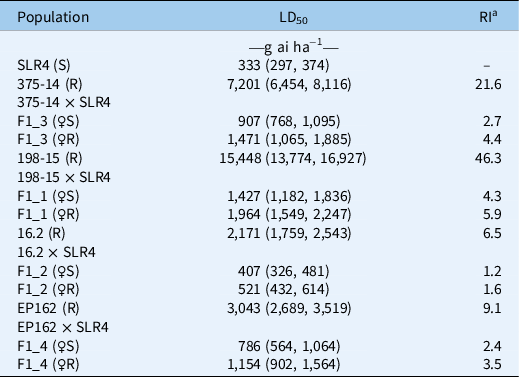
Treatment with prosulfocarb controlled the S parent at low rates of prosulfocarb with an LD50 of 333 g ha−1, where the recommended field rate is 2,400 g ha−1 (Table 1). The R populations were able to survive much higher rates of prosulfocarb. The LD50 for the four R populations ranged between 2,171 g ha−1 for 16.2 to 15,448 g ha−1 for 198-15, ranging from 6.5- to 46-fold resistant compared with the S population (Table 1). For the crosses for each R population, the LD50 values of the two F1 populations (♀S × ♂R and ♀R × ♂S) to prosulfocarb were not significantly different. This shows resistance is inherited as a nuclear trait (Table 1). Furthermore, the response of families within each population was the same and suggests that the R parents were likely homozygous for resistance. The responses of the F1 populations to prosulfocarb were intermediate between the parents, with the exception of 16.2, for which the LD50 of the F1 population was similar to the S parent (Table 1). This indicates resistance is conferred by a single, partially dominant trait for populations 375-14, 198-15, and EP162, but was recessive for 16.2. Resistance was not maternally inherited.
Prosulfocarb estimated dose required for 50% mortality (LD50) of susceptible, resistant, and reciprocal F1 populations of Lolium rigidum with 95% confidence intervals in parentheses and resistance index (RI).

a RI values calculated as the ratio between the LD50 of the R populations divided by the mean LD50 value of the S population (SLR4).
Resistance in all four populations was encoded in the nuclear genome, with no evidence of maternal inheritance present (Table 1). Nuclear inheritance of resistance is common in weed species (Jasieniuk et al. Reference Jasieniuk, Brûlé-Babel and Morrison1996), with maternal inheritance restricted to target-site resistance to photosystem II–inhibiting herbicides (Preston and Mallory-Smith Reference Preston and Mallory-Smith2001) and a few other examples (Saini et al. Reference Saini, Malone, Gill and Preston2017). Nuclear inheritance allows resistance alleles to be spread in pollen and may allow more rapid dispersal of resistance alleles in obligate outcrossing species such as L. rigidum (Preston and Mallory-Smith Reference Preston and Mallory-Smith2001). The F1 response for the cross between 16.2 and the S population suggested resistance was inherited as a recessive trait (Table 1). The F1 response for the other three populations, 375-14, 198-15, and EP162, suggests that at least one dominant allele is contributing to resistance (Table 1).
Evaluation of F 2 Populations and Segregation Patterns
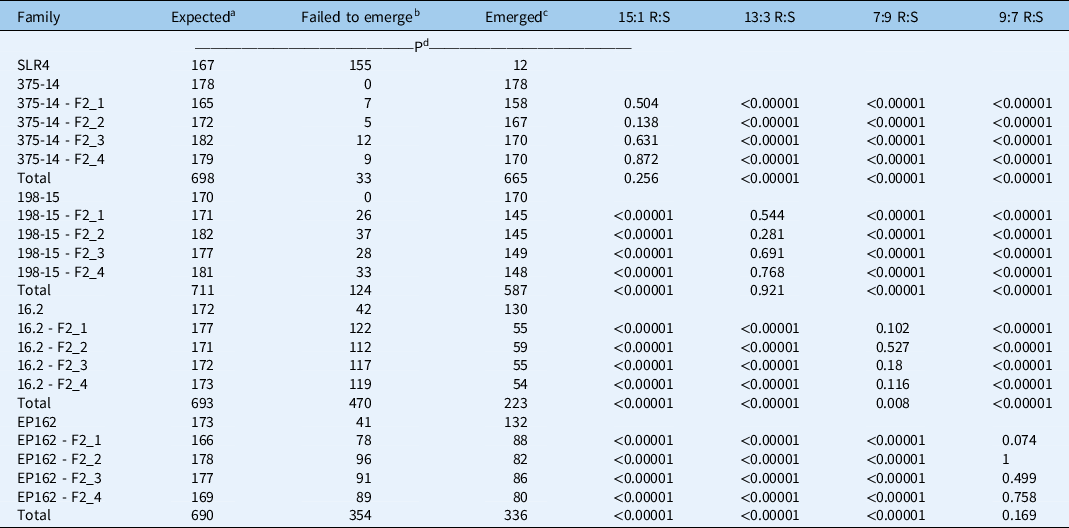
The segregation of F2 plants was tested initially at 1,200 g ha−1 with two models compared for single gene traits: 3:1 and 1:3. Neither of these models fit the response of the F2 families from any of the four crosses (data not shown). This suggested the involvement of more than one gene in resistance. The F2 families were further tested at 1,200 g ha−1 prosulfocarb using two gene model ratios. The S population had less than 10% emergence at this rate. All F2 plants from each population segregated when treated with prosulfocarb at 1,200 g ha−1 (Table 2). The response of the F2 families of 375-14, 198-15, EP162, and 16.2 fit the ratios 15:1, 13:3, 9:7, and 7:9, respectively, which suggests two genes with different levels of dominance and independence were involved. Population 375-14 fit a 15:1 ratio for two independent dominant alleles; population 198-15 fit a 13:3 ratio for two independent alleles, one dominant and one recessive; while population 16.2 fit a 7:9 ratio expected for two independent recessive alleles (Table 2). Population EP162 fit a 9:7 ratio for two additive dominant alleles. The variations in inheritance patterns suggest there may be multiple mechanisms for L. rigidum to evolve resistance to prosulfocarb and that previous selection with other herbicides may have primed the populations to evolve resistance to prosulfocarb through enrichment of alleles that also contribute to prosulfocarb resistant (Busi and Powles Reference Busi and Powles2013).
Survival and segregation of resistance at 1,200 g ha−1 prosulfocarb in F2 populations generated from crosses (375-14♂, 198-15♂, 16.2♂, and EP162♂ × R♀) between resistant 375-14, 198-15, 16.2, and EP162 and susceptible SLR4 Lolium rigidum plants for four different inheritance models.

a Expected emergence based on seeds not treated with herbicide.
b Plants that did not reach 2-leaf were recorded as not emerged.
c Plants that reached the 2-leaf stage were recorded as emerged.
d Probability from two-tailed exact binomial test and small P-value test for goodness of fit.
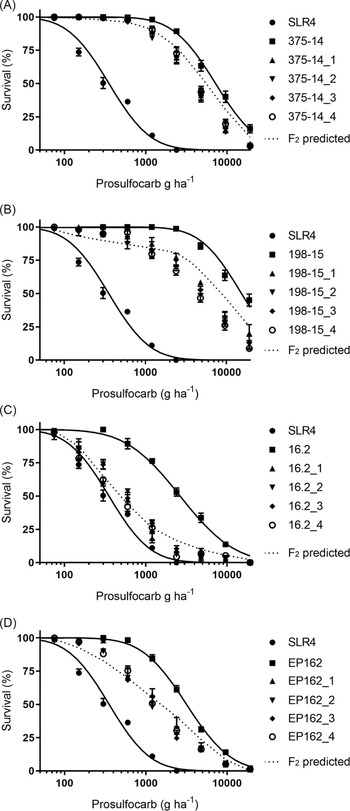
Dose–response experiments were conducted for each F2 population and compared with the expected response for the two gene models described earlier. The S population had greater than 90% mortality with 1,200 g ha−1 prosulfocarb, whereas each of the R populations and all F2 families had considerably more survival at this rate (Figure 1). All families within a population had similar response to prosulfocarb across all rates and were not significantly different from each other (P = 0.35), suggesting that the original parents were likely homozygous R and S to prosulfocarb. The response of the F2 families for populations EP162 and 16.2 followed the expected response for 9:7 and 7:9 ratios, respectively (Figure 1). The response of the other two populations fit the expected response for 15:1 and 13:3 ratios, respectively, at lower prosulfocarb rates, but deviated from the models at higher prosulfocarb rates. The models assume that dominant alleles are completely dominant across the full dose range; however, semi-dominant resistance alleles are common (Jasieniuk et al. Reference Jasieniuk, Brûlé-Babel and Morrison1996; Preston and Malone Reference Preston and Malone2015). This is the likely reason that the response of the F2 was lower than the predicted response at the higher prosulfocarb rates (Figure 1).
Dose response of susceptible SLR4, resistant 375-14 (A), 198-15 (B), 16.2 (C), and EP162 (D), and four F2 families, 375-14♂, 198-15♂, 16.2♂, and EP162♂ × R♀ (▲, ▼, ♦, and ○, respectively), of Lolium rigidum treated with prosulfocarb at different rates (0 to 19,200 g ha−1). The dotted line is the predicted response for a two-gene inheritance pattern at all doses of prosulfocarb. Each data point is the mean of eight replicates (four replicates × two runs) and bars representSEM.

The inheritance of resistance to thiocarbamate herbicides has not been widely studied. This is likely due to resistance to these herbicides having evolved in only eight weed species (Heap Reference Heap2020). Resistance to triallate in A. fatua from Canada was inherited as two recessive alleles (Kern et al. Reference Kern, Myers, Jasieniuk, Murray, Maxwell and Dyer2002), whereas resistance in a population of L. rigidum selected in the laboratory with pyroxasulfone, but which evolved cross-resistance to prosulfocarb, was due to a single dominant allele (Busi et al. Reference Busi, Gaines, Vila-Aiub and Powles2014). Here we examined four different field-selected populations of L. rigidum with resistance to prosulfocarb to better understand inheritance patterns.
The F2 data for all populations failed to fit either of the two single-gene hypotheses tested (data not shown), but all fit a two-gene hypothesis with four different patterns of inheritance (Table 2). This suggests that there are multiple genes that can contribute to resistance to prosulfocarb in L. rigidum. These populations have a long and complex selection history with herbicides and are resistant to multiple herbicides (Brunton et al. Reference Brunton, Boutsalis, Gill and Preston2019). This preceding history may have primed these populations to evolve prosulfocarb resistance by selecting for genes that may also allow plants to survive prosulfocarb. This may explain why there are different inheritance patterns among the populations.
Triallate resistance was shown to be conferred by two recessive genes in A. fatua (Kern et al. Reference Kern, Myers, Jasieniuk, Murray, Maxwell and Dyer2002), where resistance is the result of reduced herbicide activation (Kern et al. Reference Kern, Colliver, Maxwell, Fay and Dyer1996a). The same pattern of inheritance was identified in population 16.2 (Table 2). Studies with the cytochrome P450 (P450) inhibitor phorate suggest that resistance to prosulfocarb in 16.2 is also the result of reduced herbicide activation (Brunton et al. Reference Brunton, Boutsalis, Gill and Preston2020), which would be consistent with a recessive mode of inheritance. Recessive inheritance of resistance indicates a loss of a functional trait is responsible for resistance (Jasieniuk et al. Reference Jasieniuk, Brûlé-Babel and Morrison1996; Preston and Mallory-Smith Reference Preston and Mallory-Smith2001). Recessive inheritance has been previously observed for resistance to trifluralin in S. viridis (Jasieniuk et al. Reference Jasieniuk, Brûlé-Babel and Morrison1994) and L. rigidum (Chen et al. Reference Chen, Lu, Han, Yu, Sayer and Powles2019), where it is associated with target-site mutations (Chen et al. Reference Chen, Lu, Han, Yu, Sayer and Powles2019). These mutations result in rapid depolymerization of microtubules due to loss of the ability to add new tubulin dimers (Anthony and Hussey Reference Anthony and Hussey1999). Recessive inheritance is more likely to occur in self-pollinated weed species due to the difficulty of selecting for the heterozygote in outcrossing weed species (Jasieniuk et al. Reference Jasieniuk, Brûlé-Babel and Morrison1996; Preston and Mallory-Smith Reference Preston and Mallory-Smith2001). This is likely to be less difficult where PRE herbicides are the selecting agent, as these decline in concentration in the field, allowing more ready selection for recessive resistance traits (Helps et al. Reference Helps, Paveley and van den Bosch2017).
The inheritance pattern for 375-14 fit a pattern consistent with two dominant alleles and that of 198-15 fit a pattern consistent with one dominant and one recessive allele. In a laboratory-selected population with resistance to pyroxasulfone and cross-resistance to prosulfocarb and triallate, resistance to both triallate and prosulfocarb was the result of a single gene trait (Busi et al. Reference Busi, Gaines, Vila-Aiub and Powles2014). This demonstrates that both dominant and recessive alleles can endow resistance to thiocarbamate herbicides. In a previous study, the response of the R populations 375-14 and 198-15 in the presence of the P450 inhibitor phorate showed an antagonistic response with prosulfocarb that was similar to the S population (Brunton et al. Reference Brunton, Boutsalis, Gill and Preston2020), suggesting loss of herbicide activation was not the mechanism of resistance, which is consistent with the different inheritance pattern seen in 16.2. Busi et al. (Reference Busi, Gaines, Vila-Aiub and Powles2014) showed resistance to triallate and prosulfocarb could result from a single dominant allele. However, the fact that all these field populations had inheritance patterns suggesting the involvement of two genes indicates that single-gene resistance mechanisms may not be sufficiently effective to be selected in the field. Lolium rigidum is an obligate outcrossing species and a ready accumulator of resistance alleles (Preston Reference Preston2003; Preston et al. Reference Preston, Tardif and Powles1996; Saini et al. Reference Saini, Malone, Gill and Preston2017). It is possible that population 198-15 contains one allele common to population 375-14 and one common to population 16.2. The rapid selection for resistance to the thiocarbamate herbicides in L. rigidum may result from a high frequency of resistance alleles and the ability to accumulate these that offsets the requirement for two different alleles to provide resistance.
The inheritance pattern for EP162 was quite different, suggesting yet another possible resistance mechanism (Table 2). The inheritance pattern was consistent with two additive alleles. This would suggest two genes operating at different steps in the same pathway or process. EP162, like 375-14 and 198-15, showed an antagonistic effect of phorate on prosulfocarb activity (Brunton et al. Reference Brunton, Boutsalis, Gill and Preston2020).
Single-gene inheritance of herbicide resistance is common in weed species (Jasieniuk et al. Reference Jasieniuk, Brûlé-Babel and Morrison1996; Preston and Mallory-Smith Reference Preston and Mallory-Smith2001). Repeated application of highly effective herbicides imposes a strong selection pressure on S populations, and if resistant individuals are present, even at very low frequencies, rapid selection for resistance can occur. In contrast, polygenic inheritance involves recombination among individuals across many generations, bringing together a sufficient number of alleles, each with a small additive effect, to produce a highly resistant weed population (Busi et al. Reference Busi, Gaines, Vila-Aiub and Powles2014). Multiple resistance has been shown to involve more than one cytochrome P450 in L. rigidum population VLR69, and clear linkages of metabolism-based resistance were demonstrated in this population (Preston Reference Preston2003).
Here we identify four different patterns of inheritance to prosulfocarb in field-selected populations of L. rigidum (Table 2) illustrating the complexity of resistance that can be selected. The obligate outcrossing nature of L. rigidum aids with the accumulation of resistance alleles, leading to resistance evolution across different herbicide SOAs. The wide variety of resistance alleles present in L. rigidum populations resistant to thiocarbamate herbicides suggests resistance to these herbicides will show complex patterns that may make herbicide management approaches difficult to implement.
Acknowledgments
The authors acknowledge the Grains Research and Development Corporation for funding this research. No conflicts of interest have been declared.