Introduction
Fasciolosis, caused by the trematode liver fluke, Fasciola hepatica, is the cause of considerable losses in sheep and cattle production systems all over the world (Fairweather, Reference Fairweather2005). Fasciolosis is also emerging as a major zoonosis (Mas Coma et al., Reference Mas-Coma, Bargues and Valero2005) and is considered to be a serious health problem in some countries (Fairweather, Reference Fairweather2005). There are a limited number of anthelmintics available to treat fasciolosis in ruminants. Benzimidazoles (BZD) are broad-spectrum anthelmintic compounds, widely used in human and veterinary medicine for controlling nematode, cestode and trematode infections (McKellar & Scott, Reference McKellar and Scott1990). The BZD compounds, currently marketed as anthelmintics, can be grouped as BZD thiazolyls, BZD methylcarbamates, pro-BZD and halogenated BZD thiols (Lanusse & Prichard, Reference Lanusse and Prichard1993). Only a few BZD compounds display activity against F. hepatica. The halogenated derivative triclabendazole (TCBZ) is the most effective, because of its excellent activity against immature and mature adult flukes (Boray et al., Reference Boray, Crowfoot, Strong, Allison, Schellenbaum, von Orelli and Sarasin1983). Albendazole (ABZ) is the only BZD methylcarbamate recommended for the control of fasciolosis in domestic animals, despite its activity being restricted to flukes older than 12 weeks (McKellar & Scott, Reference McKellar and Scott1990). ABZ is not found in the bloodstream after its enteral administration to sheep (Marriner & Bogan, Reference Marriner and Bogan1980) and cattle (Prichard et al., Reference Prichard, Hennessy, Steel and Lacey1985). ABZ oxidations lead to more polar and less active metabolites, which are detected systemically as the sulphoxide (ABZ.SO) and sulphone (ABZ.SO2) derivatives. In terms of binding to Haemonchus contortus β-tubulin, ABZ is more potent than the active ABZ.SO, while ABZ.SO2 is an inactive metabolite (Lacey, Reference Lacey1990; Lubega & Prichard, Reference Lubega and Prichard1991).
The intensive use of TCBZ in endemic areas of fasciolosis has resulted in the development of liver fluke populations resistant to this compound (Overend & Bowen, Reference Overend and Bowen1995; Moll et al., Reference Moll, Gaasenbeek, Vellema and Borgsteede2000; Thomas et al., Reference Thomas, Coles and Duffus2000; Olaechea et al., Reference Olaechea, Lovera, Larroza, Raffo and Cabrera2011a, Reference Olaechea, Lerroza, Solana, Scarcella and Carnevaleb; Ortiz et al., Reference Ortiz, Cerna, Rosales, Cabrera, Solana, Scarcella, Lamenza and Fernández2011), which is considered a major problem for veterinary therapeutics. Interestingly, ABZ has been shown to be effective against the TCBZ-resistant fluke isolate named Sligo (Coles & Stafford, Reference Coles and Stafford2001; Fairweather, Reference Fairweather2011a). Conversely, a F. hepatica isolate resistant to ABZ and susceptible to TCBZ has recently been characterized (Sanabria et al., 2013).
The emergence of drug-resistant liver flukes leads to the necessity of accurate diagnosis. The standard and established protocol for the determination of drug activity against F. hepatica in ruminants is the efficacy controlled test (Wood et al., Reference Wood, Amaral, Bairden, Duncan, Kassai, Malone, Pankavich, Reinecke, Slocombe, Taylor and Vercruysse1995), in which efficacy is determined by comparison of the number of flukes in treated animals and in untreated controls. This methodology has the disadvantage of its relative high cost and the length of time involved. The alternative is the use the faecal egg count reduction test (FECRT), where the efficacy of the treatment (or the susceptibility of the F. hepatica isolate) is claimed if a 95% or greater reduction of faecal fluke egg counts at 14 days post-treatment is achieved. However, the release of eggs stored in the gall bladder may produce false-positive results, even when the flukes have been effectively removed by drug treatment (Fairweather, Reference Fairweather2011b). The coproantigen reduction test (Flanagan et al., Reference Flanagan, Forster, Gordon, Hanna, McCoy, Brennan and Fairweather2011a, Reference Flanagan, Edgar, Gordon, Hanna, Brennan and Fairweatherb) and the ‘histological approach’ (Hanna et al., Reference Hanna, Edgar, McConnell, Toner, McConville, Brennan, Devine, Flanagan, Halferty, Meaney, Shaw, Moffett, McCoy and Fairweather2010, Reference Hanna, Forster, Brennan and Fairweather2013), which involves the evaluation of the histological changes induced by drug treatment, have been proposed as alternative methods for the diagnosis of drug efficacy and/or resistance. The egg hatch test may have some potential to detect anthelmintic resistance in flukes. This test, used as a diagnostic method for the detection of BZD resistance in nematodes (Coles et al., Reference Coles, Jackson, Pomroy, Prichard, von Samson-Himmelstjerna, Silvestre, Taylor and Vercruysse2006), is based on the capacity of BZD compounds, mainly the methylcarbamates, to affect parasite egg hatching. Previously, it has been shown under in vitro conditions that both ABZ and ABZ.SO have an excellent ovicidal activity against F. hepatica eggs (Coles & Briscoe, Reference Coles and Briscoe1978; Alvarez et al., Reference Alvarez, Moreno, Moreno, Ceballos, Shaw, Fairweather and Lanusse2009). Thus, an egg hatch-based method potentially may be used for the detection of BZD resistance in F. hepatica. Using a high concentration of the TCBZ sulphoxide metabolite, the test has the potential to distinguish between TCBZ-susceptible and TCBZ-resistant fluke isolates, and may become a simple method of diagnosis of drug resistance (Fairweather et al., Reference Fairweather, McShane, Shaw, Ellison, O'Hagan, York, Trudgett and Brennan2012). However, the use of such a methodology to detect ABZ resistance in liver flukes requires further investigation. The main goal of the work reported here was to develop and validate an in vitro fluke egg hatch test, for the detection of ABZ resistance in F. hepatica. The test was applied to assess ABZ ovicidal activity in fluke isolates obtained from different sources.
Materials and methods
Pure ( ≥ 99%) reference standards of ABZ and ABZ.SO used in the current test were provided by Toronto Research Chemicals Inc. (Toronto, Canada). The solvent (methanol) used for drug dissolution was of analytical grade (Anedra, Buenos Aires, Argentina). Fasciola hepatica eggs from six different isolates were assessed for ABZ/ABZ.SO susceptibility. Two of them (CEDIVE and Cullompton) were considered to be Reference isolates, while the others were considered to be Unknown isolates. Unfortunately, at the time of the egg hatch test development there were no eggs from the Cullompton isolate available in our laboratory. Since the egg hatch test previously published (Alvarez et al., Reference Alvarez, Moreno, Moreno, Ceballos, Shaw, Fairweather and Lanusse2009) was performed under similar experimental conditions as in the current study, the data relating to the inhibition of egg hatching of the Cullompton isolate by ABZ was included as a ‘positive control’. Details of the different isolates with regard to ABZ susceptibility are given below.
Reference isolates
CEDIVE
This isolate was obtained from the bile ducts of two sacrificed sheep, and subsequently maintained in donor sheep and Lymnaea viatrix snails under laboratory conditions at the ‘Centro de Diagnóstico e Investigaciones Veterinarias’ (CEDIVE), Facultad de Ciencias Veterinarias, Universidad Nacional de La Plata, Chascomús, Argentina. After two controlled efficacy tests, this isolate has been shown to behave as resistant to ABZ and susceptible to TCBZ (Sanabria et al., 2013).
Cullompton
This isolate was first obtained (1998) from sheep slaughtered at an abbatoir in Cullompton, Devon, UK, and has been maintained in Queens University, Belfast, UK since 1999 (Fairweather, Reference Fairweather2011a). In different in vivo and in vitro studies, the Cullompton isolate has been shown to be susceptible to TCBZ (Walker et al., Reference Walker, McKinstry, Boray, Brennan, Trudgett, Hoey, Fletcher and Fairweather2004; McConville et al., Reference McConville, Brennan, Flanagan, Edgar, Hanna, McCoy, Gordon, Castillo, Hernández-Campos and Fairweather2009, Devine et al., Reference Devine, Brennan, Lanusse, Alvarez, Trudgett, Hoey and Fairweather2010, Reference Devine, Brennan, Lanusse, Alvarez, Trudgett, Hoey and Fairweather2012; Toner et al., Reference Toner, Brennan, McConvery, Meaney and Fairweather2010; Flanagan et al., Reference Flanagan, Edgar, Gordon, Hanna, Brennan and Fairweather2011b) and ABZ (Buchanan et al., Reference Buchanan, Fairweather, Brennan, Trudgett and Hoey2003; McConville et al., Reference McConville, Brennan, McCoy, Castillo, Hernández-Campos and Fairweather2006; Alvarez et al., Reference Alvarez, Moreno, Moreno, Ceballos, Shaw, Fairweather and Lanusse2009).
Unknown isolates
INTA-Bariloche
This isolate was obtained from naturally infected cattle on a Patagonian farm in Neuquén, Argentina, by Dr Fermín Olaechea (INTA Bariloche, Bariloche, Argentina). Resistance to TCBZ has been determined by the faecal egg count reduction test (FECRT) (Olaechea et al., Reference Olaechea, Lovera, Larroza, Raffo and Cabrera2011a) and confirmed after TCBZ treatment of artificially infected sheep (Olaechea et al., Reference Olaechea, Lerroza, Solana, Scarcella and Carnevale2011b). The INTA-Bariloche isolate has been maintained under the same laboratory conditions as described for the CEDIVE isolate. No definitive data are available regarding potential susceptibility to ABZ. However, two sheep artificially infected with this isolate and orally treated with ABZ (7.5 mg/kg) 16 weeks after infection, became negative to F. hepatica eggs in the faeces (L. Alvarez, unpublished data), indicating its potential susceptibility to ABZ.
Rubino
This isolate was obtained from naturally infected sheep from a farm near Salto, Uruguay, and has been maintained under laboratory conditions at the DILAVE Laboratory, Montevideo, Uruguay. According to its previous history, this isolate is susceptible to closantel and nitroxynil, but there is no definitive information on ABZ susceptibility. However, F. hepatica eggs were recovered from faeces obtained from two sheep artificially infected with the Rubino isolate, 15 days post-ABZ oral treatment (7.5 mg/kg) (V. Gayo, unpublished data).
Cajamarca
This isolate was obtained from faeces collected from one cow on a farm located in Cajamarca, Perú, and has been maintained under laboratory conditions at the Laboratorio de Diagnóstico Veterinario, Facultad de Ciencias Veterinarias, Universidad Nacional de Cajamarca, Cajamarca, Perú. This isolate behaves as TCBZ resistant (Ortiz et al., Reference Ortiz, Cerna, Rosales, Cabrera, Solana, Scarcella, Lamenza and Fernández2011). No data are available on ABZ susceptibility. However, in the area where the isolate was recovered, the frequent use of different anthelmintics (including ABZ) to control trematode and nematode infections is a common practice.
Río Chico
Eggs from this isolate were recovered from one sheep sacrificed at a local abattoir in the area of Río Chico, Catamarca, Argentina. No data on potential susceptibility/resistance to anthelmintics of this isolate has been obtained. However, since no type of anthelmintic treatment is performed at the farm where the sheep were bred, it is highly likely that the Rio Chico isolate is susceptible to all flukicidal compounds, including ABZ.
In vitro egg hatch test
The in vitro egg hatch test used in the current experiment was previously described by Alvarez et al. (Reference Alvarez, Moreno, Moreno, Ceballos, Shaw, Fairweather and Lanusse2009). Briefly, fluke eggs (200 eggs in 1 ml of water placed in Khan tubes) from each isolate (each isolate represents one experiment) were incubated (25°C) for a 12-h period with either ABZ or ABZ.SO, at a final concentration of 5, 0.5 or 0.05 nmol/ml. These are pharmacologically relevant concentrations obtained from previous studies where the bile concentrations of these compounds were measured after conventional treatments in sheep (Hennessy et al., Reference Hennessy, Steel, Lacey, Eagleson and Prichard1989; Alvarez et al., Reference Alvarez, Imperiale, Sánchez and Lanusse2000). The working solutions of pure ABZ and ABZ.SO were prepared by dissolution in acidified methanol at final concentrations of 500, 50 and 5 nmol/ml. Ten microlitres of each working solution was added to 1 ml of egg suspension (methanol concentration: 1%). In each experiment, five replicates were used for each drug concentration. Control eggs were incubated with the solvent (without drug). The low number of F. hepatica eggs recovered from the Bariloche and Rubino isolates prevented their incubation with ABZ.SO. Untreated and treated eggs were gently washed with tap water (3 × ) to facilitate drug removal, and kept in darkness at 25°C for 15 days. After this period, the trematode eggs were exposed to daylight for 2 h. Immediately afterwards, 1 ml of 10% (v/v) buffered formalin was added to each tube in order to prevent further eggs from hatching. Hatched and unhatched eggs were evaluated using an optical microscope (40 × magnification). Approximately 80–90 eggs were counted in order to estimate the proportion of hatched eggs in each tube. The ‘ovicidal activity’ expressed as a percentage was estimated using the following formula:
 $$\begin{eqnarray} Ovicidal\,activity\,(\%) = [(\%\,eggs\,hatched\,in\,control - \%\,eggs\,hatched\,after\,drug\, incubation)/\%\,eggs\,hatched\, in\,control]\times 100 \end{eqnarray}$$
The percentages of egg hatch are reported as the arithmetic mean ± standard deviation (SD). Parametric analysis of variance plus Tukey's test were used for the statistical comparison of the egg hatch data obtained from each experiment. A value of P< 0.05 was considered statistically significant. The statistical analysis was performed using the Instat 3.0 Software (Graph Pad Software, California, USA).
Results
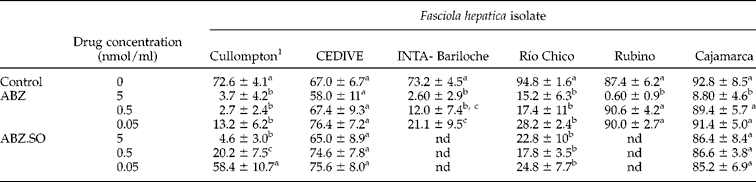
The mean egg hatch percentage obtained for untreated eggs in the different F. hepatica isolates ranged between 67.0 (CEDIVE) and 94.8% (Río Chico) (table 1). ABZ affected egg hatch in the Cullompton, INTA-Bariloche and Río Chico isolates at all concentrations tested. Conversely, ABZ (at 5, 0.5 and 0.05 nmol/ml) did not affect egg hatch in the CEDIVE isolate. A similar behaviour after ABZ incubation was observed in the Rubino and Cajamarca isolates, in which egg hatch was inhibited only at the highest concentration of 5 nmol/ml but, at lower concentrations (0.5 and 0.05 nmol/ml), the drug failed to inhibit hatching. In the Cullompton and Cajamarca isolates, the reduction in egg hatch with ABZ.SO was lower than that observed for ABZ.
Hatching of Fasciola hepatica eggs from different isolates, after incubation at 25°C with either albendazole (ABZ) or ABZ sulphoxide (ABZ.SO) at different concentrations for a 15-day period (with drug removal after a 12-h incubation). Values indicate percentage of total incubated eggs, expressed as mean ± SD.

For each fluke isolate, values with different superscripts are statistically different (P< 0.05). nd, not determined.
1 Data obtained from Alvarez et al. (Reference Alvarez, Moreno, Moreno, Ceballos, Shaw, Fairweather and Lanusse2009).
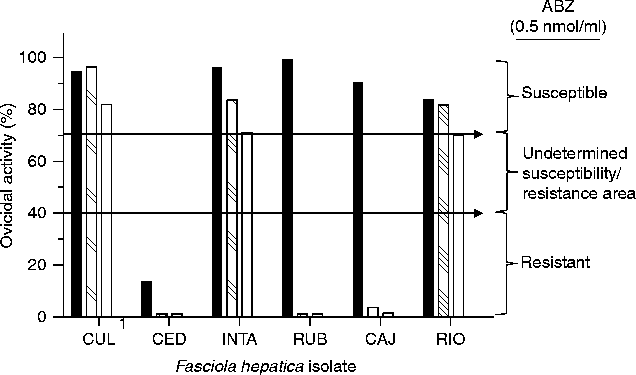
A very low ovicidal activity ( ≤ 13.4%) was observed in the ABZ-resistant CEDIVE isolate for both ABZ parent compound and its sulphoxide metabolite, even at the highest concentration tested (5 nmol/ml) (fig. 1). Conversely, in the INTA-Bariloche and Río Chico isolates, suspected to be susceptible to ABZ, ovicidal activities ≥ 70.3% were observed after incubation with ABZ at the lowest concentration tested (0.05 nmol/ml) (fig. 1). This finding correlates with that previously described for the ABZ-susceptible Cullompton isolate (Alvarez et al., Reference Alvarez, Moreno, Moreno, Ceballos, Shaw, Fairweather and Lanusse2009). Finally, in the Cajamarca and Rubino isolates, no ovicidal activity was observed after incubation of eggs with ABZ at 0.5 nmol/ml (fig. 1).
The ovicidal activity (%) of albendazole (ABZ) concentrations on eggs of different Fasciola hepatica isolates, including Cullompton (CUL), CEDIVE (CED), INTA-Bariloche (INTA), Rubino (RUB), Cajamarca (CAJ) and Río Chico (RIO). 1Data obtained from Alvarez et al. (Reference Alvarez, Moreno, Moreno, Ceballos, Shaw, Fairweather and Lanusse2009). Black bars, ABZ 5 nmol/ml; hatched bars, ABZ 0.5 nmol/ml; white bars, ABZ 0.05 nmol/ml.

Discussion
In ABZ-susceptible F. hepatica isolates, such as the Cullompton isolate, ABZ showed excellent ovicidal activity (Alvarez et al., Reference Alvarez, Moreno, Moreno, Ceballos, Shaw, Fairweather and Lanusse2009), even at concentrations as low as 0.05 nmol/ml (fig. 1). In this isolate, a high ovicidal efficacy was also observed for the active ABZ.SO metabolite, in spite of its lower anthelmintic potency compared to the parent drug. However, in the well-characterized ABZ-resistant CEDIVE isolate (Sanabria et al., 2013), both ABZ and ABZ.SO failed to prevent the egg hatch, demonstrating that the method is suitable to detect ABZ resistance in F. hepatica. It is important to highlight that in the ABZ-resistant CEDIVE isolate, egg hatching was not inhibited, even at the highest ABZ/ABZ.SO concentration tested (5 nmol/ml) (fig. 1).
Regarding the ‘Unknown isolates’, the INTA-Bariloche isolate showed susceptibility to ABZ in the in vitro test, with ovicidal activities ranging between 71.2% (0.05 nmol/ml) and 96.4% (5 nmol/ml) (fig. 1). This is a TCBZ-resistant isolate (Olaechea et al., Reference Olaechea, Lovera, Larroza, Raffo and Cabrera2011a, b), obtained from a farm where all anthelmintic treatments used in cattle are mainly directed against the liver fluke (and involve TCBZ and closantel), with sporadic treatment of gastrointestinal nematodes using ivermectin. The lack of a BZD methylcarbamate selection pressure may help to explain the potential susceptibility of the INTA-Bariloche isolate to ABZ observed in the current work. It may be assumed that the INTA-Bariloche isolate behaves in a similar way to the Sligo isolate, which has been previously characterized as resistant to TCBZ and susceptible to ABZ (Coles & Stafford, Reference Coles and Stafford2001). The present in vitro finding was partially validated by an in vivo study in which two sheep, artificially infected with this isolate, were treated with ABZ (7.5 mg/kg) 16 weeks after infection. There were no fluke eggs in the faeces 15 days after treatment, which would indicate a good ABZ efficacy (L. Alvarez, unpublished data). Although this in vivo trial is not definitive, the result may support the usefulness of the in vitro method in detecting ABZ resistance in liver flukes.
The Rio Chico isolate behaves as susceptible to ABZ and/or ABZ.SO, since a marked (P< 0.05) egg hatch reduction was observed at the three concentrations tested compared to the untreated control (table 1). The ABZ ovicidal activity ranged between 70.3% (0.05 nmol/ml) and 84% (5 nmol/ml) (fig. 1). Similarly, the efficacy of ABZ.SO ranged between 73.8% and 81.2%. Río Chico is located in the Catamarca province, Argentina, in a semi-arid region where nematode parasites are not prevalent. Most farmers graze sheep under a very low density of animals, and do not use anthelmintics in their sanitary management. As a consequence, it is not surprising that the isolate behaves as susceptible to ABZ. Interestingly, the ovicidal activity against the Río Chico isolate appears to be slightly lower than that described for the Cullompton isolate. Differences in drug susceptibility between isolates have been described previously (Fairweather, Reference Fairweather2011a). For instance, the Cullompton isolate is more sensitive to nitroxynil than either the Sligo, Oberon or Fairhurst isolates (McKinstry et al., Reference McKinstry, Halferty, Brennan and Fairweather2009), which may be related to biological differences among the fluke isolates (Walker et al., Reference Walker, McKinstry, Boray, Brennan, Trudgett, Hoey, Fletcher and Fairweather2004).
Similar findings were observed after drug incubation with F. hepatica eggs from the Cajamarca and Rubino isolates. Interestingly, following incubation with ABZ at the highest concentration (5 nmol/ml), both isolates behave as susceptible to ABZ. Ovicidal efficacies were 90.5% (Cajamarca) and 99.3% (Rubino) (fig. 1). However, at lower concentrations ( ≤ 0.5 nmol/ml), the drug failed to inhibit egg hatching, which suggests that these isolates may be resistant to ABZ, but probably at a lower degree than that observed for the CEDIVE isolate. Unfortunately, this hypothesis could not be fully tested under in vivo conditions. However, in a preliminary field efficacy trial, F. hepatica eggs were recovered after ABZ treatment (7.5 mg/kg) in two sheep artificially infected with the Rubino isolate (V. Gayo, unpublished data). Although a controlled efficacy test is needed to corroborate these findings, the preliminary data described here may demonstrate that flukes belonging to the Rubino isolate may possess some degree of resistance to ABZ.
Concerning animal welfare, in vitro methods constitute an alternative to clinical efficacy tests such as ‘dose and slaughter’ trials (where a large number of animals need to be infected and sacrificed after treatment). Egg collection for this type of test could eventually be performed directly from faecal material, making any animal sacrifice unnecessary. The use of the egg hatch test as a tool to detect ABZ resistance should be corroborated with in vivo trials, in order to establish the in vitro/in vivo relationship, and its applicability with eggs isolated from faecal material (sheep and/or cattle) and from different animal categories (that is, young animals, adult animals). Therefore, the described in vitro egg hatch test appears to be a suitable method for detection of ABZ resistance in F. hepatica. The key reference ABZ concentration to be used in the test appears to be 0.5 nmol/ml, assuming susceptibility with efficacies ≥ 70% and resistance with efficacies ≤ 40% (fig. 1). The area between 40 and 70% of egg hatch inhibition represents an area where resistance/susceptibility would be suspected. The correct adjustment of this ‘scale’ needs further research to be far more conclusive. However, the data described here clearly demonstrate the value of the egg hatch test as a suitable method to detect ABZ resistance in F. hepatica.
Acknowledgements
This work was partially supported by Consejo Nacional de Investigaciones Científicas y Técnicas (CONICET) and Agencia Nacional de Promoción Científica y Técnica (ANPCyT), both from Argentina.