Introduction
Bangladesh is an agriculture-based tropical country where over 80% of the country's 150 million people live in rural areas and are highly dependent on agriculture. Livestock contributes 6.5% to GDP on the basis of value added through their production of egg, milk, meat, hides and skins. The growth rate at 7.23% in GDP in 2004-05 for livestock was the highest of any sub-sector comparing with 0.15% for arable crops and 3.65% for fisheries (Bangladesh Economic Review, Reference BANGLADESH ECONOMIC REVIEW2006). Poultry is in the top position of the livestock sector, contributing 21% of the total livestock contribution whereas the livestock sub-sector contributed 12-14% to total Agricultural GDP in 1998-99 at current prices (Khan and Roy, Reference KHAN and ROY2003).
There are approximately 160 million chickens and 36 million ducks in the total poultry population of Bangladesh (Ahmmad, Reference AHMMAD2005) and indigenous chickens constitute nearly 80% of the chicken population (DLS, Reference DLS1998). More than 89% of rural smallholders rear chickens, and the average number per household is 6.8 chickens. Recently commercial farming has emerged in different areas of Bangladesh to satisfy market demands for poultry meat and eggs, mostly in urban and municipal populations. Although commercial broiler and layer farming are increasing rapidly, it is unable to satisfy the needs of the nations. Poultry producers, both of large and small-scale farmers, are facing numerous problems in farm operations and management, such as disease outbreaks, non-availability of inputs (day-old chicks, feeds, ingredients, etc.), a harsh environment and fluctuating market prices.
Indigenous chickens are reared in scavenging system with no extra feeds, housing, vaccine, medicine or management. Scavenging birds thrive on residual grains in the yard and surrounding residence, kitchen wastes, insects and earthworm and so on. In Bangladesh, both non-descript IFF and INN chickens are available and reared in scavenging system. Despite their lower egg production (35-45 eggs/hen/year), these birds are well adapted to a harsh tropical environment (Ahmed and Islam, Reference AHMED and ISLAM1985; Huque and Haque, Reference HUQUE and HAQUE1990; Batti and Sahota, Reference BATTI and SAHOTA1996; Islam, Reference ISLAM2006). They are highly resistant to aflatoxin and local diseases including Avian Influenza and Gumboro, but they are susceptible to other diseases, including Newcastle's disease, fowl cholera and pox (Chrysostome et al., Reference CHRYSOSTOME, BELL, DEMAY and VERHULST1995; Huque et al., Reference HUQUE, CHOWDHURY, HAQUE and SIL2001; Branckaert, Reference BRANCKAERT2007). They may be protected by using locally produced vaccines (Das et al., Reference DAS, CHOWDHURY, KHATUN, NISHIBORI, ISOBE and YOSHIMURA2008). Productivity of indigenous chicken breeds may be doubled with improved diets and management conditions (Prawirokusumo and Hadinato, Reference PRAWIROKUSUMO and HADINATO1987; Sonaiya, Reference SONAIYA1995; Chowdhury et al., Reference CHOWDHURY, AHMED and HAMID2006). Their meat and eggs are preferred widely by consumers because of their taste, leanness, and suitability for special dishes (Horst, Reference HORST1989). Generally in Bangladesh rural people prefer to buy live birds. Indigenous chickens are sold in live markets at an even higher (almost double) price compared to their exotic counterparts (Mafeni, Reference MAFENI1995; Huque, Reference HUQUE1996; Barua et al., Reference BARUA, HOWLIDER and YOSHIMURA1998; Islam, Reference ISLAM2000). Out of the indigenous chickens, INN (which carry the tropical relevant major gene) chicken is better at heat dissipation and is more heat tolerant, and are well adapted to the tropical climate (Merat, Reference MERAT1986; Horst, Reference HORST1989; Barua and Howlider, Reference BARUA and HOWLIDER1991; Islam, Reference ISLAM2006). INN chicken is more resistant to disease compared to IFF counterparts (Merat, Reference MERAT1986; Horst, Reference HORST1988; Barua and Howlider, Reference BARUA and HOWLIDER1991; Hossain et al., Reference HOSSAIN, HOWLIDER and HOSSAIN1991; Alam et al., Reference ALAM, ISLAM, HOWLIDER and ISLAM1995; Islam, Reference ISLAM2000 and 2006). The present review will update information on INN chicken regarding its productive adaptability and suitability for future poultry production in Bangladesh.
Genetic background of naked neck chickens
Naked neck (Na) is a major ‘marker’ gene identified by qualitative criteria (visual, biochemical or serological) that may show association with quantitative traits, either because of pleiotropy, defined by Johnson and Rendel (Reference JOHNSON and RENDEL1968) as in the case when a gene influences two or more traits, or because of linkage with other genes (Crawford, Reference CRAWFORD1990). Major genes are economically interesting in modern breeding systems as they act as sex marker genes and disease resistant factors (e.g. avian leucosis). Recently research findings have proved that several major genes can affect productive adaptability to tropical climates and management conditions. Major genes are associated with improved feed intake, productivity and survivability under heat stress conditions. The autosomal incomplete dominant naked neck (Na) gene is not only responsible for defeathering the neck region, but also restricts the feathering areas around the body by 20-30% in the heterozygous (Nana) and up to 40% in the homozygous (NaNa) genotype, because of incomplete dominance of the Na gene. In homozygous situations, INN chickens have a completely bare neck whereas in the heterozygous condition they have a bare neck with a tuft of feathers (Horst, Reference HORST1988).
Environment and adaptability of naked neck chickens (Na)
The ‘Na’ gene and its effect on heat dissipation positively affects appetite. This happens for two opposing reasons: in cool climates, because of higher energy demands, and in hot climates because of an increase in the upper limits of critical body temperatures. Under such conditions, feed intake increases, resulting in improved body weight, egg sizes and liveability. A specific effect of this gene is related to improved vitality and reduced liver fatness. Due to the dominant ‘Na’ gene, physiological improvements strongly related to the severity of the environmental stress situation. The gene is clearly expressed under unfavourable conditions such as higher temperatures, smaller diurnal or seasonal fluctuations and under poor management conditions. Susceptibility of the ‘Na’ gene to heat tolerance was found to be less than observed in other commercial broilers (N'dri et al., Reference N'DRI, MIGNON-GRASTEAU, SELLIER, BEAUMONT and TIXIER-BOICHARD2007). Normal feathered (nana) birds (IFF) are more susceptible to heat stress than INN birds, because the INN breeds have significantly greater dermal swelling capability compared to their nana counterparts in high ambient temperatures (El-Safty et al., Reference EL-SAFTY, ALI and FATHI2006). With respect to the naked neck gene, the Na birds have received greater attention for poultry production, because of their association with the reduction in feather coverage, improved heat tolerance and better adaptability at high ambient temperatures (Merat, Reference MERAT1986). Na birds were inferior at 20°C or lower ambient temperature but superior to their normally feathered counterparts at 30°C or more ambient temperature for body weight, feed conversion efficiency, egg production and carcass yield (Horst and Rauen, Reference HORST and RAUEN1986; Merat, Reference MERAT1986; Rauen et al., Reference RAUEN, HORST and VALLE-ZARATE1986; Cahaner et al., Reference CAHANER, DEEB and GUTMAN1993).
Feathering intensity and feather structure can increase heat loss, and so indirectly increases feed intake and productivity, which may lead to an improved productive adaptability of laying hens under hot-environmental conditions (Rauen et al., Reference RAUEN, HORST and VALLE-ZARATE1985). Furthermore the ‘Na’ gene reduces mortality due to heat stress, and INN birds can thrive under adverse environments like poor feeding, poor housing, poor management, sudden change of feeding or nutrients and variable temperature and humidity (Barua and Howlider, Reference BARUA and HOWLIDER1990). The ‘Na’ gene has improved the bird's ability for convection cooling and adult fitness as tropical tolerance (Horst, Reference HORST1991).
Morphological and molecular aspects of Bangladeshi chickens
Varieties of INN and IFF chickens are available in Bangladesh in different colours, shapes, sizes, comb types and shank lengths, characteristics which have not yet been investigated. The colour of the INN and IFF birds may be expressed as red, brownish, black, white, and barred or show a mixture of colours which are found to be highly morphological and phenotypic variability, and are thought to indicate increased hardiness, allowing them to thrive under local conditions (Bhuiyan et al., Reference BHUIYAN, BHUIYAN and DEB2005). These authors also reported the black or reddish plumage colour, yellow skin colour and brownish egg shell colour of INN birds.
Genetic distance, at a molecular level, of indigenous chicken of Bangladesh has not yet been investigated. A collaboration program between Japan and the Bangladesh Agricultural University had been initiated to clarify the gene constitution at the morphological and blood group loci of indigenous chicken in Bangladesh (Okada et al., Reference OKADA, HASHIGUCHI, HASNATH, FARUQUE and MAJID1988; Zaman et al., Reference ZAMAN, ALI, FARUQUE and BHUIYAN1991). Genetic distance was estimated from 4 blood groups and plasma polymorphic proteins (the AKPAKP-2ES-1, Amy-1, Amy-3, Alb, Pas and Tf loci). This was found to be very small among the indigenous chicken populations but the distance was relatively large between non-descript indigenous full-feathered and Aseel chickens.
Recently a phylogenetic analysis investigated the multiple origin of Asiatic chicken (Liu et al., Reference LIU, W.U, YAO, MIAO, LUIKART, BAIG, A.B., DING, PALANICHAMY and ZHANG2006). Plumage colours of INN chickens are variable, with red and black tending to dominate, a rectangular body shape, and medium sized build used as a dual purpose bird for both meat and eggs (Barua et al., Reference BARUA, HOWLIDER and YOSHIMURA1998). Adult heterozygous naked neck birds have an isolated tuft of feathers on the ventral side of the neck above the crop. Homozygous naked neck birds have either no tuft in the neck region or just a few pin feathers. The naked neck gene not only defeathers the neck region, but also restricts body size. The featherless area for male and female chickens of INN and IFF were 34.7 and 39.5, and 15.6 and 17.7% respectively (Howlider et al., Reference HOWLIDER, BEGUM, ISLAM and WAHID1995). Horst (Reference HORST1988) observed the featherless area around the body by 20-30% in heterozygous (Nana) and up to 40% in homozygous (NaNa) genotypes because of the incomplete dominance of the ‘Na’ gene. Hence, both types of naked neck bird can easily be differentiated. Featherless areas of 30% in Nana bird were reported by Bordas et al. (Reference BORDAS, MERAT, SERGENT and RICARD1978). In terms of sex differences, Nana females have 4.8% greater naked area compared to Nana males (Howlider et al., Reference HOWLIDER, BEGUM, ISLAM and WAHID1995). Recently developed mitochondrial DNA sequences and genetic markers have been used to evaluate the genetic relationship within and between native and exotic chickens in order to develop the breeds (Osman et al., Reference OSMAN, SEKINO, KUWAYAMA, KINOSHITA, NISHIBORI, YAMAMOTO and TSUDZUKI2006; Oka et al., Reference OKA, INO, NOMURA, KAWASHIMA, KUWAYAMA, HANADA, AMANO, TAKADA, TAKAHATA, HAYASHI and AKISHINONOMIYA2007).
Productive and reproductive characteristics of naked neck and other chicken types
Research findings on INN and IFF chickens of Bangladesh are scarce. Yet, a few studies have been reported.
growth performance
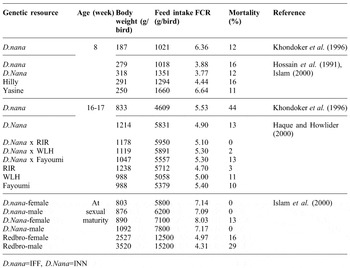
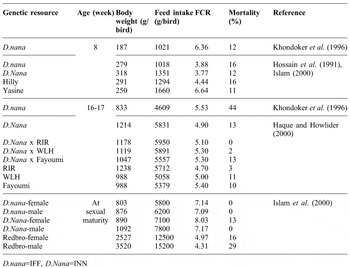
Broiler strains at eight weeks of age show better growth performance than indigenous chickens. However, within the indigenous breeds, INN birds are superior to IFF in respect of body weight, feed conversion ratio and mortality. At the adult stage, growth performance of INN was found to be better than exotic egg-type chickens (Table 1).
Growth performances of INN and other chicken types in Bangladesh.

D.nana=IFF, D.Nana=INN
Deeb and Cahaner (Reference DEEB and CAHANER1996) observed the highest potential benefit in naked neck birds compared to fast growing broiler at hot-climate. Male birds were heavier with lower feed conversion ratio (FCR) than female counterparts. Adult body weight of male and female IFF, and INN were 876.2 and 803.4, and 1092.1 and 890.0g respectively (Islam, Reference ISLAM2000). Other authors have reported that adult body weights of IFF and INN chicken was 833 and 1214 g respectively (Khondoker et al., Reference KHONDOKER, FARUQUE, HOWLIDER and ALI1996; Haque and Howlider, Reference HAQUE and HOWLIDER2000). Barua and Yoshimura (Reference BARUA and YOSHIMURA1997) reported body weights of 1.02 kg and 1.00 kg for adult male and female INN chicken respectively, which coincided with the findings of Khatun et al. (Reference KHATUN, ISLAM, FARUQUE, AZMAL and UDDIN2005). A report demonstrated the better adaptability of INN chicken in stressful environments by its higher survival rate (Horst, Reference HORST1988). Crossbreds of naked neck with exotic chickens are found to have improved growth performances at levels even higher than exotic chickens (Table 1).
egg production
Egg production performance of indigenous chicken strongly depends on nutrition and management. Under scavenging conditions they can lay 35-45 eggs per year (Bulbul, Reference BULBUL1983; Ahmed and Islam, Reference AHMED and ISLAM1985; Sazzad, Reference SAZZAD1986; Huque and Haque, Reference HUQUE and HAQUE1990). Under improved conditions, egg yields of local birds may be doubled, as reported in Indonesia (Prawirokusumo and Hadinato, Reference PRAWIROKUSUMO and HADINATO1987) and Nigeria (Nwosu, Reference NWOSU1979). Yoshimura et al. (Reference YOSHIMURA, BARUA, OLIRA and ZHENG1997) found 50-55 eggs in Bangladeshi indigenous hens per year under improved conditions. Exotic and crossbreds of INN birds with exotic chicken kept under scavenging system showed delayed sexual maturity with lower body weights and egg production. Inversely they attained earlier sexual maturity with higher body weight and egg production when kept in a cage rearing system. Age at sexual maturity, adult body weight and annual egg production of INN birds were found to be 163 days, 1433g and 88 eggs respectively under the cage rearing system compared to 234 days, 1171g and 13 eggs respectively in scavenging systems (Huque et al., Reference HUQUE, CHOWDHURY, HAQUE and SIL2001). Galal et al. (Reference GALAL, AHMED, ALI and YOUNIS2007) investigated the highest number of eggs (132.8 eggs/year), egg mass (8.25 kg/bird), and the medium feed conversion ratio (2.20) in Dahlem naked neck chickens in Egypt (Table 2).
Egg production performance of INN and other chicken types in Bangladesh.

D.nana=IFF; D.Nana=INN; nanaDw-=Dahlem full feathered; NanaDw-, = Dahlem naked neck; nanadw- =Dahlem full feathered dwarf; Nanadw- =Dahlem naked neck dwarf chicken
They also found better egg production, egg mass and FCR in dwarf Nana compared to the Dahlem dwarf chickens. Some authors showed that INN chickens are superior to IFF strains in terms of egg production and survivability (Bhuiyan et al., Reference BHUIYAN, BHUIYAN and DEB2005; Khatun et al., Reference KHATUN, ISLAM, FARUQUE, AZMAL and UDDIN2005; El-Safty et al., Reference EL-SAFTY, ALI and FATHI2006; Islam, Reference ISLAM2006; Galal et al., Reference GALAL, AHMED, ALI and YOUNIS2007). El-Safty et al. (Reference EL-SAFTY, ALI and FATHI2006) found a 1.6% lower laying performance under temperate conditions, but 10% more eggs in heat stress conditions in naked neck birds compared to normal feathered counterparts. Similar trends for egg weight, egg mass and feed efficiency were observed by Horst (Reference HORST1988). When INN male chickens were crossed with exotic females improved egg production was reported (Huque et al., Reference HUQUE, CHOWDHURY, HAQUE and SIL2001; Zaman et al., Reference ZAMAN, SORENSEN and HOWLIDER2004). Horst (Reference HORST1991) reported the highest number of eggs (256.3 eggs/year) for the crosses of naked neck with Frizzle genetics, followed by naked neck with normal feathered chicken (247.5 eggs/year), as tested in Malaysia. Paul and Huque (Reference PAUL and HUQUE1996) observed 99, 91, 58, 44 and 34 eggs/year in INN chickens, Hilly, Yasine, non-descript IFF and Aseel chicken respectively tested in Bangladesh. The highest annual egg production (99 eggs/hen) with delayed sexual maturity (201 days) of Indian naked neck in comparison with other Indian chickens kept in intensive systems was observed by Singh et al. (Reference SINGH, JOHARI, MOHAPATRA and SHARMA1996). Egg number at moderate temperatures was not significantly affected, but, at high temperature, improved egg production was seen in naked neck layers (Horst and Rauen, Reference HORST and RAUEN1986; Merat, Reference MERAT1986; Rauen et al., Reference RAUEN, HORST and VALLE-ZARATE1986).
egg quality
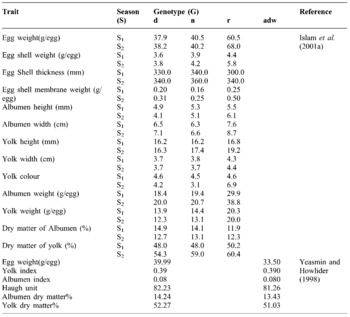
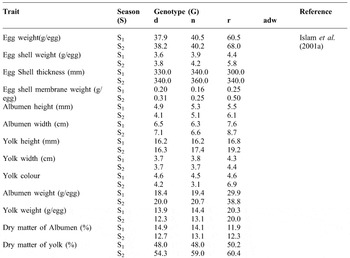
Limited published work on egg quality of indigenous hens is available. Table 3 shows the better quality eggs in the exotic Redbro broiler strain compared to eggs from indigenous chickens, except for egg shell thickness. The highest egg shell thickness was found in INN hens, which affects hatchability of eggs. Naked neck hens eggs were stronger in terms of shell breaking strength than normal feathered and Ff genotypes (Galal et al., Reference GALAL, EL-ATTAR and FATHI2000). These authors also found a higher percentage of albumen and Haugh unit in INN hen eggs compared to IFF layers. Egg quality of INN hens is better than IFF birds, and comparable to RIR, WLH and Fayoumi (Salahuddin and Howlider, Reference SALAHUDDIN and HOWLIDER1991; Islam et al., Reference ISLAM, BULBUL, SEELAND and ISLAM2001a). Yeasmin and Howlider (Reference YEASMIN and HOWLIDER1998) found better egg quality in IFF layers compared to indigenous autosomal dwarf chickens (adw). Although the egg size is small in INN and IFF hens, the dry matter percentage of albumen and yolk are comparable to, and in some circumstances exceed, those from exotic hens (Table 3).
Egg quality of INN(d), INN(n), Redbro (r) and indigenous autosomal dwarf (adw) chickens.

fertility and hatchability of eggs
Eggs from indigenous hens show higher fertility and hatchability rates than those from exotic birds under local conditions (Table 4). Fertility and hatchability of fertile eggs of IFF and INN were 83.0-92.7% and 52.4-87.0%, and 71.5-87.6% and 68.2% respectively, compared to 84.4% and 59.4% for Redbro hens (Table 4). Kamble et al. (Reference KAMBLE, SINGH, JORI and SHARMA1996) reported 85% fertility in Indian full-feathered Kadakanath chickens, 78% in Dahlem Red and 66% in Indian naked neck and in Aseel hen eggs, and lowest in Frizzle breeds. They also found a similar trend for hatchability, but they observed poor fertility and hatchability among the crosses of those chickens. Khatun et al. (Reference KHATUN, ISLAM, FARUQUE, AZMAL and UDDIN2005) reported the significant differences between IFF, INN and ‘Hilly’ type chicken for hatchability (P<0.01). Post-embryonic chick mortality did not differ between INN and IFF flocks, except when exposed to heat stress above 40°C temperature, where survival rates of 51.4% for INN and 38.8% for IFF chicken were reported (Smith and Lee, Reference SMITH and LEE1977).
Fertility and hatchability of eggs of INNand other chicken types in Bangladesh.

D.nana=IFF; D.Nana=INN chicken
meat yield
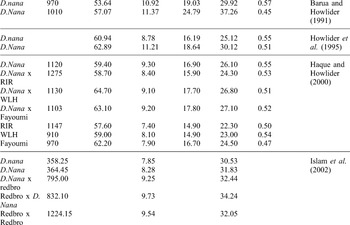
INN chickens are superior to IFF and exotic egg type chicken for yielding a higher percentage of dressed, breast, dark and total meat (Barua and Howlider, Reference BARUA and HOWLIDER1991; Howlider et al., Reference HOWLIDER, BEGUM, ISLAM and WAHID1995; Haque and Howlider, Reference HAQUE and HOWLIDER2000). Dressed percentages and total meat yield of INN, and IFF chicken were 57-63 and 30-37, and 53-61 and 25-30 respectively (Table 5). Even when INN is crossed with exotic chicken to improve meat yield traits, dressed, dark and total meat yield of crossbred of INN with WLH was higher than the crossbred of INN x RIR, and comparable to INN x Fayoumi (Table 5).
Meat yield of INNand other chicken types in Bangladesh.

D.nana=IFF, D.Nana= INN chicken
Islam et al. (Reference ISLAM, SEELAND, BULBUL and HOWLIDER2002) found the most suitable combinations of Redbro x INN and INN x Redbro for meat yield traits which were superior to pureline Redbro broiler strain. The higher yields seen for INN birds in terms of breast and dark meat yield seem to be the main advantages of ‘Na’ gene, with ‘Na’ males from slow-growing meat type label chicken lines, and females for egg production in hot-humid climates performing better (N'dri et al., Reference N'DRI, MIGNON-GRASTEAU, SELLIER, BEAUMONT and TIXIER-BOICHARD2007). Another study reported that dressing percentage, total meat and breast meat of IFF and broiler chickens were 52.57%, 10.16% and 13.96%, and 45.61%, 28.74% and 10.40% respectively (Paul et al., Reference PAUL, HOWLIDER and BULBUL1990). These authors also reported 8.9% higher dressed carcass yield, 3.56% more breast meat, and 7.65% more dark meat in IFF compared to broilers. They also found larger gizzards in IFF chickens than in exotic broilers.
Begum (Reference BEGUM1993) found that although total meat yield of INN fowl did not relate with live weight, breast and dark meat percentage, and breast to dark meat ratio increased slightly with increasing live weight. Alam et al. (Reference ALAM, ISLAM, HOWLIDER and ISLAM1995) reported higher total meat yield in eviscerated carcass of naked neck chickens than in broilers. Breast meat yield is reduced in commercial broilers when reared in a hot, humid environment which is attributed to their higher growth rate and the insulation provided by their feather coverage (Howlider, Reference HOWLIDER1988).
Consumer preference, production costs and prices of chickens and their products
In Bangladesh, around 8% of the total protein for human consumption comes from livestock (BBS, Reference BBS2000). The meat and eggs of indigenous chickens are widely preferred by the consumers because of their pigmentation, taste, leanness and suitability for special dishes (Horst, Reference HORST1991; Islam, Reference ISLAM2000). Habituation is also another reason for preferring indigenous chickens and their products. Meat and eggs from indigenous chickens fetch premium prices compared to products from commercial birds (Horst, Reference HORST1989; Mafeni, Reference MAFENI1995; Guèye, Reference GUÈYE1998). In Bangladesh, chickens are traditionally sold live and are then slaughtered, defeathered, and eviscerated either at the market or at home. Consumers do not trust the slaughtering method for dressed chicken, whether it is done by Halal method, though fear of disease or slaughtering methods (Islam, Reference ISLAM2003). Coloured INN birds are widely preferred by the rural consumers because of their superiority for egg production and meat yield in a harsh tropical environment, where the temperature is 30°C and above (Barua and Yoshimura, Reference BARUA and YOSHIMURA1997). Because of their bare necks, alertness, strength, hardiness and fighting characteristics, the birds seem appear to be more able to protect themselves and their chicks from predators, compared to their fully feathered counterparts (Barua et al., Reference BARUA, HOWLIDER and YOSHIMURA1998).
Production costs per kg of meat or eggs from indigenous chickens is very small (Nwosu, Reference NWOSU1979), but the price of eggs or meat can fetch two or three times that of commercial exotic poultry products (Aini, Reference AINI1990). A survey showed that the price of live indigenous chicken in Malaysia is M$4 (US$1.16) per kg (Supramaniam, Reference SUPRAMANIAM1987) to M$5 (US$1.45) per kg (Oh, Reference OH1987) compared with the price of M$1.3-M$2.3 (US$0.38-0.67) per kg for commercial broilers. In practice, it has been seen in Bangladesh that the price of live indigenous chicken is Taka 150-170 (US$2.17-2.46) per kg while that of live broiler is Taka 70-80 (US$1.01-1.16) per kg.
Marketing of chicken and their products
Meat or egg grading and marketing channels have not yet been fully developed in Bangladesh. Marketing systems are traditional, linking (according to product flow) in the chain of production and marketing; producers>middleman>local assembly traders>distributing traders>wholesalers>retailers> consumers. Therefore producers do not get remunerative price and middleman are the main beneficiaries (Islam, Reference ISLAM2003). Some problems may be arise during the marketing of live birds, such as spread of disease, mortality due to poor handling, environmental hazards or increased production costs during transportation. Therefore, dressed chicken is safe and convenient to consumers because they do not have the onus of processing and preparing the chickens. Recently, some commercial poultry farms like the Biman Poultry complex, Aftab Bhuhumukhi Poultry Farms and Kazi Farms Ltd. have started to process and sell their own products, partly to restaurants, hotels or consumers and through sales outlets established in the towns and cities. Consumers can buy dressed meat or eggs from these outlets with confidence. However, a suitable poultry marketing system is needed to develop throughout the country for the benefit of producers and consumers in respect of price and quality.
Potential use of INN chickens for future breeding plan
Although systematic research work on INN breeds as well as Bangladeshi native chickens is scarce, limited findings and practical observations suggest that INN chickens are potentially the most efficient genome either for meat or egg production, especially in hot, humid climatic conditions. Since there is a wide genetic distance between indigenous chicken and the improved breeds, under environmental stress a higher degree of heterosis may result (Barlow, Reference BARLOW1981). In India, Rao (Reference RAO1983) observed that the backcross of F1 types to local parents displayed a significant superiority in egg production. In Bangladesh, meat and egg production were found to be significantly higher in crossbreds between INN cocks and exotic hens (Haque and Howlider, Reference HAQUE and HOWLIDER2000; Huque et al., Reference HUQUE, CHOWDHURY, HAQUE and SIL2001; Islam, Reference ISLAM2000). INN chickens are superior to IFF and can assure productive adaptability in harsh tropical environments. Therefore it has a high genetic potential for the improvement of breeding stocks either by selective or comprehensive cross breeding programs.
Conclusions
This review reveals that INN chicken is an important and revolutionary genome for tropical poultry production. This is because of its high heat dissipation ability, and promising and exciting ‘productive adaptability’ under harsh tropical environments and resistance to disease. This renders its performance be better than exotic and IFF chickens kept in harsh environment in terms of adaptability, growth, sexual maturity, egg production, egg quality, fertility and hatchability and meat yield traits. Consumers prefer INN poultry products because of pigmentation, taste, leanness, firmness and their suitability for special dishes even their products fetch the price nearly double than of the products from exotic chickens. INN birds are superior to their IFF counterparts in terms of growth, egg production, egg quality and meat yield. Crossbreeding INN with exotic chicken has been shown to improve productivity. Therefore INN chickens may be useful for future breeding strategies, as well as poultry production in Bangladesh.