This article reports on a case study where Lorrin, the first author, a Rumaki pūtaiao kaiako (Science) teacher at a New Zealand high school, used creative narratives with her Year-10 students as a way of developing their understanding of the human digestive system. The prompt for this intervention was her participation in a six-day Writing Workshop, conducted in January, 2013 by Terry, the second author (Locke, Reference Locke2015b). Lorrin had opted to undertake this professional learning during her summer break as part of her commitment in a two-year (2013–2014), participatory action research project being undertaken in her school entitled: ‘A culture of writing: Impacting on teacher and student performance across the curriculum’. This project investigated the potential of Writing Workshop-based practices to enhance teacher self-efficacy in respect of writing and the teaching of writing and, in particular, to positively impact on student (including Māori student) motivation and performance in writing as evidenced by a range of teacher-initiated, classroom-based case studies. At the same time, it investigated how a schoolwide ‘culture of writing’ might be developed, thereby enhancing the collective efficacy of staff with respect to the school's ‘writing across the curriculum’ capability (Locke & Hawthorne, Reference Locke, Hawthorne, Rowell, Bruce, Shosh and Riel2016).
A concomitant goal of the project was to explore the conditions under which teachers in a range of curriculum areas might assume identities as writers and teachers of writing, and the Writing Workshop was a major component enabling this to happen (Locke, Reference Locke2015a). The Professional Learning Community, Lorrin was part of taught across a range of subjects: English, Geography, Science and ESOL. Each teacher-researcher was invited to try something different in just one of their classrooms and to gauge the impact of the ‘intervention’ via various data collection methods. In effect, the classrooms these teachers selected became distinct cases in a multiple case study (Yin, Reference Yin2009; Heigham & Croker, Reference Heigham and Croker2009).
Our focus in this article is Lorrin's Year-10 Pūtaiao Class. Like other teachers in this project, Lorrin assumed the identity of practitioner researcher, by undertaking ‘systematic, intentional inquiry. . .about [her] own school and classroom work’ by ‘gathering and recording information, documenting experiences inside and outside of classrooms, and making some kind of written record’ (Lytle & Cochran-Smith, Reference Lytle and Cochran-Smith1992, p. 450). Ethical approval was obtained via a whole school agreement with the College for this project. In addition, Lorrin obtained consent from her intervention class students before any data gathering occurred. This small study is significant for science teaching and learning in at least two ways. First, it responds to a call by scholars such as Norton-Meier, Tippett, Hand, and Yore (Reference Norton-Meier, Tippett, Hand, Yore, Troia, Shankland and Heintz2010) to develop classroom practices that best ‘facilitate disciplinary literacy’ in science (2010, p. 118). Second, it heeds Grimberg and Hand's (Reference Grimberg and Hand2009) insistence that ‘a guiding principle of science education’ is that ‘canonical discourse. . .should be explicitly taught in the classroom’ (p. 504).
It is also significant for Indigenous education in the New Zealand context because it exemplifies at least two of the five principles underpinning the Ministry of Education's strategy for accelerating Māori success – Ka Hikitia (2013). Principle 2, ‘Māori potential approach’, is reflected in Lorrin's determination to ‘tailor education to the student’ (p. 15). Principle 4, ‘Identity, language and culture count’ affirms that ‘Students do better in education when what and how they learn reflects and positively reinforces where they come from, what they value and what they already know’ (p. 17). As will be shown, the writing of ‘Tomato Pip’ narratives did exactly that.
Science Discourse and Literary Form
School subjects are ‘decontextualised’ (Bernstein, Reference Bernstein2000) versions of beyond-school disciplines, defined by Young and Muller (Reference Young and Muller2010) in this way:
All disciplines, in order to be disciplines, have shared objects of study, and in order to be robust and stable, display objectivity – that is to say, they possess legitimate, shared and stably reliable means for generating truth. . ..Truth is, by this account, a stable relationship between the objects of study and an informed community of practitioners. (p. 21)
In varying ways, school subjects mirror beyond-school disciplines by making meaning using a range of representational resources that is discipline specific. These ways of making meaning can be thought of as disciplinary literacies –– socially constructed, cognitive, technologically mediated ways of making meaning using a range of symbolic (semiotic) systems. The textual outputs of this meaning-making, including written texts, generally engage in one or more of three language ‘superfunctions’: description, narration and argumentation (Locke, Reference Locke2015a, p. 60).
In using the term ‘science discourse’, we acknowledge that the word discourse has a range of meanings in the literature. The meaning adopted here is ‘an abstract noun denoting language in use as a social practice with particular emphasis on larger units such as paragraphs, utterances, whole texts or genres’ (Locke, Reference Locke2004, p. 13). Science discourse is one example of a discipline-specific, socially constructed practice. We concur with Grimberg and Hand (Reference Grimberg and Hand2009), who argue that:
A guiding principle of science education is that engaging in the canonical discourse – meaning language, genre, textual forms, and the use of symbolic conventions – of a discipline is critical for science learning. . .and therefore should be explicitly taught in the classroom. (p. 504)
The case study reported on here was explicitly concerned with students’ conceptual understandings as manifested in their use of biological terminology, and development of an explanatory narrative related to the human digestive system.
A question for science teachers is: How might disciplinary thinking, particularly higher level thinking, be developed in students via a focus on metacognition. Metalinguistic understanding (based on disciplinary linguistic knowledge (DLK)) facilitates metacognition because it gives students a vocabulary to reflect on their learning. Turkan, De Oliveira, Lee and Phelps (Reference Turkan, De Oliveira, Lee and Phelps2014), in specific reference to teaching English language learners (ELLs), view DLK as ‘teachers’ knowledge of a particular disciplinary discourse and involves knowledge for (a) identifying linguistic features of the disciplinary discourse and (b) modelling. . .how to communicate meaning in the discipline and engaging [learners] in using the language of the discipline orally or in writing’ (p. 2). As mentioned above, our focus was on having students develop discipline-specific conceptual knowledge as reflected in their terminological use and development of explanatory narratives.
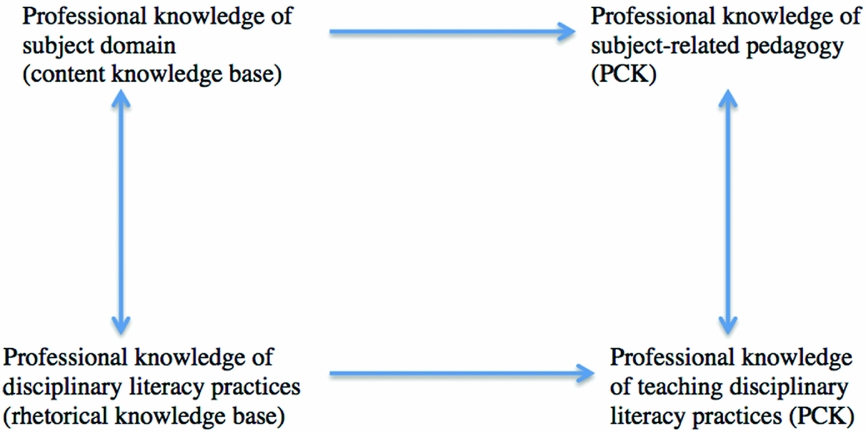
A question underpinning the ‘Culture of writing’ project was the extent to which the development of a metalinguistic vocabulary is associated with one's sense of identity as a writer (of, for example, science). As Figure 1 indicates, there is a complex relationship between the technical language (terminology) that is integral to a subject or discipline (e.g. ‘pipette’, ‘contour’, ‘deficit’), and the metalanguage required to think about the demands of a particular genre (e.g. ‘lab report’, ‘function’, ‘coherence’). This distinction relates to Bereiter and Scardamalia's (Reference Bereiter and Scardamalia1987) terms: content knowledge base and rhetorical knowledge base. Research conducted alongside the ‘Culture of writing’ project suggested that science and maths teachers, at least in the New Zealand context, were likely to be limited in terms of professional knowledge as related to the bottom half of Figure 1 (Locke & Johnston, Reference Locke and Johnston2016).
Professional and metalinguistic knowledge.

An exploratory case study by Cavagnetto, Hand and Norton-Meier (Reference Cavagnetto, Hand and Norton-Meier2010) is a good illustration of research with a single class of fifth-grade students, focused on using the Science Writing Heuristic (SWH) approach to develop argumentational skills (based on Toulmin's model) in generating and representing science knowledge in relation to four topics. Students worked in small groups of four to allow for claims to be made, grounded, warranted and contested, using modes (for a discussion of ‘mode’ and ‘multimodality’ see Locke, Reference Locke2015a, pp. 101–2) of spoken and written language. As per Figure 1, there was a dual metalinguistic focus. Knowledge of the subject domain was reflected in such terms as ‘sprouted’ and ‘preferred environment’ (p. 439). Knowledge of writing as a literacy practice was reflected in terms related to argumentational function (rather than genre per se), e.g. ‘evidence’, ‘claim’ (pp. 438–9).
Underpinning the above study is the belief that ‘using science discourse’ is integral to ‘learning science’ (p. 427). The SWH approach was adopted precisely because it requires students to engage with different language modes (talking, writing) as they investigate topics and generate and justify knowledge claims. ‘Social negotiation through argumentation’, these researchers claim, ‘is critical to learning science’ (p. 430). Reflected here is the belief that engaging students in particular language practices is essential in order to foster their participation (as novices) in quality disciplinary inquiry. It is in contrast to a mode of teaching, which resembles religious indoctrination –– science ‘as dogmatic, unquestionable truths provided by a teacher and sacred text’ (p. 430 [emphasis theirs]). A final point we will make in relation to this study is that it draws attention to the way ‘Representational talk requires an oscillation between disposition (topic) and linguistic (writing task) knowledge, which leads to clarification of conceptual understandings’ (p. 445). In other words, and in line with the work of such researchers as Galbraith (Reference Galbraith, Connelly, Barnett, Dockrell and Tolmie2009), engaging in language production can be generative of new knowledge. Or as Grimberg and Hand (Reference Grimberg and Hand2009) put it, ‘. . .writing per se constitutes a learning process’ (p. 504). As Cavagnetto et al. concluded, ‘. . .the self challenges that occurred during the representational talk (e.g. when talking to maintain ideas when writing) may have pushed students to higher levels of argument than would have been achieved if the task did not required representation of the argument in a written form” (p. 446). The case study reported on here adopts a similar theoretical position, but focuses on narrative rather than argumentation.
The relationship between science thinking and creative/literary writing is well established. In a well-known Harvard Educational Review article, poet Anne McGrary Sullivan (Reference Sullivan2000) draws attention to the way she was schooled in an aesthetic vision by her biologist mother:
Aesthetic vision engages a sensitivity to suggestion, to pattern, to that which is beneath the surface as well as to the surface itself. It requires a fine attention to detail and form: the perception of relations (tensions and harmonies); the perception of nuance (colors of meaning): and the perception of change (shifts and subtle motions). (pp. 220–1)
In turn, she asserts, researchers and teachers need to learn this aesthetic vision from artists (see also Martin & Brouwer, Reference Martin and Brouwer1991). Consistent with this thinking, Dirnberger, McCullagh and Howick (Reference Dirnberger, McCullagh and Howick2005) resurrect the old idea of the naturalist's journal, viewing the genre as exemplifying ‘the mutually reinforcing integration of science and art’ (p. 29). By keeping such journals, they argue, ‘students learn that science is a process that requires creativity based on their observations of the natural world and the questions these observations create’ (p. 39), noting that ‘it may even be appropriate to capture observations through poetry’ (p. 41). Killingbeck (Reference Killingbeck2006) also recounts how engaging in a range of creative writing genres made his Field Botany and Taxonomy course fun and enhanced student motivation and achievement.
A number of educators advocate various forms of personal writing as a strategy for developing science knowledge. Hanrahan (Reference Hanrahan1999) conducted her year-long study with a teacher and his Year-8 science class in a disadvantaged Queensland Catholic school. Viewing science learning as a ‘process of induction into the beliefs and values of the scientific community’ (p. 699), she negotiated with the classroom teacher the introduction of affirmational dialogue journal writing as a way of combatting alienation from science, and enhancing student empowerment and voice. In response to a range of prompts, students were given regular 10-min slots to write in journals, which were then collected and responded to in an affirming way by either researcher or classroom teacher. Prompts were wide-ranging, including foci on feelings about classroom practices, what they were learning and their understandings of key concepts. Findings suggested that among other things, the dialogue journal writing helped foster ‘a more democratic and collaborative classroom ethos’ and helped the teacher ‘focus more on language and literacy aspects of science learning’ (p. 713). The use of narrative in this study builds on this kind of study, but is tailored to the need to build understanding of a process (digestion) that occurs in time.
Like Hanrahan (Reference Hanrahan1999), Seraphin (Reference Seraphin2014), writing from the perspective of an Indigenous (Hawaian) science educator, contends that the personal (inter)connectedness valued by Indigenous peoples is given scant recognition in classrooms, where science is taught in accordance with Western ideas of empirical inquiry, factual knowledge and abstract thinking. Actively encouraging students to share what they think and feel, and tapping into their cultural funds of knowledge, can be used productively to ‘enhance students’ incorporation of science knowledge with their personal worldview and daily lives, allowing students to use their prior conceptions as resources for cognitive growth’(p. 12) and building conceptual knowledge. Seraphin offers models of different kinds of personal and reflective science writing that serve this purpose, including ‘I am from’ poems, writing stories from students’ cultural traditions, a dialogue with a famous scientist, a letter explaining a scientific concept to a family member, and so on. As explained below, this study occurred in the context of a rumaki, a school within a school where students are taught the curriculum using Māori medium for at least 51 per cent of their learning time. There are complex cultural and epistemological issues related to the recognition of a Māori worldview in the science education of Māori students, which are beyond the scope of this article (see McKinley & Keegan, Reference McKinley and Keegan2008). Our study had the more modest aim of having students draw on cultural funds of knowledge in a looser sense as a bridge in developing competence in science discourse.
More germane to the intervention we describe here, is the specific use of narratives as enabling high-school science students to make sense of their experiences, challenging practices that position narrative as a ‘stepping stone to some higher plane of communication’ (p. 58) such as exposition and also challenging the poet/scientist binary (Pagnucci & Abt-Perkins, Reference Pagnucci and Abt-Perkins1992, p. 58; see also Miele, Reference Miele2010; Clopton, Reference Clopton2011). With a focus on epistemology, Martin & Brouwer (Reference Martin and Brouwer1991) assert that ‘. . .the narrative mode is essential to a science education that values the belief that students must have a personal engagement with the ideas they are to learn’, noting that, ‘Through stories students may more successfully begin to see the subtle dimensions of science and of understanding the ways in which science, culture and worldview interact’ (p. 708). Drawing on Bruner's distinction between paradigmatic and narrative modes of thought, they offer a range of ways in which students of all ages can draw on and shape their personal experiences of the world as a way of ‘anchor[ing]’ (p. 712) a range of science concepts. We concurred with this valorising of narrative, which, in addition to the benefits argued above, we viewed as ideally suited to developing understanding of biological processes and particularly apt for Māori students for whom story-telling was a central cultural practice and mode of argumentation.
Lorrin's Intervention
The purpose of Lorrin's intervention was to provide her year-10 Rumaki students with an opportunity to draw on their own cultural funds of knowledge (Moll, Amanti, Neff & Gonzalez, Reference Moll, Amanti, Neff and Gonzalez1992) in writing a creative narrative to enhance their concept development, specifically in relation to the human digestive system. Effectively, she was using creative narrative as a bridge between personal, cultural discourse and the discourse of science. As these students’ classroom pūtaiao teacher, she felt that having students engage in writing creative narratives would afford her access to their ways of seeing and thinking. She believed that science teachers often ‘leap over’ students’ personal understandings and attempt to teach science without attempting to have students ‘connect’ with the body of knowledge taught, with the result that students end up feeling alienated or disconnected from it.
Participants
Ngā Puna O Waiorea is the name of the Western Springs College Rumaki. The Rumaki fosters the pride of these students in ‘their origins, language and culture’, with aims that include:
• competence in written and spoken Māori, and genuine respect for Māori customs and protocol;
• respect for one's own culture, respect and appreciation of other cultures;
• high achievement at all year levels across all subject areas through the supportive networking of Rumaki teachers.
The New Zealand Ministry of Education classifies Māori medium education in two levels: Level 1: 81–100 per cent instruction in Māori; and level 2: 51–80 per cent instruction in Māori (Ministry of Education, 2014). The case-study rumaki had one Level 1 class and one Level 2 class at each of Years 9, 10, 11 and 12 and a mixed Level 1/2 class at Year 13. Lorrin's 10OR class of 21 students, the case study participants, was at Level 1, that is, over 81per cent of its instruction was in Māori language.
Why did Lorrin have them write narratives in English? Why was she not encouraging students to write in Te Reo Māori – for Māori by Māori? The bilingual dilemma she faced was that, while a firm believer that Rumaki students must be able to communicate effectively in both languages (Te Reo Pākeha and Te Reo Māori), the primary purpose of the intervention was to develop the tools, skills and strategies her students would need to write successfully and effectively by the end of Y11. After completing Y11, these students were destined leave this form of teaching (the Rumaki) and pursue specialist science subjects in the kura auraki (mainstream). As their pūtaiao teacher, Lorrin saw herself needing to equip these students with the skills to effectively engage in science discourse in English.
A Design for Learning
Lorrin set for herself the following aims in a unit drawing on students’ cultural and personal backgrounds to enhance their understanding of science discourse by applying the latter in their own writing:
• Invite students to use a creative form to tell a scientific story;
• discover something about students’ processes of thinking when preparing to write;
• introduce students to a scientific register;
• help students to learn the discourse of science in a fun way;
• enable students to produce effective science discourse.
The specific learning objectives (SLOs), she formulated for her students were as follows:
1. Become familiar with and comfortable in using scientific language related to the human digestive system.
2. Draw on their own familiar surroundings to help construct a narrative to inform their understanding of the digestive system.
3. Understand that to do science means to use the discourse of science as talkers and writers.
4. Adopt a positive attitude to using science discourse in their writing.
5. Identify specific features of science discourse, such as diction (the words used), syntactical usages (types of sentences) and typical structures (at the whole text level).
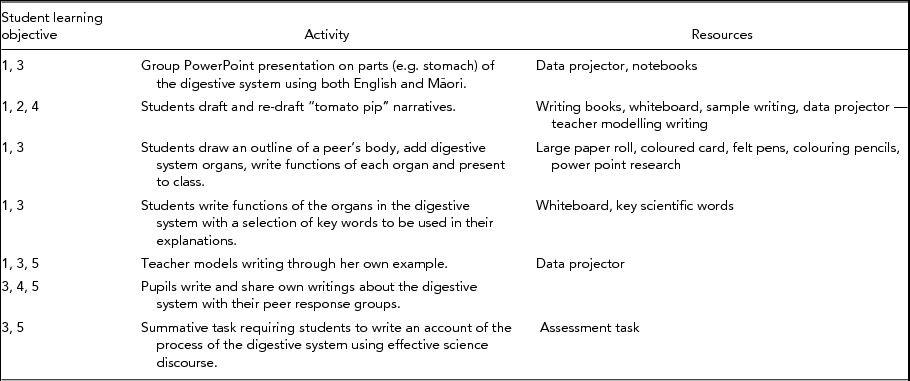
Like other teachers in the ‘Culture of writing’ project, Lorrin collaborated with other members of the Professional Learning Community in designing activities she believed served her identified SLOs (see Table 1). While we are not providing here a blow-by-blow account of how Lorrin taught this unit of work, Table 1 does offer an overview of the kinds of activities planned. Data collection instrumentation (see Methodology section) was influenced by the decision-making around SLOs and their associated activities.
Linking Learning Objectives with Activities and Resources

Writing a Creative Narrative
The following milestones offer a sense of the learning process students underwent over the course of the four-week unit of work Lorrin designed.
1. At the beginning of the unit, students were engaged in a diagnostic writing task, writing a first-person narrative imagining themselves as a ‘tomato pip’ passing through the human digestive system. The purpose of this activity was to gauge students’ initial understanding of the digestive system and to provide baseline data.
2. Students were engaged in a range of culturally responsive learning activities (see Table 1), e.g. group PowerPoint presentations, drawing and labelling tasks, as a way of developing science discourse understanding and usage, and mastery of relevant language functions.
3. Students were encouraged in second and subsequent ‘tomato pip’ narratives to introduce key scientific words/concepts into their writing.
4. At the end of the unit, students sat an hour-long summative test on ‘Te Pūnaha Nakunaku Kai — Digestive System’. This test included a labelling task, a mix-and-match task, a series of short-answer questions, table-completion tasks and finally a narrative task with the following instruction:
During this topic one of your tasks was to write a narrative where you were a tomato pip passing through the digestive system. In the space provided below discuss the processes involved in the digestive system, naming each part of the digestion process and explain what occurs in each section, starting from the mouth through to the anus.
Students had approximately 30 min for this narrative task.
Methodology
In articulating the ‘logic of design’ underpinning case study research, Yin (Reference Yin2009) offers a two-part definition. The first part, which addresses the topic of scope, defines case study as an ‘empirical inquiry that investigates a contemporary phenomenon in depth and within its real-life context, especially when the boundaries between phenomenon and context are not clearly evident’ (p. 18). The second part of his definition, addresses issues around data collection and analysis, noting that in the context of case-study inquiry, ‘there will be many more variables of interest that data points’, with the consequent reliance on ‘multiple sources of [triangulated] evidence’ and the desirability of some ‘prior development of theoretical propositions to guide data collection and analysis’ (2009, p. 18).
The purpose of this case study was to explore whether the use of creative narratives enhanced students’ conceptual development and use of science discourse over the course of a four-week unit of work. The research questions we sought to address were as follows:
1. How did students view the learning activities Lorrin designed for them in terms of both motivation and facilitating learning?
2. Did students develop confidence and competence in using science discourse over a succession of creative narrative drafts?
In thus study, a pragmatic, mixed-methods approach was adopted in selecting data collection methods. Mixed methods is ‘a procedure for collecting, analysing, and mixing quantitative and qualitative data. . .within a single study in order to understand a research problem more completely’ (Ivankova & Cresswell, Reference Ivankova, Cresswell, Heigham and Croker2009, p. 137). We viewed this procedure as having the potential to illuminate the two questions posed above (Heigham & Croker, Reference Heigham and Croker2009). That is, consistent with Yin (Reference Yin2009), we saw both quantitative and qualitative sources of evidence as complementing each other and allowing for the triangulation of results from each data set. However, it would be fair to say that our major focus was on the creative narratives themselves, with the postintervention questionnaire and focus group having a complementary role.
Data Collection
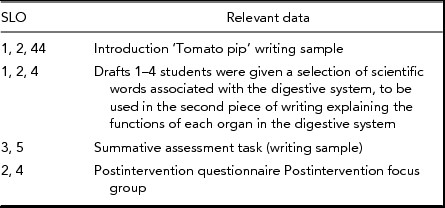
The case study class was the only Year-10 pūtaiao (science) class that Lorrin taught, so can be viewed as a convenience sample (Cohen, Manion & Morrison, Reference Cohen, Manion and Morrison2000, pp. 102–3). Table 2 provides a timeline of each stage of the research intervention process and links data collection methods to the study's SLOs.
Data Collection Plan

Writing Samples
Writing samples were viewed as the primary data collection instrument in this case study, since they were viewed as the primary evidence for science discursive growth (as per RQ2). Before sitting their summative test, these students had four classroom opportunities to write creative ‘tomato pip’ narratives: February 28, March 3, March 4 and March 8. The summative test, though done under examination conditions, was a fifth opportunity for these students to produce a creative narrative. Inadvertently, Lorrin was observing Nuthall's (Reference Nuthall2007) well-known principle that a student is highly likely to retain a concept, if they are exposed to a full explanation on at least three separate occasions. In this instance, however, they were instantiating this knowledge in a creative narrative. (For an example of a fourth draft, see Supplementary Material)
Postintervention Questionnaire
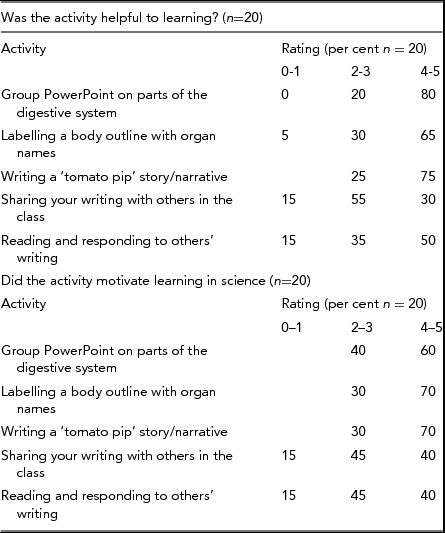
As Menter, Elliot, Hulme, Lewin and Lowden (Reference Menter, Elliot, Hulme, Lewin and Lowden2011) point out, questionnaires have the advantage of ease of administration, can gather a wide range of information relatively quickly and allow for the application of a range of statistical procedures. The postintervention questionnaire was co-designed by both authors, and aimed to seek student responses to those strategies the first author deemed to be central to her intervention (RQ1). The 0–5 Likert scale allowed respondents to indicate degrees of positivity or negativity towards each item in terms of helpfulness to learning and enhancing learning motivation. These were completed by 20 students from Lorrin's class once the intervention was completed. As per Tables S3 (Supplementary Material) and Table 7, students were asked to rate five intervention activities on a scale of 0–5 as either helping their science understanding or their motivation to learn science.
Focus Group
Focus groups rely on ‘interaction within the group based on topics that are supplied by the researcher’ (Morgan, Reference Morgan1997, p. 12), and allow for participants to feed off, reinforce or contest the views of other members. Four students, two male (Hone and Tipene) and two female (Hine and Pania — Names are pseudonyms.) participated in a postintervention focus group, which canvassed their views (as per RQ1) on:
1. Activities they found enjoyable and/or motivating.
2. Activities that they found helpful to their learning about the human digestive system.
3. Writing creative narratives about the journey of the tomato pip through the human digestive system, in particular.
Participants volunteered to be part of the group during one of Terry's visits to the school and had not met him previously. The sampling was partly convenience and partly purposive (to obtain a gender balance). The meeting was conducted some months following the intervention.
Analysis
Writing Samples
Writing samples were subject to three types of analysis, word-count analysis, summative evaluation and discourse analysis.
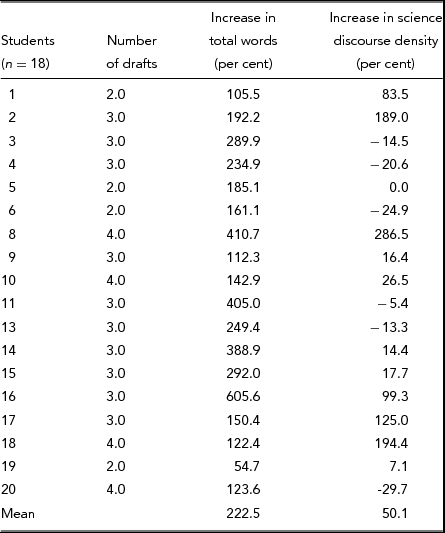
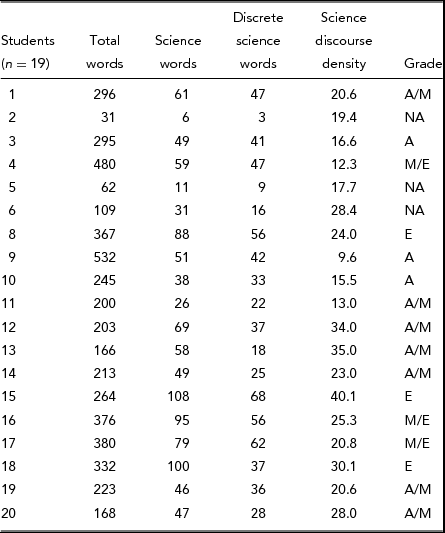
Word-count data were derived from creative narratives produced on up to four occasions in class (see Table S1 in Supplementary Material). Our initial word-level analysis focused on a total word count of each draft, a tally of ‘total science words’ and a tally of ‘total discrete science words’ were used. We defined science words as words those associated with science disciplinary diction. For each draft, we also calculated the percentage of total words regarded as ‘science words’ (science discourse density), surmising that as confidence developed the presence of such words would become more pronounced over successive drafts. Our purpose in analysing discrete science words was to obtain an indication of the range of science words students were using. Some students were absent from one of more of these drafting occasions. Others did not take the opportunity to write a creative narrative on the first two occasions and opted to brainstorm words they might use at a later date (marked with an asterisk in Table S1). Of the 19 students whose data we further analysed (Table 3), student 7 did no creative narratives at all), 4 had written narratives on just two occasions, 10 had written 3 drafts, and 5 had written 4. Additional statistical analysis conducted on the basis of word-count data is discussed in the Findings section.
Increases in Total Words and Science Discourse Density Over Successive Drafts

As mentioned previously, students produced a further writing sample in their summative test. The test was marked in accordance with the rubric shown in Table 3, which was developed collaboratively with other teacher-researchers in the ‘Culture of writing’ project. While there are three grades of ‘pass’ in this rubric, students were in fact marked in terms of a six-point scale ranging from not achieved to excellence. The grade categories of ‘not achieved’, ‘achieved’, ‘merit’ and ‘excellence’ are based on the four-point scale used in New Zealand's senior secondary qualification, the National Certificate of Educational Achievement, which commences at Year 11. It is now commonplace for New Zealand schools to use 6–8-point scales based on notional descriptors midway between the four original categories. The verbs ‘describe’, ‘explain’ and ‘discuss’ are commonplace taxonomic markers in New Zealand assessment practices.
To probe more deeply into what might be occurring over the process of developing successive drafts, we took one student's (we call her Atarangi) first and final narrative, and subjected it to discourse analysis. As Paltridge (Reference Paltridge2000) points out, ‘Discourse analysis. . .is the analysis of language in use. . .[and] examines how stretches of language become meaningful and unified for their uses’ (p. 4). We were particular interested in identifying evidence of voice (Elbow, Reference Elbow2000), and how different voices might be seen as related to different ways of storying a particular, natural phenomenon (in this case, human digestion).
Post-intervention Questionnaire
The six-point scale used in the questionnaire was reduced to three categories (i.e. lukewarm, modest and warm endorsement), and analysed accordingly.
Focus Group
Thematic analysis (Braun & Clarke, Reference Braun and Clarke2006) was used in relation to the transcript of the focus group interview. Most responses to prompts were relatively brief, and where responses were sustained over a number of utterances, an initial coding was performed by Terry and resulting themes agreed upon by both researchers.
Findings
Writing Samples
From Lorrin's classroom teacher's perspective, the second drafts consisted predominantly of descriptive words, hence indicating a creative process at word, but not yet effective science discourse. She noted that students were becoming familiar with new concepts related to the digestive system. By the time they wrote their third drafts, students were using more scientific words, with more detailed description in their narrative and more detail in their explanations of the processes of the digestive system. This general pattern indicated that students were gaining more confidence and a clearer understanding of key scientific concepts. By draft three, as she observed it, students’ grammar and sequencing of ideas had also improved.
Table 4 is derived from Table S1. It shows the number of drafts each student completed, the percentage increase in number of words for each student from their initial draft, and the percentage increase in science discourse density across successive drafts. As can be seen, the total word number in the creative narratives increased markedly, with a mean increase in word number of 222.5 per cent. However, when a mean is calculated for the increase in total word count for students who had written just two drafts, the result was 126 per cent, considerably less than the mean overall. Across the 19 students, the range for increases in science discourse density across successive drafts was between −29.7 per cent and 286.5 per cent. Those students whose narratives indicated a decrease in science discourse density, tended to be students whose word totals had increased markedly, but we would view this as a tendency only. However, this tendency had the potential to provide a kind of dilution effect in respect of the prevalence of science discourse in the writing.
Tīnana: Riunga Kai (Digestive System) Rubric

As we reflected on these initial results, we believed that an increase in confidence and competence in using science discourse had occurred. Students were able to write more and in most cases science discourse density increased. However, an increase in science discourse density on its own does not necessarily indicate increased confidence and competence. The freedom associated with the creative narrative task meant that students were free to embellish their ‘stories’ with nontechnical literary language, which may or may not have reflected a deep understanding of the digestive process. While the number of ‘science words’ increased markedly for all students — for some to a staggering degree — the numbers in Table S1 don't indicate the range of science words used.
Table 5 records the total words, total science words, total discrete science words (science words minus repetitions), science discourse density and grade for the 19 students in Lorrin's class who sat the summative test (student 7 was absent). All students (4) who totalled over 80 ‘science words’ obtained an excellence grade. The three students who were graded as not achieved had the lowest tallies of science words (Student 11 excepted). As the case of Student 9 illustrates, a student could have a low science discourse density score, yet still gain an achieved grade.
Summative Test Scores

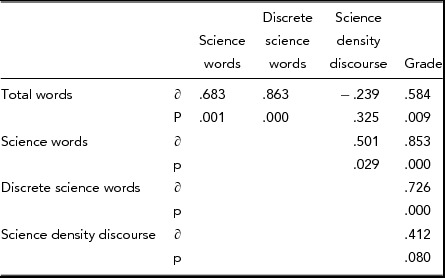
To further investigate possible correlations between the four variables (total words, science words, discrete science words and science discourse density) and summative test scores — we converted Table 5 scores to rankings (See Table S2. Supplementary Material). Table 6 shows the Spearman Rank Order Correlation Coefficients between the five variables. Spearman correlations were used because of the sample size (n = 19) and the impact of extreme scores on the correlations involving Total Words and Science Words. Significant correlations were found between Total Words and Grade (∂ = .584, p = .009), Science Words and Grade (∂ = .853, p = .000), and Discrete Science Words and Grade (∂ = .726, p = .000). The correlation between Science Density Discourse and Grade, although positive, did not reach significance (∂ = .412, p = .080). Based on these figures, we drew the conclusion that the number of Science Words and Discrete Science Words are the best predictors of Grade.
Spearman Rank Order Correlation Coefficients (∂) and Probabilities (p)

These findings make sense when one considers that a student could have used a lot of science words and also written a long narrative, which would have academic merit for both the correct use of science terminology and the creative nature of the answer, and score no more for Science Density Discourse than a student writing a relatively short narrative and using few science words. We hypothesise that, if a word range had been given to students (e.g. 300–400 words), the correlation between science density discourse and grade would have been higher.
As explained earlier, the decision to have students write creative narratives was justified by the fact that human digestion is a natural process that occurs over around 40 h. As in many narratives involving human actors, a tomato pip narrative has a protagonist who, in picaresque fashion, experiences a range of encounters in time between mouth and anus. The language of narrative is multifunctional. At times the language focuses on events, moving the action forward in time. At other times, the language focuses on aspects of setting and character that warrant description, as a way of putting a reader in the picture and/or offering a commentary or explanation.
In discussing the topic of discourse analysis, Gee (Reference Gee1996), distinguishes stanzas from lines by describing them as follows:
sets of lines about a single minimal topic, organized rhythmically and syntactically so as to hang together in a particularly tight way. The stanza takes a particular perspective on a character, action, event, claim, or piece of information. (p. 94)
We used discourse analysis as a way of deepening our understanding of the play of voices at work in these narratives and to reveal patternings that might not be apparent through a casual reading. In the extract from Atarangi's first draft below, we have used a forward slash to mark off the stanzas, the first and fifth of which (marked with a ‘d’) we interpret as primarily descriptive in function, and the remainder (marked with an ‘a’) as primarily concerned with moving the action forward, even though these stanzas do contain descriptive language.
Here is Atarangi's very first attempt at a tomato pip narrative:
/d I'm a tomato pip. My world is a round juicy ball of sweet redness. /a As the strange beings cut my world in half, throw me in between two squishy brown, grainy things where I lay, waiting to see what other odd things would happen to change my life. /a I feel my-self levitate and approach a dark cave. /a Sharp white things start crunching down around me, ruining everything in their path. The land underneath me moving around like an earthquake. /d This is the beginning of my regeneration, mechanical digestion. /a I feel the mush around me getting squishier and wetter, salvia [sic] is starting to fill the cave to help flush the squishy stuff and I go down the track to the stomach, the oesophagus.
At the start of this narrative, Atarangi's diction is both colloquial (‘squishy’) and highly figurative (as per those words in bold in the extract above). In reading her account, we had a clear sense of her enjoying the creative challenge, identifying with the tomato pip by withholding the naming of commonplace objects such as sandwiches, mouth and teeth, preferring to communicate something of the sensuous reality of these things. It is not until the last two sentences of this draft, that we encounter science discourse in words/phrases such as regeneration, mechanical digestion, salvia [sic], stomach and oesophagus.
Using the three analytical tools of stanzas, figurative language use and discrete instances of science discourse (words/phrases), we have used the example of Atarangi's fourth Tomato Pip narrative to develop our understanding of what happened for students like her between their initial and fourth drafts. (We decided against using the test narrative as the basis for comparison, since it was written under different conditions than the narratives produced in class.)
This narrative (see Supplementary T1) consisting of 12 paragraphs of uneven length, began in a manner similar to her first draft and ended with the tomato pip finding a home near Pakiri Beach — a long, white beach north of Auckland with Māori owners and beloved by surfers. As Supplementary T1 indicates, we identified 29 stanzas, of which 14 were concerned with events that moved the action forward, and 15 with description. At the start of her fourth narrative, she replaces the word cave with mouth and inserts a new sentence describing the breaking down of starches in the mouth. According to our count, there were a total of 122 instances of science discourse items in this narrative, largely concentrated in paragraphs 2–10. These instances include verbs such as absorb and nouns we treated as compounds (small intestine, gall bladder). Of these 122, 74 were discrete items, giving a redundancy rate of 39 per cent, i.e. the percentage of total science discourse items involving repetition.
An interesting finding in relation to this illustrative script, however, concerns voice, and the relationship between stanza type and diction. While both stanza types in this narrative contain instances of science discourse, 72 per cent of these items are found in descriptive stanzas, even though these make up only half the total. What becomes evident is that Atarangi has used the affordance of descriptive stanzas to provide a scientific commentary on the action, illustrated in sentences such as: /d ‘The small intestine digestive juices help break down the food even more around me, and absorbs [sic] the vitamins, minerals, proteins, carbohydrates and fats’. Later in the narrative we find a telling change in point of view: /d ‘The kidneys make urine, removes [sic] extra liquid waste and extra fluid from your blood. They also keep your bones healthy, and help you make red blood cells’. The first person (me) is present in the first of these two sentences, though muted. In the second, it is replaced by a third-person narrator using the mode of second-person address.
One way of describing this creative narrative is to think of it as a play of two voices: the voice of the tomato pip as picaresque adventurer drawing on commonplace language and familiar imagery; and the voice of the detached scientist, exercising the power of naming and explanation, albeit with limited success. Of course, these voices do not co-habit this narrative space effortlessly, but then this is a 14-year-old girl who is still learning the discursive ropes.
Student Responses
Post-Intervention Questionnaire
Table 7 reports the ratings of the activities Lorrin was seeking student responses to in terms of both helpfulness and motivation. The group PowerPoint, the labelling activity and the creative narrative were warmly endorsed by a significant majority of students, while the two peer response activities had a more mixed response. In terms of both helpfulness and motivation, the creative narratives received by far the most maximum scores of 5: 11 for helpfulness and 9 for motivation.
Questionnaire Results

Focus Group
Three students identified different activities that they found helpful. Hine mentioned the group Powerpoint ‘about a specific body part’ and how hearing other people present made her ‘want to learn more about that part of the digestive system’. Pania referred to Lorrin's use of a full-scale model of the digestive system, which students could touch and add ‘pictures of organs’ to. Hone mentioned the narrative writing as motivating. No student referred to peer response activities. There was no sense of disagreement among group members re these contributions.
In a similar manner, four students mentioned different activities they deemed useful for learning, again with no sense of dissent. Hine mentioned Lorrin's use of ‘quizzes’, which enabled her to know ‘if we were learning enough’. Pania mentioned the PowerPoint presentation, essentially a jigsaw activity, where different groups presented on different organs, ‘which helped you learn, instead of learning a whole bunch at once’. Hone mentioned the helpfulness of the ‘posters and diagrams’ that Lorrin had on her classroom wall, while Tipene mentioned the use of worksheets for revision purposes.
Most of the focus group was taken up with a lively discussion about the creative narratives. Although not describing science outright as ‘boring’, these students did suggest that this was ‘usually’ the case. They related the tedium to the need to master terms and ‘memorise a whole lot of things’ (Pania). These students found writing the creative narratives both helpful and ‘fun’ or ‘cool’. Two dominant themes are summed up in these words of Hone: ‘. . .you learn more when you've having fun at the same time. And. . .you could really bring out your creative side’.
Re the theme of creativity, two students mentioned enjoying the opportunity to ‘use our imagination’. Pania referred to liking English ‘a lot’ and associated ‘creative writing’ with fun. Hine also referred to liking English, commenting that with Lorrin's teaching ‘it's like two subjects in one’. It was this focus on imaginative writing that enabled these students to link personal, cultural knowledge with science knowledge. Students could easily remember images they used in their own narratives. Hone, for example, connected the stomach with ‘having a spa’ telling us later that ‘my nana used to have one’.
What impressed Terry as interviewer was these students’ knowledge retention. At various points Pania argued strongly that the use of creative narratives helped develop subject matter understanding and retention. After hearing Hine remark that: ‘I used sharks because enzymes break down things, so do sharks and saliva's like the liquid’, she commented:
I think it was a really efficient way. . .’cause people can always relate things to help them learn better. And use different things to help them remember things. Like – if you were memorising saliva, you can know that it's water, so you would use waves. Whenever you think of waves, you think of saliva. And with sharks, if you like swimming, you always see sharks – it's easier to remember enzymes. So it is a really good way to help you memorise things without just writing them down. . ..
Some data on which these results are based are shared as supplementary material accompanying the online article.
Conclusion
The study reported on here concerned a single Year-10 class; the sample was thereby limited and the findings not generalisable to larger populations of Year-10 students (external validity). This was a class of Māori students in the context of a rumaki with a teacher who was developing her own style and practice. In addition, while all students completed the postintervention questionnaires, only four students (randomly selected) constituted the focus group. However, as focus-group facilitator, Terry was unknown to the students and there was no sense in their responses they wanted to please their teacher. The findings we have reported on here have to be viewed as indicative and context-specific.
In his theory of heteroglossia, the Russian linguist Bakhtin drew attention to the coexistence of diverse styles and voices in a single text. In The Dialogical Imagination (Reference Bakhtin, Bakhtin, Holquist, Emerson and Holquist1981) he writes that: ‘It is possible to give a concrete and detailed analysis of any utterance, once having exposed it as a contradiction-ridden, tension-filled unity of two embattled tendencies in the life of language’ (p. 272). In analysing Atarangi's Tomato Pip narrative, we have revealed Atarangi's becoming as a young scientist, as she manages the tensions between personal story-teller and the emergent biologist-commentator on the workings of the human digestive system. We view this single example of discourse analysis as a suggestive indication of the way in which the scientist's voice can begin to emerge in the successive production of creative narratives.
In respect of internal validity, we must reiterate that we are not arguing that the students’ test grades were caused by any of the variables we statistically correlated, i.e. total words, total science words, total discrete science words and science discursive density. Indeed, other factors at play in Lorrin's classroom would have contributed to their mastery of science discourse and understanding of the topic. While we would argue that the greater use of science discourse is likely to reflect a greater understanding of the topic, we would also accept the possibility that a student can score a good grade without necessarily using a large scientific vocabulary and by reflecting their understanding of a topic in nontechnical language. Writing a lot of words on its own is no guarantor of a quality answer.
For all that, there is, we believe, ample evidence that certain activities featuring in Lorrin's intervention enhanced students’ motivation to learn science and their consequent achievement. In particular, most students found writing creative narratives motivating and helpful. Focus group students, in particular, drew attention to the enjoyment they found in this kind of writing, the opportunity for creativity, and the way it helped them retain knowledge. From Lorrin's perspective, students’ science writing was enhanced by the permission given to draw on their own cultural backgrounds. Further, on the evidence of work-samples, there was a significant correlation between both the number of words written, the number of science words written, the number of discrete science words used, and student achievement. Though a small case study, this one supports the assertions about the value of narrative in fostering student mastery of science discourse made by Martin and Brouwer (Reference Martin and Brouwer1991).
Most students also liked the group-based Powerpoint and labelling activities and found them helpful to their learning. From Lorrin's point of view, the purpose of the Powerpoint was to encourage students to research data online, to synthesise it, and draw on it in their writing — a kind of prewriting activity. We would suggest that both activities operated in this way, though we can't draw this inference directly from the evidence. In contrast, response-group activities were endorsed by fewer students.
Lorrin herself derived from her own reflections a number of measures to improve her teaching:
• ensuring the authenticity of the students’ work and to reduce opportunities for ‘cut and paste’;
• allowing students to work in pairs and groups as opportunities for students to develop their language;
• a more systematic use of writing response groups and using these as forums for students to foster their understanding of research findings;
• opportunities to practise the skill of paraphrasing;
• more formal teaching of relevant syntactical structures and linking words;
• greater use of teacher modelling of her own science writing;
• incorporating more numerical (word count) data in her feedback to students and in the rubric descriptors.
We would hypothesise, based on research on the effectiveness of peer response in teaching writing (see Hoogeveen and van Gelderen, Reference Hoogeveen and van Gelderen2013), that some of these measures would address the less enthusiastic response to this activity in our study.
The intervention reported on here was designed and implemented by a teacher/researcher who had undergone a cross-curricular Writing Workshop experience with some of her colleagues. Interviewed by Terry around the time she was teaching this unit, Lorrin had this to say:
Having to write poetry, creative writing, reflecting back on childhood memories, I thought that brought out a writer in me that I wasn't aware of so that was great; . . . [I] continue to practise writing like that and. . .get ideas and thoughts out on paper. . . then having to rewrite that into again academic writing for research.
What this statement encapsulates, we think, is the transformative effect the Writing Workshop experience can have for teachers in any curriculum area. For Lorrin it expanded her sense of what disciplinary writing means and encouraged her to engage in what we might call ‘disciplinary border crossing’, that is, engaging in a type of writing not regularly associated with the biology classroom. As this study illustrates, there was a flow-on effect from this personal/professional transformation to her students, and they all benefited from it.
Acknowledgments
We acknowledge the input and expertise of Professor Cedric Hall in relation to the statistical work included in this paper.
Supplementary material
To view supplementary material for this article, please visit https://doi.org/10.1017/jie.2017.11
About the Authors
Lorrin Shortland is Tumuaki Tuarua/Head of Oranga House in the Te Rumaki Reo o Ngā o Puna o Waiorea (Western Springs College). She is a member of the Science Department at this school and is currently undertaking research on the relationship between the periodic table of the elements and indigenous knowledges.
Terry Locke is Professor of Arts and Language Education in Te Hononga: School of Curriculum and Pedagogy at the University of Waikato. His research interests include writer identity in teachers, the teaching of writing across the curriculum, the teaching of English and the place of metalinguistic understanding in teaching and learning. His most recent book is Developing Writing Teachers.