Introduction
Pain conditions are common in the elderly. Reported estimates of chronic pain range between 20% and 50% in elderly populations (Reyes-Gibby et al., Reference Reyes-Gibby, Aday and Cleeland2002; Mossey and Gallagher, Reference Mossey and Gallagher2004; Chou, Reference Chou2007; Zanocchi et al., Reference Zanocchi2008). Many authors believe the documented prevalence of pain in elderly populations may be an underestimate because older adults are less likely to complain of pain as it is seen as a normal, expected consequence of aging (Gagliese and Melzack, Reference Gagliese, Melzack and 1997; Melding, Reference Melding2004). The under-reporting of pain in elderly populations is reportedly attributed to the presence of other medical problems, cognitive impairment, presence of depression and the definition of what constitutes chronic pain (Gagliese and Melzack, Reference Gagliese, Melzack and 1997; Mantyselka et al., Reference Mantyselka, Hartikainen, Louhivuori-Laako and Sulkava2004). General population studies of the elderly report that pain tends to be persistent over time (Geerlings et al., Reference Geerlings, Twisk, Beekman, Deeg and van Tilburg2002) and has significant adverse impact on health outcomes, functioning, and quality of life (Reyes-Gibby et al., Reference Reyes-Gibby, Aday and Cleeland2002; Zanocchi et al., Reference Zanocchi2008).
Pain conditions frequently co-exist with depression in community-dwelling elderly (Bair et al., Reference Bair, Robinson, Katon and Kroenke2003; Onder et al., Reference Onder2005). The comorbidity of pain and depression is associated with worse outcomes than either condition alone (Arnow et al., Reference Arnow2006). Comorbidity is also more likely to be associated with insomnia, longer duration of depressive symptoms, more intense pain, disability and reduced functioning (Mossey and Gallagher, Reference Mossey and Gallagher2004; Ohayon, Reference Ohayon2004; Leong et al., Reference Leong, Farrell, Helme and Gibson2007). Individuals with pain and depression are less likely to seek mental health care, to incur higher total health care costs and to use more complementary and alternative treatments (Bao et al., Reference Bao, Sturm and Croghan2003; Emptage et al., Reference Emptage, Sturm and Robinson2005).
Epidemiological studies also show that chronic pains commonly co-occur and that the occurrence of multiple pains increases the risk of comorbid mental health conditions. Despite these well-established relationships between pain and depression, little is known about the differential risk of depression with pain at different anatomic sites, or whether the association of depression with a particular pain condition is partly or fully accounted for by the presence of other pain conditions or associated disability. It is of course plausible to expect that the presence of functional limitation may influence the association of pain with depression. Also, there is some evidence that the association of pain with depression may be partly influenced by the anatomic site of the pain and the presence or absence of associated functional limitation. For example, Blay et al. (Reference Blay, Andreoli, Dewey and Gastal2007) found increased psychiatric morbidity in elderly persons with chest, head or joint pain compared with those with abdominal and back pains while Ohayon and Schatzberg (Reference Ohayon and Schatzberg2003), reporting on a general adult population in some European countries, found higher odds for depression among persons with backache or headaches compared with persons with gastrointestinal and limb pains. There is therefore a need to consider anatomical sites as well as functional limitation in exploring the association of pain with depression.
The developing world is currently witnessing a demographic transition with the rapid growth in elderly populations. According to the World Health Organization, of the current population of 580 million persons aged 60 years and over worldwide, 355 million live in developing countries. By 2020, the projected population of 1 billion elderly persons worldwide will consist of 700 million living in developing countries. There is need for empirical data on mental and physical health needs of the elderly to enable countries to prioritize the allocation of health service resources for the elderly. Chronic pain, with its associated disability, will be an important health issue for this growing elderly population and further information is required for proper health planning. In this report, we present prevalence estimates of chronic pain in different anatomic sites, examine the relationship of the pain conditions to major depressive disorder, and determine the mediating role of functional impairment in the association between pain conditions and depression.
Methods
This report is based on data from the Ibadan Study of Ageing (ISA). The ISA is a community-based, longitudinal survey of the profile and determinants of successful aging. The ISA examines the mental and physical health status as well as functioning and disability in elderly persons aged 65 years and over. The details of the methods of the survey have been described in full in earlier reports (Gureje et al., Reference Gureje, Kola, Afolabi and 2007; Bekibele and Gureje, Reference Bekibele and Gureje2008) and only a summary is provided here.
Sample
The survey is being conducted in the Yoruba-speaking areas of Nigeria, comprising eight contiguous states, six in the south-west (Lagos, Ogun, Osun, Ondo, Oyo and Ekiti) and two in the north-central (Kogi and Kwara) regions of the country. These states account for approximately 22% of the Nigerian population. Nigeria has a population of approximately 130 million people; persons aged 65 years and older constitute about 4% of the population.
A four-stage area probability sampling of households was used to select respondents aged 65 years and over. In households with more than one eligible person (≥65 and fluent in Yoruba, the language of the study), the Kish table selection method was used to select one respondent. The baseline survey was undertaken between November 2003 and August 2004. On the basis of the selection procedure, face-to-face interviews were conducted with a total of 2152 respondents who provided consent, representing a response rate of 74.2%.Non-response was due to non-availability after repeated visits (14%), interviewers’ inability to trace the original address (4%), death (3%), physical incapacitation (2%) and refusal (2%).
The survey was approved by the University of Ibadan/University College Hospital Joint Ethical Review Board.
Measures
Chronic pain was assessed by self-report. Respondents were asked whether they had any chronic pain, defined as persistent pains present most of the time for a period of six months or more during the previous year that interfered with daily activities or caused significant worry. The checklist ascertained the presence of pain at different sites: back or neck, chest, stomach or abdomen, joint, headache and a residual category of pain in any other body parts.
Socio-demographic characteristics included the variables age, sex, marital status, years of education, area of residence and economic status. Economic status was assessed by taking an inventory of a list of 24 household and personal items such as buckets, radio, chairs, clocks, stoves or cookers, telephones, cars or motorbikes present in the household. This is a standard and validated method for estimating economic wealth of elderly persons in low-income settings (Ferguson et al., Reference Ferguson, Tandon, Gakidou, Murray and Evans2003). The economic status of respondents was categorized by relating each person's possessions to the median number of possessions of the entire sample. Thus the economic status was rated low when its ratio to the median was 0.5 or less, low average if the ratio was 0.5–1, high average if it was 1.0–2.0 and high if it was greater than 2.0.
Depression was assessed using the World Health Organization Composite International Diagnostic Interview (CIDI) Version 3, a fully structured, lay-administered diagnostic interview. The diagnosis of major depression was based on meeting the diagnostic criteria of the Diagnostic and Statistical Manual of Mental Disorders, fourth edition (DSM-IV) in the preceding 12 months. DSM-IV organic exclusion rules were imposed in making the diagnosis of depression. Judgments about which organic factors could explain a depressive syndrome (organic conditions such as anemia, infections, etc.) were made by a psychiatrist after clinical review of all questionnaires that had endorsements of depressive features. Respondents with probable dementia (diagnosed using a previously validated cognitive screen) were excluded from the analysis.
Functional disability was rated in two domains. Activities of daily living (ADL) was rated using the Katz index of independence in ADLs, in which the activities assessed included bathing, dressing, toileting, rising and transferring, continence, and feeding. Instrumental activities of daily living (IADLs) were rated on a scale of seven items adapted from the Nagi Physical Performance scale and the Health Assessment questionnaire; items rated included walking around the house, climbing a flight of stairs, reaching above the head to carry something as heavy as 10 pounds (4.5 kg), stooping, gripping small objects with the hands, shopping, and activities such as sweeping the floor with a broom or cutting grass around the yard.
The interviews were conducted by 24 trained interviewers, all of whom had at least a high school education. Many of them had been involved in previous field surveys and had experience of face-to-face interviews. Interviewers had two weeks of training prior to the commencement of the survey, which consisted of an initial 6-day training session by OG which included item-by-item description of the questionnaires and role play. This was followed by a further two days of debriefing and review after each interviewer had done two practice interviews in the field.
Statistical analysis
To take into account the stratified multistage sampling procedure with the associated clustering, weights were derived and applied to the rates presented in this report (Heeringa et al., Reference Heeringa, Kessler and Ustun2008). In addition, adjustments were made for the differences between the sample and the total Nigerian population (according to the 2000 United Nations projections) by post-stratification to the target sex and age range. The derived weights were adjusted to normal values to reset the sum of weights back to the original sample size of 2152. Individuals who had a diagnosis of probable dementia (255 respondents) were excluded leaving 1897 records for analysis.
The complex sample design and weighting were accounted for in the analysis by making use of the jack-knife replication method implemented with the STATA version 7.0 to estimate standard errors for proportion. Demographic correlates were explored with logistic regression analysis and estimates of standard errors of odds ratios were made with STATA. All the reported confidence intervals are adjusted for design effects.
Results
Prevalence of pain
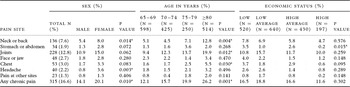
The sample consisted of 52.5% male and had a mean age of 75.0 (SD 9.2) years. Chronic pain was reported by 315 subjects (16.6%). The most common chronic pain conditions were joint pain (12.8%), neck or back pain (7.6%) and chest pain (3.0%).
Associations of chronic pain and demographic variables
Table 1 shows the association of chronic pain conditions with age, sex and economic status. Females reported more pain conditions than males (20.1% and 14.1% respectively; p = 0.01) Headache and neck or back pain were significantly more common in women than men (p = 0.003 and 0.014 respectively).
Prevalence of chronic pain and association with sex, age and economic status

*Significant at 0.05 level.
Increasing age was associated with increasing pain prevalence with the trend being significant for neck or back pain, joint pain, chest pain as well as the presence of pain in any anatomical site. In general, respondents in the oldest age group (≥80 years) had higher rates of pain at all the different anatomic sites except for stomach or abdominal pain.
Even though the prevalence of pain was lower in respondents from the highest economic groups, the trend was only significant for stomach or abdominal pain (p = 0.015).
Pain and depression
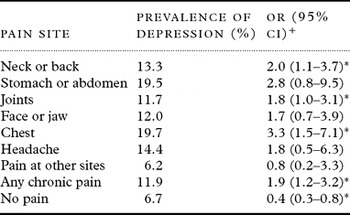
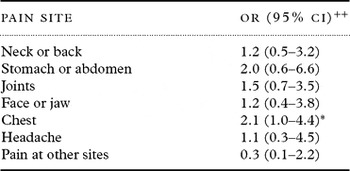
The 12-month prevalence estimate for major depressive disorder in those reporting a chronic pain condition was 11.9% whereas it was 7.1% for the entire sample and 6.7% in those with no pain. In logistic regression analyses, adjusting for age and sex, there was a two-fold increased likelihood of comorbid depression in persons with joint pain and neck or back pain and a three-fold increased likelihood among those with chest pain (Table 2). When the presence of other pain conditions was taken into consideration in the analysis, only chest pain remained significantly associated with major depression (Table 3).
Association of 12-month major depressive disorder with persistent pain (controlling for age and sex)

OR = Odds ratio; CI = Confidence Interval.
*Significant.
+Values adjusted for age and sex.
Association of 12-month major depressive disorder with persistent pain (controlling for age, sex, other pain conditions)

OR = Odds ratio; CI = Confidence Interval.
*Significant.
++ Values adjusted for age, sex and other pain conditions.
To assess whether the presence of disability mediates the association between pain and depression, multivariate analyses were carried out that controlled for the occurrence of ADL and IADL disability. The risk for depression among individuals with any chronic pain remained unchanged when controls were introduced for both ADL (OR (95% CI) 1.8 (1.1–3.0)) and IADL (OR (95% CI) 1.9 (1.1–3.1)) disability.
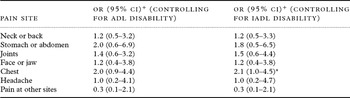
As shown in Table 4, while the presence of ADL disability slightly attenuated the relationship of chest pain to depression, the risk remains unchanged when the presence of IADL disability was taken into consideration.
Association of 12-month major depressive disorder with persistent pain at different anatomic sites

ADL = Activities of daily living; IADL = Instrumental activities of daily living.
OR = Odds ratio; CI = Confidence Interval.
*Significant.
+Values adjusted for age, sex and other pain conditions.
Discussion
To our knowledge, this is the first large-scale study to consider the prevalence and correlates of pain in a representative sample of community-dwelling elderly persons in Sub-Saharan Africa. Close to one in five elderly persons reported pain that was persistent for at least six months and interfered with their daily activities. The demographic profile of respondents who are more likely to experience chronic pain include being female, older age and being socioeconomically disadvantaged.
Comparison of chronic pain prevalence across studies is somewhat difficult as different studies have used different definitions for chronic pain. However, our results are comparable to those from studies which incorporated interference with daily activities into their definition of pain. For example, Reyes-Gibby et al. (Reference Reyes-Gibby, Aday and Cleeland2002), in a population-based survey of the elderly in the U.S.A., reported a prevalence of 20% for pain resulting in significant activity limitation lasting up to 12 months; and Mossey and Gallagher (Reference Mossey and Gallagher2004), in a longitudinal study of residents in a continuing care retirement community, reported chronic activity limiting pain in 37% of the population who reported pain at three or more assessments six months apart.
In keeping with many studies from both general adult (Gureje et al., Reference Gureje, Von Korff, Simon and Gater1998; Tsang et al., Reference Tsang2008) and elderly populations (Brochet et al., Reference Brochet, Michel, Barberger-Gateau and Dartigues1998; Reyes-Gibby et al., Reference Reyes-Gibby, Aday and Cleeland2002; Chou, Reference Chou2007), persistent pain was more often reported by females in this sample. The reason for this increased burden of pain in females is unknown. Only a few studies have attempted to explain the reasons for this gender difference in the experience of pain. Brotchet et al. (Reference Brochet, Michel, Barberger-Gateau and Dartigues1998) in their study attributed the gender difference to the difference in the type of pain experienced by men and women. In their study, women more often experienced persistent pain while men tend more frequently to report episodic pain. There is a possibility that this could be a factor in this study as our definition of pain focused on persistent pain hence there might be the possibility that more men with pain were screened out. Other authors have suggested that the higher prevalence of pain in females might be due to greater sensitization to pain and its reporting possibly arising from hormonal and/or psychosocial factors specific to the female gender (Breivik et al., Reference Breivik, Collett, Ventafridda, Cohen and Gallacher2006). The etiological basis for the increased prevalence of pain in women warrants further investigation.
Most epidemiologic studies of pain complaints in the community have found that pain peaks in middle age and declines thereafter (Gallagher et al., Reference Gallagher, Verma and Mossey2000; Thomas et al., Reference Thomas, Peat, Harris, Wilkie and Croft2004). However, the prevalence of persistent pain, joint pain and pain interfering with daily activities increases with increasing age (Sternbach, Reference Sternbach1986; Ohayon and Schatzberg, Reference Ohayon and Schatzberg2003; Thomas et al., Reference Thomas, Mottram, Peat, Wilkie and Croft2007). This age-related increase in the occurrence of persistent activity-limiting pain was also demonstrated in this population of elderly persons from a developing country; this was more pronounced for joint and chest pain where there was a stepwise increase in the reporting of pain with increasing age. Given the effect that joint pain may have on mobility and the central role of mobility to full functional independence, our observation raises the possibility of the likelihood of increased disability related to joint pains in the elderly. In the context of the projected increase in the growth of elderly populations in developing nations, this observation has serious public health implications. Facilities and resources to cater for the health needs of the elderly are not widely available in most low-income nations. In addition, the burden of care for elderly people in Nigeria currently falls on family members. With the rapid rate of urbanization and migration resulting from the social and economic changes being witnessed in many African societies, it will become increasingly difficult for elderly people requiring assistance in daily activities to find family members who are able or willing to provide such care. As shown by an earlier report from the Ibadan Study of Ageing, up to 19% of elderly persons with disability requiring assistance were unable to access such help (Gureje et al., Reference Gureje, Ogunniyi, Kola and Afolabi2006).
Consistent with many previous studies on pain and depression, there was an increased risk of depression amongst individuals with chronic pain. Interestingly, chest pain stood out as being a significant predictor for major depression in this study even after adjusting for the co-occurrence of pain at other sites. Blay et al. (Reference Blay, Andreoli, Dewey and Gastal2007), in a survey of community-dwelling elderly persons in Brazil, found chest, head and joint pains to be a significant predictor of psychiatric morbidity. This differential risk for depression amongst individuals with chest pain is difficult to explain. However, different locations of pain refer to different bodily systems with different impact on the individual's everyday functioning and their interpretation of the significance of the pain. The occurrence of chest pain might also be an indicator of underlying cardiac, respiratory or other physiological dysfunction. For example, studies have shown that up to 20% of coronary heart disease patient develop depression (Rybakowski, Reference Rybakowski2003). Unfortunately, our study is not designed to explore possible etiological factors for these pains. This association of chest pain to depression and the possible role of underlying physical dysfunction might be worth exploring in future studies
In general, the presence of disability had no major impact on the relationship between chronic pain and depression. However, when considering association of depression to different pain sites, while performance on IADL did not alter the strength of the association between chest pain and depression, that on ADL attenuated the relationship but not to a large extent. It is not surprising that the effect of ADL is more pronounced that than of IADL given that disability in ADLs constitutes a more severe form of disability than that in IADL. Our findings support those of earlier studies that have demonstrated that functional disability is not a mediating factor in the pain-depression relationship (Parmelee et al., Reference Parmelee, Katz and Lawton1991; Geerlings et al., Reference Geerlings, Twisk, Beekman, Deeg and van Tilburg2002).
The results of this study need to be interpreted in the context of its limitations. The assessment of pain, disability and depression were based on self-report. However, previous studies have demonstrated the validity of self-report in the assessment of depression, pain and physical disability (Myers et al., Reference Myers, Holliday, Harvey and Hutchinson1993). In addition to this, interference with daily function was incorporated in our definition of pain, which might have affected our analysis of the role of disability in the association between pain and depression. Another limitation is the cross-sectional nature of the data presented here, which does not permit any inference about direction of causality. While we have demonstrated associations between pain and depression, we cannot aver that one causes the other. Nevertheless, the results presented here are of value in considering the import of the well-known relationship between pain and depression. At least in the elderly, our findings suggest that in considering this relationship, due attention should always be given to the anatomical sites of pain.
Conflict of interest
None.
Description of authors’ roles
O. Gureje designed the study and supervised data collection. B. Oladeji and O. Gureje interpreted the data and wrote the first draft. V. Makanjuola and O. Esan assisted in reviewing the paper. All authors approved the final draft for submission.
Acknowledgments
Funding for The Ibadan study of Ageing was provided by The Wellcome Trust. The Wellcome Trust was not involved in the design, methods, subject recruitment, data collection, analysis or preparation of this paper.